





Improving Cash Flow
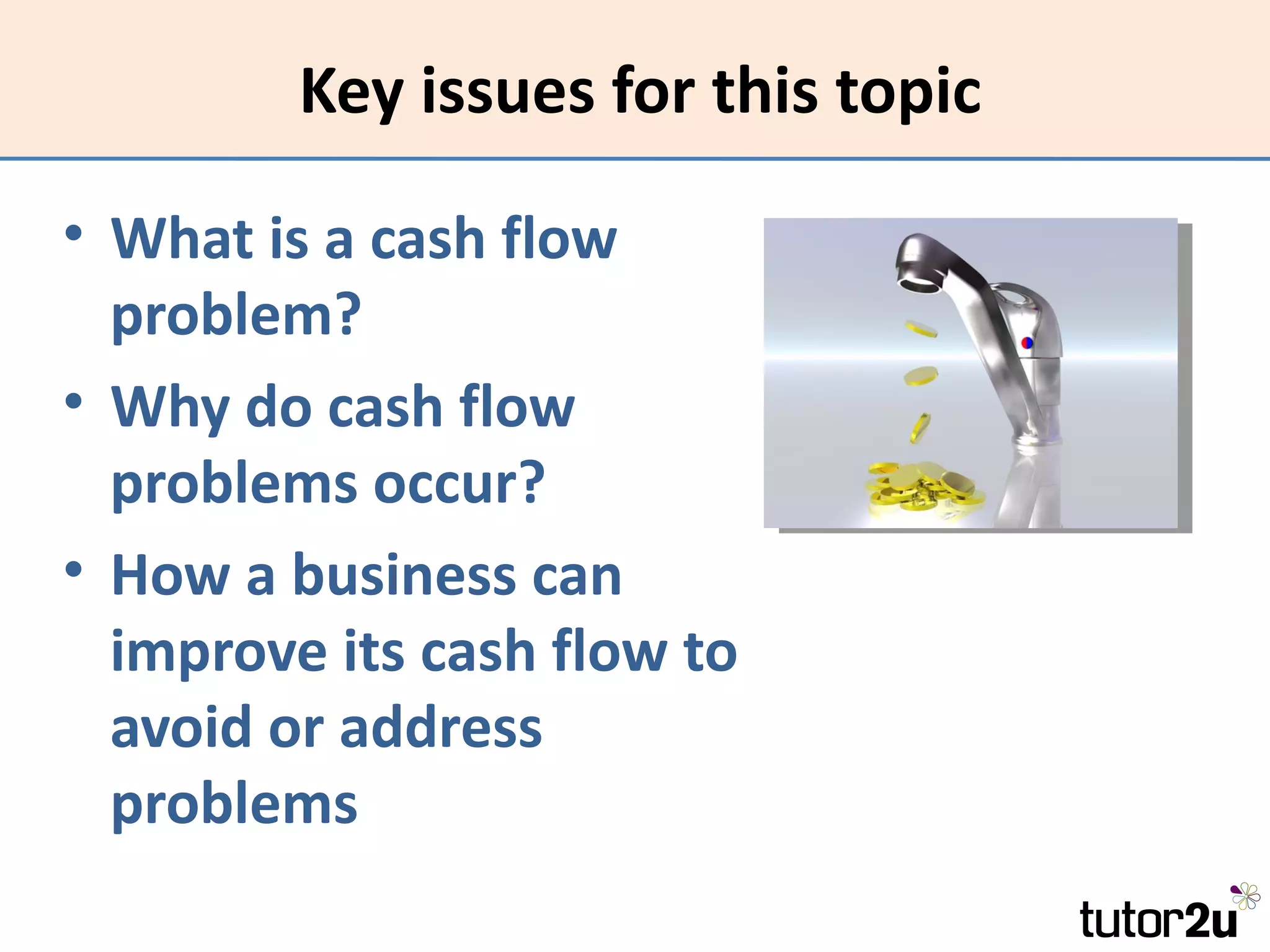
Key issues for this topic

• What is a cash flow
  problem?
• Why do cash flow
  problems occur?
• How a business can
  improve its cash flow to
  avoid or address
  problems
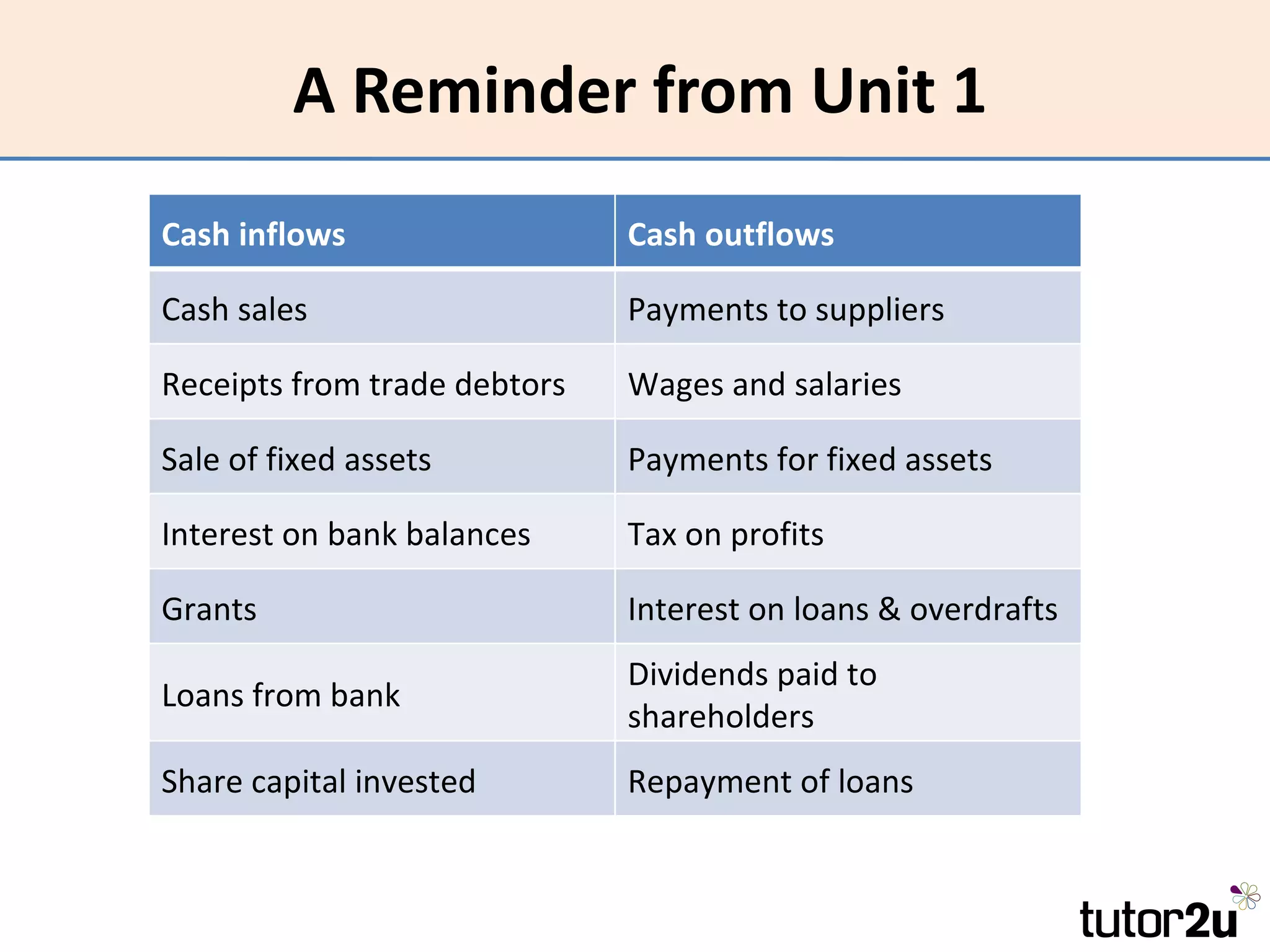
A Reminder from Unit 1
Cash inflows                  Cash outflows

Cash sales                    Payments to suppliers

Receipts from trade debtors   Wages and salaries

Sale of fixed assets          Payments for fixed assets

Interest on bank balances     Tax on profits

Grants                        Interest on loans & overdrafts
                              Dividends paid to
Loans from bank
                              shareholders
Share capital invested        Repayment of loans
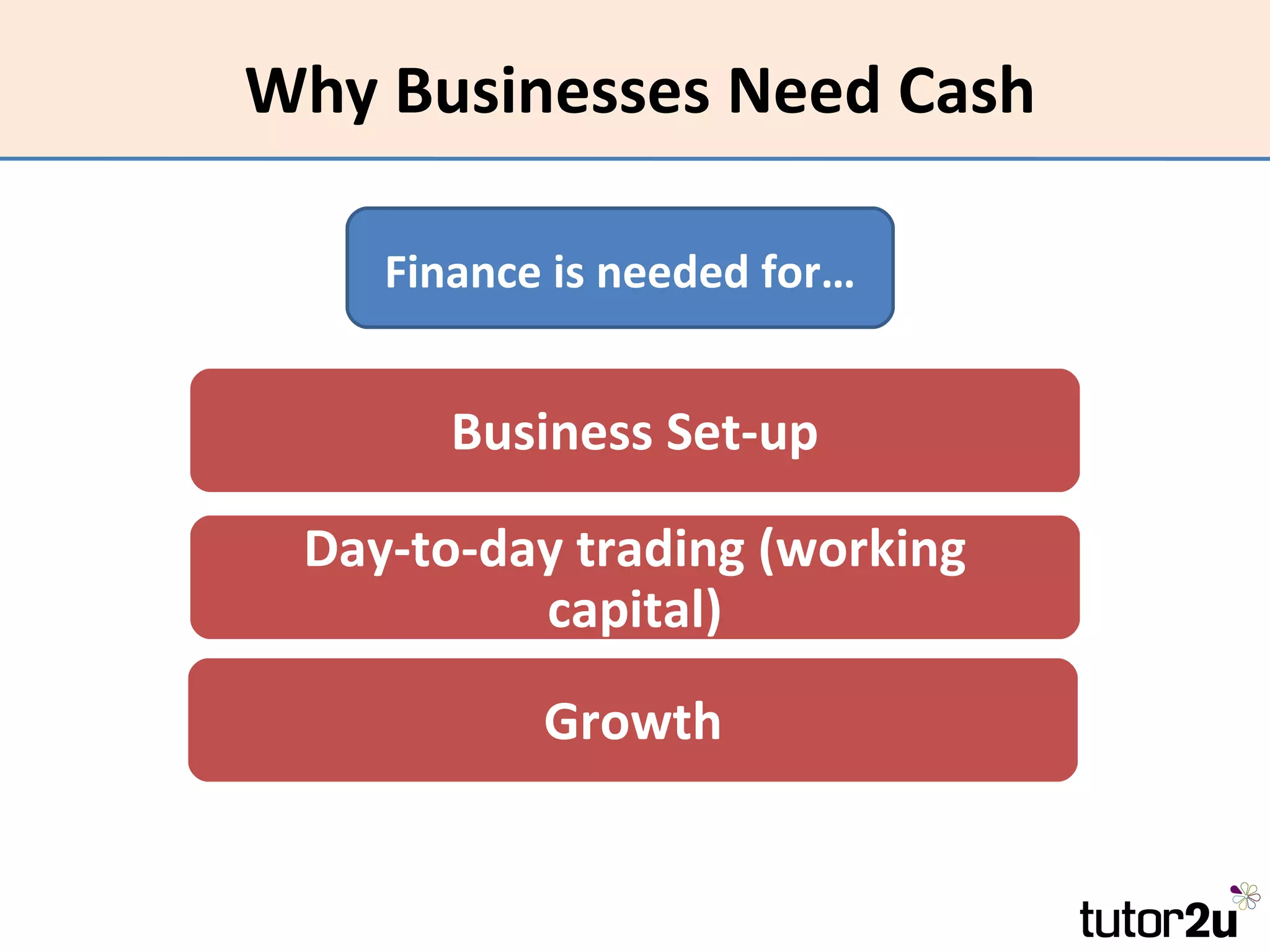
Why Businesses Need Cash

    Finance is needed for…


       Business Set-up

 Day-to-day trading (working
          capital)
           Growth
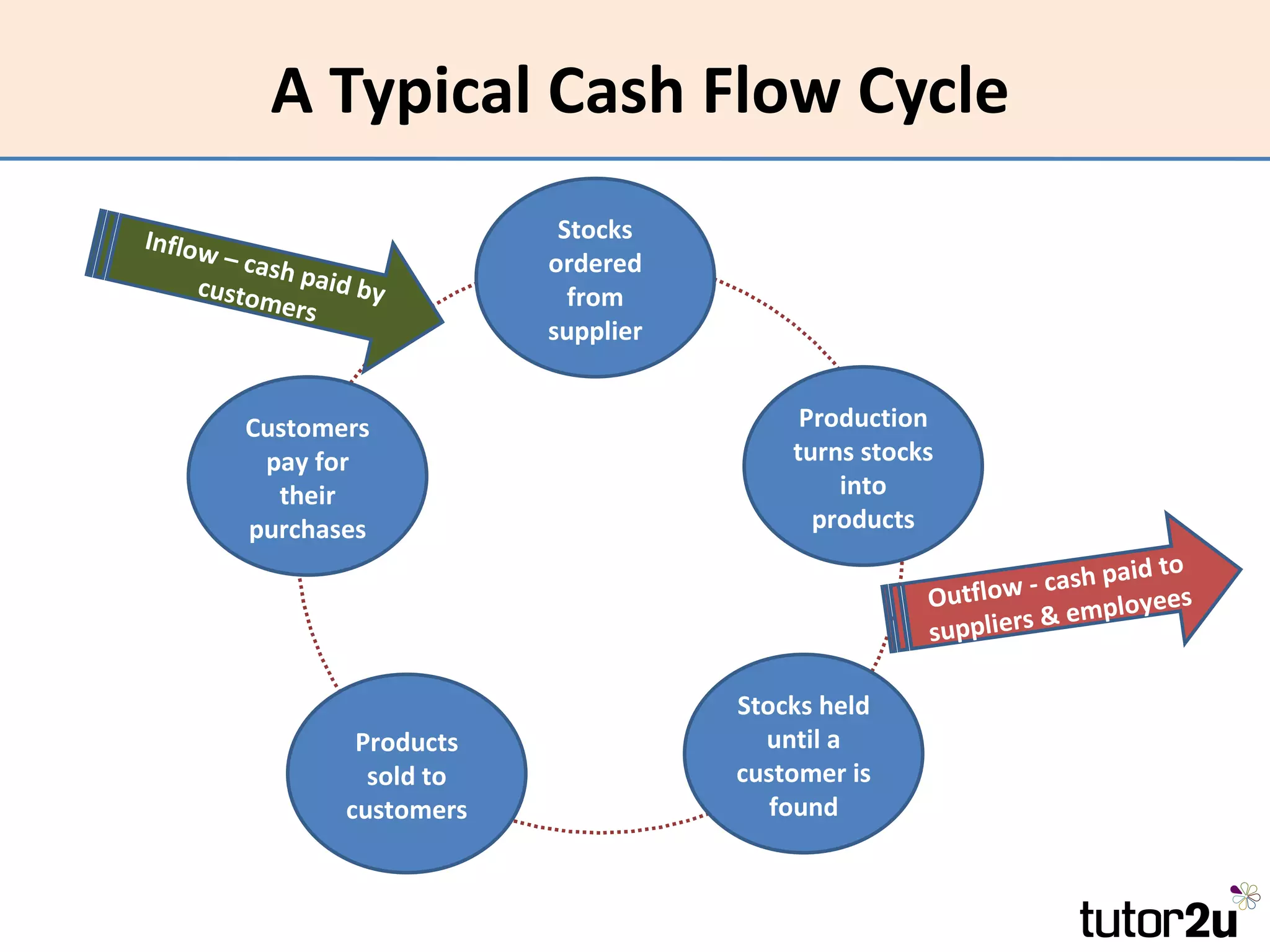
A Typical Cash Flow Cycle
Inflow                       Stocks
      – cas h               ordered
    custom paid by            from
            ers
                            supplier


         Customers                          Production
          pay for                          turns stocks
           their                               into
         purchases                           products
                                                                      paid to
                                                      Outfl ow - cash     ees
                                                                & employ
                                                      suppliers

                                       Stocks held
                 Products                until a
                  sold to              customer is
                customers                 found
The cash flow operating cycle
• It is equal to:
   – The time that goods are in stock
   – plus the time that debtors take to pay
   – minus the period of credit received from suppliers
• The working capital cycle can be shortened by
   – reducing the level of stock - this lowers the number of days
     the stock is held
   – speeding up the rate of debtor collection -the faster
     business collects from its debtors the better
• The shorter the cycle, the lower the value of working
  capital to be financed by other sources
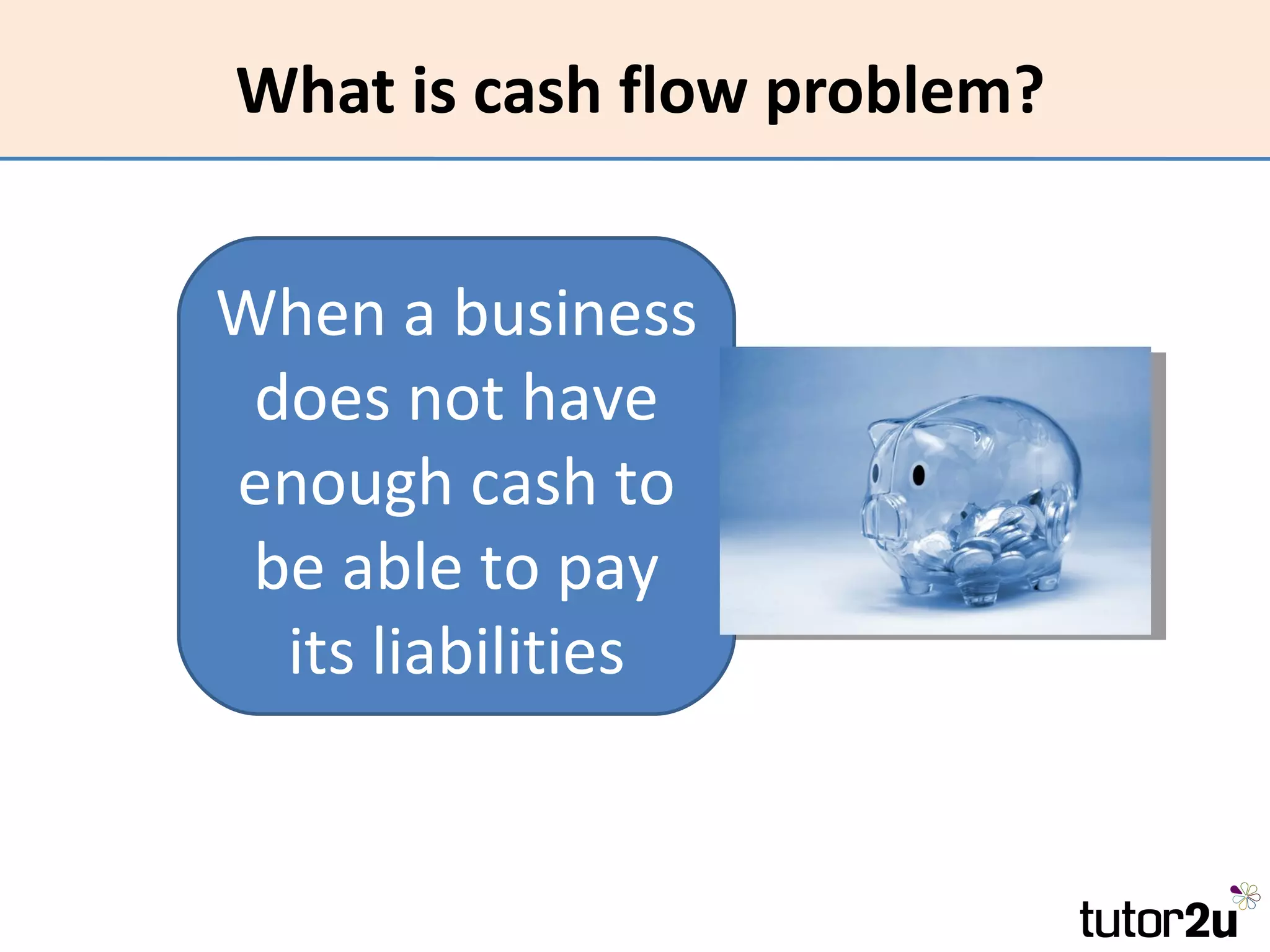
What is cash flow problem?


When a business
 does not have
enough cash to
 be able to pay
  its liabilities
Main Causes of Cash Flow Problems

•   Low profits or (worse) losses
•   Over-investment in capacity
•   Too much stock
•   Allowing customers too much credit
•   Overtrading
•   Unexpected changes
•   Seasonal demand
Profit = most important source of cash
• The profit a business makes
  from trading is the most
  important source of cash
• There is a direct link
  between low profits or
  losses and cash flow
  problems
• Most loss-making businesses
  eventually run out of cash
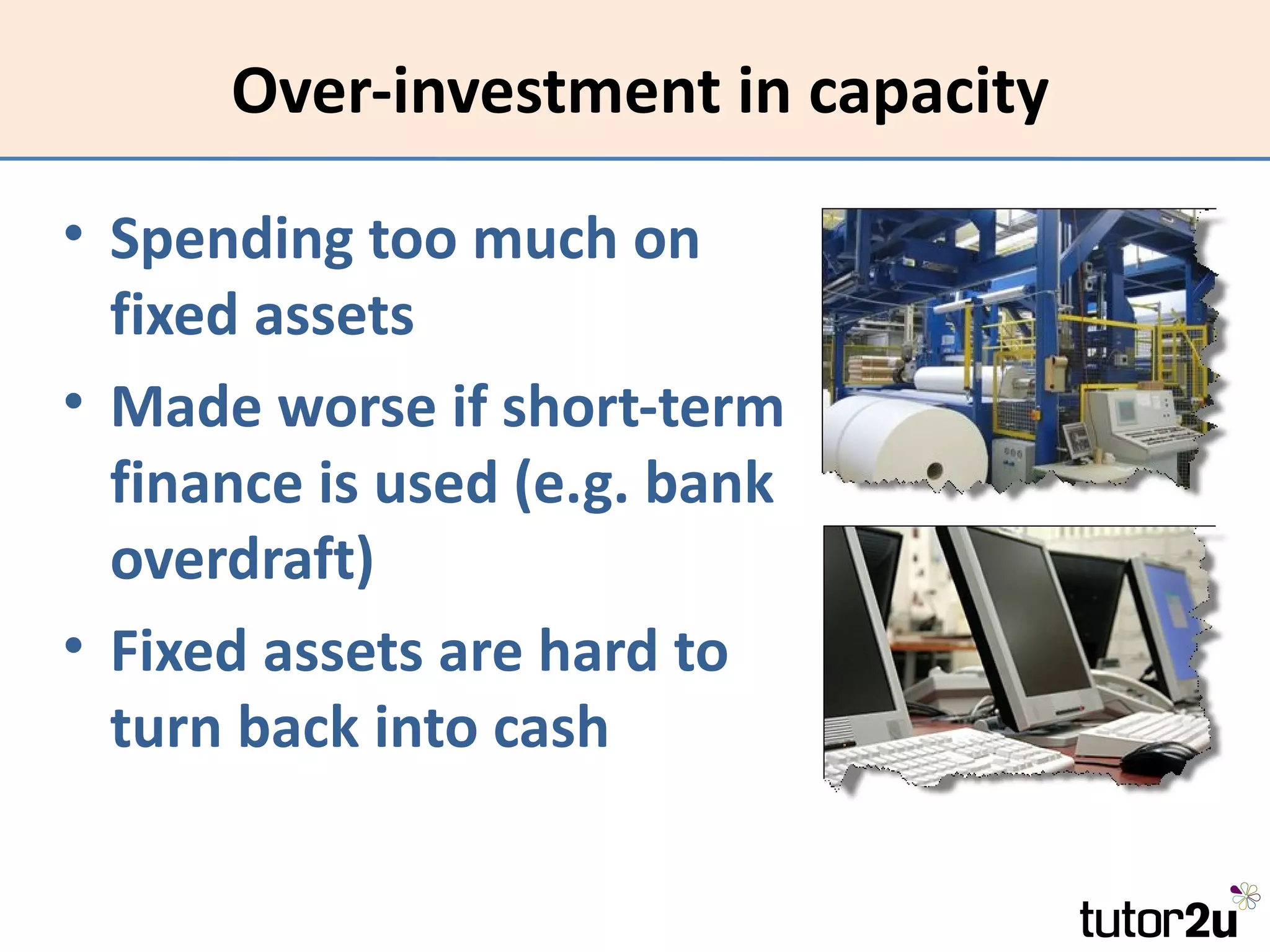
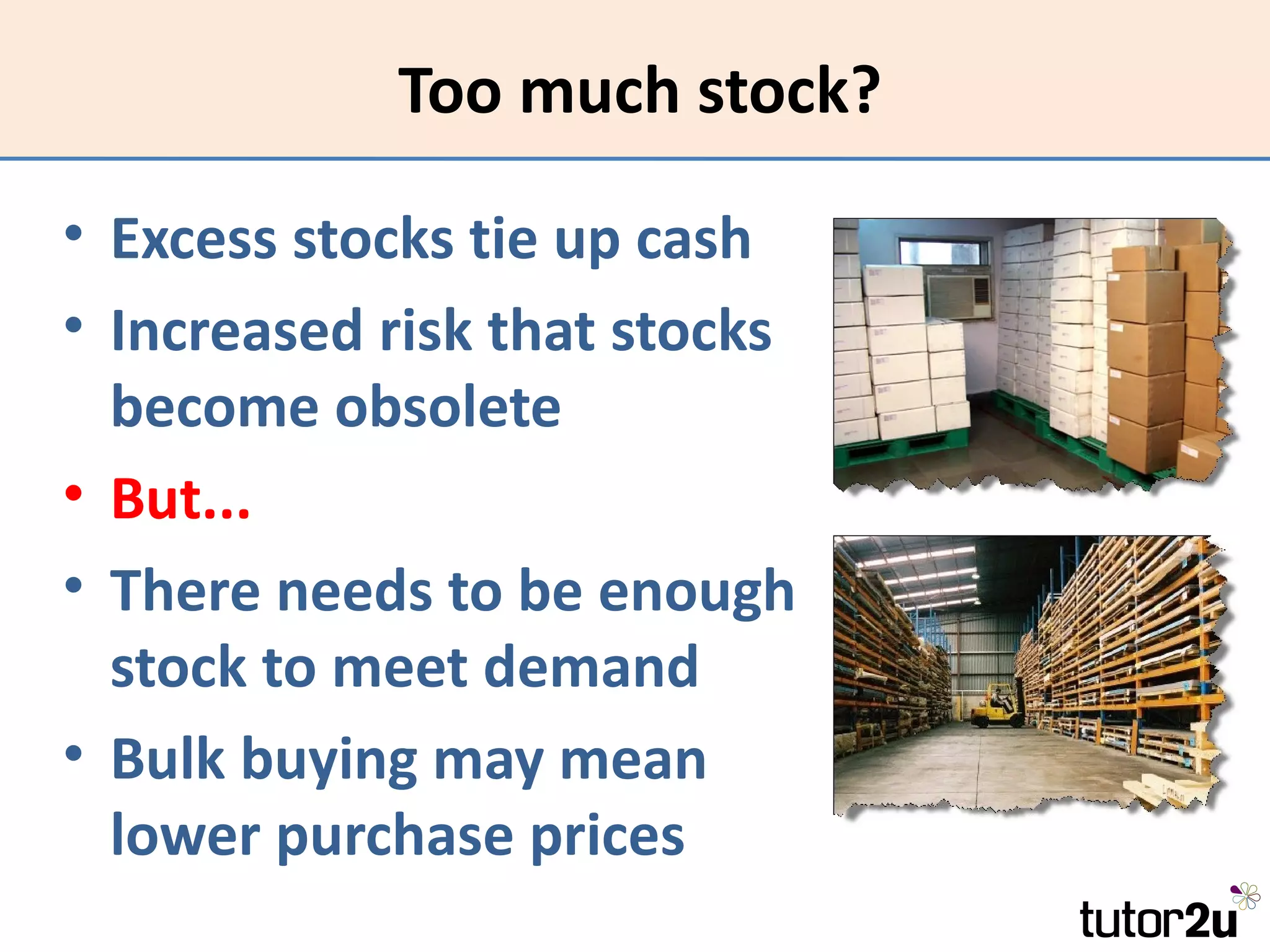
Over-investment in capacity

• Spending too much on
  fixed assets
• Made worse if short-term
  finance is used (e.g. bank
  overdraft)
• Fixed assets are hard to
  turn back into cash
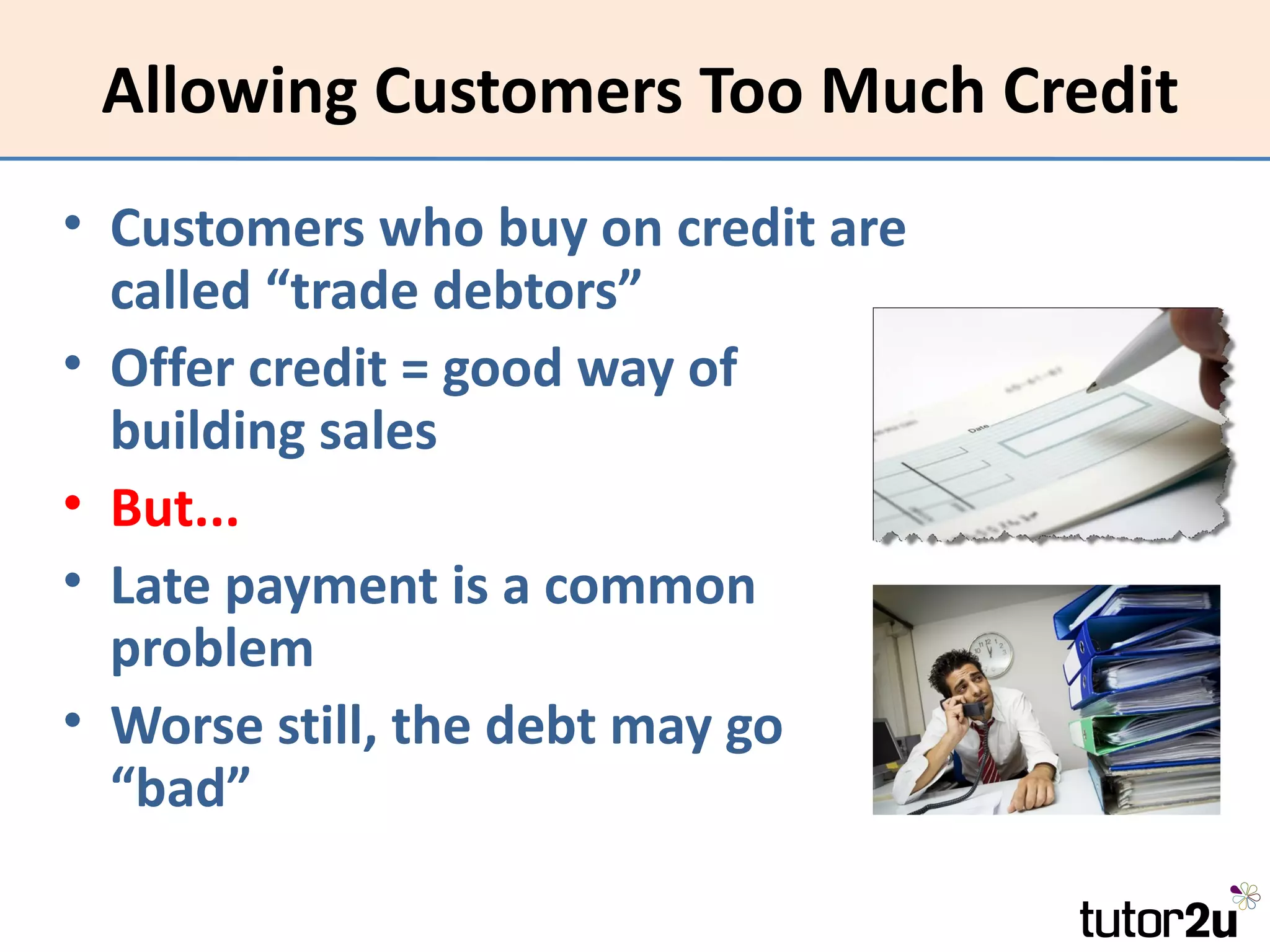
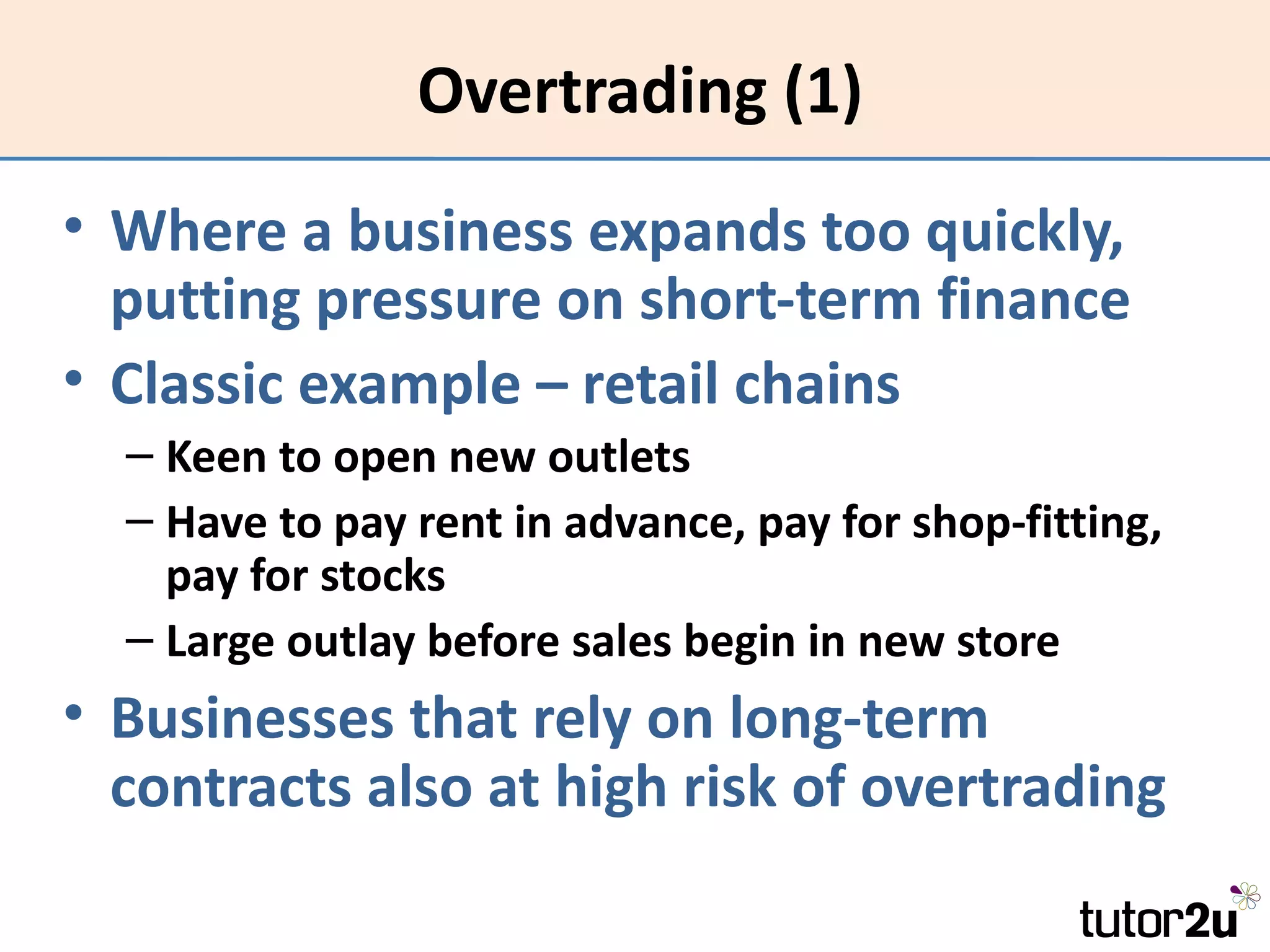
Too much stock?

• Excess stocks tie up cash
• Increased risk that stocks
  become obsolete
• But...
• There needs to be enough
  stock to meet demand
• Bulk buying may mean
  lower purchase prices
Allowing Customers Too Much Credit
• Customers who buy on credit are
  called “trade debtors”
• Offer credit = good way of
  building sales
• But...
• Late payment is a common
  problem
• Worse still, the debt may go
  “bad”
Overtrading (1)
• Where a business expands too quickly,
  putting pressure on short-term finance
• Classic example – retail chains
  – Keen to open new outlets
  – Have to pay rent in advance, pay for shop-fitting,
    pay for stocks
  – Large outlay before sales begin in new store
• Businesses that rely on long-term
  contracts also at high risk of overtrading
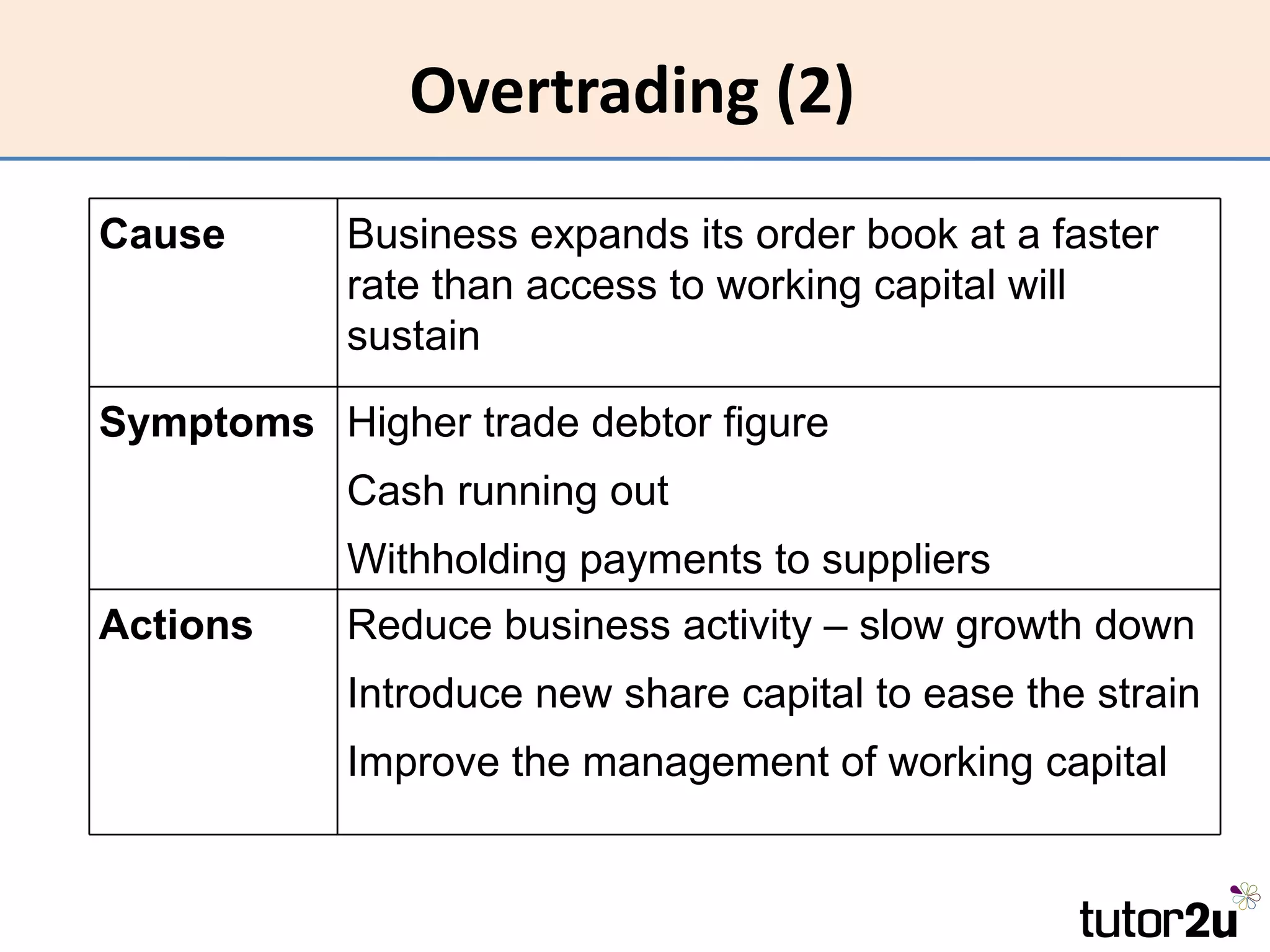
Overtrading (2)
Cause      Business expands its order book at a faster
           rate than access to working capital will
           sustain

Symptoms Higher trade debtor figure
           Cash running out
           Withholding payments to suppliers
Actions    Reduce business activity – slow growth down
           Introduce new share capital to ease the strain
           Improve the management of working capital
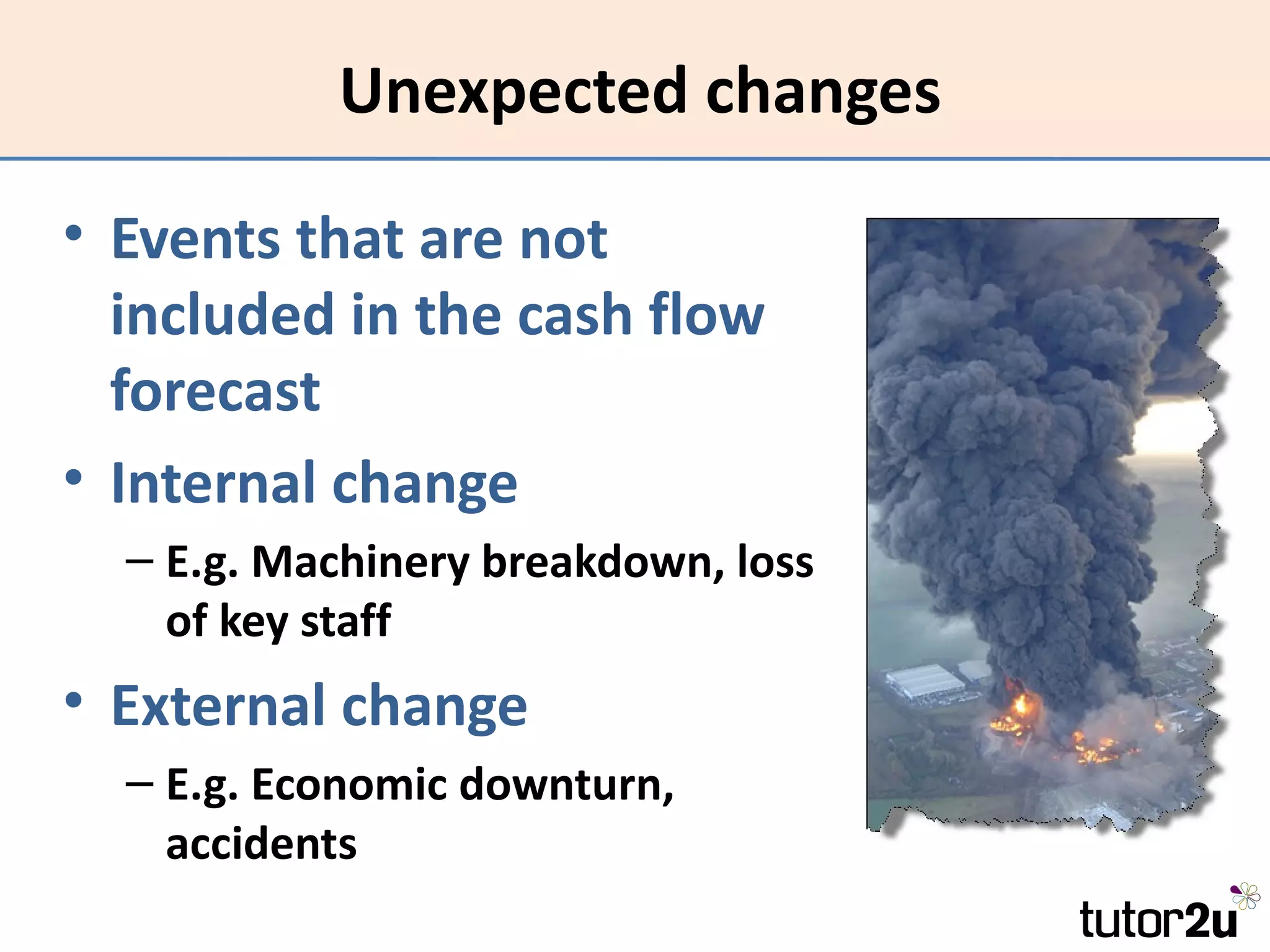
Unexpected changes

• Events that are not
  included in the cash flow
  forecast
• Internal change
  – E.g. Machinery breakdown, loss
    of key staff
• External change
  – E.g. Economic downturn,
    accidents
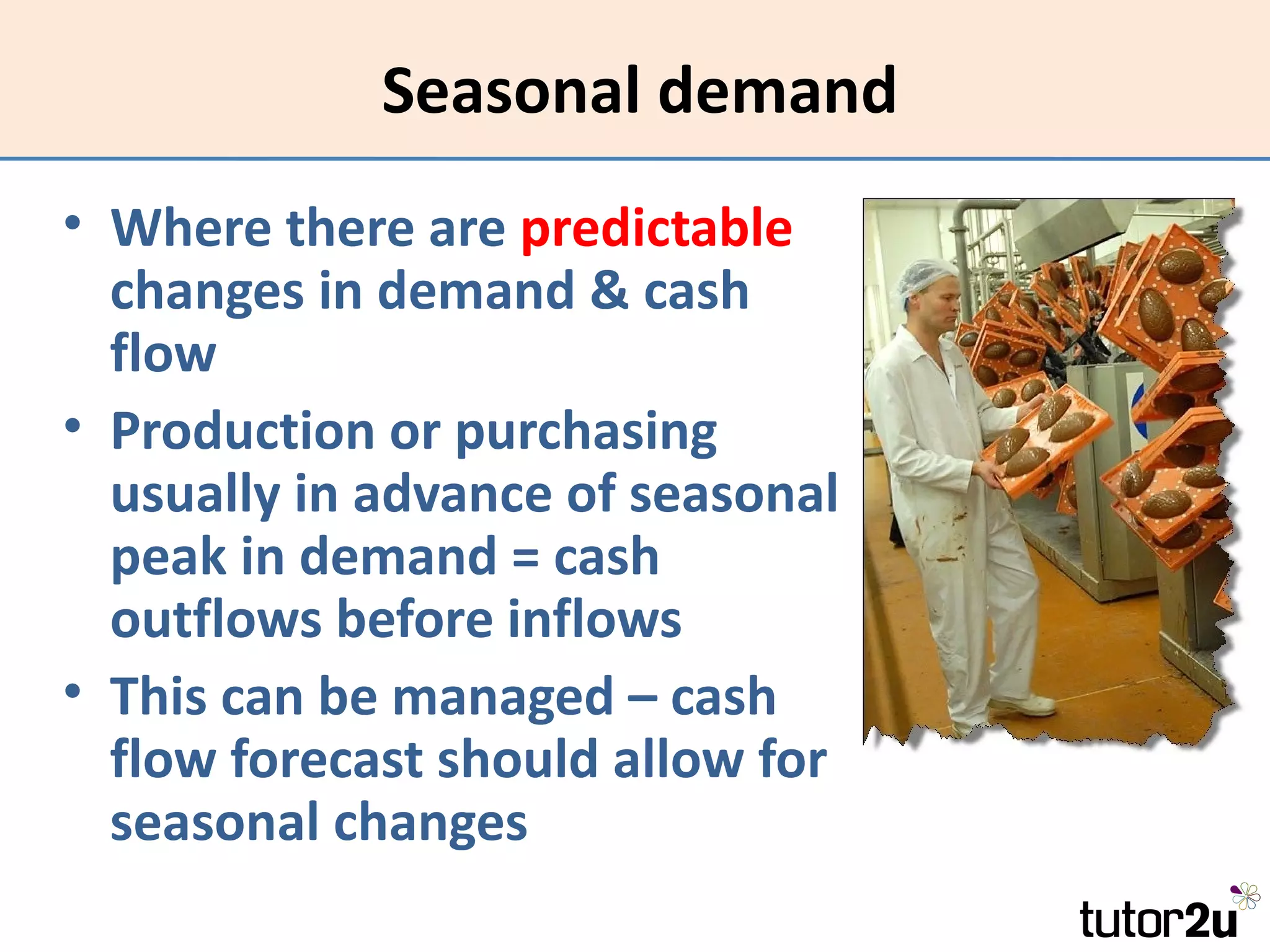
Seasonal demand
• Where there are predictable
  changes in demand & cash
  flow
• Production or purchasing
  usually in advance of seasonal
  peak in demand = cash
  outflows before inflows
• This can be managed – cash
  flow forecast should allow for
  seasonal changes
Handling
Cash Flow
Problems
How to Handle Cash Flow Problems

• Have a good cash flow forecast
• Manage working capital effectively
• Choose the right sources of finance
  – Bank overdraft v bank loan
  – Factoring
  – Sale and leaseback
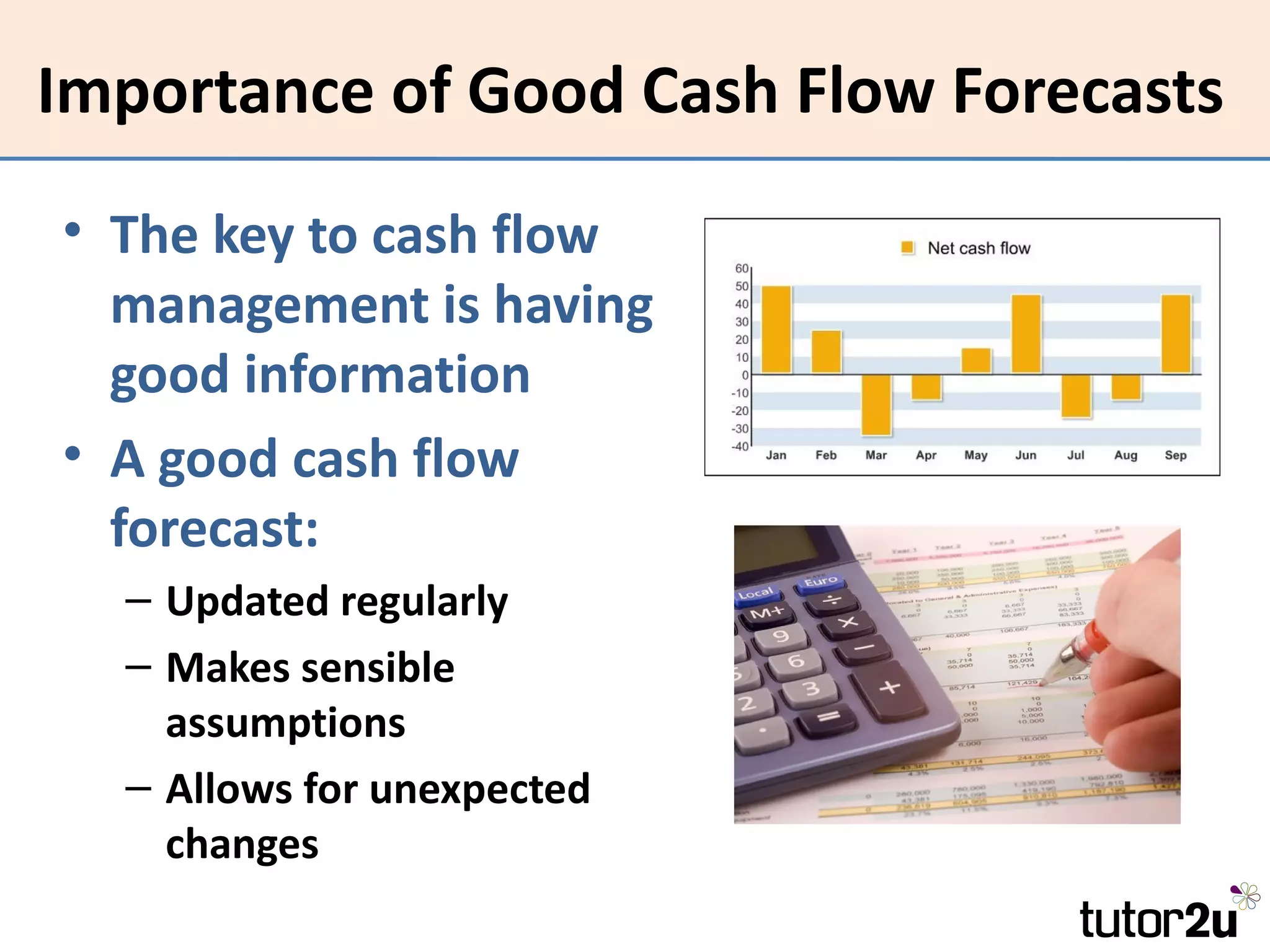
Importance of Good Cash Flow Forecasts
• The key to cash flow
  management is having
  good information
• A good cash flow
  forecast:
  – Updated regularly
  – Makes sensible
    assumptions
  – Allows for unexpected
    changes
Managing Working Capital
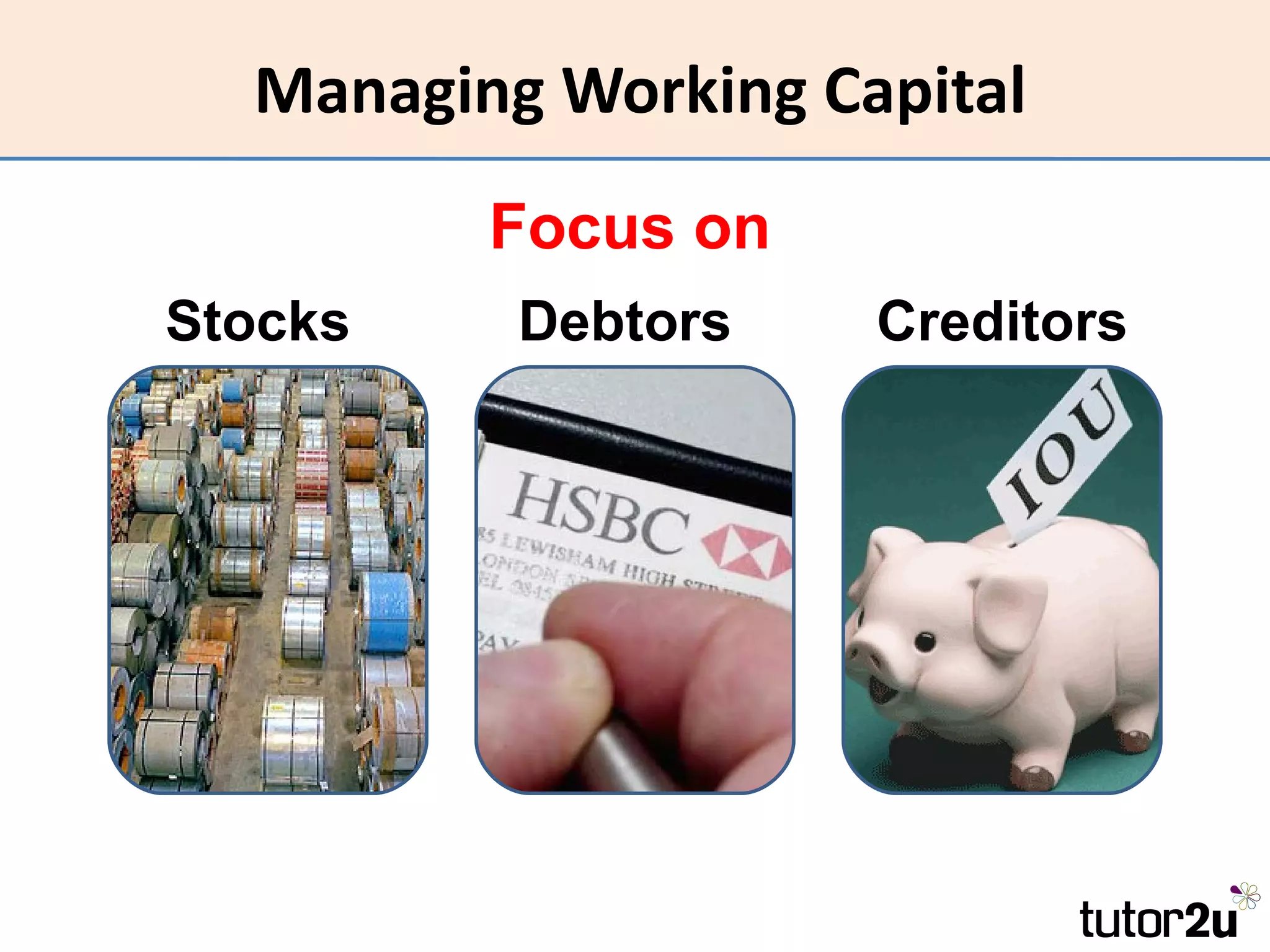
         Focus on
Stocks    Debtors    Creditors
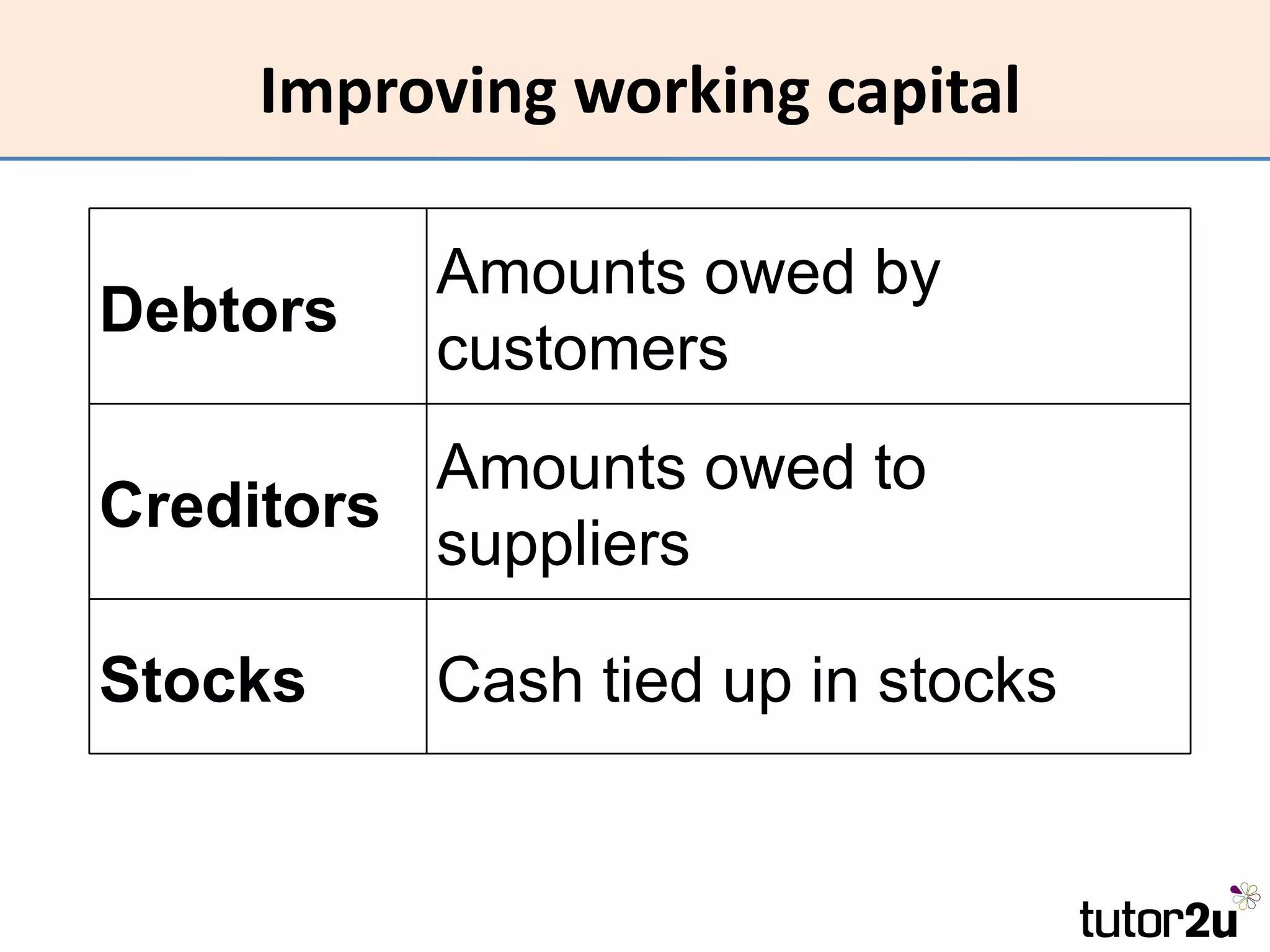
Improving working capital

          Amounts owed by
Debtors
          customers
          Amounts owed to
Creditors
          suppliers

Stocks    Cash tied up in stocks
What is working capital?

• Working capital is the cash needed to pay
  for the day to day trading of the business
• Often, suppliers and employees have to
  be paid before customer pay for their
  goods
Why working capital is important
• Working capital “oils the wheels” of
  business
• Businesses use cash to finance stocks
  through the production process
• It facilitates the smooth flow of
  production and the supply of goods to
  customers
• In financing debtors, it enables the
  business to offer credit to customers
Working capital needed depends on

•   Planned production volumes
•   Forecast cost per unit
•   The length of the production cycle
•   Credit terms allowed to customers
•   Credit terms received from suppliers
A lack of working capital means…

• Harder to buy in bulk and benefit from
  discounts
• Difficulties in offering credit to customer
  with the danger of losing sales
• Loss of reputation with suppliers if there
  are difficulties in settling debts
• Harder to respond to opportunities
• Increased danger of overtrading
Dealing with working capital shortages
•   Discount prices
•   Reduce purchases
•   Negotiate more credit from suppliers
•   Delay the payment of bills (but not for too long)
•   Credit control - chase trade debtors (customers
    who haven’t paid)
•   Negotiate a bank overdraft
•   Debt factoring
•   Sell assets
•   Sale and leaseback
Managing debtors better
• Credit control
  • Policies on how much credit to give and repayment
    terms and conditions
  • Measures to control doubtful debtors
  • Credit checking
• Selling off debts to debt factors
• Cash discounts for prompt payment
• Improved record keeping – e.g. accurate
  and timely invoicing
Debt factoring

• The selling of debtors (money owned to
  the business) to a third party
• This generates cash
• It guarantees the firm a percentage of
  money owed to it
• But will reduce income and profit margin
  made on sales
• Cost involved in factoring can be high
What is credit control?
• Establishing credit limits for new customers
• Credit checking new and existing customers
• Setting realistic credit limits
• Monitoring the age of debts and chasing up
  bad debts
• Determine appropriate terms and conditions
  for credit
• Chasing up debtors will get payment in
  sooner but may upset customers
Trade creditors
• Amounts owed to suppliers for goods supplied
  on credit and not yet paid for
• Delayed payment means that the firm retains
  cash longer
• Have to be careful not to damage firm’s credit
  reputation and rating
• Trade creditors are seen (wrongly) as a “free”
  source of capital
• Some firms habitually delay payment to
  creditors in order to enhance their cash flow - a
  short sighted policy and raises ethical issues
Managing Stocks
• Stock refers to goods purchased and awaiting
  use or produced and awaiting sale
• Stocks take the form of raw materials, work-
  in-progress and finished goods
• Stockholding is costly and therefore it is
  sound business to:
  – keep smaller balances (just in time stocks)
  – computerise ordering to improve efficiency
  – improve stock control
• This will cut down the spending on stock but
  may leave the firm vulnerable to stock out
Cash management
• Always necessary to hold some cash for
  transactions, precautionary reasons and for
  speculative purposes (awaiting a business
  opportunity)
• Cash management involves the construction
  of a cash budget
• Cash flows should be monitored
• Excess cash should be profitably invested
• Provision of overdraft facilities should be
  negotiated in case of cash shortage
Improving the cash position

• Short term
  – Reduce current assets (stock and debtors)
  – Increase current liabilities (delaying payment)
  – Sell surplus fixed assets
• Long term
  – Increase equity finance
  – Increase long term liabilities
  – Reduce net outflow on fixed assets
Should selling prices be discounted?
• Price discounting is designed to improve the
  cash flow into the business
• It generates cash through increased sales
• Also reduces stock levels
But
• It may undermine the firm’s pricing structure
• It may leave the firm with low stocks
• Its success does depend on price elasticity of
  demand
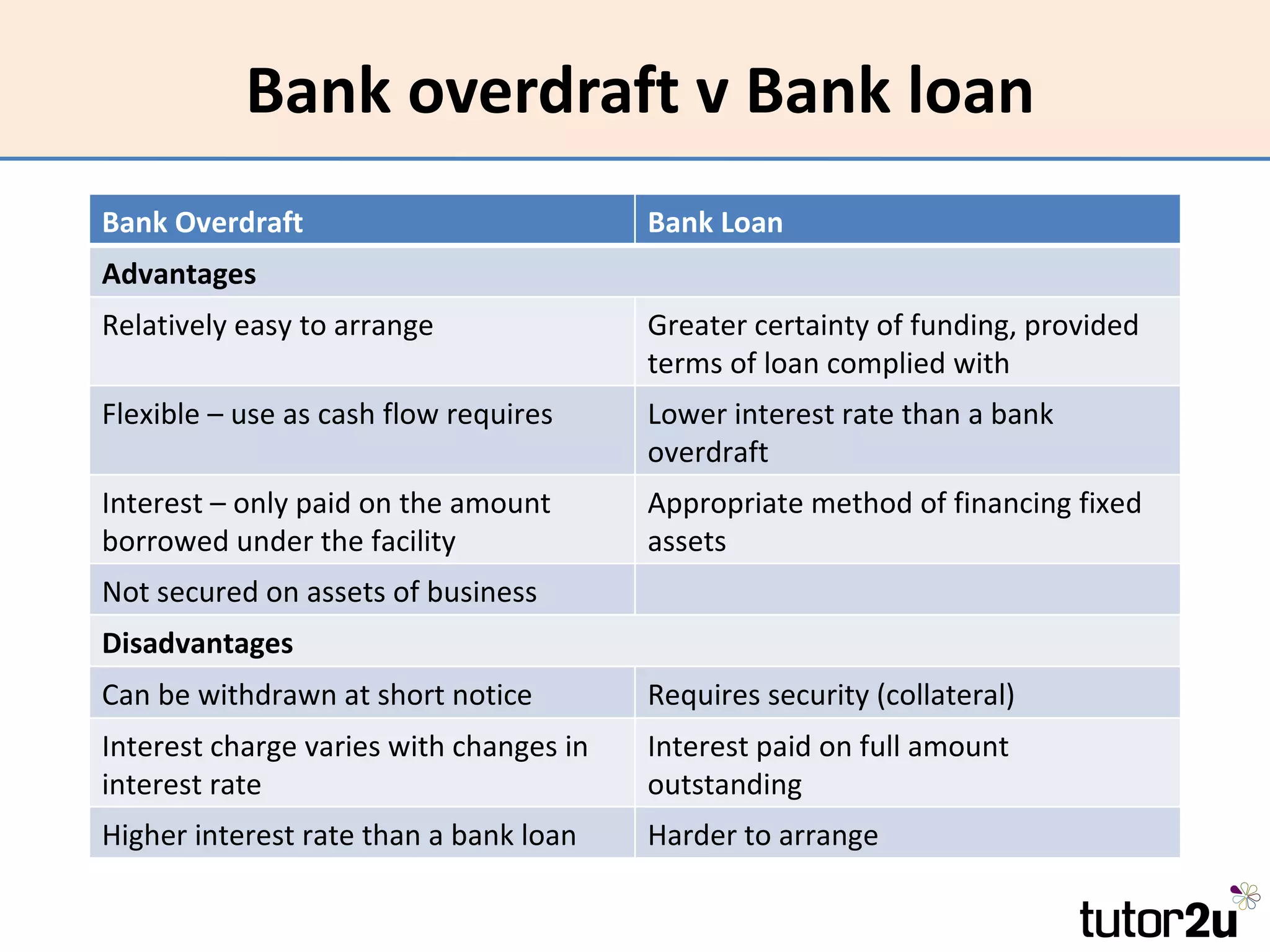
Bank overdraft v Bank loan

• Banks are the traditional “port of call” for
  businesses with cash flow problems
• However, the Credit Crunch has made
  banks much more wary of lending to
  troubled businesses
• Assuming this finance is available, which
  one should a business go for?
Bank overdraft v Bank loan
Bank Overdraft                           Bank Loan
Advantages
Relatively easy to arrange               Greater certainty of funding, provided
                                         terms of loan complied with
Flexible – use as cash flow requires     Lower interest rate than a bank
                                         overdraft
Interest – only paid on the amount       Appropriate method of financing fixed
borrowed under the facility              assets
Not secured on assets of business
Disadvantages
Can be withdrawn at short notice         Requires security (collateral)
Interest charge varies with changes in   Interest paid on full amount
interest rate                            outstanding
Higher interest rate than a bank loan    Harder to arrange
Sale of assets

• Selling spare or surplus
  assets is a way to achieve a
  short-term boost to cash
  flow
• Good examples: spare land,
  surplus equipment
• Note – not all businesses
  have spare assets
Sale and Leaseback

• Specialist method of raising cash
• Involves selling fixed assets and then
  leasing them back from new owner
• Tends to involve business properties (e.g.
  Hotels, supermarkets, offices – popular
  when property market was booming
• Note: can only be done once!
Test Your Understanding


http://www.tutor2u.net/business/quiz/improvingcashflow/quiz.html
Improving Cash Flow

Finance - Improving Cash Flow

  • 1.
  • 2.
    Key issues forthis topic • What is a cash flow problem? • Why do cash flow problems occur? • How a business can improve its cash flow to avoid or address problems
  • 3.
    A Reminder fromUnit 1 Cash inflows Cash outflows Cash sales Payments to suppliers Receipts from trade debtors Wages and salaries Sale of fixed assets Payments for fixed assets Interest on bank balances Tax on profits Grants Interest on loans & overdrafts Dividends paid to Loans from bank shareholders Share capital invested Repayment of loans
  • 4.
    Why Businesses NeedCash Finance is needed for… Business Set-up Day-to-day trading (working capital) Growth
  • 5.
    A Typical CashFlow Cycle Inflow Stocks – cas h ordered custom paid by from ers supplier Customers Production pay for turns stocks their into purchases products paid to Outfl ow - cash ees & employ suppliers Stocks held Products until a sold to customer is customers found
  • 6.
    The cash flowoperating cycle • It is equal to: – The time that goods are in stock – plus the time that debtors take to pay – minus the period of credit received from suppliers • The working capital cycle can be shortened by – reducing the level of stock - this lowers the number of days the stock is held – speeding up the rate of debtor collection -the faster business collects from its debtors the better • The shorter the cycle, the lower the value of working capital to be financed by other sources
  • 7.
    What is cashflow problem? When a business does not have enough cash to be able to pay its liabilities
  • 8.
    Main Causes ofCash Flow Problems • Low profits or (worse) losses • Over-investment in capacity • Too much stock • Allowing customers too much credit • Overtrading • Unexpected changes • Seasonal demand
  • 9.
    Profit = mostimportant source of cash • The profit a business makes from trading is the most important source of cash • There is a direct link between low profits or losses and cash flow problems • Most loss-making businesses eventually run out of cash
  • 10.
    Over-investment in capacity •Spending too much on fixed assets • Made worse if short-term finance is used (e.g. bank overdraft) • Fixed assets are hard to turn back into cash
  • 11.
    Too much stock? •Excess stocks tie up cash • Increased risk that stocks become obsolete • But... • There needs to be enough stock to meet demand • Bulk buying may mean lower purchase prices
  • 12.
    Allowing Customers TooMuch Credit • Customers who buy on credit are called “trade debtors” • Offer credit = good way of building sales • But... • Late payment is a common problem • Worse still, the debt may go “bad”
  • 13.
    Overtrading (1) • Wherea business expands too quickly, putting pressure on short-term finance • Classic example – retail chains – Keen to open new outlets – Have to pay rent in advance, pay for shop-fitting, pay for stocks – Large outlay before sales begin in new store • Businesses that rely on long-term contracts also at high risk of overtrading
  • 14.
    Overtrading (2) Cause Business expands its order book at a faster rate than access to working capital will sustain Symptoms Higher trade debtor figure Cash running out Withholding payments to suppliers Actions Reduce business activity – slow growth down Introduce new share capital to ease the strain Improve the management of working capital
  • 15.
    Unexpected changes • Eventsthat are not included in the cash flow forecast • Internal change – E.g. Machinery breakdown, loss of key staff • External change – E.g. Economic downturn, accidents
  • 16.
    Seasonal demand • Wherethere are predictable changes in demand & cash flow • Production or purchasing usually in advance of seasonal peak in demand = cash outflows before inflows • This can be managed – cash flow forecast should allow for seasonal changes
  • 17.
  • 18.
    How to HandleCash Flow Problems • Have a good cash flow forecast • Manage working capital effectively • Choose the right sources of finance – Bank overdraft v bank loan – Factoring – Sale and leaseback
  • 19.
    Importance of GoodCash Flow Forecasts • The key to cash flow management is having good information • A good cash flow forecast: – Updated regularly – Makes sensible assumptions – Allows for unexpected changes
  • 20.
    Managing Working Capital Focus on Stocks Debtors Creditors
  • 21.
    Improving working capital Amounts owed by Debtors customers Amounts owed to Creditors suppliers Stocks Cash tied up in stocks
  • 22.
    What is workingcapital? • Working capital is the cash needed to pay for the day to day trading of the business • Often, suppliers and employees have to be paid before customer pay for their goods
  • 23.
    Why working capitalis important • Working capital “oils the wheels” of business • Businesses use cash to finance stocks through the production process • It facilitates the smooth flow of production and the supply of goods to customers • In financing debtors, it enables the business to offer credit to customers
  • 24.
    Working capital neededdepends on • Planned production volumes • Forecast cost per unit • The length of the production cycle • Credit terms allowed to customers • Credit terms received from suppliers
  • 25.
    A lack ofworking capital means… • Harder to buy in bulk and benefit from discounts • Difficulties in offering credit to customer with the danger of losing sales • Loss of reputation with suppliers if there are difficulties in settling debts • Harder to respond to opportunities • Increased danger of overtrading
  • 26.
    Dealing with workingcapital shortages • Discount prices • Reduce purchases • Negotiate more credit from suppliers • Delay the payment of bills (but not for too long) • Credit control - chase trade debtors (customers who haven’t paid) • Negotiate a bank overdraft • Debt factoring • Sell assets • Sale and leaseback
  • 27.
    Managing debtors better •Credit control • Policies on how much credit to give and repayment terms and conditions • Measures to control doubtful debtors • Credit checking • Selling off debts to debt factors • Cash discounts for prompt payment • Improved record keeping – e.g. accurate and timely invoicing
  • 28.
    Debt factoring • Theselling of debtors (money owned to the business) to a third party • This generates cash • It guarantees the firm a percentage of money owed to it • But will reduce income and profit margin made on sales • Cost involved in factoring can be high
  • 29.
    What is creditcontrol? • Establishing credit limits for new customers • Credit checking new and existing customers • Setting realistic credit limits • Monitoring the age of debts and chasing up bad debts • Determine appropriate terms and conditions for credit • Chasing up debtors will get payment in sooner but may upset customers
  • 30.
    Trade creditors • Amountsowed to suppliers for goods supplied on credit and not yet paid for • Delayed payment means that the firm retains cash longer • Have to be careful not to damage firm’s credit reputation and rating • Trade creditors are seen (wrongly) as a “free” source of capital • Some firms habitually delay payment to creditors in order to enhance their cash flow - a short sighted policy and raises ethical issues
  • 31.
    Managing Stocks • Stockrefers to goods purchased and awaiting use or produced and awaiting sale • Stocks take the form of raw materials, work- in-progress and finished goods • Stockholding is costly and therefore it is sound business to: – keep smaller balances (just in time stocks) – computerise ordering to improve efficiency – improve stock control • This will cut down the spending on stock but may leave the firm vulnerable to stock out
  • 32.
    Cash management • Alwaysnecessary to hold some cash for transactions, precautionary reasons and for speculative purposes (awaiting a business opportunity) • Cash management involves the construction of a cash budget • Cash flows should be monitored • Excess cash should be profitably invested • Provision of overdraft facilities should be negotiated in case of cash shortage
  • 33.
    Improving the cashposition • Short term – Reduce current assets (stock and debtors) – Increase current liabilities (delaying payment) – Sell surplus fixed assets • Long term – Increase equity finance – Increase long term liabilities – Reduce net outflow on fixed assets
  • 34.
    Should selling pricesbe discounted? • Price discounting is designed to improve the cash flow into the business • It generates cash through increased sales • Also reduces stock levels But • It may undermine the firm’s pricing structure • It may leave the firm with low stocks • Its success does depend on price elasticity of demand
  • 35.
    Bank overdraft vBank loan • Banks are the traditional “port of call” for businesses with cash flow problems • However, the Credit Crunch has made banks much more wary of lending to troubled businesses • Assuming this finance is available, which one should a business go for?
  • 36.
    Bank overdraft vBank loan Bank Overdraft Bank Loan Advantages Relatively easy to arrange Greater certainty of funding, provided terms of loan complied with Flexible – use as cash flow requires Lower interest rate than a bank overdraft Interest – only paid on the amount Appropriate method of financing fixed borrowed under the facility assets Not secured on assets of business Disadvantages Can be withdrawn at short notice Requires security (collateral) Interest charge varies with changes in Interest paid on full amount interest rate outstanding Higher interest rate than a bank loan Harder to arrange
  • 37.
    Sale of assets •Selling spare or surplus assets is a way to achieve a short-term boost to cash flow • Good examples: spare land, surplus equipment • Note – not all businesses have spare assets
  • 38.
    Sale and Leaseback •Specialist method of raising cash • Involves selling fixed assets and then leasing them back from new owner • Tends to involve business properties (e.g. Hotels, supermarkets, offices – popular when property market was booming • Note: can only be done once!
  • 39.
  • 40.