Young Learners’ Forum

                                  Teaching Young Learners: Challenges and reflections
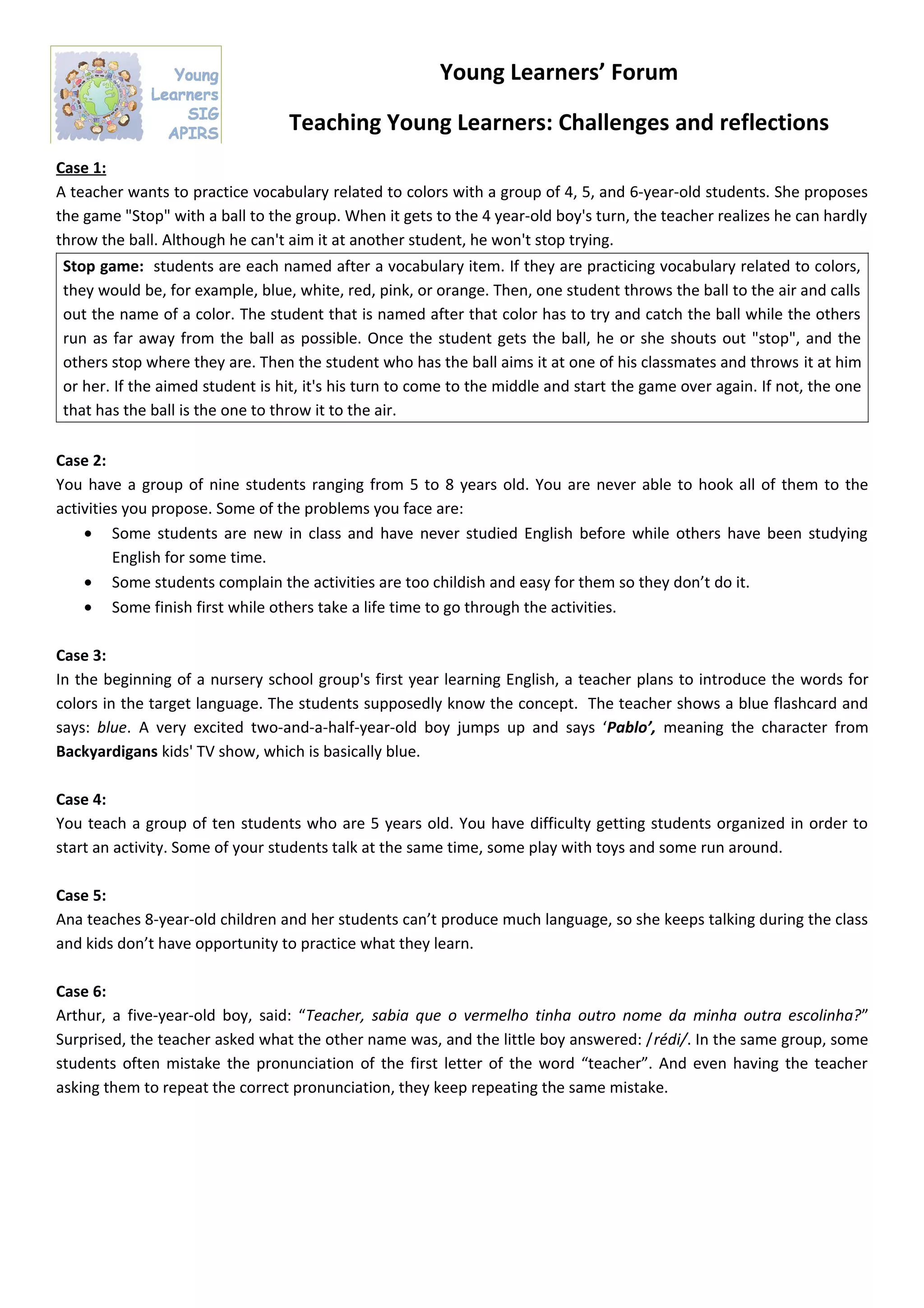
Case 1:
A teacher wants to practice vocabulary related to colors with a group of 4, 5, and 6-year-old students. She proposes
the game "Stop" with a ball to the group. When it gets to the 4 year-old boy's turn, the teacher realizes he can hardly
throw the ball. Although he can't aim it at another student, he won't stop trying.
 Stop game: students are each named after a vocabulary item. If they are practicing vocabulary related to colors,
 they would be, for example, blue, white, red, pink, or orange. Then, one student throws the ball to the air and calls
 out the name of a color. The student that is named after that color has to try and catch the ball while the others
 run as far away from the ball as possible. Once the student gets the ball, he or she shouts out "stop", and the
 others stop where they are. Then the student who has the ball aims it at one of his classmates and throws it at him
 or her. If the aimed student is hit, it's his turn to come to the middle and start the game over again. If not, the one
 that has the ball is the one to throw it to the air.

Case 2:
You have a group of nine students ranging from 5 to 8 years old. You are never able to hook all of them to the
activities you propose. Some of the problems you face are:
    • Some students are new in class and have never studied English before while others have been studying
         English for some time.
    • Some students complain the activities are too childish and easy for them so they don’t do it.
    • Some finish first while others take a life time to go through the activities.

Case 3:
In the beginning of a nursery school group's first year learning English, a teacher plans to introduce the words for
colors in the target language. The students supposedly know the concept. The teacher shows a blue flashcard and
says: blue. A very excited two-and-a-half-year-old boy jumps up and says ‘Pablo’, meaning the character from
Backyardigans kids' TV show, which is basically blue.

Case 4:
You teach a group of ten students who are 5 years old. You have difficulty getting students organized in order to
start an activity. Some of your students talk at the same time, some play with toys and some run around.

Case 5:
Ana teaches 8-year-old children and her students can’t produce much language, so she keeps talking during the class
and kids don’t have opportunity to practice what they learn.

Case 6:
Arthur, a five-year-old boy, said: “Teacher, sabia que o vermelho tinha outro nome da minha outra escolinha?”
Surprised, the teacher asked what the other name was, and the little boy answered: /rédi/. In the same group, some
students often mistake the pronunciation of the first letter of the word “teacher”. And even having the teacher
asking them to repeat the correct pronunciation, they keep repeating the same mistake.
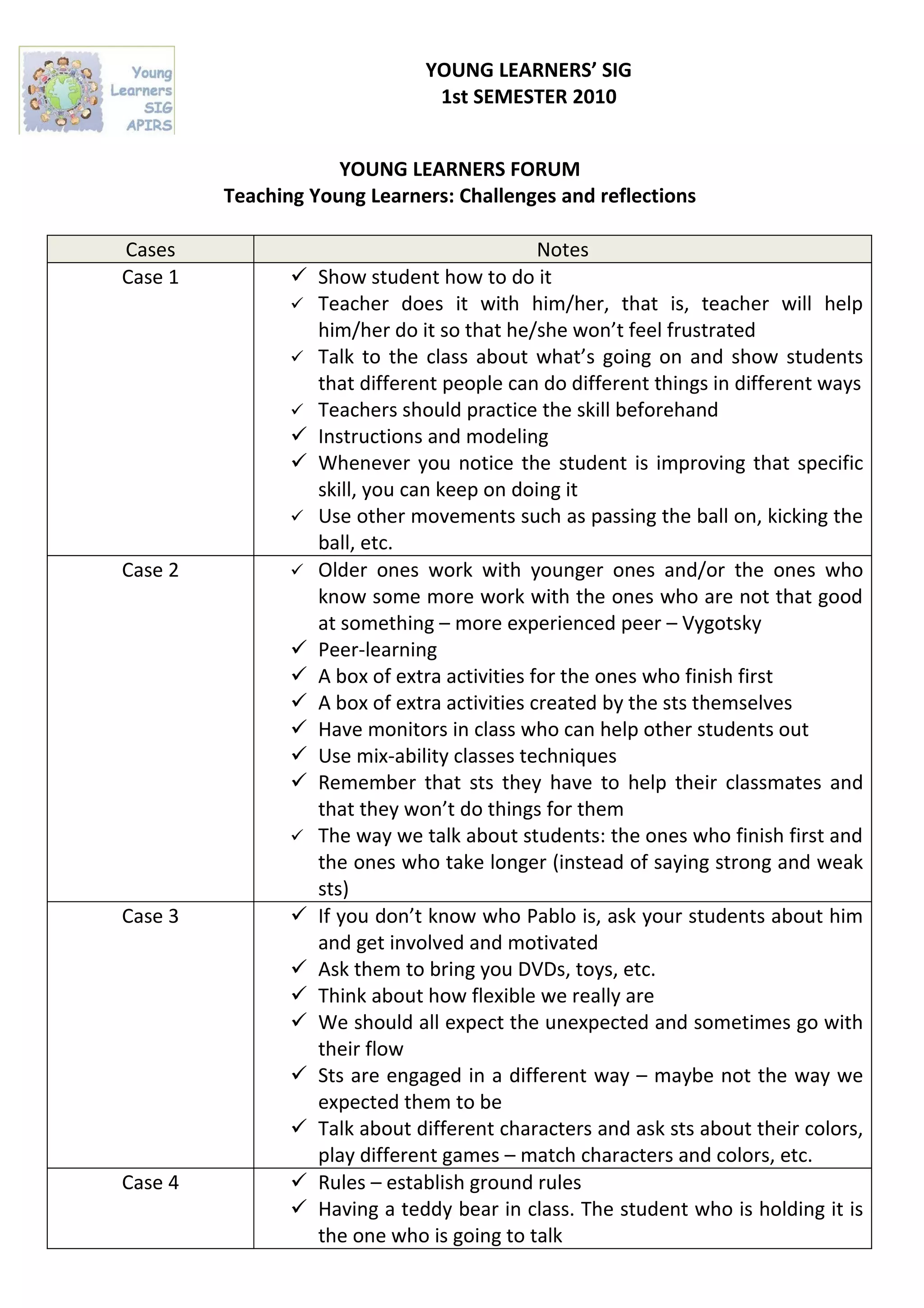
YOUNG LEARNERS’ SIG
                                 1st SEMESTER 2010


                     YOUNG LEARNERS FORUM
         Teaching Young Learners: Challenges and reflections

Cases                                          Notes
Case 1             Show student how to do it
                   Teacher does it with him/her, that is, teacher will help
                    him/her do it so that he/she won’t feel frustrated
                   Talk to the class about what’s going on and show students
                    that different people can do different things in different ways
                   Teachers should practice the skill beforehand
                   Instructions and modeling
                   Whenever you notice the student is improving that specific
                    skill, you can keep on doing it
                   Use other movements such as passing the ball on, kicking the
                    ball, etc.
Case 2             Older ones work with younger ones and/or the ones who
                    know some more work with the ones who are not that good
                    at something – more experienced peer – Vygotsky
                   Peer-learning
                   A box of extra activities for the ones who finish first
                   A box of extra activities created by the sts themselves
                   Have monitors in class who can help other students out
                   Use mix-ability classes techniques
                   Remember that sts they have to help their classmates and
                    that they won’t do things for them
                   The way we talk about students: the ones who finish first and
                    the ones who take longer (instead of saying strong and weak
                    sts)
Case 3             If you don’t know who Pablo is, ask your students about him
                    and get involved and motivated
                   Ask them to bring you DVDs, toys, etc.
                   Think about how flexible we really are
                   We should all expect the unexpected and sometimes go with
                    their flow
                   Sts are engaged in a different way – maybe not the way we
                    expected them to be
                   Talk about different characters and ask sts about their colors,
                    play different games – match characters and colors, etc.
Case 4             Rules – establish ground rules
                   Having a teddy bear in class. The student who is holding it is
                    the one who is going to talk
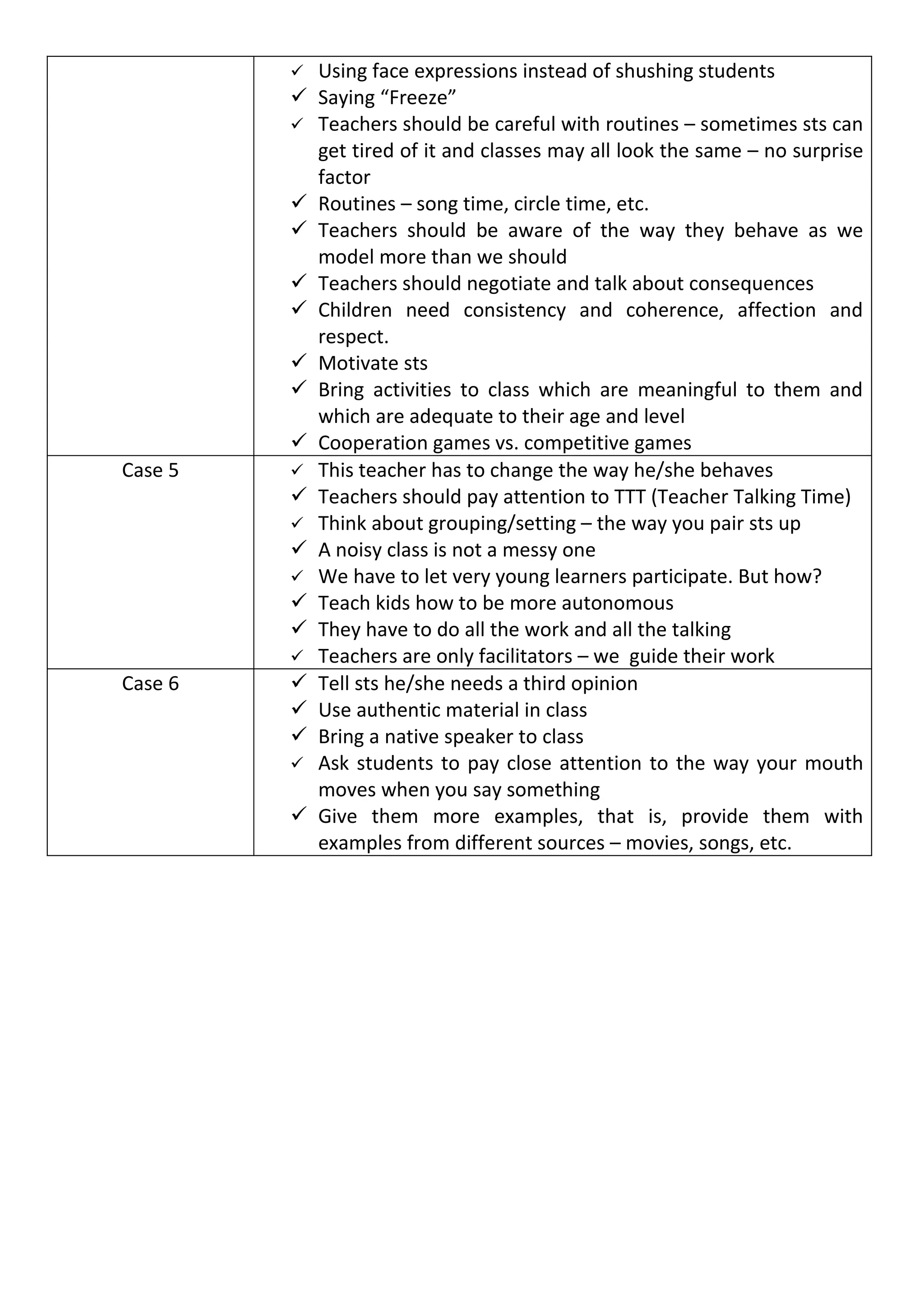
   Using face expressions instead of shushing students
            Saying “Freeze”
            Teachers should be careful with routines – sometimes sts can
             get tired of it and classes may all look the same – no surprise
             factor
            Routines – song time, circle time, etc.
            Teachers should be aware of the way they behave as we
             model more than we should
            Teachers should negotiate and talk about consequences
            Children need consistency and coherence, affection and
             respect.
            Motivate sts
            Bring activities to class which are meaningful to them and
             which are adequate to their age and level
            Cooperation games vs. competitive games
Case 5      This teacher has to change the way he/she behaves
            Teachers should pay attention to TTT (Teacher Talking Time)
            Think about grouping/setting – the way you pair sts up
            A noisy class is not a messy one
            We have to let very young learners participate. But how?
            Teach kids how to be more autonomous
            They have to do all the work and all the talking
            Teachers are only facilitators – we guide their work
Case 6      Tell sts he/she needs a third opinion
            Use authentic material in class
            Bring a native speaker to class
            Ask students to pay close attention to the way your mouth
             moves when you say something
            Give them more examples, that is, provide them with
             examples from different sources – movies, songs, etc.

Young Learners Forum - Cases & Notes

  • 1.
    Young Learners’ Forum Teaching Young Learners: Challenges and reflections Case 1: A teacher wants to practice vocabulary related to colors with a group of 4, 5, and 6-year-old students. She proposes the game "Stop" with a ball to the group. When it gets to the 4 year-old boy's turn, the teacher realizes he can hardly throw the ball. Although he can't aim it at another student, he won't stop trying. Stop game: students are each named after a vocabulary item. If they are practicing vocabulary related to colors, they would be, for example, blue, white, red, pink, or orange. Then, one student throws the ball to the air and calls out the name of a color. The student that is named after that color has to try and catch the ball while the others run as far away from the ball as possible. Once the student gets the ball, he or she shouts out "stop", and the others stop where they are. Then the student who has the ball aims it at one of his classmates and throws it at him or her. If the aimed student is hit, it's his turn to come to the middle and start the game over again. If not, the one that has the ball is the one to throw it to the air. Case 2: You have a group of nine students ranging from 5 to 8 years old. You are never able to hook all of them to the activities you propose. Some of the problems you face are: • Some students are new in class and have never studied English before while others have been studying English for some time. • Some students complain the activities are too childish and easy for them so they don’t do it. • Some finish first while others take a life time to go through the activities. Case 3: In the beginning of a nursery school group's first year learning English, a teacher plans to introduce the words for colors in the target language. The students supposedly know the concept. The teacher shows a blue flashcard and says: blue. A very excited two-and-a-half-year-old boy jumps up and says ‘Pablo’, meaning the character from Backyardigans kids' TV show, which is basically blue. Case 4: You teach a group of ten students who are 5 years old. You have difficulty getting students organized in order to start an activity. Some of your students talk at the same time, some play with toys and some run around. Case 5: Ana teaches 8-year-old children and her students can’t produce much language, so she keeps talking during the class and kids don’t have opportunity to practice what they learn. Case 6: Arthur, a five-year-old boy, said: “Teacher, sabia que o vermelho tinha outro nome da minha outra escolinha?” Surprised, the teacher asked what the other name was, and the little boy answered: /rédi/. In the same group, some students often mistake the pronunciation of the first letter of the word “teacher”. And even having the teacher asking them to repeat the correct pronunciation, they keep repeating the same mistake.
  • 2.
    YOUNG LEARNERS’ SIG 1st SEMESTER 2010 YOUNG LEARNERS FORUM Teaching Young Learners: Challenges and reflections Cases Notes Case 1  Show student how to do it  Teacher does it with him/her, that is, teacher will help him/her do it so that he/she won’t feel frustrated  Talk to the class about what’s going on and show students that different people can do different things in different ways  Teachers should practice the skill beforehand  Instructions and modeling  Whenever you notice the student is improving that specific skill, you can keep on doing it  Use other movements such as passing the ball on, kicking the ball, etc. Case 2  Older ones work with younger ones and/or the ones who know some more work with the ones who are not that good at something – more experienced peer – Vygotsky  Peer-learning  A box of extra activities for the ones who finish first  A box of extra activities created by the sts themselves  Have monitors in class who can help other students out  Use mix-ability classes techniques  Remember that sts they have to help their classmates and that they won’t do things for them  The way we talk about students: the ones who finish first and the ones who take longer (instead of saying strong and weak sts) Case 3  If you don’t know who Pablo is, ask your students about him and get involved and motivated  Ask them to bring you DVDs, toys, etc.  Think about how flexible we really are  We should all expect the unexpected and sometimes go with their flow  Sts are engaged in a different way – maybe not the way we expected them to be  Talk about different characters and ask sts about their colors, play different games – match characters and colors, etc. Case 4  Rules – establish ground rules  Having a teddy bear in class. The student who is holding it is the one who is going to talk
  • 3.
    Using face expressions instead of shushing students  Saying “Freeze”  Teachers should be careful with routines – sometimes sts can get tired of it and classes may all look the same – no surprise factor  Routines – song time, circle time, etc.  Teachers should be aware of the way they behave as we model more than we should  Teachers should negotiate and talk about consequences  Children need consistency and coherence, affection and respect.  Motivate sts  Bring activities to class which are meaningful to them and which are adequate to their age and level  Cooperation games vs. competitive games Case 5  This teacher has to change the way he/she behaves  Teachers should pay attention to TTT (Teacher Talking Time)  Think about grouping/setting – the way you pair sts up  A noisy class is not a messy one  We have to let very young learners participate. But how?  Teach kids how to be more autonomous  They have to do all the work and all the talking  Teachers are only facilitators – we guide their work Case 6  Tell sts he/she needs a third opinion  Use authentic material in class  Bring a native speaker to class  Ask students to pay close attention to the way your mouth moves when you say something  Give them more examples, that is, provide them with examples from different sources – movies, songs, etc.