In this writing I will speak about my philosophy of teaching, I will mention some
teaching responsibilities; I will make brief analyses of the teaching context; I will
speak about my experience of teaching and I will mention the use of materials.
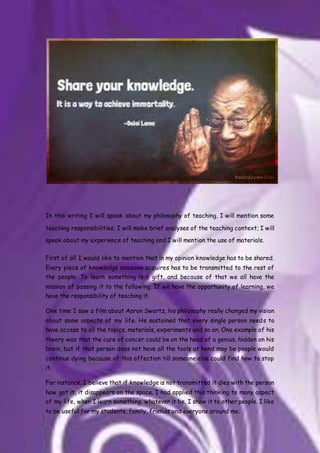
First of all I would like to mention that in my opinion knowledge has to be shared.
Every piece of knowledge someone acquires has to be transmitted to the rest of
the people. To learn something is a gift, and because of that we all have the
mission of passing it to the following. If we have the opportunity of learning, we
have the responsibility of teaching it.
One time I saw a film about Aaron Swartz, his philosophy really changed my vision
about some aspects of my life. He sustained that every single person needs to
have access to all the topics, materials, experiments and so on. One example of his
theory was that the cure of cancer could be on the head of a genius, hidden on his
brain, but if that person does not have all the tools at hand may be people would
continue dying because of this affection till someone else could find how to stop
it.
For instance, I believe that if knowledge is not transmitted it dies with the person
how got it, it disappears on the space. I had applied this thinking to many aspect
of my life, when I learn something, whatever it be, I show it to other people. I like
to be useful for my students, family, friends and everyone around me.
In my town there are for primary schools and only one of them teaches English for
learners of 6 years old, from first grade till seventh. The rest only have English
lessons from fourth grade till seventh grade; so graduated students have a
noticeable level of the target language when they join together at the secondary
school.
The social status of people is from middle class to low class, and the main
economic activities are health and education, the rest of the people have private
jobs and in many cases do not have enough money to send their children to private
institutes of English. I have presented a project to teach English to children from
6 to 8 years old for free at the library, but I did not have a response; it was a
shame since it would be a bridge to those children to have access to the foreign
language.
Having mentioned this, the environment in which we are going to work on it is
relevant and important for choosing activities; it is not the same to work at a
private institute than teaching at a public school. Moreover, students` needs are
different, topics will be different, and strategies are not going to be the same,
the vision of the teacher, the aims and objectives among many others. Teachers
have to take into account many aspects at the time of planning the lessons. Also, it
is important to analyze if the topic we are about to teach will be meaningful for
them. That is to say, we have to be aware of their environment, the activities they
do on their every life routine to introduce what we want to teach.
According to Gardner (1983) there are seven different learning intelligences to
take into account at the time of applying strategies. These styles have to do with
the perception of the world people have; some of them learn faster when they use
numbers, others have more abilities to learning while they are listening and so on.
The seven intelligences are: logical mathematical, visual spatial, body kinesthetic,
musical rhythmic, interpersonal, intrapersonal, verbal linguistic. This does not
mean that a person that has a verbal linguistic intelligence won`t be able of
learning something by using images, it means that that person will learn faster and
better if we use activities in which verbal interaction is the main goal.
Furthermore, another factor that influences the learning of a language is the age
of students, it has not got to do with the ability of acquiring a language, as we
know, there is not a limit of age for learning it; but it is easier to teach whatever
to young learners, since their motivation is higher than adults or adolescents, in
which case it is more difficult since teachers have to look for strategies to call
their attention and to get them concentrate.
Another theory that helped me is Larsen- Freeman`s (2000) in which I could see
that the methods we use, may have as a main goal to communicate in the target
language, so the purpose of teaching a language is to use it as a channel to foster
interaction among people. I completely agree with this theory, moreover, I always
try to teach the language for communicative purposes.
Another point to consider is the relationship we have with students, when we are
in front of the group we may be aware about them, we may bear in mind that they
are like us, people that have problems, worries, feelings, responsibilities and so on.
One time I had the opportunity of working at the secondary school; I always tried
to be on the teacher´s place, I do not talk about anything of my private life, do
not share expressions, tried to speak only when I had to explain something.
Well, in September one of my students committed suicide; it was terrible, all the
school were in shock. No one knew what to do, what to say, it was the most
horrible experience I had, but in that moment I could understand that we were a
group of people that needed to each other; and were teachers the ones who had
to sustain students since we were the adults. It was really difficult to continue, to
spoke with the heart. I used to be a cold person, everyone in the school knew me
as a person who does not fell anything, but I had to be there for my students, I
had to hug them and to say them that everything was going to be all right.
According to Larsen and Freeman (2010) the role of the teacher is to facilitate
communication, to establish situations likely to promote communicative situations;
he also acts as an adviser, answering questions and making note of students`
errors; and he is the nearest referent of the foreign language. It is also
important to bear in mind that teachers are not for making jokes or to funny
students; although to be fun could be a good strategy for calling students`
attention, it is not vital for the process of learning.
Another contribution I can mention is Scrivener`s, he sustains that a teacher has
to create a positive atmosphere in the classroom; he mentions some
characteristics of educators, some of them are: to show respect, to be fair, to
give clear and positive feedback, to be patient, to be honest, to inspire
confidence, to be approachable and to trust people, among others. I think that
before getting in the classroom we have to remember these characteristics.
Moreover, it is difficult to know what kind of relation we may have with students,
but it is vital to have a clear idea that we are all people, that we can commit
mistakes or have personal troubles; teachers have to observe students, to identify
if they need something that goes further of an explanation.
On the other hand, the use of materials plays a fundamental role on teaching a
language. According to Scrivener, materials have to be authentic, taken from real
situations in which the language is used, for example news papers, menus,
magazines, etc. These kinds of materials provide a link between students and the
real world, in contrast with text books that are especially designed for learning
purposes; they represent an unreal use of language.
According to Cunnington(1995), the use of text books has many advantages, for
example, they provide structure and a syllabus for a program, they provide a
variety of language resources and effective language models and input, they also
can train teachers, and they are visually appealing. This analyses is interesting
since we have to explore all the options we have to look for the one that best suits
on our purpose.
All in all, teaching is a very complex and important process and there are a lot of
things that will happen during that process. There are many aspects to take into
account, but everything we are about to do has to be made with love and passion.
If someone does not have that feeling she would suffer every time she has to be
standing up in front of a group of students.

Portfolio

  • 1.
    In this writingI will speak about my philosophy of teaching, I will mention some teaching responsibilities; I will make brief analyses of the teaching context; I will speak about my experience of teaching and I will mention the use of materials. First of all I would like to mention that in my opinion knowledge has to be shared. Every piece of knowledge someone acquires has to be transmitted to the rest of the people. To learn something is a gift, and because of that we all have the mission of passing it to the following. If we have the opportunity of learning, we have the responsibility of teaching it. One time I saw a film about Aaron Swartz, his philosophy really changed my vision about some aspects of my life. He sustained that every single person needs to have access to all the topics, materials, experiments and so on. One example of his theory was that the cure of cancer could be on the head of a genius, hidden on his brain, but if that person does not have all the tools at hand may be people would continue dying because of this affection till someone else could find how to stop it. For instance, I believe that if knowledge is not transmitted it dies with the person how got it, it disappears on the space. I had applied this thinking to many aspect of my life, when I learn something, whatever it be, I show it to other people. I like to be useful for my students, family, friends and everyone around me.
  • 2.
    In my townthere are for primary schools and only one of them teaches English for learners of 6 years old, from first grade till seventh. The rest only have English lessons from fourth grade till seventh grade; so graduated students have a noticeable level of the target language when they join together at the secondary school. The social status of people is from middle class to low class, and the main economic activities are health and education, the rest of the people have private jobs and in many cases do not have enough money to send their children to private institutes of English. I have presented a project to teach English to children from 6 to 8 years old for free at the library, but I did not have a response; it was a shame since it would be a bridge to those children to have access to the foreign language. Having mentioned this, the environment in which we are going to work on it is relevant and important for choosing activities; it is not the same to work at a private institute than teaching at a public school. Moreover, students` needs are different, topics will be different, and strategies are not going to be the same, the vision of the teacher, the aims and objectives among many others. Teachers have to take into account many aspects at the time of planning the lessons. Also, it is important to analyze if the topic we are about to teach will be meaningful for them. That is to say, we have to be aware of their environment, the activities they do on their every life routine to introduce what we want to teach. According to Gardner (1983) there are seven different learning intelligences to take into account at the time of applying strategies. These styles have to do with the perception of the world people have; some of them learn faster when they use numbers, others have more abilities to learning while they are listening and so on. The seven intelligences are: logical mathematical, visual spatial, body kinesthetic, musical rhythmic, interpersonal, intrapersonal, verbal linguistic. This does not mean that a person that has a verbal linguistic intelligence won`t be able of learning something by using images, it means that that person will learn faster and better if we use activities in which verbal interaction is the main goal. Furthermore, another factor that influences the learning of a language is the age of students, it has not got to do with the ability of acquiring a language, as we know, there is not a limit of age for learning it; but it is easier to teach whatever to young learners, since their motivation is higher than adults or adolescents, in which case it is more difficult since teachers have to look for strategies to call their attention and to get them concentrate.
  • 3.
    Another theory thathelped me is Larsen- Freeman`s (2000) in which I could see that the methods we use, may have as a main goal to communicate in the target language, so the purpose of teaching a language is to use it as a channel to foster interaction among people. I completely agree with this theory, moreover, I always try to teach the language for communicative purposes. Another point to consider is the relationship we have with students, when we are in front of the group we may be aware about them, we may bear in mind that they are like us, people that have problems, worries, feelings, responsibilities and so on. One time I had the opportunity of working at the secondary school; I always tried to be on the teacher´s place, I do not talk about anything of my private life, do not share expressions, tried to speak only when I had to explain something. Well, in September one of my students committed suicide; it was terrible, all the school were in shock. No one knew what to do, what to say, it was the most horrible experience I had, but in that moment I could understand that we were a group of people that needed to each other; and were teachers the ones who had to sustain students since we were the adults. It was really difficult to continue, to spoke with the heart. I used to be a cold person, everyone in the school knew me as a person who does not fell anything, but I had to be there for my students, I had to hug them and to say them that everything was going to be all right. According to Larsen and Freeman (2010) the role of the teacher is to facilitate communication, to establish situations likely to promote communicative situations; he also acts as an adviser, answering questions and making note of students` errors; and he is the nearest referent of the foreign language. It is also important to bear in mind that teachers are not for making jokes or to funny students; although to be fun could be a good strategy for calling students` attention, it is not vital for the process of learning. Another contribution I can mention is Scrivener`s, he sustains that a teacher has to create a positive atmosphere in the classroom; he mentions some characteristics of educators, some of them are: to show respect, to be fair, to give clear and positive feedback, to be patient, to be honest, to inspire confidence, to be approachable and to trust people, among others. I think that before getting in the classroom we have to remember these characteristics. Moreover, it is difficult to know what kind of relation we may have with students, but it is vital to have a clear idea that we are all people, that we can commit mistakes or have personal troubles; teachers have to observe students, to identify if they need something that goes further of an explanation.
  • 4.
    On the otherhand, the use of materials plays a fundamental role on teaching a language. According to Scrivener, materials have to be authentic, taken from real situations in which the language is used, for example news papers, menus, magazines, etc. These kinds of materials provide a link between students and the real world, in contrast with text books that are especially designed for learning purposes; they represent an unreal use of language. According to Cunnington(1995), the use of text books has many advantages, for example, they provide structure and a syllabus for a program, they provide a variety of language resources and effective language models and input, they also can train teachers, and they are visually appealing. This analyses is interesting since we have to explore all the options we have to look for the one that best suits on our purpose. All in all, teaching is a very complex and important process and there are a lot of things that will happen during that process. There are many aspects to take into account, but everything we are about to do has to be made with love and passion. If someone does not have that feeling she would suffer every time she has to be standing up in front of a group of students.