


Education for All
Open Innovation Africa Summit, Kenya
Steve Vosloo

28 November 2010
Roadmap

Education for All: Progress and challenges


Africa’s “mobile miracle”


Mobile miracle meets EFA challenges
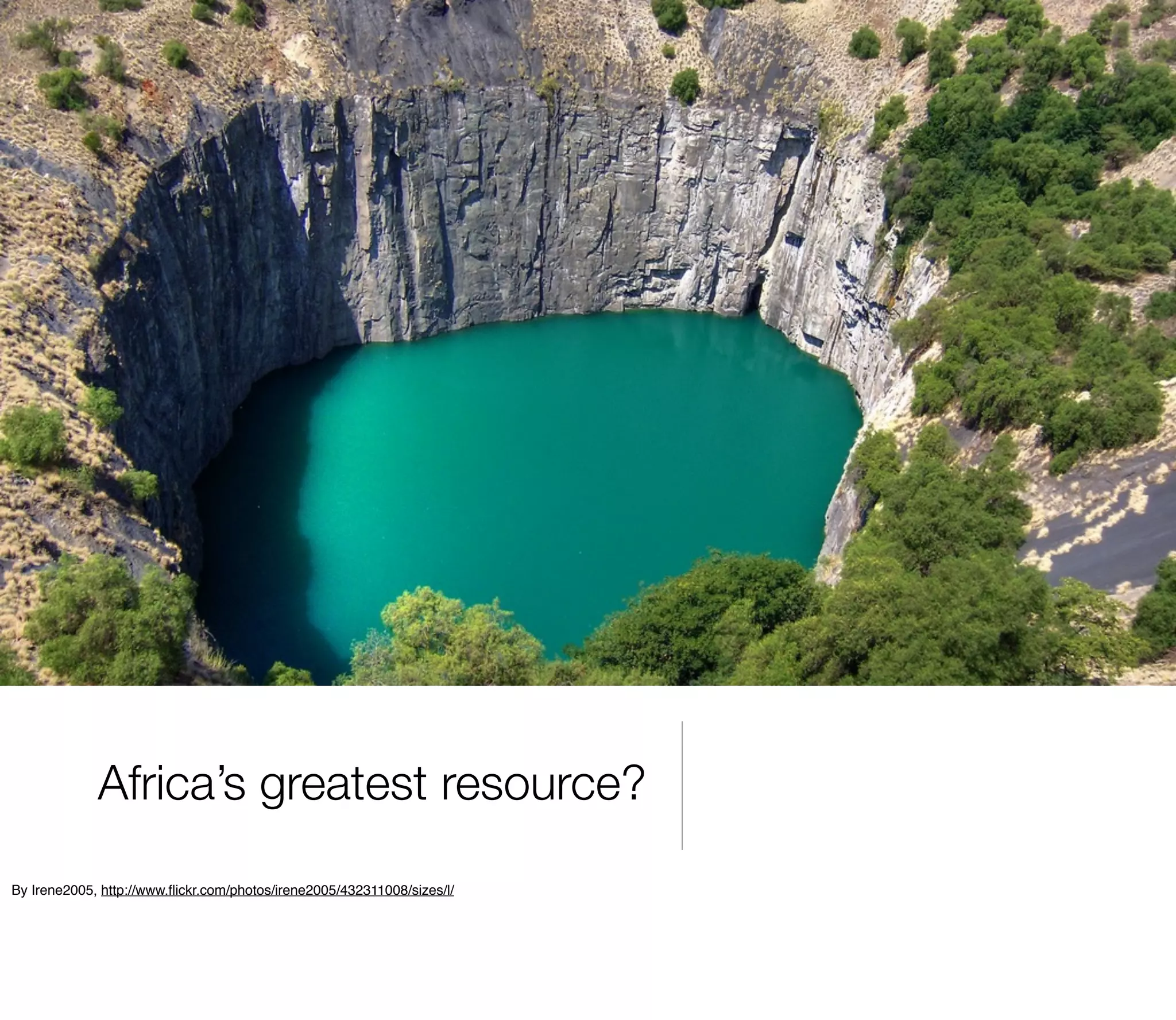
Africa’s greatest resource?
By Irene2005, http://www.flickr.com/photos/irene2005/432311008/sizes/l/
Africa’s greatest resource?
By Irene2005, http://www.flickr.com/photos/irene2005/432311008/sizes/l/
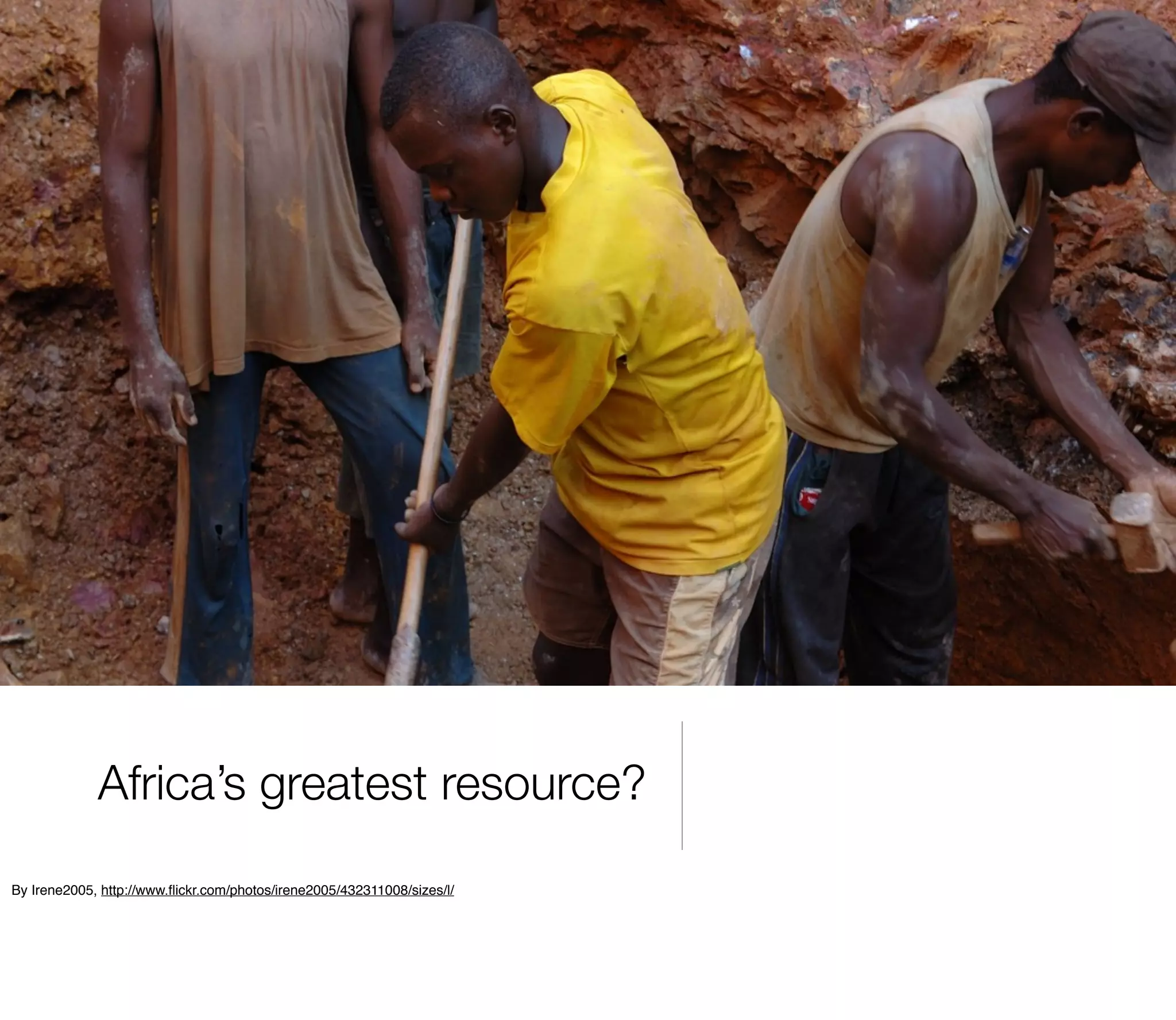
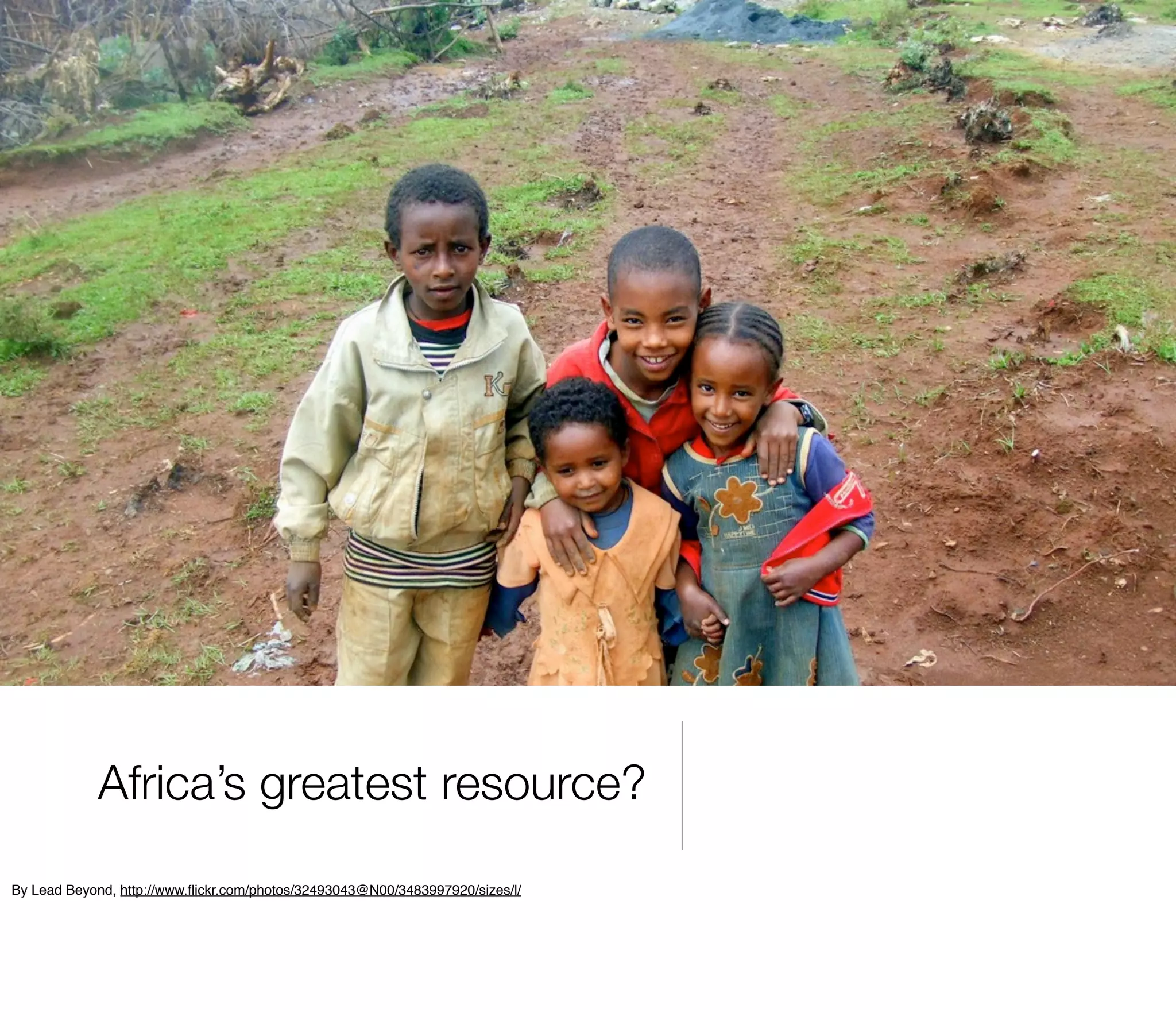
Africa’s greatest resource?
By Lead Beyond, http://www.flickr.com/photos/32493043@N00/3483997920/sizes/l/
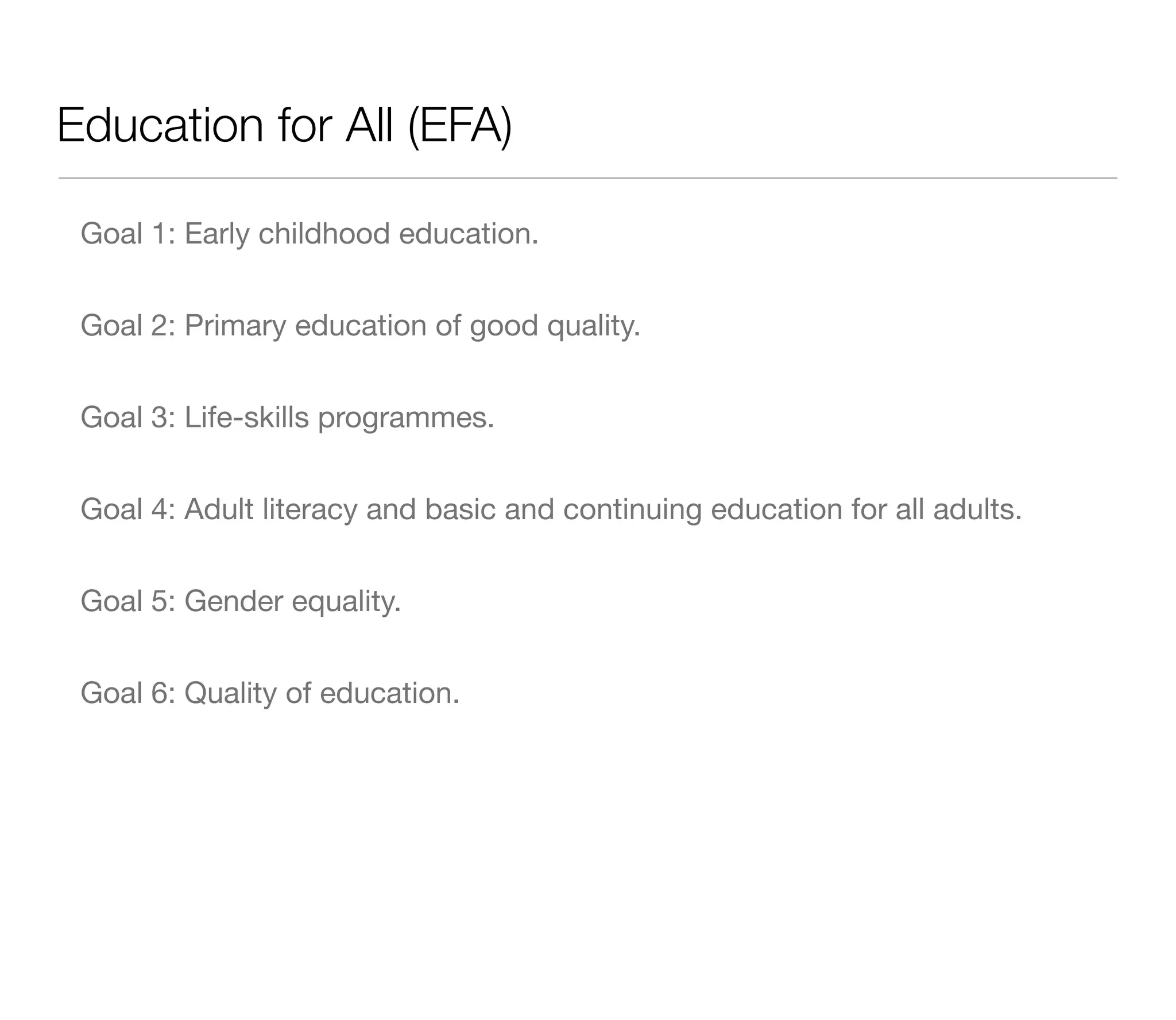
Education for All (EFA)

 Goal 1: Early childhood education.


 Goal 2: Primary education of good quality.


 Goal 3: Life-skills programmes.


 Goal 4: Adult literacy and basic and continuing education for all adults.


 Goal 5: Gender equality.


 Goal 6: Quality of education.
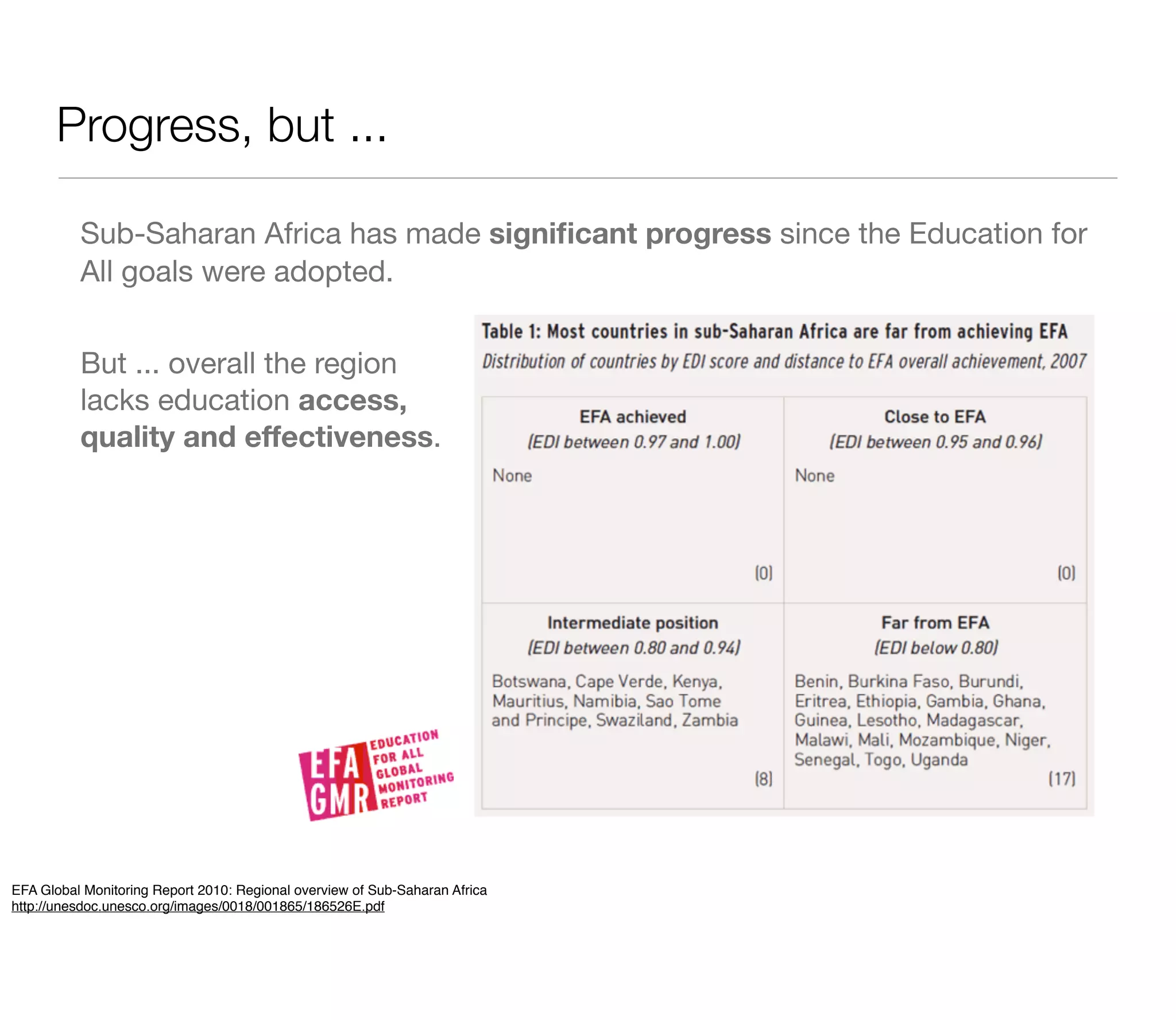
Progress, but ...

          Sub-Saharan Africa has made significant progress since the Education for
          All goals were adopted.


          But ... overall the region
          lacks education access,
          quality and effectiveness.


EFA Global Monitoring Report 2010: Regional overview of Sub-Saharan Africa
http://unesdoc.unesco.org/images/0018/001865/186526E.pdf
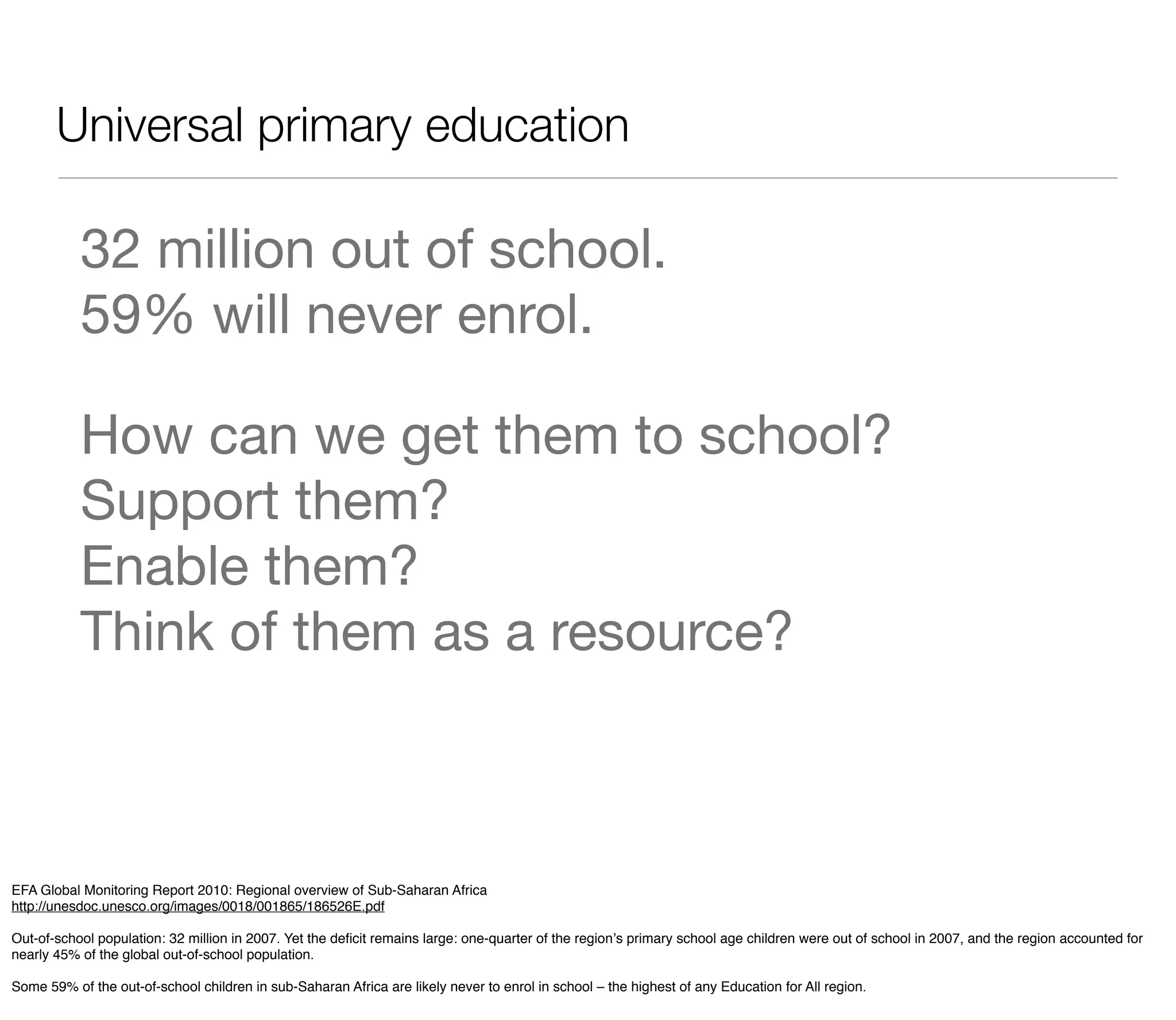
Universal primary education

           32 million out of school.
           59% will never enrol.

           How can we get them to school?
           Support them?
           Enable them?
           Think of them as a resource?


EFA Global Monitoring Report 2010: Regional overview of Sub-Saharan Africa
http://unesdoc.unesco.org/images/0018/001865/186526E.pdf

Out-of-school population: 32 million in 2007. Yet the deficit remains large: one-quarter of the regionʼs primary school age children were out of school in 2007, and the region accounted for
nearly 45% of the global out-of-school population.

Some 59% of the out-of-school children in sub-Saharan Africa are likely never to enrol in school – the highest of any Education for All region.
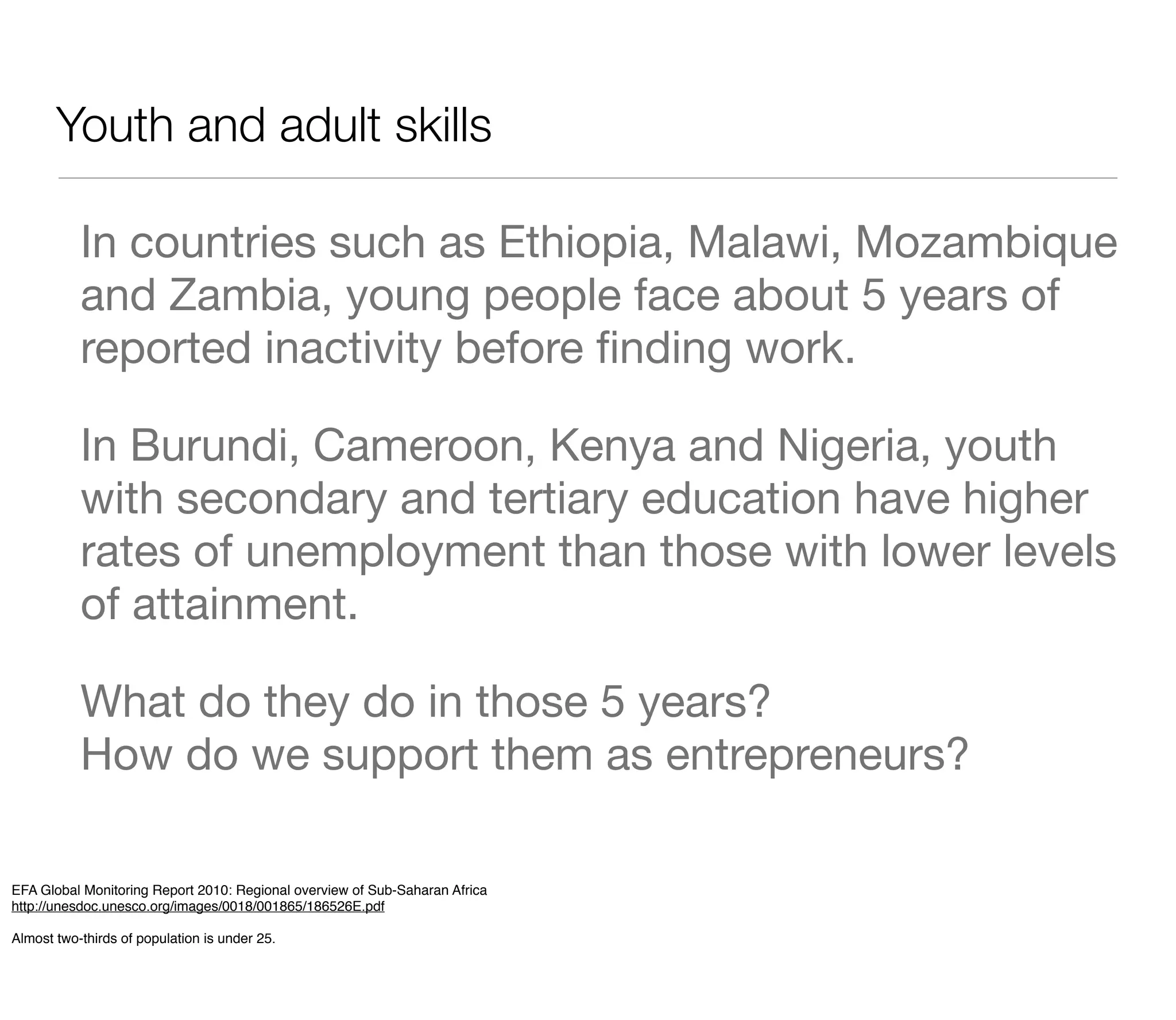
Youth and adult skills

           In countries such as Ethiopia, Malawi, Mozambique
           and Zambia, young people face about 5 years of
           reported inactivity before finding work.

           In Burundi, Cameroon, Kenya and Nigeria, youth
           with secondary and tertiary education have higher
           rates of unemployment than those with lower levels
           of attainment.

           What do they do in those 5 years?
           How do we support them as entrepreneurs?

EFA Global Monitoring Report 2010: Regional overview of Sub-Saharan Africa
http://unesdoc.unesco.org/images/0018/001865/186526E.pdf

Almost two-thirds of population is under 25.
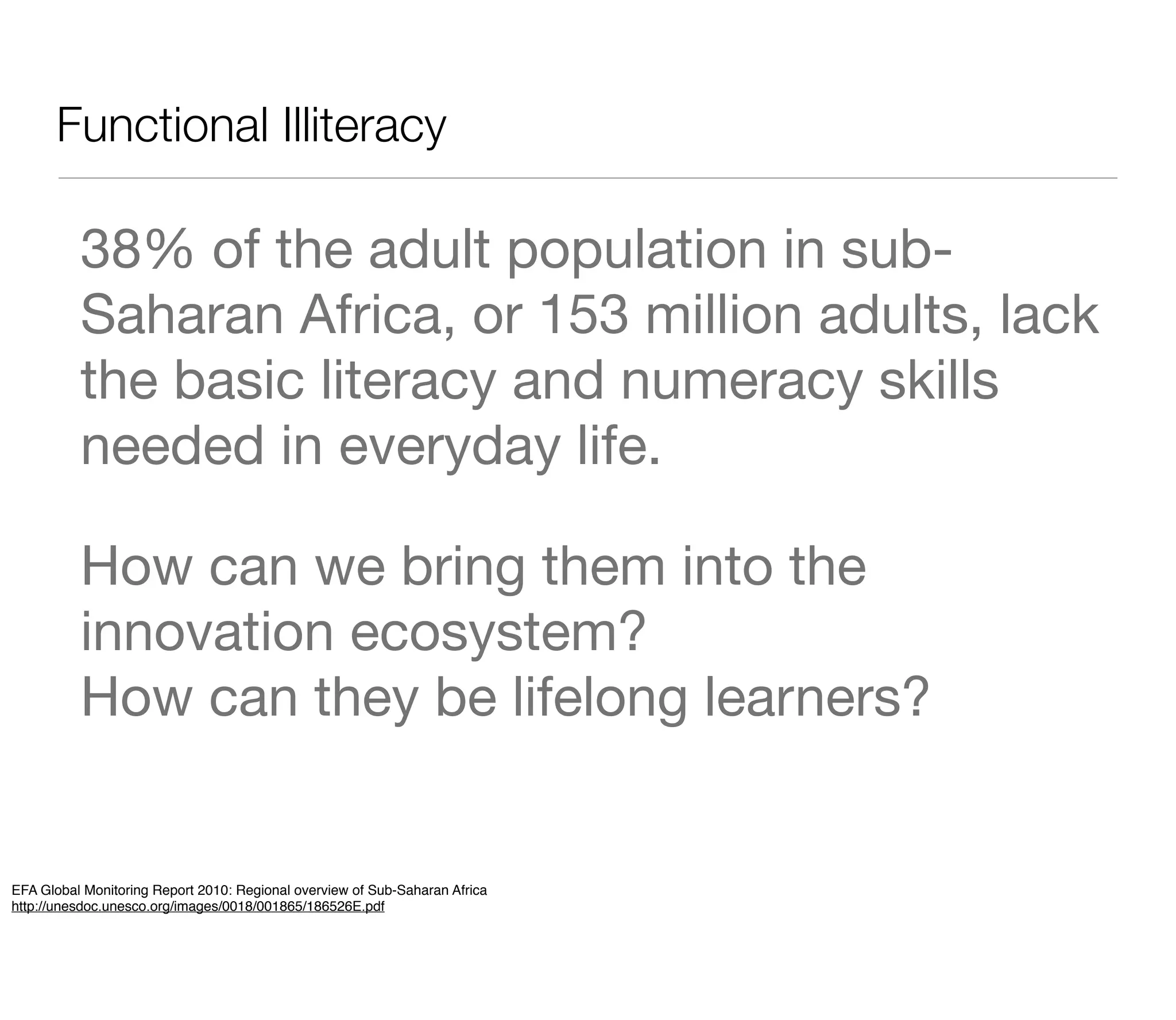
Functional Illiteracy

          38% of the adult population in sub-
          Saharan Africa, or 153 million adults, lack
          the basic literacy and numeracy skills
          needed in everyday life.

          How can we bring them into the
          innovation ecosystem?
          How can they be lifelong learners?


EFA Global Monitoring Report 2010: Regional overview of Sub-Saharan Africa
http://unesdoc.unesco.org/images/0018/001865/186526E.pdf
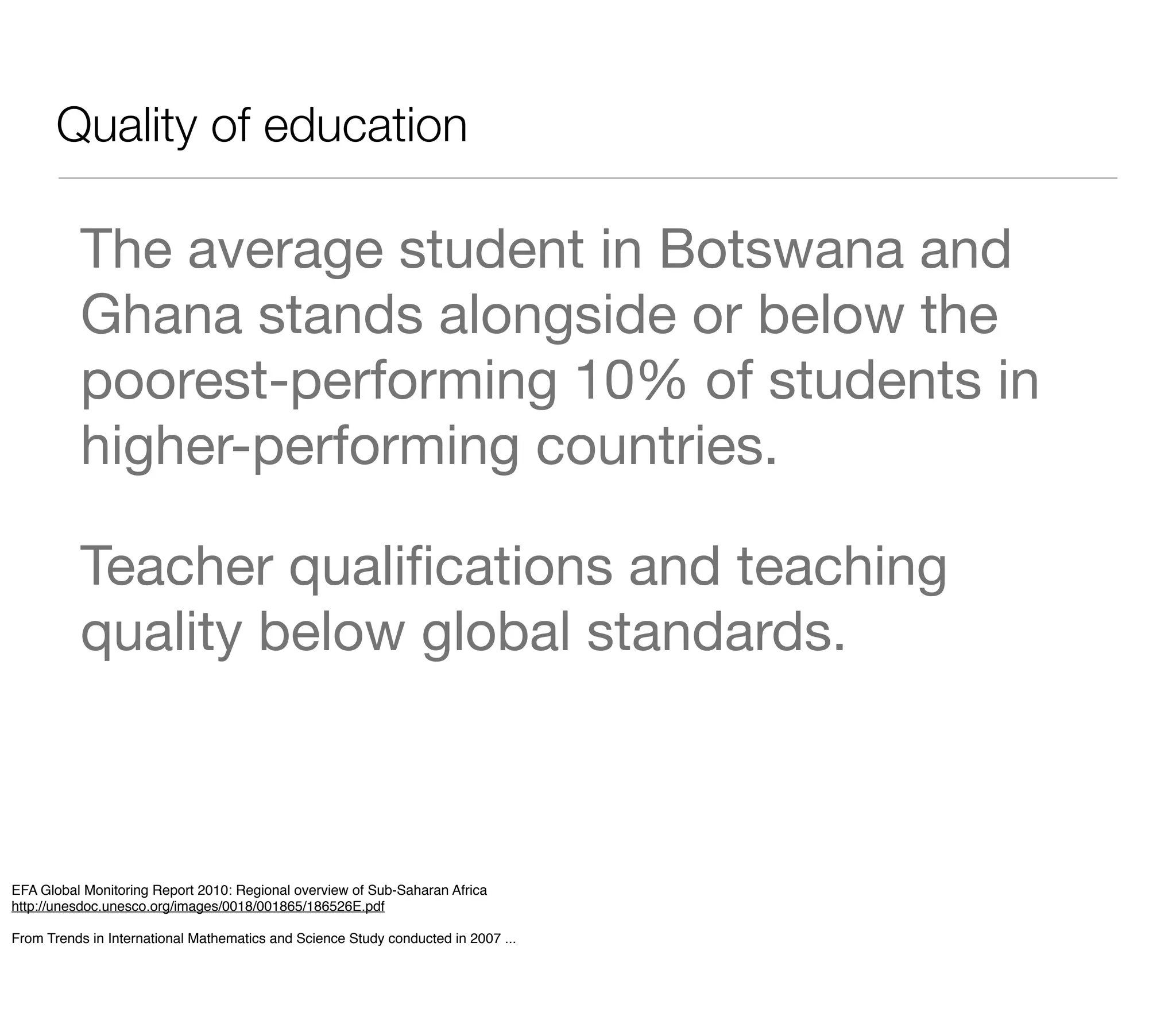
Quality of education

          The average student in Botswana and
          Ghana stands alongside or below the
          poorest-performing 10% of students in
          higher-performing countries.

          Teacher qualifications and teaching
          quality below global standards.


EFA Global Monitoring Report 2010: Regional overview of Sub-Saharan Africa
http://unesdoc.unesco.org/images/0018/001865/186526E.pdf

From Trends in International Mathematics and Science Study conducted in 2007 ...
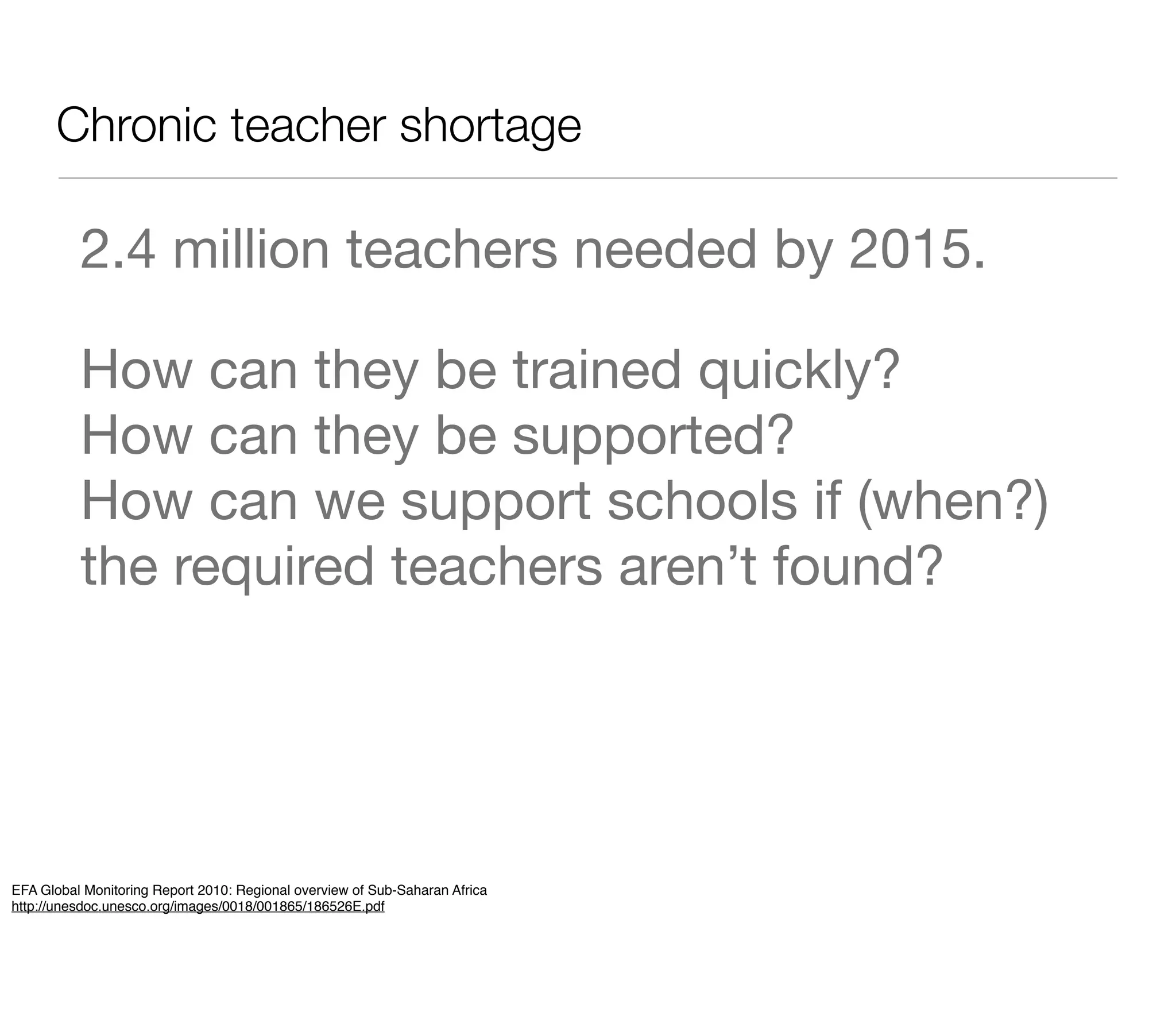
Chronic teacher shortage

          2.4 million teachers needed by 2015.

          How can they be trained quickly?
          How can they be supported?
          How can we support schools if (when?)
          the required teachers aren’t found?


EFA Global Monitoring Report 2010: Regional overview of Sub-Saharan Africa
http://unesdoc.unesco.org/images/0018/001865/186526E.pdf
Getting left behind

          Although more children from poor
          households have entered school in
          Malawi and Uganda since they abolished
          fees over a decade ago, half the
          households with children who have
          dropped out of school cite lack of money
          as the main problem.

          How we can help them?

EFA Global Monitoring Report 2010: Regional overview of Sub-Saharan Africa
http://unesdoc.unesco.org/images/0018/001865/186526E.pdf
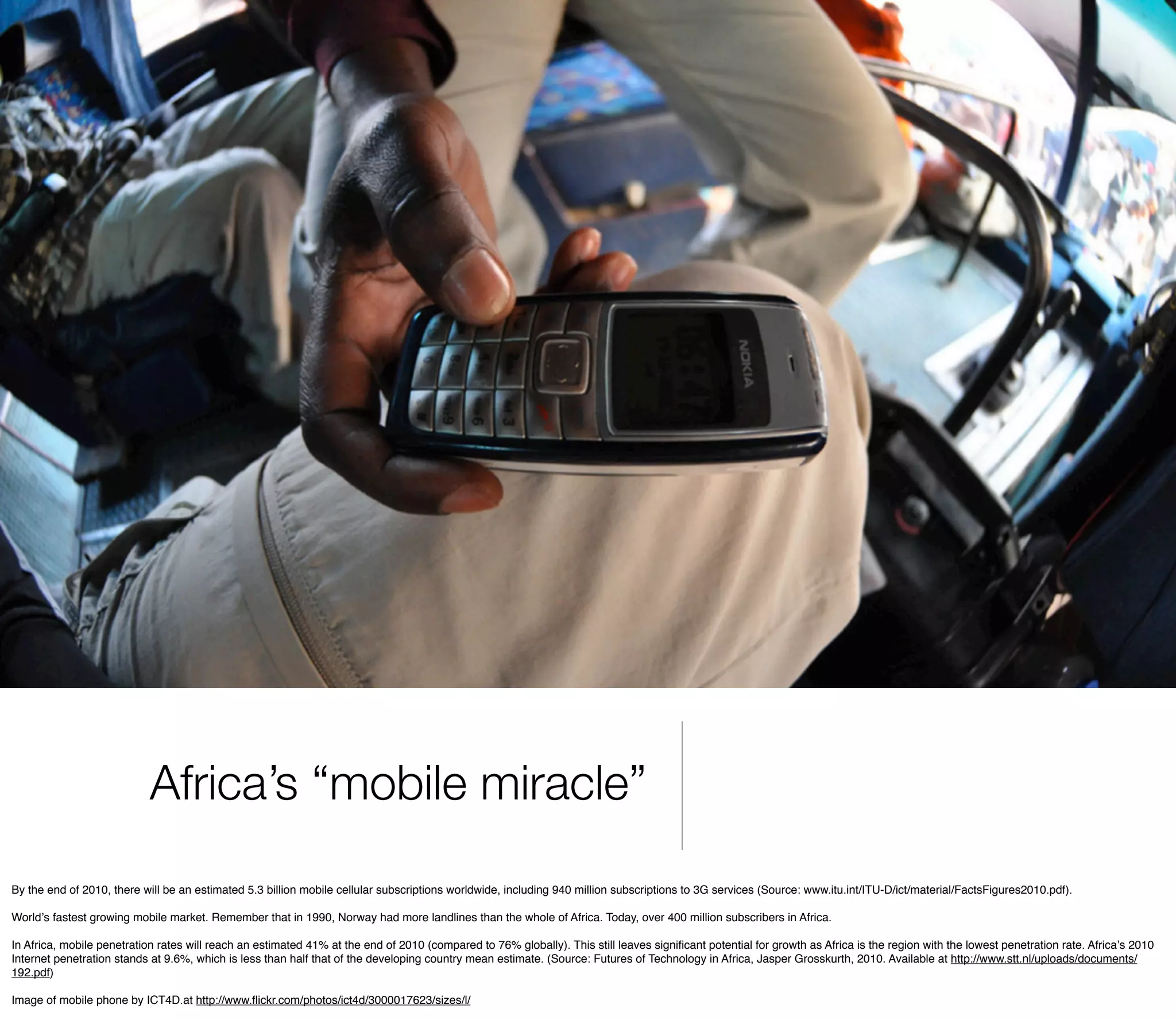
Africa’s “mobile miracle”
By the end of 2010, there will be an estimated 5.3 billion mobile cellular subscriptions worldwide, including 940 million subscriptions to 3G services (Source: www.itu.int/ITU-D/ict/material/FactsFigures2010.pdf).

Worldʼs fastest growing mobile market. Remember that in 1990, Norway had more landlines than the whole of Africa. Today, over 400 million subscribers in Africa.

In Africa, mobile penetration rates will reach an estimated 41% at the end of 2010 (compared to 76% globally). This still leaves significant potential for growth as Africa is the region with the lowest penetration rate. Africaʼs 2010
Internet penetration stands at 9.6%, which is less than half that of the developing country mean estimate. (Source: Futures of Technology in Africa, Jasper Grosskurth, 2010. Available at http://www.stt.nl/uploads/documents/
192.pdf)

Image of mobile phone by ICT4D.at http://www.flickr.com/photos/ict4d/3000017623/sizes/l/
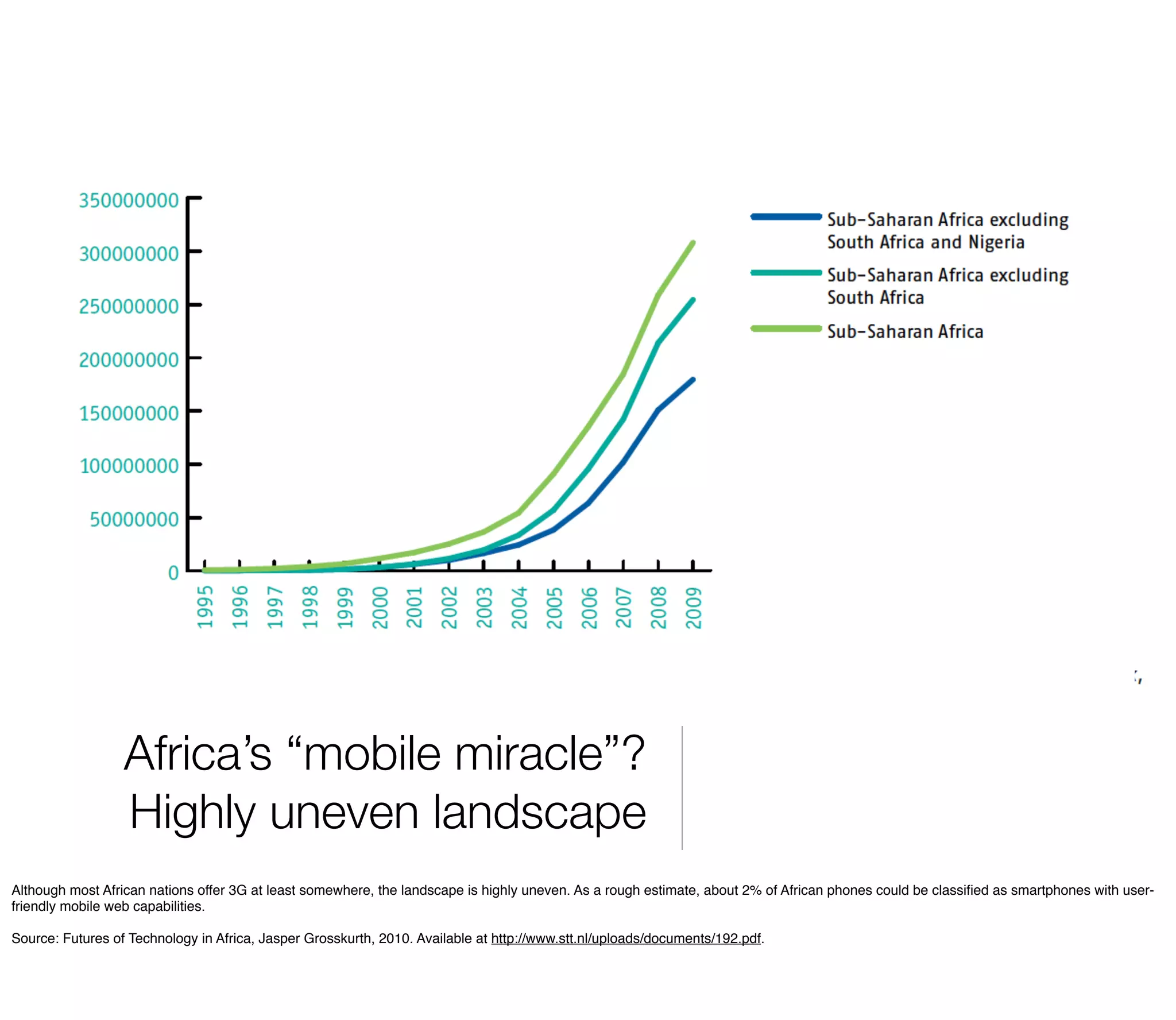
Africa’s “mobile miracle”?
                  Highly uneven landscape
Although most African nations offer 3G at least somewhere, the landscape is highly uneven. As a rough estimate, about 2% of African phones could be classified as smartphones with user-
friendly mobile web capabilities.

Source: Futures of Technology in Africa, Jasper Grosskurth, 2010. Available at http://www.stt.nl/uploads/documents/192.pdf.
"Most phones are very cheap or
   secondhand devices, which
   hardly ever have usable airtime
   loaded on them. The primary
   purpose is to be reachable and
   not to be able to call others."
             Jasper Grosskurth, Futures of Technology in Africa


Africa’s “mobile miracle”?
Mobile miracle meets EFA challenges
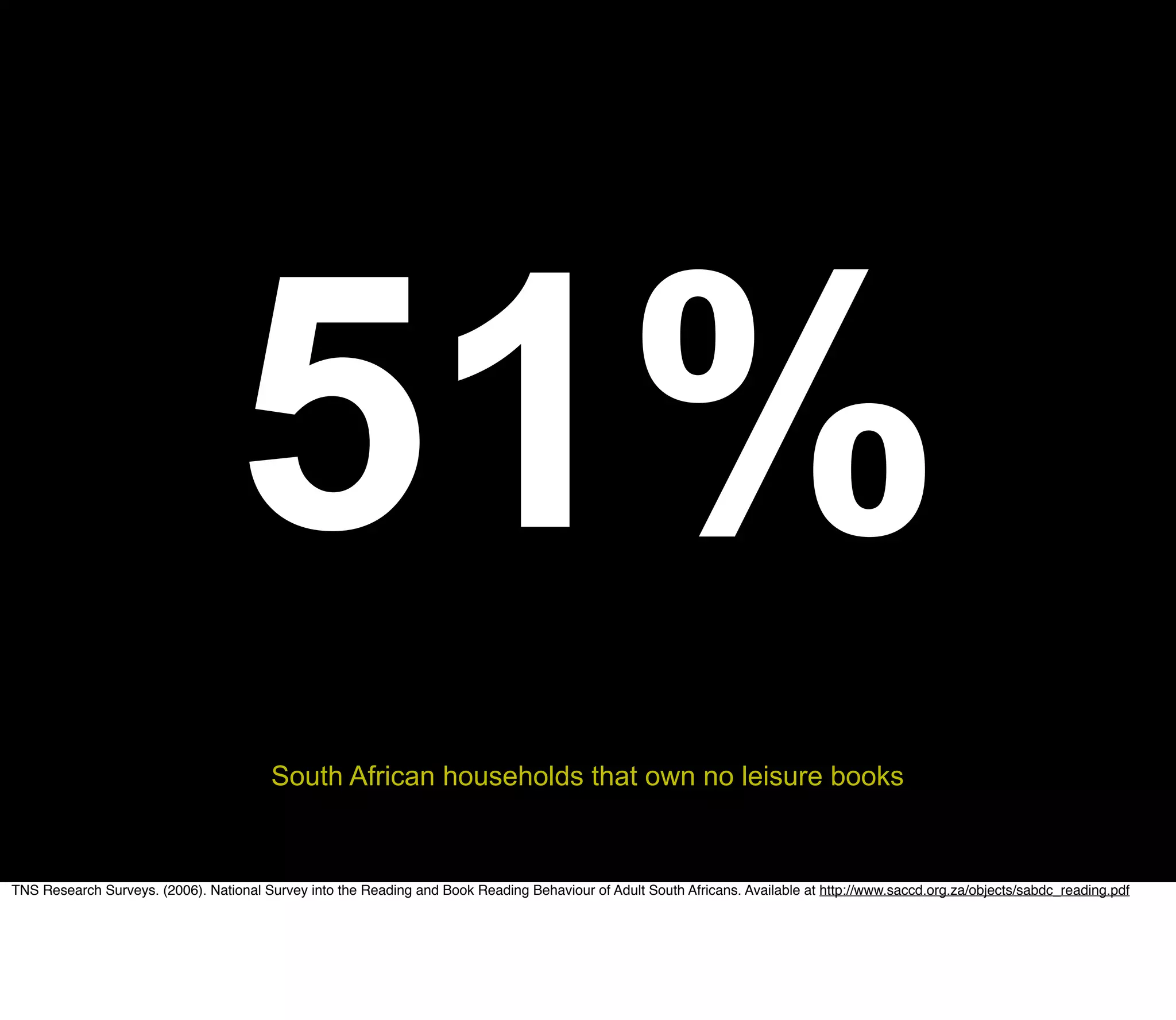
51%
                                         South African households that own no leisure books


TNS Research Surveys. (2006). National Survey into the Reading and Book Reading Behaviour of Adult South Africans. Available at http://www.saccd.org.za/objects/sabdc_reading.pdf
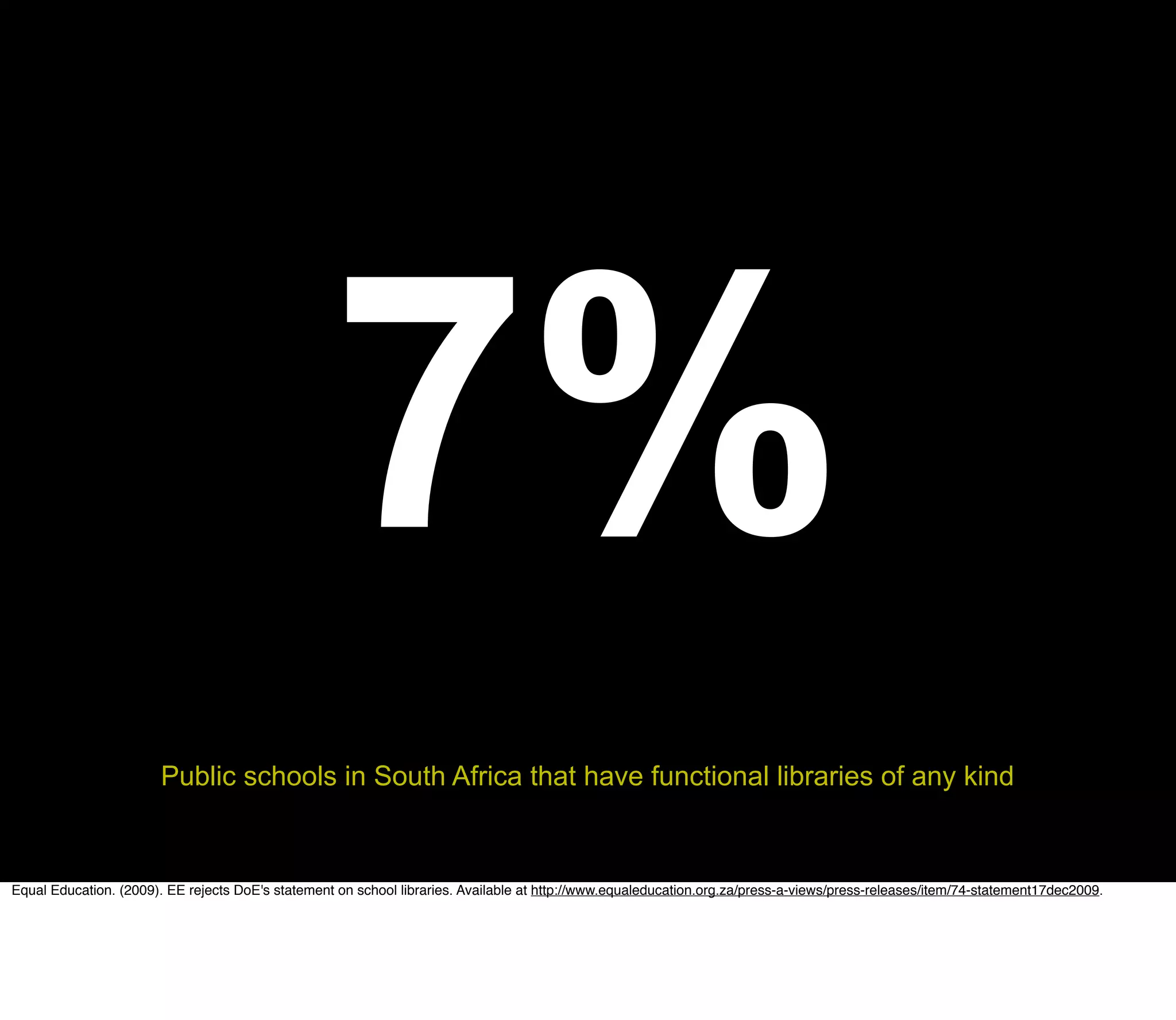
7%
                       Public schools in South Africa that have functional libraries of any kind


Equal Education. (2009). EE rejects DoE's statement on school libraries. Available at http://www.equaleducation.org.za/press-a-views/press-releases/item/74-statement17dec2009.
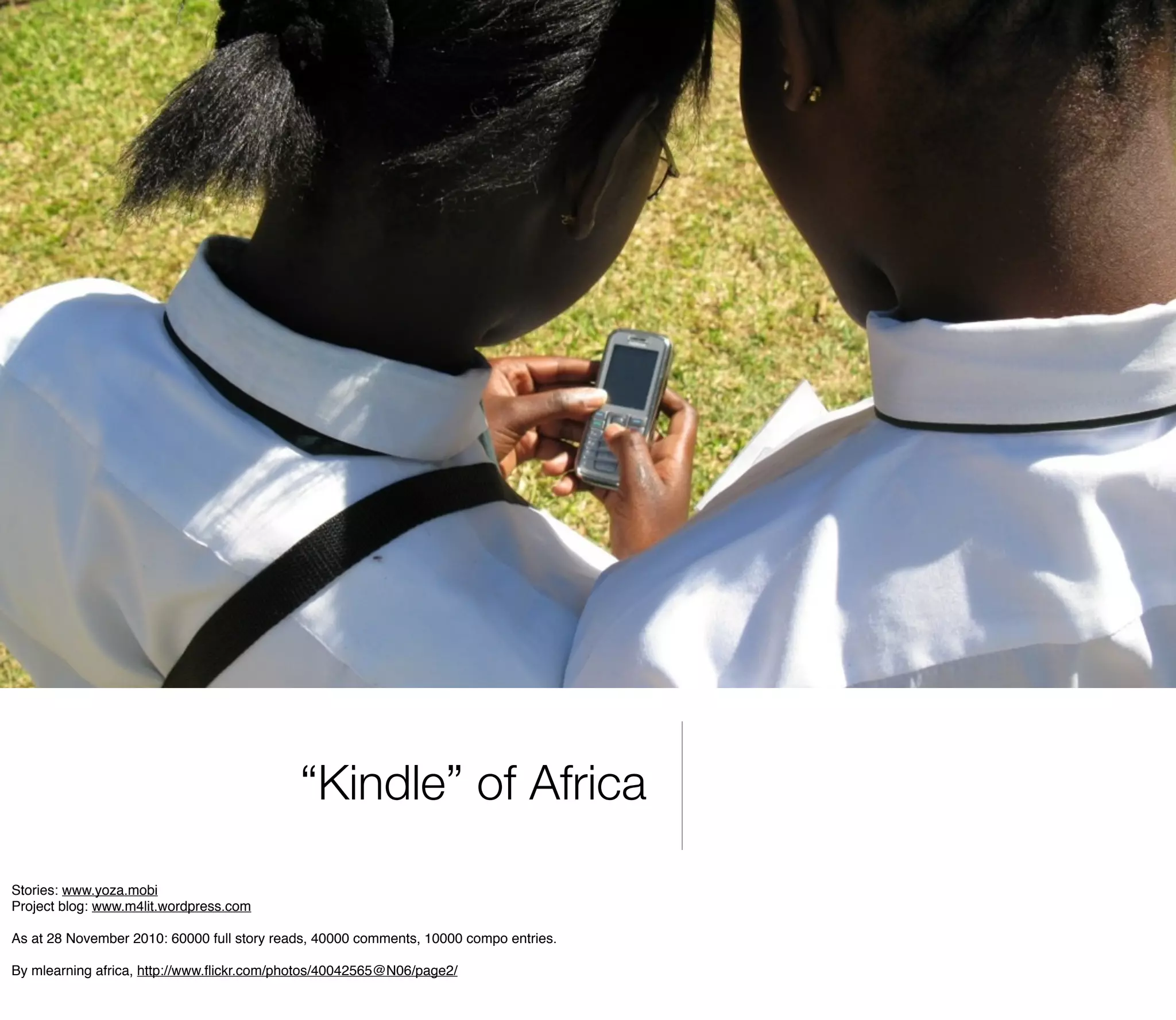
“Kindle” of Africa
Stories: www.yoza.mobi
Project blog: www.m4lit.wordpress.com

As at 28 November 2010: 60000 full story reads, 40000 comments, 10000 compo entries.

By mlearning africa, http://www.flickr.com/photos/40042565@N06/page2/
It's great ... for me it really hard to
pick up a book to start readin but i
don mind readin on my phone
dotty1
The stories r interesting nd fun 2
read, they kip ma englsh gng
Hlengiwe gulube
If friar's plan wrks, then romeo wil b
able 2 cum nd take juliet wit hm 2 liv
hapily 2geda at mantua bt if it fails,
sumbdy's gna b dead. Lol!
Elsie
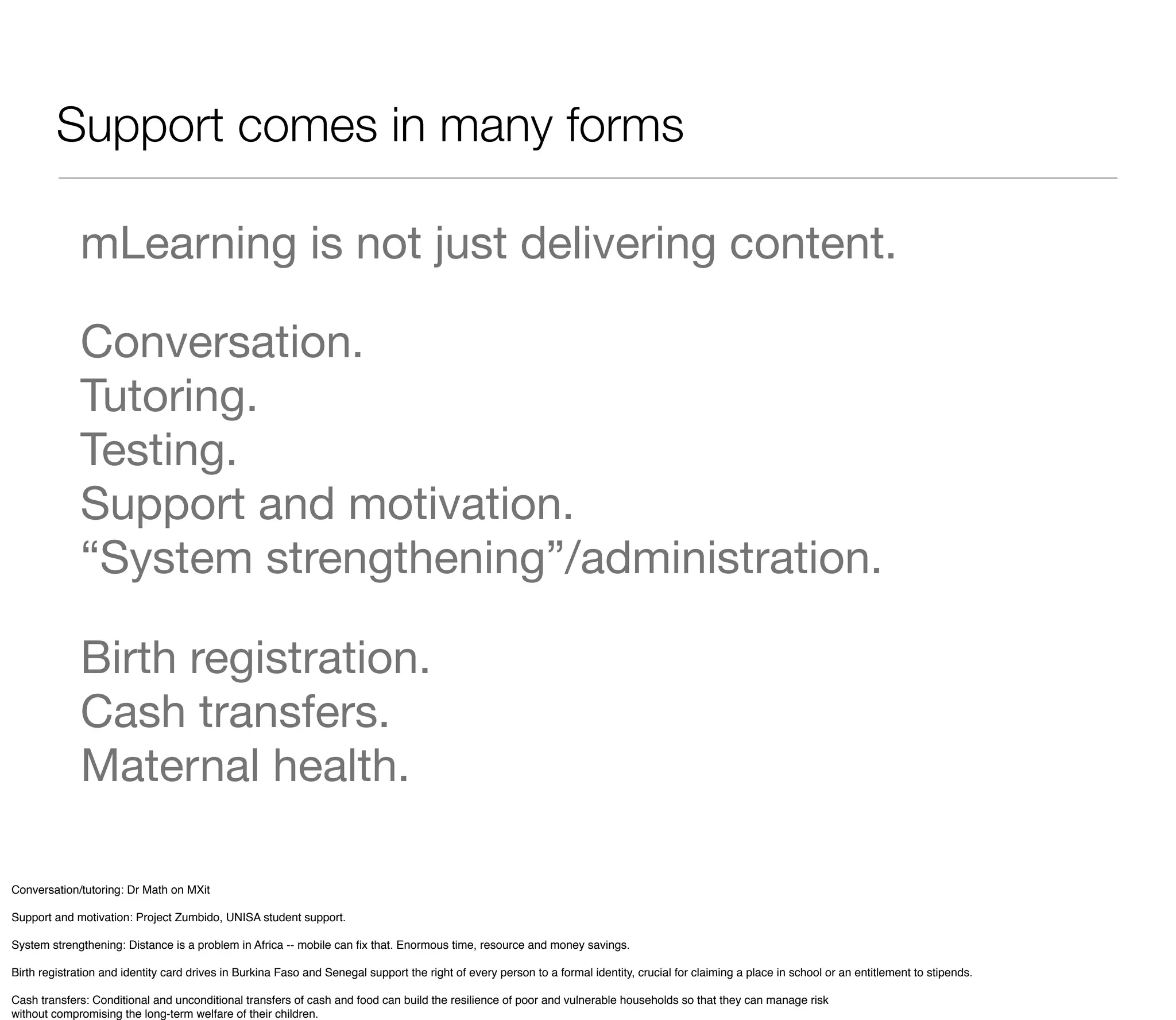
Support comes in many forms

              mLearning is not just delivering content.

              Conversation.
              Tutoring.
              Testing.
              Support and motivation.
              “System strengthening”/administration.

              Birth registration.
              Cash transfers.
              Maternal health.

Conversation/tutoring: Dr Math on MXit

Support and motivation: Project Zumbido, UNISA student support.

System strengthening: Distance is a problem in Africa -- mobile can fix that. Enormous time, resource and money savings.

Birth registration and identity card drives in Burkina Faso and Senegal support the right of every person to a formal identity, crucial for claiming a place in school or an entitlement to stipends.

Cash transfers: Conditional and unconditional transfers of cash and food can build the resilience of poor and vulnerable households so that they can manage risk
without compromising the long-term welfare of their children.
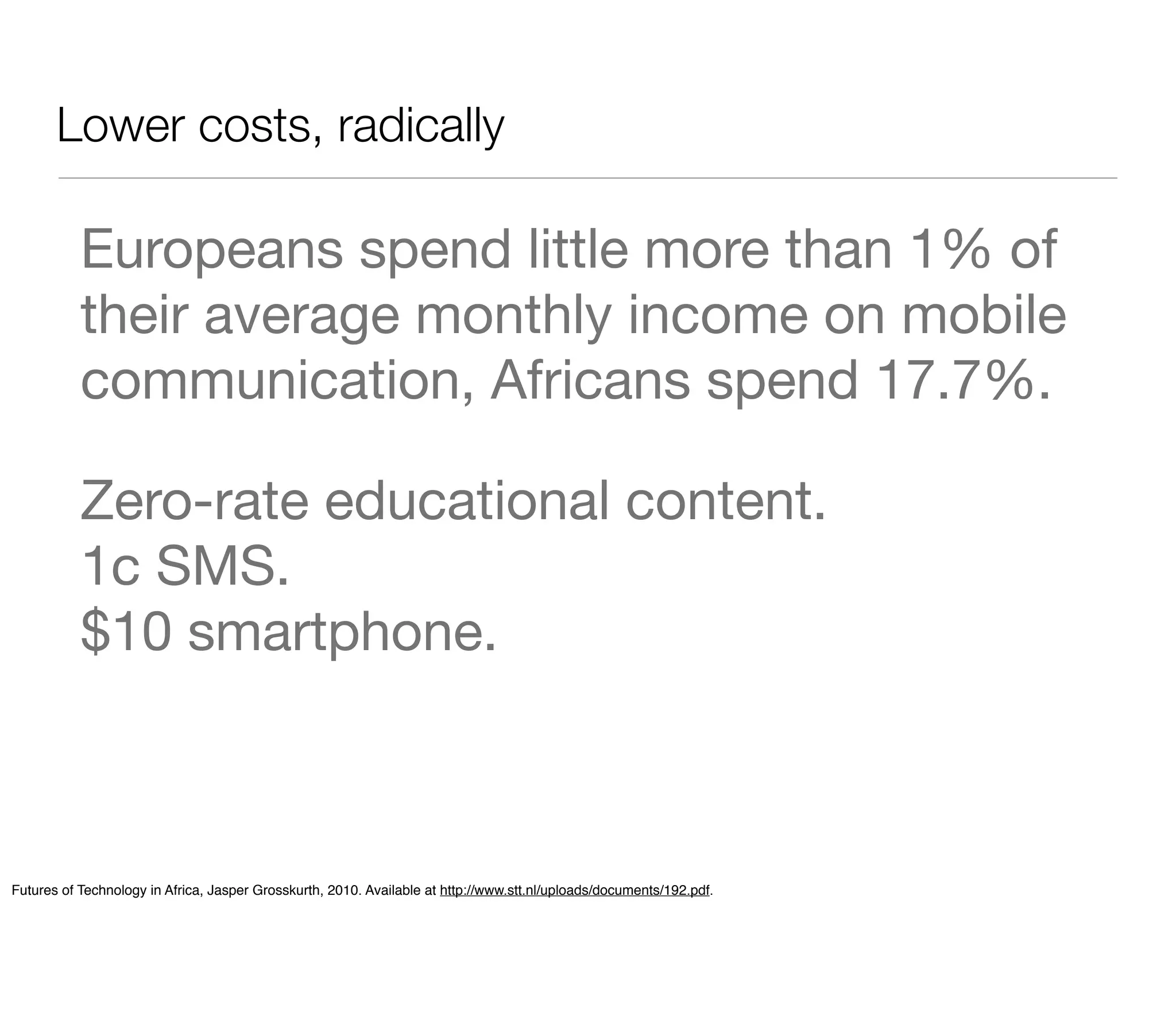
Lower costs, radically

           Europeans spend little more than 1% of
           their average monthly income on mobile
           communication, Africans spend 17.7%.

           Zero-rate educational content.
           1c SMS.
           $10 smartphone.


Futures of Technology in Africa, Jasper Grosskurth, 2010. Available at http://www.stt.nl/uploads/documents/192.pdf.
Mobile miracle meets EFA challenges:
          so where is all the mlearning?


Iʼve been using the same examples of mlearning for 3 years now. Why not more? Sometimes I feel like m-money and m-health and m-agriculture is doing more interesting and effective work
than mlearning?
mLearning needs to get serious

 Need policies that support mlearning.

 Buy-in at government as well as school
 level.

 Fresh thinking: support and disrupt
 existing educational structures.

 Address real problems.
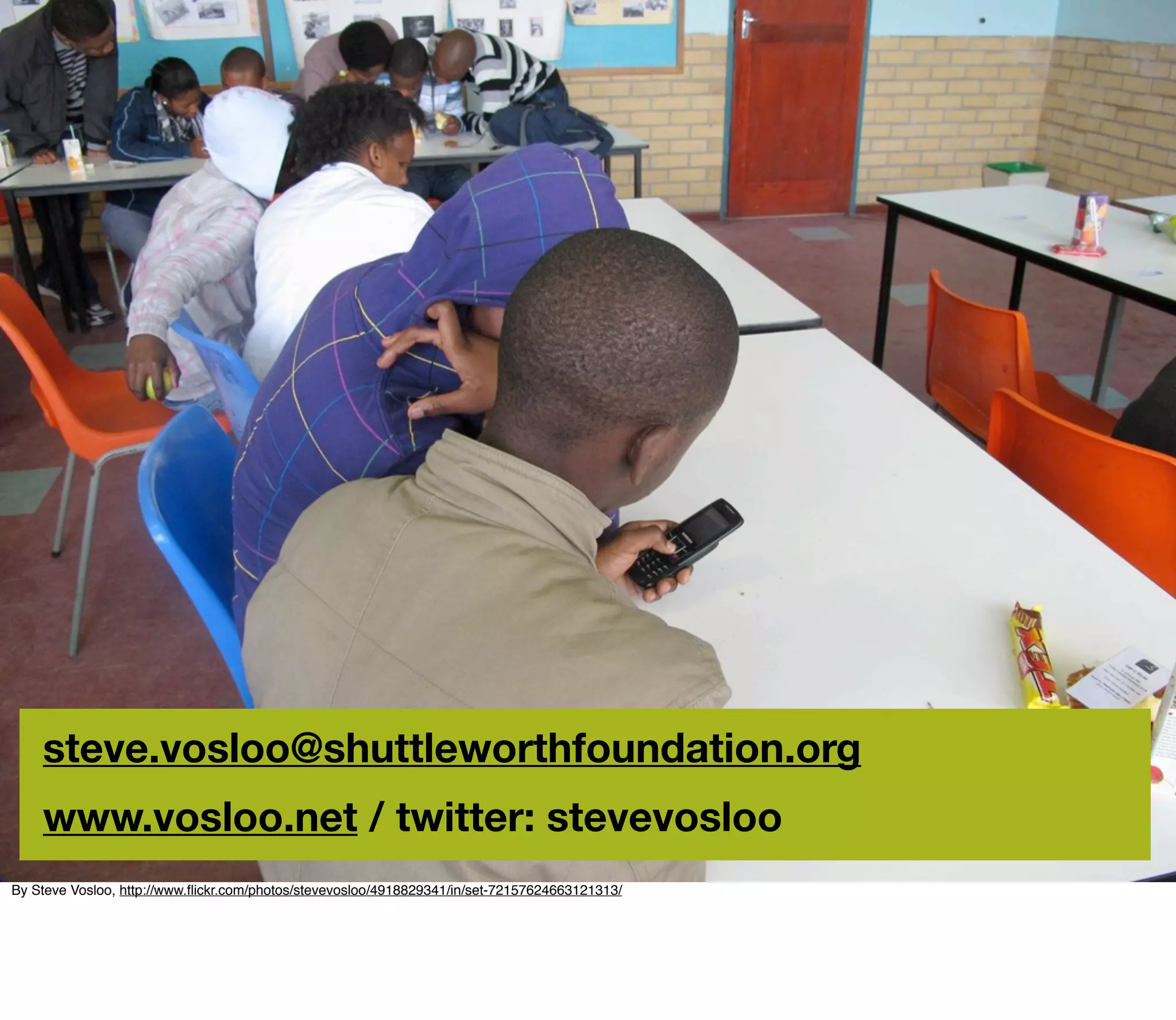
steve.vosloo@shuttleworthfoundation.org
    www.vosloo.net / twitter: stevevosloo
By Steve Vosloo, http://www.flickr.com/photos/stevevosloo/4918829341/in/set-72157624663121313/

Education for All mLearning presentation, Open Innovation Africa Summit

  • 1.
    Education for All OpenInnovation Africa Summit, Kenya Steve Vosloo 28 November 2010
  • 2.
    Roadmap Education for All:Progress and challenges Africa’s “mobile miracle” Mobile miracle meets EFA challenges
  • 3.
    Africa’s greatest resource? ByIrene2005, http://www.flickr.com/photos/irene2005/432311008/sizes/l/
  • 4.
    Africa’s greatest resource? ByIrene2005, http://www.flickr.com/photos/irene2005/432311008/sizes/l/
  • 5.
    Africa’s greatest resource? ByLead Beyond, http://www.flickr.com/photos/32493043@N00/3483997920/sizes/l/
  • 6.
    Education for All(EFA) Goal 1: Early childhood education. Goal 2: Primary education of good quality. Goal 3: Life-skills programmes. Goal 4: Adult literacy and basic and continuing education for all adults. Goal 5: Gender equality. Goal 6: Quality of education.
  • 7.
    Progress, but ... Sub-Saharan Africa has made significant progress since the Education for All goals were adopted. But ... overall the region lacks education access, quality and effectiveness. EFA Global Monitoring Report 2010: Regional overview of Sub-Saharan Africa http://unesdoc.unesco.org/images/0018/001865/186526E.pdf
  • 8.
    Universal primary education 32 million out of school. 59% will never enrol. How can we get them to school? Support them? Enable them? Think of them as a resource? EFA Global Monitoring Report 2010: Regional overview of Sub-Saharan Africa http://unesdoc.unesco.org/images/0018/001865/186526E.pdf Out-of-school population: 32 million in 2007. Yet the deficit remains large: one-quarter of the regionʼs primary school age children were out of school in 2007, and the region accounted for nearly 45% of the global out-of-school population. Some 59% of the out-of-school children in sub-Saharan Africa are likely never to enrol in school – the highest of any Education for All region.
  • 9.
    Youth and adultskills In countries such as Ethiopia, Malawi, Mozambique and Zambia, young people face about 5 years of reported inactivity before finding work. In Burundi, Cameroon, Kenya and Nigeria, youth with secondary and tertiary education have higher rates of unemployment than those with lower levels of attainment. What do they do in those 5 years? How do we support them as entrepreneurs? EFA Global Monitoring Report 2010: Regional overview of Sub-Saharan Africa http://unesdoc.unesco.org/images/0018/001865/186526E.pdf Almost two-thirds of population is under 25.
  • 10.
    Functional Illiteracy 38% of the adult population in sub- Saharan Africa, or 153 million adults, lack the basic literacy and numeracy skills needed in everyday life. How can we bring them into the innovation ecosystem? How can they be lifelong learners? EFA Global Monitoring Report 2010: Regional overview of Sub-Saharan Africa http://unesdoc.unesco.org/images/0018/001865/186526E.pdf
  • 11.
    Quality of education The average student in Botswana and Ghana stands alongside or below the poorest-performing 10% of students in higher-performing countries. Teacher qualifications and teaching quality below global standards. EFA Global Monitoring Report 2010: Regional overview of Sub-Saharan Africa http://unesdoc.unesco.org/images/0018/001865/186526E.pdf From Trends in International Mathematics and Science Study conducted in 2007 ...
  • 12.
    Chronic teacher shortage 2.4 million teachers needed by 2015. How can they be trained quickly? How can they be supported? How can we support schools if (when?) the required teachers aren’t found? EFA Global Monitoring Report 2010: Regional overview of Sub-Saharan Africa http://unesdoc.unesco.org/images/0018/001865/186526E.pdf
  • 13.
    Getting left behind Although more children from poor households have entered school in Malawi and Uganda since they abolished fees over a decade ago, half the households with children who have dropped out of school cite lack of money as the main problem. How we can help them? EFA Global Monitoring Report 2010: Regional overview of Sub-Saharan Africa http://unesdoc.unesco.org/images/0018/001865/186526E.pdf
  • 14.
    Africa’s “mobile miracle” Bythe end of 2010, there will be an estimated 5.3 billion mobile cellular subscriptions worldwide, including 940 million subscriptions to 3G services (Source: www.itu.int/ITU-D/ict/material/FactsFigures2010.pdf). Worldʼs fastest growing mobile market. Remember that in 1990, Norway had more landlines than the whole of Africa. Today, over 400 million subscribers in Africa. In Africa, mobile penetration rates will reach an estimated 41% at the end of 2010 (compared to 76% globally). This still leaves significant potential for growth as Africa is the region with the lowest penetration rate. Africaʼs 2010 Internet penetration stands at 9.6%, which is less than half that of the developing country mean estimate. (Source: Futures of Technology in Africa, Jasper Grosskurth, 2010. Available at http://www.stt.nl/uploads/documents/ 192.pdf) Image of mobile phone by ICT4D.at http://www.flickr.com/photos/ict4d/3000017623/sizes/l/
  • 15.
    Africa’s “mobile miracle”? Highly uneven landscape Although most African nations offer 3G at least somewhere, the landscape is highly uneven. As a rough estimate, about 2% of African phones could be classified as smartphones with user- friendly mobile web capabilities. Source: Futures of Technology in Africa, Jasper Grosskurth, 2010. Available at http://www.stt.nl/uploads/documents/192.pdf.
  • 16.
    "Most phones arevery cheap or secondhand devices, which hardly ever have usable airtime loaded on them. The primary purpose is to be reachable and not to be able to call others." Jasper Grosskurth, Futures of Technology in Africa Africa’s “mobile miracle”?
  • 17.
    Mobile miracle meetsEFA challenges
  • 18.
    51% South African households that own no leisure books TNS Research Surveys. (2006). National Survey into the Reading and Book Reading Behaviour of Adult South Africans. Available at http://www.saccd.org.za/objects/sabdc_reading.pdf
  • 19.
    7% Public schools in South Africa that have functional libraries of any kind Equal Education. (2009). EE rejects DoE's statement on school libraries. Available at http://www.equaleducation.org.za/press-a-views/press-releases/item/74-statement17dec2009.
  • 20.
    “Kindle” of Africa Stories:www.yoza.mobi Project blog: www.m4lit.wordpress.com As at 28 November 2010: 60000 full story reads, 40000 comments, 10000 compo entries. By mlearning africa, http://www.flickr.com/photos/40042565@N06/page2/
  • 21.
    It's great ...for me it really hard to pick up a book to start readin but i don mind readin on my phone dotty1
  • 22.
    The stories rinteresting nd fun 2 read, they kip ma englsh gng Hlengiwe gulube
  • 23.
    If friar's planwrks, then romeo wil b able 2 cum nd take juliet wit hm 2 liv hapily 2geda at mantua bt if it fails, sumbdy's gna b dead. Lol! Elsie
  • 24.
    Support comes inmany forms mLearning is not just delivering content. Conversation. Tutoring. Testing. Support and motivation. “System strengthening”/administration. Birth registration. Cash transfers. Maternal health. Conversation/tutoring: Dr Math on MXit Support and motivation: Project Zumbido, UNISA student support. System strengthening: Distance is a problem in Africa -- mobile can fix that. Enormous time, resource and money savings. Birth registration and identity card drives in Burkina Faso and Senegal support the right of every person to a formal identity, crucial for claiming a place in school or an entitlement to stipends. Cash transfers: Conditional and unconditional transfers of cash and food can build the resilience of poor and vulnerable households so that they can manage risk without compromising the long-term welfare of their children.
  • 25.
    Lower costs, radically Europeans spend little more than 1% of their average monthly income on mobile communication, Africans spend 17.7%. Zero-rate educational content. 1c SMS. $10 smartphone. Futures of Technology in Africa, Jasper Grosskurth, 2010. Available at http://www.stt.nl/uploads/documents/192.pdf.
  • 26.
    Mobile miracle meetsEFA challenges: so where is all the mlearning? Iʼve been using the same examples of mlearning for 3 years now. Why not more? Sometimes I feel like m-money and m-health and m-agriculture is doing more interesting and effective work than mlearning?
  • 27.
    mLearning needs toget serious Need policies that support mlearning. Buy-in at government as well as school level. Fresh thinking: support and disrupt existing educational structures. Address real problems.
  • 28.
    steve.vosloo@shuttleworthfoundation.org www.vosloo.net / twitter: stevevosloo By Steve Vosloo, http://www.flickr.com/photos/stevevosloo/4918829341/in/set-72157624663121313/