Carcass characteristics of
pasture vs. pen-fed meat goats

   S. G. Schoenian1*, J.W. Semler1, D. L. Gordon1,
           M.B. Bennett2, and D.J. O’Brien3

            1Universityof Maryland College Park
                  2West Virginia University

                 3Delaware State University
Background

• There is a lack of data
  pertaining to the
  performance, carcass
  characteristics, and
  economics of finishing
  meat goats in
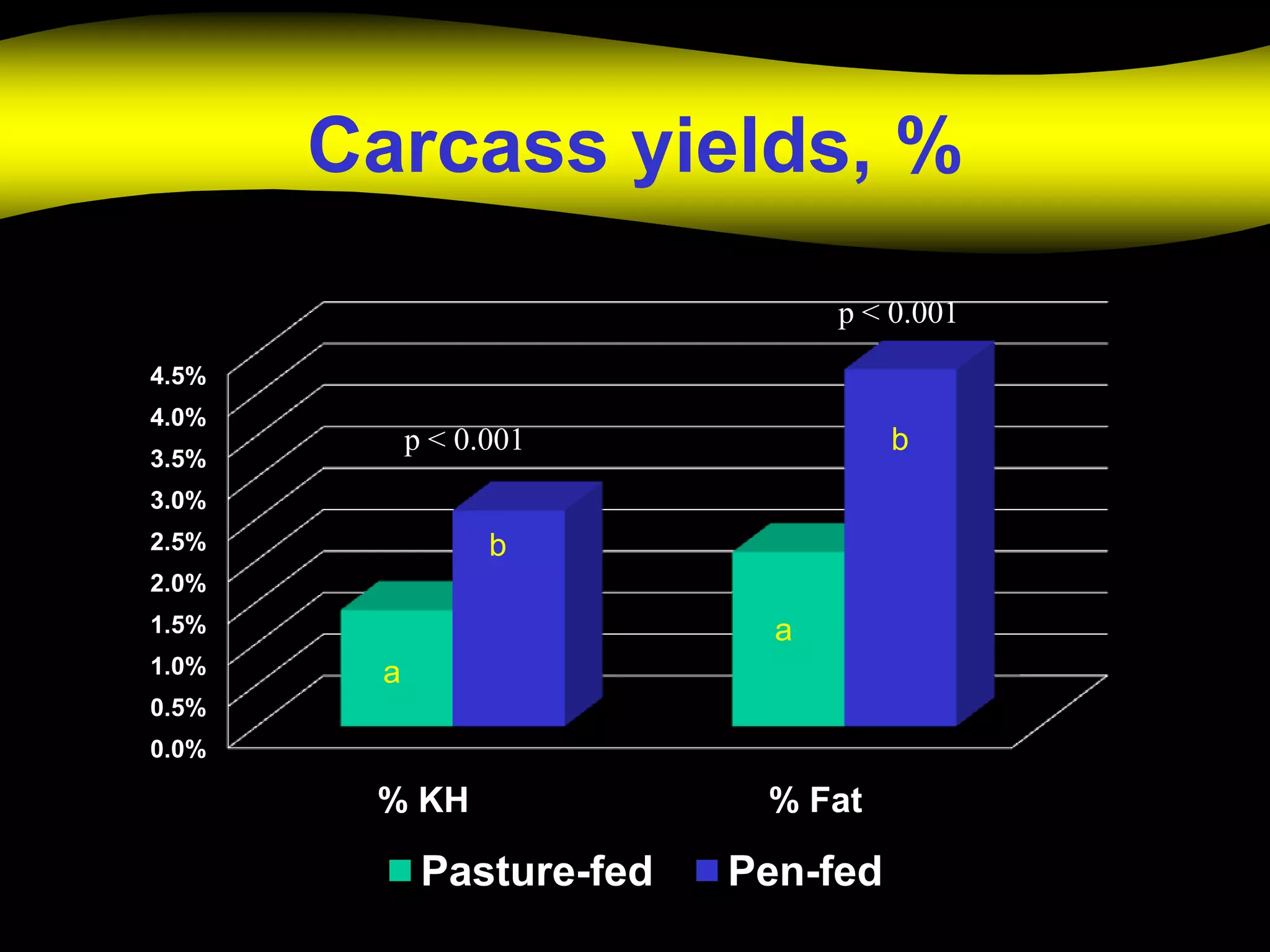
  different production
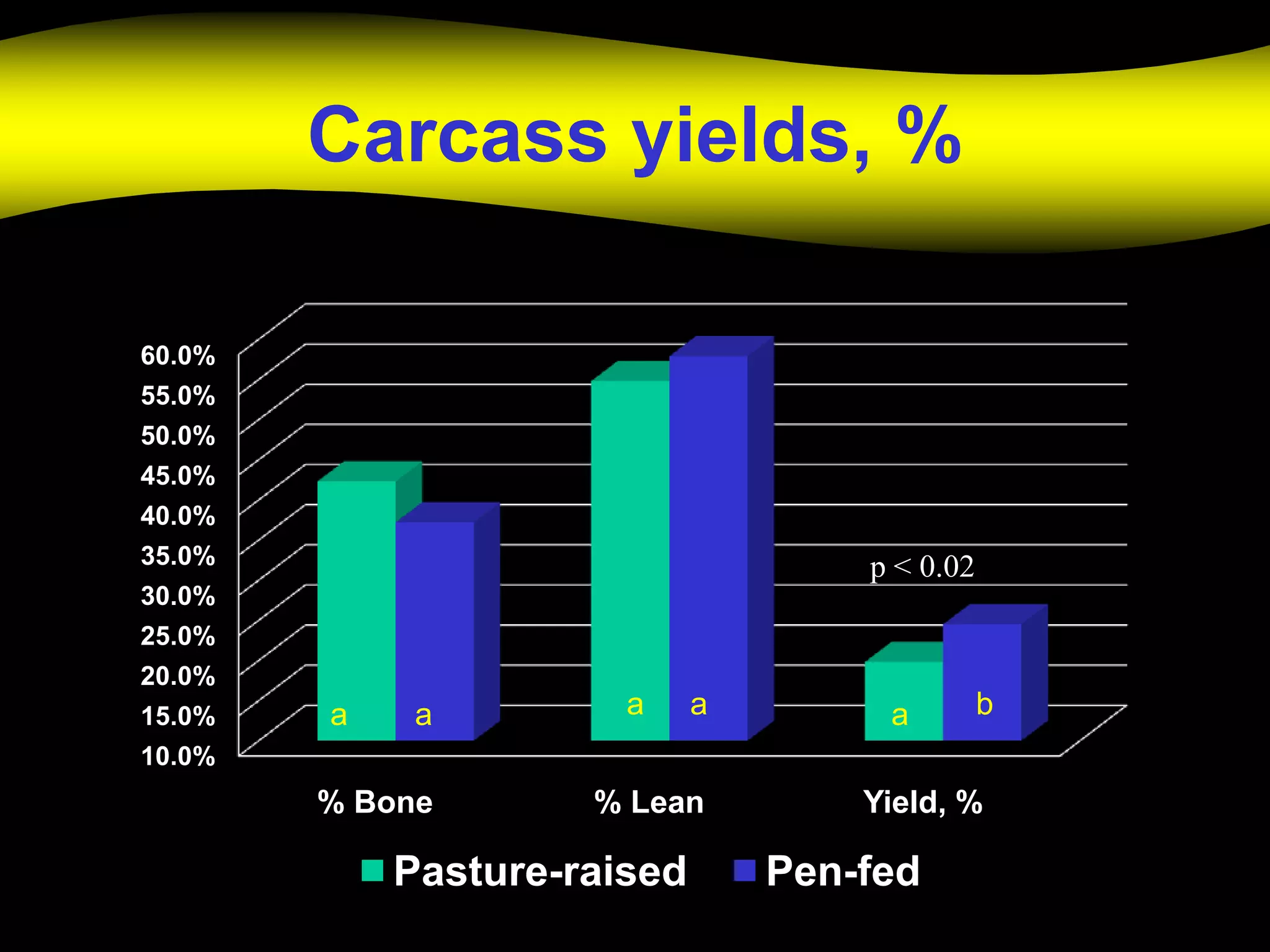
  systems.
Procedure

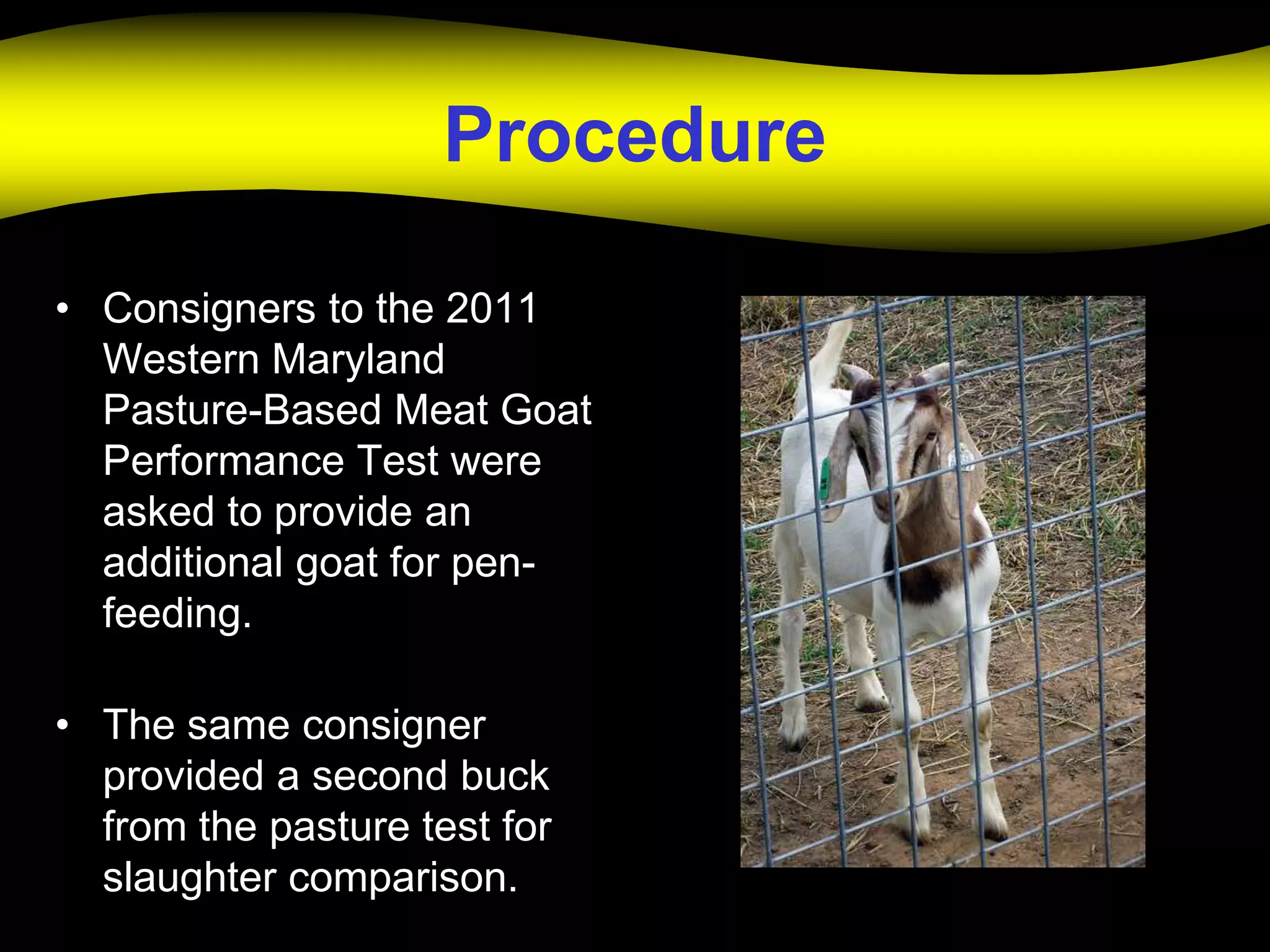
• Consigners to the 2011
  Western Maryland
  Pasture-Based Meat Goat
  Performance Test were
  asked to provide an
  additional goat for pen-
  feeding.

• The same consigner
  provided a second buck
  from the pasture test for
  slaughter comparison.
Procedure

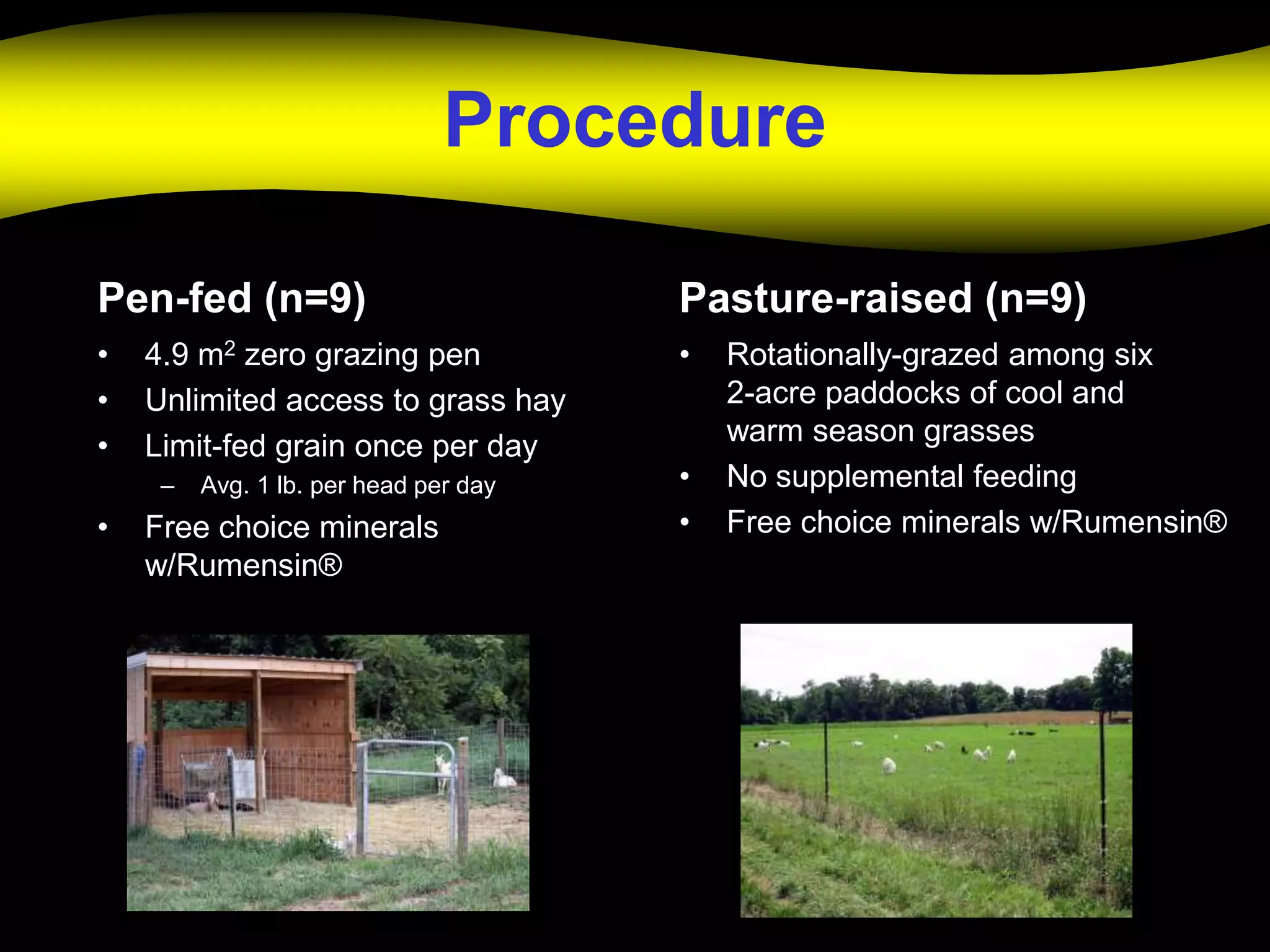
Pen-fed (n=9)                          Pasture-raised (n=9)
•   4.9 m2 zero grazing pen            •   Rotationally-grazed among six
•   Unlimited access to grass hay          2-acre paddocks of cool and
•   Limit-fed grain once per day           warm season grasses
     –   Avg. 1 lb. per head per day   •   No supplemental feeding
•   Free choice minerals               •   Free choice minerals w/Rumensin®
    w/Rumensin®
Data (6/10-9/15)

• Bi-weekly
  –   Body weights
  –   FAMACHA© scores
  –   Body condition scores
  –   Coat condition scores
  –   Dag scores
  –   Fecal egg counts
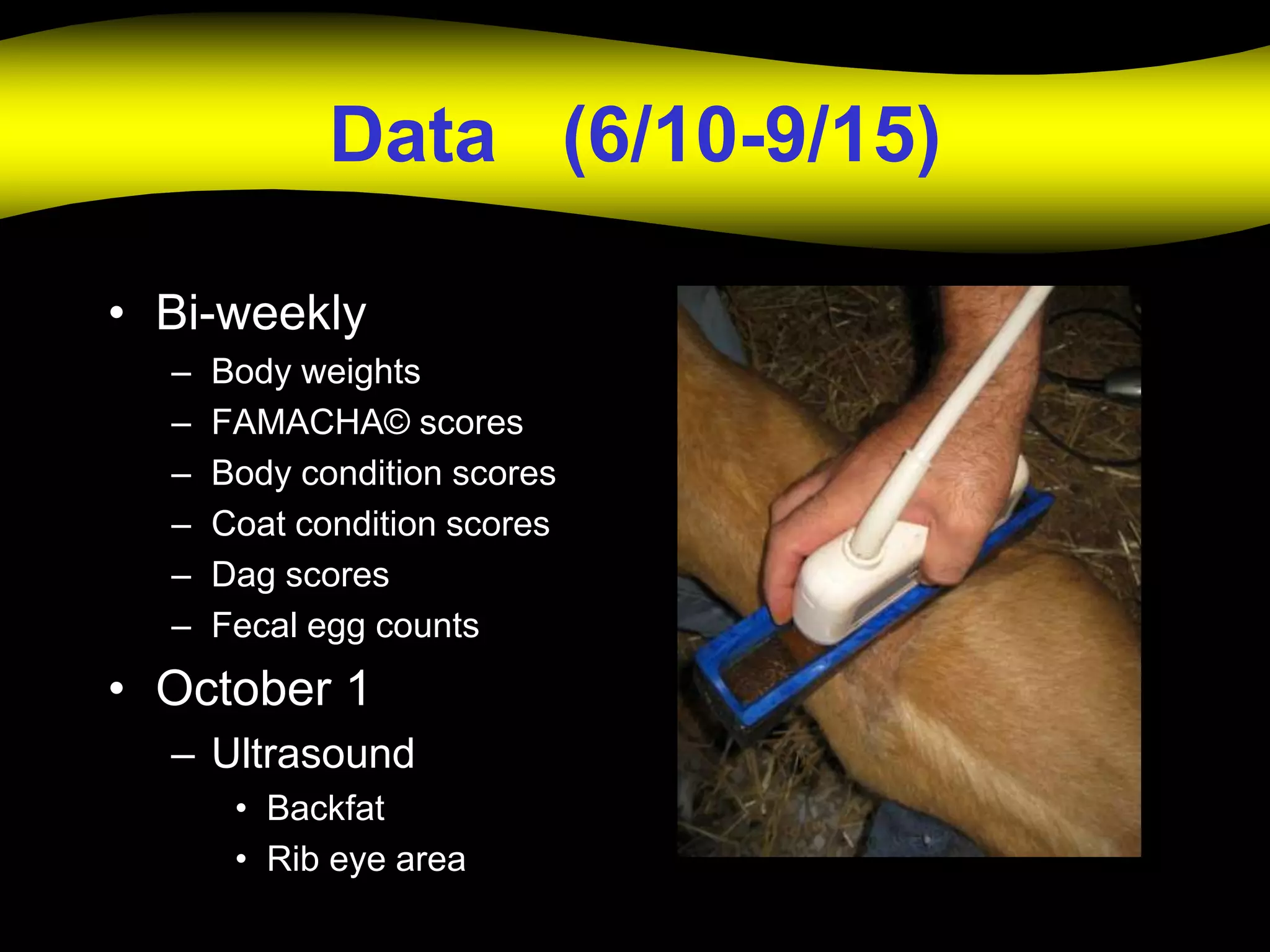
• October 1
  – Ultrasound
       • Backfat
       • Rib eye area
Procedures
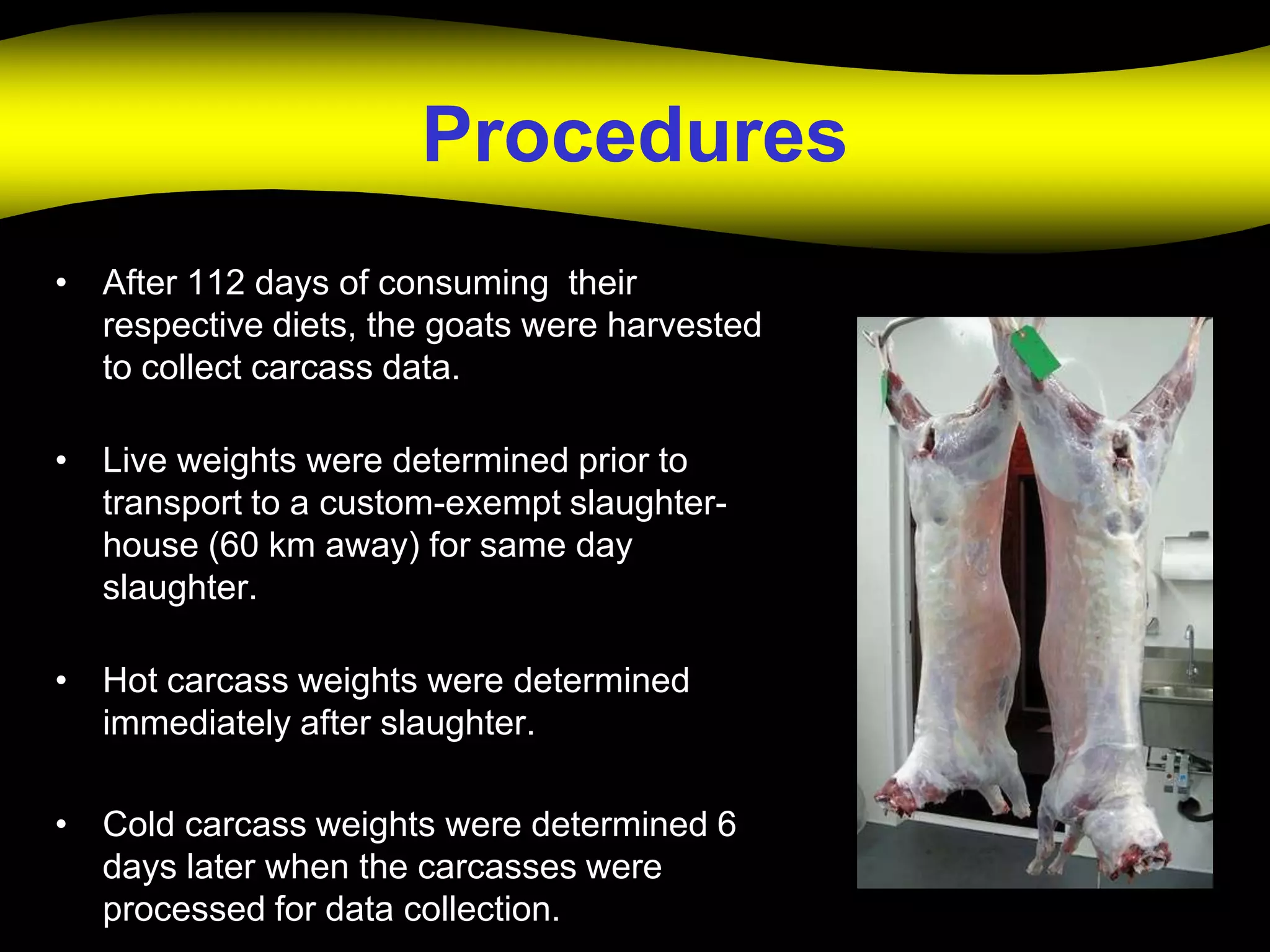
• After 112 days of consuming their
  respective diets, the goats were harvested
  to collect carcass data.

• Live weights were determined prior to
  transport to a custom-exempt slaughter-
  house (60 km away) for same day
  slaughter.

• Hot carcass weights were determined
  immediately after slaughter.

• Cold carcass weights were determined 6
  days later when the carcasses were
  processed for data collection.
Procedures
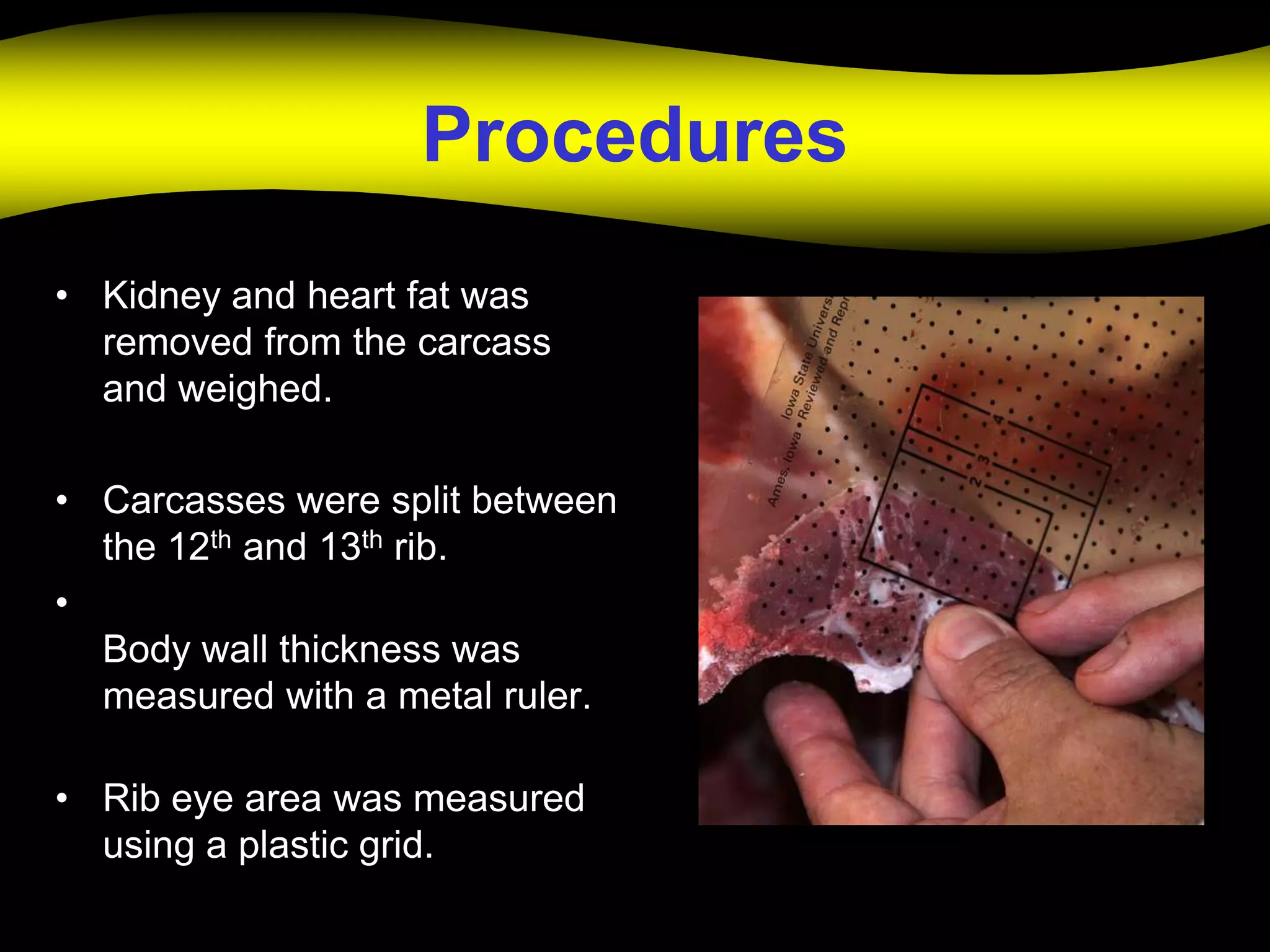
• Kidney and heart fat was
  removed from the carcass
  and weighed.

• Carcasses were split between
  the 12th and 13th rib.
•
  Body wall thickness was
  measured with a metal ruler.

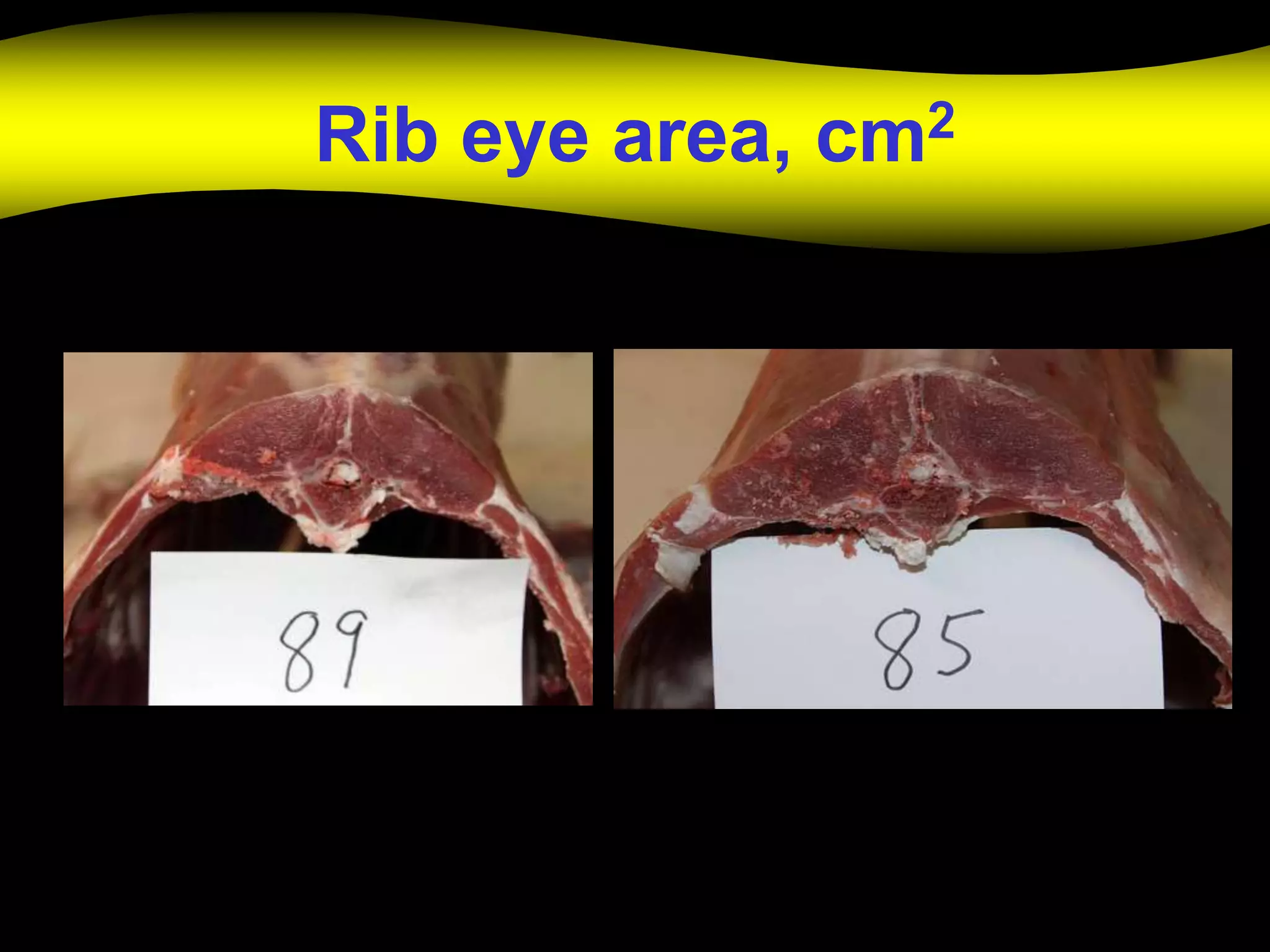
• Rib eye area was measured
  using a plastic grid.
Procedures

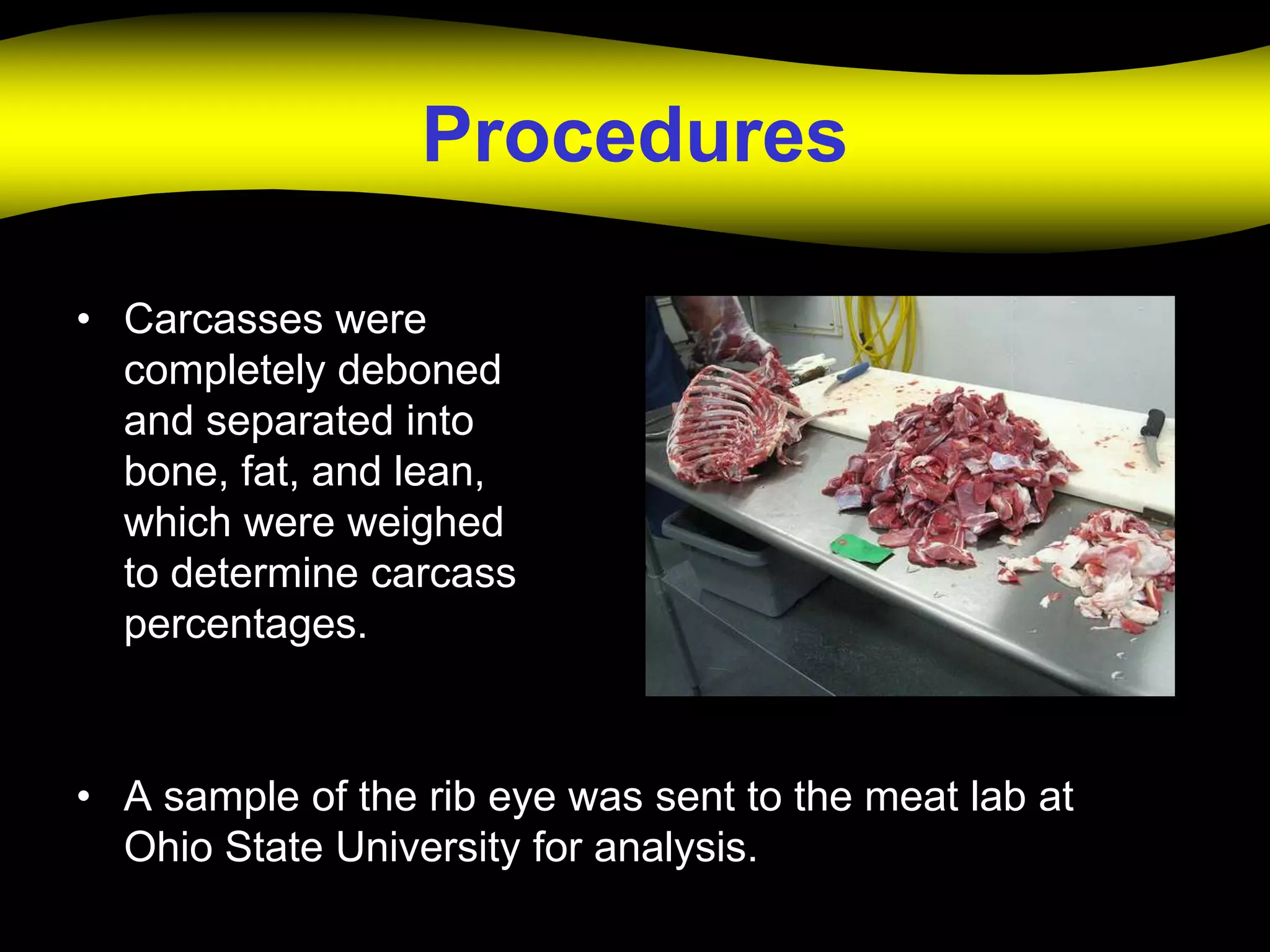
• Carcasses were
  completely deboned
  and separated into
  bone, fat, and lean,
  which were weighed
  to determine carcass
  percentages.


• A sample of the rib eye was sent to the meat lab at
  Ohio State University for analysis.
Data
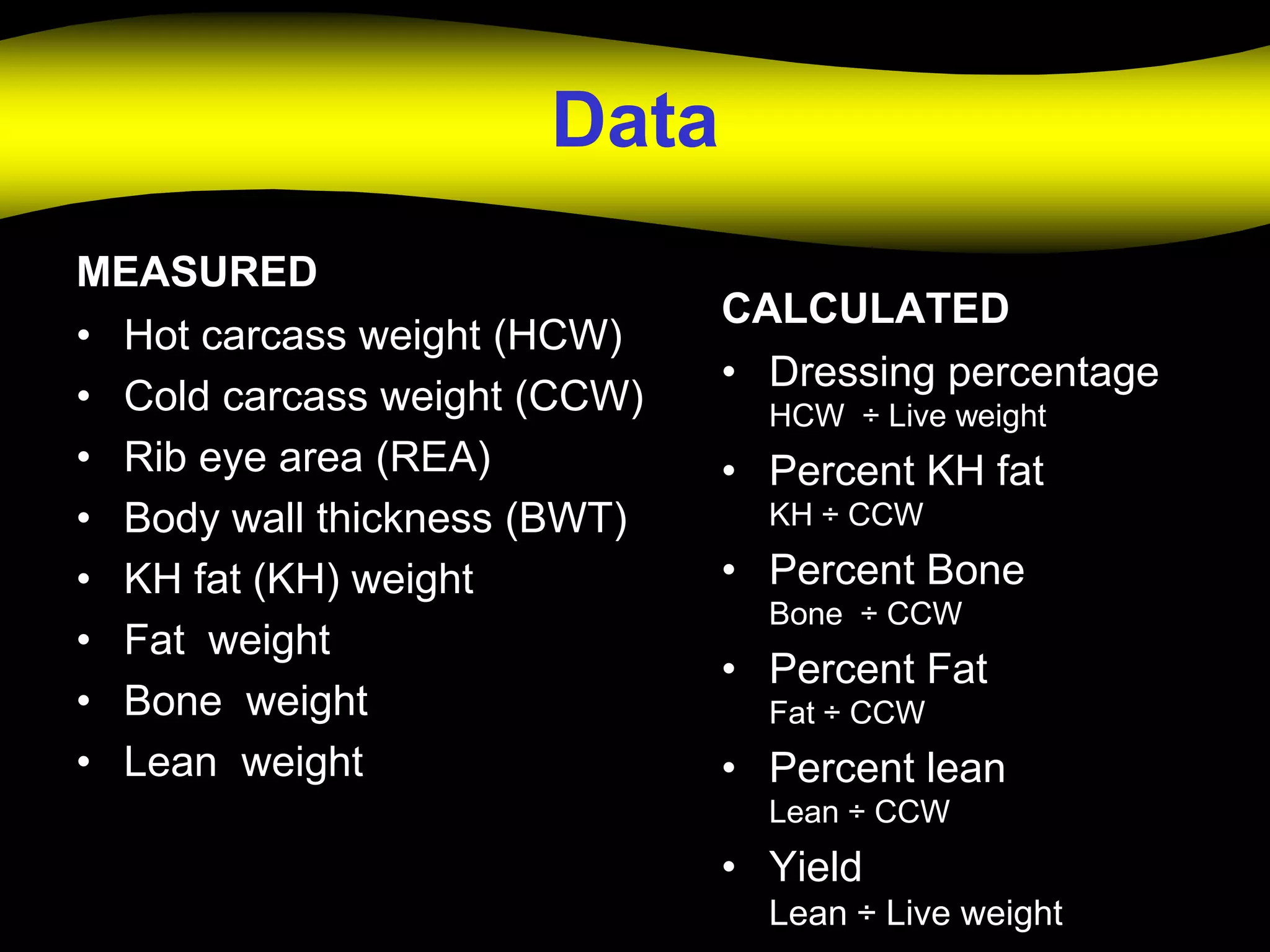
MEASURED
                              CALCULATED
• Hot carcass weight (HCW)
                              • Dressing percentage
• Cold carcass weight (CCW)     HCW ÷ Live weight
• Rib eye area (REA)          • Percent KH fat
• Body wall thickness (BWT)     KH ÷ CCW

• KH fat (KH) weight          • Percent Bone
                                Bone ÷ CCW
• Fat weight
                              • Percent Fat
• Bone weight                   Fat ÷ CCW
• Lean weight                 • Percent lean
                                Lean ÷ CCW
                              • Yield
                                Lean ÷ Live weight
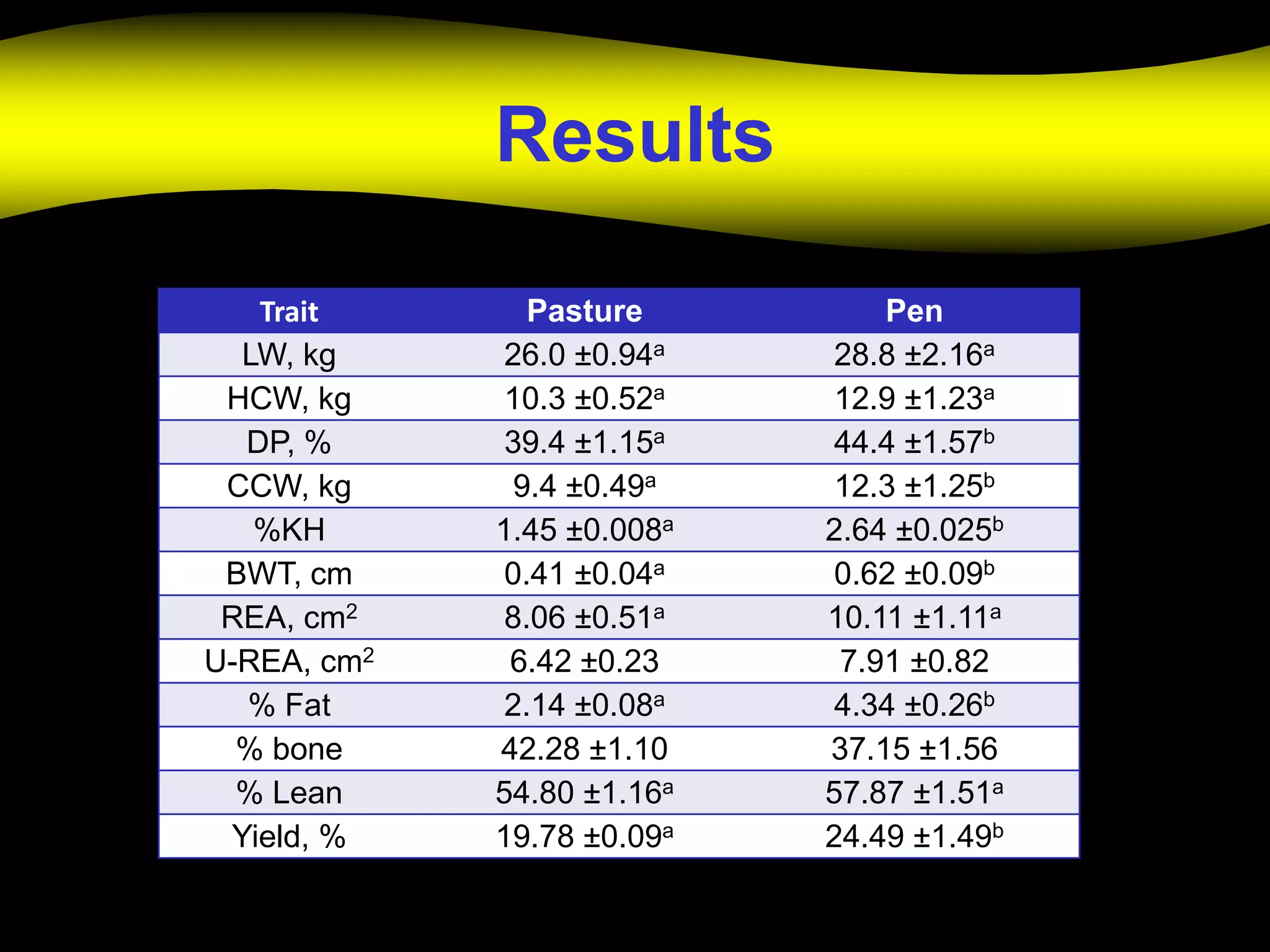
Results

   Trait        Pasture         Pen
  LW, kg      26.0 ±0.94a    28.8 ±2.16a
 HCW, kg      10.3 ±0.52a    12.9 ±1.23a
  DP, %       39.4 ±1.15a    44.4 ±1.57b
 CCW, kg       9.4 ±0.49a    12.3 ±1.25b
   %KH       1.45 ±0.008a   2.64 ±0.025b
 BWT, cm      0.41 ±0.04a    0.62 ±0.09b
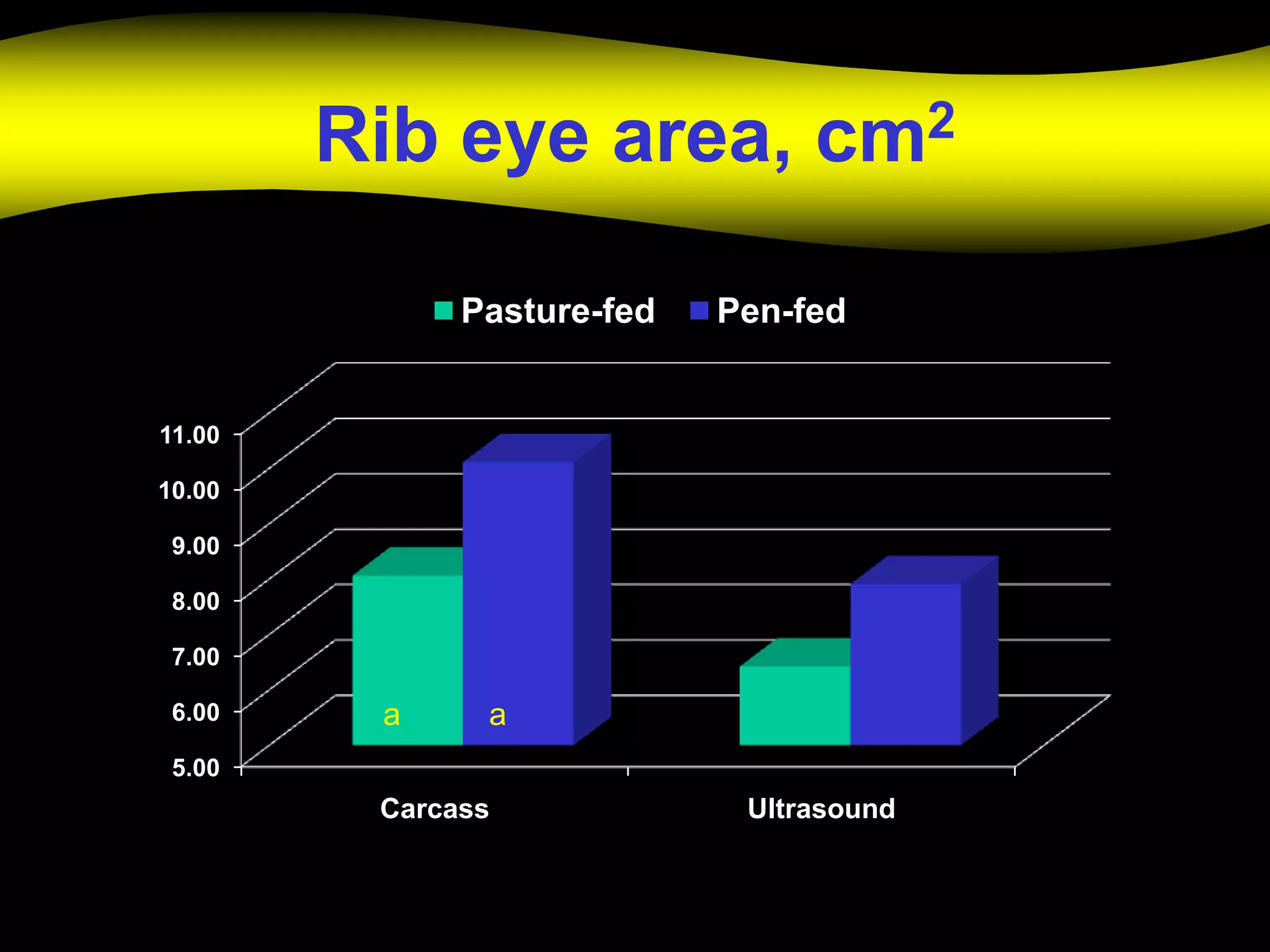
 REA, cm2     8.06 ±0.51a   10.11 ±1.11a
U-REA, cm2    6.42 ±0.23     7.91 ±0.82
  % Fat       2.14 ±0.08a    4.34 ±0.26b
  % bone     42.28 ±1.10    37.15 ±1.56
  % Lean     54.80 ±1.16a   57.87 ±1.51a
 Yield, %    19.78 ±0.09a   24.49 ±1.49b
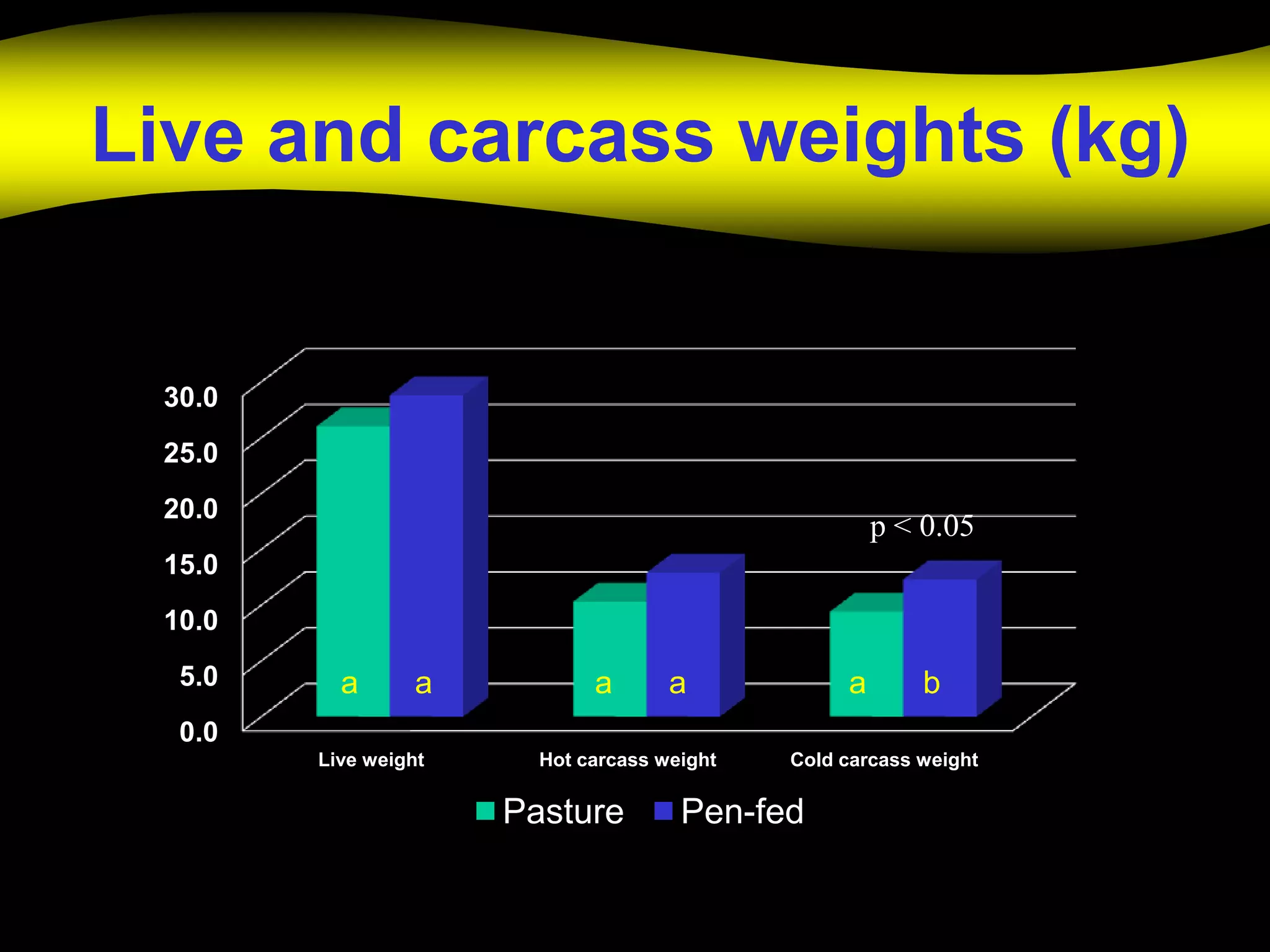
Live and carcass weights (kg)


 30.0
 25.0
 20.0
                                                      p < 0.05
 15.0
 10.0
  5.0     a       a          a       a            a       b
  0.0
        Live weight     Hot carcass weight   Cold carcass weight

                      Pasture         Pen-fed
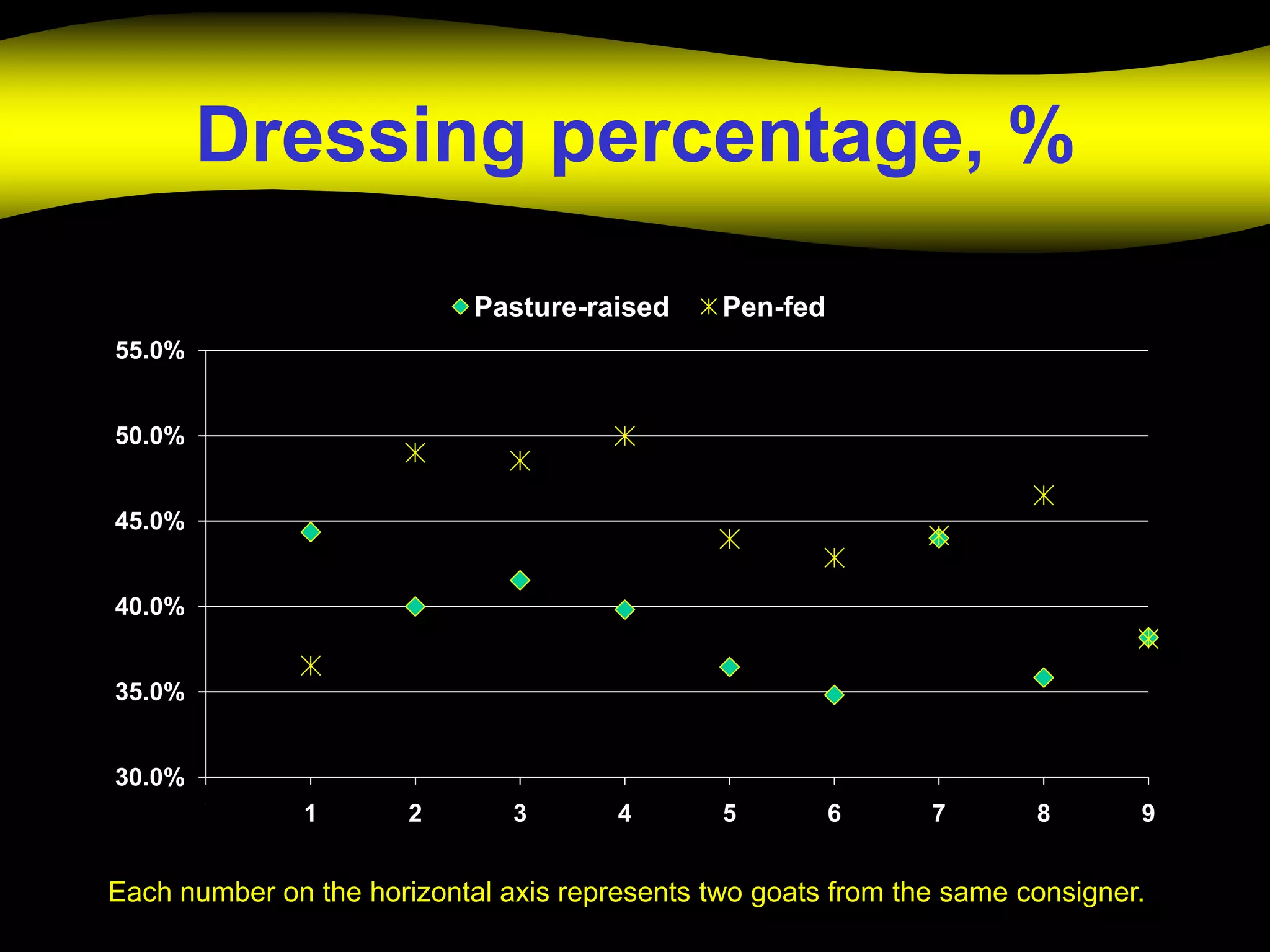
Dressing percentage, %
                            Pasture-raised     Pen-fed
55.0%


50.0%


45.0%


40.0%


35.0%


30.0%
        0      1       2       3       4       5         6     7       8       9


Each number on the horizontal axis represents two goats from the same consigner.
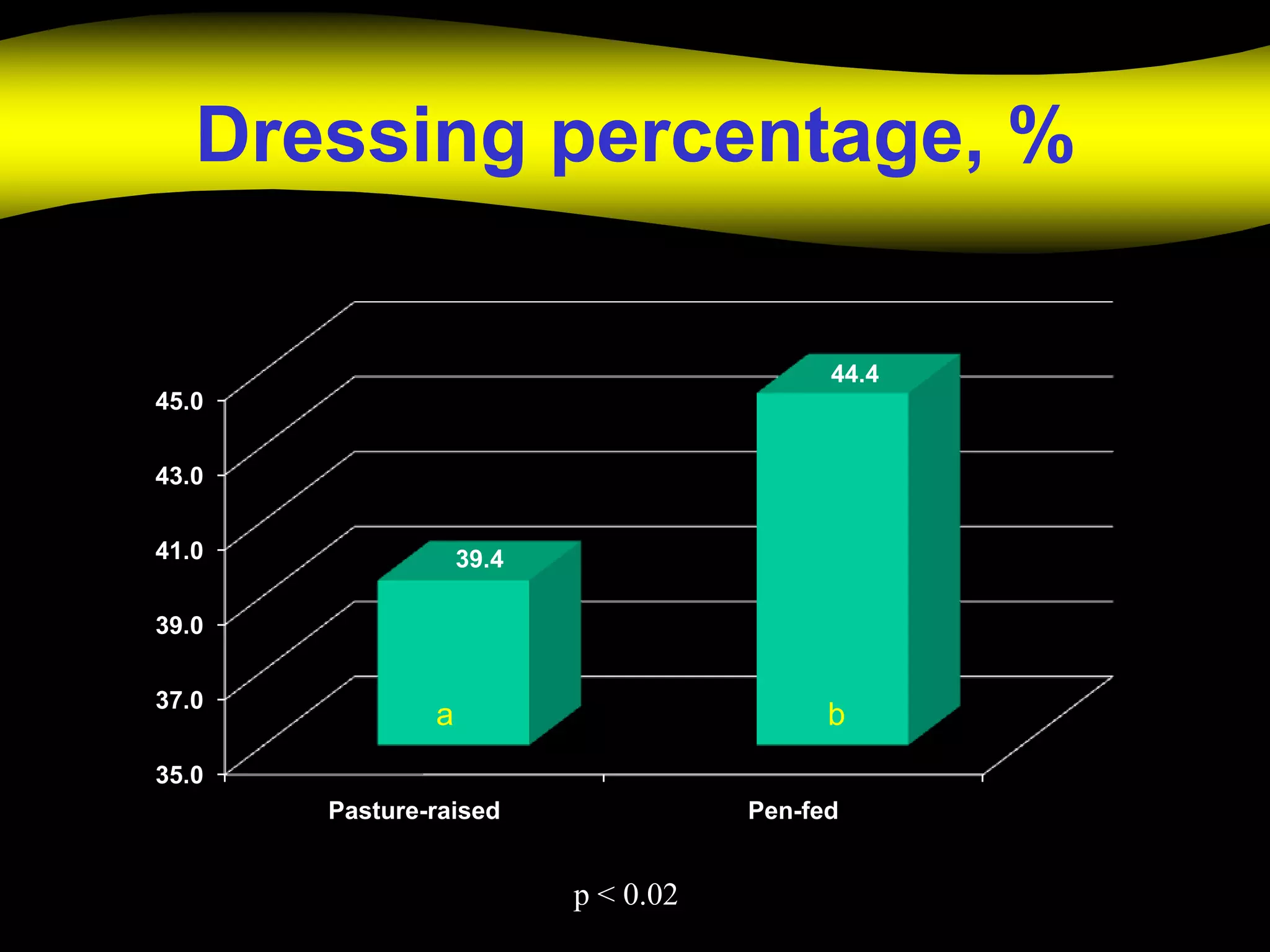
Dressing percentage, %

                                           44.4
45.0


43.0


41.0               39.4

39.0


37.0
               a                           b
35.0
       Pasture-raised                Pen-fed


                          p < 0.02
Carcass yields, %
                                 p < 0.001
4.5%
4.0%
            p < 0.001                b
3.5%
3.0%
2.5%              b
2.0%
1.5%                         a
1.0%    a
0.5%
0.0%

        % KH                % Fat

             Pasture-fed   Pen-fed
Carcass yields, %

60.0%
55.0%
50.0%
45.0%
40.0%
35.0%                                p < 0.02
30.0%
25.0%
20.0%
15.0%   a    a         a     a        a         b
10.0%
        % Bone       % Lean          Yield, %

            Pasture-raised       Pen-fed
Rib eye area, cm2
Rib eye area, cm2

              Pasture-fed   Pen-fed


11.00

10.00

 9.00

 8.00

 7.00

 6.00    a     a
 5.00
         Carcass             Ultrasound
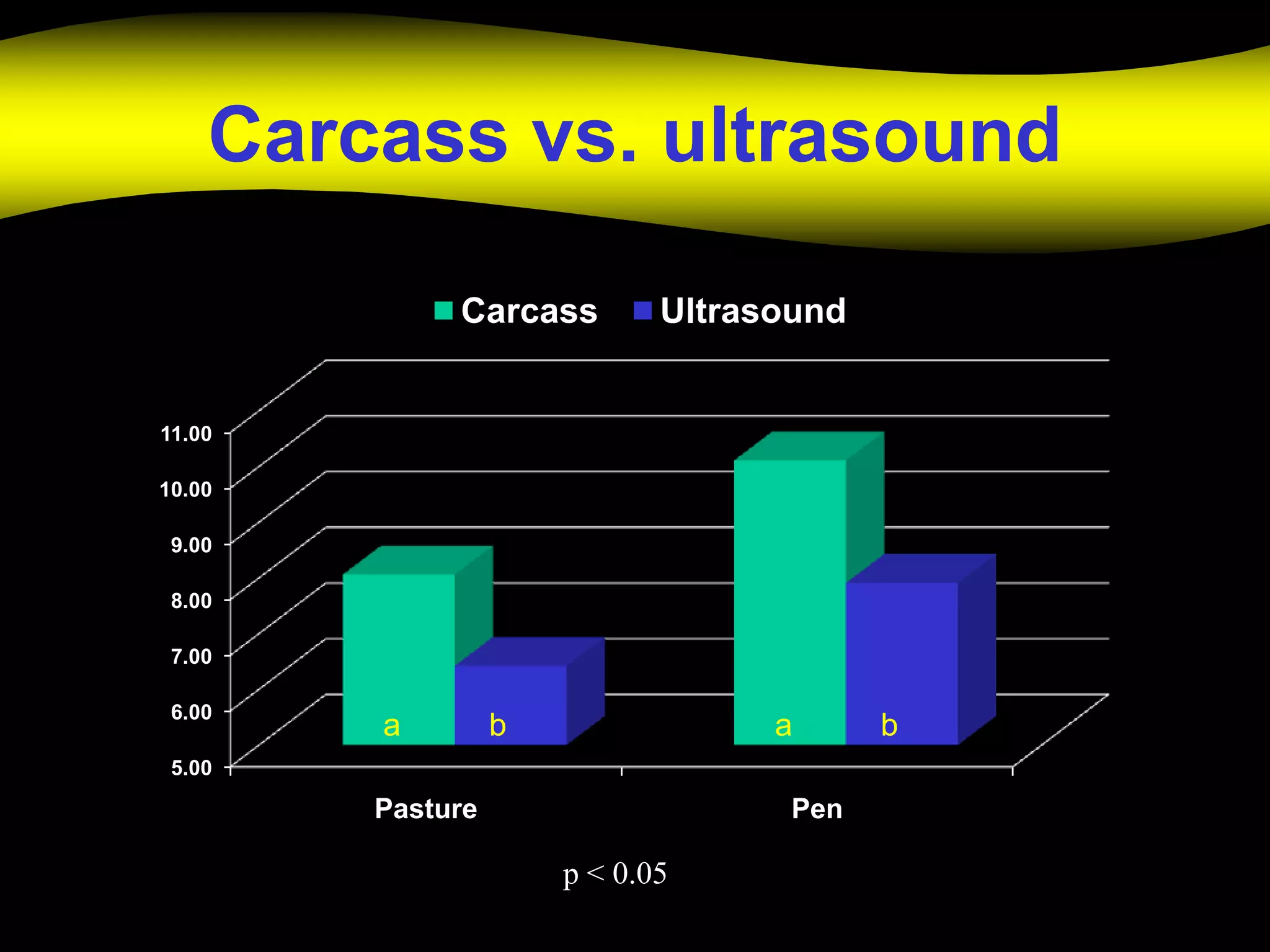
Carcass vs. ultrasound

             Carcass         Ultrasound


11.00

10.00

 9.00

 8.00

 7.00

 6.00
        a         b                a      b
 5.00

        Pasture                     Pen

                      p < 0.05
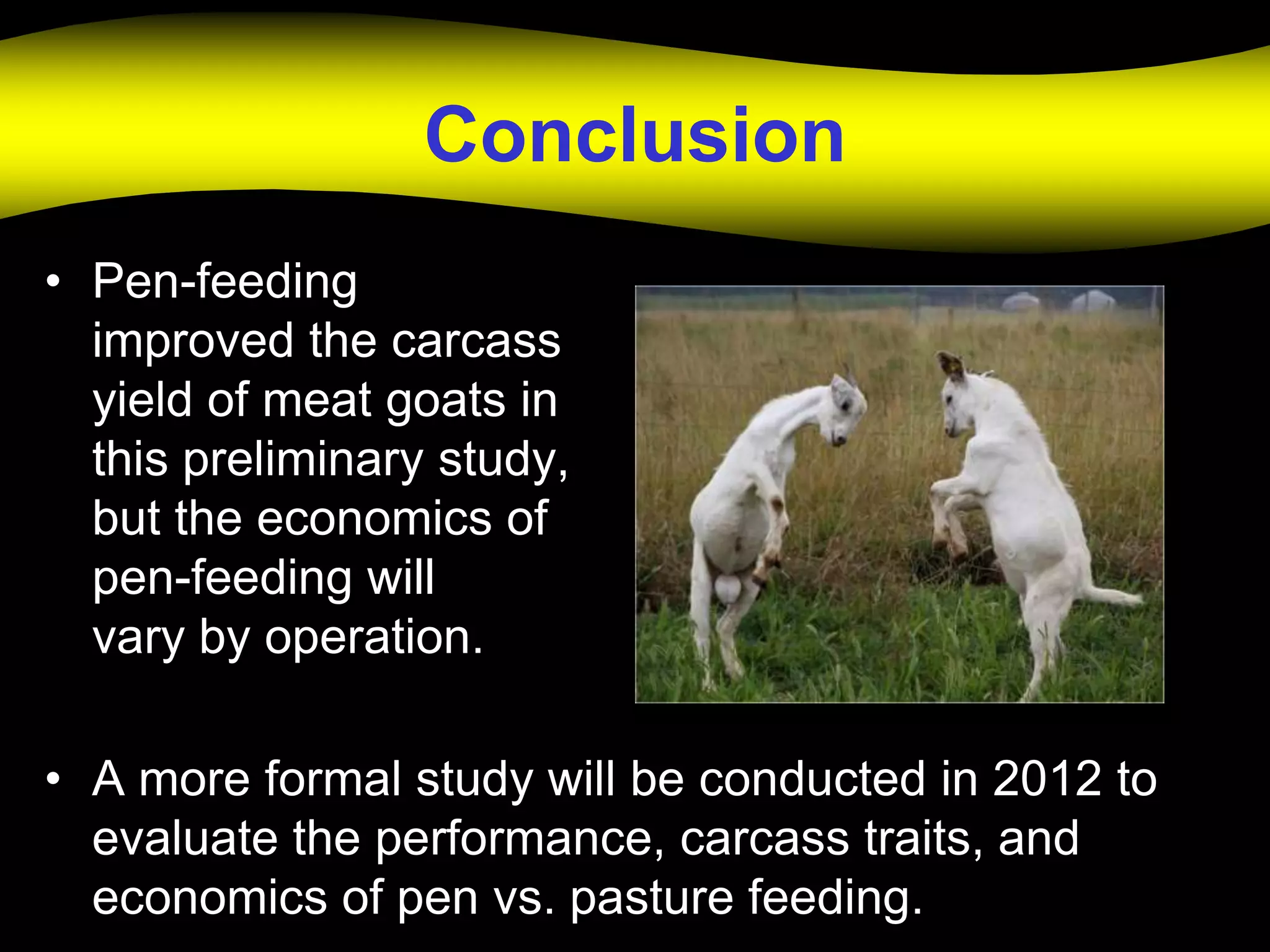
Conclusion
• Pen-feeding
  improved the carcass
  yield of meat goats in
  this preliminary study,
  but the economics of
  pen-feeding will
  vary by operation.

• A more formal study will be conducted in 2012 to
  evaluate the performance, carcass traits, and
  economics of pen vs. pasture feeding.
Thank you for your attention.

Pasture vs. pen-fed goats

  • 1.
    Carcass characteristics of pasturevs. pen-fed meat goats S. G. Schoenian1*, J.W. Semler1, D. L. Gordon1, M.B. Bennett2, and D.J. O’Brien3 1Universityof Maryland College Park 2West Virginia University 3Delaware State University
  • 2.
    Background • There isa lack of data pertaining to the performance, carcass characteristics, and economics of finishing meat goats in different production systems.
  • 3.
    Procedure • Consigners tothe 2011 Western Maryland Pasture-Based Meat Goat Performance Test were asked to provide an additional goat for pen- feeding. • The same consigner provided a second buck from the pasture test for slaughter comparison.
  • 4.
    Procedure Pen-fed (n=9) Pasture-raised (n=9) • 4.9 m2 zero grazing pen • Rotationally-grazed among six • Unlimited access to grass hay 2-acre paddocks of cool and • Limit-fed grain once per day warm season grasses – Avg. 1 lb. per head per day • No supplemental feeding • Free choice minerals • Free choice minerals w/Rumensin® w/Rumensin®
  • 5.
    Data (6/10-9/15) • Bi-weekly – Body weights – FAMACHA© scores – Body condition scores – Coat condition scores – Dag scores – Fecal egg counts • October 1 – Ultrasound • Backfat • Rib eye area
  • 6.
    Procedures • After 112days of consuming their respective diets, the goats were harvested to collect carcass data. • Live weights were determined prior to transport to a custom-exempt slaughter- house (60 km away) for same day slaughter. • Hot carcass weights were determined immediately after slaughter. • Cold carcass weights were determined 6 days later when the carcasses were processed for data collection.
  • 7.
    Procedures • Kidney andheart fat was removed from the carcass and weighed. • Carcasses were split between the 12th and 13th rib. • Body wall thickness was measured with a metal ruler. • Rib eye area was measured using a plastic grid.
  • 8.
    Procedures • Carcasses were completely deboned and separated into bone, fat, and lean, which were weighed to determine carcass percentages. • A sample of the rib eye was sent to the meat lab at Ohio State University for analysis.
  • 9.
    Data MEASURED CALCULATED • Hot carcass weight (HCW) • Dressing percentage • Cold carcass weight (CCW) HCW ÷ Live weight • Rib eye area (REA) • Percent KH fat • Body wall thickness (BWT) KH ÷ CCW • KH fat (KH) weight • Percent Bone Bone ÷ CCW • Fat weight • Percent Fat • Bone weight Fat ÷ CCW • Lean weight • Percent lean Lean ÷ CCW • Yield Lean ÷ Live weight
  • 10.
    Results Trait Pasture Pen LW, kg 26.0 ±0.94a 28.8 ±2.16a HCW, kg 10.3 ±0.52a 12.9 ±1.23a DP, % 39.4 ±1.15a 44.4 ±1.57b CCW, kg 9.4 ±0.49a 12.3 ±1.25b %KH 1.45 ±0.008a 2.64 ±0.025b BWT, cm 0.41 ±0.04a 0.62 ±0.09b REA, cm2 8.06 ±0.51a 10.11 ±1.11a U-REA, cm2 6.42 ±0.23 7.91 ±0.82 % Fat 2.14 ±0.08a 4.34 ±0.26b % bone 42.28 ±1.10 37.15 ±1.56 % Lean 54.80 ±1.16a 57.87 ±1.51a Yield, % 19.78 ±0.09a 24.49 ±1.49b
  • 11.
    Live and carcassweights (kg) 30.0 25.0 20.0 p < 0.05 15.0 10.0 5.0 a a a a a b 0.0 Live weight Hot carcass weight Cold carcass weight Pasture Pen-fed
  • 12.
    Dressing percentage, % Pasture-raised Pen-fed 55.0% 50.0% 45.0% 40.0% 35.0% 30.0% 0 1 2 3 4 5 6 7 8 9 Each number on the horizontal axis represents two goats from the same consigner.
  • 13.
    Dressing percentage, % 44.4 45.0 43.0 41.0 39.4 39.0 37.0 a b 35.0 Pasture-raised Pen-fed p < 0.02
  • 14.
    Carcass yields, % p < 0.001 4.5% 4.0% p < 0.001 b 3.5% 3.0% 2.5% b 2.0% 1.5% a 1.0% a 0.5% 0.0% % KH % Fat Pasture-fed Pen-fed
  • 15.
    Carcass yields, % 60.0% 55.0% 50.0% 45.0% 40.0% 35.0% p < 0.02 30.0% 25.0% 20.0% 15.0% a a a a a b 10.0% % Bone % Lean Yield, % Pasture-raised Pen-fed
  • 16.
  • 17.
    Rib eye area,cm2 Pasture-fed Pen-fed 11.00 10.00 9.00 8.00 7.00 6.00 a a 5.00 Carcass Ultrasound
  • 18.
    Carcass vs. ultrasound Carcass Ultrasound 11.00 10.00 9.00 8.00 7.00 6.00 a b a b 5.00 Pasture Pen p < 0.05
  • 19.
    Conclusion • Pen-feeding improved the carcass yield of meat goats in this preliminary study, but the economics of pen-feeding will vary by operation. • A more formal study will be conducted in 2012 to evaluate the performance, carcass traits, and economics of pen vs. pasture feeding.
  • 20.
    Thank you foryour attention.