Trends & Changing
R&D Needs in Blade
Technology
Anurag Gupta, Ph.D.
Innovation Architect, Technology & Service Solutions
Vestas Wind Systems A/S
Aug 30, 2016
VestasInnovation & ConceptDevelopment 1
An underlying theme: “INDUSTRIALIZATION”
• Mature, fact- and first-principles driven basis… elimination of uncertainties
• Commonality of standards/methods… accelerated collaboration, many foundational and pre-
competitive fields
• Driving full exploitation of the learning curve… can we brake the up-scaling freight train AND drive
LCOE to grid parity?
NB: Given expertise in rest of panel, I will not go into details on Materials, manufacturing etc
Introduction
About me, and a theme for today…
• Aero, Design & CFD trained; worked on hypersonics, rotorcraft, aircraft engines, gas turbines and of
course, wind turbines. Moved to Vestas in 2011 from GE, working on Rotor Systems; now enjoying
new concept development and (with a process hat), doing adv. technology roadmaps/programs for
Vestas.
VestasInnovation & Concept Development 2
OTHER DRIVERS/NEEDS
• Surface Engineering becoming important: Next level of capability and consistency needed
Erosion protection as tip speeds go up; Understanding from t=0 to t=20 yrs, Service and Performance
Optimization needs; new markets with sand, dust
• Next-gen turbine and blade architectures: Is it time to revisit ?
Starting thoughts
3
Drivers, specific vectors
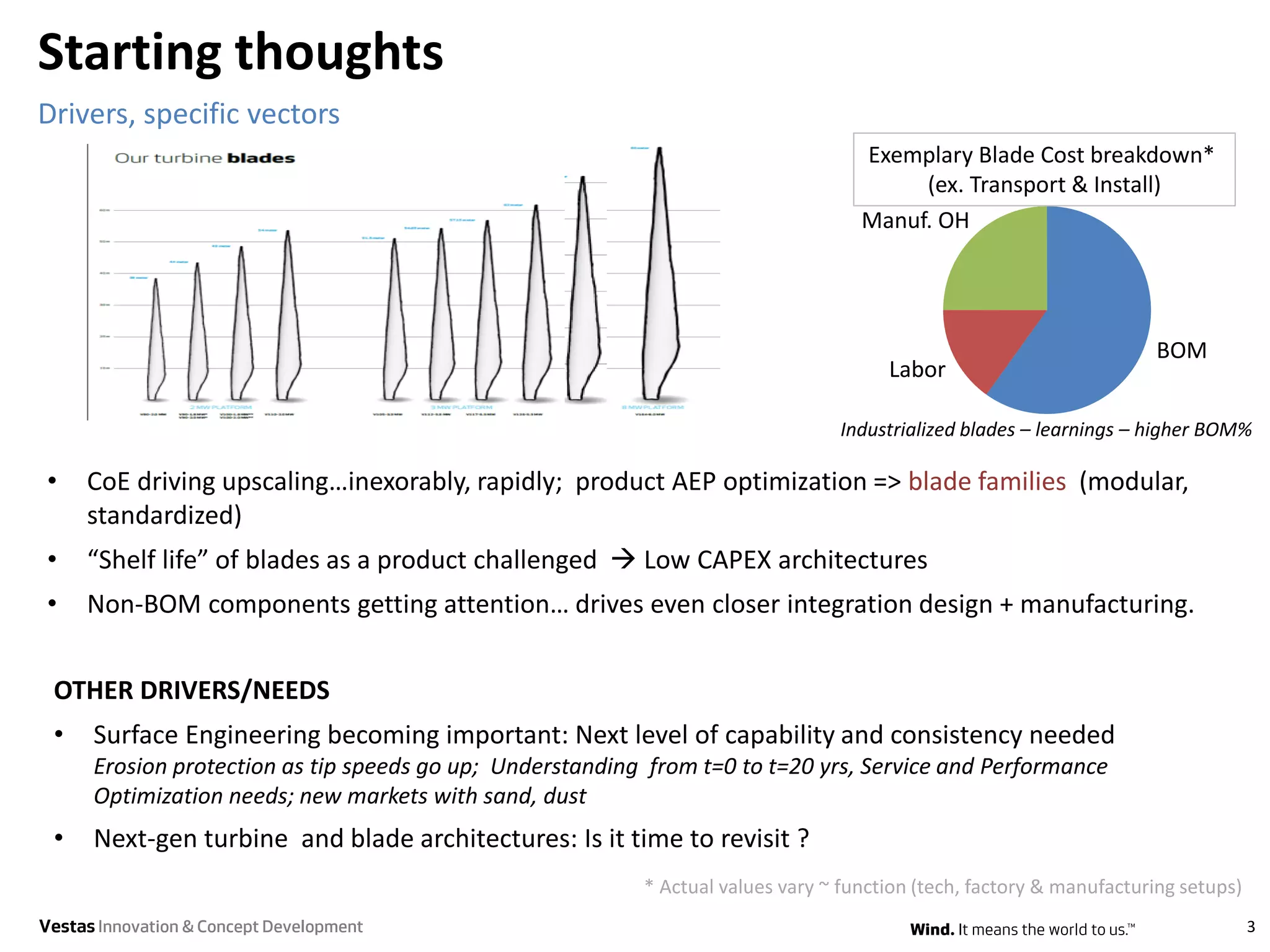
• CoE driving upscaling…inexorably, rapidly; product AEP optimization => blade families (modular,
standardized)
• “Shelf life” of blades as a product challenged  Low CAPEX architectures
• Non-BOM components getting attention… drives even closer integration design + manufacturing.
BOM
Labor
Manuf. OH
Exemplary Blade Cost breakdown*
(ex. Transport & Install)
* Actual values vary ~ function (tech, factory & manufacturing setups)
Industrialized blades – learnings – higher BOM%
VestasInnovation & Concept Development
Next and Needs
• Inconsistent best-practices, sub-models and thumb rules… “mixing” of clean and rough data, stall
margin, 3d inboard effects, Re # effects etc. Opportunity to standardize and exploit ?
• Have we given up on the “near-stall” area ? Modeling, Measurements – more activity in DES of full
wind farms !
• Industrial V&V technology upgrade … expensive but necessary to drive from Product verification to
Technology validation. Mature industries do both necessary + sufficient validation
• Where’s the 3D Aero-elastic design system ?
…reflect on net fidelity change of Wind Industry aero systems 2016 vs 2006 ?
Aerodynamics & Aero-acoustics
4
Significant progress at airfoil level, low-hanging fruits at blade level ?
Trends
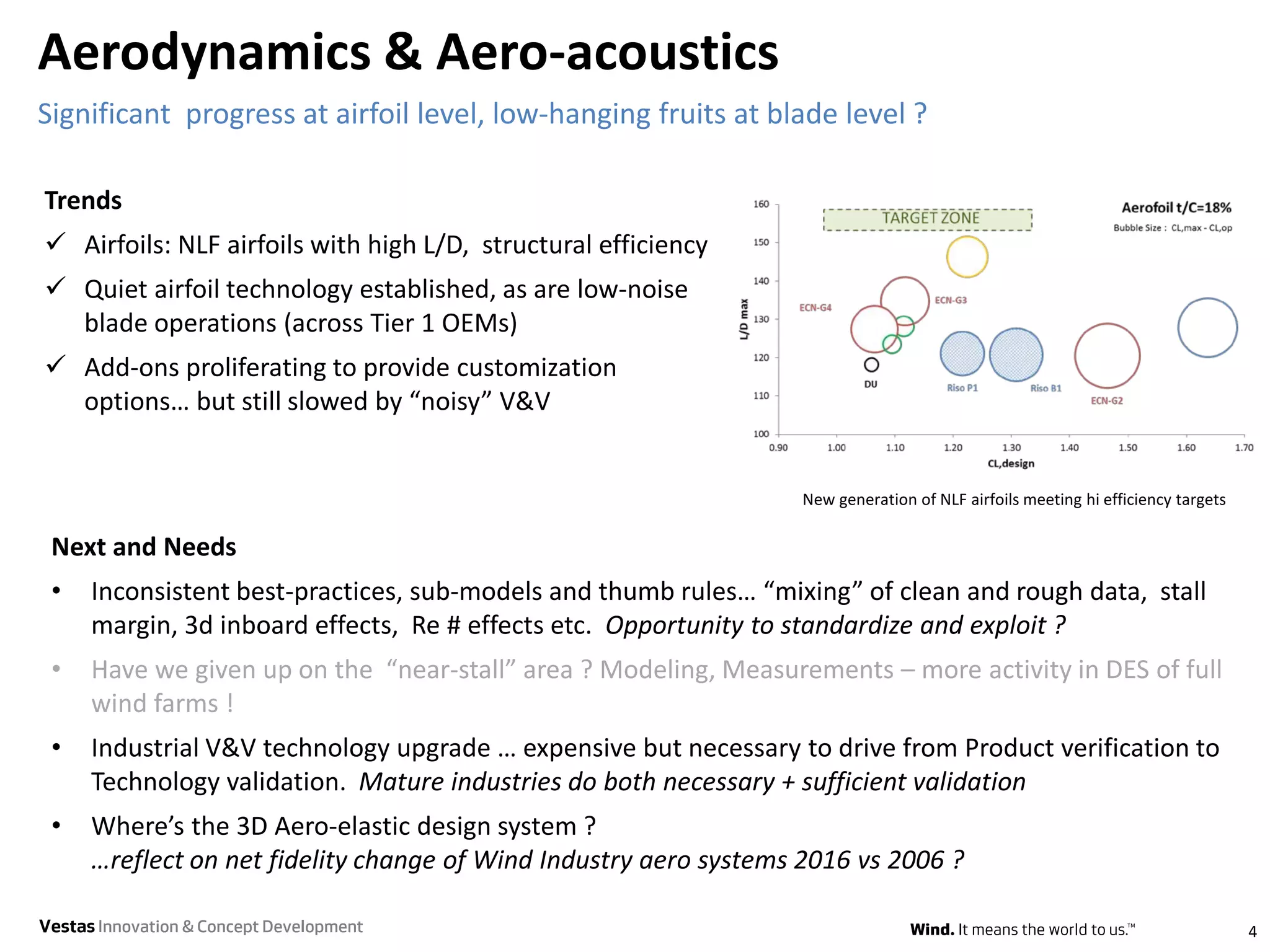
 Airfoils: NLF airfoils with high L/D, structural efficiency
 Quiet airfoil technology established, as are low-noise
blade operations (across Tier 1 OEMs)
 Add-ons proliferating to provide customization
options… but still slowed by “noisy” V&V
New generation of NLF airfoils meeting hi efficiency targets
VestasInnovation & Concept Development
Needs
• AALC actuation & concepts that are simple,
robust and respect Wind Industry O&M paradigms
• Upgraded physical modeling to have an effective and efficient “LAC” design system
• Industrial V&V technology upgrade … expensive but necessary to drive from Product verification to
Technology validation
Loads Management
5
Aero-servo-elastic design and technologies maturing, @ the actuation frontier(s)
Trends
 “System-level” design optimization or “CoE-
effective” blades driving significant LCoE gains
 Aero-elastic tailoring (e.g., bend-twist coupling) has
become part of OEM tool-kit
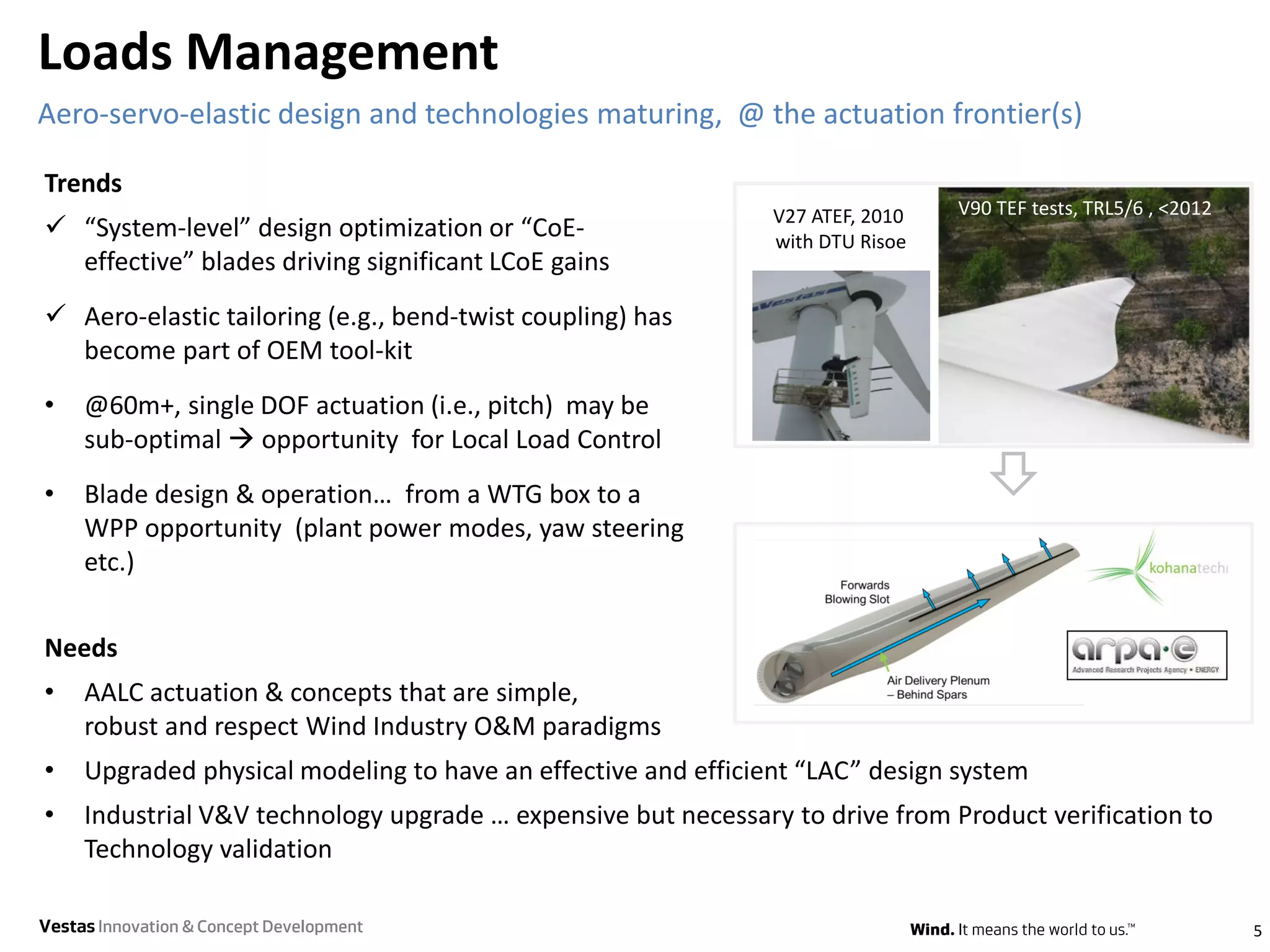
• @60m+, single DOF actuation (i.e., pitch) may be
sub-optimal  opportunity for Local Load Control
• Blade design & operation… from a WTG box to a
WPP opportunity (plant power modes, yaw steering
etc.)
V90 TEF tests, TRL5/6 , <2012V27 ATEF, 2010
with DTU Risoe
VestasInnovation & Concept Development
Comments
• STATUS: 4-Rotor Concept Demonstrator up and running
@ DTU campus in Roskilde* (4xV29,225kW – thank
you, SWIFT!)
• Proving dynamics, controls, structural, loads and power
mgt. concepts
Turbine Architectures – an alternate approach
6
Same goal… but alter the scale playing field, allow more “industrial” solutions
Hypothesis
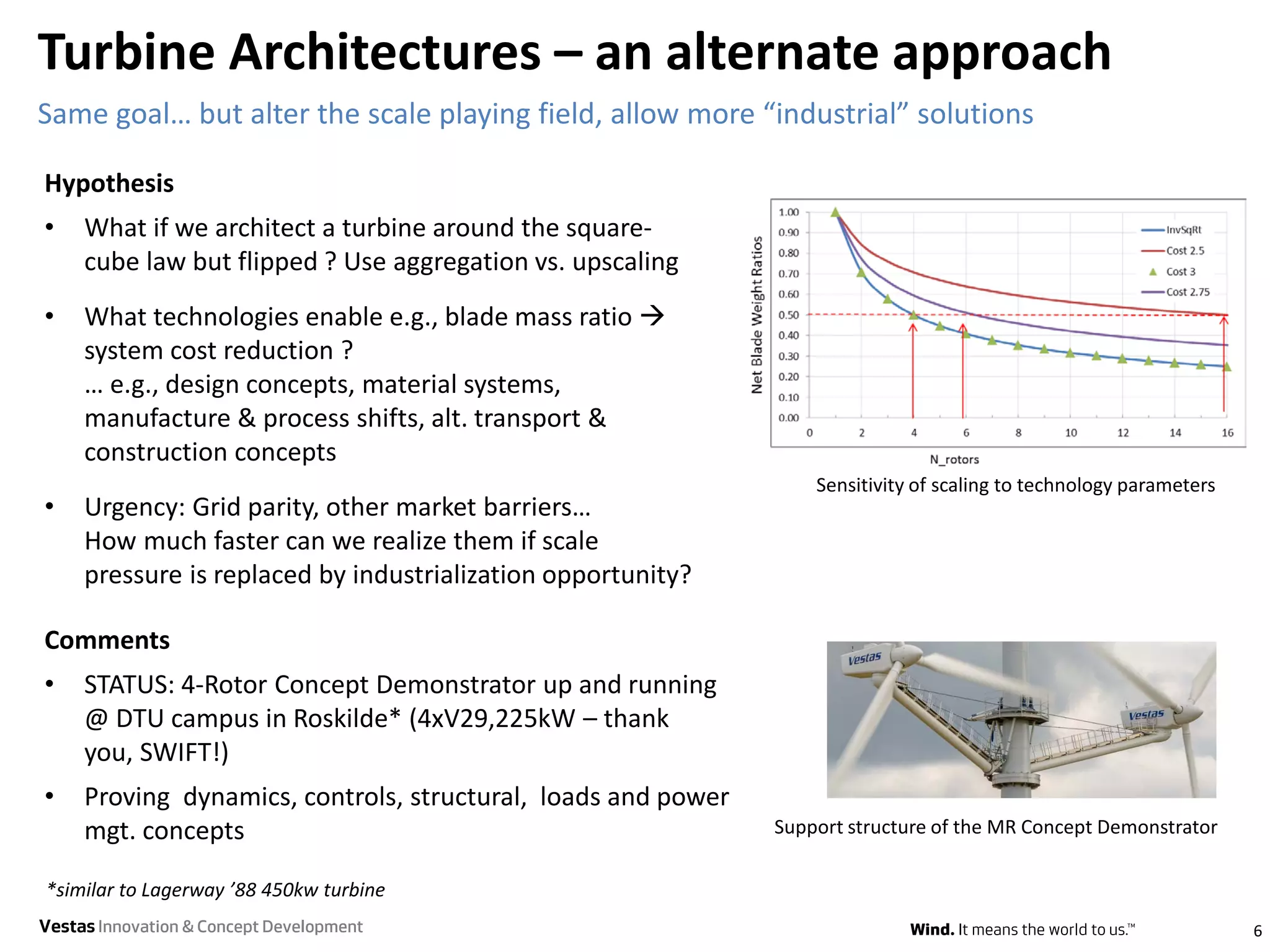
• What if we architect a turbine around the square-
cube law but flipped ? Use aggregation vs. upscaling
• What technologies enable e.g., blade mass ratio 
system cost reduction ?
… e.g., design concepts, material systems,
manufacture & process shifts, alt. transport &
construction concepts
• Urgency: Grid parity, other market barriers…
How much faster can we realize them if scale
pressure is replaced by industrialization opportunity?
Sensitivity of scaling to technology parameters
*similar to Lagerway ’88 450kw turbine
Support structure of the MR Concept Demonstrator
VestasInnovation & Concept Development
Backup Info:
Blade needs from Materials
Courtesy Dr. Adrian Gill, Vestas
VestasInnovation & ConceptDevelopment 7
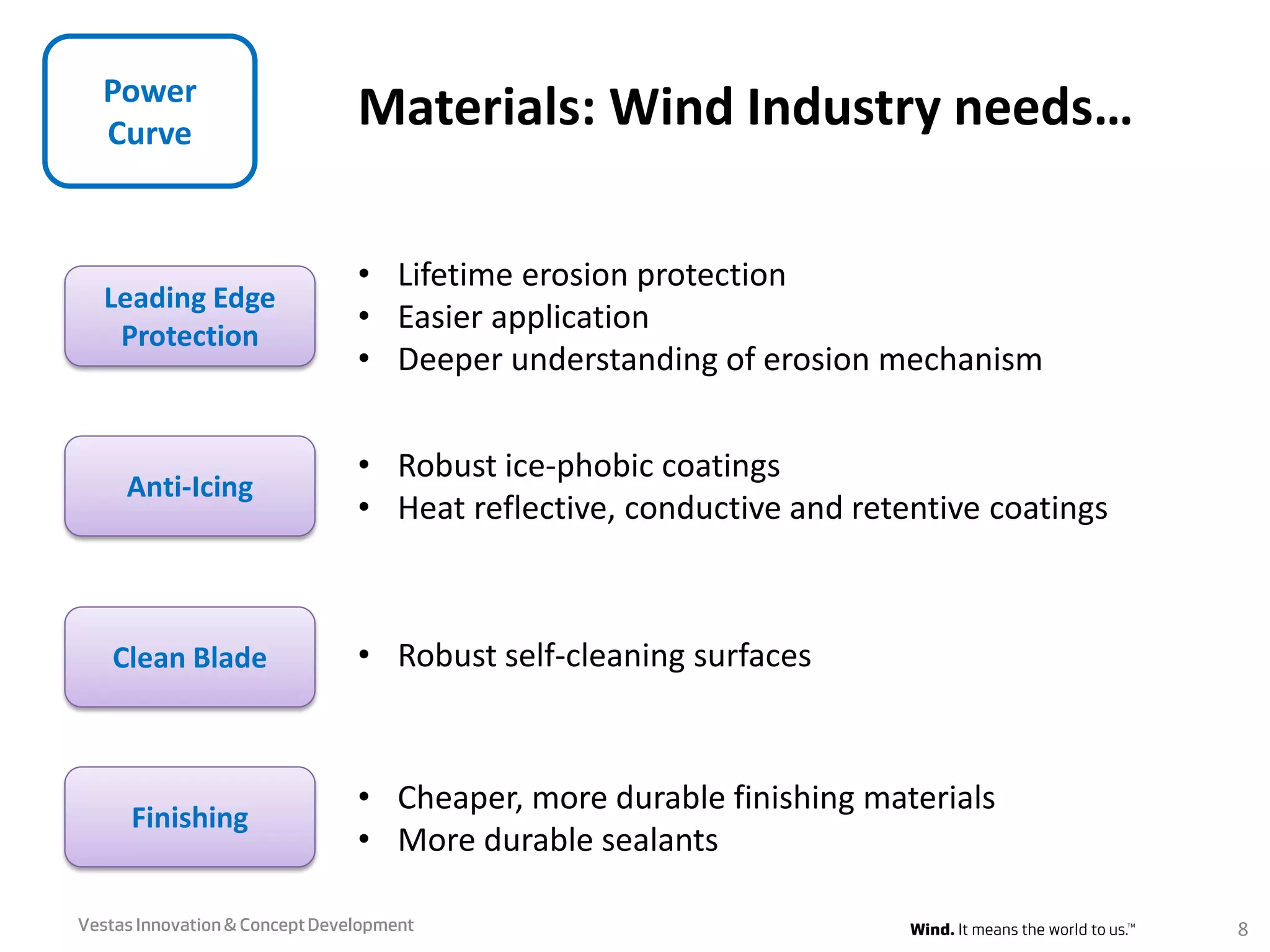
Power
Curve
Materials: Wind Industry needs…
• Lifetime erosion protection
• Easier application
• Deeper understanding of erosion mechanism
Leading Edge
Protection
• Robust ice-phobic coatings
• Heat reflective, conductive and retentive coatings
Anti-Icing
• Robust self-cleaning surfacesClean Blade
• Cheaper, more durable finishing materials
• More durable sealants
Finishing
VestasInnovation & ConceptDevelopment 8
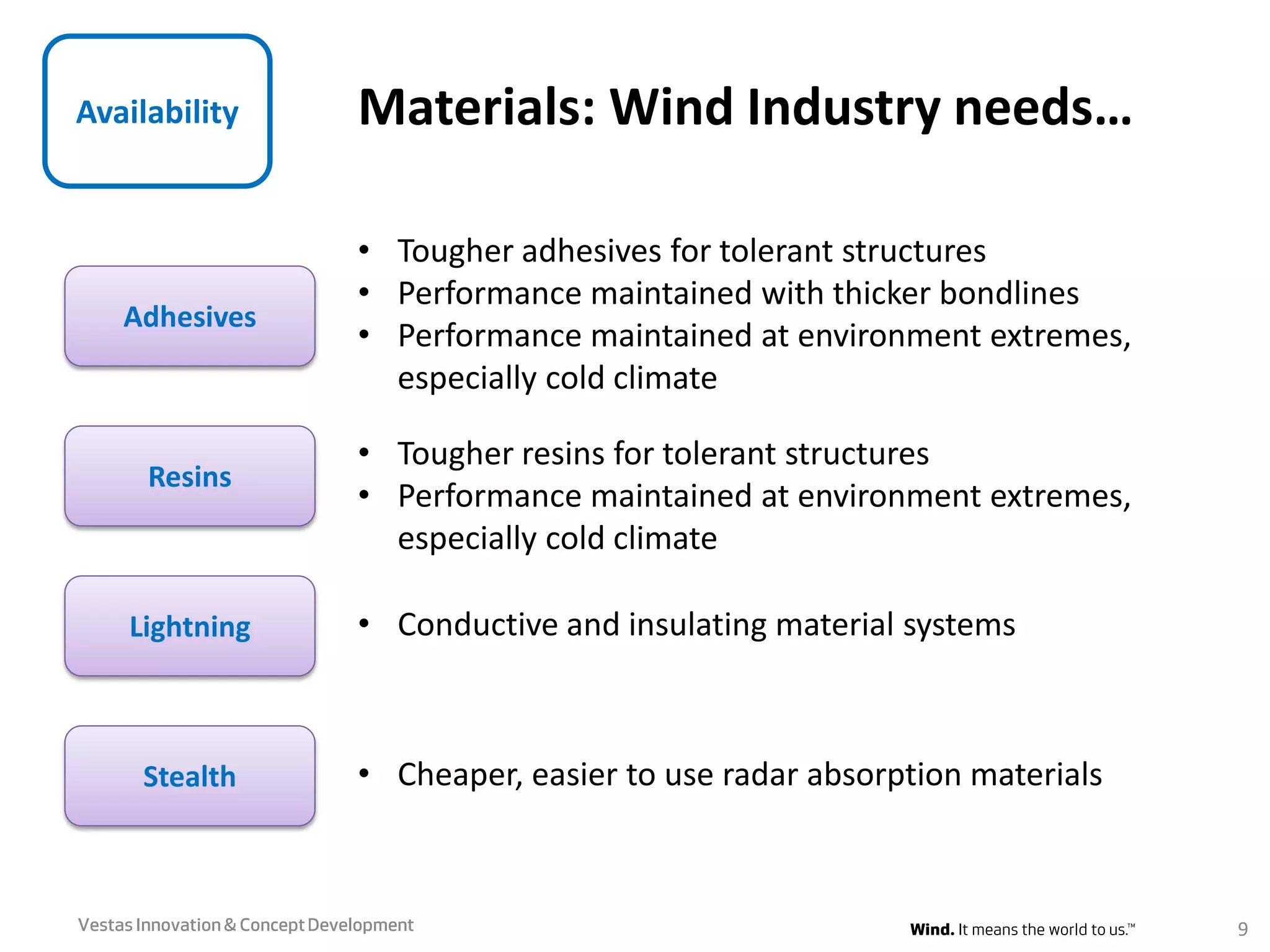
Availability
• Tougher adhesives for tolerant structures
• Performance maintained with thicker bondlines
• Performance maintained at environment extremes,
especially cold climate
Adhesives
Resins
• Cheaper, easier to use radar absorption materialsStealth
• Tougher resins for tolerant structures
• Performance maintained at environment extremes,
especially cold climate
• Conductive and insulating material systemsLightning
VestasInnovation & ConceptDevelopment 9
Materials: Wind Industry needs…
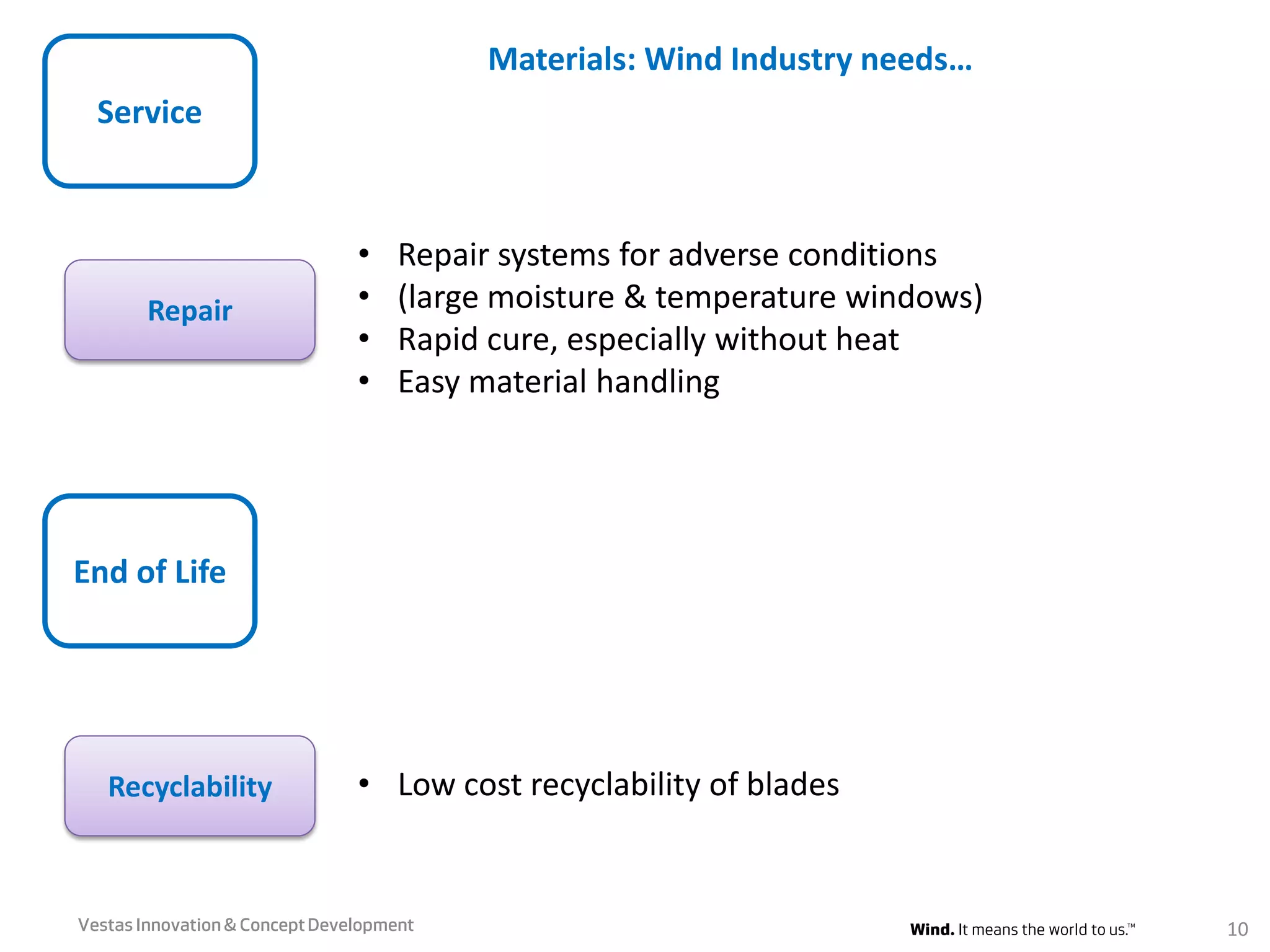
Service
Repair
• Repair systems for adverse conditions
• (large moisture & temperature windows)
• Rapid cure, especially without heat
• Easy material handling
End of Life
Recyclability • Low cost recyclability of blades
Materials: Wind Industry needs…
VestasInnovation & ConceptDevelopment 10
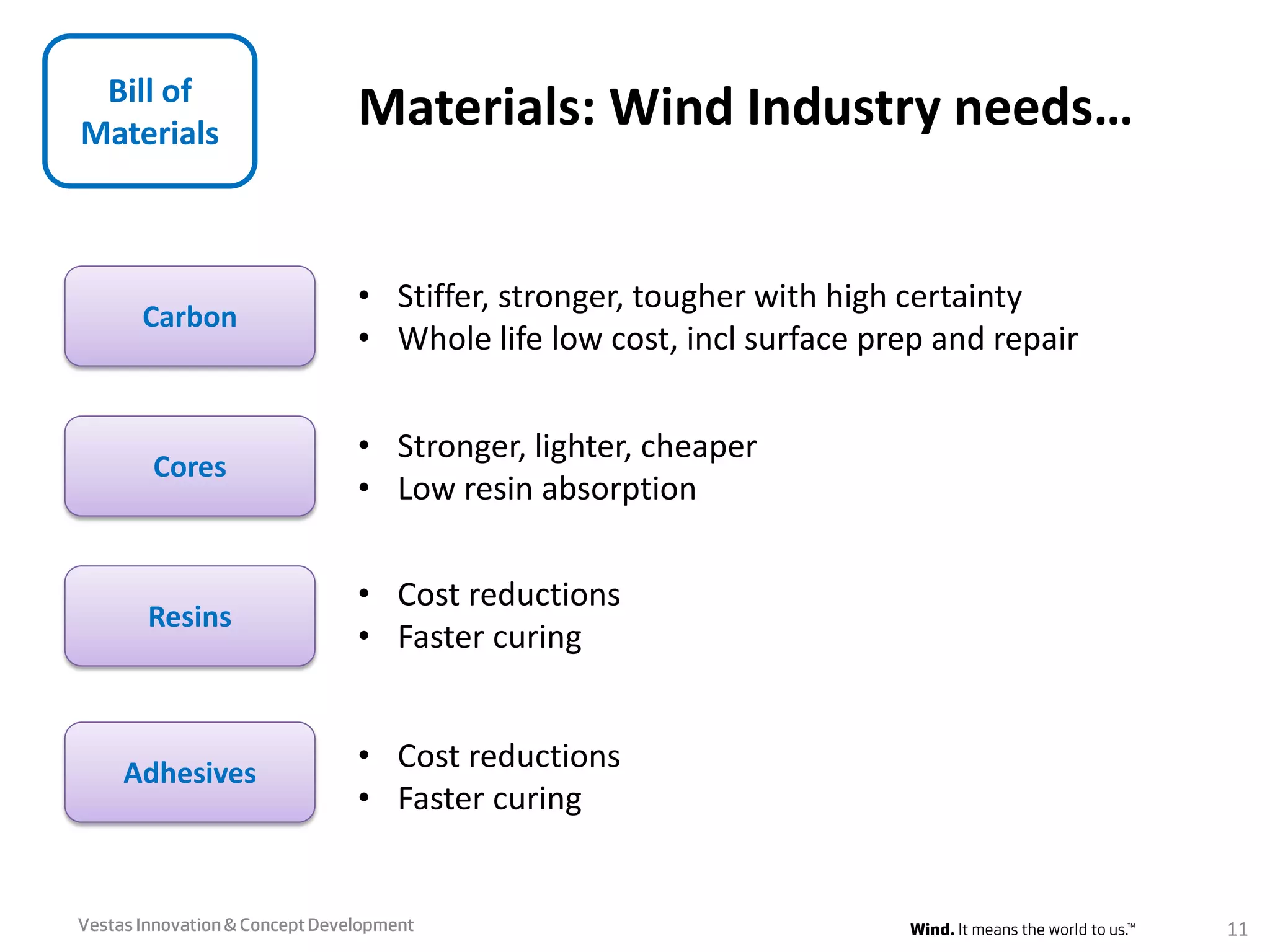
Bill of
Materials
• Stiffer, stronger, tougher with high certainty
• Whole life low cost, incl surface prep and repair
Carbon
Resins
• Cost reductions
• Faster curing
Adhesives
• Cost reductions
• Faster curing
• Stronger, lighter, cheaper
• Low resin absorption
Cores
VestasInnovation & ConceptDevelopment 11
Materials: Wind Industry needs…
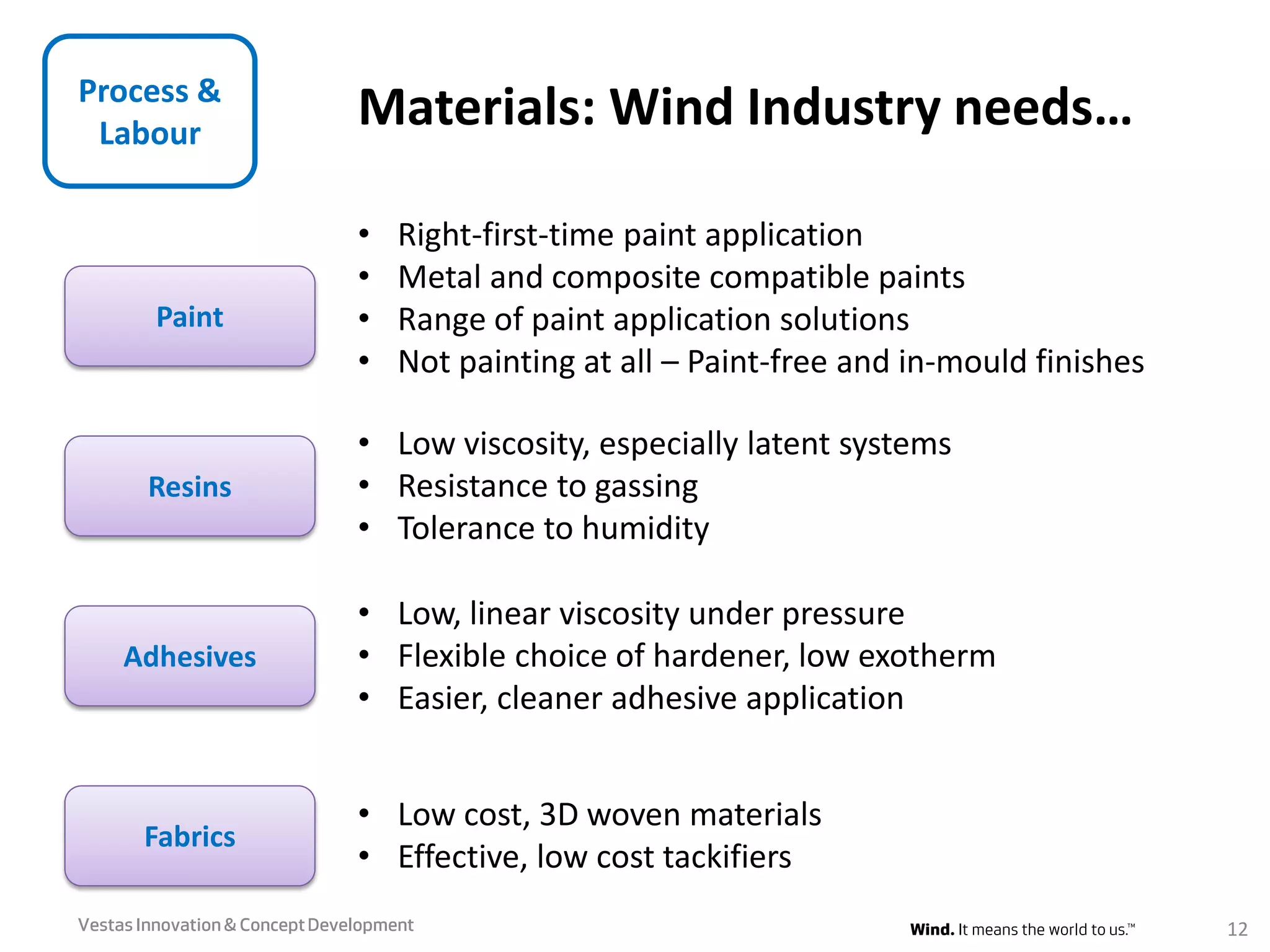
Process &
Labour
• Right-first-time paint application
• Metal and composite compatible paints
• Range of paint application solutions
• Not painting at all – Paint-free and in-mould finishes
Paint
Resins
• Low, linear viscosity under pressure
• Flexible choice of hardener, low exotherm
• Easier, cleaner adhesive application
Adhesives
• Low viscosity, especially latent systems
• Resistance to gassing
• Tolerance to humidity
• Low cost, 3D woven materials
• Effective, low cost tackifiers
Fabrics
VestasInnovation & ConceptDevelopment 12
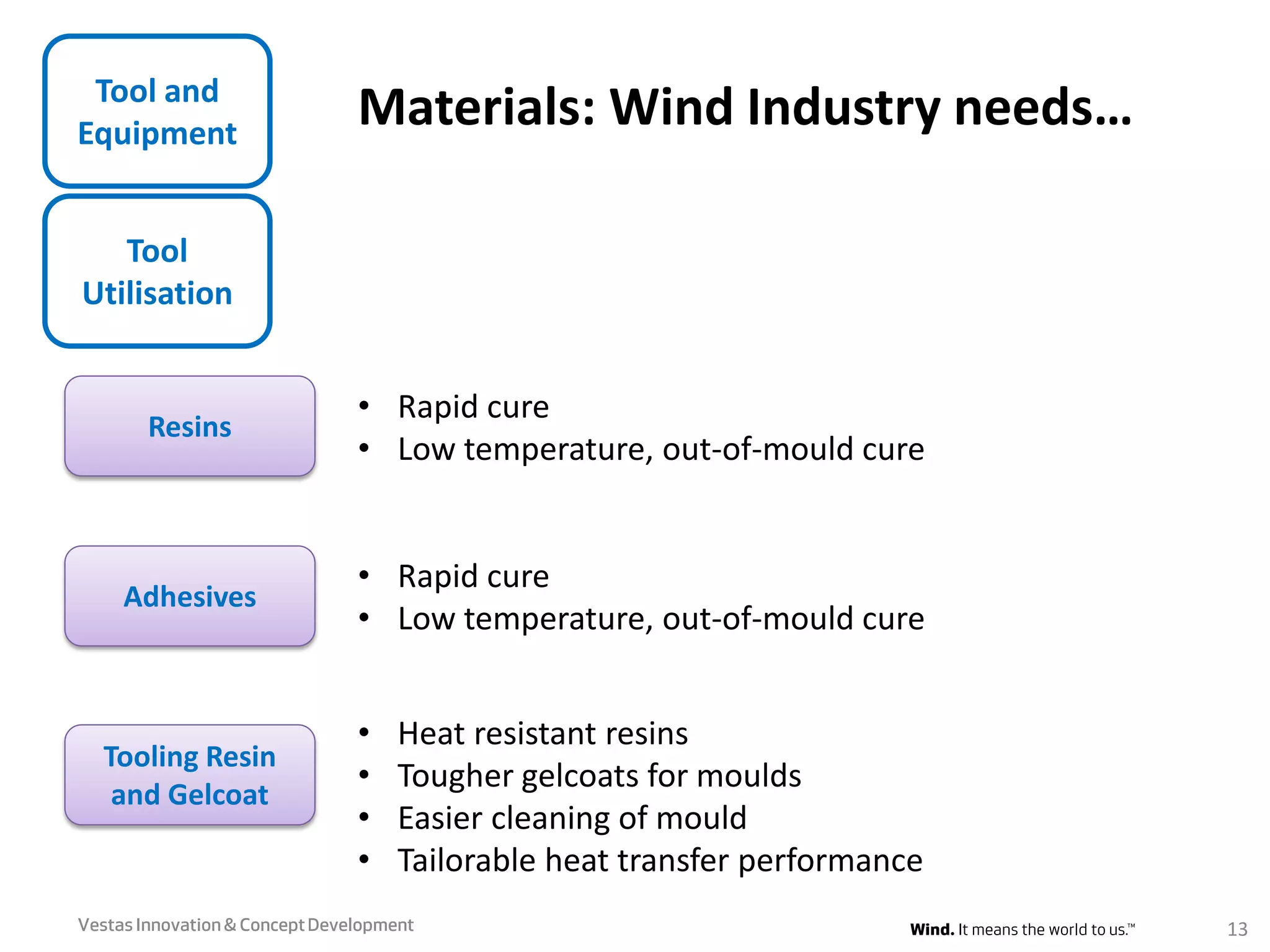
Materials: Wind Industry needs…
Tool and
Equipment
Resins
• Rapid cure
• Low temperature, out-of-mould cure
Adhesives
• Rapid cure
• Low temperature, out-of-mould cure
• Heat resistant resins
• Tougher gelcoats for moulds
• Easier cleaning of mould
• Tailorable heat transfer performance
Tooling Resin
and Gelcoat
Tool
Utilisation
VestasInnovation & ConceptDevelopment 13
Materials: Wind Industry needs…

Anurag Gupta - Trends and Changing R&D Needs in Blade Technology

  • 1.
    Trends & Changing R&DNeeds in Blade Technology Anurag Gupta, Ph.D. Innovation Architect, Technology & Service Solutions Vestas Wind Systems A/S Aug 30, 2016 VestasInnovation & ConceptDevelopment 1
  • 2.
    An underlying theme:“INDUSTRIALIZATION” • Mature, fact- and first-principles driven basis… elimination of uncertainties • Commonality of standards/methods… accelerated collaboration, many foundational and pre- competitive fields • Driving full exploitation of the learning curve… can we brake the up-scaling freight train AND drive LCOE to grid parity? NB: Given expertise in rest of panel, I will not go into details on Materials, manufacturing etc Introduction About me, and a theme for today… • Aero, Design & CFD trained; worked on hypersonics, rotorcraft, aircraft engines, gas turbines and of course, wind turbines. Moved to Vestas in 2011 from GE, working on Rotor Systems; now enjoying new concept development and (with a process hat), doing adv. technology roadmaps/programs for Vestas. VestasInnovation & Concept Development 2
  • 3.
    OTHER DRIVERS/NEEDS • SurfaceEngineering becoming important: Next level of capability and consistency needed Erosion protection as tip speeds go up; Understanding from t=0 to t=20 yrs, Service and Performance Optimization needs; new markets with sand, dust • Next-gen turbine and blade architectures: Is it time to revisit ? Starting thoughts 3 Drivers, specific vectors • CoE driving upscaling…inexorably, rapidly; product AEP optimization => blade families (modular, standardized) • “Shelf life” of blades as a product challenged  Low CAPEX architectures • Non-BOM components getting attention… drives even closer integration design + manufacturing. BOM Labor Manuf. OH Exemplary Blade Cost breakdown* (ex. Transport & Install) * Actual values vary ~ function (tech, factory & manufacturing setups) Industrialized blades – learnings – higher BOM% VestasInnovation & Concept Development
  • 4.
    Next and Needs •Inconsistent best-practices, sub-models and thumb rules… “mixing” of clean and rough data, stall margin, 3d inboard effects, Re # effects etc. Opportunity to standardize and exploit ? • Have we given up on the “near-stall” area ? Modeling, Measurements – more activity in DES of full wind farms ! • Industrial V&V technology upgrade … expensive but necessary to drive from Product verification to Technology validation. Mature industries do both necessary + sufficient validation • Where’s the 3D Aero-elastic design system ? …reflect on net fidelity change of Wind Industry aero systems 2016 vs 2006 ? Aerodynamics & Aero-acoustics 4 Significant progress at airfoil level, low-hanging fruits at blade level ? Trends  Airfoils: NLF airfoils with high L/D, structural efficiency  Quiet airfoil technology established, as are low-noise blade operations (across Tier 1 OEMs)  Add-ons proliferating to provide customization options… but still slowed by “noisy” V&V New generation of NLF airfoils meeting hi efficiency targets VestasInnovation & Concept Development
  • 5.
    Needs • AALC actuation& concepts that are simple, robust and respect Wind Industry O&M paradigms • Upgraded physical modeling to have an effective and efficient “LAC” design system • Industrial V&V technology upgrade … expensive but necessary to drive from Product verification to Technology validation Loads Management 5 Aero-servo-elastic design and technologies maturing, @ the actuation frontier(s) Trends  “System-level” design optimization or “CoE- effective” blades driving significant LCoE gains  Aero-elastic tailoring (e.g., bend-twist coupling) has become part of OEM tool-kit • @60m+, single DOF actuation (i.e., pitch) may be sub-optimal  opportunity for Local Load Control • Blade design & operation… from a WTG box to a WPP opportunity (plant power modes, yaw steering etc.) V90 TEF tests, TRL5/6 , <2012V27 ATEF, 2010 with DTU Risoe VestasInnovation & Concept Development
  • 6.
    Comments • STATUS: 4-RotorConcept Demonstrator up and running @ DTU campus in Roskilde* (4xV29,225kW – thank you, SWIFT!) • Proving dynamics, controls, structural, loads and power mgt. concepts Turbine Architectures – an alternate approach 6 Same goal… but alter the scale playing field, allow more “industrial” solutions Hypothesis • What if we architect a turbine around the square- cube law but flipped ? Use aggregation vs. upscaling • What technologies enable e.g., blade mass ratio  system cost reduction ? … e.g., design concepts, material systems, manufacture & process shifts, alt. transport & construction concepts • Urgency: Grid parity, other market barriers… How much faster can we realize them if scale pressure is replaced by industrialization opportunity? Sensitivity of scaling to technology parameters *similar to Lagerway ’88 450kw turbine Support structure of the MR Concept Demonstrator VestasInnovation & Concept Development
  • 7.
    Backup Info: Blade needsfrom Materials Courtesy Dr. Adrian Gill, Vestas VestasInnovation & ConceptDevelopment 7
  • 8.
    Power Curve Materials: Wind Industryneeds… • Lifetime erosion protection • Easier application • Deeper understanding of erosion mechanism Leading Edge Protection • Robust ice-phobic coatings • Heat reflective, conductive and retentive coatings Anti-Icing • Robust self-cleaning surfacesClean Blade • Cheaper, more durable finishing materials • More durable sealants Finishing VestasInnovation & ConceptDevelopment 8
  • 9.
    Availability • Tougher adhesivesfor tolerant structures • Performance maintained with thicker bondlines • Performance maintained at environment extremes, especially cold climate Adhesives Resins • Cheaper, easier to use radar absorption materialsStealth • Tougher resins for tolerant structures • Performance maintained at environment extremes, especially cold climate • Conductive and insulating material systemsLightning VestasInnovation & ConceptDevelopment 9 Materials: Wind Industry needs…
  • 10.
    Service Repair • Repair systemsfor adverse conditions • (large moisture & temperature windows) • Rapid cure, especially without heat • Easy material handling End of Life Recyclability • Low cost recyclability of blades Materials: Wind Industry needs… VestasInnovation & ConceptDevelopment 10
  • 11.
    Bill of Materials • Stiffer,stronger, tougher with high certainty • Whole life low cost, incl surface prep and repair Carbon Resins • Cost reductions • Faster curing Adhesives • Cost reductions • Faster curing • Stronger, lighter, cheaper • Low resin absorption Cores VestasInnovation & ConceptDevelopment 11 Materials: Wind Industry needs…
  • 12.
    Process & Labour • Right-first-timepaint application • Metal and composite compatible paints • Range of paint application solutions • Not painting at all – Paint-free and in-mould finishes Paint Resins • Low, linear viscosity under pressure • Flexible choice of hardener, low exotherm • Easier, cleaner adhesive application Adhesives • Low viscosity, especially latent systems • Resistance to gassing • Tolerance to humidity • Low cost, 3D woven materials • Effective, low cost tackifiers Fabrics VestasInnovation & ConceptDevelopment 12 Materials: Wind Industry needs…
  • 13.
    Tool and Equipment Resins • Rapidcure • Low temperature, out-of-mould cure Adhesives • Rapid cure • Low temperature, out-of-mould cure • Heat resistant resins • Tougher gelcoats for moulds • Easier cleaning of mould • Tailorable heat transfer performance Tooling Resin and Gelcoat Tool Utilisation VestasInnovation & ConceptDevelopment 13 Materials: Wind Industry needs…