KILL THE MUTANTS 
a better way to test your tests
ABOUT ME 
• Roy van Rijn 
• Mutants: 
• Nora 
• Lucas 
• Works for
let's do a 
SHOW OF HANDS
WHO DOES 
• Unit testing 
• Test-driven development (TDD) 
• Continuous integration 
• Measure code coverage 
• Mutation testing
UNIT TESTING 
• Prove your code works 
• Instant regression tests 
• Improve code design 
• Has become a mainstream practise over the last 10 years
CONTINUOUS INTEGRATION 
• Automate testing 
• Maintain a single source repository 
• Collect statistics
CODE COVERAGE 
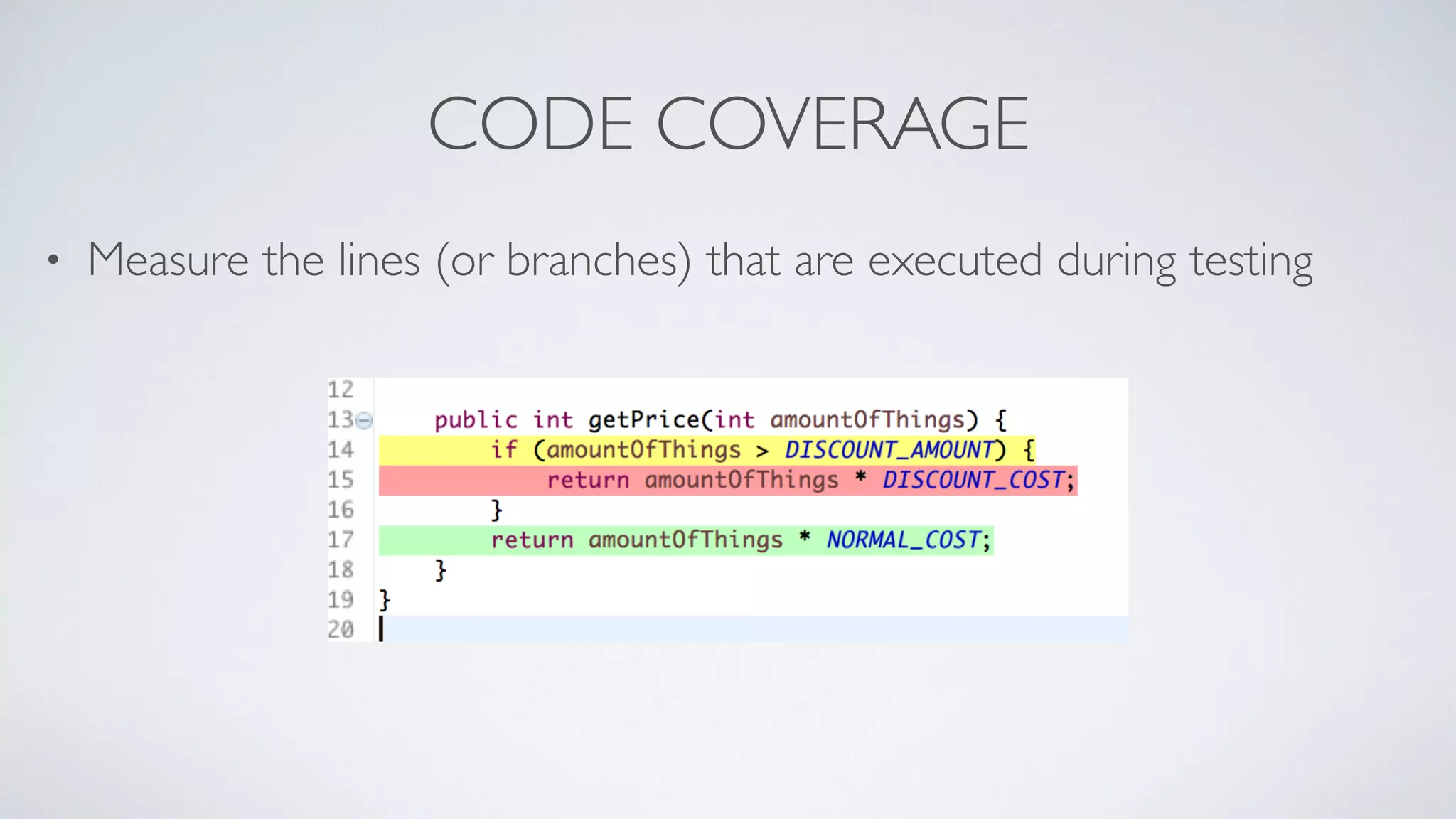
• Measure the lines (or branches) that are executed during testing
CODE COVERAGE 
• How did they test your car?
CODE COVERAGE 
• Who has seen (or written?) tests 
• without verifications or assertions? 
• just to fake and boost coverage? 
• 100% branch coverage proves nothing
QUIS CUSTODIET IPSOS CUSTODES? 
Who watches the watchmen?
MUTATION TESTING 
• Proposed by Richard J. Lipton in 1971 (winner of 2014 Knuth Prize) 
• A better way to measure the quality of your tests 
• Surge of interest in the 1980s 
• Time to revive this interest!
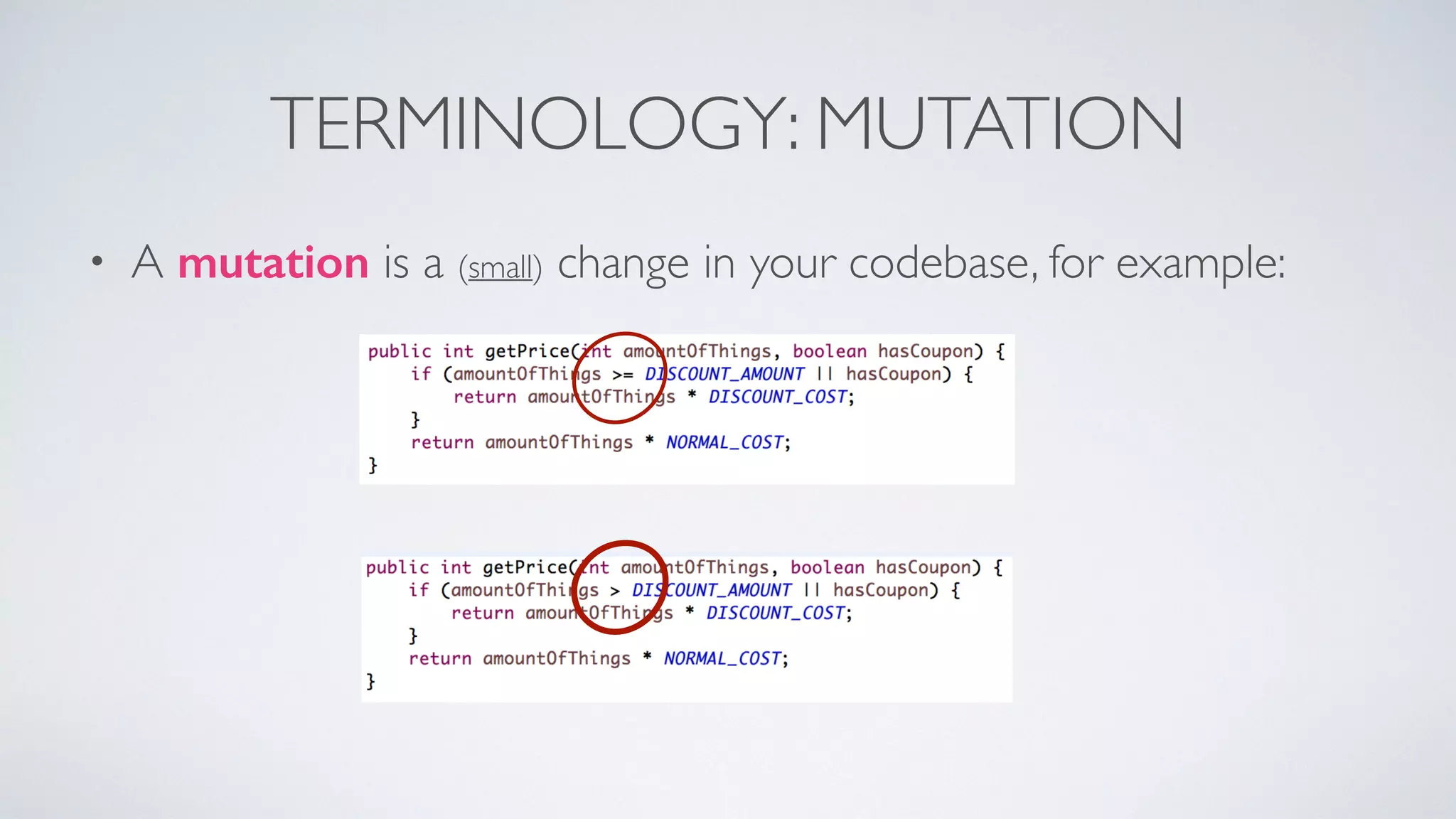
TERMINOLOGY: MUTATION 
• A mutation is a (small) change in your codebase, for example:
TERMINOLOGY: MUTANT 
• A mutant is a mutated version of your class
MUTATION TESTING 
• Generate (a lot of) mutants of your codebase 
• Run (some of) your unit tests 
• Check the outcome!
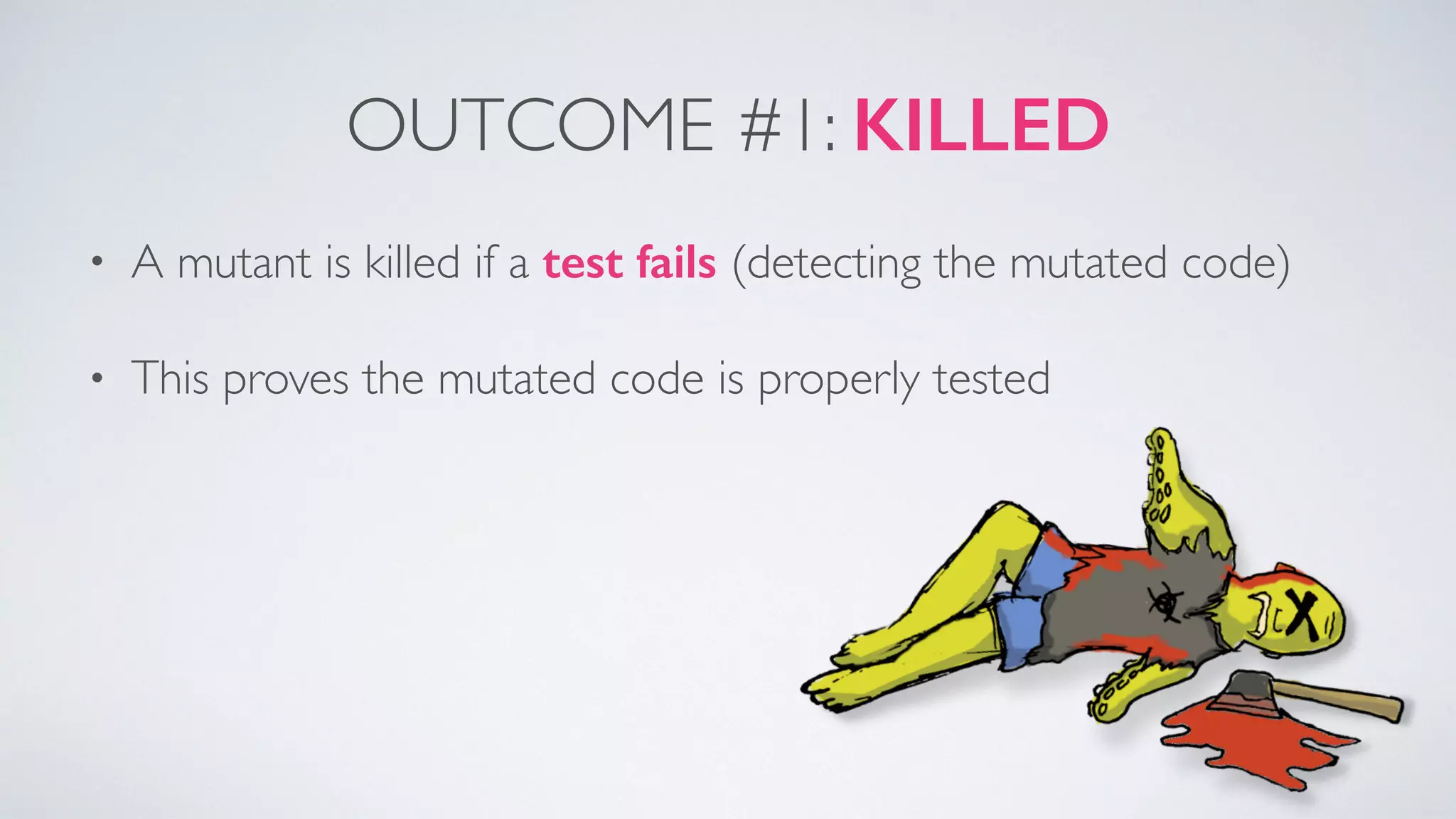
OUTCOME #1: KILLED 
• A mutant is killed if a test fails (detecting the mutated code) 
• This proves the mutated code is properly tested
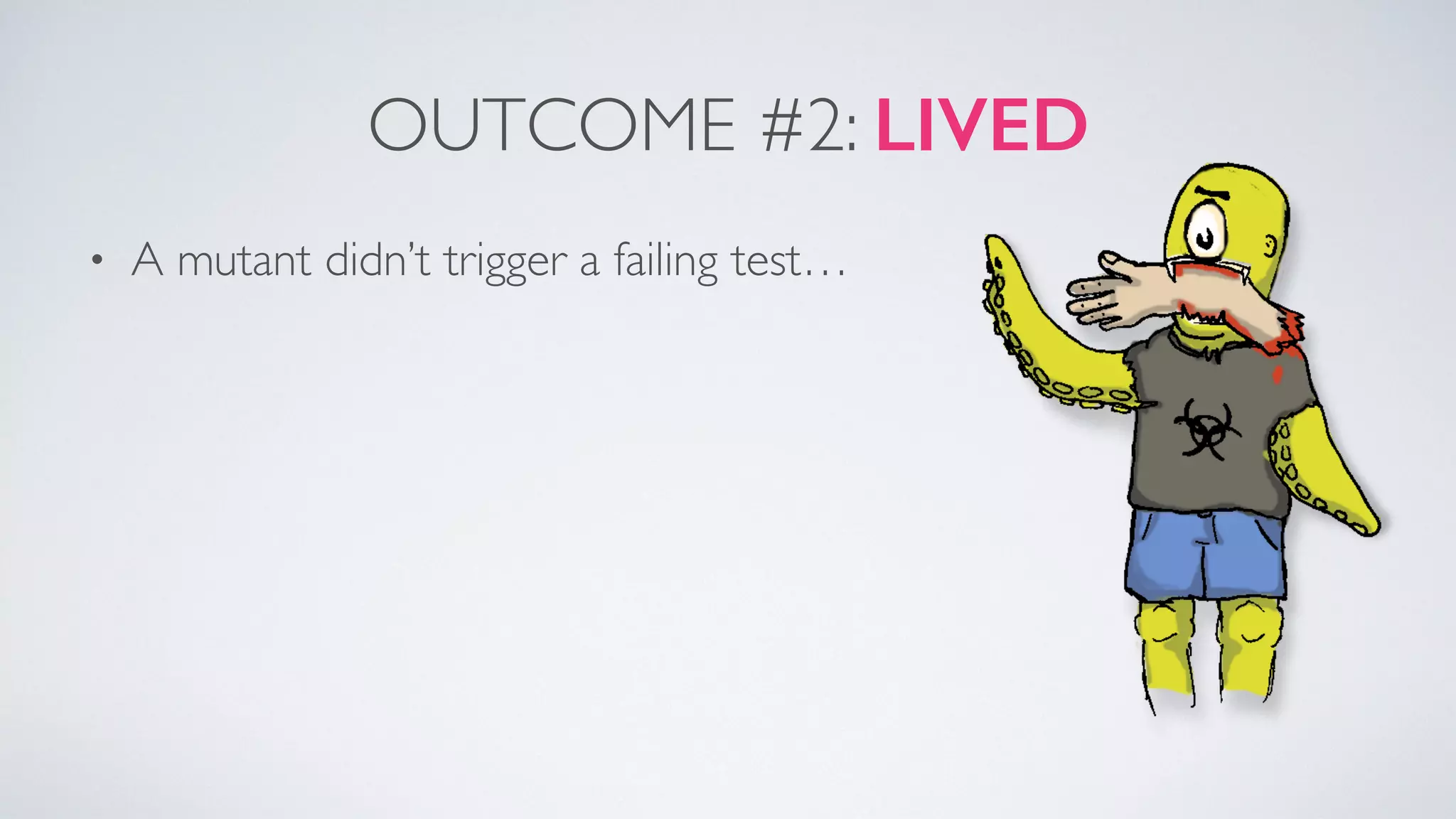
OUTCOME #2: LIVED 
• A mutant didn’t trigger a failing test…
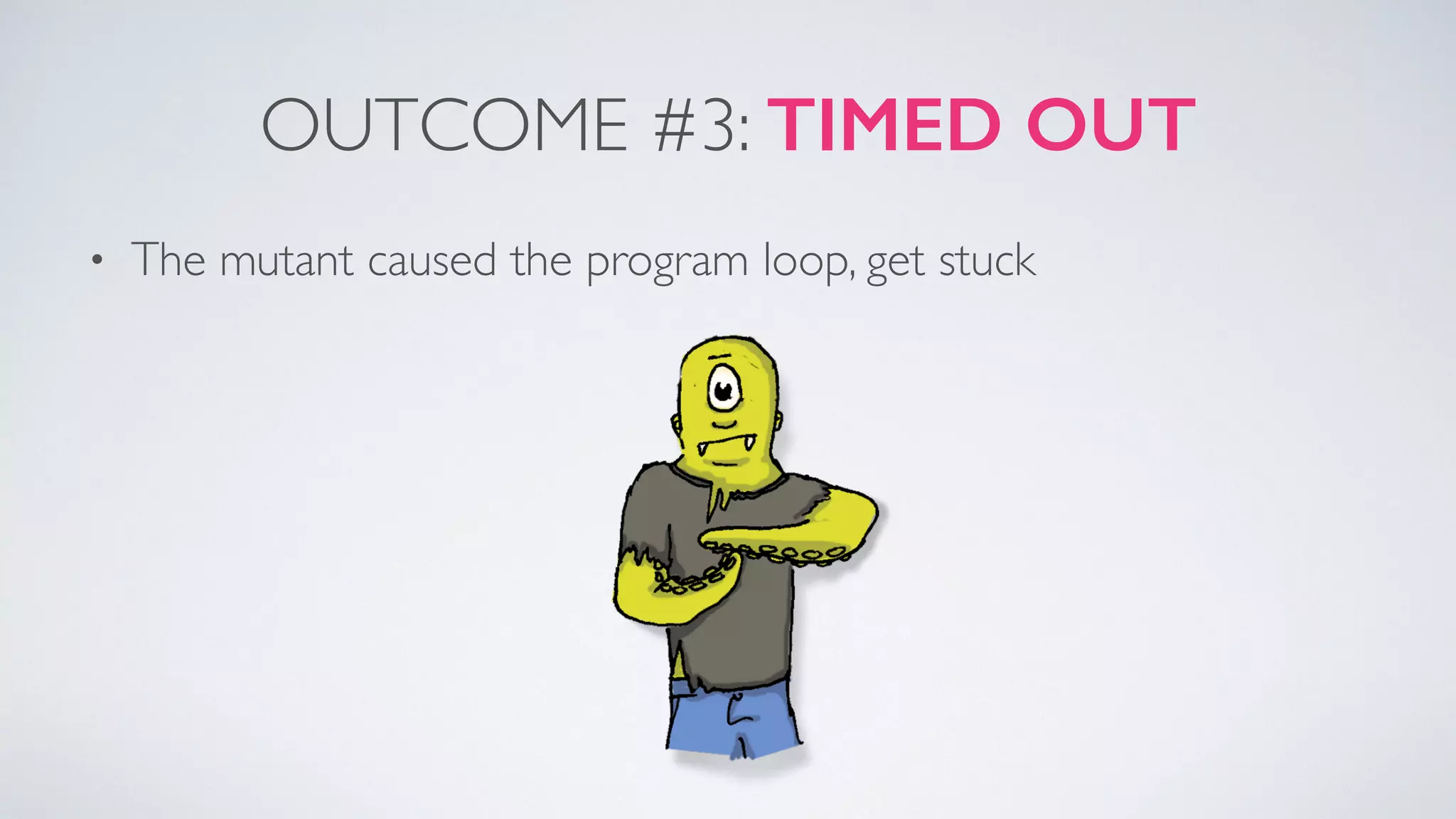
OUTCOME #3: TIMED OUT 
• The mutant caused the program loop, get stuck
OTHER OUTCOMES 
• NON-VIABLE 
• JVM could not load the mutant bytecode 
• MEMORY ERROR 
• JVM ran out of memory during test 
• RUN ERROR 
• An error but none of the above.
FAULT INJECTION? 
• With fault injection you test code 
• Inject faults/mutations and see how the system reacts 
• With mutation testing you test your tests 
• Inject faults/mutations and see how the tests react
TOOLING 
• μJava: http://cs.gmu.edu/~offutt/mujava/ (inactive) 
• Jester: http://jester.sourceforge.net/ (inactive) 
• Jumble: http://jumble.sourceforge.net/ (inactive) 
• javaLanche: http://www.st.cs.uni-saarland.de/mutation/ (inactive) 
• PIT: http://pitest.org/
USING PIT 
• PIT uses configurable ‘mutators' 
• ASM (bytecode manipulation) is used to mutate your code 
• No mutated code is stored, it can't interfere with your code 
• Generates reports with test results
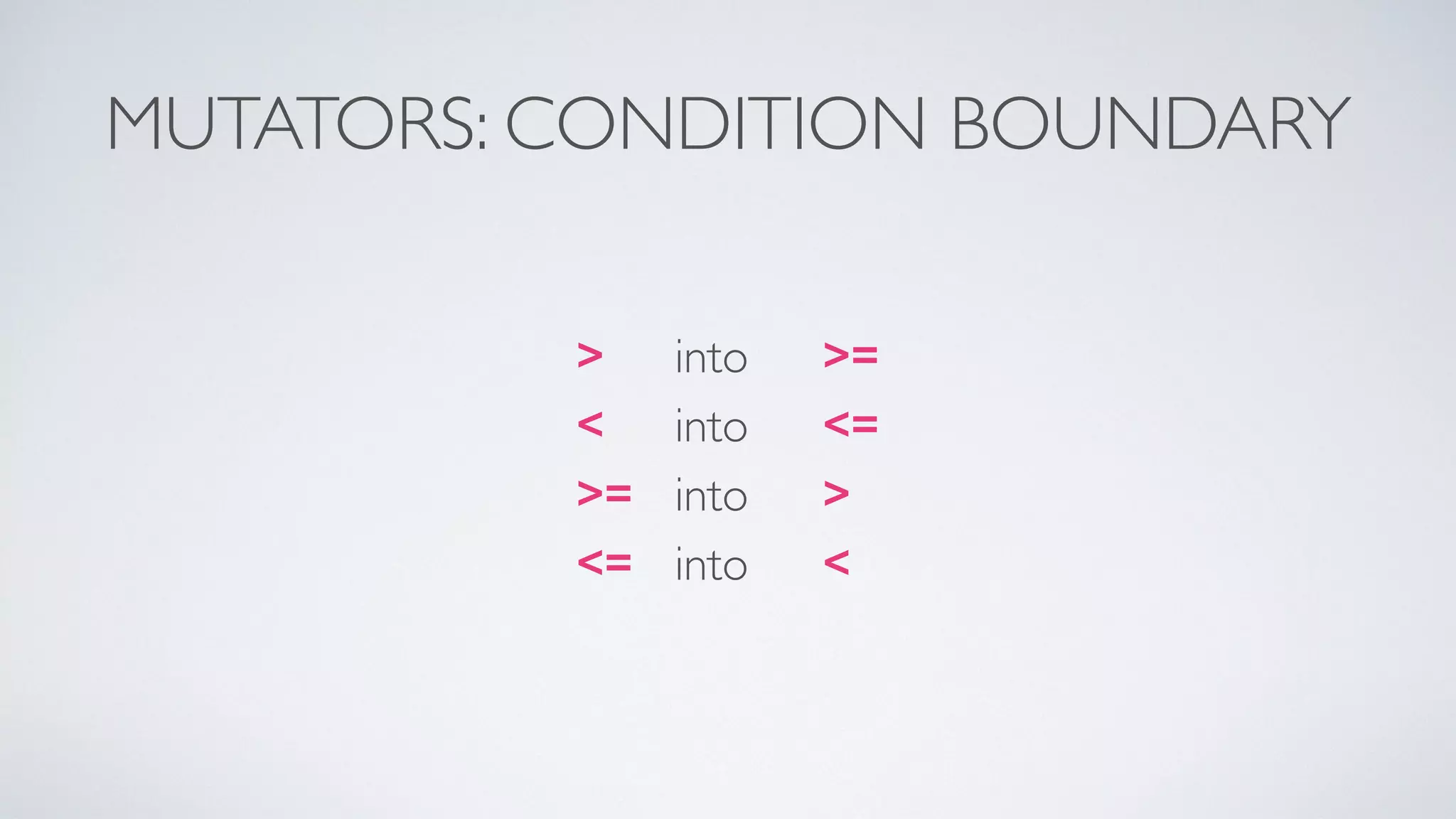
MUTATORS: CONDITION BOUNDARY 
> into >= 
< into <= 
>= into > 
<= into <
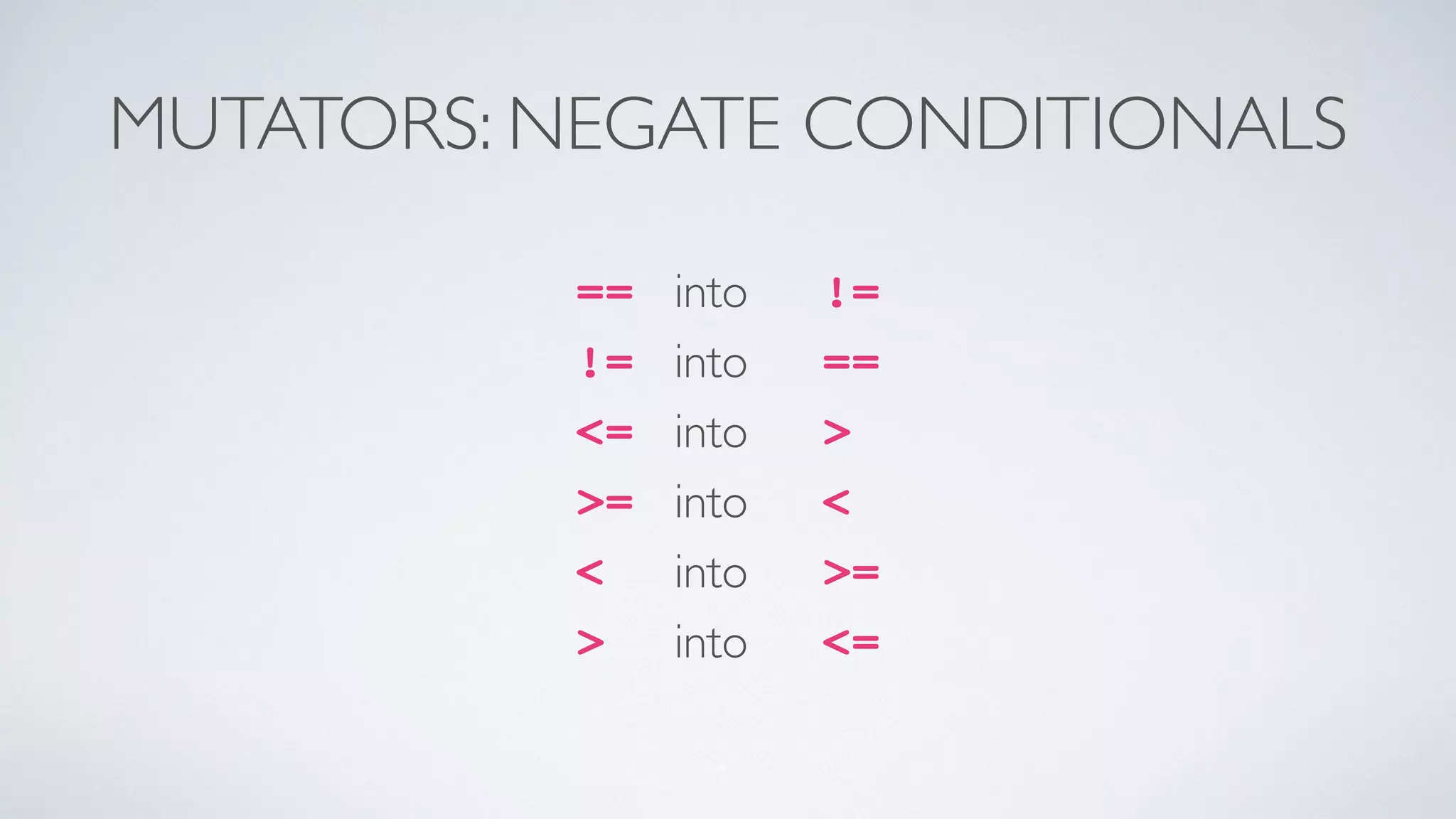
MUTATORS: NEGATE CONDITIONALS 
== into != 
!= into == 
<= into > 
>= into < 
< into >= 
> into <=
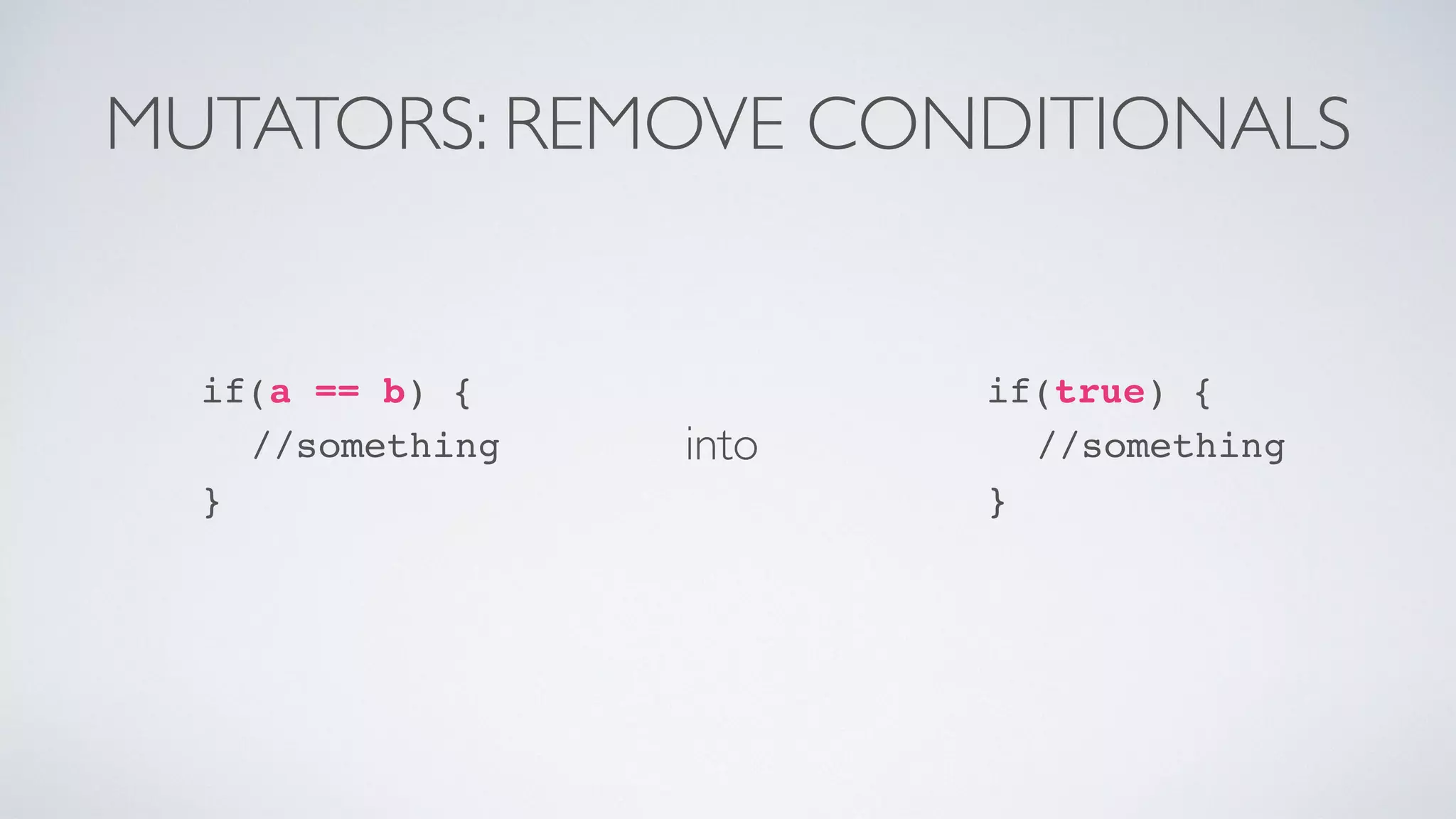
MUTATORS: REMOVE CONDITIONALS 
into 
if(true) { 
//something 
} 
if(a == b) { 
//something 
}
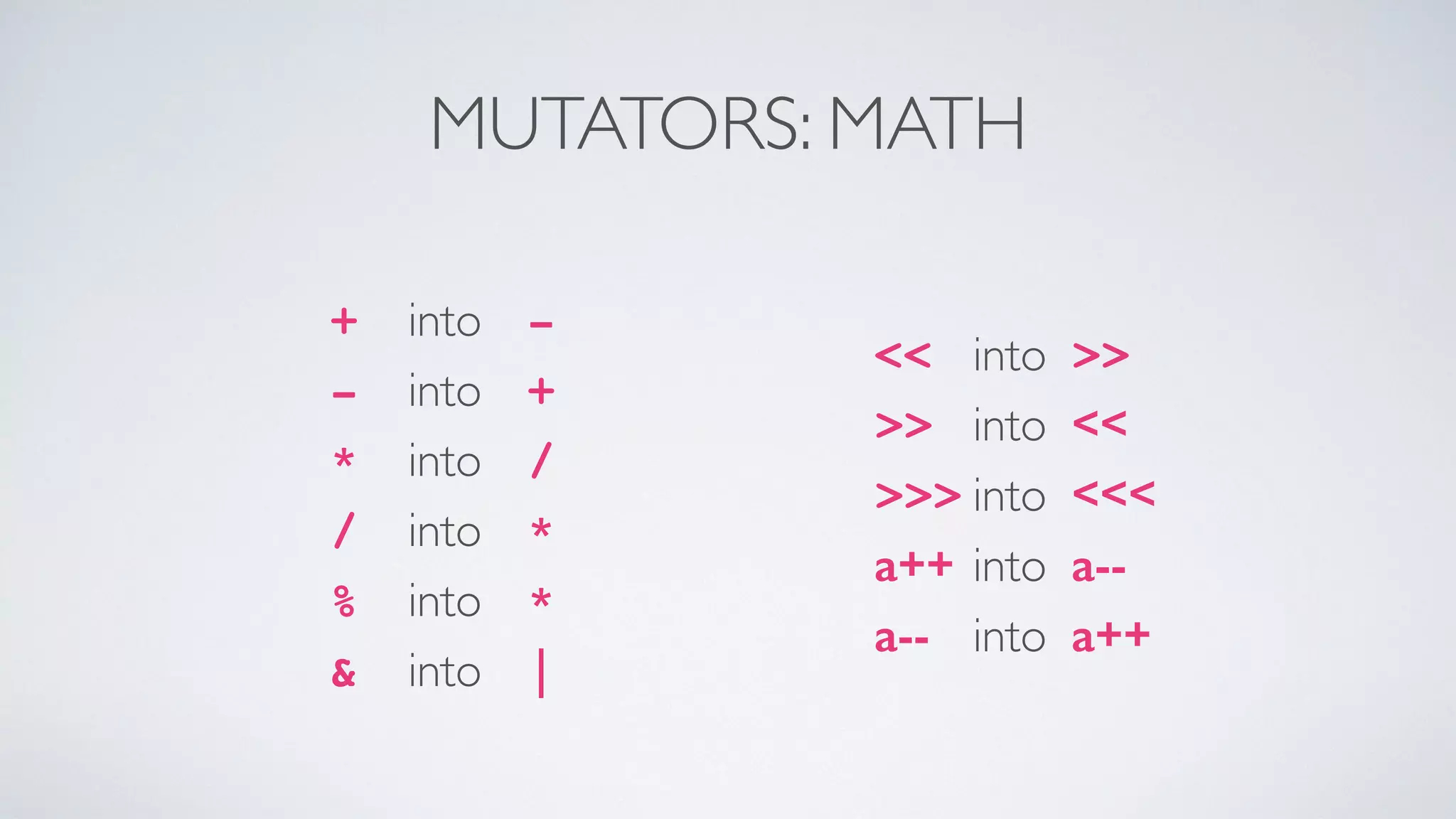
MUTATORS: MATH 
+ into - 
- into + 
* into / 
/ into * 
% into * 
& into | 
<< into >> 
>> into << 
>>> into <<< 
a++ into a-- 
a-- into a++
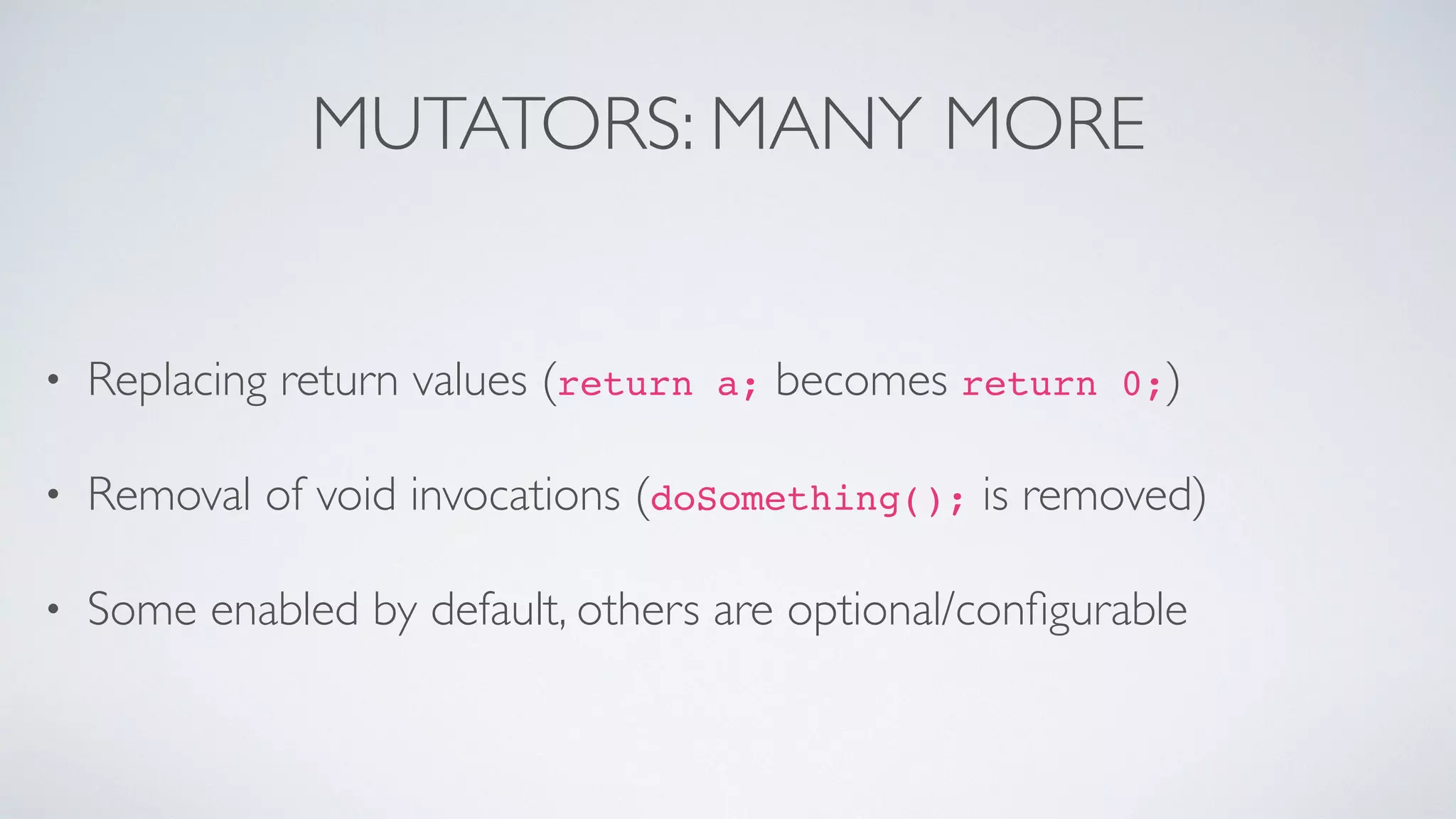
MUTATORS: MANY MORE 
• Replacing return values (return a; becomes return 0;) 
• Removal of void invocations (doSomething(); is removed) 
• Some enabled by default, others are optional/configurable
MUTATION TESTING IS SLOW? 
• Speed was unacceptable in the 80's 
• Mutation testing is still CPU intensive 
• But PIT has a lot of methods to speed it up!
WHICH TESTS TO RUN? 
• PIT uses code coverage to decide which tests to run: 
• A mutation is on a line covered by 3 tests? Only run those.
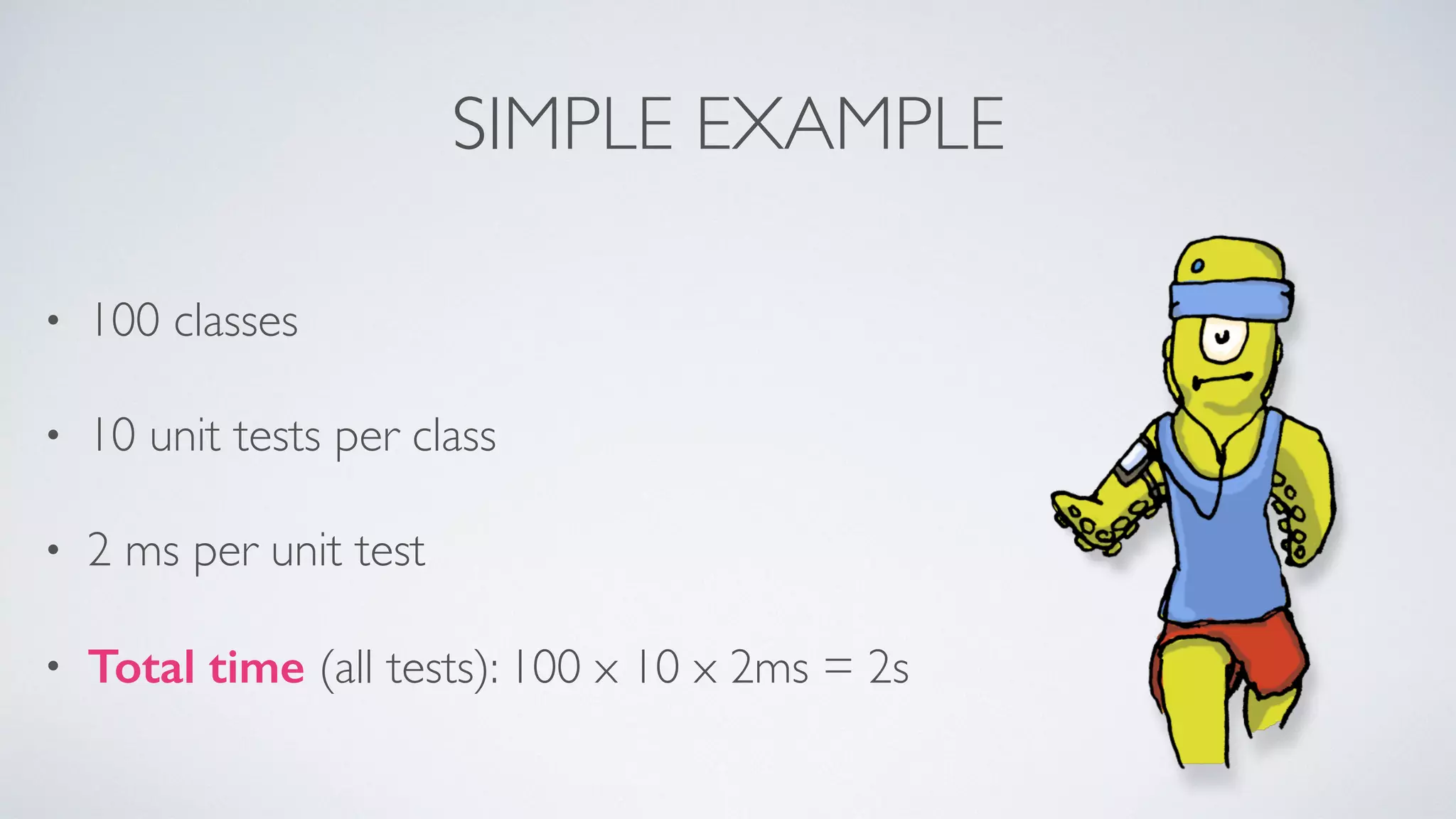
SIMPLE EXAMPLE 
• 100 classes 
• 10 unit tests per class 
• 2 ms per unit test 
• Total time (all tests): 100 x 10 x 2ms = 2s
SIMPLE EXAMPLE 
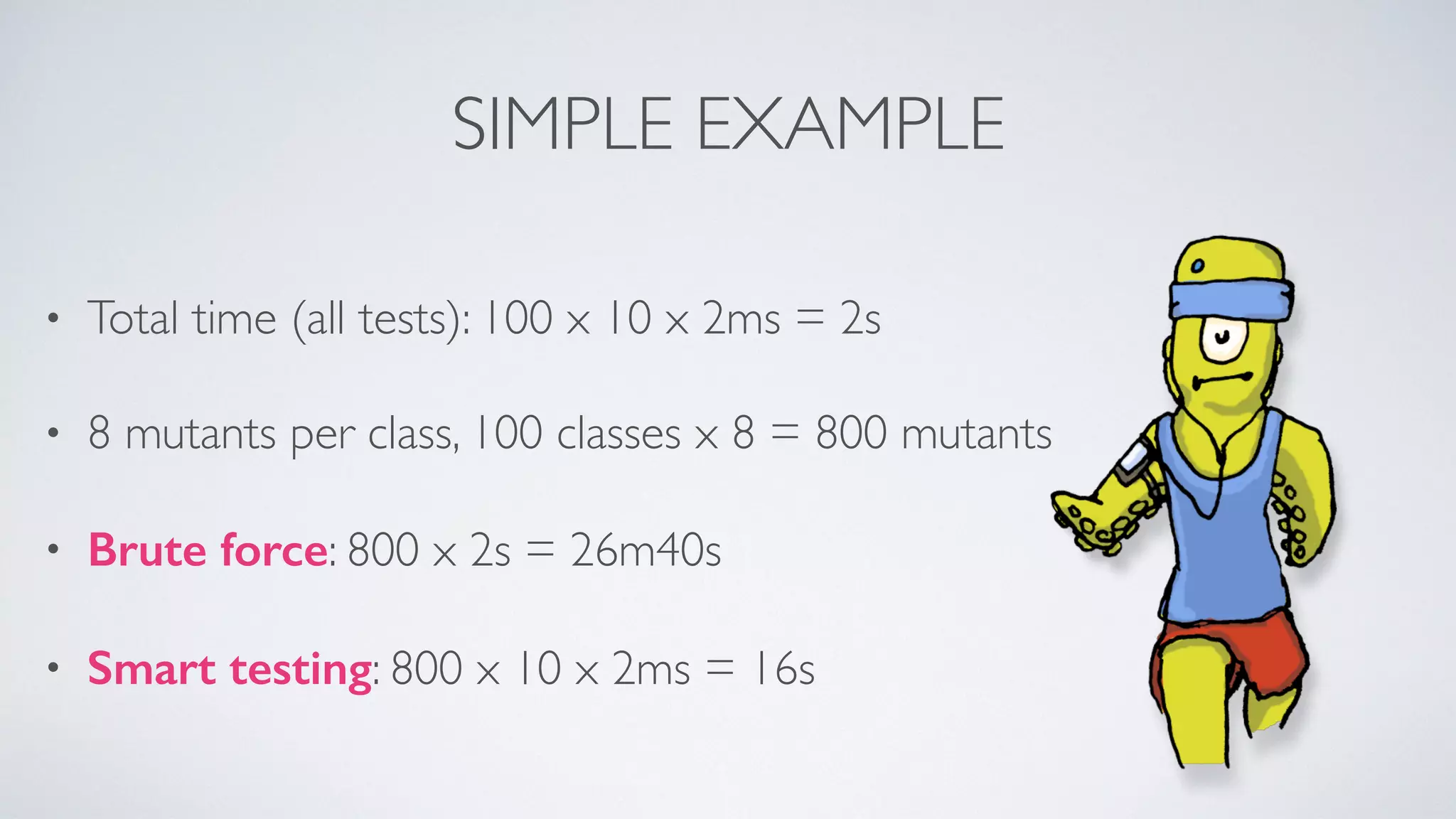
• Total time (all tests): 100 x 10 x 2ms = 2s 
• 8 mutants per class, 100 classes x 8 = 800 mutants 
• Brute force: 800 x 2s = 26m40s 
• Smart testing: 800 x 10 x 2ms = 16s
LONGER EXAMPLE 
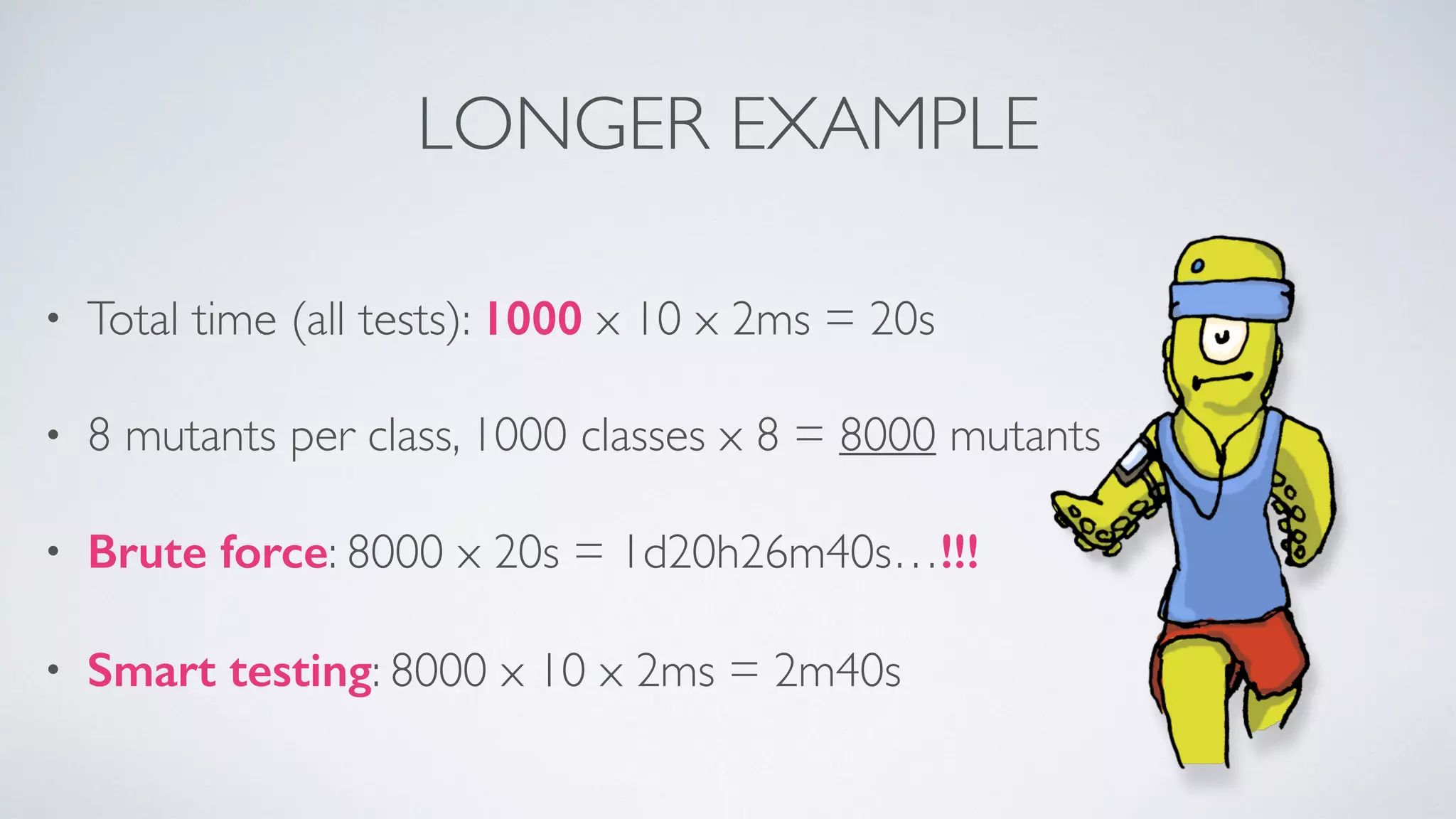
• Total time (all tests): 1000 x 10 x 2ms = 20s 
• 8 mutants per class, 1000 classes x 8 = 8000 mutants 
• Brute force: 8000 x 20s = 1d20h26m40s…!!! 
• Smart testing: 8000 x 10 x 2ms = 2m40s
PERFORMANCE TIPS 
• Write fast tests 
• Good separation or concerns 
• Use small classes, keep amount of unit tests per class low
INCREMENTAL ANALYSIS 
• Experimental feature 
• Incremental analysis keeps track of: 
• Changes in the codebase 
• Previous results
HOW ABOUT MOCKING? 
• PIT has support for: 
• Mockito, EasyMock, JMock, PowerMock and JMockit
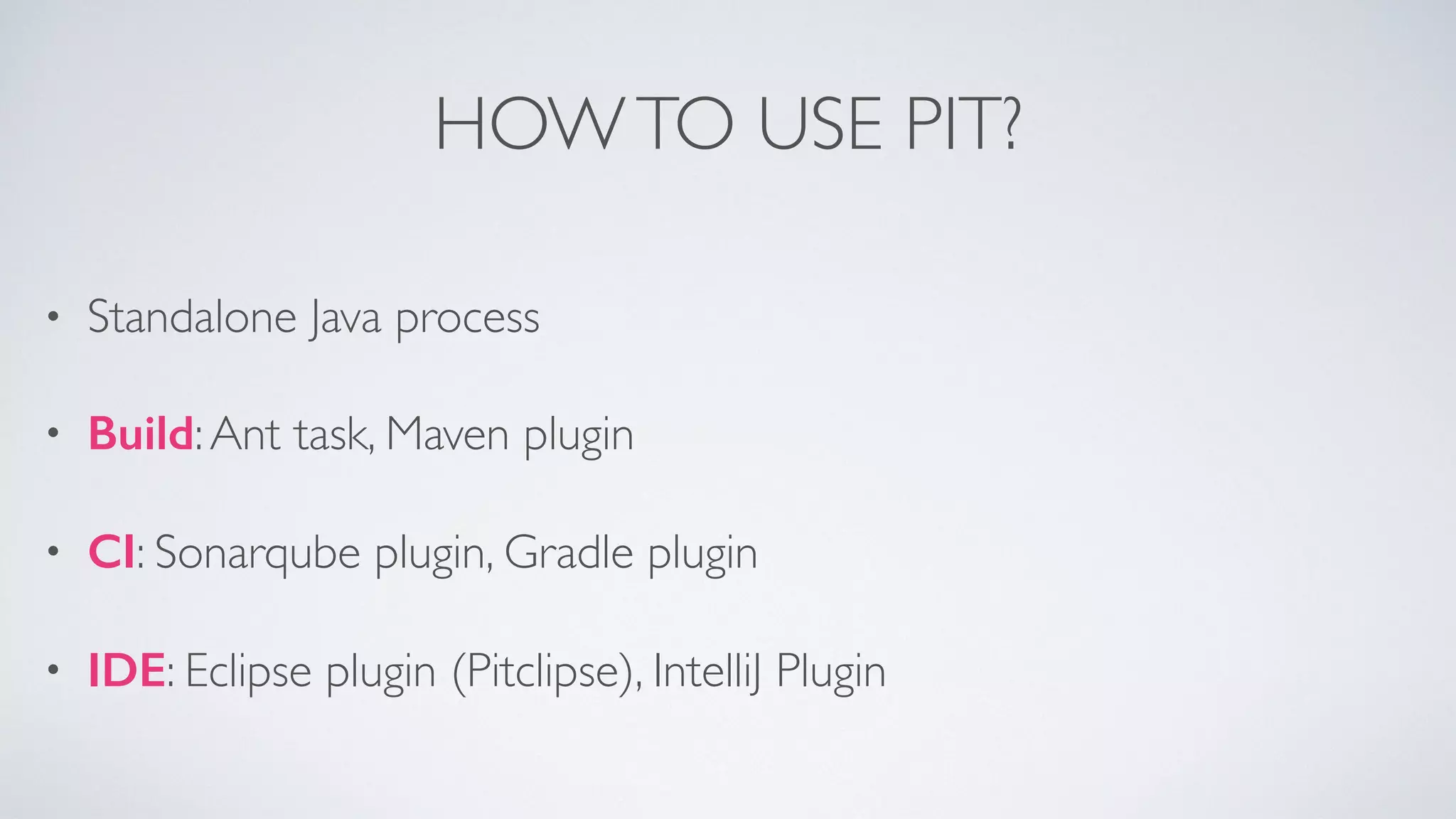
HOW TO USE PIT? 
• Standalone Java process 
• Build: Ant task, Maven plugin 
• CI: Sonarqube plugin, Gradle plugin 
• IDE: Eclipse plugin (Pitclipse), IntelliJ Plugin
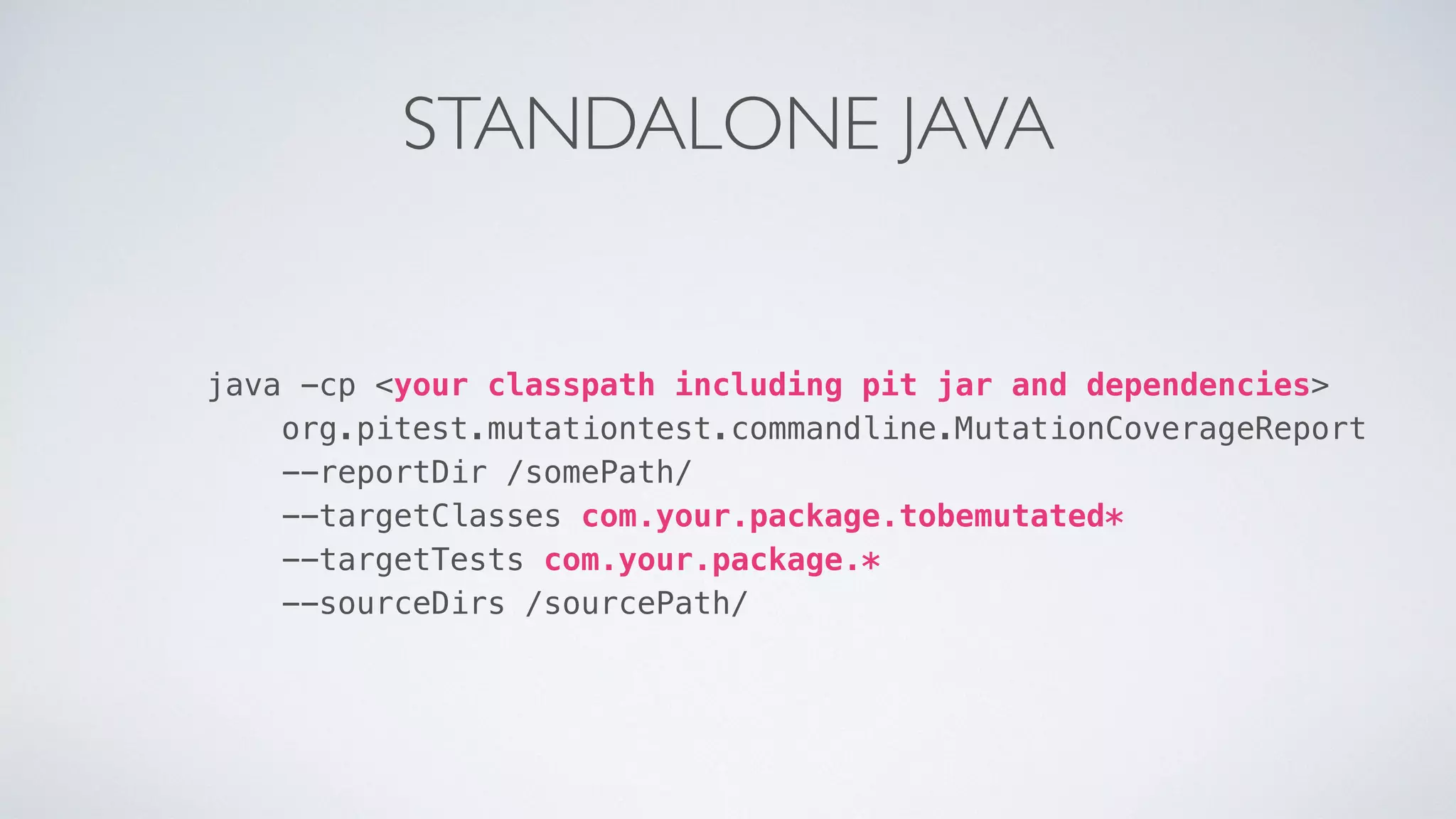
STANDALONE JAVA 
java -cp <your classpath including pit jar and dependencies> 
org.pitest.mutationtest.commandline.MutationCoverageReport 
--reportDir /somePath/ 
--targetClasses com.your.package.tobemutated* 
--targetTests com.your.package.* 
--sourceDirs /sourcePath/
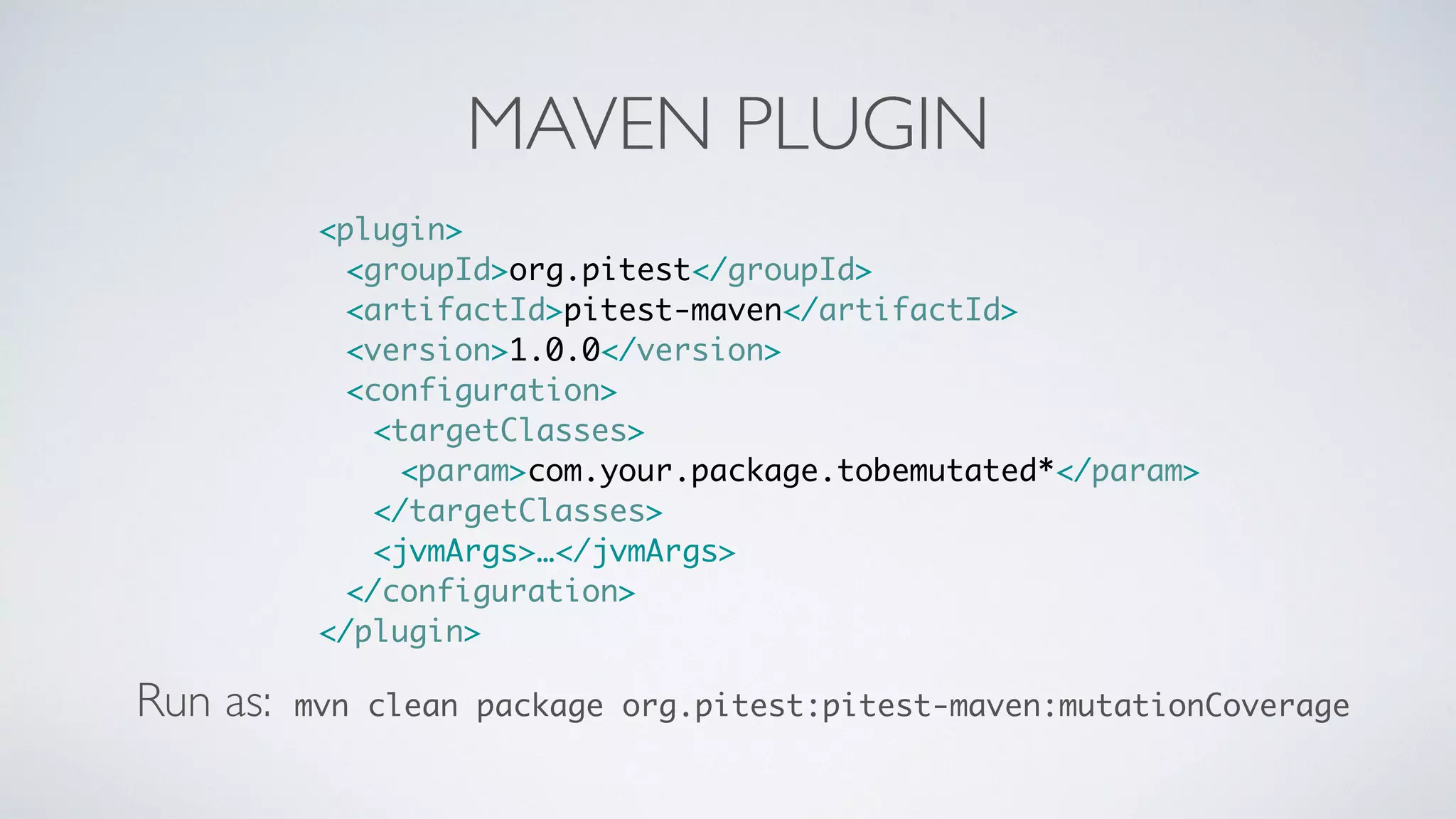
MAVEN PLUGIN 
<plugin> 
<groupId>org.pitest</groupId> 
<artifactId>pitest-maven</artifactId> 
<version>1.0.0</version> 
<configuration> 
<targetClasses> 
<param>com.your.package.tobemutated*</param> 
</targetClasses> 
<jvmArgs>…</jvmArgs> 
</configuration> 
</plugin> 
Run as: mvn clean package org.pitest:pitest-maven:mutationCoverage
EXAMPLE 
Let’s kill some mutants… or be killed.
USE CASE 
The price of an item is 17 euro 
If you buy 20 or more, all items cost 15 euro 
If you have a coupon, all items cost 15 euro
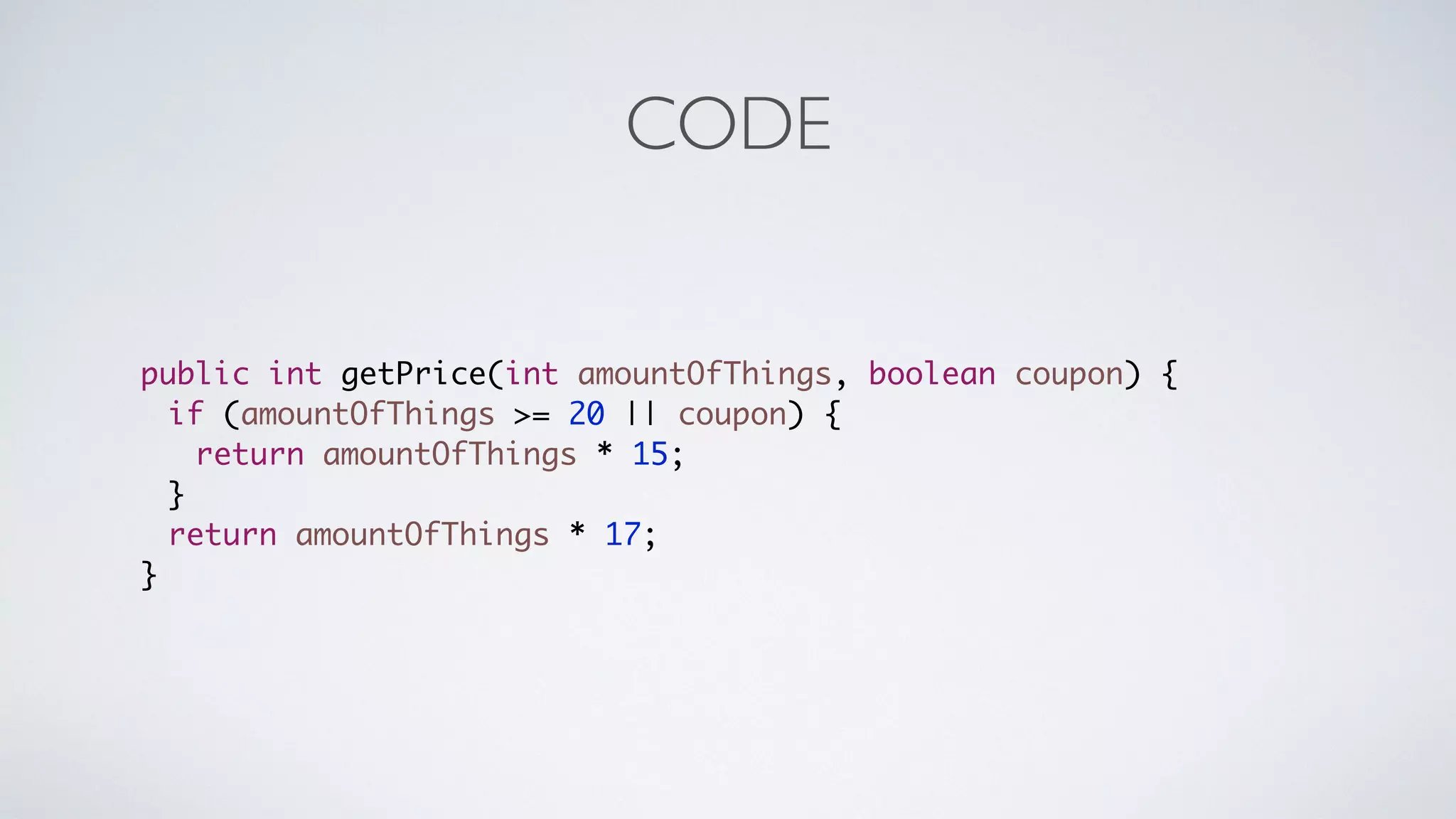
CODE 
public int getPrice(int amountOfThings, boolean coupon) { 
if (amountOfThings >= 20 || coupon) { 
return amountOfThings * 15; 
} 
return amountOfThings * 17; 
}
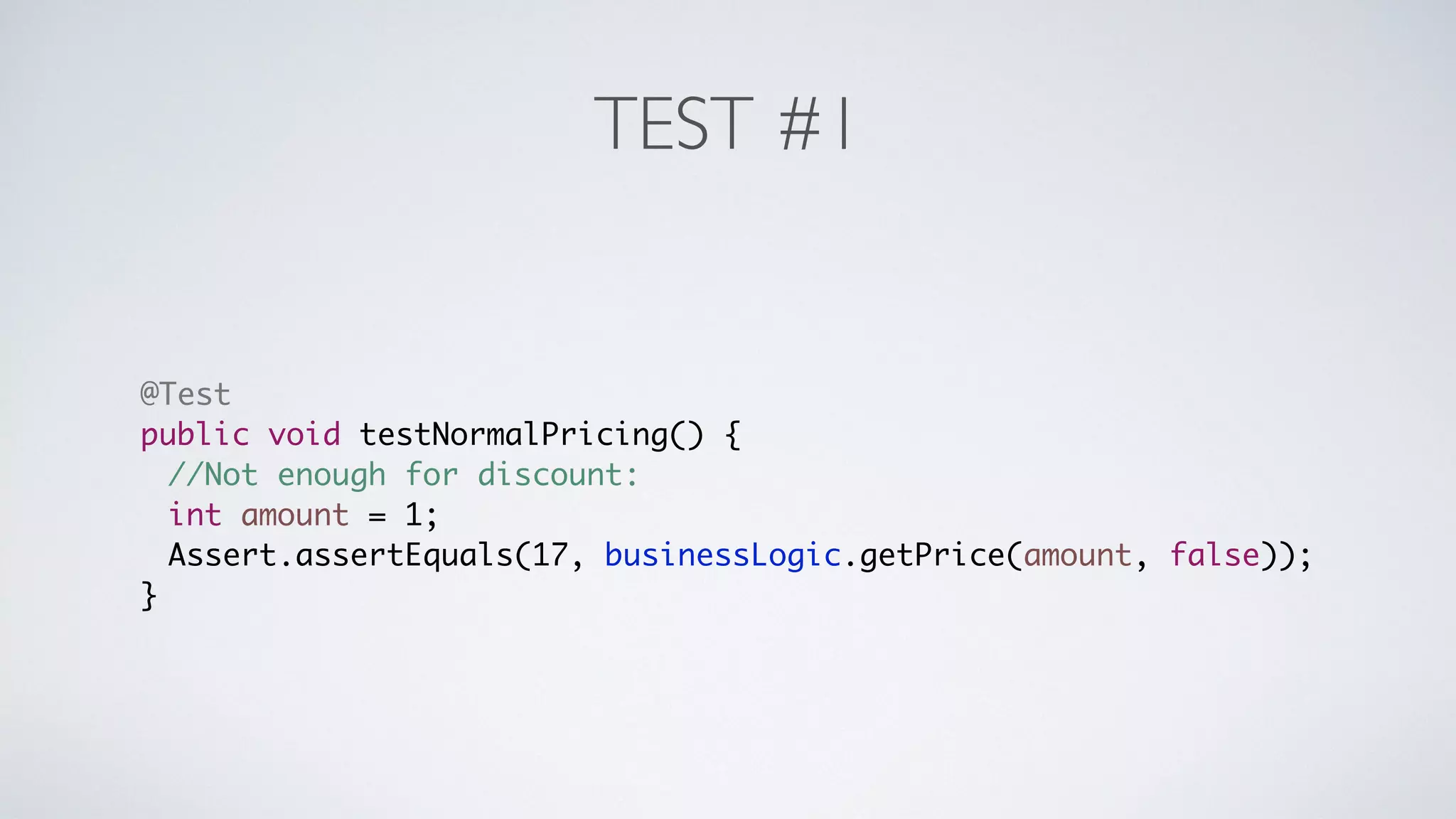
TEST #1 
@Test 
public void testNormalPricing() { 
//Not enough for discount: 
int amount = 1; 
Assert.assertEquals(17, businessLogic.getPrice(amount, false)); 
}
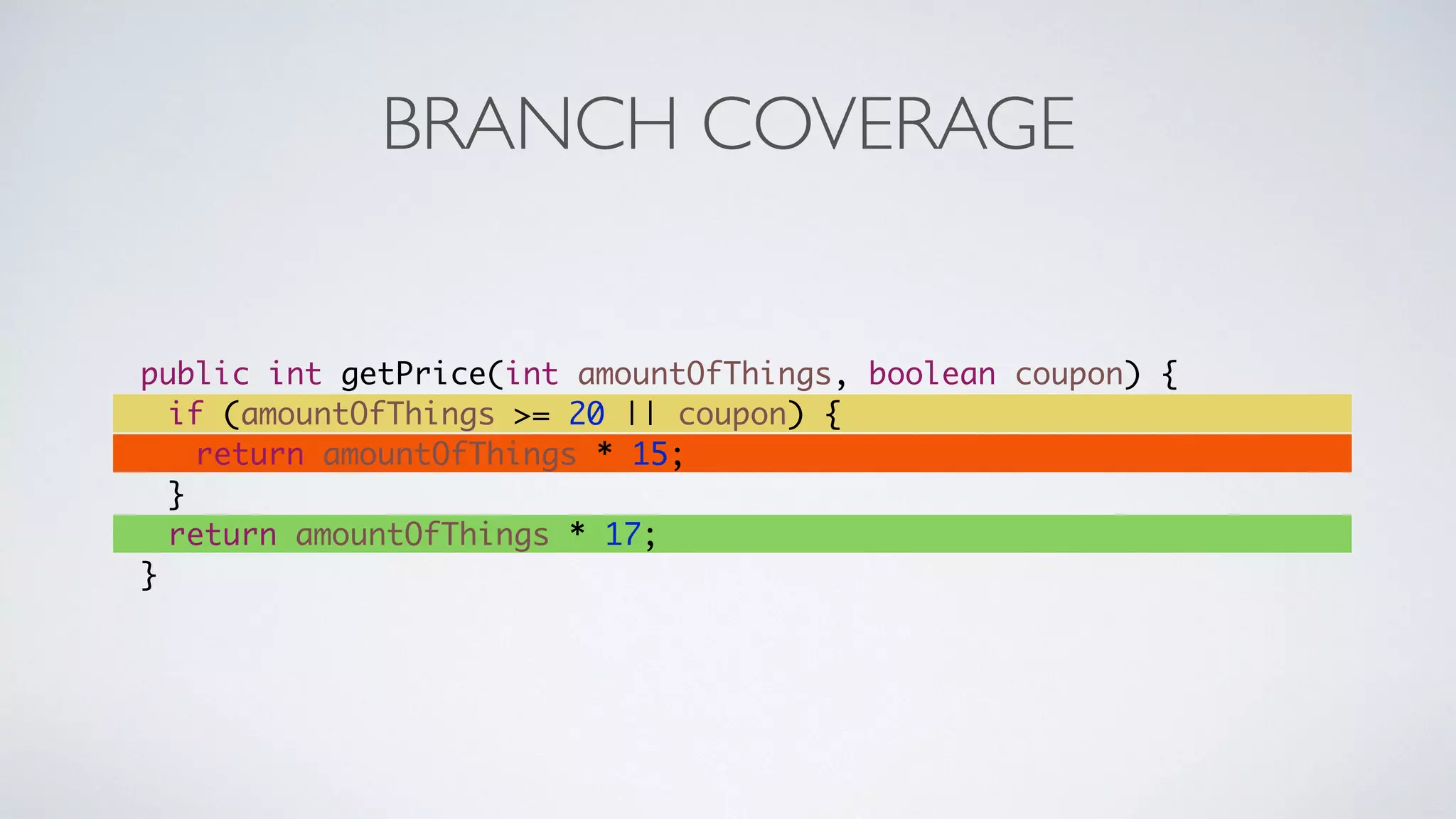
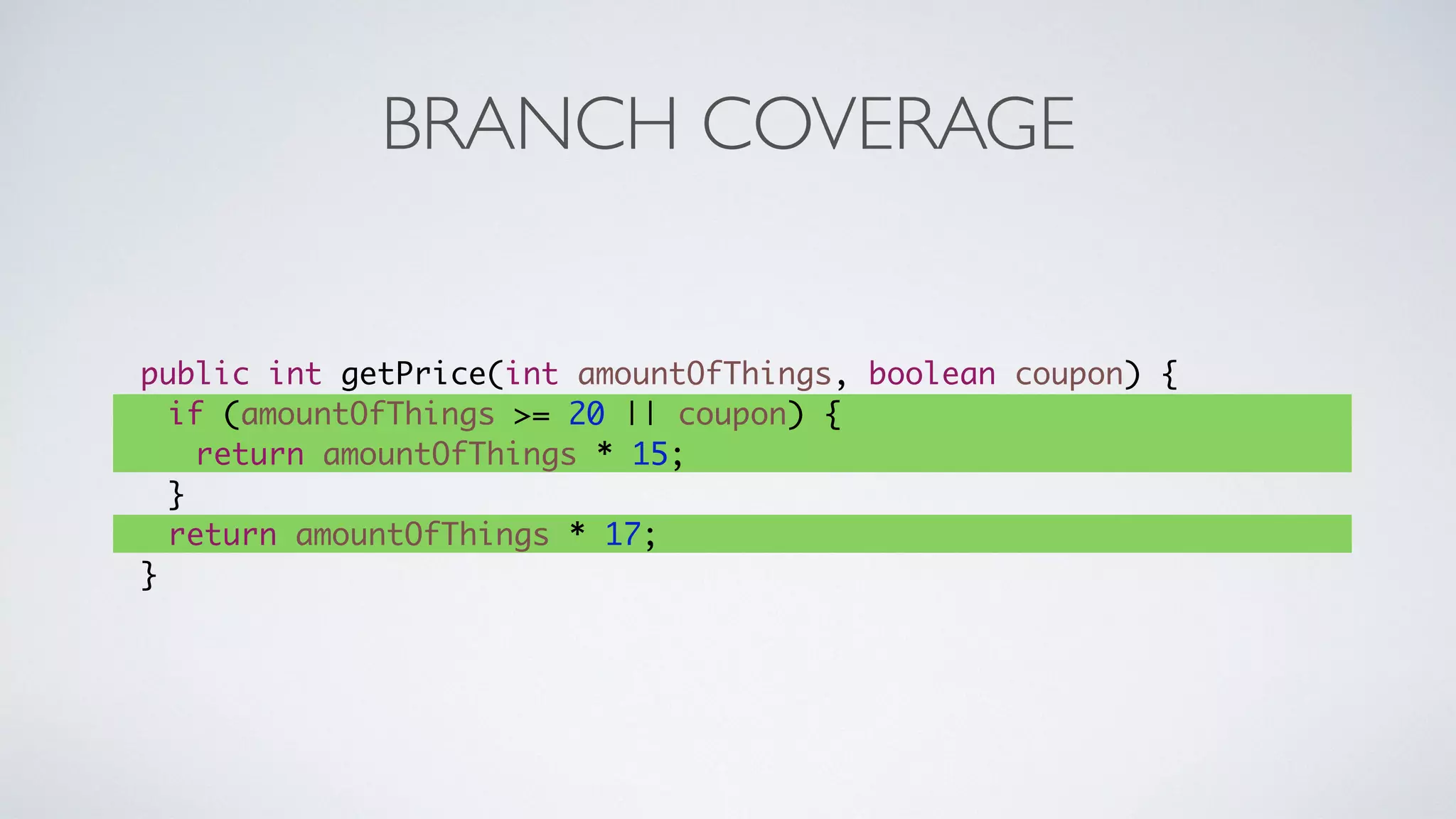
BRANCH COVERAGE 
public int getPrice(int amountOfThings, boolean coupon) { 
if (amountOfThings >= 20 || coupon) { 
return amountOfThings * 15; 
} 
return amountOfThings * 17; 
}
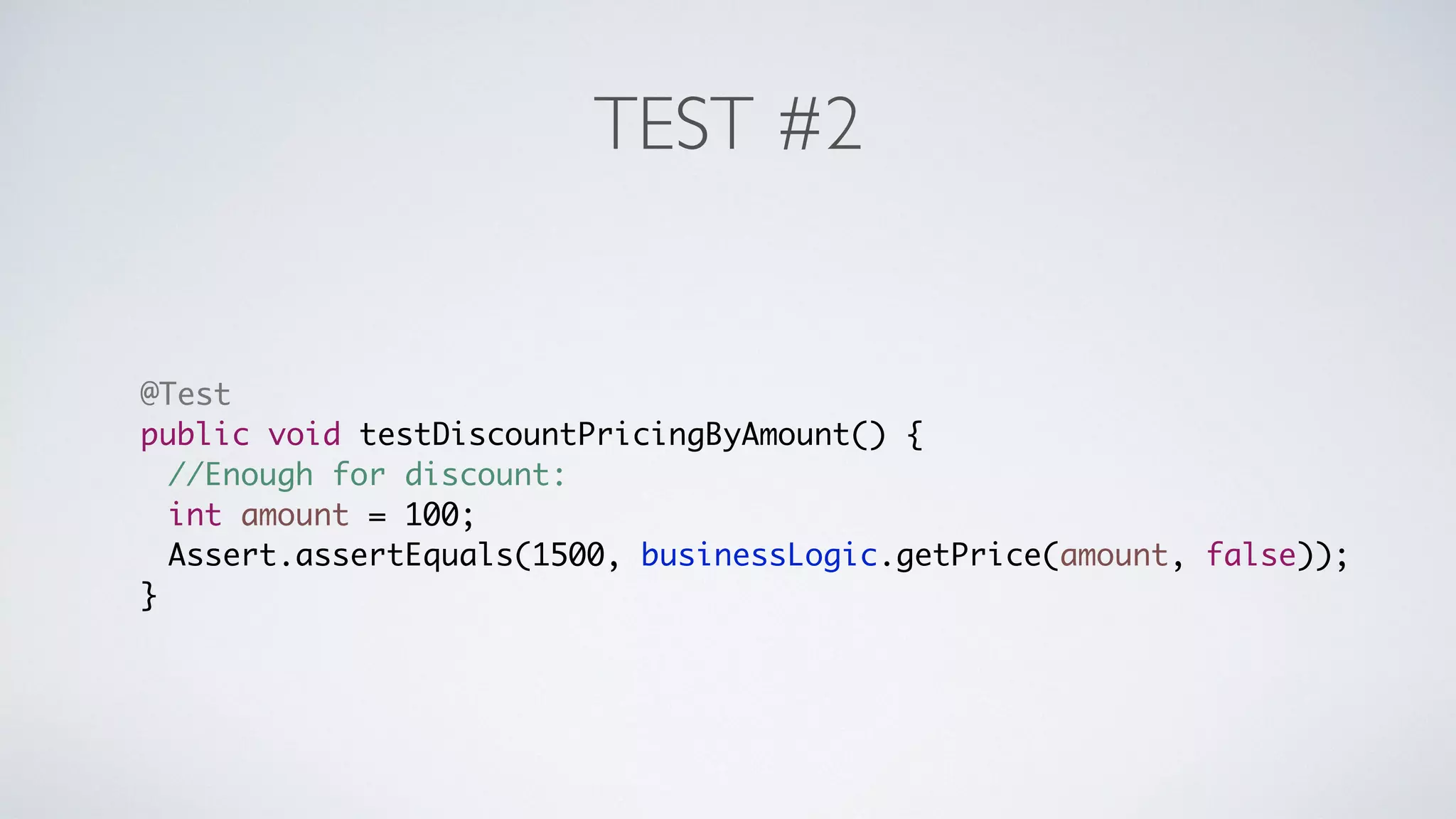
TEST #2 
@Test 
public void testDiscountPricingByAmount() { 
//Enough for discount: 
int amount = 100; 
Assert.assertEquals(1500, businessLogic.getPrice(amount, false)); 
}
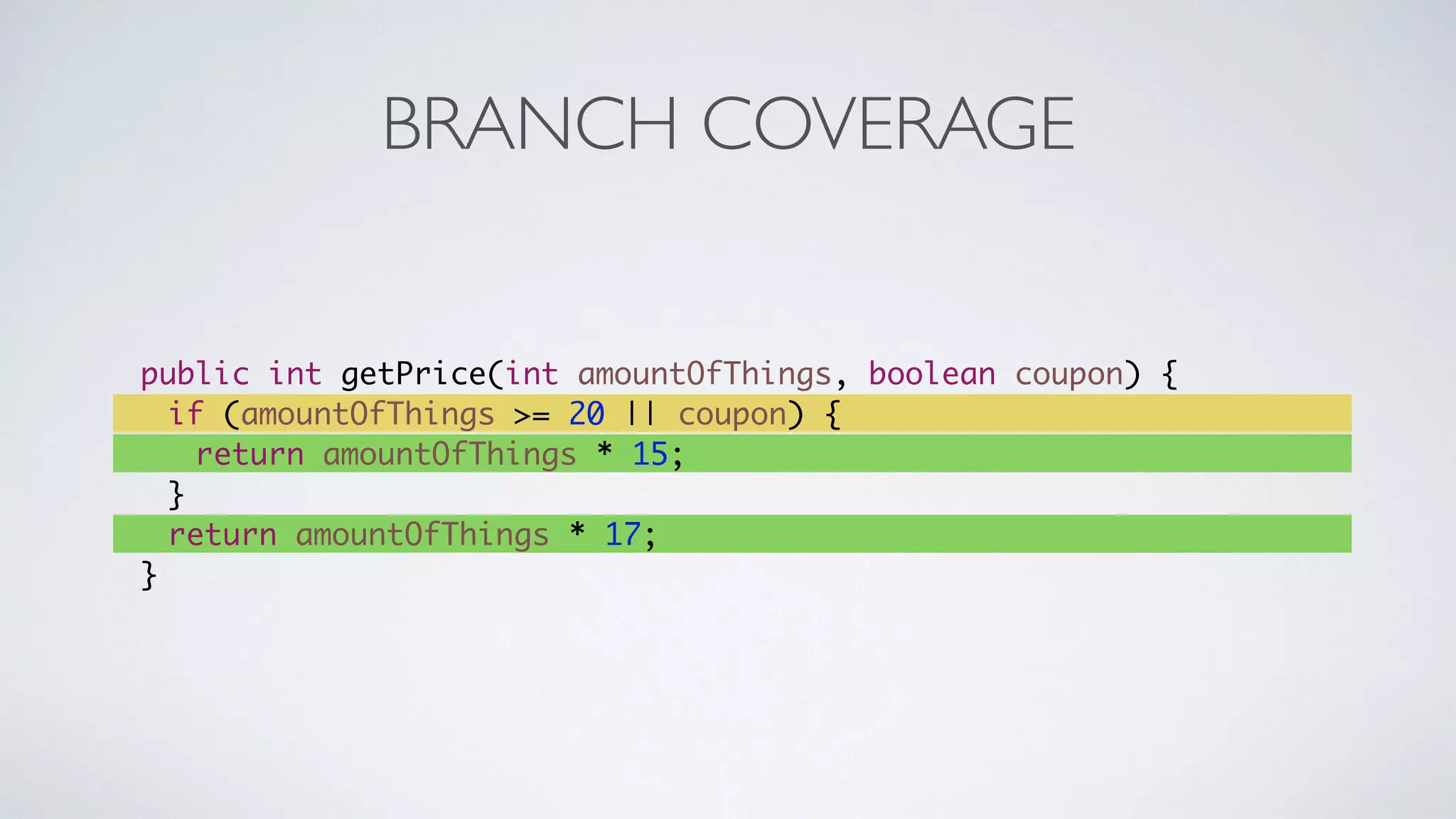
BRANCH COVERAGE 
public int getPrice(int amountOfThings, boolean coupon) { 
if (amountOfThings >= 20 || coupon) { 
return amountOfThings * 15; 
} 
return amountOfThings * 17; 
}
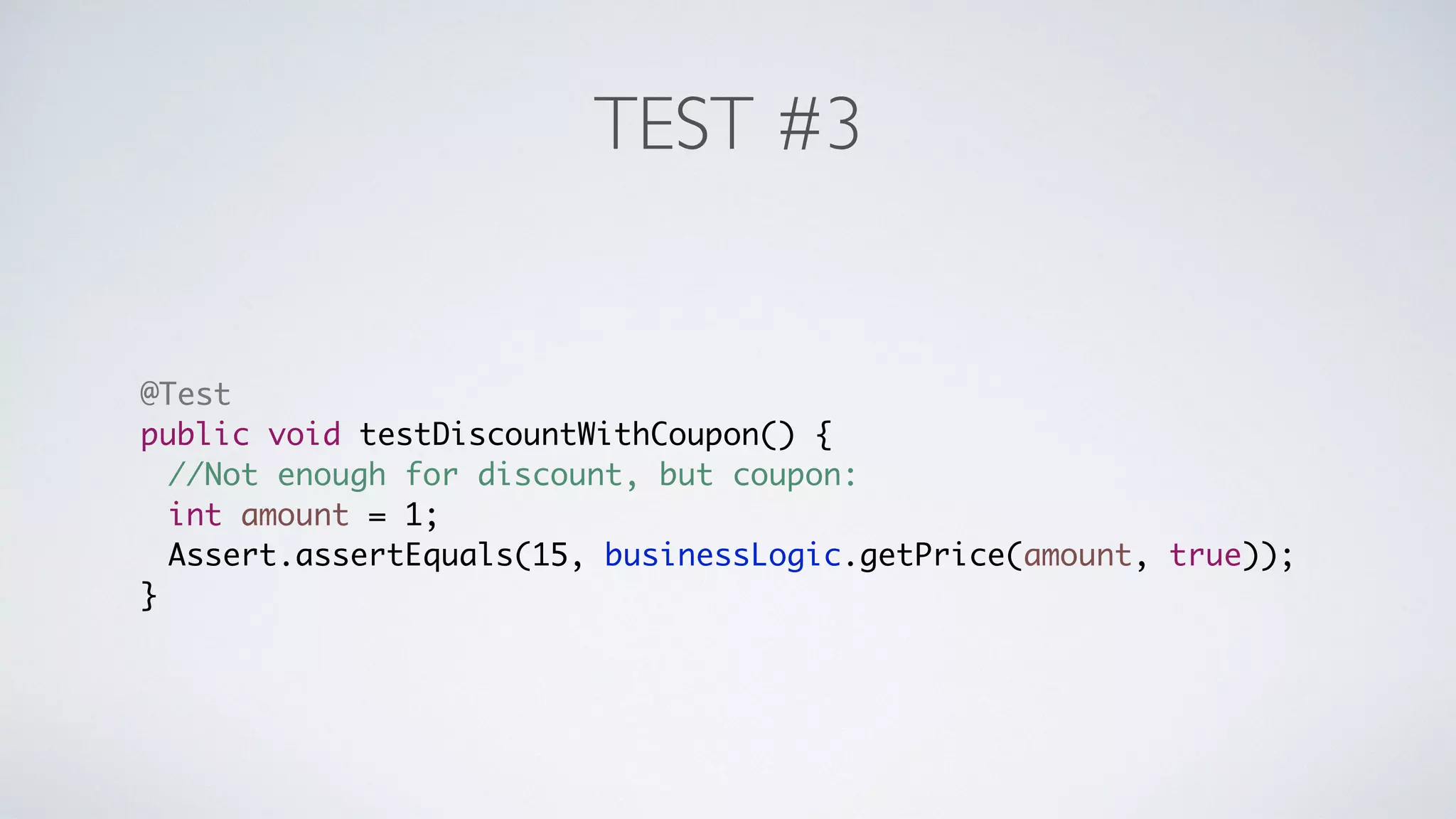
TEST #3 
@Test 
public void testDiscountWithCoupon() { 
//Not enough for discount, but coupon: 
int amount = 1; 
Assert.assertEquals(15, businessLogic.getPrice(amount, true)); 
}
BRANCH COVERAGE 
public int getPrice(int amountOfThings, boolean coupon) { 
if (amountOfThings >= 20 || coupon) { 
return amountOfThings * 15; 
} 
return amountOfThings * 17; 
}
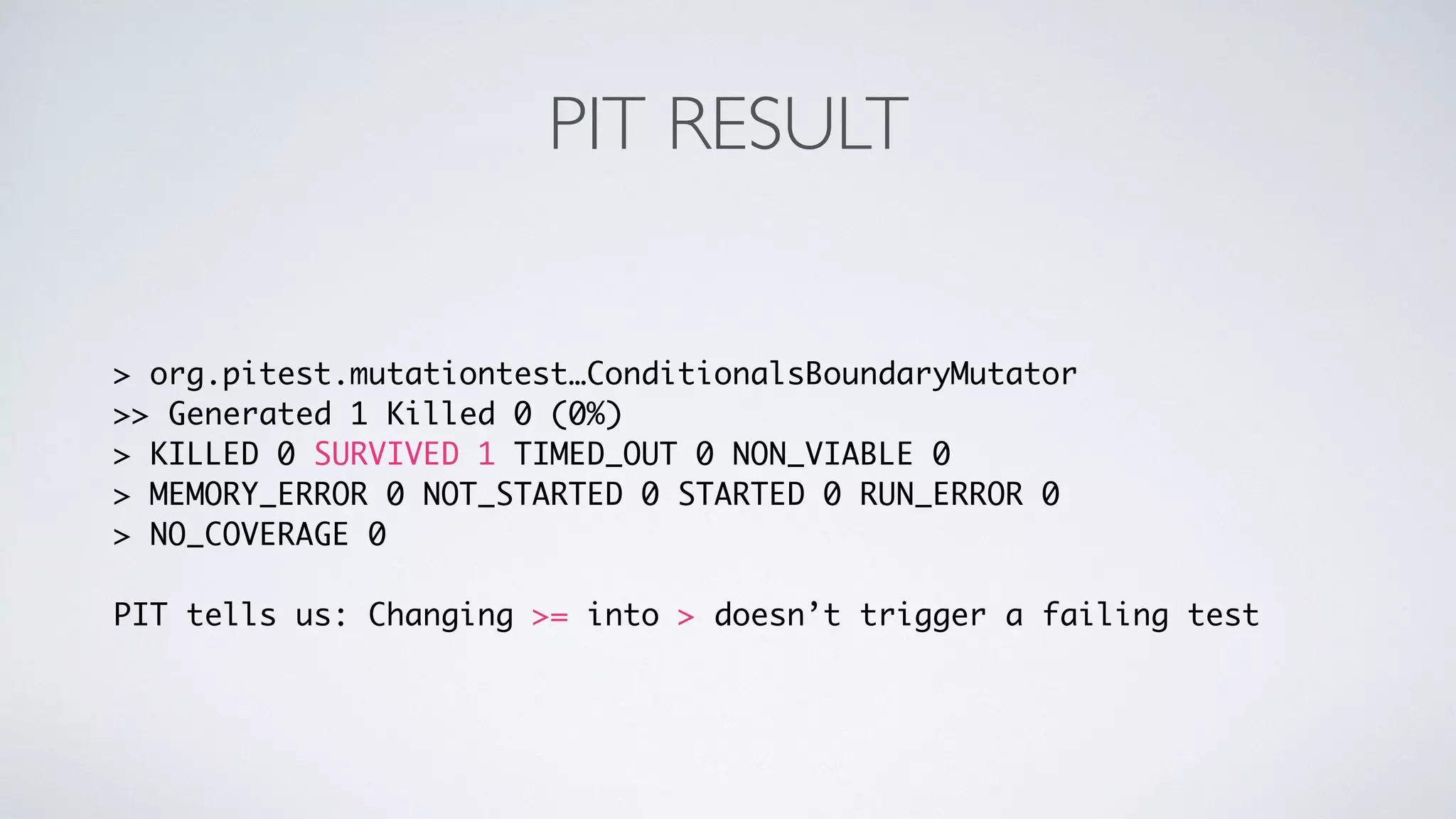
PIT RESULT
PIT RESULT 
> org.pitest.mutationtest…ConditionalsBoundaryMutator 
>> Generated 1 Killed 0 (0%) 
> KILLED 0 SURVIVED 1 TIMED_OUT 0 NON_VIABLE 0 
> MEMORY_ERROR 0 NOT_STARTED 0 STARTED 0 RUN_ERROR 0 
> NO_COVERAGE 0 
PIT tells us: Changing >= into > doesn’t trigger a failing test
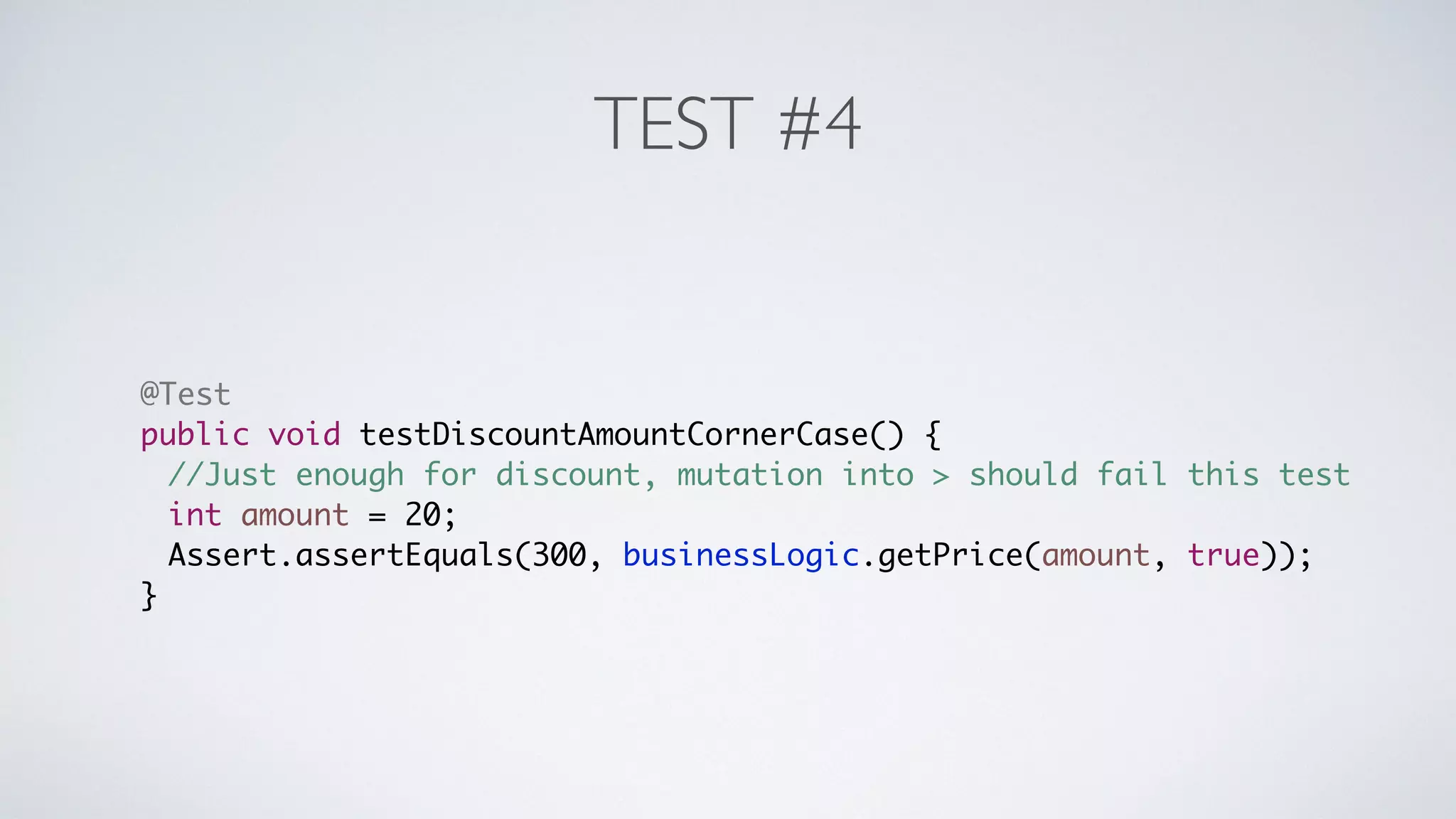
TEST #4 
@Test 
public void testDiscountAmountCornerCase() { 
//Just enough for discount, mutation into > should fail this test 
int amount = 20; 
Assert.assertEquals(300, businessLogic.getPrice(amount, true)); 
}
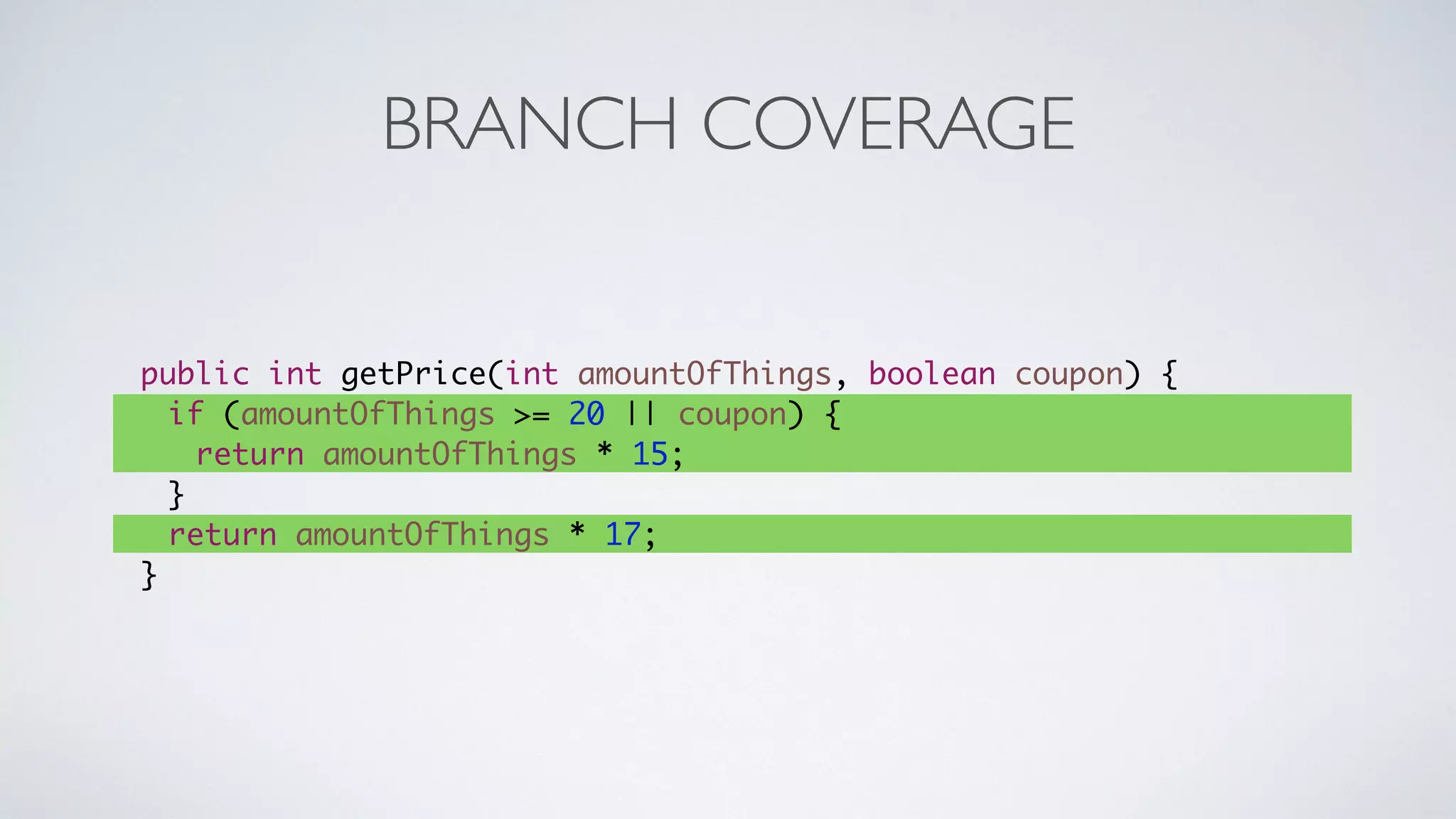
BRANCH COVERAGE 
public int getPrice(int amountOfThings, boolean coupon) { 
if (amountOfThings >= 20 || coupon) { 
return amountOfThings * 15; 
} 
return amountOfThings * 17; 
}
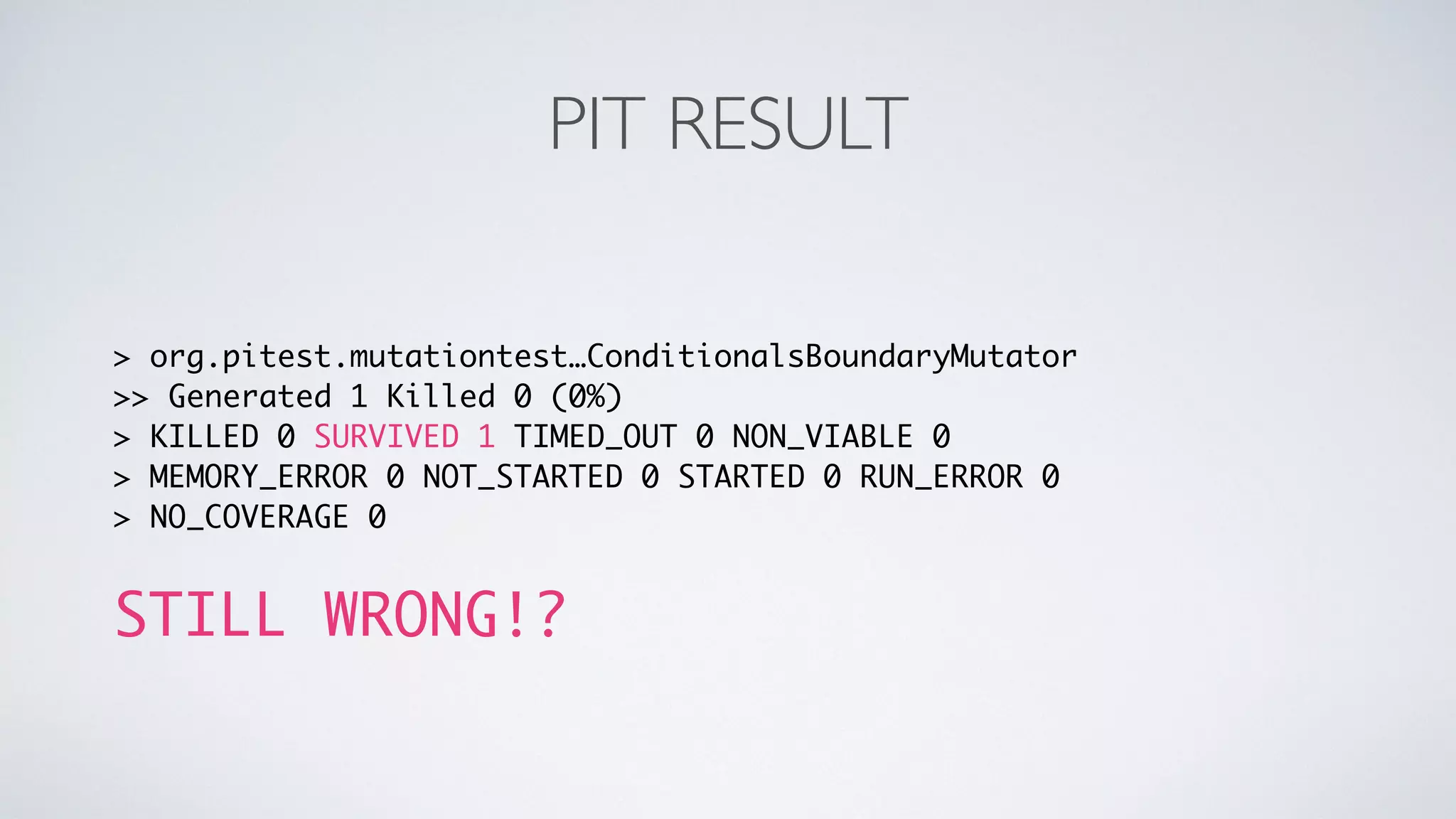
PIT RESULT
PIT RESULT 
> org.pitest.mutationtest…ConditionalsBoundaryMutator 
>> Generated 1 Killed 0 (0%) 
> KILLED 0 SURVIVED 1 TIMED_OUT 0 NON_VIABLE 0 
> MEMORY_ERROR 0 NOT_STARTED 0 STARTED 0 RUN_ERROR 0 
> NO_COVERAGE 0 
STILL WRONG!?
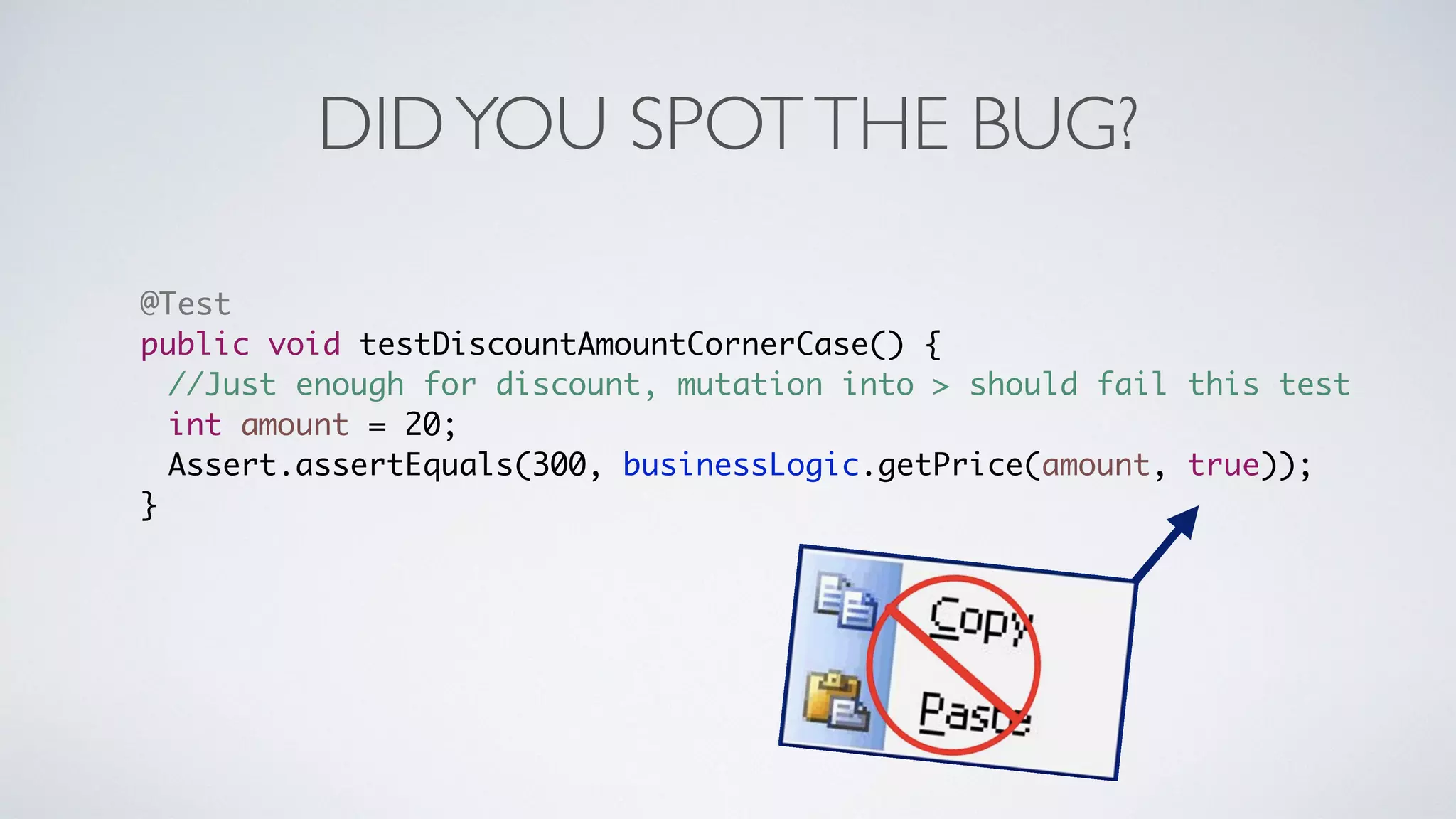
DID YOU SPOT THE BUG? 
@Test 
public void testDiscountAmountCornerCase() { 
//Just enough for discount, mutation into > should fail this test 
int amount = 20; 
Assert.assertEquals(300, businessLogic.getPrice(amount, true)); 
}
SUMMARY 
• Mutation testing automatically tests your tests 
• Mutation testing can find bugs in your tests 
• Code coverage is wrong, gives a false sense of security 
• Mutation testing with PIT is easy to implement
QUESTIONS?

Kill the mutants - A better way to test your tests

  • 1.
    KILL THE MUTANTS a better way to test your tests
  • 2.
    ABOUT ME •Roy van Rijn • Mutants: • Nora • Lucas • Works for
  • 3.
    let's do a SHOW OF HANDS
  • 4.
    WHO DOES •Unit testing • Test-driven development (TDD) • Continuous integration • Measure code coverage • Mutation testing
  • 5.
    UNIT TESTING •Prove your code works • Instant regression tests • Improve code design • Has become a mainstream practise over the last 10 years
  • 6.
    CONTINUOUS INTEGRATION •Automate testing • Maintain a single source repository • Collect statistics
  • 7.
    CODE COVERAGE •Measure the lines (or branches) that are executed during testing
  • 8.
    CODE COVERAGE •How did they test your car?
  • 9.
    CODE COVERAGE •Who has seen (or written?) tests • without verifications or assertions? • just to fake and boost coverage? • 100% branch coverage proves nothing
  • 10.
    QUIS CUSTODIET IPSOSCUSTODES? Who watches the watchmen?
  • 11.
    MUTATION TESTING •Proposed by Richard J. Lipton in 1971 (winner of 2014 Knuth Prize) • A better way to measure the quality of your tests • Surge of interest in the 1980s • Time to revive this interest!
  • 12.
    TERMINOLOGY: MUTATION •A mutation is a (small) change in your codebase, for example:
  • 13.
    TERMINOLOGY: MUTANT •A mutant is a mutated version of your class
  • 14.
    MUTATION TESTING •Generate (a lot of) mutants of your codebase • Run (some of) your unit tests • Check the outcome!
  • 15.
    OUTCOME #1: KILLED • A mutant is killed if a test fails (detecting the mutated code) • This proves the mutated code is properly tested
  • 16.
    OUTCOME #2: LIVED • A mutant didn’t trigger a failing test…
  • 17.
    OUTCOME #3: TIMEDOUT • The mutant caused the program loop, get stuck
  • 18.
    OTHER OUTCOMES •NON-VIABLE • JVM could not load the mutant bytecode • MEMORY ERROR • JVM ran out of memory during test • RUN ERROR • An error but none of the above.
  • 19.
    FAULT INJECTION? •With fault injection you test code • Inject faults/mutations and see how the system reacts • With mutation testing you test your tests • Inject faults/mutations and see how the tests react
  • 20.
    TOOLING • μJava:http://cs.gmu.edu/~offutt/mujava/ (inactive) • Jester: http://jester.sourceforge.net/ (inactive) • Jumble: http://jumble.sourceforge.net/ (inactive) • javaLanche: http://www.st.cs.uni-saarland.de/mutation/ (inactive) • PIT: http://pitest.org/
  • 21.
    USING PIT •PIT uses configurable ‘mutators' • ASM (bytecode manipulation) is used to mutate your code • No mutated code is stored, it can't interfere with your code • Generates reports with test results
  • 22.
    MUTATORS: CONDITION BOUNDARY > into >= < into <= >= into > <= into <
  • 23.
    MUTATORS: NEGATE CONDITIONALS == into != != into == <= into > >= into < < into >= > into <=
  • 24.
    MUTATORS: REMOVE CONDITIONALS into if(true) { //something } if(a == b) { //something }
  • 25.
    MUTATORS: MATH +into - - into + * into / / into * % into * & into | << into >> >> into << >>> into <<< a++ into a-- a-- into a++
  • 26.
    MUTATORS: MANY MORE • Replacing return values (return a; becomes return 0;) • Removal of void invocations (doSomething(); is removed) • Some enabled by default, others are optional/configurable
  • 27.
    MUTATION TESTING ISSLOW? • Speed was unacceptable in the 80's • Mutation testing is still CPU intensive • But PIT has a lot of methods to speed it up!
  • 28.
    WHICH TESTS TORUN? • PIT uses code coverage to decide which tests to run: • A mutation is on a line covered by 3 tests? Only run those.
  • 29.
    SIMPLE EXAMPLE •100 classes • 10 unit tests per class • 2 ms per unit test • Total time (all tests): 100 x 10 x 2ms = 2s
  • 30.
    SIMPLE EXAMPLE •Total time (all tests): 100 x 10 x 2ms = 2s • 8 mutants per class, 100 classes x 8 = 800 mutants • Brute force: 800 x 2s = 26m40s • Smart testing: 800 x 10 x 2ms = 16s
  • 31.
    LONGER EXAMPLE •Total time (all tests): 1000 x 10 x 2ms = 20s • 8 mutants per class, 1000 classes x 8 = 8000 mutants • Brute force: 8000 x 20s = 1d20h26m40s…!!! • Smart testing: 8000 x 10 x 2ms = 2m40s
  • 32.
    PERFORMANCE TIPS •Write fast tests • Good separation or concerns • Use small classes, keep amount of unit tests per class low
  • 33.
    INCREMENTAL ANALYSIS •Experimental feature • Incremental analysis keeps track of: • Changes in the codebase • Previous results
  • 34.
    HOW ABOUT MOCKING? • PIT has support for: • Mockito, EasyMock, JMock, PowerMock and JMockit
  • 35.
    HOW TO USEPIT? • Standalone Java process • Build: Ant task, Maven plugin • CI: Sonarqube plugin, Gradle plugin • IDE: Eclipse plugin (Pitclipse), IntelliJ Plugin
  • 36.
    STANDALONE JAVA java-cp <your classpath including pit jar and dependencies> org.pitest.mutationtest.commandline.MutationCoverageReport --reportDir /somePath/ --targetClasses com.your.package.tobemutated* --targetTests com.your.package.* --sourceDirs /sourcePath/
  • 37.
    MAVEN PLUGIN <plugin> <groupId>org.pitest</groupId> <artifactId>pitest-maven</artifactId> <version>1.0.0</version> <configuration> <targetClasses> <param>com.your.package.tobemutated*</param> </targetClasses> <jvmArgs>…</jvmArgs> </configuration> </plugin> Run as: mvn clean package org.pitest:pitest-maven:mutationCoverage
  • 38.
    EXAMPLE Let’s killsome mutants… or be killed.
  • 39.
    USE CASE Theprice of an item is 17 euro If you buy 20 or more, all items cost 15 euro If you have a coupon, all items cost 15 euro
  • 40.
    CODE public intgetPrice(int amountOfThings, boolean coupon) { if (amountOfThings >= 20 || coupon) { return amountOfThings * 15; } return amountOfThings * 17; }
  • 41.
    TEST #1 @Test public void testNormalPricing() { //Not enough for discount: int amount = 1; Assert.assertEquals(17, businessLogic.getPrice(amount, false)); }
  • 42.
    BRANCH COVERAGE publicint getPrice(int amountOfThings, boolean coupon) { if (amountOfThings >= 20 || coupon) { return amountOfThings * 15; } return amountOfThings * 17; }
  • 43.
    TEST #2 @Test public void testDiscountPricingByAmount() { //Enough for discount: int amount = 100; Assert.assertEquals(1500, businessLogic.getPrice(amount, false)); }
  • 44.
    BRANCH COVERAGE publicint getPrice(int amountOfThings, boolean coupon) { if (amountOfThings >= 20 || coupon) { return amountOfThings * 15; } return amountOfThings * 17; }
  • 45.
    TEST #3 @Test public void testDiscountWithCoupon() { //Not enough for discount, but coupon: int amount = 1; Assert.assertEquals(15, businessLogic.getPrice(amount, true)); }
  • 46.
    BRANCH COVERAGE publicint getPrice(int amountOfThings, boolean coupon) { if (amountOfThings >= 20 || coupon) { return amountOfThings * 15; } return amountOfThings * 17; }
  • 47.
  • 48.
    PIT RESULT >org.pitest.mutationtest…ConditionalsBoundaryMutator >> Generated 1 Killed 0 (0%) > KILLED 0 SURVIVED 1 TIMED_OUT 0 NON_VIABLE 0 > MEMORY_ERROR 0 NOT_STARTED 0 STARTED 0 RUN_ERROR 0 > NO_COVERAGE 0 PIT tells us: Changing >= into > doesn’t trigger a failing test
  • 49.
    TEST #4 @Test public void testDiscountAmountCornerCase() { //Just enough for discount, mutation into > should fail this test int amount = 20; Assert.assertEquals(300, businessLogic.getPrice(amount, true)); }
  • 50.
    BRANCH COVERAGE publicint getPrice(int amountOfThings, boolean coupon) { if (amountOfThings >= 20 || coupon) { return amountOfThings * 15; } return amountOfThings * 17; }
  • 51.
  • 52.
    PIT RESULT >org.pitest.mutationtest…ConditionalsBoundaryMutator >> Generated 1 Killed 0 (0%) > KILLED 0 SURVIVED 1 TIMED_OUT 0 NON_VIABLE 0 > MEMORY_ERROR 0 NOT_STARTED 0 STARTED 0 RUN_ERROR 0 > NO_COVERAGE 0 STILL WRONG!?
  • 53.
    DID YOU SPOTTHE BUG? @Test public void testDiscountAmountCornerCase() { //Just enough for discount, mutation into > should fail this test int amount = 20; Assert.assertEquals(300, businessLogic.getPrice(amount, true)); }
  • 54.
    SUMMARY • Mutationtesting automatically tests your tests • Mutation testing can find bugs in your tests • Code coverage is wrong, gives a false sense of security • Mutation testing with PIT is easy to implement
  • 55.