Mutation Testing


   Filip van Laenen
       OOP 2012
      2012-01-24


                      © Computas AS 27.01.12
Agenda


•   Basics of mutation testing
•   Relation to other testing techniques
•   Example
•   Mutation testing techniques
•   Mutation testing tools
•   Personal experiences and recommendations
•   Improvements
•   Questions and comments


                         2                © Computas AS 27.01.12
Basics of
Mutation Testing


       3           © Computas AS 27.01.12
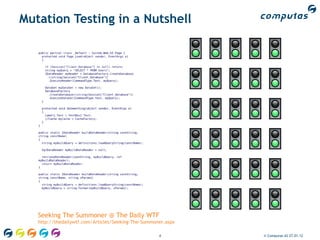
Mutation Testing in a Nutshell


   Seeking The Summoner @ The Daily WTF
   http://thedailywtf.com/Articles/Seeking-The-Summoner.aspx

                                                     4         © Computas AS 27.01.12
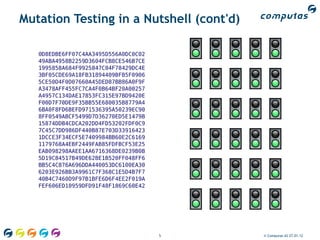
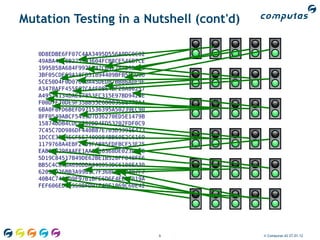
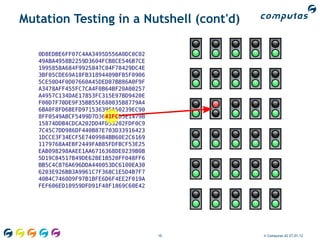
Mutation Testing in a Nutshell (cont'd)


                        5                 © Computas AS 27.01.12
Mutation Testing in a Nutshell (cont'd)


                        6                 © Computas AS 27.01.12
Mutation Testing in a Nutshell (cont'd)


• Unit tests guard the source code
• But who guards the guardians?
   • Do the unit tests cover all source code?
      • Lines?
      • Branches?
      • Paths?
   • Do the unit tests test the right things?

    Mutation testing tests the tests!

                         7                  © Computas AS 27.01.12
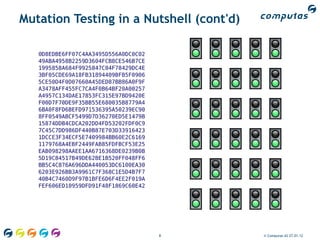
Mutation Testing in a Nutshell (cont'd)


                        8                 © Computas AS 27.01.12
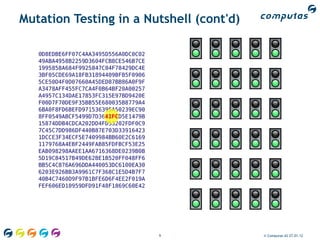
Mutation Testing in a Nutshell (cont'd)


                        9                 © Computas AS 27.01.12
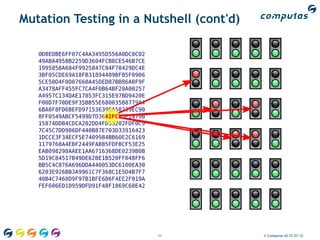
Mutation Testing in a Nutshell (cont'd)


                        10                © Computas AS 27.01.12
Mutation Testing in a Nutshell (cont'd)


                        11                © Computas AS 27.01.12
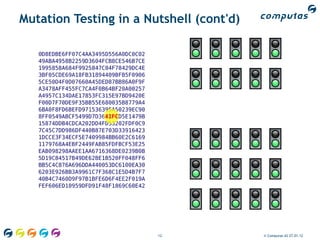
Mutation Testing in a Nutshell (cont'd)


                        12                © Computas AS 27.01.12
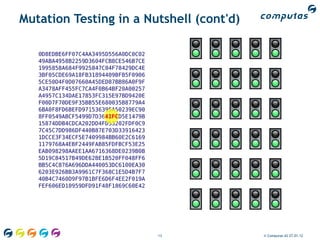
Mutation Testing in a Nutshell (cont'd)


                        13                © Computas AS 27.01.12
Mutation Testing in a Nutshell (cont'd)


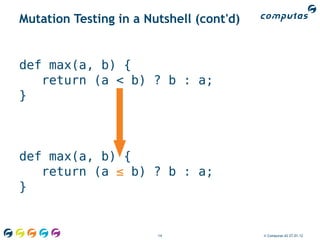
def max(a, b) {
   return (a < b) ? b : a;
}


def max(a, b) {
   return (a ≤ b) ? b : a;
}


                        14                © Computas AS 27.01.12
Mutation Testing in a Nutshell (cont'd)


                        15                © Computas AS 27.01.12
Does Mutation Testing Work?


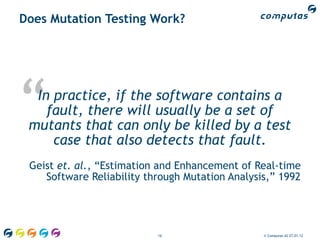
“ In practice, if the software contains a
    fault, there will usually be a set of
 mutants that can only be killed by a test
     case that also detects that fault.
 Geist et. al., “Estimation and Enhancement of Real-time
    Software Reliability through Mutation Analysis,” 1992


                           16                    © Computas AS 27.01.12
Does Mutation Testing Work? (cont'd)


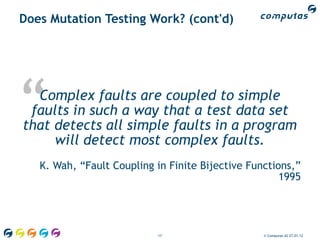
“ Complex faults are coupled to simple
 faults in such a way that a test data set
that detects all simple faults in a program
     will detect most complex faults.
   K. Wah, “Fault Coupling in Finite Bijective Functions,”
                                                      1995


                           17                     © Computas AS 27.01.12
Does Mutation Testing Work? (cont'd)


• “Generated mutants are similar to real faults.”
  • Andrews, Briand, Labiche, ICSE 2005
• “Mutation testing is more powerful than
  statement or branch coverage.”
  • Walsh, Ph.D. Thesis, State University of New York at
    Binghampton, 1985
• “Mutation testing is superior to data flow
  coverage criteria.”
  • Frankl, Weiss, Hu, Journal of Systems and Software,
    1997


                           18                    © Computas AS 27.01.12
Relation to Other
Testing Techniques


        19           © Computas AS 27.01.12
Relation to Other Testing Techniques


•   Unit tests
•   Test-Driven Development (TDD)
•   Test coverage
•   Static code analysis
•   Fuzz testing


                         20            © Computas AS 27.01.12
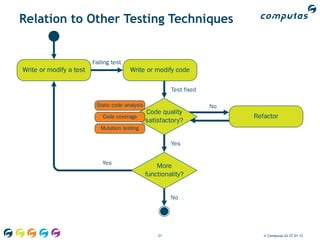
Relation to Other Testing Techniques


                       21              © Computas AS 27.01.12
Is Mutation Testing New?


• R. Lipton, “Fault Diagnosis of Computer
  Programs,” 1971
• R. Lipton et. al., “Hints on Test Data Selection:
  Help for the Practicing Programmer,” 1978
• Historical obstacles:
   • No unit testing
   • No TDD
   • Time-consuming
   • No integration with IDEs


                         22                  © Computas AS 27.01.12
Practical Example
of Mutation Testing


         23           © Computas AS 27.01.12
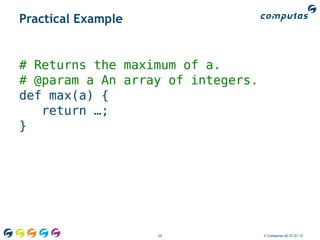
Practical Example


# Returns the maximum of a.
# @param a An array of integers.
def max(a) {
   return …;
}


                    24             © Computas AS 27.01.12
Practical Example (cont'd)


Omitted: max(null)
Omitted: max([])

def max(a) {
   return …;
}


                       25    © Computas AS 27.01.12
Practical Example (cont'd)


Assertion: max([0]) = 0

def max(a) {
   return 0;
}


                       26    © Computas AS 27.01.12
Practical Example (cont'd)


Assertion: max([0]) = 0
Assertion: max([1]) = 1

def max(a) {
   return 0;
}


                       27    © Computas AS 27.01.12
Practical Example (cont'd)


Assertion: max([0]) = 0
Assertion: max([1]) = 1

def max(a) {
   return a.first;
}


                       28    © Computas AS 27.01.12
Practical Example (cont'd)


Assertion: max([0]) = 0
Assertion: max([1]) = 1
Assertion: max([1, 2]) = 2

def max(a) {
   return a.first;
}


                       29    © Computas AS 27.01.12
Practical Example (cont'd)


Assertion: max([0]) = 0
Assertion: max([1]) = 1
Assertion: max([1, 2]) = 2

def max(a) {
                        nit t ests!
   m ← a.first;        U             age!
                               cover
   foreach (e ∈ a)        line
                    100%               age?
      if (e > m)                  over
                            nch c
         m ← e;
                   100% b ra
   return m;
}
                       30              © Computas AS 27.01.12
Practical Example (cont'd)


Assertion: max([0]) = 0
Assertion: max([1]) = 1
Assertion: max([1, 2]) = 2

def max(a) {
   m ← a.first;
   foreach (e ∈ a)
      if (e > m)
         m ← e;
   return m;
}
                       31    © Computas AS 27.01.12
Practical Example (cont'd)


Assertion: max([0]) = 0
Assertion: max([1]) = 1
Assertion: max([1, 2]) = 2

def max(a) {
   m ← a.first;
   foreach (e ∈ a)
      if (true)
         m ← e;
   return m;
}
                       32    © Computas AS 27.01.12
Practical Example (cont'd)


Assertion: max([0]) = 0
Assertion: max([1]) = 1
Assertion: max([1, 2]) = 2

def max(a) {
   return a.last;
}


                       33    © Computas AS 27.01.12
Practical Example (cont'd)


Assertion:    max([0]) = 0
Assertion:    max([1]) = 1
Assertion:    max([1, 2]) = 2
Assertion:    max([2, 1]) = 2

def max(a) {
   return a.last;
}


                       34       © Computas AS 27.01.12
Practical Example (cont'd)


Assertion:    max([0]) = 0
Assertion:    max([1]) = 1
Assertion:    max([1, 2]) = 2
Assertion:    max([2, 1]) = 2

def max(a) {
   m ← a.first;
   foreach (e ∈ a)
      if (e > m)
         m ← e;
   return m;
}                      35       © Computas AS 27.01.12
Practical Example (cont'd)


Assertion:    max([0]) = 0
Assertion:    max([1]) = 1
Assertion:    max([1, 2]) = 2
Assertion:    max([2, 1]) = 2

def max(a) {
   m ← -∞;
   foreach (e ∈ a)
      if (e > m)
         m ← e;
   return m;
}                      36       © Computas AS 27.01.12
Practical Example (cont'd)


Assertion: max([0]) = 0
Assertion: max([1]) = 1
Assertion: max([1, 2]) = 2

def max(a) {
   m ← a.first;
   foreach (e ∈ a)
      if (e > m)   ← Implicit else-branch!
         m ← e;
   return m;
}
                       37           © Computas AS 27.01.12
Practical Example (cont'd)


Assertion: max([0]) = 0
Assertion: max([1]) = 1
Assertion: max([1, 2]) = 2

def max(a) {
   m ← -∞;
   foreach (e ∈ a)                       ?
                                     rage
      if (e > m)               h cove
                   ← Implicitcelse-branch!
                           ran
         m ← e;    10 0% b
   return m;
}
                       38           © Computas AS 27.01.12
Practical Example (cont'd)


• 100% test coverage may be illusory
   • Line coverage
   • Branch coverage
   • Path coverage
• TDD principles easily broken
   • Even if you're very careful


                        39             © Computas AS 27.01.12
Mutation Testing
  Techniques


       40          © Computas AS 27.01.12
Mutation Testing Techniques


• Three aspects:
   • Mutation injection
   • Mutation types
   • Unit test selection per mutant
• Key properties:
   • Efficiency
   • Performance


                        41            © Computas AS 27.01.12
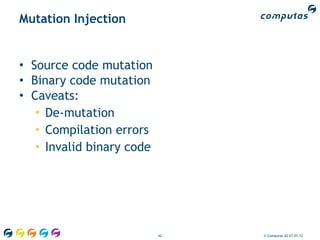
Mutation Injection


• Source code mutation
• Binary code mutation
• Caveats:
   • De-mutation
   • Compilation errors
   • Invalid binary code


                           42   © Computas AS 27.01.12
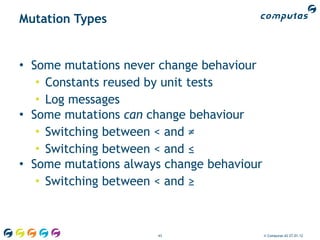
Mutation Types


• Some mutations never change behaviour
   • Constants reused by unit tests
   • Log messages
• Some mutations can change behaviour
   • Switching between < and ≠
   • Switching between < and ≤
• Some mutations always change behaviour
   • Switching between < and ≥


                      43                   © Computas AS 27.01.12
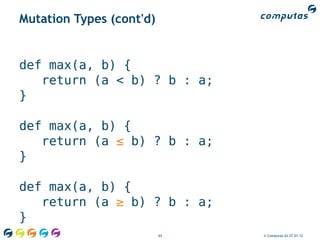
Mutation Types (cont'd)


def max(a, b) {
   return (a < b) ? b : a;
}

def max(a, b) {
   return (a ≤ b) ? b : a;
}

def max(a, b) {
   return (a ≥ b) ? b : a;
}
                          44   © Computas AS 27.01.12
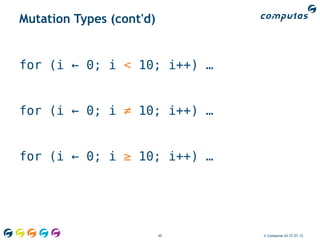
Mutation Types (cont'd)


for (i ← 0; i < 10; i++) …


for (i ← 0; i ≠ 10; i++) …


for (i ← 0; i ≥ 10; i++) …


                          45   © Computas AS 27.01.12
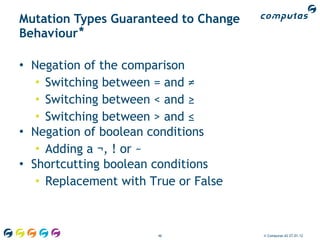
Mutation Types Guaranteed to Change
Behaviour *

• Negation of the comparison
   • Switching between = and ≠
   • Switching between < and ≥
   • Switching between > and ≤
• Negation of boolean conditions
   • Adding a ¬, ! or ~
• Shortcutting boolean conditions
   • Replacement with True or False


                       46             © Computas AS 27.01.12
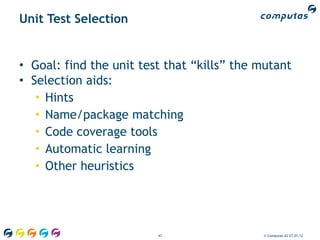
Unit Test Selection


• Goal: find the unit test that “kills” the mutant
• Selection aids:
   • Hints
   • Name/package matching
   • Code coverage tools
   • Automatic learning
   • Other heuristics


                         47                 © Computas AS 27.01.12
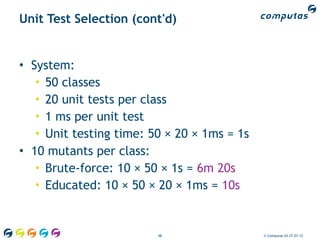
Unit Test Selection (cont'd)


• System:
   • 50 classes
   • 20 unit tests per class
   • 1 ms per unit test
   • Unit testing time: 50 × 20 × 1ms = 1s
• 10 mutants per class:
   • Brute-force: 10 × 50 × 1s = 6m 20s
   • Educated: 10 × 50 × 20 × 1ms = 10s


                         48                  © Computas AS 27.01.12
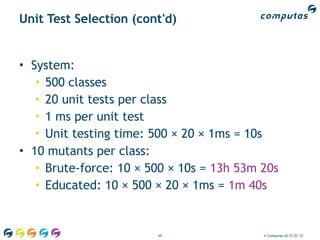
Unit Test Selection (cont'd)


• System:
   • 500 classes
   • 20 unit tests per class
   • 1 ms per unit test
   • Unit testing time: 500 × 20 × 1ms = 10s
• 10 mutants per class:
   • Brute-force: 10 × 500 × 10s = 13h 53m 20s
   • Educated: 10 × 500 × 20 × 1ms = 1m 40s


                        49                 © Computas AS 27.01.12
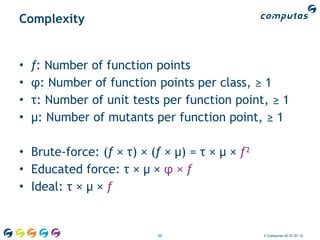
Complexity


•   f: Number of function points
•   φ: Number of function points per class, ≥ 1
•   τ: Number of unit tests per function point, ≥ 1
•   μ: Number of mutants per function point, ≥ 1

• Brute-force: (f × τ) × (f × μ) = τ × μ × f²
• Educated force: τ × μ × φ × f
• Ideal: τ × μ × f


                           50                   © Computas AS 27.01.12
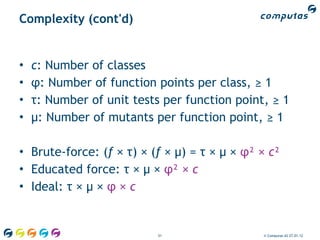
Complexity (cont'd)


•   c: Number of classes
•   φ: Number of function points per class, ≥ 1
•   τ: Number of unit tests per function point, ≥ 1
•   μ: Number of mutants per function point, ≥ 1

• Brute-force: (f × τ) × (f × μ) = τ × μ × φ² × c²
• Educated force: τ × μ × φ² × c
• Ideal: τ × μ × φ × c


                           51                 © Computas AS 27.01.12
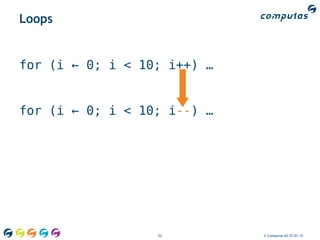
Loops


for (i ← 0; i < 10; i++) …


for (i ← 0; i < 10; i--) …


                  52         © Computas AS 27.01.12
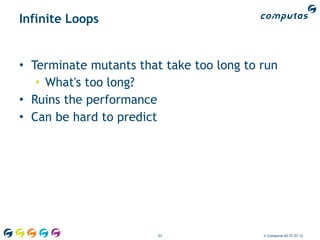
Infinite Loops


• Terminate mutants that take too long to run
   • What's too long?
• Ruins the performance
• Can be hard to predict


                        53                © Computas AS 27.01.12
Other Problems


• Recursion:
   • Stack overflows
   • Out of memory exceptions
• Syntax errors
• Segmentation faults


                       54       © Computas AS 27.01.12
Mutation Testing
     Tools


       55          © Computas AS 27.01.12
Mutation Testing Tools


• Ruby: Heckle
• Java:
   • Jester
   • Jumble
   • PIT
• C#: Nester
• Python: Pester


                         56   © Computas AS 27.01.12
Heckle


•   Ruby
•   Test::Unit and rSpec
•   Usually run from the command-line
•   Runs a set of unit tests on a class or a method
•   Good to-the-point reporting
•   Good performance
•   Virtually no documentation

• http://rubyforge.org/projects/seattlerb/
• http://docs.seattlerb.org/heckle/

                           57                 © Computas AS 27.01.12
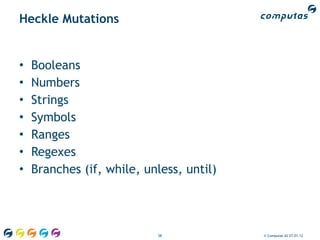
Heckle Mutations


•   Booleans
•   Numbers
•   Strings
•   Symbols
•   Ranges
•   Regexes
•   Branches (if, while, unless, until)


                           58             © Computas AS 27.01.12
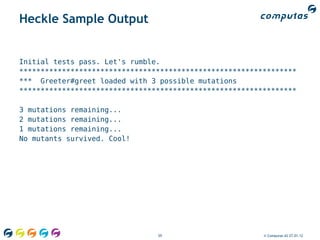
Heckle Sample Output


Initial tests pass. Let's rumble.
*****************************************************************
*** Greeter#greet loaded with 3 possible mutations
*****************************************************************

3 mutations remaining...
2 mutations remaining...
1 mutations remaining...
No mutants survived. Cool!


                                59                       © Computas AS 27.01.12
My Heckle Sample Output


filip@filip-laptop:~/github/wruf$ rake heckle
(in /home/filip/github/wruf)
Doing mutation testing on 15 method(s) of FlickrSearcher against
test/flickr_searcher_unit_test.rb:
 o FlickrSearcher#convert_photo_info [1/15]
 o FlickrSearcher#create_form_data_to_get_info_about_photo [2/15]
 o FlickrSearcher#create_form_data_to_get_info_about_user [3/15]
 o FlickrSearcher#create_form_data_to_search_photos [4/15]
 o FlickrSearcher#do_rest_request [5/15]
 o FlickrSearcher#get_author [6/15]
…
 o FlickrSearcher#get_photo_info [12/15]
 o FlickrSearcher#get_photo_url [13/15]
 o FlickrSearcher#get_ref_url [14/15]
 o FlickrSearcher#get_ref_url_from_xml_photo_info [15/15]
Checked 192 mutations, and no issues were found in FlickrSearcher.


                                60                       © Computas AS 27.01.12
My Heckle Sample Output (cont'd)


Doing mutation testing on 7 method(s) of WrufSettings against
test/wruf_settings_unit_test.rb:
 o WrufSettings#dimensions [1/7]
 o WrufSettings#dimensions= [2/7]
 o WrufSettings#hours [3/7]
 o WrufSettings#hours= [4/7]
 o WrufSettings#tags [5/7]
 o WrufSettings#tolerance [6/7]
 o WrufSettings#tolerance= [7/7]
Checked 0 mutations, and no issues were found in WrufSettings.


                                61                       © Computas AS 27.01.12
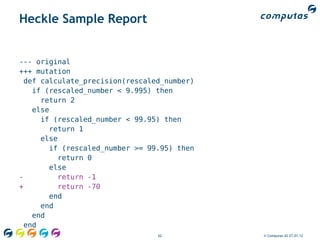
Heckle Sample Report


--- original
+++ mutation
 def calculate_precision(rescaled_number)
   if (rescaled_number < 9.995) then
     return 2
   else
     if (rescaled_number < 99.95) then
       return 1
     else
       if (rescaled_number >= 99.95) then
         return 0
       else
-        return -1
+        return -70
       end
     end
   end
 end
                                62          © Computas AS 27.01.12
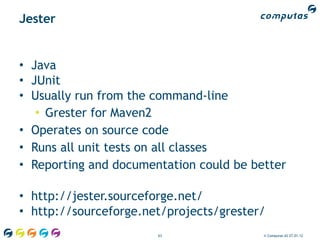
Jester


• Java
• JUnit
• Usually run from the command-line
   • Grester for Maven2
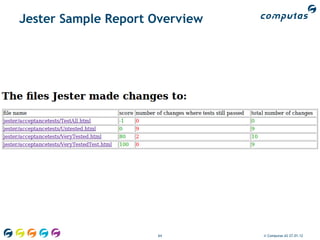
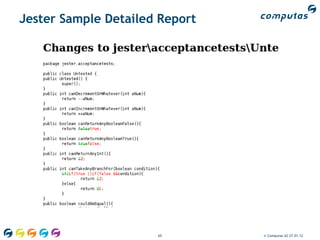
• Operates on source code
• Runs all unit tests on all classes
• Reporting and documentation could be better

• http://jester.sourceforge.net/
• http://sourceforge.net/projects/grester/
                       63                © Computas AS 27.01.12
Jester Sample Report Overview


                     64         © Computas AS 27.01.12
Jester Sample Detailed Report


                      65        © Computas AS 27.01.12
Pester and Nester


• Pester
   • Jester for Python
   • PyUnit
• Nester
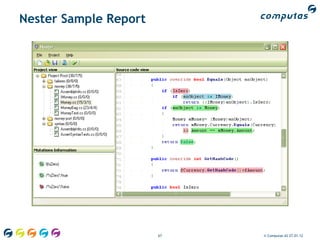
   • Port of Jester for C#
   • NUnit
   • Integrated with Visual Studio
   • But outdated…
   • http://nester.sourceforge.net/

                        66            © Computas AS 27.01.12
Nester Sample Report


                       67   © Computas AS 27.01.12
Jumble


•   Java
•   JUnit
•   Run from the command-line
•   Operates on byte code
•   Runs unit tests on a class
•   Reporting and documentation could be better
•   Claims to be faster than Jester

• http://jumble.sourceforge.net/index.html

                         68                © Computas AS 27.01.12
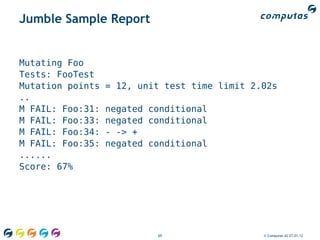
Jumble Sample Report


Mutating Foo
Tests: FooTest
Mutation points   = 12, unit test time limit 2.02s
..
M FAIL: Foo:31:   negated conditional
M FAIL: Foo:33:   negated conditional
M FAIL: Foo:34:   - -> +
M FAIL: Foo:35:   negated conditional
......
Score: 67%


                           69                  © Computas AS 27.01.12
PIT


• Java
• JUnit
• Maven or command-line
• Operates on byte code
• Large set of mutators
   • Also possibly equivalent mutators available
• Highly configurable
• Sensible defaults

• http://pitest.org/
                         70                 © Computas AS 27.01.12
PIT Mutators


•   Conditionals Boundary
•   Negate Conditionals
•   Math
•   Increments
•   Invert Negatives
•   Inline Constant*
•   Return Values
•   Void Method Call
•   Non Void Method Call*
•   Constructor Call*

                            71   © Computas AS 27.01.12
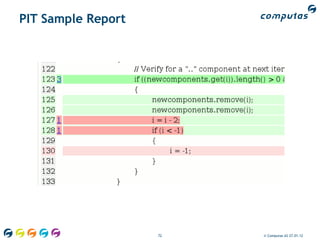
PIT Sample Report


                    72   © Computas AS 27.01.12
Personal Experiences
and Recommendations


          73            © Computas AS 27.01.12
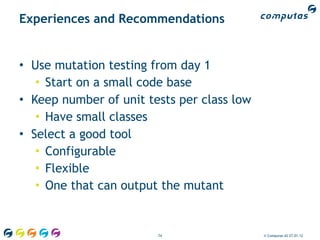
Experiences and Recommendations


• Use mutation testing from day 1
   • Start on a small code base
• Keep number of unit tests per class low
   • Have small classes
• Select a good tool
   • Configurable
   • Flexible
   • One that can output the mutant


                        74                  © Computas AS 27.01.12
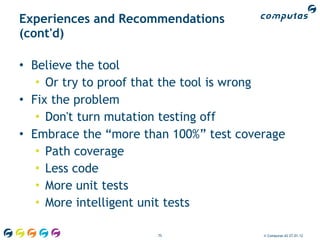
Experiences and Recommendations
(cont'd)

• Believe the tool
   • Or try to proof that the tool is wrong
• Fix the problem
   • Don't turn mutation testing off
• Embrace the “more than 100%” test coverage
   • Path coverage
   • Less code
   • More unit tests
   • More intelligent unit tests

                      75                © Computas AS 27.01.12
Improvements


     76        © Computas AS 27.01.12
Improvements


• Integration with more unit testing frameworks
• Better unit test–source code mapping
   • Better heuristics
• Parallellisation
• Better reporting
• IDE integration
• Building tool integration


                        77                © Computas AS 27.01.12
The Ideal Mutation Testing Tool™


•   Easy integration with building tools
•   Easy integration with IDEs
•   Support for all unit testing frameworks
•   Human-aided unit test selection heuristics
•   Full parallellisation
•   Good source code mutation reporting


                          78                 © Computas AS 27.01.12
Questions?


Contact:

    fvl@computas.com               @filipvanlaenen

    Computas AS                    Tel +47-67 83 10 00
    Lysaker Torg 45, pb 482        Fax +47-67 83 10 01
    N-1327 Lysaker                 Org.nr: NO 986 352 325 MVA
    NORWAY                         www.computas.com


                              79                      © Computas AS 27.01.12

Mutation testing (OOP 2012, 2012-JAN-24)

  • 1.
    Mutation Testing Filip van Laenen OOP 2012 2012-01-24 © Computas AS 27.01.12
  • 2.
    Agenda • Basics of mutation testing • Relation to other testing techniques • Example • Mutation testing techniques • Mutation testing tools • Personal experiences and recommendations • Improvements • Questions and comments 2 © Computas AS 27.01.12
  • 3.
    Basics of Mutation Testing 3 © Computas AS 27.01.12
  • 4.
    Mutation Testing ina Nutshell Seeking The Summoner @ The Daily WTF http://thedailywtf.com/Articles/Seeking-The-Summoner.aspx 4 © Computas AS 27.01.12
  • 5.
    Mutation Testing ina Nutshell (cont'd) 5 © Computas AS 27.01.12
  • 6.
    Mutation Testing ina Nutshell (cont'd) 6 © Computas AS 27.01.12
  • 7.
    Mutation Testing ina Nutshell (cont'd) • Unit tests guard the source code • But who guards the guardians? • Do the unit tests cover all source code? • Lines? • Branches? • Paths? • Do the unit tests test the right things? Mutation testing tests the tests! 7 © Computas AS 27.01.12
  • 8.
    Mutation Testing ina Nutshell (cont'd) 8 © Computas AS 27.01.12
  • 9.
    Mutation Testing ina Nutshell (cont'd) 9 © Computas AS 27.01.12
  • 10.
    Mutation Testing ina Nutshell (cont'd) 10 © Computas AS 27.01.12
  • 11.
    Mutation Testing ina Nutshell (cont'd) 11 © Computas AS 27.01.12
  • 12.
    Mutation Testing ina Nutshell (cont'd) 12 © Computas AS 27.01.12
  • 13.
    Mutation Testing ina Nutshell (cont'd) 13 © Computas AS 27.01.12
  • 14.
    Mutation Testing ina Nutshell (cont'd) def max(a, b) { return (a < b) ? b : a; } def max(a, b) { return (a ≤ b) ? b : a; } 14 © Computas AS 27.01.12
  • 15.
    Mutation Testing ina Nutshell (cont'd) 15 © Computas AS 27.01.12
  • 16.
    Does Mutation TestingWork? “ In practice, if the software contains a fault, there will usually be a set of mutants that can only be killed by a test case that also detects that fault. Geist et. al., “Estimation and Enhancement of Real-time Software Reliability through Mutation Analysis,” 1992 16 © Computas AS 27.01.12
  • 17.
    Does Mutation TestingWork? (cont'd) “ Complex faults are coupled to simple faults in such a way that a test data set that detects all simple faults in a program will detect most complex faults. K. Wah, “Fault Coupling in Finite Bijective Functions,” 1995 17 © Computas AS 27.01.12
  • 18.
    Does Mutation TestingWork? (cont'd) • “Generated mutants are similar to real faults.” • Andrews, Briand, Labiche, ICSE 2005 • “Mutation testing is more powerful than statement or branch coverage.” • Walsh, Ph.D. Thesis, State University of New York at Binghampton, 1985 • “Mutation testing is superior to data flow coverage criteria.” • Frankl, Weiss, Hu, Journal of Systems and Software, 1997 18 © Computas AS 27.01.12
  • 19.
    Relation to Other TestingTechniques 19 © Computas AS 27.01.12
  • 20.
    Relation to OtherTesting Techniques • Unit tests • Test-Driven Development (TDD) • Test coverage • Static code analysis • Fuzz testing 20 © Computas AS 27.01.12
  • 21.
    Relation to OtherTesting Techniques 21 © Computas AS 27.01.12
  • 22.
    Is Mutation TestingNew? • R. Lipton, “Fault Diagnosis of Computer Programs,” 1971 • R. Lipton et. al., “Hints on Test Data Selection: Help for the Practicing Programmer,” 1978 • Historical obstacles: • No unit testing • No TDD • Time-consuming • No integration with IDEs 22 © Computas AS 27.01.12
  • 23.
    Practical Example of MutationTesting 23 © Computas AS 27.01.12
  • 24.
    Practical Example # Returnsthe maximum of a. # @param a An array of integers. def max(a) { return …; } 24 © Computas AS 27.01.12
  • 25.
    Practical Example (cont'd) Omitted:max(null) Omitted: max([]) def max(a) { return …; } 25 © Computas AS 27.01.12
  • 26.
    Practical Example (cont'd) Assertion:max([0]) = 0 def max(a) { return 0; } 26 © Computas AS 27.01.12
  • 27.
    Practical Example (cont'd) Assertion:max([0]) = 0 Assertion: max([1]) = 1 def max(a) { return 0; } 27 © Computas AS 27.01.12
  • 28.
    Practical Example (cont'd) Assertion:max([0]) = 0 Assertion: max([1]) = 1 def max(a) { return a.first; } 28 © Computas AS 27.01.12
  • 29.
    Practical Example (cont'd) Assertion:max([0]) = 0 Assertion: max([1]) = 1 Assertion: max([1, 2]) = 2 def max(a) { return a.first; } 29 © Computas AS 27.01.12
  • 30.
    Practical Example (cont'd) Assertion:max([0]) = 0 Assertion: max([1]) = 1 Assertion: max([1, 2]) = 2 def max(a) { nit t ests! m ← a.first; U age! cover foreach (e ∈ a) line 100% age? if (e > m) over nch c m ← e; 100% b ra return m; } 30 © Computas AS 27.01.12
  • 31.
    Practical Example (cont'd) Assertion:max([0]) = 0 Assertion: max([1]) = 1 Assertion: max([1, 2]) = 2 def max(a) { m ← a.first; foreach (e ∈ a) if (e > m) m ← e; return m; } 31 © Computas AS 27.01.12
  • 32.
    Practical Example (cont'd) Assertion:max([0]) = 0 Assertion: max([1]) = 1 Assertion: max([1, 2]) = 2 def max(a) { m ← a.first; foreach (e ∈ a) if (true) m ← e; return m; } 32 © Computas AS 27.01.12
  • 33.
    Practical Example (cont'd) Assertion:max([0]) = 0 Assertion: max([1]) = 1 Assertion: max([1, 2]) = 2 def max(a) { return a.last; } 33 © Computas AS 27.01.12
  • 34.
    Practical Example (cont'd) Assertion: max([0]) = 0 Assertion: max([1]) = 1 Assertion: max([1, 2]) = 2 Assertion: max([2, 1]) = 2 def max(a) { return a.last; } 34 © Computas AS 27.01.12
  • 35.
    Practical Example (cont'd) Assertion: max([0]) = 0 Assertion: max([1]) = 1 Assertion: max([1, 2]) = 2 Assertion: max([2, 1]) = 2 def max(a) { m ← a.first; foreach (e ∈ a) if (e > m) m ← e; return m; } 35 © Computas AS 27.01.12
  • 36.
    Practical Example (cont'd) Assertion: max([0]) = 0 Assertion: max([1]) = 1 Assertion: max([1, 2]) = 2 Assertion: max([2, 1]) = 2 def max(a) { m ← -∞; foreach (e ∈ a) if (e > m) m ← e; return m; } 36 © Computas AS 27.01.12
  • 37.
    Practical Example (cont'd) Assertion:max([0]) = 0 Assertion: max([1]) = 1 Assertion: max([1, 2]) = 2 def max(a) { m ← a.first; foreach (e ∈ a) if (e > m) ← Implicit else-branch! m ← e; return m; } 37 © Computas AS 27.01.12
  • 38.
    Practical Example (cont'd) Assertion:max([0]) = 0 Assertion: max([1]) = 1 Assertion: max([1, 2]) = 2 def max(a) { m ← -∞; foreach (e ∈ a) ? rage if (e > m) h cove ← Implicitcelse-branch! ran m ← e; 10 0% b return m; } 38 © Computas AS 27.01.12
  • 39.
    Practical Example (cont'd) •100% test coverage may be illusory • Line coverage • Branch coverage • Path coverage • TDD principles easily broken • Even if you're very careful 39 © Computas AS 27.01.12
  • 40.
    Mutation Testing Techniques 40 © Computas AS 27.01.12
  • 41.
    Mutation Testing Techniques •Three aspects: • Mutation injection • Mutation types • Unit test selection per mutant • Key properties: • Efficiency • Performance 41 © Computas AS 27.01.12
  • 42.
    Mutation Injection • Sourcecode mutation • Binary code mutation • Caveats: • De-mutation • Compilation errors • Invalid binary code 42 © Computas AS 27.01.12
  • 43.
    Mutation Types • Somemutations never change behaviour • Constants reused by unit tests • Log messages • Some mutations can change behaviour • Switching between < and ≠ • Switching between < and ≤ • Some mutations always change behaviour • Switching between < and ≥ 43 © Computas AS 27.01.12
  • 44.
    Mutation Types (cont'd) defmax(a, b) { return (a < b) ? b : a; } def max(a, b) { return (a ≤ b) ? b : a; } def max(a, b) { return (a ≥ b) ? b : a; } 44 © Computas AS 27.01.12
  • 45.
    Mutation Types (cont'd) for(i ← 0; i < 10; i++) … for (i ← 0; i ≠ 10; i++) … for (i ← 0; i ≥ 10; i++) … 45 © Computas AS 27.01.12
  • 46.
    Mutation Types Guaranteedto Change Behaviour * • Negation of the comparison • Switching between = and ≠ • Switching between < and ≥ • Switching between > and ≤ • Negation of boolean conditions • Adding a ¬, ! or ~ • Shortcutting boolean conditions • Replacement with True or False 46 © Computas AS 27.01.12
  • 47.
    Unit Test Selection •Goal: find the unit test that “kills” the mutant • Selection aids: • Hints • Name/package matching • Code coverage tools • Automatic learning • Other heuristics 47 © Computas AS 27.01.12
  • 48.
    Unit Test Selection(cont'd) • System: • 50 classes • 20 unit tests per class • 1 ms per unit test • Unit testing time: 50 × 20 × 1ms = 1s • 10 mutants per class: • Brute-force: 10 × 50 × 1s = 6m 20s • Educated: 10 × 50 × 20 × 1ms = 10s 48 © Computas AS 27.01.12
  • 49.
    Unit Test Selection(cont'd) • System: • 500 classes • 20 unit tests per class • 1 ms per unit test • Unit testing time: 500 × 20 × 1ms = 10s • 10 mutants per class: • Brute-force: 10 × 500 × 10s = 13h 53m 20s • Educated: 10 × 500 × 20 × 1ms = 1m 40s 49 © Computas AS 27.01.12
  • 50.
    Complexity • f: Number of function points • φ: Number of function points per class, ≥ 1 • τ: Number of unit tests per function point, ≥ 1 • μ: Number of mutants per function point, ≥ 1 • Brute-force: (f × τ) × (f × μ) = τ × μ × f² • Educated force: τ × μ × φ × f • Ideal: τ × μ × f 50 © Computas AS 27.01.12
  • 51.
    Complexity (cont'd) • c: Number of classes • φ: Number of function points per class, ≥ 1 • τ: Number of unit tests per function point, ≥ 1 • μ: Number of mutants per function point, ≥ 1 • Brute-force: (f × τ) × (f × μ) = τ × μ × φ² × c² • Educated force: τ × μ × φ² × c • Ideal: τ × μ × φ × c 51 © Computas AS 27.01.12
  • 52.
    Loops for (i ←0; i < 10; i++) … for (i ← 0; i < 10; i--) … 52 © Computas AS 27.01.12
  • 53.
    Infinite Loops • Terminatemutants that take too long to run • What's too long? • Ruins the performance • Can be hard to predict 53 © Computas AS 27.01.12
  • 54.
    Other Problems • Recursion: • Stack overflows • Out of memory exceptions • Syntax errors • Segmentation faults 54 © Computas AS 27.01.12
  • 55.
    Mutation Testing Tools 55 © Computas AS 27.01.12
  • 56.
    Mutation Testing Tools •Ruby: Heckle • Java: • Jester • Jumble • PIT • C#: Nester • Python: Pester 56 © Computas AS 27.01.12
  • 57.
    Heckle • Ruby • Test::Unit and rSpec • Usually run from the command-line • Runs a set of unit tests on a class or a method • Good to-the-point reporting • Good performance • Virtually no documentation • http://rubyforge.org/projects/seattlerb/ • http://docs.seattlerb.org/heckle/ 57 © Computas AS 27.01.12
  • 58.
    Heckle Mutations • Booleans • Numbers • Strings • Symbols • Ranges • Regexes • Branches (if, while, unless, until) 58 © Computas AS 27.01.12
  • 59.
    Heckle Sample Output Initialtests pass. Let's rumble. ***************************************************************** *** Greeter#greet loaded with 3 possible mutations ***************************************************************** 3 mutations remaining... 2 mutations remaining... 1 mutations remaining... No mutants survived. Cool! 59 © Computas AS 27.01.12
  • 60.
    My Heckle SampleOutput filip@filip-laptop:~/github/wruf$ rake heckle (in /home/filip/github/wruf) Doing mutation testing on 15 method(s) of FlickrSearcher against test/flickr_searcher_unit_test.rb: o FlickrSearcher#convert_photo_info [1/15] o FlickrSearcher#create_form_data_to_get_info_about_photo [2/15] o FlickrSearcher#create_form_data_to_get_info_about_user [3/15] o FlickrSearcher#create_form_data_to_search_photos [4/15] o FlickrSearcher#do_rest_request [5/15] o FlickrSearcher#get_author [6/15] … o FlickrSearcher#get_photo_info [12/15] o FlickrSearcher#get_photo_url [13/15] o FlickrSearcher#get_ref_url [14/15] o FlickrSearcher#get_ref_url_from_xml_photo_info [15/15] Checked 192 mutations, and no issues were found in FlickrSearcher. 60 © Computas AS 27.01.12
  • 61.
    My Heckle SampleOutput (cont'd) Doing mutation testing on 7 method(s) of WrufSettings against test/wruf_settings_unit_test.rb: o WrufSettings#dimensions [1/7] o WrufSettings#dimensions= [2/7] o WrufSettings#hours [3/7] o WrufSettings#hours= [4/7] o WrufSettings#tags [5/7] o WrufSettings#tolerance [6/7] o WrufSettings#tolerance= [7/7] Checked 0 mutations, and no issues were found in WrufSettings. 61 © Computas AS 27.01.12
  • 62.
    Heckle Sample Report ---original +++ mutation def calculate_precision(rescaled_number) if (rescaled_number < 9.995) then return 2 else if (rescaled_number < 99.95) then return 1 else if (rescaled_number >= 99.95) then return 0 else - return -1 + return -70 end end end end 62 © Computas AS 27.01.12
  • 63.
    Jester • Java • JUnit •Usually run from the command-line • Grester for Maven2 • Operates on source code • Runs all unit tests on all classes • Reporting and documentation could be better • http://jester.sourceforge.net/ • http://sourceforge.net/projects/grester/ 63 © Computas AS 27.01.12
  • 64.
    Jester Sample ReportOverview 64 © Computas AS 27.01.12
  • 65.
    Jester Sample DetailedReport 65 © Computas AS 27.01.12
  • 66.
    Pester and Nester •Pester • Jester for Python • PyUnit • Nester • Port of Jester for C# • NUnit • Integrated with Visual Studio • But outdated… • http://nester.sourceforge.net/ 66 © Computas AS 27.01.12
  • 67.
    Nester Sample Report 67 © Computas AS 27.01.12
  • 68.
    Jumble • Java • JUnit • Run from the command-line • Operates on byte code • Runs unit tests on a class • Reporting and documentation could be better • Claims to be faster than Jester • http://jumble.sourceforge.net/index.html 68 © Computas AS 27.01.12
  • 69.
    Jumble Sample Report MutatingFoo Tests: FooTest Mutation points = 12, unit test time limit 2.02s .. M FAIL: Foo:31: negated conditional M FAIL: Foo:33: negated conditional M FAIL: Foo:34: - -> + M FAIL: Foo:35: negated conditional ...... Score: 67% 69 © Computas AS 27.01.12
  • 70.
    PIT • Java • JUnit •Maven or command-line • Operates on byte code • Large set of mutators • Also possibly equivalent mutators available • Highly configurable • Sensible defaults • http://pitest.org/ 70 © Computas AS 27.01.12
  • 71.
    PIT Mutators • Conditionals Boundary • Negate Conditionals • Math • Increments • Invert Negatives • Inline Constant* • Return Values • Void Method Call • Non Void Method Call* • Constructor Call* 71 © Computas AS 27.01.12
  • 72.
    PIT Sample Report 72 © Computas AS 27.01.12
  • 73.
  • 74.
    Experiences and Recommendations •Use mutation testing from day 1 • Start on a small code base • Keep number of unit tests per class low • Have small classes • Select a good tool • Configurable • Flexible • One that can output the mutant 74 © Computas AS 27.01.12
  • 75.
    Experiences and Recommendations (cont'd) •Believe the tool • Or try to proof that the tool is wrong • Fix the problem • Don't turn mutation testing off • Embrace the “more than 100%” test coverage • Path coverage • Less code • More unit tests • More intelligent unit tests 75 © Computas AS 27.01.12
  • 76.
    Improvements 76 © Computas AS 27.01.12
  • 77.
    Improvements • Integration withmore unit testing frameworks • Better unit test–source code mapping • Better heuristics • Parallellisation • Better reporting • IDE integration • Building tool integration 77 © Computas AS 27.01.12
  • 78.
    The Ideal MutationTesting Tool™ • Easy integration with building tools • Easy integration with IDEs • Support for all unit testing frameworks • Human-aided unit test selection heuristics • Full parallellisation • Good source code mutation reporting 78 © Computas AS 27.01.12
  • 79.
    Questions? Contact: fvl@computas.com @filipvanlaenen Computas AS Tel +47-67 83 10 00 Lysaker Torg 45, pb 482 Fax +47-67 83 10 01 N-1327 Lysaker Org.nr: NO 986 352 325 MVA NORWAY www.computas.com 79 © Computas AS 27.01.12