IMPROVE YOUR
TEST QUALITY
WITH MUTATION
TESTING
NICOLAS FRANKEL
@nicolas_frankel
ME, MYSELF AND I
Developer & Architect
• As Consultant
Teacher/trainer
Book Author
Blogger
@nicolas_frankel
SHAMELESS SELF-PROMOTION
@nicolas_frankel #mutationtesting
3
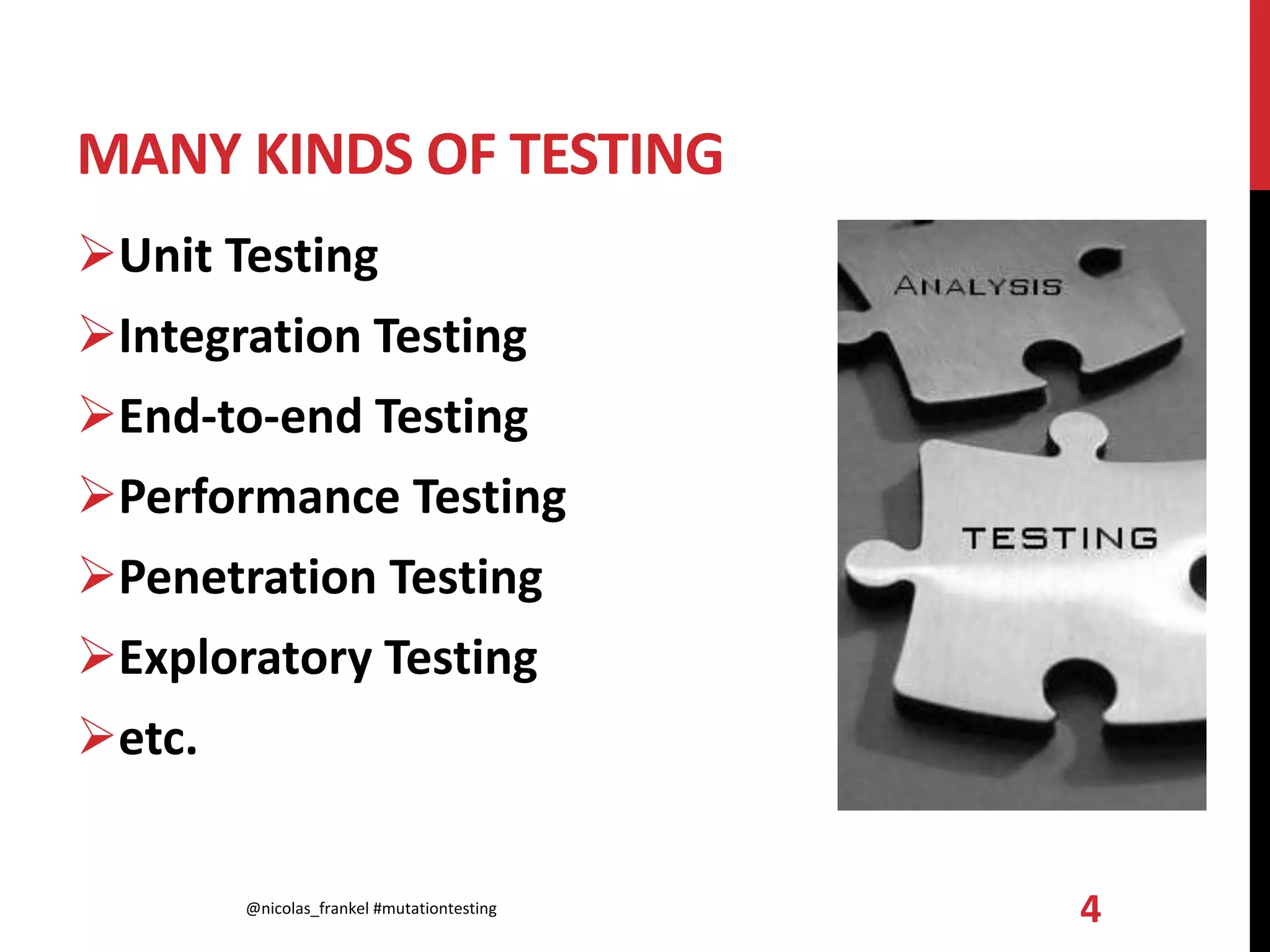
MANY KINDS OF TESTING
Unit Testing
Integration Testing
End-to-end Testing
Performance Testing
Penetration Testing
Exploratory Testing
etc.
@nicolas_frankel #mutationtesting 4
THEIR ONLY SINGLE GOAL
Ensure the Quality of the
production code
@nicolas_frankel #mutationtesting 5
THE PROBLEM
How to check the Quality of
the testing code?
@nicolas_frankel #mutationtesting 6
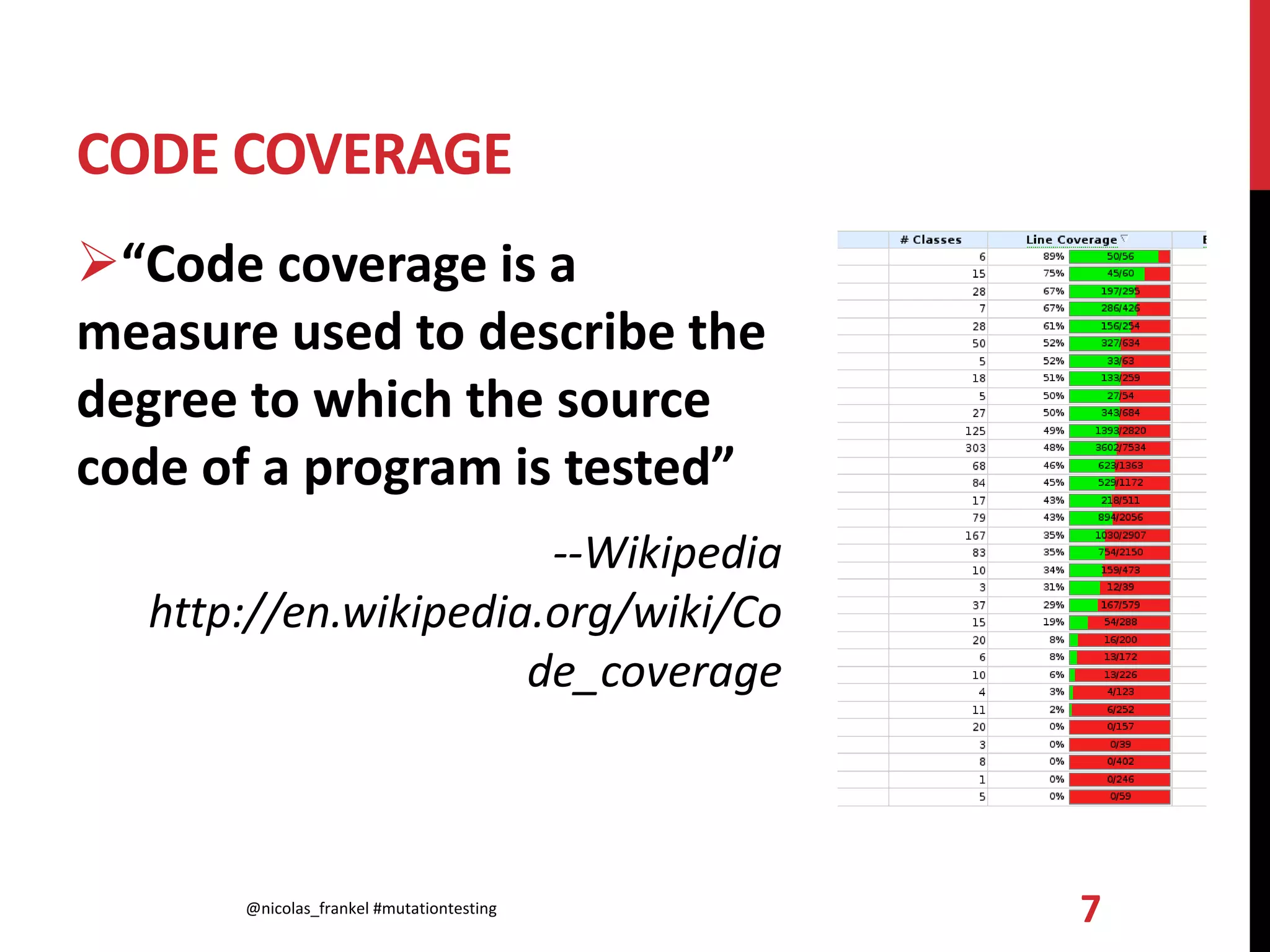
CODE COVERAGE
“Code coverage is a
measure used to describe the
degree to which the source
code of a program is tested”
--Wikipedia
http://en.wikipedia.org/wiki/Co
de_coverage
@nicolas_frankel #mutationtesting 7
MEASURING CODE COVERAGE
Check whether a source
code line is executed during a
test
• Or Branch Coverage
@nicolas_frankel #mutationtesting 8
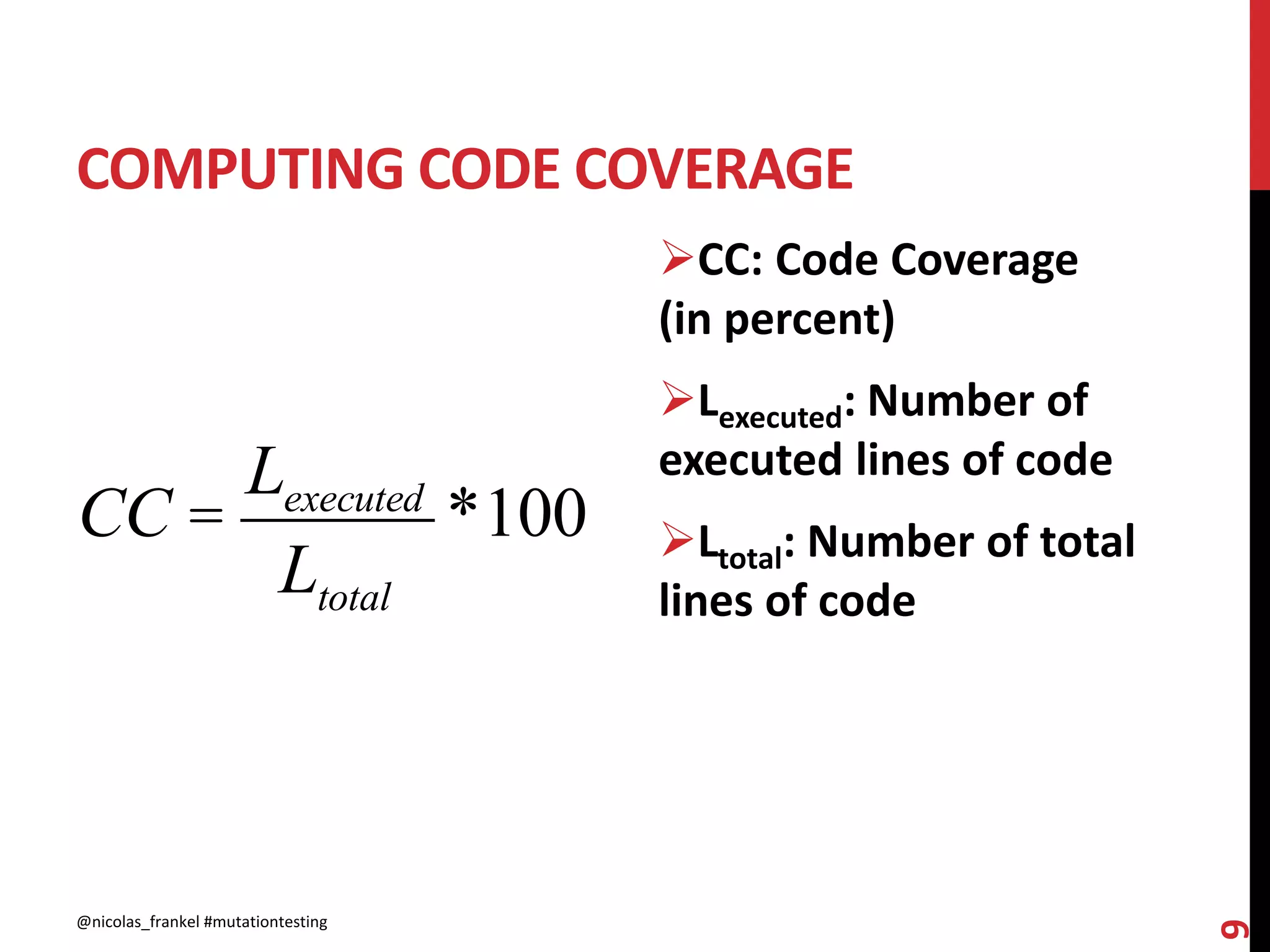
COMPUTING CODE COVERAGE
CC =
Lexecuted
Ltotal
*100
CC: Code Coverage
(in percent)
Lexecuted: Number of
executed lines of code
Ltotal: Number of total
lines of code
@nicolas_frankel #mutationtesting
9
JAVA TOOLS FOR CODE COVERAGE
JaCoCo
Clover
Cobertura
etc.
@nicolas_frankel #mutationtesting 10
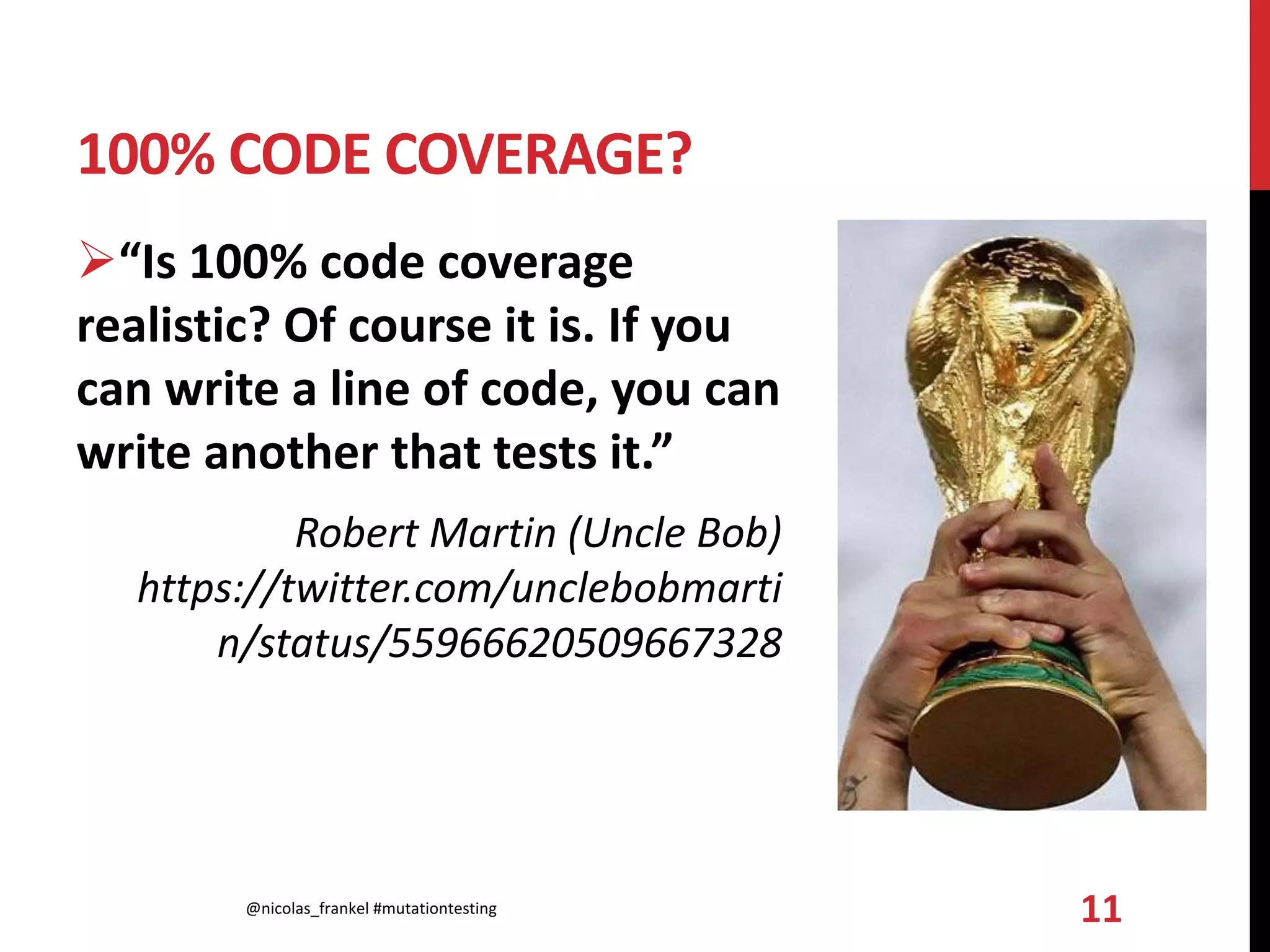
100% CODE COVERAGE?
“Is 100% code coverage
realistic? Of course it is. If you
can write a line of code, you can
write another that tests it.”
Robert Martin (Uncle Bob)
https://twitter.com/unclebobmarti
n/status/55966620509667328
@nicolas_frankel #mutationtesting 11
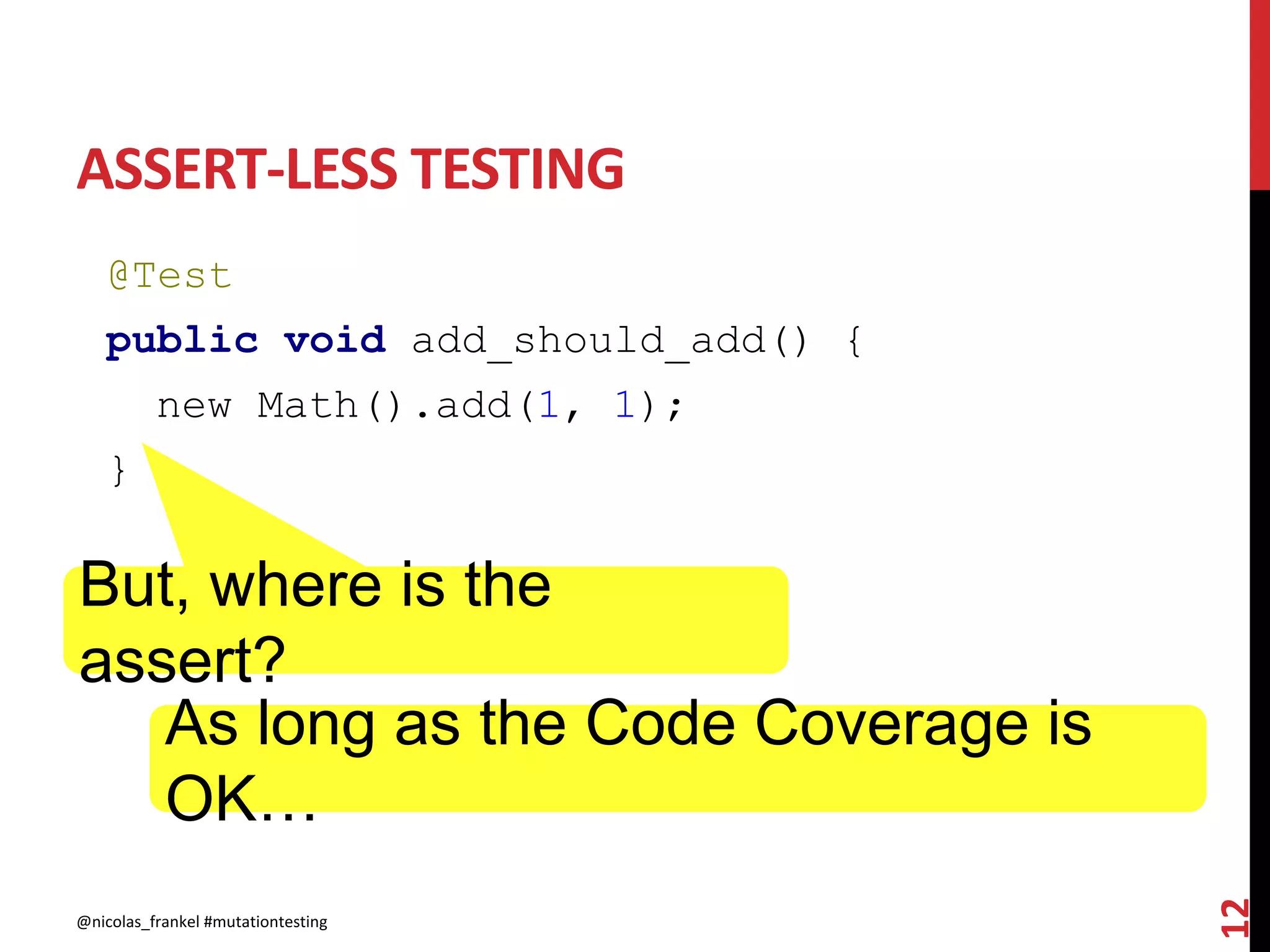
ASSERT-LESS TESTING
@Test
public void add_should_add() {
new Math().add(1, 1);
}
@nicolas_frankel #mutationtesting
12
But, where is the
assert?
As long as the Code Coverage is
OK…
CODE COVERAGE AS A MEASURE OF TEST QUAL
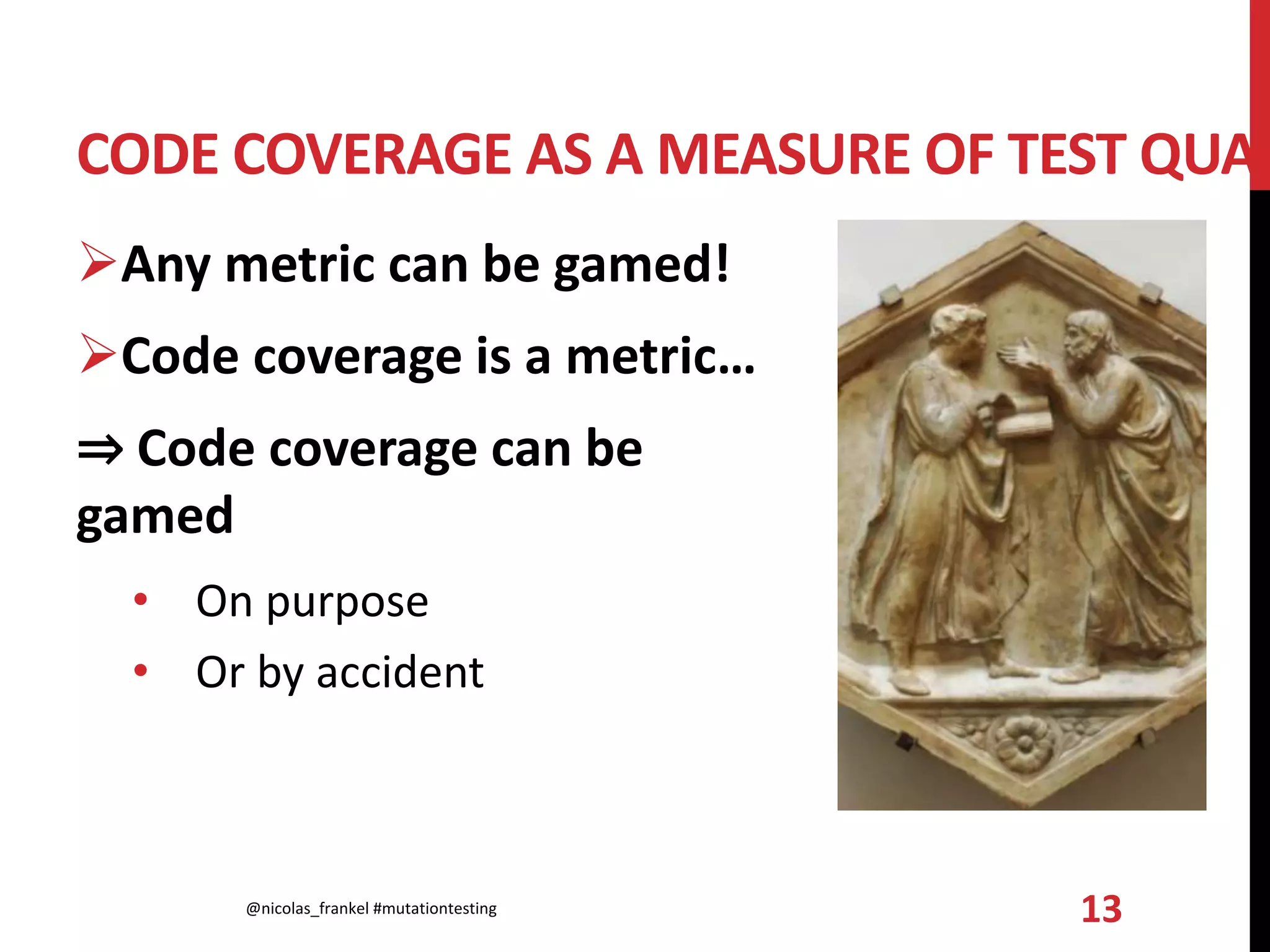
Any metric can be gamed!
Code coverage is a metric…
⇒ Code coverage can be
gamed
• On purpose
• Or by accident
@nicolas_frankel #mutationtesting 13
CODE COVERAGE AS A MEASURE OF TEST QUAL
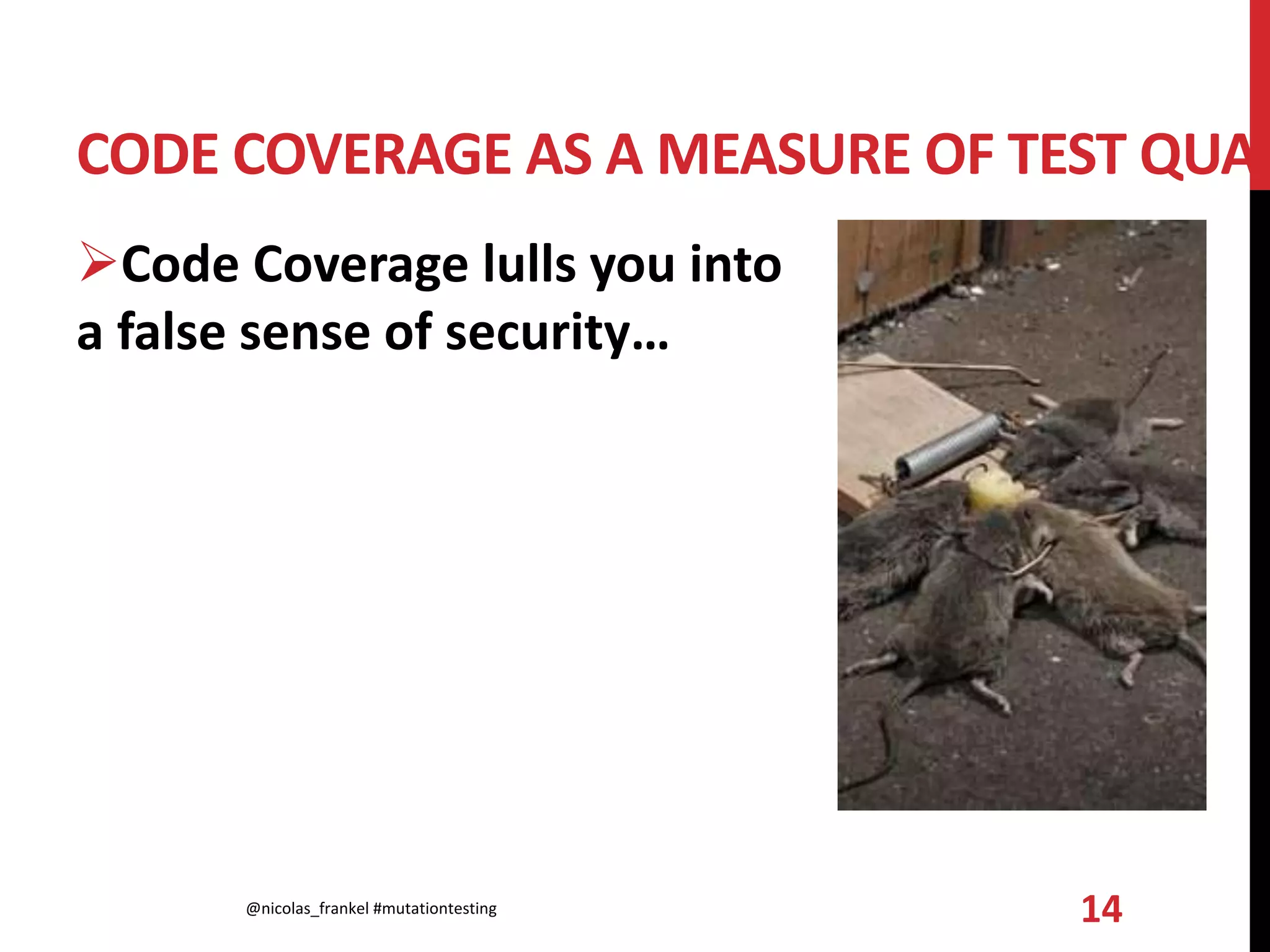
Code Coverage lulls you into
a false sense of security…
@nicolas_frankel #mutationtesting 14
THE PROBLEM STILL STANDS
Code coverage cannot
ensure test quality
• Is there another way?
Mutation Testing to the
rescue!
@nicolas_frankel #mutationtesting 15
THE CAST
@nicolas_frankel #mutationtesting
16
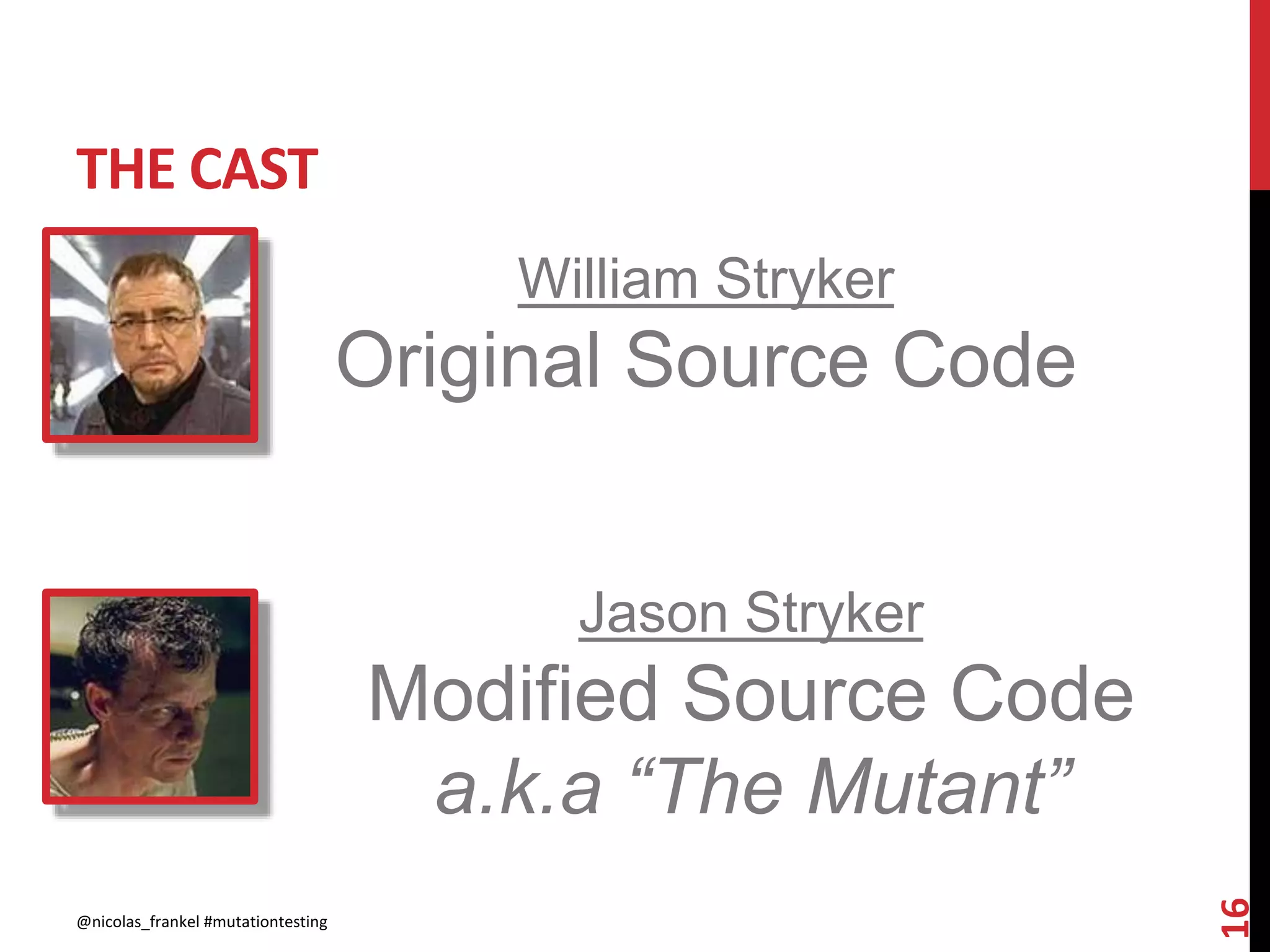
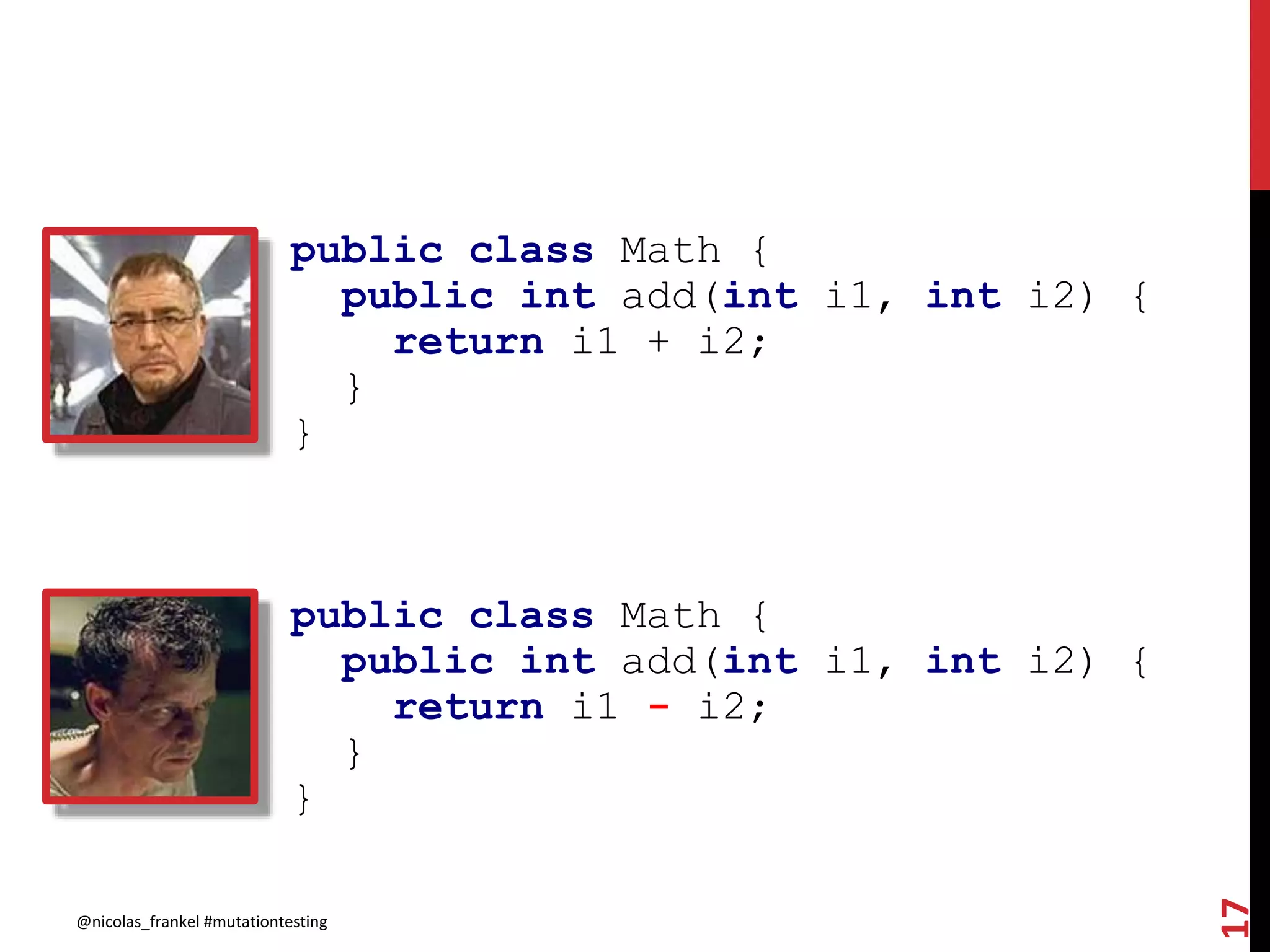
William Stryker
Original Source Code
Jason Stryker
Modified Source Code
a.k.a “The Mutant”
public class Math {
public int add(int i1, int i2) {
return i1 + i2;
}
}
@nicolas_frankel #mutationtesting
17
public class Math {
public int add(int i1, int i2) {
return i1 - i2;
}
}
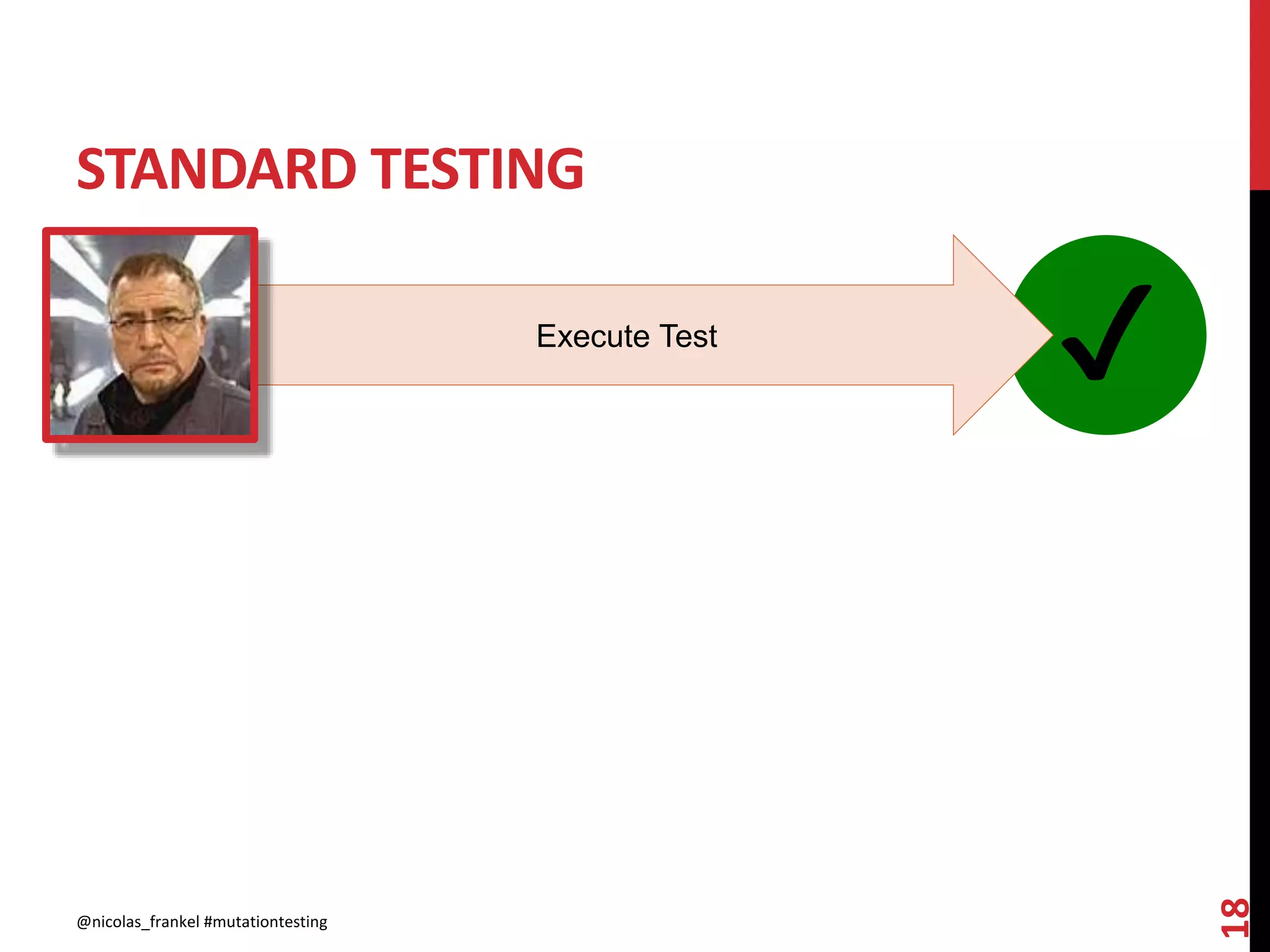
STANDARD TESTING
@nicolas_frankel #mutationtesting
18
✔Execute Test
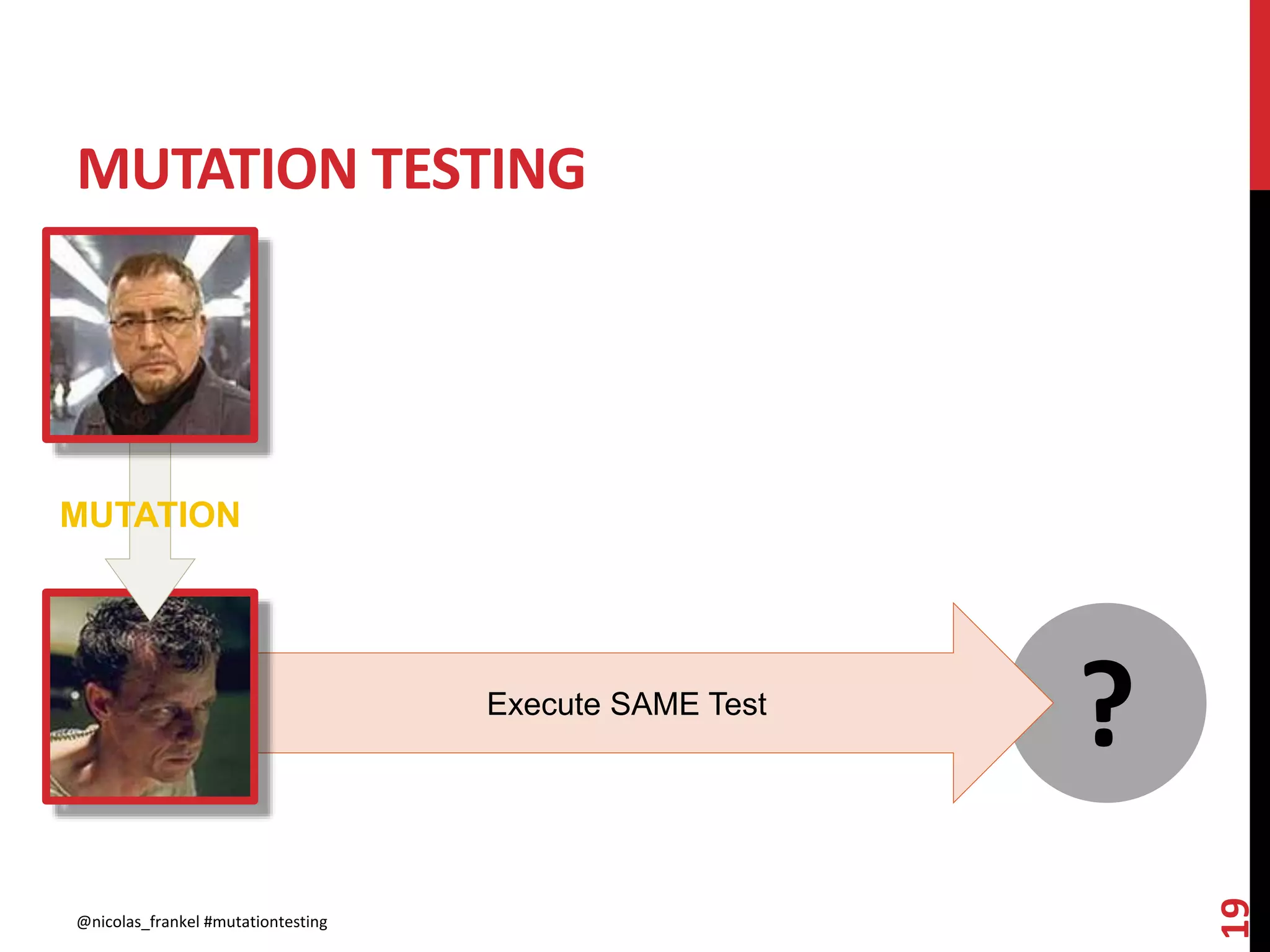
MUTATION TESTING
@nicolas_frankel #mutationtesting
19
?Execute SAME Test
MUTATION
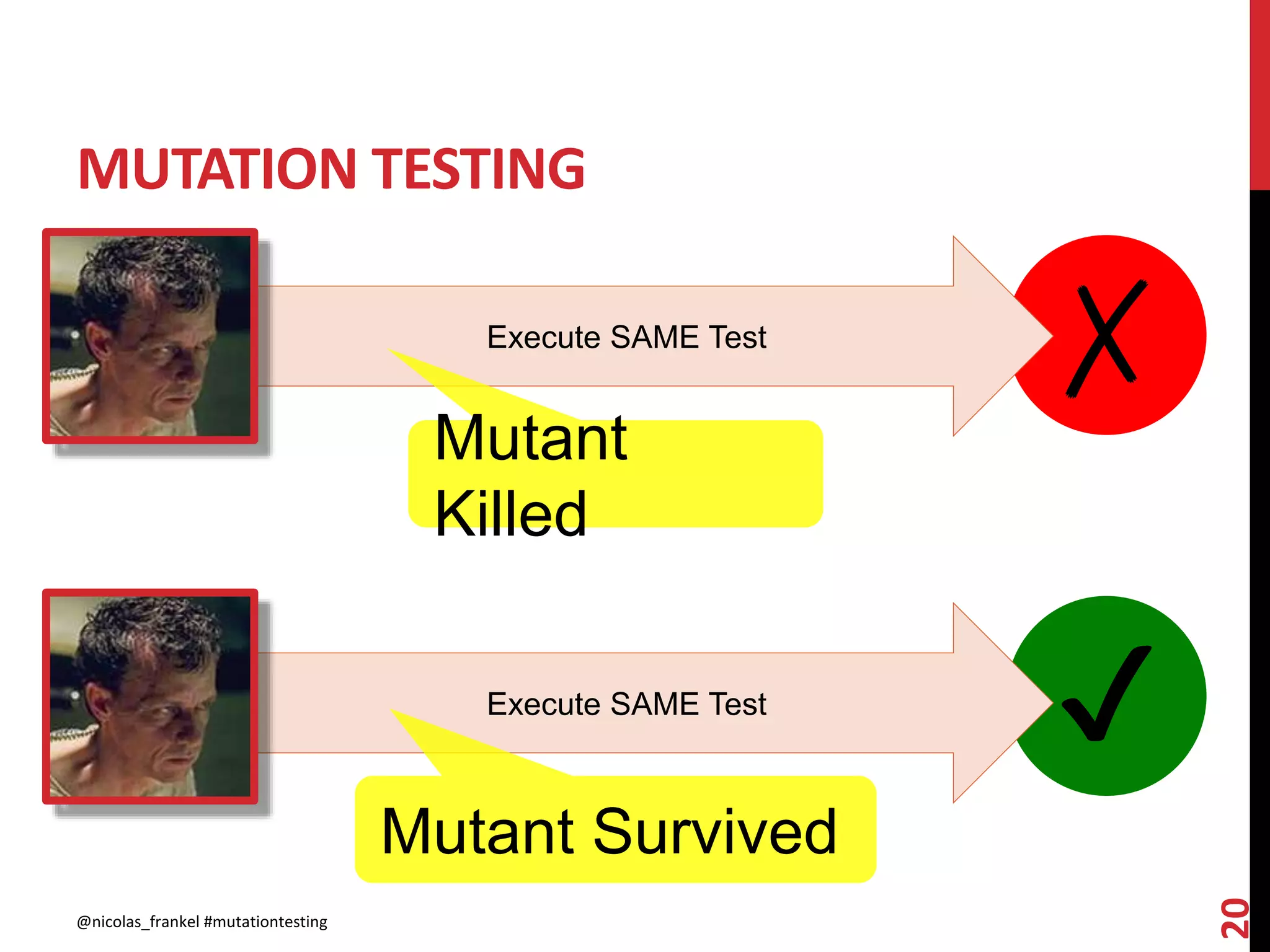
MUTATION TESTING
@nicolas_frankel #mutationtesting
20
✗
✔Execute SAME Test
Execute SAME Test
Mutant
Killed
Mutant Survived
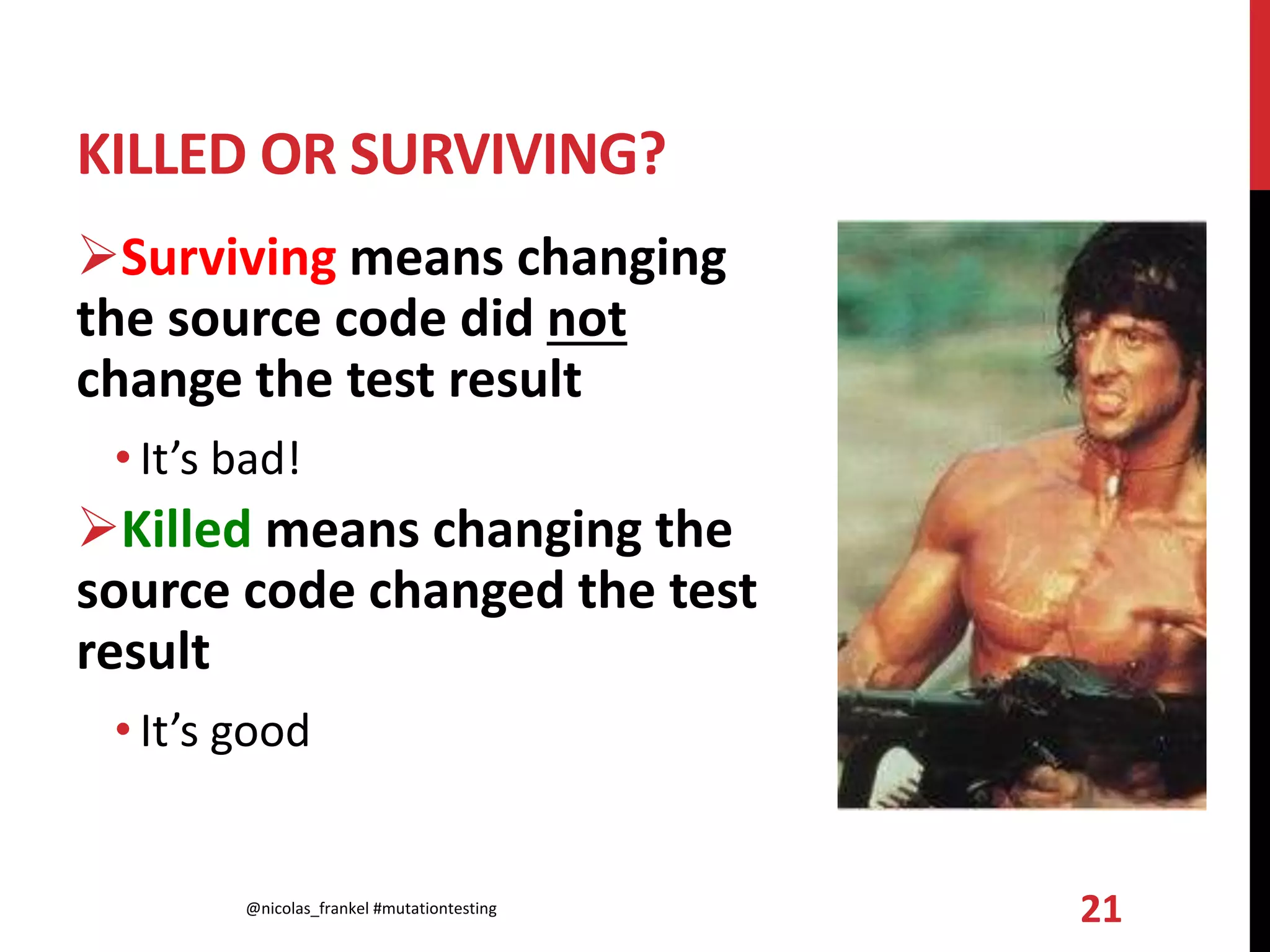
KILLED OR SURVIVING?
Surviving means changing
the source code did not
change the test result
• It’s bad!
Killed means changing the
source code changed the test
result
• It’s good
@nicolas_frankel #mutationtesting 21
TEST THE CODE
@nicolas_frankel #mutationtesting
22
public class Math {
public int add(int i1, int i2) {
return i1 + i2;
}
}
@Test
public void add_should_add() {
new Math().add(1, 1);
}
✔Execute Test
SURVIVING MUTANT
@nicolas_frankel #mutationtesting
23
public class Math {
public int add(int i1, int i2) {
return i1 - i2;
}
}
@Test
public void add_should_add() {
new Math().add(1, 1);
}
✔Execute SAME Test
TEST THE CODE
@nicolas_frankel #mutationtesting
24
public class Math {
public int add(int i1, int i2) {
return i1 + i2;
}
}
@Test
public void add_should_add() {
int sum = new Math().add(1, 1);
Assert.assertEquals(sum, 2);
}
✔Execute Test
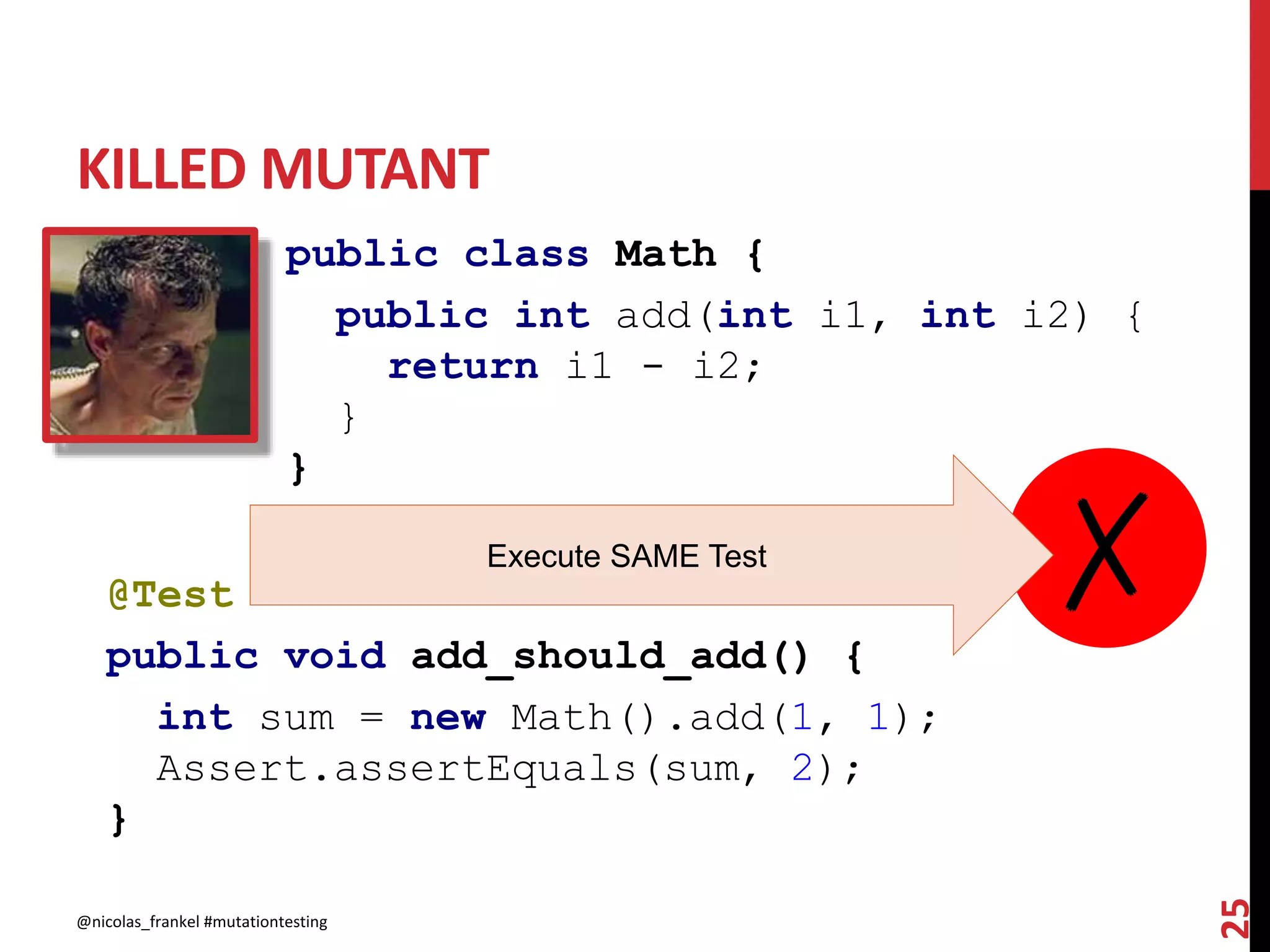
KILLED MUTANT
@nicolas_frankel #mutationtesting
25
public class Math {
public int add(int i1, int i2) {
return i1 - i2;
}
}
@Test
public void add_should_add() {
int sum = new Math().add(1, 1);
Assert.assertEquals(sum, 2);
}
✗Execute SAME Test
MUTATION TESTING IN JAVA
PIT is a tool for Mutation
testing
Available as
• Command-line tool
• Ant target
• Maven plugin
@nicolas_frankel #mutationtesting 26
MUTATORS
Mutators are patterns
applied to source code to
produce mutations
@nicolas_frankel #mutationtesting 27
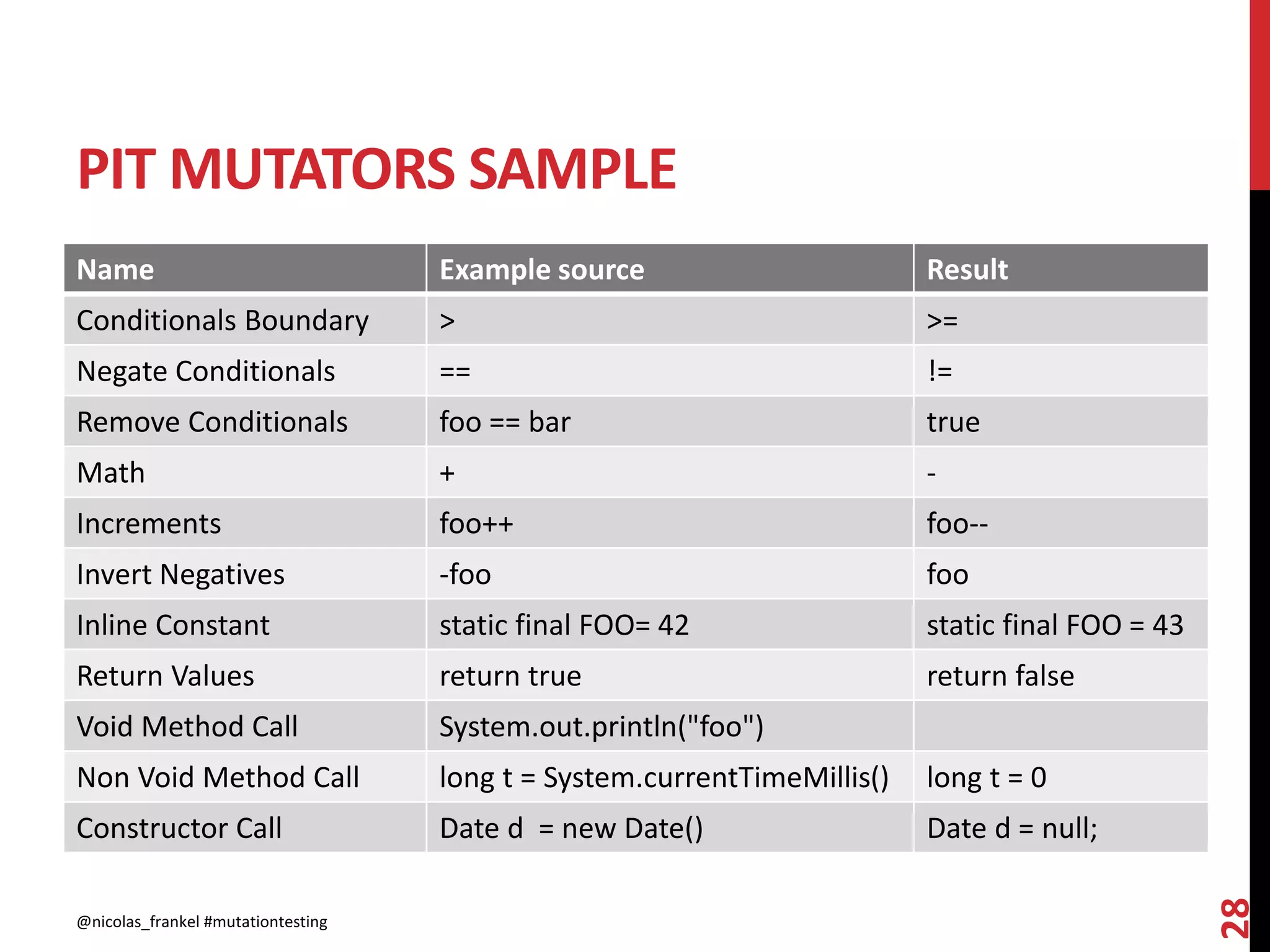
PIT MUTATORS SAMPLE
Name Example source Result
Conditionals Boundary > >=
Negate Conditionals == !=
Remove Conditionals foo == bar true
Math + -
Increments foo++ foo--
Invert Negatives -foo foo
Inline Constant static final FOO= 42 static final FOO = 43
Return Values return true return false
Void Method Call System.out.println("foo")
Non Void Method Call long t = System.currentTimeMillis() long t = 0
Constructor Call Date d = new Date() Date d = null;
@nicolas_frankel #mutationtesting
28
IMPORTANT MUTATORS
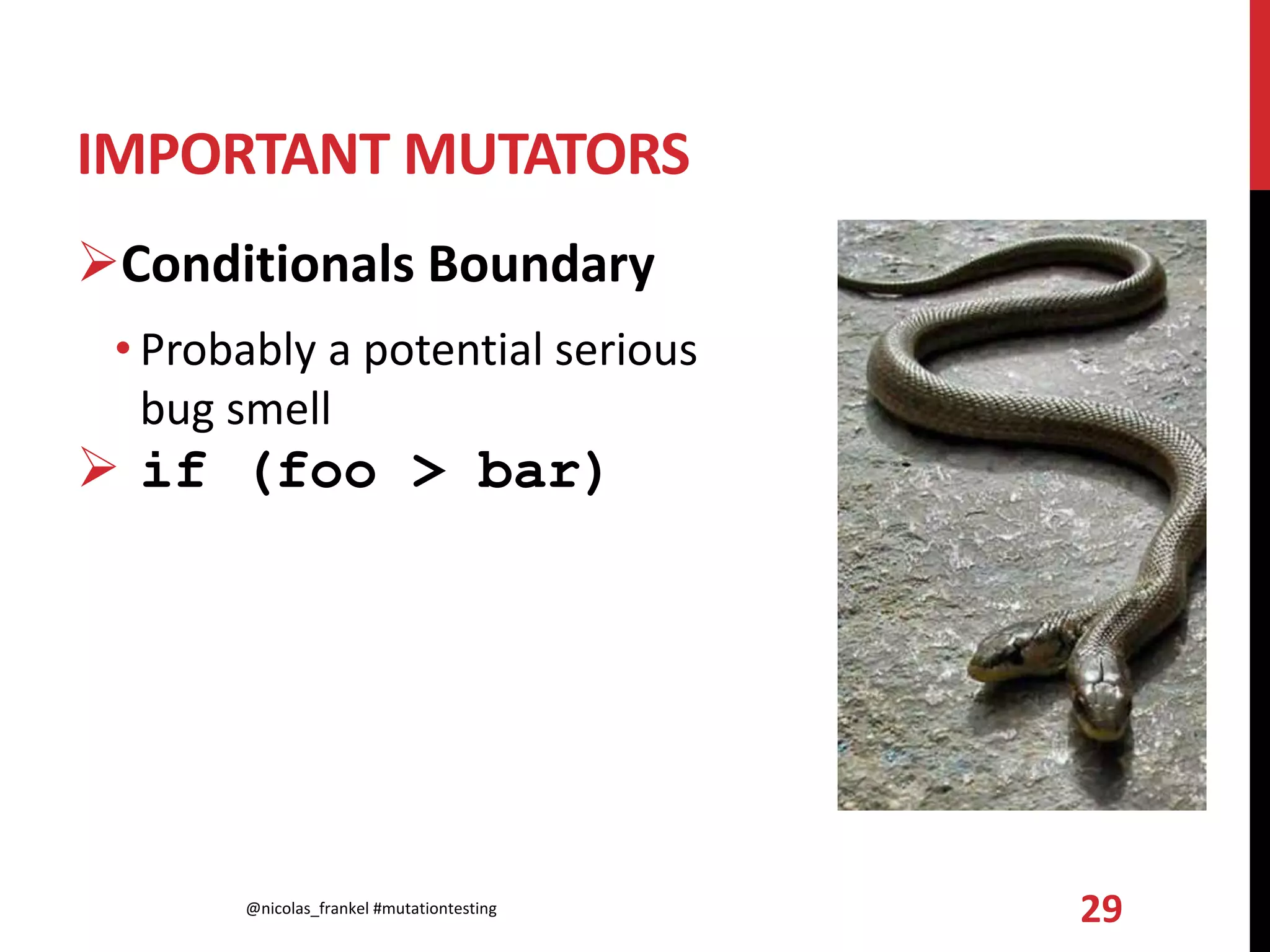
Conditionals Boundary
• Probably a potential serious
bug smell
 if (foo > bar)
@nicolas_frankel #mutationtesting 29
IMPORTANT MUTATORS
Void Method Call
 Assert.checkNotNull()
 connection.close(
)
@nicolas_frankel #mutationtesting 30
REMEMBER
 It’s not because the IDE
generates code safely that
it will never change
• equals()
• hashCode()
@nicolas_frankel #mutationtesting 31
FALSE POSITIVES
Mutation Testing is not
100% bulletproof
Might return false positives
Be cautious!
@nicolas_frankel #mutationtesting 32
ENOUGH TALK…
@nicolas_frankel #mutationtesting
33
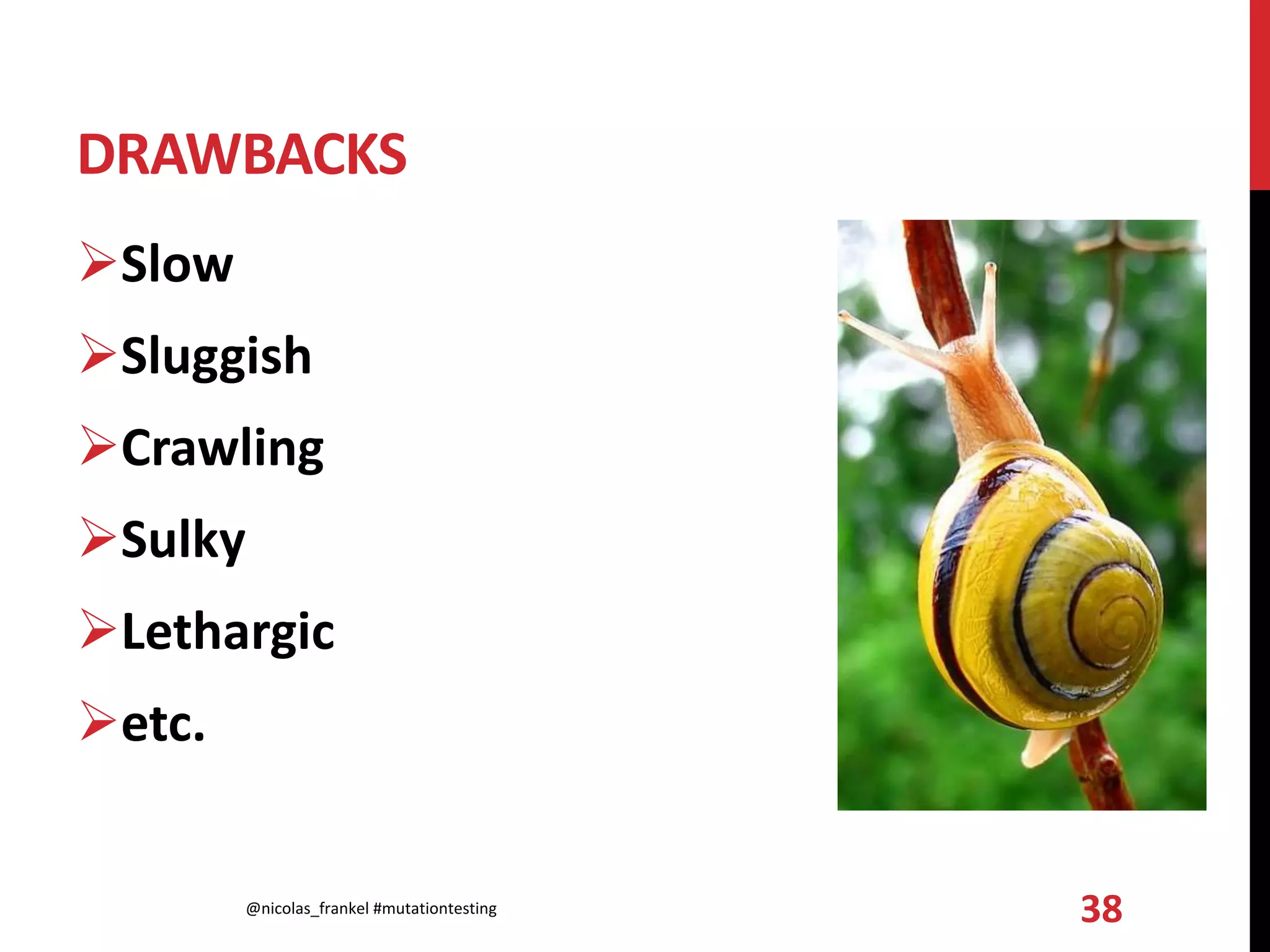
DRAWBACKS
Slow
Sluggish
Crawling
Sulky
Lethargic
etc.
@nicolas_frankel #mutationtesting 38
METRICS (KIND OF)
On joda-money
mvn clean test-
compile
mvn surefire:test
• Total time: 2.181 s
mvn pit-test...
• Total time: 48.634 s
@nicolas_frankel #mutationtesting 39
WHY SO SLOW?
Analyze test code
For each class under test
• For each mutator
• Create mutation
• For each mutation
• Run test
• Analyze result
• Aggregate results
@nicolas_frankel #mutationtesting 40
WORKAROUNDS
This is not acceptable in a
normal test run
But there are workarounds
@nicolas_frankel #mutationtesting 41
SET MUTATORS
<configuration>
<mutators>
<mutator>
CONSTRUCTOR_CALLS
</mutator>
<mutator>
NON_VOID_METHOD_CALLS
</mutator>
</mutators>
</configuration>
@nicolas_frankel #mutationtesting
42
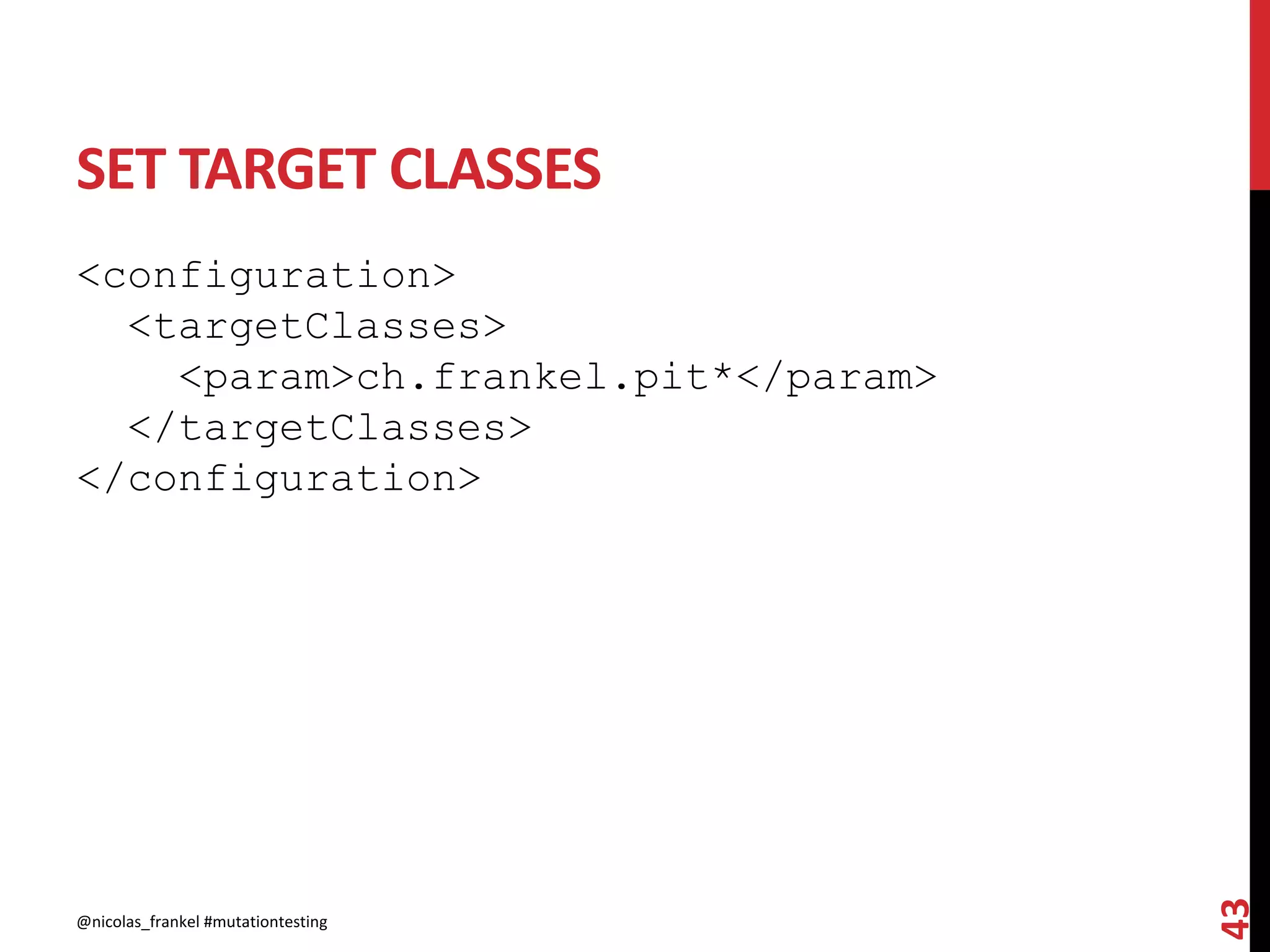
SET TARGET CLASSES
<configuration>
<targetClasses>
<param>ch.frankel.pit*</param>
</targetClasses>
</configuration>
@nicolas_frankel #mutationtesting
43
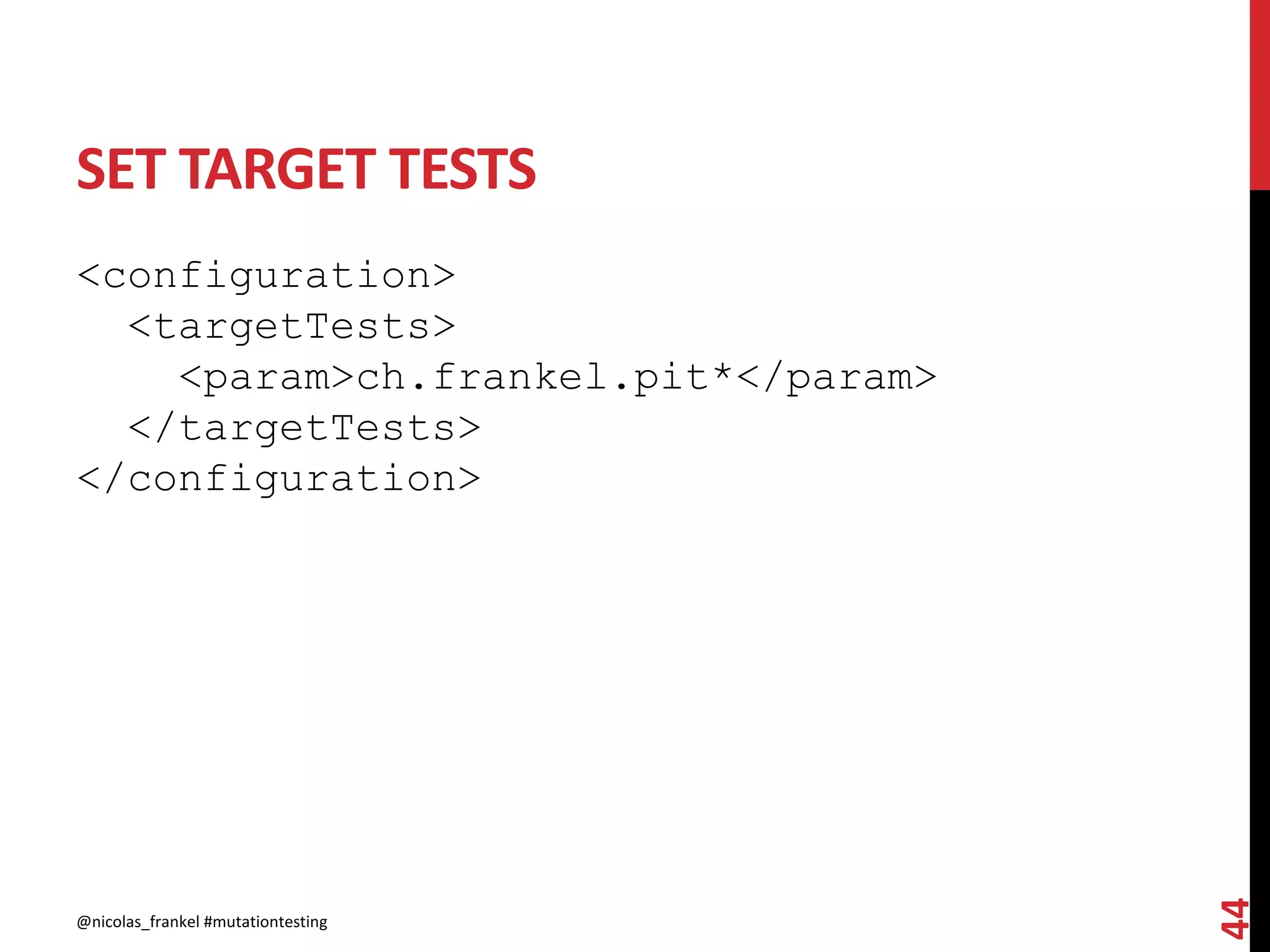
SET TARGET TESTS
<configuration>
<targetTests>
<param>ch.frankel.pit*</param>
</targetTests>
</configuration>
@nicolas_frankel #mutationtesting
44
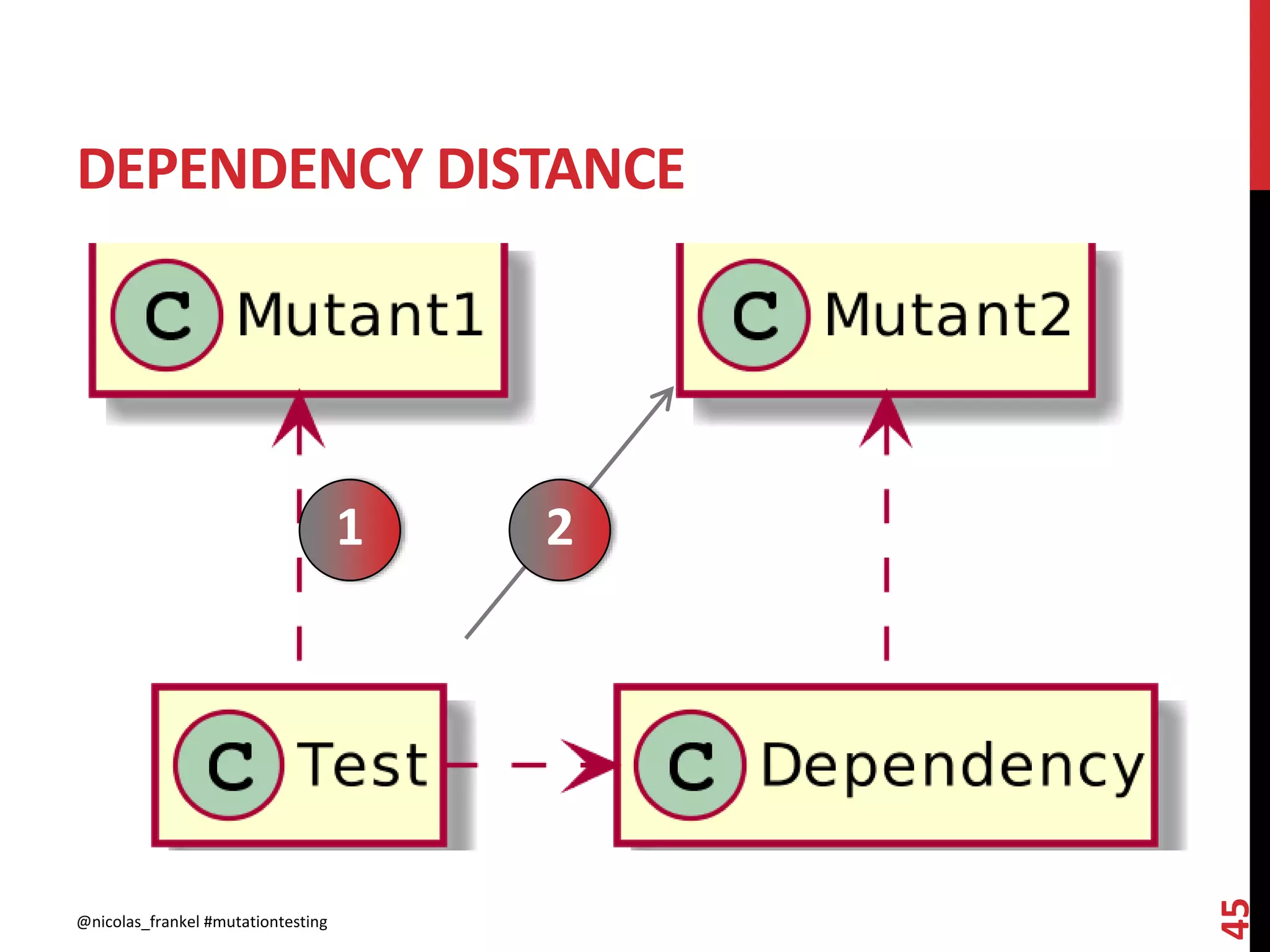
DEPENDENCY DISTANCE
@nicolas_frankel #mutationtesting
45
1 2
LIMIT DEPENDENCY DISTANCE
<configuration>
<maxDependencyDistance>
4
</maxDependencyDistance>
</configuration>
@nicolas_frankel #mutationtesting
46
LIMIT NUMBER OF MUTATIONS
<configuration>
<maxMutationsPerClass>
10
</maxMutationsPerClass>
</configuration>
@nicolas_frankel #mutationtesting
47
USE MUTATIONFILTER
From extension points
@nicolas_frankel #mutationtesting 48
PIT EXTENSION POINTS
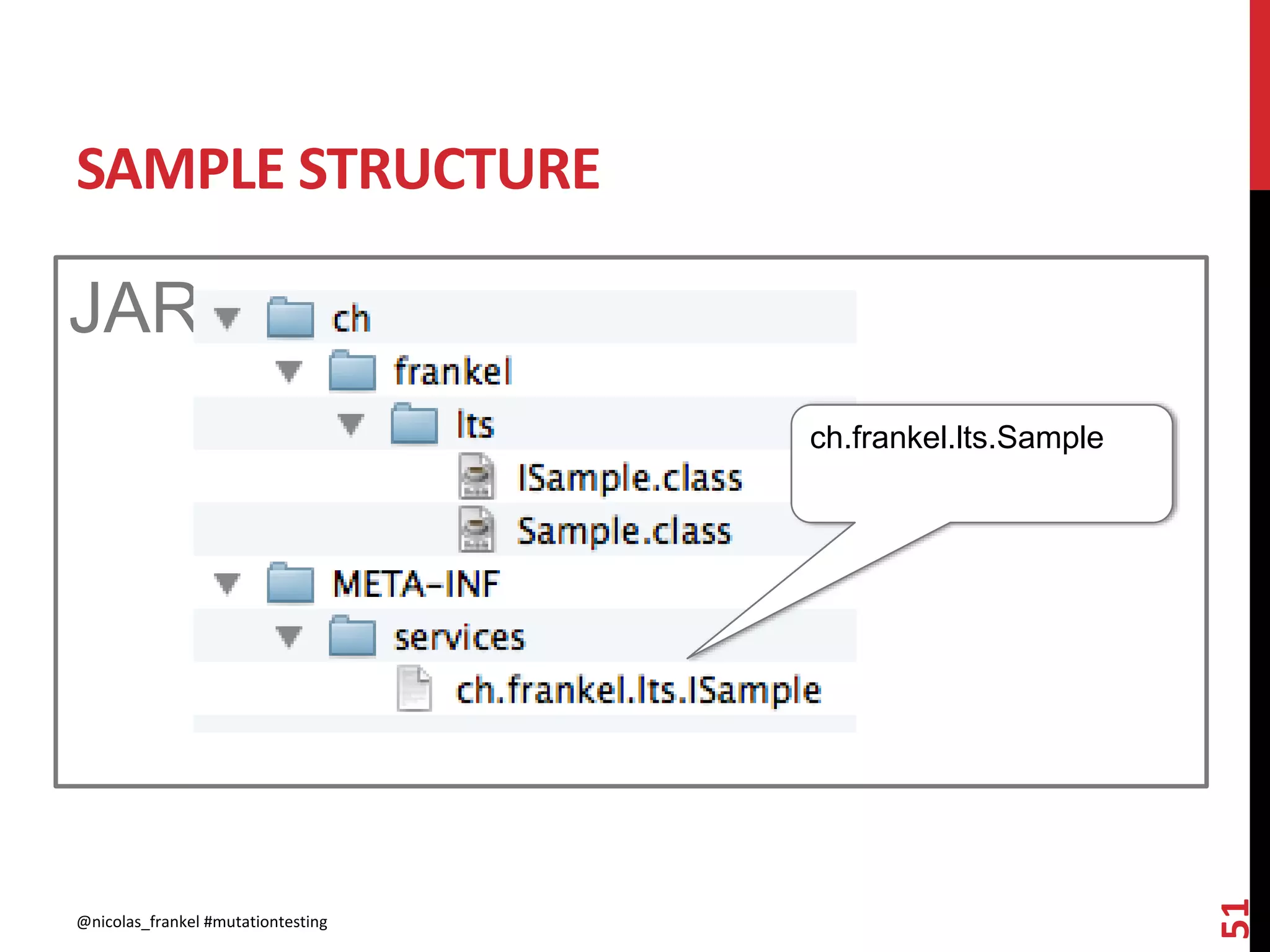
Must be packaged in JAR
Have Implementation-
Vendor and Implementation-
Title in MANIFEST.MF that
match PIT’s
Set on the classpath
Use Java’s Service Provider
feature
@nicolas_frankel #mutationtesting 49
SERVICE PROVIDER
Inversion of control
• Since Java 1.3!
Text file located in META-
INF/services
Interface
• Name of the file
Implementation class
• Content of the file
@nicolas_frankel #mutationtesting 50
SAMPLE STRUCTURE
@nicolas_frankel #mutationtesting
51
JAR
ch.frankel.lts.Sample
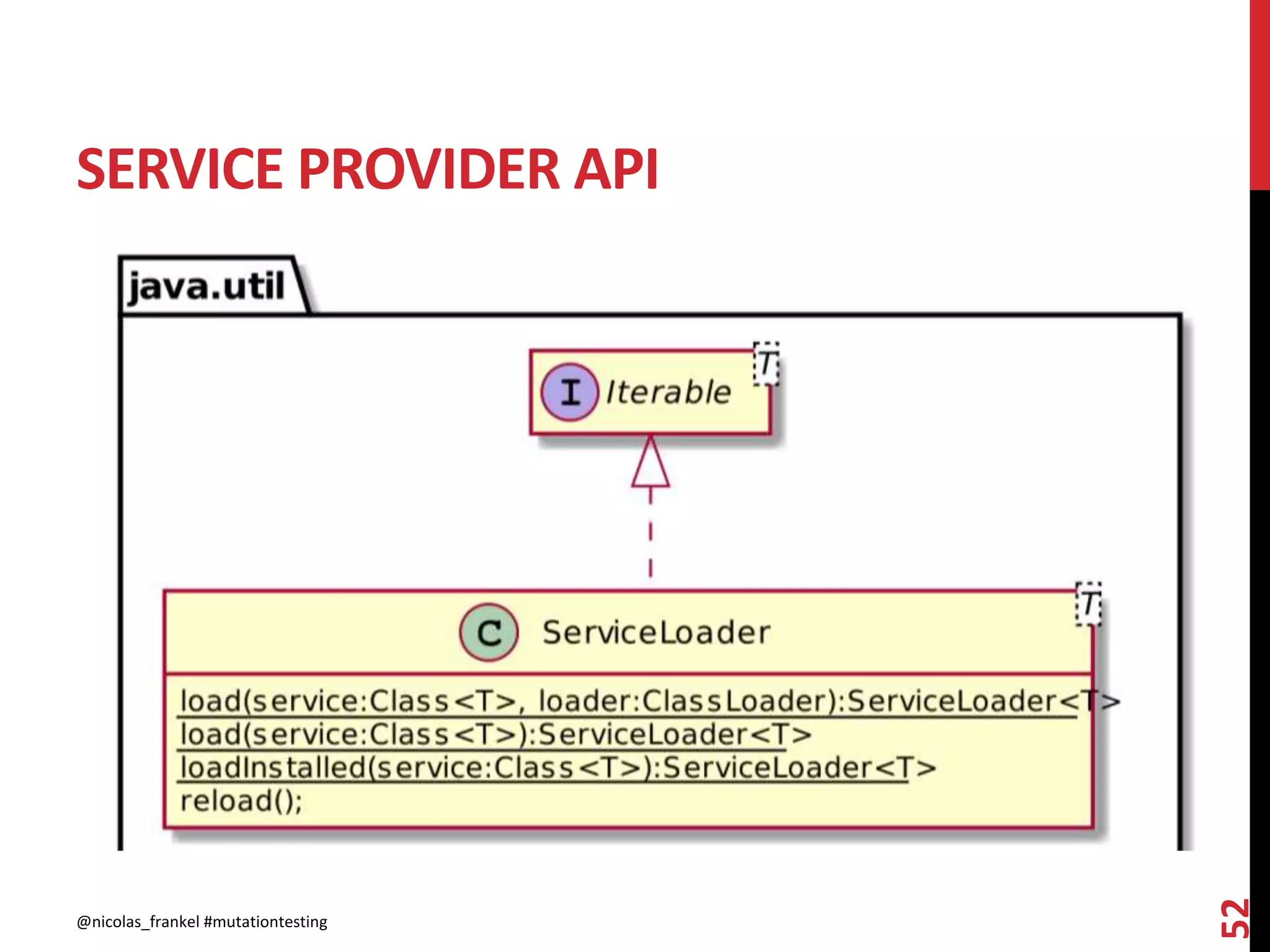
SERVICE PROVIDER API
@nicolas_frankel #mutationtesting
52
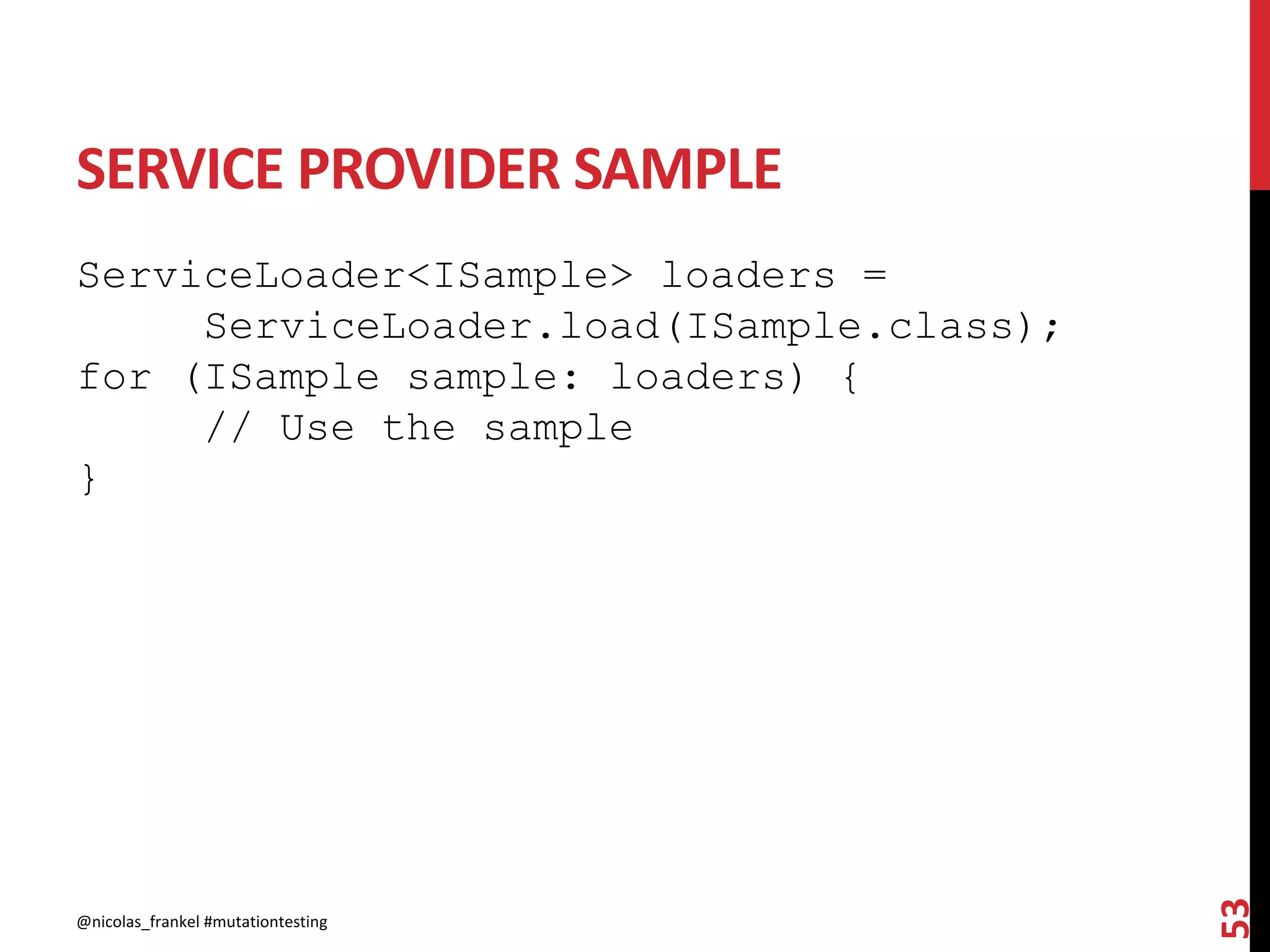
SERVICE PROVIDER SAMPLE
ServiceLoader<ISample> loaders =
ServiceLoader.load(ISample.class);
for (ISample sample: loaders) {
// Use the sample
}
@nicolas_frankel #mutationtesting
53
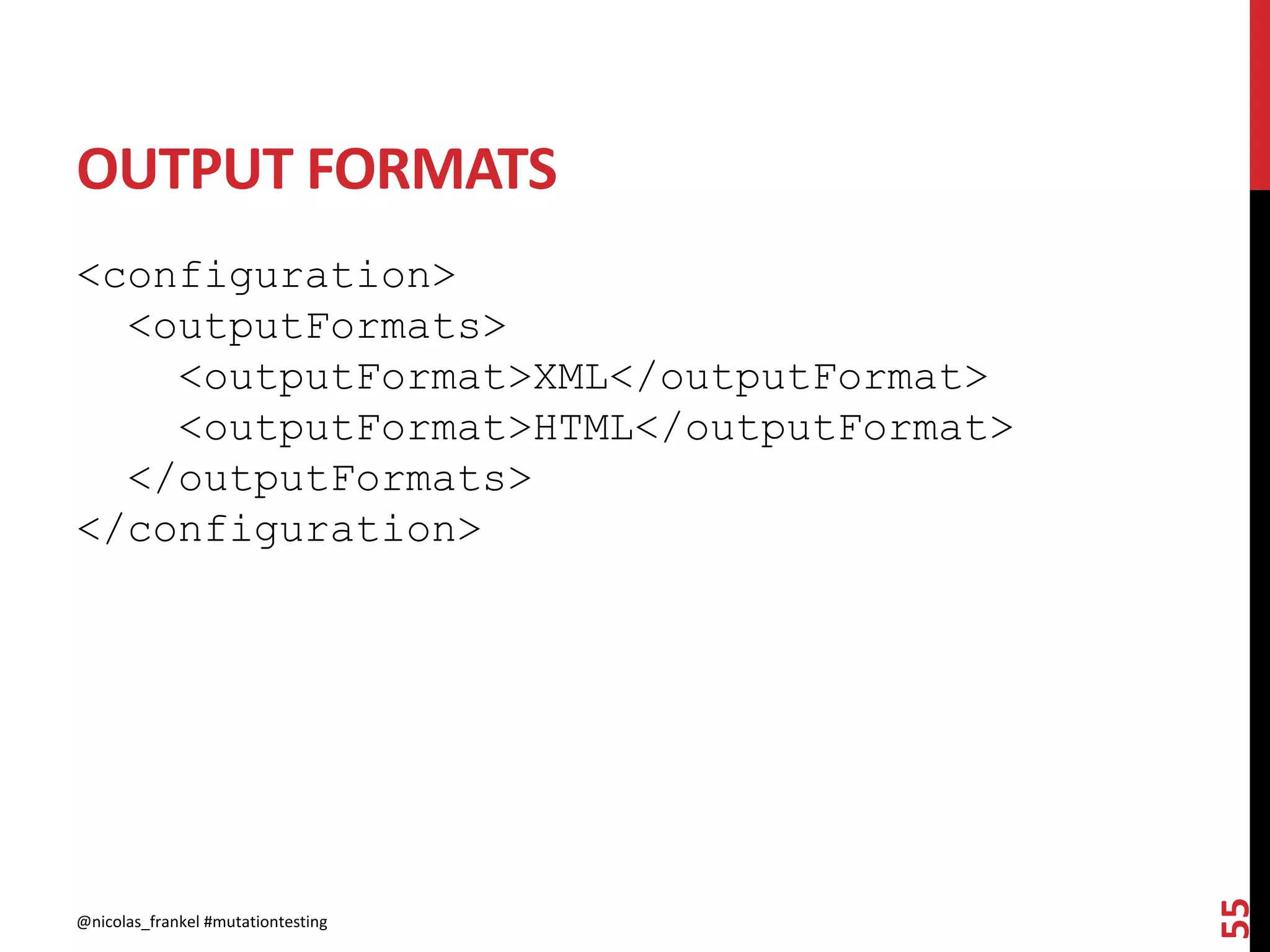
OUTPUT FORMATS
Out-of-the-box
• HTML
• XML
• CSV
@nicolas_frankel #mutationtesting 54
OUTPUT FORMATS
<configuration>
<outputFormats>
<outputFormat>XML</outputFormat>
<outputFormat>HTML</outputFormat>
</outputFormats>
</configuration>
@nicolas_frankel #mutationtesting
55
@nicolas_frankel #mutationtesting
56
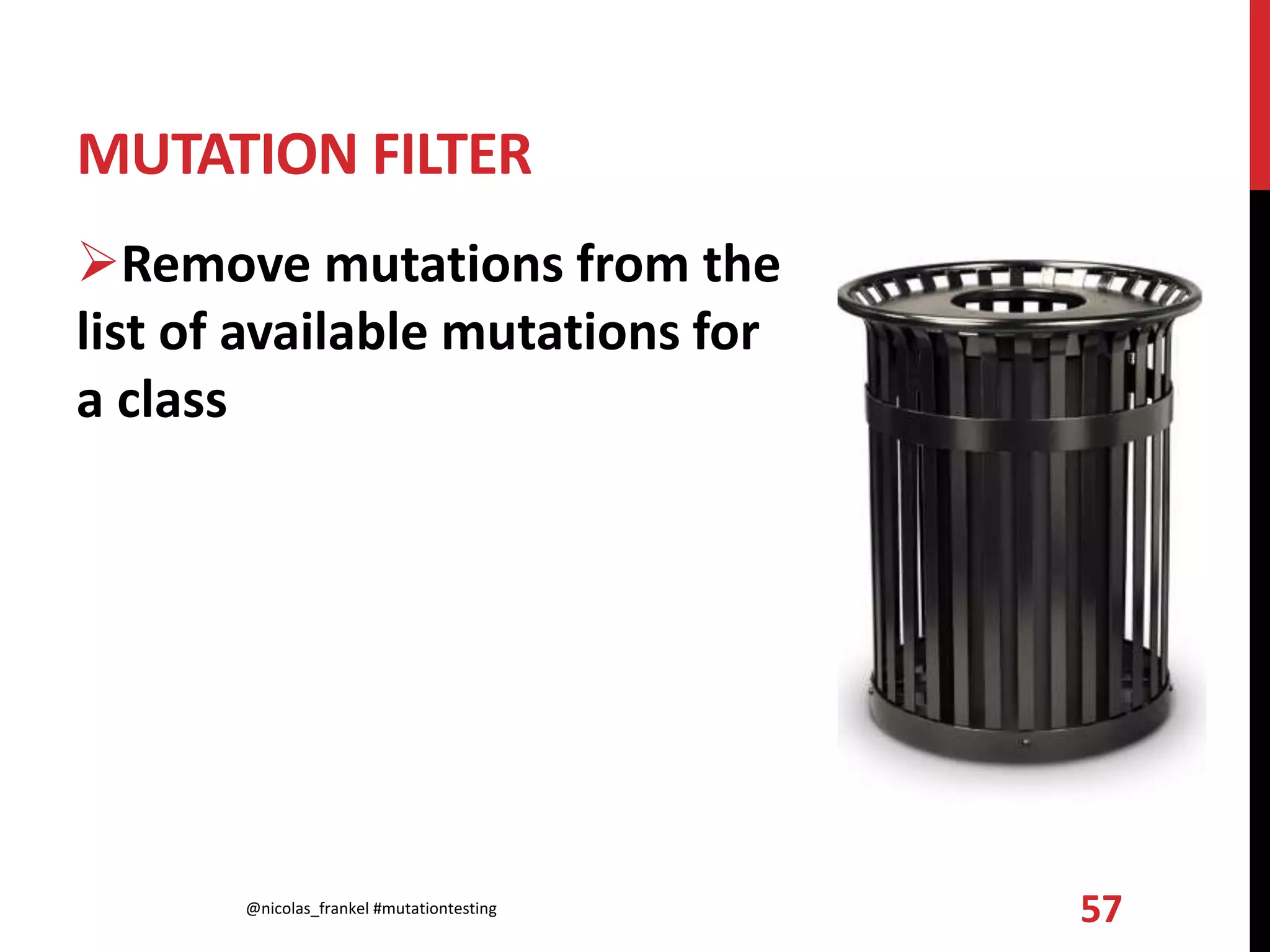
MUTATION FILTER
Remove mutations from the
list of available mutations for
a class
@nicolas_frankel #mutationtesting 57
@nicolas_frankel #mutationtesting
58
@nicolas_frankel #mutationtesting
59
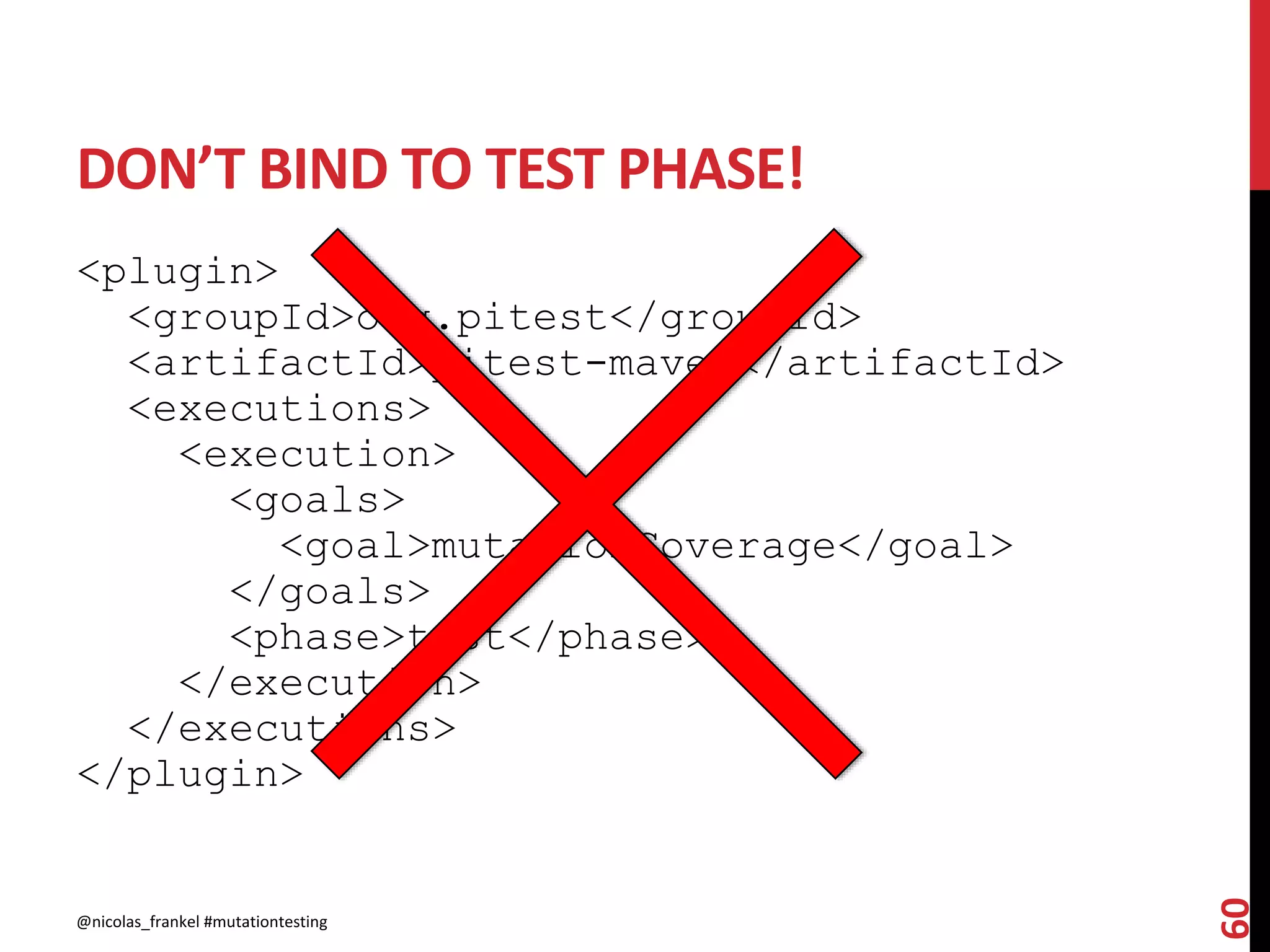
DON’T BIND TO TEST PHASE!
<plugin>
<groupId>org.pitest</groupId>
<artifactId>pitest-maven</artifactId>
<executions>
<execution>
<goals>
<goal>mutationCoverage</goal>
</goals>
<phase>test</phase>
</execution>
</executions>
</plugin>
@nicolas_frankel #mutationtesting
60
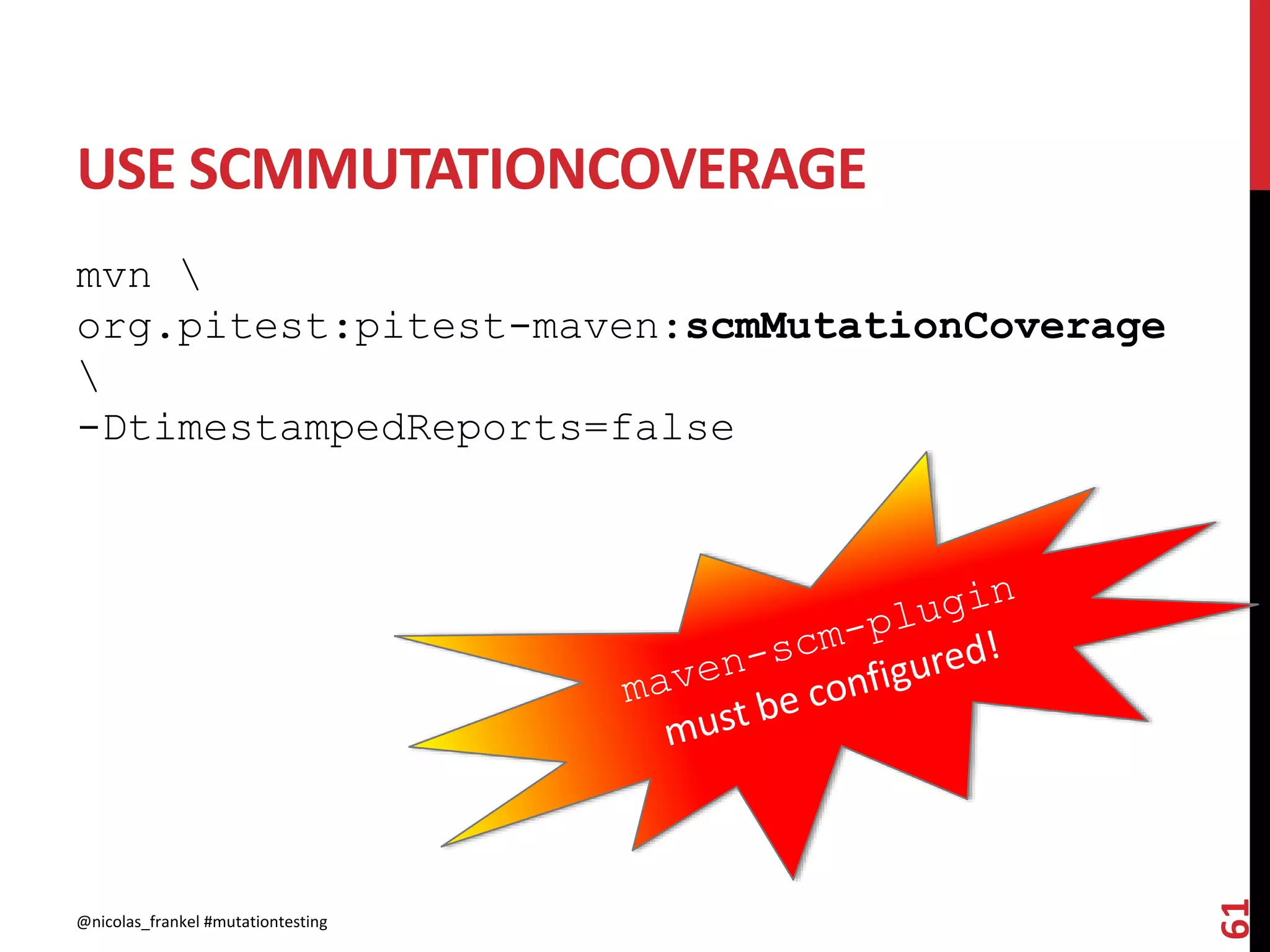
USE SCMMUTATIONCOVERAGE
mvn 
org.pitest:pitest-maven:scmMutationCoverage

-DtimestampedReports=false
@nicolas_frankel #mutationtesting
61
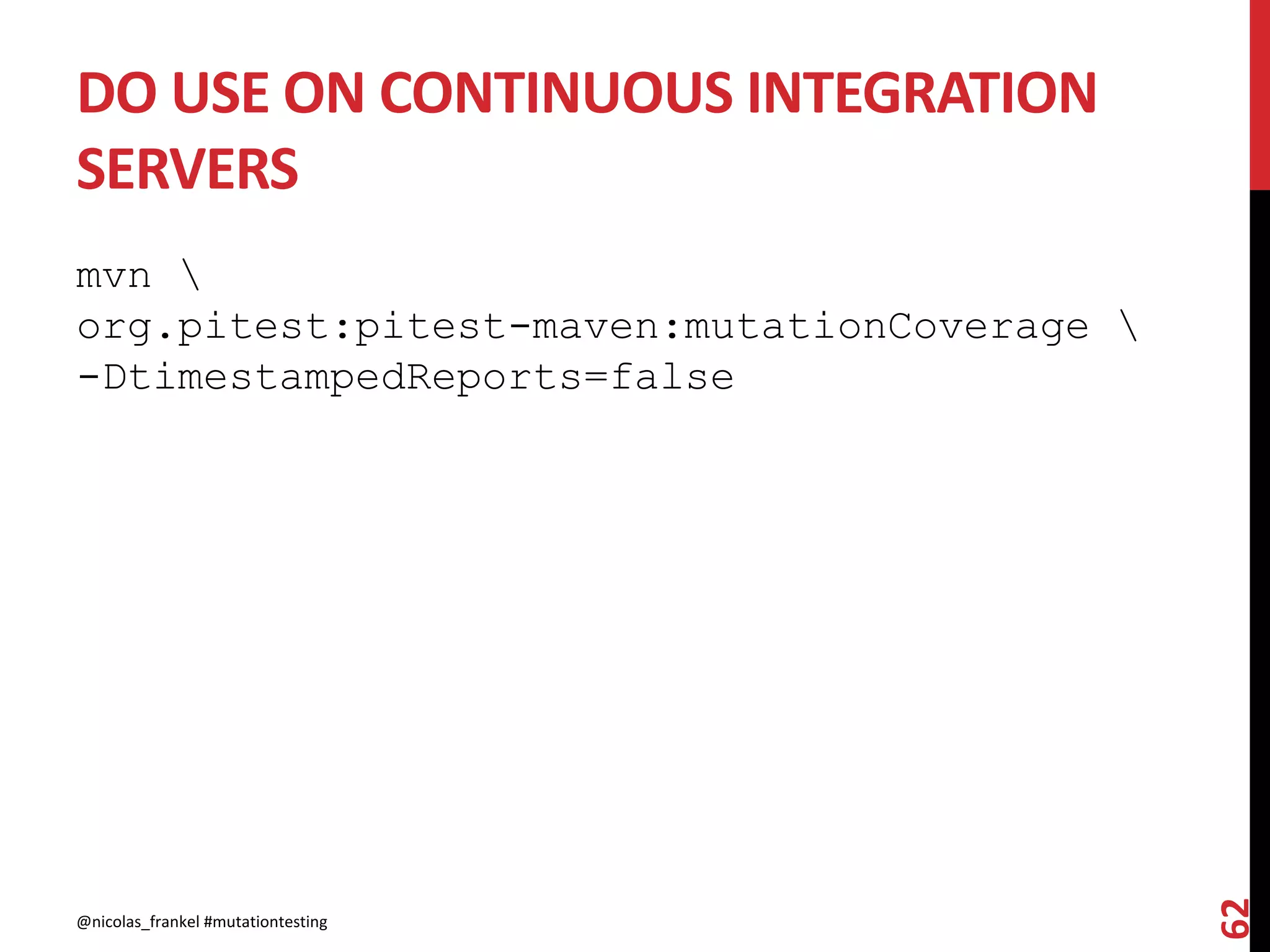
DO USE ON CONTINUOUS INTEGRATION
SERVERS
mvn 
org.pitest:pitest-maven:mutationCoverage 
-DtimestampedReports=false
@nicolas_frankel #mutationtesting
62
IS MUTATION TESTING THE SILVER BULLET?
Sorry, no!
It only
• Checks the relevance of your
unit tests
• Points out potential bugs
@nicolas_frankel #mutationtesting 63
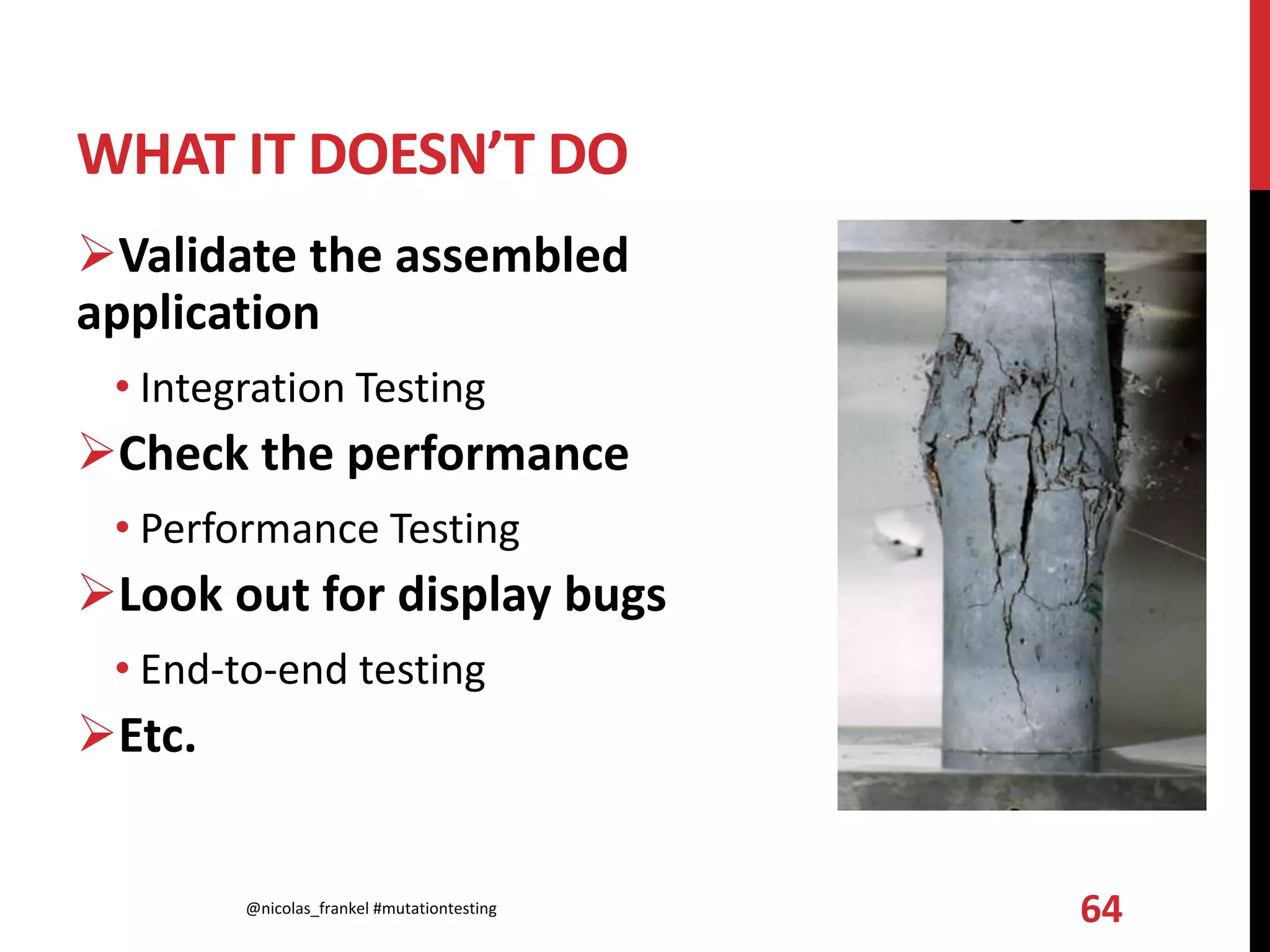
WHAT IT DOESN’T DO
Validate the assembled
application
• Integration Testing
Check the performance
• Performance Testing
Look out for display bugs
• End-to-end testing
Etc.
@nicolas_frankel #mutationtesting 64
TESTING IS ABOUT ROI
Don’t test to achieve 100%
coverage
Test because it saves money
in the long run
Prioritize:
• Business-critical code
• Complex code
@nicolas_frankel #mutationtesting 65
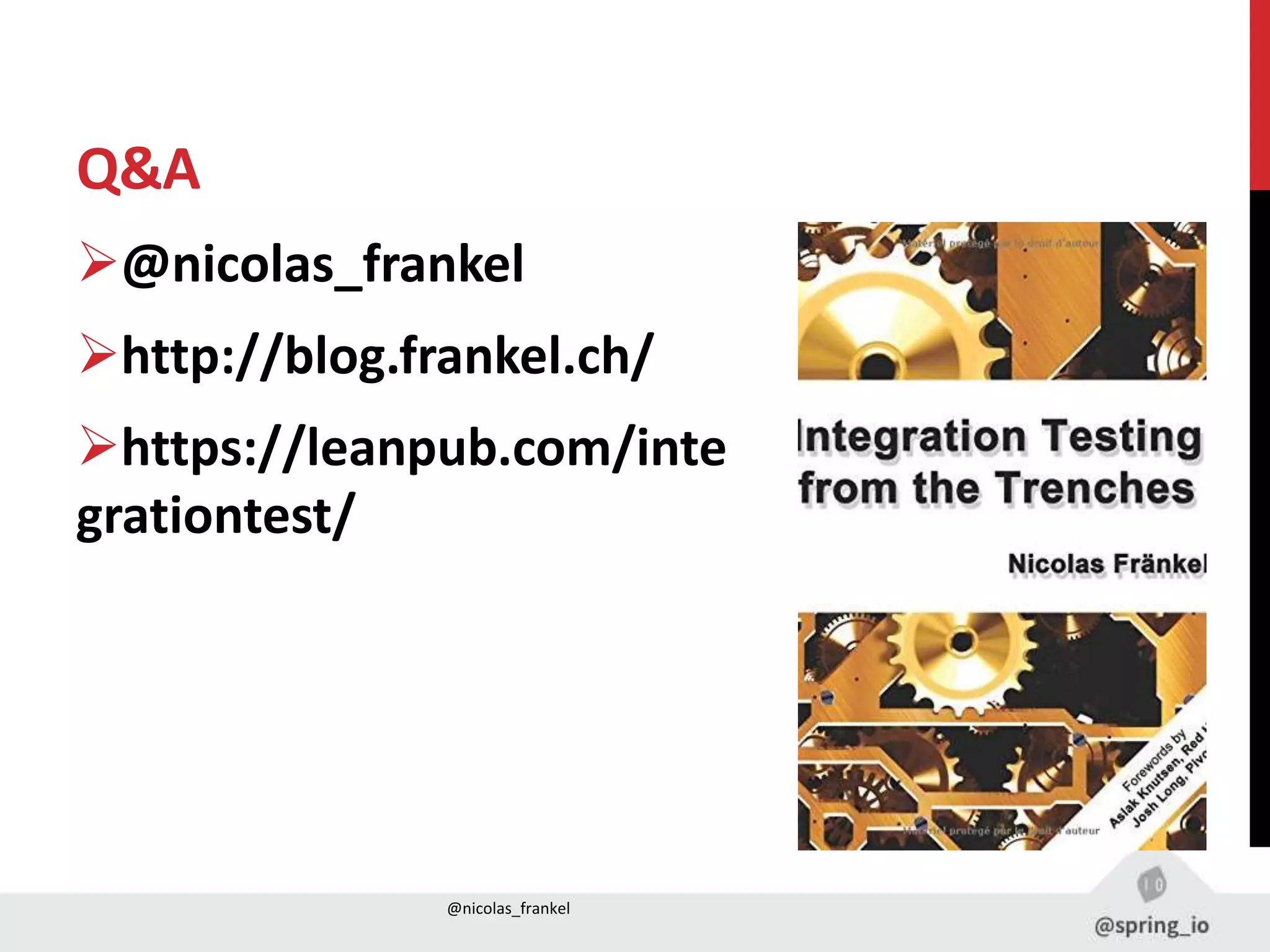
Q&A
@nicolas_frankel
http://blog.frankel.ch/
https://leanpub.com/inte
grationtest/
@nicolas_frankel

Javantura v3 - Mutation Testing for everyone – Nicolas Fränkel

Editor's Notes

  • #11 All are integrated in Maven JaCoCo is also integrated into Sonar out-of-the-box
  • #29 There are also experimental mutators http://pitest.org/quickstart/mutators/
  • #46 skinparam dpi 300 class Test class Mutant1 class Dependency class Mutant2 Test .up.> Mutant1 Test .right.> Dependency Dependency .up.> Mutant2 hide members
  • #53 skinparam dpi 300 hide empty attributes hide empty methods package java.util { interface Iterable<T> class ServiceLoader<T> { {static} load(service:Class<T>, loader:ClassLoader):ServiceLoader<T> {static} load(service:Class<T>):ServiceLoader<T> {static} loadInstalled(service:Class<T>):ServiceLoader<T> reload(); } } ServiceLoader .up.|> Iterable
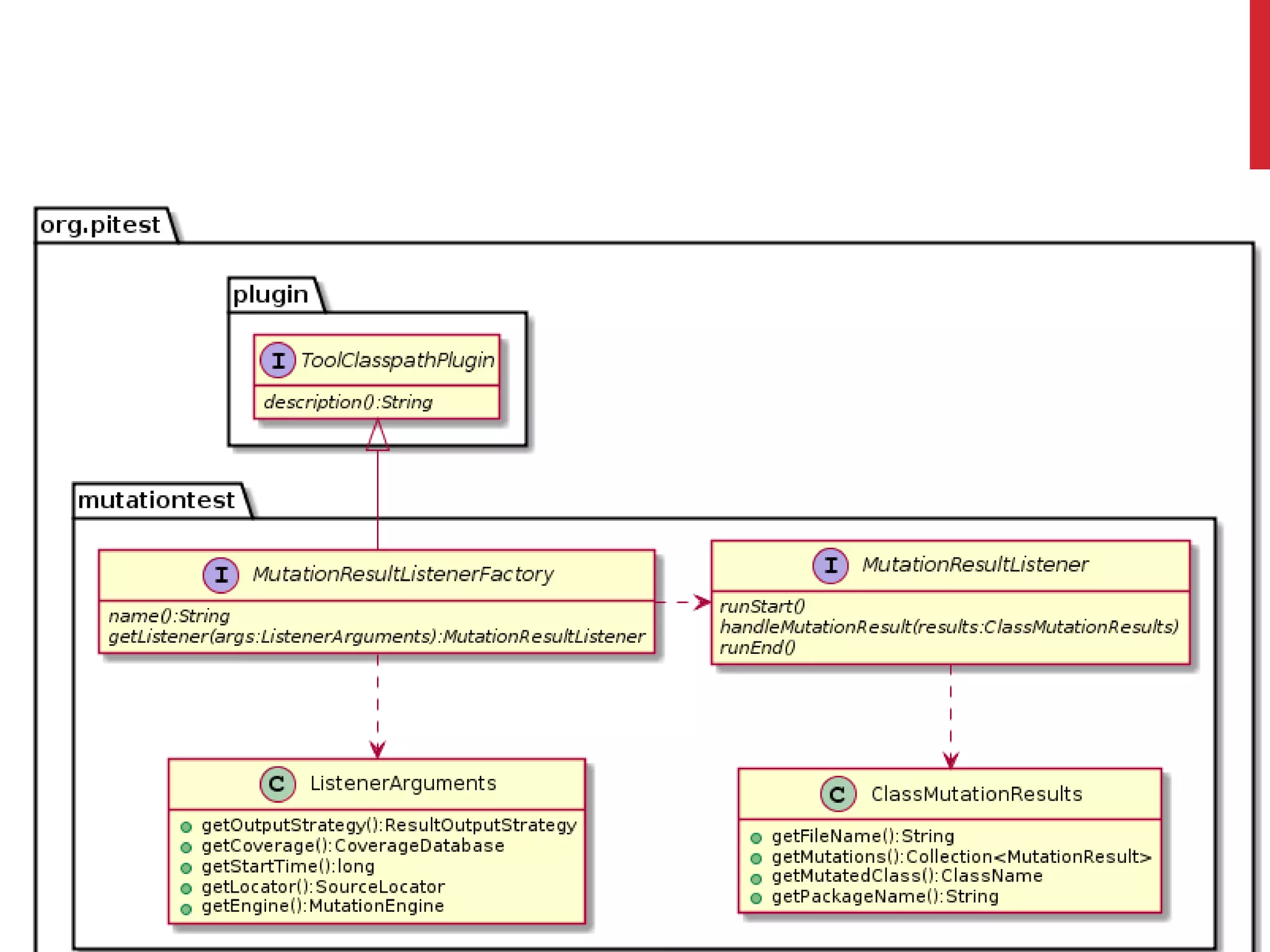
  • #57 hide attributes package org.pitest { package plugin { interface ToolClasspathPlugin { {abstract} description():String } } package mutationtest { interface MutationResultListenerFactory { {abstract} name():String {abstract} getListener(args:ListenerArguments):MutationResultListener } interface MutationResultListener { {abstract} runStart() {abstract} handleMutationResult(results:ClassMutationResults) {abstract} runEnd() } class ListenerArguments { + getOutputStrategy():ResultOutputStrategy + getCoverage():CoverageDatabase + getStartTime():long + getLocator():SourceLocator + getEngine():MutationEngine } class ClassMutationResults { + getFileName():String + getMutations():Collection<MutationResult> + getMutatedClass():ClassName + getPackageName():String } } MutationResultListenerFactory -up-|> ToolClasspathPlugin MutationResultListenerFactory .right.> MutationResultListener MutationResultListenerFactory .down.> ListenerArguments MutationResultListener .down.> ClassMutationResults
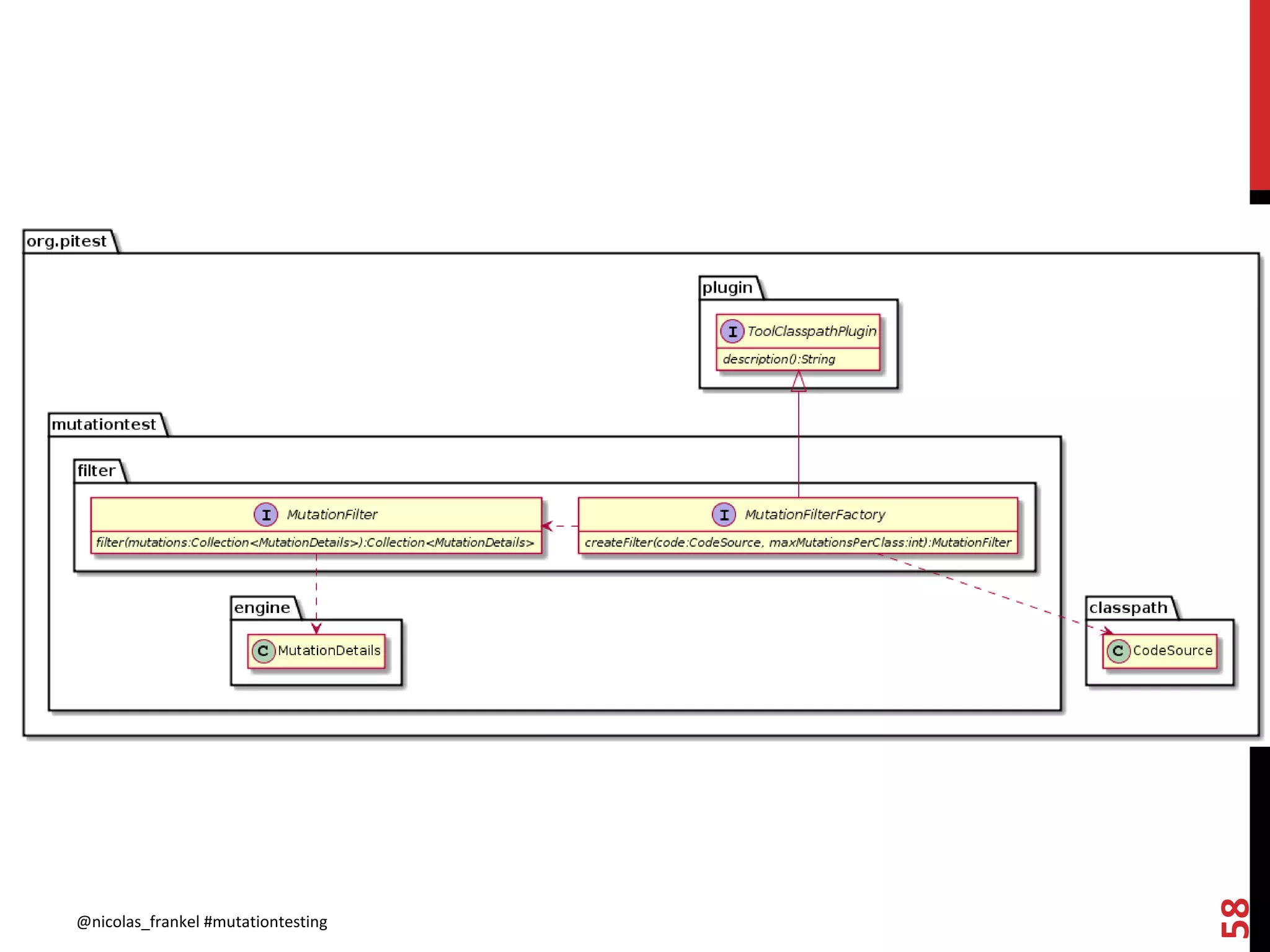
  • #59 hide attributes hide empty methods package org.pitest { package plugin { interface ToolClasspathPlugin { {abstract} description():String } } package mutationtest { package filter { interface MutationFilterFactory { {abstract} createFilter(code:CodeSource, maxMutationsPerClass:int):MutationFilter } interface MutationFilter { {abstract} filter(mutations:Collection<MutationDetails>):Collection<MutationDetails> } } package engine { class MutationDetails } } package classpath { class CodeSource } } MutationFilterFactory -up-|> ToolClasspathPlugin MutationFilterFactory .right.> MutationFilter MutationFilterFactory .down.> CodeSource MutationFilter .down.> MutationDetails