
Kicking ScrumBut
•
23 likes•4,222 views

A series of ScrumBut anti-patterns observed in multiple Scrum projects along with guidance on how to avoid them. As presented at the European Scrum Gathering (Munich, Germany) on October 19, 2009.

Recommended
Recommended
More Related Content
What's hot
What's hot (20)
Viewers also liked
Viewers also liked (17)
Similar to Kicking ScrumBut
Similar to Kicking ScrumBut (20)
More from Rowan Bunning
More from Rowan Bunning (7)
Recently uploaded
Recently uploaded (20)
Kicking ScrumBut
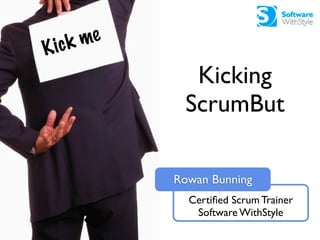
- 1. ic k me K Kicking ScrumBut Rowan Bunning Certified Scrum Trainer Software WithStyle
- 4. There are pitfalls on the journey
- 5. There are pitfalls on the journey How can we help each other to avoid them?
- 6. ScrumBut • ScrumButs are reasons why you can’t take full advantage of Scrum to solve the problems and realise the benefits. • Format: (ScrumBut) (Reason)(Workaround) • Example: “We use Scrum, but Daily Scrum meetings are too much overhead so we only have them once a week.” Source: Ken Schwaber.
- 7. ScrumBut • ScrumButs are reasons why you can’t take full advantage of Scrum to solve the problems and realise the benefits. • Format: (ScrumBut) (Reason)(Workaround) • Example: “We use Scrum, but Daily Scrum meetings are too much overhead so we only have them once a week.” Source: Ken Schwaber. What ‘ScrumButs’ have you seen?
- 8. Some ScrumButs to avoid...
- 9. Some ScrumButs to avoid... ✖ Goalless, soulless Scrum ✖ Cherry-picking practices and premature process optimisation ✖ Shooting the Scrum messenger ✖ Planning paralysis ✖ Mis-aligned stories ✖ Command and control-style micro-management ✖ Individual heroics ✖ Smoke and mirror demos ✖ Lack of risk management ✖ The vicious cycle of overcommitment ✖ Stalled improvement
- 10. Avoid: Goalless Scrum “We use Scrum but... only because [insert latest fad].” Is your Scrum implementation goalless?
- 11. Avoid: Goalless Scrum “We use Scrum but... only because [insert latest fad].” Is your Scrum implementation goalless?
- 12. Avoid: Goalless Scrum “We use Scrum but... only because [insert latest fad].” Is your Scrum implementation goalless? • Why are you using Scrum?
- 13. Avoid: Goalless Scrum “We use Scrum but... only because [insert latest fad].” Is your Scrum implementation goalless? • Why are you using Scrum? • What are your pain points?
- 14. Avoid: Goalless Scrum “We use Scrum but... only because [insert latest fad].” Is your Scrum implementation goalless? • Why are you using Scrum? • What are your pain points? • What can the business expect to get out of this?
- 15. Try: Targeting process improvement goals
- 16. Try: Targeting process improvement goals
- 17. Try: Targeting process improvement goals • Consider using Scrum to govern the introduction of Scrum
- 18. Avoid: Soulless Scrum Is your Scrum implementation soulless?
- 19. Avoid: Soulless Scrum Is your Scrum implementation soulless? • Are you just practicing Scrum by rote?
- 20. Avoid: Soulless Scrum Is your Scrum implementation soulless? • Are you just practicing Scrum by rote? • Do you have a shared vision of the future?
- 21. Avoid: Soulless Scrum Is your Scrum implementation soulless? • Are you just practicing Scrum by rote? • Do you have a shared vision of the future? • Does your team regularly discuss Scrum values and principles?
- 22. Avoid: Soulless Scrum Is your Scrum implementation soulless? • Are you just practicing Scrum by rote? • Do you have a shared vision of the future? • Does your team regularly discuss Scrum values and principles? Try: Discussing Scrum values, principles and what these mean for you
- 23. Avoid: Cherry-picking practices “We use Scrum but... only the practices that are most appealing”
- 24. Agile methods as systems
- 25. Agile methods as systems “No single practice works well by itself, each needs the other practices to keep them in balance.”
- 26. Agile methods as systems “No single practice works well by itself, each needs the other practices to keep them in balance.” “If you follow 80% of the process you get 20% of the benefits.”
- 27. Agile methods as systems “No single practice works well by itself, each needs the other practices to keep them in balance.” “If you follow 80% of the process you get 20% of the benefits.” - Kent Beck
- 28. Agile methods as systems “No single practice works well by itself, each needs the other practices to keep them in balance.” “If you follow 80% of the process you get 20% of the benefits.” - Kent Beck
- 29. Agile methods as systems “No single practice works well by itself, each needs the other practices to keep them in balance.” “If you follow 80% of the process you get 20% of the benefits.” - Kent Beck Source: Kent Beck.
- 30. Agile methods as systems “No single practice works well by itself, each needs the other practices to keep them in balance.” “If you follow 80% of the process you get 20% of the benefits.” - Kent Beck Source: Kent Beck. Avoid: Premature process optimisation
- 32. Try: applying before inspecting and adapting
- 33. Try: applying before inspecting and adapting “[Apply] Scrum as proposed... for at least 3 Sprints.” - Christian Schmidkonz, SAP.
- 34. Try: applying before inspecting and adapting “[Apply] Scrum as proposed... for at least 3 Sprints.” - Christian Schmidkonz, SAP. “ ‘Doing Scrum’ is as meaningless (and impossible) as creating an instance of an abstract class.” - Tobias Mayer
- 35. Shooting the Scrum messenger “We use Scrum but… we don’t like it because it makes life more difficult.” m S cru
- 36. Shooting the Scrum messenger “We use Scrum but… we don’t like it because it makes life more difficult.” • Is Scrum surfacing existing issues? m S cru
- 37. Shooting the Scrum messenger “We use Scrum but… we don’t like it because it makes life more difficult.” • Is Scrum surfacing existing issues? • Are people speaking out early? m S cru
- 38. Shooting the Scrum messenger “We use Scrum but… we don’t like it because it makes life more difficult.” • Is Scrum surfacing existing issues? • Are people speaking out early? m S cru “Bad news doesn’t get any better with age!”
- 40. “Scrum is a mirror.” - Alistair Cockburn
- 41. “Scrum is a mirror.” - Alistair Cockburn Try: Looking into the Scrum mirror
- 42. “Scrum is a mirror.” - Alistair Cockburn Try: Looking into the Scrum mirror
- 43. “We use Scrum but… we're still not confident about our plan after two days of Sprint planning!
- 44. Avoid: Planning Paralysis “We use Scrum but… we're still not confident about our plan after two days of Sprint planning!
- 45. Avoid: Planning Paralysis “We use Scrum but… we're still not confident about our plan after two days of Sprint planning! Try: Doing your homework on the backlog
- 46. Avoid: Planning Paralysis “We use Scrum but… we're still not confident about our plan after two days of Sprint planning! Try: Doing your homework on the backlog • Grooming the Product Backlog • Regular estimation sessions • Getting Stories to a state of ‘Ready’ • 5-10% of effort preparing future work
- 48. Avoid: Mis-aligned Stories e.g. Building screens rather than workflows
- 49. Try: Sashimi slicing by value
- 50. Try: Sashimi slicing by value Try: • Slicing by business value • Being user task-centric • Going end-to-end through technology stack
- 51. Avoid: Command and control- style micro-management “We use Scrum but… a manager keeps telling team members which tasks to do when!”
- 52. Avoid: Command and control- style micro-management “We use Scrum but… a manager keeps telling team members which tasks to do when!” Q: Does Scrum involve micro-management?
- 53. Avoid: Command and control- style micro-management “We use Scrum but… a manager keeps telling team members which tasks to do when!” Q: Does Scrum involve micro-management? A: Yes!
- 54. Avoid: Command and control- style micro-management “We use Scrum but… a manager keeps telling team members which tasks to do when!” Q: Does Scrum involve micro-management? A: Yes! Q: Who is doing the micro-management?
- 55. Avoid: Command and control- style micro-management “We use Scrum but… a manager keeps telling team members which tasks to do when!” Q: Does Scrum involve micro-management? A: Yes! Q: Who is doing the micro-management? Thanks to: Mike Cohn
- 56. Avoid: Command and control- style micro-management “We use Scrum but… a manager keeps telling team members which tasks to do when!” Q: Does Scrum involve micro-management? A: Yes! Q: Who is doing the micro-management? Thanks to: Mike Cohn Is your team empowered?
- 58. Try: Allowing the team to self-manage within a time-box
- 59. Try: Allowing the team to self-manage within a time-box Do: • Let go! • Emphasise goals • Offer to help • Facilitate learning
- 60. Try: Allowing the team to self-manage within a time-box Do: • Let go! • Emphasise goals • Offer to help • Facilitate learning “Never tell people how to do things. Tell them what to do, and they will surprise you with their ingenuity.” - General George S. Patton, Jr.
- 62. Individual Heroics Individual heroics “We use Scrum but… individuals hoard work and boast about it!”
- 64. Try: Team-centric reviews and incentives
- 65. Try: Team-centric reviews and incentives
- 66. Try: Team-centric reviews and incentives
- 67. Try: Team-centric reviews and incentives Try: • Emphasising team achievement • Dampening individual heroics • Teamwork-biased incentives
- 68. Smoke and mirror demos “Transparency ensures that aspects of the process that affect the outcome must be visible to those managing the outcomes. ...when someone inspecting a process believes that something is done; it must be equivalent to their definition of done.” - Ken Schwaber, The Scrum Guide you see isn’t quite done.
- 69. Smoke and mirror demos “Transparency ensures that aspects of the process that affect the outcome must be visible to those managing the outcomes. ...when someone inspecting a process believes that something is done; it must be equivalent to their definition of done.” - Ken Schwaber, The Scrum Guide We use Scrum but... what you see isn’t quite done.
- 71. What you can’t see...
- 72. What you can’t see...
- 73. What you can’t see... Try: Not demoing features that aren’t truly “done”
- 74. Avoid: Lack of risk management
- 75. Avoid: Lack of risk management Requirements Integrate & Design Code Analysis System Test First build and deliver Potential Impact of Highest risk activities such as Risks being integration, system testing, tackled load testing are tackled late Time
- 76. Avoid: Lack of risk management Requirements Integrate & Design Code Analysis System Test First build and deliver Potential Impact of Highest risk activities such as Risks being integration, system testing, tackled load testing are tackled late Time First build and deliver Iterations All activities are tackled early Potential Integrate & Integrate & Integrate & Integrate & Integrate & Impact of System Test System Test System Test System Test System Test Risks being Code Code Code Code Code tackled Design Design Design Design Design Analysis Analysis Analysis Analysis Analysis Time Source: Craig Larman, Agile & Iterative Development, 2004.
- 77. Scrum risk reduction strategies Source: Schwaber, K., Beedle, M., Agile Software Development with Scrum, Prentice Hall, 2001.
- 78. Scrum risk reduction strategies Risk of... Scrum Strategy Not pleasing the customer Customer sees product constantly. Customer on-site. Not completing all functionality Develop in priority order. Poor estimating and planning Small estimates tracked daily. Review and adjustment every iteration. Not resolving issues properly Active daily management. Bi-directional reporting. Not being able to complete Delivery of working software every the development cycle iteration. Team forced to confront issues early. Taking too much work and Clear goal and scope each iteration. changing expectations No change within iterations. Source: Schwaber, K., Beedle, M., Agile Software Development with Scrum, Prentice Hall, 2001.
- 79. Scrum risk reduction strategies Risk of... Scrum Strategy Not pleasing the customer Customer sees product constantly. Customer on-site. Not completing all functionality Develop in priority order. Poor estimating and planning Small estimates tracked daily. Review and adjustment every iteration. Not resolving issues properly Active daily management. Bi-directional reporting. Not being able to complete Delivery of working software every the development cycle iteration. Team forced to confront issues early. Taking too much work and Clear goal and scope each iteration. changing expectations No change within iterations. Source: Schwaber, K., Beedle, M., Agile Software Development with Scrum, Prentice Hall, 2001.
- 80. Scrum risk reduction strategies Risk of... Scrum Strategy Not pleasing the customer Customer sees product constantly. Customer on-site. Not completing all functionality Develop in priority order. Poor estimating and planning Small estimates tracked daily. Review and adjustment every iteration. Not resolving issues properly Active daily management. Bi-directional reporting. Not being able to complete Delivery of working software every the development cycle iteration. Team forced to confront issues early. Taking too much work and Clear goal and scope each iteration. changing expectations No change within iterations. Source: Schwaber, K., Beedle, M., Agile Software Development with Scrum, Prentice Hall, 2001.
- 81. Scrum risk reduction strategies Risk of... Scrum Strategy Not pleasing the customer Customer sees product constantly. Customer on-site. Not completing all functionality Develop in priority order. Poor estimating and planning Small estimates tracked daily. Review and adjustment every iteration. Not resolving issues properly Active daily management. Bi-directional reporting. Not being able to complete Delivery of working software every the development cycle iteration. Team forced to confront issues early. Taking too much work and Clear goal and scope each iteration. changing expectations No change within iterations. Source: Schwaber, K., Beedle, M., Agile Software Development with Scrum, Prentice Hall, 2001.
- 82. Scrum risk reduction strategies Risk of... Scrum Strategy Not pleasing the customer Customer sees product constantly. Customer on-site. Not completing all functionality Develop in priority order. Poor estimating and planning Small estimates tracked daily. Review and adjustment every iteration. Not resolving issues properly Active daily management. Bi-directional reporting. Not being able to complete Delivery of working software every the development cycle iteration. Team forced to confront issues early. Taking too much work and Clear goal and scope each iteration. changing expectations No change within iterations. Source: Schwaber, K., Beedle, M., Agile Software Development with Scrum, Prentice Hall, 2001.
- 83. Scrum risk reduction strategies Risk of... Scrum Strategy Not pleasing the customer Customer sees product constantly. Customer on-site. Not completing all functionality Develop in priority order. Poor estimating and planning Small estimates tracked daily. Review and adjustment every iteration. Not resolving issues properly Active daily management. Bi-directional reporting. Not being able to complete Delivery of working software every the development cycle iteration. Team forced to confront issues early. Taking too much work and Clear goal and scope each iteration. changing expectations No change within iterations. Source: Schwaber, K., Beedle, M., Agile Software Development with Scrum, Prentice Hall, 2001.
- 84. Scrum risk reduction strategies Risk of... Scrum Strategy Not pleasing the customer Customer sees product constantly. Customer on-site. Not completing all functionality Develop in priority order. Poor estimating and planning Small estimates tracked daily. Review and adjustment every iteration. Not resolving issues properly Active daily management. Bi-directional reporting. Not being able to complete Delivery of working software every the development cycle iteration. Team forced to confront issues early. Taking too much work and Clear goal and scope each iteration. changing expectations No change within iterations. Source: Schwaber, K., Beedle, M., Agile Software Development with Scrum, Prentice Hall, 2001.
- 85. Scrum risk reduction strategies Risk of... Scrum Strategy Not pleasing the customer Customer sees product constantly. Customer on-site. Not completing all functionality Develop in priority order. Poor estimating and planning Small estimates tracked daily. Review and adjustment every iteration. Not resolving issues properly Active daily management. Bi-directional reporting. Not being able to complete Delivery of working software every the development cycle iteration. Team forced to confront issues early. Taking too much work and Clear goal and scope each iteration. changing expectations No change within iterations. Source: Schwaber, K., Beedle, M., Agile Software Development with Scrum, Prentice Hall, 2001. Is it sufficient to rely solely on these built-in strategies?
- 86. Try: Creating a safe-fail environment
- 87. Try: Creating a safe-fail environment • Time-boxing
- 88. Try: Creating a safe-fail environment • Time-boxing • Areas of risk/ uncertainty early in release cycles
- 89. Try: Creating a safe-fail environment • Time-boxing • Areas of risk/ uncertainty early in release cycles • Prioritisation bias towards areas of risk
- 90. Try: Creating a safe-fail environment • Time-boxing • Areas of risk/ uncertainty early in release cycles • Prioritisation bias towards areas of risk • Spikes to reduce uncertainty
- 91. Try: Creating a safe-fail environment • Time-boxing • Areas of risk/ uncertainty early in release cycles • Prioritisation bias towards areas of risk • Spikes to reduce uncertainty • Last Responsible Moment planning
- 92. Try: Creating a safe-fail environment • Time-boxing • Areas of risk/ uncertainty early in release cycles • Prioritisation bias towards areas of risk • Spikes to reduce uncertainty • Last Responsible Moment planning • Learn quickly
- 93. Try: Collaborative risk management Risks Strategy Mitigating Containing Evading Avoiding Thanks to: Slinger, M., Broderick, S., The Software Project Manager’s Bridge to Agility, Addison Wesley, 2008.
- 94. Try: Collaborative risk management Risks Strategy Mitigating Containing Evading Avoiding take steps before the risk materialises to reduce the containment costs e.g. move feature to an earlier sprint Thanks to: Slinger, M., Broderick, S., The Software Project Manager’s Bridge to Agility, Addison Wesley, 2008.
- 95. Try: Collaborative risk management set aside time and money to pay for the risk should it materialise Risks Strategy e.g. plan for training on new tools Mitigating Containing Evading Avoiding take steps before the risk materialises to reduce the containment costs e.g. move feature to an earlier sprint Thanks to: Slinger, M., Broderick, S., The Software Project Manager’s Bridge to Agility, Addison Wesley, 2008.
- 96. Try: Collaborative risk management set aside time and money to pay for the risk should it materialise Risks Strategy e.g. plan for training on new tools Mitigating Containing bet on the risk not Evading materialising e.g. accepting not having a dedicated team Avoiding take steps before the risk materialises to reduce the containment costs e.g. move feature to an earlier sprint Thanks to: Slinger, M., Broderick, S., The Software Project Manager’s Bridge to Agility, Addison Wesley, 2008.
- 97. Try: Collaborative risk management set aside time and money to pay for the risk should it materialise Risks Strategy e.g. plan for training on new tools Mitigating Containing bet on the risk not Evading materialising e.g. accepting not having a dedicated team Avoiding take steps before the risk materialises don’t do part of the to reduce the containment costs e.g. project that entails the risk move feature to an earlier sprint e.g. avoid platform upgrade Thanks to: Slinger, M., Broderick, S., The Software Project Manager’s Bridge to Agility, Addison Wesley, 2008.
- 98. Avoid: The vicious cycle of overcommitment “We use Scrum but… we don't have time for bug fixing or process improvement because we have too many new features to
- 99. Try: Snapping out of overcommitment! Raise visibility, get buy-in, create a sense of urgency, action!
- 100. Stalled improvement “We use Scrum but… we've still got the same issues that we had a few sprints ago! ”
- 101. Stalled improvement “We use Scrum but… we've still got the same issues that we had a few sprints ago! ” Are you suffering from the ‘three meeting syndrome’?
- 102. Stalled improvement “We use Scrum but… we've still got the same issues that we had a few sprints ago! ” Are you suffering from the ‘three meeting syndrome’? Avoid: Superficial 15min retrospectives only
- 104. Try: Deep reflection & correction
- 105. Try: Deep reflection & correction
- 106. Try: Deep reflection & correction Keep Problem Try Puzzles
- 107. Try: Deep reflection & correction Keep Problem Try Puzzles 1. Set the stage 2. Gather data 3. Generate insights 4. Decide what to do 5. Close the retrospective Reference: Derby E., Larsen D., Agile Retrospectives: Making Good Teams Great, Pragmatic Bookshelf, 2006.
- 110. In Summary... let’s not dilute Scrum
- 111. In Summary... let’s not dilute Scrum
- 112. In Summary... let’s not dilute Scrum “Agile development is like teenage sex.
- 113. In Summary... let’s not dilute Scrum “Agile development is like teenage sex. Everyone says they're doing it, but only 10% are.
- 114. In Summary... let’s not dilute Scrum “Agile development is like teenage sex. Everyone says they're doing it, but only 10% are. And those who are -- ARE DOING IT WRONG.”
- 115. In Summary... let’s not dilute Scrum “Agile development is like teenage sex. Everyone says they're doing it, but only 10% are. And those who are -- ARE DOING IT WRONG.” - The Hacker Chick Blog
- 116. Remember...
- 117. Remember... “If you’re not having fun, you’re not doing it right!” - Joseph Pelrine, CST and Social Complexity Scientist
- 118. Your moment of Scrum Zen
- 119. Your moment of Scrum Zen Work towards:
- 120. Your moment of Scrum Zen Work towards: • High performance teams
- 121. Your moment of Scrum Zen Work towards: • High performance teams • Harmony with your environment and its challenges
- 122. Your moment of Scrum Zen Work towards: • High performance teams • Harmony with your environment and its challenges • Your ‘fitness peak’
- 123. Try...
- 124. Try... ✓ Targetting process improvement goals + discussing Scrum values, principles and what these mean ✓ Applying before inspecting and adapting ✓ Looking into the Scrum mirror ✓ Doing your homework on the backlog ✓ Sashimi slicing by business value ✓ Allowing the team to self-manage within a time-box ✓ Team-centric reviews and incentives ✓ Not demoing features that aren’t truly “done” ✓ Collaborative risk management ✓ Snapping out of overcommitment! ✓ Deep reflection and correction
- 125. I’m Rowan Bunning www.softwarewithstyle.com Rowan.Bunning@softwarewithstyle.com
- 126. I’m Thank you keep in touch Rowan Bunning www.softwarewithstyle.com Rowan.Bunning@softwarewithstyle.com