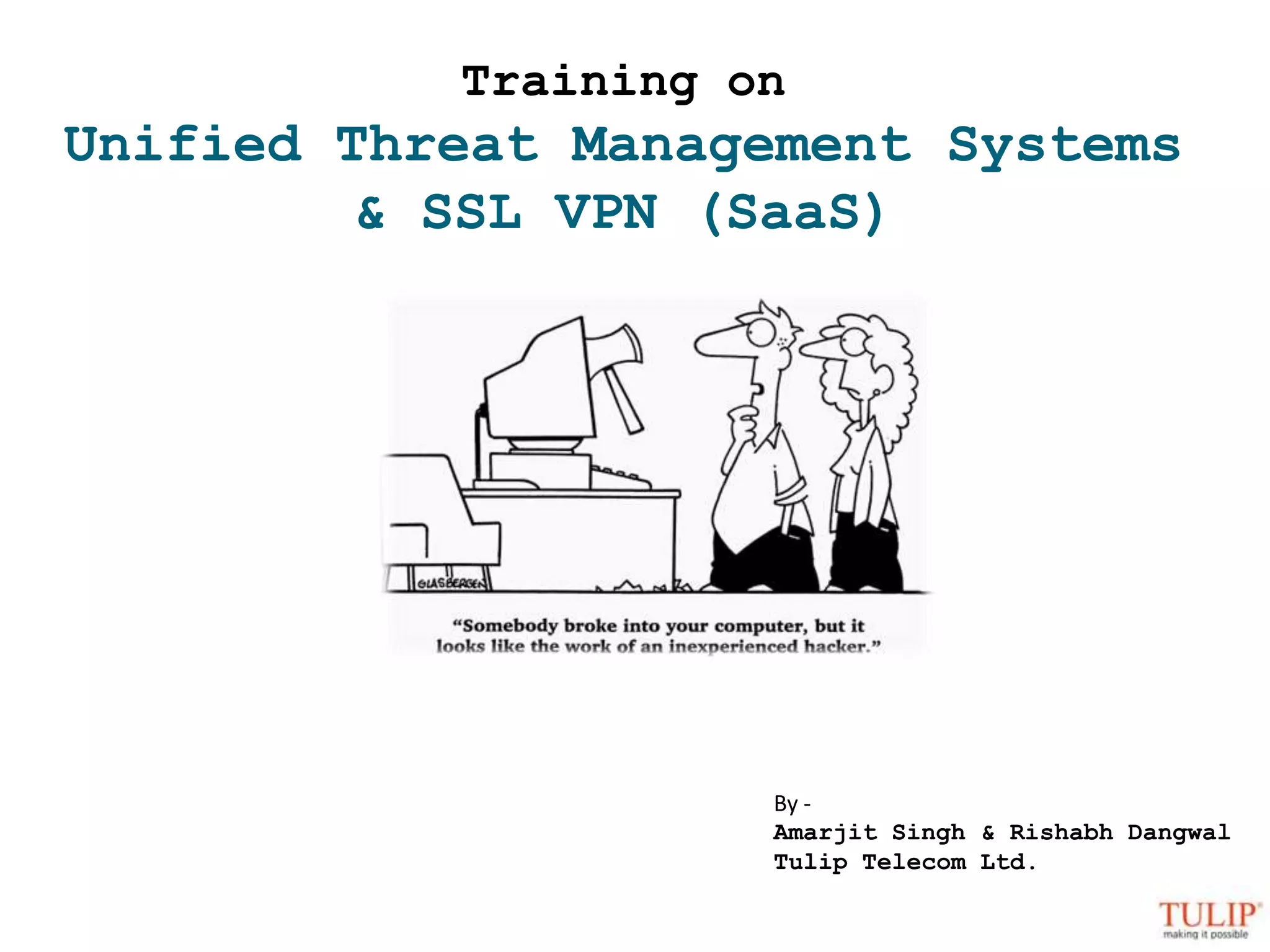


Training onUnified Threat Management Systems& SSL VPN (SaaS)By - Amarjit Singh & RishabhDangwalTulip Telecom Ltd.
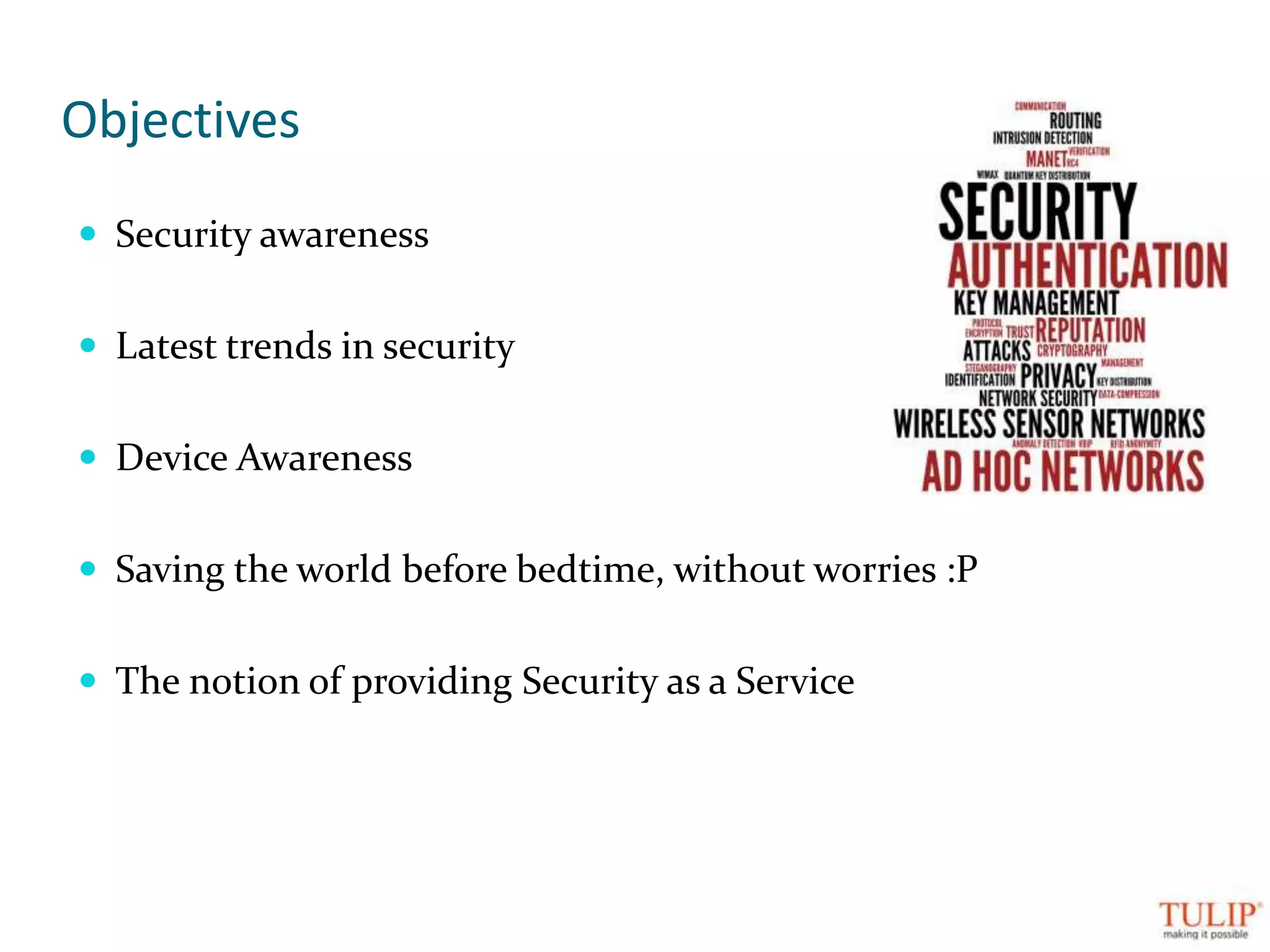
ObjectivesSecurity awarenessLatest trends in securityDevice AwarenessSaving the world before bedtime, without worries :PThe notion of providing Security as a Service
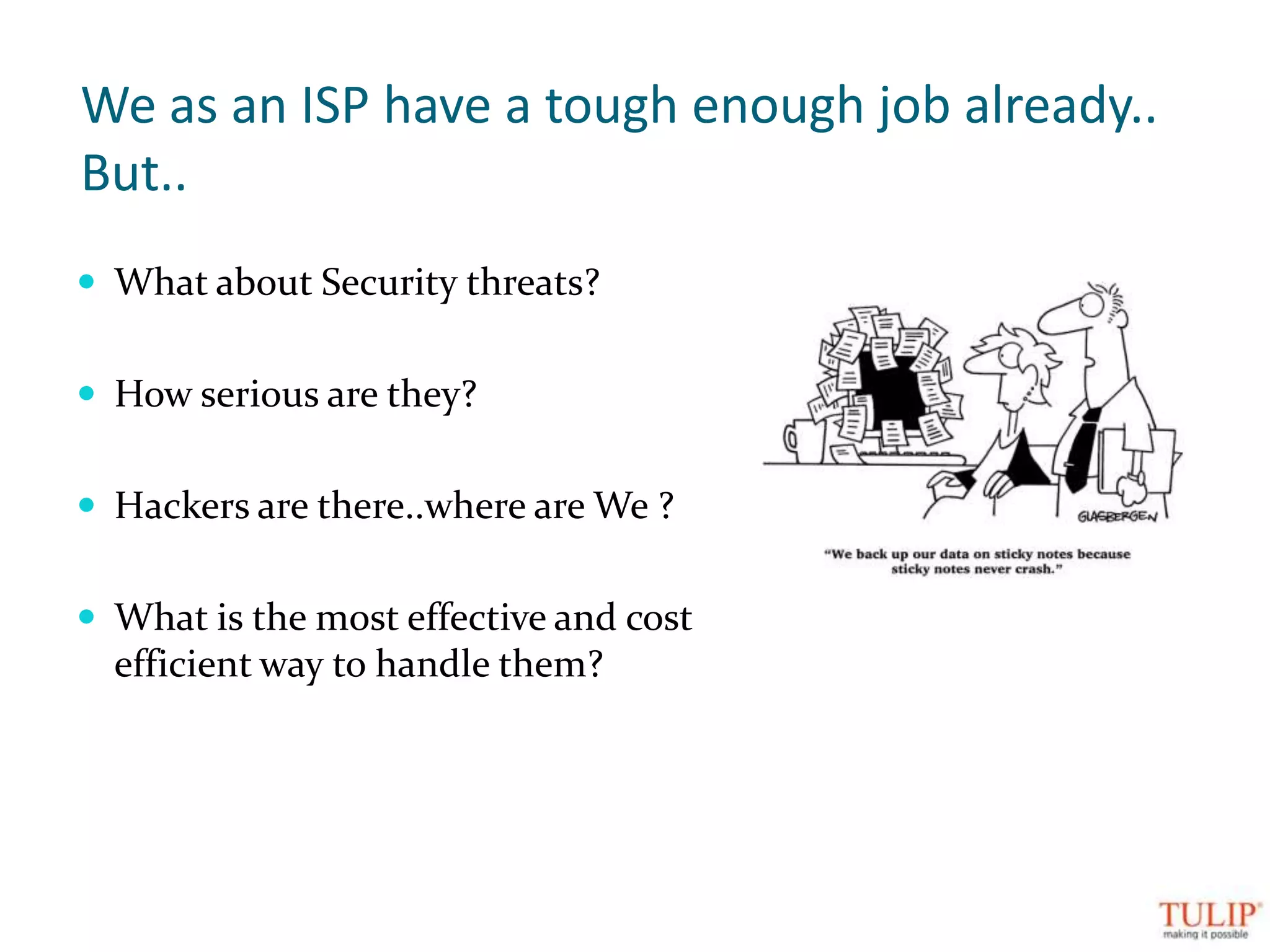
We as an ISP have a tough enough job already..But..What about Security threats?How serious are they?Hackers are there..where are We ?What is the most effective and cost efficient way to handle them?
Current TrendsCyber-attacks are increasing in speed and sophistication exponentiallyBlended threats, hybrid attacks  and APT’s..Getting automated tools is easy, increase in skid cultureSecurity costs money, Security problems cost money, time and lots of pain.
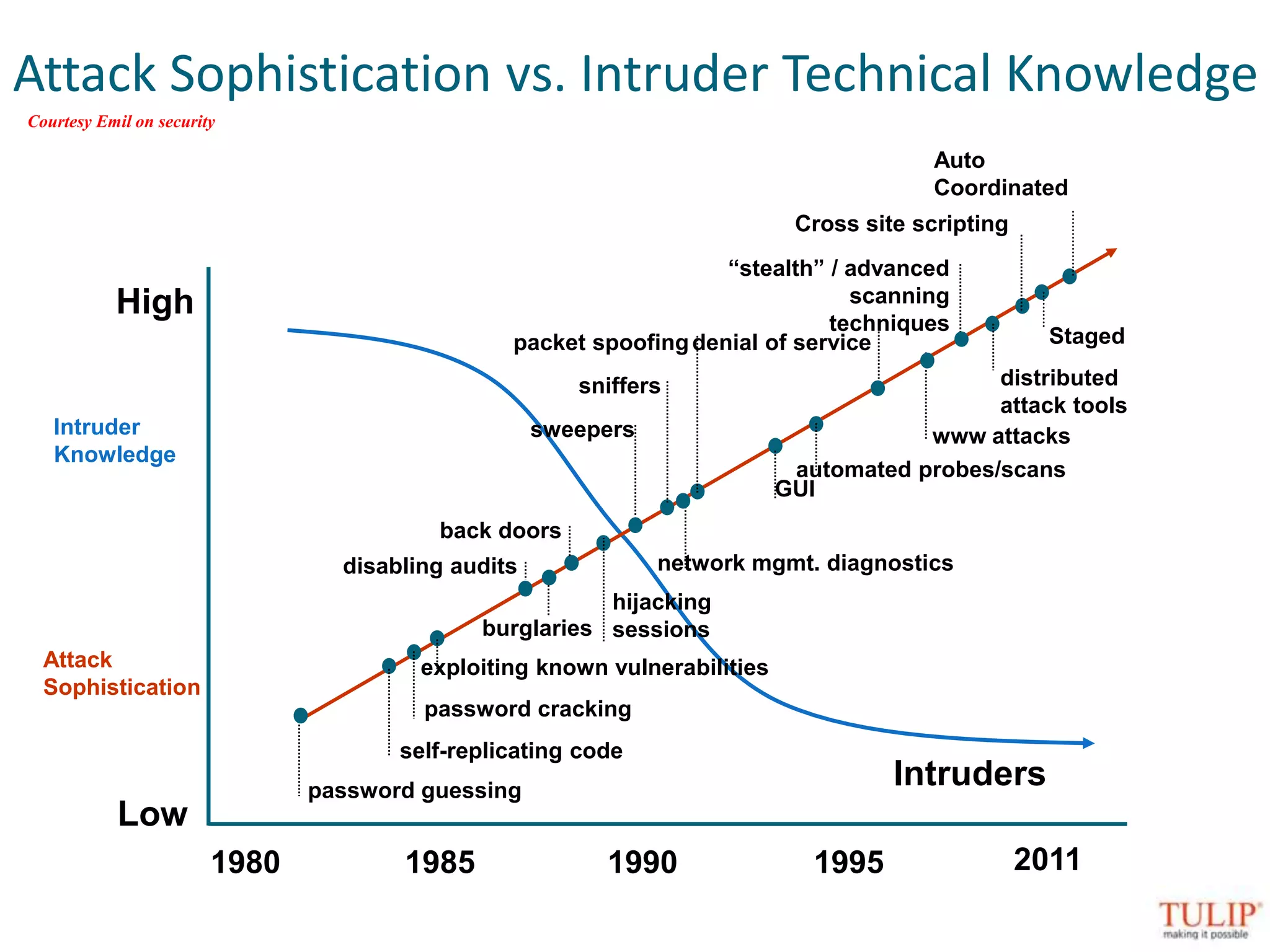
IntrudersAttack Sophistication vs. Intruder Technical KnowledgeCourtesy Emil on securityAuto CoordinatedCross site scripting“stealth” / advanced scanning techniquesHighStagedpacket spoofingdenial of servicedistributedattack toolssniffersIntruderKnowledgesweeperswww attacksautomated probes/scansGUIback doorsnetwork mgmt. diagnosticsdisabling auditshijacking sessionsburglariesAttackSophisticationexploiting known vulnerabilitiespassword crackingself-replicating codepassword guessingLow20111980198519901995
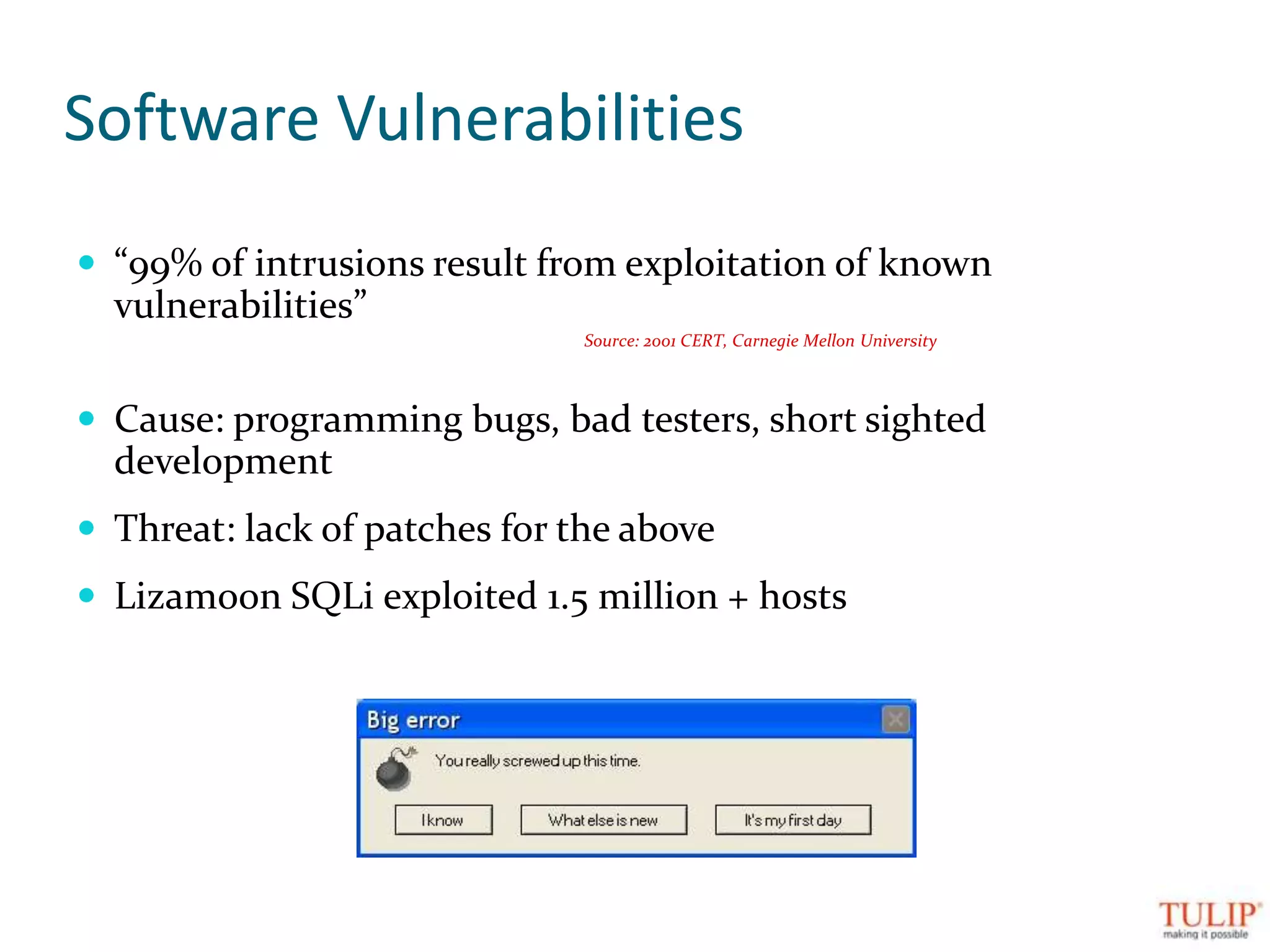
Software Vulnerabilities“99% of intrusions result from exploitation of known vulnerabilities”					Source: 2001 CERT, Carnegie Mellon UniversityCause: programming bugs, bad testers, short sighted developmentThreat: lack of patches for the aboveLizamoonSQLi exploited 1.5 million + hosts
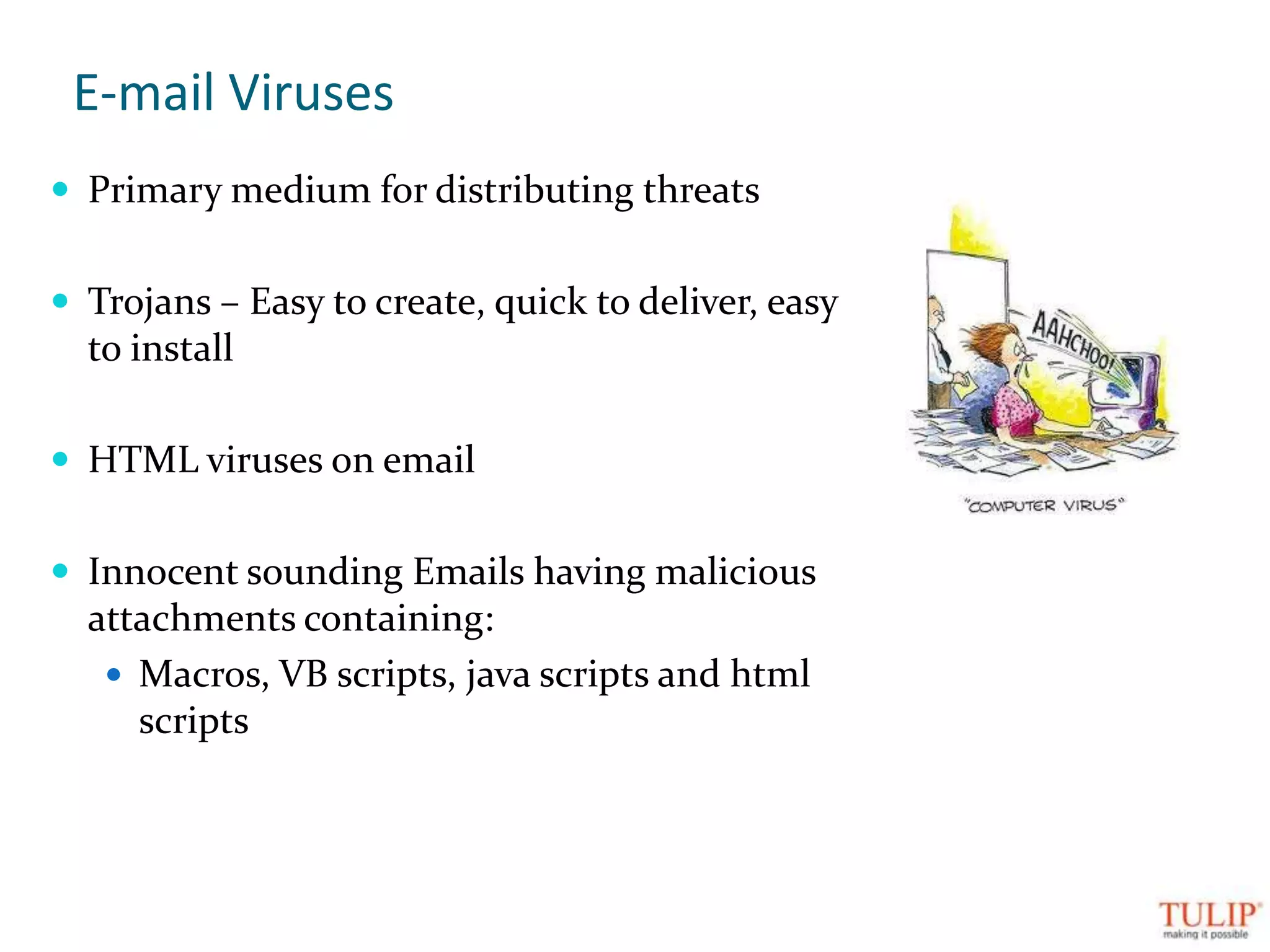
E-mail VirusesPrimary medium for distributing threatsTrojans – Easy to create, quick to deliver, easy to installHTML viruses on emailInnocent sounding Emails having malicious attachments containing: Macros, VB scripts, java scripts and html scripts
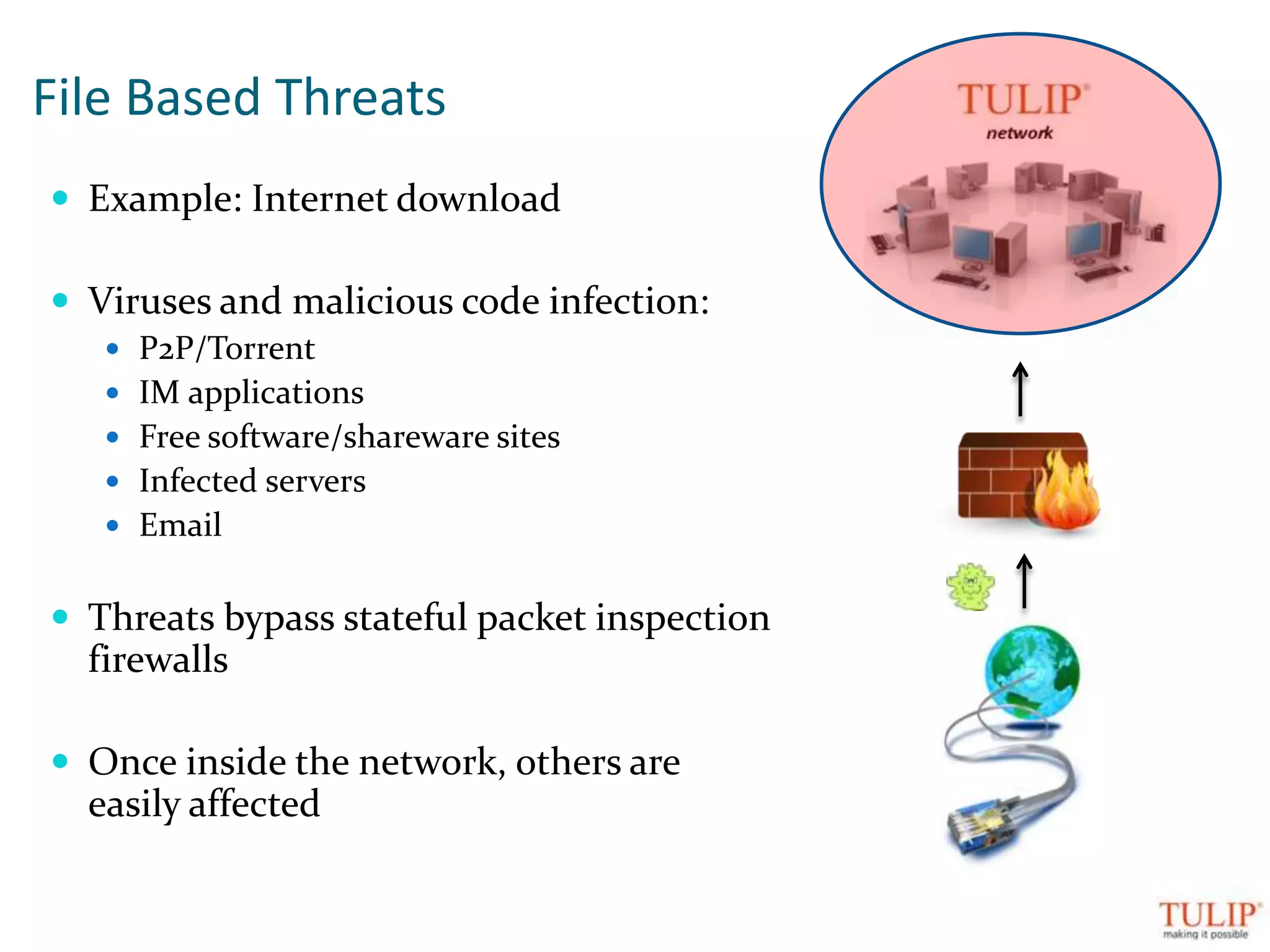
File Based ThreatsExample: Internet download
Viruses and malicious code infection:
P2P/Torrent
IM applications
Free software/shareware sites
Infected servers
Email
Threats bypass statefulpacket inspection firewalls
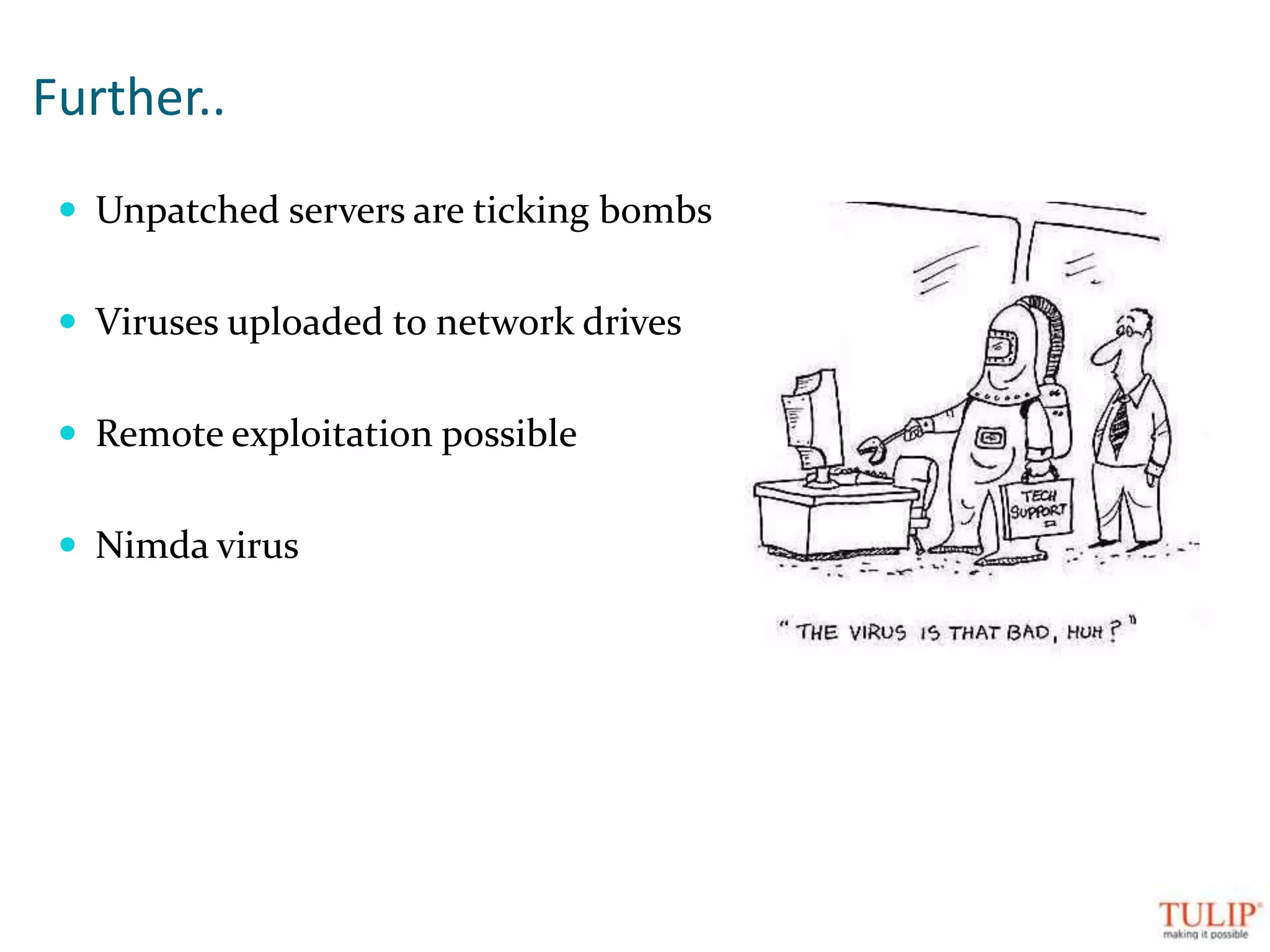
Once inside the network, others are easily affectedFurther..Unpatched servers are ticking bombsViruses uploaded to network drivesRemote exploitation possibleNimda virus
And we have got Spyware..Program that uses Internet without the User’s knowledgeApproximately 80% of computers have some form of Spyware (including corporate ones)Spread using shareware, pop ups,p2p,shareware..the usual suspectsGathering information:Browsing habits (sites visited, links clicked, etc.)Data entered into forms (including account names, passwords, text of Web forms and Web-based email, etc.)Key stokes and work habits
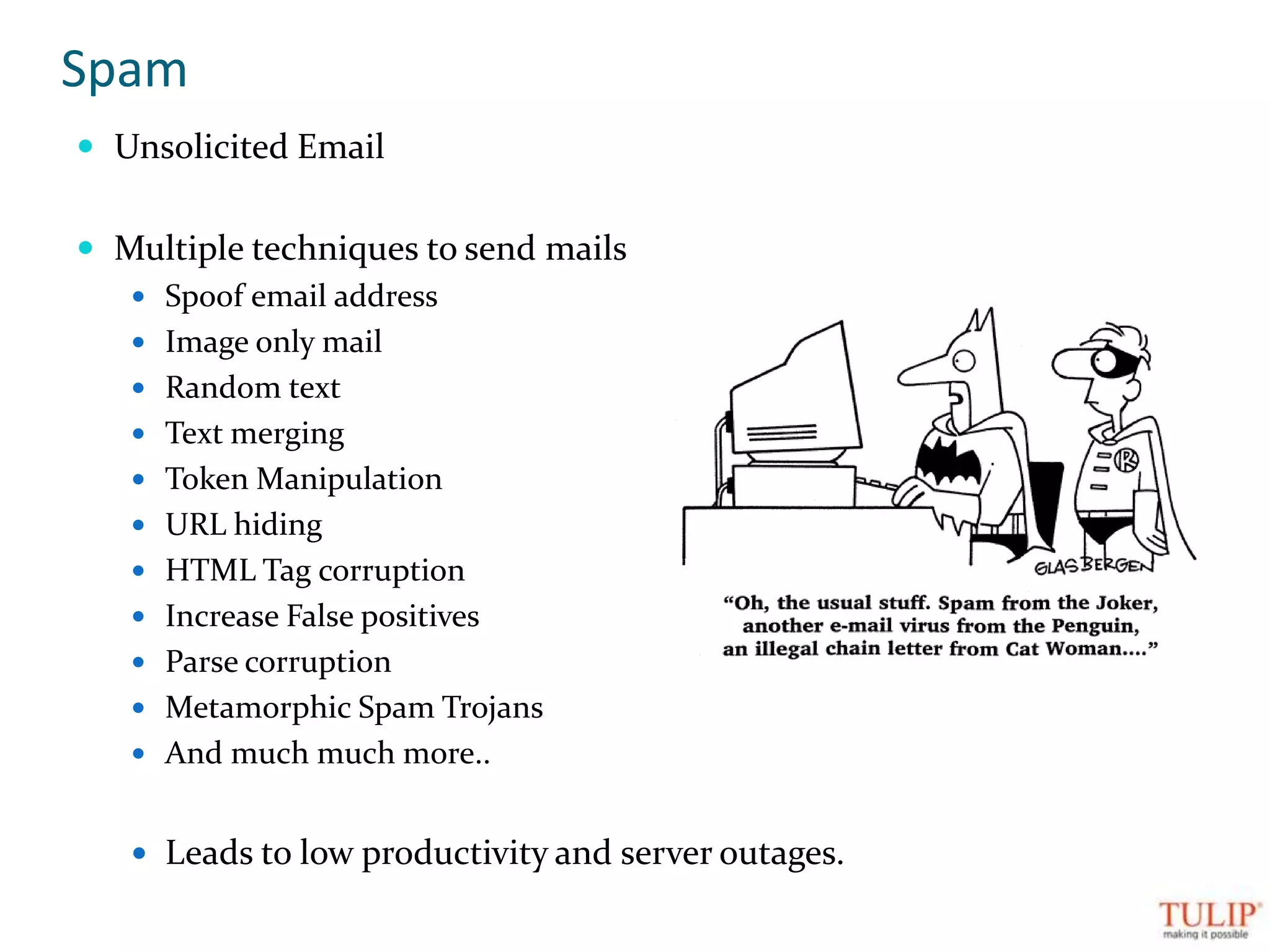
SpamUnsolicited EmailMultiple techniques to send mailsSpoof email addressImage only mailRandom textText mergingToken ManipulationURL hidingHTML Tag corruptionIncrease False positivesParse corruptionMetamorphic Spam TrojansAnd much much more..Leads to low productivity and server outages.
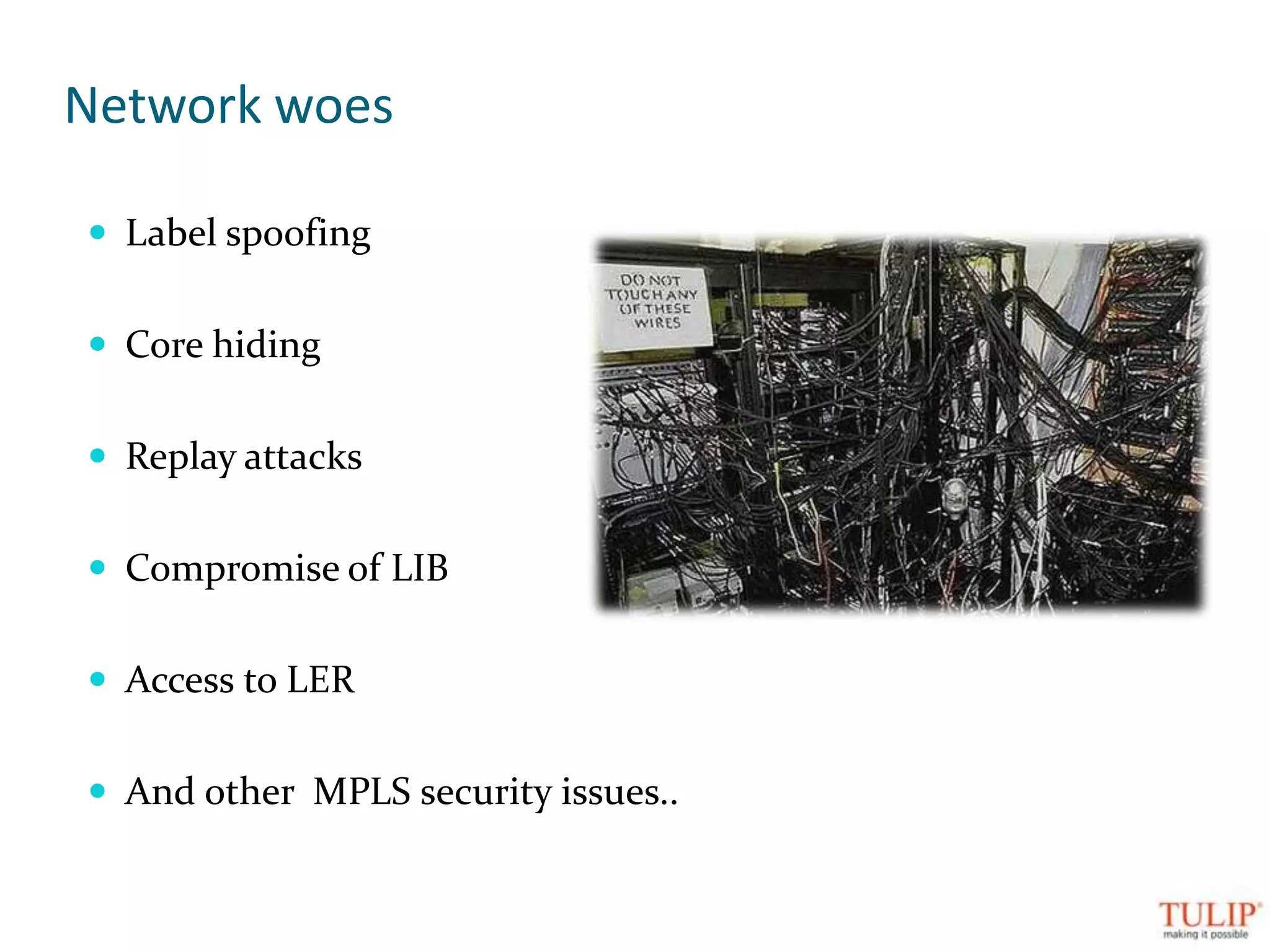
Network woes Label spoofingCore hidingReplay attacksCompromise of LIBAccess to LERAnd other  MPLS security issues..
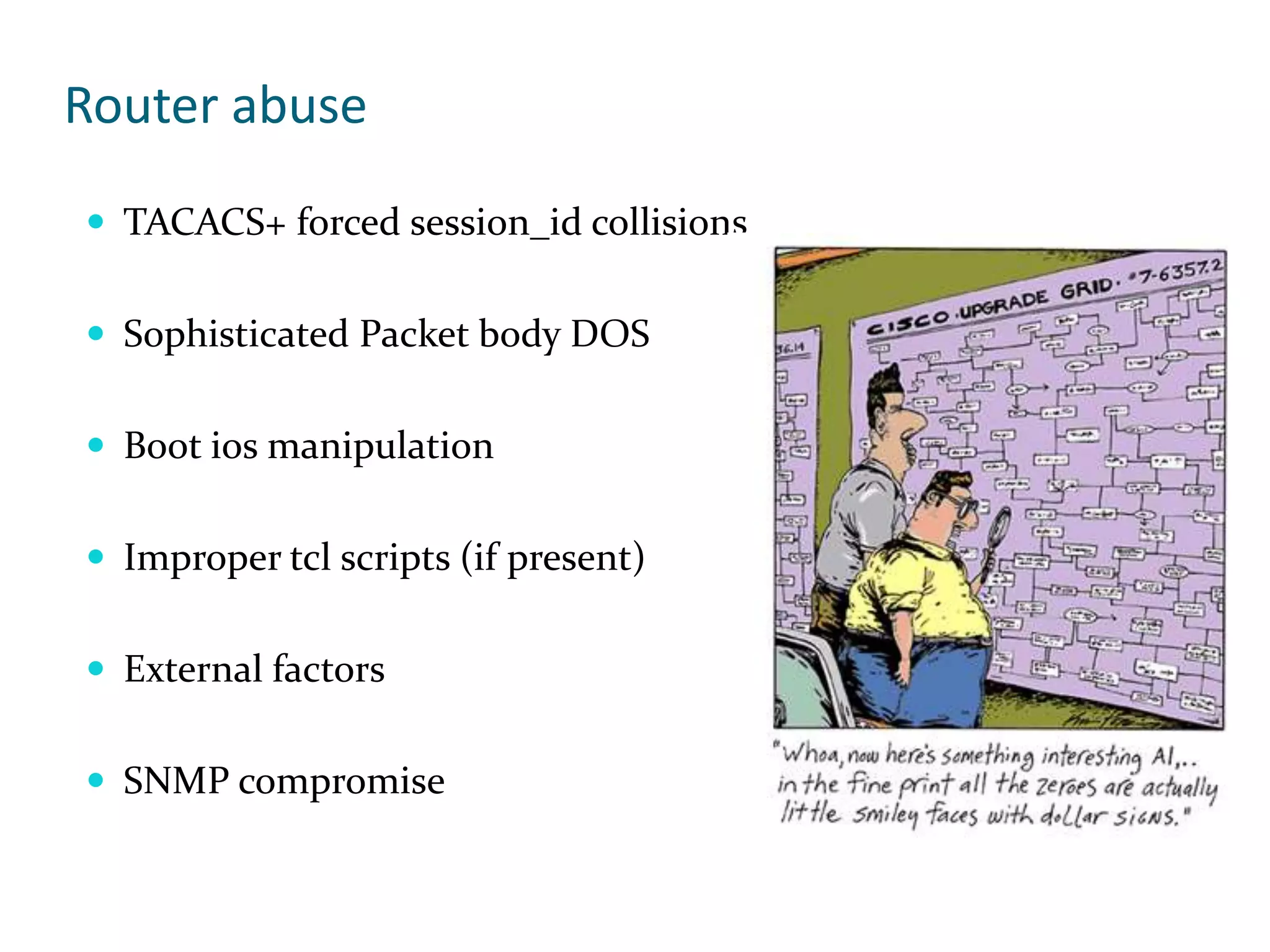
Router abuseTACACS+ forced session_id collisionsSophisticated Packet body DOSBoot iosmanipulationImproper tcl scripts (if present)External factorsSNMP compromise
And its just the Tip of Iceberg…(a.k.a Raising the Attack Standards by a Notch)Sophisticated DOS (Network, application)Advanced Persistent ThreatsSmartphone AbuseCertificate abuse (DigiNotar - PKIOverheid..)Key abuse (RSA, anyone ?)Kernel Rootkits/Bootkits
Obsolete DefensesFirewalls work on port blocking strategyReactive approachStateful Packet Inspection (SPI) :Provides source / destination / state intelligence Provides NATStateful firewalls cannot protect against multilayer threatsIs limited in nature
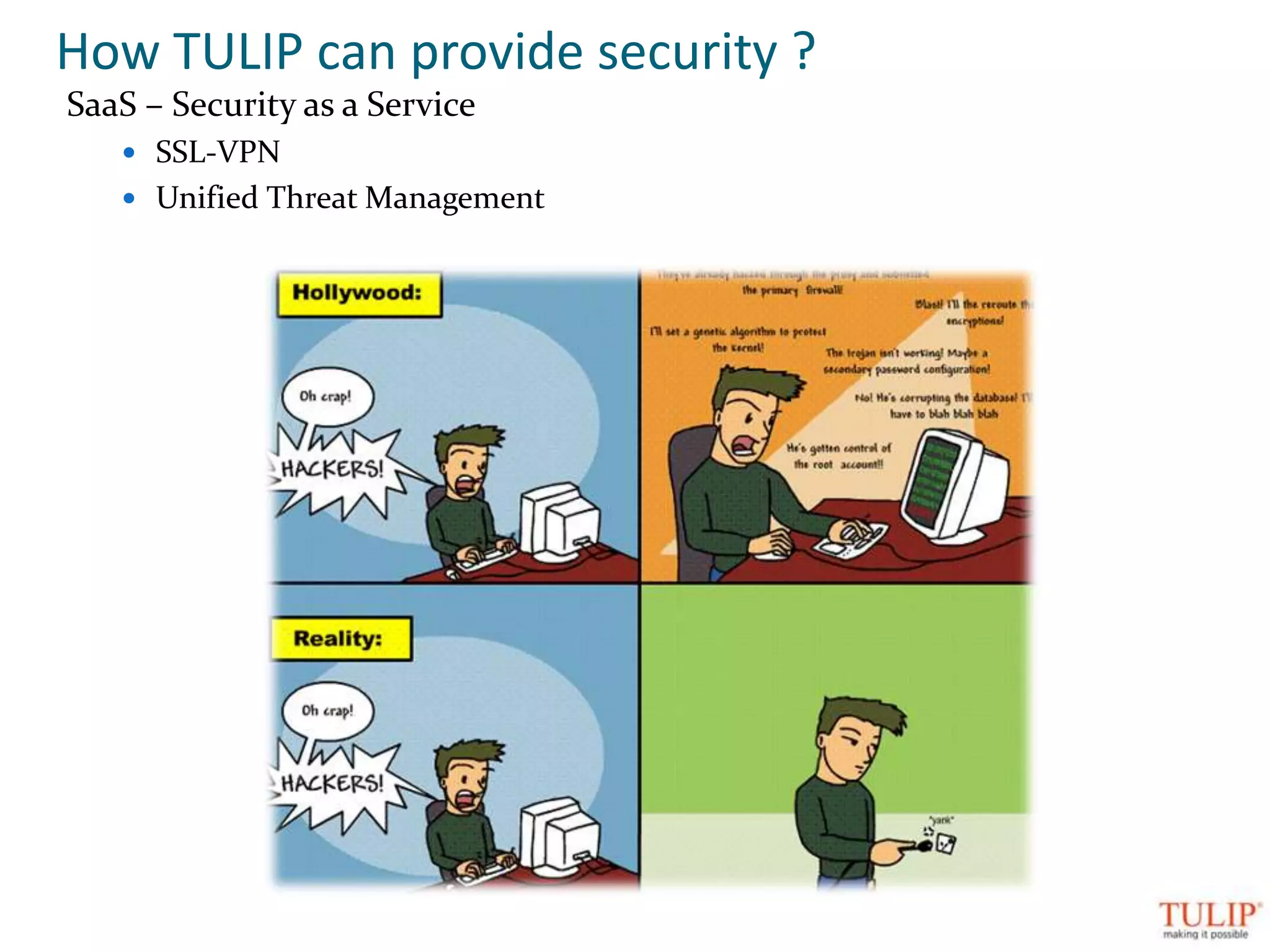
How TULIP can provide security ?SaaS – Security as a ServiceSSL-VPNUnified Threat Management
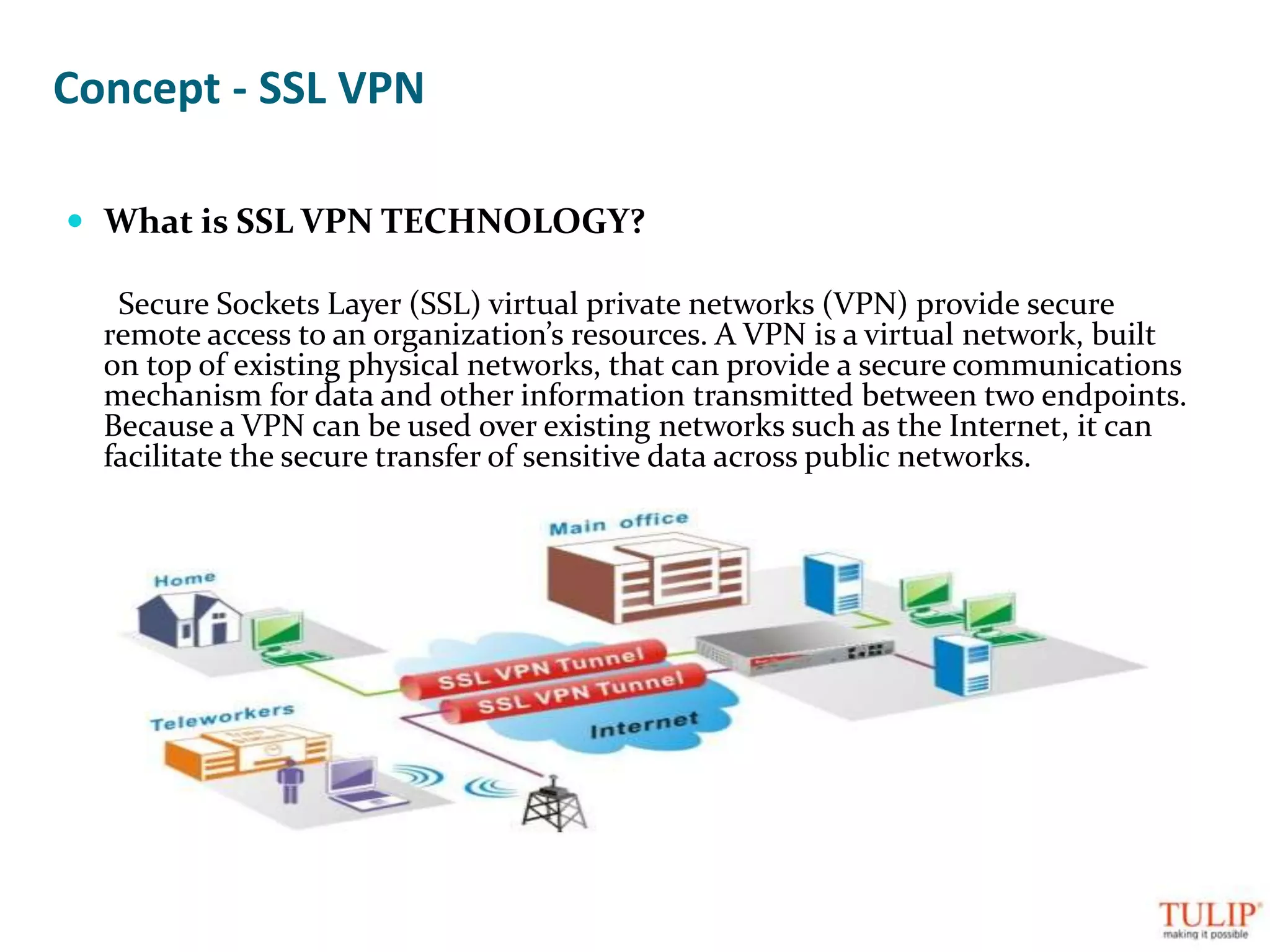
What is SSL VPN TECHNOLOGY? Secure Sockets Layer (SSL) virtual private networks (VPN) provide secure remote access to an organization’s resources. A VPN is a virtual network, built on top of existing physical networks, that can provide a secure communications mechanism for data and other information transmitted between two endpoints. Because a VPN can be used over existing networks such as the Internet, it can facilitate the secure transfer of sensitive data across public networks.Concept - SSL VPN
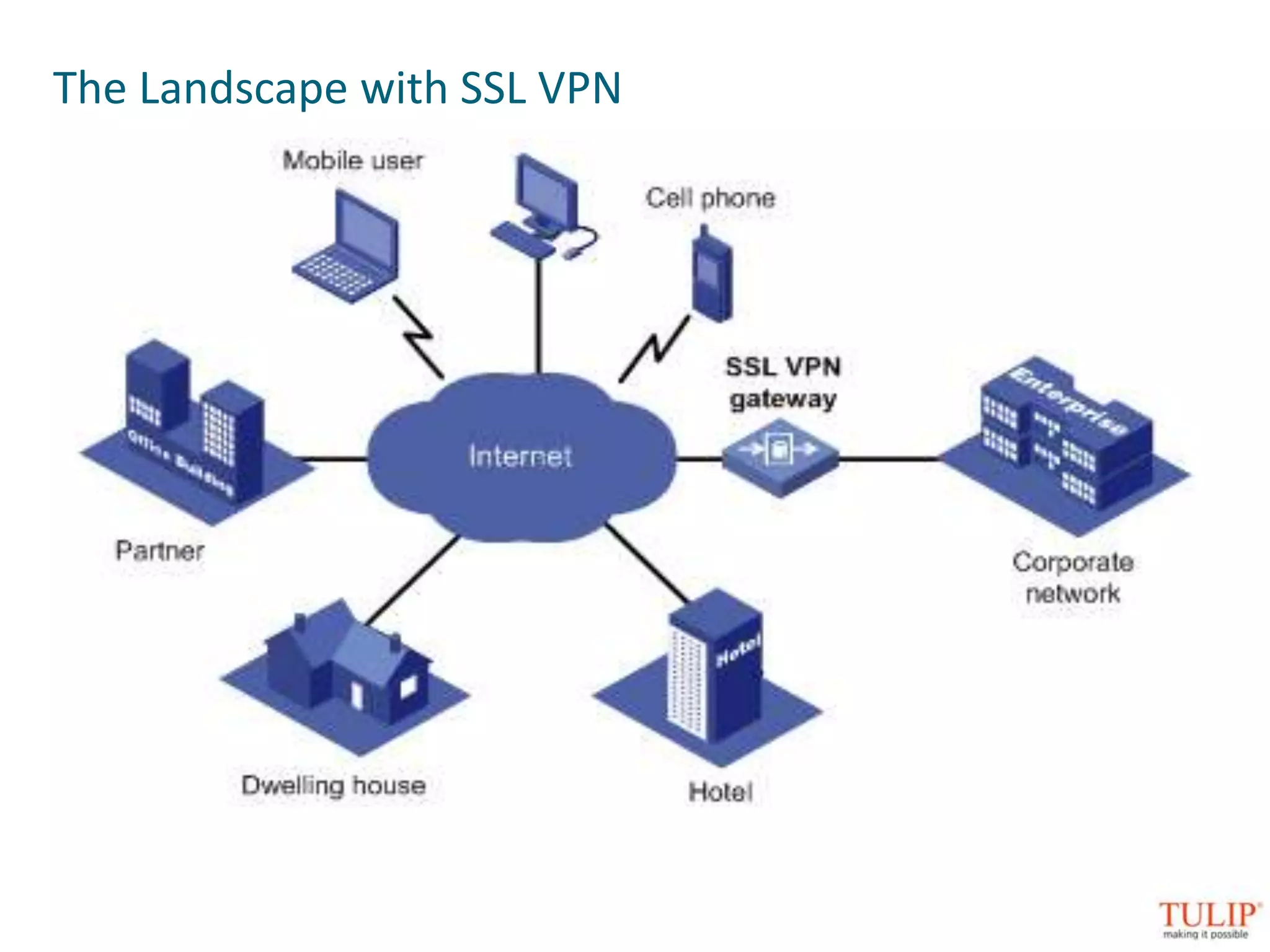
The Landscape with SSL VPN
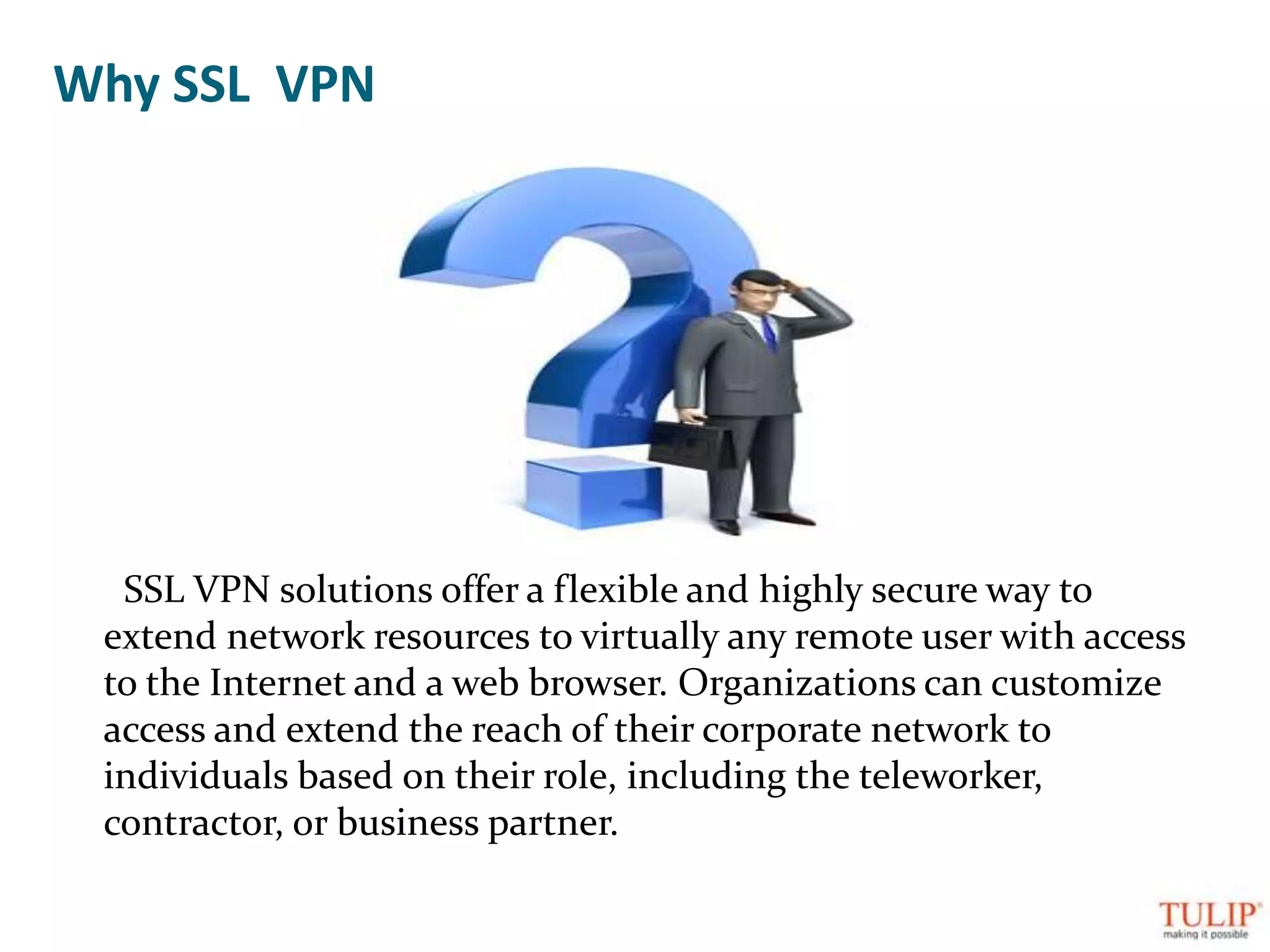
Why SSL  VPN       SSL VPN solutions offer a flexible and highly secure way to extend network resources to virtually any remote user with access to the Internet and a web browser. Organizations can customize access and extend the reach of their corporate network to individuals based on their role, including the teleworker, contractor, or business partner.
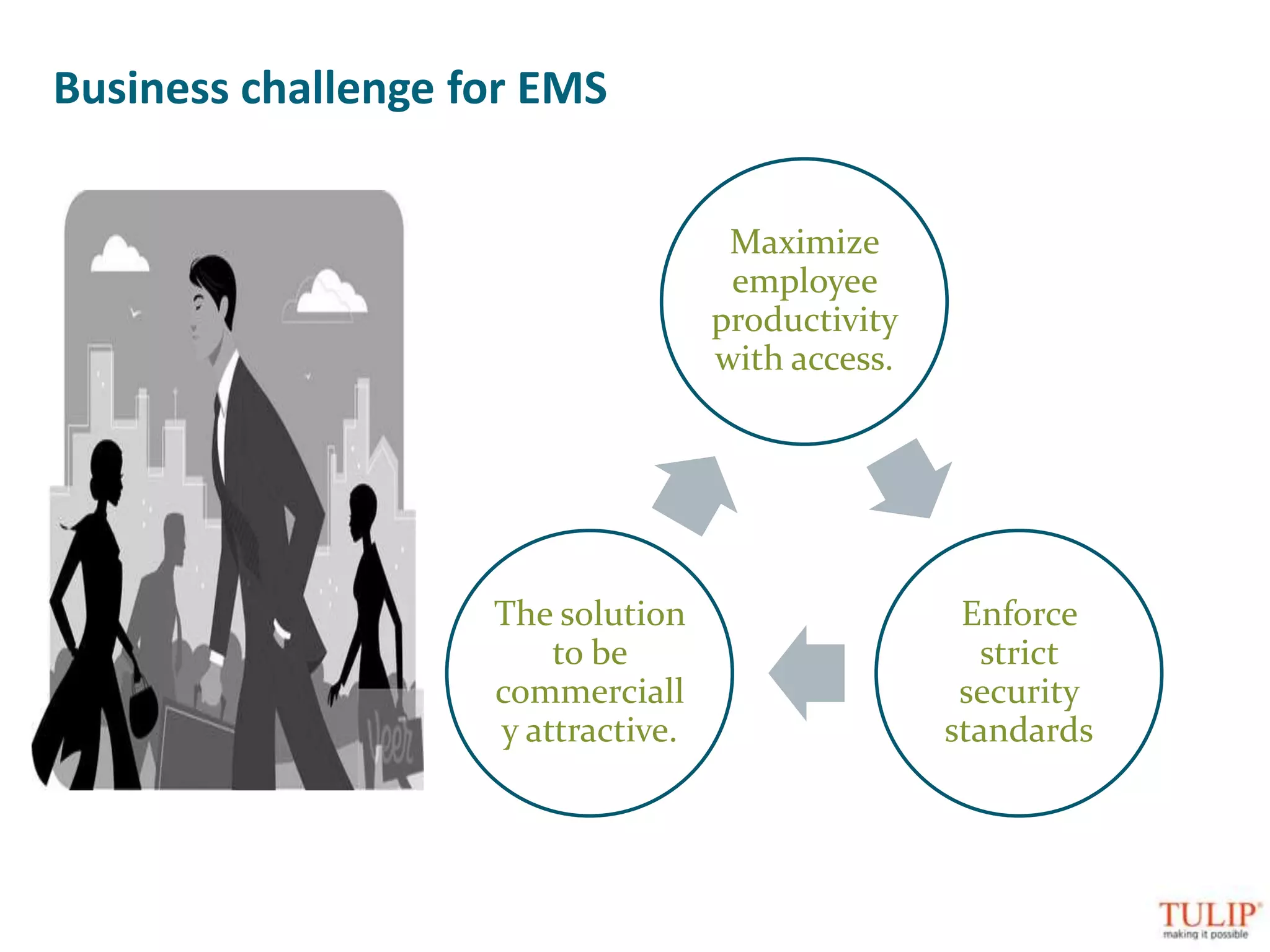
Business challenge for EMS
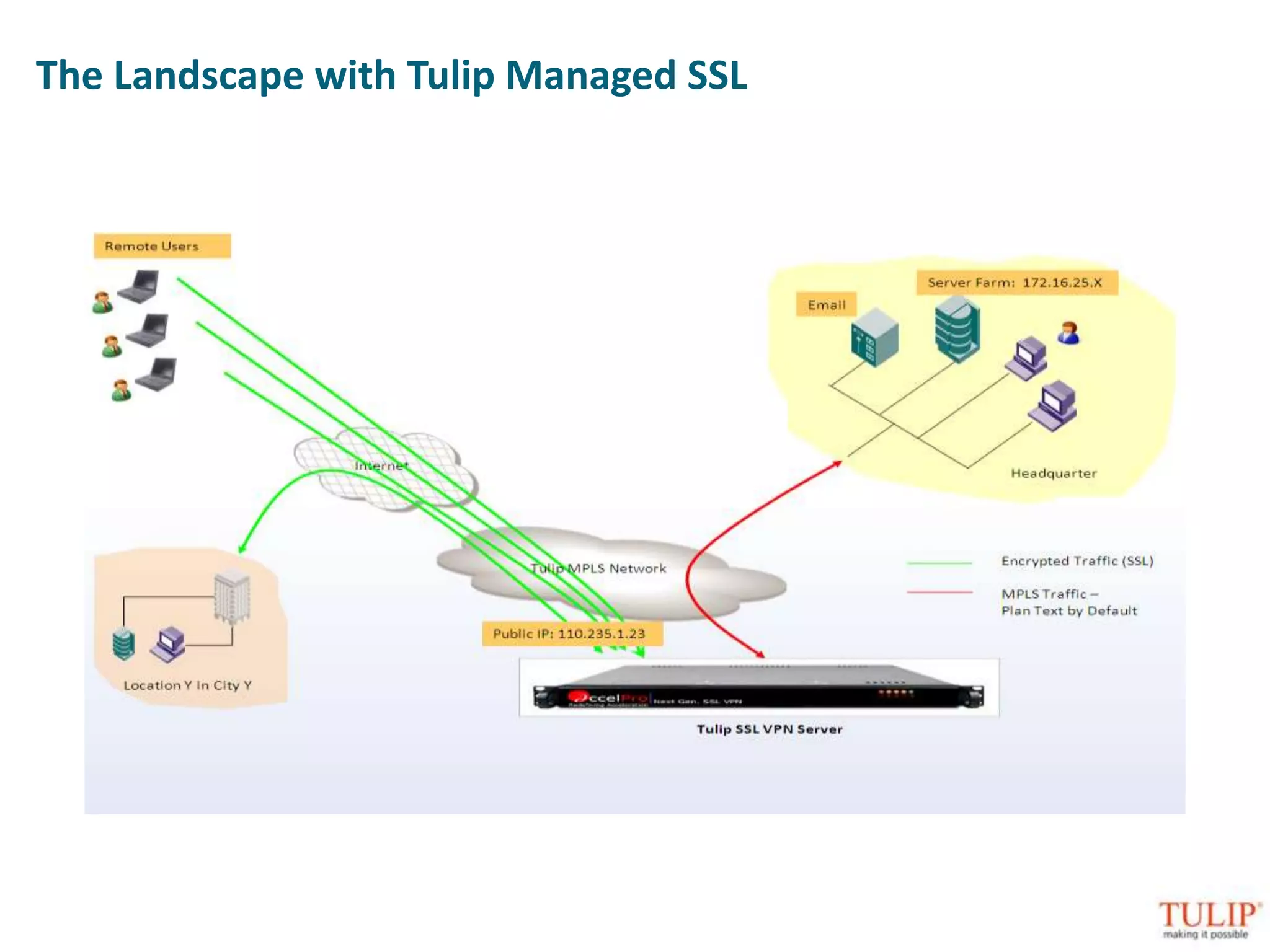
The Landscape with Tulip Managed SSL
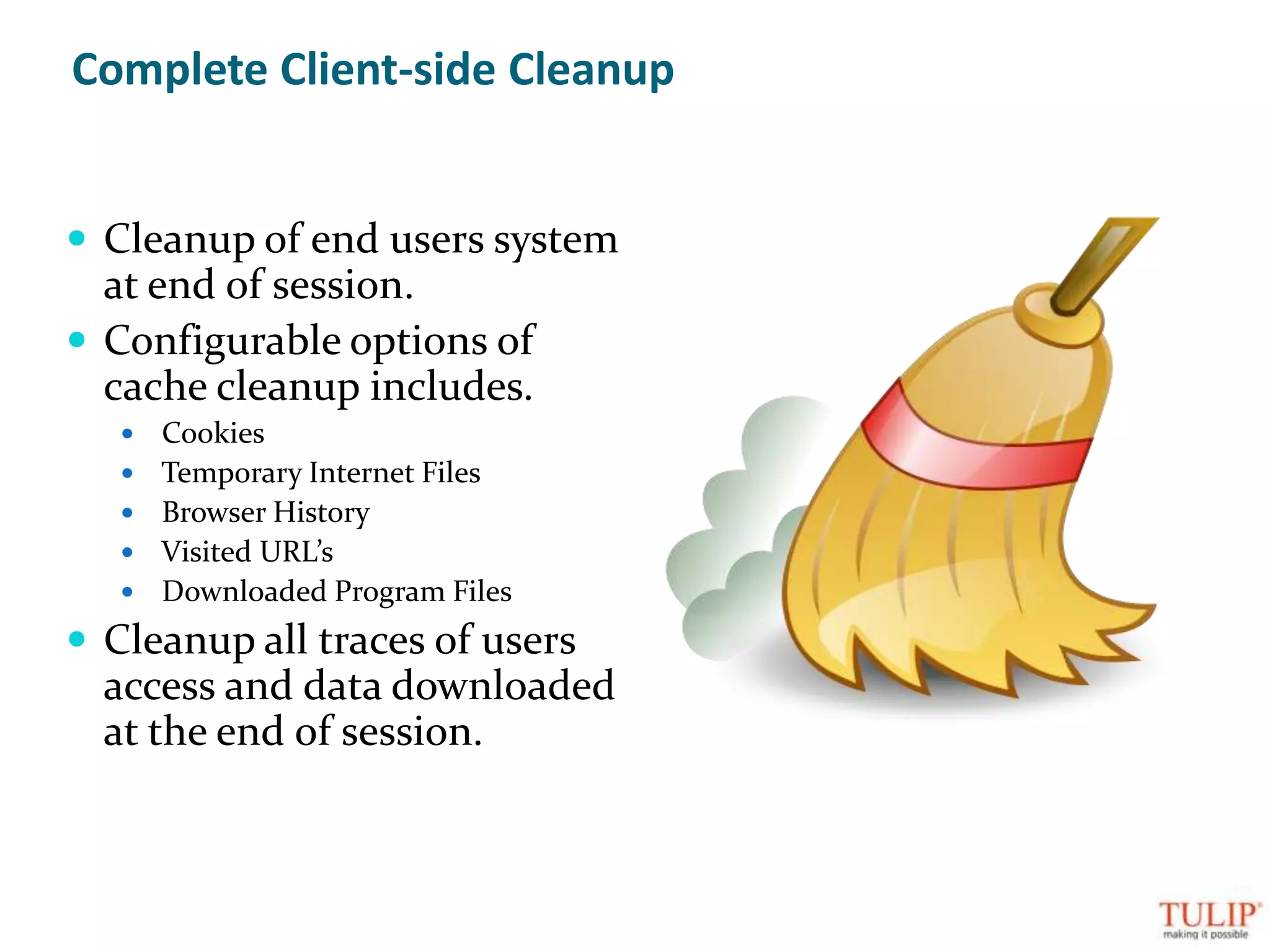
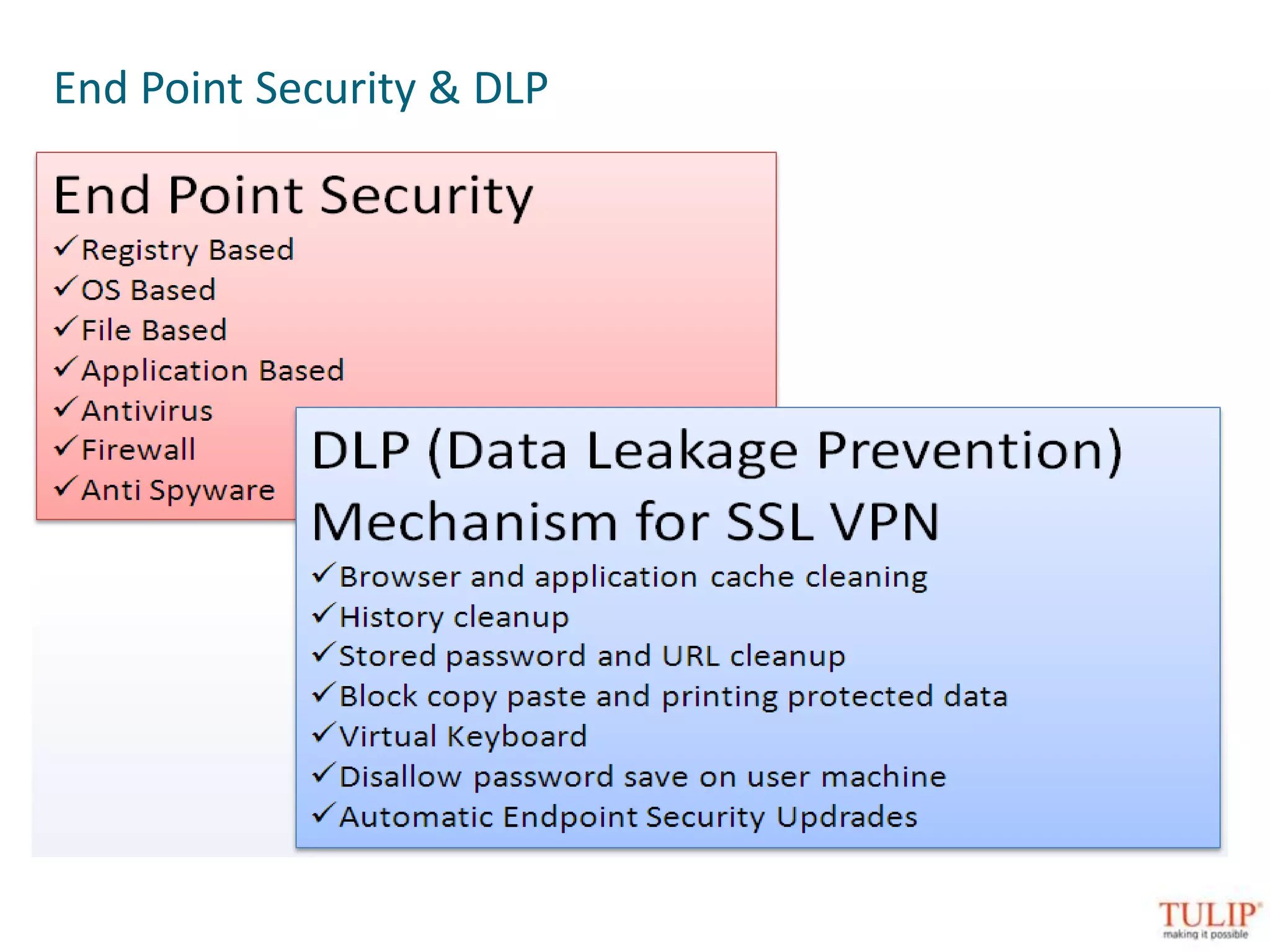
Complete Client-side CleanupCleanup of end users system at end of session.Configurable options of cache cleanup includes. Cookies Temporary Internet Files Browser History Visited URL’s Downloaded Program FilesCleanup all traces of users access and data downloaded at the end of session.
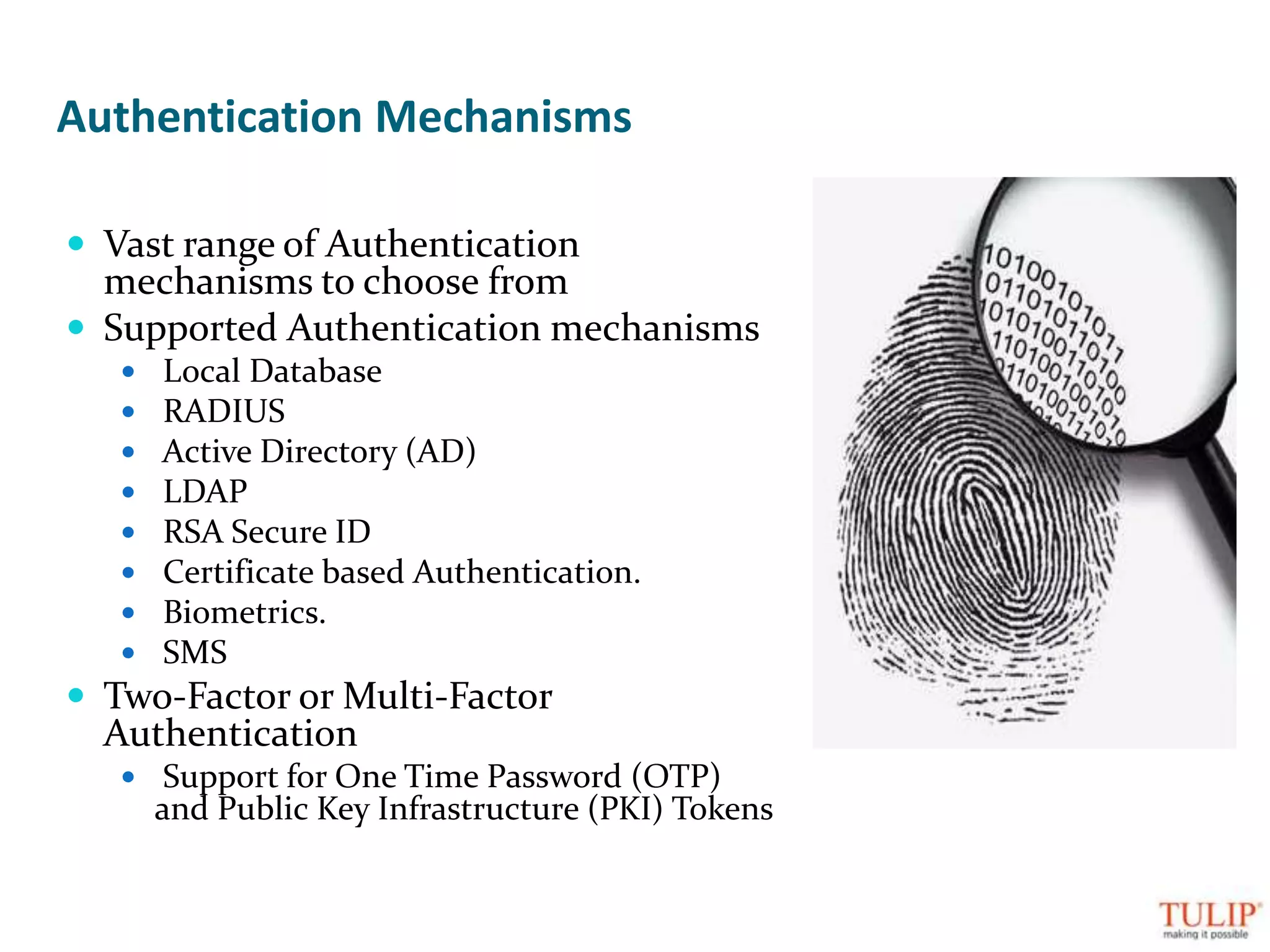
Authentication MechanismsVast range of Authentication mechanisms to choose fromSupported Authentication mechanisms Local Database RADIUS Active Directory (AD) LDAP RSA Secure ID Certificate based Authentication.  Biometrics. SMSTwo-Factor or Multi-Factor Authentication Support for One Time Password (OTP) and Public Key Infrastructure (PKI) Tokens
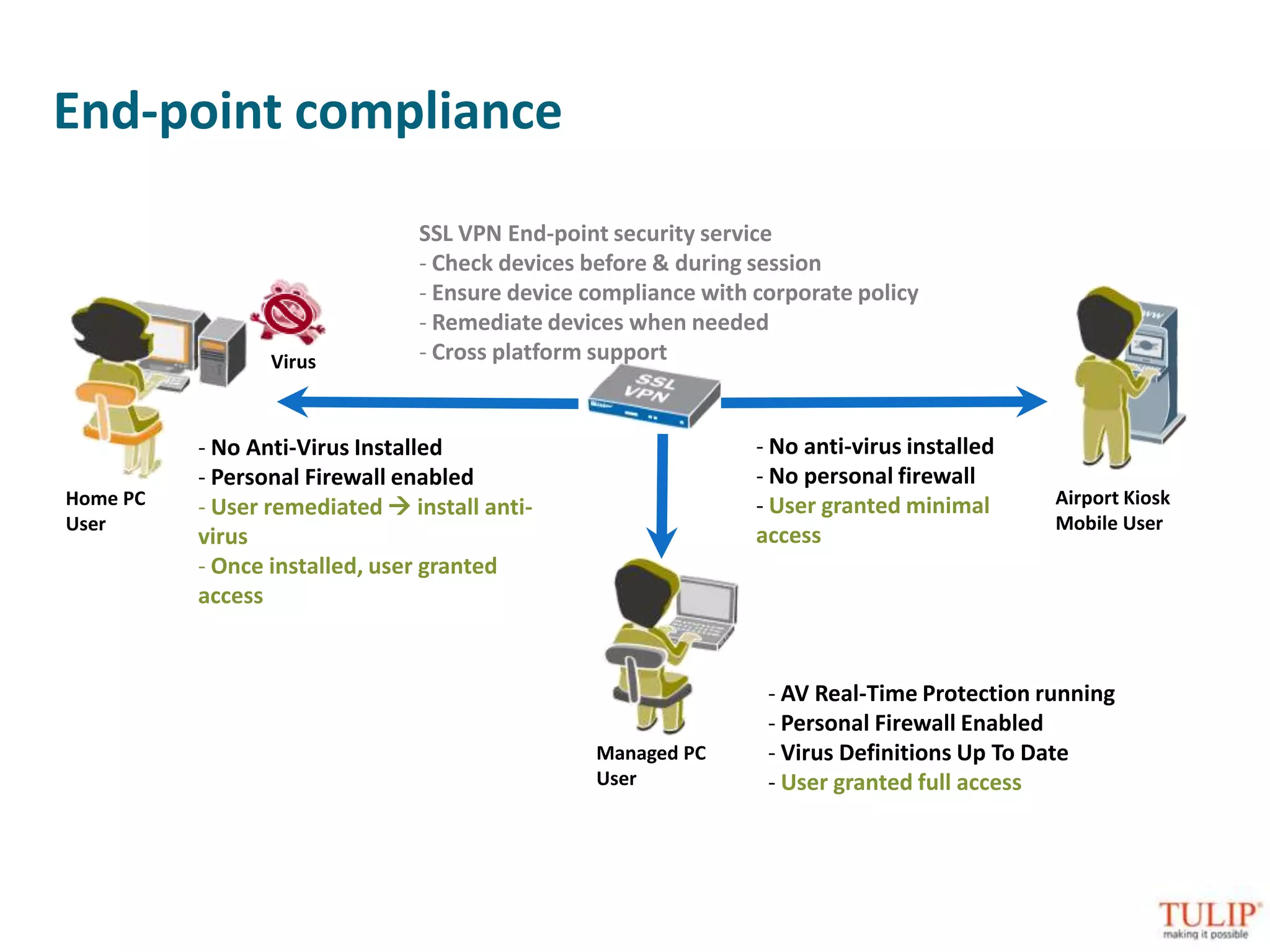
End-point complianceSSL VPN End-point security service Check devices before & during session
 Ensure device compliance with corporate policy
 Remediate devices when needed
 Cross platform supportVirus No anti-virus installed
 No personal firewall
User granted minimal access
 No Anti-Virus Installed
 Personal Firewall enabled
 User remediated  install anti-virus
 Once installed, user granted accessAirport Kiosk Mobile UserHome PC User AV Real-Time Protection running
 Personal Firewall Enabled
 Virus Definitions Up To Date

Corporate Security Issues and countering them using Unified Threat Management Systems and SSL VPN

  • 1.
    Training onUnified ThreatManagement Systems& SSL VPN (SaaS)By - Amarjit Singh & RishabhDangwalTulip Telecom Ltd.
  • 2.
    ObjectivesSecurity awarenessLatest trendsin securityDevice AwarenessSaving the world before bedtime, without worries :PThe notion of providing Security as a Service
  • 3.
    We as anISP have a tough enough job already..But..What about Security threats?How serious are they?Hackers are there..where are We ?What is the most effective and cost efficient way to handle them?
  • 4.
    Current TrendsCyber-attacks areincreasing in speed and sophistication exponentiallyBlended threats, hybrid attacks and APT’s..Getting automated tools is easy, increase in skid cultureSecurity costs money, Security problems cost money, time and lots of pain.
  • 5.
    IntrudersAttack Sophistication vs.Intruder Technical KnowledgeCourtesy Emil on securityAuto CoordinatedCross site scripting“stealth” / advanced scanning techniquesHighStagedpacket spoofingdenial of servicedistributedattack toolssniffersIntruderKnowledgesweeperswww attacksautomated probes/scansGUIback doorsnetwork mgmt. diagnosticsdisabling auditshijacking sessionsburglariesAttackSophisticationexploiting known vulnerabilitiespassword crackingself-replicating codepassword guessingLow20111980198519901995
  • 6.
    Software Vulnerabilities“99% ofintrusions result from exploitation of known vulnerabilities” Source: 2001 CERT, Carnegie Mellon UniversityCause: programming bugs, bad testers, short sighted developmentThreat: lack of patches for the aboveLizamoonSQLi exploited 1.5 million + hosts
  • 7.
    E-mail VirusesPrimary mediumfor distributing threatsTrojans – Easy to create, quick to deliver, easy to installHTML viruses on emailInnocent sounding Emails having malicious attachments containing: Macros, VB scripts, java scripts and html scripts
  • 8.
  • 9.
    Viruses and maliciouscode infection:
  • 10.
  • 11.
  • 12.
  • 13.
  • 14.
  • 15.
    Threats bypass statefulpacketinspection firewalls
  • 16.
    Once inside thenetwork, others are easily affectedFurther..Unpatched servers are ticking bombsViruses uploaded to network drivesRemote exploitation possibleNimda virus
  • 17.
    And we havegot Spyware..Program that uses Internet without the User’s knowledgeApproximately 80% of computers have some form of Spyware (including corporate ones)Spread using shareware, pop ups,p2p,shareware..the usual suspectsGathering information:Browsing habits (sites visited, links clicked, etc.)Data entered into forms (including account names, passwords, text of Web forms and Web-based email, etc.)Key stokes and work habits
  • 18.
    SpamUnsolicited EmailMultiple techniquesto send mailsSpoof email addressImage only mailRandom textText mergingToken ManipulationURL hidingHTML Tag corruptionIncrease False positivesParse corruptionMetamorphic Spam TrojansAnd much much more..Leads to low productivity and server outages.
  • 19.
    Network woes LabelspoofingCore hidingReplay attacksCompromise of LIBAccess to LERAnd other MPLS security issues..
  • 20.
    Router abuseTACACS+ forcedsession_id collisionsSophisticated Packet body DOSBoot iosmanipulationImproper tcl scripts (if present)External factorsSNMP compromise
  • 21.
    And its justthe Tip of Iceberg…(a.k.a Raising the Attack Standards by a Notch)Sophisticated DOS (Network, application)Advanced Persistent ThreatsSmartphone AbuseCertificate abuse (DigiNotar - PKIOverheid..)Key abuse (RSA, anyone ?)Kernel Rootkits/Bootkits
  • 22.
    Obsolete DefensesFirewalls workon port blocking strategyReactive approachStateful Packet Inspection (SPI) :Provides source / destination / state intelligence Provides NATStateful firewalls cannot protect against multilayer threatsIs limited in nature
  • 23.
    How TULIP canprovide security ?SaaS – Security as a ServiceSSL-VPNUnified Threat Management
  • 24.
    What is SSLVPN TECHNOLOGY? Secure Sockets Layer (SSL) virtual private networks (VPN) provide secure remote access to an organization’s resources. A VPN is a virtual network, built on top of existing physical networks, that can provide a secure communications mechanism for data and other information transmitted between two endpoints. Because a VPN can be used over existing networks such as the Internet, it can facilitate the secure transfer of sensitive data across public networks.Concept - SSL VPN
  • 25.
  • 26.
    Why SSL VPN SSL VPN solutions offer a flexible and highly secure way to extend network resources to virtually any remote user with access to the Internet and a web browser. Organizations can customize access and extend the reach of their corporate network to individuals based on their role, including the teleworker, contractor, or business partner.
  • 27.
  • 28.
    The Landscape withTulip Managed SSL
  • 29.
    Complete Client-side CleanupCleanupof end users system at end of session.Configurable options of cache cleanup includes. Cookies Temporary Internet Files Browser History Visited URL’s Downloaded Program FilesCleanup all traces of users access and data downloaded at the end of session.
  • 30.
    Authentication MechanismsVast rangeof Authentication mechanisms to choose fromSupported Authentication mechanisms Local Database RADIUS Active Directory (AD) LDAP RSA Secure ID Certificate based Authentication. Biometrics. SMSTwo-Factor or Multi-Factor Authentication Support for One Time Password (OTP) and Public Key Infrastructure (PKI) Tokens
  • 31.
    End-point complianceSSL VPNEnd-point security service Check devices before & during session
  • 32.
    Ensure devicecompliance with corporate policy
  • 33.
  • 34.
    Cross platformsupportVirus No anti-virus installed
  • 35.
    No personalfirewall
  • 36.
  • 37.
  • 38.
  • 39.
    User remediated install anti-virus
  • 40.
    Once installed,user granted accessAirport Kiosk Mobile UserHome PC User AV Real-Time Protection running
  • 41.
  • 42.
  • 43.
    User granted fullaccessManaged PC User
  • 44.
  • 45.
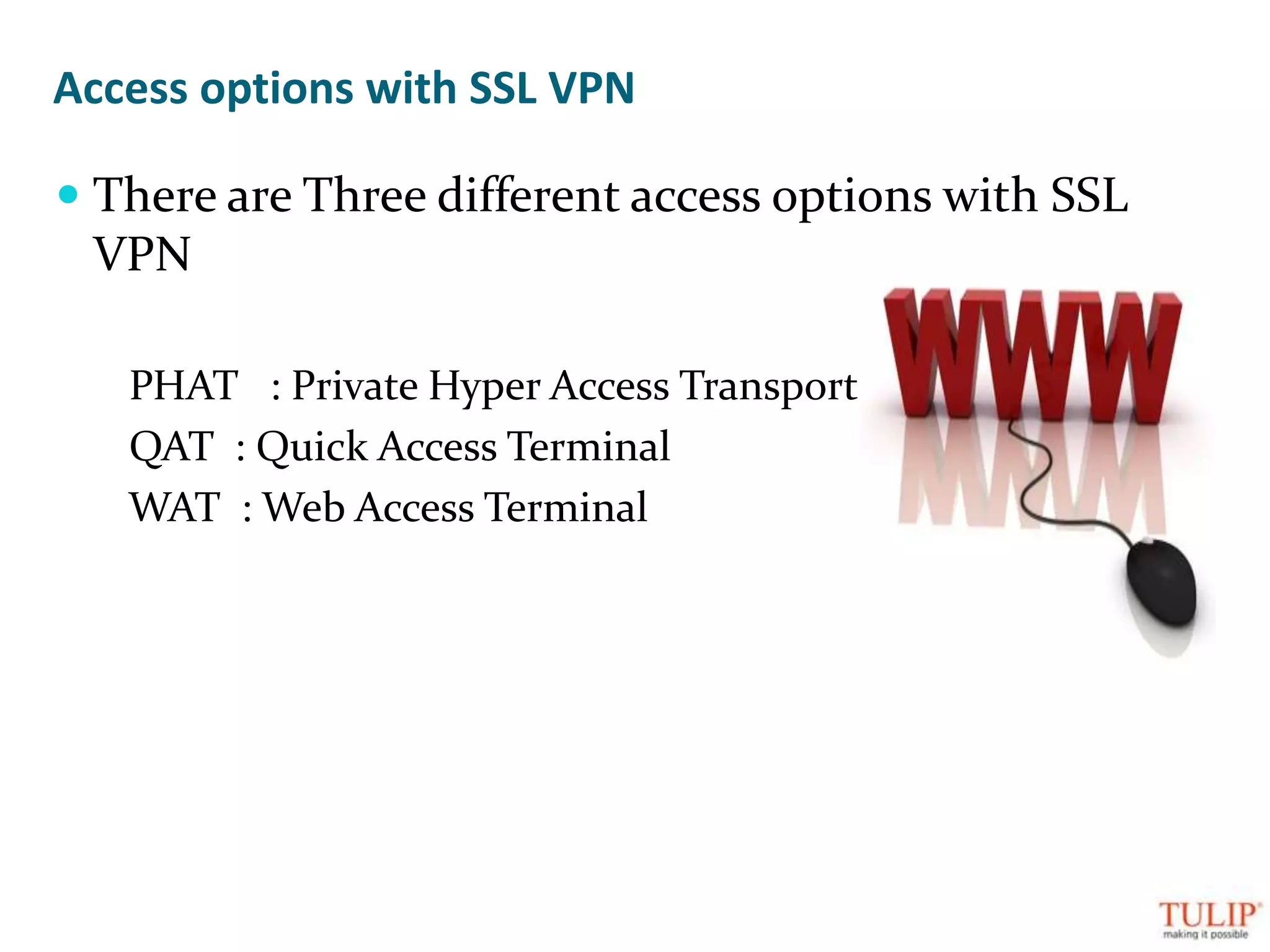
    There are Threedifferent access options with SSL VPN PHAT : Private Hyper Access Transport QAT : Quick Access Terminal WAT : Web Access TerminalAccess options with SSL VPN
  • 46.
    What is WAT  Web Access Terminal (WAT) is clientless access modes where user needs just a browser to establish SSL VPN connection. Using WAT user can access web applications such as Outlook Web Access (OWA), Intranet, Share Point, web-based databases, etc from any location like Airport kiosk, Cyber Café, etc. What is PHAT  Private Hyper Access Transport (PHAT) is one of the modes to access the Virtual Private Network (VPN). It’s small footprint web deployed software that gets installed on user’s machine. PHAT client provide IPSec like functionality to give full access to network. What is QAT Quick Access Terminal (QAT) is an intermediate client between the PHAT Client and the WAT Client. The users can access TCP based client applications without installing PHAT on their machines. Once configured by the Administrator for a particular group, QAT is started from the web portal.Access options with SSL VPN
  • 47.
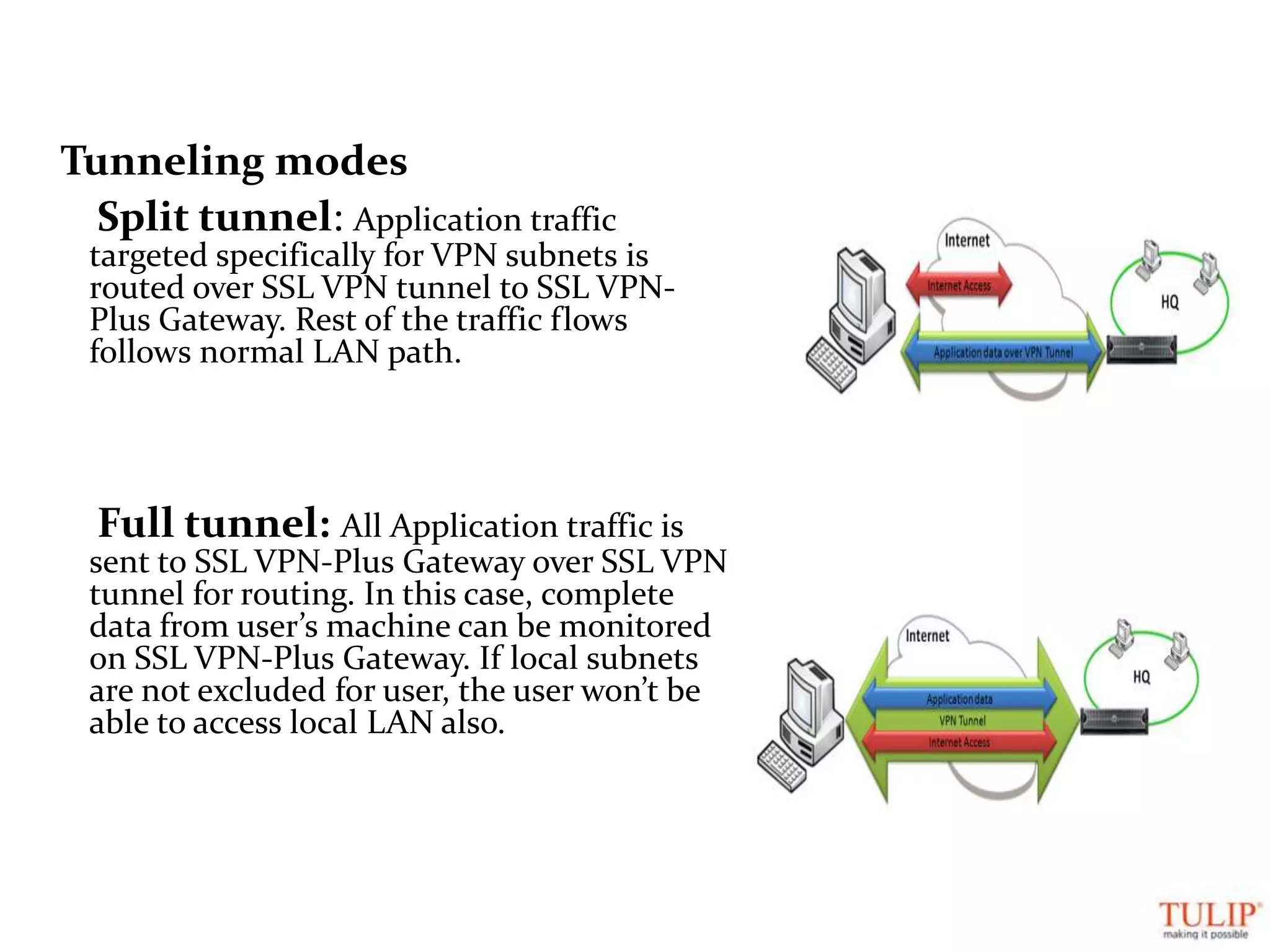
    Tunneling modesSplittunnel: Application traffic targeted specifically for VPN subnets is routed over SSL VPN tunnel to SSL VPN-Plus Gateway. Rest of the traffic flows follows normal LAN path. Full tunnel:All Application traffic is sent to SSL VPN-Plus Gateway over SSL VPN tunnel for routing. In this case, complete data from user’s machine can be monitored on SSL VPN-Plus Gateway. If local subnets are not excluded for user, the user won’t be able to access local LAN also.
  • 48.
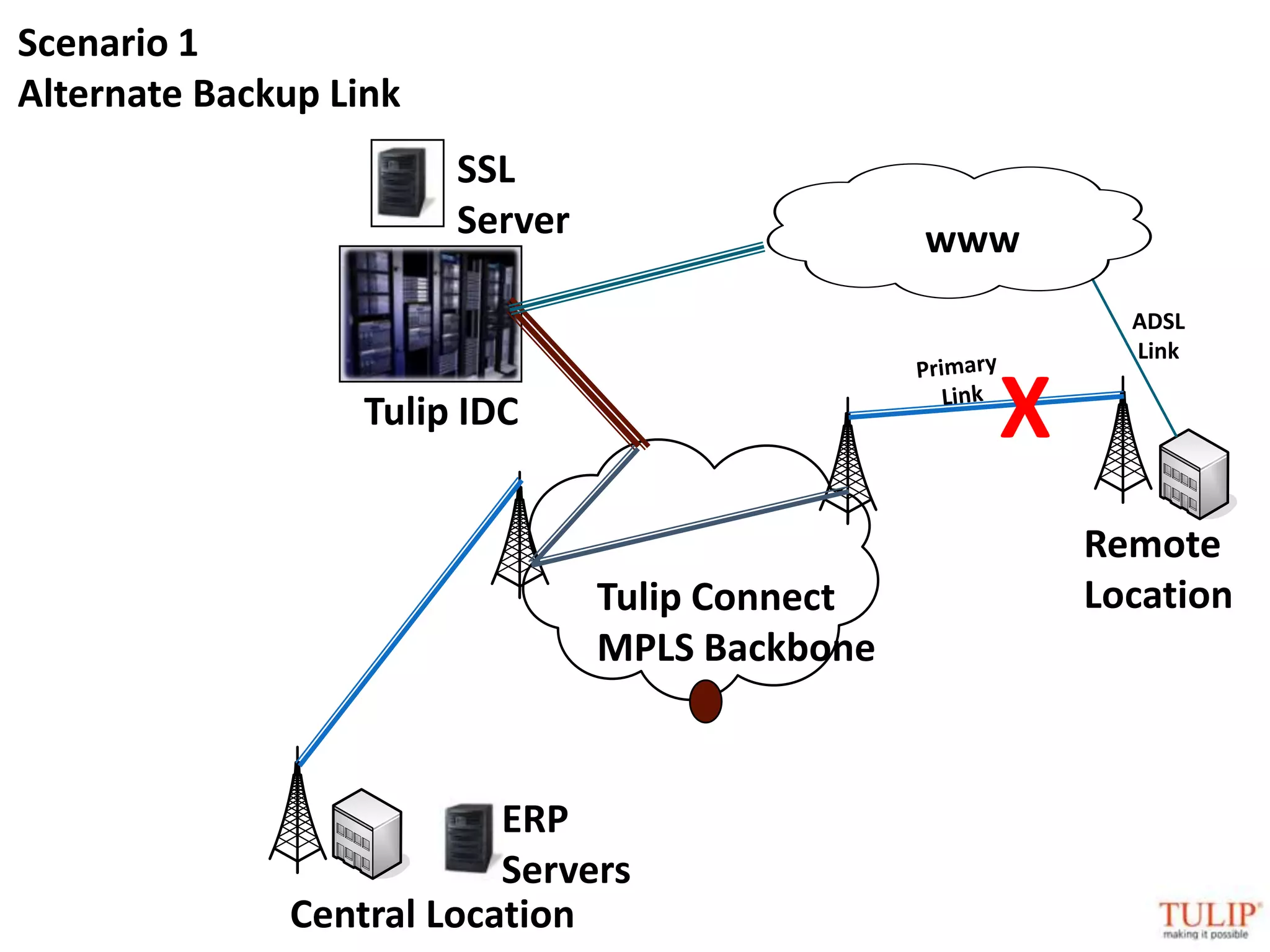
    Scenario 1Alternate BackupLinkSSLServerwwwADSLLinkXPrimary LinkTulip IDCRemote LocationTulip ConnectMPLS BackboneERPServersCentral Location
  • 49.
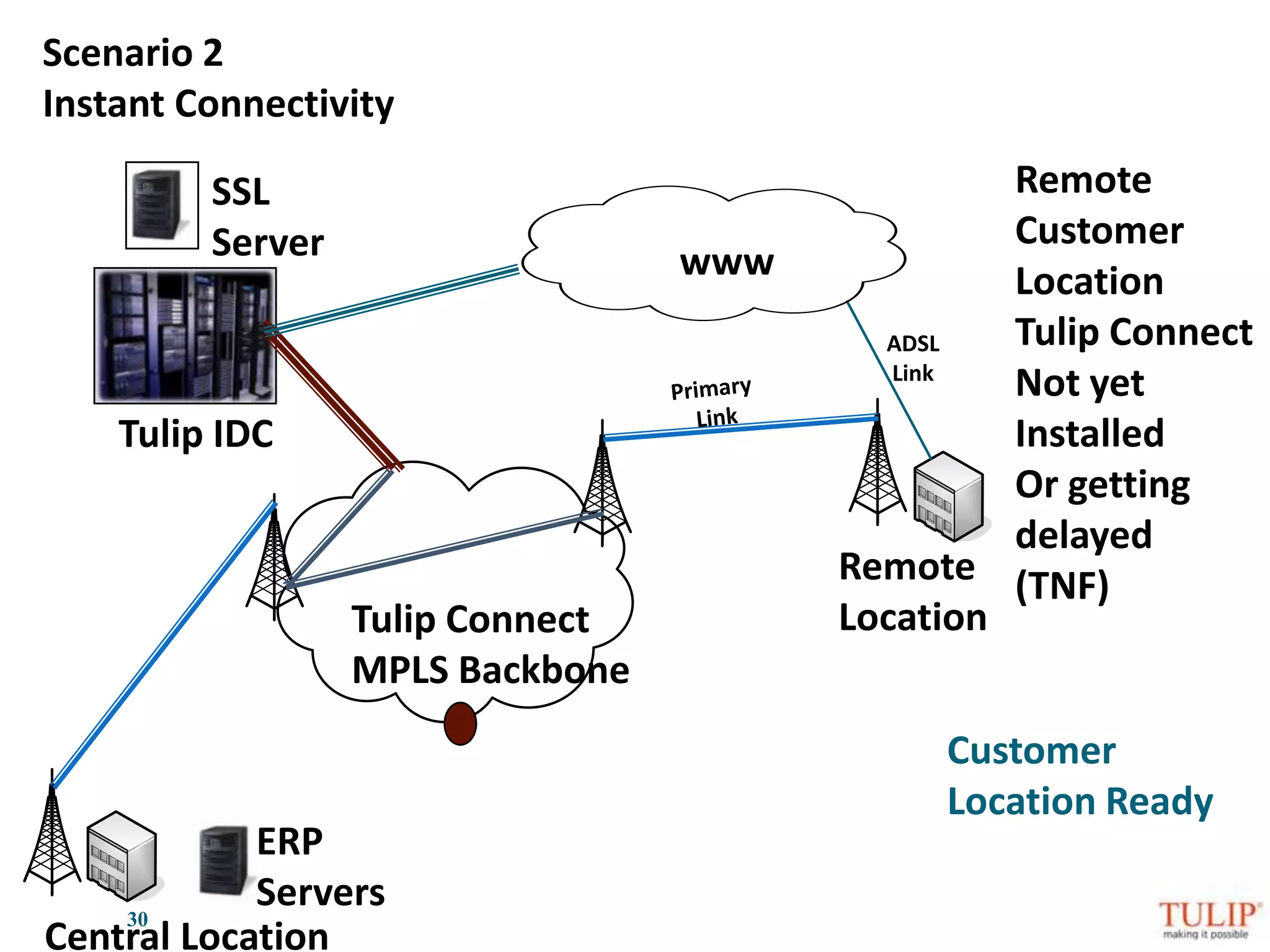
    Scenario 2Instant ConnectivityRemoteCustomerLocation Tulip ConnectNot yet InstalledOr getting delayed(TNF)SSLServerwwwADSLLinkPrimary LinkTulip IDCRemote LocationTulip ConnectMPLS BackboneCustomerLocation ReadyERPServersCentral Location30
  • 50.
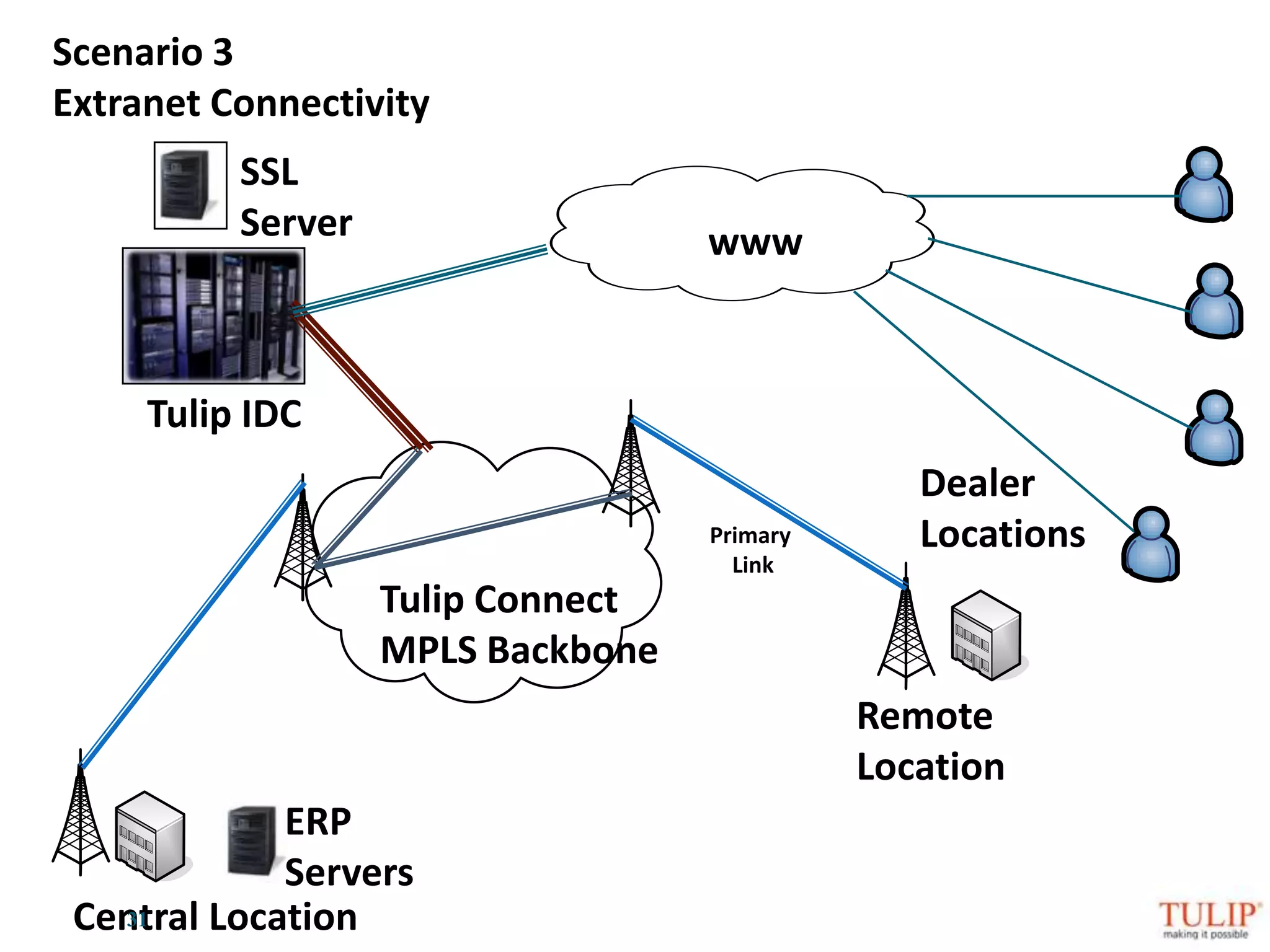
    Scenario 3Extranet ConnectivitySSLServerwwwTulipIDCDealerLocationsPrimary LinkTulip ConnectMPLS BackboneRemote LocationERPServersCentral Location31
  • 51.
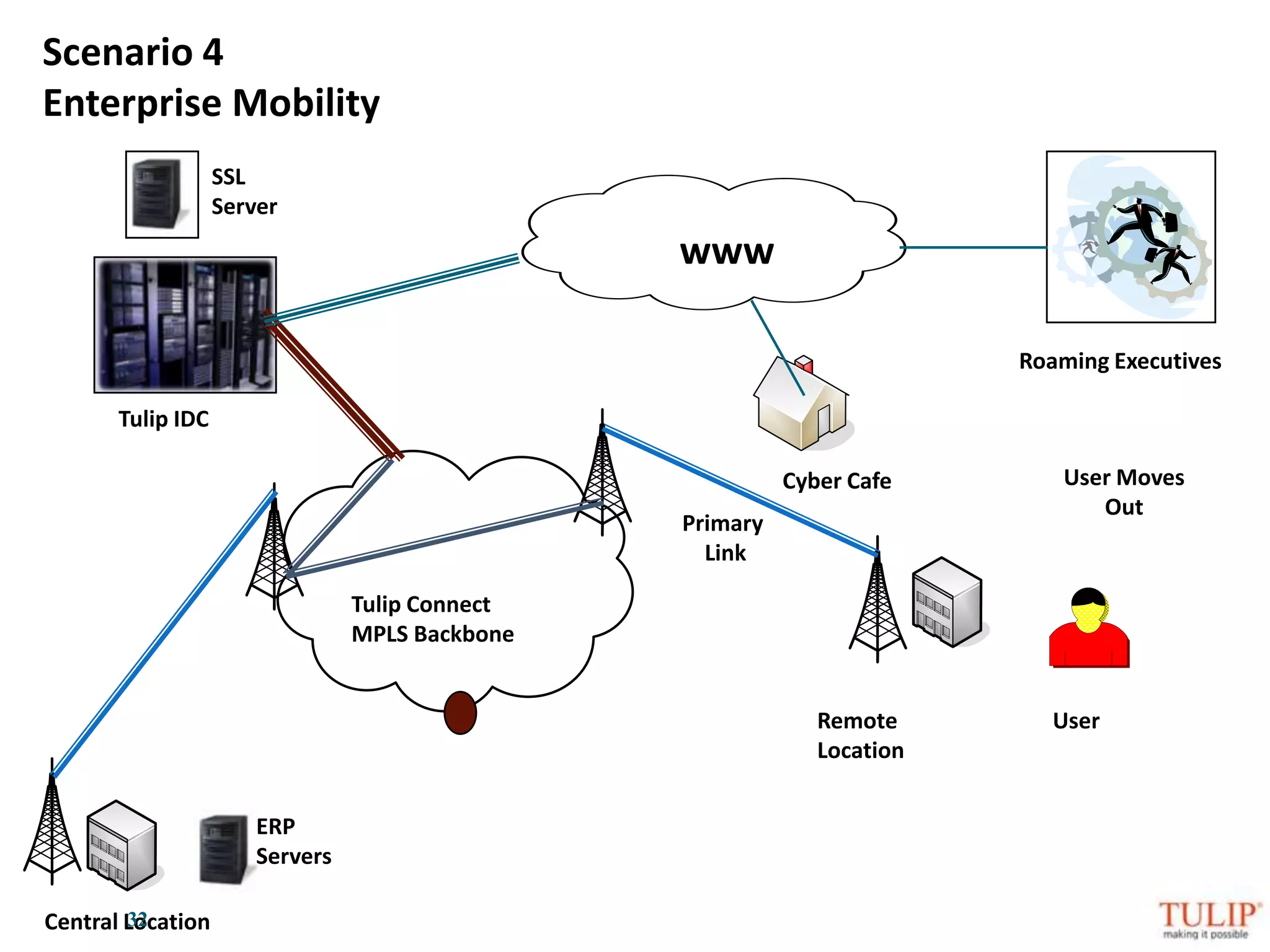
    Scenario 4Enterprise MobilitySSLServerwwwRoamingExecutivesTulip IDCUser MovesOutCyber CafePrimary LinkTulip ConnectMPLS BackboneRemote LocationUserERPServersCentral Location32
  • 52.
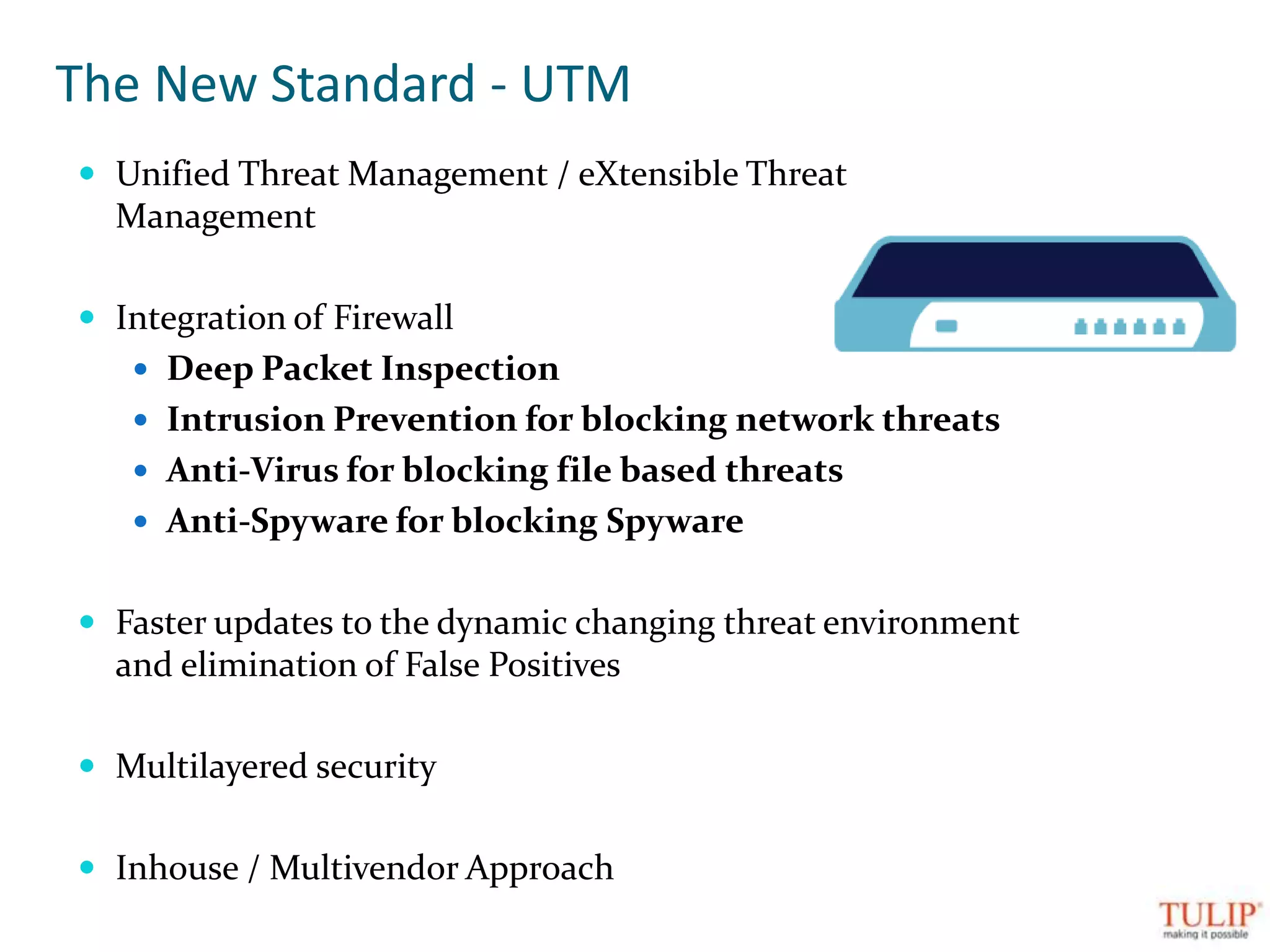
    The New Standard- UTMUnified Threat Management / eXtensible Threat ManagementIntegration of Firewall Deep Packet Inspection Intrusion Prevention for blocking network threatsAnti-Virus for blocking file based threatsAnti-Spyware for blocking SpywareFaster updates to the dynamic changing threat environment and elimination of False PositivesMultilayered securityInhouse / Multivendor Approach
  • 53.
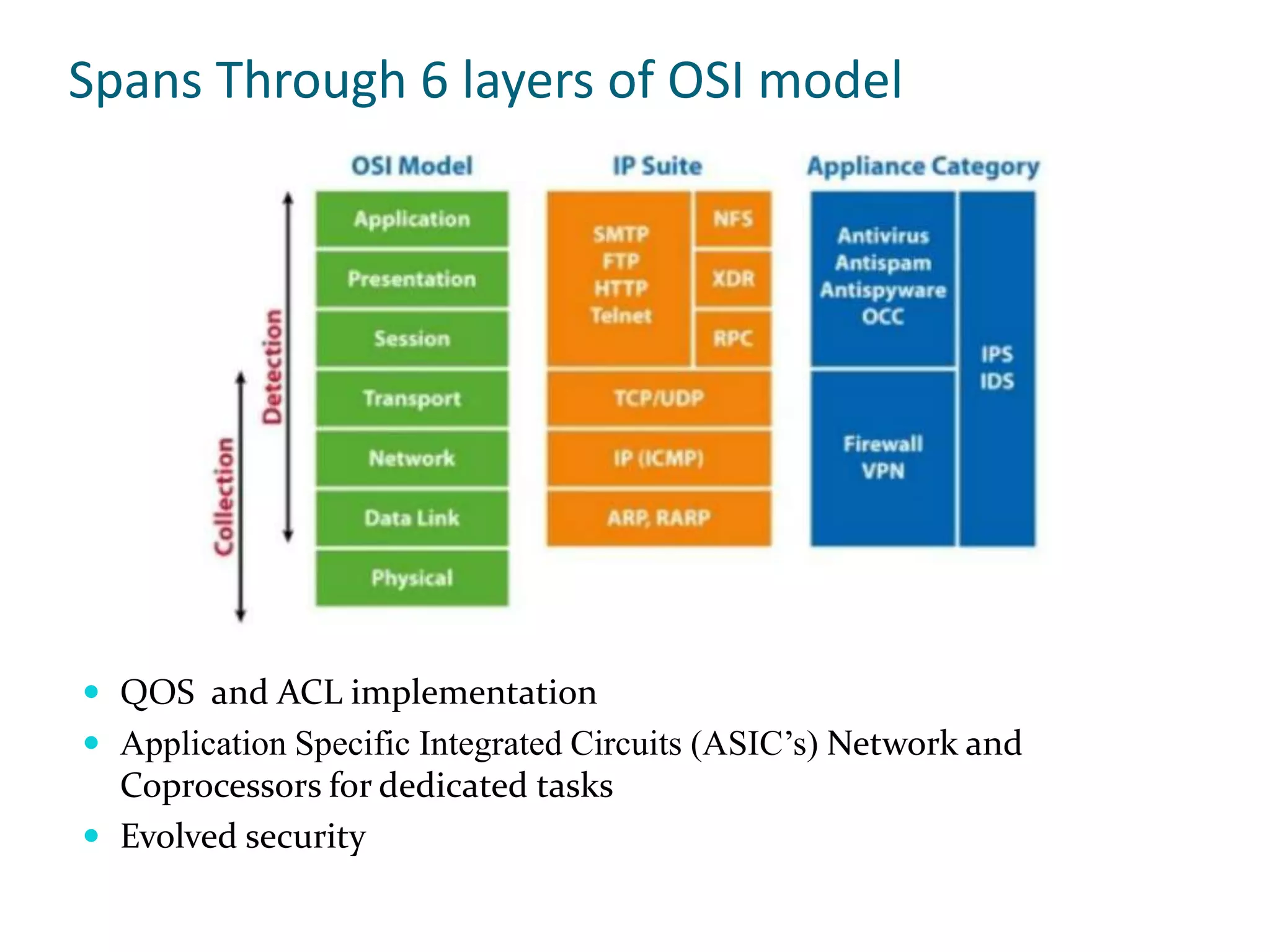
    Spans Through 6layers of OSI modelQOS and ACL implementation
  • 54.
    Application Specific IntegratedCircuits (ASIC’s) Network and Coprocessors for dedicated tasks
  • 55.
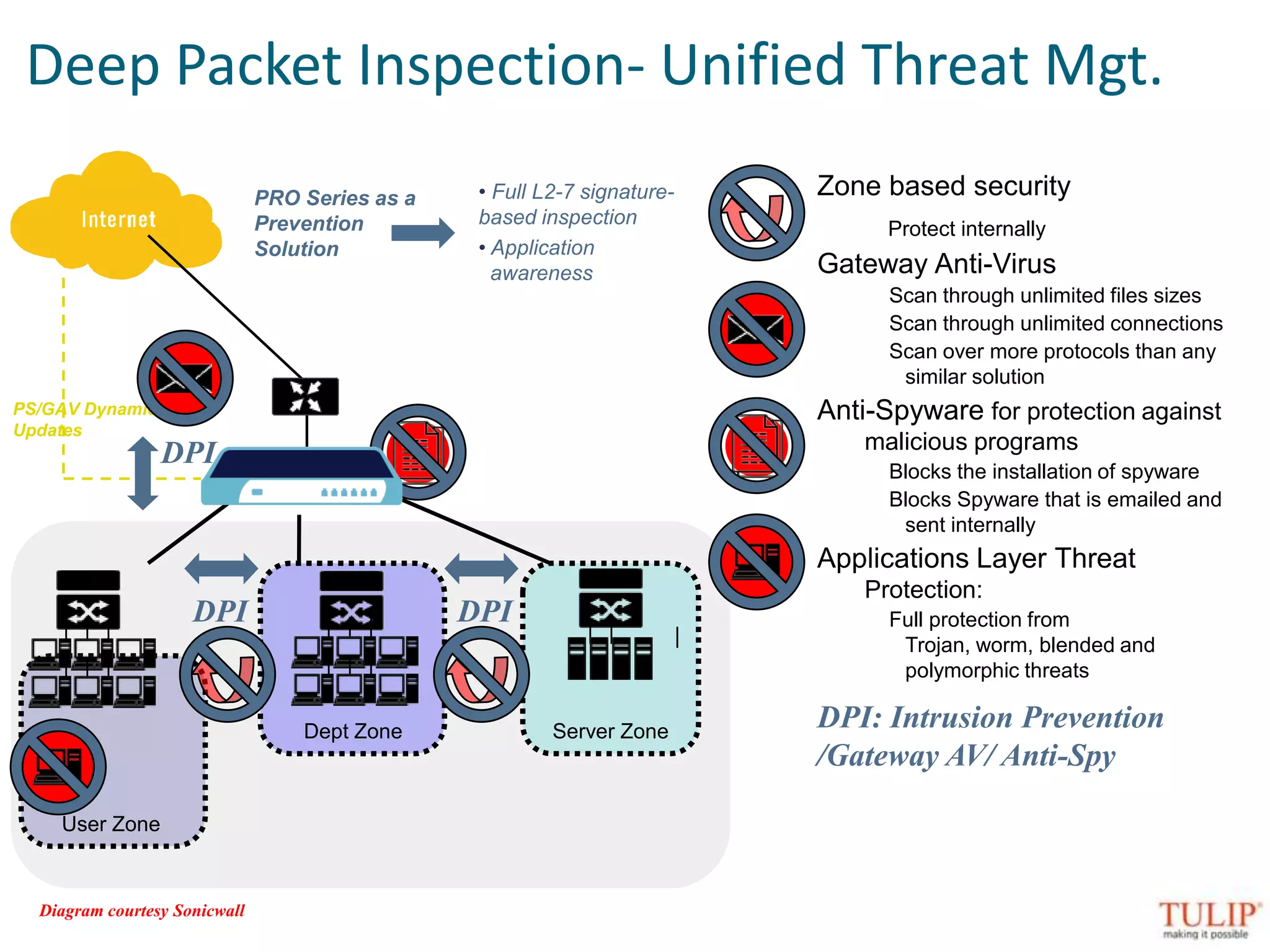
    Evolved securityDeep PacketInspection- Unified Threat Mgt.Zone based securityProtect internallyGateway Anti-VirusScan through unlimited files sizesScan through unlimited connectionsScan over more protocols than any similar solutionAnti-Spyware for protection against malicious programsBlocks the installation of spywareBlocks Spyware that is emailed and sent internally Applications Layer Threat Protection:Full protection from Trojan, worm, blended and polymorphic threats Full L2-7 signature- based inspection
  • 56.
    Application awarenessPRO Series as a Prevention SolutionPS/GAV Dynamic UpdatesDPIDPIDPIDPI: Intrusion Prevention/Gateway AV/ Anti-SpyServer ZoneDept Zone User ZoneDiagram courtesy Sonicwall
  • 57.
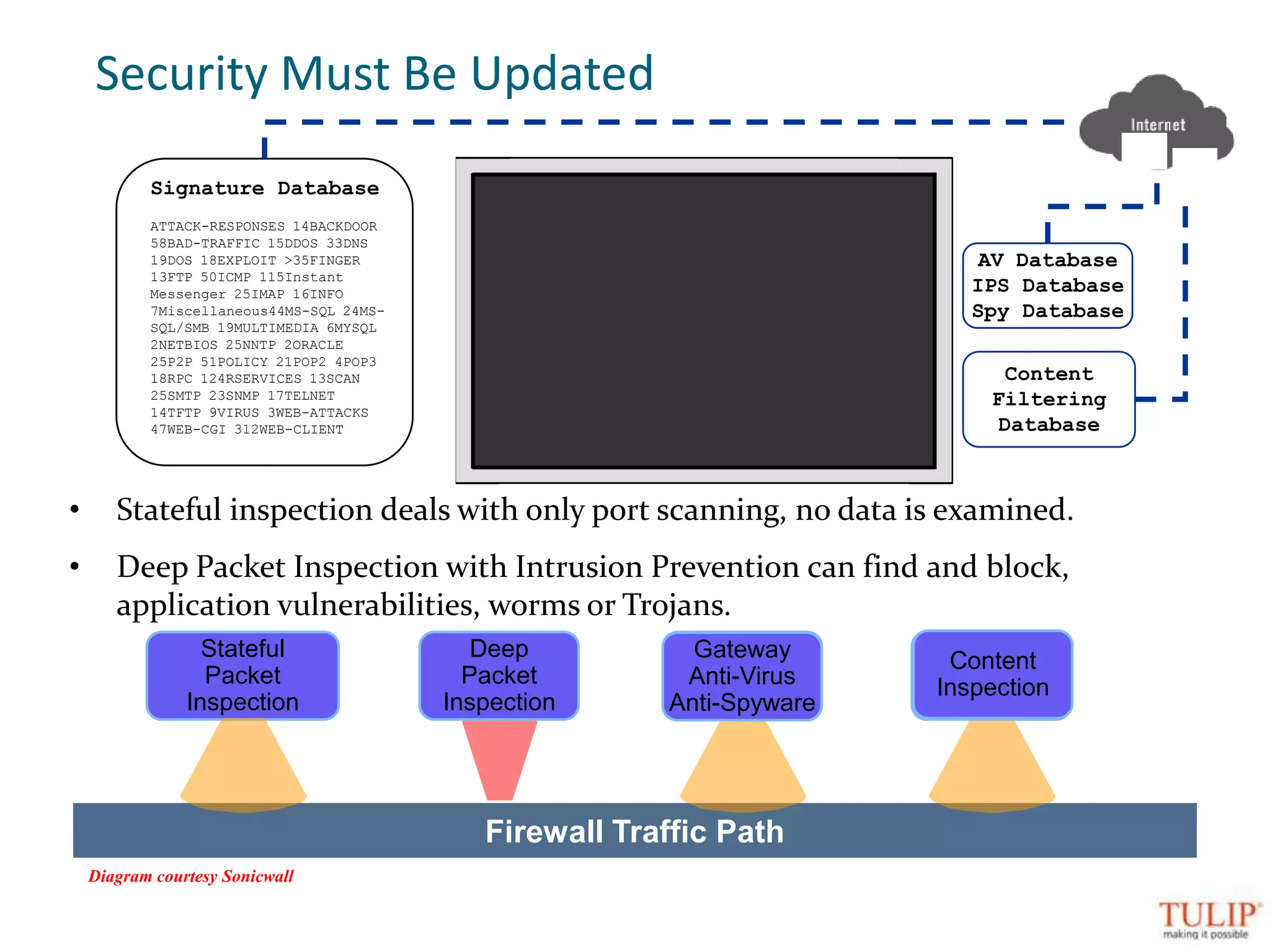
    Security Must BeUpdatedSignature DatabaseATTACK-RESPONSES 14BACKDOOR 58BAD-TRAFFIC 15DDOS 33DNS 19DOS 18EXPLOIT >35FINGER 13FTP 50ICMP 115Instant Messenger 25IMAP 16INFO 7Miscellaneous44MS-SQL 24MS-SQL/SMB 19MULTIMEDIA 6MYSQL 2NETBIOS 25NNTP 2ORACLE 25P2P 51POLICY 21POP2 4POP3 18RPC 124RSERVICES 13SCAN 25SMTP 23SNMP 17TELNET 14TFTP 9VIRUS 3WEB-ATTACKS 47WEB-CGI 312WEB-CLIENTAV DatabaseIPS DatabaseSpy DatabaseContentFilteringDatabaseStateful inspection deals with only port scanning, no data is examined.
  • 58.
    Deep Packet Inspectionwith Intrusion Prevention can find and block, application vulnerabilities, worms or Trojans.ContentInspectionStatefulPacketInspectionAnti-VirusContentFiltering ServiceDeepPacketInspectionGatewayAnti-VirusAnti-SpywareFirewall Traffic PathDiagram courtesy Sonicwall
  • 59.
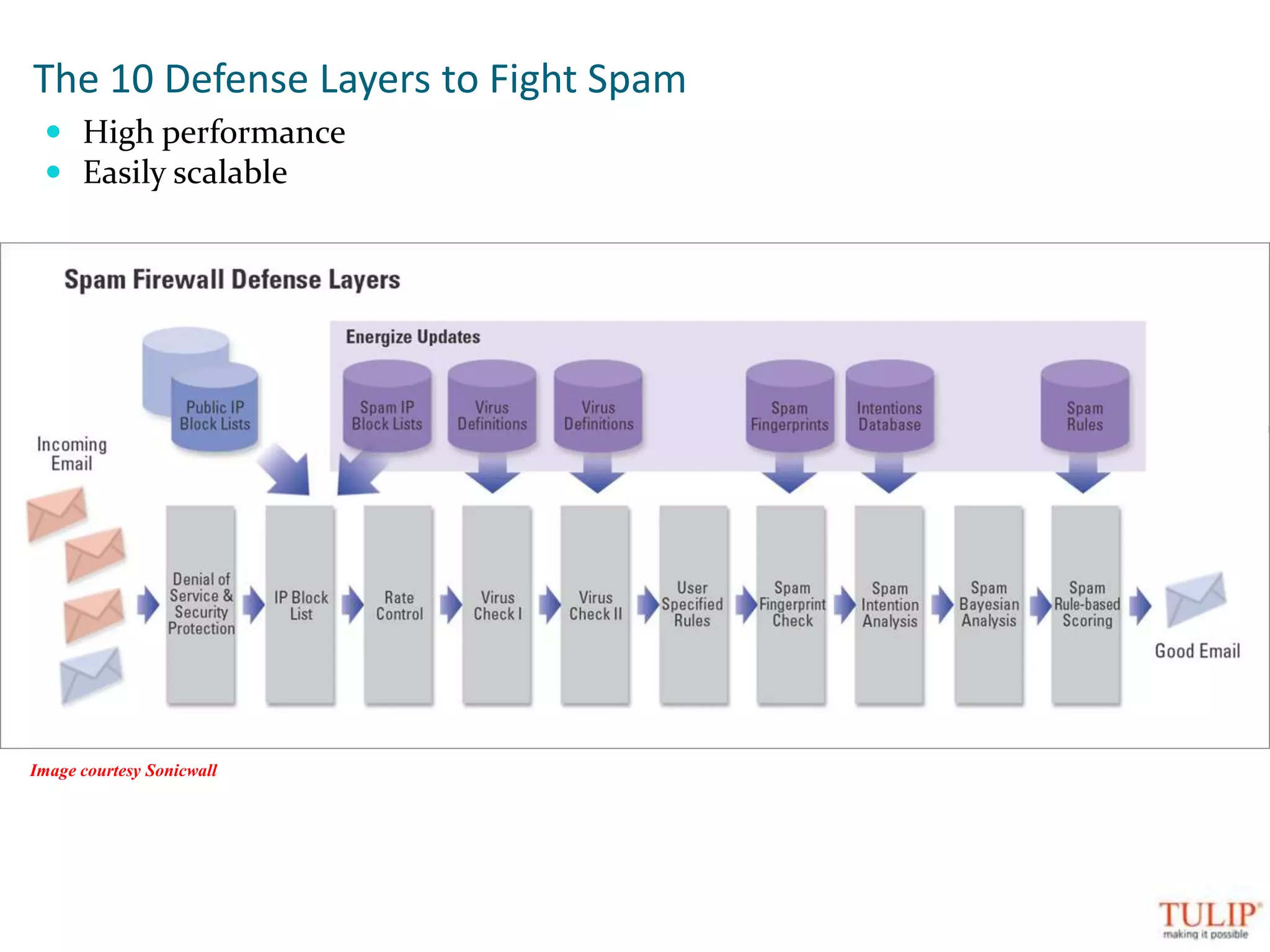
    The 10 DefenseLayers to Fight SpamHigh performance
  • 60.
  • 61.
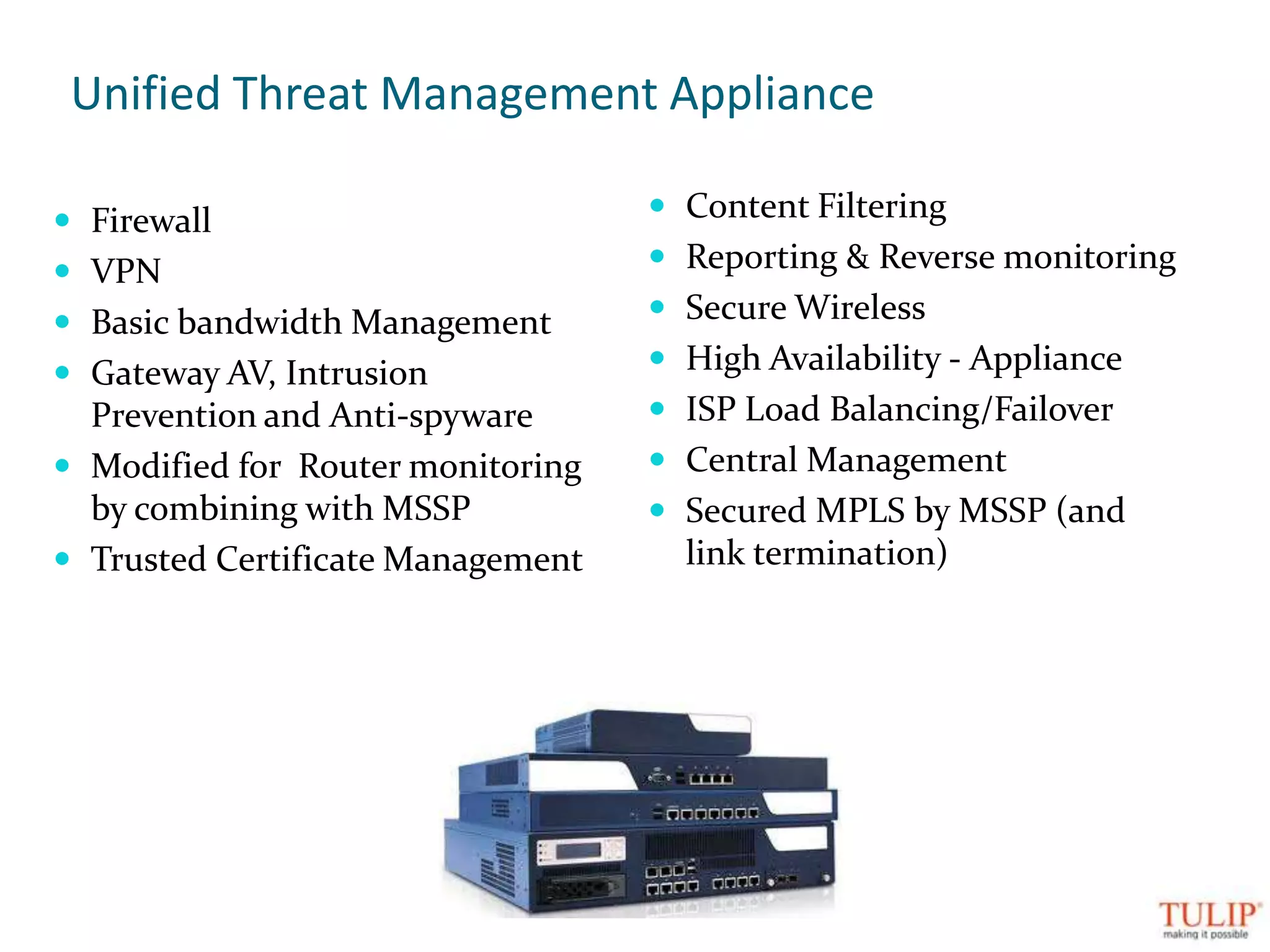
    Unified Threat ManagementApplianceContent FilteringReporting & Reverse monitoringSecure WirelessHigh Availability - Appliance ISP Load Balancing/FailoverCentral ManagementSecured MPLS by MSSP (and link termination)FirewallVPNBasic bandwidth ManagementGateway AV, Intrusion Prevention and Anti-spywareModified for Router monitoring by combining with MSSPTrusted Certificate Management
  • 62.
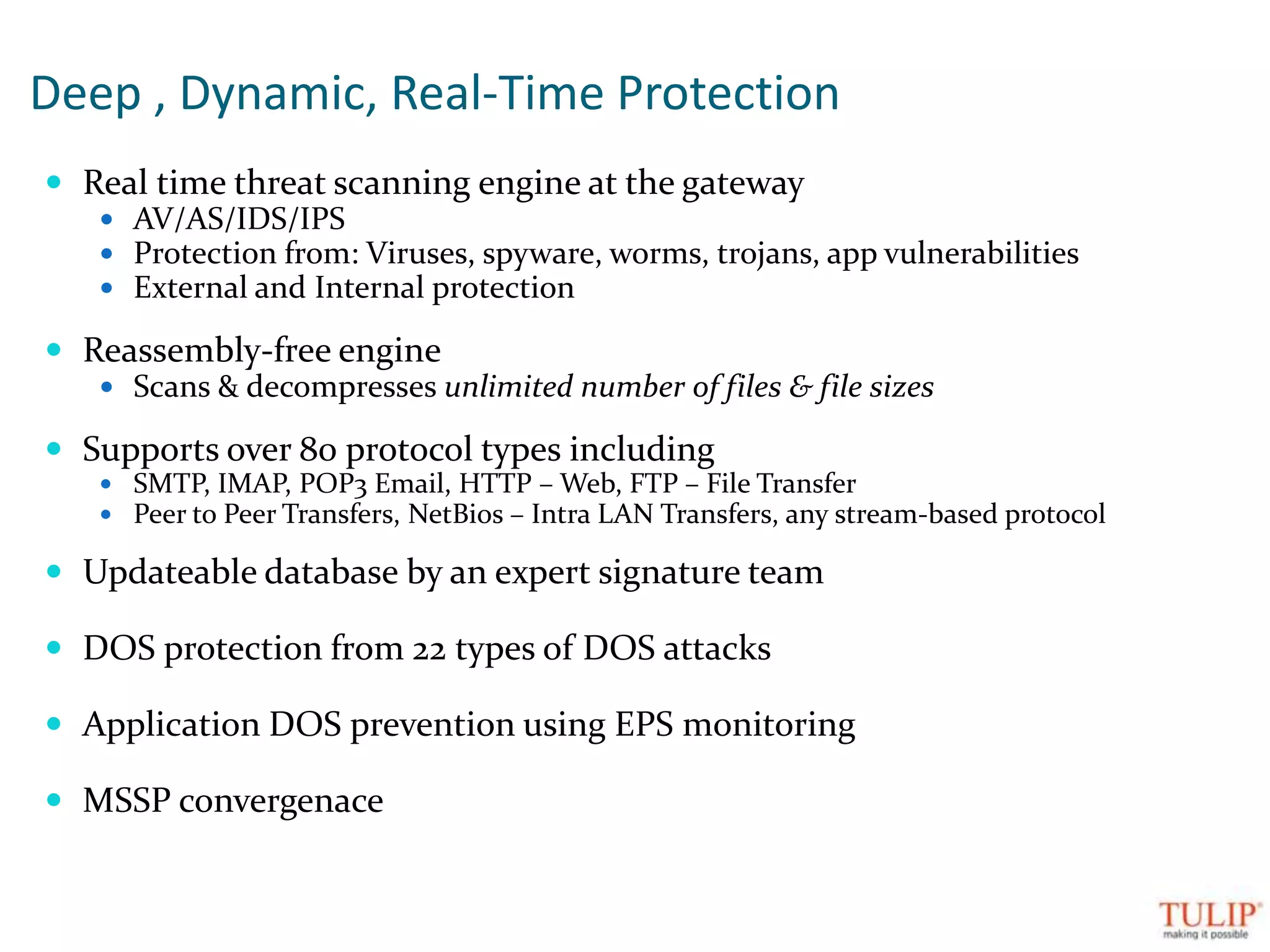
    Deep , Dynamic,Real-Time ProtectionReal time threat scanning engine at the gateway
  • 63.
  • 64.
    Protection from: Viruses,spyware, worms, trojans, app vulnerabilities
  • 65.
  • 66.
  • 67.
    Scans & decompressesunlimited number of files & file sizes
  • 68.
    Supports over 80protocol types including
  • 69.
    SMTP, IMAP, POP3Email, HTTP – Web, FTP – File Transfer
  • 70.
    Peer to PeerTransfers, NetBios – Intra LAN Transfers, any stream-based protocol
  • 71.
    Updateable database byan expert signature team
  • 72.
    DOS protection from22 types of DOS attacks
  • 73.
    Application DOS preventionusing EPS monitoring
  • 74.
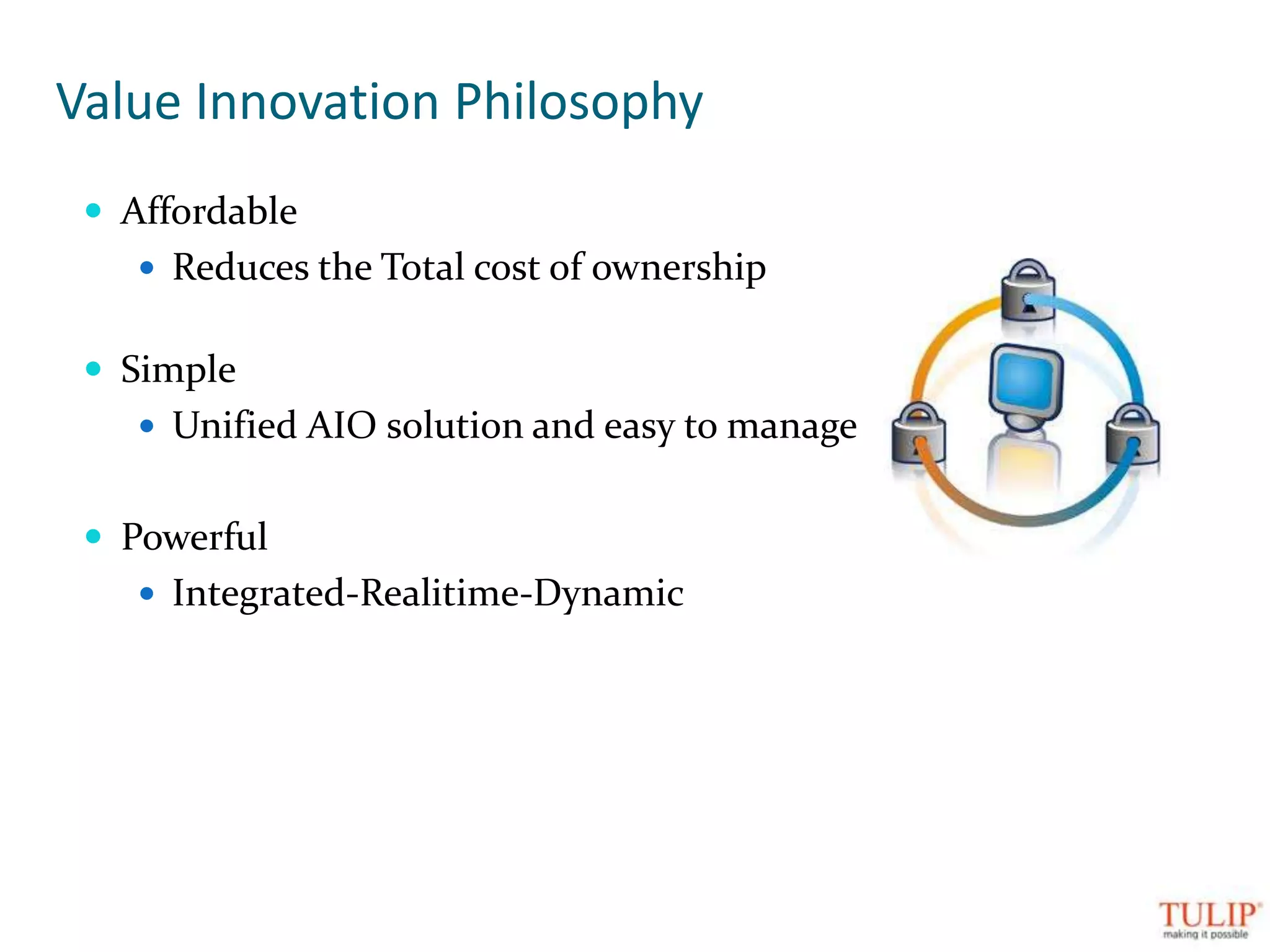
    MSSP convergenaceValue InnovationPhilosophyAffordableReduces the Total cost of ownershipSimpleUnified AIO solution and easy to managePowerfulIntegrated-Realitime-Dynamic
  • 75.
  • 76.