This document discusses span of control and organizational structures. It defines span of control as the number of people reporting to a single manager. A narrow span of control means fewer subordinates per manager, creating a taller organizational structure with more management levels, while a wide span of control creates a flatter structure. Tall structures allow for close supervision but slower decision-making, while flat structures are less costly, allow faster communication and decisions, but with potentially looser control over subordinates. Wider spans of control are generally more cost-effective due to requiring fewer managers.
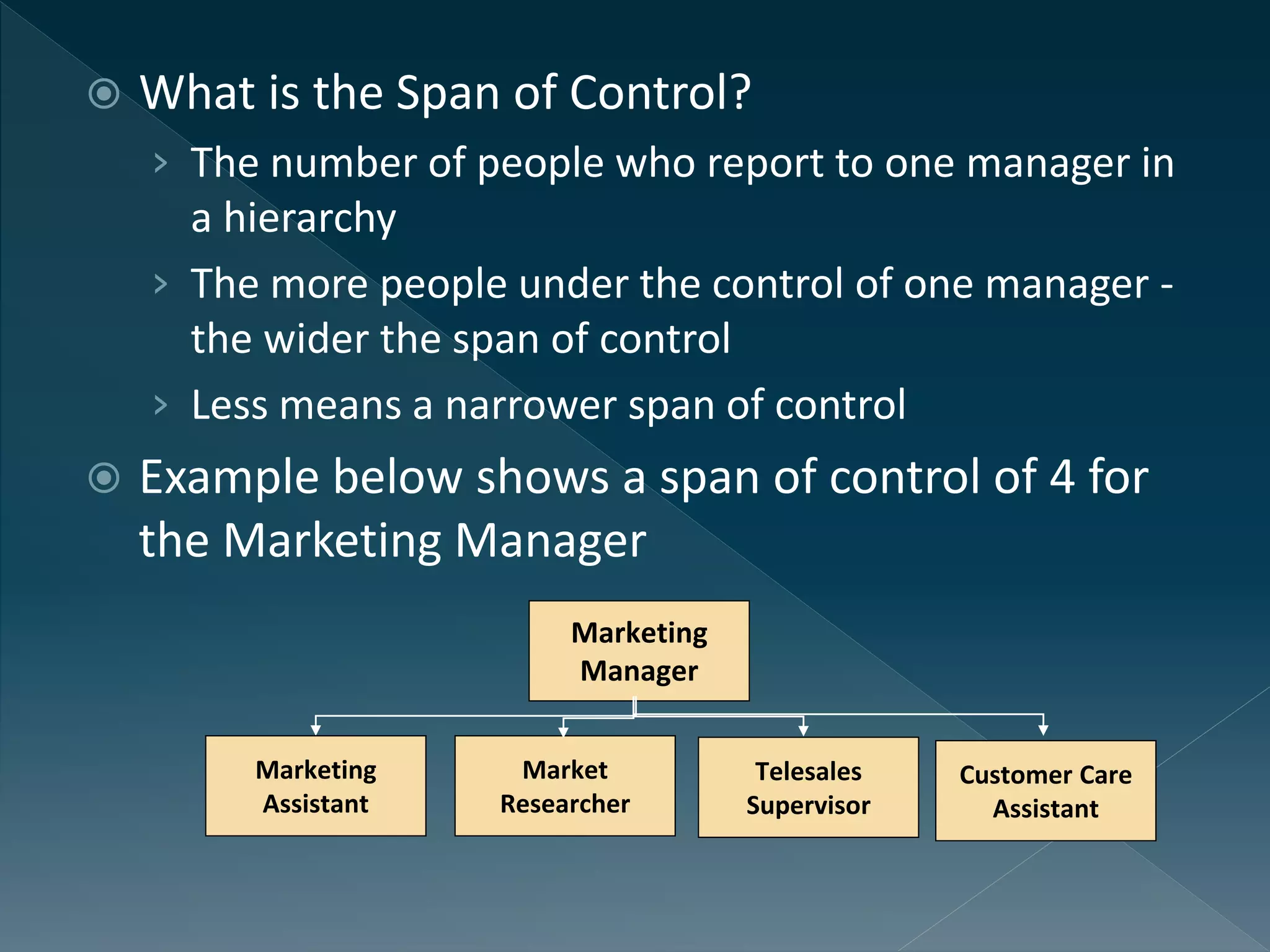
Span of control is the number of subordinates reporting to a manager; wider span means more subordinates. Example: Marketing Manager has a span of 4.
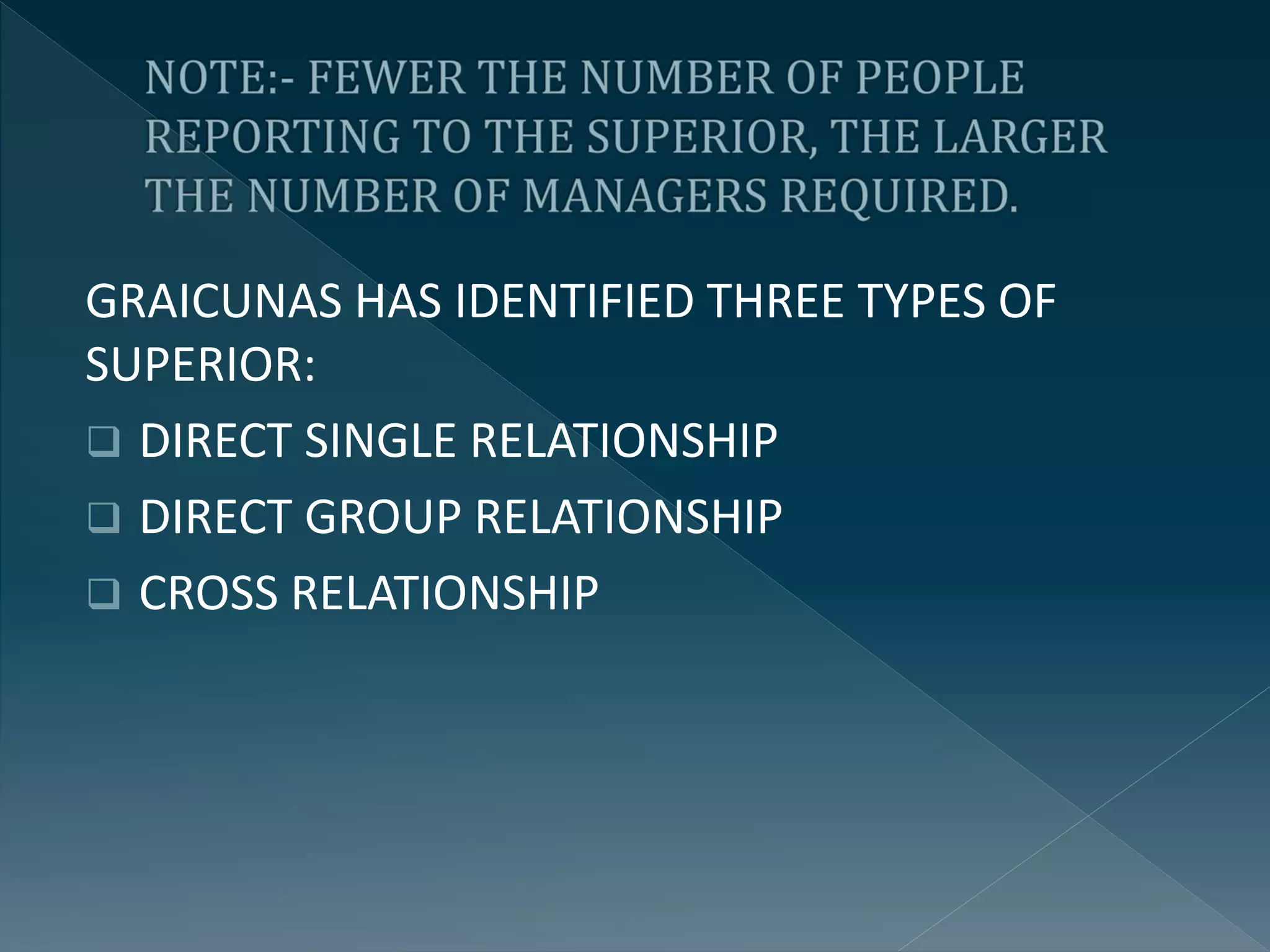
GRAICUNAS identifies three types of superior relationships: direct single, direct group, and cross relationships.
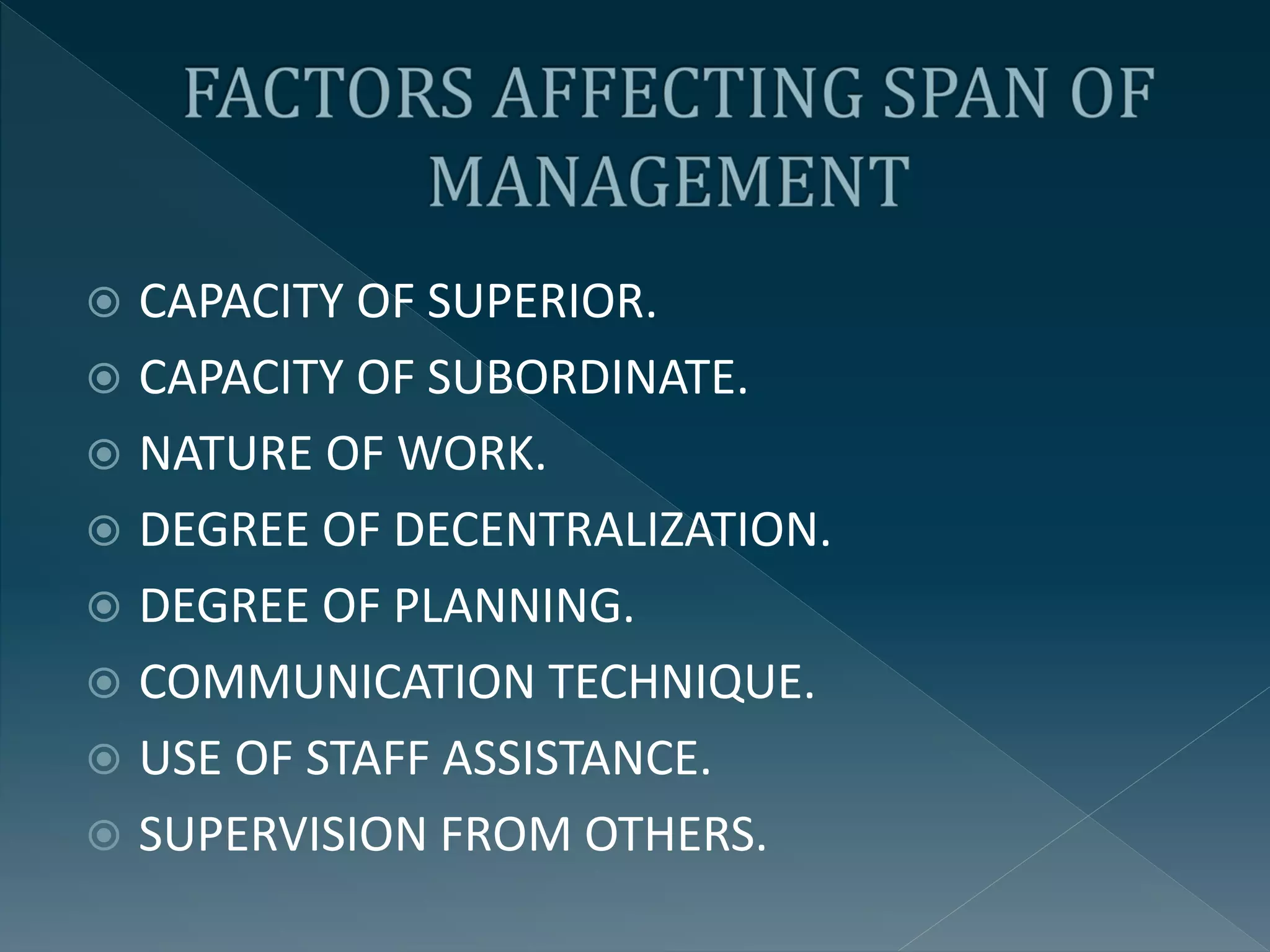
Factors include capacity of superior & subordinate, nature of work, degree of decentralization & planning, communication techniques, staff assistance, and supervision from others.
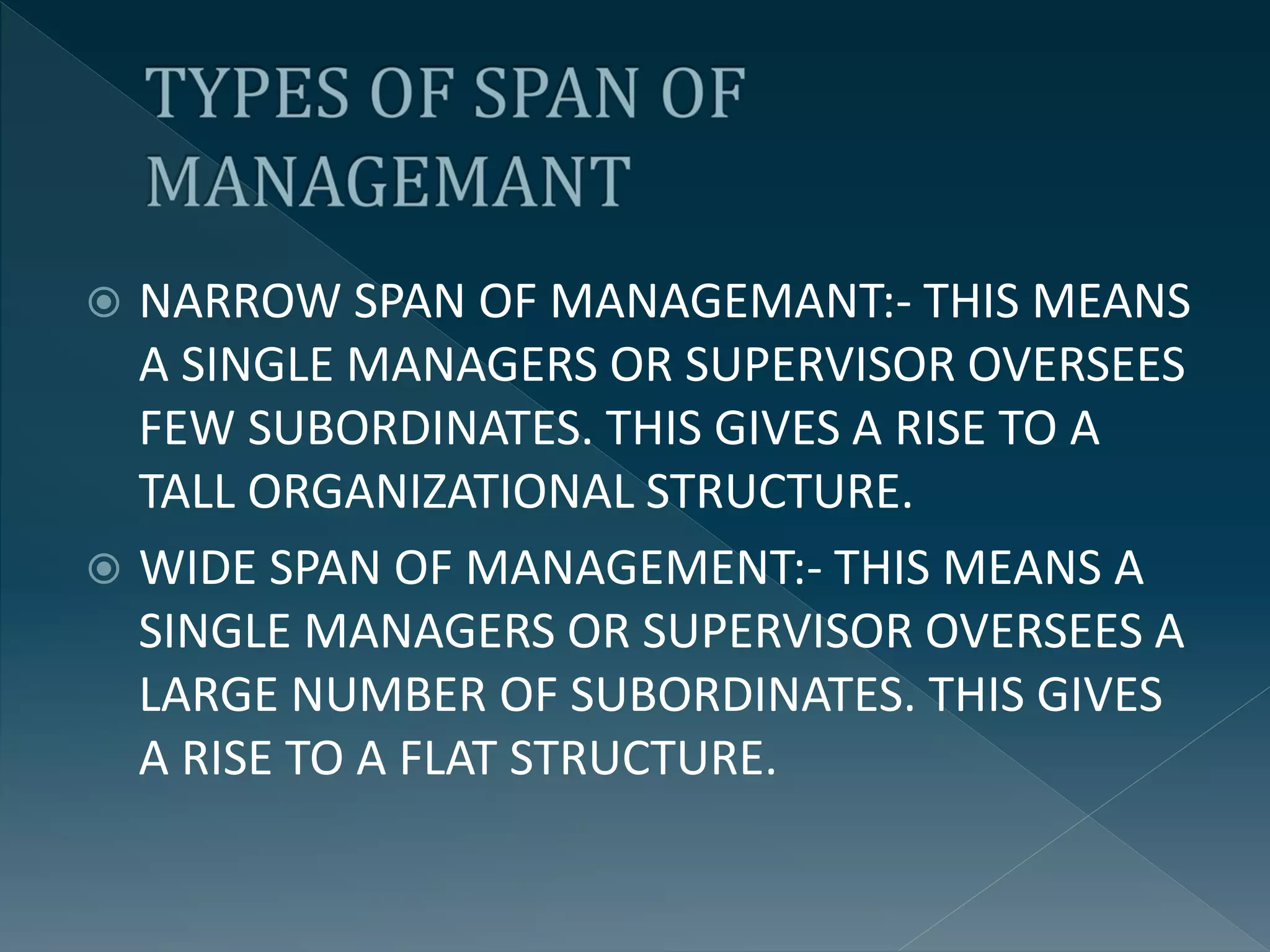
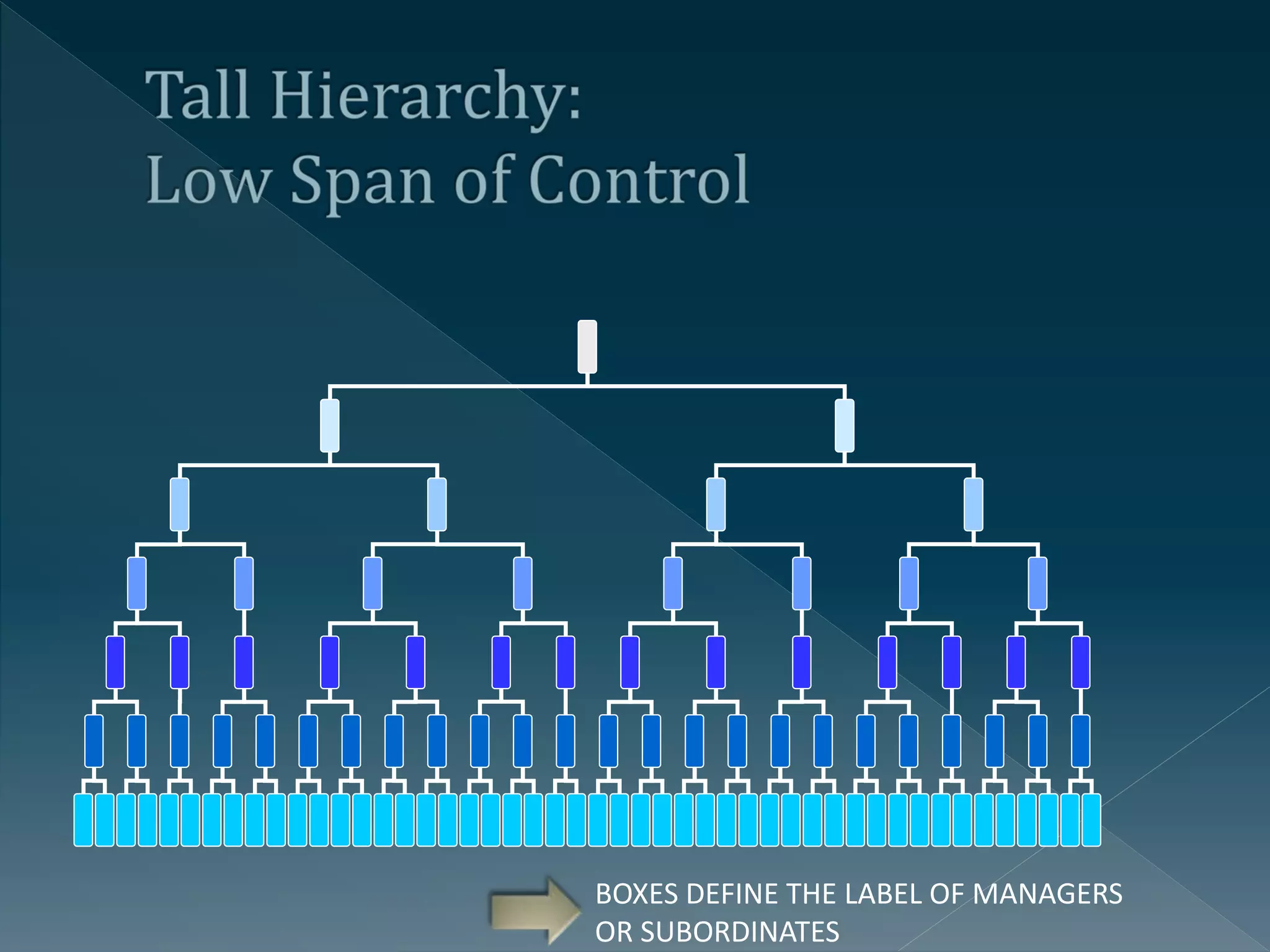
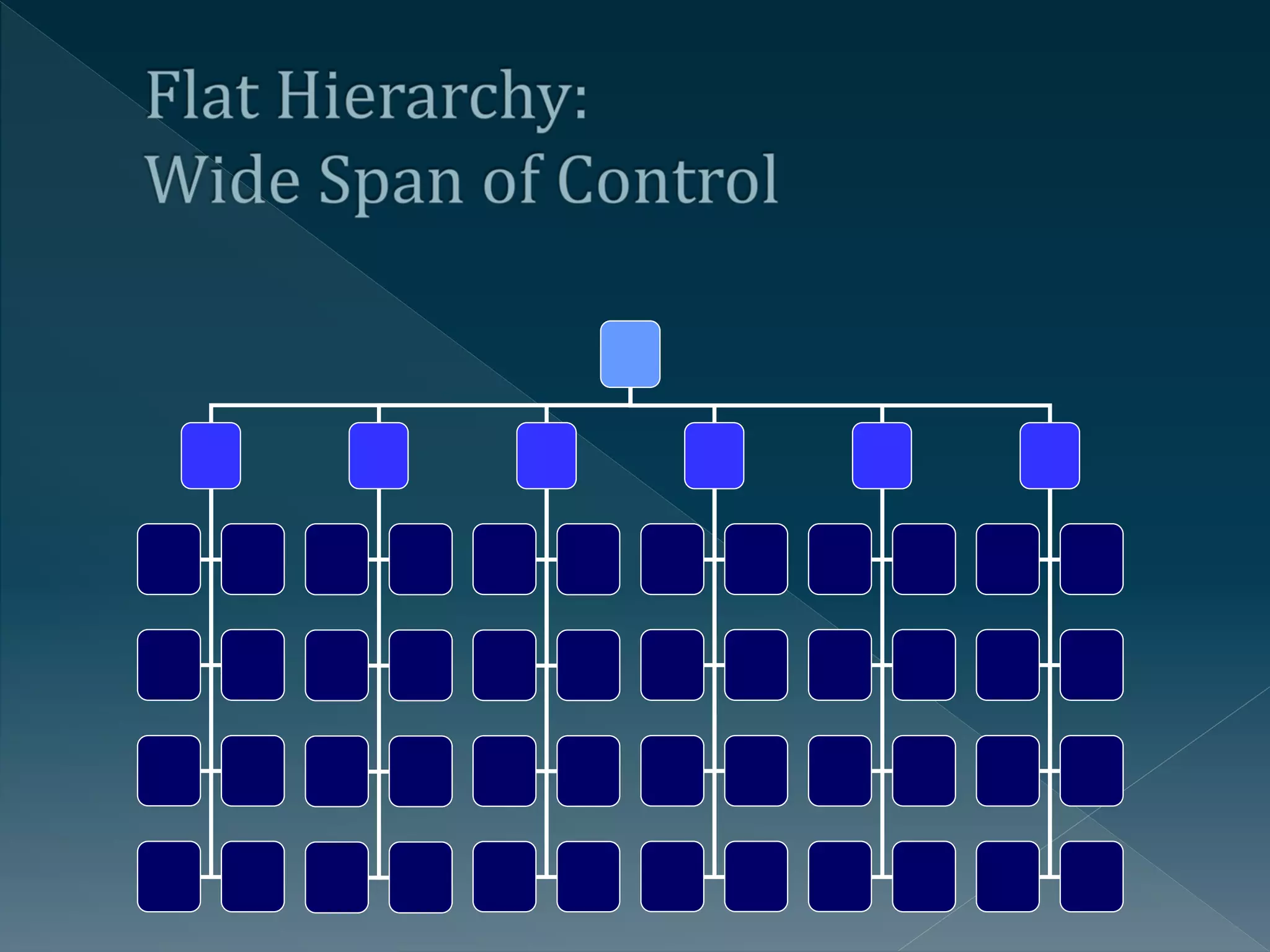
Narrow span leads to tall structures with few subordinates; wide span creates flat structures with many subordinates.
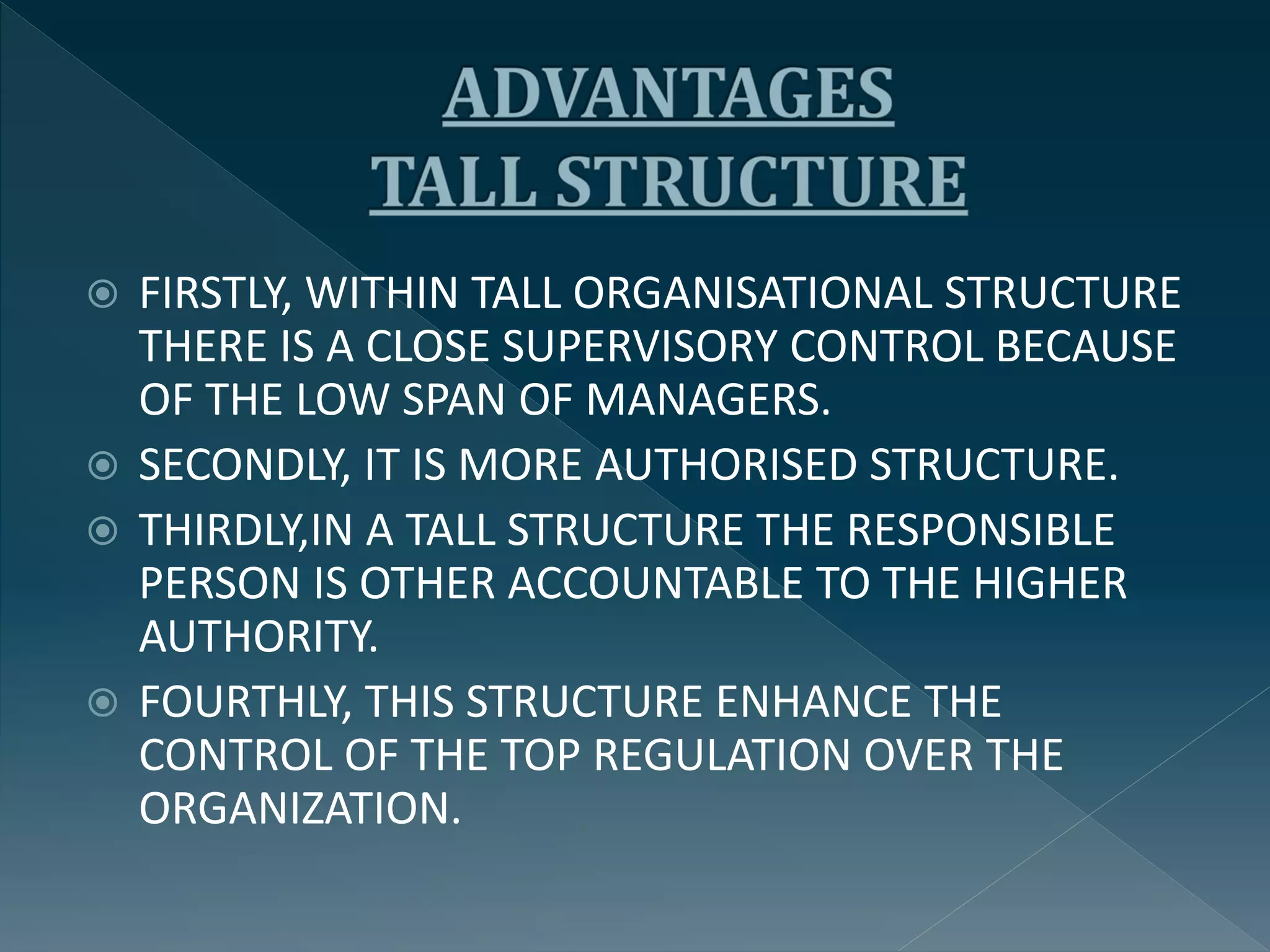
Tall structure allows close supervision, authorized control, accountability, and enhanced top regulation over the organization.
Tall structures demotivate employees, slow decision-making, create communication barriers, and provide fewer benefits.
Flat organizations reduce costs, speed up decisions, enhance communication, and lessen strict supervision.
Flat structures risk losing control, may harm discipline and relationships, affecting overall performance quality.
Narrow span of management is more costly due to higher numbers of managers, resulting in greater communication issues.
For a span of 4, 1,365 supervisors are needed, while for 8 only 585; wider span reduces employment costs.
What isthe Span of Control?
› The number of people who report to one manager in
a hierarchy
› The more people under the control of one manager -
the wider the span of control
› Less means a narrower span of control
Example below shows a span of control of 4 for
the Marketing Manager
Marketing
Manager
Market
Researcher
Telesales
Supervisor
Customer Care
Assistant
Marketing
Assistant
3.
GRAICUNAS HAS IDENTIFIEDTHREE TYPES OF
SUPERIOR:
DIRECT SINGLE RELATIONSHIP
DIRECT GROUP RELATIONSHIP
CROSS RELATIONSHIP
4.
CAPACITY OFSUPERIOR.
CAPACITY OF SUBORDINATE.
NATURE OF WORK.
DEGREE OF DECENTRALIZATION.
DEGREE OF PLANNING.
COMMUNICATION TECHNIQUE.
USE OF STAFF ASSISTANCE.
SUPERVISION FROM OTHERS.
5.
NARROW SPANOF MANAGEMANT:- THIS MEANS
A SINGLE MANAGERS OR SUPERVISOR OVERSEES
FEW SUBORDINATES. THIS GIVES A RISE TO A
TALL ORGANIZATIONAL STRUCTURE.
WIDE SPAN OF MANAGEMENT:- THIS MEANS A
SINGLE MANAGERS OR SUPERVISOR OVERSEES A
LARGE NUMBER OF SUBORDINATES. THIS GIVES
A RISE TO A FLAT STRUCTURE.
FIRSTLY, WITHINTALL ORGANISATIONAL STRUCTURE
THERE IS A CLOSE SUPERVISORY CONTROL BECAUSE
OF THE LOW SPAN OF MANAGERS.
SECONDLY, IT IS MORE AUTHORISED STRUCTURE.
THIRDLY,IN A TALL STRUCTURE THE RESPONSIBLE
PERSON IS OTHER ACCOUNTABLE TO THE HIGHER
AUTHORITY.
FOURTHLY, THIS STRUCTURE ENHANCE THE
CONTROL OF THE TOP REGULATION OVER THE
ORGANIZATION.
10.
FIRSTLY, EMPLOYEESARE LESS MOTIVATED
WITHIN THIS STRUCTURE.
SECONDLY, VERDICT MAKING IS SLOW.
THIRDLY, TALL STRUCTURE CREATES
COMMUNICATION BARRIERS BETWEEN THE
UPPER AND LOWER MANAGEMENT.
FOURTHLY, LESS BENEFIT AND REWARDS ARE
GIVEN TO THE BODY IN THE TALL
ORGANISATION.
11.
FLAT ORGANIZATIONIS LESS COSTLY.
QUICK DECISION AND ACTION CAN BE TAKEN.
FAST AND CLEAR COMMUNICATION .
SUBORDINATES ARE FREE FROM CLOSE AND
STRICT SUPERVISION AND CONTROL.
SUPERIOR MAY NOT BE TOO DOMINATING
BECAUSE OF LARGE NUMBER OF
SUBORDINATES.
12.
THERE ARECHANCES OF LOOSE CONTROL BECAUSE
THERE ARE MANY SUBORDINATES UNDER ONE
MANAGERS.
THE DISCIPLINE IN THE ORGANISATION MAY BE BAD.
THE RELATION BETWEEN THE SUPERIOR AND
SUBORDINATE MAY BE BAD.
CLOSE AND INFORMAL RELATION MAY NOT BE
POSSIBLE.
AND BECAUSE OF ALL THESE THE QUALITY OF
PERFORMANCE MY BE BAD.
13.
NARROW SPANOF MANAGEMENT IS MORE
COSTLY COMPARED TO WIDE SPAN OF
MANAGEMENT AS THERE ARE LARGE NUMBER
OF SUPERIOR/MANAGERS AND THUS THERE IS
GREAT COMMUNICATION ISSUES TOO BETWEEN
VARIOUS MANAGEMENT LEVELS.
14.
THE SAMENUMBER OF WORKERS
REQUIREMENT OF SUPERVISORY PERSONNEL AT
SPAN OF 4 IS 1,365 AND AT SPAN OF 8 IS ONLY
585.
THEREFORE, LOOKING INTO THE COST OF
EMPLOYMENT OF PERSONNEL AND THEIR
AVAILABILITY, IT IS PREFERABLE TO GO FOR WIDER
SPAN OF MANAGEMENT.