The document summarizes early atomic theory and the development of the modern atomic model. It discusses early thinkers like Democritus and Aristotle and their ideas. John Dalton proposed early atomic theory including that atoms are indivisible and unchangeable. J.J. Thomson's work led to the discovery of the electron. Rutherford determined atoms have a small, dense nucleus. Chadwick discovered the neutron in the nucleus. The modern atomic model includes protons, neutrons, and electrons. Radioactivity and nuclear reactions are discussed.
Democritus introduced atoms, but Aristotle's four elements dominated thought until Dalton's atomic theory.
Dalton formulated a theory stating atoms are indivisible, combine in fixed ratios, and differ between elements.
Thomson identified electrons; Millikan measured their charge; Rutherford proposed a dense nucleus.
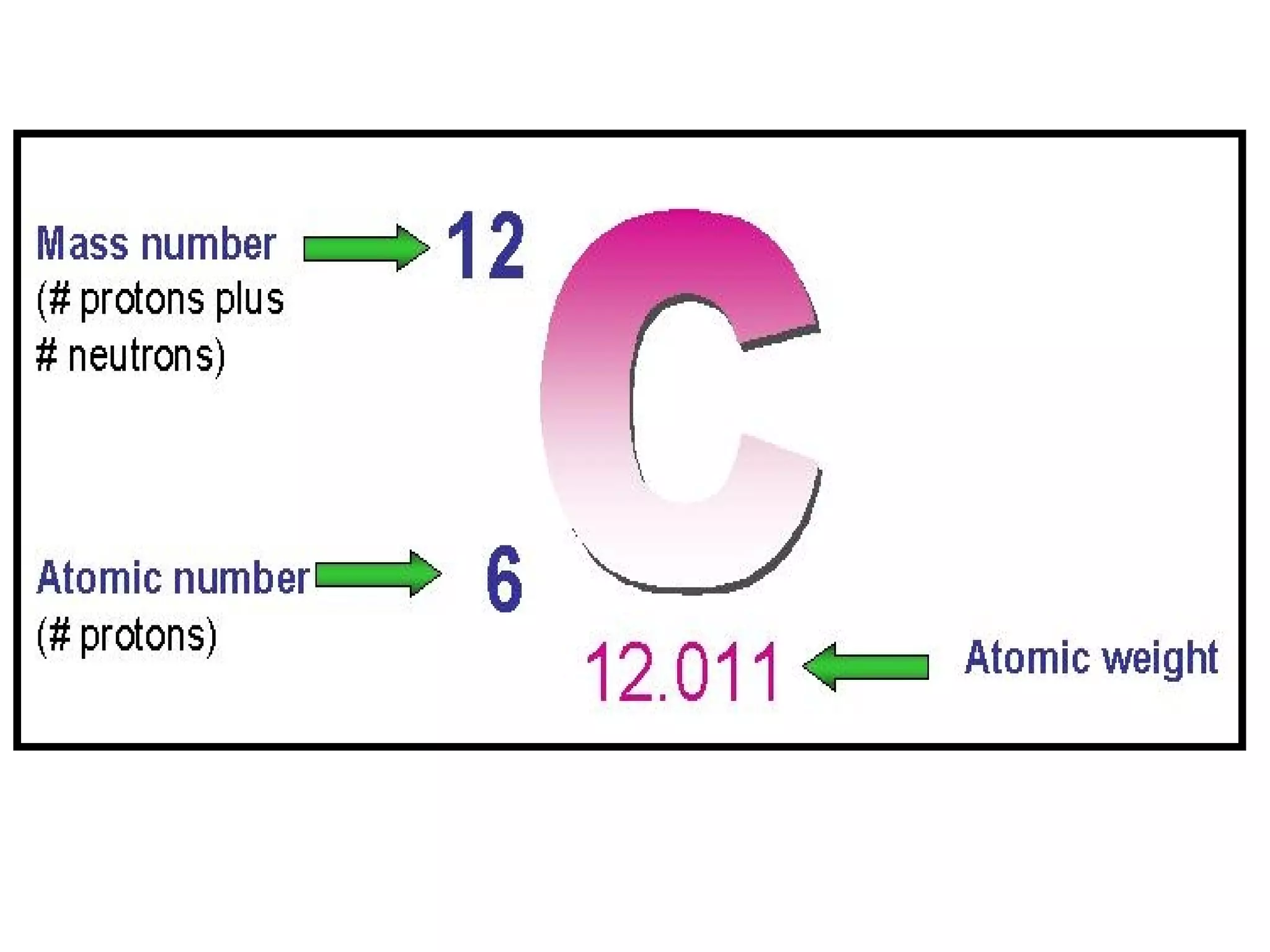
Atomic number defines elements; isotopes differ in neutrons; mass number is protons plus neutrons.
Atomic number defines elements; isotopes differ in neutrons; mass number is protons plus neutrons.
Atomic mass is the weighted average of isotopes, requiring calculations of abundance and mass.Radioactivity was discovered by Becquerel and named by Curie, involving different types of particles.
Nuclear reactions alter the atom's nucleus; radioactive decay emits energy or particles transforming elements.
Stability is influenced by neutron-proton ratios and couples with decay trends for stable nuclei identification.
Transmutation alters elements in decay; includes gamma, alpha, and beta emissions affecting elemental properties.
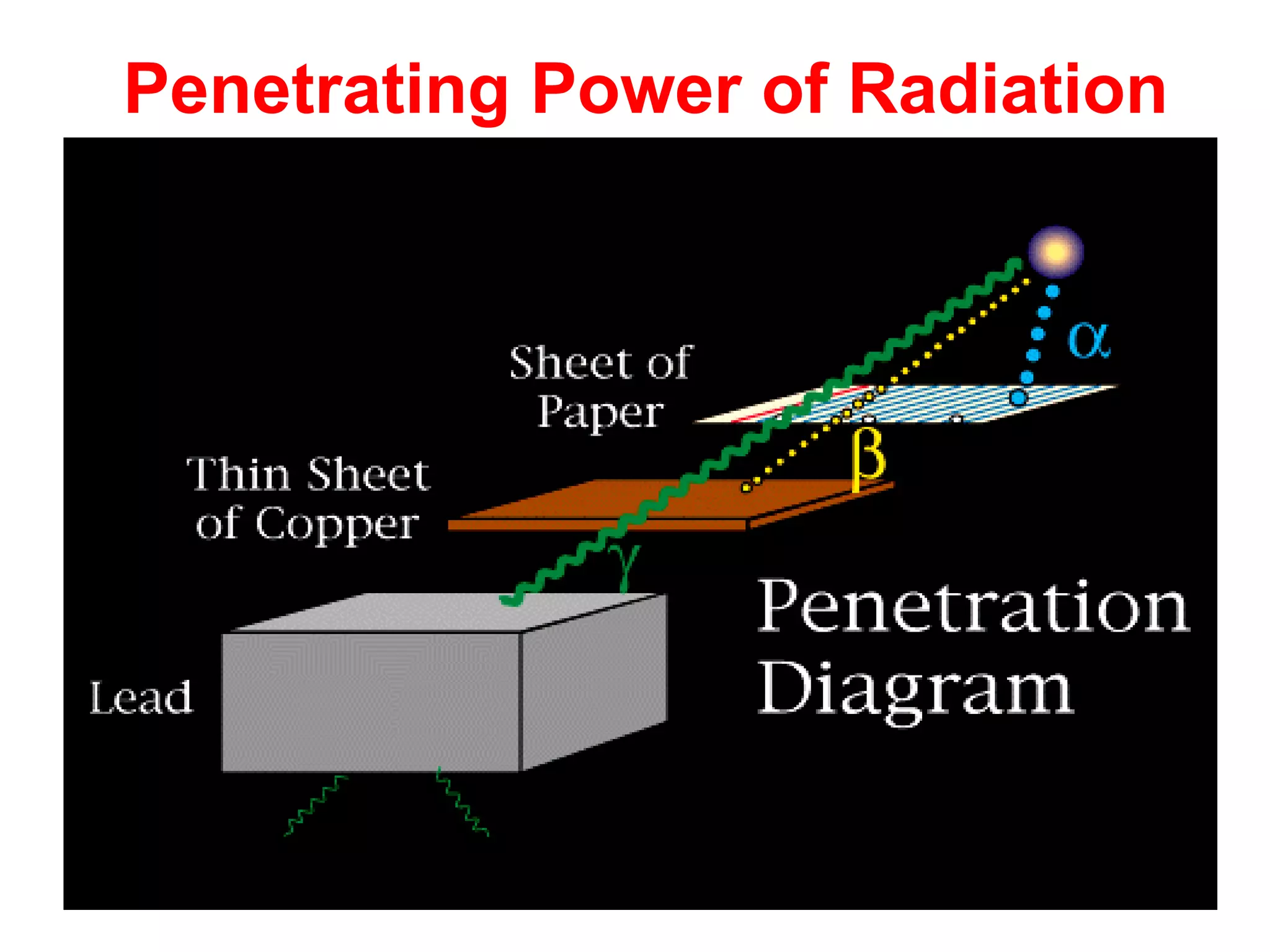
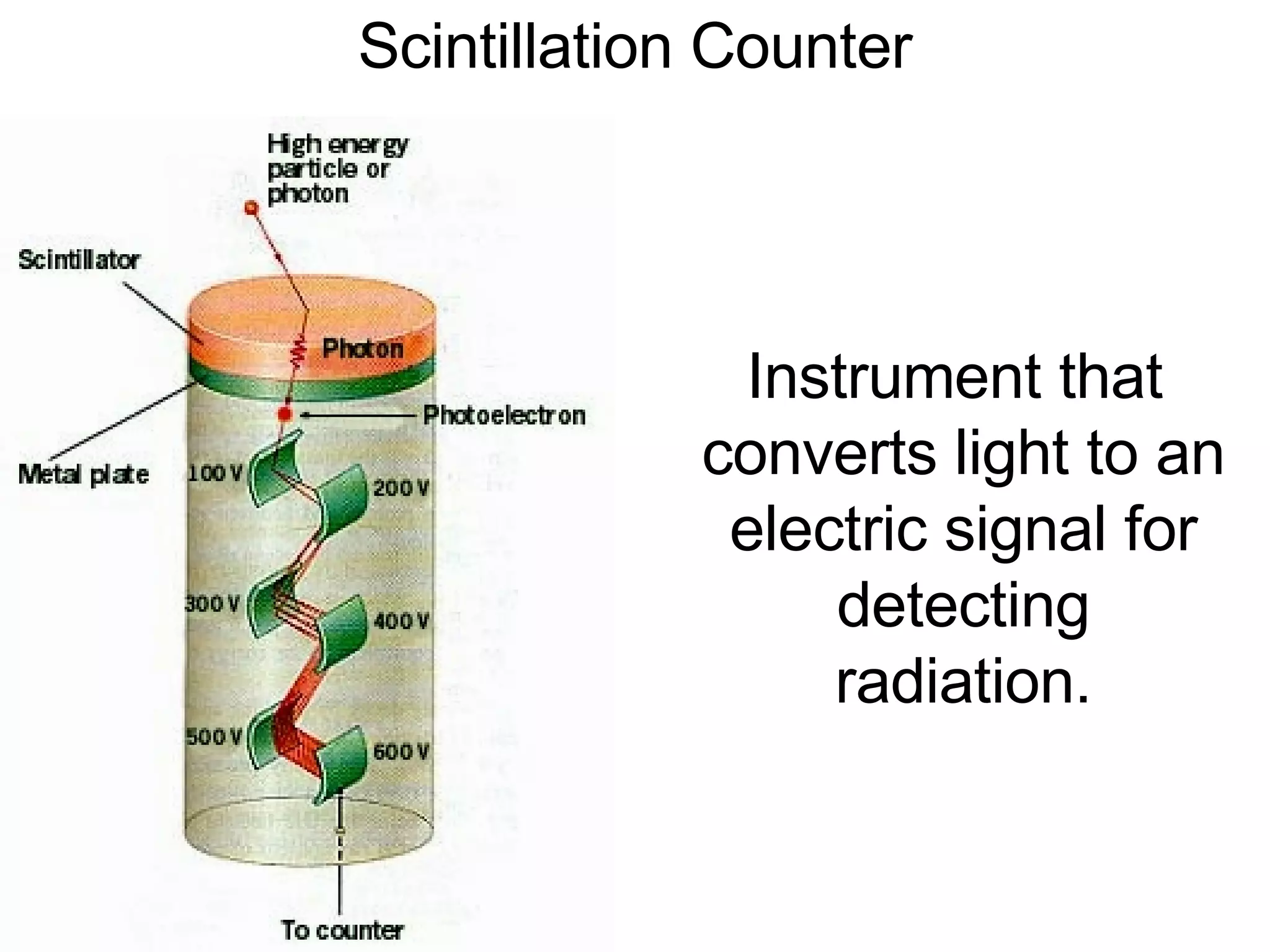
Radiation's penetrating power is diverse; detection methods include film badges and Geiger counters.
Radioactive isotopes assist in medicine, agriculture, dating, and energy production, with waste management concerns.
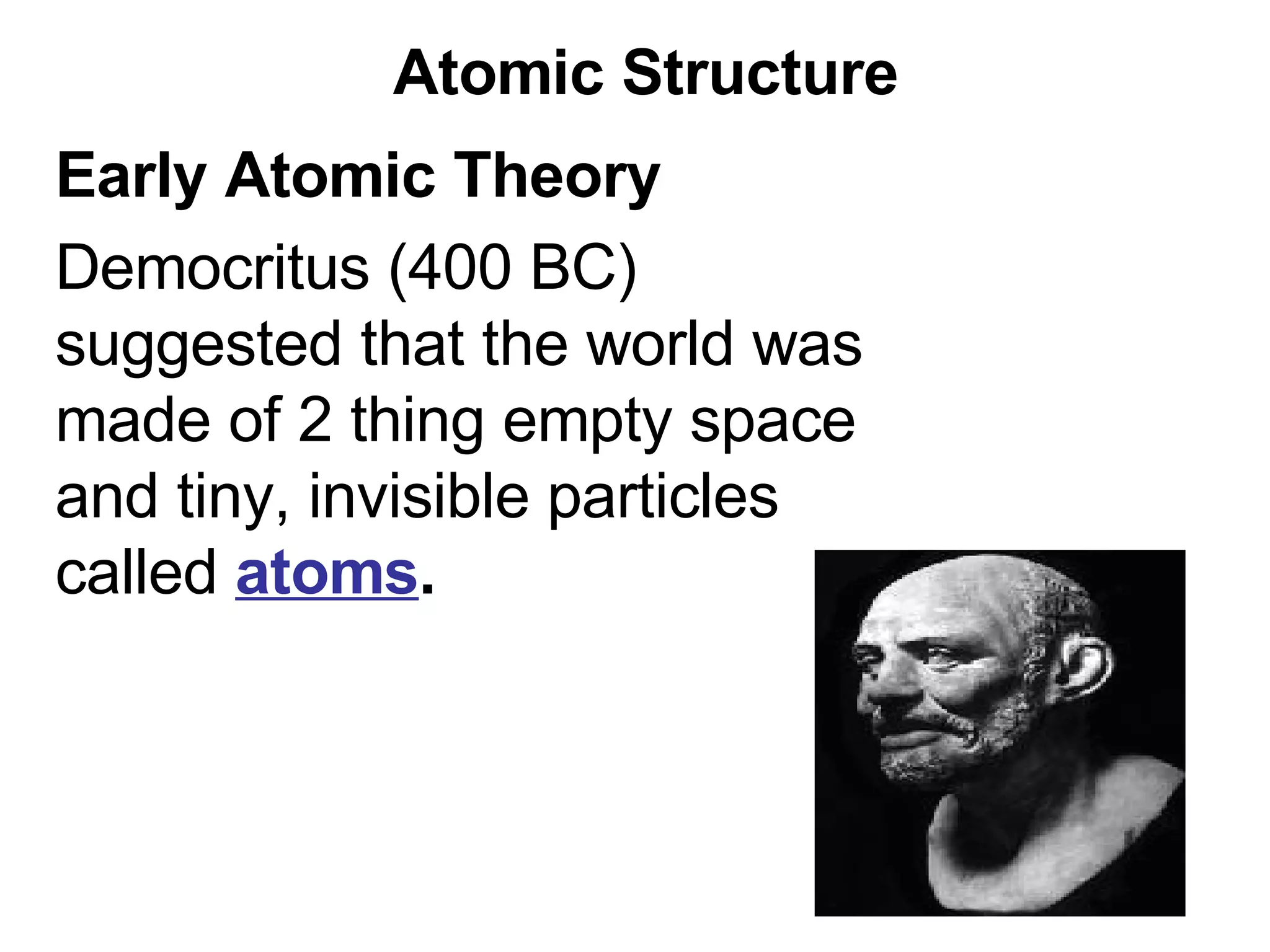
Atomic Structure EarlyAtomic Theory Democritus (400 BC) suggested that the world was made of 2 thing empty space and tiny, invisible particles called atoms .
2.
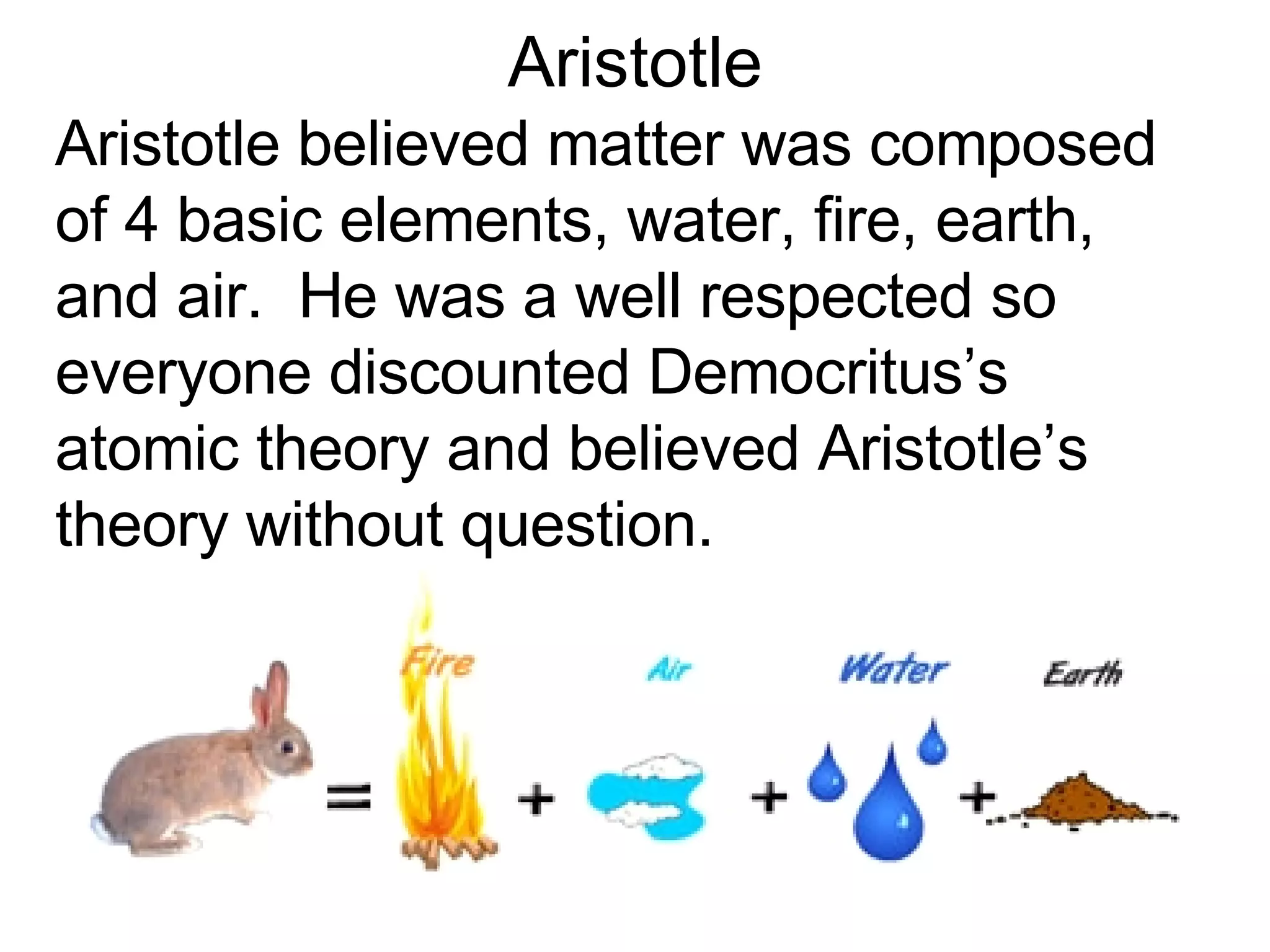
Aristotle Aristotle believedmatter was composed of 4 basic elements, water, fire, earth, and air. He was a well respected so everyone discounted Democritus’s atomic theory and believed Aristotle’s theory without question.
3.
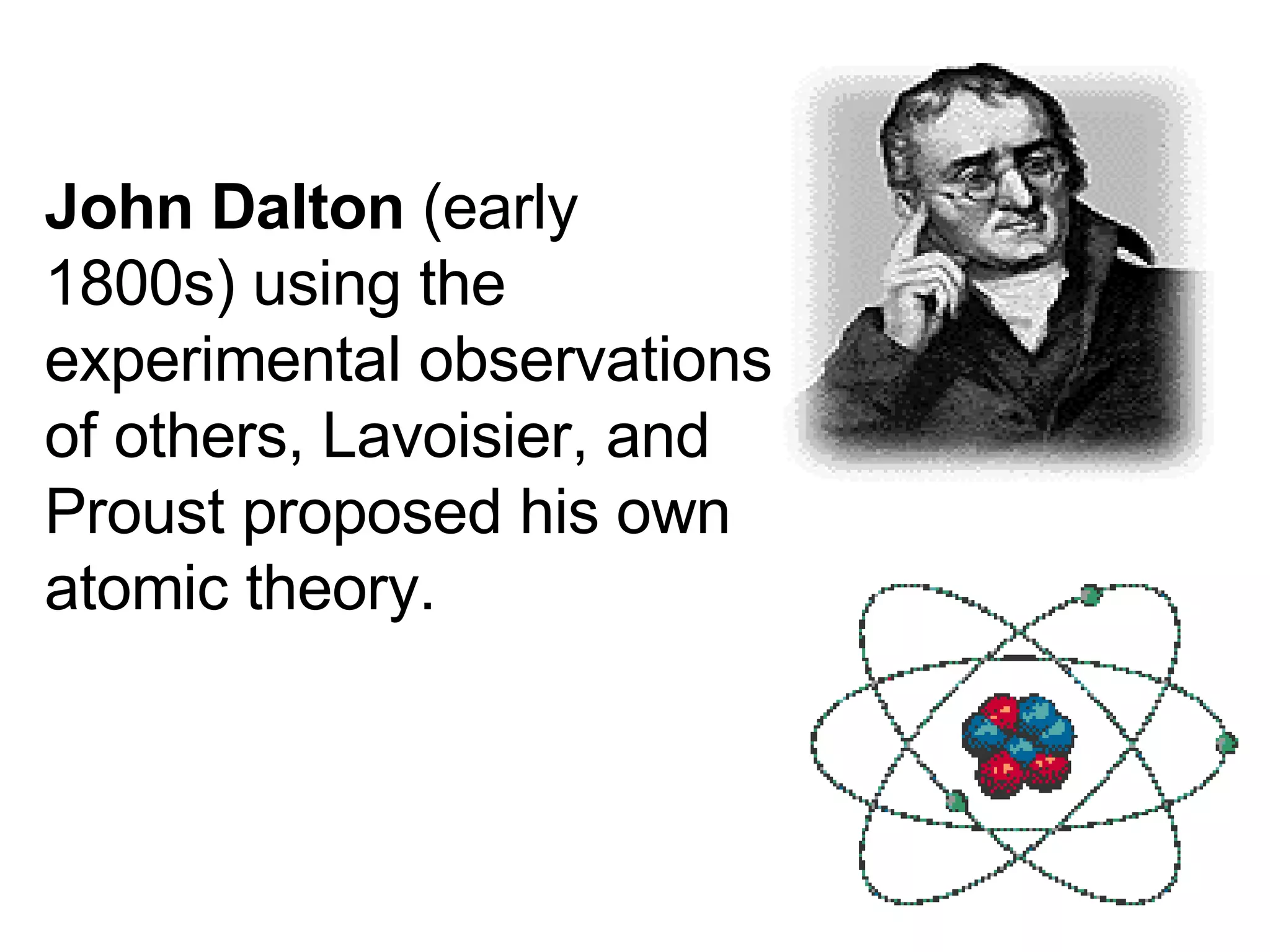
John Dalton (early 1800s) using the experimental observations of others, Lavoisier, and Proust proposed his own atomic theory.
4.
Dalton’s Atomic TheoryAll elements are composed of tiny particles called atoms. Atoms of the same element are identical . The atoms of any one element are different from those of another element. Isotopes of an element are not identical .
5.
Atoms cannot be divided , created, or destroyed. Atoms are divisible by a nuclear charge. Atoms of different elements can combine with one another in simple, whole number ratios to form compounds . Chemical reactions occur when atoms are joined , separated , or rearranged . However , atoms of one element are not changed into atoms of another element.
6.
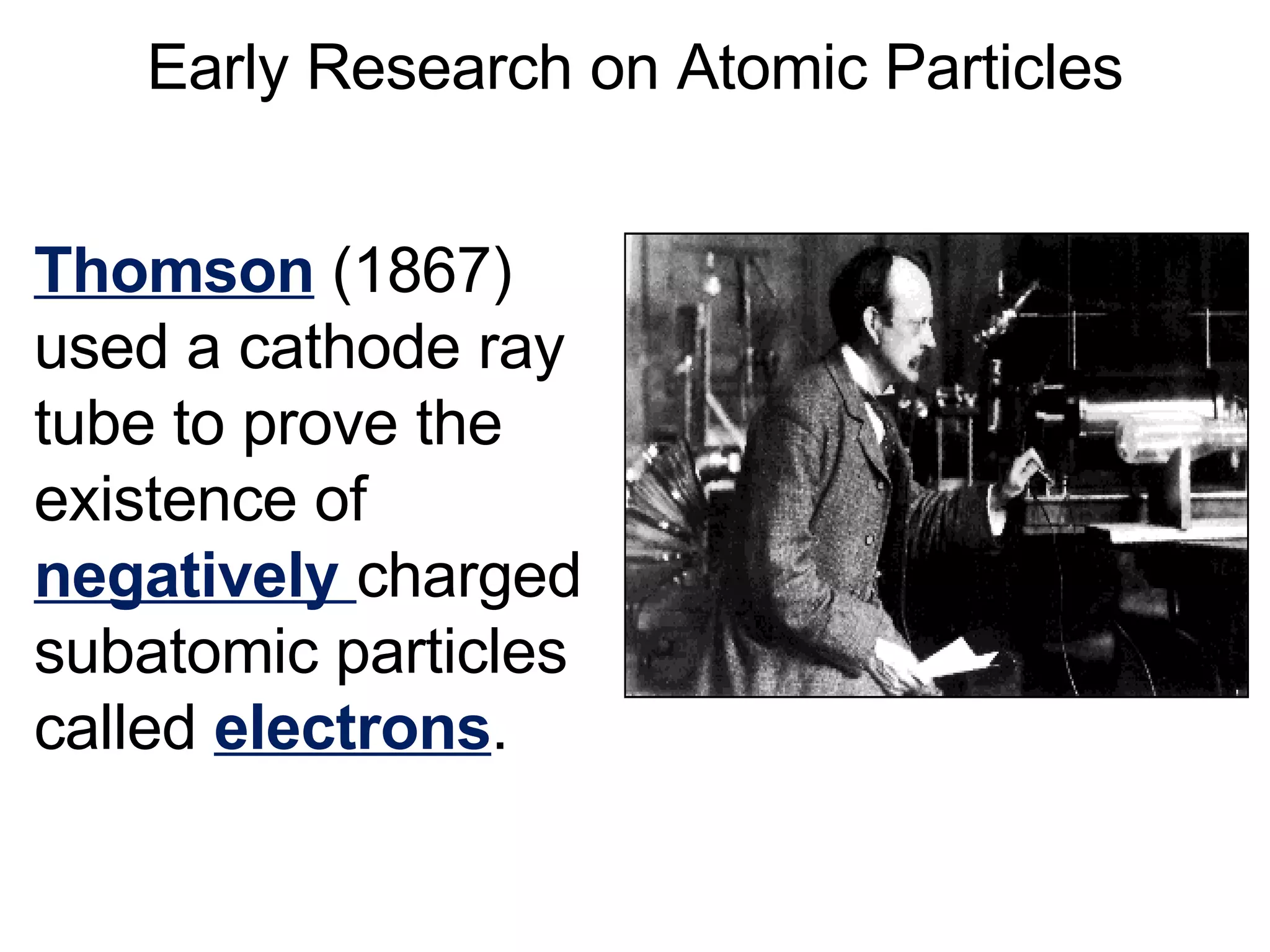
Early Research onAtomic Particles Thomson (1867) used a cathode ray tube to prove the existence of negatively charged subatomic particles called electrons .
7.
Cathode Rays andthe Electron Thomson investigated cathode rays using a devise called a cathode ray tube or CRT. Currents of electricity were pumped into vacuum tubes causing the tube to fluoresce. Thomason used magnets to determine the identity of the particles making up the rays. He found them to be tiny, negatively charged particles.
8.
9.
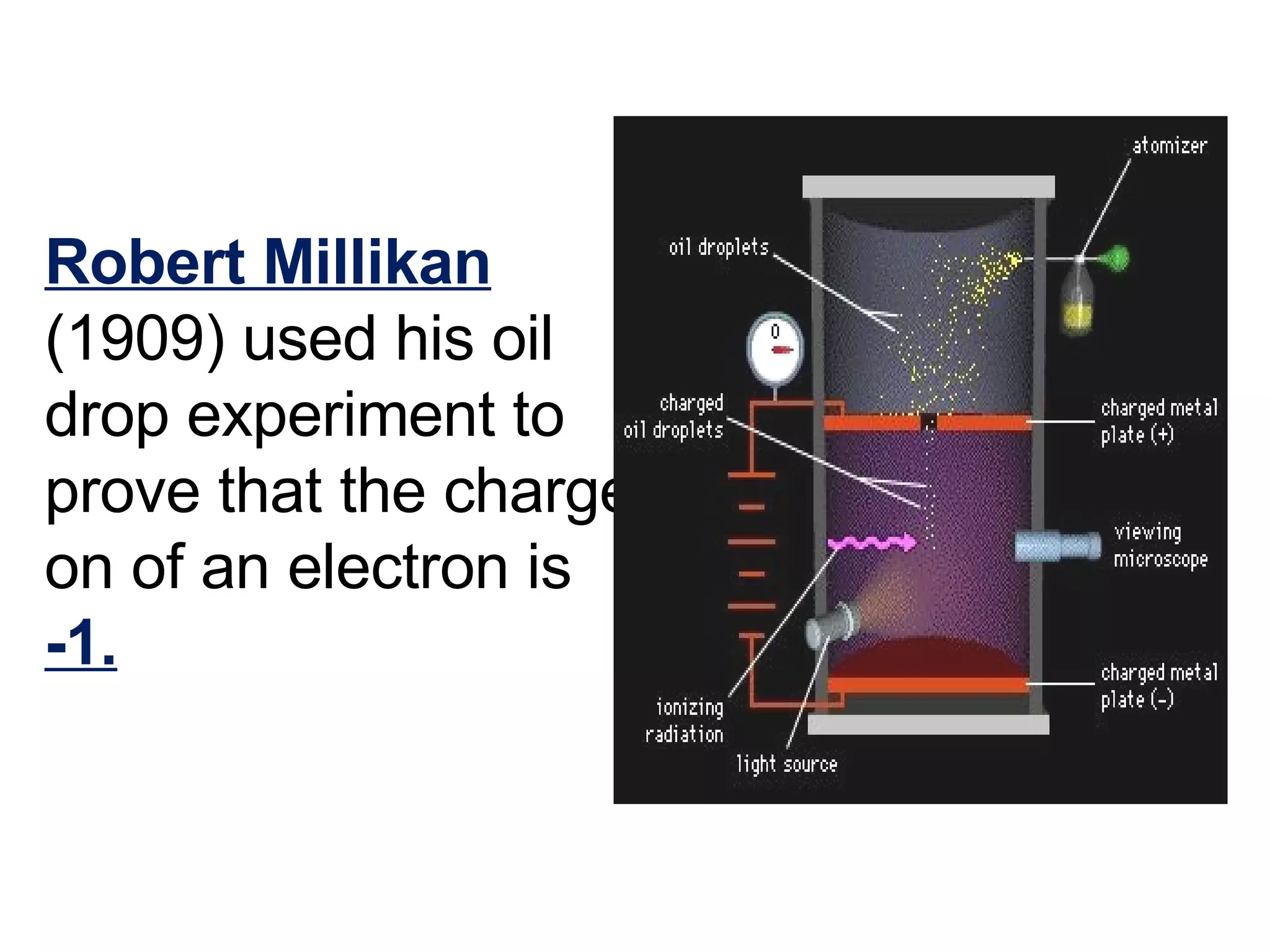
Robert Millikan (1909) used his oil drop experiment to prove that the charge on of an electron is -1.
10.
11.
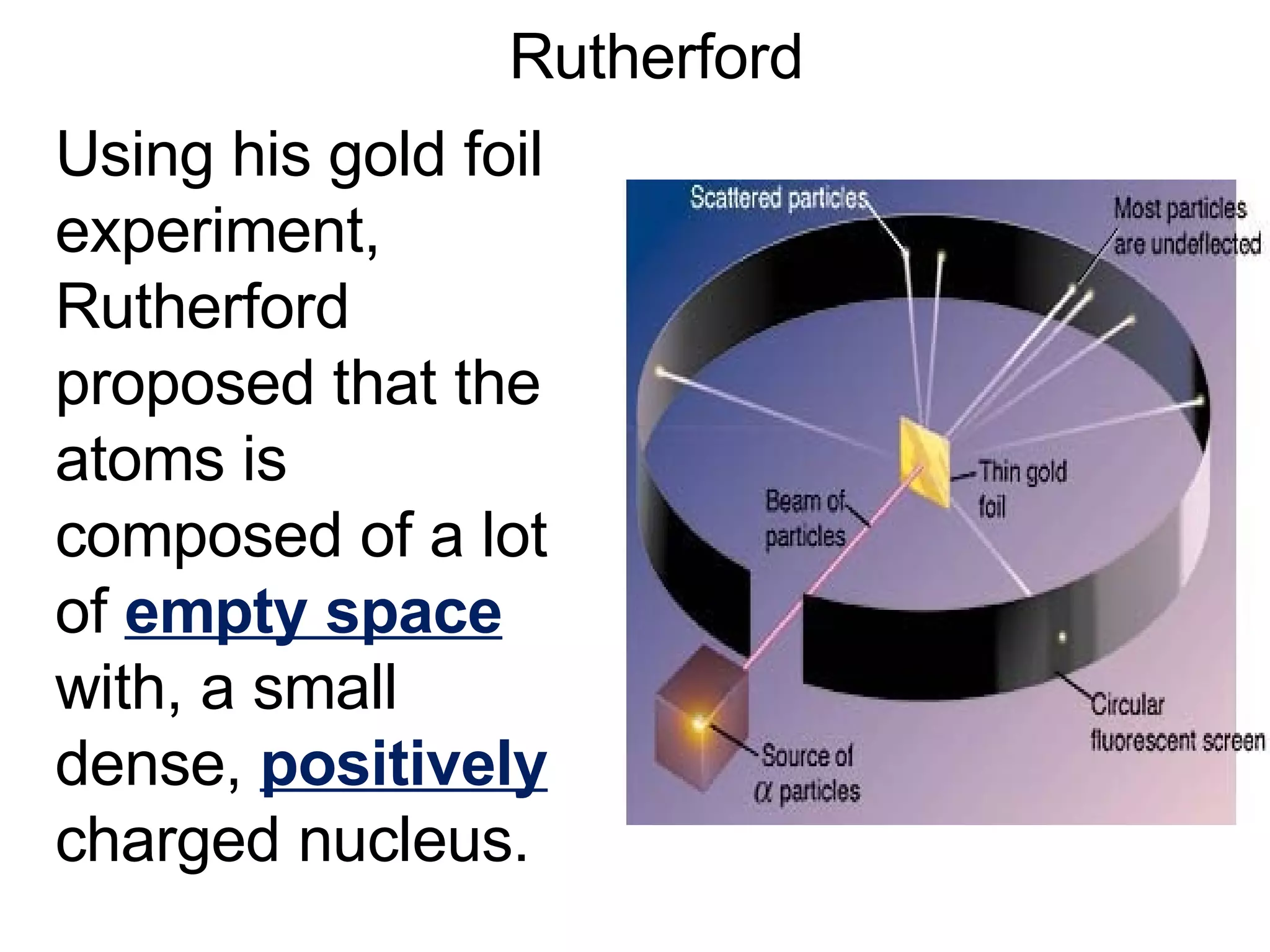
Rutherford Using hisgold foil experiment, Rutherford proposed that the atoms is composed of a lot of empty space with, a small dense, positively charged nucleus.
12.
13.
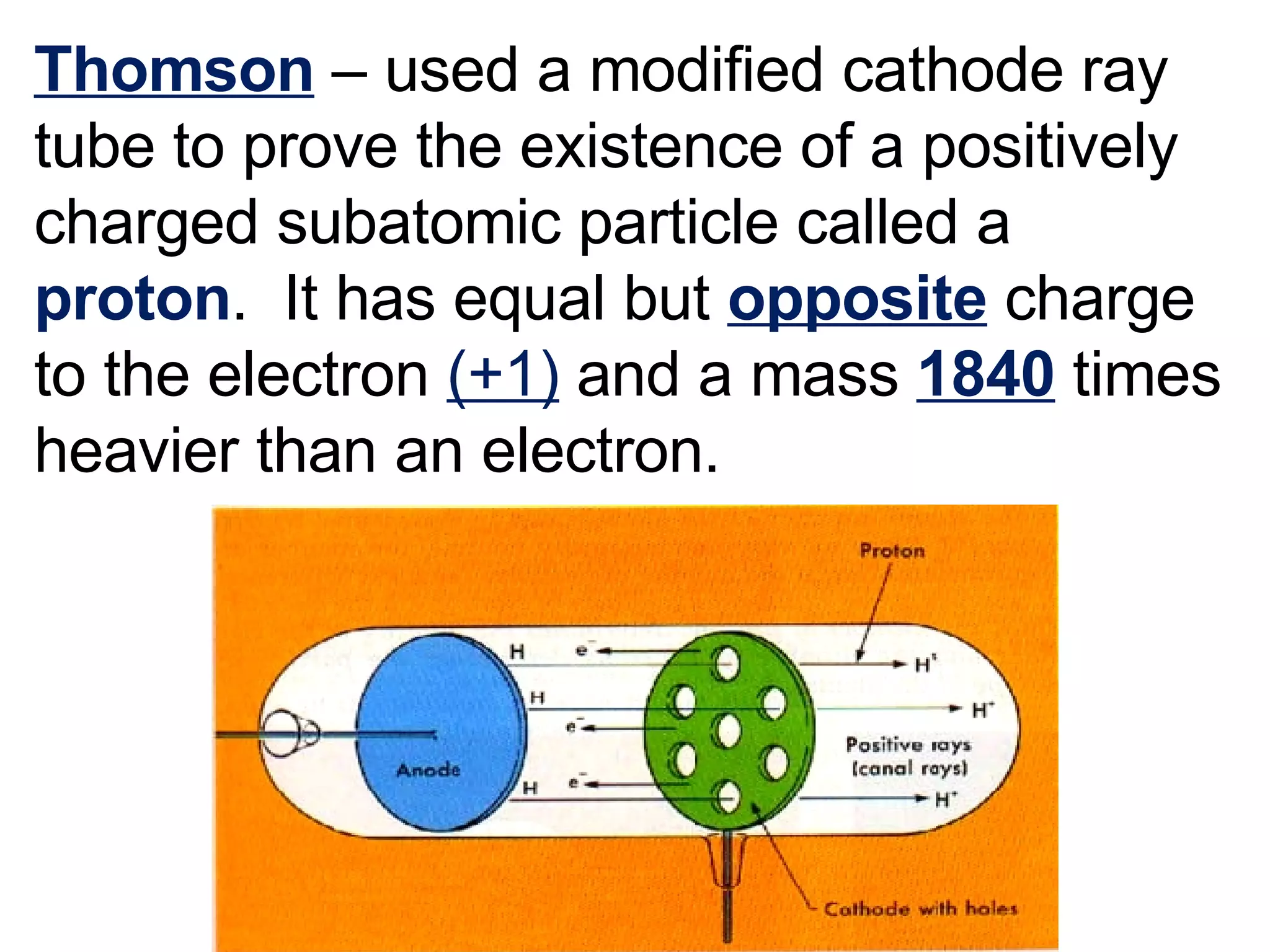
Thomson – used a modified cathode ray tube to prove the existence of a positively charged subatomic particle called a proton . It has equal but opposite charge to the electron (+1) and a mass 1840 times heavier than an electron.
14.
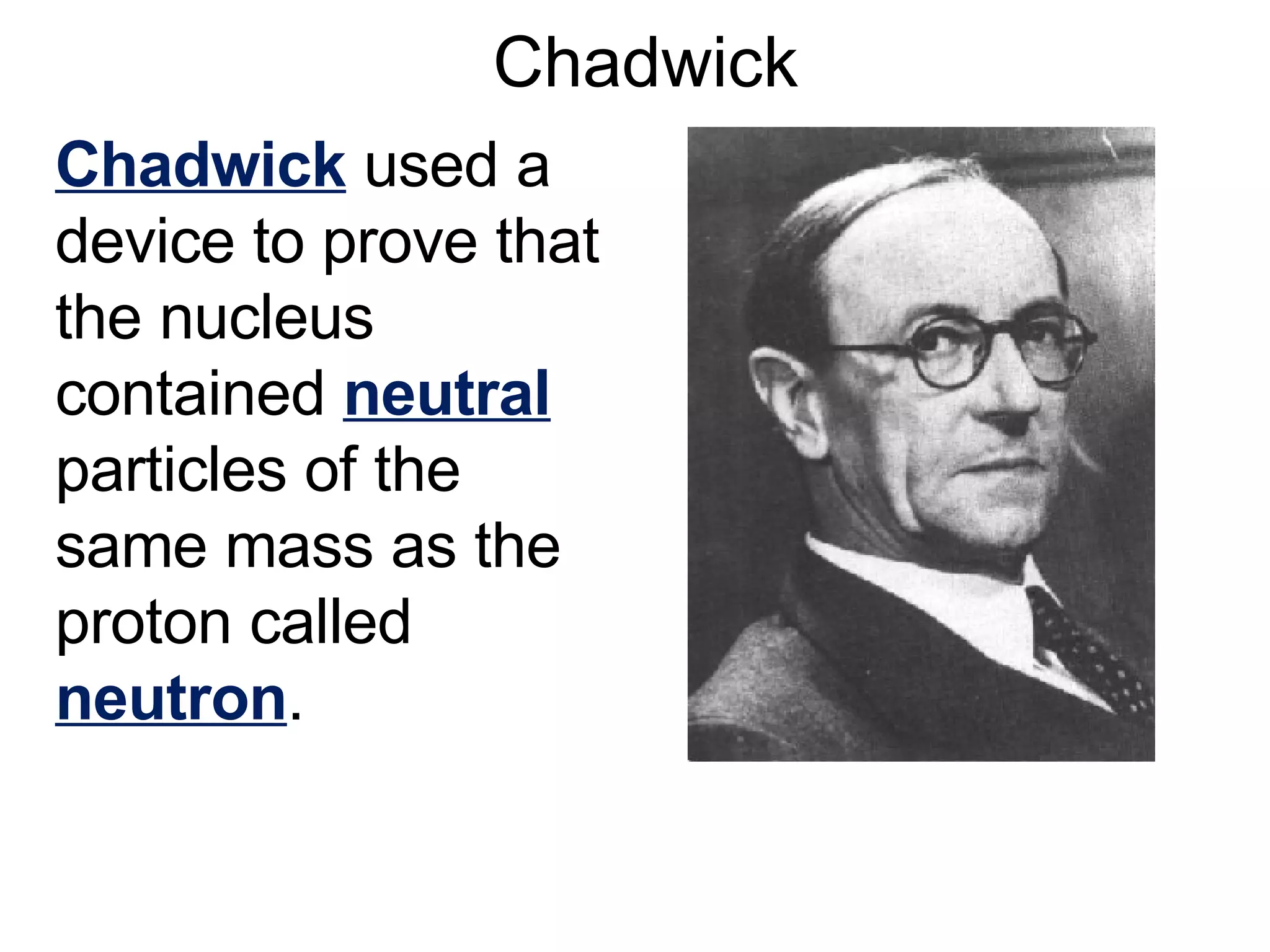
Chadwick Chadwick used a device to prove that the nucleus contained neutral particles of the same mass as the proton called neutron .
15.
16.
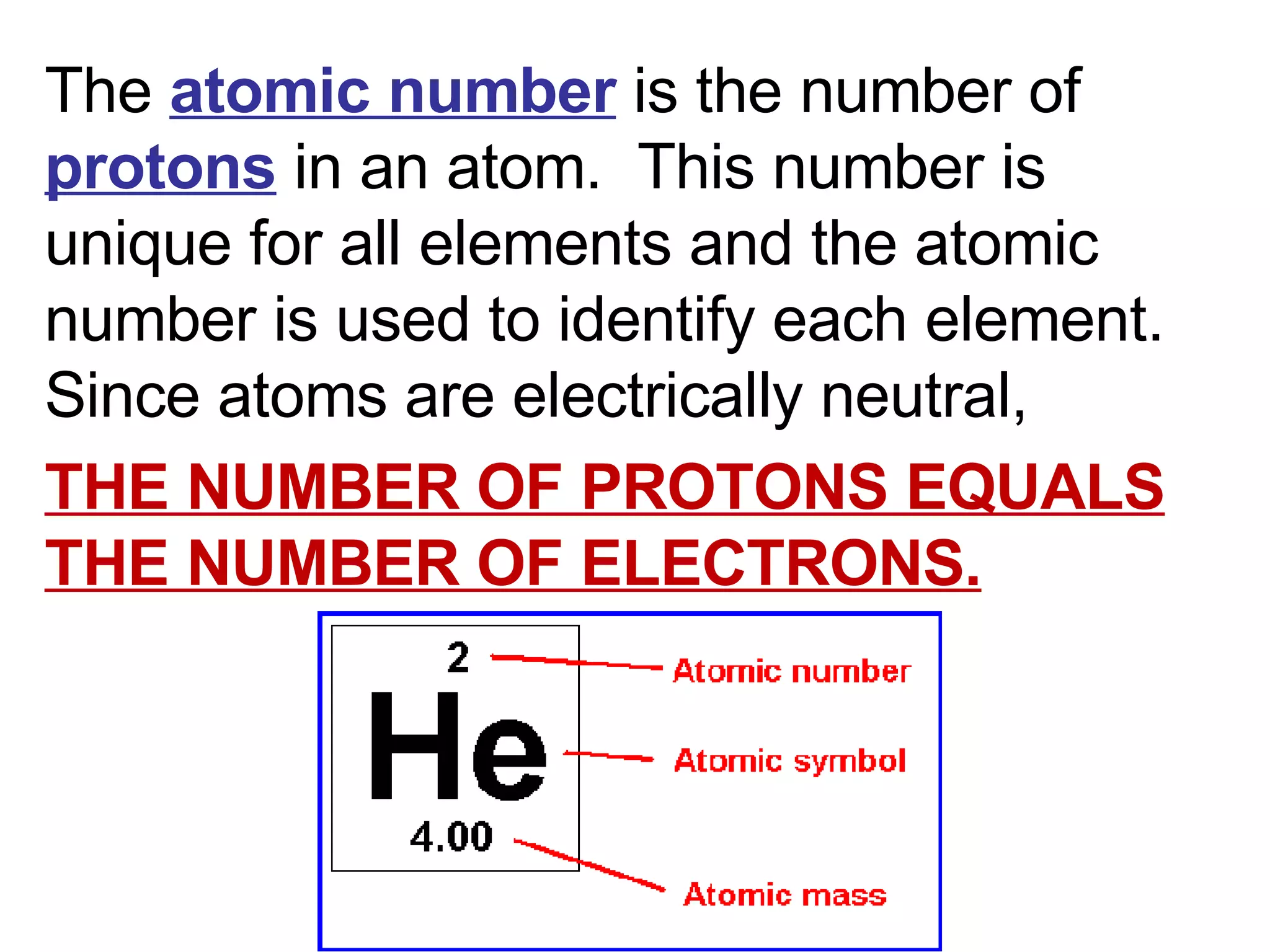
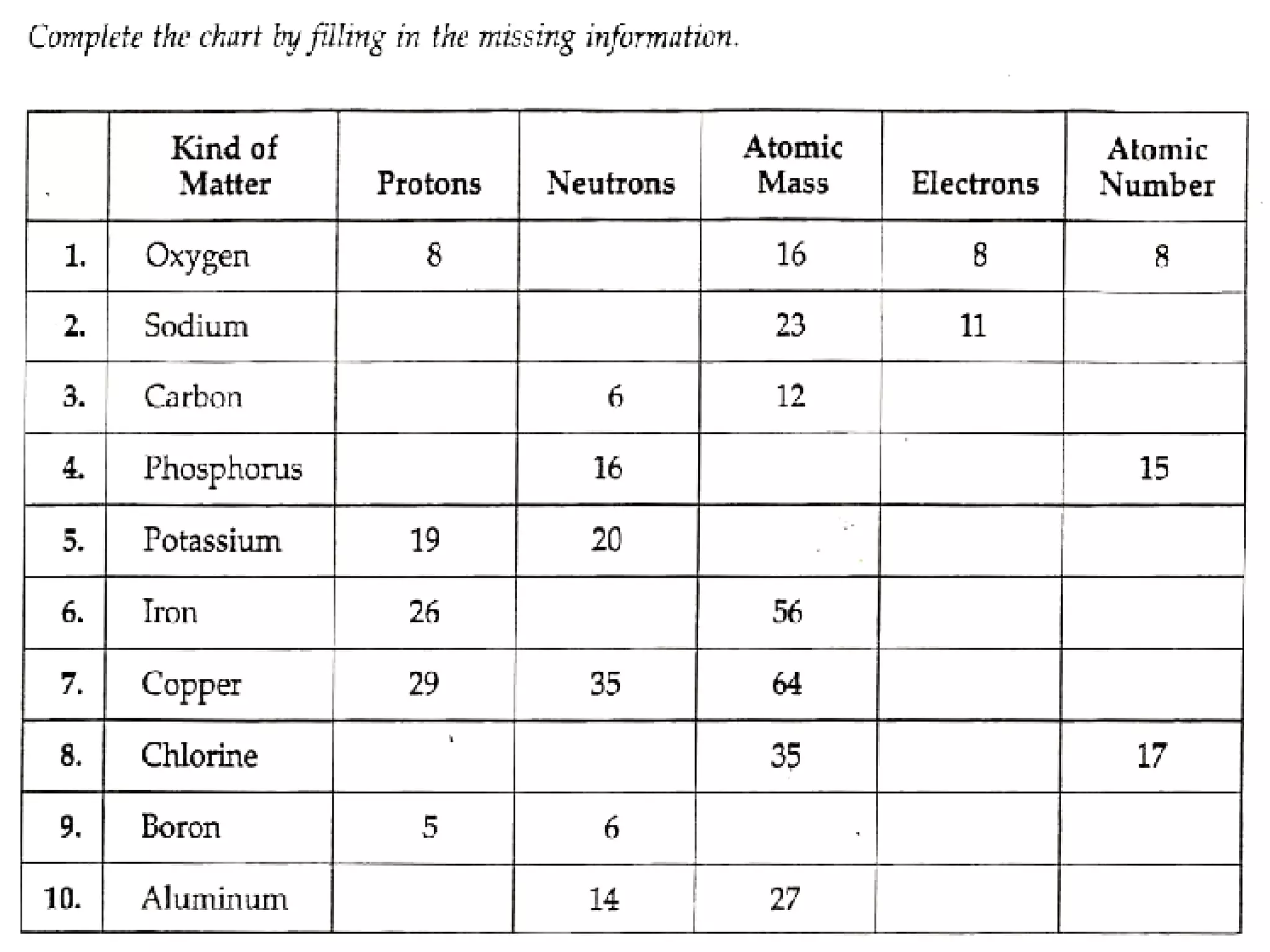
The atomicnumber is the number of protons in an atom. This number is unique for all elements and the atomic number is used to identify each element. Since atoms are electrically neutral, THE NUMBER OF PROTONS EQUALS THE NUMBER OF ELECTRONS.
17.
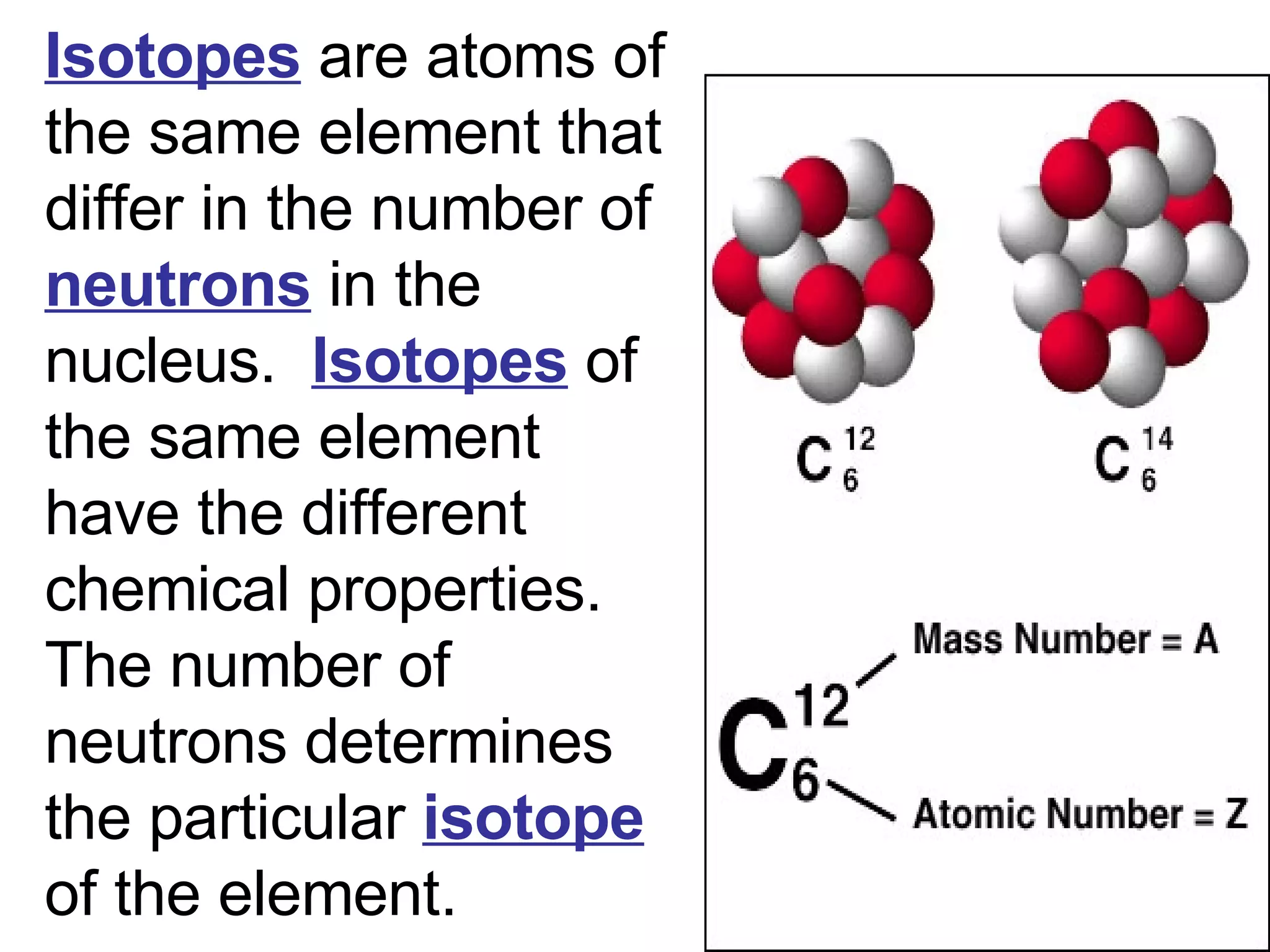
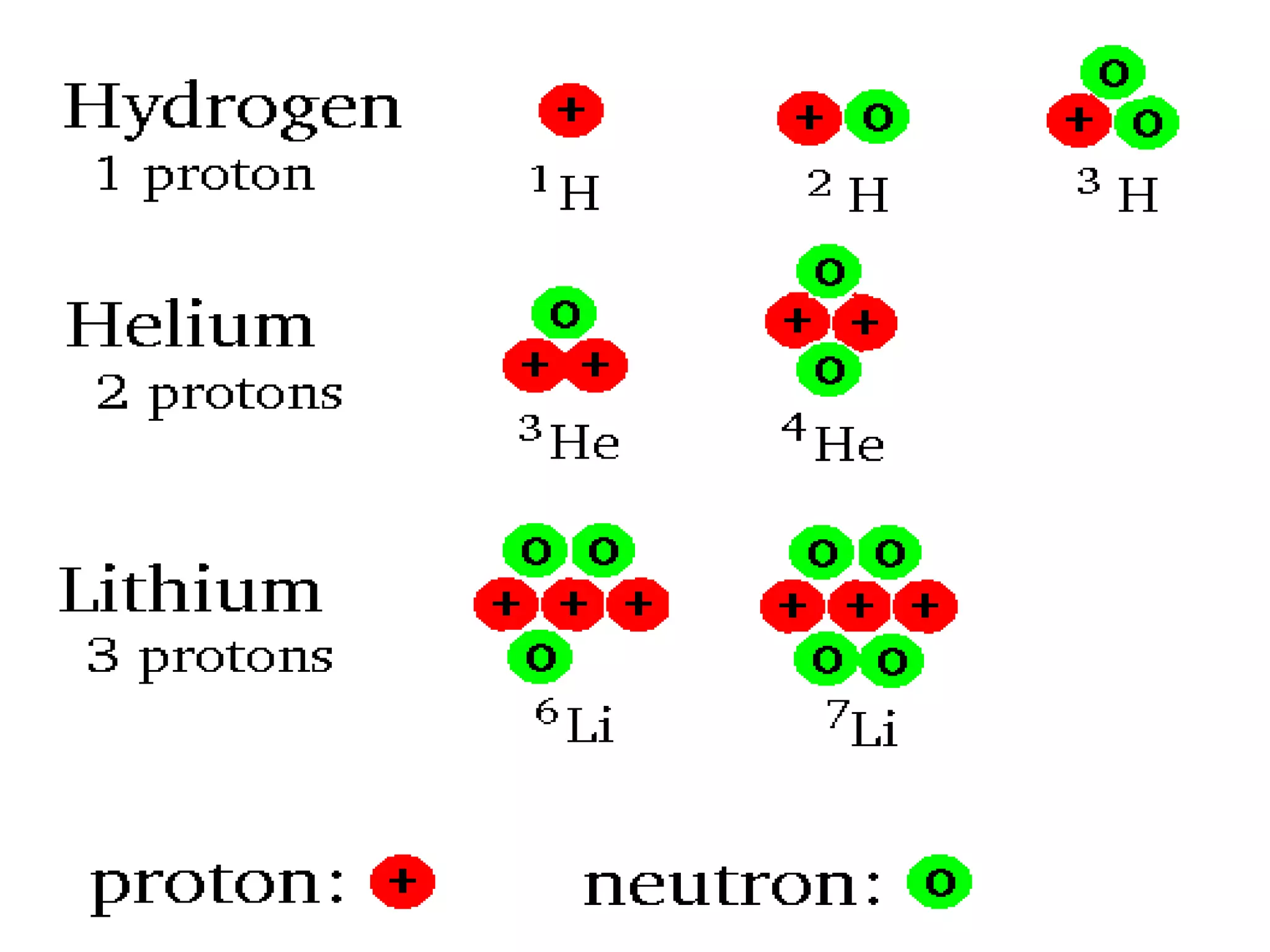
Isotopes are atoms of the same element that differ in the number of neutrons in the nucleus. Isotopes of the same element have the different chemical properties. The number of neutrons determines the particular isotope of the element.
18.
19.
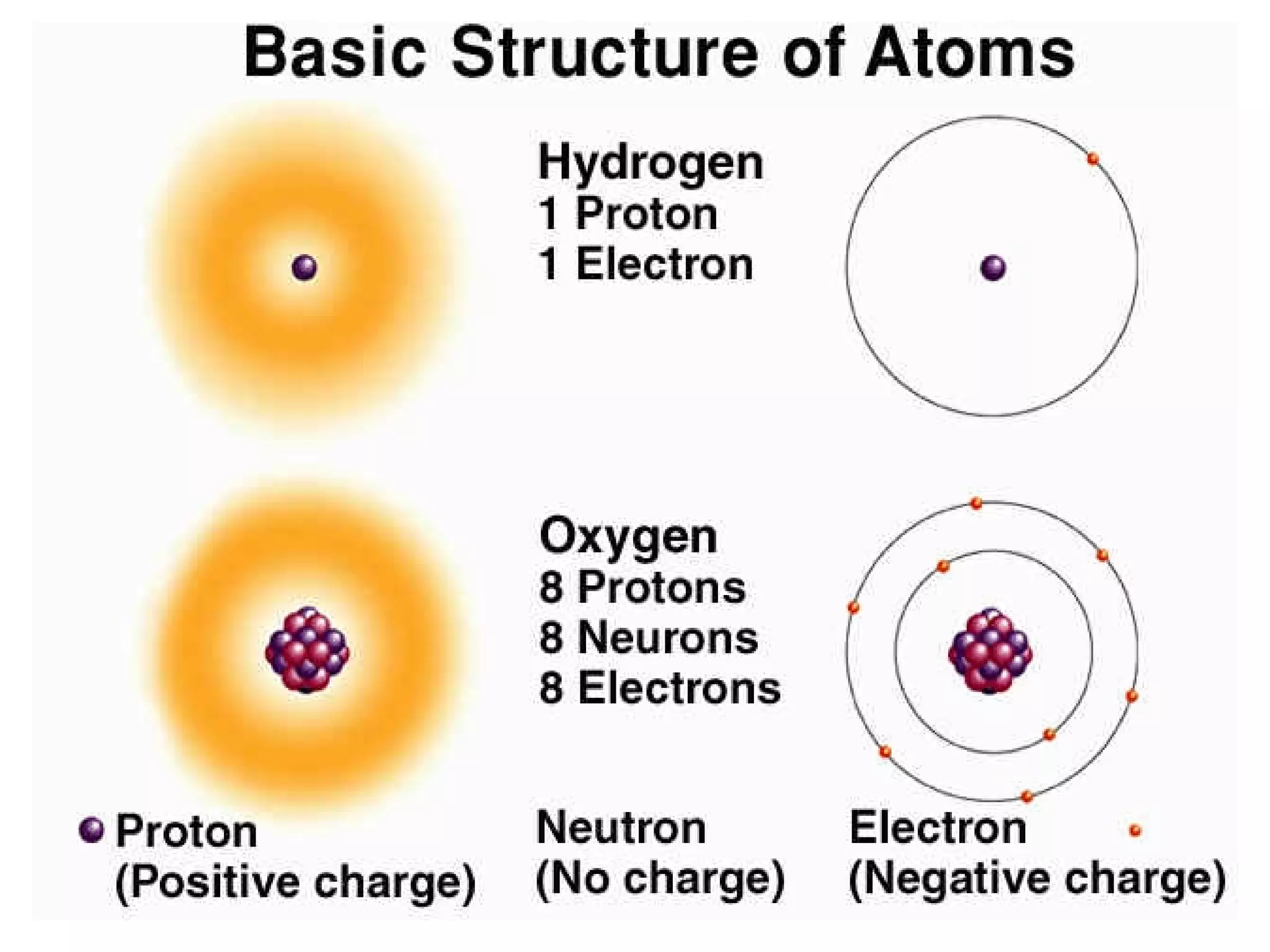
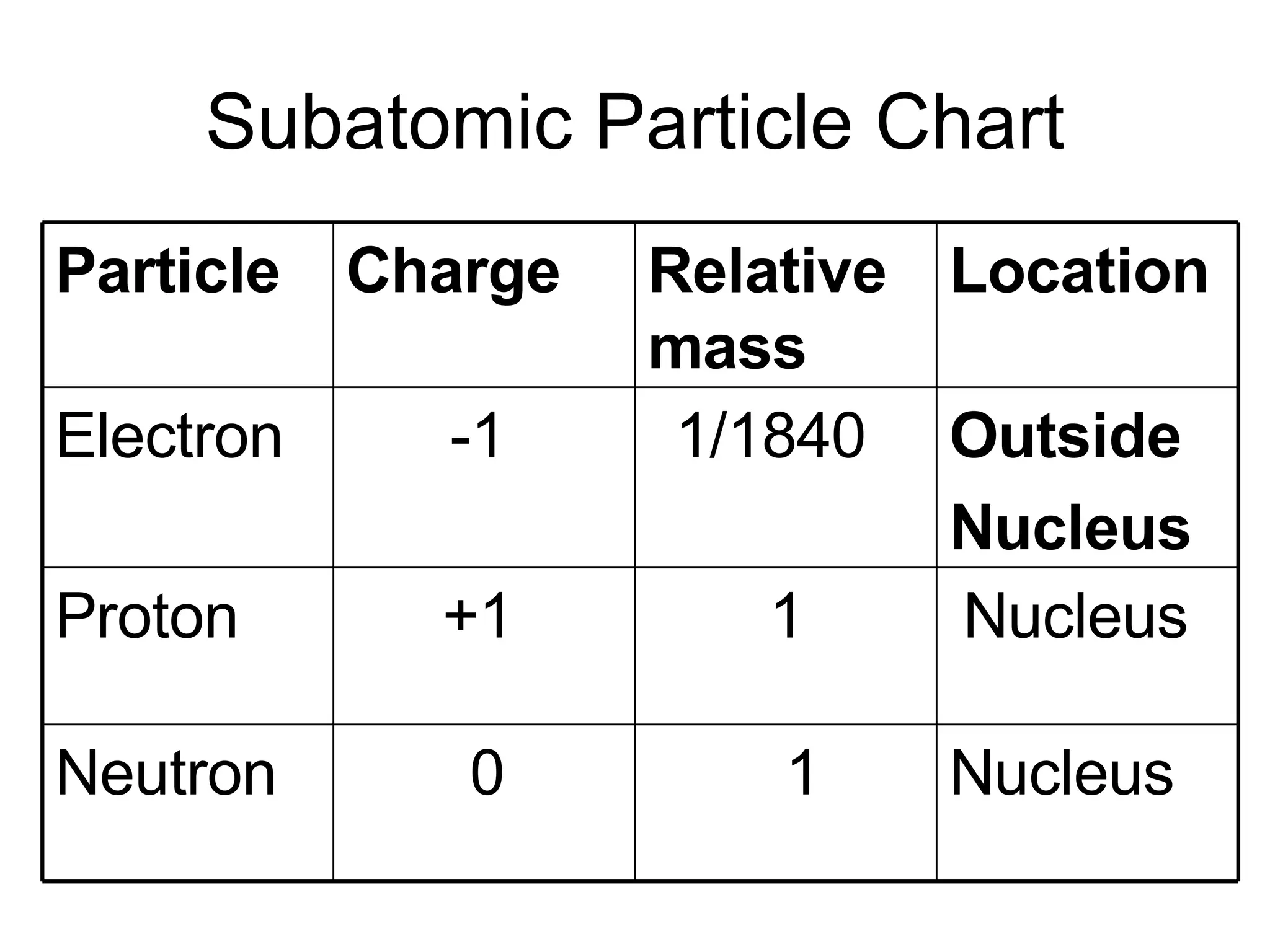
Subatomic Particle ChartParticle Charge Relative mass Location Electron -1 1/1840 Outside Nucleus Proton +1 1 Nucleus Neutron 0 1 Nucleus
20.
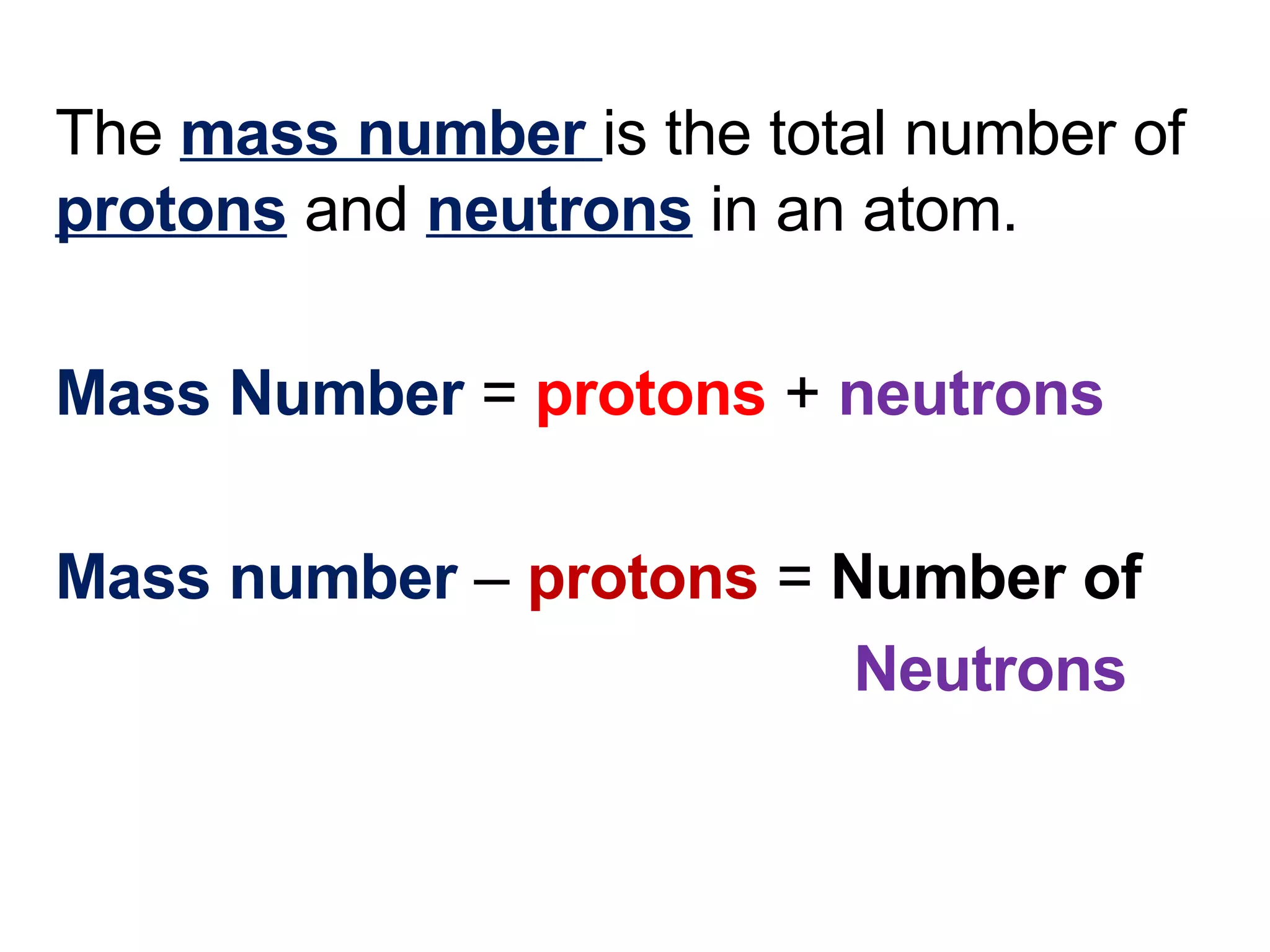
The massnumber is the total number of protons and neutrons in an atom. Mass Number = protons + neutrons Mass number – protons = Number of Neutrons
21.
22.
23.
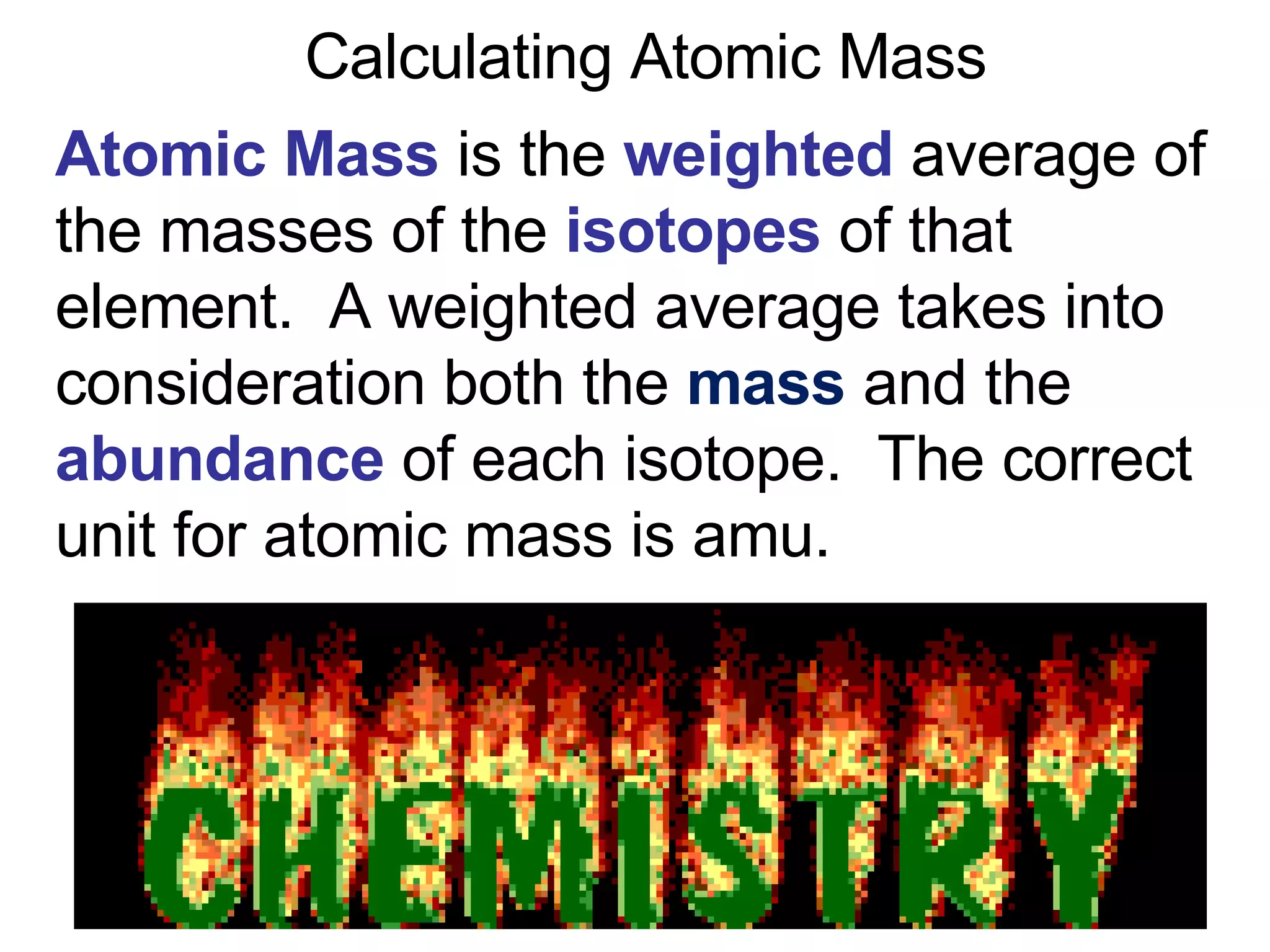
Calculating Atomic MassAtomic Mass is the weighted average of the masses of the isotopes of that element. A weighted average takes into consideration both the mass and the abundance of each isotope. The correct unit for atomic mass is amu.
24.
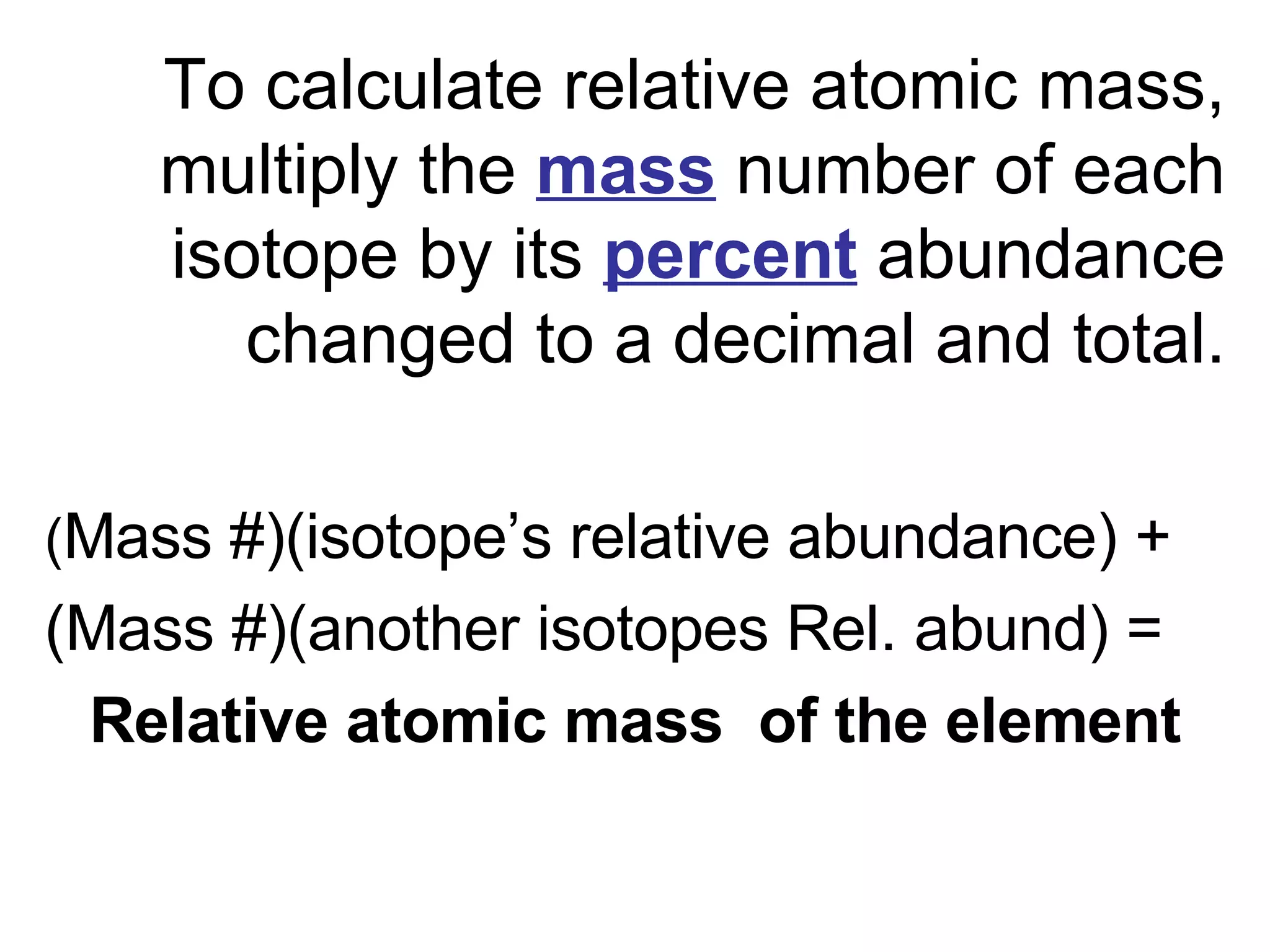
To calculate relativeatomic mass, multiply the mass number of each isotope by its percent abundance changed to a decimal and total. ( Mass #)(isotope’s relative abundance) + (Mass #)(another isotopes Rel. abund) = Relative atomic mass of the element
25.
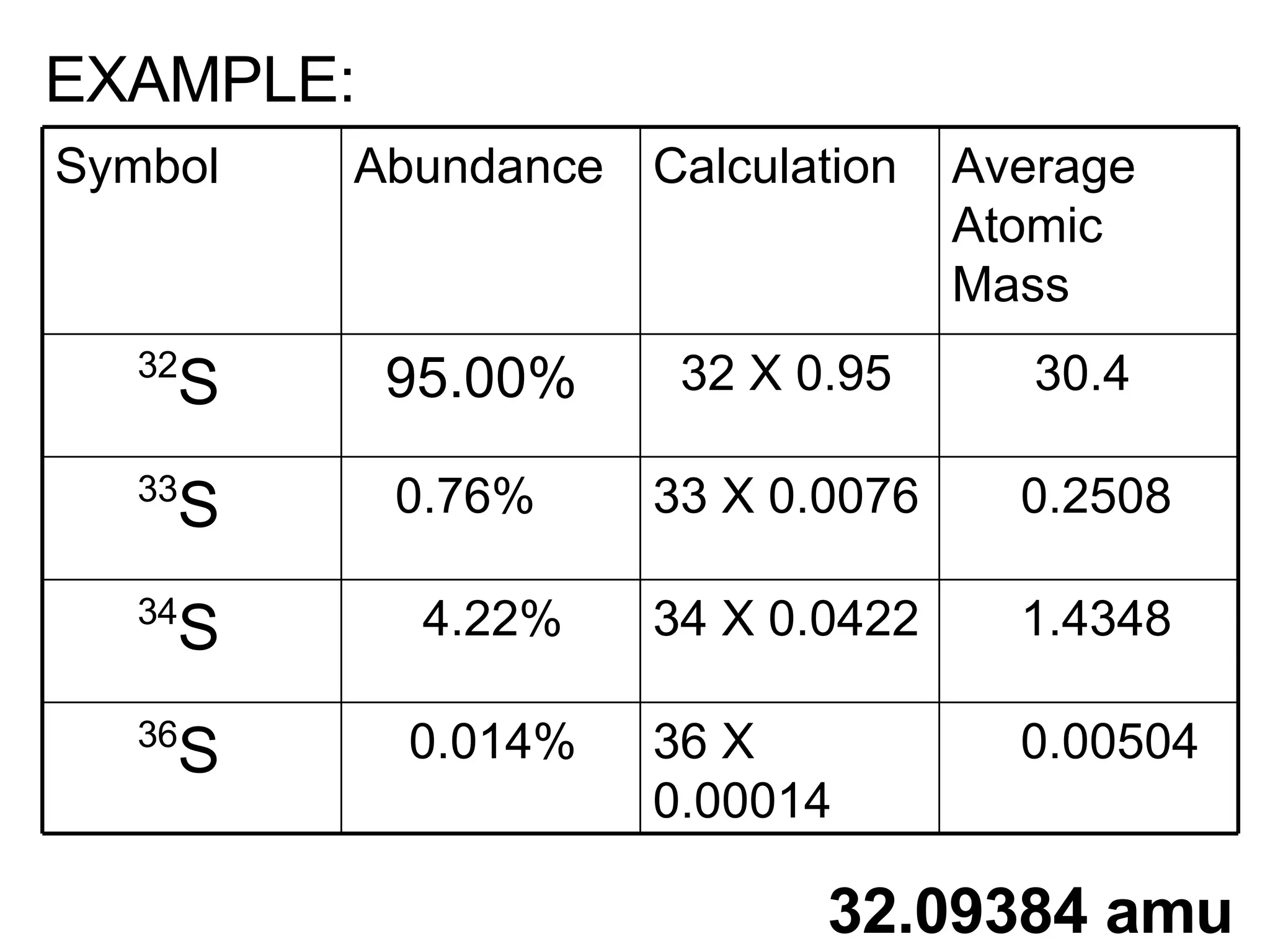
EXAMPLE: 32.09384 amuSymbol Abundance Calculation Average Atomic Mass 32 S 95.00% 32 X 0.95 30.4 33 S 0.76% 33 X 0.0076 0.2508 34 S 4.22% 34 X 0.0422 1.4348 36 S 0.014% 36 X 0.00014 0.00504
26.
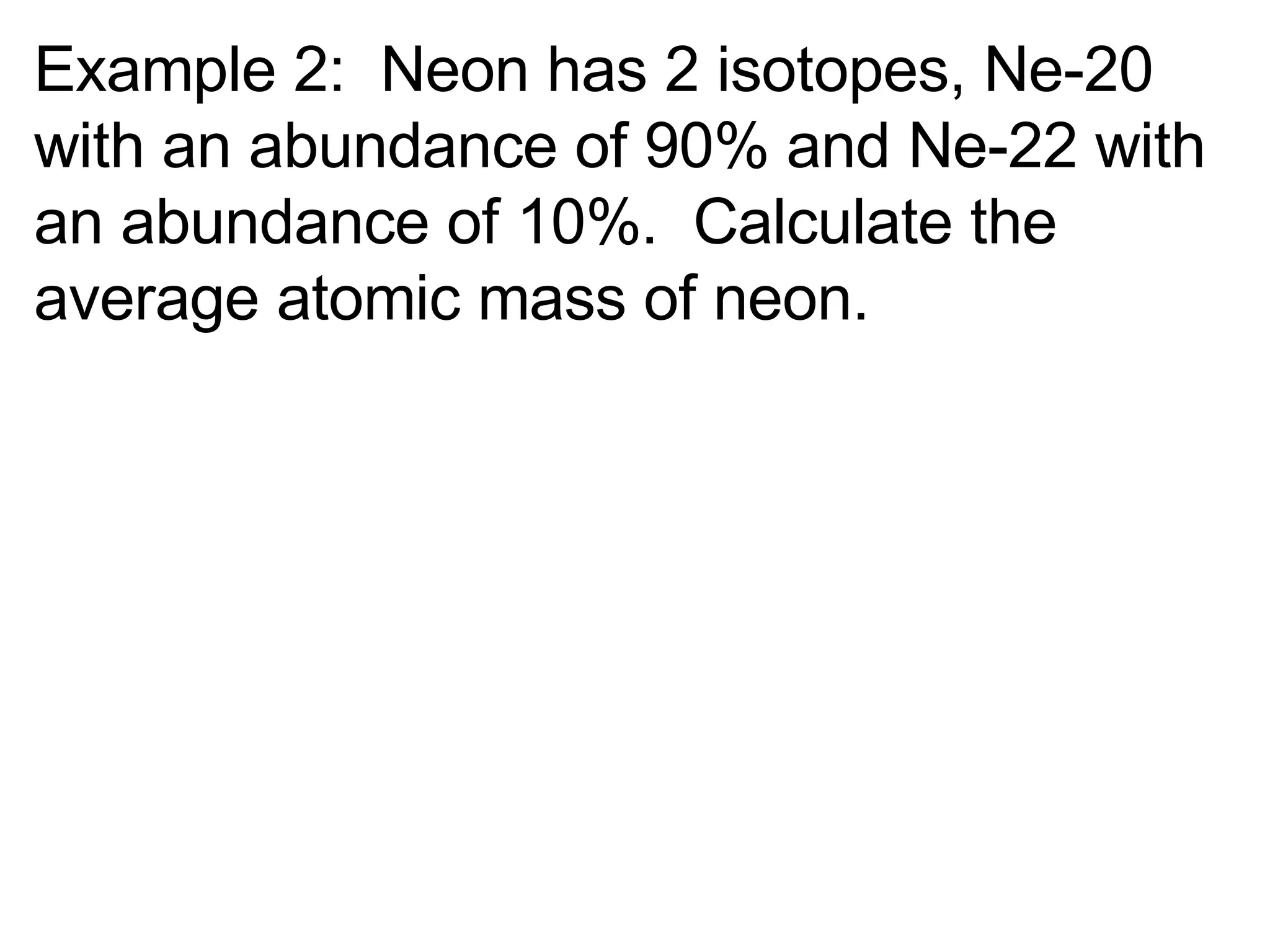
Example 2: Neon has 2 isotopes, Ne-20 with an abundance of 90% and Ne-22 with an abundance of 10%. Calculate the average atomic mass of neon.
27.
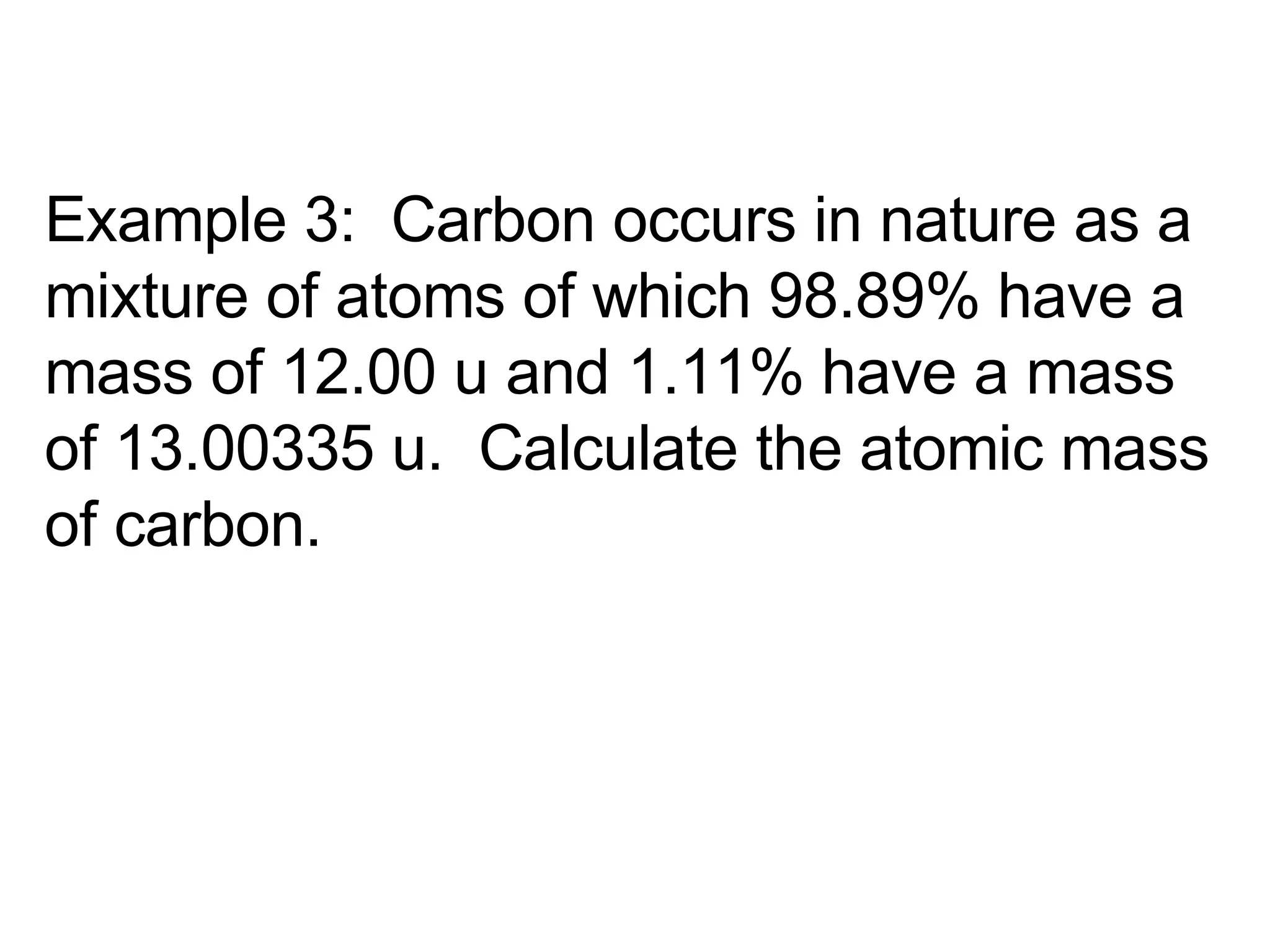
Example 3: Carbon occurs in nature as a mixture of atoms of which 98.89% have a mass of 12.00 u and 1.11% have a mass of 13.00335 u. Calculate the atomic mass of carbon.
28.
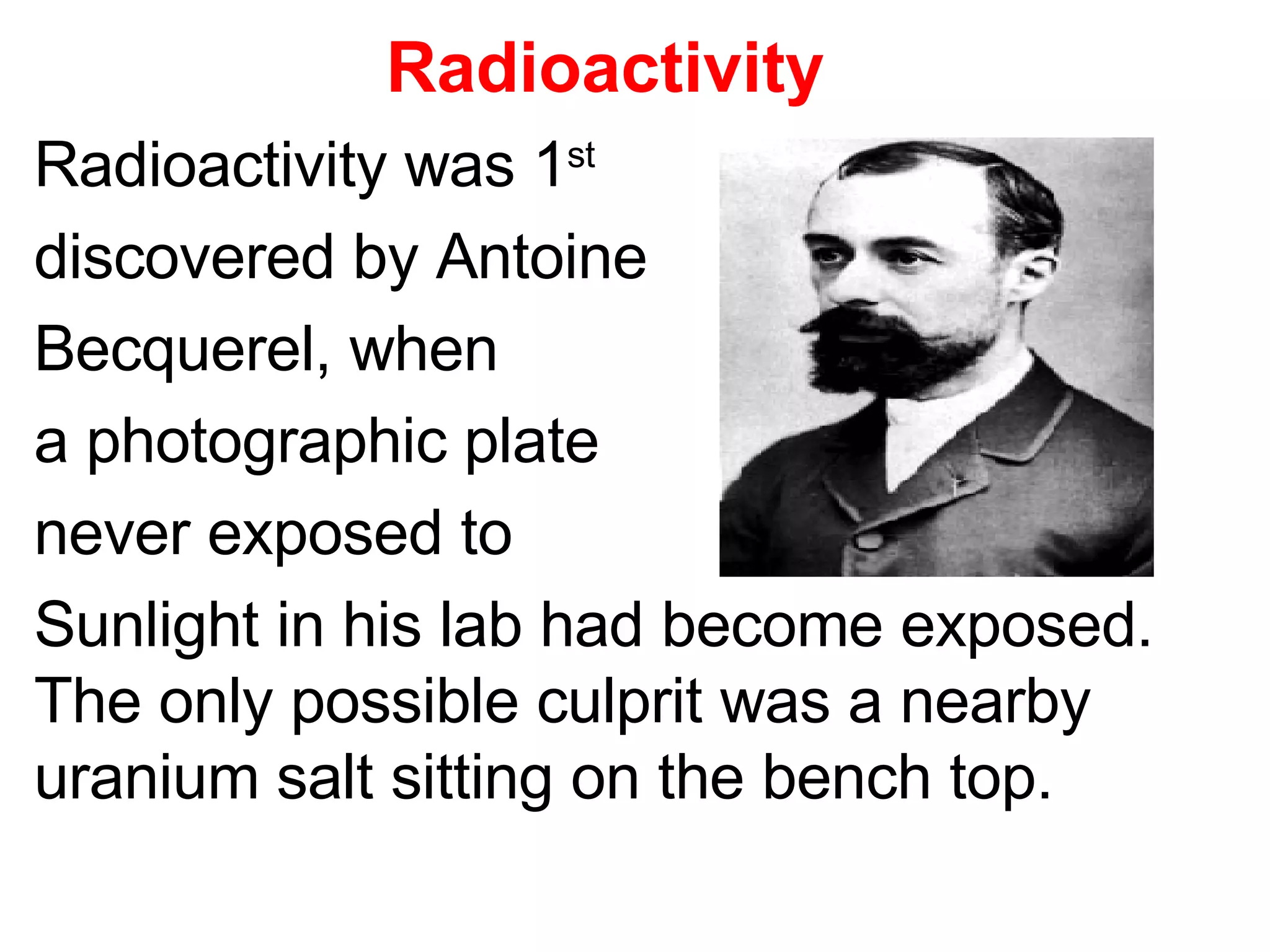
Radioactivity Radioactivity was 1 st discovered by Antoine Becquerel, when a photographic plate never exposed to Sunlight in his lab had become exposed. The only possible culprit was a nearby uranium salt sitting on the bench top.
29.
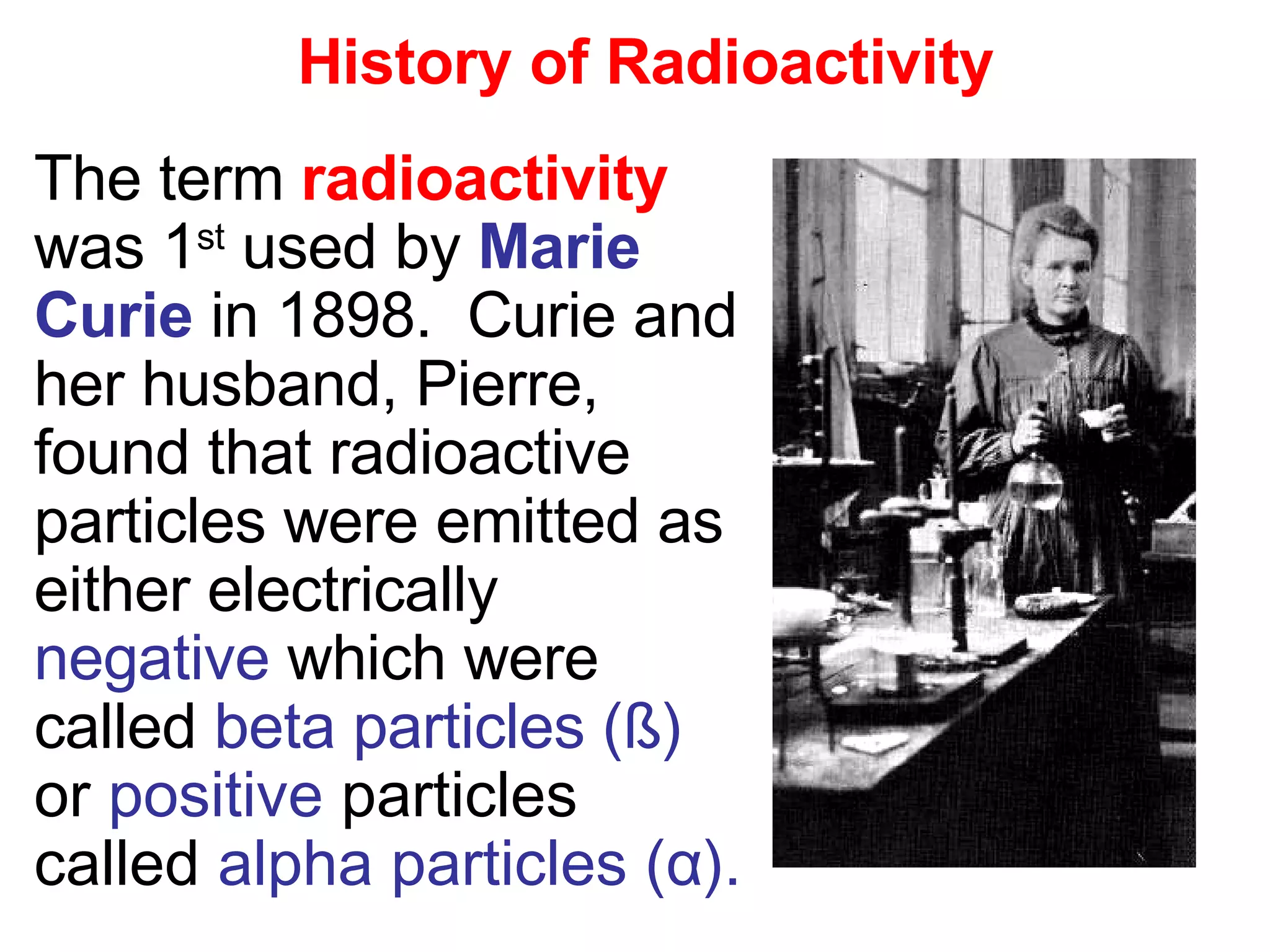
History of RadioactivityThe term radioactivity was 1 st used by Marie Curie in 1898. Curie and her husband, Pierre, found that radioactive particles were emitted as either electrically negative which were called beta particles ( ß) or positive particles called alpha particles ( α ).
Radioactivity isthe phenomenon of radiation (particles and/or energy) being ejected spontaneously by an unstable nucleus until it reaches a more stable arrangement.
32.
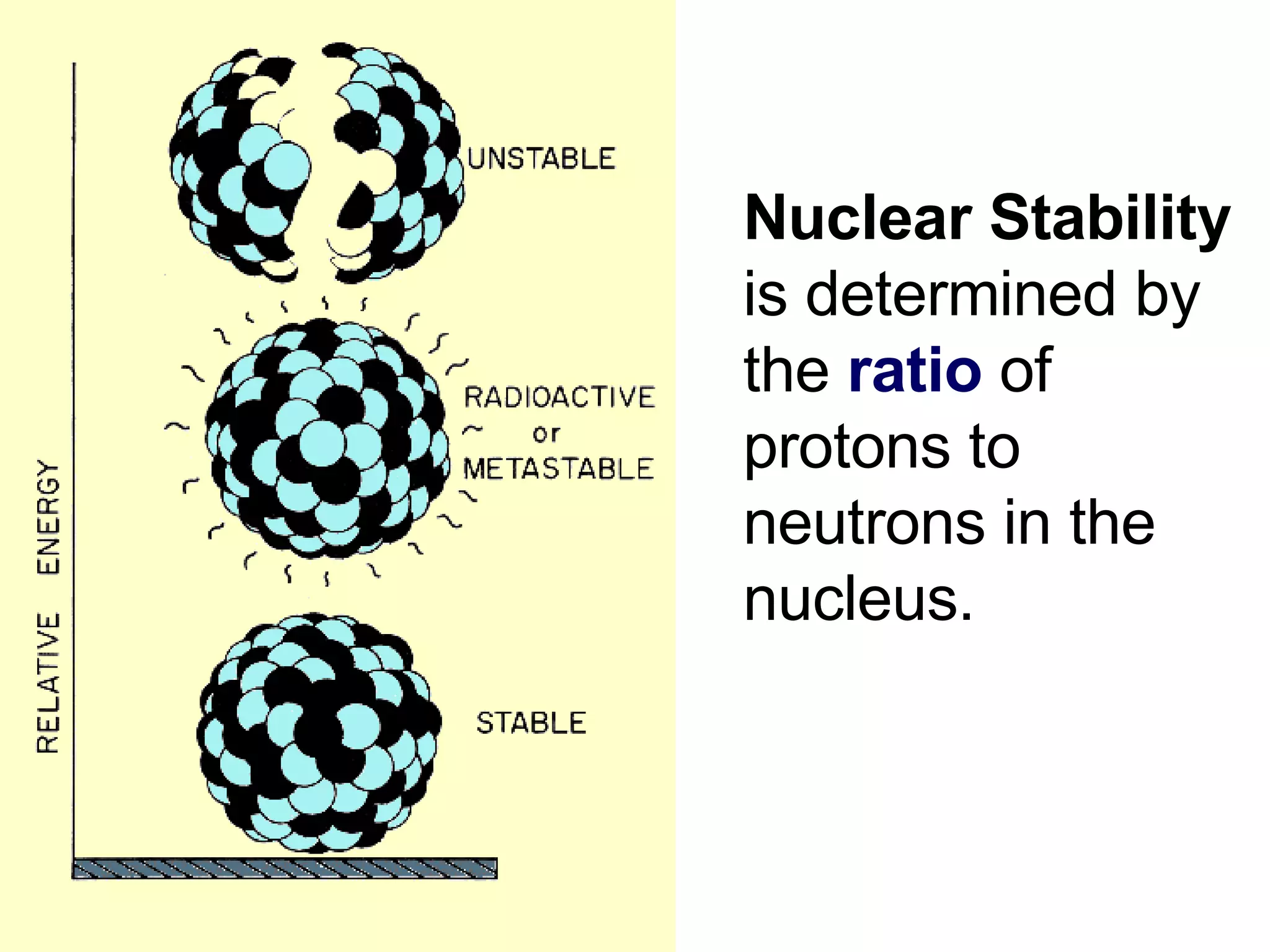
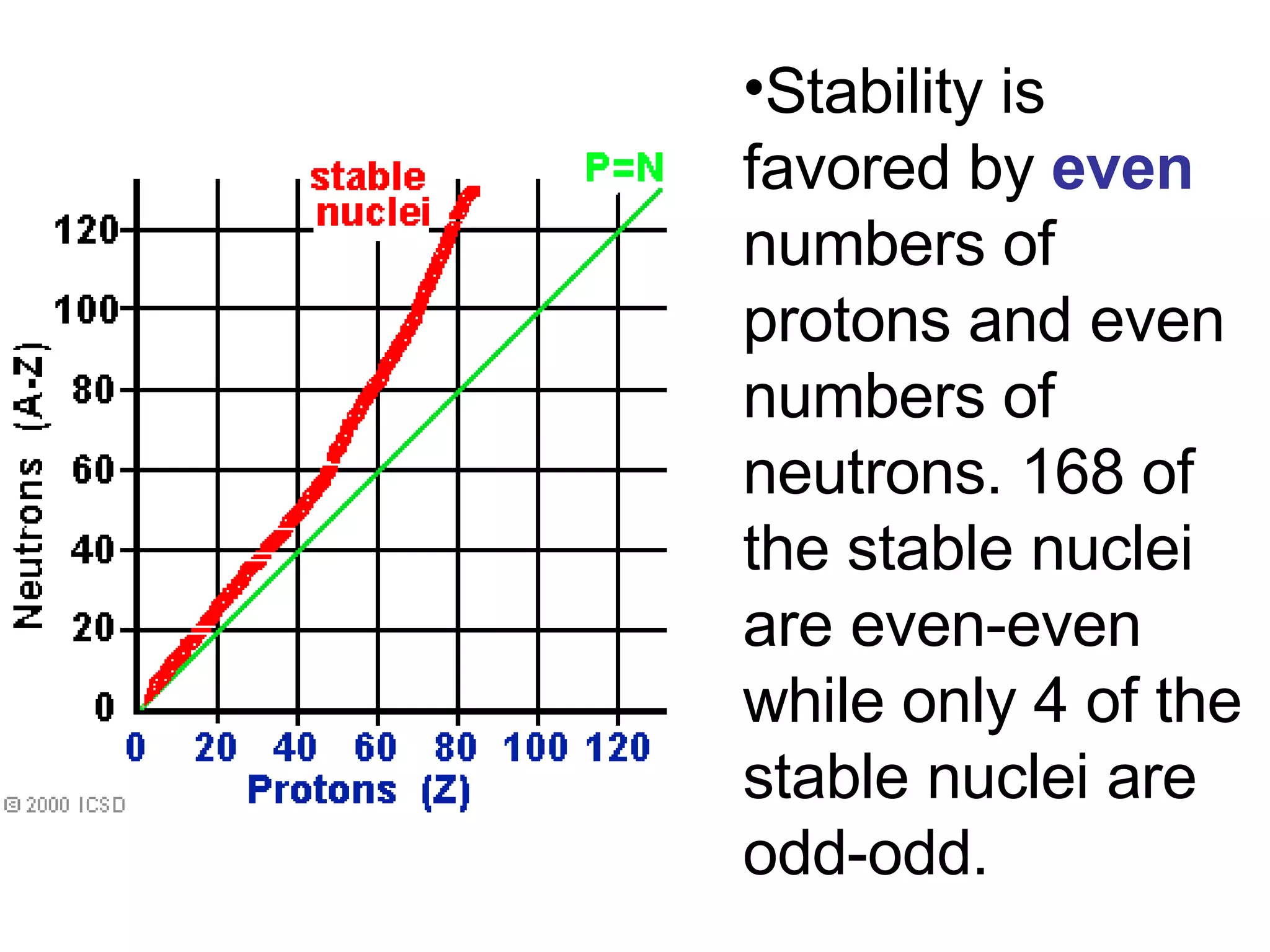
Nuclear Stability is determined by the ratio of protons to neutrons in the nucleus.
33.
There are forcesin the nucleus that oppose each other, the " Strong " force holding Protons and Neutrons to each other and the electrostatic force of protons repelling other protons. Under certain arrangements of protons and neutrons the electrostatic force can cause instability in the nucleus causing it to decay. It will continue to decay until it reaches a stable combination.
34.
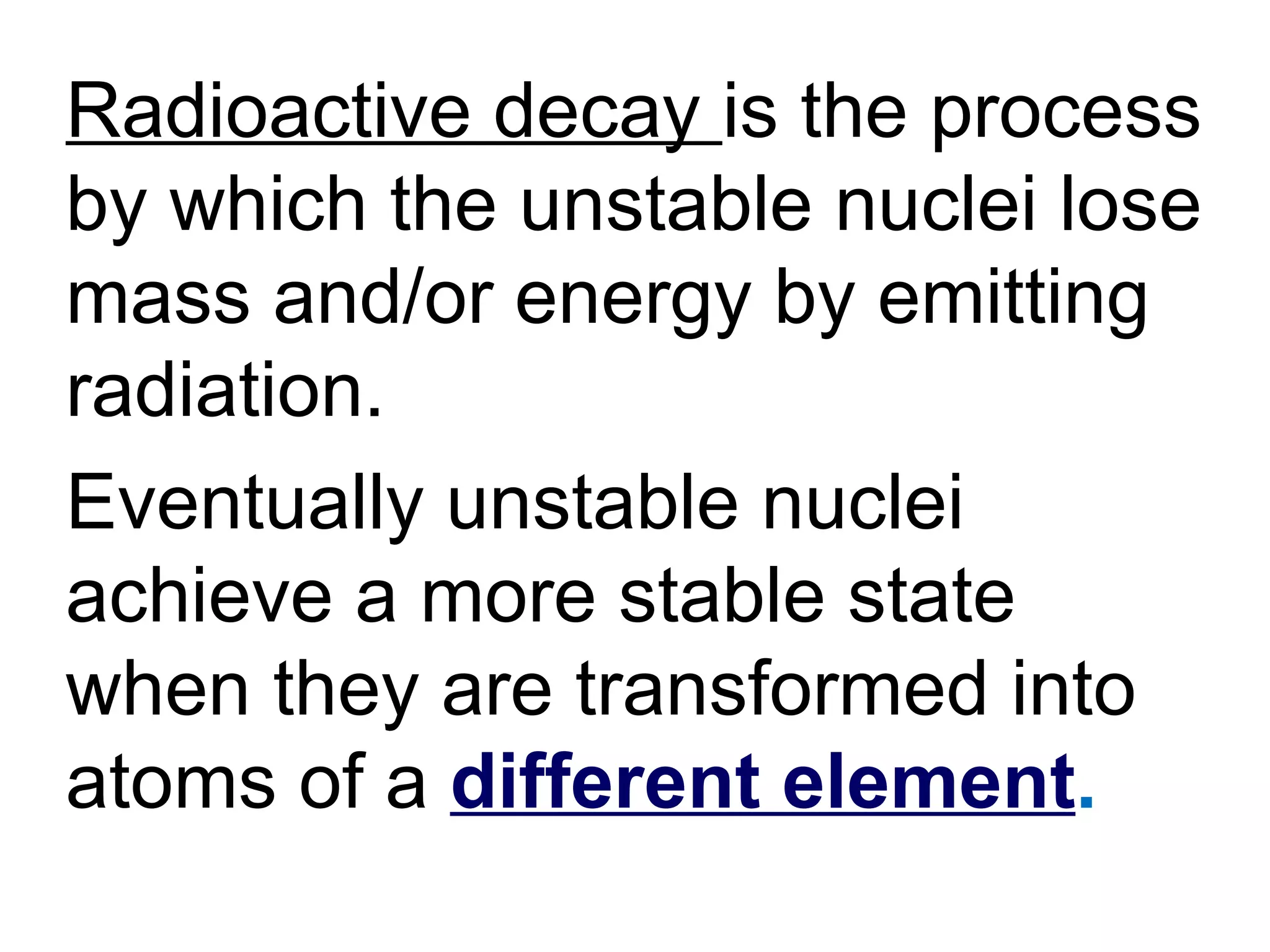
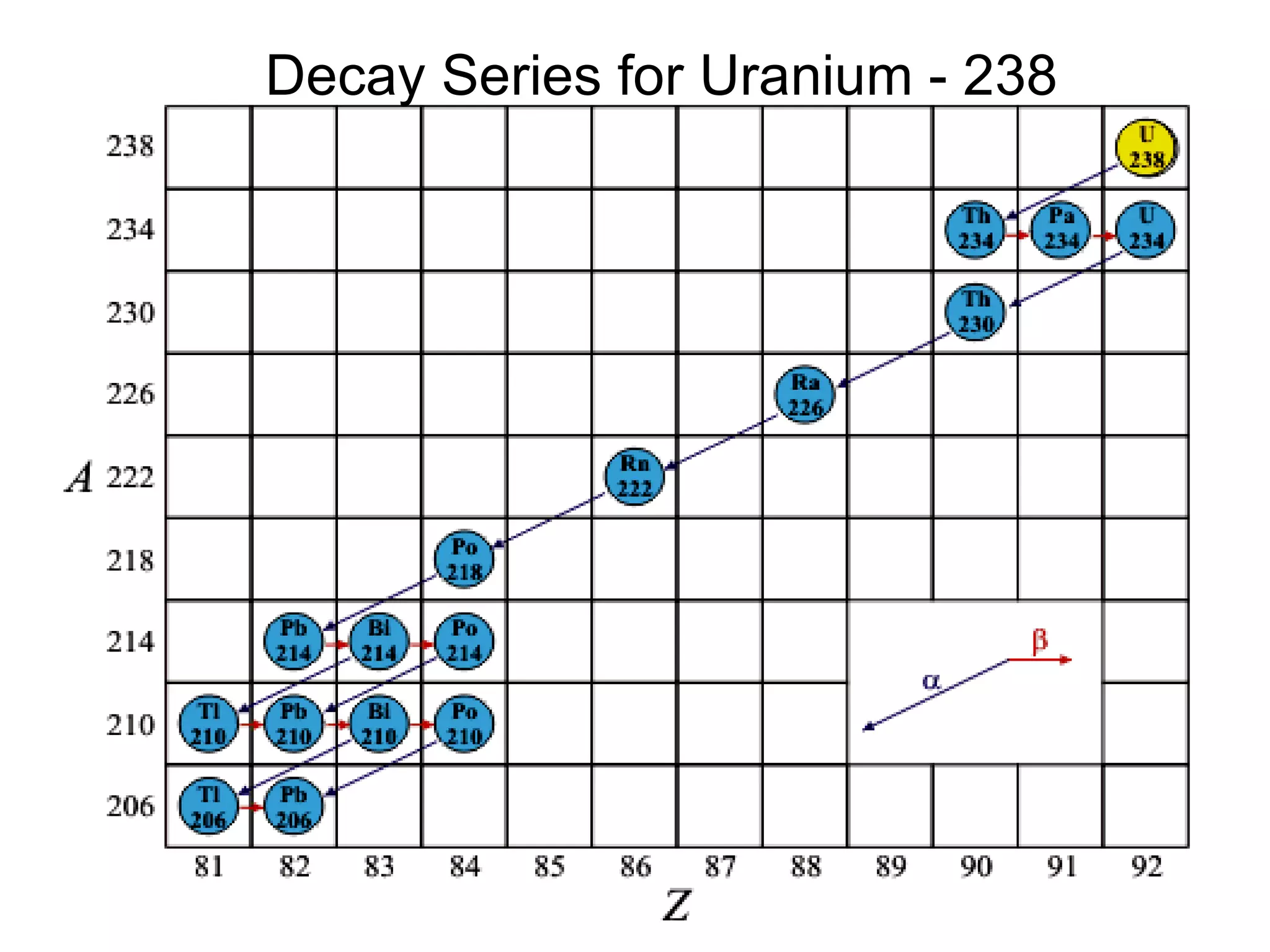
Radioactive decay is the process by which the unstable nuclei lose mass and/or energy by emitting radiation. Eventually unstable nuclei achieve a more stable state when they are transformed into atoms of a different element .
35.
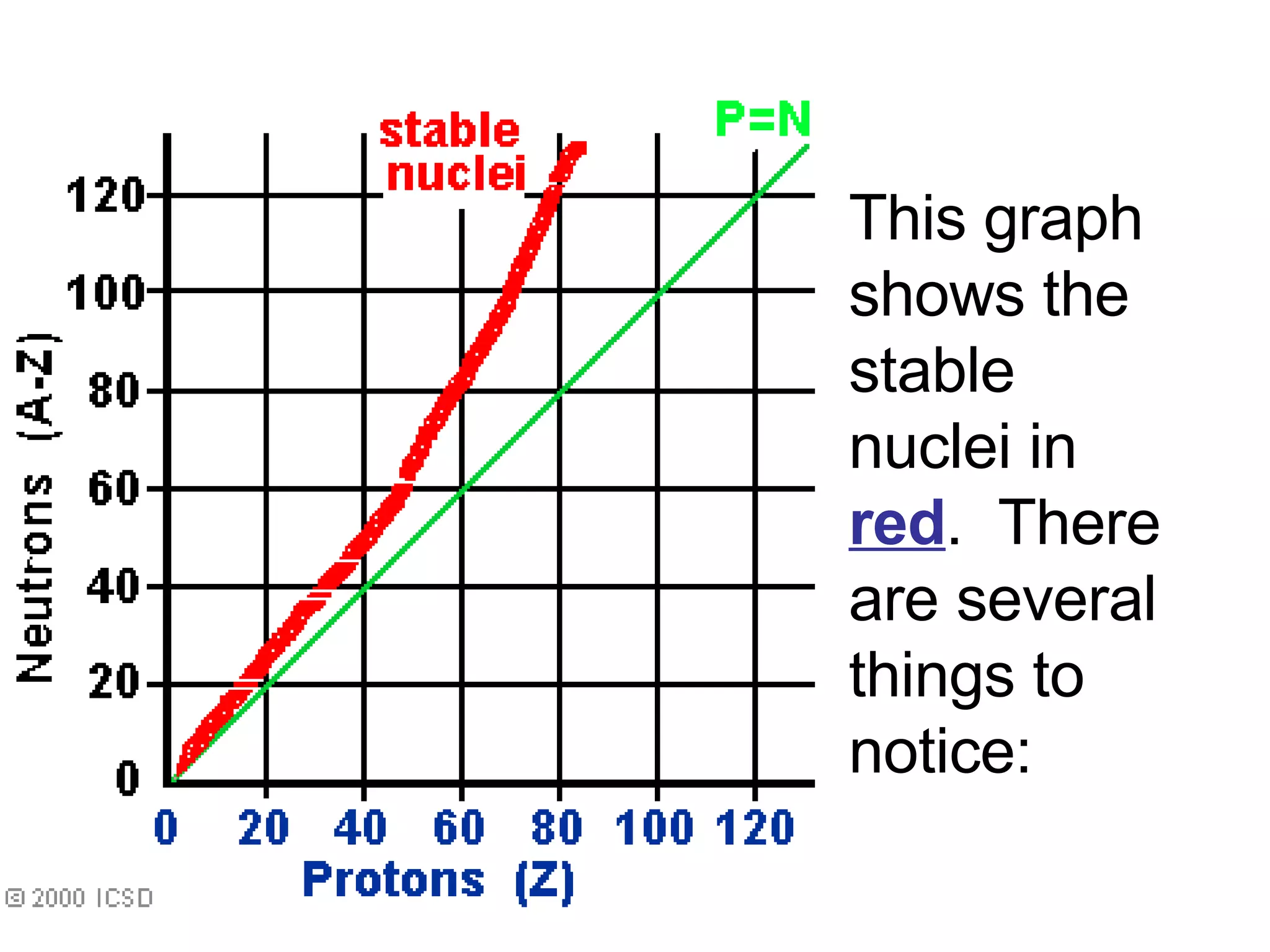
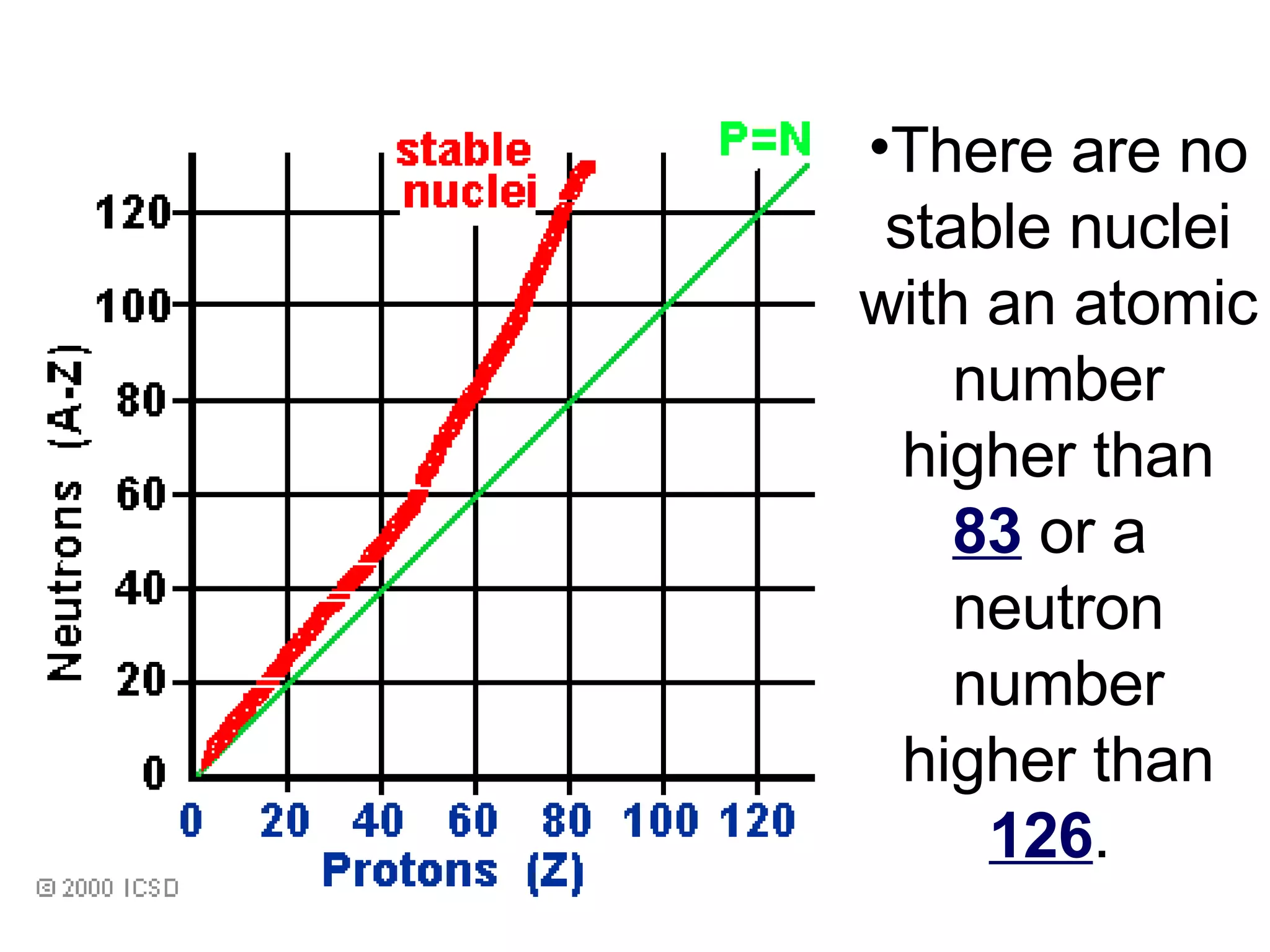
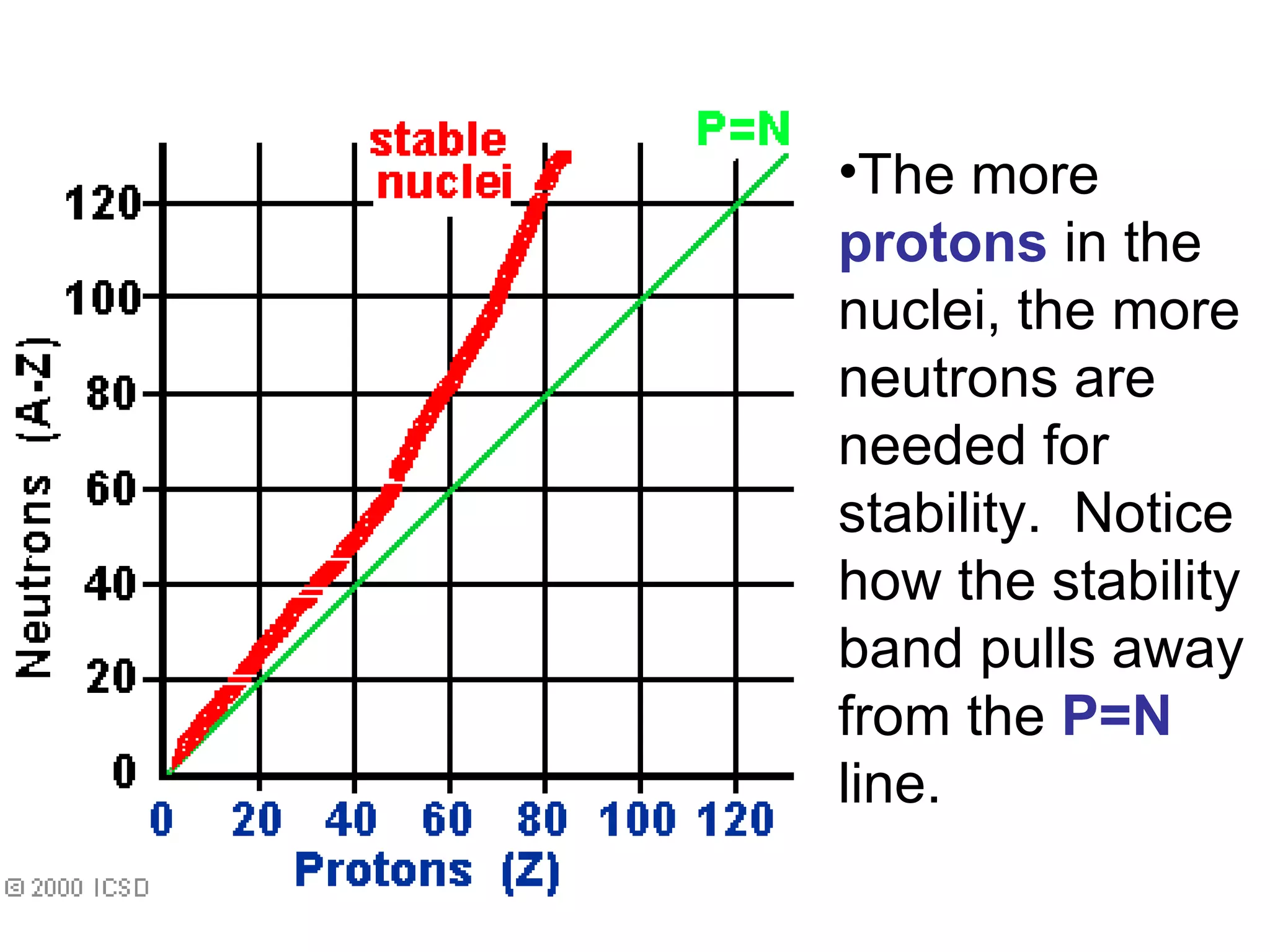
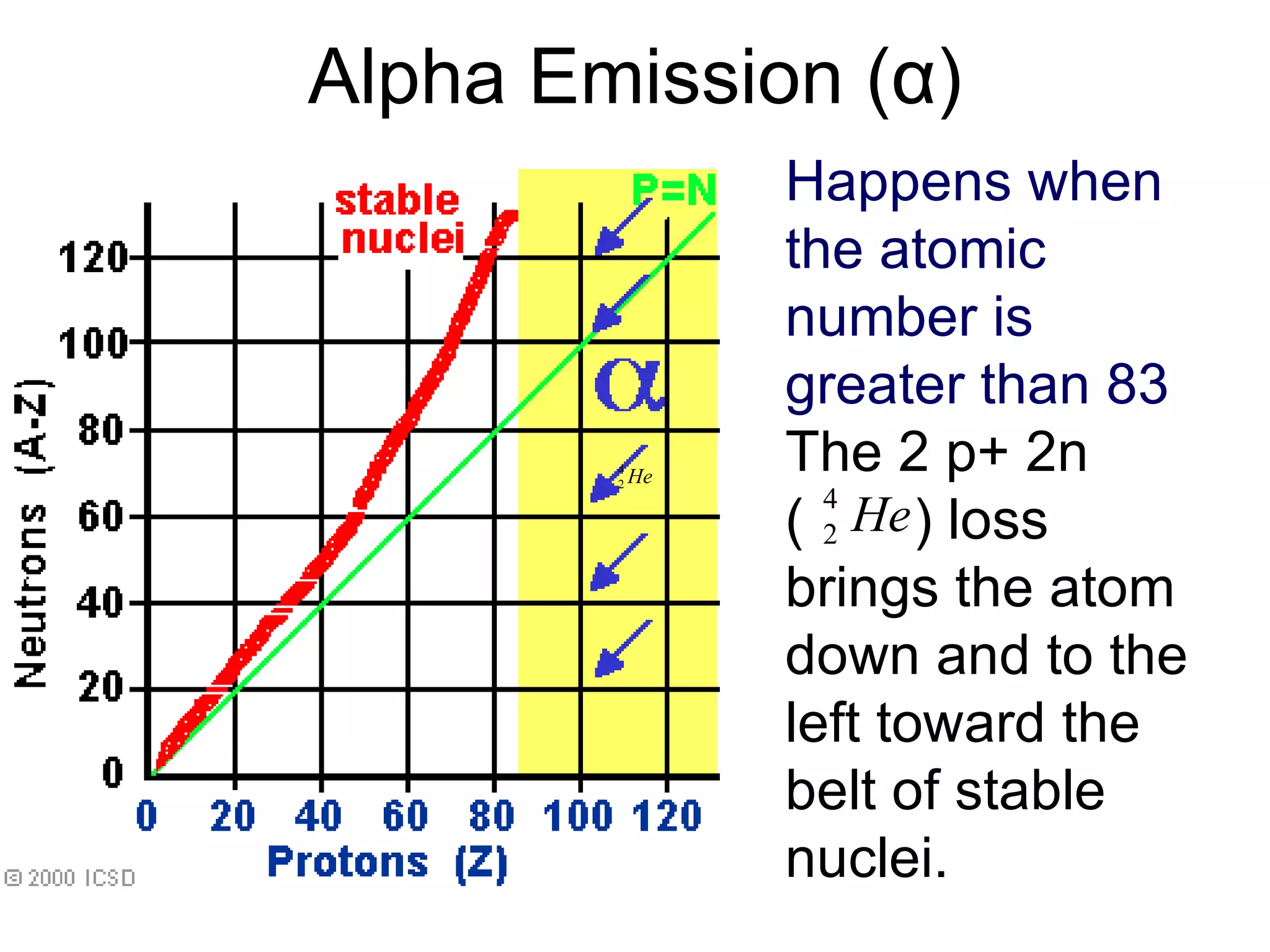
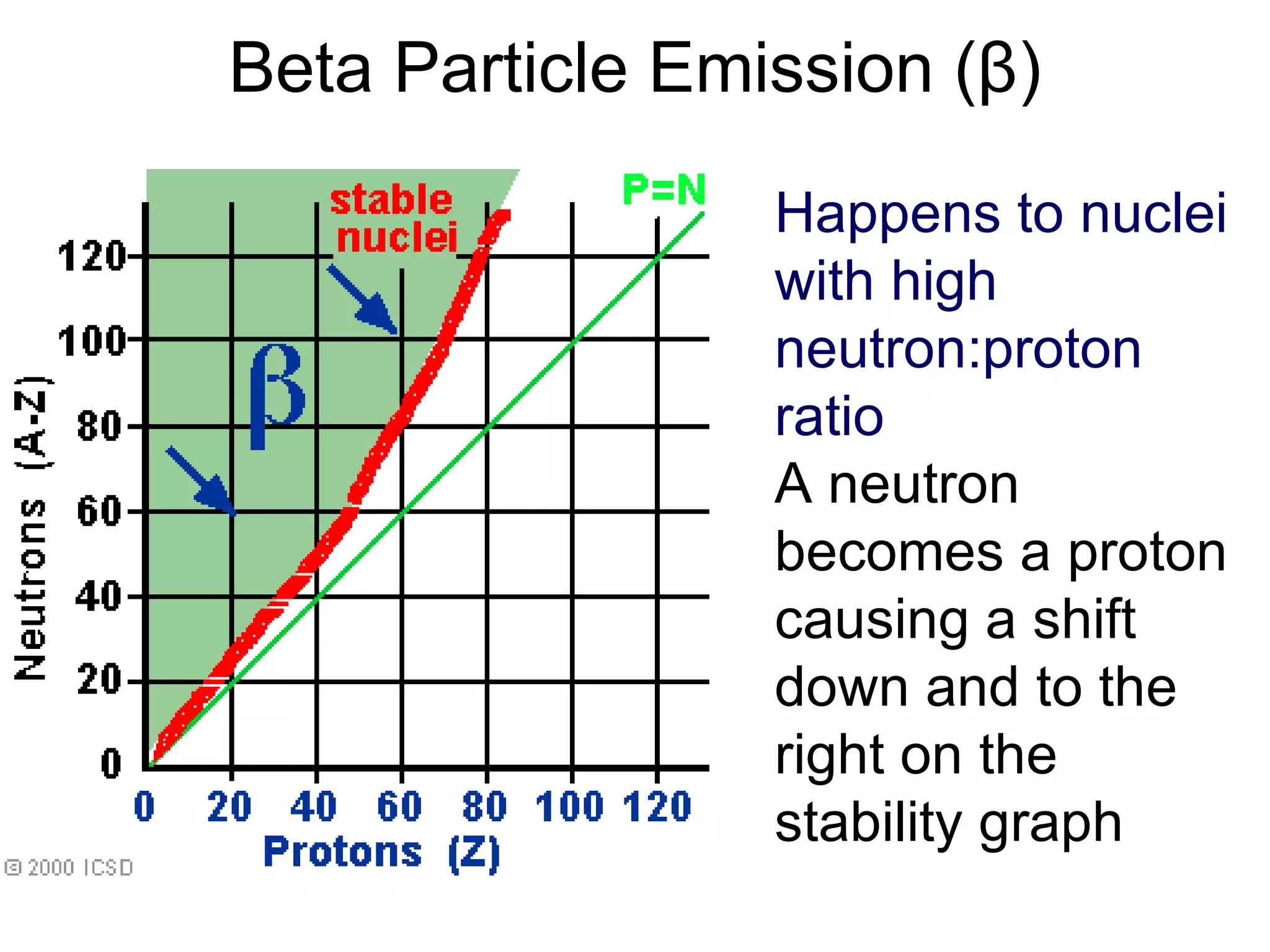
This graph showsthe stable nuclei in red . There are several things to notice:
36.
There are nostable nuclei with an atomic number higher than 83 or a neutron number higher than 126 .
37.
The more protons in the nuclei, the more neutrons are needed for stability. Notice how the stability band pulls away from the P=N line.
38.
Stability is favoredby even numbers of protons and even numbers of neutrons. 168 of the stable nuclei are even-even while only 4 of the stable nuclei are odd-odd.
39.
Types of RadioactiveDecay When unstable nuclei decay, the reactions generally involve the emission of a particle and or energy . For each type of decay, the equation is balanced with regard to atomic number and atomic mass. In other words, the total atomic number before and after the reaction are equal. And the total atomic mass before and after the reaction are also equal .
40.
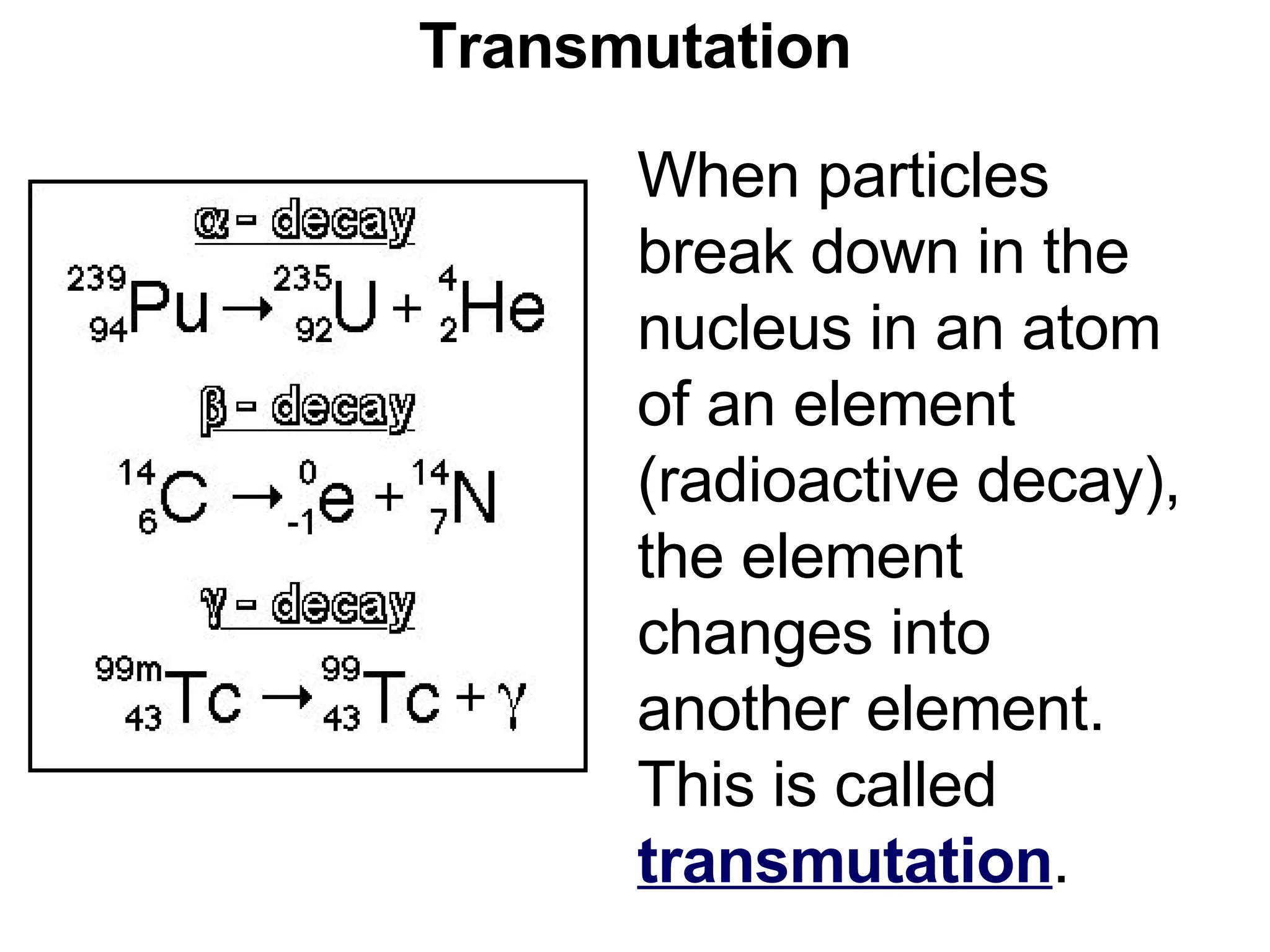
Transmutation When particlesbreak down in the nucleus in an atom of an element (radioactive decay), the element changes into another element. This is called transmutation .
41.
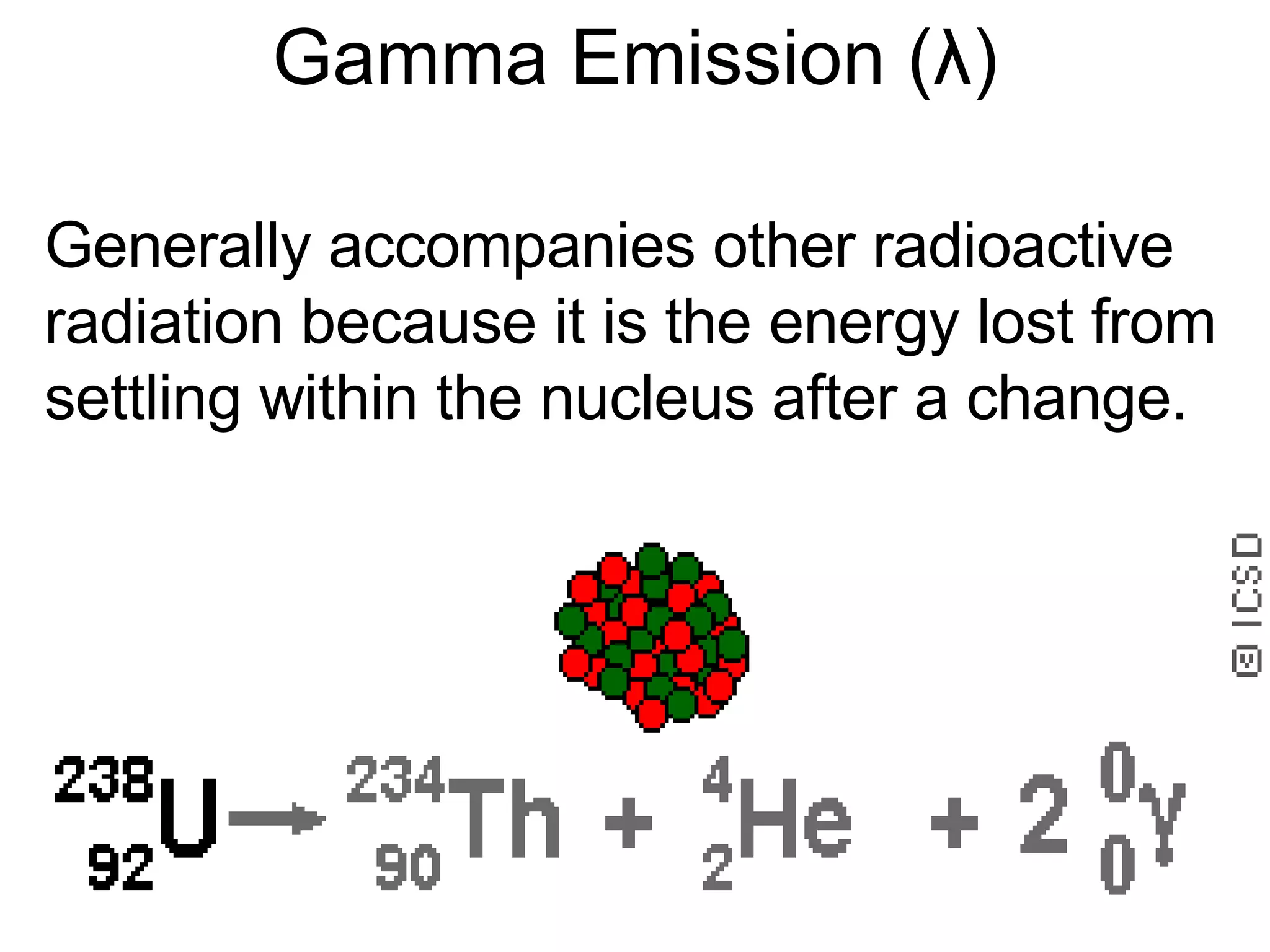
TYPES OF RADIATIONGamma emission is the high energy electromagnetic radiation given off in most nuclear reactions. GAMMA RAYS ARE NOT MATTER, THEY ARE ENERGY. Therefore, they are not involved in balancing the nuclear equation. They are very damaging and difficult to shield against.
42.
Gamma Emission (λ ) Generally accompanies other radioactive radiation because it is the energy lost from settling within the nucleus after a change.
43.
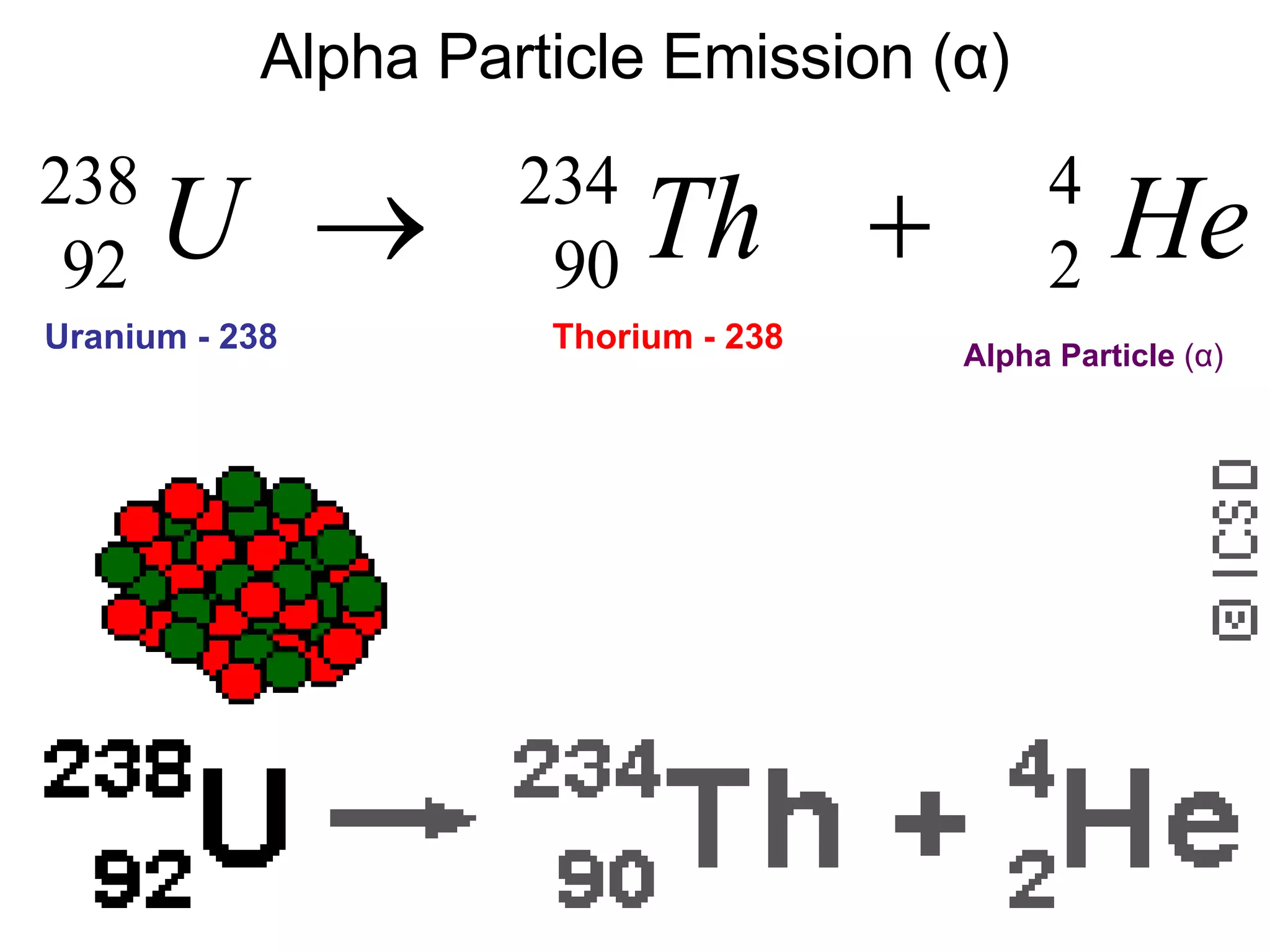
Alpha Emission (α ) Happens when the atomic number is greater than 83 The 2 p+ 2n ( ) loss brings the atom down and to the left toward the belt of stable nuclei.
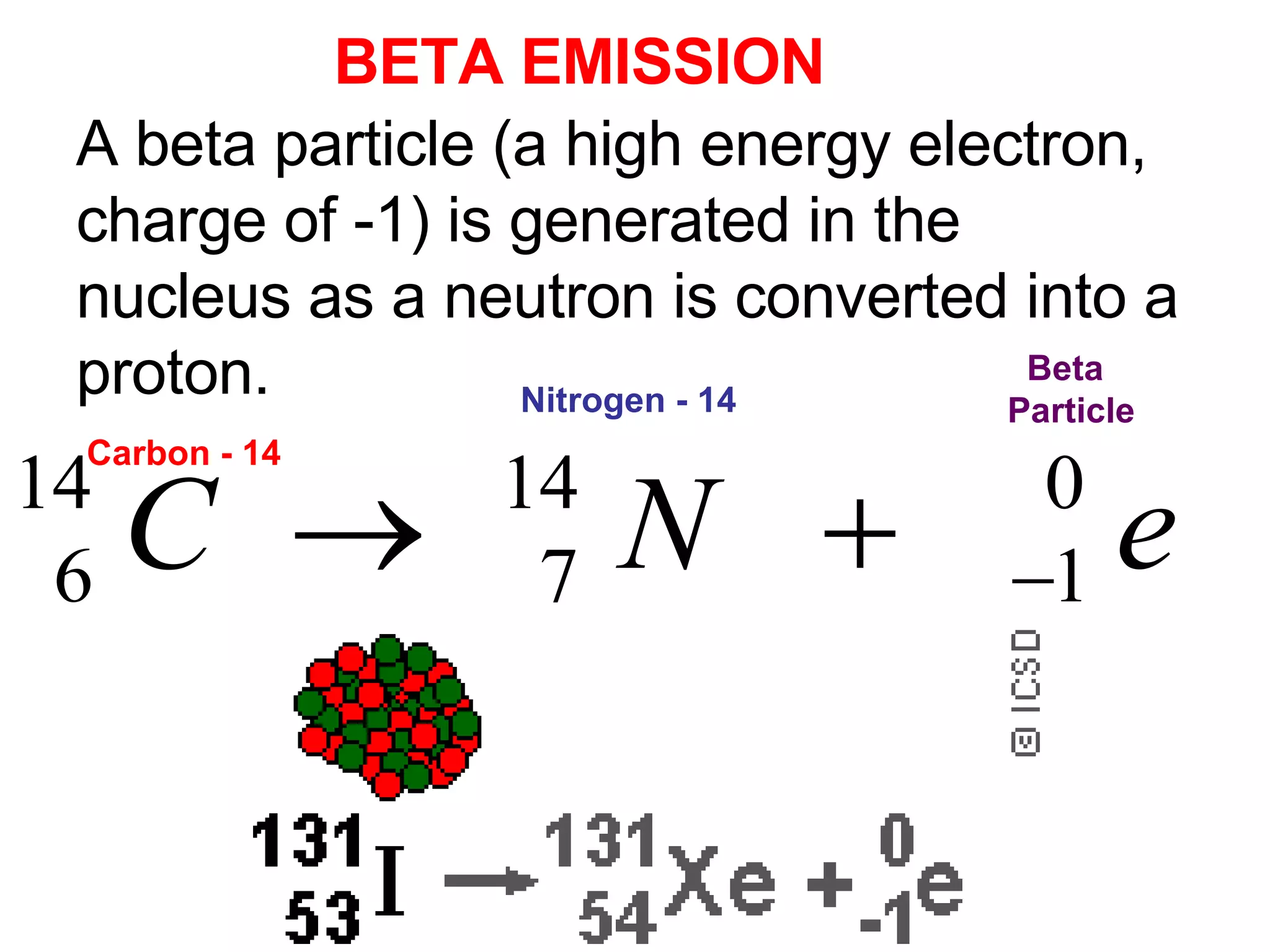
BETA EMISSION A beta particle (a high energy electron, charge of -1) is generated in the nucleus as a neutron is converted into a proton. Carbon - 14 Nitrogen - 14 Beta Particle
46.
Beta Particle Emission( β ) Happens to nuclei with high neutron:proton ratio A neutron becomes a proton causing a shift down and to the right on the stability graph
47.
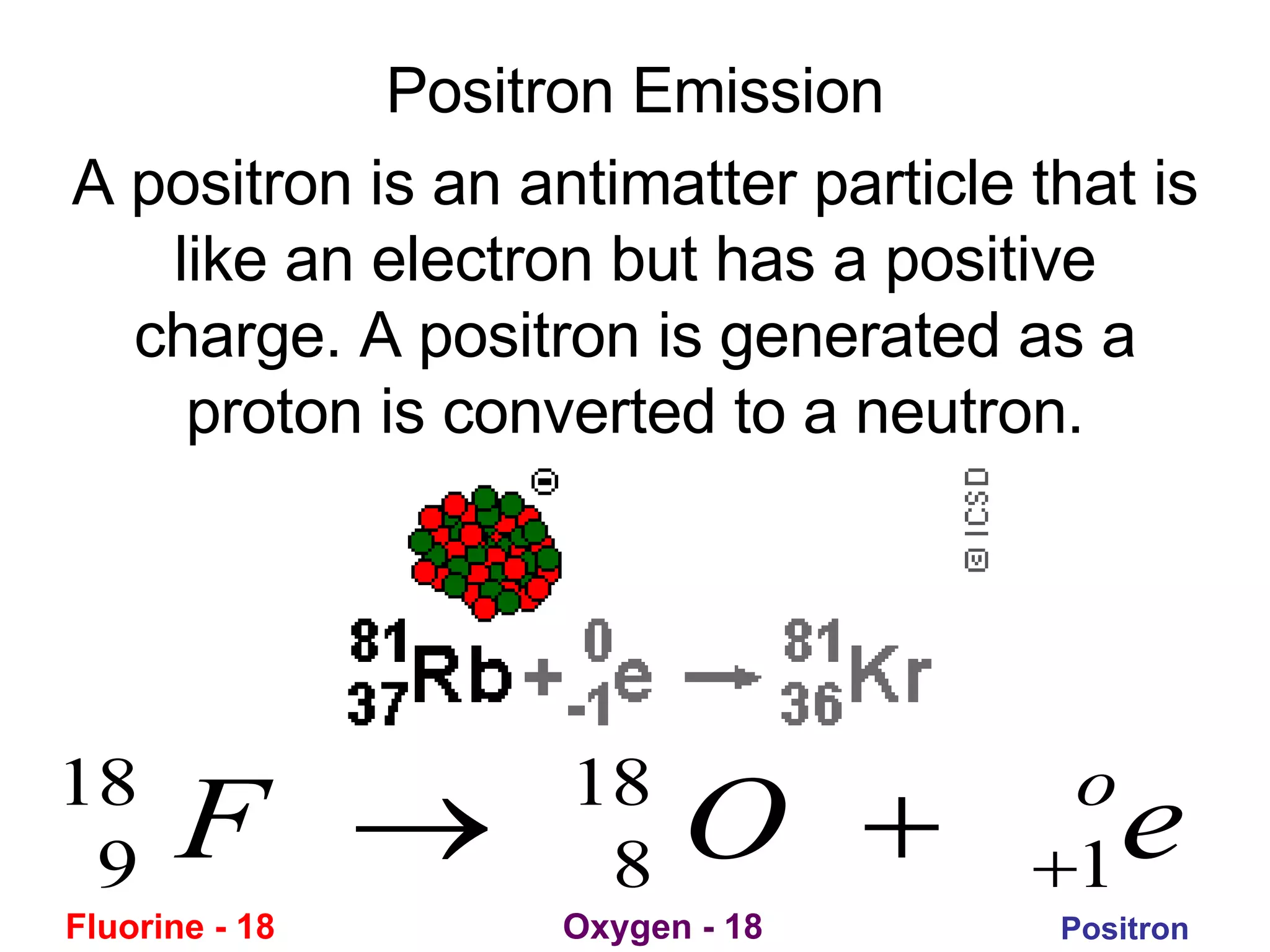
Positron Emission Apositron is an antimatter particle that is like an electron but has a positive charge. A positron is generated as a proton is converted to a neutron. Fluorine - 18 Oxygen - 18 Positron
48.
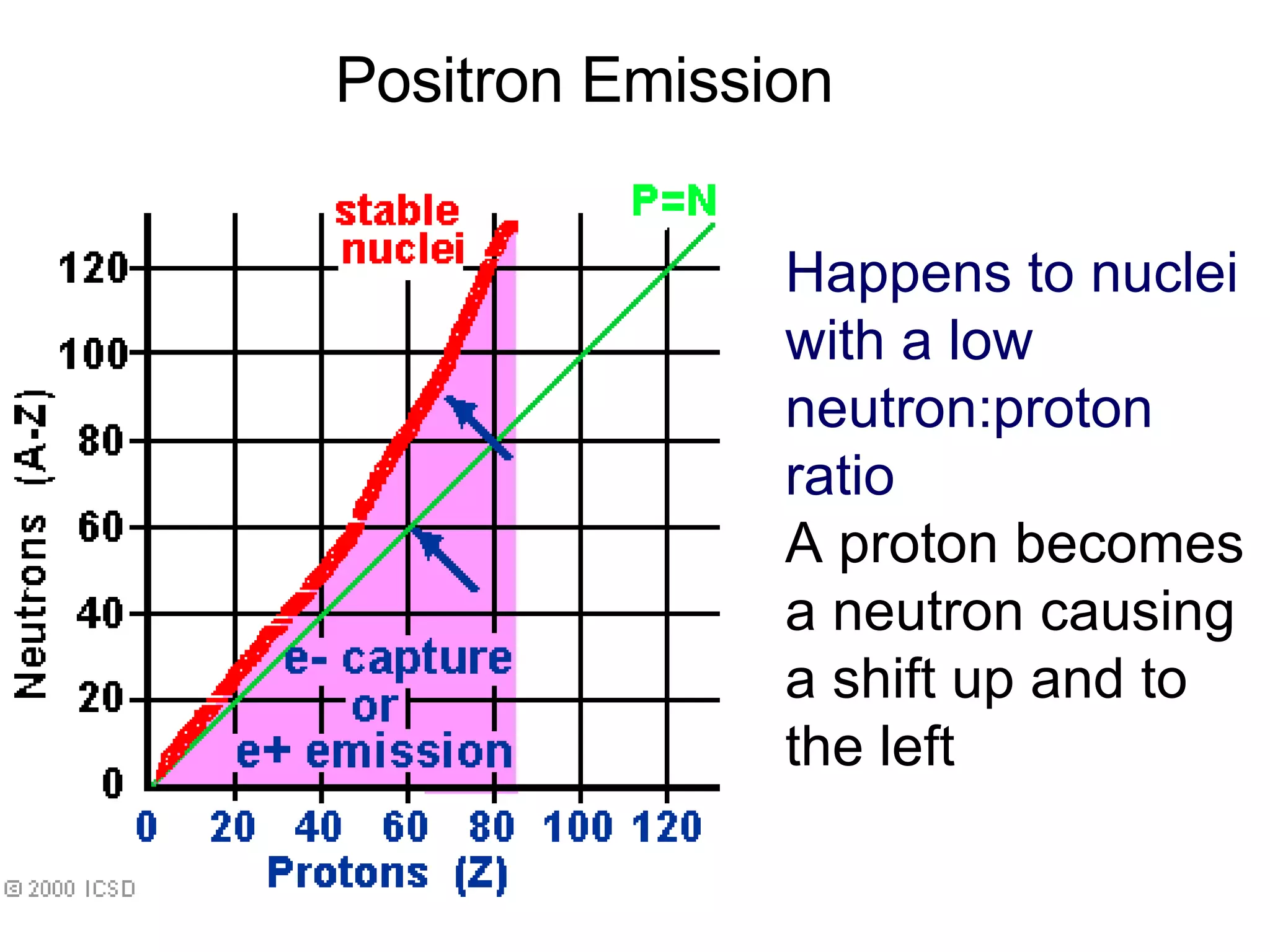
Positron Emission Happensto nuclei with a low neutron:proton ratio A proton becomes a neutron causing a shift up and to the left
49.
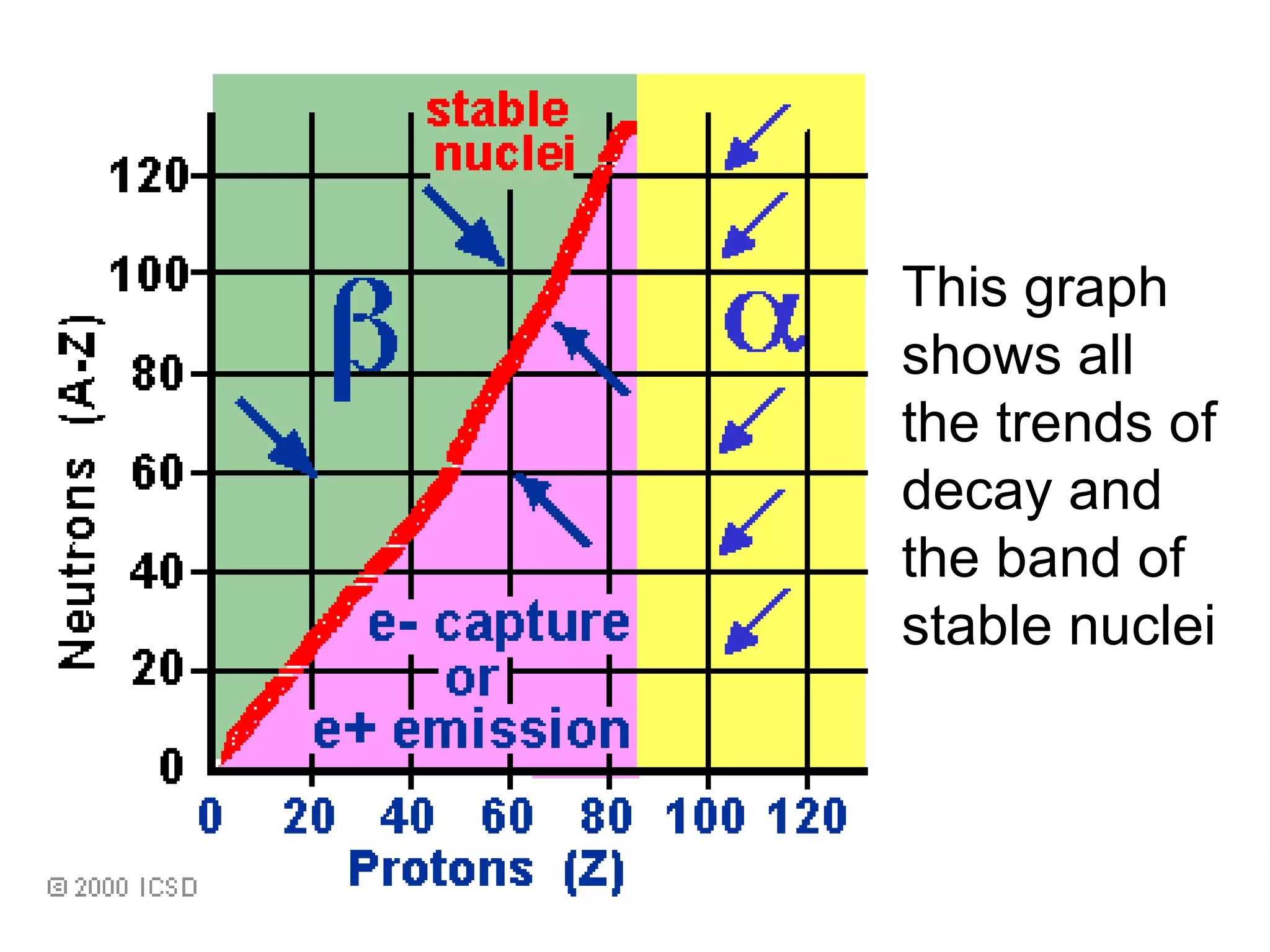
This graph showsall the trends of decay and the band of stable nuclei
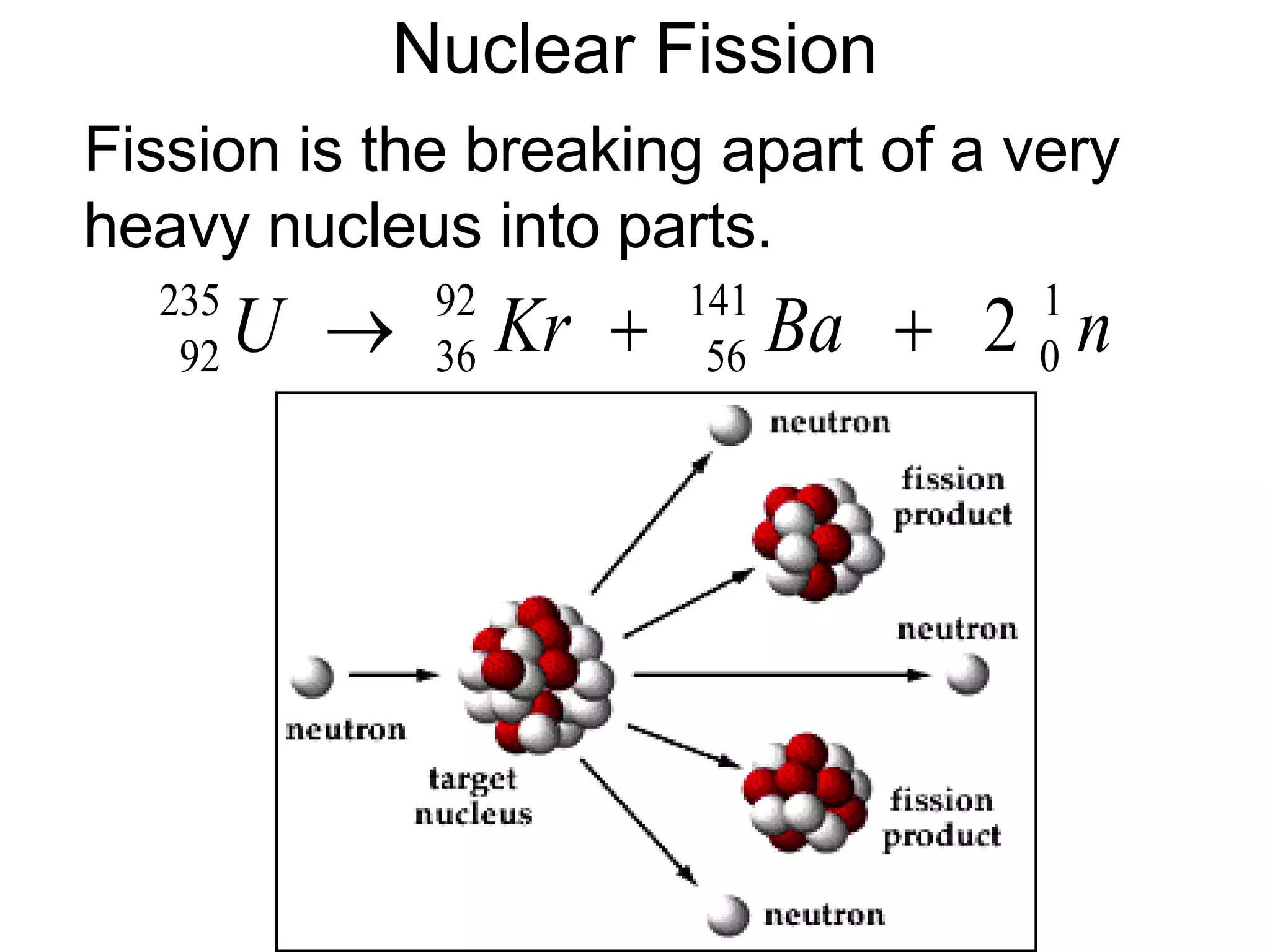
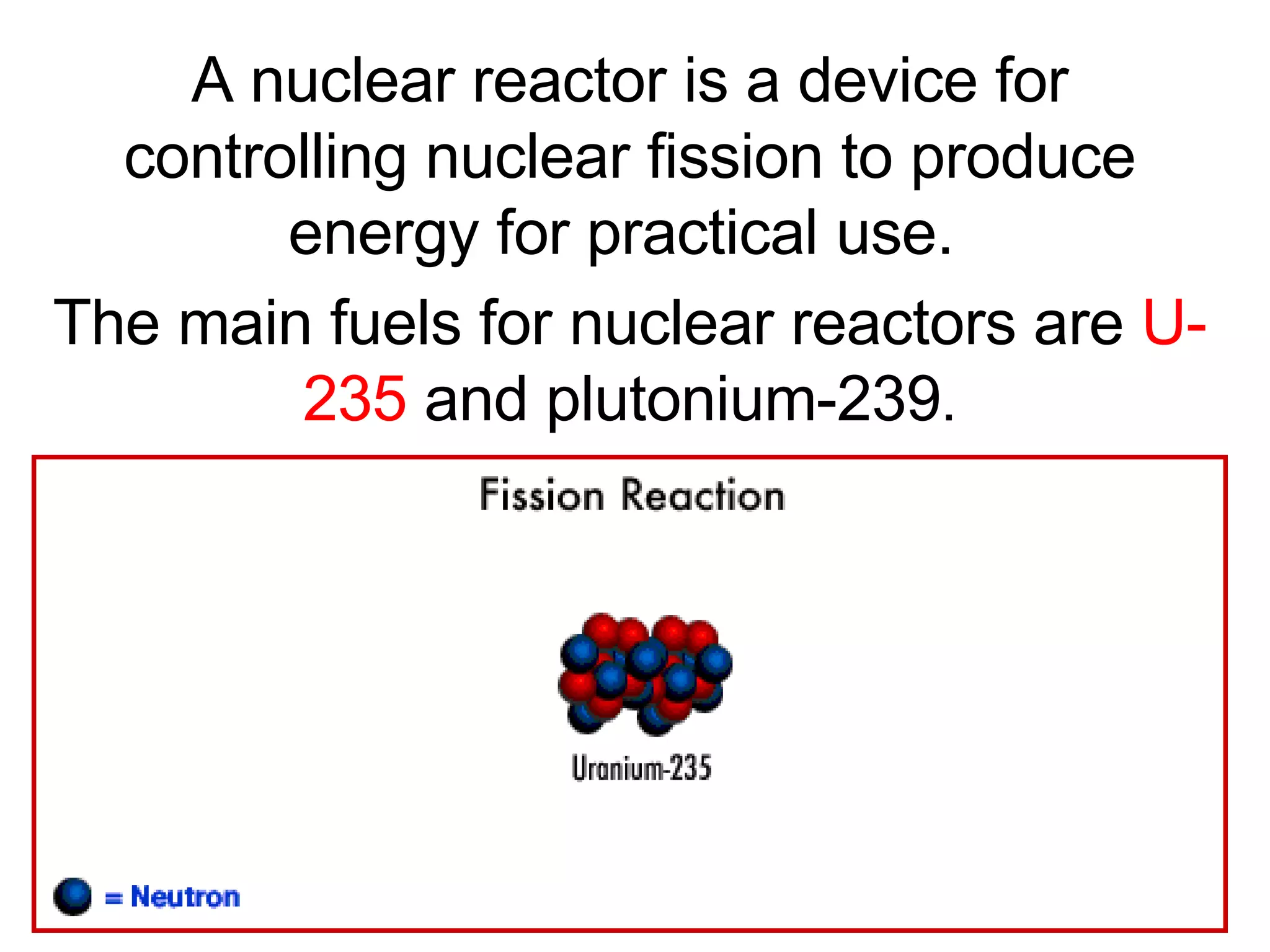
A nuclear reactoris a device for controlling nuclear fission to produce energy for practical use. The main fuels for nuclear reactors are U-235 and plutonium-239 .
53.
Fusion isthe combining of 2 small nuclei into 1 larger one. Fusion of hydrogen into helium occurs in the sun. Fusions reactions should produce much more energy than fission and use much more accessible fuels. However, currently many problems exist in fusion reactions such as the extremely high temperature needed for the reaction.
Half-Life Half-Life (t1/2 ) is the time required for half of the atoms of a radioisotope to emit radiation and to decay to products .
57.
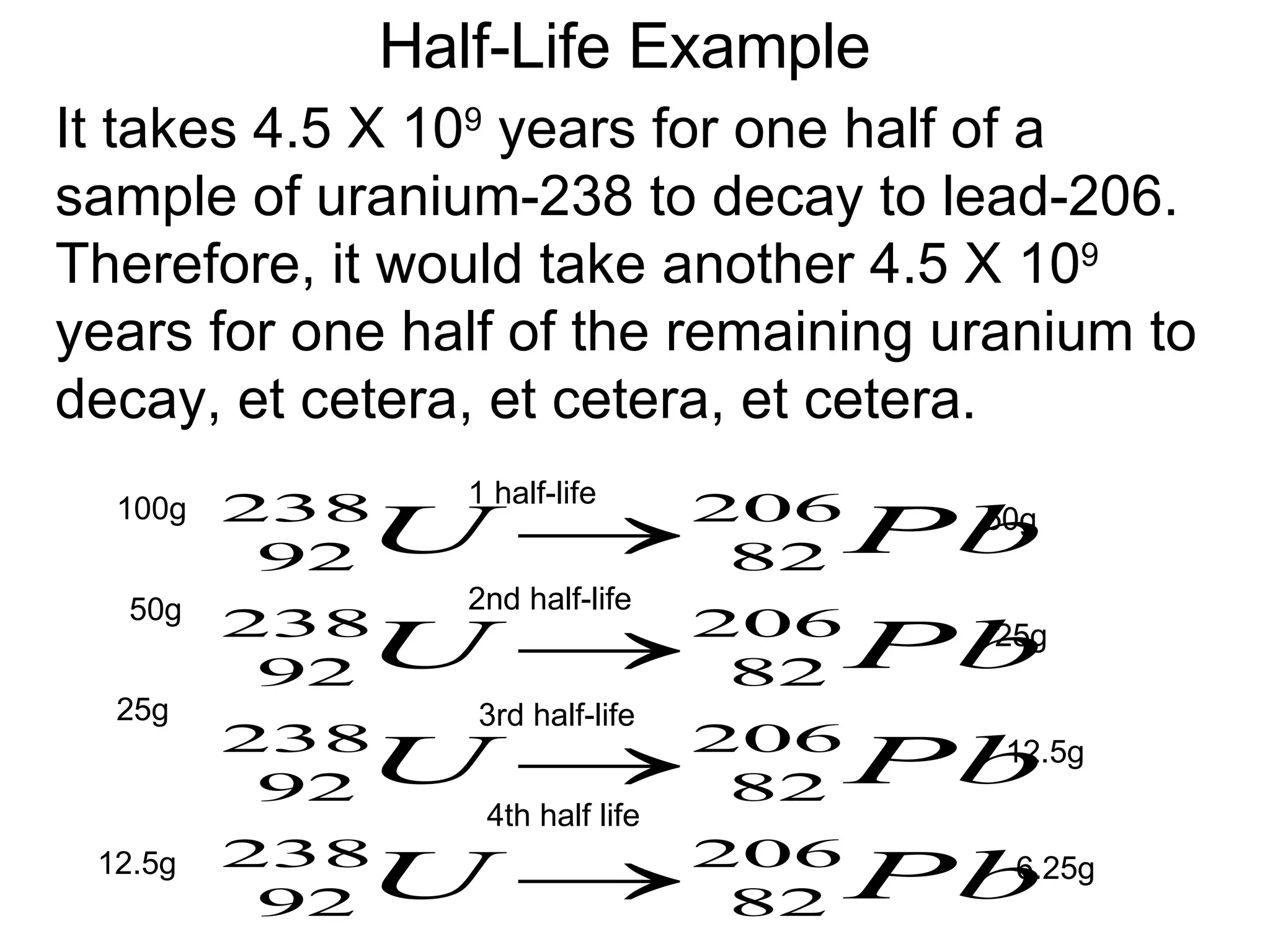
Half-Life Example Ittakes 4.5 X 10 9 years for one half of a sample of uranium-238 to decay to lead-206. Therefore, it would take another 4.5 X 10 9 years for one half of the remaining uranium to decay, et cetera, et cetera, et cetera. 100g 50g 50g 1 half-life 25g 25g 12.5g 12.5g 6.25g 2nd half-life 3rd half-life 4th half life
58.
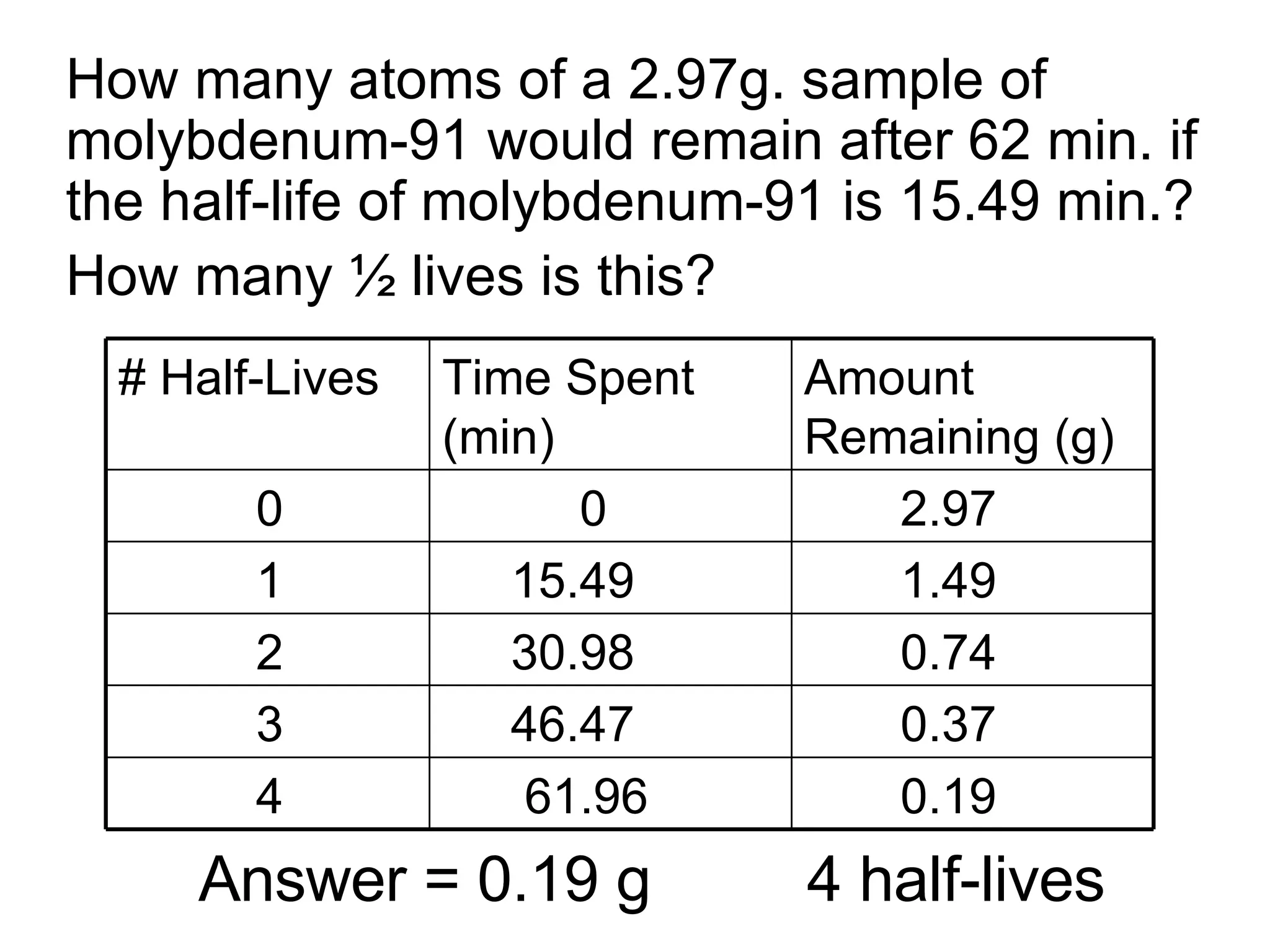
How many atomsof a 2.97g. sample of molybdenum-91 would remain after 62 min. if the half-life of molybdenum-91 is 15.49 min.? How many ½ lives is this? Answer = 0.19 g 4 half-lives # Half-Lives Time Spent (min) Amount Remaining (g) 0 0 2.97 1 15.49 1.49 2 30.98 0.74 3 46.47 0.37 4 61.96 0.19
59.
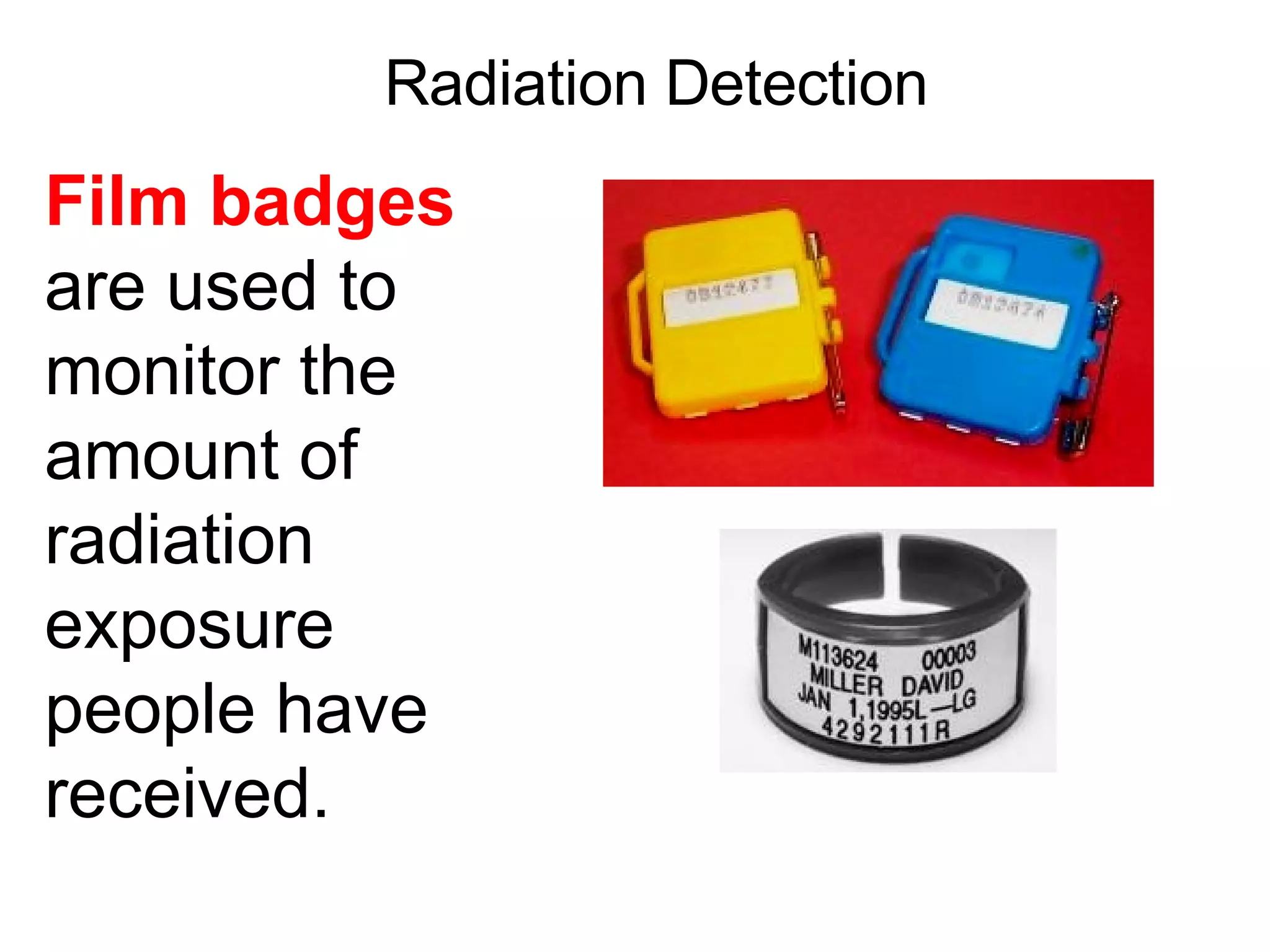
Radiation Detection Filmbadges are used to monitor the amount of radiation exposure people have received.
60.
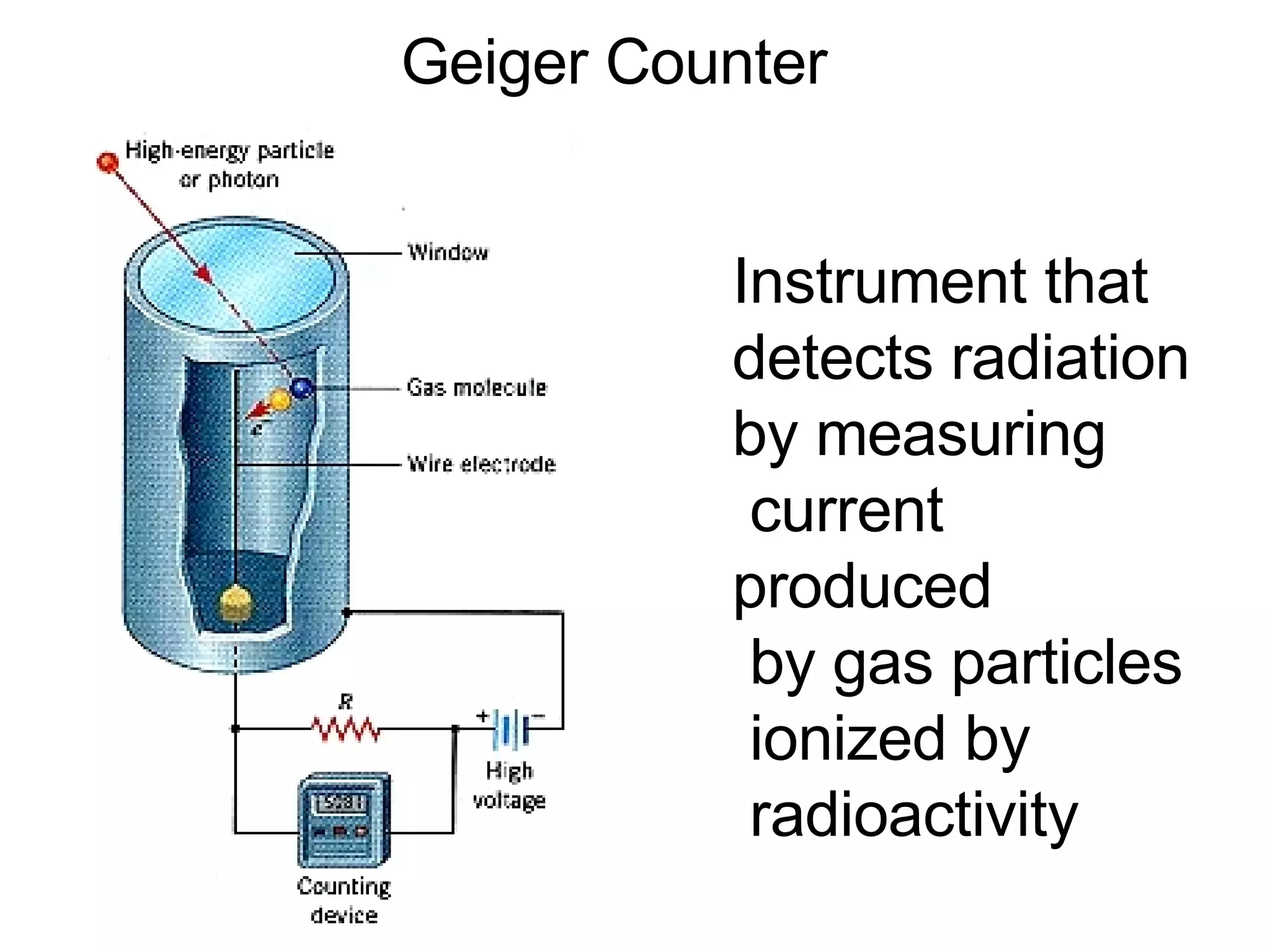
Geiger Counter Instrumentthat detects radiation by measuring current produced by gas particles ionized by radioactivity
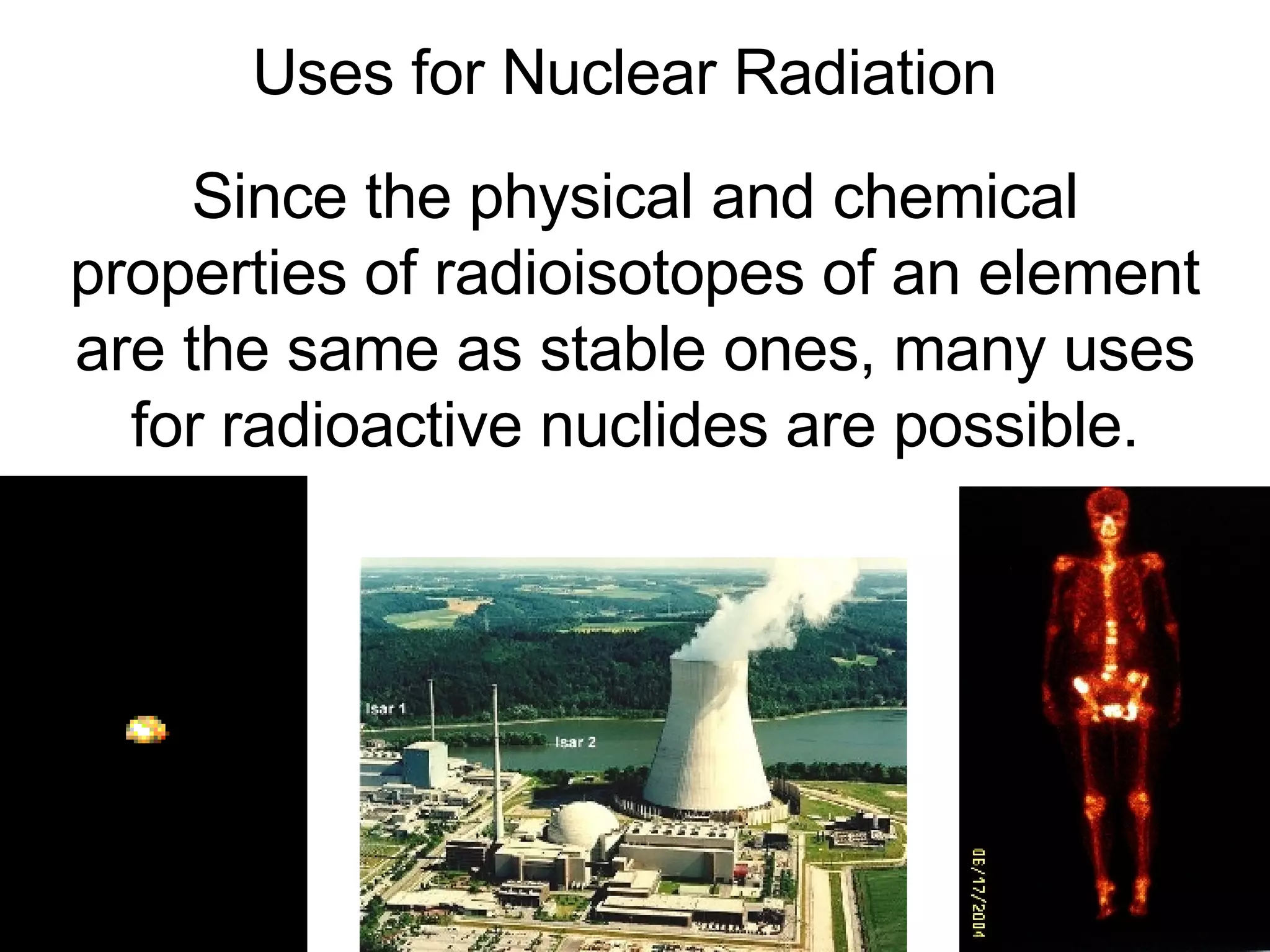
Uses for NuclearRadiation Since the physical and chemical properties of radioisotopes of an element are the same as stable ones, many uses for radioactive nuclides are possible.
64.
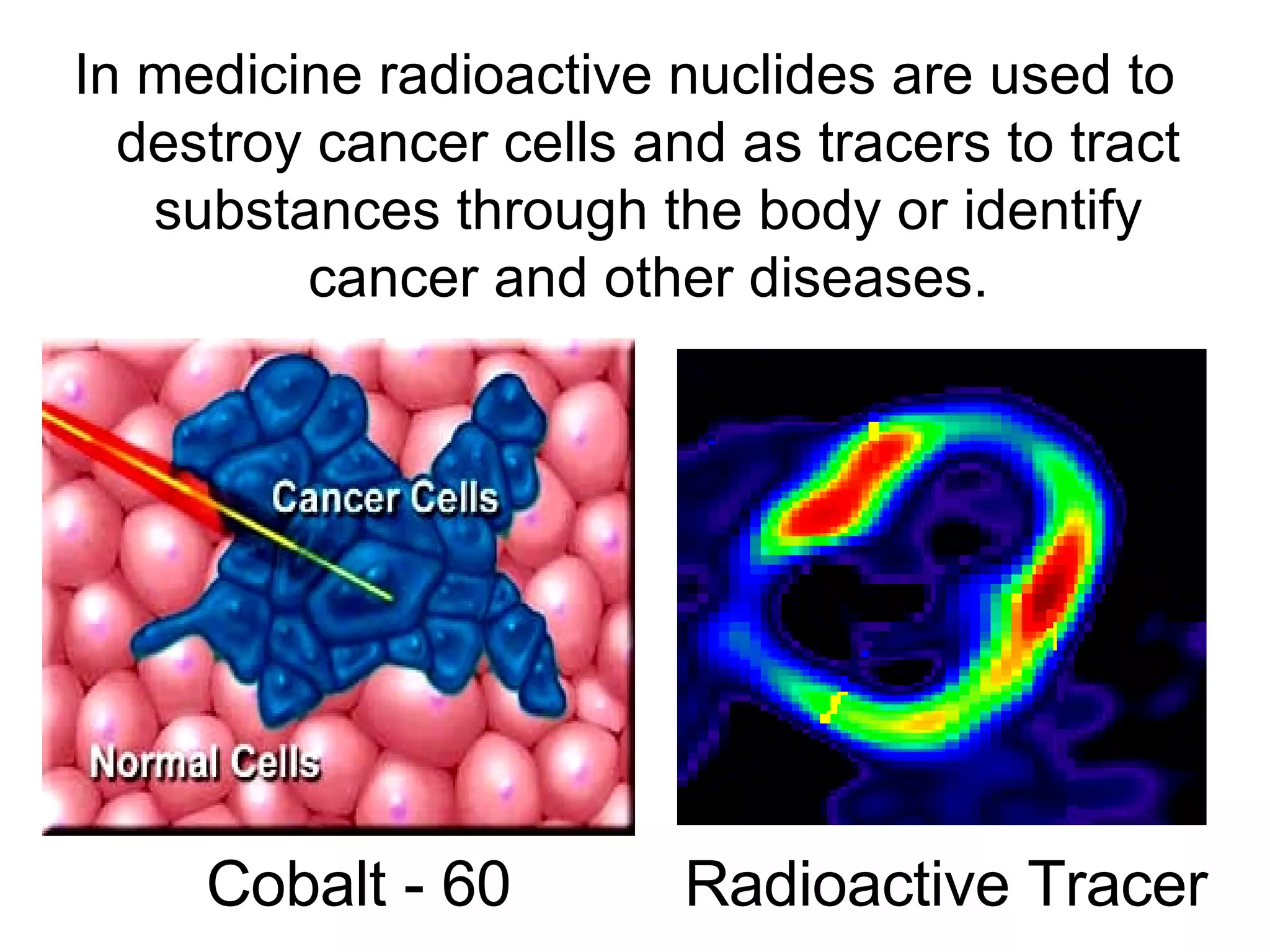
In medicine radioactivenuclides are used to destroy cancer cells and as tracers to tract substances through the body or identify cancer and other diseases. Cobalt - 60 Radioactive Tracer
65.
66.
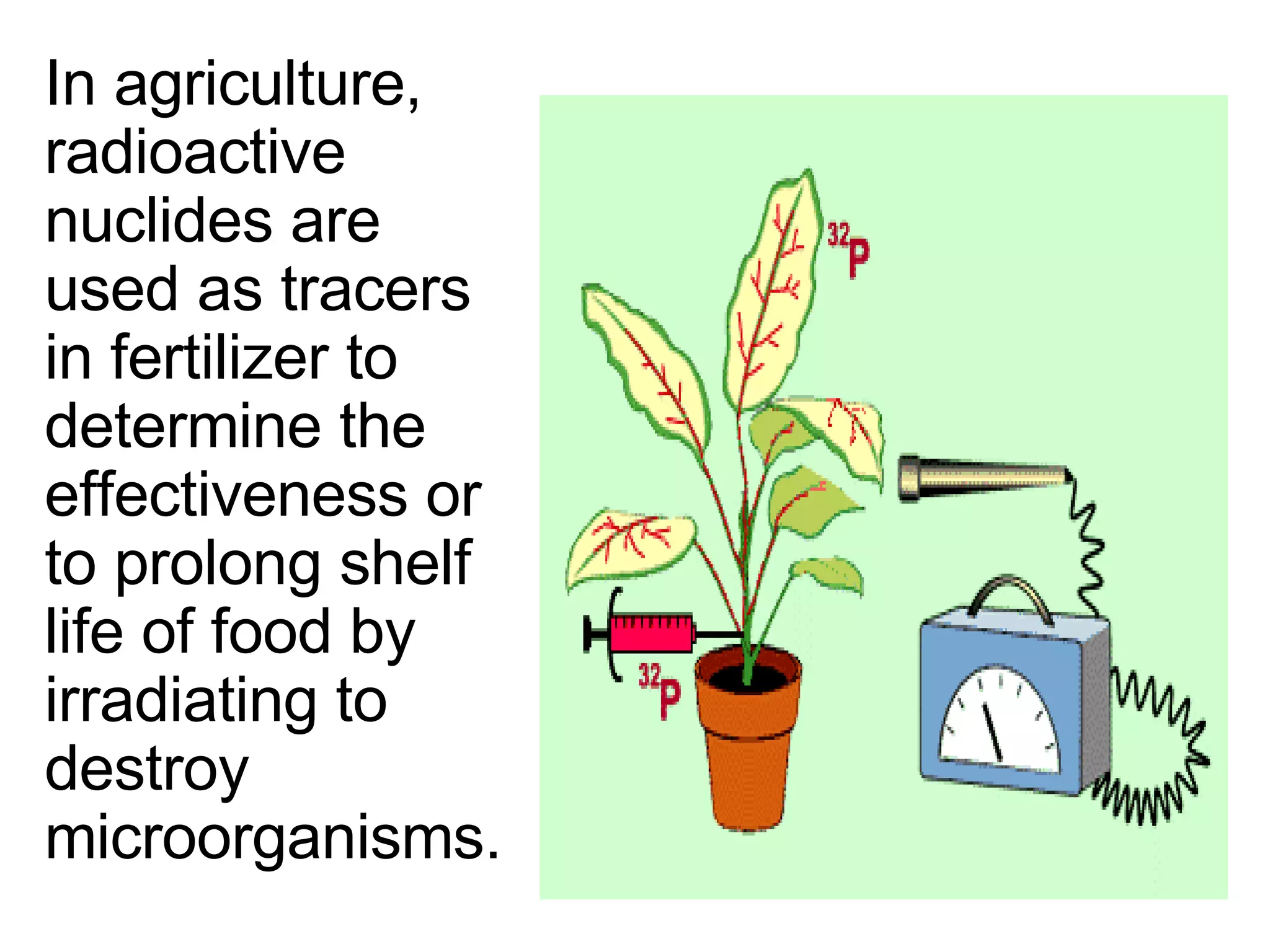
In agriculture, radioactivenuclides are used as tracers in fertilizer to determine the effectiveness or to prolong shelf life of food by irradiating to destroy microorganisms.
67.
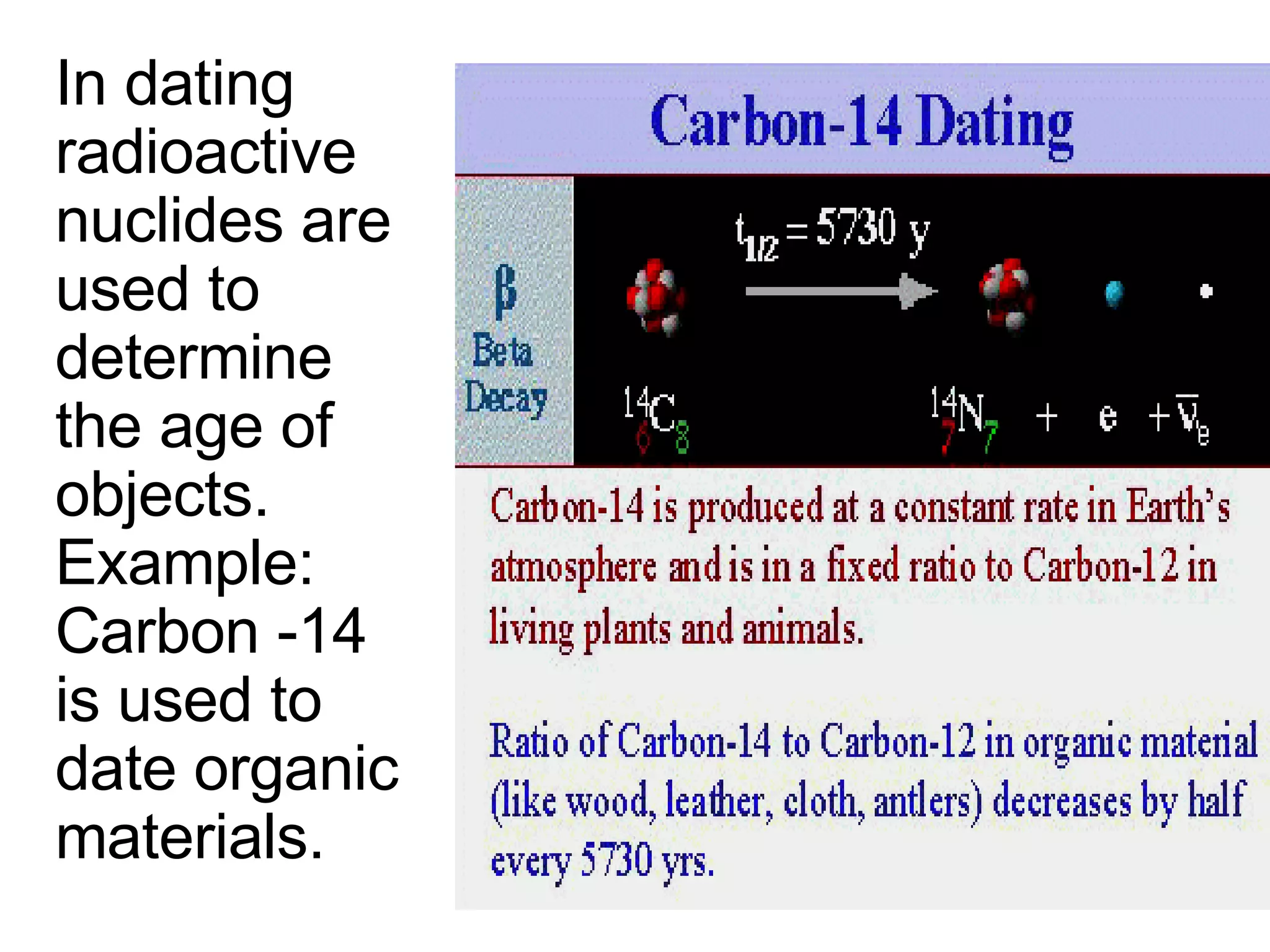
In dating radioactivenuclides are used to determine the age of objects. Example: Carbon -14 is used to date organic materials.
68.
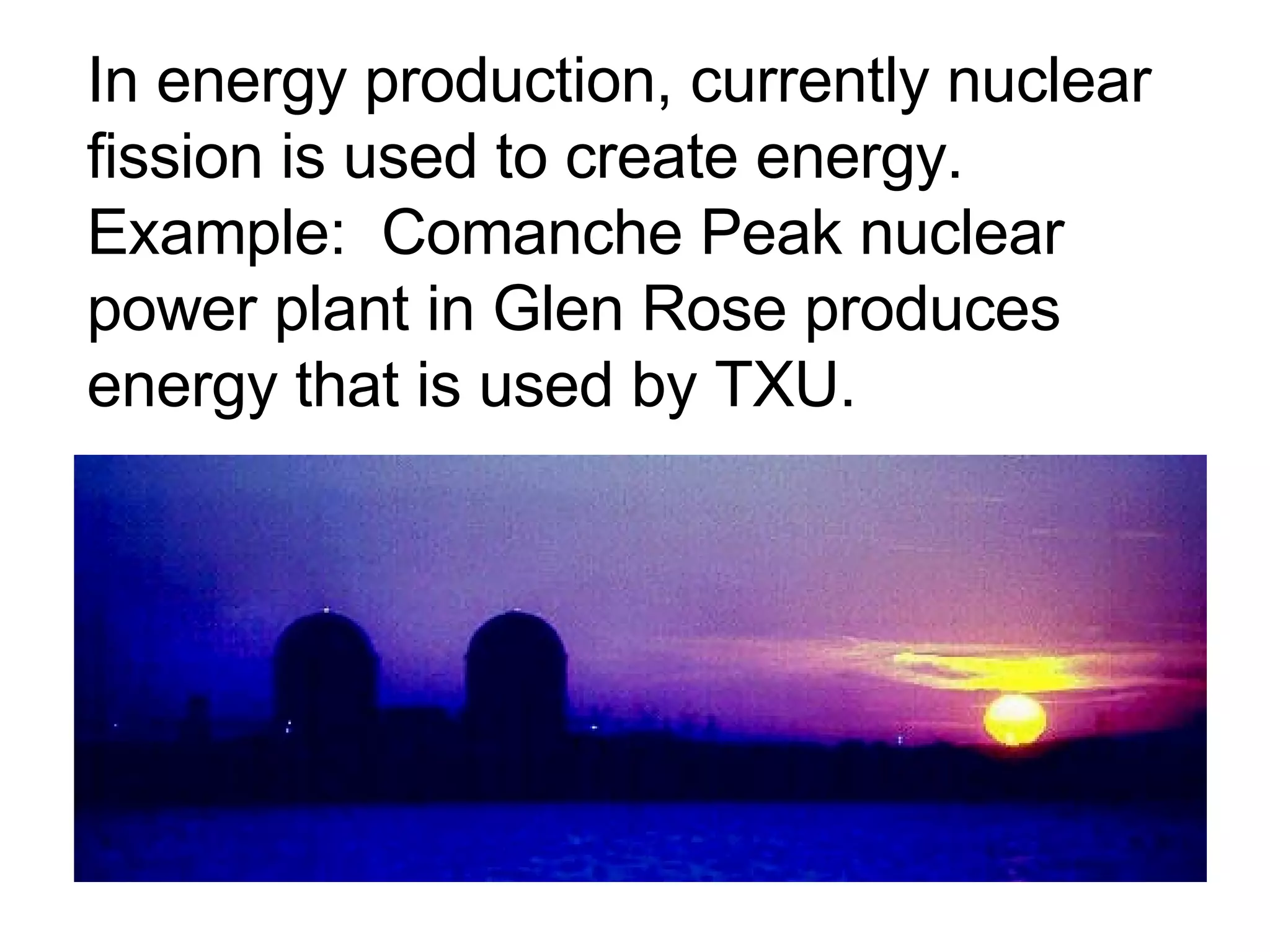
In energy production,currently nuclear fission is used to create energy. Example: Comanche Peak nuclear power plant in Glen Rose produces energy that is used by TXU.
69.
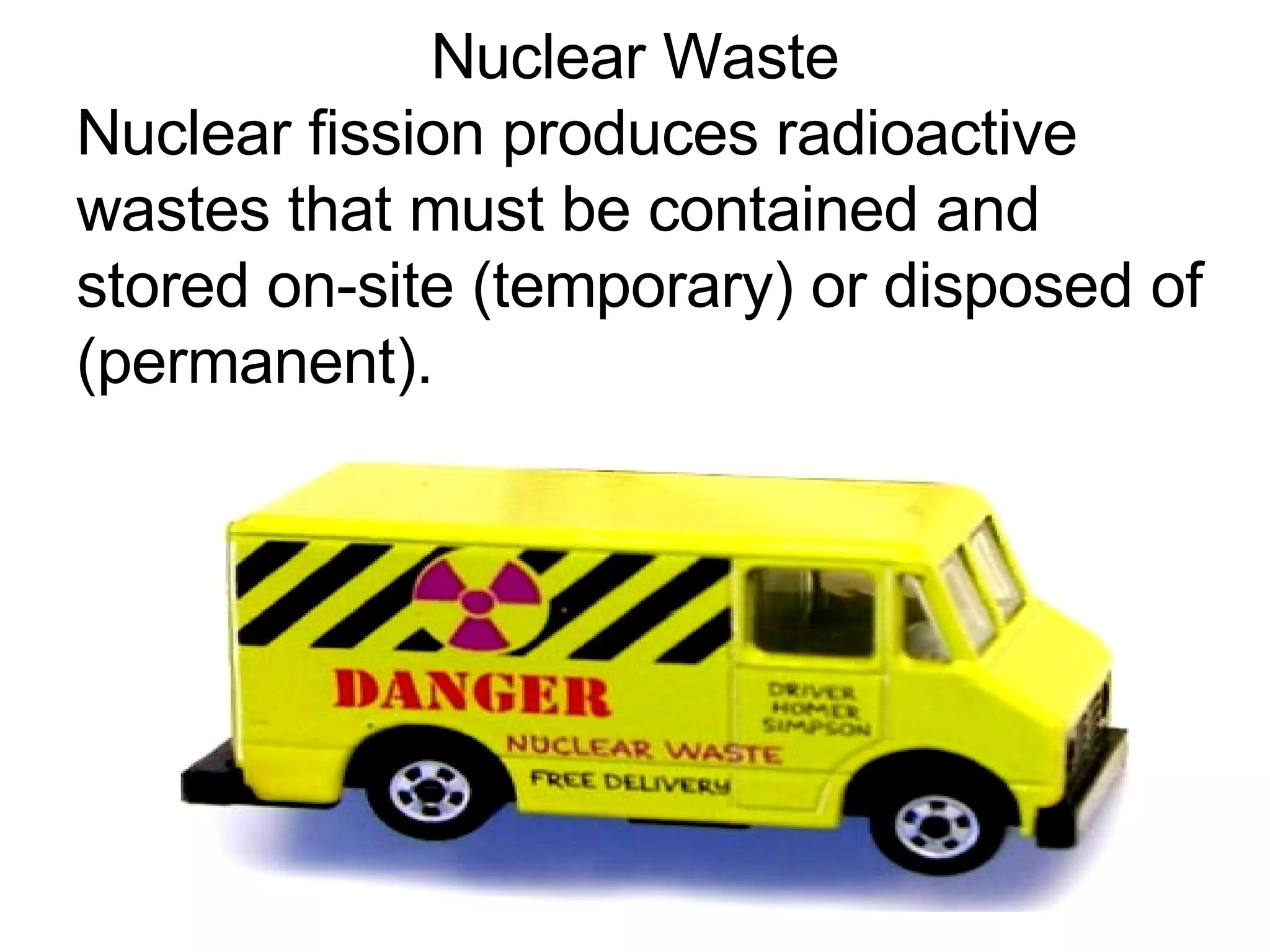
Nuclear Waste Nuclearfission produces radioactive wastes that must be contained and stored on-site (temporary) or disposed of (permanent).