Memory
Learning Objectives Multi-store model of memory (with the perceptual process) Describe: Short term sensory store (STSS), Short term memory (STM) and Long term memory (LTM) Strategies to improve STM and LTM Apply memory process to learning and performing
Memory Documentary http://video.google.com/videoplay?docid=5688279003135893692&hl=en#
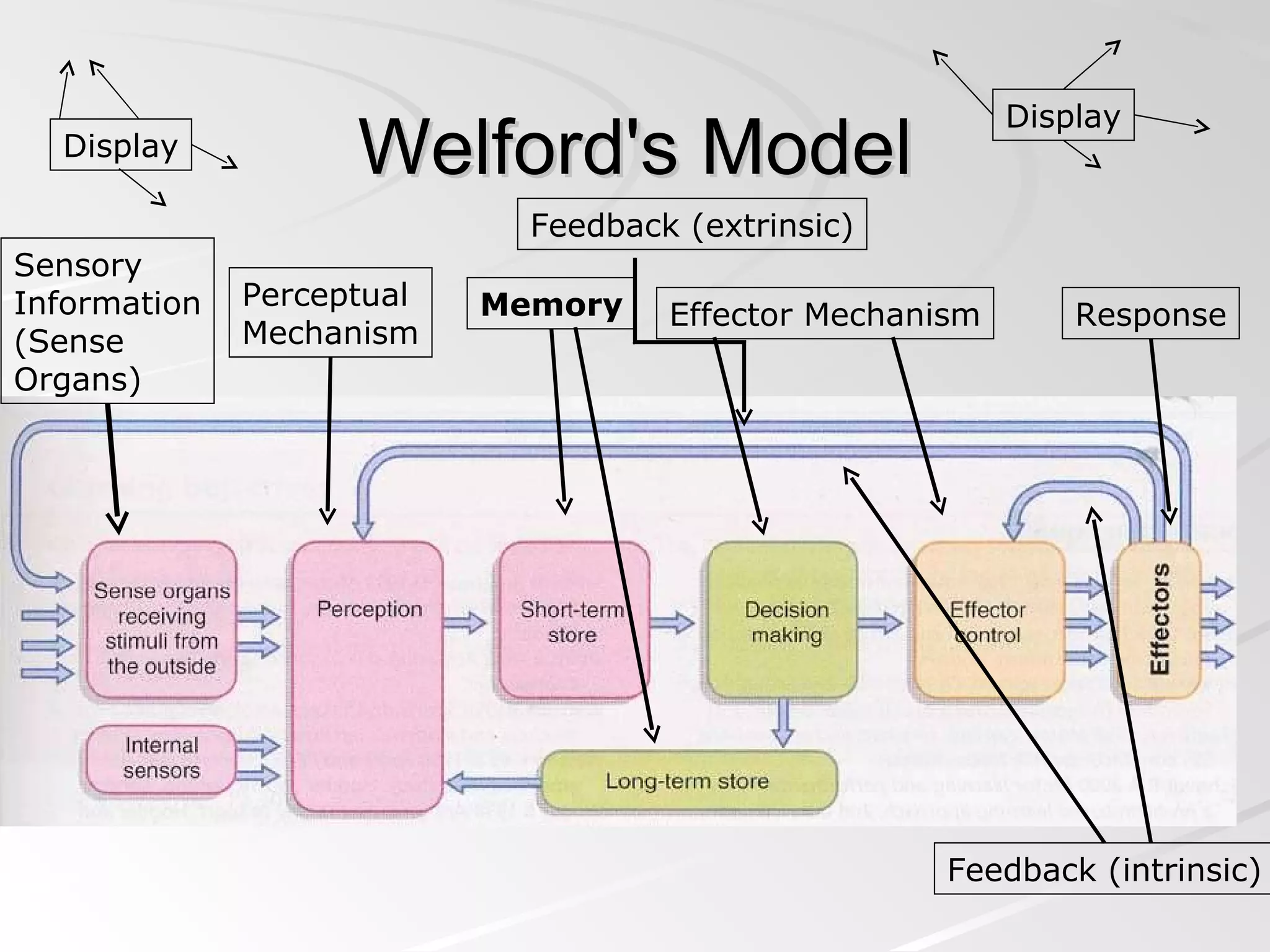
Memory Memory is vital in information processing (it allows you to rely on previous experiences) It also allows you to select the correct motor programme you use, to send the right signals to muscles, tendons etc…  Welford Model demonstrates the importance of memory:
Welford's Model Display Sensory  Information (Sense Organs) Perceptual Mechanism Display Memory Effector Mechanism Response Feedback (intrinsic) Feedback (extrinsic)
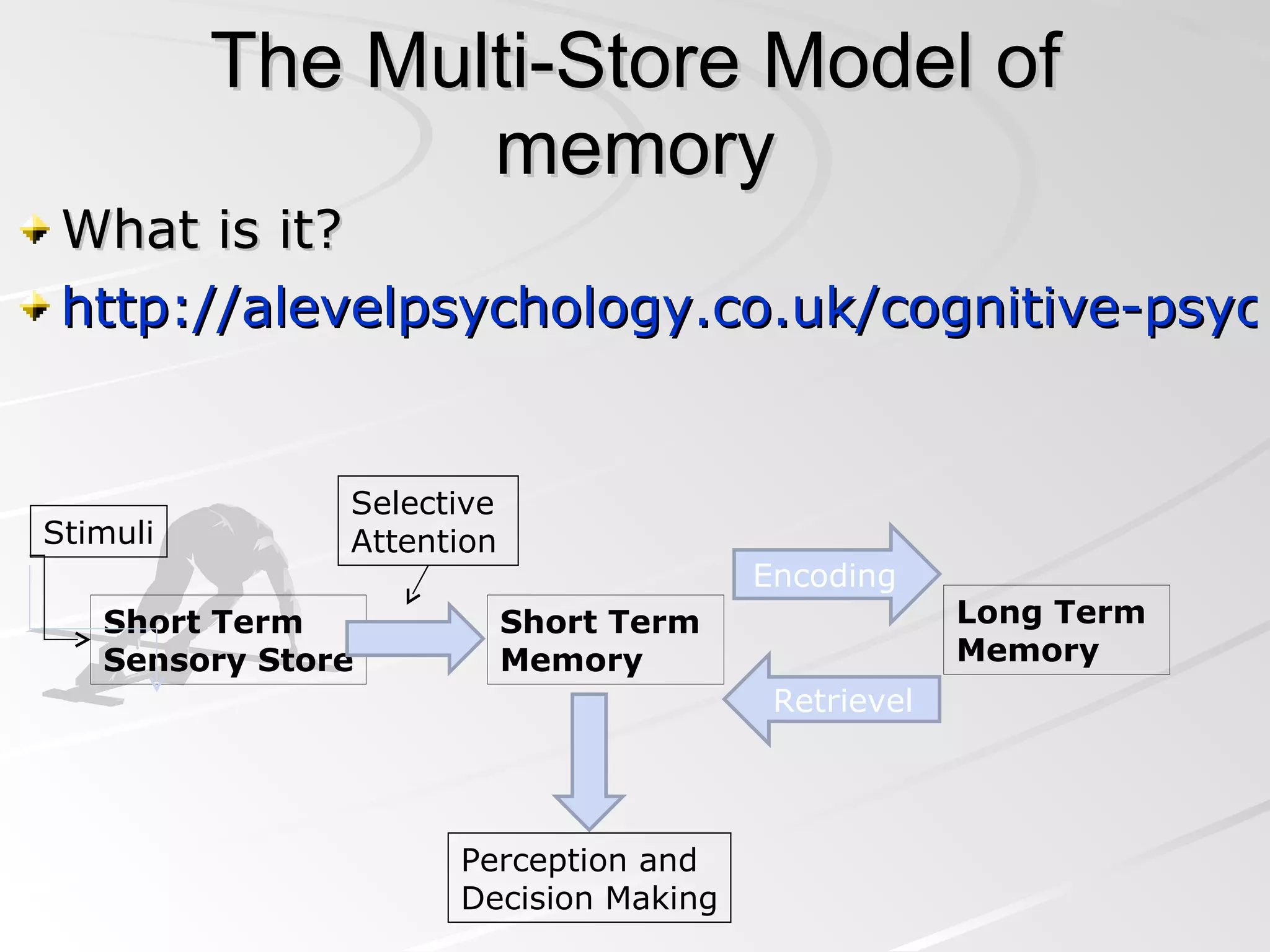
The Multi-Store Model of memory What is it? http://alevelpsychology.co.uk/cognitive-psychology/memory/the-multistore-model-of-memory-atkinson-and-shiffrin.html   Short Term  Sensory Store Short Term  Memory Long Term  Memory Encoding Stimuli Selective  Attention Perception and  Decision Making Retrievel
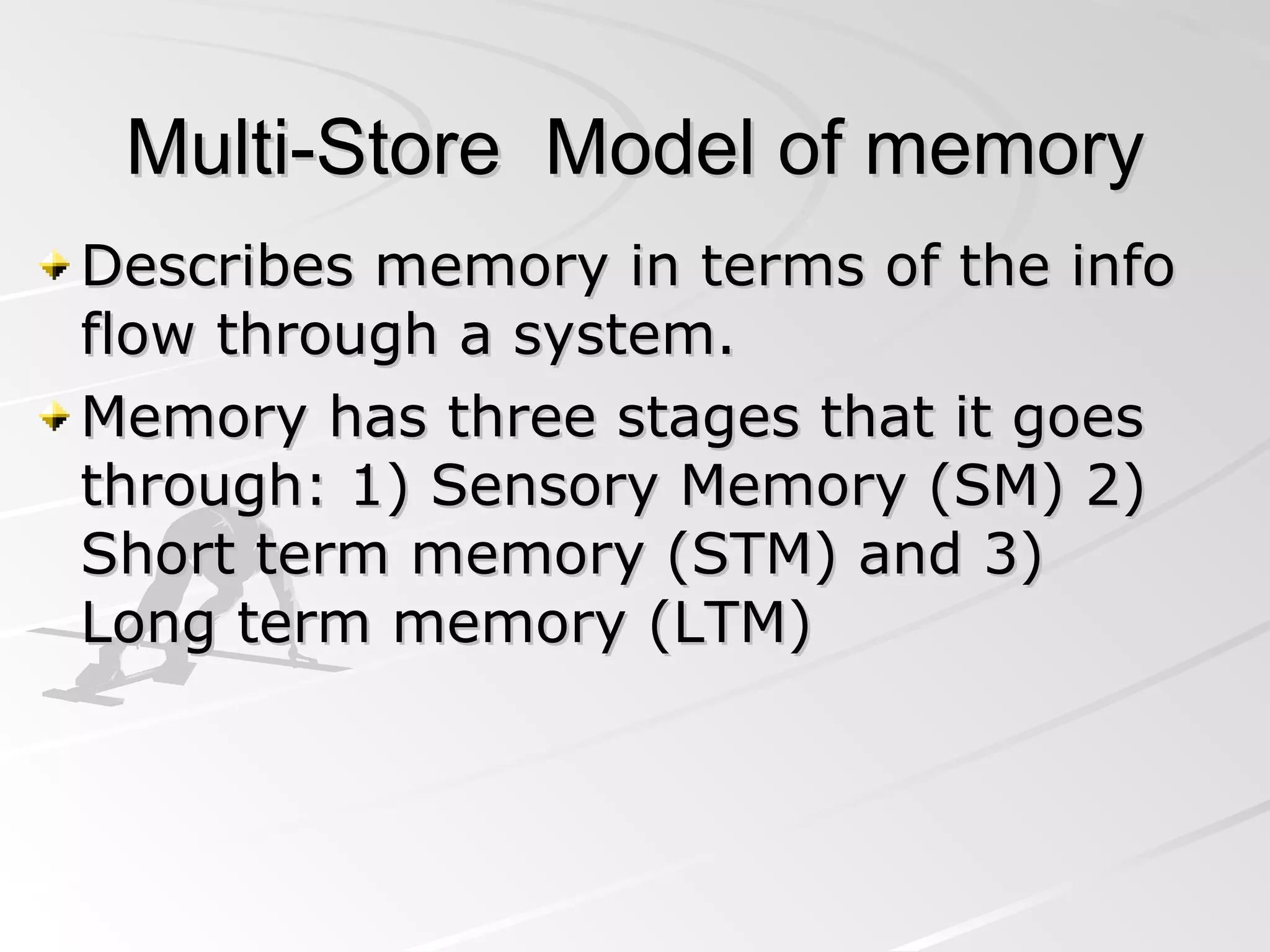
Multi-Store  Model of memory Describes memory in terms of the info flow through a system. Memory has three stages that it goes through: 1) Sensory Memory (SM) 2) Short term memory (STM) and 3) Long term memory (LTM)
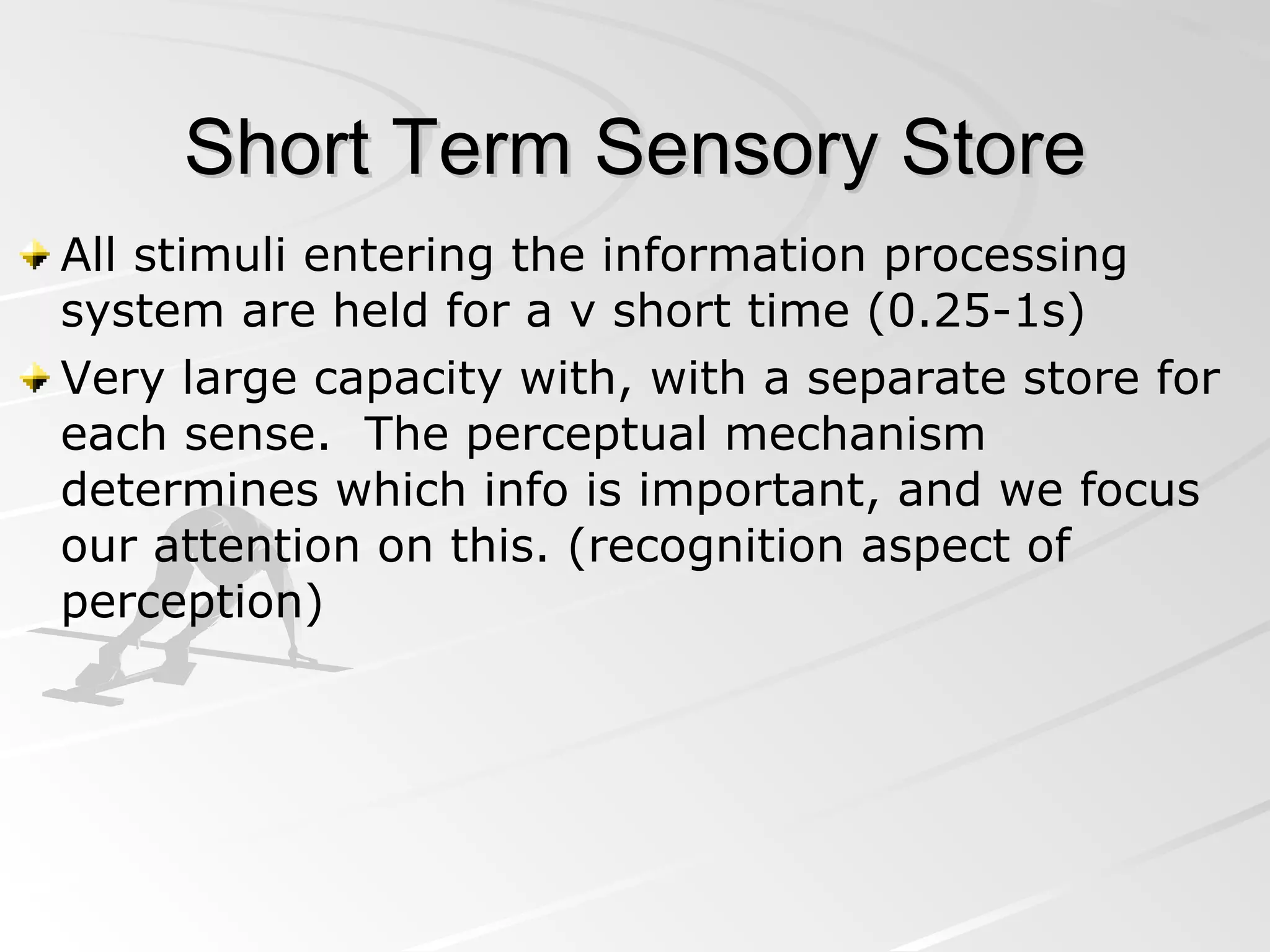
Short Term Sensory Store All stimuli entering the information processing system are held for a v short time (0.25-1s) Very large capacity with, with a separate store for each sense.  The perceptual mechanism determines which info is important, and we focus our attention on this. (recognition aspect of perception)
Memory Irrelevant info is lost from the sensory store and replaced by new info. Filtering system is called ‘selective attention’ Focusing on info will pass it onto our Short term memory (Selective attention enables us to select the correct info to be passed on) This is important because it will allow us to react to correct stimuli quickly
Memory Knowing what is important o focus on is important, e.g a sprinter will ignore the crowd and focus on the sound of the gun Focusing on irrelevant info is called intentional wastage (beginners will suffer from this)
Short Term Memory This is referred to as the ‘workplace’. Here info that comes in is compared to previously learned and stored info in the LTM (This is the comparison aspect of perception) STM has a limited capacity, both in the amount it stores and the length it stores it for. (between 5 and 9 pieces of info for up to 30sec) This can be increased by linking bits of info together to make one piece (called chunking) e.g. rugby lineout calls – relate to a movement  etc… The time you remember it for can be increased by rehearse or repeat the info.
 
The short-term memory test. Try to memorise these objects/characters.
 
Long Term Memory Info in the STM that is thought to be important is rehearsed or practiced and by this process passes into the LTM for future use, this is called encoding. Well learned and practised info is held in the LTM, the capacity is thought to be limitless, held for a long time, perhaps permanently. Motor programmes are stored in the LTM by practising them many times.  E.G. not forgetting how to ride a bike, or to swim even after not doing them for a long time. The LTM is the recognition part of the perceptual process.  Stored info in the LTM is retrieved and compared to new info which is recognised
 
Homework Using page 161 and 162, make a list of and write a description of each strategy to improve Retention and Retrieval
FLASHCARDS A revision tool
Recap http://juni.osfc.ac.uk/Extension/level_3_extension/physical_education/lesson_4/index.asp   http://www.peshare.co.uk/videos/view/20170/

PEShare.co.uk Shared Resource

  • 1.
  • 2.
    Learning Objectives Multi-storemodel of memory (with the perceptual process) Describe: Short term sensory store (STSS), Short term memory (STM) and Long term memory (LTM) Strategies to improve STM and LTM Apply memory process to learning and performing
  • 3.
  • 4.
    Memory Memory isvital in information processing (it allows you to rely on previous experiences) It also allows you to select the correct motor programme you use, to send the right signals to muscles, tendons etc… Welford Model demonstrates the importance of memory:
  • 5.
    Welford's Model DisplaySensory Information (Sense Organs) Perceptual Mechanism Display Memory Effector Mechanism Response Feedback (intrinsic) Feedback (extrinsic)
  • 6.
    The Multi-Store Modelof memory What is it? http://alevelpsychology.co.uk/cognitive-psychology/memory/the-multistore-model-of-memory-atkinson-and-shiffrin.html Short Term Sensory Store Short Term Memory Long Term Memory Encoding Stimuli Selective Attention Perception and Decision Making Retrievel
  • 7.
    Multi-Store Modelof memory Describes memory in terms of the info flow through a system. Memory has three stages that it goes through: 1) Sensory Memory (SM) 2) Short term memory (STM) and 3) Long term memory (LTM)
  • 8.
    Short Term SensoryStore All stimuli entering the information processing system are held for a v short time (0.25-1s) Very large capacity with, with a separate store for each sense. The perceptual mechanism determines which info is important, and we focus our attention on this. (recognition aspect of perception)
  • 9.
    Memory Irrelevant infois lost from the sensory store and replaced by new info. Filtering system is called ‘selective attention’ Focusing on info will pass it onto our Short term memory (Selective attention enables us to select the correct info to be passed on) This is important because it will allow us to react to correct stimuli quickly
  • 10.
    Memory Knowing whatis important o focus on is important, e.g a sprinter will ignore the crowd and focus on the sound of the gun Focusing on irrelevant info is called intentional wastage (beginners will suffer from this)
  • 11.
    Short Term MemoryThis is referred to as the ‘workplace’. Here info that comes in is compared to previously learned and stored info in the LTM (This is the comparison aspect of perception) STM has a limited capacity, both in the amount it stores and the length it stores it for. (between 5 and 9 pieces of info for up to 30sec) This can be increased by linking bits of info together to make one piece (called chunking) e.g. rugby lineout calls – relate to a movement etc… The time you remember it for can be increased by rehearse or repeat the info.
  • 12.
  • 13.
    The short-term memorytest. Try to memorise these objects/characters.
  • 14.
  • 15.
    Long Term MemoryInfo in the STM that is thought to be important is rehearsed or practiced and by this process passes into the LTM for future use, this is called encoding. Well learned and practised info is held in the LTM, the capacity is thought to be limitless, held for a long time, perhaps permanently. Motor programmes are stored in the LTM by practising them many times. E.G. not forgetting how to ride a bike, or to swim even after not doing them for a long time. The LTM is the recognition part of the perceptual process. Stored info in the LTM is retrieved and compared to new info which is recognised
  • 16.
  • 17.
    Homework Using page161 and 162, make a list of and write a description of each strategy to improve Retention and Retrieval
  • 18.
  • 19.