Regulations
Impacting Electric Power Generators

        Presented to Holland BPW
            October 20, 2011
               Doug Carter


                                      1
Overview

• Focus is on Environmental Rules, rather than economic
  regulation.
• Organized by Media: Air, Water, Solid Wastes, Climate,
  “Issues”
• Attempt to reflect key differences by type of generation (coal,
  natural gas, wind)
• Approach – describe the general structure of rules, but allow
  time for conversation on your particular interests.
• Relevant websites identified at end.


                                                                    2
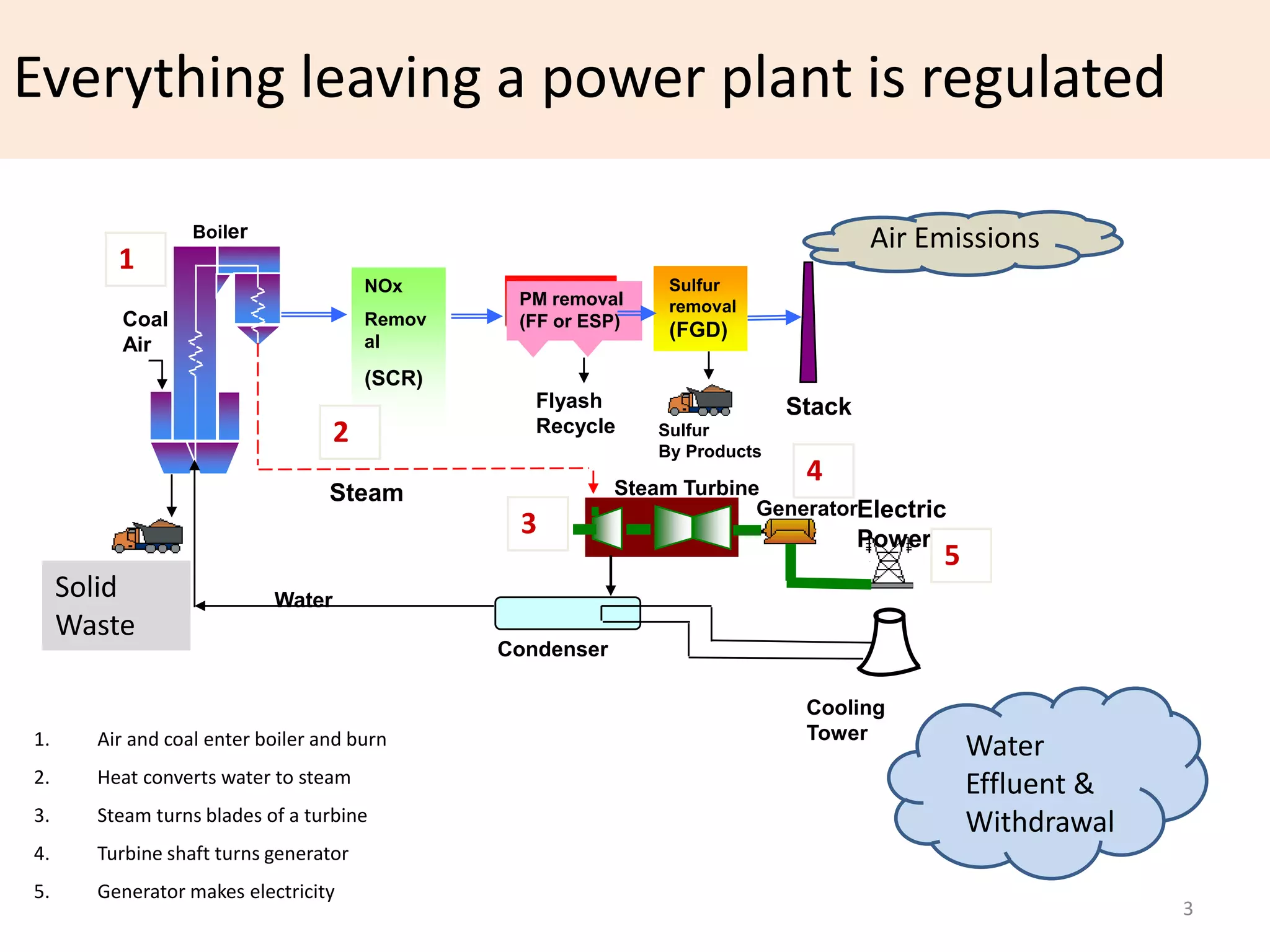
Everything leaving a power plant is regulated

                  Boiler                                                            Air Emissions
         1
                                       NOx                     Sulfur
                                                PM removal     removal
         Coal                          Remov    (FF or ESP)
                                                               (FGD)
         Air                           al

                                       (SCR)
                                                  Flyash                    Stack
                                   2              Recycle     Sulfur
                                                              By Products

                                                           Steam Turbine
                                                                             4
                                  Steam
                                                                        GeneratorElectric
                                                3                                   Power
                                                                                            5
     Solid                 Water
     Waste
                                               Condenser

                                                                             Cooling
1.     Air and coal enter boiler and burn                                    Tower
                                                                                                Water
2.     Heat converts water to steam                                                             Effluent &
3.     Steam turns blades of a turbine                                                          Withdrawal
4.     Turbine shaft turns generator
5.     Generator makes electricity
                                                                                                             3
Types of Regulation

• Air (probably the most challenging for new sources)
   –   New Source Review: BACT, Air Quality modeling, HAPs
   –   Cross State Air Pollution Rule (CAIR)
   –   NSPS: Current limits and proposed limits
   –   Acid rain program
   –   Proposed revisions to U-MACT (hazardous emissions)
• Water
   – Withdrawal: Cooling water intake structures
   – Emissions: Effluent guidelines
• Solid waste
   – Landfill regulations (state, proposed Federal)
• Climate: BACT, pending CO2 NSPS
• Other: Wind, the CFB permit.


                                                             4
AIR: National Ambient Air Quality Standards
                               Primary Standards (protect health)
          Pollutant            Level                  Averaging Time
Carbon                9 ppm (10 mg/m3)         8-hour
Monoxide              35 ppm (40 mg/m3)        1-hour
Lead                  0.15 µg/m3               Rolling 3-Month Avg
Nitrogen              53 ppb                  States(Arithmetic Avg) plans to
                                               Annual submitted
Dioxide               100 ppb                 EPA in 1971 showing
                                               1-hour
Particulate           150 µg/m3                24-hour
                                              how they would achieve
Matter (PM10)
Particulate           15.0 µg/m3              these Standards by
                                               Annual (Arithmetic Avg)
Matter (PM2.5)        35 µg/m3                regulating sources of air
                                               24-hour
Ozone                 0.075 ppm (2008 std)    pollution (SIPs).
                                               8-hour
                      0.08 ppm (1997 std)       8-hour
                      0.12 ppm                  1-hour
Sulfur                0.03 ppm (1971 std)       Annual (Arithmetic Avg)
Dioxide               0.14 ppm (1971 std)       24-hour
                      75 ppb                    1-hour
                                                                           5
Air Quality Nonattainment in Michigan


• SO2, NOx, Ozone, CO, Lead,
  PM2.5 24hr are all in
  attainment
• PM2.5 annual is in
  nonattainment in Detroit –
  Ann Arbor area
• Map shows entire metro
  area, but high readings are
  in a portion of Wayne
  County.                        Wayne County


                                                6
New Source Review

• Must obtain permit prior to construction
• Key areas of requirements
   – Best Available Control Technology for a list of regulated
     (nonhazardous) pollutants. Case-by-case determination by
     permitting authority.
   – Demonstration using complex computer models that allowed
     emissions will not exceed NAAQS, or exceed “PSD Increments”,
     which tend to be a fraction of NAAQS. Separate Increments for
     “Class I” areas such as National Parks.
   – General assessment of impacts on other values such as soils and
     vegetation
   – Public process, typically involving hearings and formal
     comments on proposed permit limits.


                                                                   7
Seney National Wildlife Refuge
95,000 acre migratory bird and
wildlife habitat, established in
1935.


                                   8
Cross State Air Pollution Rule

•   Published August 8, 2011
•   Limits SO2 and NOx from
    power plants
•   Applies to 27 eastern states
•   Initial compliance period is
    2012, second in 2014
•   2% of allowances are “set
    aside” for new sources in
    each state
•   Greatest impact is on coal-
    fired systems
•   For MI:
     – SO2 – 243kTPY (2010) to
       144kTPY (2014)
     – NOx – 81kTPY (2010) to
       58ktpy (2014)


                                                  9
EPA Acid Rain Program

• Developed under CAA Title IV, added in 1990 amendments.
• Affected 2000 existing electric generating units >25 MW, and
  all new units, in 21 eastern states. Limited emissions of SO2
  and NOx.
• Two phases: 1995/1996 & 2000.
• Targeted 10 million TPY reduction in SO2 and 2 million TPY
  reduction in NOx by 2000 (v. 1980).
• SO2 allowances based on an emission rate (2.5 or 1.2
  #SO2/mmBtu) x heat input. A small auction set-aside assured
  allowances for new units (no free allocation).
• Region-wide trading program: EPA tracks transactions, but
  does not buy or sell allowances, except via annual auction.
                                                              10
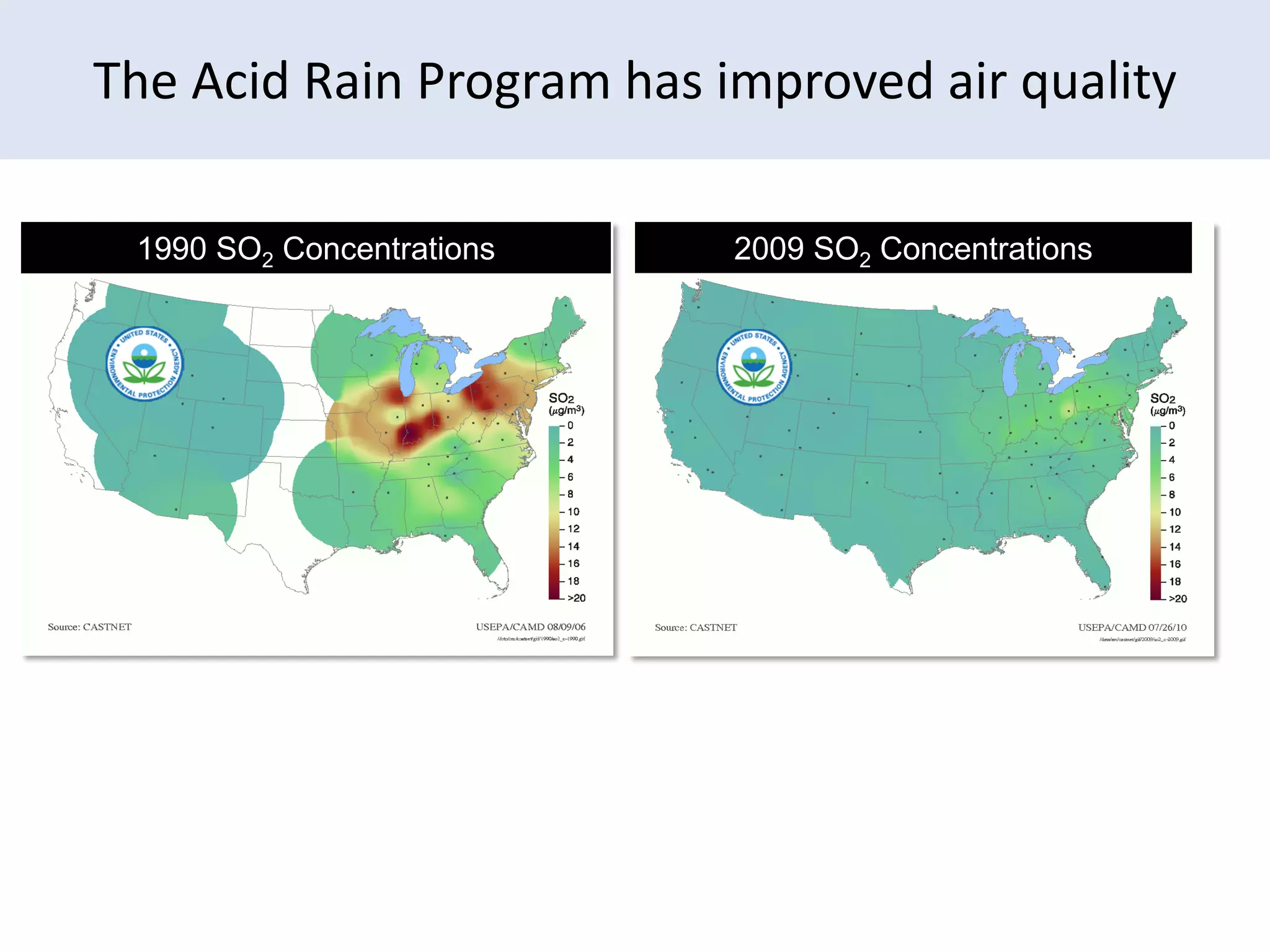
The Acid Rain Program has improved air quality

   1990 SO2 Concentrations                2009 SO2 Concentrations
                                    2009 SO2 concentrations


Similar reductions of other criteria emissions have also been achieved.
                                                                          11
New Source Performance Standards (air)

• Issued under CAA Sec. 111 authority
• Rules apply to SO2, NOx, PM. (Mercury NSPS limits displaced
  by Sec.112 “MACT” limits)
• Rules are revised over time. They apply depending on when a
  source commenced construction (let contracts, 40CFR60.2)
• NSPS is “best demonstrated” technology, and considers cost.
• Serve as a base for NSR “BACT” limits.


                                                            12
Example NSPS limits
                      CURRENT Regulations           PROPOSED Regulations      KKKK (combustion turbines
Pollutant             (CC 3/1/2005-5/4/2011)        (CC > 5/4/2011)           & NGCC)

Filterable PM         0.14 #/MWh, or 0.015
                      #/mmBtu; or 0.030 #/mmBtu
(60.42Da)
                      & 99.9% redn (NG-only is
                      generally exempt)


Total PM                                            0.055 #/MWh (NG-only is
                                                    exempt)

SO2                   1.4 #/MWh, or 95% reduction   1.0 #/MWh, or 97%         0.9 #SO2/MWh, any fuel: <
                                                    reduction                 0.06 #/mmBtu heat input
(60.43Da & 60.4330)


NOx                   1.0 #/MWh                     0.7 #/MWh                 For Natural Gas:
                                                                              50-850 mmBtu/hr heat
(60.44Da & 60.4320)
                                                                              input: 25ppm (1.2 #/MWh).
                                                                              >850 mmBtu/hr: 15ppm
                                                                              (0.43 #/MWh)


Hg                    CC > 1/30/2004:
                      Bit: 0.02 #/GWh
(60.45Da)
                      Sub: 0.066 #/GWh (w)
                           0.097 #/GWh (d)
                      Lig: 0.175 #/GWh
                      IGCC: 0.020 #/GWh


      CC = Commenced constuction                                                                          13
Utility HAPs (mercury, etc.)

• Authority is Sec. 112 of Clean Air Act (NESHAPS)
• EPA regulates listed HAPs by industrial sectors
• Electric generating unit standards were adopted in 2005 (using NSPS
  authority instead of NESHAPS). Reviewing court vacated the rule.
• Since then, permitting authority must establish HAP limits (Maximum
  Achievable Control Technology) on a case-by-case basis.
• EPA proposed a new set of MACT limits in May 3, 2011 Federal Register.
  Final rule required by November 16, per consent decree. Focus is on coal-
  fired EGUs.
    – EPA proposes “surrogates” for groups of HAPs. E.g., Total PM represents non-mercury
      metal HAPs.
    – Limits are very stringent. Bituminous coal mercury emission limit is 1% of limit adopted by
      EPA in 2005 (0.0002 #/GWh v 0.02 #/GWh)
    – New source means any affected source the construction or reconstruction of which is
      commenced after the Administrator first proposes a relevant emission standard under this
      part establishing an emission standard applicable to such source. (40CFR63.2)
                                                                                             14
Proposed Utility HAP limits
New/Existing             Fuel           Pollutant          Limit*                                   Units of Standard
                         Any coal       Total PM           0.0056 #TPM/mmBtu                        0.05 #/MWh
New                                     HCl                0.000033 #HCl/mmBtu                      0.3 #/GWh
                                        SO2                0.044 #SO2/mmBtu                         0.4 #/MWh
                         Bit or Sub     Hg                 0.018 #Hg/TBtu (revised)**               0.00001 #/GWh (orig);
                                                                                                    0.0002 #/GWh (rev’d)
                         Lig            Hg                 3.6 #Hg/TBtu                             0.040 #/GWh


                         Any coal       Total PM           0.03 #TPM/mmBtu
                                                                                   In General –
Existing                                HCl                0.0020 #HCl/mmBtu       New source limits are
                                        SO2                0.20 #SO2/mmBtu         1/5th to 1/60th the
                         Bit or Sub     Hg                 1.2 #Hg/TBtu (revised)**
                                                                                   comparable limits for
                         Lig            Hg                 4.0 #Hg/TBtu
                                                                                   existing sources.
* Note: Unit conversions for new units are based on Heat Rate of 9 millionBtu/MWh.
** EPA revised certain mercury limits after the proposed rule was published, due to a math error.


                                                                                                                            15
Water Regulations

• Steam-electric power plants (Coal, nuclear, NGCC) use large
  amounts of river/lake water to condense steam to liquid water
  (withdrawal).
• Several processes within a power plant can contribute water
  pollutants to a receiving stream or river (discharges).
• Withdrawals are regulated under Sec. 316(b) of the Clean Water
  Act, by placing requirements on the “cooling water intake
  structure”. Most new steam-electric units are required to employ
  cooling towers to reduce the heat load on aquatic biota. Many
  existing power plants use “once-through” cooling water systems.
• Discharges are regulated by Effluent Guidelines (which are actually
  regulations) set by EPA and usually enforced by states via operating
  permits.
• EPA regulations are at 40CFR423.


                                                                     16
Best Practicable Control Techy   Best Available C T   New Source Performance Std   Pretreatment Stds, new/exist


Source: Steam Electric Power Generating Point Source Category: Final
Detailed Study Report, USEPA, 821-R-09-008, Oct 2009.
                                                                                                                 17
18
In general, current technology is adequate to
                  meet EGs
• Major waste water streams are from conveying ash,
  cooling tower blowdown, metal cleaning processes, and
  coal pile runoff.
• Treatment processes include various techniques to
  remove suspended and dissolved solids in the waste
  water.
   – Settling ponds allow suspended solids to sink to the pond
     bottom by gravity.
   – Addition of lime, iron-chloride compounds, and sulfur
     compound cause conversion of dissolved solids to suspended
     particles, and encourage agglomeration to larger particles which
     can be removed by filters
   – Some power plants use biological treatment similar to sewage
     treatment plants. Others use evaporative basins.

                                                                   19
New Effluent Guidelines are planned

• Current EGs were last
  updated in 1992.
• In 2009, EPA announced
  a decision to develop
  new limits.
• A proposed rule is
  expected in July 2012.
• EPA is currently focused
  on FGD wastewater, and
  surface impoundments
  (wet storage of ash).

                                          20
Solid Wastes from power plants are regulated by State

  • Two major waste streams are byproducts of controlling air
    pollutants:
     – Calcium sulfate (gypsum) from FGD control of SO2 at coal-fired
       units.
     – Ash from the mineral content of coal or wood.
  • Michigan Department of Environmental Quality, Waste &
    Hazardous Materials Division, regulates solid waste
    disposal.
  • EPA has proposed “Coal Combustion Residuals Rule” to
    regulate power plant solid wastes under RCRA (power
    plants are currently exempt from RCRA).
     • EPA offered 2 approaches. One would be federally
       implemented, the other would provide guidelines to states.


                                                                        21
Michigan regulation of power plant solid wastes


• Solid Waste Management Act Administrative rules, 2005
• Coal ash & wood ash is “low-hazard industrial waste”
• Regulated as “Type III” landfill
   – Rules control location, design, and operation
   – In general, must use a membrane liner, “compacted soil liner” (3 feet
     thick), or pass a hydrogeologic site evaluation
   – Groundwater monitoring conducted throughout active life and for 30
     years after closure.
   – Fee/ton paid to “Perpetual Care Fund” (trust/escrow account) to
     ensure monitoring & remediation for 30 years after closure.


                                                                             22
A Large Portion of Solid Wastes are Recycled

• ACAA survey found 44% of power plant solid wastes are
  currently recycled - typically as wallboard, or as input to
  cement manufacture, or road aggregate.
• Ash can be “contaminated” by other collection systems, like
  ACI for mercury control, or by cofiring biomass.
• It is very likely that new units will either recycle, or use dry
  landfills for power plant solid waste disposal.
• Pulverized coal and FBC wastes differ, but both are amenable
  to recycle.
• Good information available from American Coal Ash
  Association, http://www.acaa-
  usa.org/associations/8003/files/2009_Production_and_Use_Survey_Revised_100511.pdf

                                                                                      23
Climate Change regulation

• New fossil fuel-fired power plants must evaluate CO2 BACT as
  part of their air permit NOW.
   – Requirement applies to PSD permits issued after January 2, 2011.
   – If potential emission > 75,000 TPY CO2 (about 9 MWe of capacity if
     firing coal; about 20 MWe if gas-fired).
   – Final guidance (94 pages) issued by EPA March 2011.
• EPA was scheduled to propose NSPS limits for power plants on
  September 30, but has delayed the rule. A final rule is still
  scheduled for May 2012, per a settlement agreement. Those
  rules would cover both existing and new power plants.


                                                                          24
Michigan Renewable Energy Standard
• MI Public Act 295, 2008: Requires all MI utilities to supply
  10% of generation from renewable energy by 2015; interim
  steps for 2012-2014.
• Up to 10% of the 10% (1%) can come from “advanced cleaner
  energy generation” (includes coal – but not gas – system
  w/85% CO2 capture)
• Additional requirements for very state’s largest utilities.
• 2009 Average RE for State was 3.6%; HBPW was 1.9%
• All utilities have submitted plans to MI PSC showing path to
  meeting 10% target by 2015.
• Most common approach to date is wind generation.
• Surcharges collected in 2009 by 2 largest utilities: $60 million.
                                                                  25
• Status of RE projects
  based on 295 contracts
  filed w/ MI PSC.
• Source: MI PSC Feb
  2011 report.

                           26
MI Wind Energy Zone Board identified regions
       with greatest wind potential

 • WEZB created by PSC under
   2008 legislation.
 • Issued its final report Oct
   2009.
 • Identified 4 regions with
   “Highest wind energy
   potential”.
 • Two existing projects, in
   2009, are at “thumb”.


                                         27
Other Issues: Wind

• Wind farm regulation is different; all state-based.
• Issues include: Noise and set-back from residences, bird/bat
  kills, visual intrusion, radar & communications interference
  from EMF, low frequency vibration, shadow flicker.
• In Michigan, PSC issues a Certificate of Convenience and
  Necessity for the electricity, but not a state-level permit.
• MI Dept of Licensing & Regulatory Affairs provides zoning
  guidance to municipalities considering wind farms.
• See: http://www.glc.org/energy/wind/pdf/GLWC-
  LandBasedSiting-Jan2010.pdf


                                                                 28
Other Issues: JDYoung CFB air permit


                            Pollutant   Limit
• Feb 11, 2011 air permit   Opacity     10%, except 20% for 6min/hr
• No more than              PM          0.010 #/mmBtu
                            PM10        0.025 #/mmBtu & 21.6 #/hr
   –   50% petcoke          SO2         1.4 #/MWh gross, 30day rol. avg.
   –   30% TDF                          109 #/hr, 24 hr RA
                            NOx         1.0 #/MWh gross, 30 d RA
   –   30% wood                         78 #/hr, 24 hr RA
   –   20% sewage sludge    CO          0.15 #/mmBtu, 30 d RA;
                                        130 #/hr, 24 hr RA
• Must meet CAIR, NSPS      VOC         0.0036 #/mmBtu ; 3.1 #/hr
• Use Cooling Tower         Hg          0.0078 #/GWh gross, 12 mo RA
                            Pb          0.217 #/TBtu; 0.019 #/hr
                            H2SO4       0.006 #/mmBtu; 5.19 #/hr
                            HF          0.0017 #/mmBtu; 1.47 #/hr
                            HCl         0.063 #/mmBtu


                                                                           29
For additional information …

AIR ISSUES
• NSR Program       http://www.epa.gov/nsr/index.html
• PSD Program       http://www.epa.gov/NSR/psd.html
     -NC guidance 16p         http://www.ncair.org/permits/mets/psd_guidance.pdf
• NAAQS Limits      http://www.epa.gov/air/criteria.html
• CAIR/CSAPR        http://www.epa.gov/airtransport/

WATER ISSUES
• CWIS / 316(b)     http://water.epa.gov/lawsregs/lawsguidance/cwa/316b/index.cfm
• Effluent Guidelines          http://water.epa.gov/scitech/wastetech/guide/steam_index.cfm


                                                                                         30
SOLID WASTE ISSUES
• Coal combustion residuals   http://www.epa.gov/osw/nonhaz/industrial/special/fossil/ccr-
   rule/index.htm

CLIMATE RULES
• Air permitting requirements http://www.epa.gov/nsr/ghgpermitting.html
• MI PSC Renewable energy http://www.michigan.gov/mpsc/0,1607,7-159-16393---,00.html

Michigan DEQ –      http://www.michigan.gov/deq
       AirQuality   http://www.michigan.gov/deq/0,1607,7-135-3306_28605---,00.html

Doug Carter
Carter1819@comcast.net
703-772-9976


                                                                                             31

Doug Carter - October 20

  • 1.
    Regulations Impacting Electric PowerGenerators Presented to Holland BPW October 20, 2011 Doug Carter 1
  • 2.
    Overview • Focus ison Environmental Rules, rather than economic regulation. • Organized by Media: Air, Water, Solid Wastes, Climate, “Issues” • Attempt to reflect key differences by type of generation (coal, natural gas, wind) • Approach – describe the general structure of rules, but allow time for conversation on your particular interests. • Relevant websites identified at end. 2
  • 3.
    Everything leaving apower plant is regulated Boiler Air Emissions 1 NOx Sulfur PM removal removal Coal Remov (FF or ESP) (FGD) Air al (SCR) Flyash Stack 2 Recycle Sulfur By Products Steam Turbine 4 Steam GeneratorElectric 3 Power 5 Solid Water Waste Condenser Cooling 1. Air and coal enter boiler and burn Tower Water 2. Heat converts water to steam Effluent & 3. Steam turns blades of a turbine Withdrawal 4. Turbine shaft turns generator 5. Generator makes electricity 3
  • 4.
    Types of Regulation •Air (probably the most challenging for new sources) – New Source Review: BACT, Air Quality modeling, HAPs – Cross State Air Pollution Rule (CAIR) – NSPS: Current limits and proposed limits – Acid rain program – Proposed revisions to U-MACT (hazardous emissions) • Water – Withdrawal: Cooling water intake structures – Emissions: Effluent guidelines • Solid waste – Landfill regulations (state, proposed Federal) • Climate: BACT, pending CO2 NSPS • Other: Wind, the CFB permit. 4
  • 5.
    AIR: National AmbientAir Quality Standards Primary Standards (protect health) Pollutant Level Averaging Time Carbon 9 ppm (10 mg/m3) 8-hour Monoxide 35 ppm (40 mg/m3) 1-hour Lead 0.15 µg/m3 Rolling 3-Month Avg Nitrogen 53 ppb States(Arithmetic Avg) plans to Annual submitted Dioxide 100 ppb EPA in 1971 showing 1-hour Particulate 150 µg/m3 24-hour how they would achieve Matter (PM10) Particulate 15.0 µg/m3 these Standards by Annual (Arithmetic Avg) Matter (PM2.5) 35 µg/m3 regulating sources of air 24-hour Ozone 0.075 ppm (2008 std) pollution (SIPs). 8-hour 0.08 ppm (1997 std) 8-hour 0.12 ppm 1-hour Sulfur 0.03 ppm (1971 std) Annual (Arithmetic Avg) Dioxide 0.14 ppm (1971 std) 24-hour 75 ppb 1-hour 5
  • 6.
    Air Quality Nonattainmentin Michigan • SO2, NOx, Ozone, CO, Lead, PM2.5 24hr are all in attainment • PM2.5 annual is in nonattainment in Detroit – Ann Arbor area • Map shows entire metro area, but high readings are in a portion of Wayne County. Wayne County 6
  • 7.
    New Source Review •Must obtain permit prior to construction • Key areas of requirements – Best Available Control Technology for a list of regulated (nonhazardous) pollutants. Case-by-case determination by permitting authority. – Demonstration using complex computer models that allowed emissions will not exceed NAAQS, or exceed “PSD Increments”, which tend to be a fraction of NAAQS. Separate Increments for “Class I” areas such as National Parks. – General assessment of impacts on other values such as soils and vegetation – Public process, typically involving hearings and formal comments on proposed permit limits. 7
  • 8.
    Seney National WildlifeRefuge 95,000 acre migratory bird and wildlife habitat, established in 1935. 8
  • 9.
    Cross State AirPollution Rule • Published August 8, 2011 • Limits SO2 and NOx from power plants • Applies to 27 eastern states • Initial compliance period is 2012, second in 2014 • 2% of allowances are “set aside” for new sources in each state • Greatest impact is on coal- fired systems • For MI: – SO2 – 243kTPY (2010) to 144kTPY (2014) – NOx – 81kTPY (2010) to 58ktpy (2014) 9
  • 10.
    EPA Acid RainProgram • Developed under CAA Title IV, added in 1990 amendments. • Affected 2000 existing electric generating units >25 MW, and all new units, in 21 eastern states. Limited emissions of SO2 and NOx. • Two phases: 1995/1996 & 2000. • Targeted 10 million TPY reduction in SO2 and 2 million TPY reduction in NOx by 2000 (v. 1980). • SO2 allowances based on an emission rate (2.5 or 1.2 #SO2/mmBtu) x heat input. A small auction set-aside assured allowances for new units (no free allocation). • Region-wide trading program: EPA tracks transactions, but does not buy or sell allowances, except via annual auction. 10
  • 11.
    The Acid RainProgram has improved air quality 1990 SO2 Concentrations 2009 SO2 Concentrations 2009 SO2 concentrations Similar reductions of other criteria emissions have also been achieved. 11
  • 12.
    New Source PerformanceStandards (air) • Issued under CAA Sec. 111 authority • Rules apply to SO2, NOx, PM. (Mercury NSPS limits displaced by Sec.112 “MACT” limits) • Rules are revised over time. They apply depending on when a source commenced construction (let contracts, 40CFR60.2) • NSPS is “best demonstrated” technology, and considers cost. • Serve as a base for NSR “BACT” limits. 12
  • 13.
    Example NSPS limits CURRENT Regulations PROPOSED Regulations KKKK (combustion turbines Pollutant (CC 3/1/2005-5/4/2011) (CC > 5/4/2011) & NGCC) Filterable PM 0.14 #/MWh, or 0.015 #/mmBtu; or 0.030 #/mmBtu (60.42Da) & 99.9% redn (NG-only is generally exempt) Total PM 0.055 #/MWh (NG-only is exempt) SO2 1.4 #/MWh, or 95% reduction 1.0 #/MWh, or 97% 0.9 #SO2/MWh, any fuel: < reduction 0.06 #/mmBtu heat input (60.43Da & 60.4330) NOx 1.0 #/MWh 0.7 #/MWh For Natural Gas: 50-850 mmBtu/hr heat (60.44Da & 60.4320) input: 25ppm (1.2 #/MWh). >850 mmBtu/hr: 15ppm (0.43 #/MWh) Hg CC > 1/30/2004: Bit: 0.02 #/GWh (60.45Da) Sub: 0.066 #/GWh (w) 0.097 #/GWh (d) Lig: 0.175 #/GWh IGCC: 0.020 #/GWh CC = Commenced constuction 13
  • 14.
    Utility HAPs (mercury,etc.) • Authority is Sec. 112 of Clean Air Act (NESHAPS) • EPA regulates listed HAPs by industrial sectors • Electric generating unit standards were adopted in 2005 (using NSPS authority instead of NESHAPS). Reviewing court vacated the rule. • Since then, permitting authority must establish HAP limits (Maximum Achievable Control Technology) on a case-by-case basis. • EPA proposed a new set of MACT limits in May 3, 2011 Federal Register. Final rule required by November 16, per consent decree. Focus is on coal- fired EGUs. – EPA proposes “surrogates” for groups of HAPs. E.g., Total PM represents non-mercury metal HAPs. – Limits are very stringent. Bituminous coal mercury emission limit is 1% of limit adopted by EPA in 2005 (0.0002 #/GWh v 0.02 #/GWh) – New source means any affected source the construction or reconstruction of which is commenced after the Administrator first proposes a relevant emission standard under this part establishing an emission standard applicable to such source. (40CFR63.2) 14
  • 15.
    Proposed Utility HAPlimits New/Existing Fuel Pollutant Limit* Units of Standard Any coal Total PM 0.0056 #TPM/mmBtu 0.05 #/MWh New HCl 0.000033 #HCl/mmBtu 0.3 #/GWh SO2 0.044 #SO2/mmBtu 0.4 #/MWh Bit or Sub Hg 0.018 #Hg/TBtu (revised)** 0.00001 #/GWh (orig); 0.0002 #/GWh (rev’d) Lig Hg 3.6 #Hg/TBtu 0.040 #/GWh Any coal Total PM 0.03 #TPM/mmBtu In General – Existing HCl 0.0020 #HCl/mmBtu New source limits are SO2 0.20 #SO2/mmBtu 1/5th to 1/60th the Bit or Sub Hg 1.2 #Hg/TBtu (revised)** comparable limits for Lig Hg 4.0 #Hg/TBtu existing sources. * Note: Unit conversions for new units are based on Heat Rate of 9 millionBtu/MWh. ** EPA revised certain mercury limits after the proposed rule was published, due to a math error. 15
  • 16.
    Water Regulations • Steam-electricpower plants (Coal, nuclear, NGCC) use large amounts of river/lake water to condense steam to liquid water (withdrawal). • Several processes within a power plant can contribute water pollutants to a receiving stream or river (discharges). • Withdrawals are regulated under Sec. 316(b) of the Clean Water Act, by placing requirements on the “cooling water intake structure”. Most new steam-electric units are required to employ cooling towers to reduce the heat load on aquatic biota. Many existing power plants use “once-through” cooling water systems. • Discharges are regulated by Effluent Guidelines (which are actually regulations) set by EPA and usually enforced by states via operating permits. • EPA regulations are at 40CFR423. 16
  • 17.
    Best Practicable ControlTechy Best Available C T New Source Performance Std Pretreatment Stds, new/exist Source: Steam Electric Power Generating Point Source Category: Final Detailed Study Report, USEPA, 821-R-09-008, Oct 2009. 17
  • 18.
  • 19.
    In general, currenttechnology is adequate to meet EGs • Major waste water streams are from conveying ash, cooling tower blowdown, metal cleaning processes, and coal pile runoff. • Treatment processes include various techniques to remove suspended and dissolved solids in the waste water. – Settling ponds allow suspended solids to sink to the pond bottom by gravity. – Addition of lime, iron-chloride compounds, and sulfur compound cause conversion of dissolved solids to suspended particles, and encourage agglomeration to larger particles which can be removed by filters – Some power plants use biological treatment similar to sewage treatment plants. Others use evaporative basins. 19
  • 20.
    New Effluent Guidelinesare planned • Current EGs were last updated in 1992. • In 2009, EPA announced a decision to develop new limits. • A proposed rule is expected in July 2012. • EPA is currently focused on FGD wastewater, and surface impoundments (wet storage of ash). 20
  • 21.
    Solid Wastes frompower plants are regulated by State • Two major waste streams are byproducts of controlling air pollutants: – Calcium sulfate (gypsum) from FGD control of SO2 at coal-fired units. – Ash from the mineral content of coal or wood. • Michigan Department of Environmental Quality, Waste & Hazardous Materials Division, regulates solid waste disposal. • EPA has proposed “Coal Combustion Residuals Rule” to regulate power plant solid wastes under RCRA (power plants are currently exempt from RCRA). • EPA offered 2 approaches. One would be federally implemented, the other would provide guidelines to states. 21
  • 22.
    Michigan regulation ofpower plant solid wastes • Solid Waste Management Act Administrative rules, 2005 • Coal ash & wood ash is “low-hazard industrial waste” • Regulated as “Type III” landfill – Rules control location, design, and operation – In general, must use a membrane liner, “compacted soil liner” (3 feet thick), or pass a hydrogeologic site evaluation – Groundwater monitoring conducted throughout active life and for 30 years after closure. – Fee/ton paid to “Perpetual Care Fund” (trust/escrow account) to ensure monitoring & remediation for 30 years after closure. 22
  • 23.
    A Large Portionof Solid Wastes are Recycled • ACAA survey found 44% of power plant solid wastes are currently recycled - typically as wallboard, or as input to cement manufacture, or road aggregate. • Ash can be “contaminated” by other collection systems, like ACI for mercury control, or by cofiring biomass. • It is very likely that new units will either recycle, or use dry landfills for power plant solid waste disposal. • Pulverized coal and FBC wastes differ, but both are amenable to recycle. • Good information available from American Coal Ash Association, http://www.acaa- usa.org/associations/8003/files/2009_Production_and_Use_Survey_Revised_100511.pdf 23
  • 24.
    Climate Change regulation •New fossil fuel-fired power plants must evaluate CO2 BACT as part of their air permit NOW. – Requirement applies to PSD permits issued after January 2, 2011. – If potential emission > 75,000 TPY CO2 (about 9 MWe of capacity if firing coal; about 20 MWe if gas-fired). – Final guidance (94 pages) issued by EPA March 2011. • EPA was scheduled to propose NSPS limits for power plants on September 30, but has delayed the rule. A final rule is still scheduled for May 2012, per a settlement agreement. Those rules would cover both existing and new power plants. 24
  • 25.
    Michigan Renewable EnergyStandard • MI Public Act 295, 2008: Requires all MI utilities to supply 10% of generation from renewable energy by 2015; interim steps for 2012-2014. • Up to 10% of the 10% (1%) can come from “advanced cleaner energy generation” (includes coal – but not gas – system w/85% CO2 capture) • Additional requirements for very state’s largest utilities. • 2009 Average RE for State was 3.6%; HBPW was 1.9% • All utilities have submitted plans to MI PSC showing path to meeting 10% target by 2015. • Most common approach to date is wind generation. • Surcharges collected in 2009 by 2 largest utilities: $60 million. 25
  • 26.
    • Status ofRE projects based on 295 contracts filed w/ MI PSC. • Source: MI PSC Feb 2011 report. 26
  • 27.
    MI Wind EnergyZone Board identified regions with greatest wind potential • WEZB created by PSC under 2008 legislation. • Issued its final report Oct 2009. • Identified 4 regions with “Highest wind energy potential”. • Two existing projects, in 2009, are at “thumb”. 27
  • 28.
    Other Issues: Wind •Wind farm regulation is different; all state-based. • Issues include: Noise and set-back from residences, bird/bat kills, visual intrusion, radar & communications interference from EMF, low frequency vibration, shadow flicker. • In Michigan, PSC issues a Certificate of Convenience and Necessity for the electricity, but not a state-level permit. • MI Dept of Licensing & Regulatory Affairs provides zoning guidance to municipalities considering wind farms. • See: http://www.glc.org/energy/wind/pdf/GLWC- LandBasedSiting-Jan2010.pdf 28
  • 29.
    Other Issues: JDYoungCFB air permit Pollutant Limit • Feb 11, 2011 air permit Opacity 10%, except 20% for 6min/hr • No more than PM 0.010 #/mmBtu PM10 0.025 #/mmBtu & 21.6 #/hr – 50% petcoke SO2 1.4 #/MWh gross, 30day rol. avg. – 30% TDF 109 #/hr, 24 hr RA NOx 1.0 #/MWh gross, 30 d RA – 30% wood 78 #/hr, 24 hr RA – 20% sewage sludge CO 0.15 #/mmBtu, 30 d RA; 130 #/hr, 24 hr RA • Must meet CAIR, NSPS VOC 0.0036 #/mmBtu ; 3.1 #/hr • Use Cooling Tower Hg 0.0078 #/GWh gross, 12 mo RA Pb 0.217 #/TBtu; 0.019 #/hr H2SO4 0.006 #/mmBtu; 5.19 #/hr HF 0.0017 #/mmBtu; 1.47 #/hr HCl 0.063 #/mmBtu 29
  • 30.
    For additional information… AIR ISSUES • NSR Program http://www.epa.gov/nsr/index.html • PSD Program http://www.epa.gov/NSR/psd.html -NC guidance 16p http://www.ncair.org/permits/mets/psd_guidance.pdf • NAAQS Limits http://www.epa.gov/air/criteria.html • CAIR/CSAPR http://www.epa.gov/airtransport/ WATER ISSUES • CWIS / 316(b) http://water.epa.gov/lawsregs/lawsguidance/cwa/316b/index.cfm • Effluent Guidelines http://water.epa.gov/scitech/wastetech/guide/steam_index.cfm 30
  • 31.
    SOLID WASTE ISSUES •Coal combustion residuals http://www.epa.gov/osw/nonhaz/industrial/special/fossil/ccr- rule/index.htm CLIMATE RULES • Air permitting requirements http://www.epa.gov/nsr/ghgpermitting.html • MI PSC Renewable energy http://www.michigan.gov/mpsc/0,1607,7-159-16393---,00.html Michigan DEQ – http://www.michigan.gov/deq AirQuality http://www.michigan.gov/deq/0,1607,7-135-3306_28605---,00.html Doug Carter Carter1819@comcast.net 703-772-9976 31