Polynomial functionsBy: Kendra Coomes
 What is a polynomial function?A polynomial function is a function with an exponent that is positive and has a whole number.Polynomials can be in standard form and factored form. They can also have different “degrees.”
What are degrees?Degrees are basically the function whenthe highest power of x is first in standard form. So if there was a x cubed and a 2x squared and a 5. The polynomial would be a third degree polynomial because the highest exponent was a 3.
Second-degree polynomialsExamples of a second-degree polynomial are:The reason these polynomials are second degree because the first x in both functions are squared.
Second-degree polynomials continued …The zero of the function and the x-intercept are always opposites.Example: if the zero of the function was 5 the x-intercept would be -5.The only time when both the zero of the function and the x-intercept could be the same is when there is a zero of multiplicity of 2.
Third-degree polynomialsExamples of third-degree polynomials are:These are both third-degree polynomials because the first x of each function  is cubed.
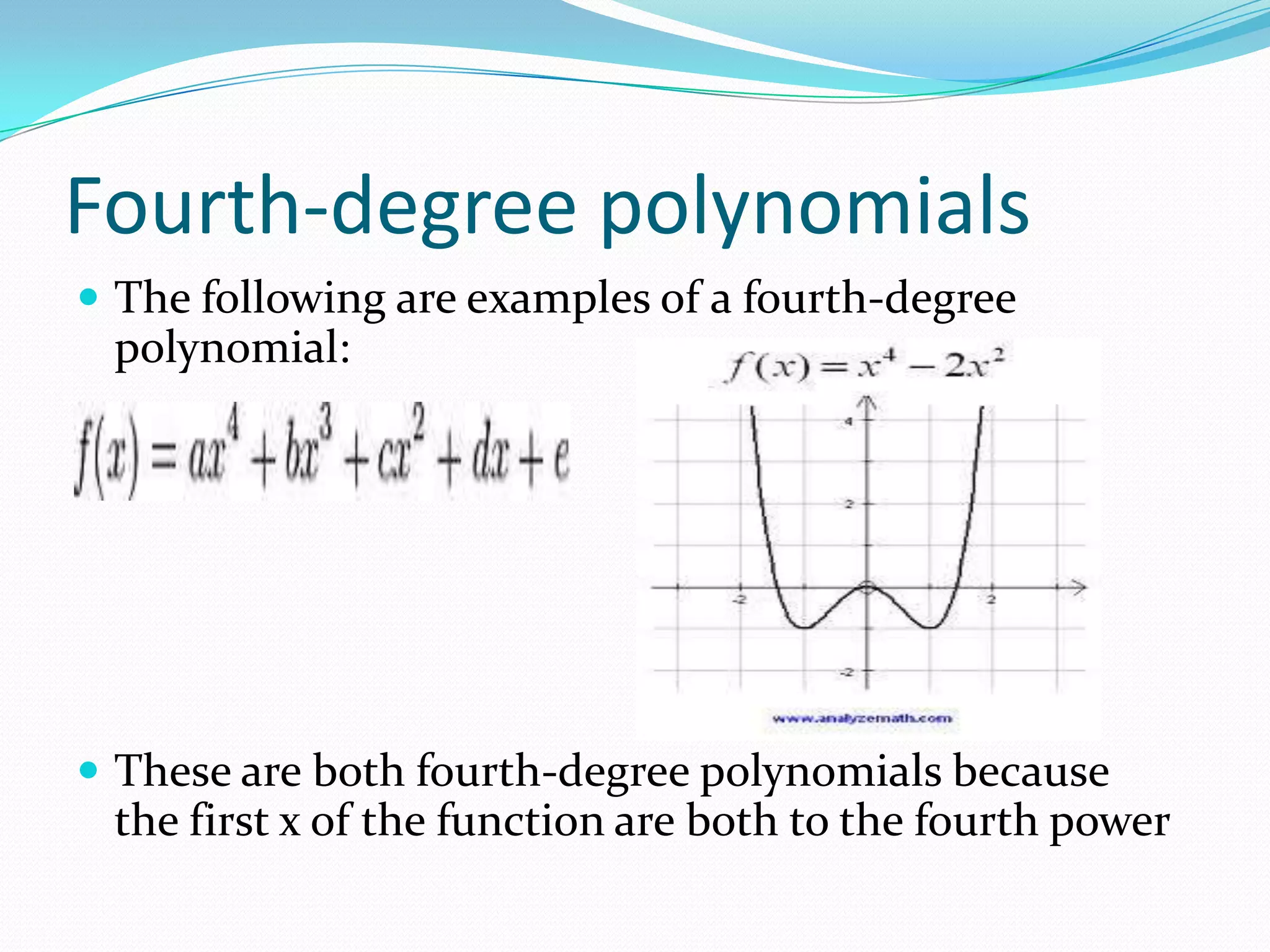
Fourth-degree polynomialsThe following are examples of a fourth-degree polynomial:These are both fourth-degree polynomials because  the first x of the function are both to the fourth power

Polynomial functions

  • 1.
  • 2.
    What isa polynomial function?A polynomial function is a function with an exponent that is positive and has a whole number.Polynomials can be in standard form and factored form. They can also have different “degrees.”
  • 3.
    What are degrees?Degreesare basically the function whenthe highest power of x is first in standard form. So if there was a x cubed and a 2x squared and a 5. The polynomial would be a third degree polynomial because the highest exponent was a 3.
  • 4.
    Second-degree polynomialsExamples ofa second-degree polynomial are:The reason these polynomials are second degree because the first x in both functions are squared.
  • 5.
    Second-degree polynomials continued…The zero of the function and the x-intercept are always opposites.Example: if the zero of the function was 5 the x-intercept would be -5.The only time when both the zero of the function and the x-intercept could be the same is when there is a zero of multiplicity of 2.
  • 6.
    Third-degree polynomialsExamples ofthird-degree polynomials are:These are both third-degree polynomials because the first x of each function is cubed.
  • 7.
    Fourth-degree polynomialsThe followingare examples of a fourth-degree polynomial:These are both fourth-degree polynomials because the first x of the function are both to the fourth power