CQRS & EVS with
Building of a modern distributed enterprise application
CQRS & EVS with
• My name is Lluis Fernández.
• I’m involved in a tech group of freelancers named
B-Team.
• We offer consultancy on distributed system
architectures.
• Contact:
llffernandez@gmail.com
b-team_b-team@googlegroups.com
• What’s this about.
• The patterns: CQRS, EVS and ESB.
• All together: An example of distributed
enterprise application.
CQRS & EVS with
CQRS & EVS with
What’s this about?
CQRS & EVS with
• NoSQL databases, like MongoDB, have
contributed to the adoption and implementation
of archetypes and patterns to develop
distributed enterprise applications.
• High read/write rates, huge data stores
management, highly scalable read-only
replication and schema-less document
orientation, are well suited for those kind of
patterns and techniques.
CQRS & EVS with
• This presentation is about how some of these
patterns and archetypes had been applied during
the implementation of real-word use case: a
Shipment Management application for one of
the most important Messaging and Packages
Delivery companies in Spain.
CQRS & EVS with
CQRS.
CQRS & EVS with
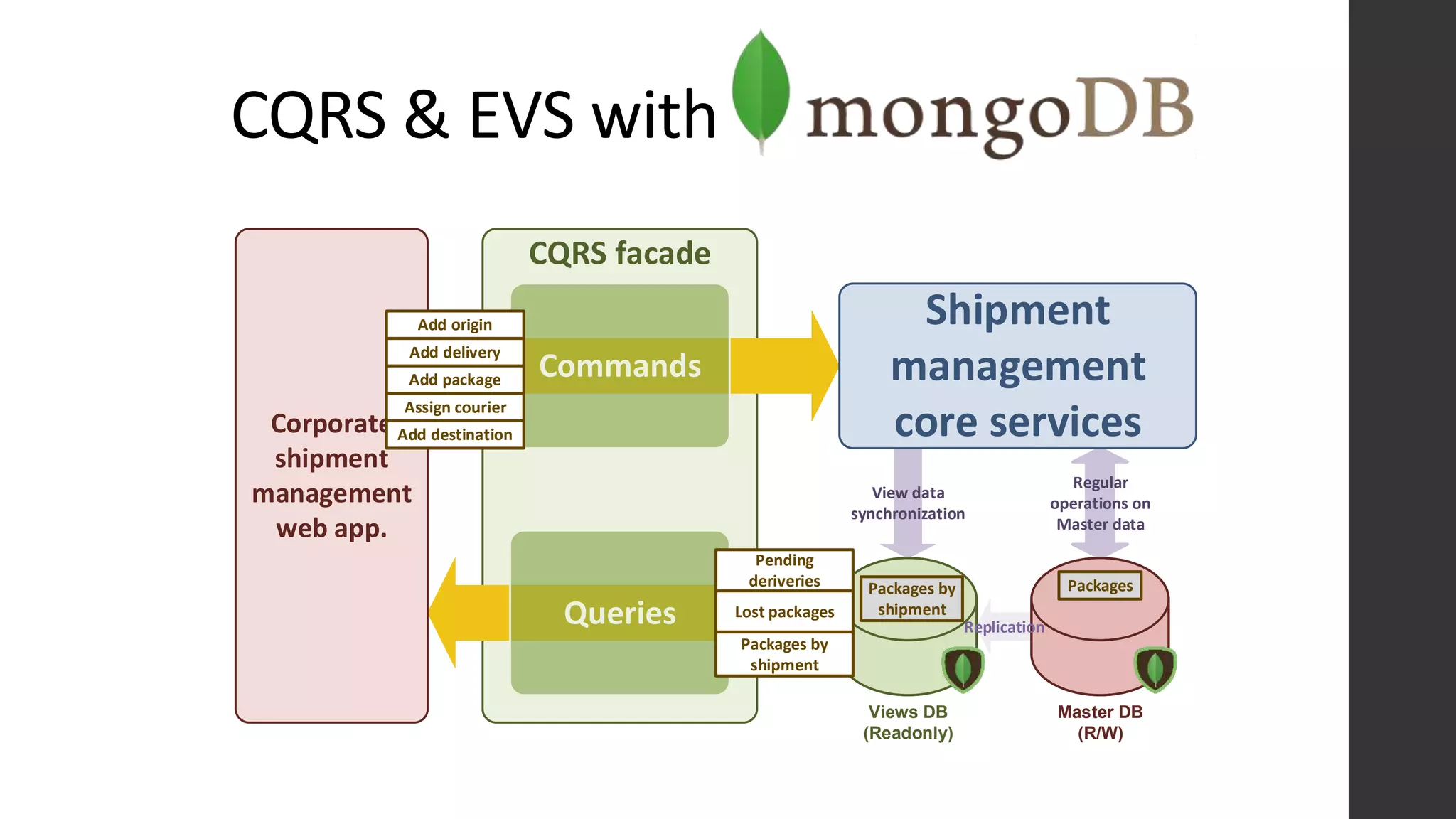
• CQRS stands for Command-Query Responsibility
Segregation.
• Commands are expected to do writes of small
portions of data.
• Queries are expected to do reads of big portions
of data.
• CQRS encourages the separation of these
different workloads.
CQRS & EVS with
CQRS facade
Commands
Queries
Shipment
management
core services
View data
synchronization
Regular
operations on
Master data
Master DB
(R/W)
Views DB
(Readonly)
Replication
Corporate
shipment
management
web app.
Packages
Add package
Add destination
Add origin
Add delivery
Assign courier
Pending
deriveries
Lost packages
Packages by
shipment
Packages by
shipment
CQRS & EVS with
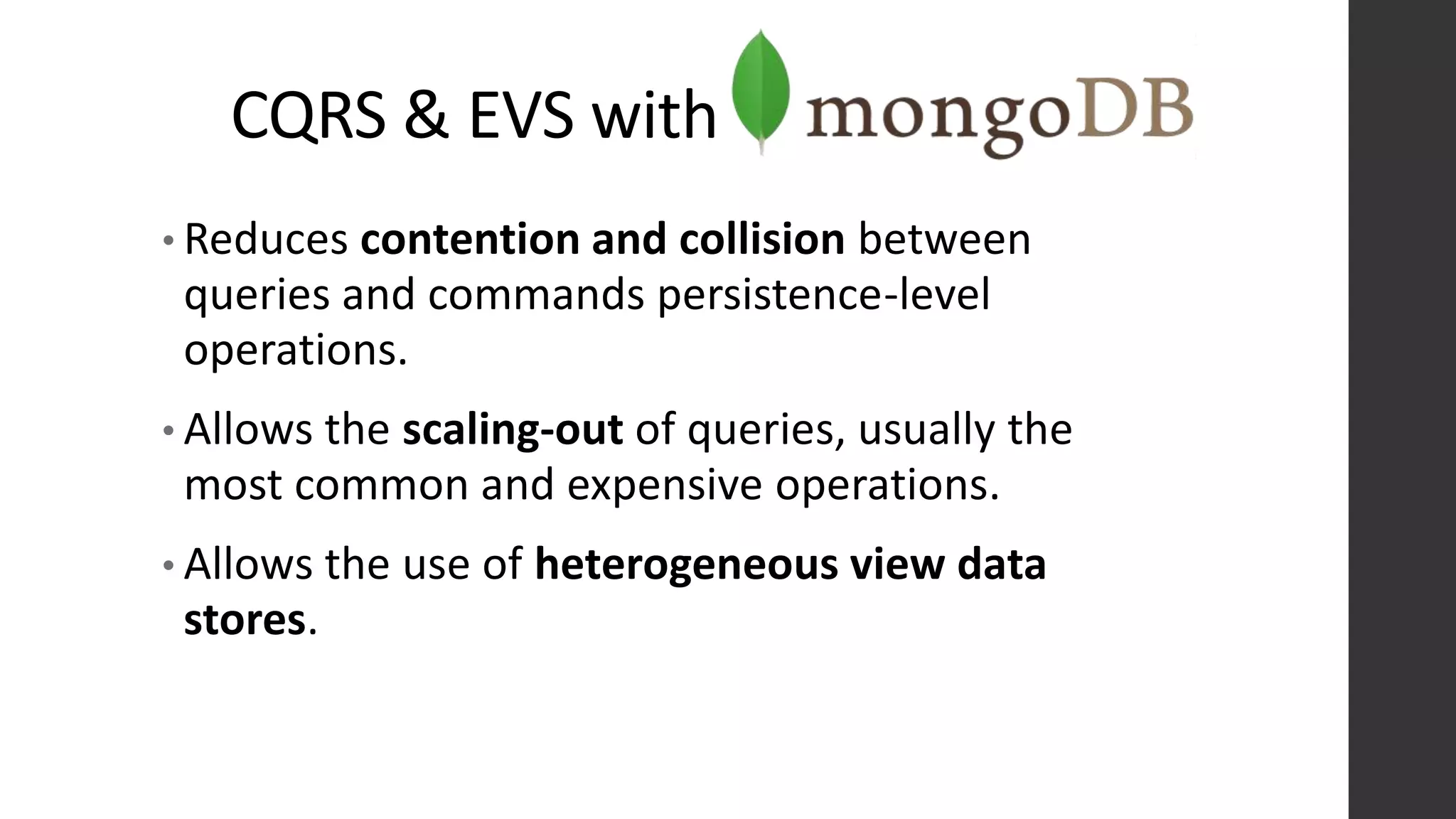
• Reduces contention and collision between
queries and commands persistence-level
operations.
• Allows the scaling-out of queries, usually the
most common and expensive operations.
• Allows the use of heterogeneous view data
stores.
CQRS & EVS with
Shipment management core services
Simple automatic synchronization
(replication)
Queries
Commands
Datasets optimized
for expected queries
(grouping, filtering,
joins, etc.)
Infrastructure-provided
synchronization mechanism.
No optimization:
Master data = View data
Regular datasets
(packages,
deliveries, etc.)
These synchronization
processes introduce
staleness of data
provided to the queries.
Views DB (Readonly) Master DB (R/W)
View data
synchronization
Regular
operations on
Master data
Packages
DeliveriesCustomers
Packages by
shipment
Package
tracking
CQRS & EVS with
Queries
Commands
Shipment management core services
Queries
Views DB (Readonly)
View data
synchronization
View data
synchronization
Regular
operations on
Master data
Master DB (R/W)
More copies of view
data or more different
views.
Also, copies of view data
can be heterogeneous.
Views DB (Readonly)
Packages by
shipment
Package
tracking
Packages by
shipment
Package
tracking
Packages
Deliveries
Customers
CQRS & EVS with
• MongoDB replica sets and ReadPreference can
be used to segregate master and view data:
 Commands write on the PRIMARY.
 View data is also written on the PRIMARY.
 Queries read from SECONDARIES.
• Separate master and view data collections in
different databases (MongoDb write locking).
• Schema optimization and indexing in collections
storing view data also improve performance.
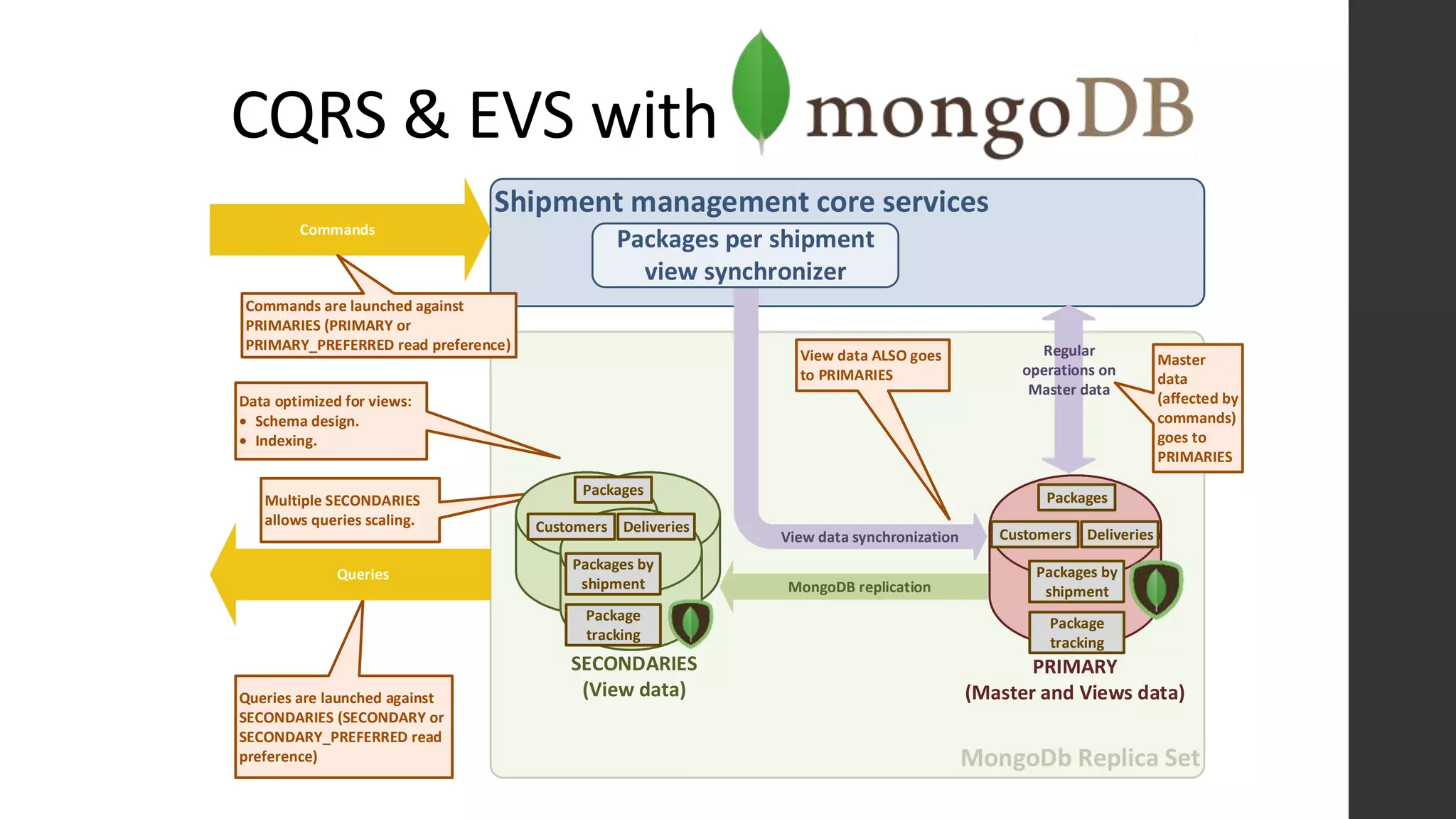
CQRS & EVS with
Shipment management core services
Queries are launched against
SECONDARIES (SECONDARY or
SECONDARY_PREFERRED read
preference)
MongoDB replication
Commands
Queries
View data synchronization
Packages per shipment
view synchronizer
Data optimized for views:
 Schema design.
 Indexing.
Multiple SECONDARIES
allows queries scaling.
Regular
operations on
Master data
Commands are launched against
PRIMARIES (PRIMARY or
PRIMARY_PREFERRED read preference)
View data ALSO goes
to PRIMARIES
Master
data
(affected by
commands)
goes to
PRIMARIES
PRIMARY
(Master and Views data)
SECONDARIES
(View data)
Packages by
shipment
Package
tracking
Packages
DeliveriesCustomers
Packages by
shipment
Package
tracking
Packages
DeliveriesCustomers
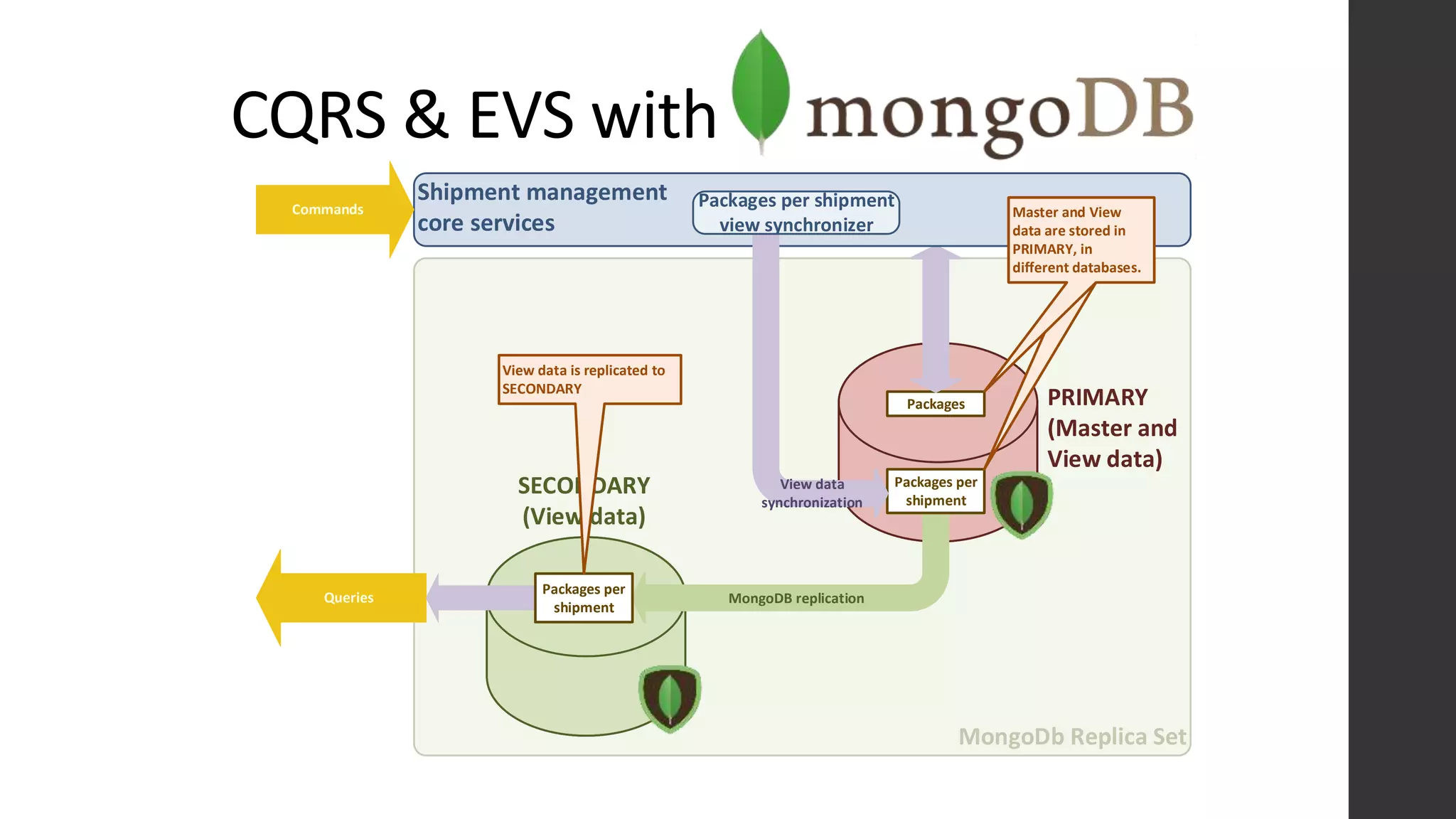
CQRS & EVS with
PRIMARY
(Master and
View data)
SECONDARY
(View data)
Packages
MongoDB replication
Packages per
shipment
Queries
Packages per
shipment
Shipment management
core services
Master and View
data are stored in
PRIMARY, in
different databases.
View data is replicated to
SECONDARY
Commands
Packages per shipment
view synchronizer
View data
synchronization
CQRS & EVS with
• Caveats:
Staleness of data read by queries.
Availability loss and overloads of PRIMARY in case
of SECONDARIES failures.
Balancer in sharding environments can introduce
additional staleness and duplication in data being
read.
CQRS & EVS with
EVS.
CQRS & EVS with
• EVS stands for EVent Sourcing.
• Closely related to DDD (Domain Driven Design) and
CQRS.
• Events are changes to the state of a domain model
subset of an application.
• Events occurred in the past, and are also referred as
Domain events.
• EVS consists in expressing the state of a domain
model subset as a sequence of events.
CQRS & EVS with
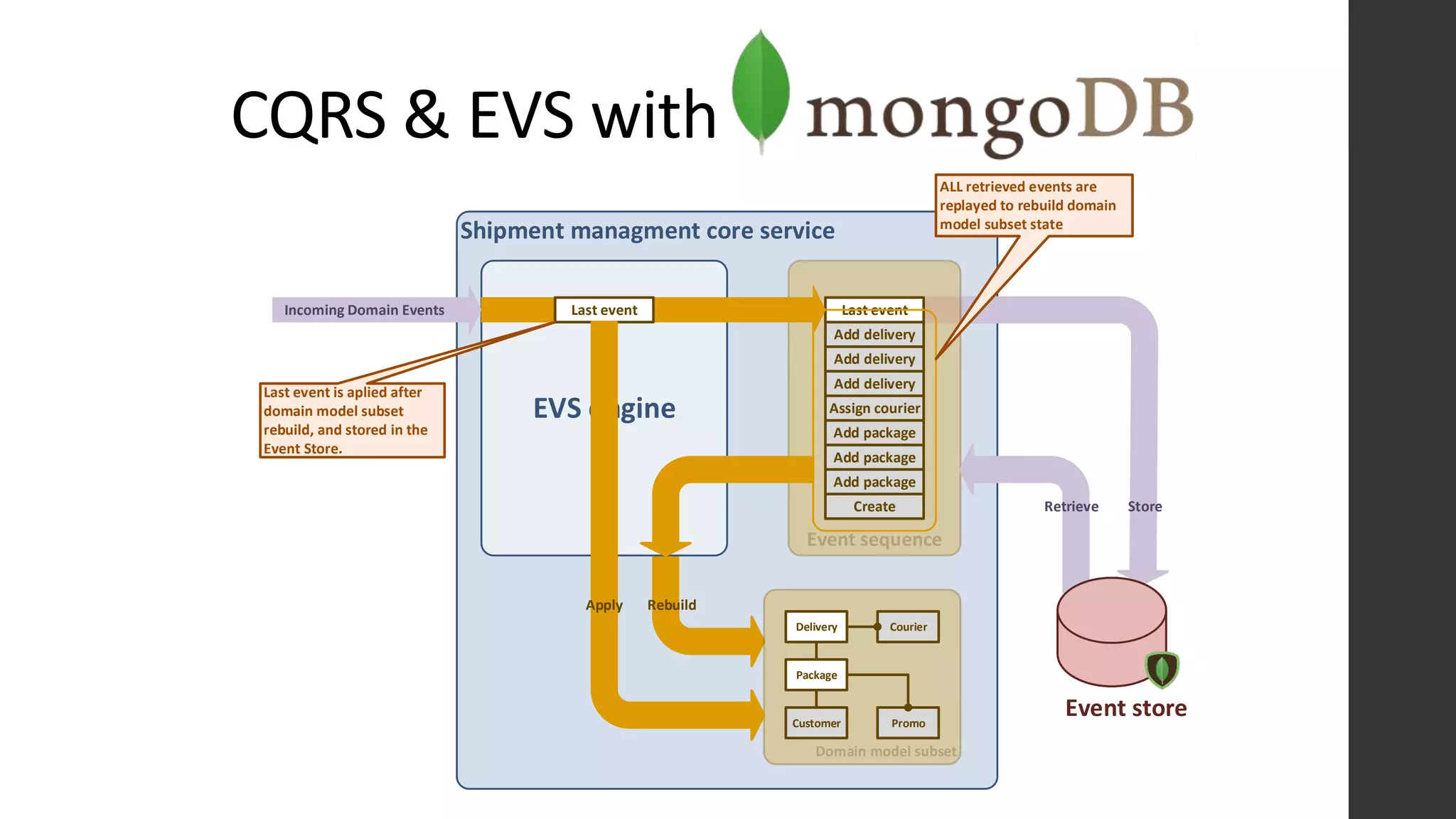
Shipment managment core service
EVS engine
Add package
Add package
Create
Add package
Assign courier
Add delivery
Add delivery
Add delivery
Last event
Store
Incoming Domain Events Last event
Delivery
Package
Customer
Courier
Promo
Rebuild
Retrieve
Event store
Apply
ALL retrieved events are
replayed to rebuild domain
model subset state
Last event is aplied after
domain model subset
rebuild, and stored in the
Event Store.
CQRS & EVS with
• Events are stored in a Event Store, that can be
huge (ideally infinite), depending on the domain
subset’s lifetime.
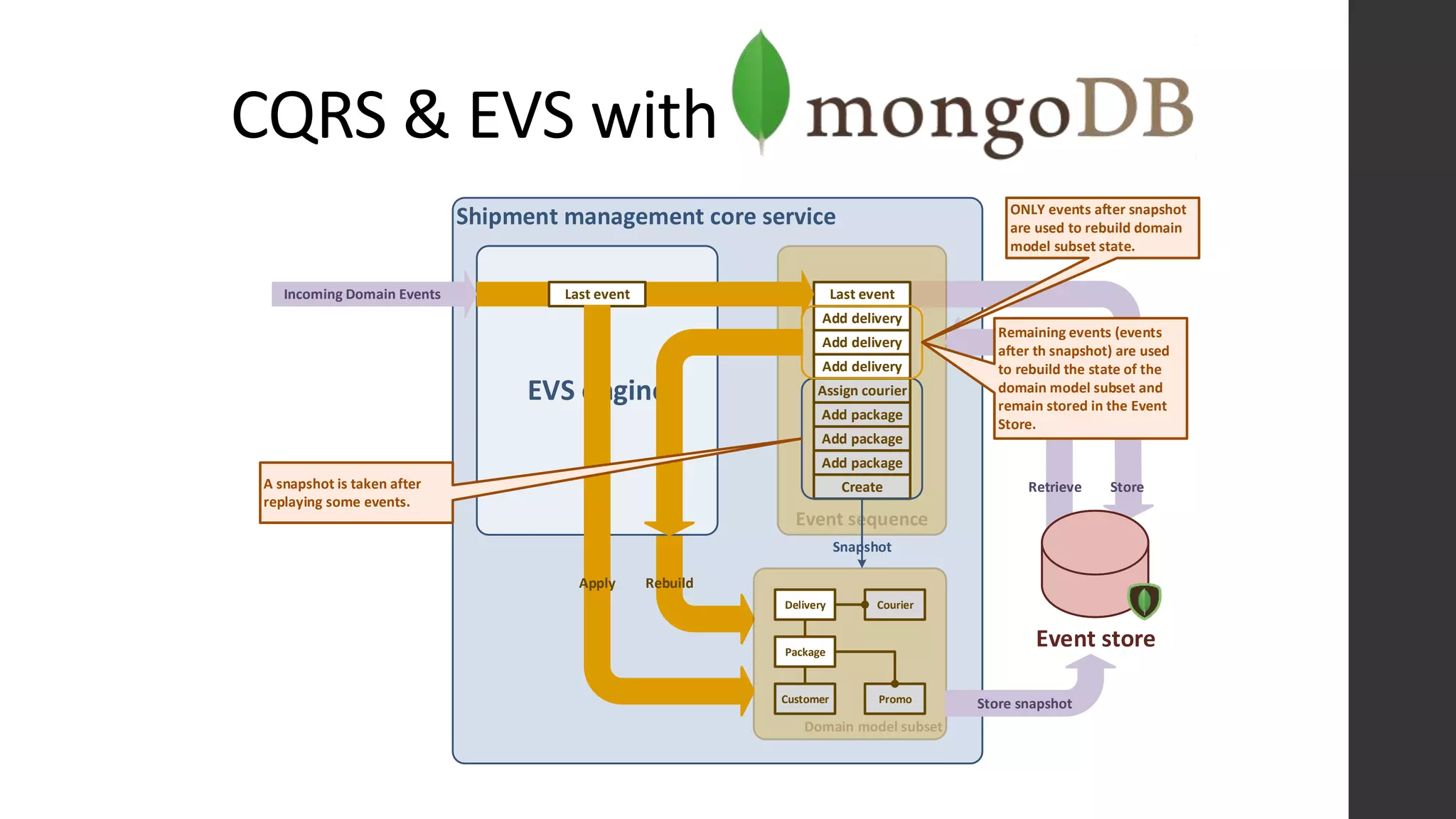
• To keep growth of the Event Store under control:
Store a point-in-time state of the domain model
subset (take a snapshot of it).
Store only events occurred after the last snapshot.
CQRS & EVS with
Shipment management core service
EVS engine
Add package
Add package
Create
Add package
Assign courier
Add delivery
Add delivery
Add delivery
Last event
Store
Incoming Domain Events Last event
Delivery
Package
Customer
Courier
Promo
Rebuild
Retrieve
Event store
Snapshot
Apply
Store snapshot
ONLY events after snapshot
are used to rebuild domain
model subset state.
A snapshot is taken after
replaying some events.
Remaining events (events
after th snapshot) are used
to rebuild the state of the
domain model subset and
remain stored in the Event
Store.
CQRS & EVS with
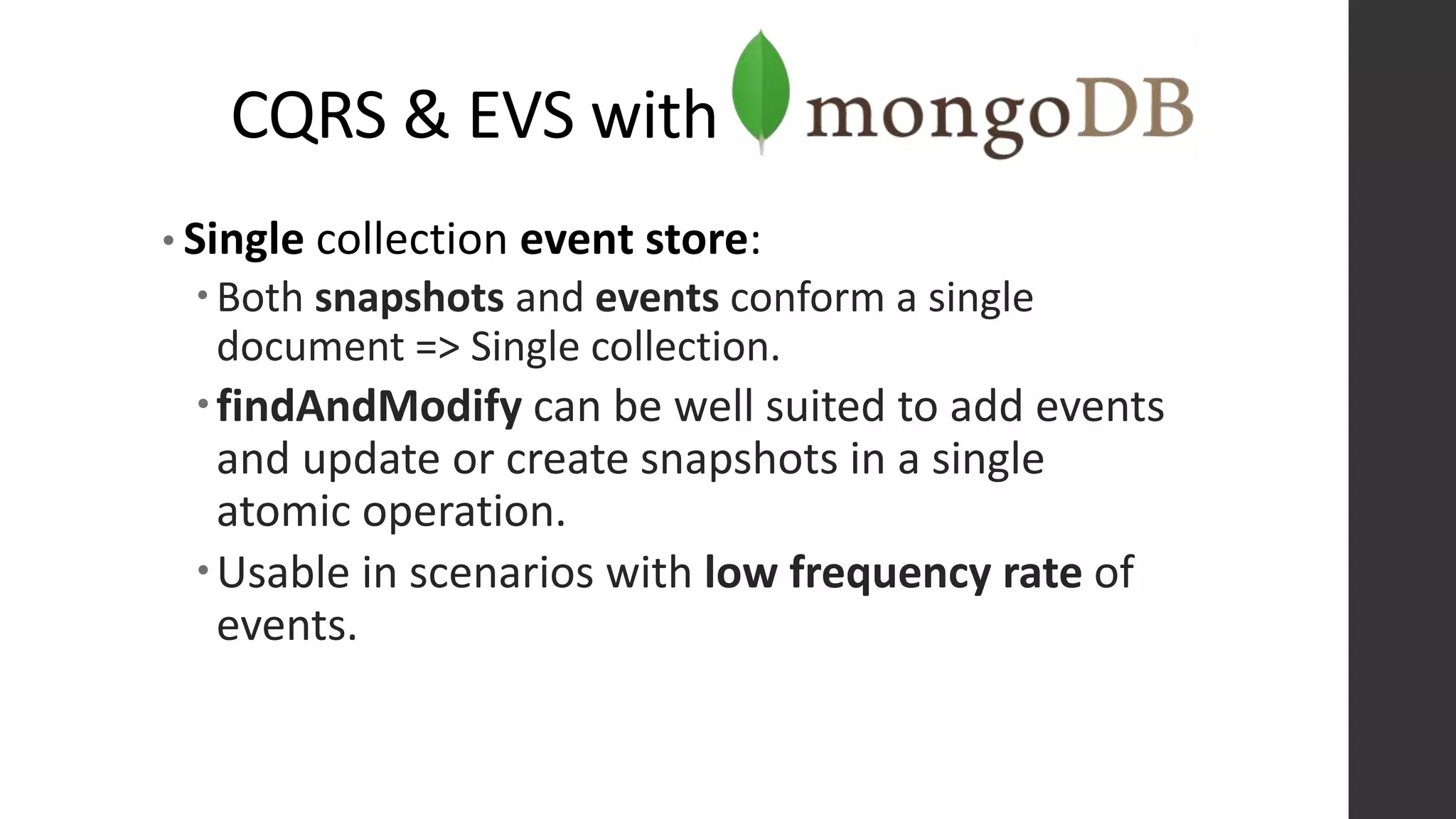
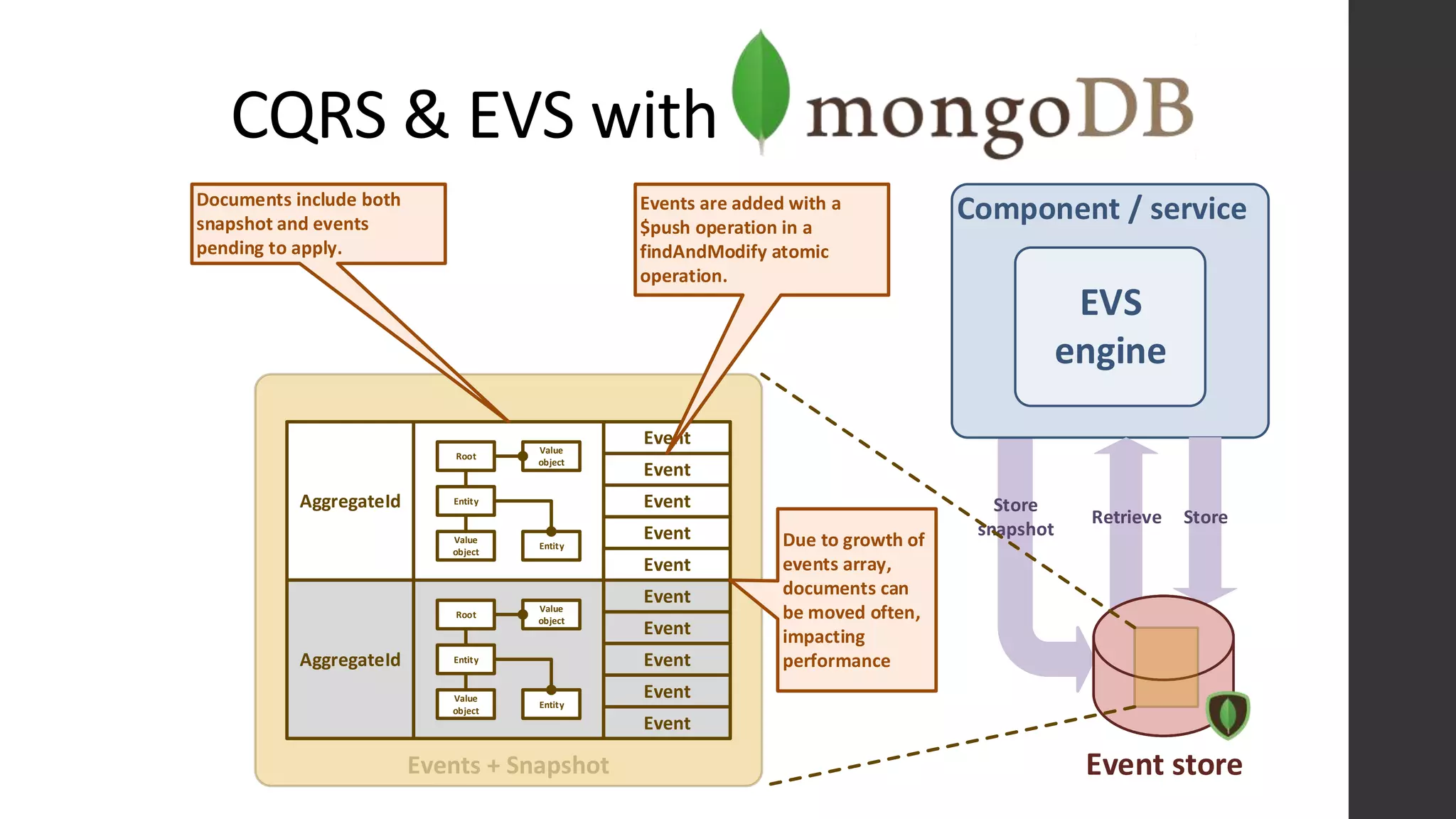
• Single collection event store:
Both snapshots and events conform a single
document => Single collection.
findAndModify can be well suited to add events
and update or create snapshots in a single
atomic operation.
Usable in scenarios with low frequency rate of
events.
CQRS & EVS with
Event
Event
Event
Event
Event
Event
Event
Event
Store
snapshot
AggregateId
AggregateId
Root
Entity
Value
object
Value
object
Entity
Root
Entity
Value
object
Value
object
Entity
Component / service
EVS
engine
StoreRetrieve
Event store
Event
Event
Documents include both
snapshot and events
pending to apply.
Events are added with a
$push operation in a
findAndModify atomic
operation.
Due to growth of
events array,
documents can
be moved often,
impacting
performance
CQRS & EVS with
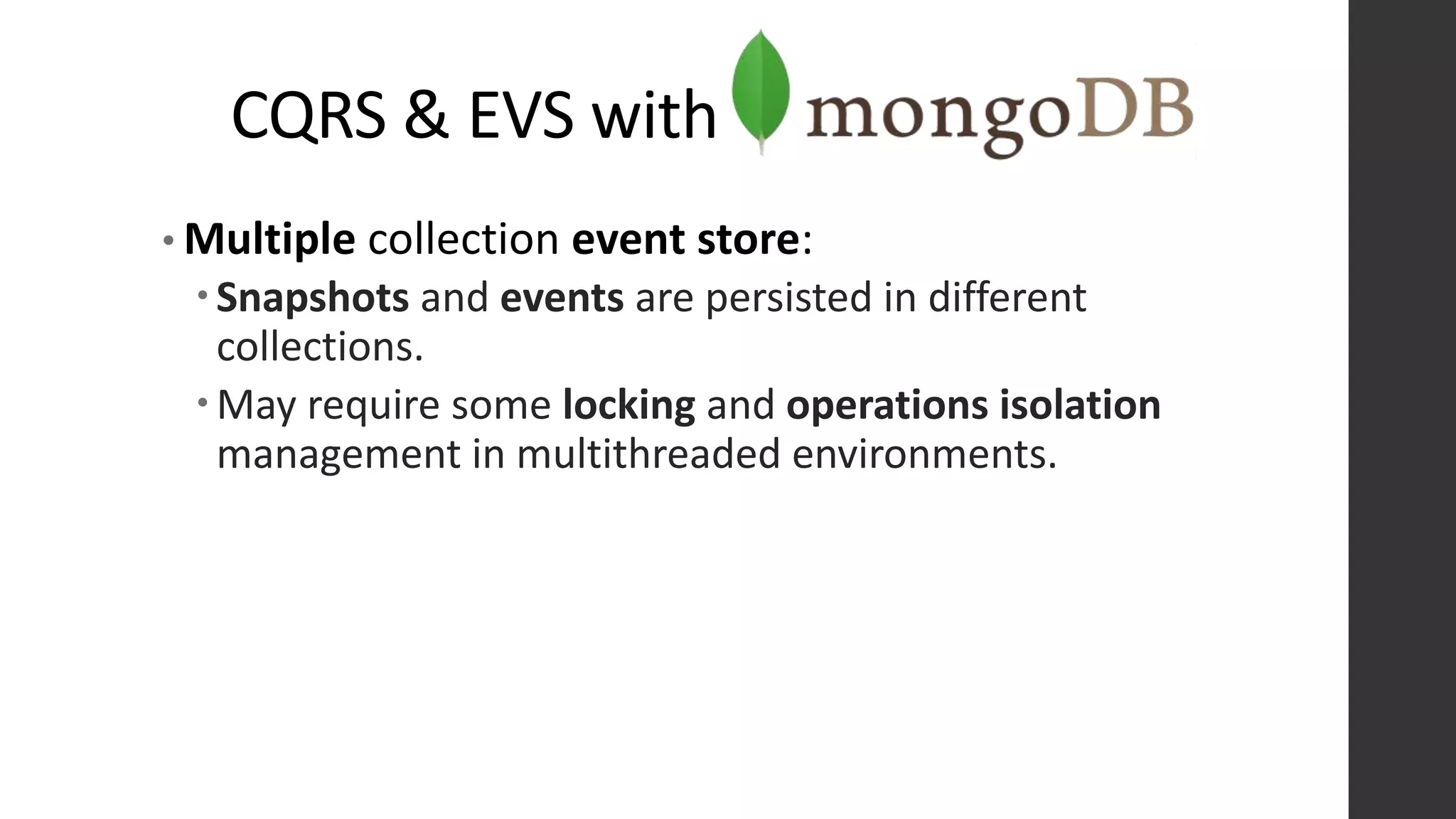
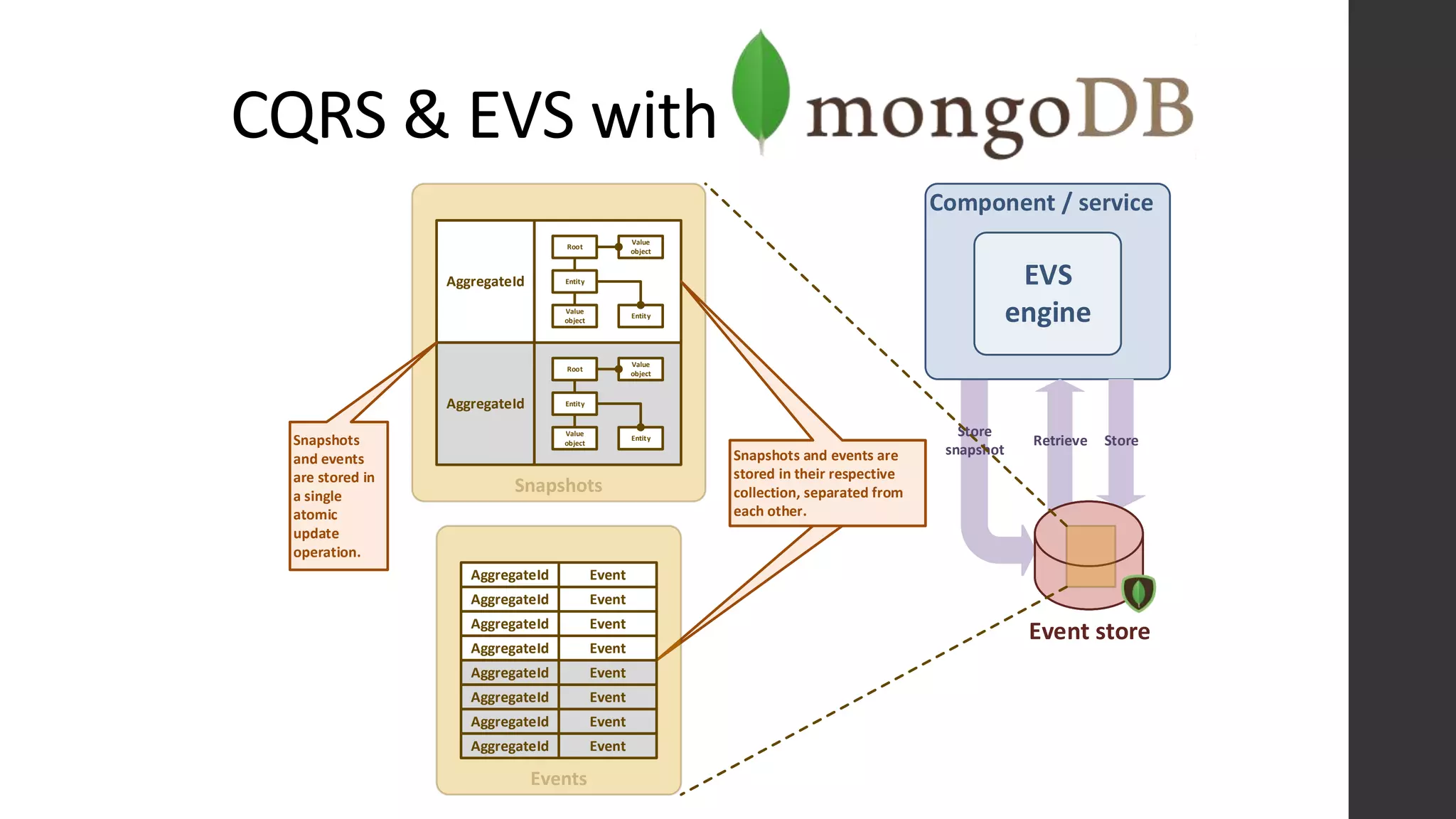
• Multiple collection event store:
Snapshots and events are persisted in different
collections.
May require some locking and operations isolation
management in multithreaded environments.
CQRS & EVS with
Event
Event
Event
Event
Event
Event
Event
Event
Store
snapshot
AggregateId
AggregateId
AggregateId
AggregateId
AggregateId
AggregateId
AggregateId
AggregateId
AggregateId
AggregateId
Root
Entity
Value
object
Value
object
Entity
Root
Entity
Value
object
Value
object
Entity
Component / service
EVS
engine
StoreRetrieve
Event store
Snapshots and events are
stored in their respective
collection, separated from
each other.
Snapshots
and events
are stored in
a single
atomic
update
operation.
CQRS & EVS with
ESB.
CQRS & EVS with
• ESB = Enterprise Service Bus. It is an
infrastructure piece of software than a pattern
itself.
• Implements different messaging patterns:
Publish / Subscribe
Request / Reply
Dead letter channel.
Others.
CQRS & EVS with
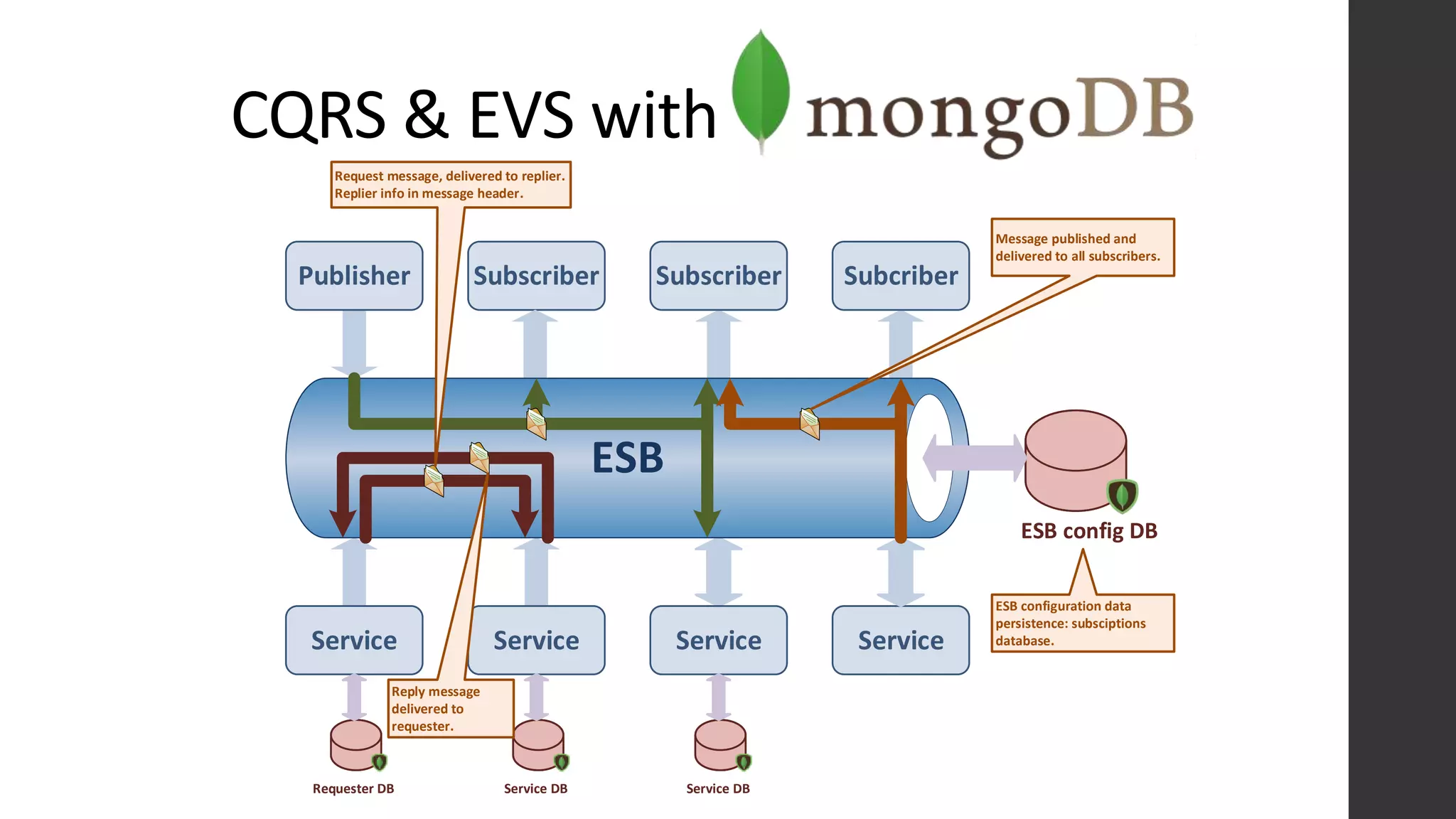
Publisher Subscriber
ServiceService Service Service
Subscriber Subcriber
ESB config DB
Message published and
delivered to all subscribers.
ESB configuration data
persistence: subsciptions
database.
Requester DB Service DB Service DB
Request message, delivered to replier.
Replier info in message header.
Reply message
delivered to
requester.
CQRS & EVS with
• MongoDB is applicable as a persistence layer for
subscriptions store.
• In complex applications, with many services
interconnected:
Persistence layer for ESB usage statistics and
metrics (latency, msg/s, queue length, etc.).
Persistence layer for Dead Letter Channel
subscribers (logger for all services connected to
ESB).
CQRS & EVS with
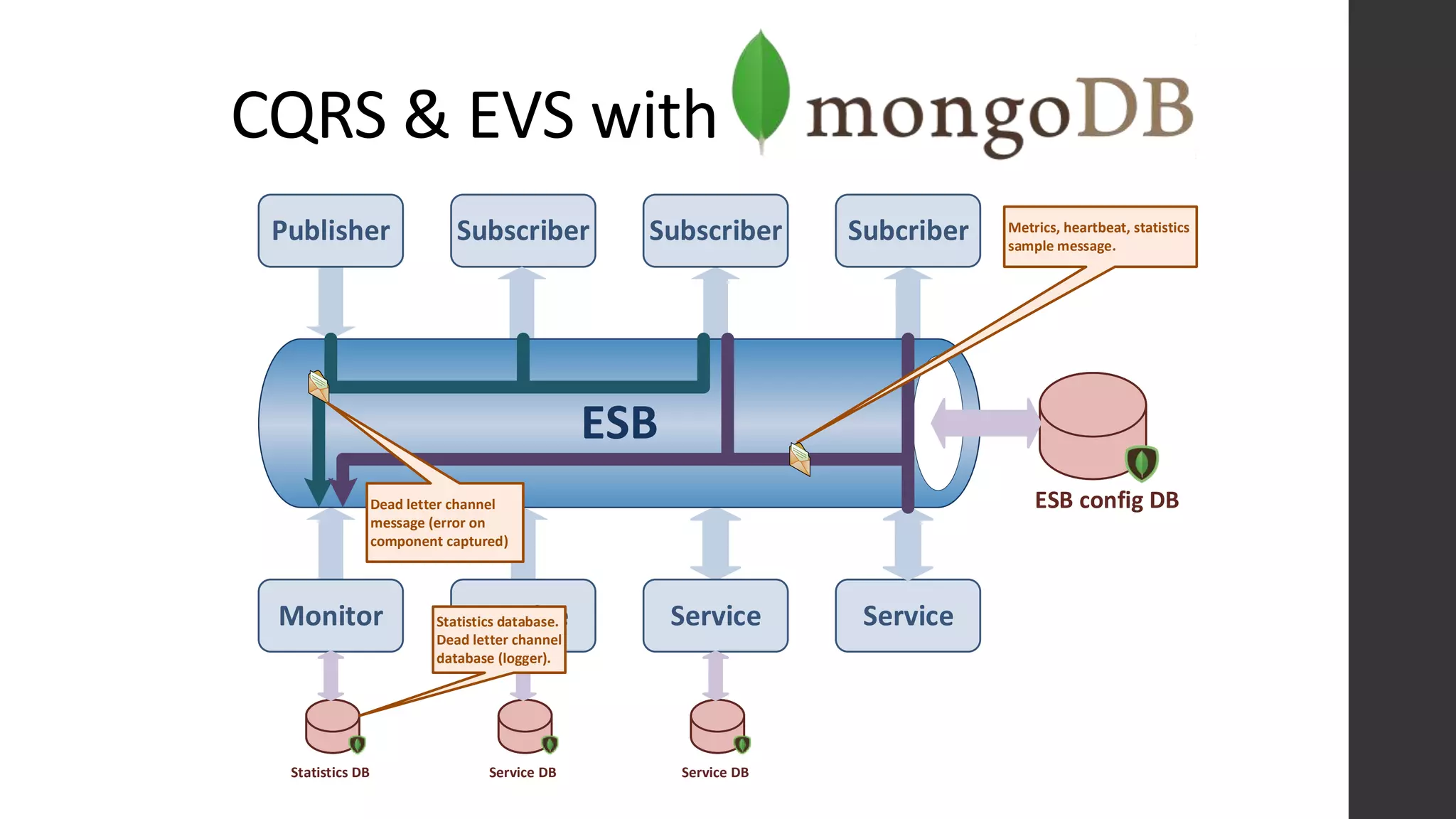
Publisher Subscriber
ServiceMonitor Service Service
Subscriber Subcriber
ESB config DB
Metrics, heartbeat, statistics
sample message.
Statistics DB Service DB Service DB
Dead letter channel
message (error on
component captured)
Statistics database.
Dead letter channel
database (logger).
CQRS & EVS with
• Two main messaging streams: data and control.
• Control messages:
Monitoring metrics samples.
Start / pause / stop service processing.
Heartbeat messages (ping to services).
• Message traffic is lead by a transport tier.
• To prevent contention and service saturation, a
buffering or queuing system is recommended.
CQRS & EVS with
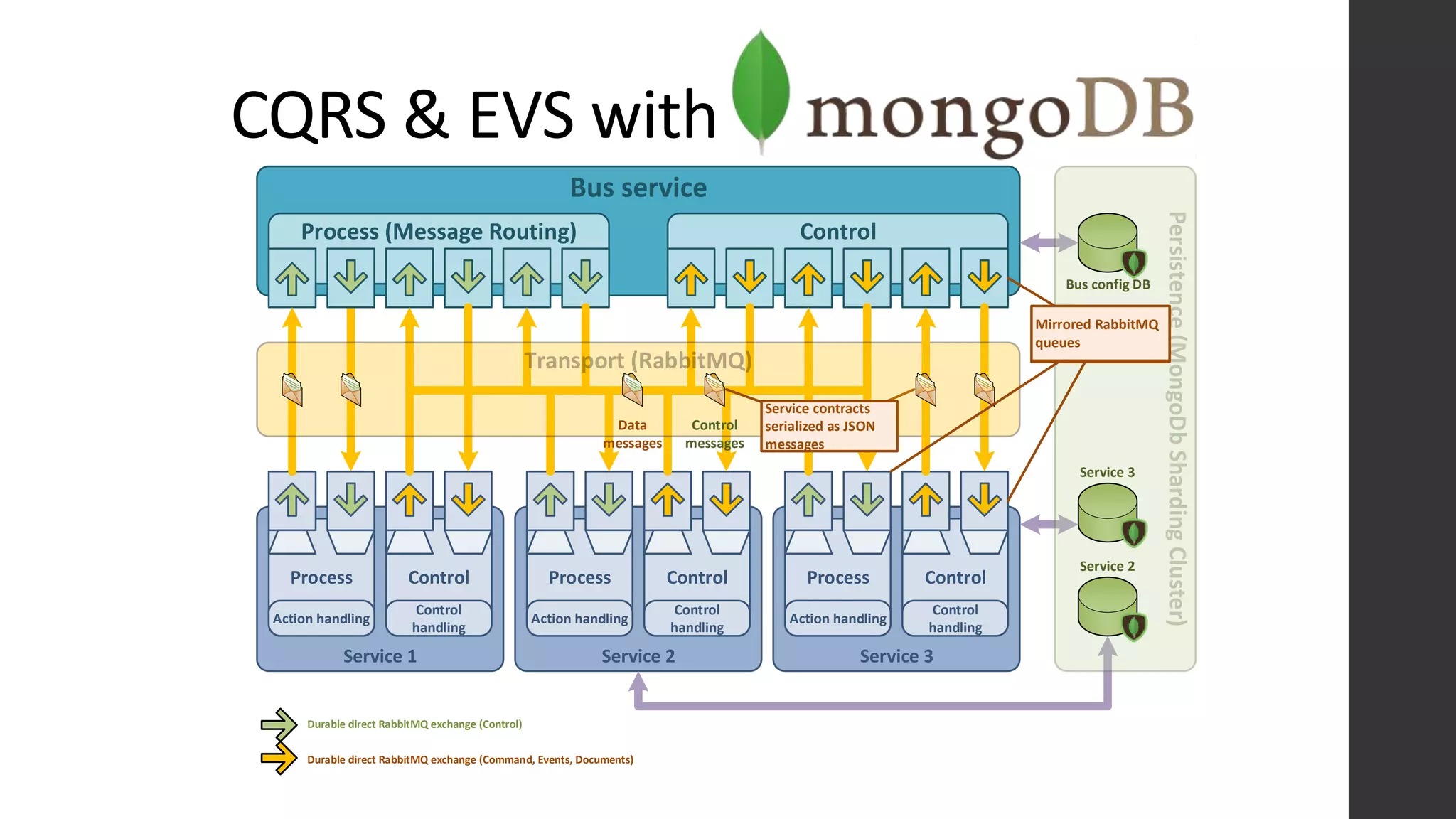
Service 2 Service 3
Control ControlProcess Process
Service 1
ControlProcess
Bus service
Process (Message Routing) Control
Action handling Action handling Action handling
Data
messages
Control
messages
Control
handling
Control
handling
Control
handling
Durable direct RabbitMQ exchange (Control)
Durable direct RabbitMQ exchange (Command, Events, Documents)
Service contracts
serialized as JSON
messages
Bus config DB
Service 3
Service 2
Mirrored RabbitMQ
queues
Mirrored RabbitMQ
queues
Mirrored RabbitMQ
queues
CQRS & EVS with
All together: An example of
distributed application.
CQRS & EVS with
• Main functional requirements:
Allow management of shipments generated online
by agencies.
Allow management of agency and corporate
customers.
Allow offline loading of shipments generated by
large customers.
Integrate with other line-of-business systems
(CRM, legacy applications, etc.).
CQRS & EVS with
• Main QoS requirements:
Nearly 550 agencies.
3K online users during office time.
Several thousands of customers.
Storage needs based on 50K shipments / day
(online and offline workloads) and 45 days of
operational shipment lifetime.
Estimation of 20 state changes per shipment
during its lifetime.
CQRS & EVS with
• Solution components:
Frontend: MVC UI.
A layer of CQRS WS interfaces frontend and
backend.
Backend: services (some implementing EVS)
interconnected by ESB.
A MongoDB Sharding Cluster as the persistence
tier for them all.
CQRS & EVS with
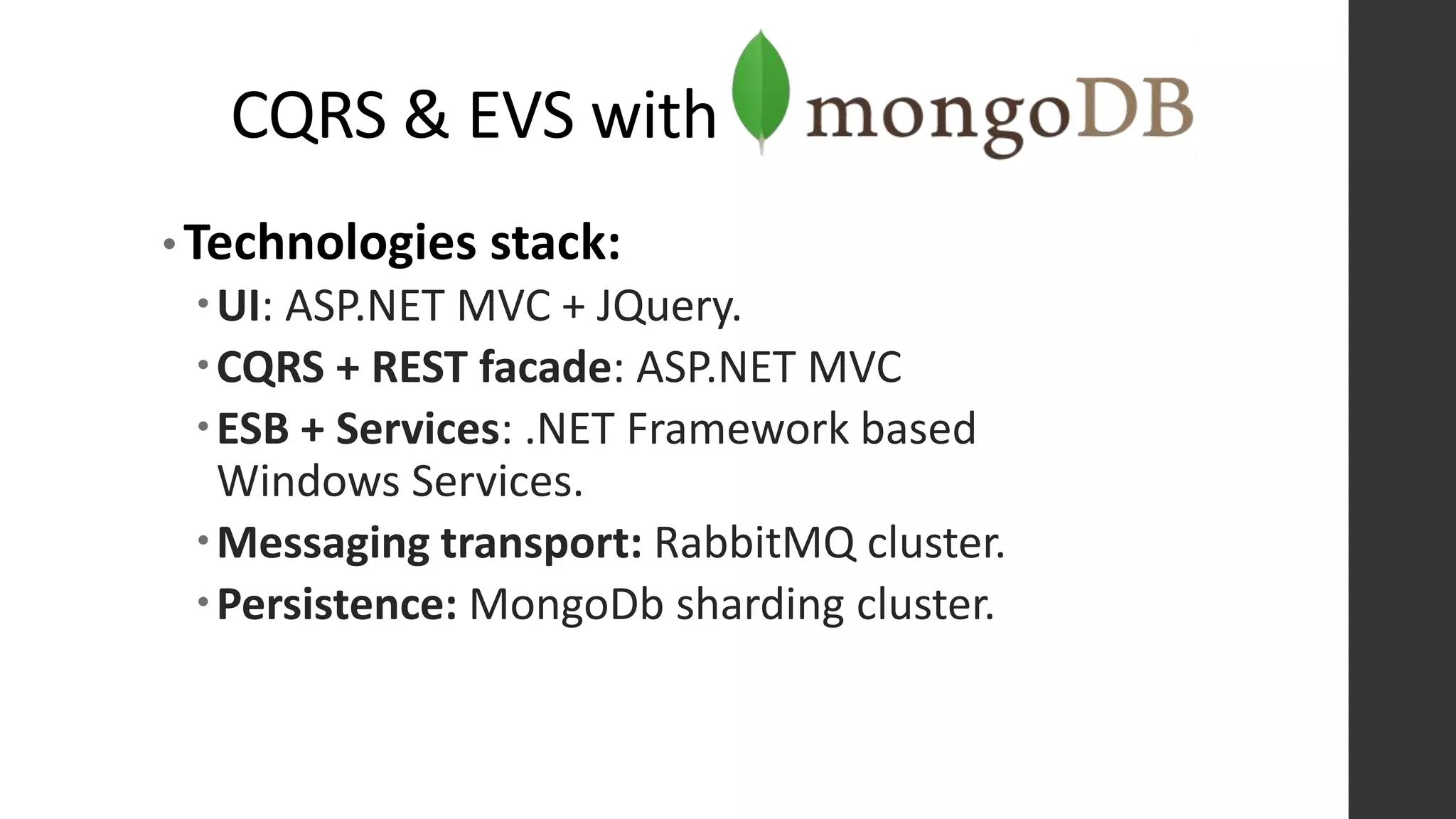
• Technologies stack:
UI: ASP.NET MVC + JQuery.
CQRS + REST facade: ASP.NET MVC
ESB + Services: .NET Framework based
Windows Services.
Messaging transport: RabbitMQ cluster.
Persistence: MongoDb sharding cluster.
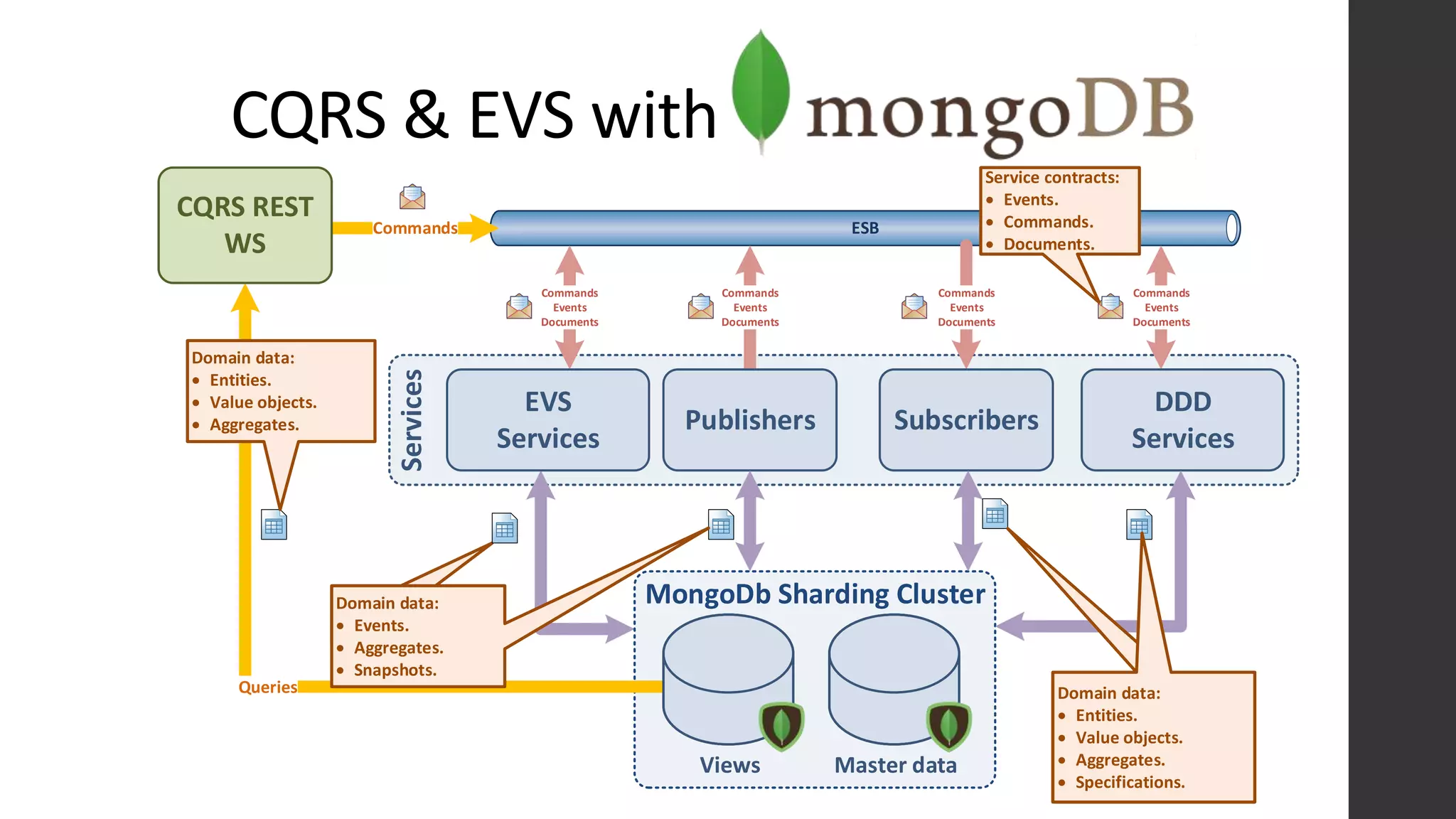
CQRS & EVS with
Services
Commands
Events
Documents
Commands
Events
Documents
Commands
Events
Documents
Commands
Events
Documents
MongoDb Sharding Cluster
DDD
Services
Publishers Subscribers
EVS
Services
Queries
Commands
CQRS REST
WS
Domain data:
 Events.
 Aggregates.
 Snapshots.
Domain data:
 Entities.
 Value objects.
 Aggregates.
Domain data:
 Entities.
 Value objects.
 Aggregates.
 Specifications.
Master dataViews
Service contracts:
 Events.
 Commands.
 Documents.
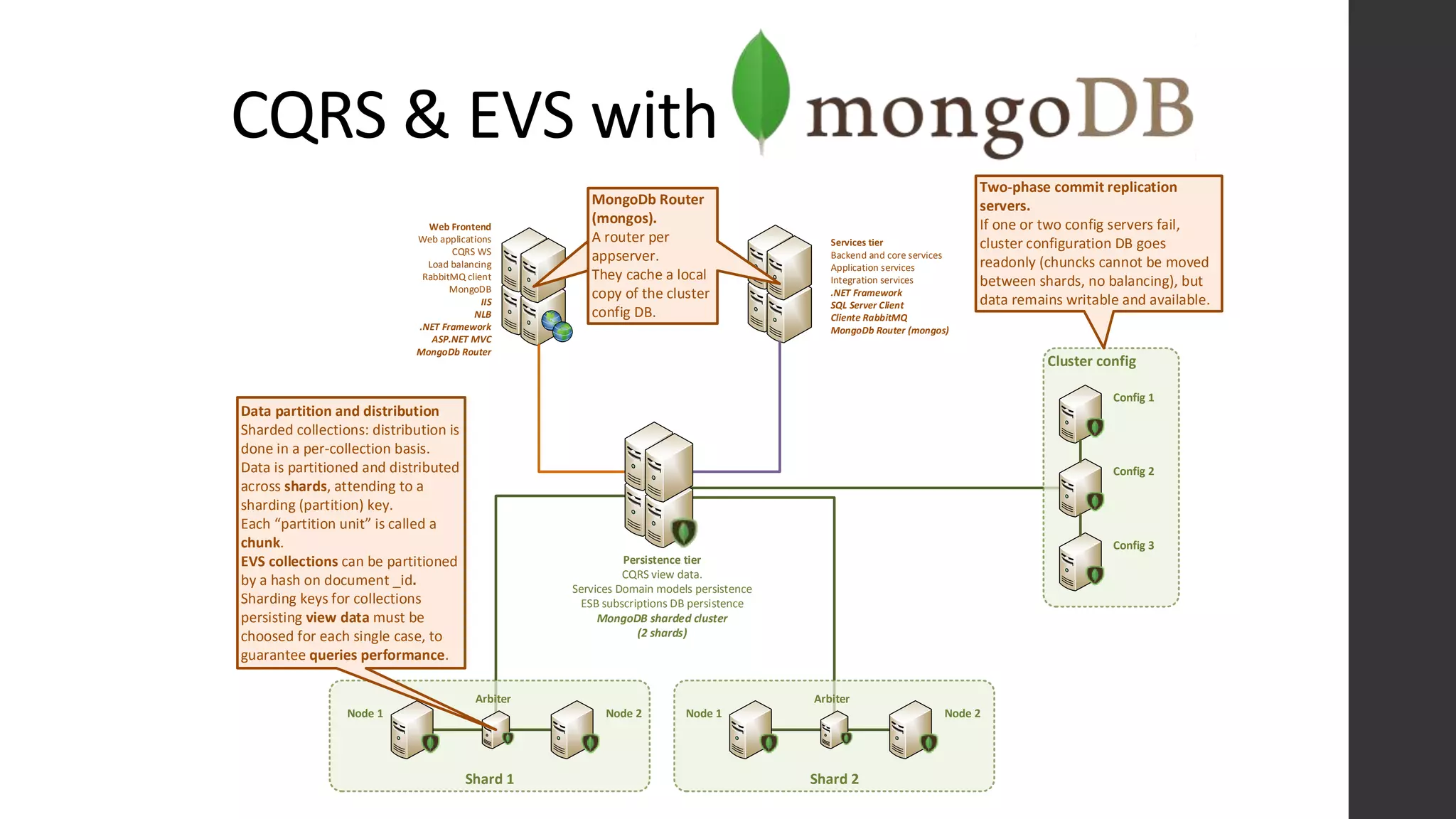
CQRS & EVS with
Web Frontend
Web applications
CQRS WS
Load balancing
RabbitMQ client
MongoDB
IIS
NLB
.NET Framework
ASP.NET MVC
MongoDb Router
Services tier
Backend and core services
Application services
Integration services
.NET Framework
SQL Server Client
Cliente RabbitMQ
MongoDb Router (mongos)
Cluster config
Config 1
Config 2
Config 3
Shard 2
Node 1 Node 2
Arbiter
Shard 1
Node 1 Node 2
Arbiter
Persistence tier
CQRS view data.
Services Domain models persistence
ESB subscriptions DB persistence
MongoDB sharded cluster
(2 shards)
MongoDb Router
(mongos).
A router per
appserver.
They cache a local
copy of the cluster
config DB.
Two-phase commit replication
servers.
If one or two config servers fail,
cluster configuration DB goes
readonly (chuncks cannot be moved
between shards, no balancing), but
data remains writable and available.
Data partition and distribution
Sharded collections: distribution is
done in a per-collection basis.
Data is partitioned and distributed
across shards, attending to a
sharding (partition) key.
Each partition unit is called a
chunk.
EVS collections can be partitioned
by a hash on document _id.
Sharding keys for collections
persisting view data must be
choosed for each single case, to
guarantee queries performance.
CQRS & EVS with
Than you for your attention.

CQRS & EVS with MongoDb

  • 1.
    CQRS & EVSwith Building of a modern distributed enterprise application
  • 2.
    CQRS & EVSwith • My name is Lluis Fernández. • I’m involved in a tech group of freelancers named B-Team. • We offer consultancy on distributed system architectures. • Contact: llffernandez@gmail.com b-team_b-team@googlegroups.com
  • 3.
    • What’s thisabout. • The patterns: CQRS, EVS and ESB. • All together: An example of distributed enterprise application. CQRS & EVS with
  • 4.
    CQRS & EVSwith What’s this about?
  • 5.
    CQRS & EVSwith • NoSQL databases, like MongoDB, have contributed to the adoption and implementation of archetypes and patterns to develop distributed enterprise applications. • High read/write rates, huge data stores management, highly scalable read-only replication and schema-less document orientation, are well suited for those kind of patterns and techniques.
  • 6.
    CQRS & EVSwith • This presentation is about how some of these patterns and archetypes had been applied during the implementation of real-word use case: a Shipment Management application for one of the most important Messaging and Packages Delivery companies in Spain.
  • 7.
    CQRS & EVSwith CQRS.
  • 8.
    CQRS & EVSwith • CQRS stands for Command-Query Responsibility Segregation. • Commands are expected to do writes of small portions of data. • Queries are expected to do reads of big portions of data. • CQRS encourages the separation of these different workloads.
  • 9.
    CQRS & EVSwith CQRS facade Commands Queries Shipment management core services View data synchronization Regular operations on Master data Master DB (R/W) Views DB (Readonly) Replication Corporate shipment management web app. Packages Add package Add destination Add origin Add delivery Assign courier Pending deriveries Lost packages Packages by shipment Packages by shipment
  • 10.
    CQRS & EVSwith • Reduces contention and collision between queries and commands persistence-level operations. • Allows the scaling-out of queries, usually the most common and expensive operations. • Allows the use of heterogeneous view data stores.
  • 11.
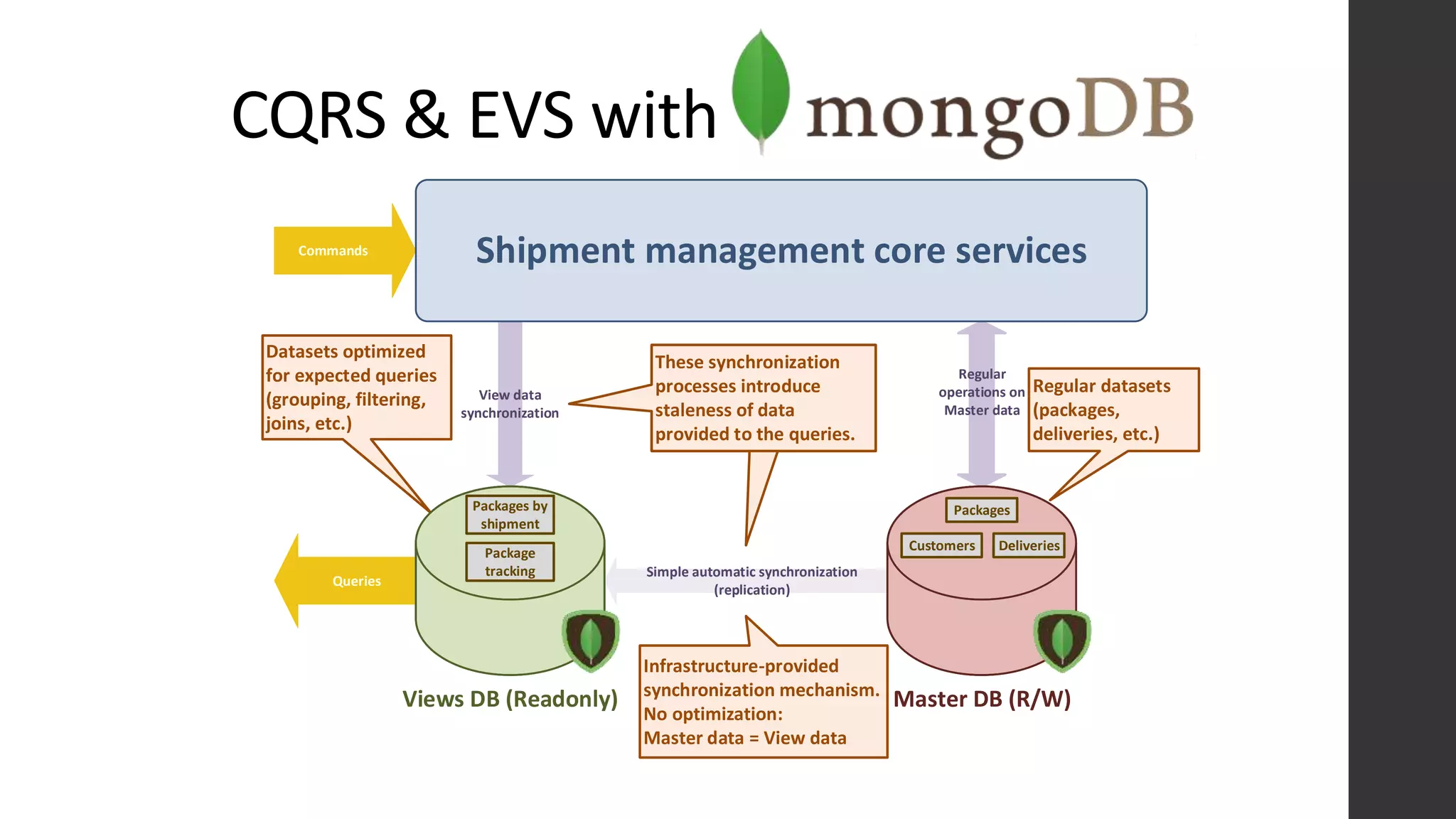
    CQRS & EVSwith Shipment management core services Simple automatic synchronization (replication) Queries Commands Datasets optimized for expected queries (grouping, filtering, joins, etc.) Infrastructure-provided synchronization mechanism. No optimization: Master data = View data Regular datasets (packages, deliveries, etc.) These synchronization processes introduce staleness of data provided to the queries. Views DB (Readonly) Master DB (R/W) View data synchronization Regular operations on Master data Packages DeliveriesCustomers Packages by shipment Package tracking
  • 12.
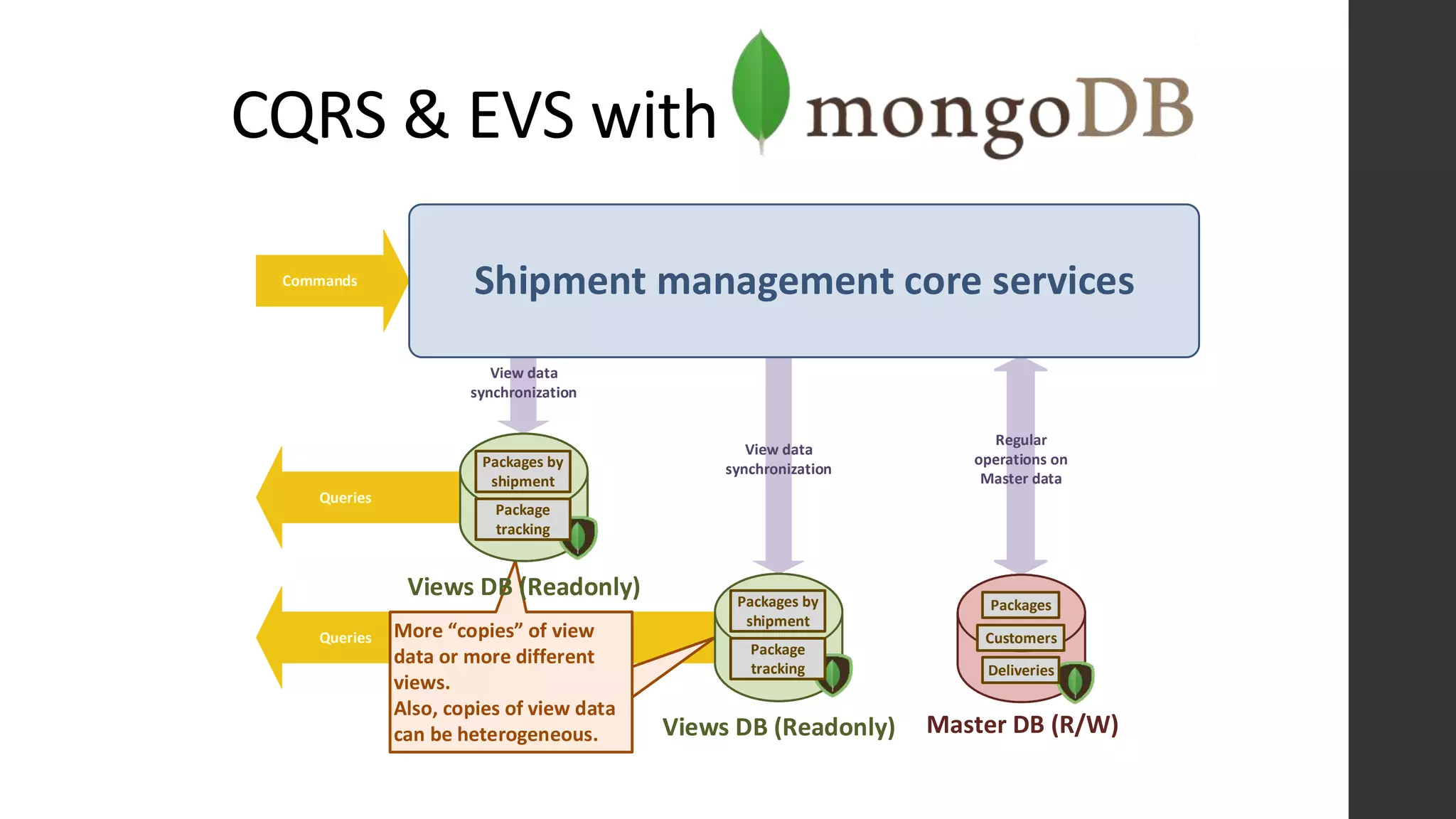
    CQRS & EVSwith Queries Commands Shipment management core services Queries Views DB (Readonly) View data synchronization View data synchronization Regular operations on Master data Master DB (R/W) More copies of view data or more different views. Also, copies of view data can be heterogeneous. Views DB (Readonly) Packages by shipment Package tracking Packages by shipment Package tracking Packages Deliveries Customers
  • 13.
    CQRS & EVSwith • MongoDB replica sets and ReadPreference can be used to segregate master and view data:  Commands write on the PRIMARY.  View data is also written on the PRIMARY.  Queries read from SECONDARIES. • Separate master and view data collections in different databases (MongoDb write locking). • Schema optimization and indexing in collections storing view data also improve performance.
  • 14.
    CQRS & EVSwith Shipment management core services Queries are launched against SECONDARIES (SECONDARY or SECONDARY_PREFERRED read preference) MongoDB replication Commands Queries View data synchronization Packages per shipment view synchronizer Data optimized for views:  Schema design.  Indexing. Multiple SECONDARIES allows queries scaling. Regular operations on Master data Commands are launched against PRIMARIES (PRIMARY or PRIMARY_PREFERRED read preference) View data ALSO goes to PRIMARIES Master data (affected by commands) goes to PRIMARIES PRIMARY (Master and Views data) SECONDARIES (View data) Packages by shipment Package tracking Packages DeliveriesCustomers Packages by shipment Package tracking Packages DeliveriesCustomers
  • 15.
    CQRS & EVSwith PRIMARY (Master and View data) SECONDARY (View data) Packages MongoDB replication Packages per shipment Queries Packages per shipment Shipment management core services Master and View data are stored in PRIMARY, in different databases. View data is replicated to SECONDARY Commands Packages per shipment view synchronizer View data synchronization
  • 16.
    CQRS & EVSwith • Caveats: Staleness of data read by queries. Availability loss and overloads of PRIMARY in case of SECONDARIES failures. Balancer in sharding environments can introduce additional staleness and duplication in data being read.
  • 17.
    CQRS & EVSwith EVS.
  • 18.
    CQRS & EVSwith • EVS stands for EVent Sourcing. • Closely related to DDD (Domain Driven Design) and CQRS. • Events are changes to the state of a domain model subset of an application. • Events occurred in the past, and are also referred as Domain events. • EVS consists in expressing the state of a domain model subset as a sequence of events.
  • 19.
    CQRS & EVSwith Shipment managment core service EVS engine Add package Add package Create Add package Assign courier Add delivery Add delivery Add delivery Last event Store Incoming Domain Events Last event Delivery Package Customer Courier Promo Rebuild Retrieve Event store Apply ALL retrieved events are replayed to rebuild domain model subset state Last event is aplied after domain model subset rebuild, and stored in the Event Store.
  • 20.
    CQRS & EVSwith • Events are stored in a Event Store, that can be huge (ideally infinite), depending on the domain subset’s lifetime. • To keep growth of the Event Store under control: Store a point-in-time state of the domain model subset (take a snapshot of it). Store only events occurred after the last snapshot.
  • 21.
    CQRS & EVSwith Shipment management core service EVS engine Add package Add package Create Add package Assign courier Add delivery Add delivery Add delivery Last event Store Incoming Domain Events Last event Delivery Package Customer Courier Promo Rebuild Retrieve Event store Snapshot Apply Store snapshot ONLY events after snapshot are used to rebuild domain model subset state. A snapshot is taken after replaying some events. Remaining events (events after th snapshot) are used to rebuild the state of the domain model subset and remain stored in the Event Store.
  • 22.
    CQRS & EVSwith • Single collection event store: Both snapshots and events conform a single document => Single collection. findAndModify can be well suited to add events and update or create snapshots in a single atomic operation. Usable in scenarios with low frequency rate of events.
  • 23.
    CQRS & EVSwith Event Event Event Event Event Event Event Event Store snapshot AggregateId AggregateId Root Entity Value object Value object Entity Root Entity Value object Value object Entity Component / service EVS engine StoreRetrieve Event store Event Event Documents include both snapshot and events pending to apply. Events are added with a $push operation in a findAndModify atomic operation. Due to growth of events array, documents can be moved often, impacting performance
  • 24.
    CQRS & EVSwith • Multiple collection event store: Snapshots and events are persisted in different collections. May require some locking and operations isolation management in multithreaded environments.
  • 25.
    CQRS & EVSwith Event Event Event Event Event Event Event Event Store snapshot AggregateId AggregateId AggregateId AggregateId AggregateId AggregateId AggregateId AggregateId AggregateId AggregateId Root Entity Value object Value object Entity Root Entity Value object Value object Entity Component / service EVS engine StoreRetrieve Event store Snapshots and events are stored in their respective collection, separated from each other. Snapshots and events are stored in a single atomic update operation.
  • 26.
    CQRS & EVSwith ESB.
  • 27.
    CQRS & EVSwith • ESB = Enterprise Service Bus. It is an infrastructure piece of software than a pattern itself. • Implements different messaging patterns: Publish / Subscribe Request / Reply Dead letter channel. Others.
  • 28.
    CQRS & EVSwith Publisher Subscriber ServiceService Service Service Subscriber Subcriber ESB config DB Message published and delivered to all subscribers. ESB configuration data persistence: subsciptions database. Requester DB Service DB Service DB Request message, delivered to replier. Replier info in message header. Reply message delivered to requester.
  • 29.
    CQRS & EVSwith • MongoDB is applicable as a persistence layer for subscriptions store. • In complex applications, with many services interconnected: Persistence layer for ESB usage statistics and metrics (latency, msg/s, queue length, etc.). Persistence layer for Dead Letter Channel subscribers (logger for all services connected to ESB).
  • 30.
    CQRS & EVSwith Publisher Subscriber ServiceMonitor Service Service Subscriber Subcriber ESB config DB Metrics, heartbeat, statistics sample message. Statistics DB Service DB Service DB Dead letter channel message (error on component captured) Statistics database. Dead letter channel database (logger).
  • 31.
    CQRS & EVSwith • Two main messaging streams: data and control. • Control messages: Monitoring metrics samples. Start / pause / stop service processing. Heartbeat messages (ping to services). • Message traffic is lead by a transport tier. • To prevent contention and service saturation, a buffering or queuing system is recommended.
  • 32.
    CQRS & EVSwith Service 2 Service 3 Control ControlProcess Process Service 1 ControlProcess Bus service Process (Message Routing) Control Action handling Action handling Action handling Data messages Control messages Control handling Control handling Control handling Durable direct RabbitMQ exchange (Control) Durable direct RabbitMQ exchange (Command, Events, Documents) Service contracts serialized as JSON messages Bus config DB Service 3 Service 2 Mirrored RabbitMQ queues Mirrored RabbitMQ queues Mirrored RabbitMQ queues
  • 33.
    CQRS & EVSwith All together: An example of distributed application.
  • 34.
    CQRS & EVSwith • Main functional requirements: Allow management of shipments generated online by agencies. Allow management of agency and corporate customers. Allow offline loading of shipments generated by large customers. Integrate with other line-of-business systems (CRM, legacy applications, etc.).
  • 35.
    CQRS & EVSwith • Main QoS requirements: Nearly 550 agencies. 3K online users during office time. Several thousands of customers. Storage needs based on 50K shipments / day (online and offline workloads) and 45 days of operational shipment lifetime. Estimation of 20 state changes per shipment during its lifetime.
  • 36.
    CQRS & EVSwith • Solution components: Frontend: MVC UI. A layer of CQRS WS interfaces frontend and backend. Backend: services (some implementing EVS) interconnected by ESB. A MongoDB Sharding Cluster as the persistence tier for them all.
  • 37.
    CQRS & EVSwith • Technologies stack: UI: ASP.NET MVC + JQuery. CQRS + REST facade: ASP.NET MVC ESB + Services: .NET Framework based Windows Services. Messaging transport: RabbitMQ cluster. Persistence: MongoDb sharding cluster.
  • 38.
    CQRS & EVSwith Services Commands Events Documents Commands Events Documents Commands Events Documents Commands Events Documents MongoDb Sharding Cluster DDD Services Publishers Subscribers EVS Services Queries Commands CQRS REST WS Domain data:  Events.  Aggregates.  Snapshots. Domain data:  Entities.  Value objects.  Aggregates. Domain data:  Entities.  Value objects.  Aggregates.  Specifications. Master dataViews Service contracts:  Events.  Commands.  Documents.
  • 39.
    CQRS & EVSwith Web Frontend Web applications CQRS WS Load balancing RabbitMQ client MongoDB IIS NLB .NET Framework ASP.NET MVC MongoDb Router Services tier Backend and core services Application services Integration services .NET Framework SQL Server Client Cliente RabbitMQ MongoDb Router (mongos) Cluster config Config 1 Config 2 Config 3 Shard 2 Node 1 Node 2 Arbiter Shard 1 Node 1 Node 2 Arbiter Persistence tier CQRS view data. Services Domain models persistence ESB subscriptions DB persistence MongoDB sharded cluster (2 shards) MongoDb Router (mongos). A router per appserver. They cache a local copy of the cluster config DB. Two-phase commit replication servers. If one or two config servers fail, cluster configuration DB goes readonly (chuncks cannot be moved between shards, no balancing), but data remains writable and available. Data partition and distribution Sharded collections: distribution is done in a per-collection basis. Data is partitioned and distributed across shards, attending to a sharding (partition) key. Each partition unit is called a chunk. EVS collections can be partitioned by a hash on document _id. Sharding keys for collections persisting view data must be choosed for each single case, to guarantee queries performance.
  • 40.
    CQRS & EVSwith Than you for your attention.