CQRS 2.0 David Hoerster
ABOUT ME
5-Time .NET (Visual C#) MVP (April 2011)
Sr. Solutions Architect at Confluence
One of the organizers for Pittsburgh TechFest (http://pghtechfest.com)
Organizer of Pittsburgh Reactive Dev Group (http://meetup.com/reactive)
Past President of Pittsburgh .NET Users Group
Twitter - @DavidHoerster
Blog – http://blog.agileways.com
Email – david@agileways.com
GOALS
What are the principles behind CQRS
How can I apply them in my current development
How Akka(.NET) shares much in common wth CQRS
How CQRS + Akka(.NET) can help with building distributed, reactive
applications
PREFACE:
FIRST CONTACT
SOME CQRS BACKGROUND
CQRS BACKGROUND
Command Query Responsibility Segregation
 Coined by Greg Young
Heavily influenced by Domain Driven Design (DDD)
Evolution of Meyer’s CQS (Command Query Separation)
Separation of writes (command) and reads (query)
CQS is more at the unit level
CQRS is at a higher level  bounded context / service
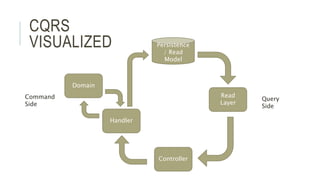
WHAT IS CQRS?
Simply: separate paths for reads and writes
Communicate via messages
Commands and Events
 “CreateOrder” and “OrderCreated”
Reads are against a thin read model (preferably optimized)
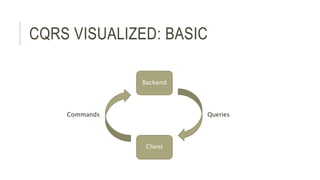
CQRS VISUALIZED: BASIC
Client
Backend
Commands Queries
CQRS
VISUALIZED
Controller
Handler
Domain
Persistence
/ Read
Model
Read
Layer
Command
Side
Query
Side
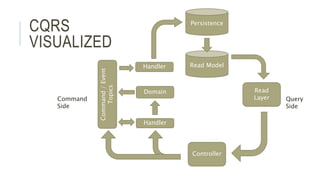
CQRS EXTENDED
Can move from direct references to queued
Decouples handlers
Increased isolation of areas
Leads to single message causing several changes
 Raising of events and subscriptions to events
CQRS
VISUALIZED
Controller
Handler
Domain
Persistence
Read
Layer
Handler
Command/Event
Topics
Read Model
Command
Side
Query
Side
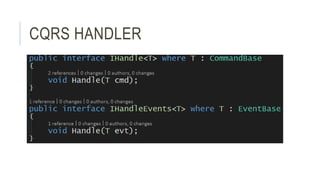
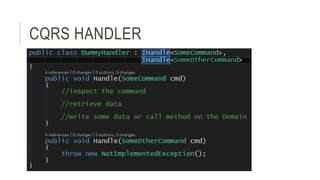
CQRS HANDLER
CQRS HANDLER
BENEFITS
Message Based
Segregation of Responsibilities – Separate Paths
Smaller, simpler classes
 Albeit more classes
Focused Approach to Domain
 Move away from anemic domain models
CQRS PRINCIPLES
Separate Paths for Command and Queries
Message-Based
Async Friendly
Thin read layer
Don’t fear lots of small classes
A CALL
Is CQRS Dead?
<rant>
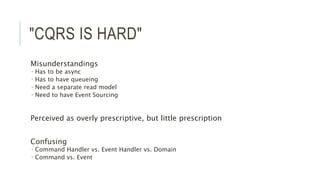
"CQRS IS HARD"
Misunderstandings
 Has to be async
 Has to have queueing
 Need a separate read model
 Need to have Event Sourcing
Perceived as overly prescriptive, but little prescription
Confusing
 Command Handler vs. Event Handler vs. Domain
 Command vs. Event
HAS CQRS “FAILED”?
Focus on CQRS as architecture over
principles
Search for prescriptive guidance
 Infrastructure/Implementation debates
 Should domains have getters??
 “…there are times a getter can be pragmatic. The trick is
learning where to use them.” – Greg Young (DDD/CQRS
Group)
“This list has its heads up its own
[butts] about infrastructure. What
business problems are you working on?”
-- Greg Young (DDD/CQRS Group)
</rant>
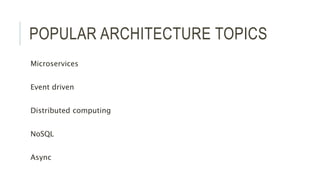
POPULAR ARCHITECTURE TOPICS
Microservices
Event driven
Distributed computing
NoSQL
Async
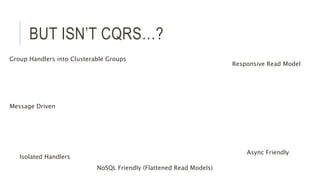
BUT ISN’T CQRS…?
Message Driven
Responsive Read Model
Isolated Handlers
Async Friendly
Group Handlers into Clusterable Groups
NoSQL Friendly (Flattened Read Models)
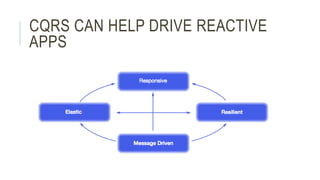
CQRS CAN HELP DRIVE REACTIVE
APPS
CQRS EVOLVED
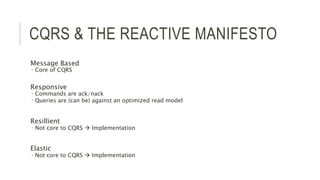
CQRS & THE REACTIVE MANIFESTO
Message Based
 Core of CQRS
Responsive
 Commands are ack/nack
 Queries are (can be) against an optimized read model
Resillient
 Not core to CQRS  Implementation
Elastic
 Not core to CQRS  Implementation
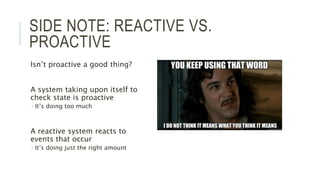
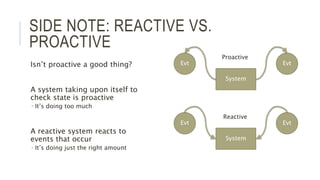
SIDE NOTE: REACTIVE VS.
PROACTIVE
Isn’t proactive a good thing?
A system taking upon itself to
check state is proactive
 It’s doing too much
A reactive system reacts to
events that occur
 It’s doing just the right amount
SIDE NOTE: REACTIVE VS.
PROACTIVE
Isn’t proactive a good thing?
A system taking upon itself to
check state is proactive
 It’s doing too much
A reactive system reacts to
events that occur
 It’s doing just the right amount
System
EvtEvt
System
EvtEvt
Proactive
Reactive
CQRS + REACTIVE
Resillient and Elastic core to
Reactive
CQRS’ core is Message-Based
and Responsive
Combining the two is powerful
ACTOR MODEL
CQRS lacks prescriptive guidance
Actor Model provides a message-based pattern
Provides prescriptive guidance
Makes for more generalized implementation
Actor Model is driving more reactive-based development
ACTOR MODEL
Actor Model is a system made of small units of concurrent
computation
 Formulated in the early 70’s
Each unit is an actor
Communicates to each other via messages
Actors can have children, which they can supervise
WHAT IS AN ACTOR?
Lightweight class that encapsulates state and behavior
 State can be persisted (Akka.Persistence)
 Behavior can be switched (Become/Unbecome)
Has a mailbox to receive messages
 Ordered delivery by default
 Queue
Can create child actors
Has a supervisory strategy for child actors
 How to handle misbehaving children
Are always thread safe
Have a lifecycle
 Started, stopped, restarted
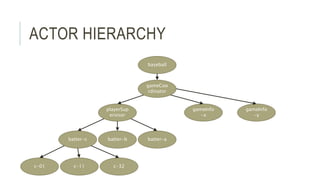
ACTOR HIERARCHY
baseball
gameCoo
rdinator
gameInfo
-x
gameInfo
-y
playerSup
ervisor
batter-abatter-bbatter-c
c-01 c-11 c-32
AKKA: RESILIENCY
Actors supervise their children
When they misbehave, they are notified
Can punish (fail) all children, or tell the misbehaving on to try again
Protects rest of the system
AKKA.NET
Akka.NET is an open source framework
Actor Model for .NET
Port of Akka (for JVM/Scala)
http://getakka.net
NuGet – searching for “akka.net”, shows up low in the list
STARTING WITH AKKA.NET
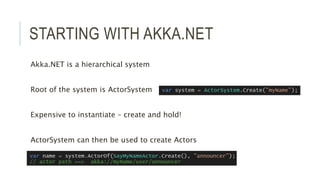
Akka.NET is a hierarchical system
Root of the system is ActorSystem
Expensive to instantiate – create and hold!
ActorSystem can then be used to create Actors
CREATING AN ACTOR
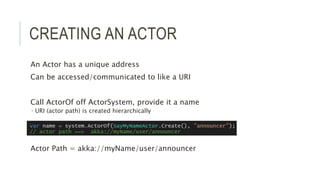
An Actor has a unique address
Can be accessed/communicated to like a URI
Call ActorOf off ActorSystem, provide it a name
 URI (actor path) is created hierarchically
Actor Path = akka://myName/user/announcer
SENDING A MESSAGE
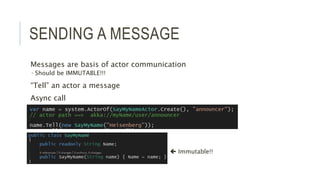
Messages are basis of actor communication
 Should be IMMUTABLE!!!
“Tell” an actor a message
Async call
 Immutable!!
RECEIVING A MESSAGE
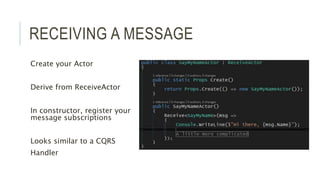
Create your Actor
Derive from ReceiveActor
In constructor, register your
message subscriptions
Looks similar to a CQRS
Handler
RECEIVING A MESSAGE
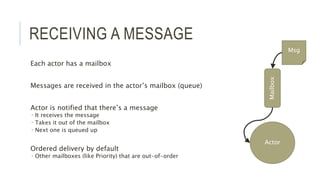
Each actor has a mailbox
Messages are received in the actor’s mailbox (queue)
Actor is notified that there’s a message
 It receives the message
 Takes it out of the mailbox
 Next one is queued up
Ordered delivery by default
 Other mailboxes (like Priority) that are out-of-order
Actor
Mailbox
Msg
DEMO: HELLO AKKA.NET
ELEMENTS OF CQRS IN ACTOR
MODEL
Message-based
Potentially async
Focused code
Actor System is your Command Side
CQRS + ACTORS
Combining the principles of CQRS and the patterns of the Actor
Model
Message-based communication with concurrent processing
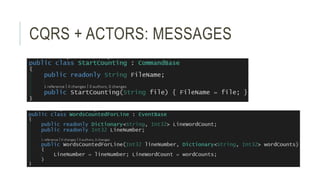
CQRS + ACTORS: MESSAGES
Messages in an Actor System include both Commands and Events
Still encapsulate intent
Still should still contain information necessary to process/handle
command or event
Basically, no big change here
CQRS + ACTORS: MESSAGES
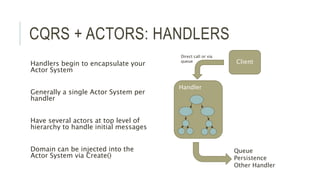
CQRS + ACTORS: HANDLERS
Handlers begin to encapsulate your
Actor System
Generally a single Actor System per
handler
Have several actors at top level of
hierarchy to handle initial messages
Domain can be injected into the
Actor System via Create()
Handler
Client
Queue
Persistence
Other Handler
Direct call or via
queue
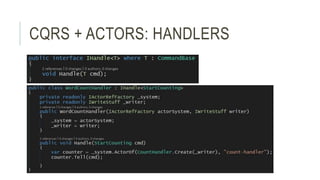
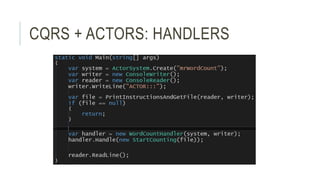
CQRS + ACTORS: HANDLERS
Handlers act as the entry point
 Web API
 Service subscribed to queue
CQRS  IHandle<T> for those messages “exposed”
Actor System is called by the CQRS Handler
Actor System has many other “internal” actors
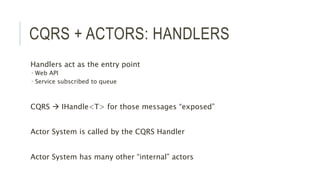
CQRS + ACTORS: SERVICES
Word Counter Handler
super
Count Write Stats
A B G H Y Z
DEMO: HELLO CQRS +
AKKA.NET
Word Counter
Handler
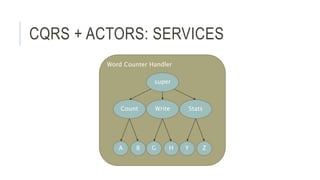
CQRS + ACTORS: SERVICES
super
Count
A B
Word Writer
Handler
super
Write
G H
Word Stats
Handler
super
Stats
Y Z
Message Bus
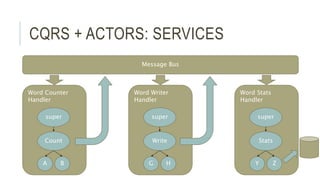
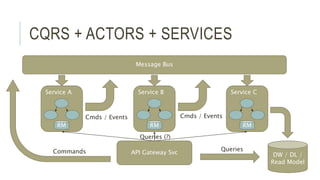
CQRS + ACTORS + SERVICES
Service A Service B Service C
Message Bus
DW / DL /
Read Model
Cmds / Events Cmds / Events
API Gateway SvcCommands Queries
RM RMRM
Queries (?)
Service A
Service A
Service A
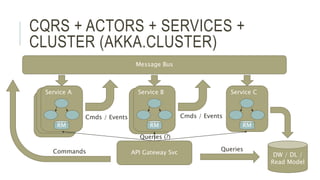
CQRS + ACTORS + SERVICES +
CLUSTER (AKKA.CLUSTER)
Service A Service B Service C
Message Bus
DW / DL /
Read Model
Cmds / Events Cmds / Events
API Gateway SvcCommands Queries
RM RMRM
Queries (?)
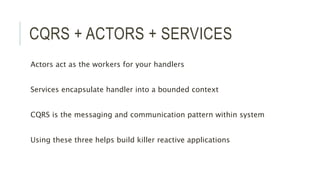
CQRS + ACTORS + SERVICES
Actors act as the workers for your handlers
Services encapsulate handler into a bounded context
CQRS is the messaging and communication pattern within system
Using these three helps build killer reactive applications
CONCLUSIONS
CQRS is not dead
Key principles of messaging, separate paths and responsibility
segregation
Apply CQRS to Reactive systems (e.g. an Akka.NET system) for best of
both
Encapsulate handlers into services for scalability and reliability

CQRS Evolved - CQRS + Akka.NET

  • 1.
  • 2.
    ABOUT ME 5-Time .NET(Visual C#) MVP (April 2011) Sr. Solutions Architect at Confluence One of the organizers for Pittsburgh TechFest (http://pghtechfest.com) Organizer of Pittsburgh Reactive Dev Group (http://meetup.com/reactive) Past President of Pittsburgh .NET Users Group Twitter - @DavidHoerster Blog – http://blog.agileways.com Email – david@agileways.com
  • 3.
    GOALS What are theprinciples behind CQRS How can I apply them in my current development How Akka(.NET) shares much in common wth CQRS How CQRS + Akka(.NET) can help with building distributed, reactive applications
  • 4.
  • 6.
  • 7.
    CQRS BACKGROUND Command QueryResponsibility Segregation  Coined by Greg Young Heavily influenced by Domain Driven Design (DDD) Evolution of Meyer’s CQS (Command Query Separation) Separation of writes (command) and reads (query) CQS is more at the unit level CQRS is at a higher level  bounded context / service
  • 8.
    WHAT IS CQRS? Simply:separate paths for reads and writes Communicate via messages Commands and Events  “CreateOrder” and “OrderCreated” Reads are against a thin read model (preferably optimized)
  • 9.
  • 10.
  • 11.
    CQRS EXTENDED Can movefrom direct references to queued Decouples handlers Increased isolation of areas Leads to single message causing several changes  Raising of events and subscriptions to events
  • 12.
  • 13.
  • 14.
  • 15.
    BENEFITS Message Based Segregation ofResponsibilities – Separate Paths Smaller, simpler classes  Albeit more classes Focused Approach to Domain  Move away from anemic domain models
  • 16.
    CQRS PRINCIPLES Separate Pathsfor Command and Queries Message-Based Async Friendly Thin read layer Don’t fear lots of small classes
  • 17.
  • 18.
  • 19.
  • 20.
    "CQRS IS HARD" Misunderstandings Has to be async  Has to have queueing  Need a separate read model  Need to have Event Sourcing Perceived as overly prescriptive, but little prescription Confusing  Command Handler vs. Event Handler vs. Domain  Command vs. Event
  • 21.
    HAS CQRS “FAILED”? Focuson CQRS as architecture over principles Search for prescriptive guidance  Infrastructure/Implementation debates  Should domains have getters??  “…there are times a getter can be pragmatic. The trick is learning where to use them.” – Greg Young (DDD/CQRS Group) “This list has its heads up its own [butts] about infrastructure. What business problems are you working on?” -- Greg Young (DDD/CQRS Group)
  • 22.
  • 23.
    POPULAR ARCHITECTURE TOPICS Microservices Eventdriven Distributed computing NoSQL Async
  • 24.
    BUT ISN’T CQRS…? MessageDriven Responsive Read Model Isolated Handlers Async Friendly Group Handlers into Clusterable Groups NoSQL Friendly (Flattened Read Models)
  • 25.
    CQRS CAN HELPDRIVE REACTIVE APPS
  • 26.
  • 27.
    CQRS & THEREACTIVE MANIFESTO Message Based  Core of CQRS Responsive  Commands are ack/nack  Queries are (can be) against an optimized read model Resillient  Not core to CQRS  Implementation Elastic  Not core to CQRS  Implementation
  • 28.
    SIDE NOTE: REACTIVEVS. PROACTIVE Isn’t proactive a good thing? A system taking upon itself to check state is proactive  It’s doing too much A reactive system reacts to events that occur  It’s doing just the right amount
  • 29.
    SIDE NOTE: REACTIVEVS. PROACTIVE Isn’t proactive a good thing? A system taking upon itself to check state is proactive  It’s doing too much A reactive system reacts to events that occur  It’s doing just the right amount System EvtEvt System EvtEvt Proactive Reactive
  • 30.
    CQRS + REACTIVE Resillientand Elastic core to Reactive CQRS’ core is Message-Based and Responsive Combining the two is powerful
  • 31.
    ACTOR MODEL CQRS lacksprescriptive guidance Actor Model provides a message-based pattern Provides prescriptive guidance Makes for more generalized implementation Actor Model is driving more reactive-based development
  • 32.
    ACTOR MODEL Actor Modelis a system made of small units of concurrent computation  Formulated in the early 70’s Each unit is an actor Communicates to each other via messages Actors can have children, which they can supervise
  • 33.
    WHAT IS ANACTOR? Lightweight class that encapsulates state and behavior  State can be persisted (Akka.Persistence)  Behavior can be switched (Become/Unbecome) Has a mailbox to receive messages  Ordered delivery by default  Queue Can create child actors Has a supervisory strategy for child actors  How to handle misbehaving children Are always thread safe Have a lifecycle  Started, stopped, restarted
  • 34.
  • 35.
    AKKA: RESILIENCY Actors supervisetheir children When they misbehave, they are notified Can punish (fail) all children, or tell the misbehaving on to try again Protects rest of the system
  • 36.
    AKKA.NET Akka.NET is anopen source framework Actor Model for .NET Port of Akka (for JVM/Scala) http://getakka.net NuGet – searching for “akka.net”, shows up low in the list
  • 37.
    STARTING WITH AKKA.NET Akka.NETis a hierarchical system Root of the system is ActorSystem Expensive to instantiate – create and hold! ActorSystem can then be used to create Actors
  • 38.
    CREATING AN ACTOR AnActor has a unique address Can be accessed/communicated to like a URI Call ActorOf off ActorSystem, provide it a name  URI (actor path) is created hierarchically Actor Path = akka://myName/user/announcer
  • 39.
    SENDING A MESSAGE Messagesare basis of actor communication  Should be IMMUTABLE!!! “Tell” an actor a message Async call  Immutable!!
  • 40.
    RECEIVING A MESSAGE Createyour Actor Derive from ReceiveActor In constructor, register your message subscriptions Looks similar to a CQRS Handler
  • 41.
    RECEIVING A MESSAGE Eachactor has a mailbox Messages are received in the actor’s mailbox (queue) Actor is notified that there’s a message  It receives the message  Takes it out of the mailbox  Next one is queued up Ordered delivery by default  Other mailboxes (like Priority) that are out-of-order Actor Mailbox Msg
  • 42.
  • 43.
    ELEMENTS OF CQRSIN ACTOR MODEL Message-based Potentially async Focused code Actor System is your Command Side
  • 44.
    CQRS + ACTORS Combiningthe principles of CQRS and the patterns of the Actor Model Message-based communication with concurrent processing
  • 45.
    CQRS + ACTORS:MESSAGES Messages in an Actor System include both Commands and Events Still encapsulate intent Still should still contain information necessary to process/handle command or event Basically, no big change here
  • 46.
  • 47.
    CQRS + ACTORS:HANDLERS Handlers begin to encapsulate your Actor System Generally a single Actor System per handler Have several actors at top level of hierarchy to handle initial messages Domain can be injected into the Actor System via Create() Handler Client Queue Persistence Other Handler Direct call or via queue
  • 48.
  • 49.
  • 50.
    CQRS + ACTORS:HANDLERS Handlers act as the entry point  Web API  Service subscribed to queue CQRS  IHandle<T> for those messages “exposed” Actor System is called by the CQRS Handler Actor System has many other “internal” actors
  • 51.
    CQRS + ACTORS:SERVICES Word Counter Handler super Count Write Stats A B G H Y Z
  • 52.
    DEMO: HELLO CQRS+ AKKA.NET
  • 53.
    Word Counter Handler CQRS +ACTORS: SERVICES super Count A B Word Writer Handler super Write G H Word Stats Handler super Stats Y Z Message Bus
  • 54.
    CQRS + ACTORS+ SERVICES Service A Service B Service C Message Bus DW / DL / Read Model Cmds / Events Cmds / Events API Gateway SvcCommands Queries RM RMRM Queries (?)
  • 55.
    Service A Service A ServiceA CQRS + ACTORS + SERVICES + CLUSTER (AKKA.CLUSTER) Service A Service B Service C Message Bus DW / DL / Read Model Cmds / Events Cmds / Events API Gateway SvcCommands Queries RM RMRM Queries (?)
  • 56.
    CQRS + ACTORS+ SERVICES Actors act as the workers for your handlers Services encapsulate handler into a bounded context CQRS is the messaging and communication pattern within system Using these three helps build killer reactive applications
  • 57.
    CONCLUSIONS CQRS is notdead Key principles of messaging, separate paths and responsibility segregation Apply CQRS to Reactive systems (e.g. an Akka.NET system) for best of both Encapsulate handlers into services for scalability and reliability