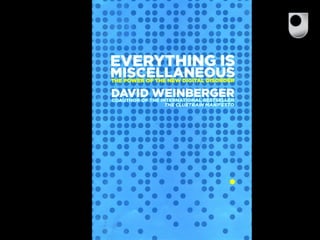
Everything is Miscellaneous

Loading...

Flash Player 9 (or above) is needed to view presentations.
We have detected that you do not have it on your computer. To install it, go here.

2 comments

Comments 1 - 2 of 2 previous next Post a comment

  • + jboutelle Jonathan Boutelle 2 years ago
    Very nice... great slidecast. ;->
  • + OliverDing Oliver Ding 2 years ago
    This is cool! I am reading this book! This slideshow is very helpful to me! Many thanks to sharing! I always meet what I want in time.
Post a comment
Embed Video
Edit your comment Cancel

11 Favorites

Everything is Miscellaneous - Presentation Transcript

  1.  
  2. Overview
    • The author
    • Key messages
      • Discussion about the book
    • Implications for education
      • Discussion
    • Conclusion and activity
  3. About
    • Co-author of the best-seller The Cluetrain Manifesto , The author of the critically-acclaimed Small Pieces Loosely Joined: A Unified Theory of the Web .
    • He has a fellowship at Harvard Law's Berkman Center for the Internet & Society
    • Has been published in a wide variety of journals, including Wired, Harvard Business Review, The New York Times, Smithsonian, The Guardian...even TV Guide.
    • Was Senior Internet Advisor to the Howard Dean campaign
    • Called a "marketing guru" by the Wall Street Journal
    • Is a strategic marketing consultant to big name companies, as well as to small, innovative ones.
    • Wrote gags for Woody Allen for seven years
    • Has a Ph.D. in philosophy and was a college professor for 6 years
    • Has been a frequent commentator on National Public Radio's All Things Considered
    • Writes a column for Knowledge Management World and Il Sole 24 ore
    • Is a well-known blogger
    • Has been a dot-com entrepreneur and serves on the advisory boards of some well-known and some not-yet-known tech companies
    • Is frequently cited by national and international news media
    • Lives in Boston
  4. Hello
    • “ Hello! Thanks for discussing my book. I'm eager to see what you make of it, especially since it is fairly open-ended. (My  email is [email_address] . Don't hesitate!) Best, David W.”
  5. Key messages
    • The laws around things change when they become digital
    • Filter on the way out, not the way in
    • Categorisation is doomed
    • Bottom up is the only way to cope
  6. Information & the physical
    • “ In a physical store, ease of access to information can be measured with a pedometer”
    • Cf.
  7. Things we take for granted
    • In physical space, some things are nearer than others
    • Physical objects can only be in one place at one time
    • Physical space is shared
    • Human physical abilities are limited
    • Organisation needs to be orderly and neat
  8. The music industry analogy
  9. The music industry analogy
    • " For decades we've been buying albums. We thought it was for artistic reasons, but it was really because the economics of the physical world required it: Bundling songs into long-playing albums lowered the production, marketing, and distribution costs ... As soon as music went digital, we learned that the natural unit of music is the track.
    • What does the record company do?
    • Market
    • Find/Filter
    • Produce physical product
    • Handle logistics required for physical product
  10. And when it goes digital?
    • Users handle logistics
    • Users share
    • Artists produce cheaply
    • Artists sell directly
    • Social services provide filter function
    • Conc: why do we need a record industry?
  11. The importance of categories
    • In the physical world categories matter
    • “ We invest so much time in making sure our world isn’t miscellaneous in part because disorder is inefficient”
    • “ We’ve been raised as experts at keeping our physical environment well ordered, but our homespun ways of maintaining order are going to break”
    • Scale changes things
    • Conclusion: “The solution to the overabundance of information is more information”
  12. Things in multiple places
    • 1 st gen – we mapped physical, we put files in folders
    • 2 nd gen – we use multiple terms to describe files and search
    • The same thing can be in several places at once
    • Libraries – books can only be in one category, because they’re physical
  13. The order of order
    • 1 st order – need to organise the objects themselves
    • 2 nd order – physical objects separate info from actual object, e.g. catalog
    • 3 rd order – digital, content and its info
    • “ We have entire industries built on the fact that the paper order severely limits how things can be organised. Museums, educational curricula, newspapers, the travel industry, and television schedules are all based on the assumption that in the 2 nd order world we need experts to go through information, ideas, and knowledge and put them neatly away”
  14. Amazon vs. Libraries
    • The absurdity of the Dewey system
    • There is no perfect classification
    • Physical limitations
    • Have to learn a system
    A whole range of metrics and paths There is your classification No limitations The system learns about you
  15. New classification
    • “ Classification is a power struggle – it is political – because the first two orders of order require that there be a winner”
    • Tagging – use any terms that are useful to you
    • Folksonomies – bottom up taxonomy
    • Data mining – we find relationships between item
  16. Four new strategies
    • Filter on the way out, not the way in
    • Put each leaf on as many branches as possible
    • Everything is metadata and everything can be a label
    • Give up control
  17. Discussion
    • Michael Wesch video http:// www.youtube.com/watch?v =-4CV05HyAbM
    • Do you agree with Weinberger’s analysis?
    • What are the important messages?
  18. For education
    • Wikipedia vs Britannica
    • Digg vs Newspapers
    • Stumbleupon vs Journals
    • Is it an either/or?
  19. Granularity
    • Size of courses
    • Size of publications
  20. Socially constructed knowledge
    • “ Our children are doing their homework socially even though they’re graded and tested as if they’re doing their work in isolation booths”
    • Assessment
    • What are we teaching?
  21. Messiness
    • Education is about order, filtering stuff out
    • But in the 3 rd order the more you add the greater the value, because you can’t predict use
    • What sort of content do we produce, promote, reward
  22. Authority
    • The removal of the filter
    • Democratisation of authority
    • Can the new metrics be cheated?
    • Are they more reliable than the old ones?
  23. A small example
    • Weinberger, D. (2007) Everything is miscellaneous: The power of the new digital disorder. Times books.
    • “ “ Classification is a power struggle – it is political – because the first two orders of order require that there be a winner”
    • ISBN-13 9780805080438
  24. Discussion
    • What do the four strategies mean for education:
    • Filter on the way out, not the way in
    • Put each leaf on as many branches as possible
    • Everything is metadata and everything can be a label
    • Give up control
  25. Activity
    • Write 3 words that describe the book
    • Social construction via Twitter
    • Let’s cloud tag it! http:// tagcrowd.com /
  26.  

+ Martin WellerMartin Weller, 2 years ago

custom

3513 views, 11 favs, 12 embeds more stats

A session that explores Weinberger's book Everythin more

More info about this document

© All Rights Reserved

Go to text version

  • Total Views 3513
    • 3401 on SlideShare
    • 112 from embeds
  • Comments 2
  • Favorites 11
  • Downloads 94
Most viewed embeds
  • 58 views on http://nogoodreason.typepad.co.uk
  • 14 views on http://blog.cnblog.org
  • 13 views on http://www.chedong.com
  • 13 views on http://swordi.com
  • 5 views on http://blog.swordi.com

more

All embeds
  • 58 views on http://nogoodreason.typepad.co.uk
  • 14 views on http://blog.cnblog.org
  • 13 views on http://www.chedong.com
  • 13 views on http://swordi.com
  • 5 views on http://blog.swordi.com
  • 3 views on http://cache.baidu.com
  • 1 views on http://static.slideshare.net
  • 1 views on http://www.123management.nl
  • 1 views on http://www.swordi.com
  • 1 views on http://www.zhuaxia.com
  • 1 views on http://inezha.com
  • 1 views on http://www.xianguo.com

less

Flagged as inappropriate Flag as inappropriate
Flag as inappropriate

Select your reason for flagging this presentation as inappropriate. If needed, use the feedback form to let us know more details.

Cancel
File a copyright complaint
Having problems? Go to our helpdesk?

Categories