The 15 Keys to Successful
Organizational Development
       (A Humanistic Perspective)

              Developed and Presented
                        by


           Murad Salman Mirza
                 Senior Vice President
   (Client Advocacy & Organizational Effectiveness)
                APAC & EMEA Regions
Table of Contents


•   Objective
•   Introduction
•   Defining the 15 Keys
•   The ‘ACHIEVER’ Encapsulation
•   Parting Advice
Objective


• This presentation focuses on providing an
  understanding of the 15 Keys that are essential
  for successful Organizational Development (OD)
  of aspiring organizations
Introduction

• Organizational Development has come a long way from
  languishing in the shadows of HR to being widely recognized
  as the primary driver of core organizational competencies
  through targeted interventions. It traverses the delicate path
  of progressive transition to a better state by employing the
  services of Change Management that embodies the
  systematic approach to managing risk in reaching desired
  goals and objectives. However, too many of such promising
  initiatives fail due to lack of foresight in instilling and
  institutionalizing certain principles that are critical for
  ensuring a high probability of success. These keys are…
Key # 1 - The Irrefutable Need
• This refers to the timely realization of the significance of
  development and change that is required to ensure the
  survival/competitiveness of the organization. It normally
  stems from organizational analysis (PESTLE, SWOT, Balanced
  Scorecard, Weisbord’s 6 Box Model, Mckinsey 7S, etc.). It
  generally indicates the stagnating business growth,
  commoditized core competencies, misalignment of strategic
  priorities with tactical measures and precarious financial
  situation. It is imperative in nature and demands undivided
  attention on part of the top/senior management.
Key # 2 - The Burning Desire
• This refers to coaxing of the passion that simmers in an
  enlightened top/senior management to excel beyond the
  conventional and foreseeable horizon. It is manifested as an
  intrinsic motivation within the primary decision makers to
  engage their ambitions in taking calculated risks from a
  position of relative comfort. It requires the courage to
  question the status quo and the willingness to initiate
  appropriate actions for shining within the constellation of
  relevant industry competitors without extinguishing the fire of
  innovation by dousing it with impending complacency.
Key # 3 - The Optimized Decisiveness

• This refers to the knack for taking balanced decisions that are
  warranted in view of the indubitable need and the infectious
  desire for the long term survival/competitiveness of the
  organization. It takes into account the available evidence in
  the form of analytical reports, employee/client feedback and
  the stated vision for scaling new heights by a certain
  timeframe in the future. The respective decision should be
  deliberated between the senior management in a democratic
  fashion, however, the final conclusion should be drawn by the
  person gracing the top position with a clear idea, acceptance,
  preparedness and accountability for the positive and negative
  consequences of ensuing actions.
Key # 4 - The Transcendent Message
• This refers to creating, designing and communicating the
  message that inspires a passionate following/buy-in within
  the organization to the call for progressive change and
  development. The respective message needs to embody an
  optimum mix of both fluidity and viscosity. Fluidity to ensure
  that it flows at all levels of the organization and can
  funnel/seep through functional silos/questioning
  mindsets/grapevine gropers without any hindrance. Viscosity
  to ensure that it sticks in the reflective
  minds/thoughts/attitudes of employees long after the initial
  communication has take place for providing a ‘safe house’ to
  keep doubts/inhibitions/fears at bay.
Key # 5 - The Wise Selection
• The refers to indulging in an inspired selection of the team
  that can get the job done. It has to be led by a person who is
  comfortable in his/her own skin with an intellectual and
  technical acumen that is able to demand attention at the very
  top and carry enough charisma to charm all parts of the
  organization. The real challenge is to become the beacon of
  hope in the ‘dark places’ of the organization, where fear and
  doubt breed profusely. The associated team members should
  be bundles of infectious energy, enthusiasm and drive
  coupled with a delightful disposition as interactive sources of
  information, facilitation and application.
Key # 6 – The Insightful Plan
• The refers to the inception and development of an astute
  plan, peppered with strategic and operational objectives, for
  proceeding forward with OD initiatives in a systematic
  manner. It is an ode to action that needs to be firm in its
  intent, unambiguous in its direction and accommodating in its
  application to safeguard against elevation to such a
  ‘sacrosanct’ status that it breeds massive alienation and
  incentivizes a buy-out situation. It should bolster the
  confidence of key stakeholders and neutralize the
  active/passive resistance from pessimistic quarters.
Key # 7 – The Keen Acceptance
• The refers to the eagerness in embracing the OD plan by the
  employees whose desire for expediency has been
  emboldened by the transcendent message delivered earlier.
  It should be evident by the ‘reverberating chatter’ permeating
  throughout the organization and manifested in the
  invigorated emphasis on going beyond the routine. This also
  serves as a timely reminder to all the conniving forces lurking
  within the ‘dark alleys’ of the organization that the time for
  Machiavellianism is over and ‘crossing the picket lines’ would
  be a more productive option.
Key # 8 – The Religious Application
• This refers to the devout realization of the OD plan through
  the blissful harmonization of comprehensive planning with
  practical rendition. It should be knitted with the reflective
  process of ‘action research’ and provide an opportunity for
  the dedicated implementers to raise the flag for personal
  competence as a foreword to subsequent reward and
  recognition consideration. The momentum for effective
  execution should be robustly maintained with visible support
  from the top/senior management to sustain/reinforce the
  psychological contract with key stakeholders.
Key # 9 – The Dogged Engagement
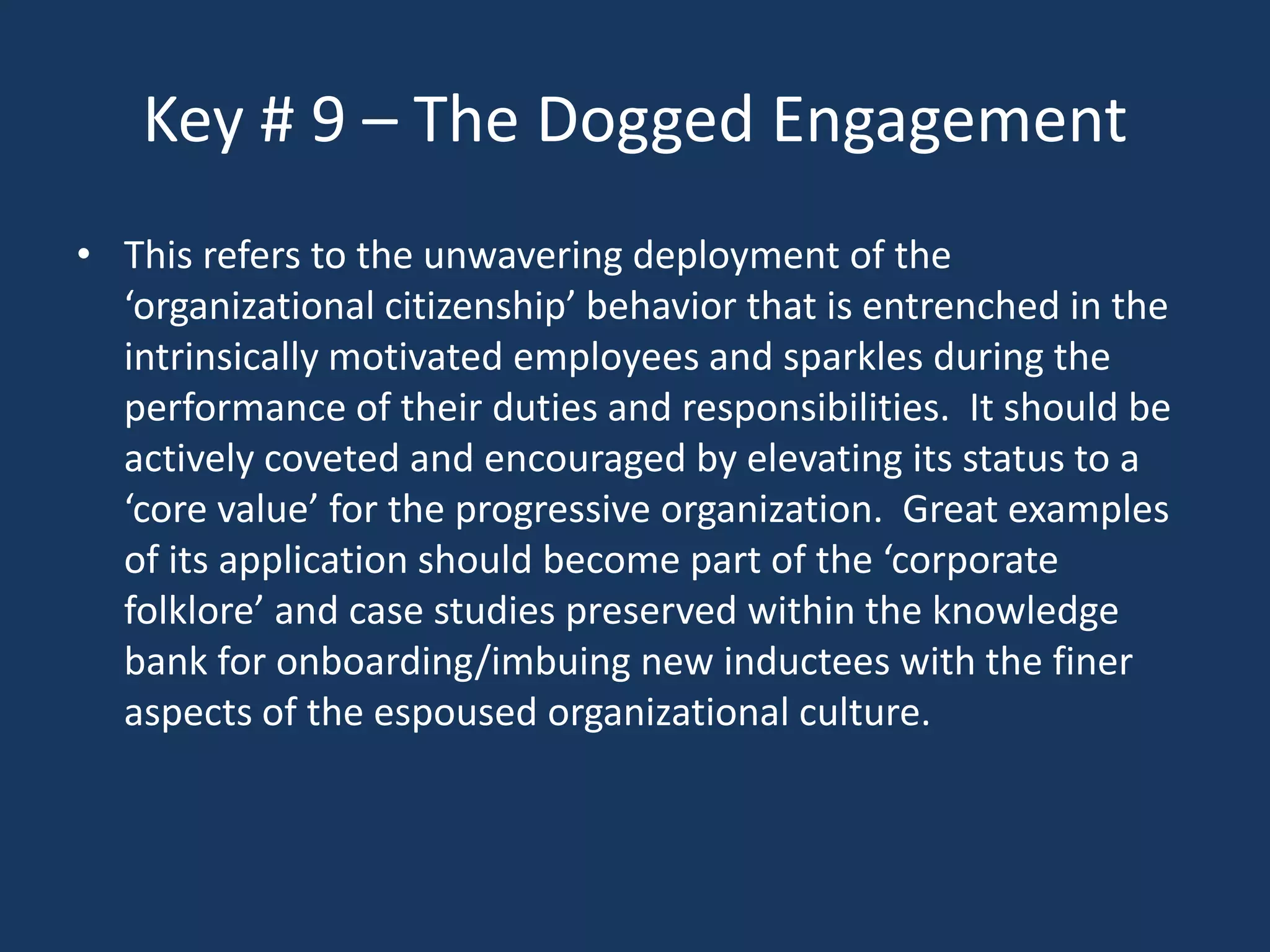
• This refers to the unwavering deployment of the
  ‘organizational citizenship’ behavior that is entrenched in the
  intrinsically motivated employees and sparkles during the
  performance of their duties and responsibilities. It should be
  actively coveted and encouraged by elevating its status to a
  ‘core value’ for the progressive organization. Great examples
  of its application should become part of the ‘corporate
  folklore’ and case studies preserved within the knowledge
  bank for onboarding/imbuing new inductees with the finer
  aspects of the espoused organizational culture.
Key # 10 – The Stimulating Review
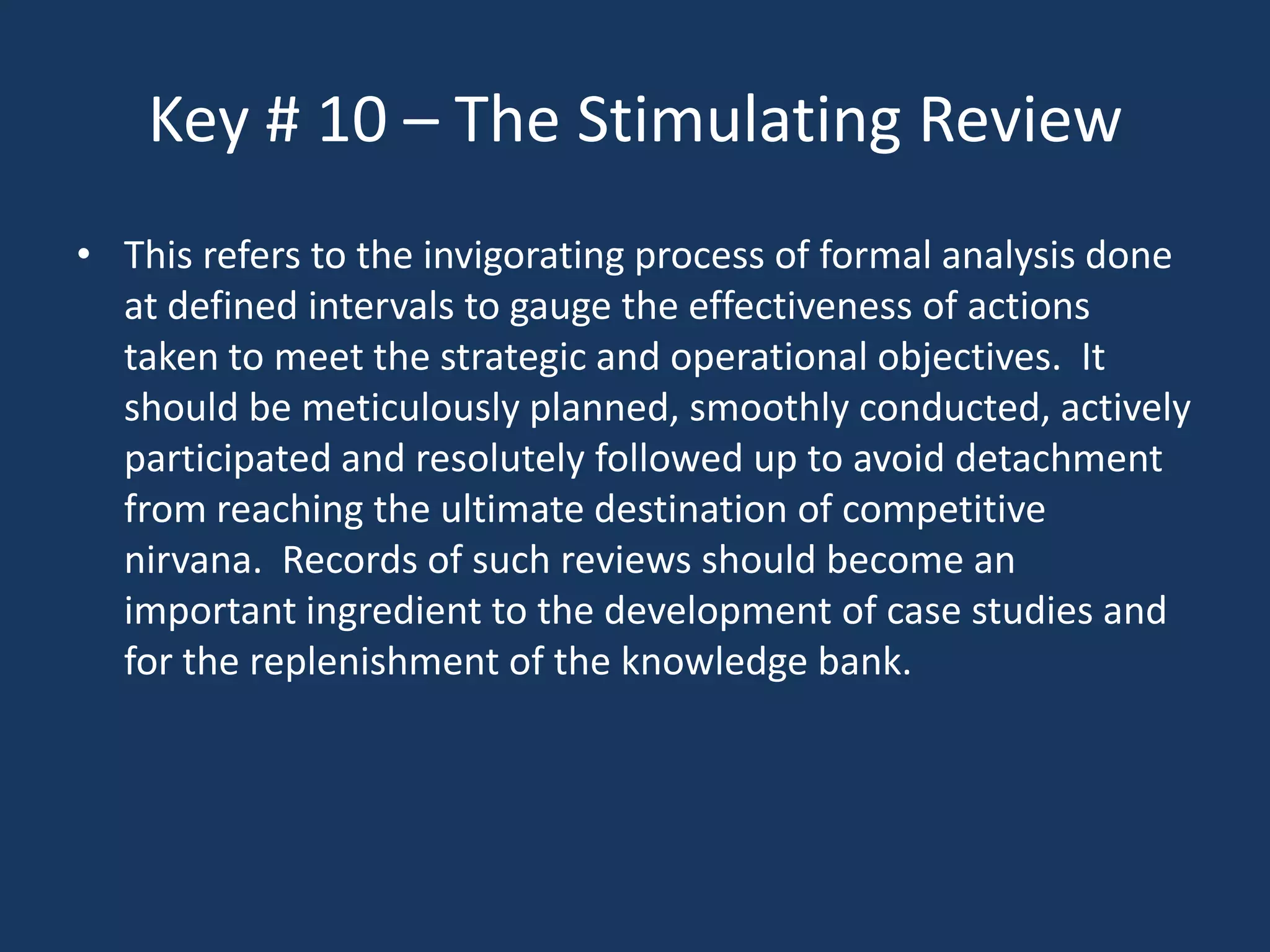
• This refers to the invigorating process of formal analysis done
  at defined intervals to gauge the effectiveness of actions
  taken to meet the strategic and operational objectives. It
  should be meticulously planned, smoothly conducted, actively
  participated and resolutely followed up to avoid detachment
  from reaching the ultimate destination of competitive
  nirvana. Records of such reviews should become an
  important ingredient to the development of case studies and
  for the replenishment of the knowledge bank.
Key # 11 - The Honest Affirmation
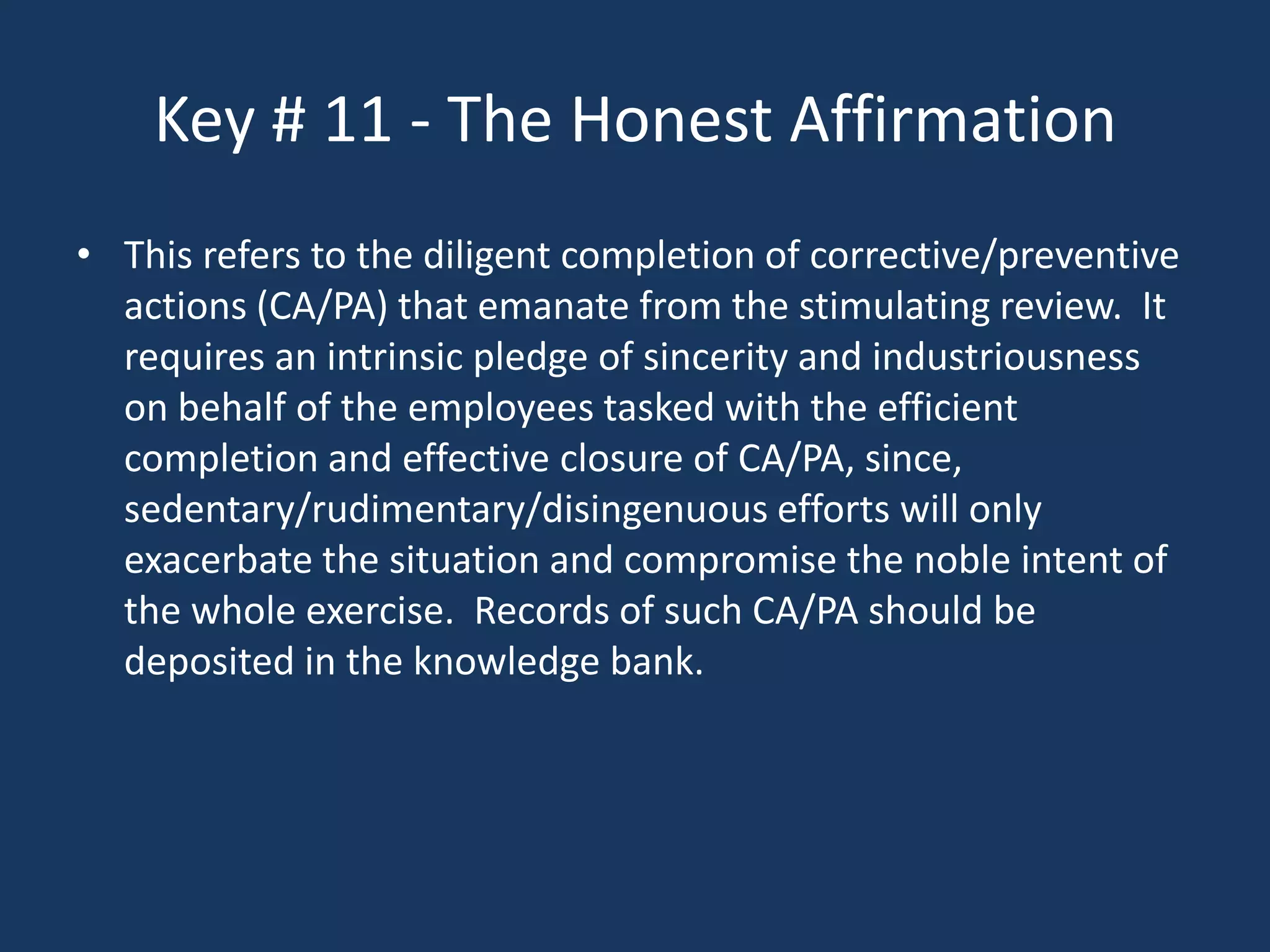
• This refers to the diligent completion of corrective/preventive
  actions (CA/PA) that emanate from the stimulating review. It
  requires an intrinsic pledge of sincerity and industriousness
  on behalf of the employees tasked with the efficient
  completion and effective closure of CA/PA, since,
  sedentary/rudimentary/disingenuous efforts will only
  exacerbate the situation and compromise the noble intent of
  the whole exercise. Records of such CA/PA should be
  deposited in the knowledge bank.
Key # 12 - The Fair Remuneration
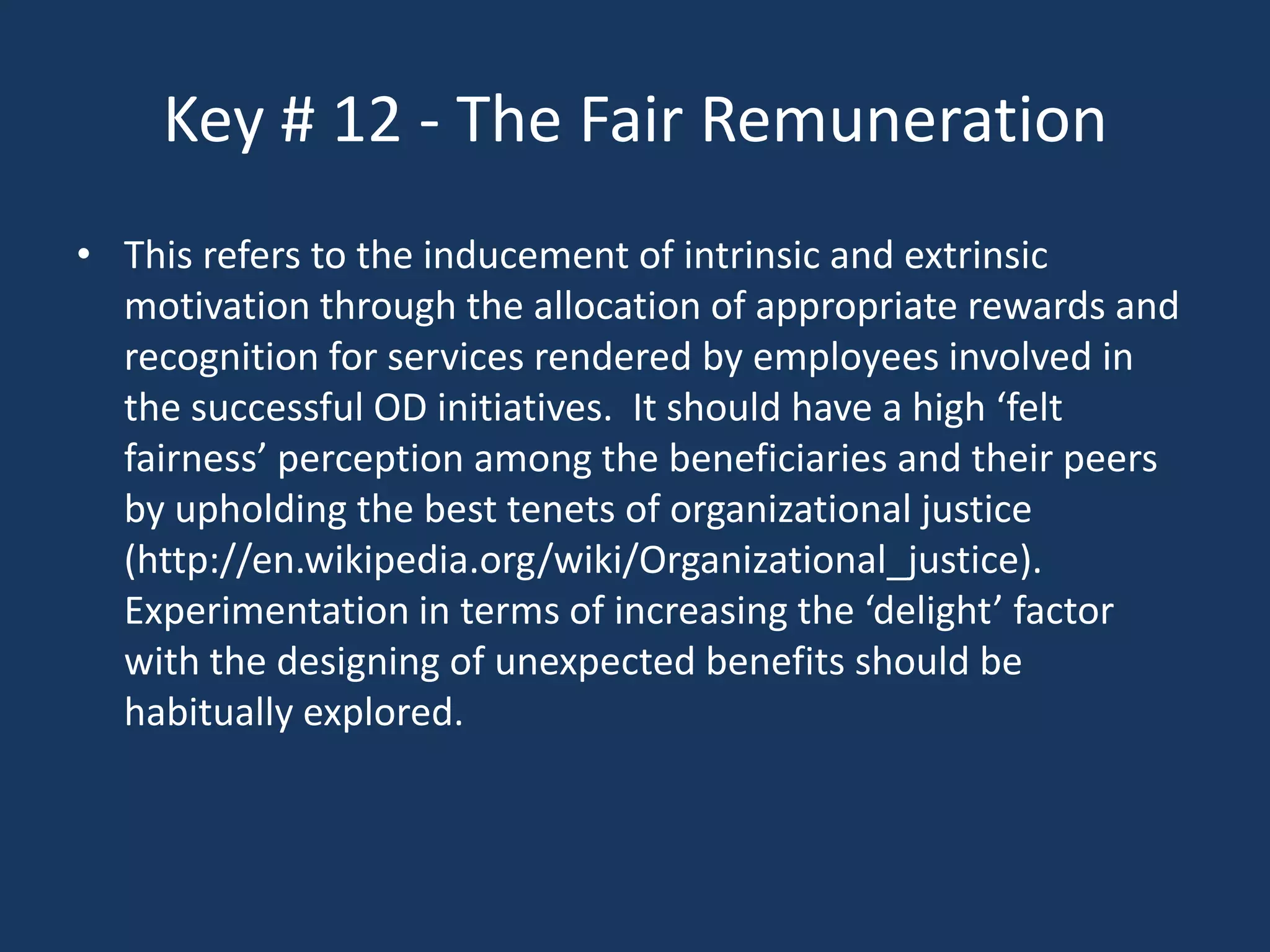
• This refers to the inducement of intrinsic and extrinsic
  motivation through the allocation of appropriate rewards and
  recognition for services rendered by employees involved in
  the successful OD initiatives. It should have a high ‘felt
  fairness’ perception among the beneficiaries and their peers
  by upholding the best tenets of organizational justice
  (http://en.wikipedia.org/wiki/Organizational_justice).
  Experimentation in terms of increasing the ‘delight’ factor
  with the designing of unexpected benefits should be
  habitually explored.
Key # 13 – The Delicate Nurturing
• This refers to an intrinsic/introspective pledge and an
  extrinsic/visible commitment by the top/senior management
  for effective talent management. It includes the dedication of
  significant resources in inculcating desired competencies
  within the employees through formal and informal means in a
  sensitive manner. Such measures should not be subservient
  to short term needs and tie symbiotically to the long term
  growth plans of the organization. Diversity and generational
  (e.g., Gen X, Gen Y) issues should form a valuable part of the
  solution and not relegated as part of the problem.
Key # 14 – The Attractive Branding
• This refers to the image-building initiatives taken by the
  top/senior management to forge an endearing bond between
  the organization and its current/potential employees. Such
  efforts should stem from the pervasiveness of ‘corporate
  citizenship’ behavior within the organization. The resulting
  success should be internally acknowledged and projected by
  engaged employees in relevant surveys and externally
  acclaimed by independent corporate monitors, e.g., Great
  Place to Work (http://www.greatplacetowork.com/).
Key # 15 – The Delicious Invitation
• This refers to developing an attractive package for soliciting
  desired talent that is currently residing outside the
  organization. It should embody the essence of the
  ‘organizational goodness’, including the virtues of a durable
  ‘organizational brand’, and vociferously advocated by the most
  effervescent employees. The primary aim of such an
  enterprising initiative should be to assimilate desired talent
  within the organization, as a revitalization measure, at a
  manageable pace that can ease its march towards
  organizational effectiveness.
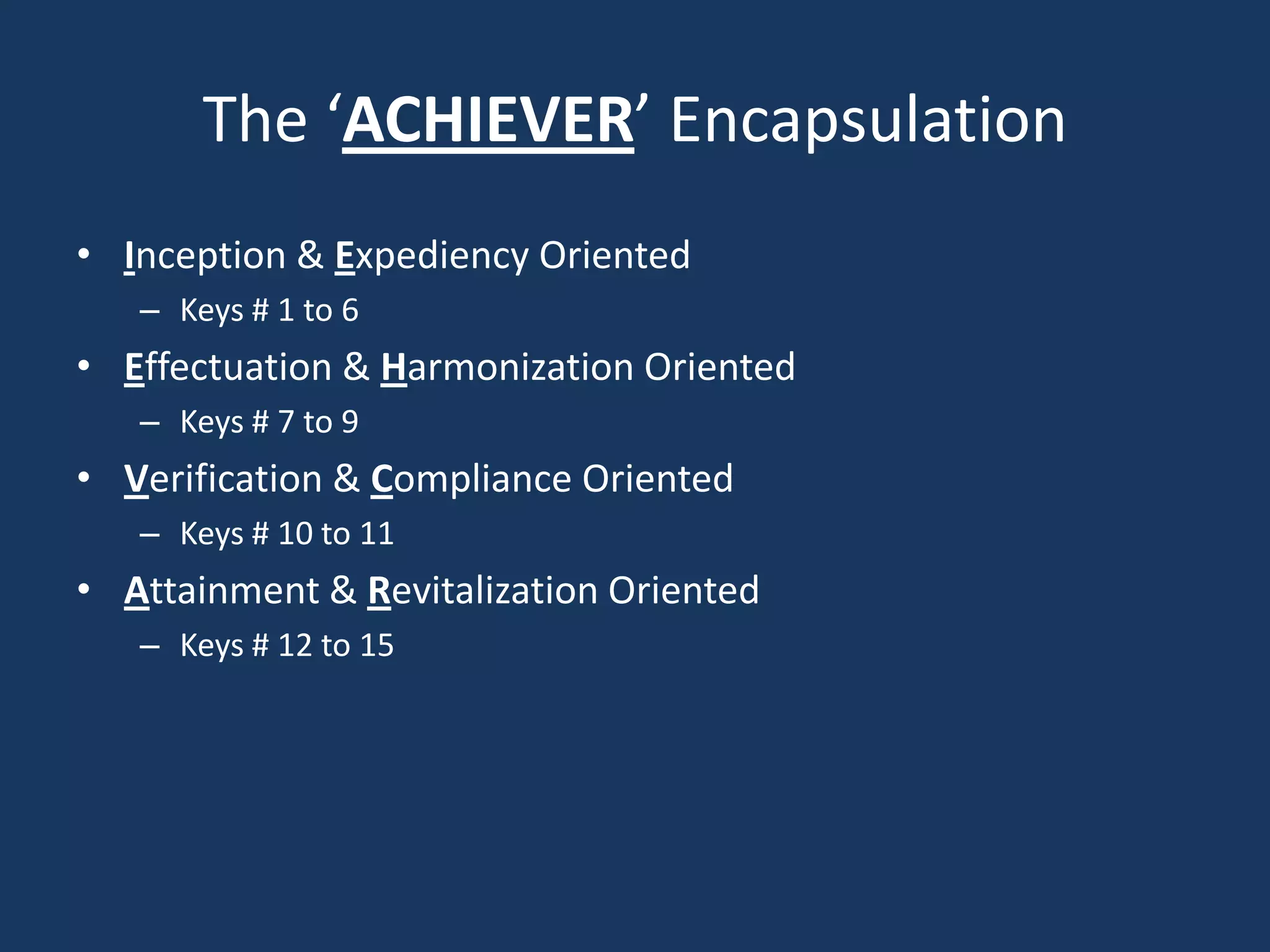
The ‘ACHIEVER’ Encapsulation
• Inception & Expediency Oriented
   – Keys # 1 to 6
• Effectuation & Harmonization Oriented
   – Keys # 7 to 9
• Verification & Compliance Oriented
   – Keys # 10 to 11
• Attainment & Revitalization Oriented
   – Keys # 12 to 15
Parting Advice

• Don’t forget the Keys!

The 15 keys to Successful Organizational Development (A Humanistic Perspective)

  • 1.
    The 15 Keysto Successful Organizational Development (A Humanistic Perspective) Developed and Presented by Murad Salman Mirza Senior Vice President (Client Advocacy & Organizational Effectiveness) APAC & EMEA Regions
  • 2.
    Table of Contents • Objective • Introduction • Defining the 15 Keys • The ‘ACHIEVER’ Encapsulation • Parting Advice
  • 3.
    Objective • This presentationfocuses on providing an understanding of the 15 Keys that are essential for successful Organizational Development (OD) of aspiring organizations
  • 4.
    Introduction • Organizational Developmenthas come a long way from languishing in the shadows of HR to being widely recognized as the primary driver of core organizational competencies through targeted interventions. It traverses the delicate path of progressive transition to a better state by employing the services of Change Management that embodies the systematic approach to managing risk in reaching desired goals and objectives. However, too many of such promising initiatives fail due to lack of foresight in instilling and institutionalizing certain principles that are critical for ensuring a high probability of success. These keys are…
  • 5.
    Key # 1- The Irrefutable Need • This refers to the timely realization of the significance of development and change that is required to ensure the survival/competitiveness of the organization. It normally stems from organizational analysis (PESTLE, SWOT, Balanced Scorecard, Weisbord’s 6 Box Model, Mckinsey 7S, etc.). It generally indicates the stagnating business growth, commoditized core competencies, misalignment of strategic priorities with tactical measures and precarious financial situation. It is imperative in nature and demands undivided attention on part of the top/senior management.
  • 6.
    Key # 2- The Burning Desire • This refers to coaxing of the passion that simmers in an enlightened top/senior management to excel beyond the conventional and foreseeable horizon. It is manifested as an intrinsic motivation within the primary decision makers to engage their ambitions in taking calculated risks from a position of relative comfort. It requires the courage to question the status quo and the willingness to initiate appropriate actions for shining within the constellation of relevant industry competitors without extinguishing the fire of innovation by dousing it with impending complacency.
  • 7.
    Key # 3- The Optimized Decisiveness • This refers to the knack for taking balanced decisions that are warranted in view of the indubitable need and the infectious desire for the long term survival/competitiveness of the organization. It takes into account the available evidence in the form of analytical reports, employee/client feedback and the stated vision for scaling new heights by a certain timeframe in the future. The respective decision should be deliberated between the senior management in a democratic fashion, however, the final conclusion should be drawn by the person gracing the top position with a clear idea, acceptance, preparedness and accountability for the positive and negative consequences of ensuing actions.
  • 8.
    Key # 4- The Transcendent Message • This refers to creating, designing and communicating the message that inspires a passionate following/buy-in within the organization to the call for progressive change and development. The respective message needs to embody an optimum mix of both fluidity and viscosity. Fluidity to ensure that it flows at all levels of the organization and can funnel/seep through functional silos/questioning mindsets/grapevine gropers without any hindrance. Viscosity to ensure that it sticks in the reflective minds/thoughts/attitudes of employees long after the initial communication has take place for providing a ‘safe house’ to keep doubts/inhibitions/fears at bay.
  • 9.
    Key # 5- The Wise Selection • The refers to indulging in an inspired selection of the team that can get the job done. It has to be led by a person who is comfortable in his/her own skin with an intellectual and technical acumen that is able to demand attention at the very top and carry enough charisma to charm all parts of the organization. The real challenge is to become the beacon of hope in the ‘dark places’ of the organization, where fear and doubt breed profusely. The associated team members should be bundles of infectious energy, enthusiasm and drive coupled with a delightful disposition as interactive sources of information, facilitation and application.
  • 10.
    Key # 6– The Insightful Plan • The refers to the inception and development of an astute plan, peppered with strategic and operational objectives, for proceeding forward with OD initiatives in a systematic manner. It is an ode to action that needs to be firm in its intent, unambiguous in its direction and accommodating in its application to safeguard against elevation to such a ‘sacrosanct’ status that it breeds massive alienation and incentivizes a buy-out situation. It should bolster the confidence of key stakeholders and neutralize the active/passive resistance from pessimistic quarters.
  • 11.
    Key # 7– The Keen Acceptance • The refers to the eagerness in embracing the OD plan by the employees whose desire for expediency has been emboldened by the transcendent message delivered earlier. It should be evident by the ‘reverberating chatter’ permeating throughout the organization and manifested in the invigorated emphasis on going beyond the routine. This also serves as a timely reminder to all the conniving forces lurking within the ‘dark alleys’ of the organization that the time for Machiavellianism is over and ‘crossing the picket lines’ would be a more productive option.
  • 12.
    Key # 8– The Religious Application • This refers to the devout realization of the OD plan through the blissful harmonization of comprehensive planning with practical rendition. It should be knitted with the reflective process of ‘action research’ and provide an opportunity for the dedicated implementers to raise the flag for personal competence as a foreword to subsequent reward and recognition consideration. The momentum for effective execution should be robustly maintained with visible support from the top/senior management to sustain/reinforce the psychological contract with key stakeholders.
  • 13.
    Key # 9– The Dogged Engagement • This refers to the unwavering deployment of the ‘organizational citizenship’ behavior that is entrenched in the intrinsically motivated employees and sparkles during the performance of their duties and responsibilities. It should be actively coveted and encouraged by elevating its status to a ‘core value’ for the progressive organization. Great examples of its application should become part of the ‘corporate folklore’ and case studies preserved within the knowledge bank for onboarding/imbuing new inductees with the finer aspects of the espoused organizational culture.
  • 14.
    Key # 10– The Stimulating Review • This refers to the invigorating process of formal analysis done at defined intervals to gauge the effectiveness of actions taken to meet the strategic and operational objectives. It should be meticulously planned, smoothly conducted, actively participated and resolutely followed up to avoid detachment from reaching the ultimate destination of competitive nirvana. Records of such reviews should become an important ingredient to the development of case studies and for the replenishment of the knowledge bank.
  • 15.
    Key # 11- The Honest Affirmation • This refers to the diligent completion of corrective/preventive actions (CA/PA) that emanate from the stimulating review. It requires an intrinsic pledge of sincerity and industriousness on behalf of the employees tasked with the efficient completion and effective closure of CA/PA, since, sedentary/rudimentary/disingenuous efforts will only exacerbate the situation and compromise the noble intent of the whole exercise. Records of such CA/PA should be deposited in the knowledge bank.
  • 16.
    Key # 12- The Fair Remuneration • This refers to the inducement of intrinsic and extrinsic motivation through the allocation of appropriate rewards and recognition for services rendered by employees involved in the successful OD initiatives. It should have a high ‘felt fairness’ perception among the beneficiaries and their peers by upholding the best tenets of organizational justice (http://en.wikipedia.org/wiki/Organizational_justice). Experimentation in terms of increasing the ‘delight’ factor with the designing of unexpected benefits should be habitually explored.
  • 17.
    Key # 13– The Delicate Nurturing • This refers to an intrinsic/introspective pledge and an extrinsic/visible commitment by the top/senior management for effective talent management. It includes the dedication of significant resources in inculcating desired competencies within the employees through formal and informal means in a sensitive manner. Such measures should not be subservient to short term needs and tie symbiotically to the long term growth plans of the organization. Diversity and generational (e.g., Gen X, Gen Y) issues should form a valuable part of the solution and not relegated as part of the problem.
  • 18.
    Key # 14– The Attractive Branding • This refers to the image-building initiatives taken by the top/senior management to forge an endearing bond between the organization and its current/potential employees. Such efforts should stem from the pervasiveness of ‘corporate citizenship’ behavior within the organization. The resulting success should be internally acknowledged and projected by engaged employees in relevant surveys and externally acclaimed by independent corporate monitors, e.g., Great Place to Work (http://www.greatplacetowork.com/).
  • 19.
    Key # 15– The Delicious Invitation • This refers to developing an attractive package for soliciting desired talent that is currently residing outside the organization. It should embody the essence of the ‘organizational goodness’, including the virtues of a durable ‘organizational brand’, and vociferously advocated by the most effervescent employees. The primary aim of such an enterprising initiative should be to assimilate desired talent within the organization, as a revitalization measure, at a manageable pace that can ease its march towards organizational effectiveness.
  • 20.
    The ‘ACHIEVER’ Encapsulation •Inception & Expediency Oriented – Keys # 1 to 6 • Effectuation & Harmonization Oriented – Keys # 7 to 9 • Verification & Compliance Oriented – Keys # 10 to 11 • Attainment & Revitalization Oriented – Keys # 12 to 15
  • 21.