
Categorizing blogs as
     information sources:

Mark-Shane Scale                    Anabel Quan-Haase
Faculty of Information & Media      SocioDigital.info Lab
Studies                             Faculty of Information & Media
The University of Western Ontario   Studies
1151 Richmond Street                The University of Western Ontario
London, ON, CA N6A 5B7              1151 Richmond Street
mscale2@uwo.ca                      London, ON, CA N6A 5B7
                                    aquan@uwo.ca                      1
Topic outline
1.   Why study this topic?
2.   Definition and typologies of information sources
3.   Definitions of Blogs
4.   Blogs as information sources
5.   Conclusions
6.   References


                                                        2
Why study this topic?
Information needs and use research generally study
the characteristics of information sources used in
every day life and for work purposes.

 Blogs are globally important for work and everyday
  life


                                                     3
Observation of the global
importance of blogs for work and
everyday life
Information sources
for mainstream        Journalist continuously use blogs
journalism            to discover what is
                      newsworthy, what will attract
                      public interest, experts on
                      issues, fact checking of their
                      reports, feedback on their work
                      and sources of news for further
                      investigation.


                                                          4
Observation of the global
importance of blogs for work and
everyday life
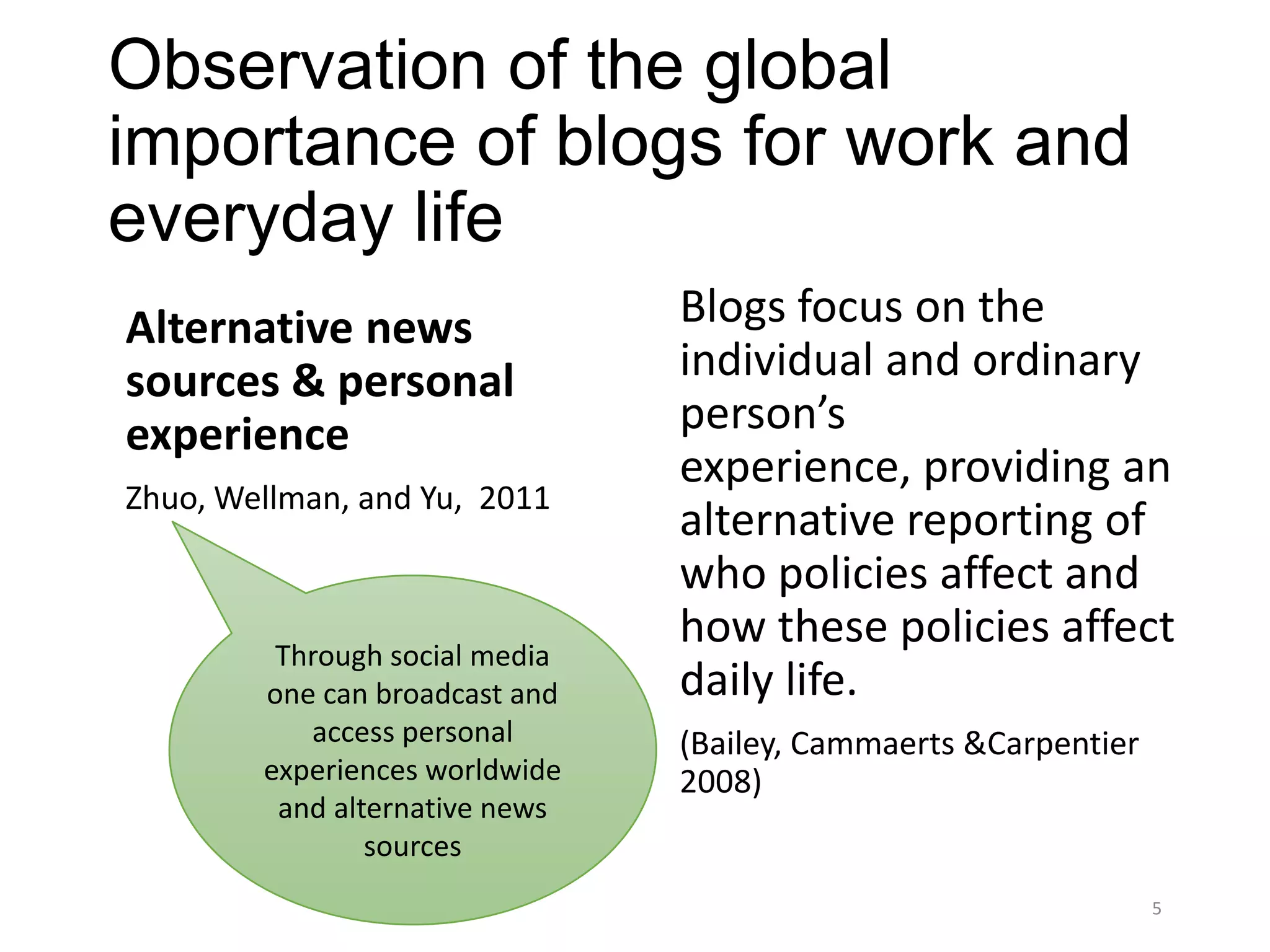
Alternative news                Blogs focus on the
sources & personal              individual and ordinary
experience                      person’s
                                experience, providing an
Zhuo, Wellman, and Yu, 2011
                                alternative reporting of
                                who policies affect and
         Through social media
                                how these policies affect
        one can broadcast and   daily life.
           access personal      (Bailey, Cammaerts &Carpentier
        experiences worldwide   2008)
         and alternative news
                sources
                                                                 5
Observation of the global
importance of blogs for work and
everyday life
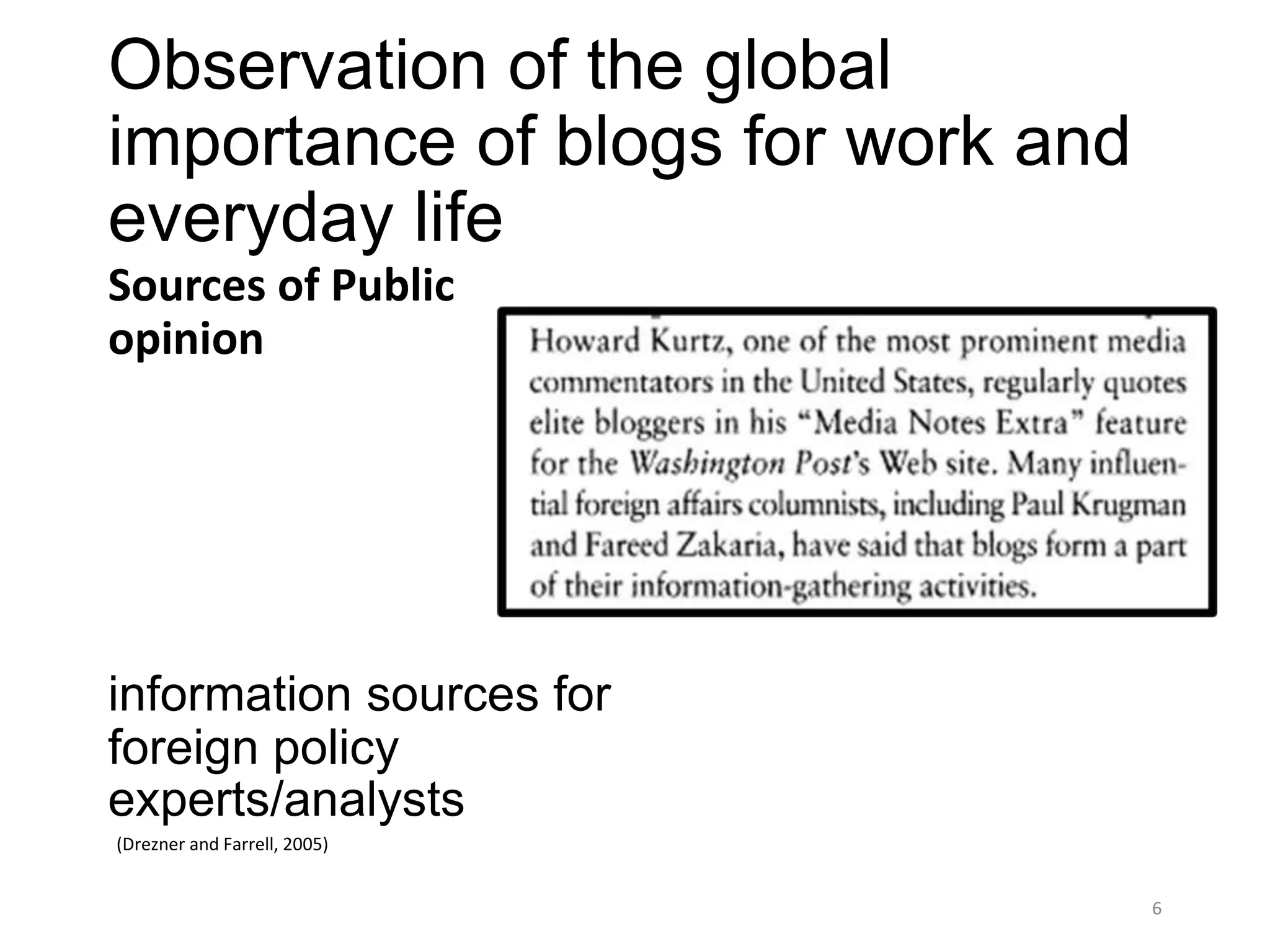
Sources of Public
opinion


information sources for
foreign policy
experts/analysts
(Drezner and Farrell, 2005)


                                   6
Observation of the global
importance of blogs for work and
everyday life
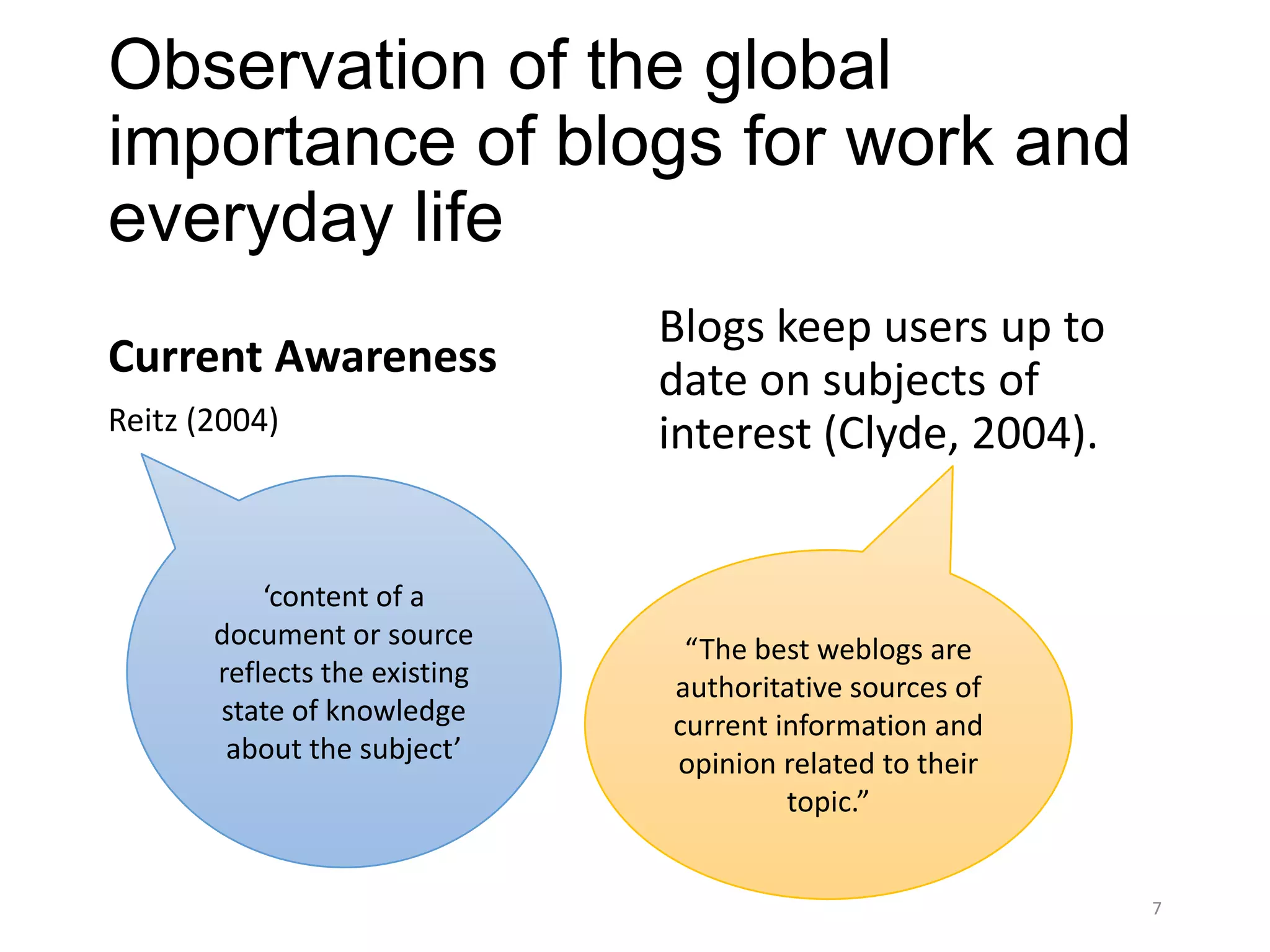
                               Blogs keep users up to
Current Awareness              date on subjects of
Reitz (2004)                   interest (Clyde, 2004).


           ‘content of a
       document or source       “The best weblogs are
       reflects the existing   authoritative sources of
       state of knowledge      current information and
        about the subject’     opinion related to their
                                        topic.”


                                                          7
Observation of the global
importance of blogs for work and
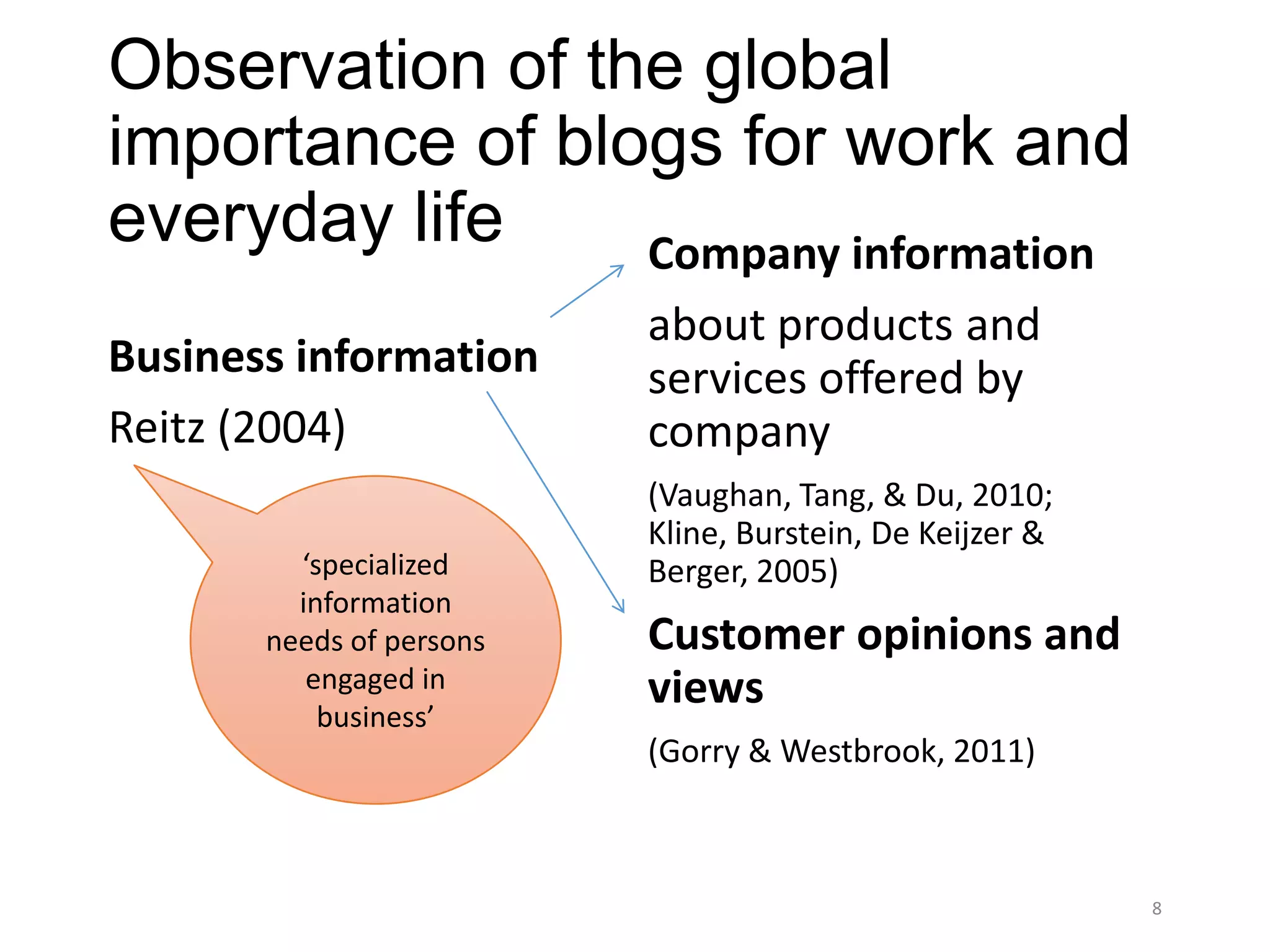
everyday life    Company information
                          about products and
Business information      services offered by
Reitz (2004)              company
                          (Vaughan, Tang, & Du, 2010;
                          Kline, Burstein, De Keijzer &
         ‘specialized     Berger, 2005)
         information
       needs of persons   Customer opinions and
          engaged in      views
           business’
                          (Gorry & Westbrook, 2011)


                                                          8
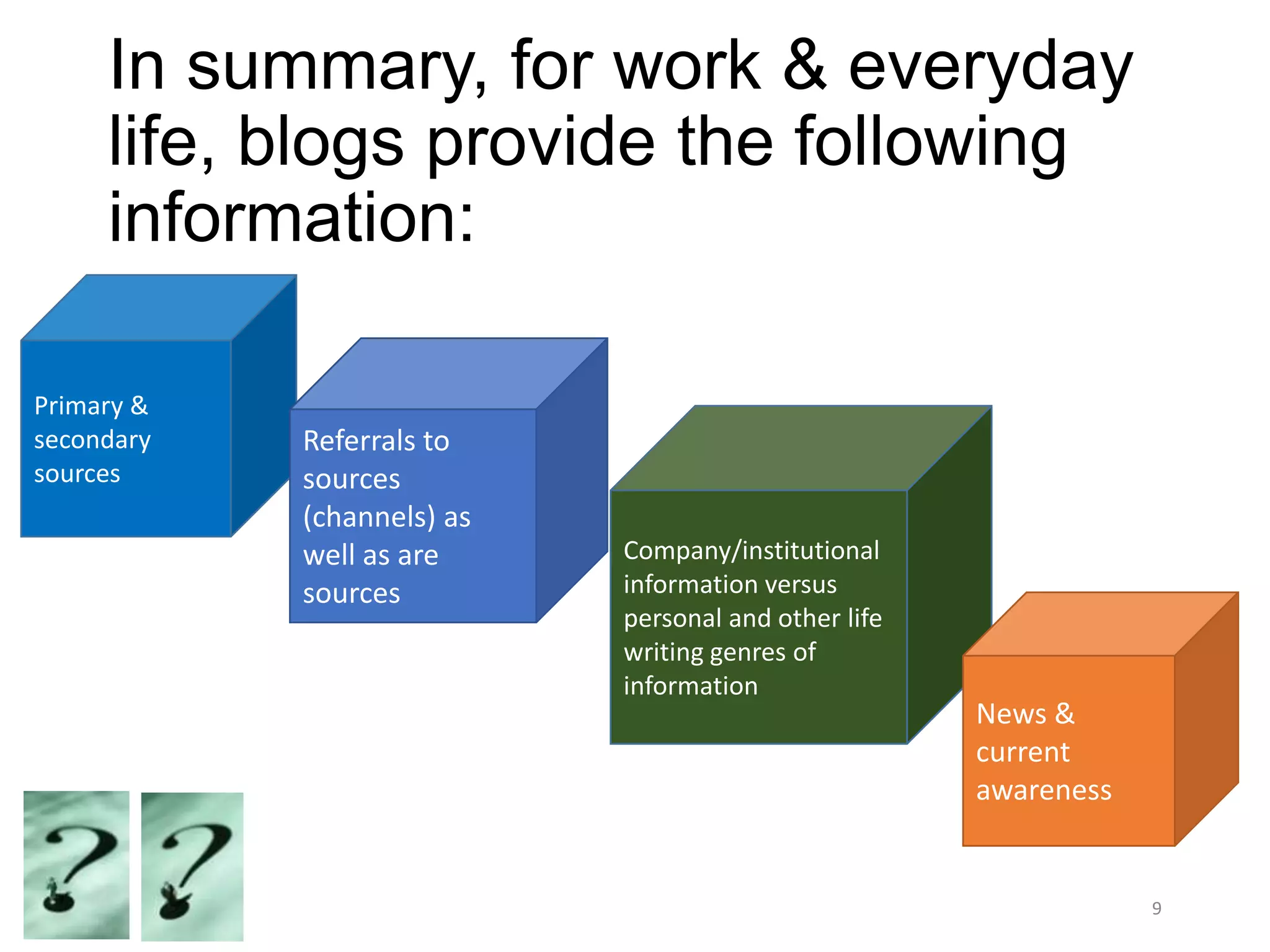
In summary, for work & everyday
     life, blogs provide the following
     information:

Primary &
secondary   Referrals to
sources     sources
            (channels) as
            well as are     Company/institutional
            sources         information versus
                            personal and other life
                            writing genres of
                            information
                                                      News &
                                                      current
                                                      awareness


                                                                  9
Where do blogs fit in existing/
official information typologies?

         Blogs and other social media do not
         neatly fit into existing categories of
         information sources.


                                                  10
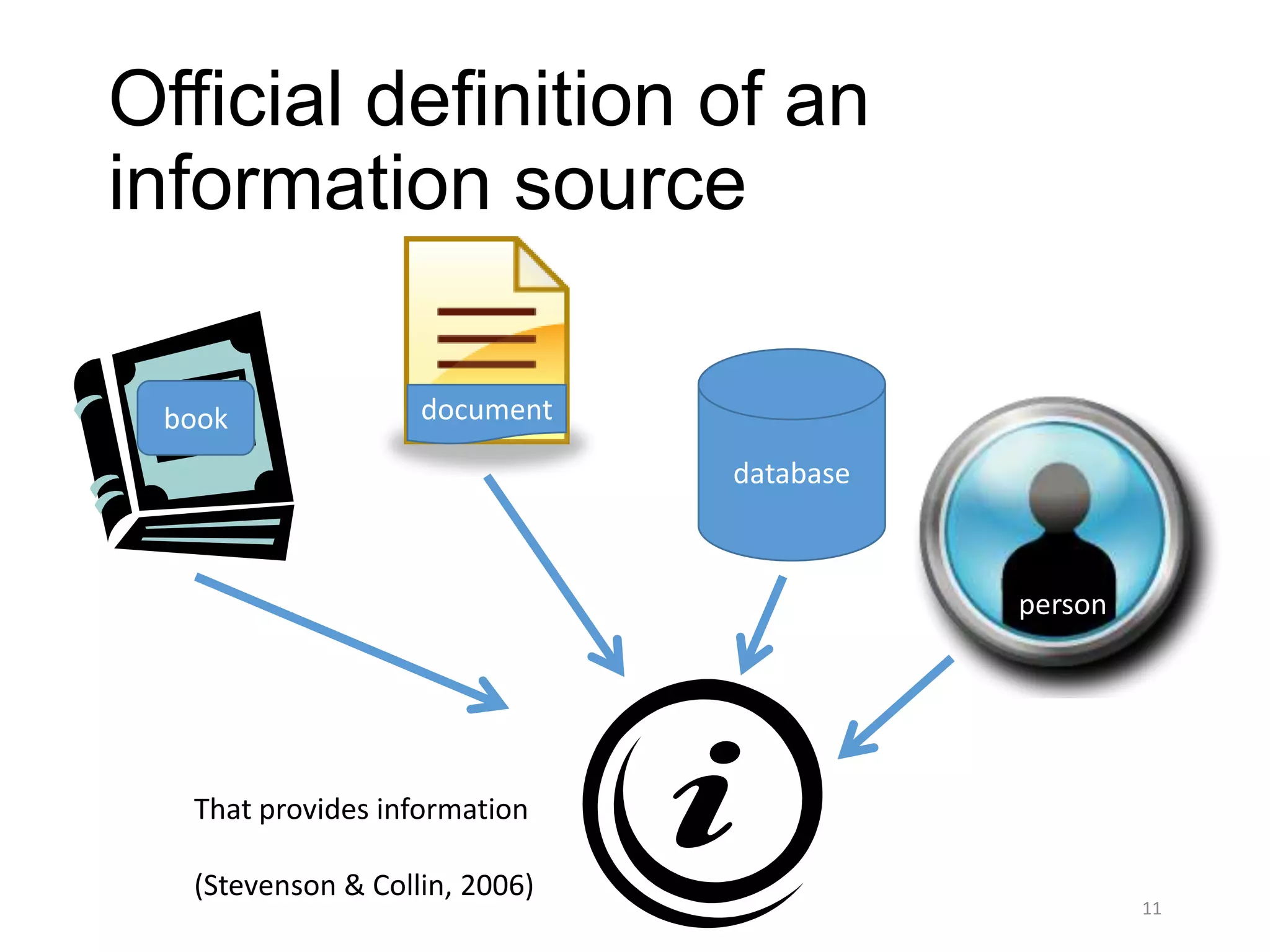
Official definition of an
information source

 book              document

                               database


                                          person


  That provides information

  (Stevenson & Collin, 2006)
                                                   11
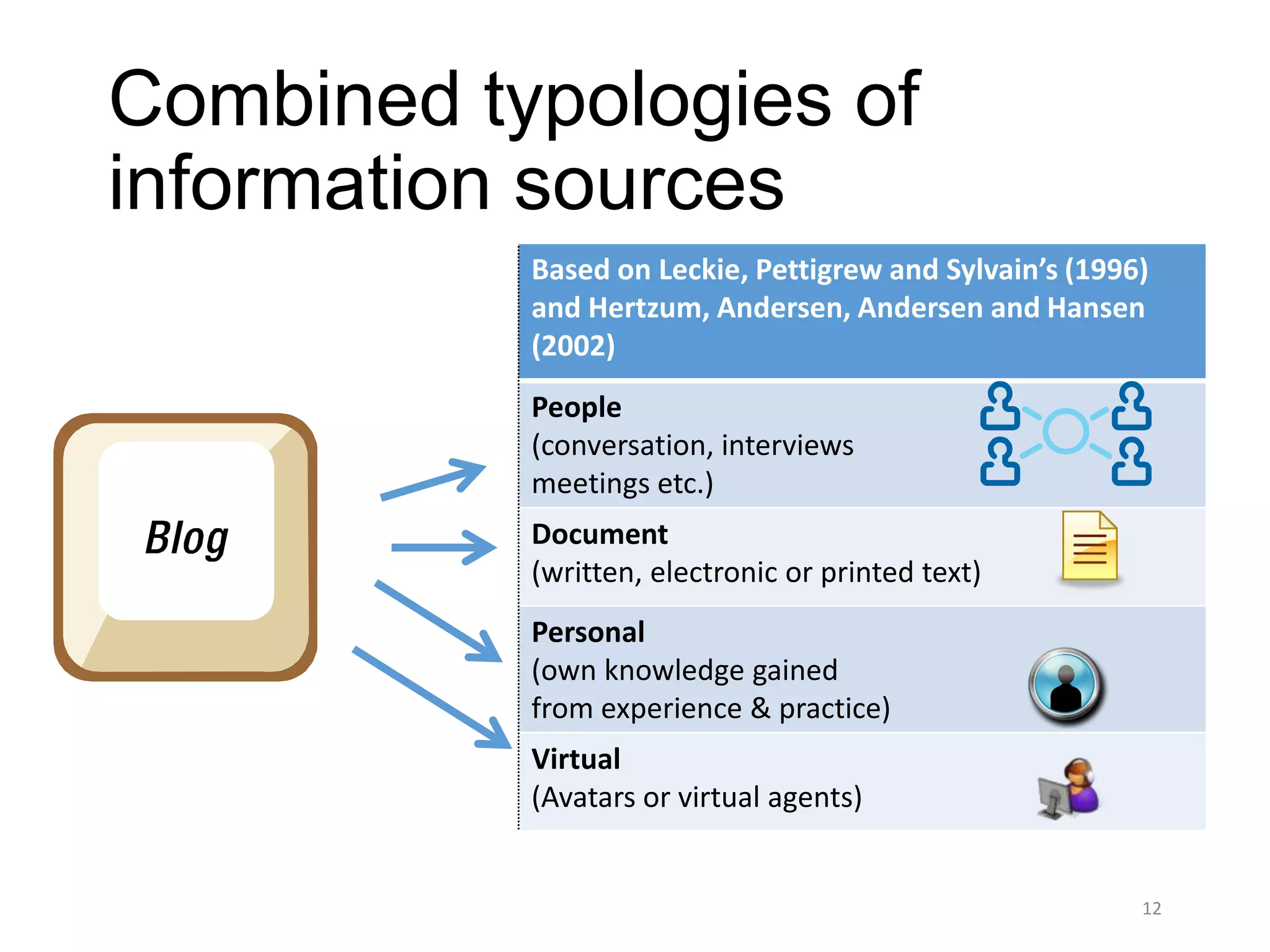
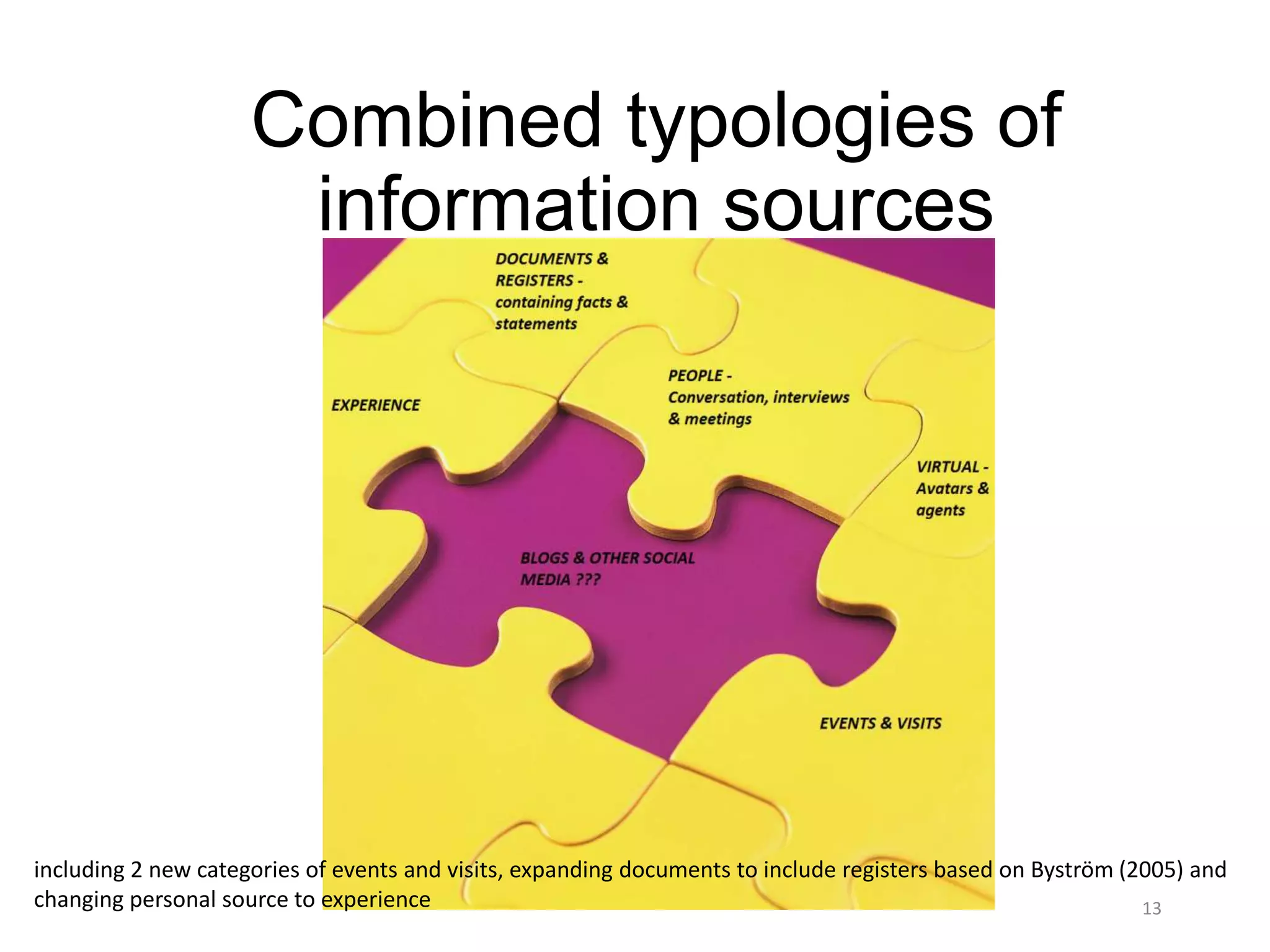
Combined typologies of
information sources
           Based on Leckie, Pettigrew and Sylvain’s (1996)
           and Hertzum, Andersen, Andersen and Hansen
           (2002)
           People
           (conversation, interviews
           meetings etc.)
           Document
           (written, electronic or printed text)
           Personal
           (own knowledge gained
           from experience & practice)
           Virtual
           (Avatars or virtual agents)


                                                         12
Combined typologies of
                      information sources


including 2 new categories of events and visits, expanding documents to include registers based on Byström (2005) and
changing personal source to experience                                                                       13
Blogs defined
Agreed properties
Webpages or websites
Briefly & regularly updated
Content chronologically arranged
Dynamic & constantly evolving


                                    14
Blogs defined
Disputed
 Genre of communication or medium
 Typologies of blogs that exist
 Metaphors for blogs, such as:
  o Citizen journalism?
  o Personal websites?
  o Online diaries?


                                     15
Blogs incorporate documents
Maxwell (2008) states that blogs:


          “are repositories of PDF scans of useful tidbits
          of legal information that either are not offered
          through the conventional legal publishing
          channels or are offered by the blog at no
          charge.”


                                                             16
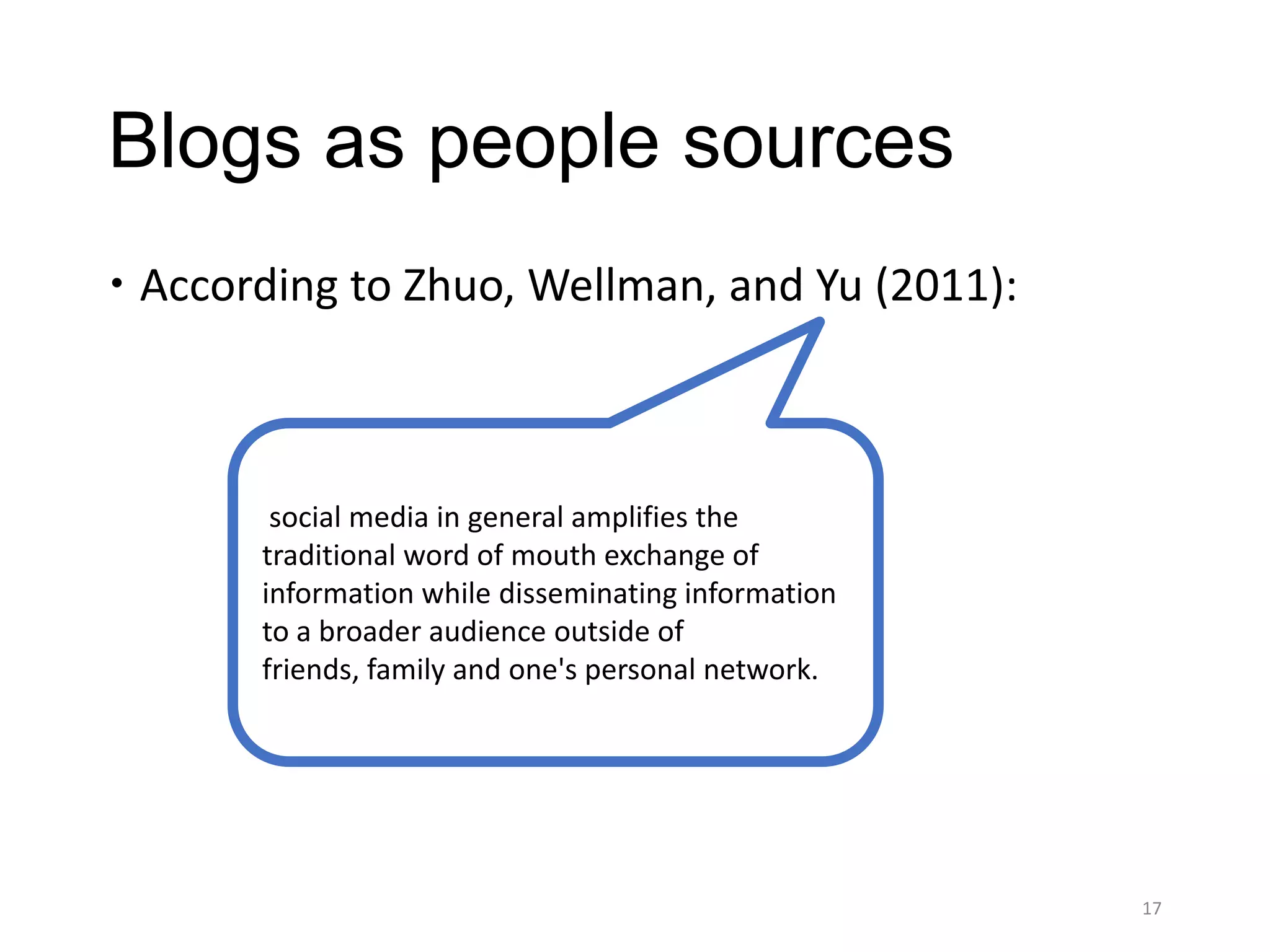
Blogs as people sources
 According to Zhuo, Wellman, and Yu (2011):


        social media in general amplifies the
       traditional word of mouth exchange of
       information while disseminating information
       to a broader audience outside of
       friends, family and one's personal network.


                                                     17
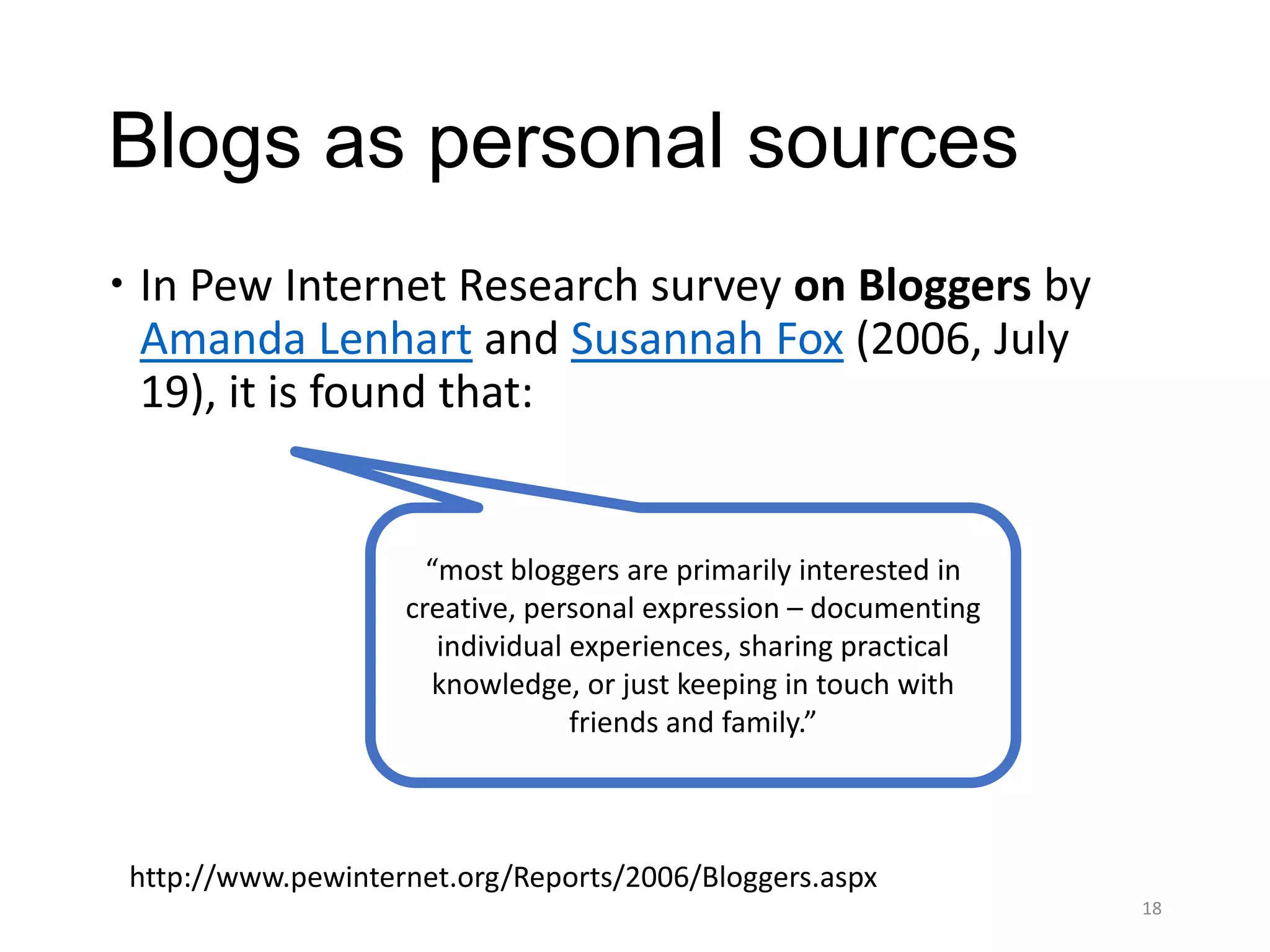
Blogs as personal sources
 In Pew Internet Research survey on Bloggers by
  Amanda Lenhart and Susannah Fox (2006, July
  19), it is found that:


                      “most bloggers are primarily interested in
                    creative, personal expression – documenting
                       individual experiences, sharing practical
                      knowledge, or just keeping in touch with
                                  friends and family.”


 http://www.pewinternet.org/Reports/2006/Bloggers.aspx
                                                                   18
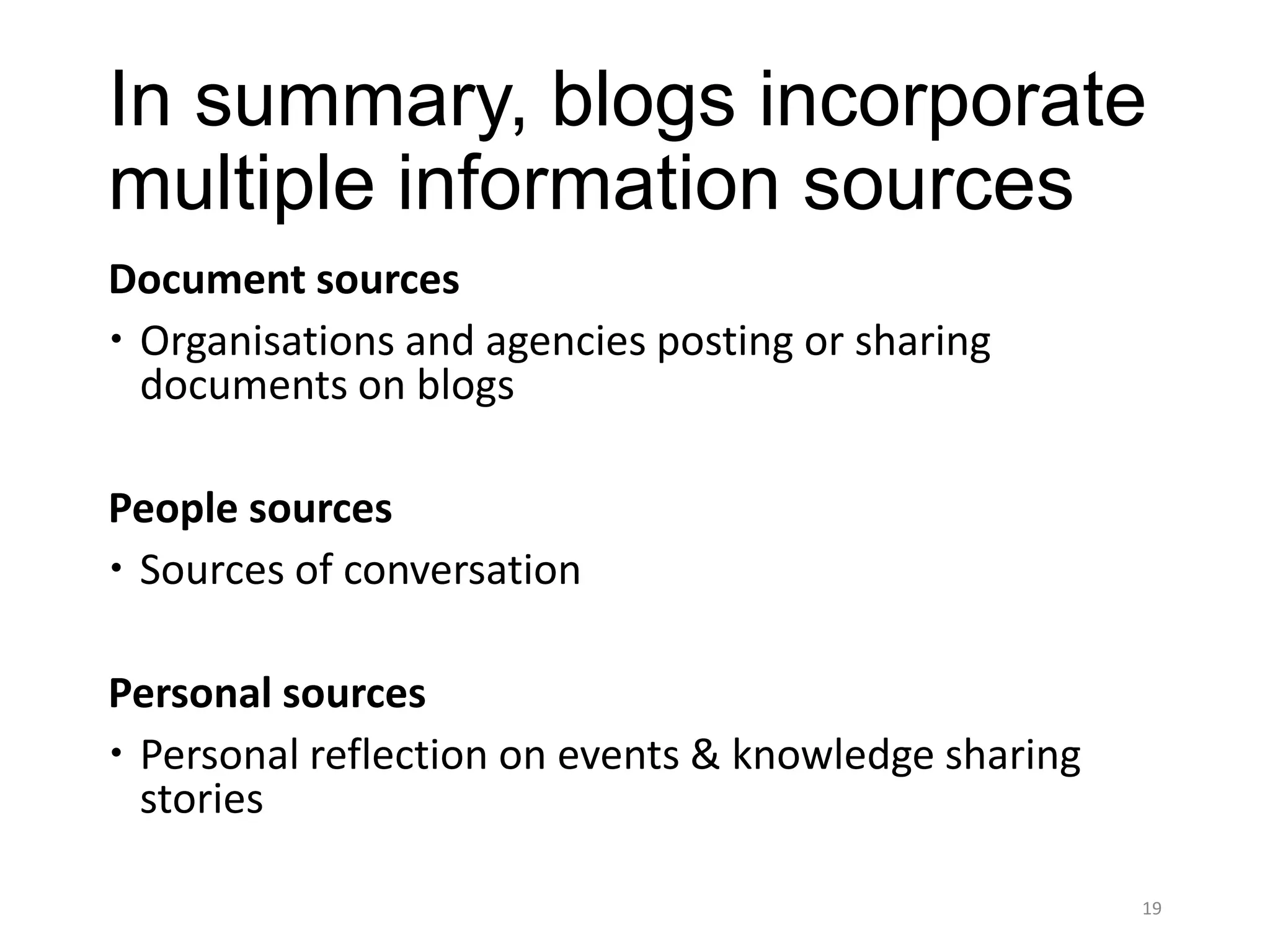
In summary, blogs incorporate
multiple information sources
Document sources
 Organisations and agencies posting or sharing
  documents on blogs

People sources
 Sources of conversation

Personal sources
 Personal reflection on events & knowledge sharing
  stories

                                                      19
New framework for studying how
blogs function as information
sources


                             20
Begin with broader definition
of an information source
Anything that a person
turns to in order to
properly answer a
question.


                                21
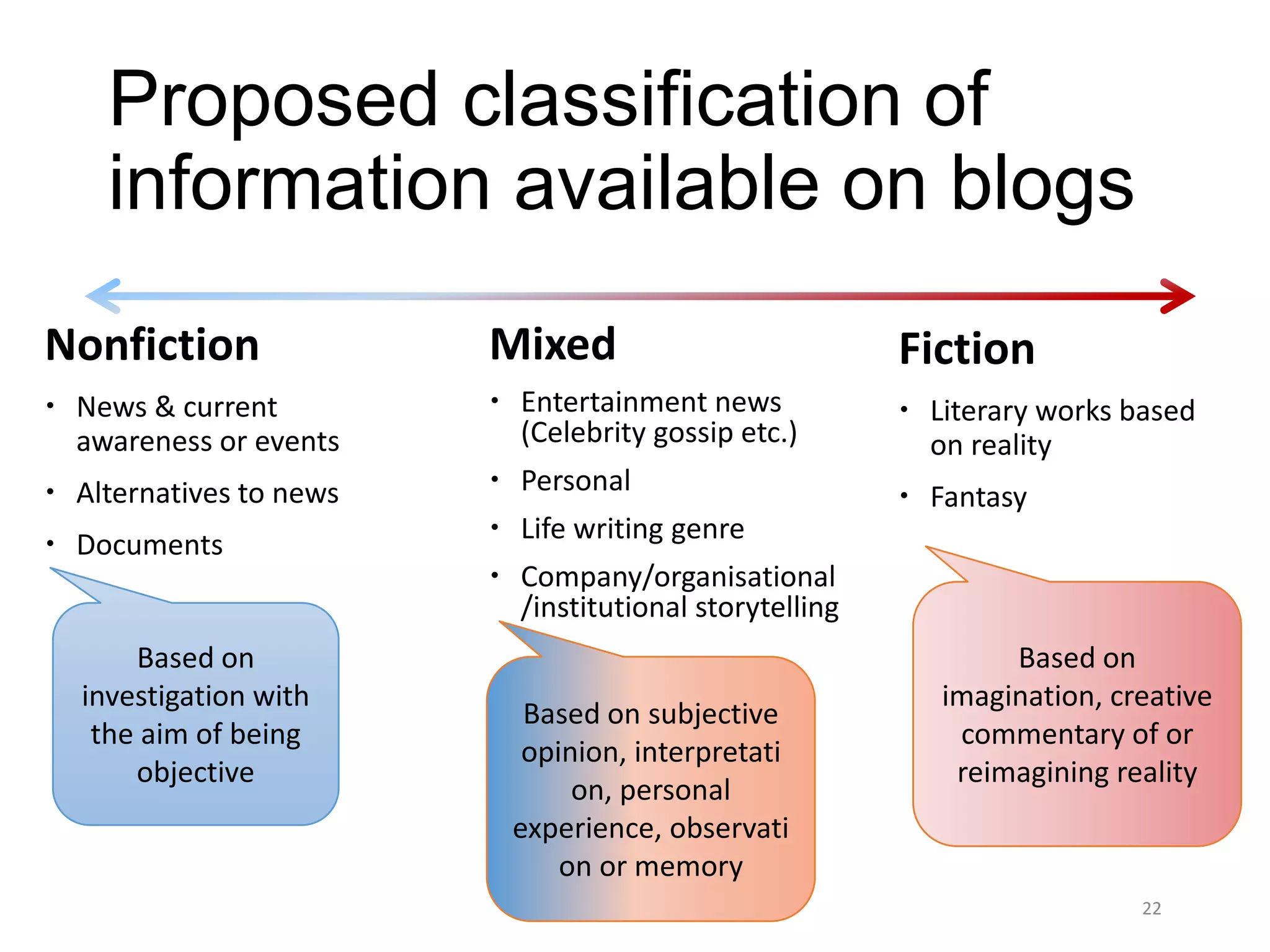
Proposed classification of
    information available on blogs
Nonfiction               Mixed                           Fiction
 News & current          Entertainment news             Literary works based
  awareness or events      (Celebrity gossip etc.)         on reality
 Alternatives to news    Personal
                                                          Fantasy
                          Life writing genre
 Documents
                          Company/organisational
                           /institutional storytelling
      Based on                                                   Based on
  investigation with                                        imagination, creative
                           Based on subjective
   the aim of being                                          commentary of or
                           opinion, interpretati
      objective                                              reimagining reality
                               on, personal
                          experience, observati
                              on or memory
                                                                           22
Questions, comments, criticis
ms?


                                23
References
Bailey, O. G. (2008). Blogs in the second Iraqi war: Alternative media challenging the
mainstream?” In O. G. Bailey, B. Cammaerts & N. Carpentier. Understanding Alternative Media.(
pp.72- 83). New York: Open University Press.
boyd, d. (2006). A Blogger’s blog: Exploring the definition of a medium. Reconstruction, 6(4)
Retrieved from http://reconstruction.eserver.org/064/boyd.shtml
Clyde, L. (2004a). Weblogs and libraries. Oxford: Chandos.
Clyde , L. (2004b). Weblogs – are you serious? The Electronic Library, 22 (5), 390-392 . doi
10.1108/02640470410561893
Dean, J. (2010). Blog theory: Feedback and capture in the circuits of drive. Cambridge;
Malden, MA: Polity.
Drezner, D. W. & Farrell, H. (2005). Web of influence. In D. Kline, D. Burstein, A.J. Keijzer. &
P.Berger. (Eds.). Blog! How the newest media revolution is changing politics, business, and culture.
(pp 83-97). New York: CDS Books in association with Squibnocket Partners LLC.
Garden, M. (2012). Defining blog: A fool’s errand or a necessary undertaking.
Journalism, 13(4), 483-499. doi:10.1177/1464884911421700
Herring, S. C., Scheidt, L. A., Bonus, S., & Wright, E. (2004). "Bridging the gap: A genre analysis of
weblogs. Proceedings of the 37th Annual Hawaii International Conference on System Sciences
(HICSS'04) - Track 4, 2004,


                                                                                                         24
References
Hertzum, M., Andersen, H. H. K., Andersen, V., & Hansen, C. B. (2002). Trust in information sources: Seeking
information from people, documents, and virtual agents. Interacting with Computers, 14(5), 575-599.
doi:10.1016/S0953-5438(02)00023-1
Kline, D., Burstein, D., De Keijzer, A. J., & Berger, P. (2005). Blog! :How the newest media revolution is changing
politics, business, and culture. New York: CDS Books in association with Squibnocket Partners LLC.
Leckie, G. J., Pettigrew, K. E., & Sylvain, C. (1996). Modeling the information seeking of professionals: A general
model derived from research on engineers, health care professionals, and lawyers. The Library
Quarterly, 66(2), 161-193. Retrieved from http://www.jstor.org/stable/4309109
Lenhart, A., & Fox, S. (2006). Bloggers: A portrait of the internet’s new storytellers. Pew Internet & American Life
Project. Retrieved from
http://www.pewinternet.org/~/media//Files/Reports/2006/PIP%20Bloggers%20Report%20July%2019%202006.
pdf.pdf
Maxwell, R. (2008). Flash and substance: Blogs as alternative sources of legal information. The CRIVSheet, The
Newsletter of American Association of Law Libraries [AALL] ‘s Committee on Relations with Information
Vendors, 30 (2), 9-10. Retrieved 8/17/2012, from http://www.aallnet.org/main-
menu/Publications/spectrum/Archives/Vol-12/pub_sp0802/pub-sp0802-criv.pdf
Stevenson, J. & Collin, P. H. (2006). Dictionary of information and library management (2nd ed.). London: A & C
Black.
Vaughan, L., Tang, J., & Du, J. (2010). Constructing business profiles based on keyword patterns on web sites.
Journal of the American Society for Information Science and Technology, 61(6), 1120-1129. doi:
10.1002/asi.21321
Zhuo, X., Wellman, B., & Yu, J. (2011). Egypt: The first Internet revolt? Peace Magazine, 27(3), 6-10. Retrieved
from http://peacemagazine.org/archive/v27n3p06.htm


                                                                                                                      25

Categorizing blogs as information sources: Implications for collection development policies of libraries

  • 1.
    Categorizing blogs as information sources: Mark-Shane Scale Anabel Quan-Haase Faculty of Information & Media SocioDigital.info Lab Studies Faculty of Information & Media The University of Western Ontario Studies 1151 Richmond Street The University of Western Ontario London, ON, CA N6A 5B7 1151 Richmond Street mscale2@uwo.ca London, ON, CA N6A 5B7 aquan@uwo.ca 1
  • 2.
    Topic outline 1. Why study this topic? 2. Definition and typologies of information sources 3. Definitions of Blogs 4. Blogs as information sources 5. Conclusions 6. References 2
  • 3.
    Why study thistopic? Information needs and use research generally study the characteristics of information sources used in every day life and for work purposes.  Blogs are globally important for work and everyday life 3
  • 4.
    Observation of theglobal importance of blogs for work and everyday life Information sources for mainstream Journalist continuously use blogs journalism to discover what is newsworthy, what will attract public interest, experts on issues, fact checking of their reports, feedback on their work and sources of news for further investigation. 4
  • 5.
    Observation of theglobal importance of blogs for work and everyday life Alternative news Blogs focus on the sources & personal individual and ordinary experience person’s experience, providing an Zhuo, Wellman, and Yu, 2011 alternative reporting of who policies affect and Through social media how these policies affect one can broadcast and daily life. access personal (Bailey, Cammaerts &Carpentier experiences worldwide 2008) and alternative news sources 5
  • 6.
    Observation of theglobal importance of blogs for work and everyday life Sources of Public opinion information sources for foreign policy experts/analysts (Drezner and Farrell, 2005) 6
  • 7.
    Observation of theglobal importance of blogs for work and everyday life Blogs keep users up to Current Awareness date on subjects of Reitz (2004) interest (Clyde, 2004). ‘content of a document or source “The best weblogs are reflects the existing authoritative sources of state of knowledge current information and about the subject’ opinion related to their topic.” 7
  • 8.
    Observation of theglobal importance of blogs for work and everyday life Company information about products and Business information services offered by Reitz (2004) company (Vaughan, Tang, & Du, 2010; Kline, Burstein, De Keijzer & ‘specialized Berger, 2005) information needs of persons Customer opinions and engaged in views business’ (Gorry & Westbrook, 2011) 8
  • 9.
    In summary, forwork & everyday life, blogs provide the following information: Primary & secondary Referrals to sources sources (channels) as well as are Company/institutional sources information versus personal and other life writing genres of information News & current awareness 9
  • 10.
    Where do blogsfit in existing/ official information typologies? Blogs and other social media do not neatly fit into existing categories of information sources. 10
  • 11.
    Official definition ofan information source book document database person That provides information (Stevenson & Collin, 2006) 11
  • 12.
    Combined typologies of informationsources Based on Leckie, Pettigrew and Sylvain’s (1996) and Hertzum, Andersen, Andersen and Hansen (2002) People (conversation, interviews meetings etc.) Document (written, electronic or printed text) Personal (own knowledge gained from experience & practice) Virtual (Avatars or virtual agents) 12
  • 13.
    Combined typologies of information sources including 2 new categories of events and visits, expanding documents to include registers based on Byström (2005) and changing personal source to experience 13
  • 14.
    Blogs defined Agreed properties Webpagesor websites Briefly & regularly updated Content chronologically arranged Dynamic & constantly evolving 14
  • 15.
    Blogs defined Disputed  Genreof communication or medium  Typologies of blogs that exist  Metaphors for blogs, such as: o Citizen journalism? o Personal websites? o Online diaries? 15
  • 16.
    Blogs incorporate documents Maxwell(2008) states that blogs: “are repositories of PDF scans of useful tidbits of legal information that either are not offered through the conventional legal publishing channels or are offered by the blog at no charge.” 16
  • 17.
    Blogs as peoplesources  According to Zhuo, Wellman, and Yu (2011): social media in general amplifies the traditional word of mouth exchange of information while disseminating information to a broader audience outside of friends, family and one's personal network. 17
  • 18.
    Blogs as personalsources  In Pew Internet Research survey on Bloggers by Amanda Lenhart and Susannah Fox (2006, July 19), it is found that: “most bloggers are primarily interested in creative, personal expression – documenting individual experiences, sharing practical knowledge, or just keeping in touch with friends and family.” http://www.pewinternet.org/Reports/2006/Bloggers.aspx 18
  • 19.
    In summary, blogsincorporate multiple information sources Document sources  Organisations and agencies posting or sharing documents on blogs People sources  Sources of conversation Personal sources  Personal reflection on events & knowledge sharing stories 19
  • 20.
    New framework forstudying how blogs function as information sources 20
  • 21.
    Begin with broaderdefinition of an information source Anything that a person turns to in order to properly answer a question. 21
  • 22.
    Proposed classification of information available on blogs Nonfiction Mixed Fiction  News & current  Entertainment news  Literary works based awareness or events (Celebrity gossip etc.) on reality  Alternatives to news  Personal  Fantasy  Life writing genre  Documents  Company/organisational /institutional storytelling Based on Based on investigation with imagination, creative Based on subjective the aim of being commentary of or opinion, interpretati objective reimagining reality on, personal experience, observati on or memory 22
  • 23.
  • 24.
    References Bailey, O. G.(2008). Blogs in the second Iraqi war: Alternative media challenging the mainstream?” In O. G. Bailey, B. Cammaerts & N. Carpentier. Understanding Alternative Media.( pp.72- 83). New York: Open University Press. boyd, d. (2006). A Blogger’s blog: Exploring the definition of a medium. Reconstruction, 6(4) Retrieved from http://reconstruction.eserver.org/064/boyd.shtml Clyde, L. (2004a). Weblogs and libraries. Oxford: Chandos. Clyde , L. (2004b). Weblogs – are you serious? The Electronic Library, 22 (5), 390-392 . doi 10.1108/02640470410561893 Dean, J. (2010). Blog theory: Feedback and capture in the circuits of drive. Cambridge; Malden, MA: Polity. Drezner, D. W. & Farrell, H. (2005). Web of influence. In D. Kline, D. Burstein, A.J. Keijzer. & P.Berger. (Eds.). Blog! How the newest media revolution is changing politics, business, and culture. (pp 83-97). New York: CDS Books in association with Squibnocket Partners LLC. Garden, M. (2012). Defining blog: A fool’s errand or a necessary undertaking. Journalism, 13(4), 483-499. doi:10.1177/1464884911421700 Herring, S. C., Scheidt, L. A., Bonus, S., & Wright, E. (2004). "Bridging the gap: A genre analysis of weblogs. Proceedings of the 37th Annual Hawaii International Conference on System Sciences (HICSS'04) - Track 4, 2004, 24
  • 25.
    References Hertzum, M., Andersen,H. H. K., Andersen, V., & Hansen, C. B. (2002). Trust in information sources: Seeking information from people, documents, and virtual agents. Interacting with Computers, 14(5), 575-599. doi:10.1016/S0953-5438(02)00023-1 Kline, D., Burstein, D., De Keijzer, A. J., & Berger, P. (2005). Blog! :How the newest media revolution is changing politics, business, and culture. New York: CDS Books in association with Squibnocket Partners LLC. Leckie, G. J., Pettigrew, K. E., & Sylvain, C. (1996). Modeling the information seeking of professionals: A general model derived from research on engineers, health care professionals, and lawyers. The Library Quarterly, 66(2), 161-193. Retrieved from http://www.jstor.org/stable/4309109 Lenhart, A., & Fox, S. (2006). Bloggers: A portrait of the internet’s new storytellers. Pew Internet & American Life Project. Retrieved from http://www.pewinternet.org/~/media//Files/Reports/2006/PIP%20Bloggers%20Report%20July%2019%202006. pdf.pdf Maxwell, R. (2008). Flash and substance: Blogs as alternative sources of legal information. The CRIVSheet, The Newsletter of American Association of Law Libraries [AALL] ‘s Committee on Relations with Information Vendors, 30 (2), 9-10. Retrieved 8/17/2012, from http://www.aallnet.org/main- menu/Publications/spectrum/Archives/Vol-12/pub_sp0802/pub-sp0802-criv.pdf Stevenson, J. & Collin, P. H. (2006). Dictionary of information and library management (2nd ed.). London: A & C Black. Vaughan, L., Tang, J., & Du, J. (2010). Constructing business profiles based on keyword patterns on web sites. Journal of the American Society for Information Science and Technology, 61(6), 1120-1129. doi: 10.1002/asi.21321 Zhuo, X., Wellman, B., & Yu, J. (2011). Egypt: The first Internet revolt? Peace Magazine, 27(3), 6-10. Retrieved from http://peacemagazine.org/archive/v27n3p06.htm 25