Vascular Access Matters ...because one small act can save - or cost - a life. Fade into video here for narrative
Introduction  audio What is vascular access?  Peripheral. Central.  Proper care:  saves lines, saves lives .   Standardization of Care:  new technology,  new challenges: how to stay current?
2009 Joint Commission Hospital National Patient Safety Goals  – select list As of  April 1, 2009 :  Hospital’s leadership has assigned responsibility for oversight and coordination of the development , testing, and implementation of NPSG.07.04.01 As of  October 1, 2009 :  Pilot testing in at least one clinical unit is under way, for the requirements in NPSG.07.04.01 As of  January 1, 2010 :  The hospital educates health care workers who are involved in these procedures about health care associated infections, central line-associated bloodstream infections, and the importance of prevention.  Education occurs upon hire, annually thereafter, and when involvement in these procedures is added to an individual’s job responsibilities. Prior to insertion of a central venous catheter, the hospital educates patients, and their families as needed, about central line-associated bloodstream infection prevention. The hospital implements policies and practices aimed at reducing the risk of central line-associated bloodstream infections that meet regulatory requirements and are aligned with evidence-based standards (for example, the Centers for Disease Control and Prevention (CDC) and/or professional organization guidelines).
2009 Joint Commission Hospital National Patient Safety Goals (cont’d) As of  January 1, 2010 , the following will be required:  The hospital conducts periodic risk assessments for surgical site infections, measures central line-associated bloodstream infection rates, monitors compliance with best practices or evidence based guidelines, and evaluates the effectiveness of prevention efforts. Use a catheter checklist and a standardized protocol for central venous catheter insertion. Use a standardized supply cart or kit that is all inclusive for the insertion of central venous catheters. Use a standardized protocol for maximum sterile barrier precautions during central venous catheter insertion. Use a chlorhexidine-based antiseptic for skin preparation during central venous catheter insertion in patients over two months of age, unless contraindicated. Use a standardized protocol to disinfect catheter hubs and injection ports before accessing the ports.
Evidence Based Practice audio 25% of all CVC usage results in occlusion 1 . ~ $100,000 of TPA used for PICC catheter clearance @ FAHC  10/07-03/08.  (Does not include expenses of nursing time, supplies, delay of treatment, catheter replacement.)  1  Deitcher S, Fesen MR, Kiproff PM, et al. Safety and efficacy of alteplace for restoring function in occluded central venous catheters: results of the cardiovascular thrombolytic to open occluded lines trial. J Clin Oncol. 2003;20(1):317-324.
Evidence Based Practice  (cont’d)   audio Catheter related bloodstream infections (CRBSI) are the most costly & life threatening of all healthcare infections. Between 14-28,000 patients die annually due to central line infections. CRBSI cost up to $29,000/case, and prolong hospitalization by a mean of 7 days. Since October 1, 2008, CMS will not reimburse for hospital acquired CRBSI 5 Million Lives Campaign.  Getting Started Kit:   Prevent Central Line Infections How-to Guide.  Cambridge, MA:  Institute for Healthcare Improvement; 2008.
Principles Of  Asepsis Fade into video here for narrative
Principles of Asepsis  audio Medical Asepsis   clean:   reduce and prevent spread of microorganisms Surgical Asepsis   sterile:   aim to  eliminate  microorganisms Contamination –  caused by: prolonged exposure to air wicking (capillary action) from wet areas out of field of vision objects below waist touched by non-sterile objects bedsheets, skin,   contaminated syringes/tubing
Asepsis:  video See notes below
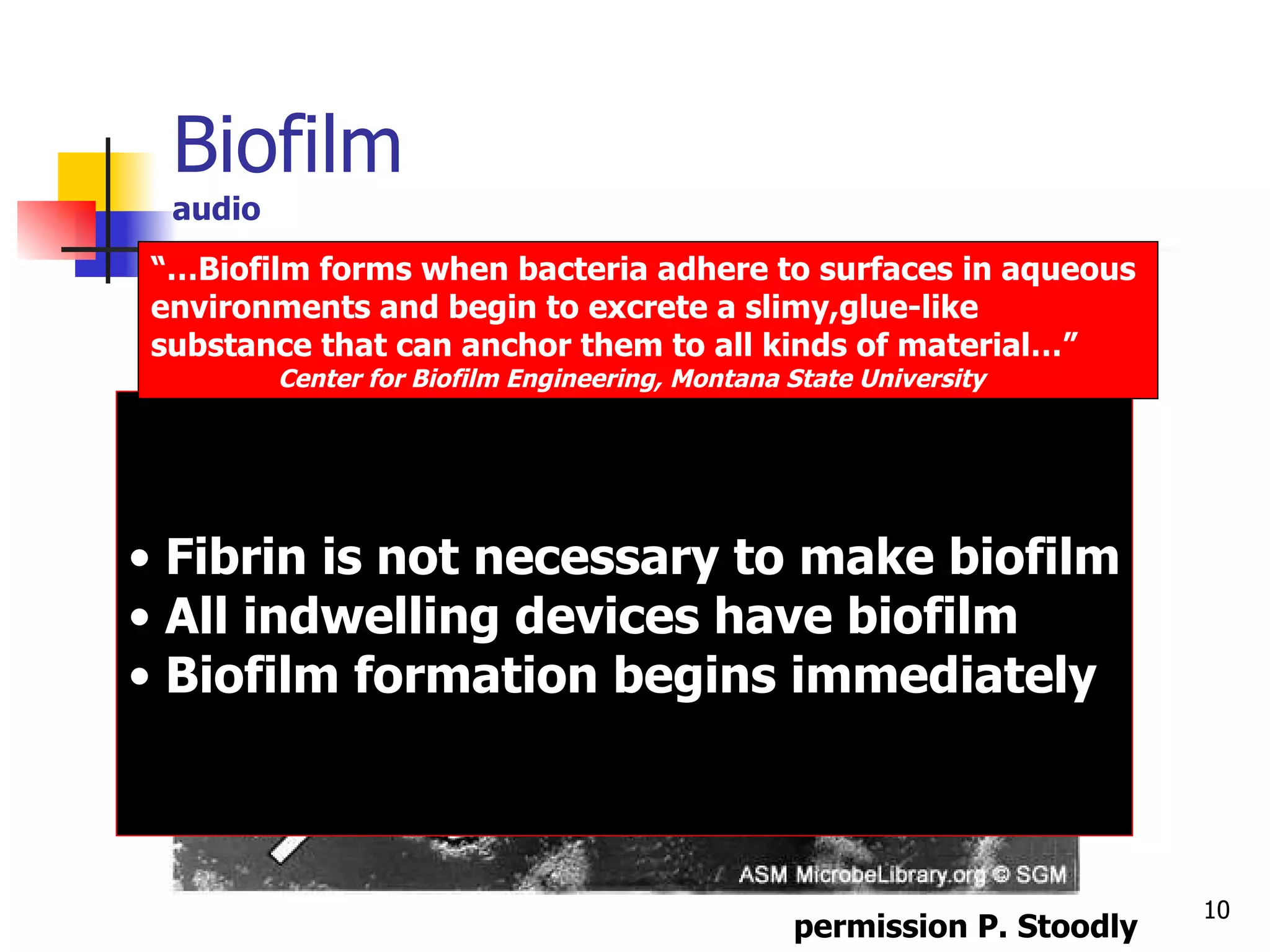
Biofilm audio Fibrin is not necessary to make biofilm All indwelling devices have biofilm Biofilm formation begins immediately “… Biofilm forms when bacteria adhere to surfaces in aqueous  environments and begin to excrete a slimy,glue-like  substance that can anchor them to all kinds of material…”  Center for Biofilm Engineering, Montana State University permission P. Stoodly
Used with permission audio Almost all micro-organisms are embedded in matrices of these complex biofilm communities, or colonies.  Biofilm begins forming on vascular access devices almost immediately upon contact with the patient’s bloodstream.  The biofilm allows the micro-organisms to adhere to any surface, living or nonliving.  Microbial biofilms are responsible for 65% of infections treated in the developed world. The adaptive and genetic changes of the micro-organisms within the biofilm make them resistant to all known antimicrobial agents 1 .  Vascular catheter-related bloodstream infections are the most serious and costly healthcare-associated infections – and the most life threatening.  87% of primary bloodstream infections are associated with an intravascular device 2 . 1 Ryder, Marcia; “Catheter-Related Infections – Its All About Biofilm”; Topics in Advanced Practice Nursing e-Journal. 2005;5(3)  ©Medscape 2 Richards MJ, Edwards JR, Culver DH, Gaynes RP. Nosocomial infections in medical intensive care units in the United States. National Nosocomial Infections Surveillance System. Crit Care Med. 1999;27:887-892 .
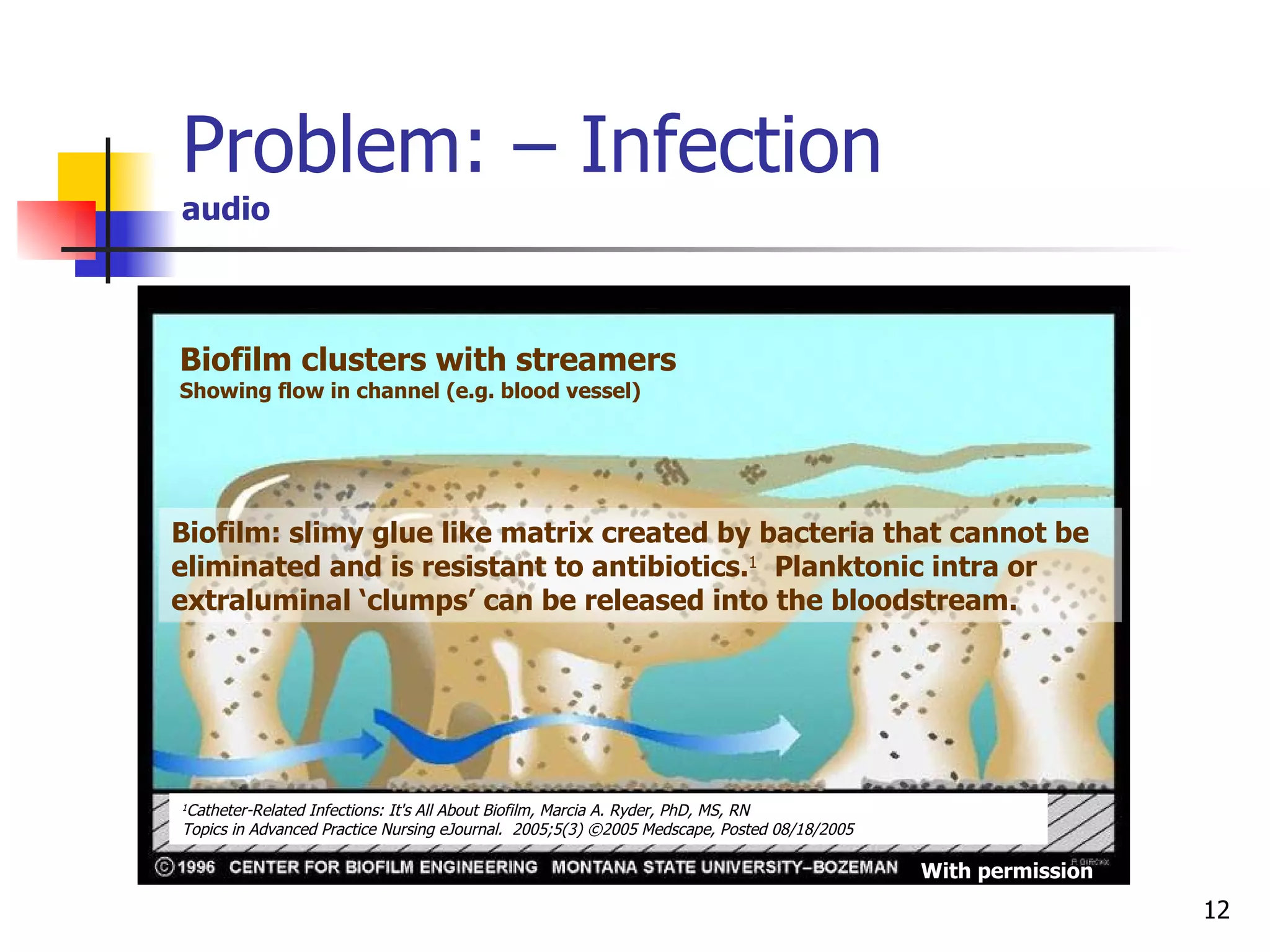
Problem: – Infection audio With permission Biofilm clusters with streamers  Showing flow in channel (e.g. blood vessel) Biofilm: slimy glue like matrix created by bacteria that cannot be eliminated and is resistant to antibiotics. 1   Planktonic intra or extraluminal ‘clumps’ can be released into the bloodstream. 1 Catheter-Related Infections: It's All About Biofilm, Marcia A. Ryder, PhD, MS, RN  Topics in Advanced Practice Nursing eJournal.  2005;5(3) ©2005 Medscape, Posted 08/18/2005
Know your  VAD! (vascular access device) Fade into video
know your  VAD! pretest A non-valved catheter has clamps. T F Vancomycin should be given through a midline. T F A triple lumen subclavian line is considered a   valved catheter. T F
know your  VAD! PICC = ‘Peripherally Inserted  Central  Catheter’ Midline = long  peripheral  catheter Tunneled catheter = long term central catheter that has a portion implanted through a tract created in the tissue Chest groshong, Hickman, Broviac Non-tunneled = short term central catheter Cordis IJ, subclavian line, femoral line Dialysis catheters NOTE WELL:  Dialysis catheters may ONLY be used for infusion with order from Renal Attending/Fellow, and ONLY be accessed by Dialysis RN or IV RN with competency training and assessment.
Know your  VAD! vascular access device audio Where is the catheter tip?  Where is the catheter inserted? Valved or non-valved? Power injectable? Type of needleless connector?
Central: required for administration of many agents/medications PICC tip placement  Non-fluoro PICCs  confirmed by CXR  MUST be verified by an IV RN even attendings may not release these PICCs for use Catheter migration? Consult IV RN  Malpositioned catheters may pose serious risk Staff RN’s: document   length of external catheter. Optimal central catheter tip placement is essential… audio
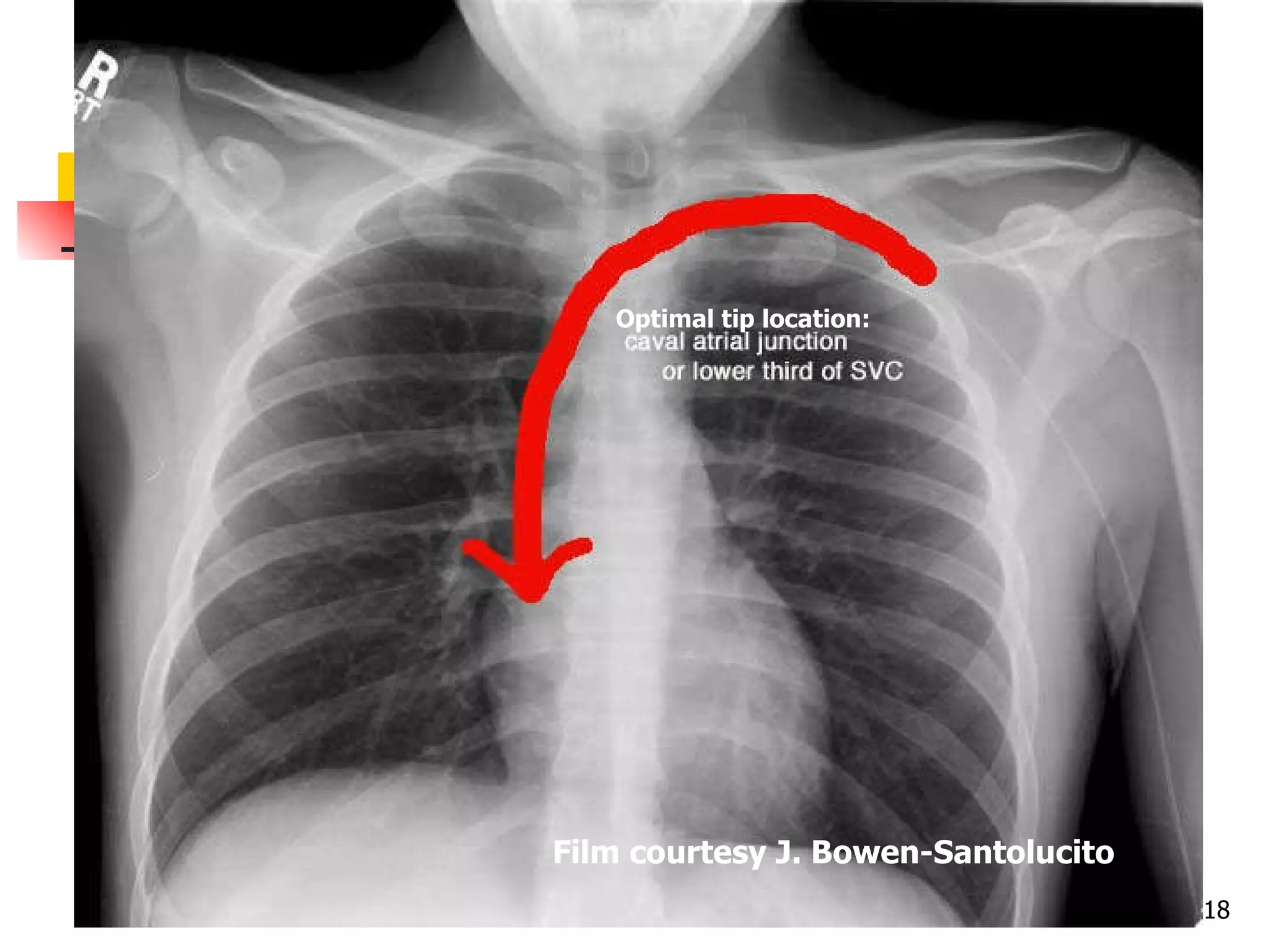
Know your  VAD! vascular access device audio Central: terminates at or near the heart.  Peripheral: short (~1 inch); usually in forearm.  Midline: ~6-8 inches, terminates in upper arm. Where’s the catheter tip? Film courtesy J. Bowen-Santolucito Optimal tip location:
Know your  VAD! vascular access device audio Where is the catheter inserted? Arm Groin Chest Subclavian Neck/Internal or External Jugular Flank  Umbilicus Leg/foot
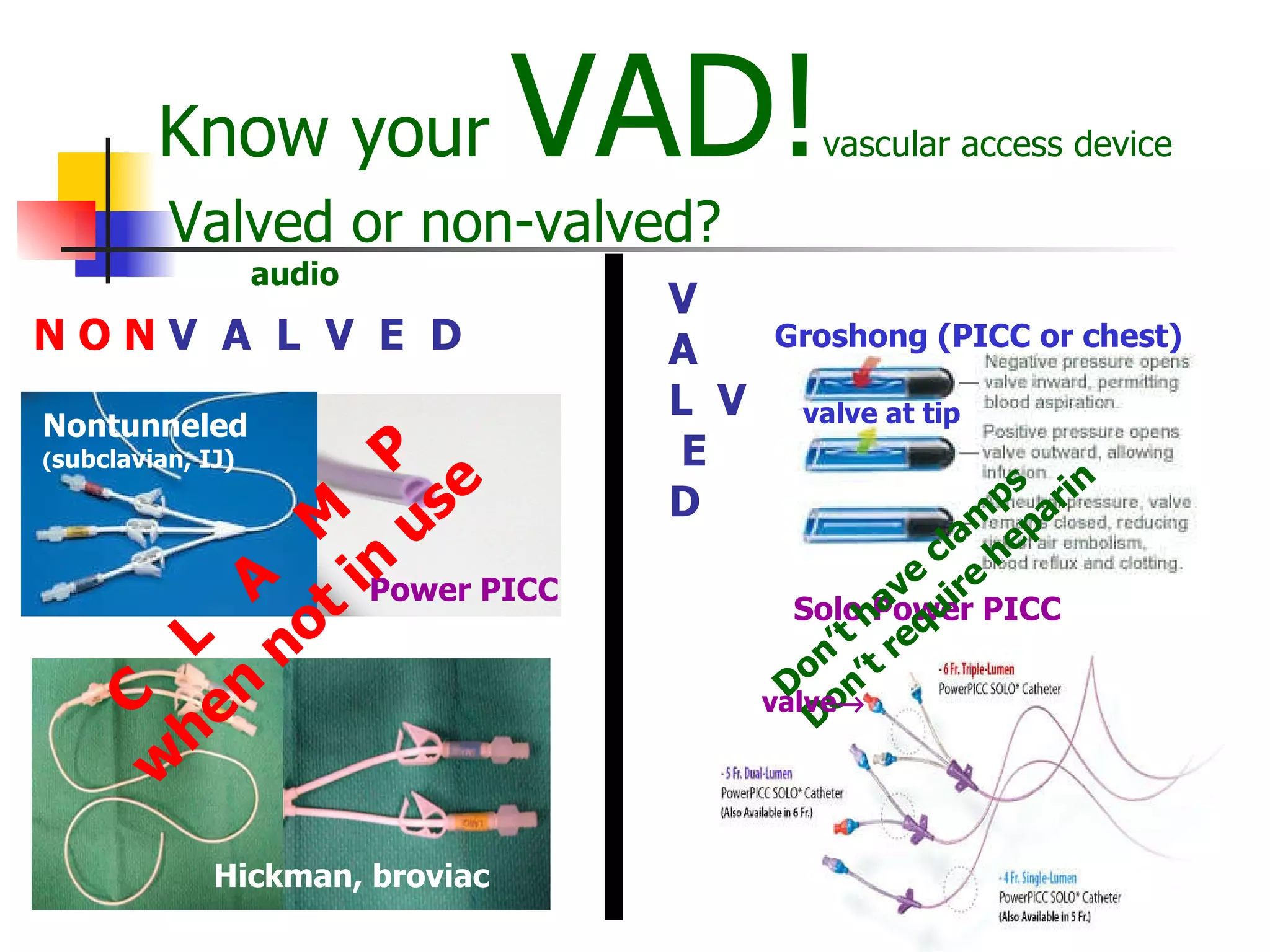
Know your  VAD! vascular access device   Valved or non-valved?    audio Hickman, broviac Power PICC Groshong (PICC or chest) Nontunneled ( subclavian, IJ) Solo Power PICC N O N  V  A  L  V  E  D V  A  L  V  E  D C  L  A  M  P when not in use Don’t have clamps Don’t require heparin valve  valve at tip
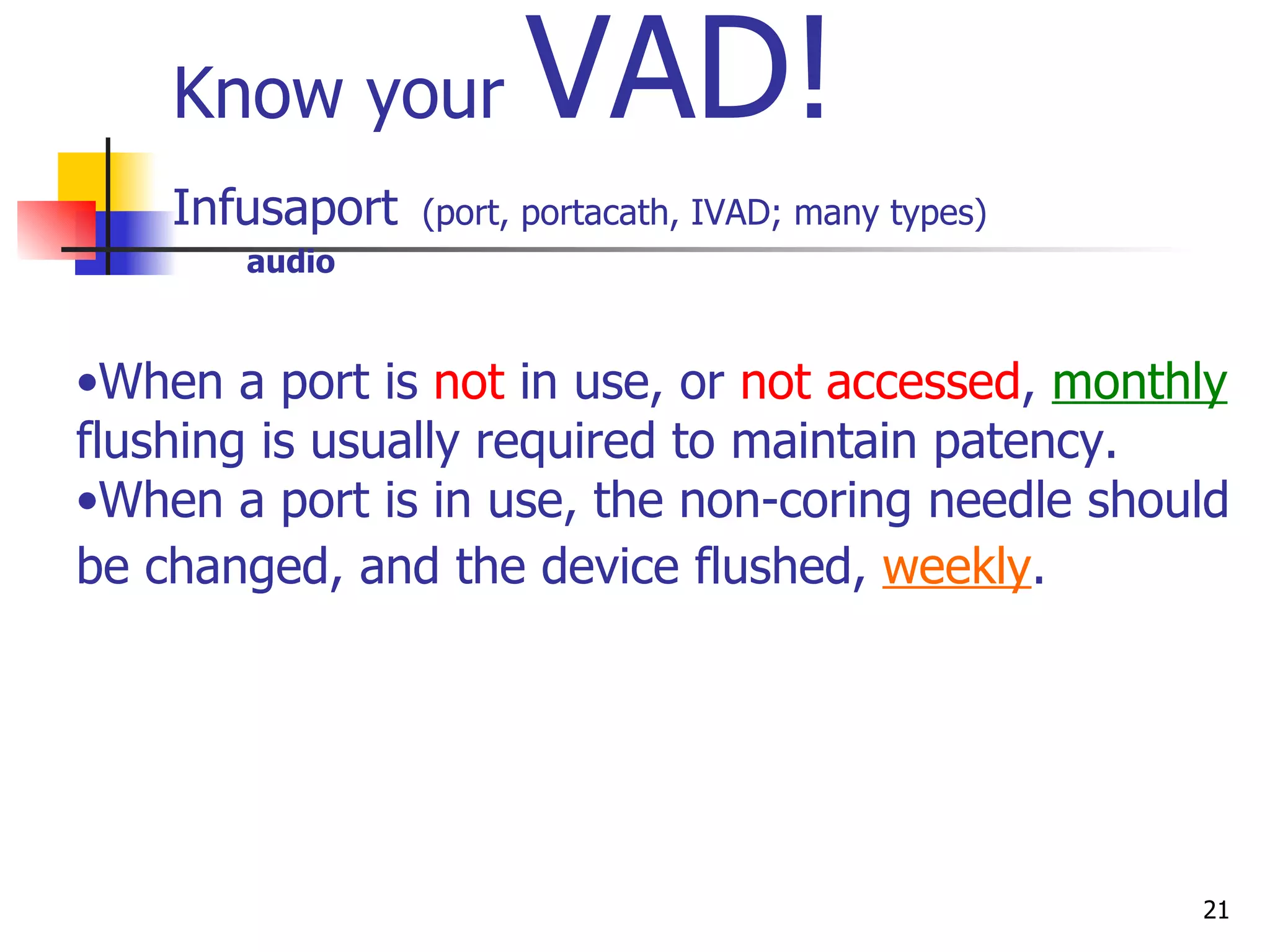
Know your  VAD! Infusaport   (port, portacath, IVAD; many types)   audio Huber needle Device under tissue IV tubing Power Port Power injectable Consider all ports NONvalved unless you know it is Groshong When a port is  not  in use, or  not accessed ,  monthly  flushing is usually required to maintain patency.  When a port is in use, the non-coring needle should be changed, and the device flushed,  weekly .
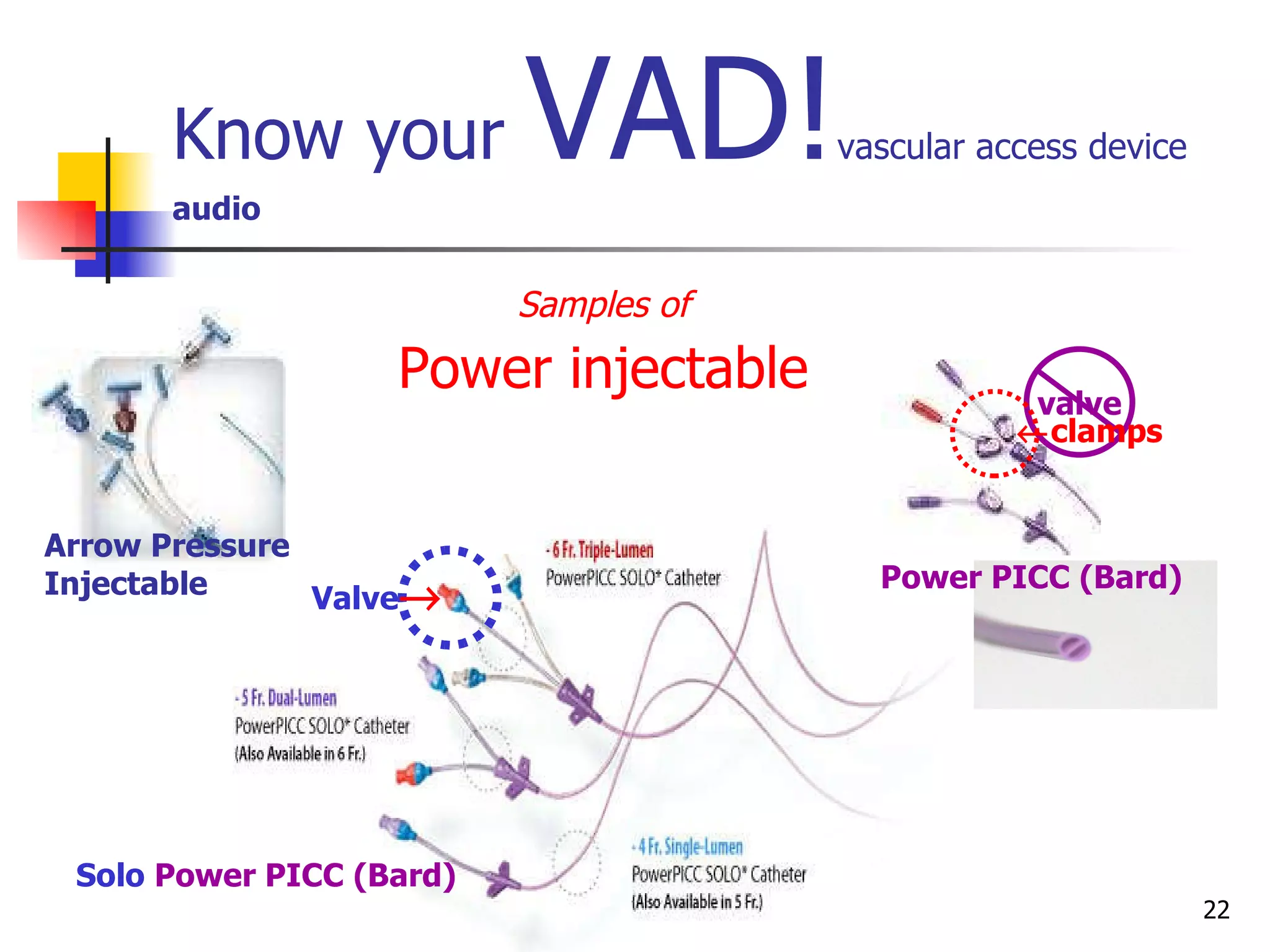
Know your  VAD! vascular access device audio Samples of Power injectable Power PICC (Bard) Solo  Power PICC (Bard) Arrow Pressure Injectable Valve  valve  clamps
Know your  VAD! vascular access device audio Where is the catheter tip?  Where is the catheter inserted? Valved or non-valved? Power injectable? Type of needleless connector?
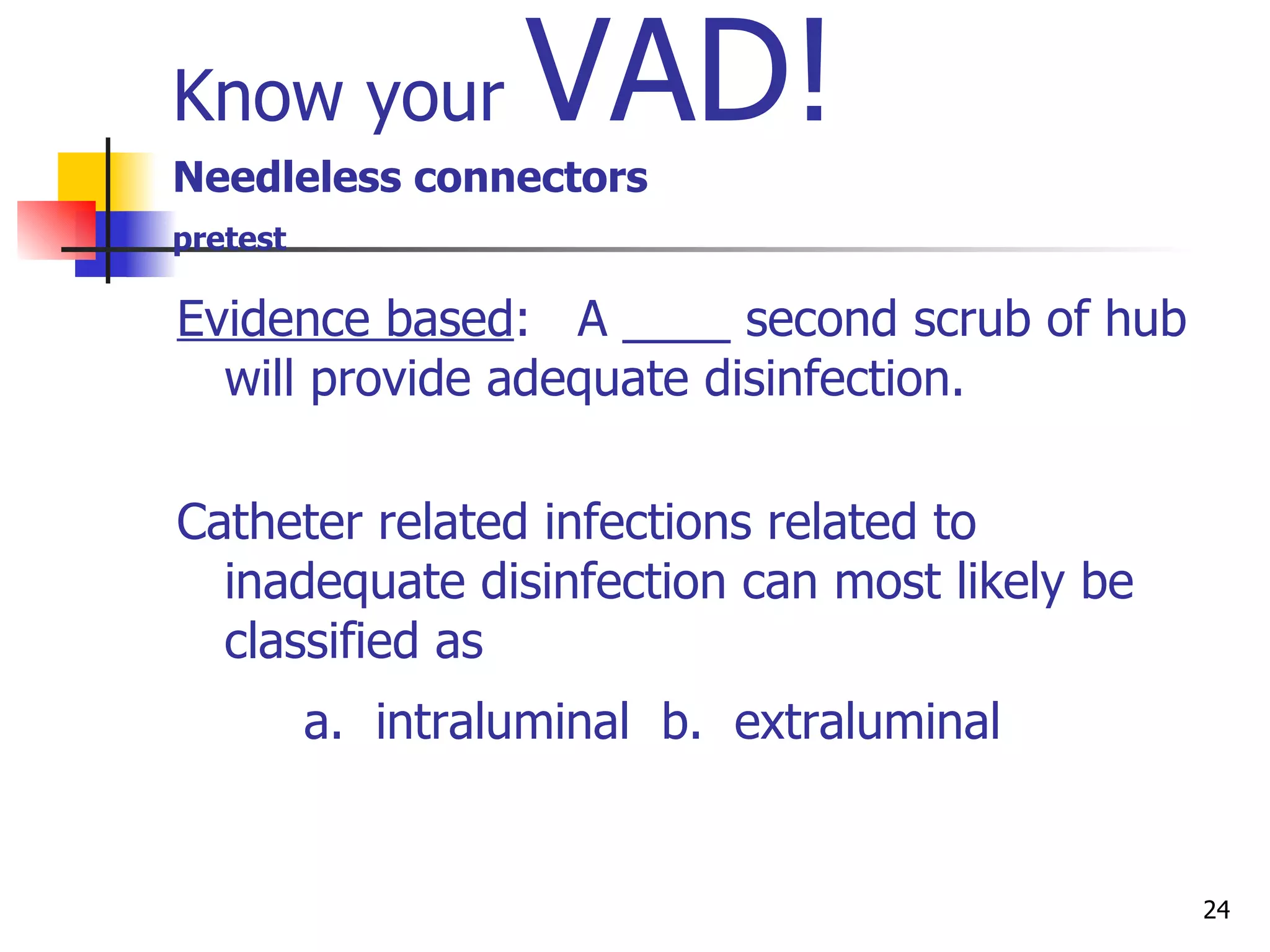
Know your  VAD!   Needleless connectors  pretest   Evidence based :  A ____ second scrub of hub will provide adequate disinfection. Catheter related infections related to inadequate disinfection can most likely be classified as a.  intraluminal  b.  extraluminal
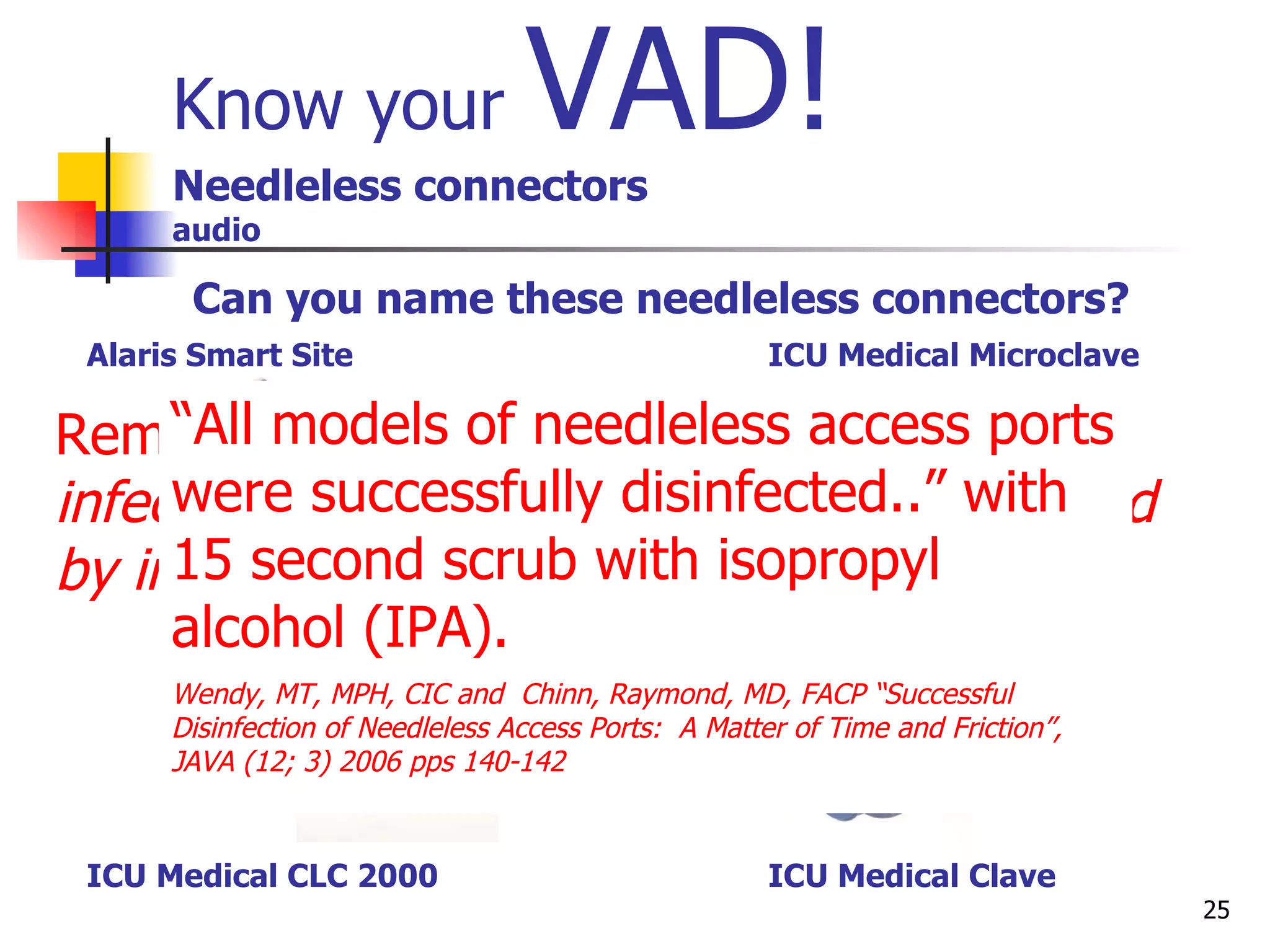
Know your  VAD!   Needleless connectors audio Remember:  A majority of blood stream infections related to central lines are caused by improper care and accessing . Can you name these needleless connectors? “ All models of needleless access ports were successfully disinfected..” with 15 second scrub with isopropyl alcohol (IPA).   Wendy, MT, MPH, CIC and  Chinn, Raymond, MD, FACP “Successful Disinfection of Needleless Access Ports:  A Matter of Time and Friction”, JAVA (12; 3) 2006 pps 140-142 Alaris Smart Site    ICU Medical Microclave ICU Medical CLC 2000   ICU Medical Clave
Which line for what? Some vascular access devices can be used for  any  infusion therapy Some infusion therapies are contraindicated via certain vascular access devices Usually because of risk to patient’s tissue Clinicians must know the difference, and are legally liable
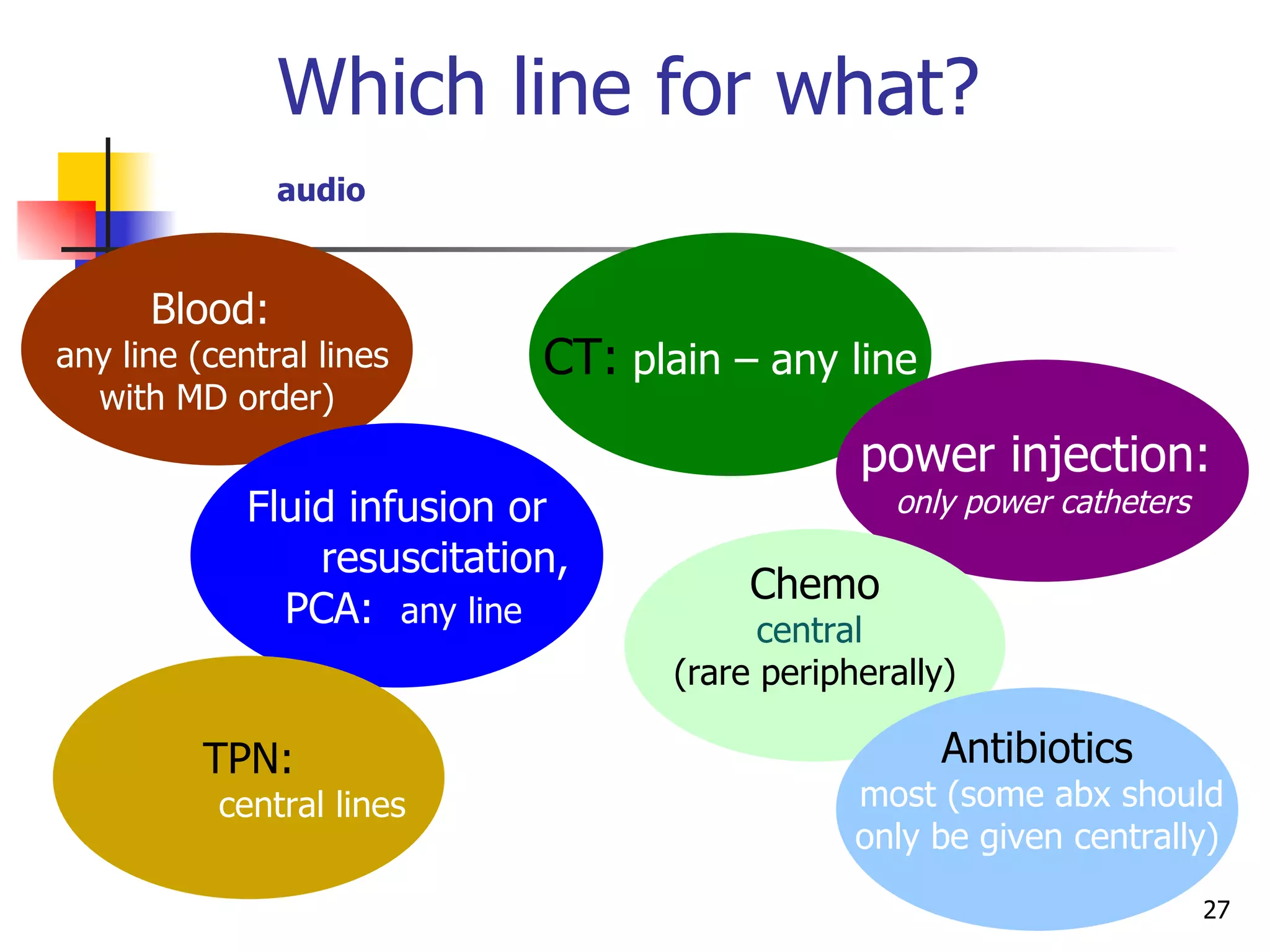
Which line for what? audio   CT:   plain – any line power injection:   only power catheters Chemo central  (rare peripherally) Antibiotics most (some abx should  only be given centrally) Blood:  any line (central lines  with MD order) Fluid infusion or resuscitation,   PCA:  any line TPN: central lines
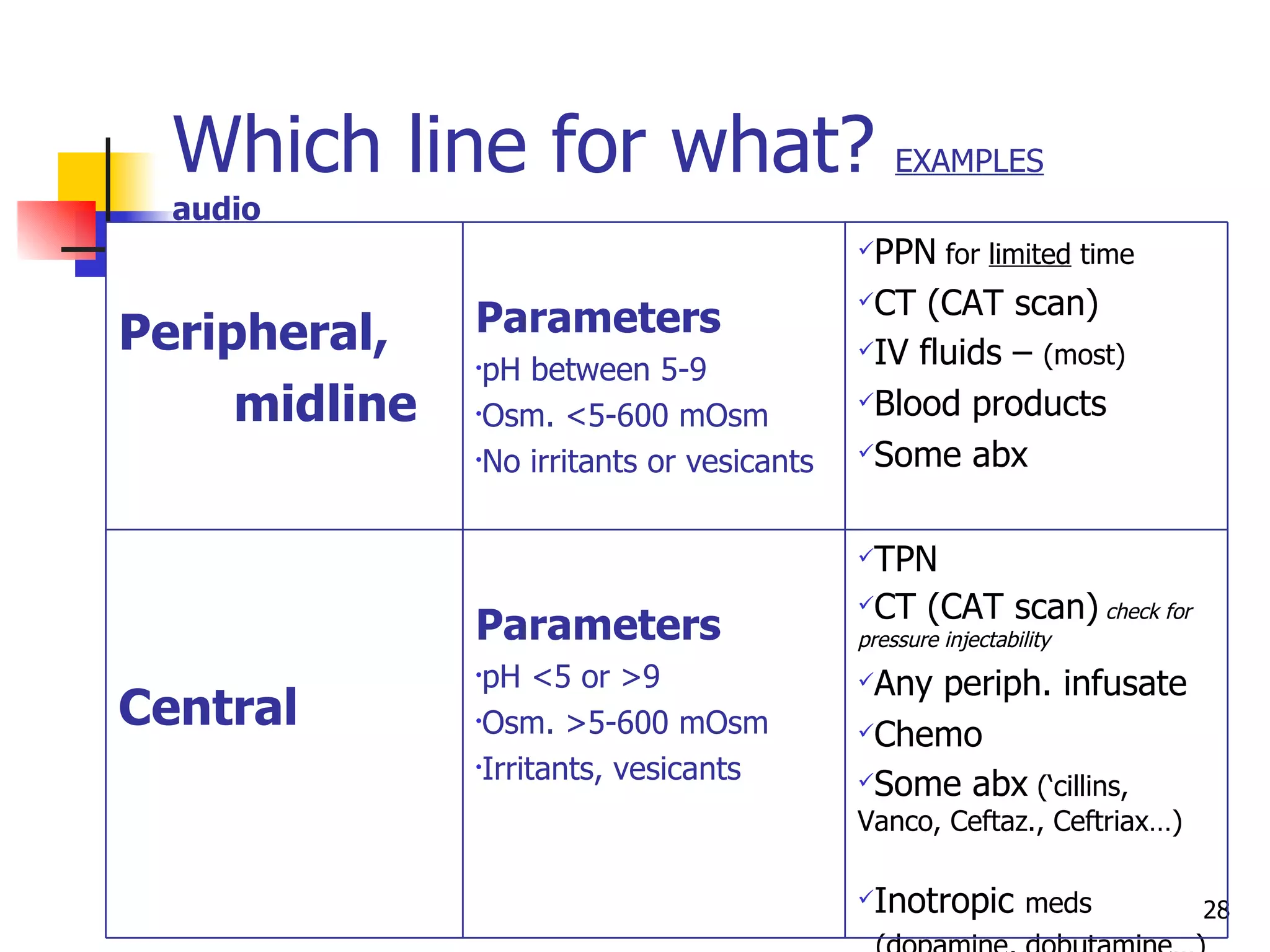
Which line for what?   EXAMPLES   audio Parameters pH <5 or >9 Osm. >5-600 mOsm Irritants, vesicants Parameters pH between 5-9 Osm. <5-600 mOsm No irritants or vesicants TPN CT (CAT scan)  check for pressure injectability Any periph. infusate Chemo Some abx  (‘cillins, Vanco, Ceftaz., Ceftriax…)  Inotropic  meds (dopamine, dobutamine…) Central   PPN  for  limited  time CT (CAT scan) IV fluids –  (most) Blood products Some abx Peripheral, midline
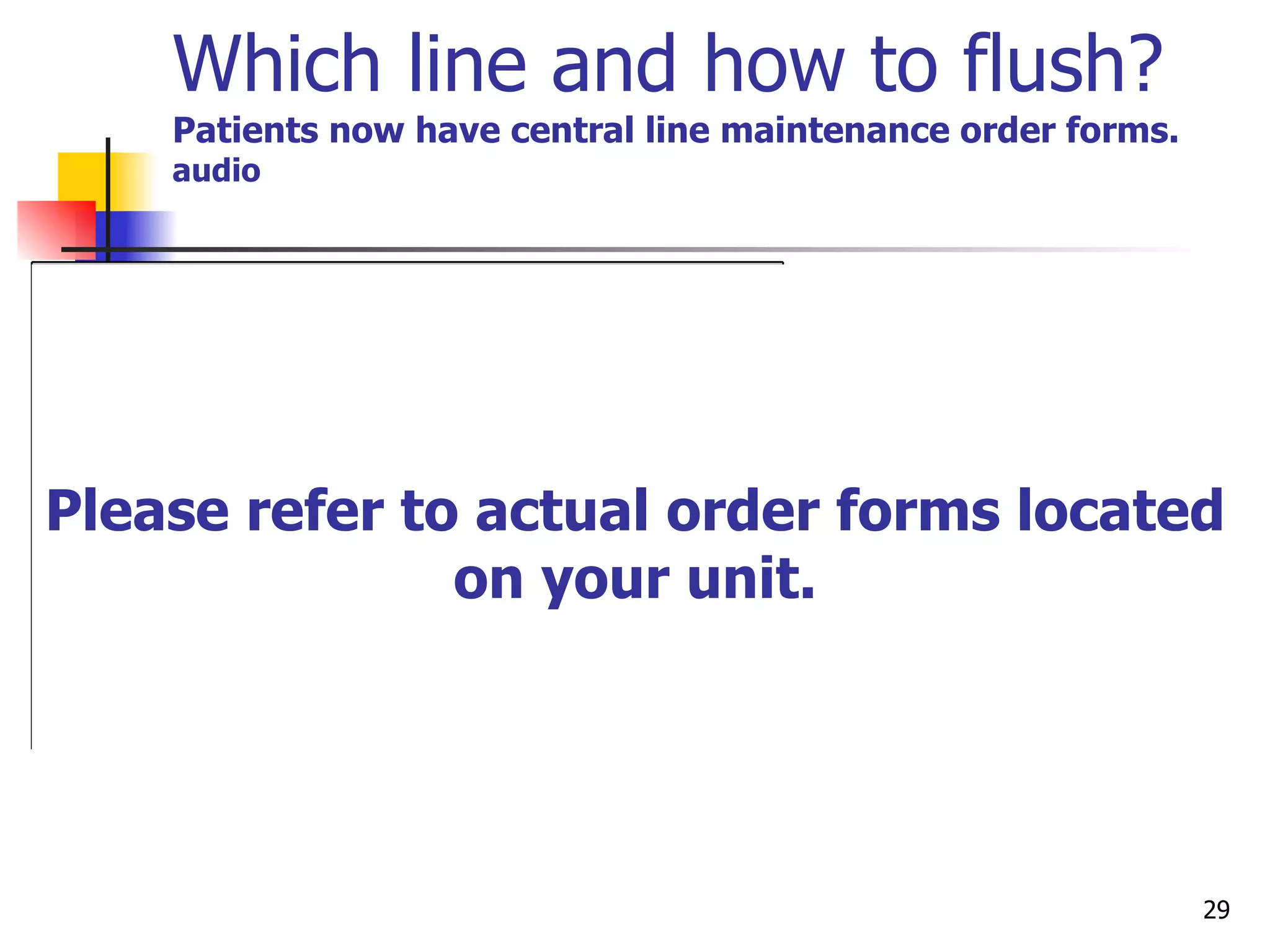
Which line and how to flush? Patients now have central line maintenance order forms.   audio   Please refer to actual order forms located on your unit. 10 unit/ml 2.5-3ml after sodium chloride flush 100 unit/ml 5ml in chest port after sodium chloride flush NA N/A  Heparin Flush All Lumens 10 ml before and after each dose 20ml after blood draw 10 ml every twelve hours if not in use 10 ml before and after each dose  20 ml after blood draw 10 ml monthly if not accessed 10 ml every twelve hours if accessed 10 ml before and after each dose 20 ml after blood draw 10ml monthly if not accessed 10 ml daily if accessed 10 ml before and after each dose 20 ml after blood draw 10 ml every week if not in use Sodium Chloride 0.9%  Flush All Lumens Power PICC, Hickman, Broviac, Mid-line, Per Q Cath Chest Port Groshong Chest Port  Groshong, Vaxcel, Solo PICC,  Mid-line  Catheter Non-Valved Catheters Valved Catheters ADULT   Line Maintenance -adults Less Than 10 kg 10 unit/ml  5 ml daily after Sodium Chloride flush 10 units/ml  2.5 to 3 ml daily after Sodium Chloride flush for Broviac and Hickman only.  Power PICC every 12 hrs Greater Than 10 kg 100 unit/ml  5 ml daily after Sodium Chloride flush  NA NA  Heparin Flush All Lumens Note: < 5kg, use preservative free Heparin 5 ml before and after each dose 10 ml after blood draw 5 ml every twelve hours if not in use 5 ml once a month if not accessed 5 ml every 12 hours if accessed 5 ml before and after each dose  10 ml after blood draw   5 ml once a month if not accessed 5 ml daily if accessed 5 ml before and after each dose 10 ml after blood draw 5 ml Weekly if not in used 5 ml before and after each dose  10 ml  after blood draw Sodium Chloride 0.9%  Flush All Lumens Broviac,  Hickman Power PICC Chest Port Groshong Chest Port Groshong, Vaxcel, Solo PICC, Midline C. Catheter Non-Valved Catheters Valved Catheters PEDI  Line Maintenance Heparin weight based use adult sheet if over 30 /kg
Problem Solving Central Lines Occlusion Emboli Extravasation/Infiltration Phlebitis Infection
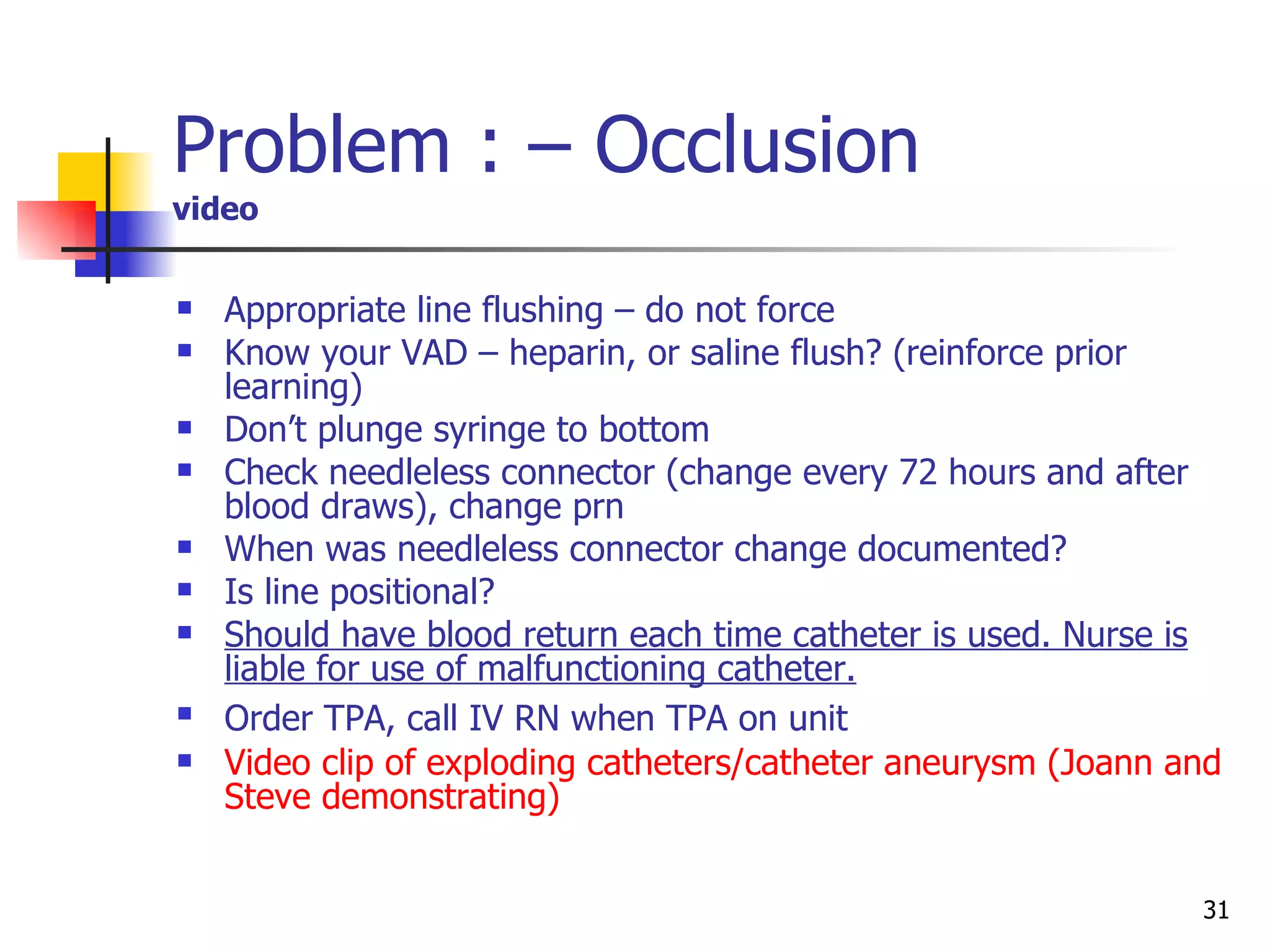
Problem : – Occlusion video Appropriate line flushing – do not force Know your VAD – heparin, or saline flush? (reinforce prior learning) Don’t plunge syringe to bottom Check needleless connector (change every 72 hours and after blood draws), change prn When was needleless connector change documented? Is line positional? Should have blood return each time catheter is used. Nurse is liable for use of malfunctioning catheter. Order TPA, call IV RN when TPA on unit   Video clip of exploding catheters/catheter aneurysm (Joann and Steve demonstrating)
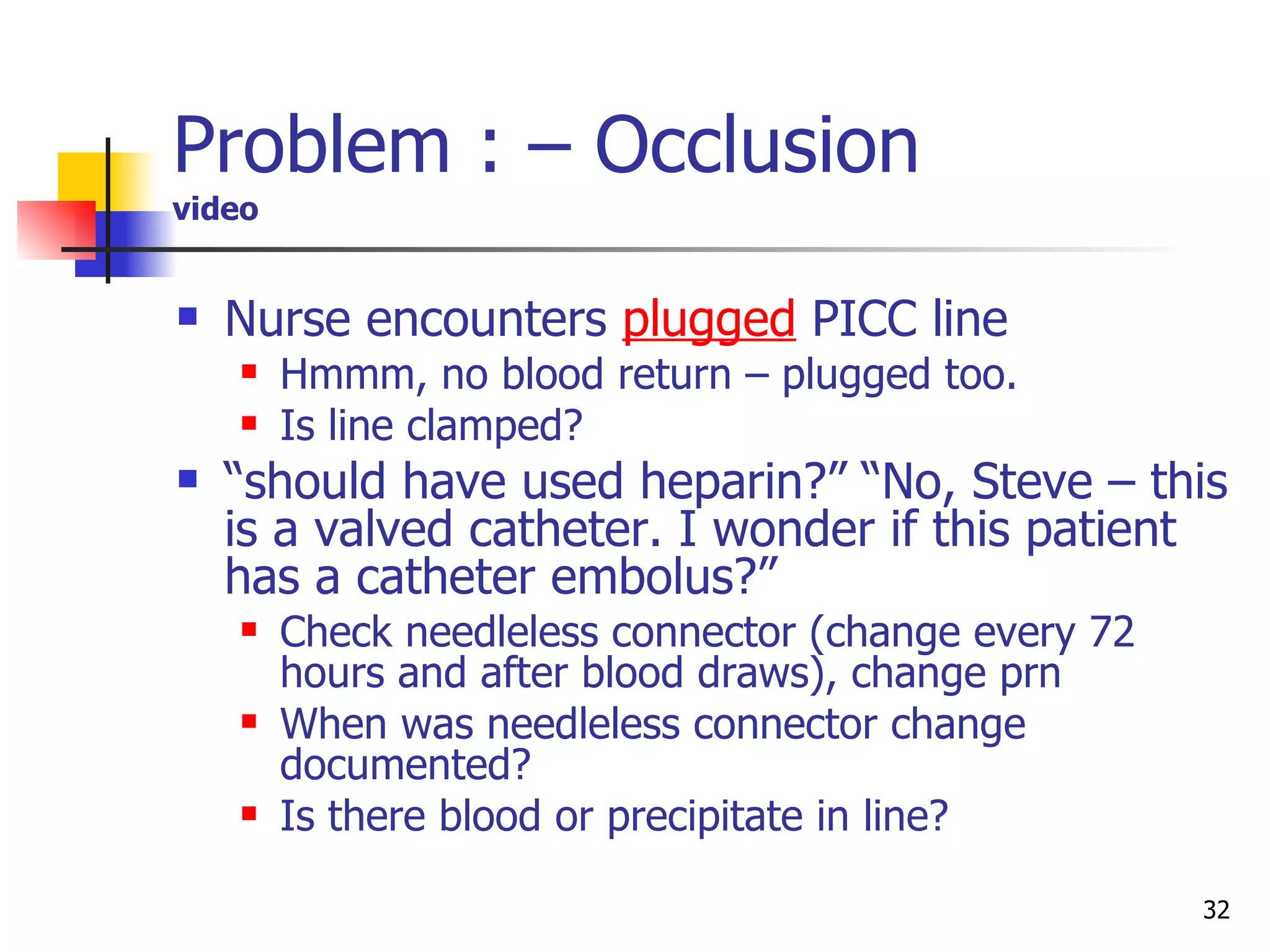
Problem : – Occlusion video Nurse encounters  plugged  PICC line Hmmm, no blood return – plugged too. Is line clamped? “ should have used heparin?” “No, Steve – this is a valved catheter. I wonder if this patient has a catheter embolus?” Check needleless connector (change every 72 hours and after blood draws), change prn When was needleless connector change documented? Is there blood or precipitate in line?
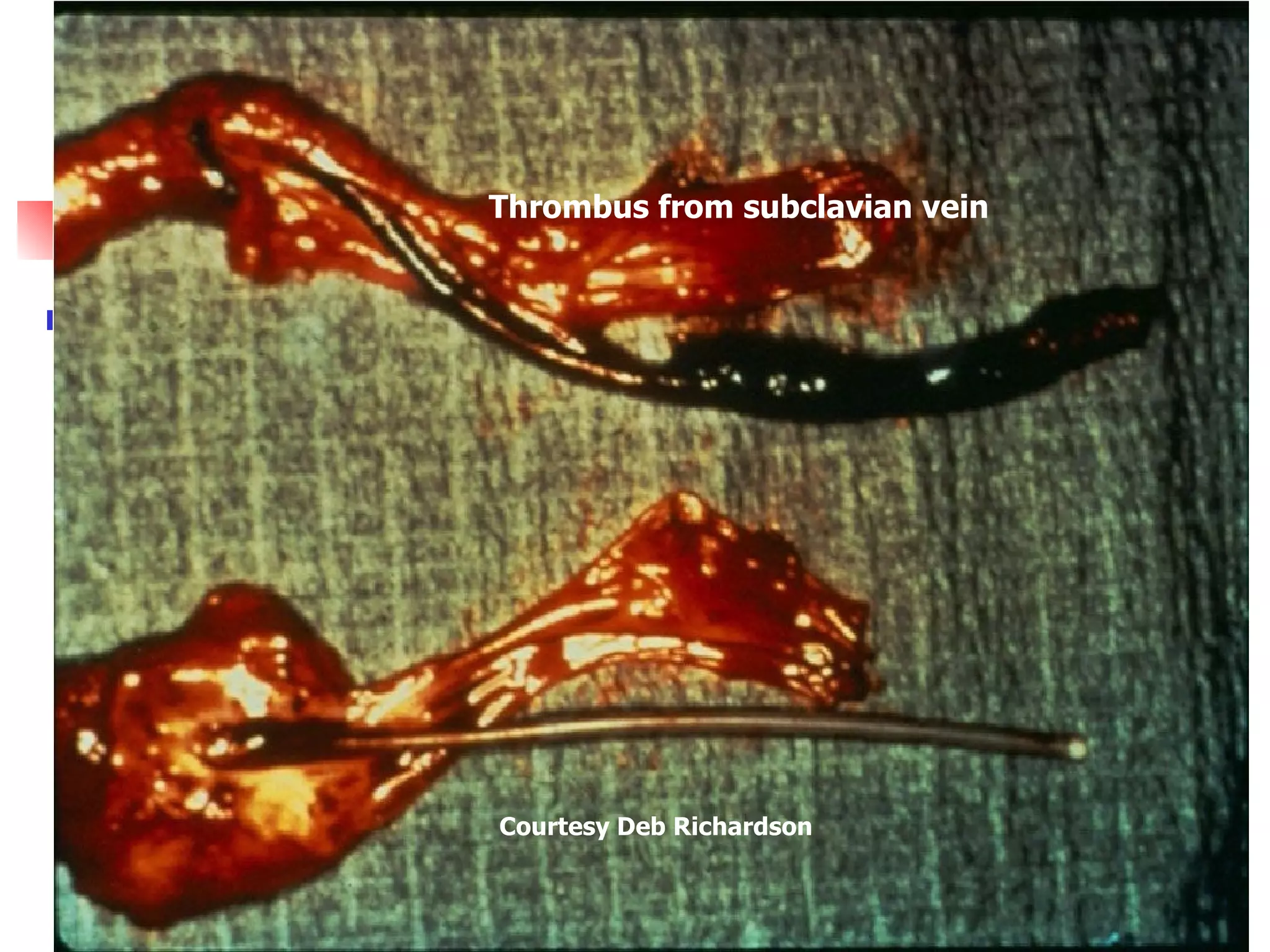
Problem: Emboli audio   Different types of emboli Air  Catheter Wire  Thromboembolus  What is wrong with this picture? No connectors = potential air embolus What is wrong with this picture? Torn catheter = potential catheter embolus  Catheter tip Stylet (wire) Thrombus from subclavian vein Courtesy Deb Richardson
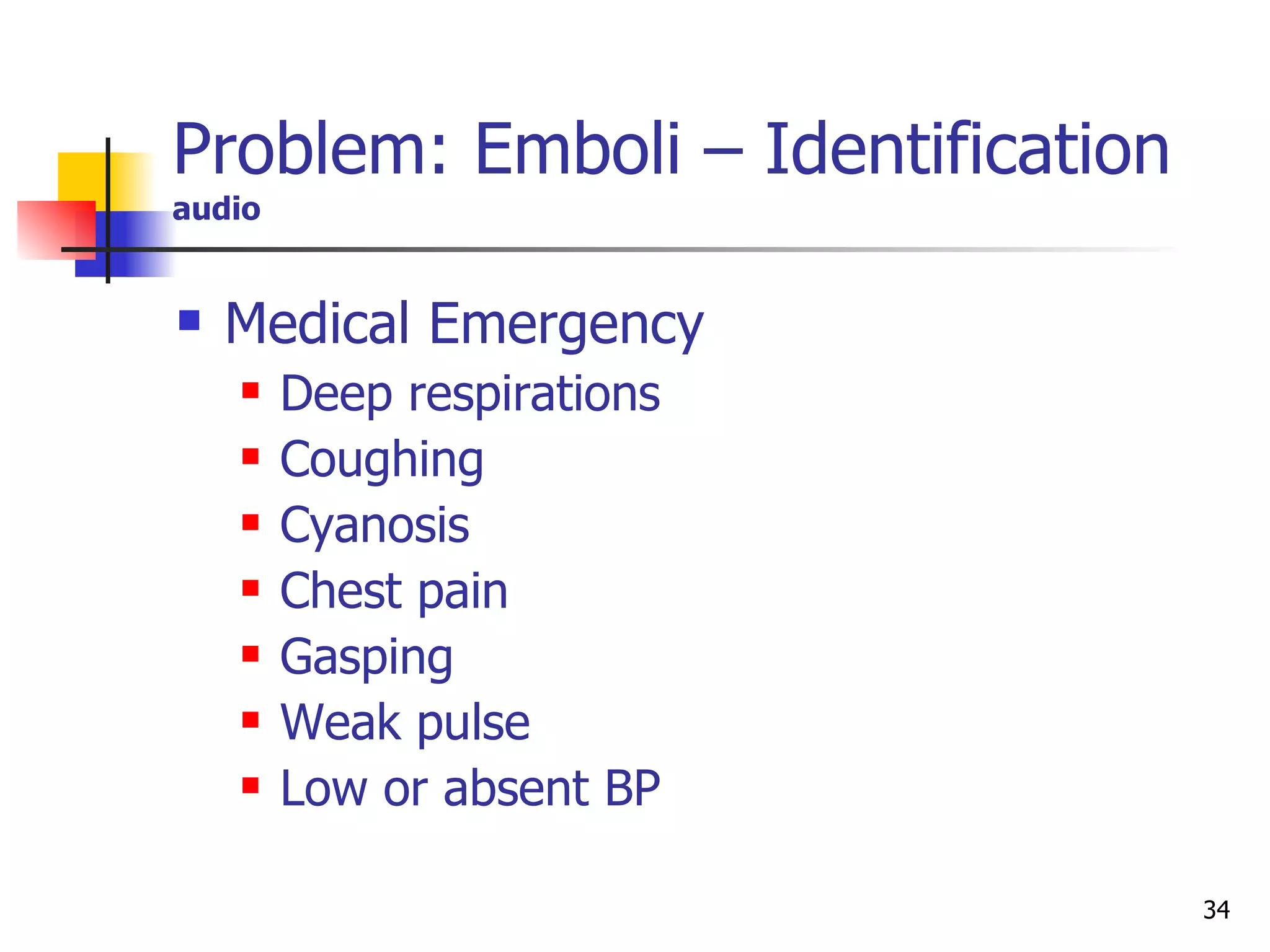
Problem: Emboli – Identification audio Medical Emergency Deep respirations Coughing Cyanosis Chest pain Gasping Weak pulse Low or absent BP
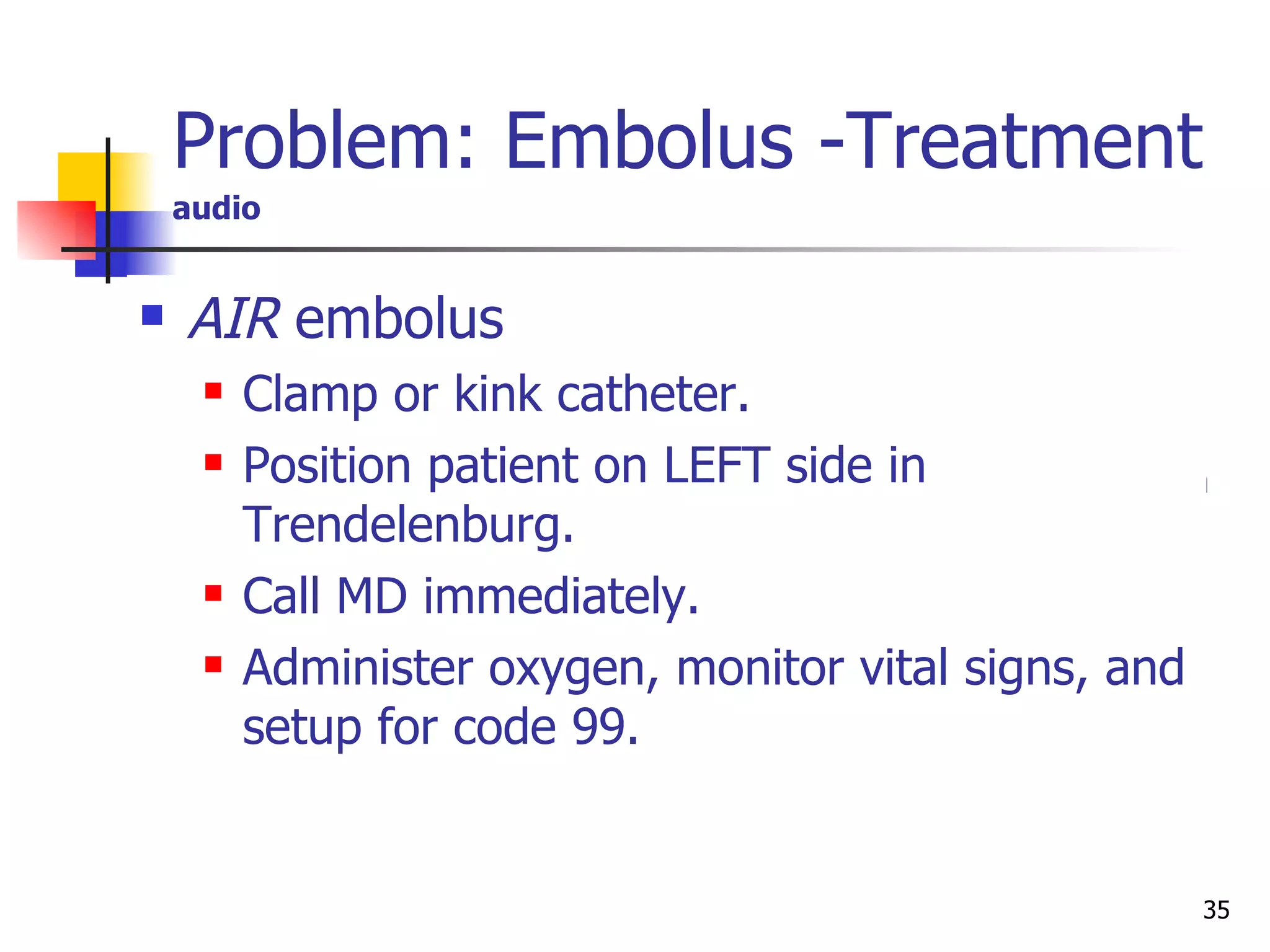
Problem: Embolus -Treatment   audio  CATHETER  embolus (catheter fragment in bloodstream):   THIS IS CONSIDERED A MEDICAL EMERGENCY:  Immediate medical intervention is warranted.  Implement strict bed rest. Immediately apply tourniquet PROXIMAL to the site to retain the fragment in the arm. Obstruct venous, not arterial flow. Assess pulses distal to tourniquet every 15 minutes. Initiate oxygen therapy. Notify physician, contact Interventional Radiology to prepare for emergent procedure. Monitor vital signs. Ensure patient has adequate peripheral IV access. Only MD should remove tourniquet. AIR  embolus Clamp or kink catheter. Position patient on LEFT side in Trendelenburg. Call MD immediately. Administer oxygen, monitor vital signs, and setup for code 99.
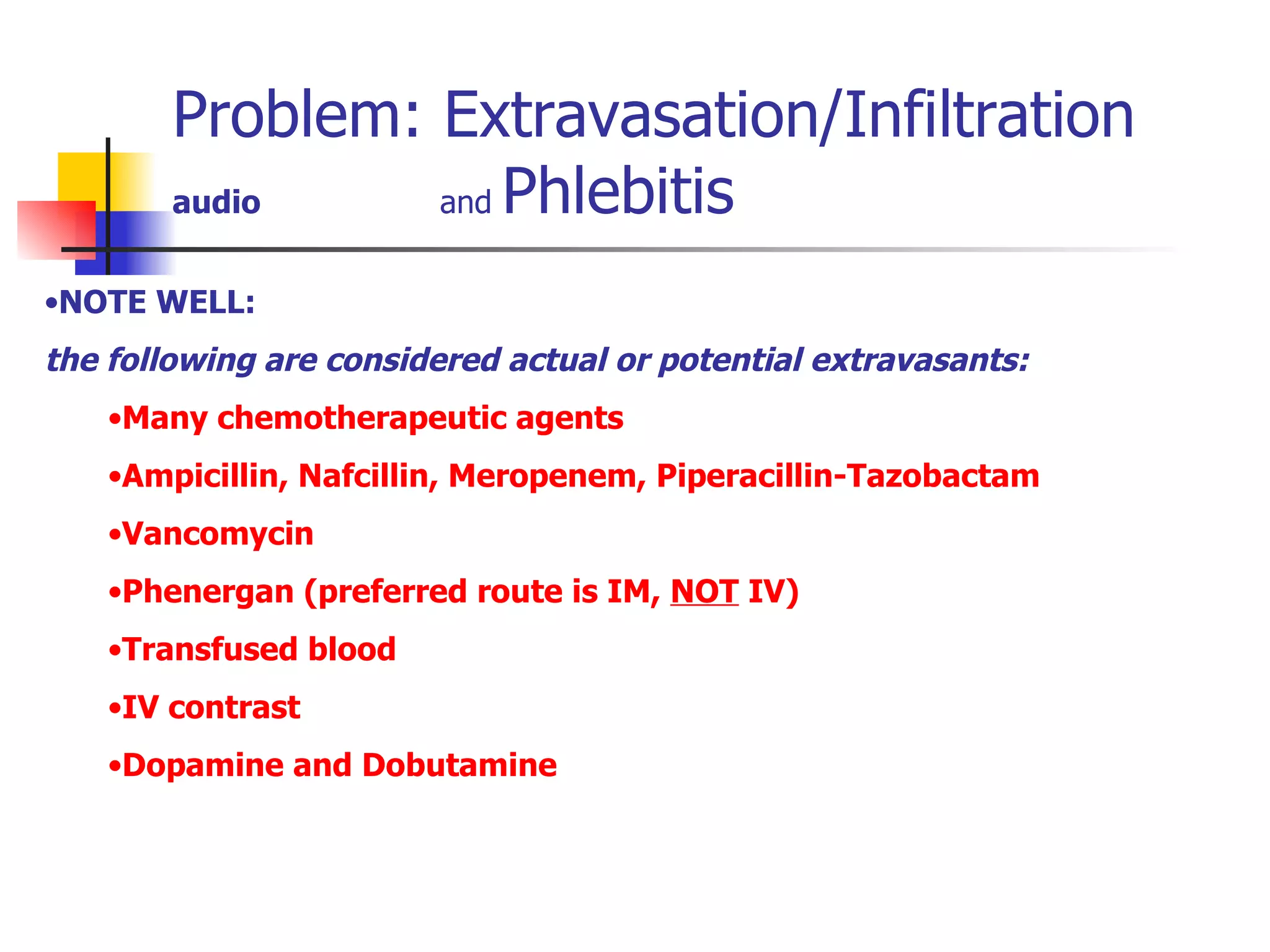
Problem: Extravasation/Infiltration audio   and  Phlebitis Refer to NGP 117 Extravasation Photos courtesy Lorelle Wuerz, RN Dilantin extravasation Gross infiltration NOTE WELL:  the following are considered actual or potential extravasants: Many chemotherapeutic agents Ampicillin, Nafcillin, Meropenem, Piperacillin-Tazobactam Vancomycin Phenergan (preferred route is IM,  NOT  IV) Transfused blood IV contrast Dopamine and Dobutamine
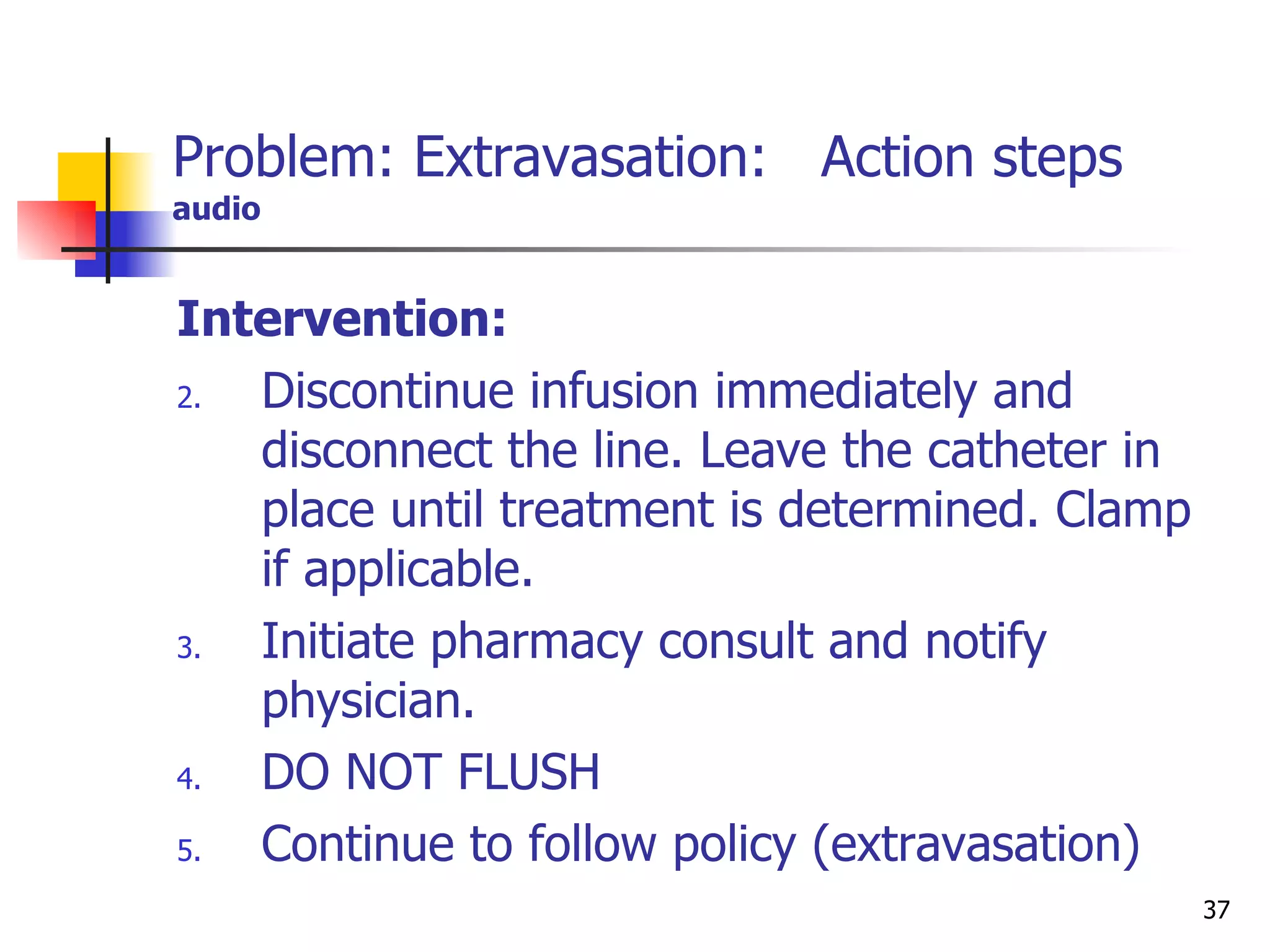
Problem: Extravasation:  Action steps audio Intervention: Discontinue infusion immediately and disconnect the line. Leave the catheter in place until treatment is determined. Clamp if applicable. Initiate pharmacy consult and notify physician. DO NOT FLUSH Continue to follow policy (extravasation)
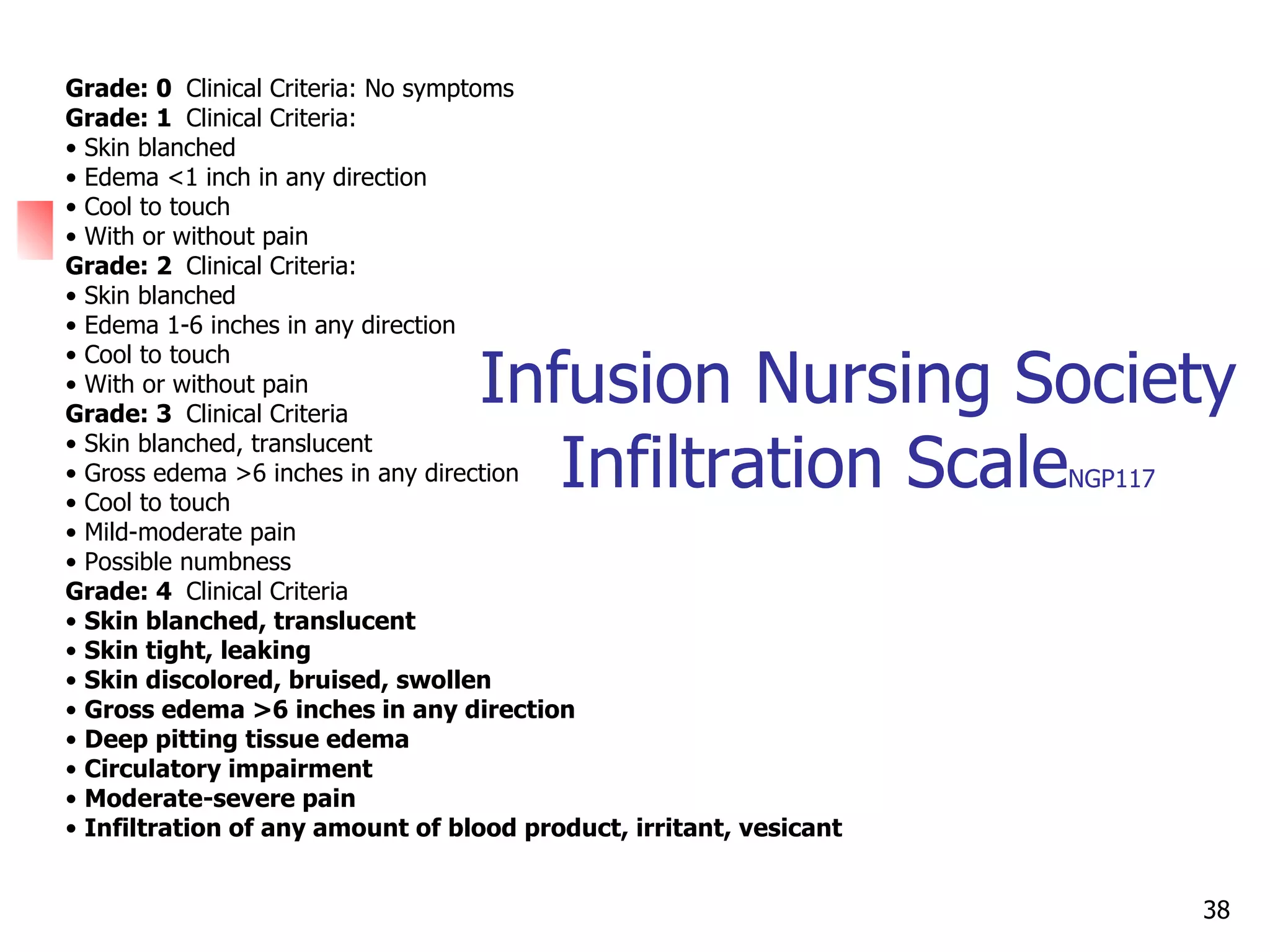
Problem: Extravasation/Infiltration Grade: 0  Clinical Criteria: No symptoms Grade: 1  Clinical Criteria: •  Skin blanched •  Edema <1 inch in any direction •  Cool to touch •  With or without pain Grade: 2  Clinical Criteria: •  Skin blanched •  Edema 1-6 inches in any direction •  Cool to touch •  With or without pain Grade: 3  Clinical Criteria •  Skin blanched, translucent •  Gross edema >6 inches in any direction •  Cool to touch •  Mild-moderate pain •  Possible numbness Grade: 4  Clinical Criteria •  Skin blanched, translucent •  Skin tight, leaking •  Skin discolored, bruised, swollen •  Gross edema >6 inches in any direction •  Deep pitting tissue edema •  Circulatory impairment •  Moderate-severe pain •  Infiltration of any amount of blood product, irritant, vesicant Infusion Nursing Society Infiltration Scale NGP117
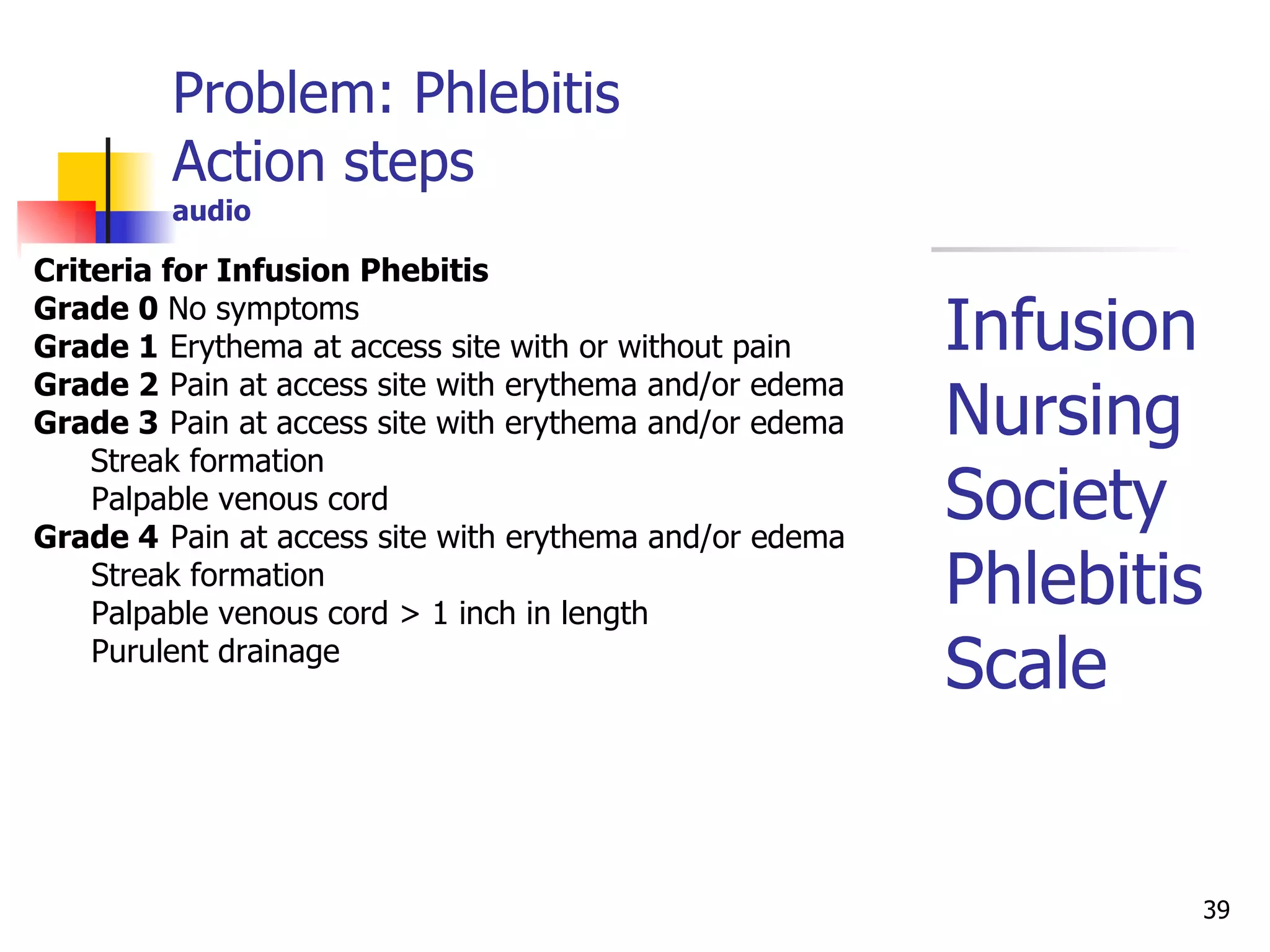
Problem: Phlebitis  Action steps audio Peripheral lines:  Stop infusion. Remove line immediately. Central lines: Stop infusion. Contact MD/IV Therapy. Document well. Criteria for Infusion Phebitis Grade 0  No symptoms Grade 1   Erythema at access site with or without pain Grade 2   Pain at access site with erythema and/or edema Grade 3   Pain at access site with erythema and/or edema   Streak formation   Palpable venous cord Grade 4  Pain at access site with erythema and/or edema   Streak formation   Palpable venous cord > 1 inch in length   Purulent drainage Infusion Nursing Society Phlebitis Scale
Problem: Infection
Problem : Infection  pretest If the nurse touches any pt. object after she performed hand hygiene, she must repeat hand hygiene immediately prior to handling vascular access devices. T F FAHC performs hand hygiene audits every __________________.
Infection: The Impact audio A Mother’s Letter to a Hospital CEO   http://safecarecampaign.org/index.html  hyperlink this.. Our son died in your hospital 7 days ago. He died from a bacterial infection he caught there as a result of his medical care while being treated for something else. It created so much pressure around his brain that it caused part of it to be pushed into his spinal column, leaving him a helpless ventilator-dependent quadriplegic and ending his short but unforgettable life among us all…….
……… ..Dear CEO, I hope you read this letter to your team aloud. Tell your board that we do not want anything for the loss of our dear son but a dramatic and effective plan for change that will make a difference for others who trust healthcare in general and your hospital specifically. We look to you to partner with us as patients and caregivers so that we may all be safe and well, both now, and in the future. Sincerely, Victoria Nahum audio
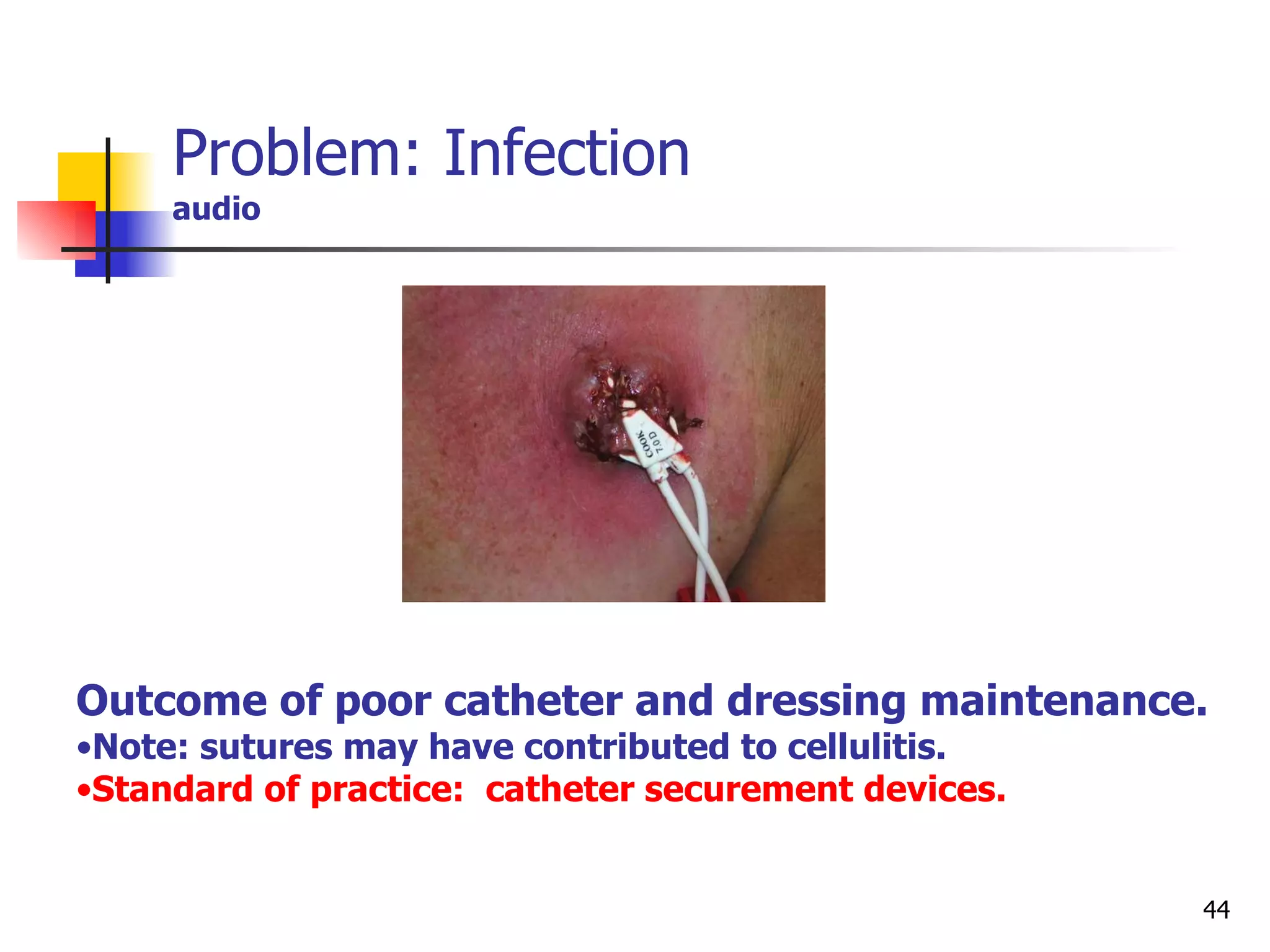
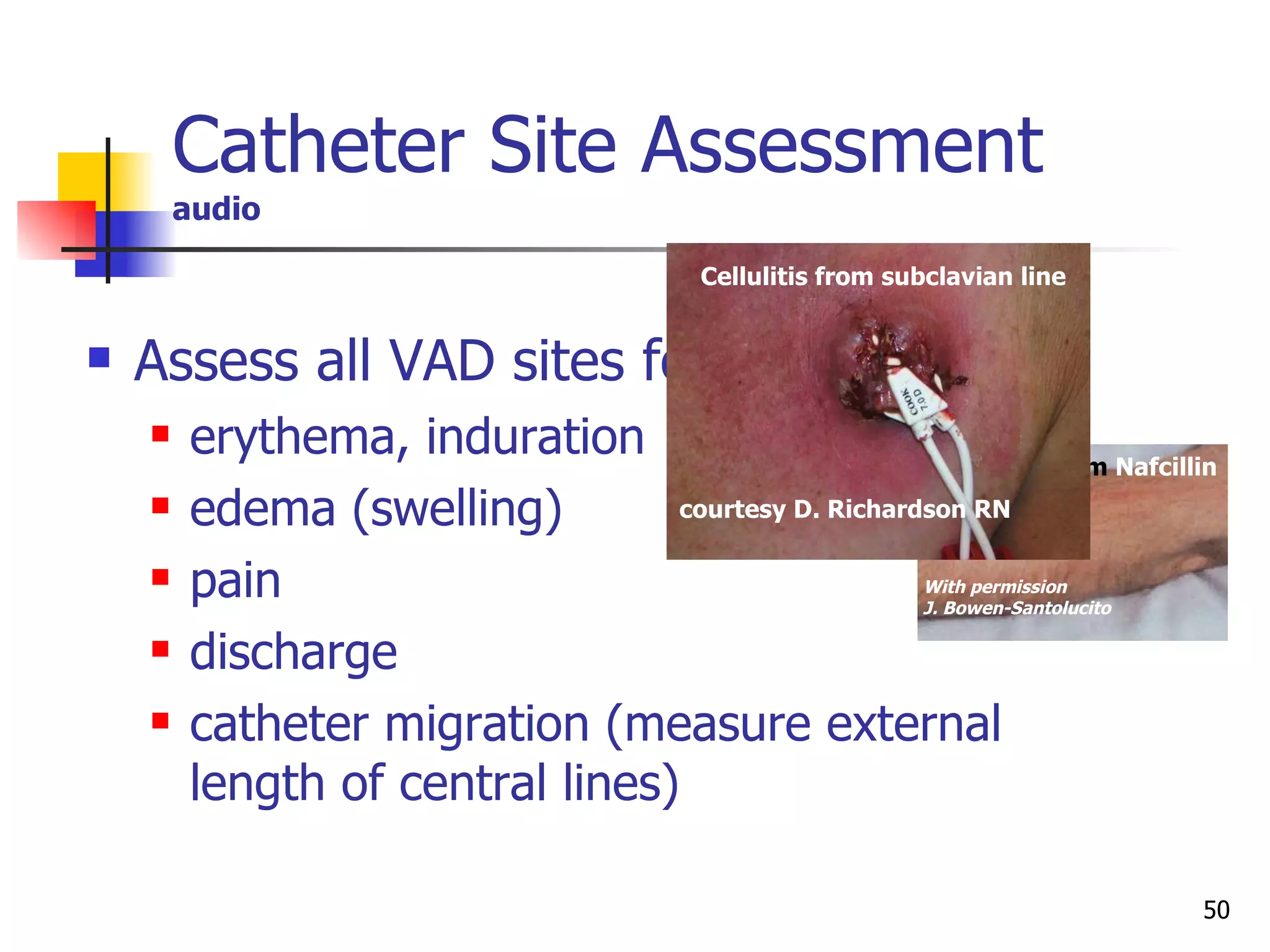
Problem: Infection audio Outcome of poor catheter and dressing maintenance. Note: sutures may have contributed to cellulitis.  Standard of practice:  catheter securement devices.
Infection: factors audio Use of contaminated administration sets, solutions, or medications Contamination of catheter needleless connector Catheter insertion technique Site of insertion Use of multiple lumen catheters Migration of organisms from insertion site Thrombosis, fibrin, biofilm, and catheter occlusions
Problem : – Infection –  Disinfection of needleless connector video 1 show proper disinfection technique 2 show proper connector change technique
Integration (fade into video narration) how you practice. Transform  into what you know
Catheter Site Assessment Fade into video
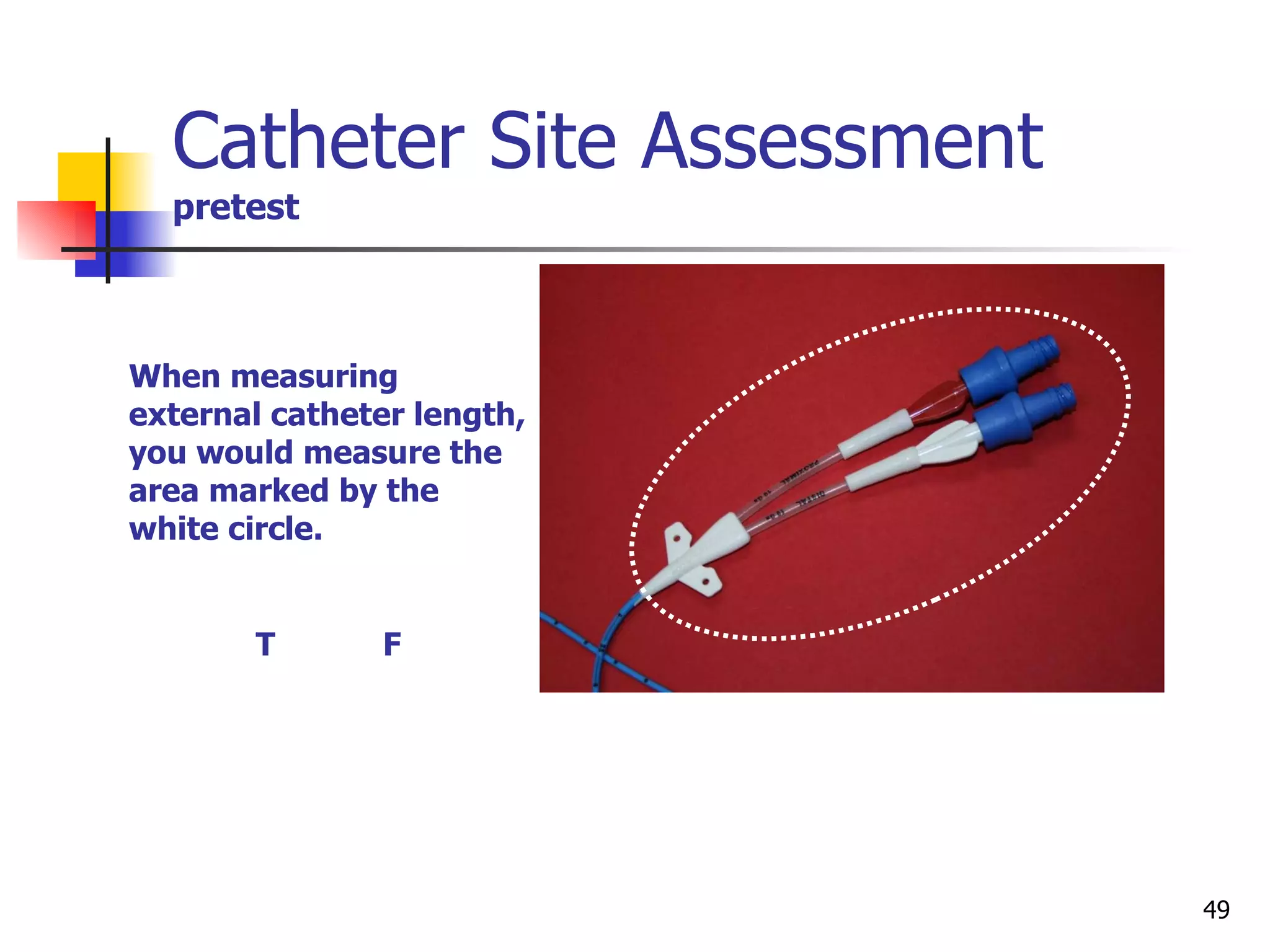
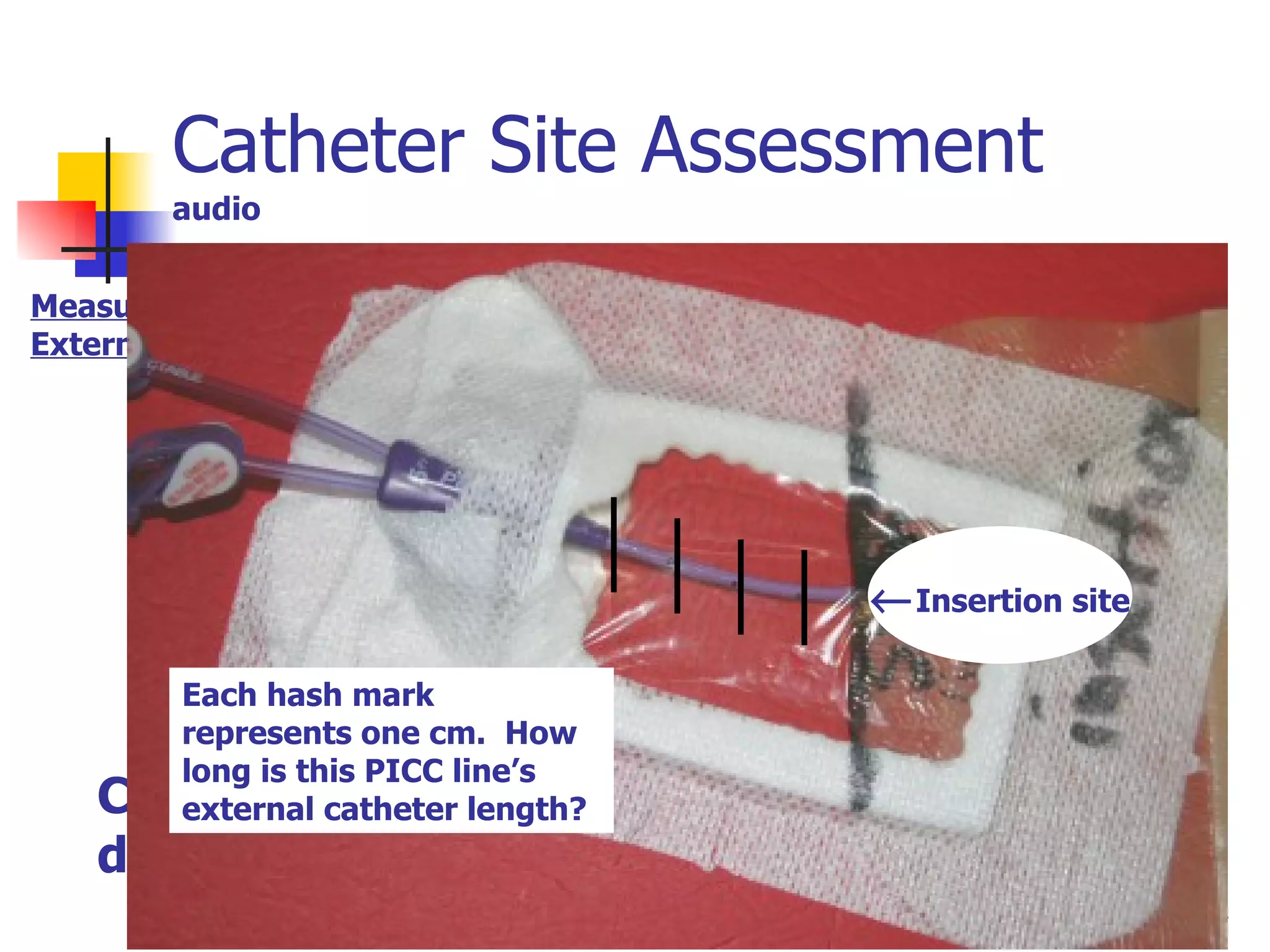
Catheter Site Assessment pretest When measuring external catheter length, you would measure the area marked by the white circle. T F
Catheter Site Assessment audio Assess all VAD sites for:  erythema, induration edema (swelling) pain discharge catheter migration (measure external length of central lines) With permission J. Bowen-Santolucito Phlebitis from  Nafcillin courtesy D. Richardson RN Cellulitis from subclavian line
Catheter Site Assessment audio junction Clue:  if any catheter is visible outside of dressing – catheter has likely migrated. Measuring External Catheter Measure to suture wing  junction Leave dressing in place Each hash mark represents one cm.  How long is this PICC line’s external catheter length?  Insertion site
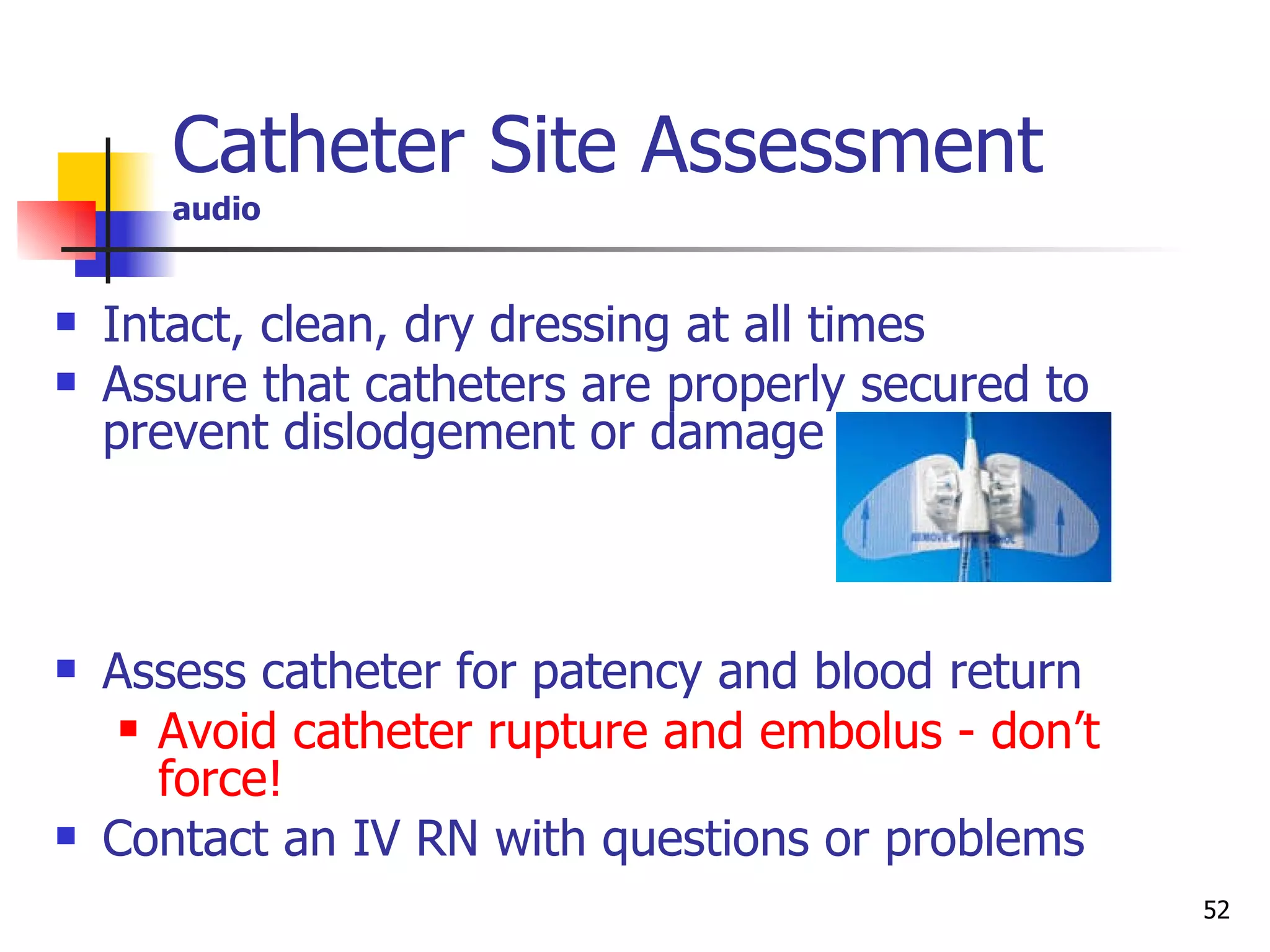
Intact, clean, dry dressing at all times Assure that catheters are properly secured to prevent dislodgement or damage Assess catheter for patency and blood return Avoid catheter rupture and embolus - don’t force!   Contact an IV RN with questions or problems Catheter Site Assessment   audio
Catheter Site Assessment   video
Flushing and Infusion
Flushing and Infusion  pre-test It is appropriate to have an IV line unclamped with blood in line; it’s the patient’s own blood.  T  F   Why is it that a syringe smaller than 10ml should not be used to flush PICCs or other central lines?
Which line, and… how to flush?   pretest Patient on Baird 4 has triple lumen subclavian line, with clamps on each lumen.  How should this catheter be flushed after Vancomycin administration? With 20ml 0.9% normal saline, followed by heparin flush of 10u/ml With 20ml 0.9% normal saline, followed by heparin flush of 100u/ml With 10ml 0.9% normal saline, clamping line before end of heparin flush. With 20ml 0.9% normal saline, followed by heparin flush of 10u/ml, clamping line before end of heparin flush.
Flushing and Infusion video No visible blood in line 10ml syringe use No pushing through resistance 20ml after vanco,TPN, blood transfusion/sampling Stop flush before syringe is completely empty Keep end of tubing sterile/connected – no loop backs Keep exposed male luer end away from contact
Home Care Considerations video Short or long term use?  Mandatory: pt./caregiver teaching Document well in discharge planning  Process will involve nurse case manager Does patient have vendor services established?
Vascular Access Matters Resources audio FAHC IV Therapy 847-3647 Intradoc  (hyperlink these) NGP0009 Central Venous Access Devices INFC00003 Prevention of IV Device Related Infections NGP 119 De-Clotting Central Venous Catheters Using Thrombolytic Agent tPA NGP00062 Peripheral Venous Catheters; Staff Responsibilities and Care of NGP00083 Peripherally Inserted Central Catheter (PICC); General Care NPG111 - Blood Drawing through Central Venous Access Devices
Coming in FY 2009: audio SVAT: specialized vascular access team, multidisciplinary oversight committee and work group “ Fistula First” program: preserving arm veins of renal patients for fistula placement.  BEST PRACTICE.
Dressing Changes Create link here for people to bypass this section if they don’t need to see dressing change portion
Dressing Changes audio Central line dressing changes are performed by:  the IV RNs. RNs from specialty units, who have completed standard FAHC competency training and assessment for this skill.
Dressing Changes pretest At FAHC, Central Line dressing change procedures are a.  clean   b.  sterile  c. either If a CVAD insertion site is covered by an ___________ dressing, it should be changed weekly and prn. Should patients wear masks during dressing changes?
Dressing Changes  see Intradoc  NGP0009 audio Perform hand hygiene EVERY time immediately prior to handling vascular access devices. MUST use sterile procedure and wear mask (for IVAD accessing as well). Home patients must wear mask; highly recommended for inpatients as well.
Dressing Changes audio Chlorhexidine and isopropyl alcohol (e.g. Chloraprep) is FAHC preferred antiseptic for central line insertion and maintenance. Instructions for use:  scrub back and forth for 30 seconds, let air dry. One 3ml chloraprep covers 4”x5” area TIP:   remove old dressing in direction of insertion site to avoid pulling catheter out. Catheter securement devices (e.g. statlock) are standard of practice over sutures – significantly reduce complications.
Post test (Go to post-test questions in Angel)

Vascular Access Devices

  • 1.
    Vascular Access Matters...because one small act can save - or cost - a life. Fade into video here for narrative
  • 2.
    Introduction audioWhat is vascular access? Peripheral. Central. Proper care: saves lines, saves lives . Standardization of Care: new technology, new challenges: how to stay current?
  • 3.
    2009 Joint CommissionHospital National Patient Safety Goals – select list As of April 1, 2009 : Hospital’s leadership has assigned responsibility for oversight and coordination of the development , testing, and implementation of NPSG.07.04.01 As of October 1, 2009 : Pilot testing in at least one clinical unit is under way, for the requirements in NPSG.07.04.01 As of January 1, 2010 : The hospital educates health care workers who are involved in these procedures about health care associated infections, central line-associated bloodstream infections, and the importance of prevention. Education occurs upon hire, annually thereafter, and when involvement in these procedures is added to an individual’s job responsibilities. Prior to insertion of a central venous catheter, the hospital educates patients, and their families as needed, about central line-associated bloodstream infection prevention. The hospital implements policies and practices aimed at reducing the risk of central line-associated bloodstream infections that meet regulatory requirements and are aligned with evidence-based standards (for example, the Centers for Disease Control and Prevention (CDC) and/or professional organization guidelines).
  • 4.
    2009 Joint CommissionHospital National Patient Safety Goals (cont’d) As of January 1, 2010 , the following will be required: The hospital conducts periodic risk assessments for surgical site infections, measures central line-associated bloodstream infection rates, monitors compliance with best practices or evidence based guidelines, and evaluates the effectiveness of prevention efforts. Use a catheter checklist and a standardized protocol for central venous catheter insertion. Use a standardized supply cart or kit that is all inclusive for the insertion of central venous catheters. Use a standardized protocol for maximum sterile barrier precautions during central venous catheter insertion. Use a chlorhexidine-based antiseptic for skin preparation during central venous catheter insertion in patients over two months of age, unless contraindicated. Use a standardized protocol to disinfect catheter hubs and injection ports before accessing the ports.
  • 5.
    Evidence Based Practiceaudio 25% of all CVC usage results in occlusion 1 . ~ $100,000 of TPA used for PICC catheter clearance @ FAHC 10/07-03/08. (Does not include expenses of nursing time, supplies, delay of treatment, catheter replacement.) 1 Deitcher S, Fesen MR, Kiproff PM, et al. Safety and efficacy of alteplace for restoring function in occluded central venous catheters: results of the cardiovascular thrombolytic to open occluded lines trial. J Clin Oncol. 2003;20(1):317-324.
  • 6.
    Evidence Based Practice (cont’d) audio Catheter related bloodstream infections (CRBSI) are the most costly & life threatening of all healthcare infections. Between 14-28,000 patients die annually due to central line infections. CRBSI cost up to $29,000/case, and prolong hospitalization by a mean of 7 days. Since October 1, 2008, CMS will not reimburse for hospital acquired CRBSI 5 Million Lives Campaign. Getting Started Kit: Prevent Central Line Infections How-to Guide. Cambridge, MA: Institute for Healthcare Improvement; 2008.
  • 7.
    Principles Of Asepsis Fade into video here for narrative
  • 8.
    Principles of Asepsis audio Medical Asepsis clean: reduce and prevent spread of microorganisms Surgical Asepsis sterile: aim to eliminate microorganisms Contamination – caused by: prolonged exposure to air wicking (capillary action) from wet areas out of field of vision objects below waist touched by non-sterile objects bedsheets, skin, contaminated syringes/tubing
  • 9.
    Asepsis: videoSee notes below
  • 10.
    Biofilm audio Fibrinis not necessary to make biofilm All indwelling devices have biofilm Biofilm formation begins immediately “… Biofilm forms when bacteria adhere to surfaces in aqueous environments and begin to excrete a slimy,glue-like substance that can anchor them to all kinds of material…” Center for Biofilm Engineering, Montana State University permission P. Stoodly
  • 11.
    Used with permissionaudio Almost all micro-organisms are embedded in matrices of these complex biofilm communities, or colonies. Biofilm begins forming on vascular access devices almost immediately upon contact with the patient’s bloodstream. The biofilm allows the micro-organisms to adhere to any surface, living or nonliving. Microbial biofilms are responsible for 65% of infections treated in the developed world. The adaptive and genetic changes of the micro-organisms within the biofilm make them resistant to all known antimicrobial agents 1 . Vascular catheter-related bloodstream infections are the most serious and costly healthcare-associated infections – and the most life threatening. 87% of primary bloodstream infections are associated with an intravascular device 2 . 1 Ryder, Marcia; “Catheter-Related Infections – Its All About Biofilm”; Topics in Advanced Practice Nursing e-Journal. 2005;5(3) ©Medscape 2 Richards MJ, Edwards JR, Culver DH, Gaynes RP. Nosocomial infections in medical intensive care units in the United States. National Nosocomial Infections Surveillance System. Crit Care Med. 1999;27:887-892 .
  • 12.
    Problem: – Infectionaudio With permission Biofilm clusters with streamers Showing flow in channel (e.g. blood vessel) Biofilm: slimy glue like matrix created by bacteria that cannot be eliminated and is resistant to antibiotics. 1 Planktonic intra or extraluminal ‘clumps’ can be released into the bloodstream. 1 Catheter-Related Infections: It's All About Biofilm, Marcia A. Ryder, PhD, MS, RN Topics in Advanced Practice Nursing eJournal.  2005;5(3) ©2005 Medscape, Posted 08/18/2005
  • 13.
    Know your VAD! (vascular access device) Fade into video
  • 14.
    know your VAD! pretest A non-valved catheter has clamps. T F Vancomycin should be given through a midline. T F A triple lumen subclavian line is considered a valved catheter. T F
  • 15.
    know your VAD! PICC = ‘Peripherally Inserted Central Catheter’ Midline = long peripheral catheter Tunneled catheter = long term central catheter that has a portion implanted through a tract created in the tissue Chest groshong, Hickman, Broviac Non-tunneled = short term central catheter Cordis IJ, subclavian line, femoral line Dialysis catheters NOTE WELL: Dialysis catheters may ONLY be used for infusion with order from Renal Attending/Fellow, and ONLY be accessed by Dialysis RN or IV RN with competency training and assessment.
  • 16.
    Know your VAD! vascular access device audio Where is the catheter tip? Where is the catheter inserted? Valved or non-valved? Power injectable? Type of needleless connector?
  • 17.
    Central: required foradministration of many agents/medications PICC tip placement Non-fluoro PICCs confirmed by CXR MUST be verified by an IV RN even attendings may not release these PICCs for use Catheter migration? Consult IV RN Malpositioned catheters may pose serious risk Staff RN’s: document length of external catheter. Optimal central catheter tip placement is essential… audio
  • 18.
    Know your VAD! vascular access device audio Central: terminates at or near the heart. Peripheral: short (~1 inch); usually in forearm. Midline: ~6-8 inches, terminates in upper arm. Where’s the catheter tip? Film courtesy J. Bowen-Santolucito Optimal tip location:
  • 19.
    Know your VAD! vascular access device audio Where is the catheter inserted? Arm Groin Chest Subclavian Neck/Internal or External Jugular Flank Umbilicus Leg/foot
  • 20.
    Know your VAD! vascular access device Valved or non-valved? audio Hickman, broviac Power PICC Groshong (PICC or chest) Nontunneled ( subclavian, IJ) Solo Power PICC N O N V A L V E D V A L V E D C L A M P when not in use Don’t have clamps Don’t require heparin valve  valve at tip
  • 21.
    Know your VAD! Infusaport (port, portacath, IVAD; many types) audio Huber needle Device under tissue IV tubing Power Port Power injectable Consider all ports NONvalved unless you know it is Groshong When a port is not in use, or not accessed , monthly flushing is usually required to maintain patency. When a port is in use, the non-coring needle should be changed, and the device flushed, weekly .
  • 22.
    Know your VAD! vascular access device audio Samples of Power injectable Power PICC (Bard) Solo Power PICC (Bard) Arrow Pressure Injectable Valve  valve  clamps
  • 23.
    Know your VAD! vascular access device audio Where is the catheter tip? Where is the catheter inserted? Valved or non-valved? Power injectable? Type of needleless connector?
  • 24.
    Know your VAD! Needleless connectors pretest Evidence based : A ____ second scrub of hub will provide adequate disinfection. Catheter related infections related to inadequate disinfection can most likely be classified as a. intraluminal b. extraluminal
  • 25.
    Know your VAD! Needleless connectors audio Remember: A majority of blood stream infections related to central lines are caused by improper care and accessing . Can you name these needleless connectors? “ All models of needleless access ports were successfully disinfected..” with 15 second scrub with isopropyl alcohol (IPA). Wendy, MT, MPH, CIC and Chinn, Raymond, MD, FACP “Successful Disinfection of Needleless Access Ports: A Matter of Time and Friction”, JAVA (12; 3) 2006 pps 140-142 Alaris Smart Site ICU Medical Microclave ICU Medical CLC 2000 ICU Medical Clave
  • 26.
    Which line forwhat? Some vascular access devices can be used for any infusion therapy Some infusion therapies are contraindicated via certain vascular access devices Usually because of risk to patient’s tissue Clinicians must know the difference, and are legally liable
  • 27.
    Which line forwhat? audio CT: plain – any line power injection: only power catheters Chemo central (rare peripherally) Antibiotics most (some abx should only be given centrally) Blood: any line (central lines with MD order) Fluid infusion or resuscitation, PCA: any line TPN: central lines
  • 28.
    Which line forwhat? EXAMPLES audio Parameters pH <5 or >9 Osm. >5-600 mOsm Irritants, vesicants Parameters pH between 5-9 Osm. <5-600 mOsm No irritants or vesicants TPN CT (CAT scan) check for pressure injectability Any periph. infusate Chemo Some abx (‘cillins, Vanco, Ceftaz., Ceftriax…) Inotropic meds (dopamine, dobutamine…) Central PPN for limited time CT (CAT scan) IV fluids – (most) Blood products Some abx Peripheral, midline
  • 29.
    Which line andhow to flush? Patients now have central line maintenance order forms. audio Please refer to actual order forms located on your unit. 10 unit/ml 2.5-3ml after sodium chloride flush 100 unit/ml 5ml in chest port after sodium chloride flush NA N/A Heparin Flush All Lumens 10 ml before and after each dose 20ml after blood draw 10 ml every twelve hours if not in use 10 ml before and after each dose 20 ml after blood draw 10 ml monthly if not accessed 10 ml every twelve hours if accessed 10 ml before and after each dose 20 ml after blood draw 10ml monthly if not accessed 10 ml daily if accessed 10 ml before and after each dose 20 ml after blood draw 10 ml every week if not in use Sodium Chloride 0.9% Flush All Lumens Power PICC, Hickman, Broviac, Mid-line, Per Q Cath Chest Port Groshong Chest Port Groshong, Vaxcel, Solo PICC, Mid-line Catheter Non-Valved Catheters Valved Catheters ADULT Line Maintenance -adults Less Than 10 kg 10 unit/ml 5 ml daily after Sodium Chloride flush 10 units/ml 2.5 to 3 ml daily after Sodium Chloride flush for Broviac and Hickman only. Power PICC every 12 hrs Greater Than 10 kg 100 unit/ml 5 ml daily after Sodium Chloride flush NA NA Heparin Flush All Lumens Note: < 5kg, use preservative free Heparin 5 ml before and after each dose 10 ml after blood draw 5 ml every twelve hours if not in use 5 ml once a month if not accessed 5 ml every 12 hours if accessed 5 ml before and after each dose 10 ml after blood draw 5 ml once a month if not accessed 5 ml daily if accessed 5 ml before and after each dose 10 ml after blood draw 5 ml Weekly if not in used 5 ml before and after each dose 10 ml after blood draw Sodium Chloride 0.9% Flush All Lumens Broviac, Hickman Power PICC Chest Port Groshong Chest Port Groshong, Vaxcel, Solo PICC, Midline C. Catheter Non-Valved Catheters Valved Catheters PEDI Line Maintenance Heparin weight based use adult sheet if over 30 /kg
  • 30.
    Problem Solving CentralLines Occlusion Emboli Extravasation/Infiltration Phlebitis Infection
  • 31.
    Problem : –Occlusion video Appropriate line flushing – do not force Know your VAD – heparin, or saline flush? (reinforce prior learning) Don’t plunge syringe to bottom Check needleless connector (change every 72 hours and after blood draws), change prn When was needleless connector change documented? Is line positional? Should have blood return each time catheter is used. Nurse is liable for use of malfunctioning catheter. Order TPA, call IV RN when TPA on unit Video clip of exploding catheters/catheter aneurysm (Joann and Steve demonstrating)
  • 32.
    Problem : –Occlusion video Nurse encounters plugged PICC line Hmmm, no blood return – plugged too. Is line clamped? “ should have used heparin?” “No, Steve – this is a valved catheter. I wonder if this patient has a catheter embolus?” Check needleless connector (change every 72 hours and after blood draws), change prn When was needleless connector change documented? Is there blood or precipitate in line?
  • 33.
    Problem: Emboli audio Different types of emboli Air Catheter Wire Thromboembolus What is wrong with this picture? No connectors = potential air embolus What is wrong with this picture? Torn catheter = potential catheter embolus  Catheter tip Stylet (wire) Thrombus from subclavian vein Courtesy Deb Richardson
  • 34.
    Problem: Emboli –Identification audio Medical Emergency Deep respirations Coughing Cyanosis Chest pain Gasping Weak pulse Low or absent BP
  • 35.
    Problem: Embolus -Treatment audio CATHETER embolus (catheter fragment in bloodstream): THIS IS CONSIDERED A MEDICAL EMERGENCY: Immediate medical intervention is warranted. Implement strict bed rest. Immediately apply tourniquet PROXIMAL to the site to retain the fragment in the arm. Obstruct venous, not arterial flow. Assess pulses distal to tourniquet every 15 minutes. Initiate oxygen therapy. Notify physician, contact Interventional Radiology to prepare for emergent procedure. Monitor vital signs. Ensure patient has adequate peripheral IV access. Only MD should remove tourniquet. AIR embolus Clamp or kink catheter. Position patient on LEFT side in Trendelenburg. Call MD immediately. Administer oxygen, monitor vital signs, and setup for code 99.
  • 36.
    Problem: Extravasation/Infiltration audio and Phlebitis Refer to NGP 117 Extravasation Photos courtesy Lorelle Wuerz, RN Dilantin extravasation Gross infiltration NOTE WELL: the following are considered actual or potential extravasants: Many chemotherapeutic agents Ampicillin, Nafcillin, Meropenem, Piperacillin-Tazobactam Vancomycin Phenergan (preferred route is IM, NOT IV) Transfused blood IV contrast Dopamine and Dobutamine
  • 37.
    Problem: Extravasation: Action steps audio Intervention: Discontinue infusion immediately and disconnect the line. Leave the catheter in place until treatment is determined. Clamp if applicable. Initiate pharmacy consult and notify physician. DO NOT FLUSH Continue to follow policy (extravasation)
  • 38.
    Problem: Extravasation/Infiltration Grade:0 Clinical Criteria: No symptoms Grade: 1 Clinical Criteria: • Skin blanched • Edema <1 inch in any direction • Cool to touch • With or without pain Grade: 2 Clinical Criteria: • Skin blanched • Edema 1-6 inches in any direction • Cool to touch • With or without pain Grade: 3 Clinical Criteria • Skin blanched, translucent • Gross edema >6 inches in any direction • Cool to touch • Mild-moderate pain • Possible numbness Grade: 4 Clinical Criteria • Skin blanched, translucent • Skin tight, leaking • Skin discolored, bruised, swollen • Gross edema >6 inches in any direction • Deep pitting tissue edema • Circulatory impairment • Moderate-severe pain • Infiltration of any amount of blood product, irritant, vesicant Infusion Nursing Society Infiltration Scale NGP117
  • 39.
    Problem: Phlebitis Action steps audio Peripheral lines: Stop infusion. Remove line immediately. Central lines: Stop infusion. Contact MD/IV Therapy. Document well. Criteria for Infusion Phebitis Grade 0 No symptoms Grade 1 Erythema at access site with or without pain Grade 2 Pain at access site with erythema and/or edema Grade 3 Pain at access site with erythema and/or edema Streak formation Palpable venous cord Grade 4 Pain at access site with erythema and/or edema Streak formation Palpable venous cord > 1 inch in length Purulent drainage Infusion Nursing Society Phlebitis Scale
  • 40.
  • 41.
    Problem : Infection pretest If the nurse touches any pt. object after she performed hand hygiene, she must repeat hand hygiene immediately prior to handling vascular access devices. T F FAHC performs hand hygiene audits every __________________.
  • 42.
    Infection: The Impactaudio A Mother’s Letter to a Hospital CEO http://safecarecampaign.org/index.html hyperlink this.. Our son died in your hospital 7 days ago. He died from a bacterial infection he caught there as a result of his medical care while being treated for something else. It created so much pressure around his brain that it caused part of it to be pushed into his spinal column, leaving him a helpless ventilator-dependent quadriplegic and ending his short but unforgettable life among us all…….
  • 43.
    ……… ..Dear CEO,I hope you read this letter to your team aloud. Tell your board that we do not want anything for the loss of our dear son but a dramatic and effective plan for change that will make a difference for others who trust healthcare in general and your hospital specifically. We look to you to partner with us as patients and caregivers so that we may all be safe and well, both now, and in the future. Sincerely, Victoria Nahum audio
  • 44.
    Problem: Infection audioOutcome of poor catheter and dressing maintenance. Note: sutures may have contributed to cellulitis. Standard of practice: catheter securement devices.
  • 45.
    Infection: factors audioUse of contaminated administration sets, solutions, or medications Contamination of catheter needleless connector Catheter insertion technique Site of insertion Use of multiple lumen catheters Migration of organisms from insertion site Thrombosis, fibrin, biofilm, and catheter occlusions
  • 46.
    Problem : –Infection – Disinfection of needleless connector video 1 show proper disinfection technique 2 show proper connector change technique
  • 47.
    Integration (fade intovideo narration) how you practice. Transform into what you know
  • 48.
    Catheter Site AssessmentFade into video
  • 49.
    Catheter Site Assessmentpretest When measuring external catheter length, you would measure the area marked by the white circle. T F
  • 50.
    Catheter Site Assessmentaudio Assess all VAD sites for: erythema, induration edema (swelling) pain discharge catheter migration (measure external length of central lines) With permission J. Bowen-Santolucito Phlebitis from Nafcillin courtesy D. Richardson RN Cellulitis from subclavian line
  • 51.
    Catheter Site Assessmentaudio junction Clue: if any catheter is visible outside of dressing – catheter has likely migrated. Measuring External Catheter Measure to suture wing junction Leave dressing in place Each hash mark represents one cm. How long is this PICC line’s external catheter length?  Insertion site
  • 52.
    Intact, clean, drydressing at all times Assure that catheters are properly secured to prevent dislodgement or damage Assess catheter for patency and blood return Avoid catheter rupture and embolus - don’t force! Contact an IV RN with questions or problems Catheter Site Assessment audio
  • 53.
  • 54.
  • 55.
    Flushing and Infusion pre-test It is appropriate to have an IV line unclamped with blood in line; it’s the patient’s own blood. T F Why is it that a syringe smaller than 10ml should not be used to flush PICCs or other central lines?
  • 56.
    Which line, and…how to flush? pretest Patient on Baird 4 has triple lumen subclavian line, with clamps on each lumen. How should this catheter be flushed after Vancomycin administration? With 20ml 0.9% normal saline, followed by heparin flush of 10u/ml With 20ml 0.9% normal saline, followed by heparin flush of 100u/ml With 10ml 0.9% normal saline, clamping line before end of heparin flush. With 20ml 0.9% normal saline, followed by heparin flush of 10u/ml, clamping line before end of heparin flush.
  • 57.
    Flushing and Infusionvideo No visible blood in line 10ml syringe use No pushing through resistance 20ml after vanco,TPN, blood transfusion/sampling Stop flush before syringe is completely empty Keep end of tubing sterile/connected – no loop backs Keep exposed male luer end away from contact
  • 58.
    Home Care Considerationsvideo Short or long term use? Mandatory: pt./caregiver teaching Document well in discharge planning Process will involve nurse case manager Does patient have vendor services established?
  • 59.
    Vascular Access MattersResources audio FAHC IV Therapy 847-3647 Intradoc (hyperlink these) NGP0009 Central Venous Access Devices INFC00003 Prevention of IV Device Related Infections NGP 119 De-Clotting Central Venous Catheters Using Thrombolytic Agent tPA NGP00062 Peripheral Venous Catheters; Staff Responsibilities and Care of NGP00083 Peripherally Inserted Central Catheter (PICC); General Care NPG111 - Blood Drawing through Central Venous Access Devices
  • 60.
    Coming in FY2009: audio SVAT: specialized vascular access team, multidisciplinary oversight committee and work group “ Fistula First” program: preserving arm veins of renal patients for fistula placement. BEST PRACTICE.
  • 61.
    Dressing Changes Createlink here for people to bypass this section if they don’t need to see dressing change portion
  • 62.
    Dressing Changes audioCentral line dressing changes are performed by: the IV RNs. RNs from specialty units, who have completed standard FAHC competency training and assessment for this skill.
  • 63.
    Dressing Changes pretestAt FAHC, Central Line dressing change procedures are a. clean b. sterile c. either If a CVAD insertion site is covered by an ___________ dressing, it should be changed weekly and prn. Should patients wear masks during dressing changes?
  • 64.
    Dressing Changes see Intradoc NGP0009 audio Perform hand hygiene EVERY time immediately prior to handling vascular access devices. MUST use sterile procedure and wear mask (for IVAD accessing as well). Home patients must wear mask; highly recommended for inpatients as well.
  • 65.
    Dressing Changes audioChlorhexidine and isopropyl alcohol (e.g. Chloraprep) is FAHC preferred antiseptic for central line insertion and maintenance. Instructions for use: scrub back and forth for 30 seconds, let air dry. One 3ml chloraprep covers 4”x5” area TIP: remove old dressing in direction of insertion site to avoid pulling catheter out. Catheter securement devices (e.g. statlock) are standard of practice over sutures – significantly reduce complications.
  • 66.
    Post test (Goto post-test questions in Angel)

Editor's Notes

  • #2 Mari What do we know about the proper use and maintenance of IV lines, and best practices to prevent patient adverse events related to IV lines? How can we stay current with new technologies?
  • #3 This education session addresses these issues and more. Today we look at VASCULAR ACCESS DEVICES….. You will encounter pre-tests throughout the education session for your contemplation. The pretest questions will not need to be answered until the conclusion of the entire presentation. At that time, you will complete the post-test. So let’s begin. Remember that: Saving lines, saves lives……
  • #4 These are a few of the 2009-2010 Hospital National Patient Safety Goals from the Joint Commission. Narrator read above script as it rolls out.
  • #5 Narrator read above script.
  • #6 While vascular access devices are patient lifelines, they also present serious risk to every individual with one. Then read or highlight the bullet points above.
  • #7 Narrator read text.
  • #8 Asepsis is the first step in protecting patients from complications related to vascular access. For lines in place 10 days or more, the majority of blood stream infections related to central lines are caused by improper care and accessing, and are intraluminal (from inside the line). 1 You are the gatekeeper between bacteria and a potentially life-threatening infection for each of your patients, EVERY time you use a vascular access device. 1 Ryder, Marcia; “Catheter-Related Infections – Its All About Biofilm” Topics in Advanced Practice Nursing eJournal.  2005;5(3) ©2005 Medscape Posted 08/18/2005 Ryder referenced the following for this statement in her article Raad I. Intravascular-catheter-related infections. Lancet. 1998;351:893-898. Abstract Safdar N, Maki DG. The pathogenesis of catheter-related bloodstream infection with noncuffed short-term central venous catheters. Intensive Care Med. 2004;30:62-67. Abstract Darouiche RO, Raad II, Heard SO, et al. A comparison of two antimicrobial-impregnated central venous catheters. Catheter Study Group. N Engl J Med. 1999;340:1-8. Abstract Raad I, Hanna H. Nosocomial infections related to use of intravascular devices inserted for long-term vascular access. In: Mayhall C, ed. Hospital Epidemiology and Infection Control. Philadelphia, Pa: Lippincott Williams &amp; Wilkins; 1999:165-172. Hall K, Farr B. Diagnosis and management of long-term central venous catheter infections. J Vasc Interv Radiol. 2004;15:327-334. Abstract
  • #9 Principles of asepsis are the foundation for providing safe care during patient interventions, particularly if they are invasive. Medical asepsis is used during non-sterile interventions. Scrubbing the needleless connector for 15 seconds is an example of a medical asepsis practice. (Film vigorous scrub of NC, with countdown image/clock ((Jim)) (the narrative below will be part of next slide – voice over) Surgical aseptic technique is used for procedures that significantly interrupt the patient’s first line of defense: the skin. The placement, and subsequent management of, central vascular access devices is one of those interruptions. For example, maximum barrier precautions must be used for placement of all central lines.
  • #10 Footage of sterile set-up, gowning for CVC insertion: Fade into JoAnn helping Steve place gown and gloves…narrator is still speaking; Continue with placing drapes over the pt. until the narrator is finished. Props: Stretcher Drapes Gown and Gloves, masks Patient Sm. White drape 2 preps Mari’s note: should also include here video shot of scrubbing the needleless connector – that footage to show prior to demonstration of maximum barrier precautions.
  • #11 Biofilm – it’s in rivers and streams, known there as “Didymo”, or “rock snot”, AND - it’s all over any medical device that is inside a patient’s body. Nearly 100% of bacteria form communities that attach to surfaces like catheters as opposed to being free flowing in the bloodstream. While the study of biofilm is relatively new, it clearly has major significance in relation to it’s impact upon patient safety.
  • #12 Here are a few examples of where biofilm will reside. Biofilm is pernicious, and largely resistant to all known forms of antimicrobials. (then read text on overlay)
  • #13 Read text.
  • #14 Video narrator: Speaking of patient safety…..know your Vascular Access Device! Before using any type of medical device, including infusion devices, it is imperative that the clinician has a thorough understanding of the technical specifications and instructions for use. All catheters, all needleless connectors, are NOT alike!
  • #15 Take a moment to contemplate these questions.
  • #16 This slide provides basic definitions of catheter types. PICCs are long central lines usually placed in upper arm veins, with the distal tip residing in the lower one third of the superior vena cava, or SVC. In contrast, midlines are long peripheral lines, with the distal tip residing in the shoulder area. Midlines are only appropriate for a few specific infusions, while PICCs are appropriate for most infusion therapies, especially those that are longer term. Tunneled catheters are also appropriate for most infusion therapies, and are particularly well suited for long term needs. The pediatric population uses these catheters frequently – Broviac is one type of pediatric tunneled catheter. Non-tunneled catheters are used for short term infusion needs, and are often placed emergently. A triple or multi-access lumen subclavian or IJ central line is an example of a non-tunneled catheter.
  • #17 Narrator read the slide: preface by saying The clinician MUST ask the following prior to using any IV device. (Narrator continues to read each question listed above.)
  • #18 Catheter tip location determines what types of infusions can safely be administered through them. Malpositioned catheter tips can have devastating consequences. Therefore, PICCs placed by IV Therapy must be released for use only by an IV nurse, and significant changes in external catheter length must be discussed with an IV RN.
  • #19 At Fletcher Allen, evidence based practice and policy dictates that optimal tip location for central lines, other than dialysis catheters, is at the junction of the lower superior vena cava (SVC) and the right atrium, otherwise known as caval atrial junction. Remember, IV Therapy placed PICCs can ONLY be released for use by an IV Therapy Nurse. Midlines are rarely used.
  • #20 These are the most common sites for catheter placements. Infusion can also occur through devices placed through the translumbar, hepatic portal, or intra-osseus approach, but these are not common.
  • #21 Access devices can be valved or non-valved. It is important to understand the difference. (narrator – section one is nonvalved, section 2 is valved) 1. Non-valved access devices do not contain incorporated valves. Non-valved access devices may require heparin to prevent occlusion and maintain catheter patency. Non-valved access devices have clamps, and should be kept clamped when not in use to prevent blood reflux leading to occlusion. Air embolism and exsanguination may occur when a line is left unclamped. The amount and frequency of heparin is dependent upon the age of the patient and type of access device used. ***************************** 2. Valved access devices contain an incorporated valve at either the proximal or distal tip. Because these devices have reduced risk of blood reflux they do not require heparin flush. Generally, valved access devices require saline only flush.
  • #22 An implantable vascular access device, often called an IVAD or port, may be surgically inserted. These devices are intended for patients who are receiving long term therapies such as chemotherapy. They are placed completely underneath the skin, in a subcutaneous pocket. They are accessed through the skin using a non-coring needle, for example the Huber needle. The port is usually located in the chest. Peripherally placed ports in the antecubital area attached to a centrally placed catheter are less common. When a port is not in use, or not accessed, monthly flushing is usually required to maintain patency. When a port is in use, the non-coring needle should be changed weekly, and the device flushed.
  • #23 Power injectable access devices use unique engineering to allow for injection at a maximum pressure not to exceed 300 pounds per square inch, or psi. Power injected contrast for stroke code CTs are often injected at a rate of 6ml/second and higher than 300 psi. Until we are able to place catheters FDA approved for that rate, power injectable catheters may not be used for stroke code CTs, unless the rate is reduced. The plain Power PICC is a non-valved power injectable access device. The Solo Power PICC is a valved , power injectable access device. The Solo Power PICC valve is located in the proximal end of the lumen, near the needleless connector. Some Power injectable access devices also allow for central venous pressure monitoring, such as Bard Power PICC and Bard Solo Power PICC.
  • #24 To conclude the section “Know your VAD”, we’ll discuss some things clinicians need to know about needleless connectors.
  • #25 Take a moment to contemplate these questions.
  • #26 Needleless connectors were originally designed and manufactured to protect clinicians from needlestick injuries. They may appear to be simple devices, but have complex design issues that may make some more prone to cause occlusion, and others more prone to cause infection. In 2007, there were 7 different needleless connectors in use within Fletcher Allen. These included negative, neutral and positive displacement connectors, each with different technical characteristics and flushing requirements. The Jeffords Quality Institute Central Line “FMEA” chose to implement one standard needleless connector at Fletcher Allen Health Care. We have changed from the Smart Site needleless connector to the Microclave. This connector has little or no blood reflux upon disconnection, while negative displacement connectors, such as the Alaris Smart Site, have significant reflux. Microclave requires a simple and familiar flushing technique, and is FDA approved for saline only flushing (although at this time we will continue to flush non-valved catheters with heparin flush per the Intradoc policy NGP0009 “Central Venous Access Devices”. Some positive displacement connectors have been shown to have higher rates of bacterial transfer through them, more dead and priming space for biofilm and fibrin to form, and have been implicated in increased catheter associated blood stream infections in certain studies. They also require significant changes in flushing technique.
  • #27 Which Line for What? Selection of the type of access device is determined by the primary use for that line and how long the access device will be used. Medication and IV solution properties may determine the type of access device required. Some vascular access devices can be used for any infusion therapy, while some devices are limited in the numbers of appropriate solutions that can be infused through them. If the clinician does not know the difference, they risk significant harm to the patient’s tissue, including loss of limb, or limb function.
  • #28 Some medications and IV solutions have vesicant properties requiring a centrally placed access device. Vesicant and irritant drugs such as vancomycin require further dilution and slower administration rates when infused peripherally to prevent adverse events, and infusion through a central line is preferred. Total parenteral nutrition solutions with greater than 10% dextrose or 5% protein require infusion through a central line. Solutions or medications with a pH less than 5 or greater than 9 or an osmolarity &gt; 500 to 600mOsm/Liter require infusion through a centrally placed access device. Consult pharmacy for pH, osmolarity, and other questions related to IV medications.
  • #29 This table reviews the parameters guiding best choice of catheter.
  • #30 Fletcher Allen has standardized protocols for line maintenance and flushes, and are incorporated into central line maintenance order forms for adults and pediatrics, inpatient and outpatient populations.
  • #31 Problems can occur frequently with an access device. These problems are often serious medical events and need to be immediately identified and addressed. Problems most often associated with access devices are: Occlusion, Emboli, Extravasation/Infiltration, Phlebitis and Infection.
  • #32 Scene to include footage of: needleless connector change, checking for blood return (use the phrase “withdrawal occlusion”); flushing (pulsatile? Not evidence-based yet; is controversy). Fade into scene with patient with a ____PICC over the arm (to look real). Have either S or J as floor RN attempting to aspirate blood from PICC, unable. Fade out. Fade back into the same room with both floor RN and the PICC RN with pt. Floor RN: “Thank you for coming, (S or J). I cannot get a blood return.” IV RN: “This is a non-valved PICC, judging by these clamps (camera zoom to clamps). Has heparin been used to flush it?” Floor RN: “ I don’t know, this is the first time I used it this shift.” IV RN: “The first thing we need to do, if you’re sure you unclamped the line prior to checking for withdrawal occlusion, is replace the needleless connector. Do you know when the connector was last changed?” Floor RN: “No.” IV RN: “The needleless connector needs to be changed every 72hours, or if blood sampling or tranfusion occurred - within reason, for eg once/shift or at least within 24hours. This should be recorded by the staff nurse on the caredex and the pt.s daily flow sheet. Let’s change it now.” Camera is videoing the nurses talking in the room with the pt. IV RN removes the connector, scrubs hub of catheter for 15 seconds singing 15 second song.” Floor RN: “what are you singing?” IV RN (laughing) “oh.,..it helps me to know when 15 seconds is up. Once I’m done scrubbing, it will need to air dry – usually takes another 15 seconds.” Using “no touch” method, The IV RN places sterile preprimed needleless connector with syringe attached to the hub while looking at the PICC through the dressing. IVRN: “Everything looks good – I don’t see any kinks in the catheter.” The IVRN flushes the line and attempts to aspirate blood without success. IVRN: “I cannot get a blood return either; this patient’s PICC has a withdrawal occlusion. If the tPA is not already on the floor, please page us as soon as it arrives, and please flush the PICC right now with heparin flush.
  • #33 Camera fades in on a pt. with a PICC while the IVRN and floor RN are talking. Floor RN: “I can’t get a blood return or flush this PICC. Should I have used heparin?” IV RN: “No, this is a valved catheter – a Solo Power PICC. I see no blood in the line – let’s start by changing the needleless connector. Floor RN: “I just did that, but it still isn’t flushing. The patient said I could push really hard on the flush; sometimes that works for him.” IV RN: “Attempting to push past resistance in the catheter can cause the catheter to aneurysm, or rupture; flush only if the catheter flushes with ease. Show video footage of exploding and/or aneurysm’ing catheter.
  • #34 An embolus is a mass or foreign object that travels through the bloodstream, and may cause serious patient injury, or death. Emboli can be comprised of air, catheter or wire, or thrombotic material. Air may enter an IV line during administration of drugs or flushing, when a line is left unclamped, or when there is no needleless connector or end cap attached to the catheter or stopcocks. Although many occurrences of air embolism go unreported because they are not sympomatic, entrapment of large quantities of air can lead to severe neurologic injury, cardiovascular collapse, and even death. Air embolism is Catheter emboli can occur during insertion of peripheral or central lines, or during forceful flushing or removal of central lines. Wire emboli occur during catheter insertion. Foreign items left in patients AND air embolism are considered “Never” events by the Centers for Medicare/Medicaid Services, or CMS, are preventable, and are not reimburseable. They are also reportable events. Thrombosis occurs for many reasons including increased blood viscosity, reduced blood flow through and trauma to the blood vessel, patient pathology, and improper care of catheters and their add on devices. Not clamping non-valved catheters causes reflux back into catheters; a clinician flushing a non-clamped line may be flushing clot material into the patient’s bloodstream.
  • #35 Clinical emboli are considered a medical emergency. Symptoms of pulmonary embolism may be vague, or they may resemble symptoms associated with other diseases. Symptoms can include: Deep respirations and/or shortness of breath Cough with or without hemoptysis Cyanosis Chest pain Gasping or tachypnea Tachycardia Low or absent blood pressure
  • #36 If you suspect catheter embolism from a peripheral site, keep the patient quiet, immediately tourniquet the venous blood flow proximal to the suspected embolus, initiate the critical access team, or CAT. Although many occurrences of air embolism go unreported because they are not symptomatic, entrapment of large quantities of air can lead to severe neurologic injury, cardiovascular collapse, and death. Clamp or kink catheter immediately, position patient on their left side, initiate the CAT, and continue with life-saving measures. For severe, life-threatening thromboembolism, treatment may consist of dissolving the clot with thrombolytic therapy. Anticoagulant therapy prevents the formation of more clots and allows the body to re-absorb the existing clots faster. Clot-dissolving medication (thrombolytic therapy) t-PA is most commonly used.
  • #37 Extravasations occur when a damaging infusion compound infiltrates from a vascular access site into the patient’s surrounding tissue. These same compounds can cause phlebitis. Infiltrations and extravasations occur with any type of vascular access device, including central venous access devices. Nurses and other clinicians using vascular access devices must assess for infiltration immediately prior to EVERY use. Vascular access sites with infusions running should be assessed at least every hour. Begin to understand extravasation by knowing what medications and infusions can cause it. Here are a few common ones. Pharmacy has the most current and complete list of extravasants and their antidotes.
  • #38 Whether or not you are sure that it is an infiltration or an extravasation, follow these steps (read slide aloud) There are no black and white rules about applying heat or cold as antidotes; it is solution specific. Pharmacy will have this information.
  • #39 The infiltration scale can be found in the extravasation policy NGP117, and will also be incorporated into PRISM. If you determine an infiltration is mild to moderate – Grade 0 through 1, it should not be necessary to notify the MD unless you have other cause for concern.
  • #40 Phlebitis is irritation and inflammation of the inner layers of vein, caused by mechanical trauma from needle puncture and catheter movement, chemical trauma by infusion of irritant or vesicant, and/or by bacterial contamination leading to septic phlebitis. Phlebitis can cause significant discomfort and negative outcomes, such as bacteremia, loss of vein, and loss of limb function. The Phlebitis scale can be found on the back of the IV Therapy flow sheet, and will be incorporated into PRISM.
  • #41 (JoAnn Hammond – video narrator) Of all potential complications related to vascular access devices, infection is the most common. Catheters can be patient lifelines, or provide patients with devastating outcomes. Let’s turn our attention once again to catheter related infections.
  • #42 Take another moment to contemplate these statements.
  • #43 Narrator (read before letter rolls out): This is a letter from a woman who’s family had 3 different family members with a health care acquired infection within one year. Her son Josh had a skydiving accident with a fractured skull and femur from which he was recovering well from, until he acquired a nosocomial infection. Josh died from his infection.
  • #44 Narrator read this aloud.
  • #45 Vascular access associated infections can occur in the tissue surrounding the vascular access device, or in the patient’s bloodstream. Microorganisms entering the catheter through improper technique (inadequate disinfection, for example) can colonize the catheter as well as susceptible areas of the patient’s body, leading to infection. Catheter related blood stream infections result in significant morbidity and in many cases, mortality. CRBSIs carry significant cost to the health care system. Treatment of nosocomial central line associated blood stream infections will no longer be reimbursed by Medicare beginning October 1 st , 2008. Understanding factors responsible for catheter related infections is crucial in prevention and treatment.
  • #47 IV RN: “Remember: Disinfect needleless connector or catheter hub for 15 seconds and let it air dry prior to EVERY access with a sterile luer lock device. After disinfection, use “NO TOUCH” – make sure nothing comes into contact with the disinfected needleless connector or the sterile male luer end. If contamination of connector occurs, disinfect again for 15 seconds (Show video clip of this contamination, and re-disinfection). If contamination of the male luer end of the administration set occurs, DISCARD the administration set and REPLACE with a new one. This is a great example of evidence based practice.” Show close-up of IVRN (or floor RN?) changing needleless connector. Show scrub for 15 seconds. Film of digital clock or watch ticking for 15 seconds during this demonstration of a scrub. Reference (can we have reference fade into view somehow with video?): “Successful Disinfection of Needleless Access Ports: A Matter of Time and Friction”, Kaler, Wendy, MT, MPH, CIC; Chinn Raymond, MD, FACP; Journal of the Association of Vascular Access, Volume 12, Number 3, September 2007, pp. 140-142(3 )
  • #48 Video narrator (Mari) (This slide introduces the video narrator again – and begins the conclusion of the presentation; “putting it all together”.) Zero infection rates for central line associated blood stream infections are attainable. Keeping patient vascular access functional and safe is our duty. It’s a team approach, and the bedside clinician is the captain.
  • #49 Video Narrator: (Mari) A first step in excellent evidence based practice for vascular access devices is assessment. Prior to using any infusion device, the clinician must not only know about the vascular access equipment involved, but must also perform a thorough assessment of the catheter site.
  • #51 Narrator read above
  • #52 To measure external catheter length, leave the occlusive dressing in place. Use a patient specific measuring tape. The measurement that staff nurses use may be 1-2cm different than the measurements provided by the IV nurse, in part because the IV nurse will measure during the dressing change.
  • #53 Narrator read slide. Preface with: A proper site assessment would include…
  • #54 Audio narrator: “What do you know about measuring external catheter length?” Fade into video, pt. with a PICC and floor RN saying: “Hi, (S or J), would you please show me how to measure the exterior part of the PICC?” IVRN “Let’s do a complete assessment of this line.” camera zooms in on PICC. Camera zooms to PICC while IV RN points to catheter site and items…. IV RN: “Looking at the catheter, identify the brand and type, including whether it is valved, whether it is power injectable, look for kinks or bends under the dressing, is the catheter intact or is it damaged? Is the dressing clean, dry, and intact? Then assess the insertion site, and the whole arm. Is there any tenderness, discharge, redness, swelling, induration? Is it time for a dressing or needleless connector change? When was the administration set last changed? (show colored label on administration set). I see that this administration set is no longer connected to the patient – this should be discarded and replaced with a new one. It is standard of practice to keep administration sets connected to patient’s vascular access devices at all times to maintain a closed system in an attempt to prevent inadvertent bacterial contamination. Infusion sets that are disconnected from patients automatically become intermittent infusion sets and need to be changed every 24 hours.” IV RN: “I can see by the color and labeling that this is a power PICC. Because of the labeling and the clamps, it is clear this is a non-valved catheter.” IVRN pulls out measuring tape. “OK, now lets measure this. Begin at the insertion site and follow tape along top of dressing until you come to the point where the catheter meets the suture wing. This length should be within 1-2 centimeters of the original external length documented when the PICC was placed. IV RN: “ The dressing is clean and dry. We change the dressing weekly, or as needed. Now let’s talk about arm assessment: there is no redness, swelling or discharge visible. I will now palpate the upper arm from insertion site to the axilla. I don’t note any induration or swelling. (to patient): Any discomfort? (Pt. says “no”.) Be sure to change the needleless connector every 72 hours or after blood sampling or transfusion. You shouldn’t need to change needleless connectors more than once daily (check with Sally Hess about this – once? Twice daily?)
  • #55 Flushing and infusion is likely the activity you perform most frequently with your patient’s vascular access devices, and is also likeliest activity that will prevent – or provide – a bloodstream infection.
  • #56 Take a moment to contemplate these statements.
  • #57 And this question….
  • #58 IVRN to staff RN: “If you have a really good reason to disconnect the administration set from the patient, be sure you have a new sterile end cap to place on the male luer end (zoom view of this), or discard the tubing completely since it is now an intermittent set and would need to have been changed within 24 hours. Never loop back the catheter onto itself (zoom view of this). Use a ‘no-touch’ method to avoid contaminating any portion of the tubing that should remain completely disinfected, or sterile, such as the male luer tip of the administration tubing. (zoom view of this)” IV RN: “To flush a central line, use a 10ml or larger prefilled saline syringe. If you are checking for blood return, be sure to only aspirate blood until it is immediately visible; do not pull blood into the needleless connector or the syringe. Then proceed to flush, stopping before the syringe plunger reaches the bottom of the syringe. This is called “bottoming out”, causes negative displacement when the syringe is removed, which then pulls blood from the patient’s vein back into the catheter. Bottoming out a flush syringe may be a common cause of catheter occlusion.”
  • #59 Steve or Joann video narrate the following: Patients at home with vascular access devices typically have lines designed for long term use, such as a PICC or a chest port. Patients at home with vascular access devices will need line care education and follow up in a clinic or in the home setting by a home health agency nurse. Dressing changes are generally performed by a nurse. Flushing and administration of medication may be performed by a clinic or home health agency nurse or by a trained patient or caregiver. All necessary supplies for the patient at home will be provided by the outpatient pharmacy or other home infusion supplier.
  • #60 If you have a question, be sure to ask. Here are just a few of the resources available to you. Remember to include your colleagues on your unit as resources.
  • #61 The Joint Commission recently identified quality of care goals related to central lines that institutions must have in place by 2009-2010. We are already near completion with most of what they identified. The vascular access team, early vascular access assessment, and the vein preservation program for patients with renal disease are examples of these.
  • #62 If you are a clinician working in a unit where you’ll be changing central line dressings, continue through this section. If not, click link above and you will be directed to the remaining portion of the presentation.
  • #63 Narrator read above.
  • #64 Contemplate these statements and questions.
  • #65 Narrator read slide as it rolls out.
  • #66 Narrator read text.
  • #67 Mari will provide test questions.