What HTTP/2.0 will*
        TO
      __
    do for you
      Mark Nottingham
    http://www.mnot.net/
          or, @mnot
*
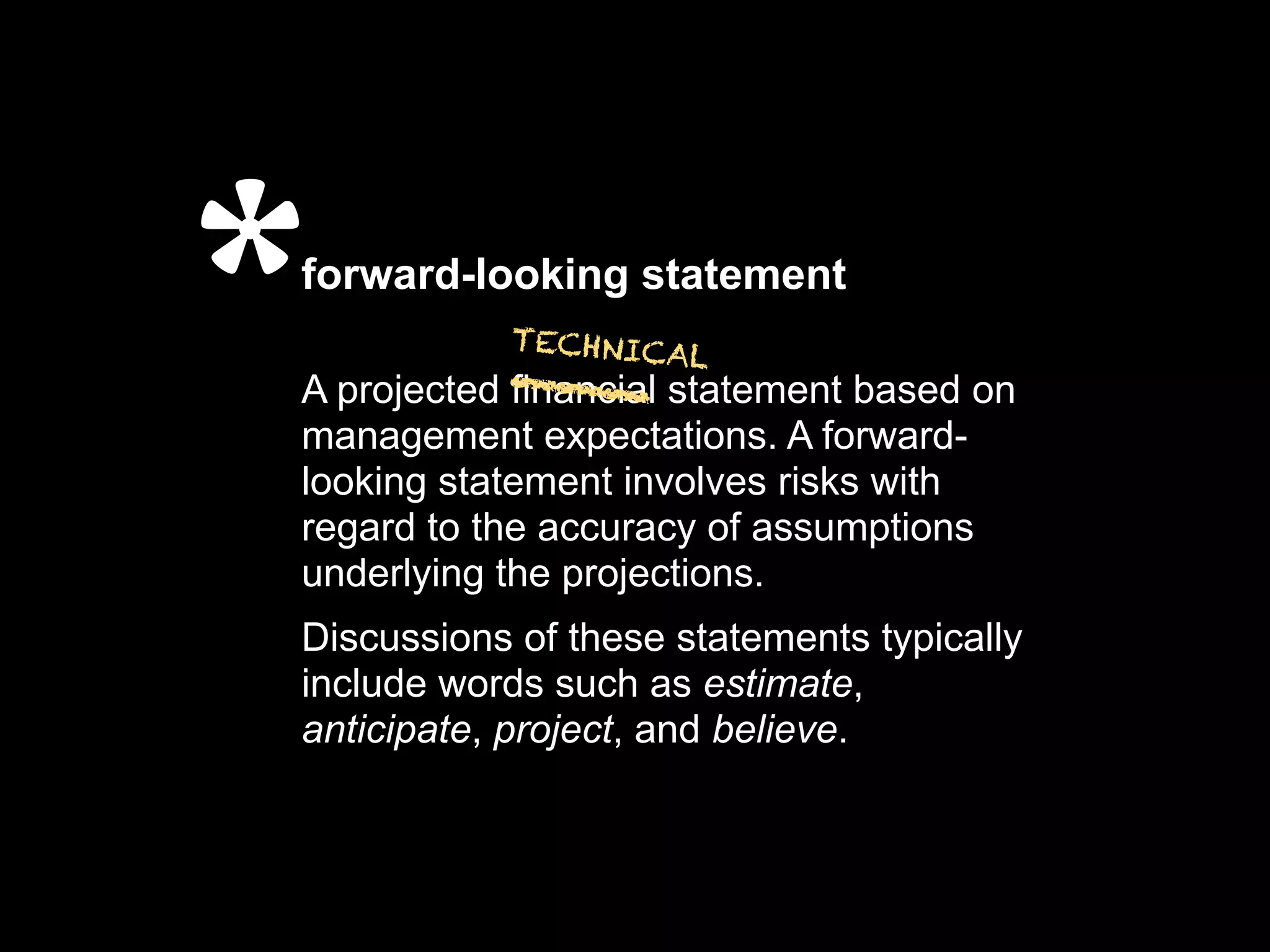
forward-looking statement
            ___ statement based on
           TECHNICA
                    L
A projected financial
management expectations. A forward-
looking statement involves risks with
regard to the accuracy of assumptions
underlying the projections.
Discussions of these statements typically
include words such as estimate,
anticipate, project, and believe.
1. Some recent history
IETF HTTPbis WG
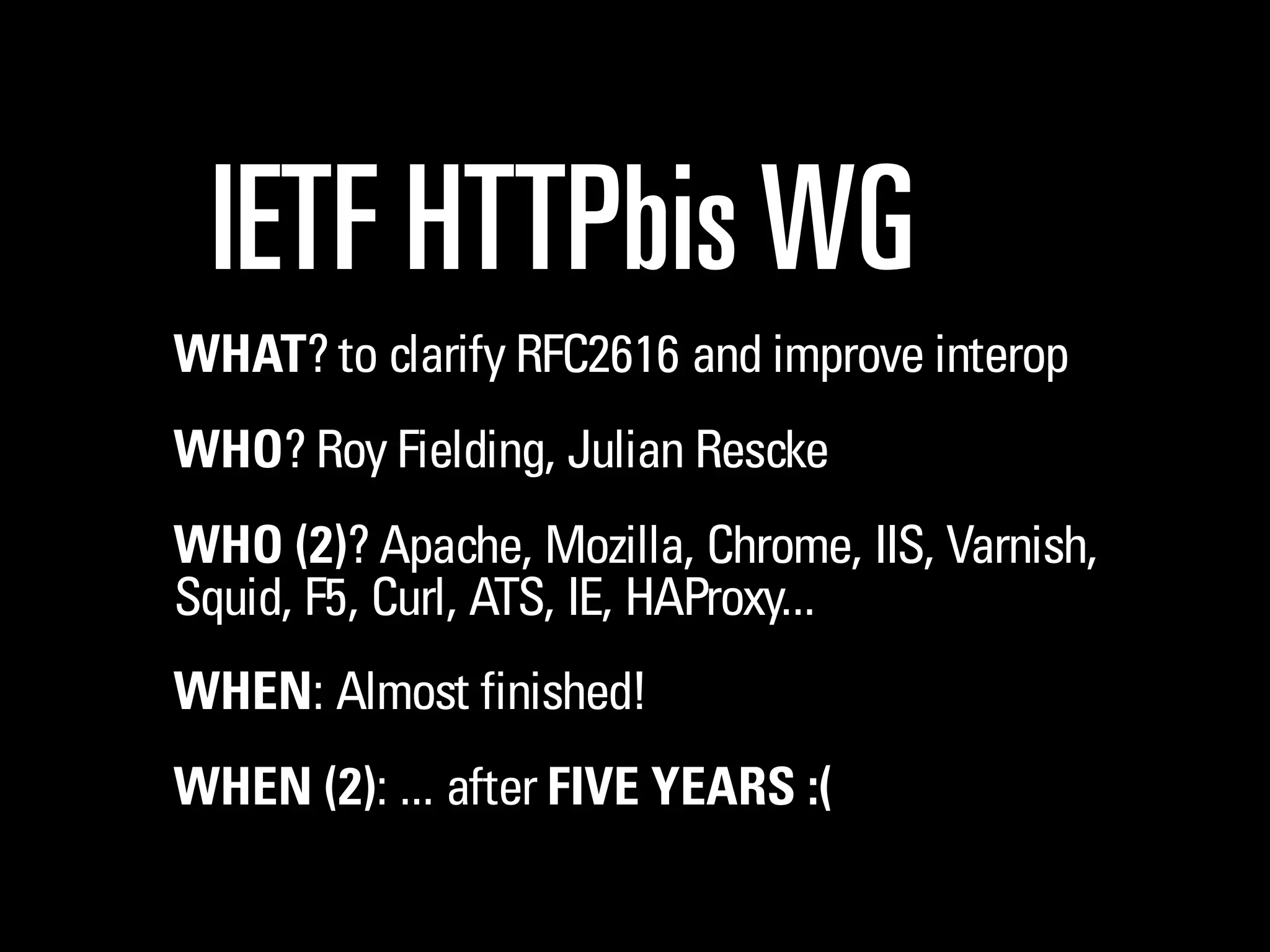
WHAT? to clarify RFC2616 and improve interop
WHO? Roy Fielding, Julian Reschke
WHO (2)? Apache, Mozilla, Chrome, IIS, Varnish,
Squid, F5, Curl, ATS, IE, HAProxy...
WHEN: Almost finished!
WHEN (2): ... after FIVE YEARS :(
IETF HTTPbis WG (2)
STRICTLY chartered to avoid making a new
version of the protocol.


Because EVERYBODY knows that’s not going
to happen.
MEANWHILE
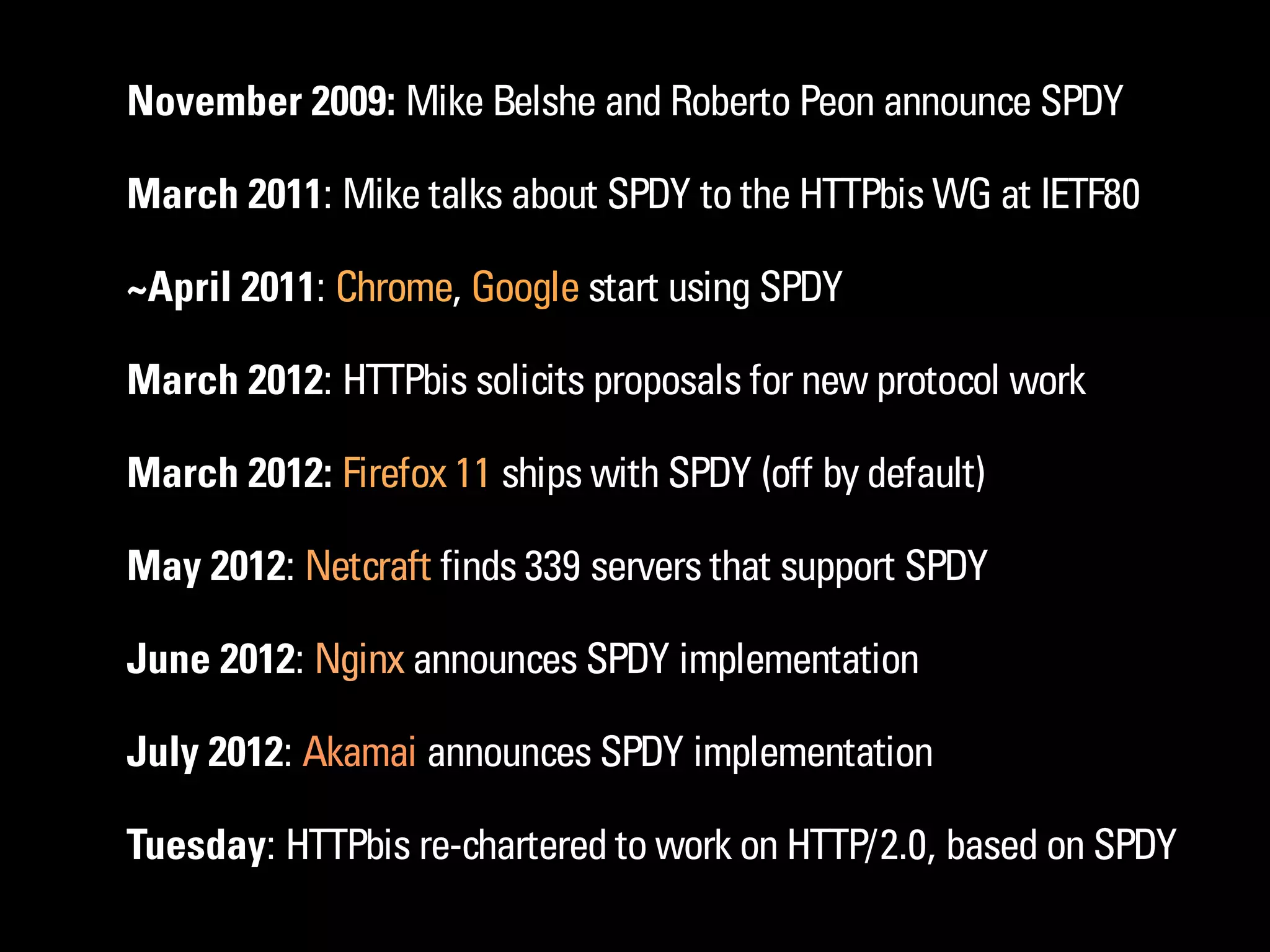
November 2009: Mike Belshe and Roberto Peon announce SPDY

March 2011: Mike talks about SPDY to the HTTPbis WG at IETF80

~April 2011: Chrome, Google start using SPDY

March 2012: HTTPbis solicits proposals for new protocol work

March 2012: Firefox 11 ships with SPDY (off by default)

May 2012: Netcraft finds 339 servers that support SPDY

June 2012: Nginx announces SPDY implementation

July 2012: Akamai announces SPDY implementation

Tuesday: HTTPbis re-chartered to work on HTTP/2.0, based on SPDY
2. What is it?
NO change to HTTP semantics; it’s
 about how it gets onto the wire
Nothing new
 to see here
Not magic
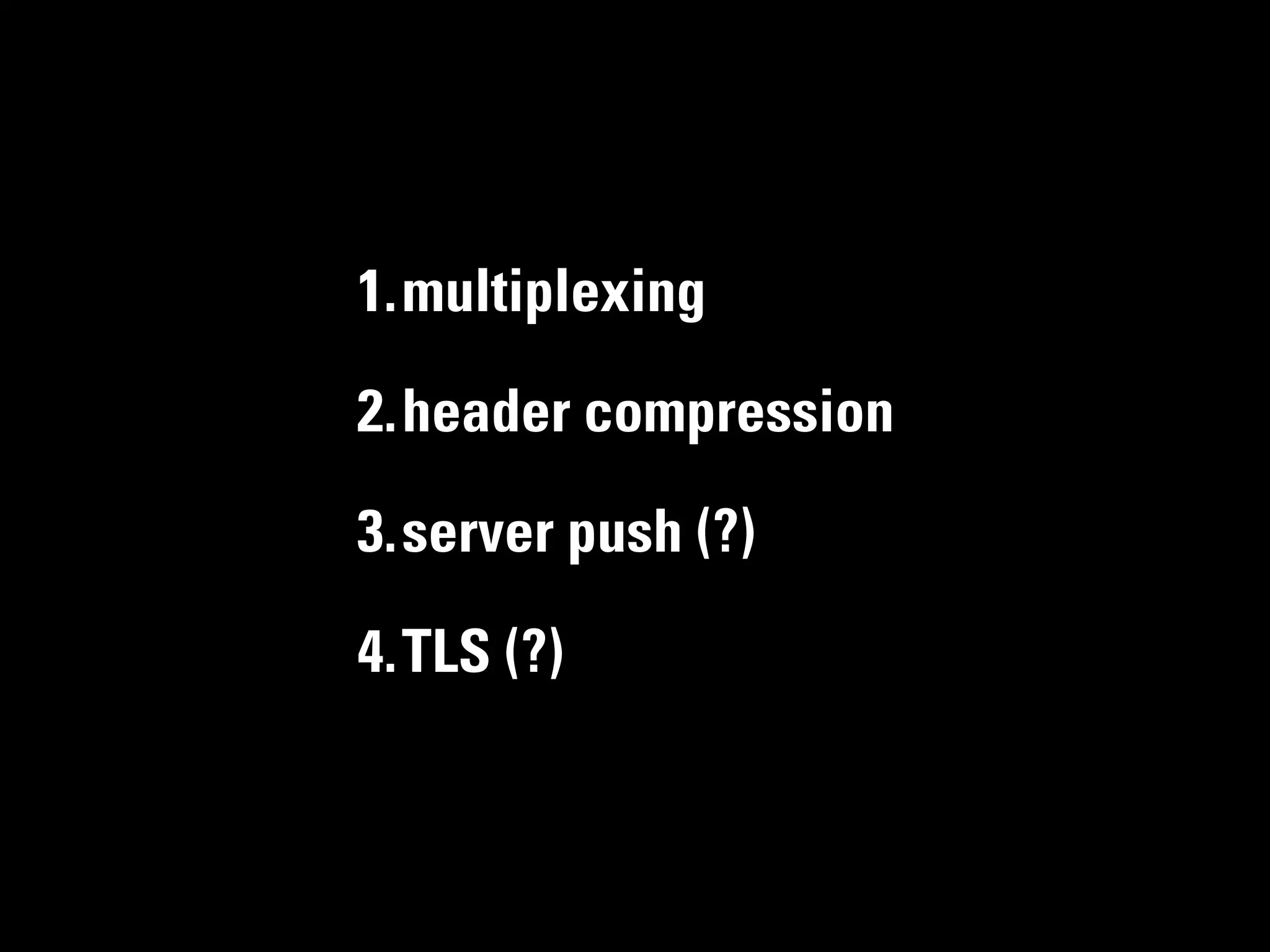
1.multiplexing

2.header compression

3.server push (?)

4.TLS (?)
2.1 multiplexing
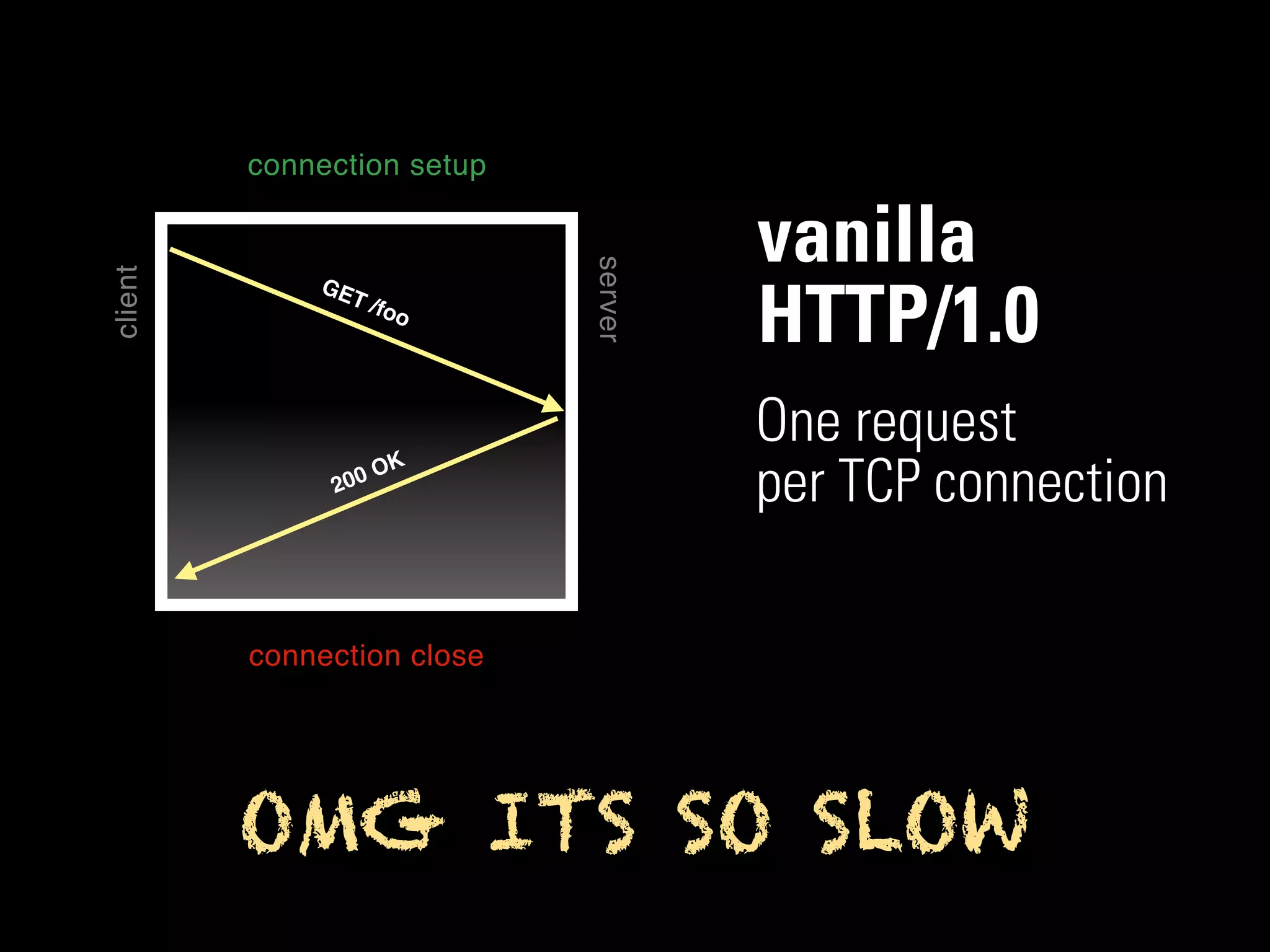
connection setup

                                     vanilla


                            server
client


             GE
                T   /foo
                                     HTTP/1.0
                                     One request
                      K
              200
                  O
                                     per TCP connection

         connection close


         OMG ITS SO SLOW
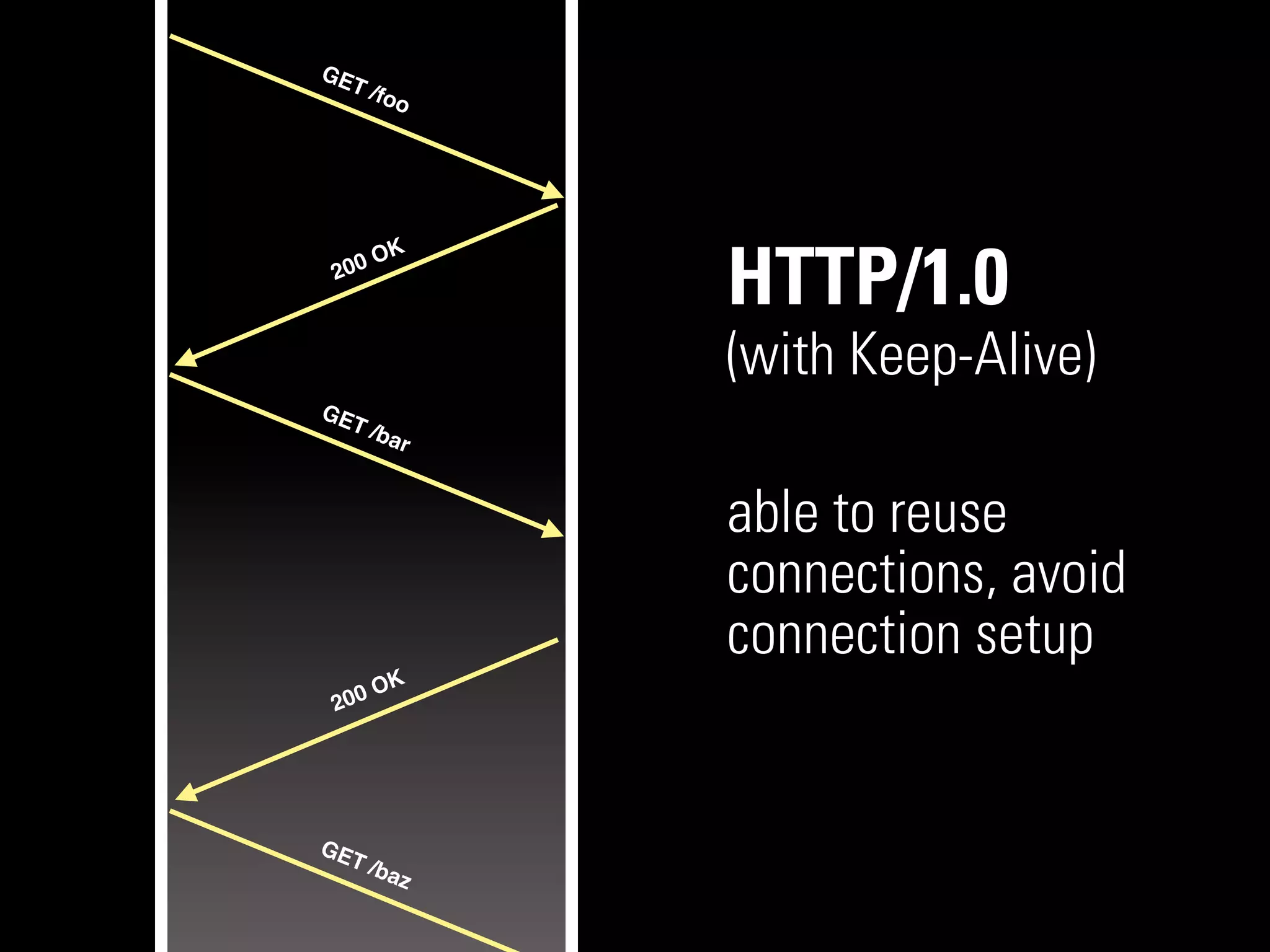
GE
   T   /foo


     O   K
 200
               HTTP/1.0
               (with Keep-Alive)
GE
   T   /ba
           r


               able to reuse
               connections, avoid
               connection setup
     O   K
 200


GE
   T   /ba
           z
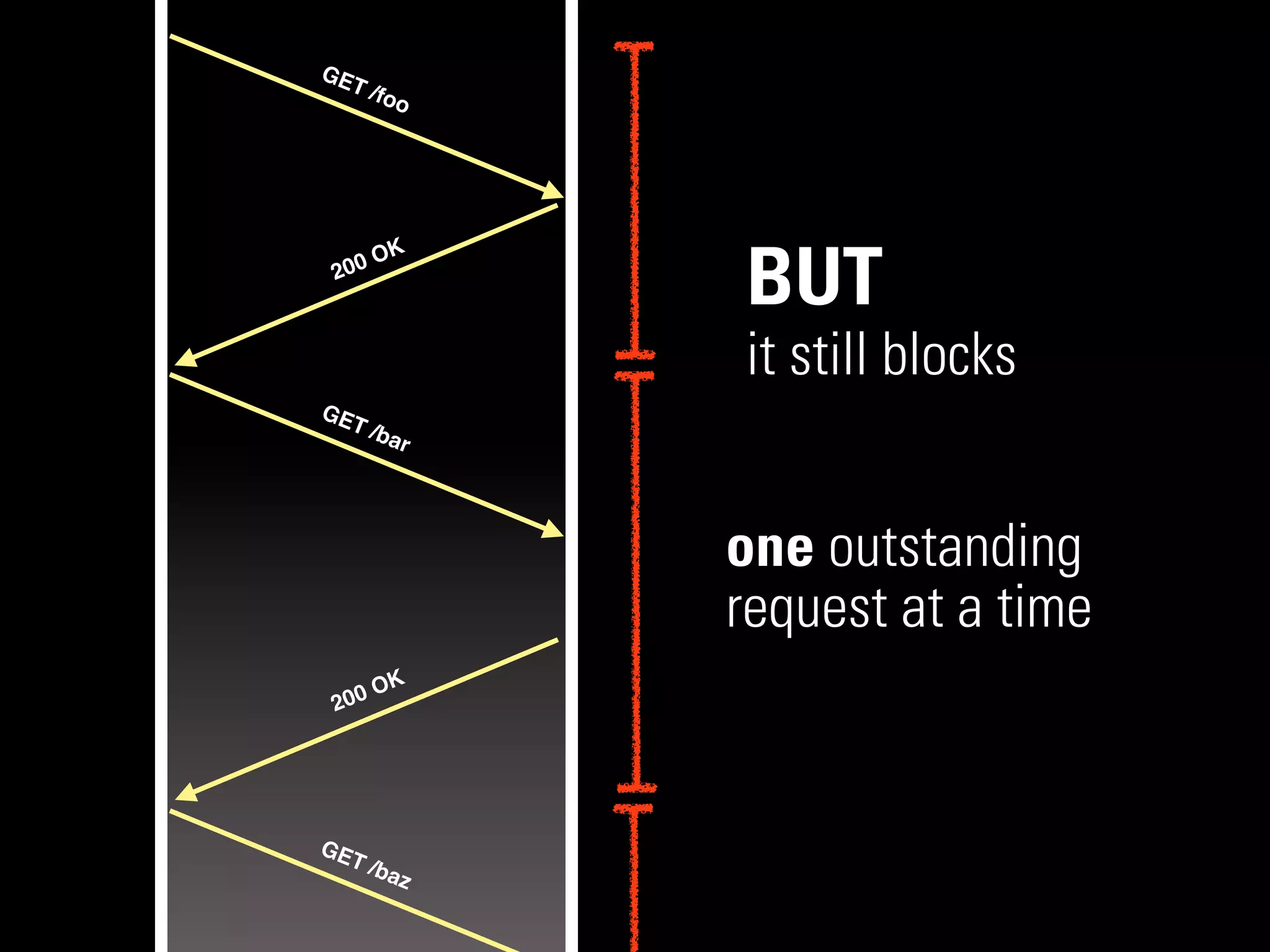
GE
   T   /foo


     O   K
 200
               BUT
               it still blocks
GE
   T   /ba
           r


               one outstanding
               request at a time
     O   K
 200


GE
   T   /ba
           z
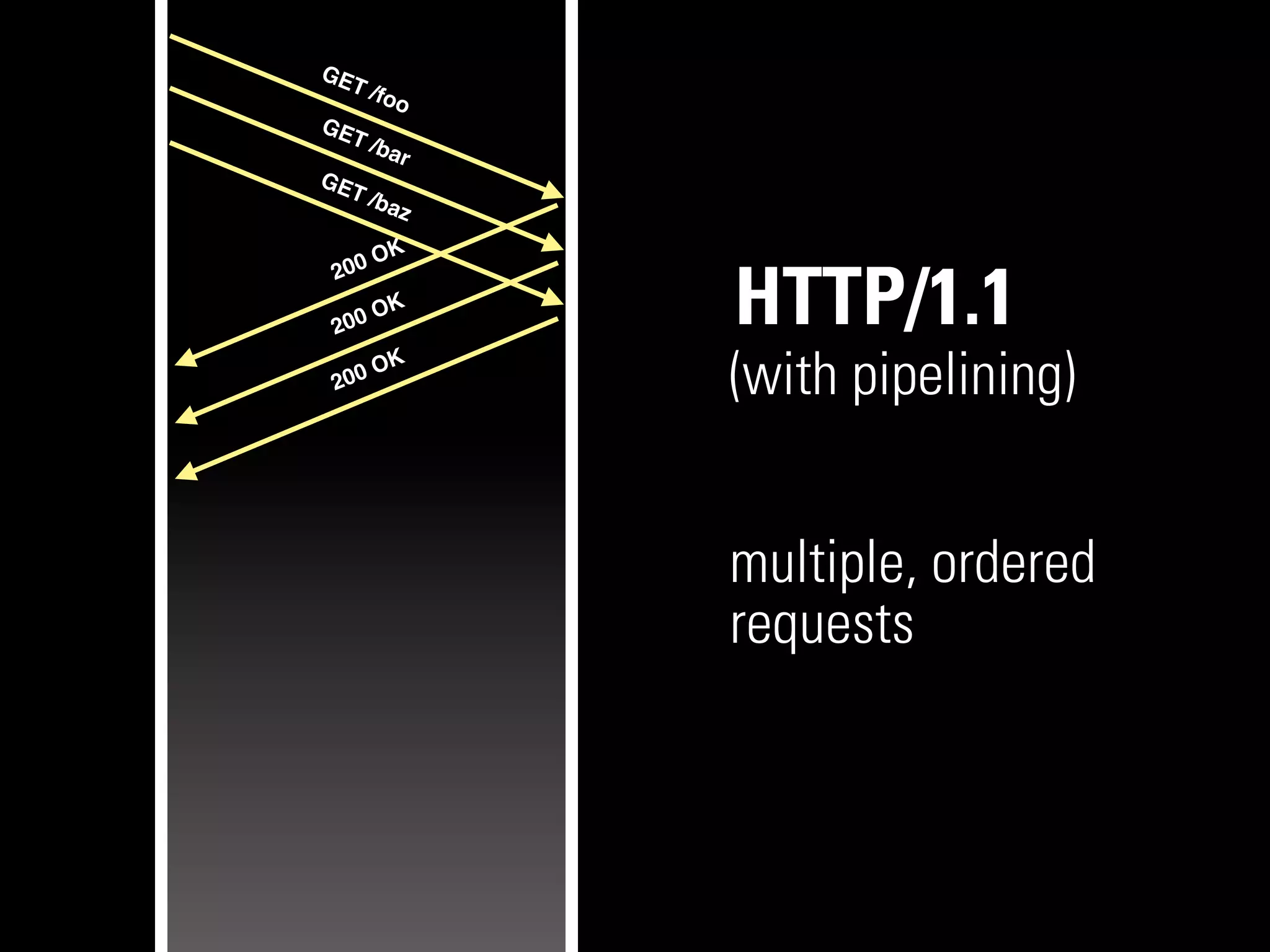
GE
   T   /foo
GE
   T   /ba
           r
GE
   T   /ba
           z

     O   K
 200

 200
     O   K
               HTTP/1.1
       OK
 200           (with pipelining)


               multiple, ordered
               requests
GE
   T   /foo
GE
   T   /ba
           r


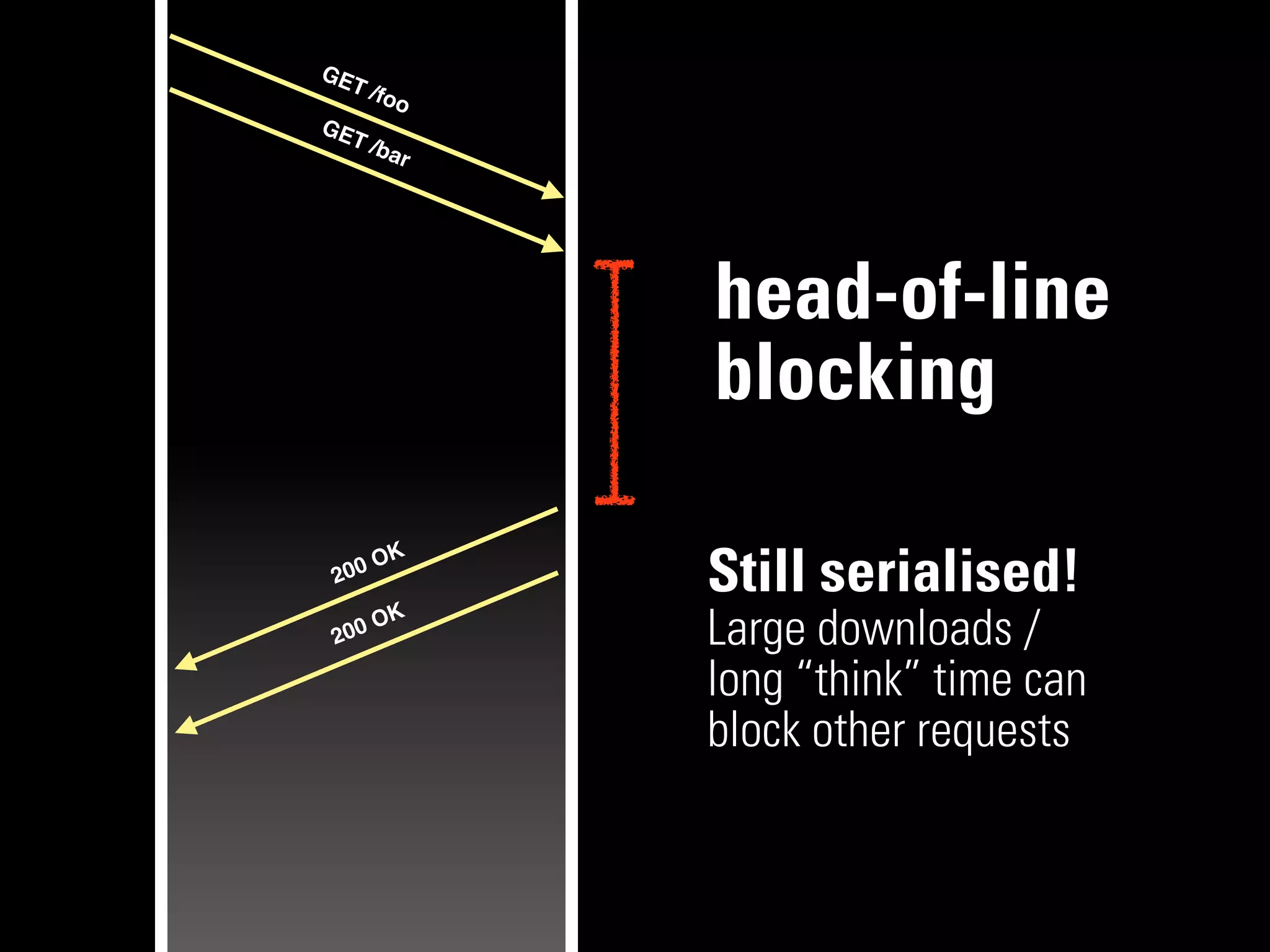
               head-of-line
               blocking

       OK
 200           Still serialised!
          K
 2 00
      O
               Large downloads /
               long “think” time can
               block other requests
The State of the Art
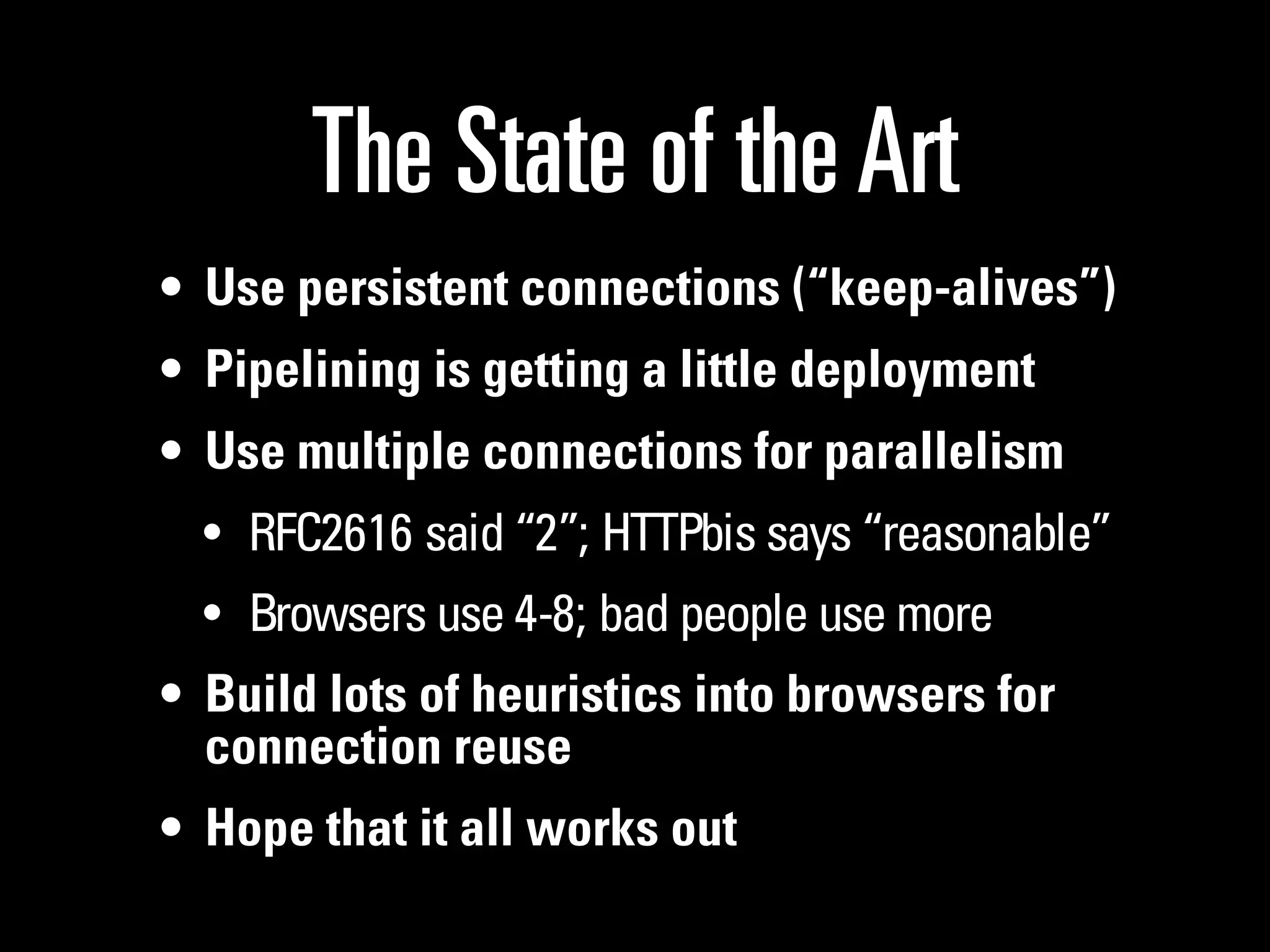
• Use persistent connections (“keep-alives”)
• Pipelining is getting a little deployment
• Use multiple connections for parallelism
  • RFC2616 said “2”; HTTPbis says “reasonable”
  • Browsers use 4-8; bad people use more
• Build lots of heuristics into browsers for
  connection reuse
• Hope that it all works out
What’s so bad about that?
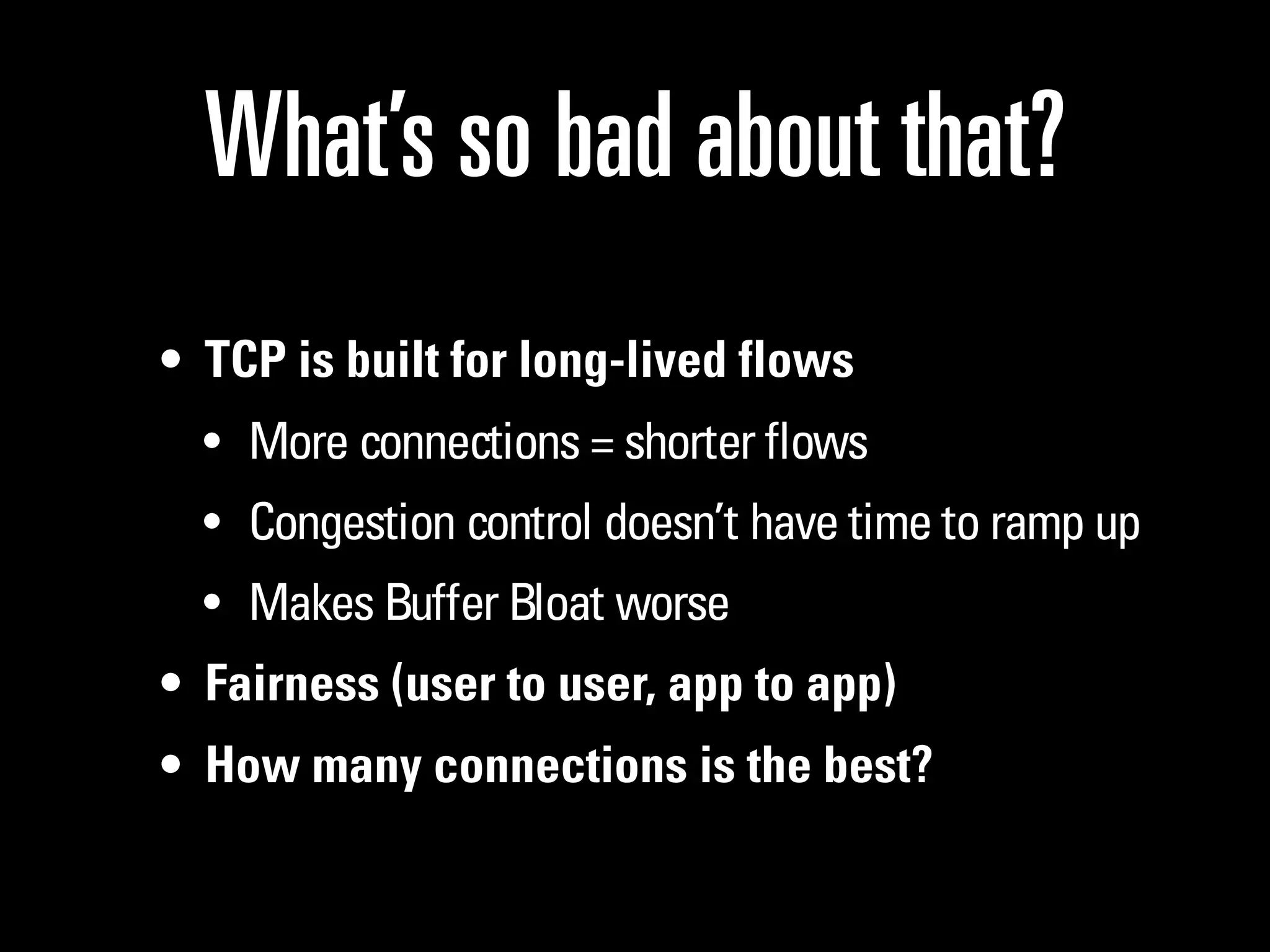
• TCP is built for long-lived flows
  • More connections = shorter flows
  • Congestion control doesn’t have time to ramp up
  • Makes Buffer Bloat worse
• Fairness (user to user, app to app)
• How many connections is the best?
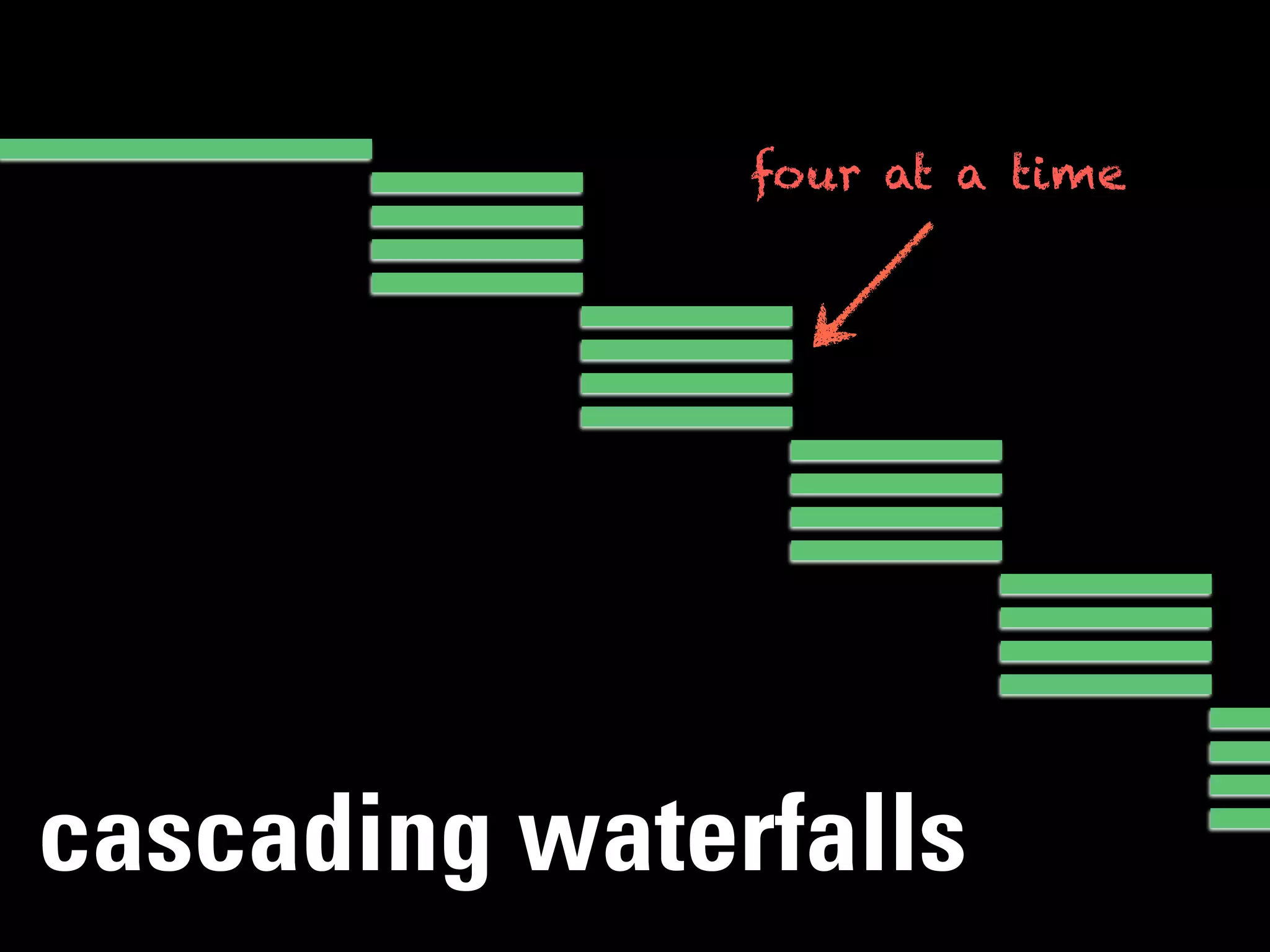
four at a time


cascading waterfalls
GE
   T   /foo


GE
   T   /ba
           r
          K
 2
GE
   00

   T
      O


       /ba
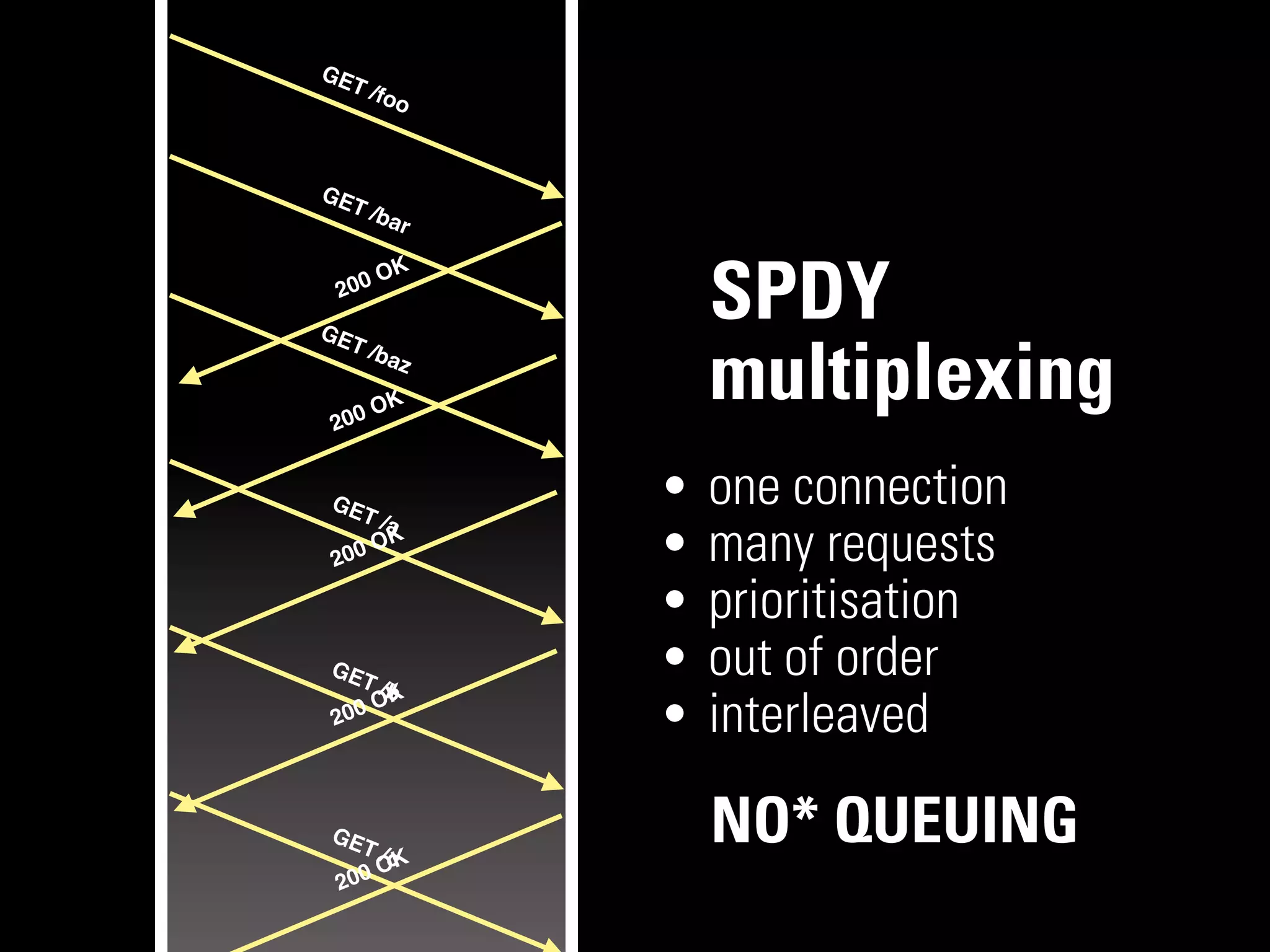
                   SPDY
 2 00
      O   K
           z
                   multiplexing
 GE
    T  /a
               •   one connection
 20   0O
         K
               •   many requests
               •   prioritisation
 GE
    T   /b
               •   out of order
        OK
 20   0
               •   interleaved

 GE
    T   /c
                   NO* QUEUING
      0 OK
 20
2.2 header compression
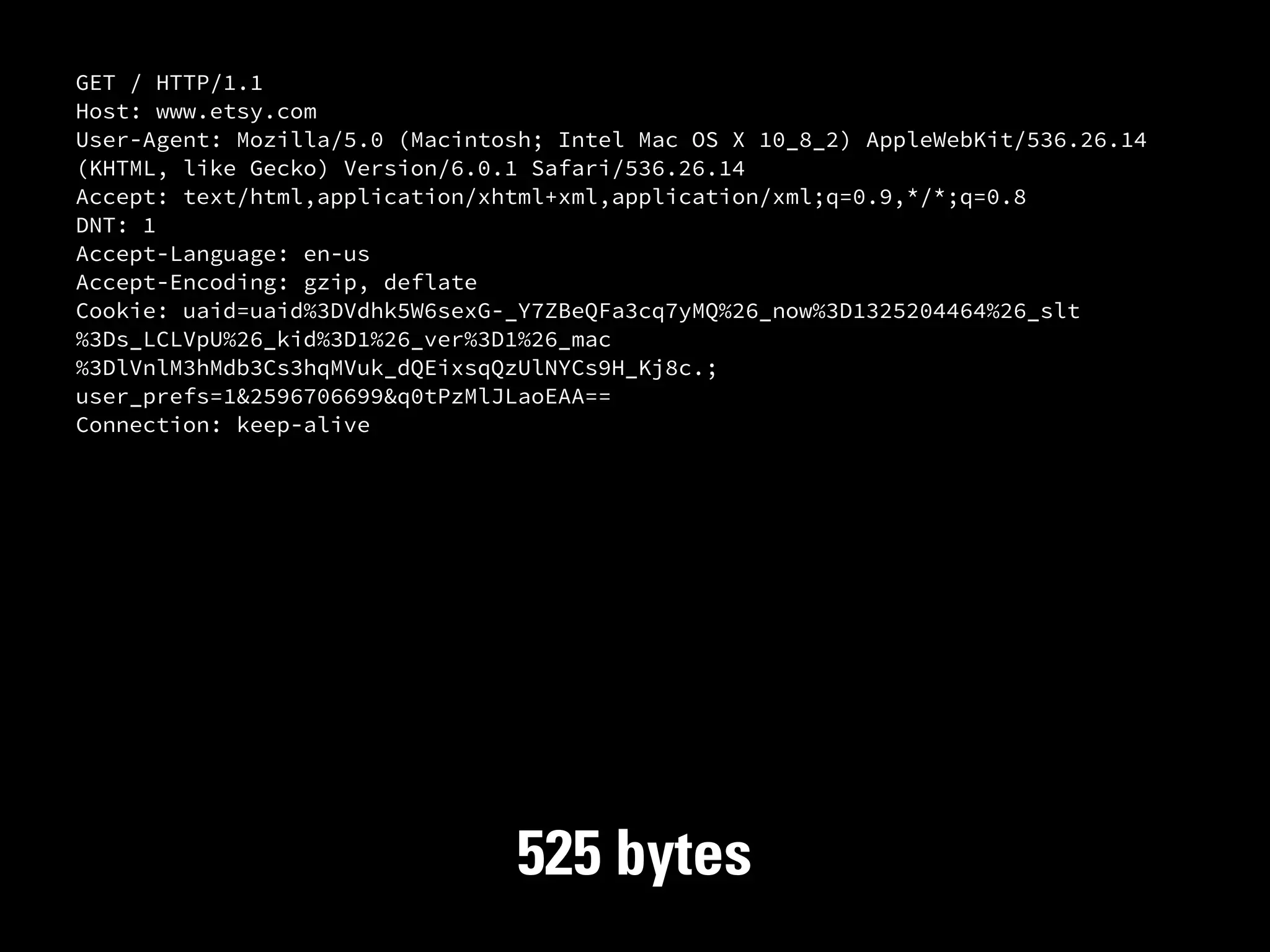
GET / HTTP/1.1
Host: www.etsy.com
User-Agent: Mozilla/5.0 (Macintosh; Intel Mac OS X 10_8_2) AppleWebKit/536.26.14
(KHTML, like Gecko) Version/6.0.1 Safari/536.26.14
Accept: text/html,application/xhtml+xml,application/xml;q=0.9,*/*;q=0.8
DNT: 1
Accept-Language: en-us
Accept-Encoding: gzip, deflate
Cookie: uaid=uaid%3DVdhk5W6sexG-_Y7ZBeQFa3cq7yMQ%26_now%3D1325204464%26_slt
%3Ds_LCLVpU%26_kid%3D1%26_ver%3D1%26_mac
%3DlVnlM3hMdb3Cs3hqMVuk_dQEixsqQzUlNYCs9H_Kj8c.;
user_prefs=1&2596706699&q0tPzMlJLaoEAA==
Connection: keep-alive


                                525 bytes
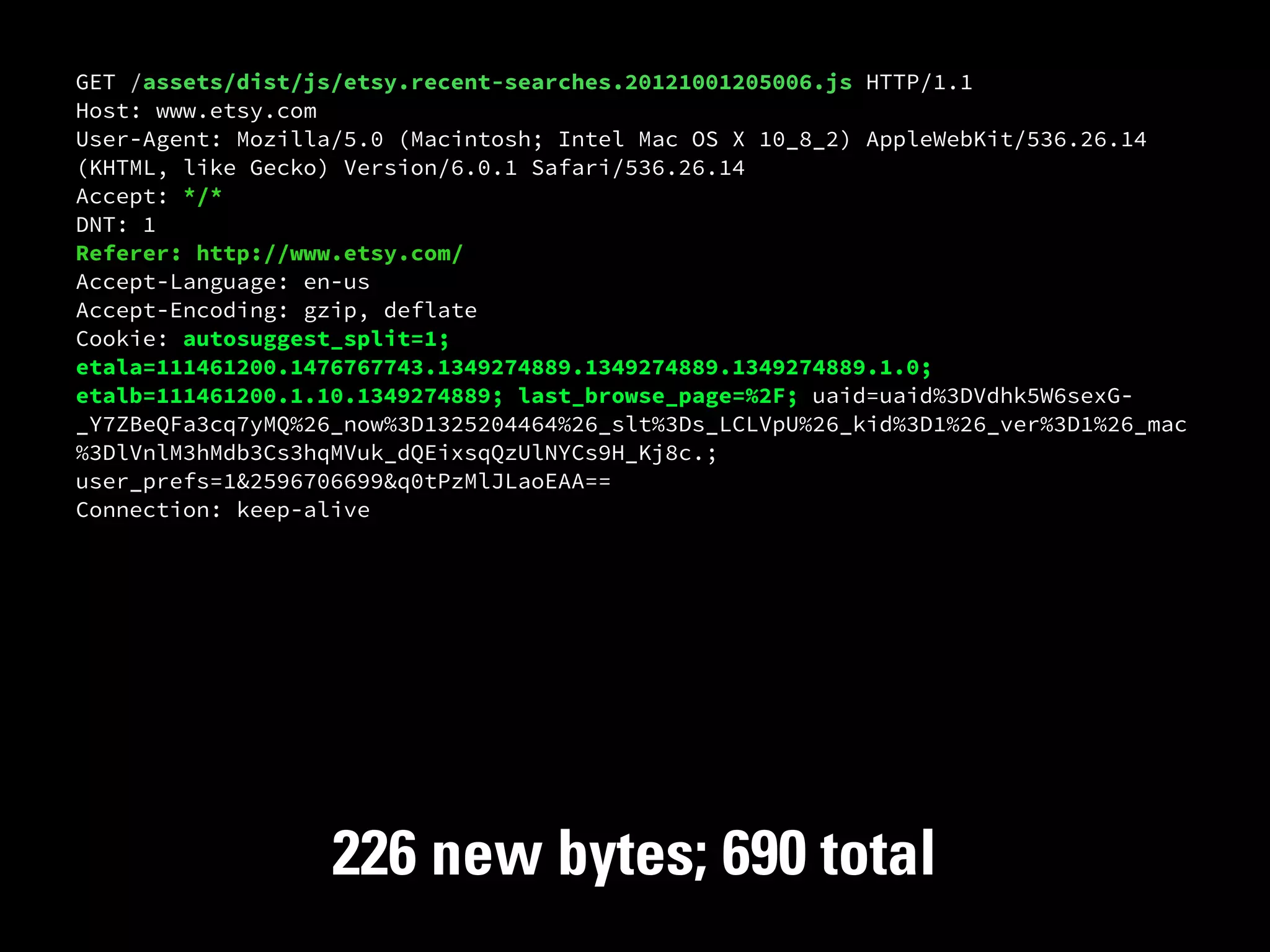
GET /assets/dist/js/etsy.recent-searches.20121001205006.js HTTP/1.1
Host: www.etsy.com
User-Agent: Mozilla/5.0 (Macintosh; Intel Mac OS X 10_8_2) AppleWebKit/536.26.14
(KHTML, like Gecko) Version/6.0.1 Safari/536.26.14
Accept: */*
DNT: 1
Referer: http://www.etsy.com/
Accept-Language: en-us
Accept-Encoding: gzip, deflate
Cookie: autosuggest_split=1;
etala=111461200.1476767743.1349274889.1349274889.1349274889.1.0;
etalb=111461200.1.10.1349274889; last_browse_page=%2F; uaid=uaid%3DVdhk5W6sexG-
_Y7ZBeQFa3cq7yMQ%26_now%3D1325204464%26_slt%3Ds_LCLVpU%26_kid%3D1%26_ver%3D1%26_mac
%3DlVnlM3hMdb3Cs3hqMVuk_dQEixsqQzUlNYCs9H_Kj8c.;
user_prefs=1&2596706699&q0tPzMlJLaoEAA==
Connection: keep-alive


                   226 new bytes; 690 total
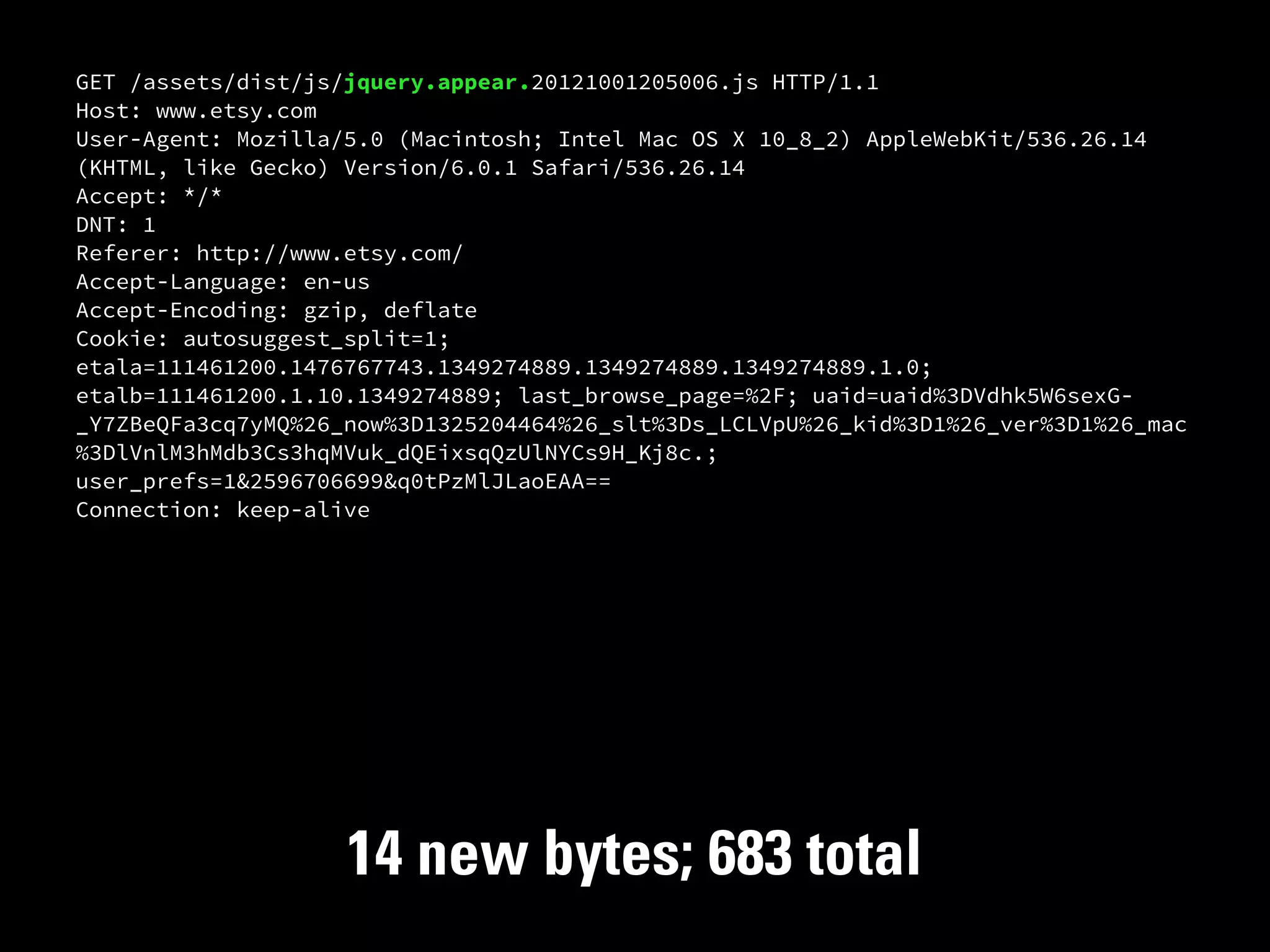
GET /assets/dist/js/jquery.appear.20121001205006.js HTTP/1.1
Host: www.etsy.com
User-Agent: Mozilla/5.0 (Macintosh; Intel Mac OS X 10_8_2) AppleWebKit/536.26.14
(KHTML, like Gecko) Version/6.0.1 Safari/536.26.14
Accept: */*
DNT: 1
Referer: http://www.etsy.com/
Accept-Language: en-us
Accept-Encoding: gzip, deflate
Cookie: autosuggest_split=1;
etala=111461200.1476767743.1349274889.1349274889.1349274889.1.0;
etalb=111461200.1.10.1349274889; last_browse_page=%2F; uaid=uaid%3DVdhk5W6sexG-
_Y7ZBeQFa3cq7yMQ%26_now%3D1325204464%26_slt%3Ds_LCLVpU%26_kid%3D1%26_ver%3D1%26_mac
%3DlVnlM3hMdb3Cs3hqMVuk_dQEixsqQzUlNYCs9H_Kj8c.;
user_prefs=1&2596706699&q0tPzMlJLaoEAA==
Connection: keep-alive


                    14 new bytes; 683 total
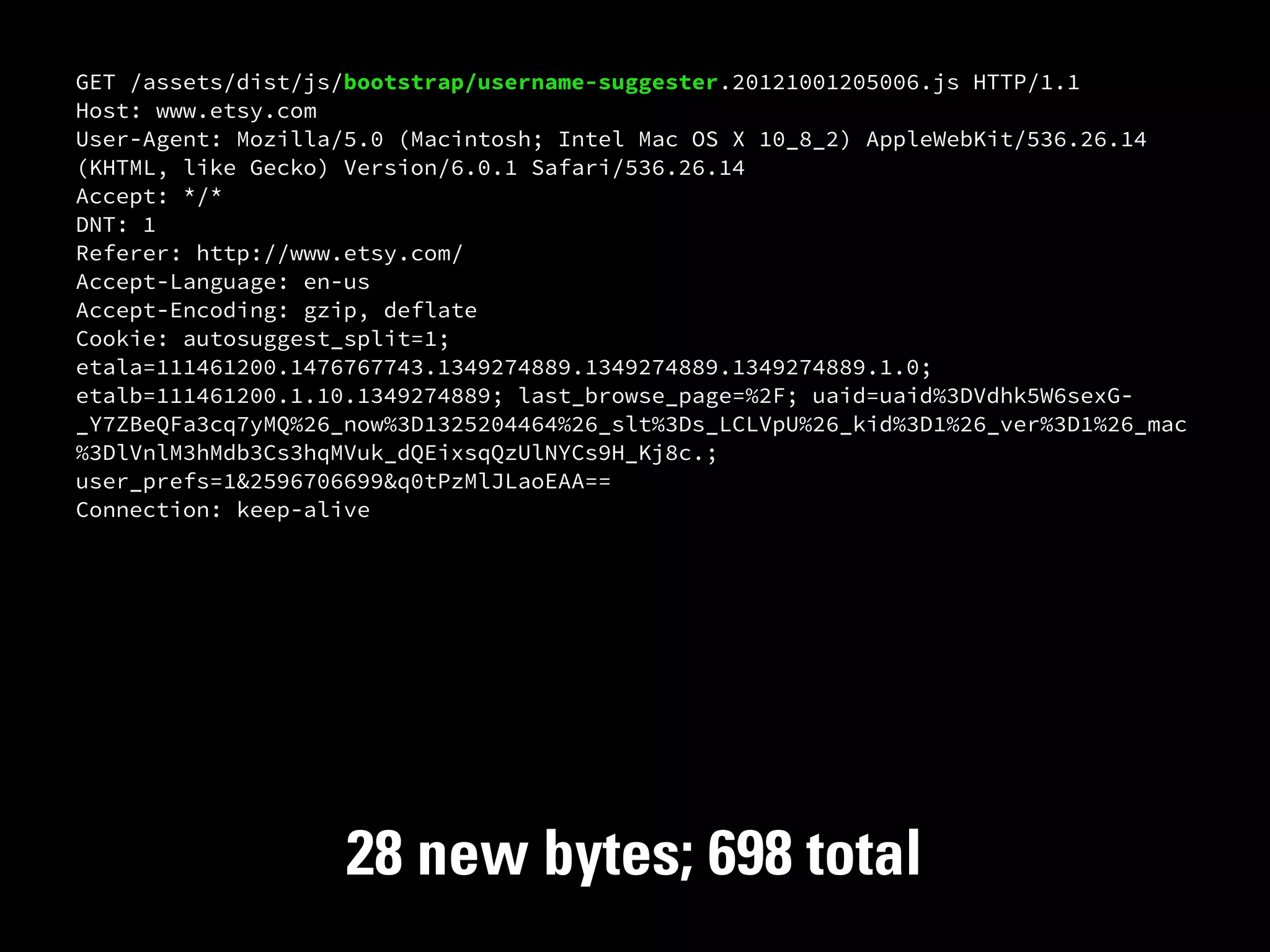
GET /assets/dist/js/bootstrap/username-suggester.20121001205006.js HTTP/1.1
Host: www.etsy.com
User-Agent: Mozilla/5.0 (Macintosh; Intel Mac OS X 10_8_2) AppleWebKit/536.26.14
(KHTML, like Gecko) Version/6.0.1 Safari/536.26.14
Accept: */*
DNT: 1
Referer: http://www.etsy.com/
Accept-Language: en-us
Accept-Encoding: gzip, deflate
Cookie: autosuggest_split=1;
etala=111461200.1476767743.1349274889.1349274889.1349274889.1.0;
etalb=111461200.1.10.1349274889; last_browse_page=%2F; uaid=uaid%3DVdhk5W6sexG-
_Y7ZBeQFa3cq7yMQ%26_now%3D1325204464%26_slt%3Ds_LCLVpU%26_kid%3D1%26_ver%3D1%26_mac
%3DlVnlM3hMdb3Cs3hqMVuk_dQEixsqQzUlNYCs9H_Kj8c.;
user_prefs=1&2596706699&q0tPzMlJLaoEAA==
Connection: keep-alive


                    28 new bytes; 698 total
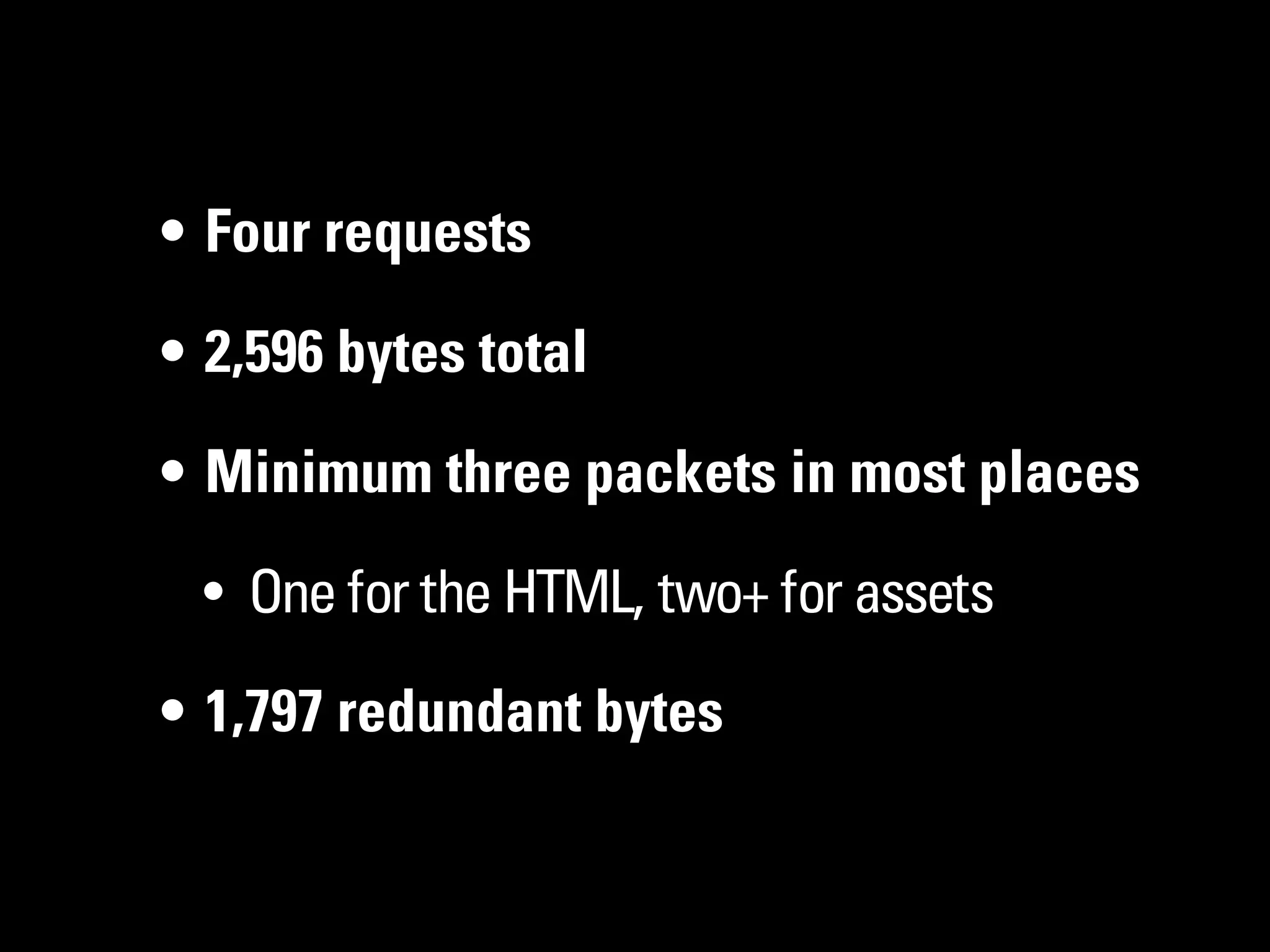
• Four requests

• 2,596 bytes total

• Minimum three packets in most places

 • One for the HTML, two+ for assets

• 1,797 redundant bytes
HTTP headers on a
 connection are
  highly similar
Request URI

User-Agent

Cookies

Referer
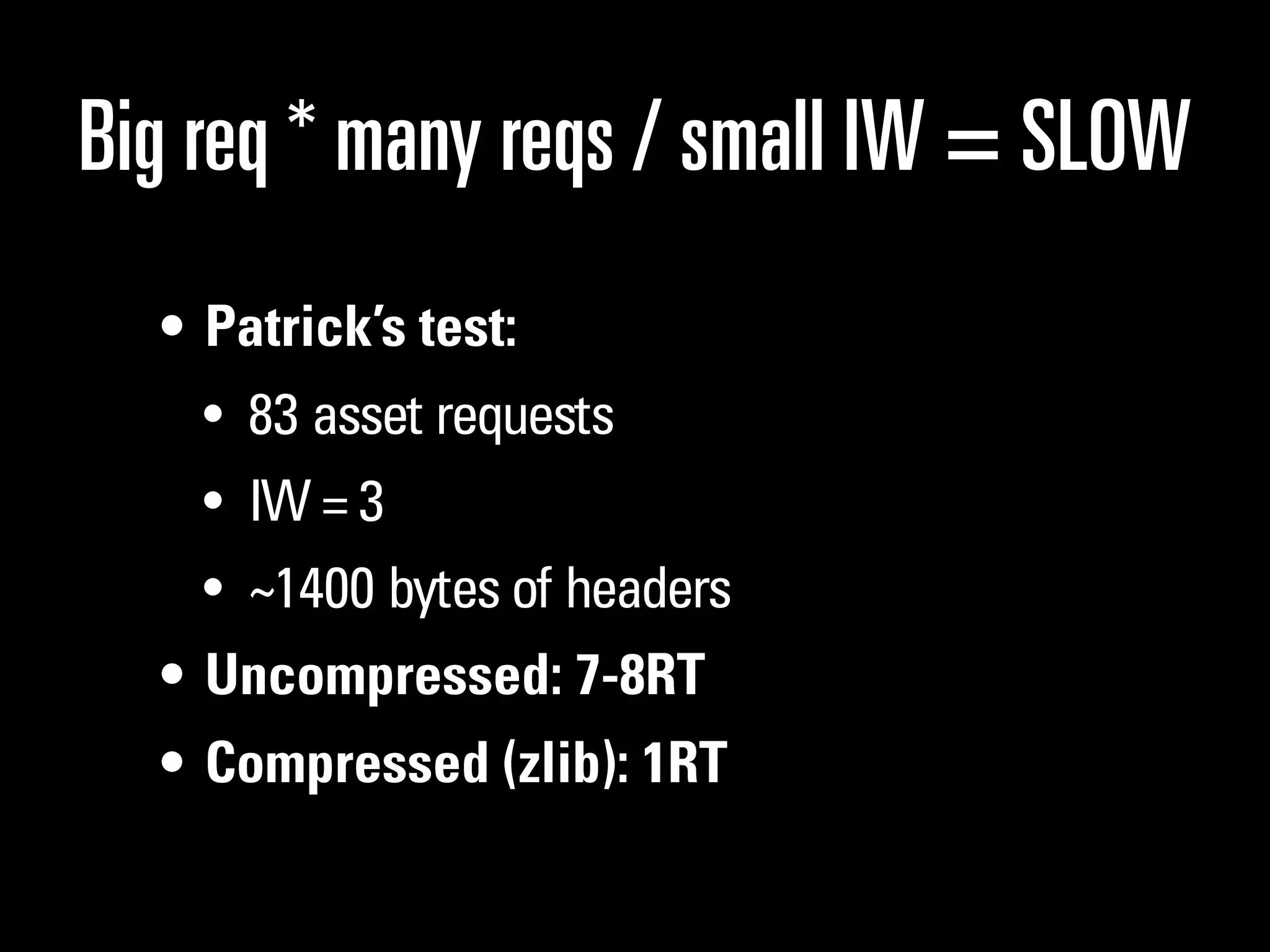
Big req * many reqs / small IW = SLOW
  • Patrick’s test:
    • 83 asset requests
    • IW = 3
    • ~1400 bytes of headers
  • Uncompressed: 7-8RT
  • Compressed (zlib): 1RT
2.3 server push (?)
2.4 TLS?
3. What does it all mean?
HTTP/2.0 is going to
change Web Engineering...
... but not change
HTTP APIs. Much.
Leaky Abstractions
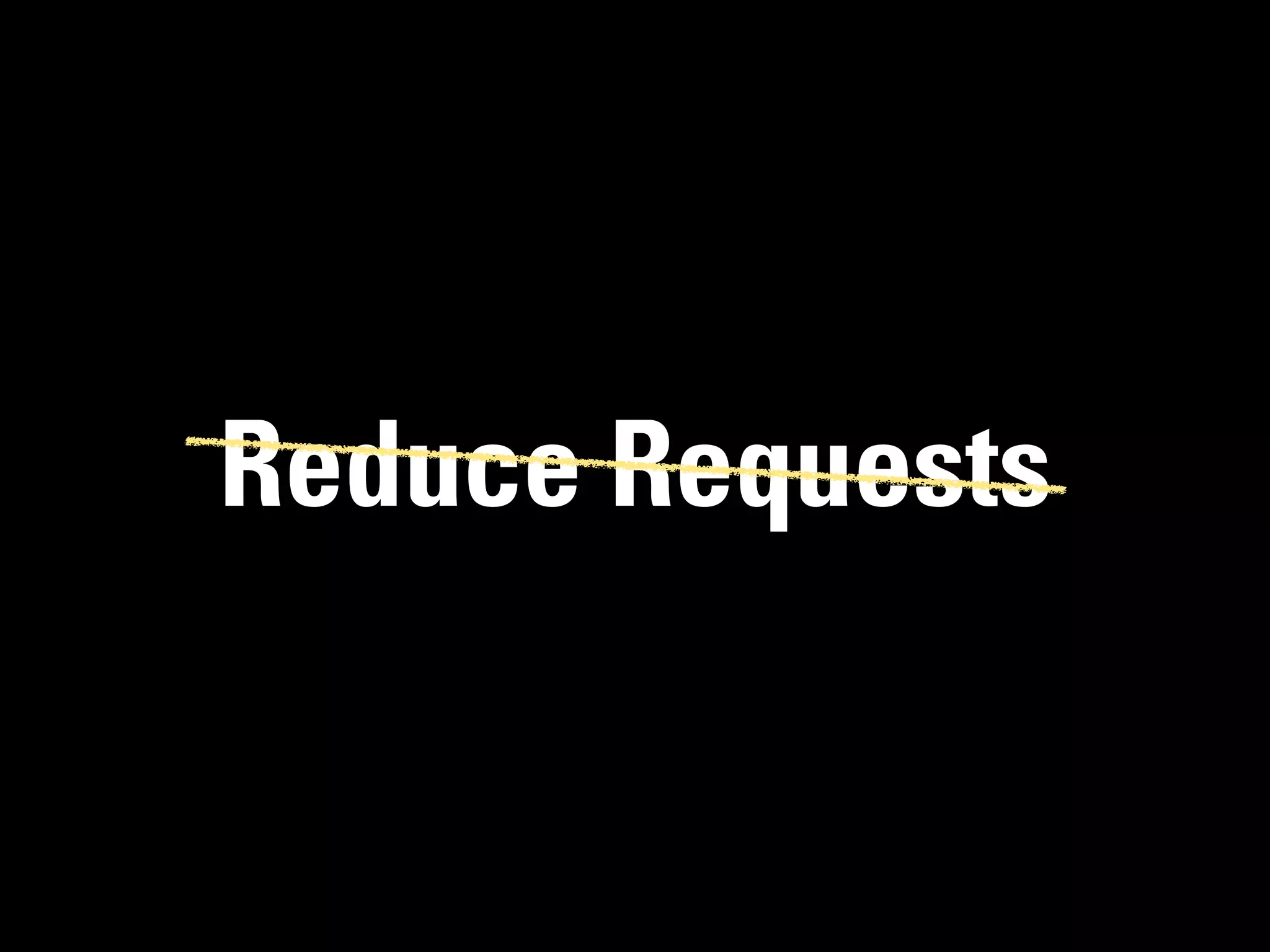
Reduce Requests
• Image spriting - not necessary

• CSS / JS can be in multiple files

• HTTP APIs can be finer-grained without
  sacrificing performance

• Third party content is an even bigger
  problem
Domain Sharding
• Multiplexing SHOULD make multiple
  connections unnecessary

• Key is to get the TCP connection
  “warm” as quickly as possible, and
  keep it there
Header Optimisation
• Now, adding new headers is easy

 • Very small performance / latency /
   bandwidth impact

• What should be in headers can be in
  headers

• Content Negotiation might become
  interesting again
Predictability
Better Error
 Handling
Debugging will
  need Tools
Lots of tweaking
   • Prioritisation
   • When to Push
   • Flow Control
Transition Decisions
• De-sharding
• De-combining scripts
• De-spriting
• etc.
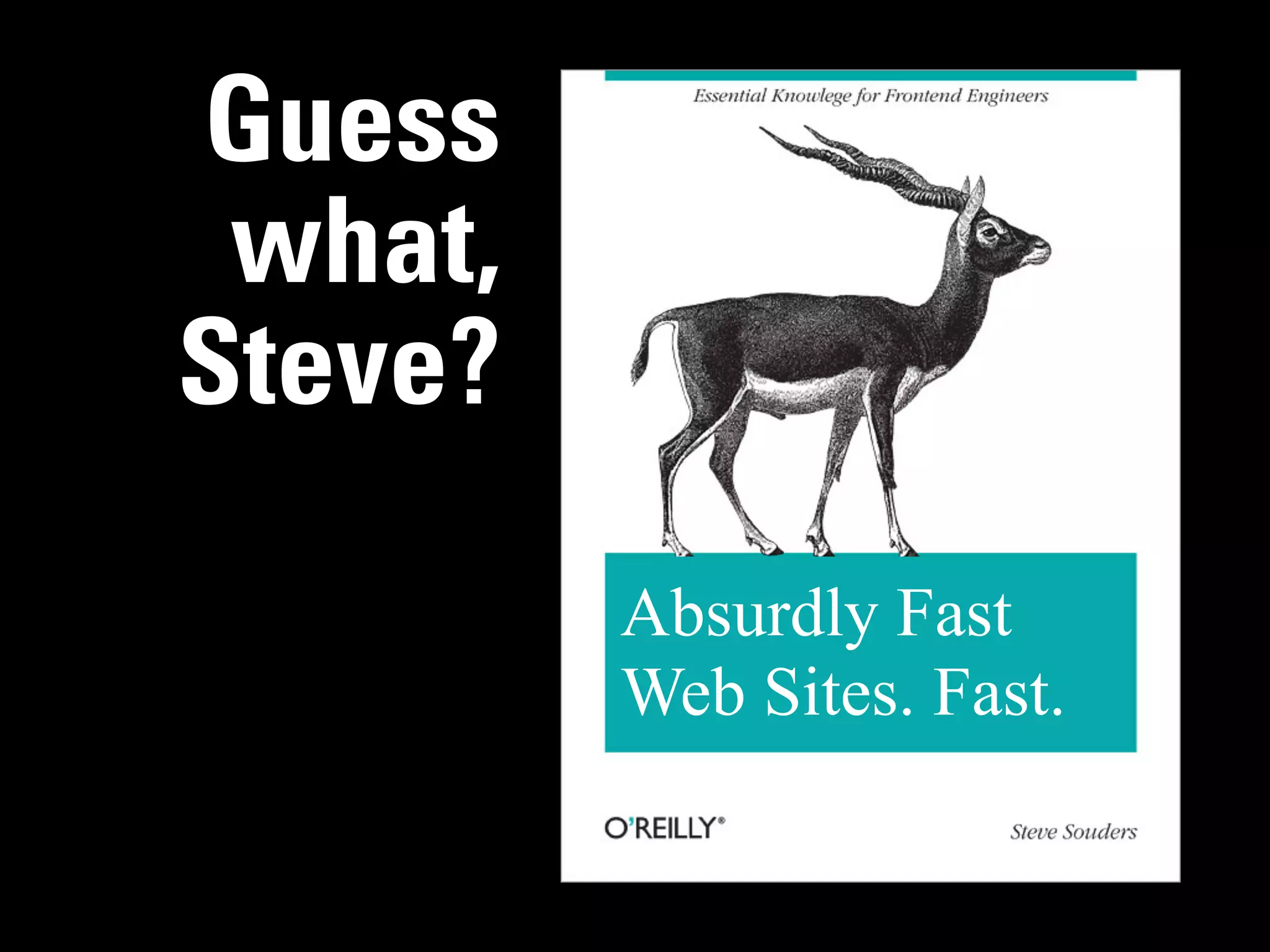
Guess
 what,
Steve?
         Absurdly Fast
         Web Sites. Fast.
4. What’s still wrong
4.1 Security is hard
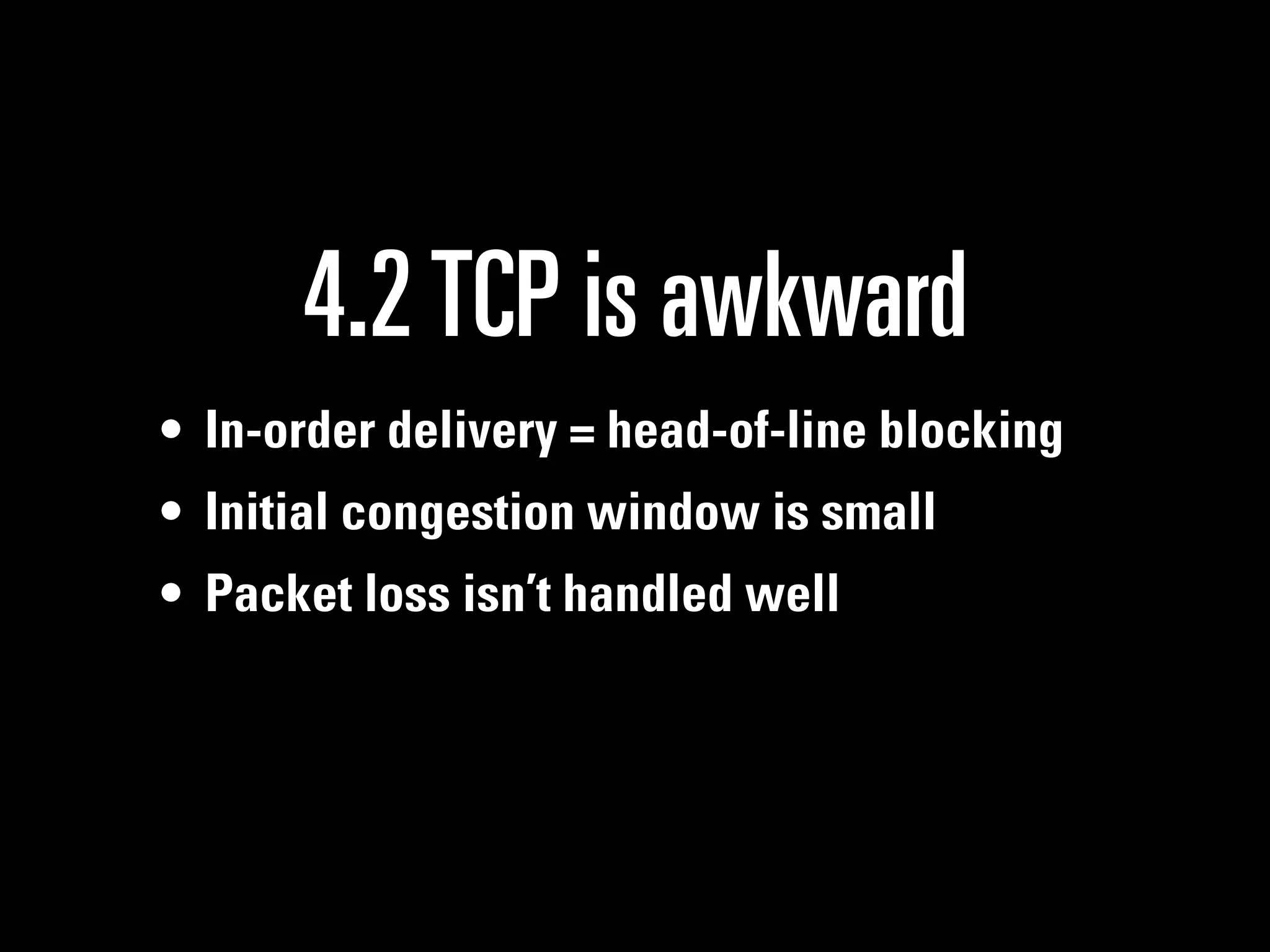
4.2 TCP is awkward
• In-order delivery = head-of-line blocking
• Initial congestion window is small
• Packet loss isn’t handled well
HTTP as the
“Everything Protocol”
          ?
Some Links

http://bit.ly/httpbis-home

http://www.chromium.org/spdy

http://www.mnot.net/

What HTTP/2.0 Will Do For You

  • 1.
    What HTTP/2.0 will* TO __ do for you Mark Nottingham http://www.mnot.net/ or, @mnot
  • 2.
    * forward-looking statement ___ statement based on TECHNICA L A projected financial management expectations. A forward- looking statement involves risks with regard to the accuracy of assumptions underlying the projections. Discussions of these statements typically include words such as estimate, anticipate, project, and believe.
  • 3.
  • 4.
    IETF HTTPbis WG WHAT?to clarify RFC2616 and improve interop WHO? Roy Fielding, Julian Reschke WHO (2)? Apache, Mozilla, Chrome, IIS, Varnish, Squid, F5, Curl, ATS, IE, HAProxy... WHEN: Almost finished! WHEN (2): ... after FIVE YEARS :(
  • 5.
    IETF HTTPbis WG(2) STRICTLY chartered to avoid making a new version of the protocol. Because EVERYBODY knows that’s not going to happen.
  • 6.
  • 7.
    November 2009: MikeBelshe and Roberto Peon announce SPDY March 2011: Mike talks about SPDY to the HTTPbis WG at IETF80 ~April 2011: Chrome, Google start using SPDY March 2012: HTTPbis solicits proposals for new protocol work March 2012: Firefox 11 ships with SPDY (off by default) May 2012: Netcraft finds 339 servers that support SPDY June 2012: Nginx announces SPDY implementation July 2012: Akamai announces SPDY implementation Tuesday: HTTPbis re-chartered to work on HTTP/2.0, based on SPDY
  • 8.
  • 9.
    NO change toHTTP semantics; it’s about how it gets onto the wire
  • 10.
  • 11.
  • 12.
  • 13.
  • 14.
    connection setup vanilla server client GE T /foo HTTP/1.0 One request K 200 O per TCP connection connection close OMG ITS SO SLOW
  • 15.
    GE T /foo O K 200 HTTP/1.0 (with Keep-Alive) GE T /ba r able to reuse connections, avoid connection setup O K 200 GE T /ba z
  • 16.
    GE T /foo O K 200 BUT it still blocks GE T /ba r one outstanding request at a time O K 200 GE T /ba z
  • 17.
    GE T /foo GE T /ba r GE T /ba z O K 200 200 O K HTTP/1.1 OK 200 (with pipelining) multiple, ordered requests
  • 18.
    GE T /foo GE T /ba r head-of-line blocking OK 200 Still serialised! K 2 00 O Large downloads / long “think” time can block other requests
  • 19.
    The State ofthe Art • Use persistent connections (“keep-alives”) • Pipelining is getting a little deployment • Use multiple connections for parallelism • RFC2616 said “2”; HTTPbis says “reasonable” • Browsers use 4-8; bad people use more • Build lots of heuristics into browsers for connection reuse • Hope that it all works out
  • 20.
    What’s so badabout that? • TCP is built for long-lived flows • More connections = shorter flows • Congestion control doesn’t have time to ramp up • Makes Buffer Bloat worse • Fairness (user to user, app to app) • How many connections is the best?
  • 21.
    four at atime cascading waterfalls
  • 22.
    GE T /foo GE T /ba r K 2 GE 00 T O /ba SPDY 2 00 O K z multiplexing GE T /a • one connection 20 0O K • many requests • prioritisation GE T /b • out of order OK 20 0 • interleaved GE T /c NO* QUEUING 0 OK 20
  • 23.
  • 24.
    GET / HTTP/1.1 Host:www.etsy.com User-Agent: Mozilla/5.0 (Macintosh; Intel Mac OS X 10_8_2) AppleWebKit/536.26.14 (KHTML, like Gecko) Version/6.0.1 Safari/536.26.14 Accept: text/html,application/xhtml+xml,application/xml;q=0.9,*/*;q=0.8 DNT: 1 Accept-Language: en-us Accept-Encoding: gzip, deflate Cookie: uaid=uaid%3DVdhk5W6sexG-_Y7ZBeQFa3cq7yMQ%26_now%3D1325204464%26_slt %3Ds_LCLVpU%26_kid%3D1%26_ver%3D1%26_mac %3DlVnlM3hMdb3Cs3hqMVuk_dQEixsqQzUlNYCs9H_Kj8c.; user_prefs=1&2596706699&q0tPzMlJLaoEAA== Connection: keep-alive 525 bytes
  • 25.
    GET /assets/dist/js/etsy.recent-searches.20121001205006.js HTTP/1.1 Host:www.etsy.com User-Agent: Mozilla/5.0 (Macintosh; Intel Mac OS X 10_8_2) AppleWebKit/536.26.14 (KHTML, like Gecko) Version/6.0.1 Safari/536.26.14 Accept: */* DNT: 1 Referer: http://www.etsy.com/ Accept-Language: en-us Accept-Encoding: gzip, deflate Cookie: autosuggest_split=1; etala=111461200.1476767743.1349274889.1349274889.1349274889.1.0; etalb=111461200.1.10.1349274889; last_browse_page=%2F; uaid=uaid%3DVdhk5W6sexG- _Y7ZBeQFa3cq7yMQ%26_now%3D1325204464%26_slt%3Ds_LCLVpU%26_kid%3D1%26_ver%3D1%26_mac %3DlVnlM3hMdb3Cs3hqMVuk_dQEixsqQzUlNYCs9H_Kj8c.; user_prefs=1&2596706699&q0tPzMlJLaoEAA== Connection: keep-alive 226 new bytes; 690 total
  • 26.
    GET /assets/dist/js/jquery.appear.20121001205006.js HTTP/1.1 Host:www.etsy.com User-Agent: Mozilla/5.0 (Macintosh; Intel Mac OS X 10_8_2) AppleWebKit/536.26.14 (KHTML, like Gecko) Version/6.0.1 Safari/536.26.14 Accept: */* DNT: 1 Referer: http://www.etsy.com/ Accept-Language: en-us Accept-Encoding: gzip, deflate Cookie: autosuggest_split=1; etala=111461200.1476767743.1349274889.1349274889.1349274889.1.0; etalb=111461200.1.10.1349274889; last_browse_page=%2F; uaid=uaid%3DVdhk5W6sexG- _Y7ZBeQFa3cq7yMQ%26_now%3D1325204464%26_slt%3Ds_LCLVpU%26_kid%3D1%26_ver%3D1%26_mac %3DlVnlM3hMdb3Cs3hqMVuk_dQEixsqQzUlNYCs9H_Kj8c.; user_prefs=1&2596706699&q0tPzMlJLaoEAA== Connection: keep-alive 14 new bytes; 683 total
  • 27.
    GET /assets/dist/js/bootstrap/username-suggester.20121001205006.js HTTP/1.1 Host:www.etsy.com User-Agent: Mozilla/5.0 (Macintosh; Intel Mac OS X 10_8_2) AppleWebKit/536.26.14 (KHTML, like Gecko) Version/6.0.1 Safari/536.26.14 Accept: */* DNT: 1 Referer: http://www.etsy.com/ Accept-Language: en-us Accept-Encoding: gzip, deflate Cookie: autosuggest_split=1; etala=111461200.1476767743.1349274889.1349274889.1349274889.1.0; etalb=111461200.1.10.1349274889; last_browse_page=%2F; uaid=uaid%3DVdhk5W6sexG- _Y7ZBeQFa3cq7yMQ%26_now%3D1325204464%26_slt%3Ds_LCLVpU%26_kid%3D1%26_ver%3D1%26_mac %3DlVnlM3hMdb3Cs3hqMVuk_dQEixsqQzUlNYCs9H_Kj8c.; user_prefs=1&2596706699&q0tPzMlJLaoEAA== Connection: keep-alive 28 new bytes; 698 total
  • 28.
    • Four requests •2,596 bytes total • Minimum three packets in most places • One for the HTML, two+ for assets • 1,797 redundant bytes
  • 29.
    HTTP headers ona connection are highly similar
  • 30.
  • 31.
    Big req *many reqs / small IW = SLOW • Patrick’s test: • 83 asset requests • IW = 3 • ~1400 bytes of headers • Uncompressed: 7-8RT • Compressed (zlib): 1RT
  • 32.
  • 33.
  • 34.
    3. What doesit all mean?
  • 35.
    HTTP/2.0 is goingto change Web Engineering...
  • 36.
    ... but notchange HTTP APIs. Much.
  • 37.
  • 38.
  • 39.
    • Image spriting- not necessary • CSS / JS can be in multiple files • HTTP APIs can be finer-grained without sacrificing performance • Third party content is an even bigger problem
  • 40.
  • 41.
    • Multiplexing SHOULDmake multiple connections unnecessary • Key is to get the TCP connection “warm” as quickly as possible, and keep it there
  • 42.
  • 43.
    • Now, addingnew headers is easy • Very small performance / latency / bandwidth impact • What should be in headers can be in headers • Content Negotiation might become interesting again
  • 44.
  • 45.
  • 46.
    Debugging will need Tools
  • 47.
    Lots of tweaking • Prioritisation • When to Push • Flow Control
  • 48.
    Transition Decisions • De-sharding •De-combining scripts • De-spriting • etc.
  • 49.
    Guess what, Steve? Absurdly Fast Web Sites. Fast.
  • 50.
  • 51.
  • 52.
    4.2 TCP isawkward • In-order delivery = head-of-line blocking • Initial congestion window is small • Packet loss isn’t handled well
  • 53.
  • 54.