Module 1 Lesson 2 Ratios.notebook 
1 
September 09, 2014 
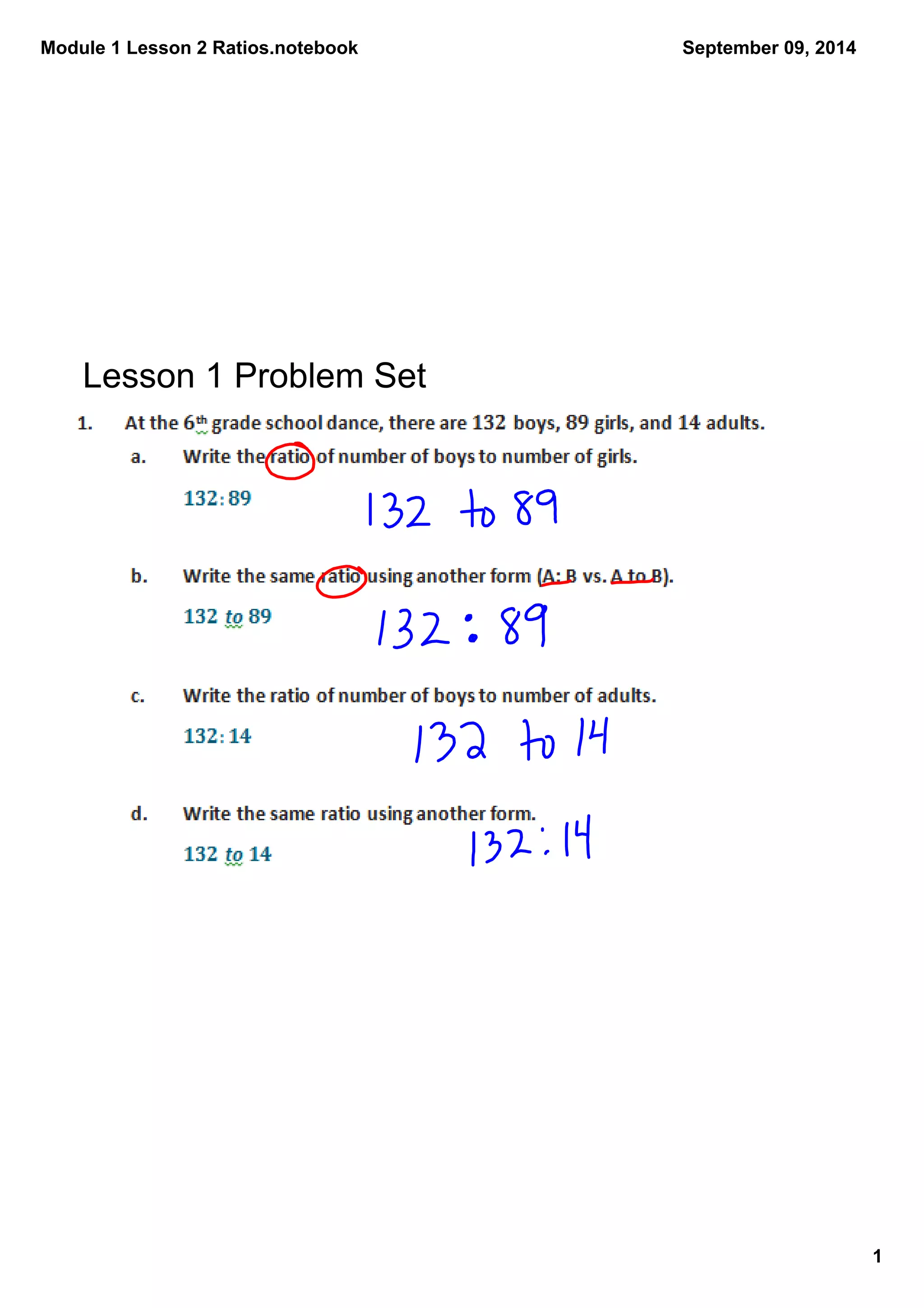
Lesson 1 Problem Set
Module 1 Lesson 2 Ratios.notebook 
2 
September 09, 2014
Module 1 Lesson 2 Ratios.notebook 
3 
September 09, 2014 
Module 1 
Ratios and Unit Rates 
Topic A: Representing and Reasoning About Ratios 
Lesson 2: Ratios 
Student Outcomes 
§ Students reinforce their understanding that a ratio is an ordered pair of non‐negative numbers, which are not both zero. Students continue to learn and use the precise 
language and notation of ratios (e.g., 3:2, 3 to 2). Students demonstrate their understanding that the order of the pair of numbers in a ratio matters. 
§ Students create multiple ratios from a context in which more than two quantities are given. Students conceive of real‐world contextual situations to match a given ratio.
Module 1 Lesson 2 Ratios.notebook 
4 
September 09, 2014 
Classwork 
Exercise 1 
Come up with two examples of ratio relationships that are interesting to you. 
1. 
2. 
What are the verbal cues that tell us someone is talking about a ratio relationship? 
___________________ ___________________ 
___________________ ___________________
Module 1 Lesson 2 Ratios.notebook 
5 
September 09, 2014 
Exploratory Challenge 
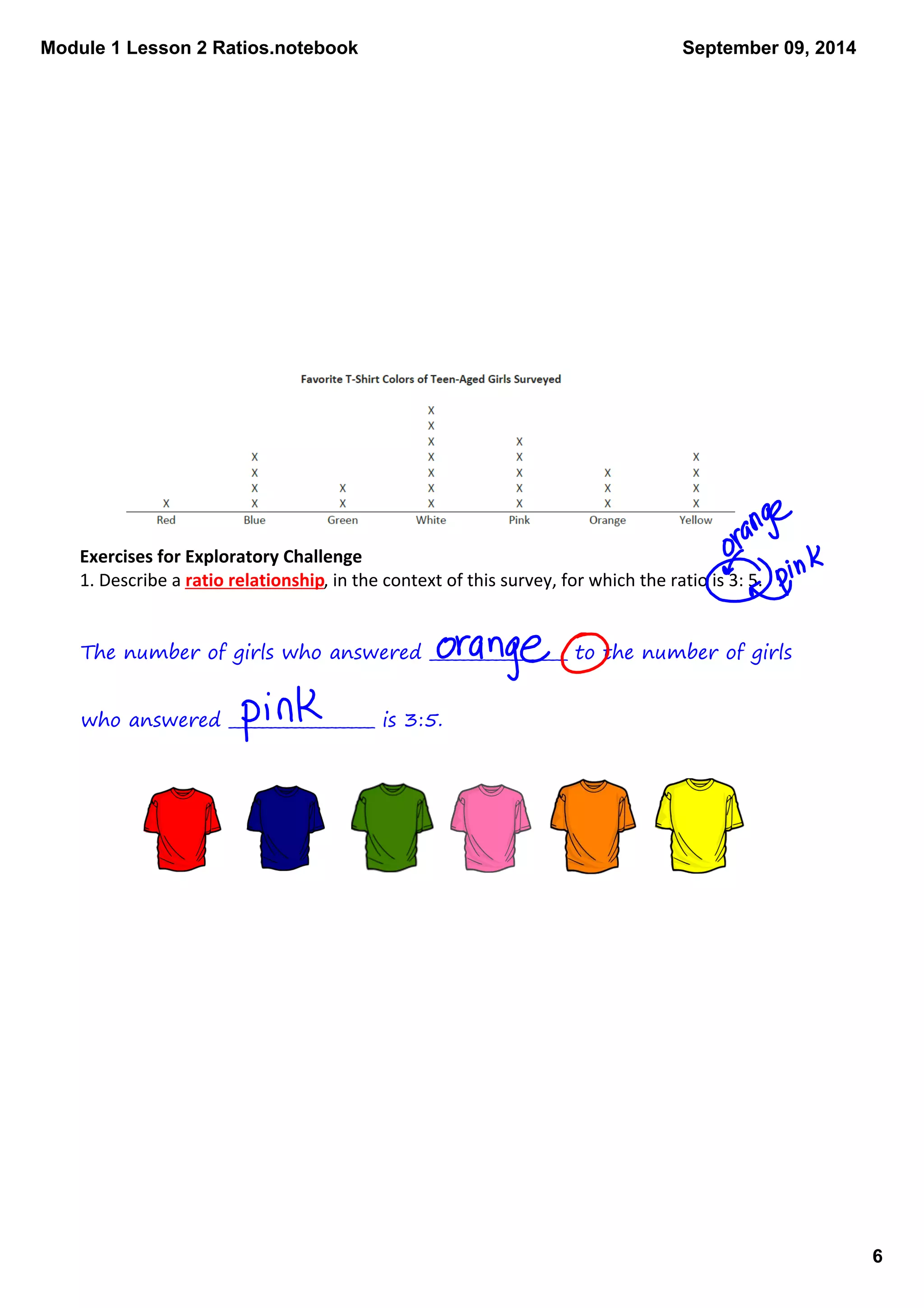
A t‐shirt manufacturing company surveyed teen‐aged girls on their favorite t‐shirt color to guide the 
company’s decisions about how many of each color t‐shirt they should design and manufacture. The 
results of the survey are shown here. 
Based on the survey, should the company order more pink fabric or more orange fabric? 
What is the ratio of the number of bolts of pink fabric to number of bolts of orange fabric you 
think the company should order? 
Someone said 5 to 3, and another person said it would be 3 to 5. 
Are those the same? Is a ratio of 3 to 5 the same as a ratio of 5 to 3?
Module 1 Lesson 2 Ratios.notebook 
6 
September 09, 2014 
Exercises for Exploratory Challenge 
1. Describe a ratio relationship, in the context of this survey, for which the ratio is 3: 5. 
The number of girls who answered _________________ to the number of girls 
who answered __________________ is 3:5.
Module 1 Lesson 2 Ratios.notebook 
7 
September 09, 2014 
2. For each ratio relationship given, fill in the ratio it is describing.
Module 1 Lesson 2 Ratios.notebook 
8 
September 09, 2014 
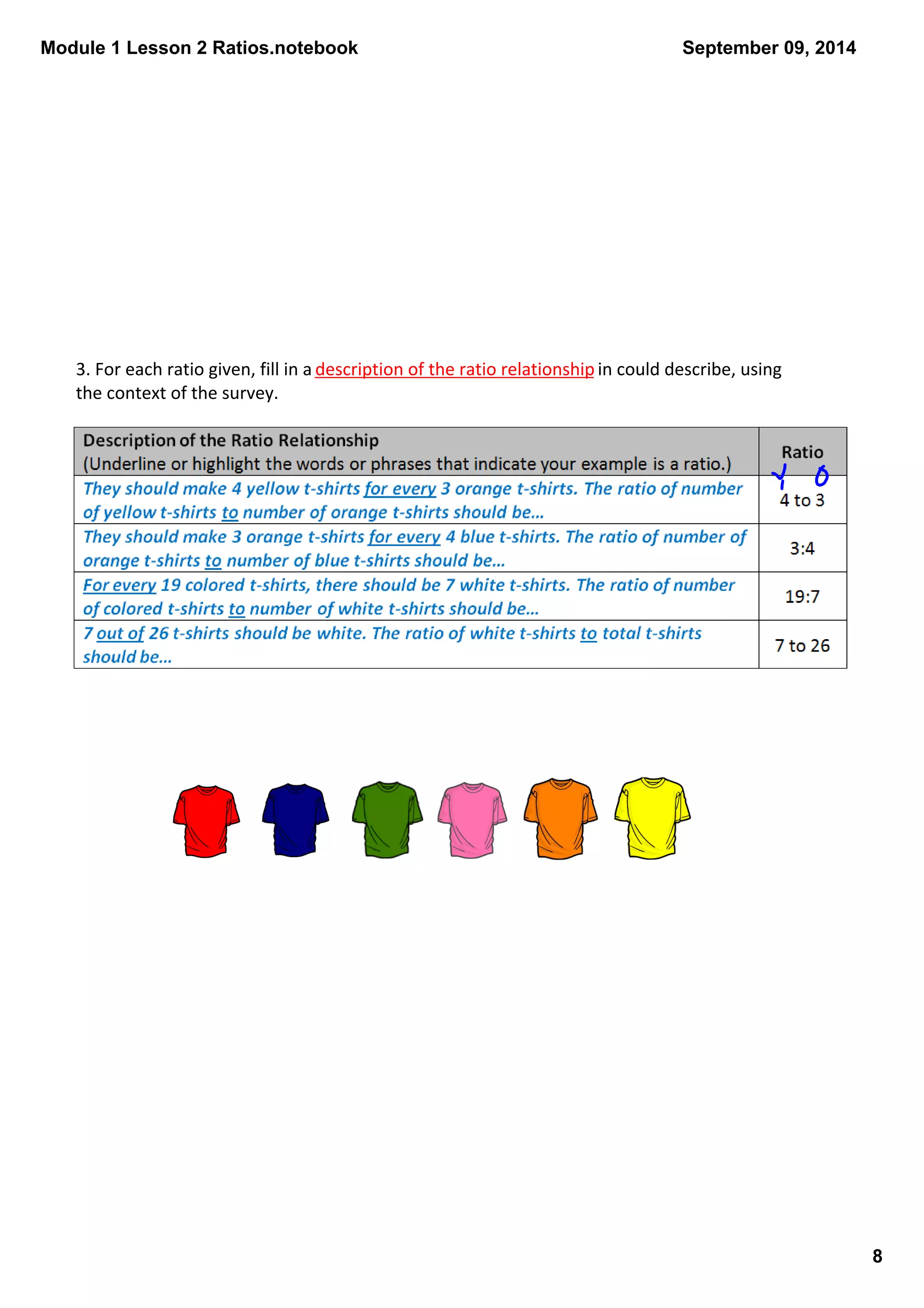
3. For each ratio given, fill in a description of the ratio relationship in could describe, using 
the context of the survey.
Module 1 Lesson 2 Ratios.notebook 
9 
September 09, 2014 
Closing 
Are the ratios 2:5 and 5:2 the same? Why or why not? 
Please take out your exit ticket for Lesson 1, close your 
binder, and complete the exit ticket. This will be collected.

Module 2 lesson 1 2014

  • 1.
    Module 1 Lesson2 Ratios.notebook 1 September 09, 2014 Lesson 1 Problem Set
  • 2.
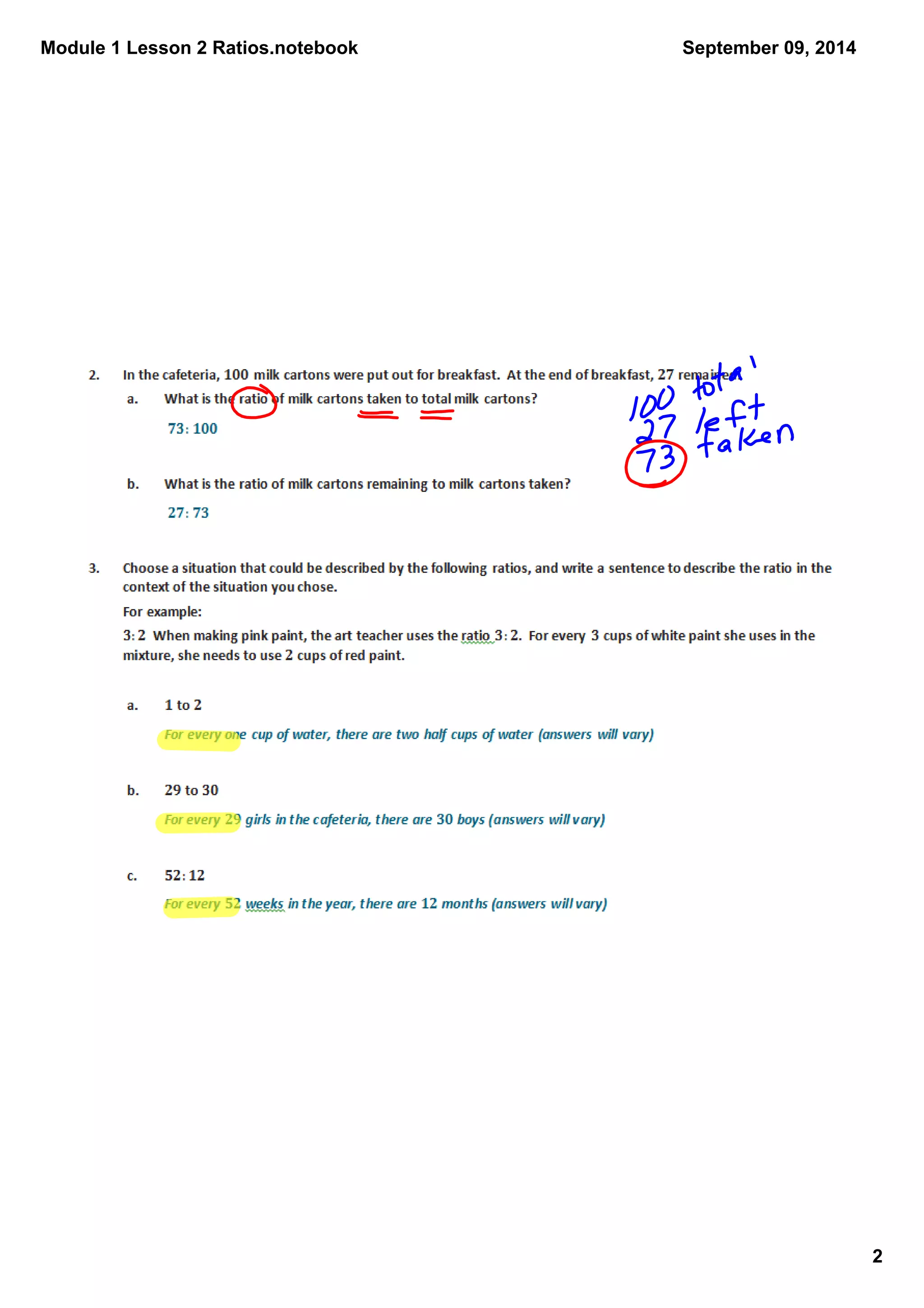
    Module 1 Lesson2 Ratios.notebook 2 September 09, 2014
  • 3.
    Module 1 Lesson2 Ratios.notebook 3 September 09, 2014 Module 1 Ratios and Unit Rates Topic A: Representing and Reasoning About Ratios Lesson 2: Ratios Student Outcomes § Students reinforce their understanding that a ratio is an ordered pair of non‐negative numbers, which are not both zero. Students continue to learn and use the precise language and notation of ratios (e.g., 3:2, 3 to 2). Students demonstrate their understanding that the order of the pair of numbers in a ratio matters. § Students create multiple ratios from a context in which more than two quantities are given. Students conceive of real‐world contextual situations to match a given ratio.
  • 4.
    Module 1 Lesson2 Ratios.notebook 4 September 09, 2014 Classwork Exercise 1 Come up with two examples of ratio relationships that are interesting to you. 1. 2. What are the verbal cues that tell us someone is talking about a ratio relationship? ___________________ ___________________ ___________________ ___________________
  • 5.
    Module 1 Lesson2 Ratios.notebook 5 September 09, 2014 Exploratory Challenge A t‐shirt manufacturing company surveyed teen‐aged girls on their favorite t‐shirt color to guide the company’s decisions about how many of each color t‐shirt they should design and manufacture. The results of the survey are shown here. Based on the survey, should the company order more pink fabric or more orange fabric? What is the ratio of the number of bolts of pink fabric to number of bolts of orange fabric you think the company should order? Someone said 5 to 3, and another person said it would be 3 to 5. Are those the same? Is a ratio of 3 to 5 the same as a ratio of 5 to 3?
  • 6.
    Module 1 Lesson2 Ratios.notebook 6 September 09, 2014 Exercises for Exploratory Challenge 1. Describe a ratio relationship, in the context of this survey, for which the ratio is 3: 5. The number of girls who answered _________________ to the number of girls who answered __________________ is 3:5.
  • 7.
    Module 1 Lesson2 Ratios.notebook 7 September 09, 2014 2. For each ratio relationship given, fill in the ratio it is describing.
  • 8.
    Module 1 Lesson2 Ratios.notebook 8 September 09, 2014 3. For each ratio given, fill in a description of the ratio relationship in could describe, using the context of the survey.
  • 9.
    Module 1 Lesson2 Ratios.notebook 9 September 09, 2014 Closing Are the ratios 2:5 and 5:2 the same? Why or why not? Please take out your exit ticket for Lesson 1, close your binder, and complete the exit ticket. This will be collected.