Lesson 27: Solving Percent Problems
Date: 11/17/14 214
© 2013 Common Core, Inc. Some rightsreserved. commoncore.org
This work is licensed under a
Creative Commons Attribution-NonCommercial-ShareAlike 3.0 Unported License.
NYS COMMON CORE MATHEMATICS CURRICULUM 6•1Lesson 27
Lesson 27: Solving Percent Problems
Student Outcomes
 Students find the percent of a quantity. Given a part and the percent, students solveproblems involving
findingthe whole.
Classwork
Example 1 (10 minutes)
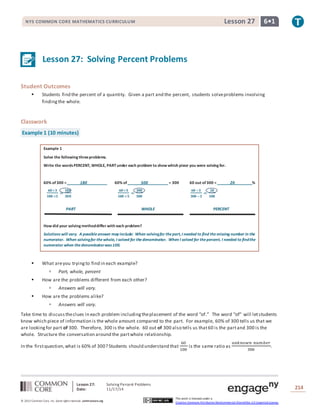
Example 1
Solve the following threeproblems.
Write the wordsPERCENT, WHOLE, PARTunder each problem to show which piece you were solving for.
60% of300 = 180 60% of 500 = 300 60 out of300 = 20 %
𝟔𝟎×𝟑
𝟏𝟎𝟎 ×𝟑
=
𝟏𝟖𝟎
𝟑𝟎𝟎
𝟔𝟎×𝟓
𝟏𝟎𝟎 ×𝟓
=
𝟑𝟎𝟎
𝟓𝟎𝟎
𝟔𝟎 ÷𝟑
𝟑𝟎𝟎 ÷𝟑
=
𝟐𝟎
𝟏𝟎𝟎
PART WHOLE PERCENT
How did your solving methoddiffer with each problem?
Solutions will vary. A possibleanswer may include: When solvingfor thepart,I needed to find themissing number in the
numerator. When solvingfor thewhole, I solved for thedenominator. When I solved for thepercent, I needed to findthe
numerator when thedenominatorwas 100.
 What areyou tryingto find in each example?
 Part, whole, percent
 How are the problems different from each other?
 Answers will vary.
 How are the problems alike?
 Answers will vary.
Take time to discusstheclues in each problem includingtheplacement of the word “of.” The word “of” will letstudents
know which piece of information is the whole amount compared to the part. For example, 60% of 300 tells us that we
are lookingfor part of 300. Therefore, 300 is the whole. 60 out of 300 also tells us that60 is the partand 300 is the
whole. Structure the conversation around the partwhole relationship.
In the firstquestion,what is 60% of 300? Students should understand that
60
100
is the same ratio as
𝑢𝑛𝑘𝑛𝑜𝑤𝑛 𝑛𝑢𝑚𝑏𝑒𝑟
300
.
Lesson 27: Solving Percent Problems
Date: 11/17/14 215
© 2013 Common Core, Inc. Some rightsreserved. commoncore.org
This work is licensed under a
Creative Commons Attribution-NonCommercial-ShareAlike 3.0 Unported License.
NYS COMMON CORE MATHEMATICS CURRICULUM 6•1Lesson 27
60% of some value= 300 →
60
100
=
300
?
60 out of 300 = what percent →
60
300
=
?
100
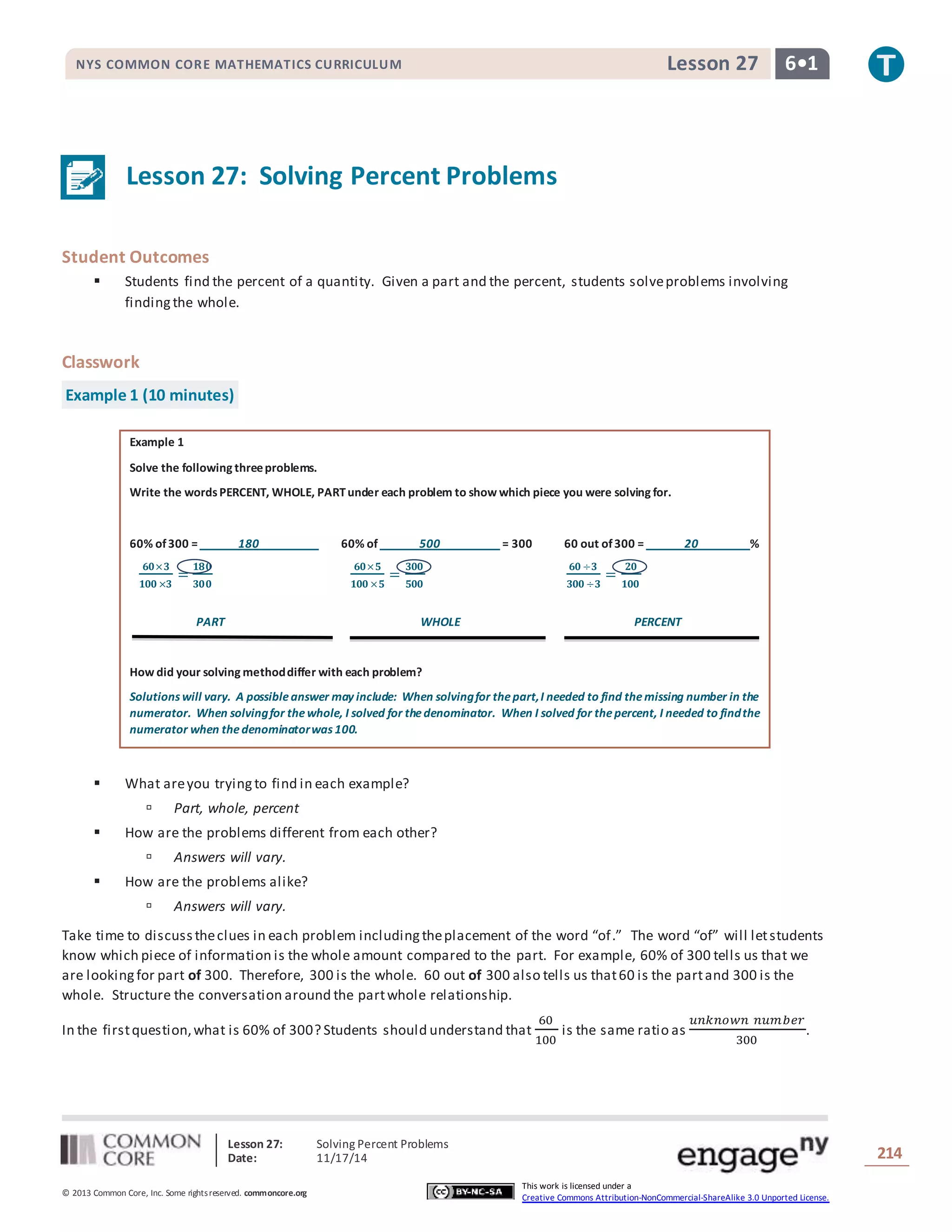
Exercise 1 (20 minutes)
At this time, the students break out into pairs or small thinkinggroups to solvethe problem.
Exercise 1
Use models, such as 𝟏𝟎 × 𝟏𝟎 grids, ratio tables, tape diagramsor double number line diagrams, tosolve thefollowing
situation.
Priyaisdoing her back to school shopping. Calculateall ofthe missing valuesin thetable below, rounding tothe nearest
penny, and calculatethe total amountPriyawillspend onher outfit after she received theindicated discounts.
What isthe total cost ofPriya’soutfit?
Shirt 𝟐𝟓%=
𝟐𝟓
𝟏𝟎𝟎
=
𝟏
𝟒
𝟏
𝟒
=
𝟏𝟏
𝟒𝟒
Thediscount is $11.
Pants 𝟑𝟎%=
𝟑𝟎
𝟏𝟎𝟎
=
𝟏𝟓
𝟓𝟎
Theoriginal priceis $50.
Shoes 𝟏𝟓%=
𝟏𝟓
𝟏𝟎𝟎
=
𝟑
𝟐𝟎
=
𝟗
𝟔𝟎
Theoriginal priceis $60.
Necklace 𝟏𝟎%=
𝟏
𝟏𝟎
=
𝟐
𝟐𝟎
Thediscount is $2.
Sweater 𝟐𝟎%=
𝟐𝟎
𝟏𝟎𝟎
=
𝟏
𝟓
=
𝟕
𝟑𝟓
Theoriginal priceis $35.
The total outfit would cost: $𝟑𝟑 + $𝟑𝟓 + $𝟓𝟏 + $𝟏𝟖 + $𝟐𝟖 = $𝟏𝟔𝟓
Closing(10 minutes)
Give time for students to sharesamples of how they solved the problem and describethe methods they chose to use
when solving.
Exit Ticket (5 minutes)
Shirt
(25% discount)
Pants
(30% discount)
Shoes
(15% discount)
Necklace
(10% discount)
Sweater
(20% discount)
Original Price $44 $50 $60 $20 $35
Amount of
Discount
$11 $15 $9 $2 $7
Lesson Summary
Percent problemsincludethepart, whole and percent. When oneofthesevaluesismissing, wecan use tables,
diagrams, and modelsto solve for the missing number.
Lesson 27: Solving Percent Problems
Date: 11/17/14 216
© 2013 Common Core, Inc. Some rightsreserved. commoncore.org
This work is licensed under a
Creative Commons Attribution-NonCommercial-ShareAlike 3.0 Unported License.
NYS COMMON CORE MATHEMATICS CURRICULUM 6•1Lesson 27
Name ___________________________________________________ Date____________________
Lesson 27: Solving Percent Problems
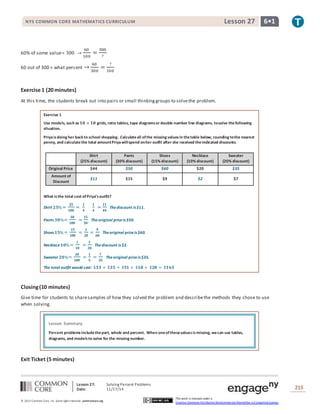
Exit Ticket
Jane paid $40 for an item after she received a 20% discount. Jane’s friend says this means that the original priceof the
item was $48.
a. How do you think Jane’s friend arrived atthis amount?
b. Is her friend correct? Why or why not?
Lesson 27: Solving Percent Problems
Date: 11/17/14 217
© 2013 Common Core, Inc. Some rightsreserved. commoncore.org
This work is licensed under a
Creative Commons Attribution-NonCommercial-ShareAlike 3.0 Unported License.
NYS COMMON CORE MATHEMATICS CURRICULUM 6•1Lesson 27
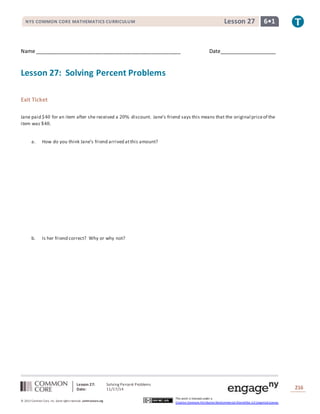
Exit Ticket Sample Solutions
The following solutions indicatean understandingof the objectives of this lesson:
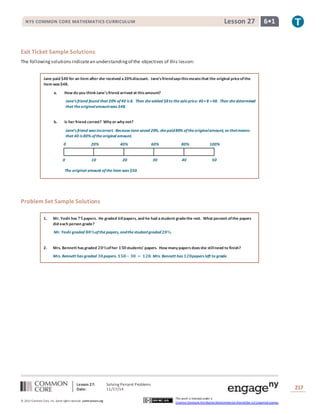
Jane paid $40 for an item after she received a20%discount. Jane’sfriendsaysthismeansthat the original priceofthe
item was$48.
a. How do you think Jane’sfriend arrived at thisamount?
Jane’s friend found that 20% of40 is 8. Then sheadded $8to thesaleprice: 40+8 =48. Then shedetermined
that theoriginalamountwas $48.
b. Is her friend correct? Why or why not?
Jane’s friend was incorrect. BecauseJane saved 20%, shepaid80% oftheoriginalamount, so thatmeans
that 40 is 80% oftheoriginal amount.
Problem Set Sample Solutions
1. Mr. Yoshi has 𝟕𝟓papers. He graded 𝟔𝟎papers, and he had astudent gradethe rest. What percent ofthe papers
did each person grade?
Mr. Yoshi graded 𝟖𝟎%ofthepapers, andthestudentgraded 𝟐𝟎%.
2. Mrs. Bennett has graded 𝟐𝟎%ofher 𝟏𝟓𝟎students’ papers. How many papersdoesshe stillneed to finish?
Mrs. Bennett has graded 𝟑𝟎papers. 𝟏𝟓𝟎− 𝟑𝟎 = 𝟏𝟐𝟎. Mrs. Bennett has 𝟏𝟐𝟎papers left to grade.
0 20% 40% 60% 80% 100%
0 10 20 30 40 50
The original amount oftheitem was $50.

G6 m1-d-lesson 27-t

  • 1.
    Lesson 27: SolvingPercent Problems Date: 11/17/14 214 © 2013 Common Core, Inc. Some rightsreserved. commoncore.org This work is licensed under a Creative Commons Attribution-NonCommercial-ShareAlike 3.0 Unported License. NYS COMMON CORE MATHEMATICS CURRICULUM 6•1Lesson 27 Lesson 27: Solving Percent Problems Student Outcomes  Students find the percent of a quantity. Given a part and the percent, students solveproblems involving findingthe whole. Classwork Example 1 (10 minutes) Example 1 Solve the following threeproblems. Write the wordsPERCENT, WHOLE, PARTunder each problem to show which piece you were solving for. 60% of300 = 180 60% of 500 = 300 60 out of300 = 20 % 𝟔𝟎×𝟑 𝟏𝟎𝟎 ×𝟑 = 𝟏𝟖𝟎 𝟑𝟎𝟎 𝟔𝟎×𝟓 𝟏𝟎𝟎 ×𝟓 = 𝟑𝟎𝟎 𝟓𝟎𝟎 𝟔𝟎 ÷𝟑 𝟑𝟎𝟎 ÷𝟑 = 𝟐𝟎 𝟏𝟎𝟎 PART WHOLE PERCENT How did your solving methoddiffer with each problem? Solutions will vary. A possibleanswer may include: When solvingfor thepart,I needed to find themissing number in the numerator. When solvingfor thewhole, I solved for thedenominator. When I solved for thepercent, I needed to findthe numerator when thedenominatorwas 100.  What areyou tryingto find in each example?  Part, whole, percent  How are the problems different from each other?  Answers will vary.  How are the problems alike?  Answers will vary. Take time to discusstheclues in each problem includingtheplacement of the word “of.” The word “of” will letstudents know which piece of information is the whole amount compared to the part. For example, 60% of 300 tells us that we are lookingfor part of 300. Therefore, 300 is the whole. 60 out of 300 also tells us that60 is the partand 300 is the whole. Structure the conversation around the partwhole relationship. In the firstquestion,what is 60% of 300? Students should understand that 60 100 is the same ratio as 𝑢𝑛𝑘𝑛𝑜𝑤𝑛 𝑛𝑢𝑚𝑏𝑒𝑟 300 .
  • 2.
    Lesson 27: SolvingPercent Problems Date: 11/17/14 215 © 2013 Common Core, Inc. Some rightsreserved. commoncore.org This work is licensed under a Creative Commons Attribution-NonCommercial-ShareAlike 3.0 Unported License. NYS COMMON CORE MATHEMATICS CURRICULUM 6•1Lesson 27 60% of some value= 300 → 60 100 = 300 ? 60 out of 300 = what percent → 60 300 = ? 100 Exercise 1 (20 minutes) At this time, the students break out into pairs or small thinkinggroups to solvethe problem. Exercise 1 Use models, such as 𝟏𝟎 × 𝟏𝟎 grids, ratio tables, tape diagramsor double number line diagrams, tosolve thefollowing situation. Priyaisdoing her back to school shopping. Calculateall ofthe missing valuesin thetable below, rounding tothe nearest penny, and calculatethe total amountPriyawillspend onher outfit after she received theindicated discounts. What isthe total cost ofPriya’soutfit? Shirt 𝟐𝟓%= 𝟐𝟓 𝟏𝟎𝟎 = 𝟏 𝟒 𝟏 𝟒 = 𝟏𝟏 𝟒𝟒 Thediscount is $11. Pants 𝟑𝟎%= 𝟑𝟎 𝟏𝟎𝟎 = 𝟏𝟓 𝟓𝟎 Theoriginal priceis $50. Shoes 𝟏𝟓%= 𝟏𝟓 𝟏𝟎𝟎 = 𝟑 𝟐𝟎 = 𝟗 𝟔𝟎 Theoriginal priceis $60. Necklace 𝟏𝟎%= 𝟏 𝟏𝟎 = 𝟐 𝟐𝟎 Thediscount is $2. Sweater 𝟐𝟎%= 𝟐𝟎 𝟏𝟎𝟎 = 𝟏 𝟓 = 𝟕 𝟑𝟓 Theoriginal priceis $35. The total outfit would cost: $𝟑𝟑 + $𝟑𝟓 + $𝟓𝟏 + $𝟏𝟖 + $𝟐𝟖 = $𝟏𝟔𝟓 Closing(10 minutes) Give time for students to sharesamples of how they solved the problem and describethe methods they chose to use when solving. Exit Ticket (5 minutes) Shirt (25% discount) Pants (30% discount) Shoes (15% discount) Necklace (10% discount) Sweater (20% discount) Original Price $44 $50 $60 $20 $35 Amount of Discount $11 $15 $9 $2 $7 Lesson Summary Percent problemsincludethepart, whole and percent. When oneofthesevaluesismissing, wecan use tables, diagrams, and modelsto solve for the missing number.
  • 3.
    Lesson 27: SolvingPercent Problems Date: 11/17/14 216 © 2013 Common Core, Inc. Some rightsreserved. commoncore.org This work is licensed under a Creative Commons Attribution-NonCommercial-ShareAlike 3.0 Unported License. NYS COMMON CORE MATHEMATICS CURRICULUM 6•1Lesson 27 Name ___________________________________________________ Date____________________ Lesson 27: Solving Percent Problems Exit Ticket Jane paid $40 for an item after she received a 20% discount. Jane’s friend says this means that the original priceof the item was $48. a. How do you think Jane’s friend arrived atthis amount? b. Is her friend correct? Why or why not?
  • 4.
    Lesson 27: SolvingPercent Problems Date: 11/17/14 217 © 2013 Common Core, Inc. Some rightsreserved. commoncore.org This work is licensed under a Creative Commons Attribution-NonCommercial-ShareAlike 3.0 Unported License. NYS COMMON CORE MATHEMATICS CURRICULUM 6•1Lesson 27 Exit Ticket Sample Solutions The following solutions indicatean understandingof the objectives of this lesson: Jane paid $40 for an item after she received a20%discount. Jane’sfriendsaysthismeansthat the original priceofthe item was$48. a. How do you think Jane’sfriend arrived at thisamount? Jane’s friend found that 20% of40 is 8. Then sheadded $8to thesaleprice: 40+8 =48. Then shedetermined that theoriginalamountwas $48. b. Is her friend correct? Why or why not? Jane’s friend was incorrect. BecauseJane saved 20%, shepaid80% oftheoriginalamount, so thatmeans that 40 is 80% oftheoriginal amount. Problem Set Sample Solutions 1. Mr. Yoshi has 𝟕𝟓papers. He graded 𝟔𝟎papers, and he had astudent gradethe rest. What percent ofthe papers did each person grade? Mr. Yoshi graded 𝟖𝟎%ofthepapers, andthestudentgraded 𝟐𝟎%. 2. Mrs. Bennett has graded 𝟐𝟎%ofher 𝟏𝟓𝟎students’ papers. How many papersdoesshe stillneed to finish? Mrs. Bennett has graded 𝟑𝟎papers. 𝟏𝟓𝟎− 𝟑𝟎 = 𝟏𝟐𝟎. Mrs. Bennett has 𝟏𝟐𝟎papers left to grade. 0 20% 40% 60% 80% 100% 0 10 20 30 40 50 The original amount oftheitem was $50.