Modeling and Validating
  BPMN Diagrams


  Michele Chinosi, Alberto Trombetta


 Universit` degli Studi dell’Insubria (Varese – Italy)
          a
   Dipartimento di Informatica e Comunicazione
         michele.chinosi@uninsubria.it

        BPMN 2009 Workshop
           July 20, 2009, Vienna, Austria
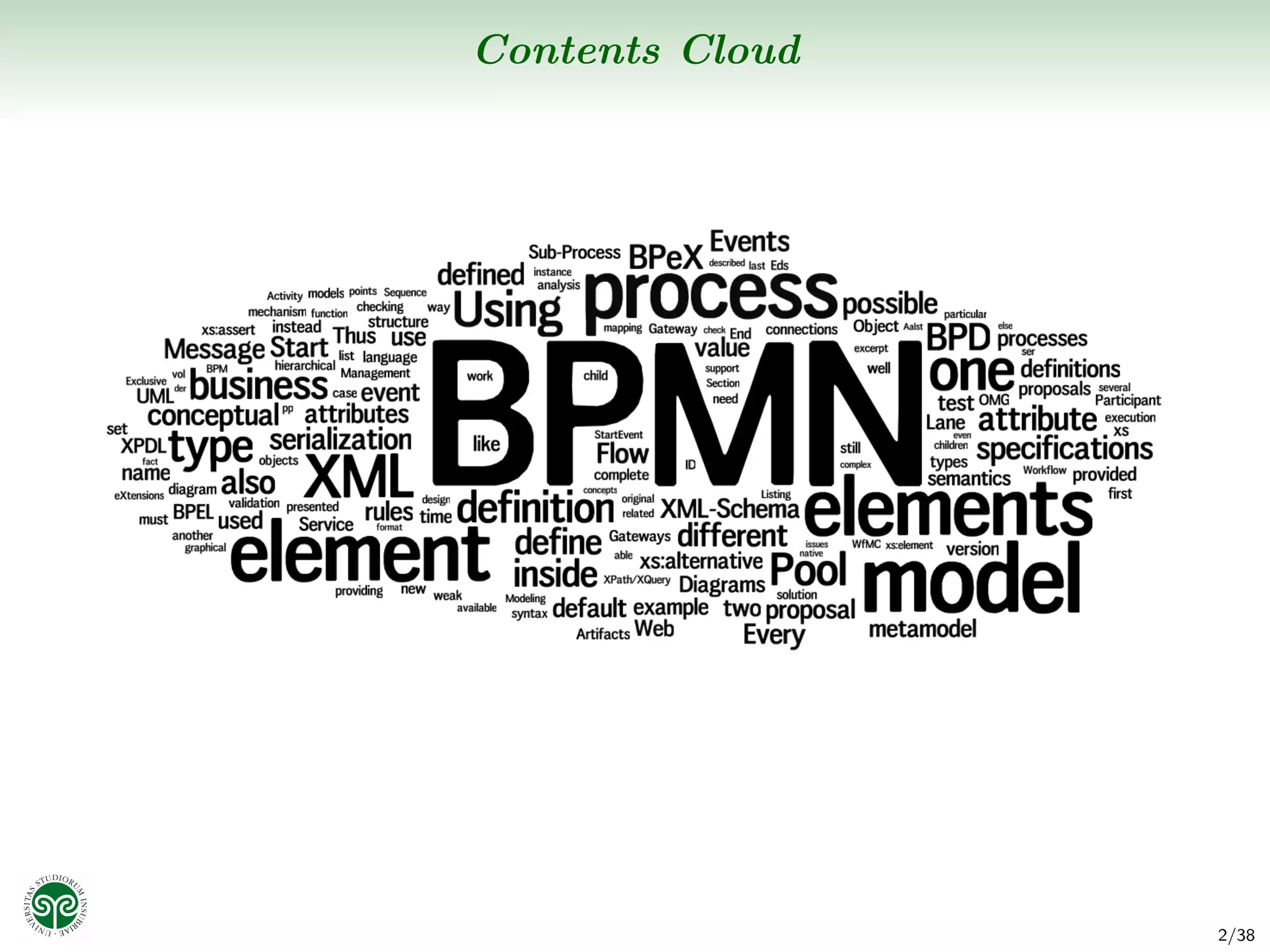
Contents Cloud


                 2/38
Agenda


BPMN 1.1 and 2.0 Analysis


Our BPMN Metamodel Proposal


The XML Linearization


Referential Integrity


Concluding Remarks


                                 3/38
Motivations


• need for easy usable models to test properties, to patch BPMN and
  to add new features
• other proposals (as well as BPMN 2.0 submissions) are quite unclear
  and too complex
• lack of validation support
• BPMN 1.1/1.2 comes without a native XSD
• methods to ensure diagrams correctness are manual and error-prone


                                                                        4/38
Contributions


  • simplified test-oriented version of the BPMN metamodel
  • self-validating XML serialization for BPMN diagrams
  • automated checks (using software tools)
  • our approach could be abstracted from the specificities of BPMN
    1.2 porting the base concepts also to BPMN 2.0

Last-Month Update
This work has been partially superseded by the recent BPMN 2.0 final
submission adoption by OMG. We will see a brief summary of major
changes at the end of this talk.


                                                                      5/38
Contributions


  • simplified test-oriented version of the BPMN metamodel
  • self-validating XML serialization for BPMN diagrams
  • automated checks (using software tools)
  • our approach could be abstracted from the specificities of BPMN
    1.2 porting the base concepts also to BPMN 2.0

Last-Month Update
This work has been partially superseded by the recent BPMN 2.0 final
submission adoption by OMG. We will see a brief summary of major
changes at the end of this talk.


                                                                      5/38
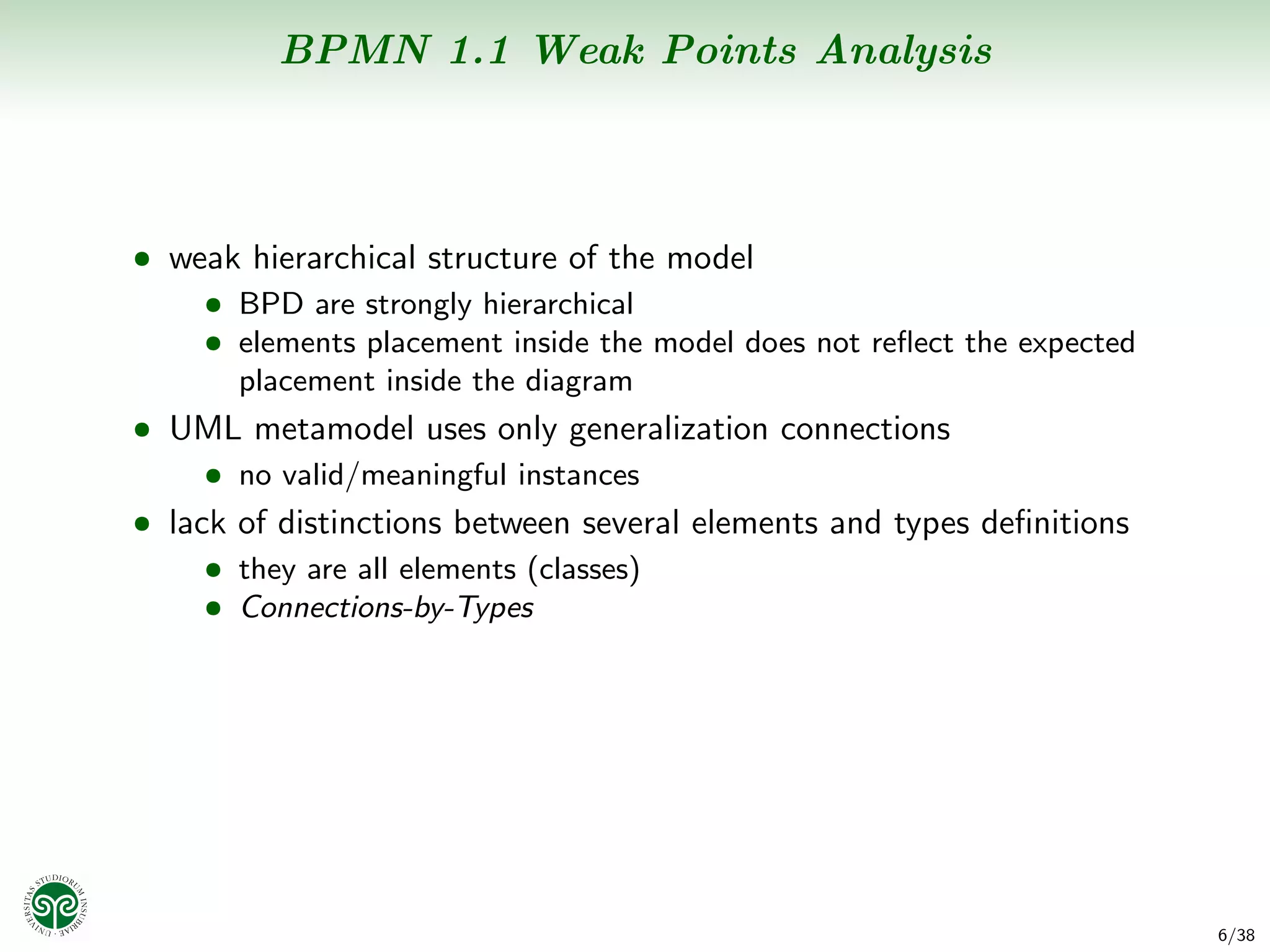
BPMN 1.1 Weak Points Analysis


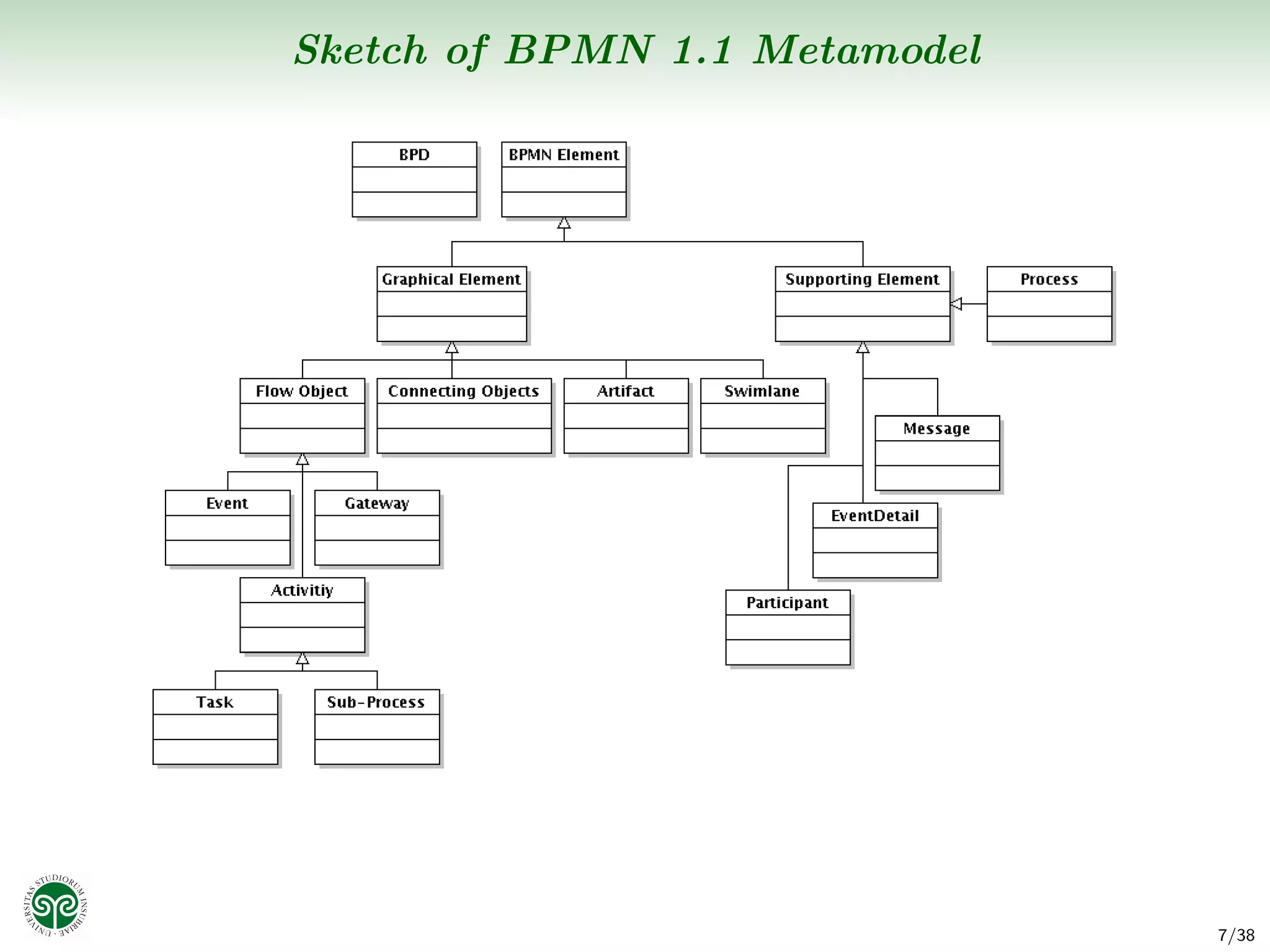
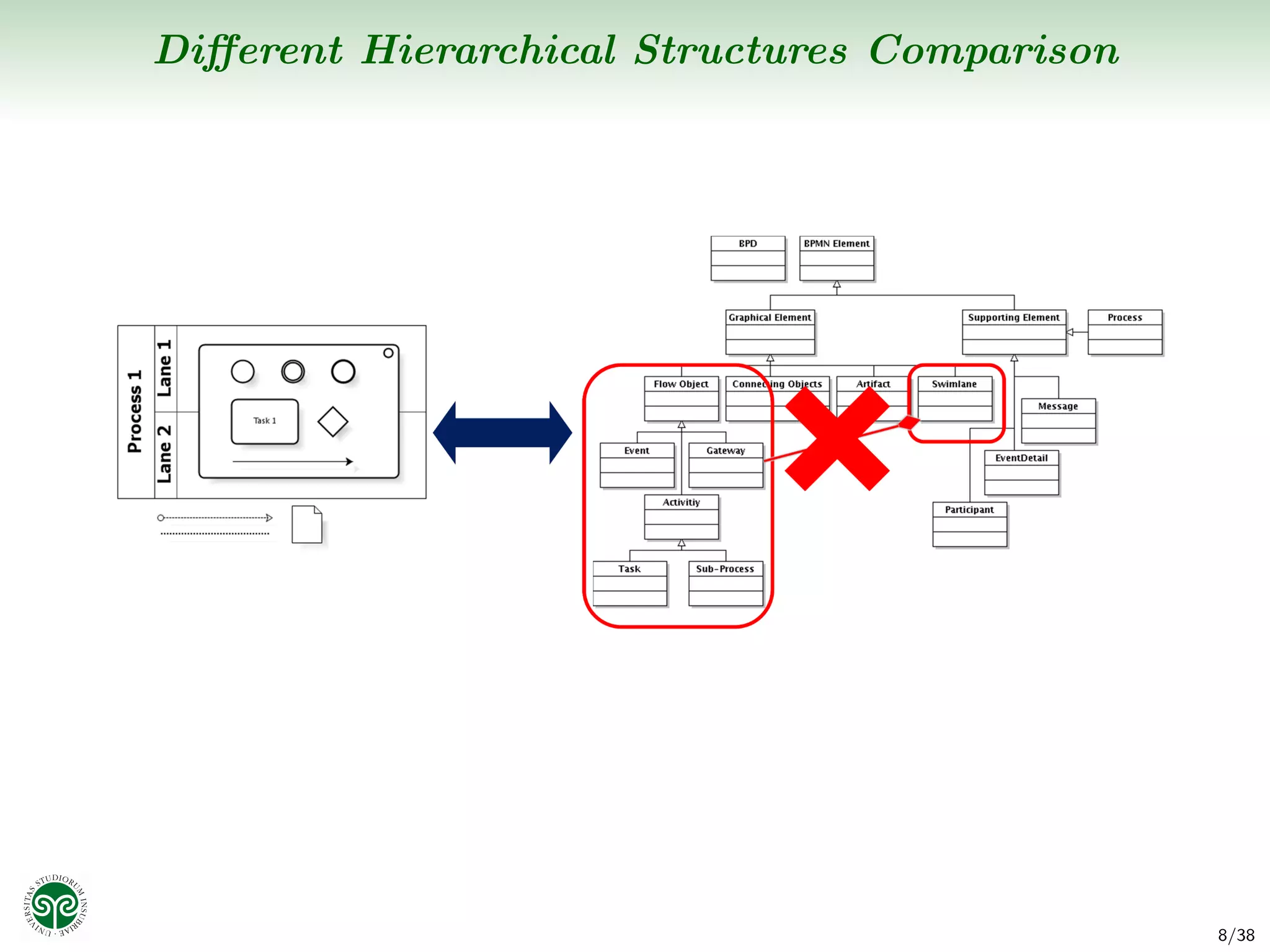
• weak hierarchical structure of the model
    • BPD are strongly hierarchical
    • elements placement inside the model does not reflect the expected
      placement inside the diagram
• UML metamodel uses only generalization connections
     • no valid/meaningful instances
• lack of distinctions between several elements and types definitions
     • they are all elements (classes)
     • Connections-by-Types


                                                                         6/38
Sketch of BPMN 1.1 Metamodel


                               7/38
Different Hierarchical Structures Comparison


                                              8/38
BPMN 2.0 Overview
(B)IOS
 • (BEA), IBM, Oracle, SAP
 • execution semantics formalization
 • extensibility mechanism for both model and graphical extensions
 • event composition and correlation refinement
 • human interactions definition
 • choreography model

BPMN-S
 • Adaptive, Axway Software, HP, Lombardi Software, Fujitsu, et al.
 • business level modeling
 • checking compliance to choreography and rules
 • process taxonomies
 • execution interoperability
 • model re-usability


                                                                      9/38
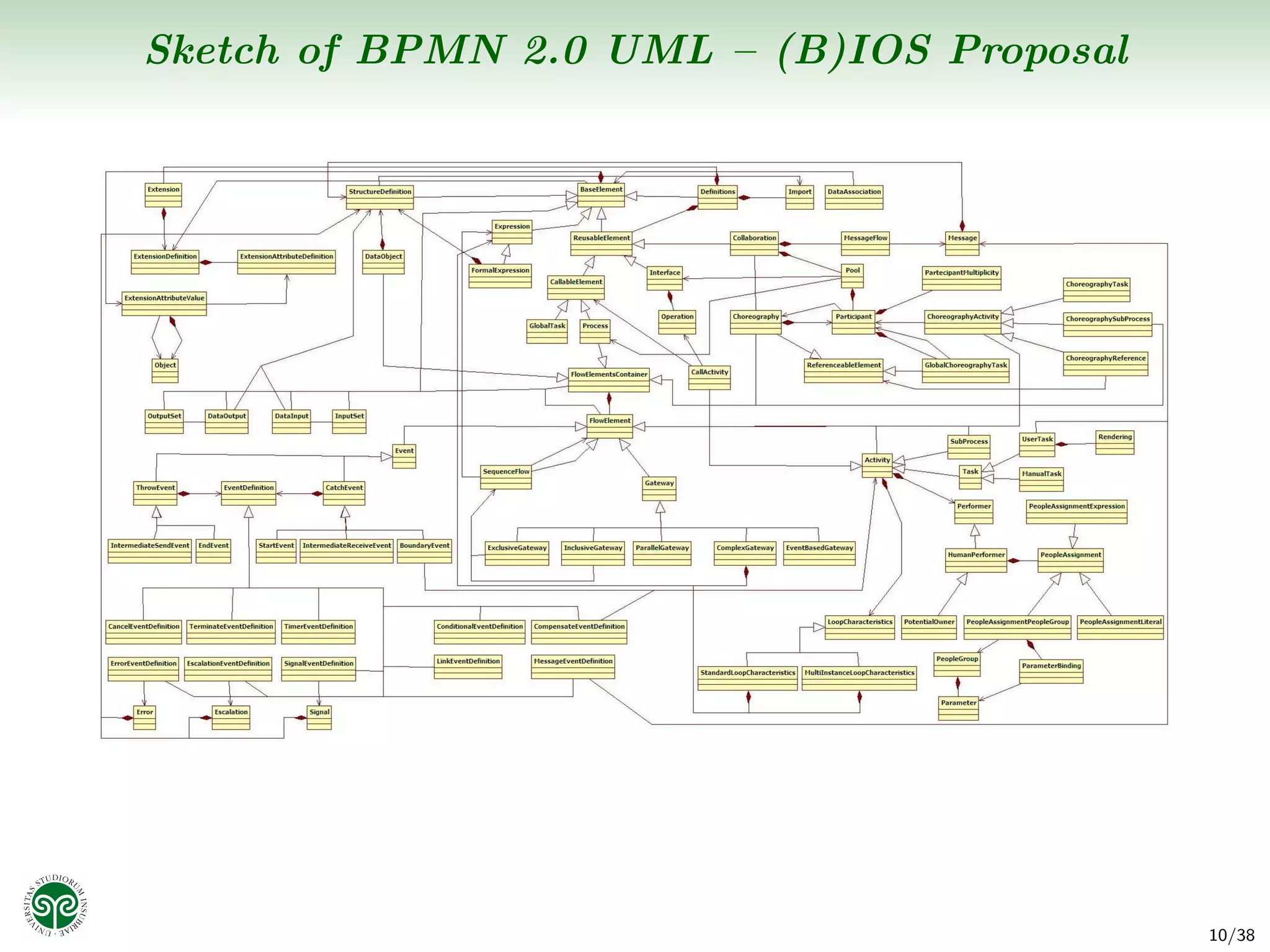
Sketch of BPMN 2.0 UML – (B)IOS Proposal


                                           10/38
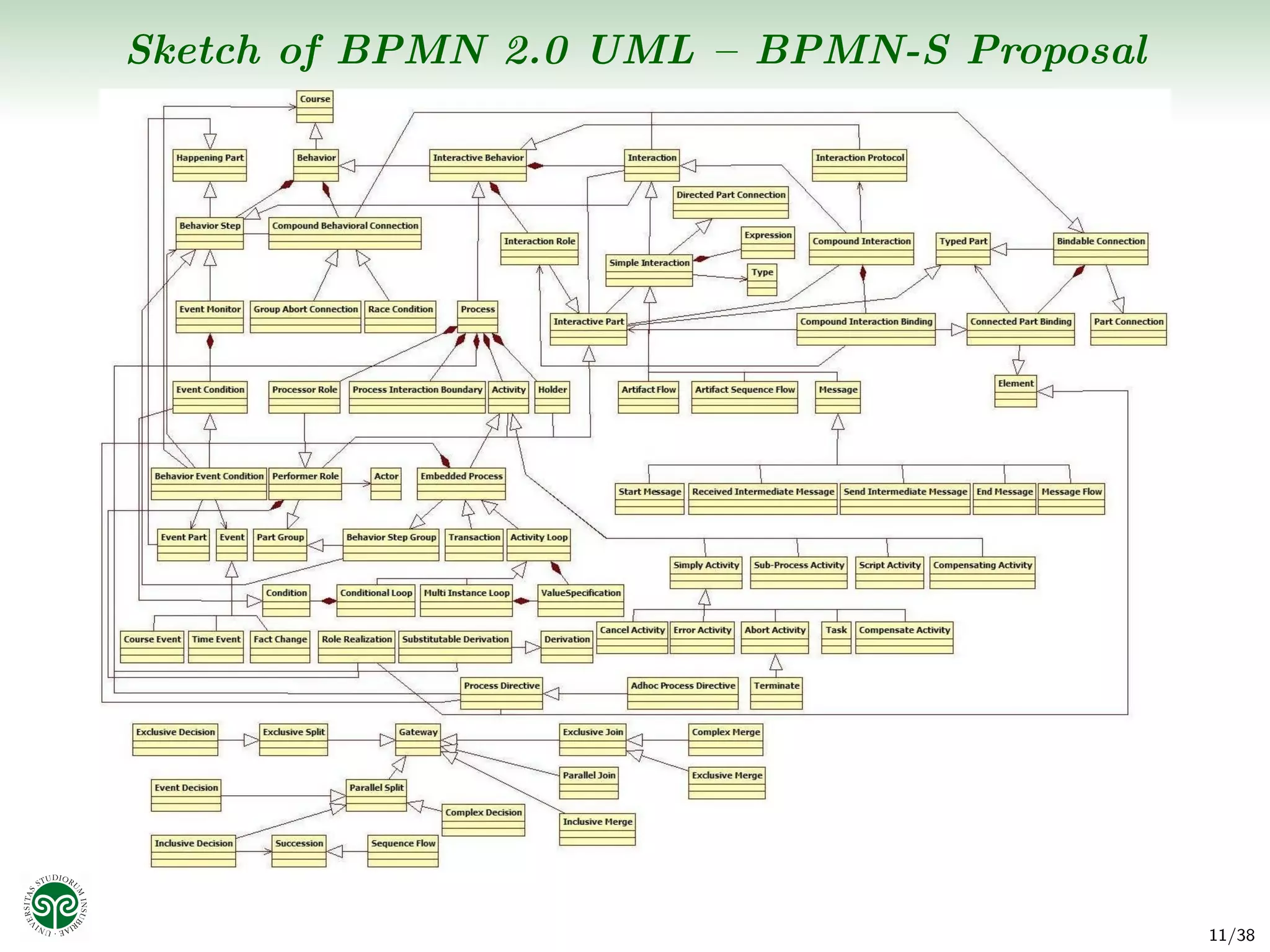
Sketch of BPMN 2.0 UML – BPMN-S Proposal


                                           11/38
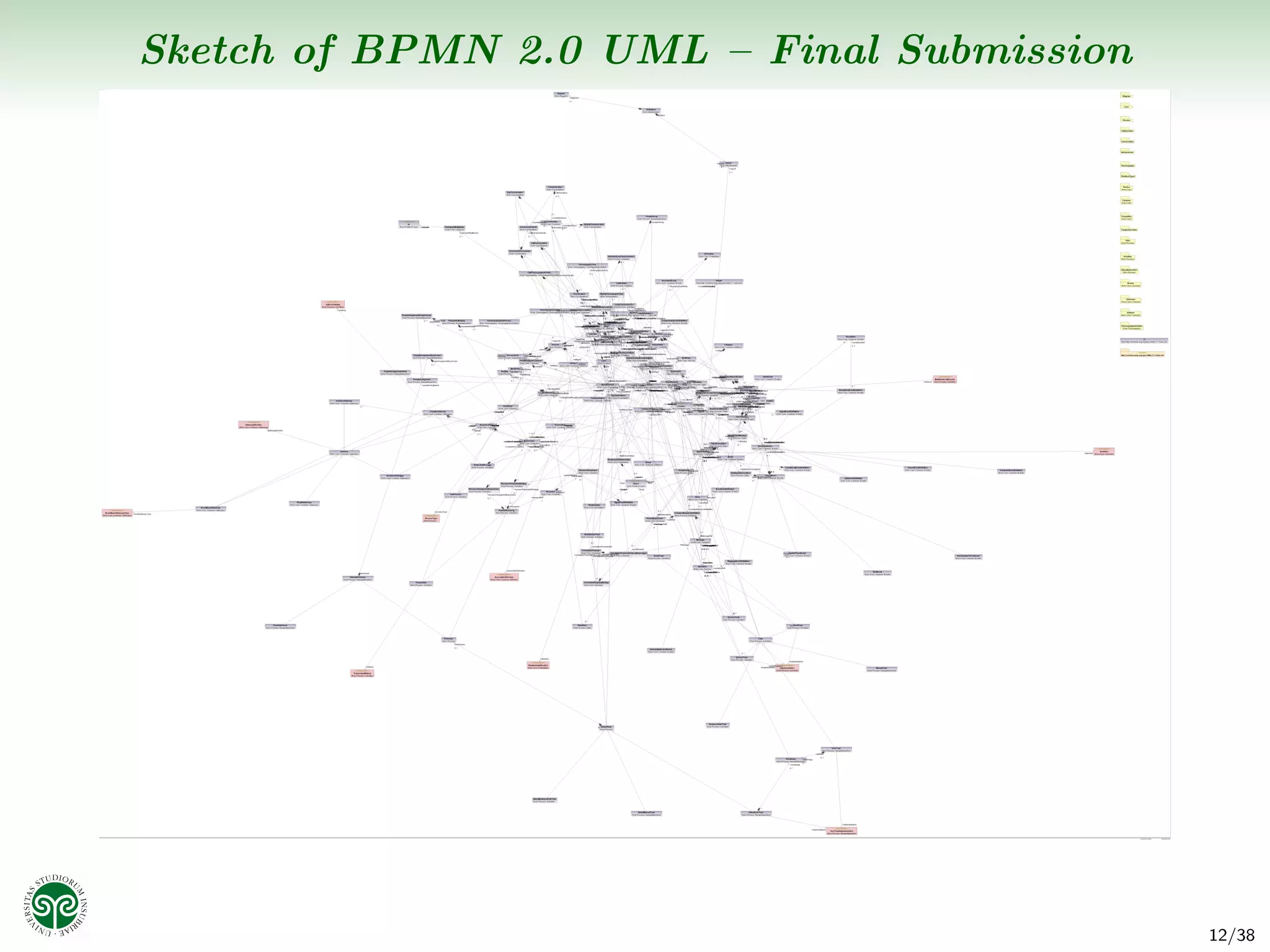
Sketch of BPMN 2.0 UML – Final Submission


                                            12/38
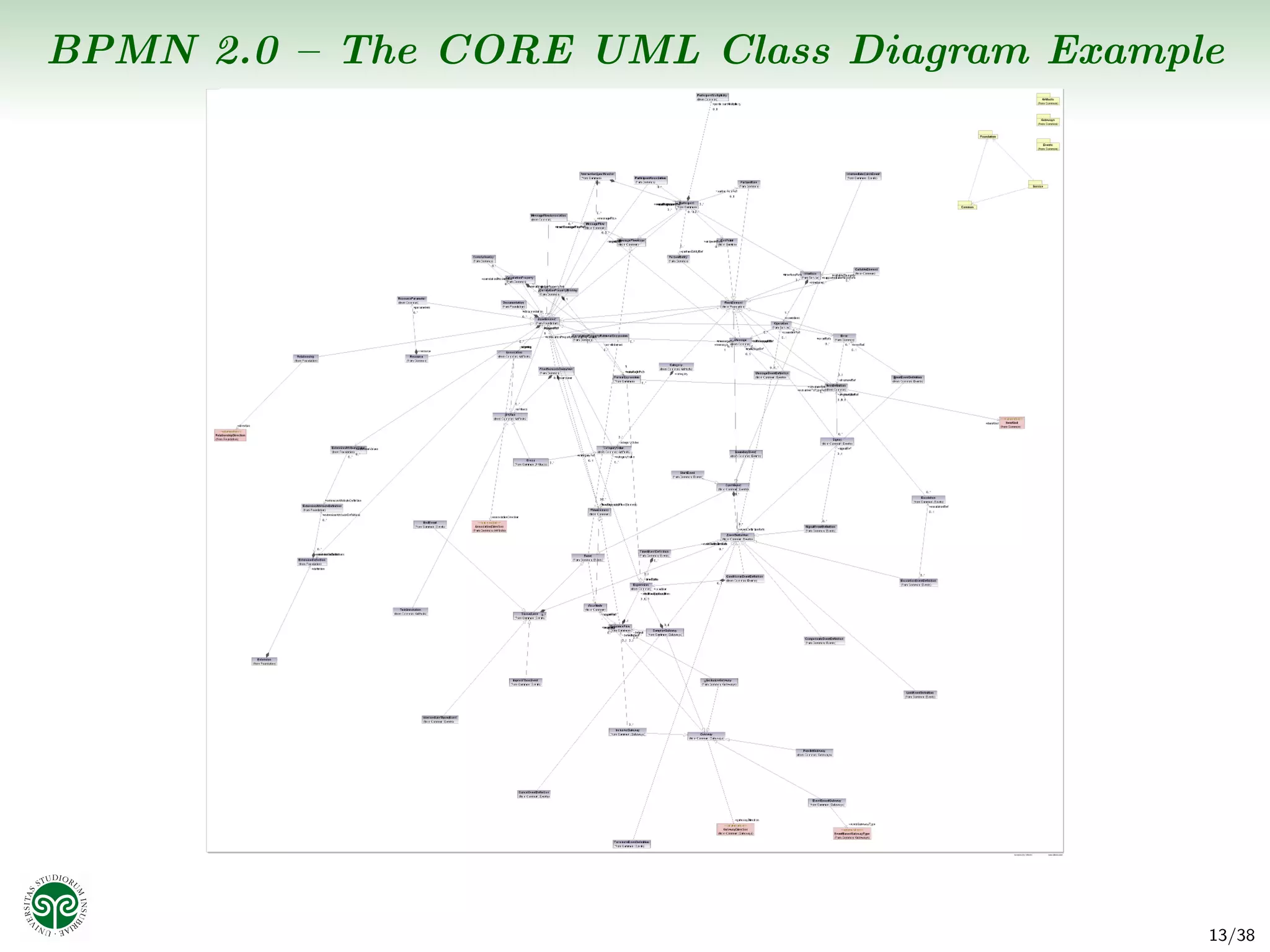
BPMN 2.0 – The CORE UML Class Diagram Example


                                            13/38
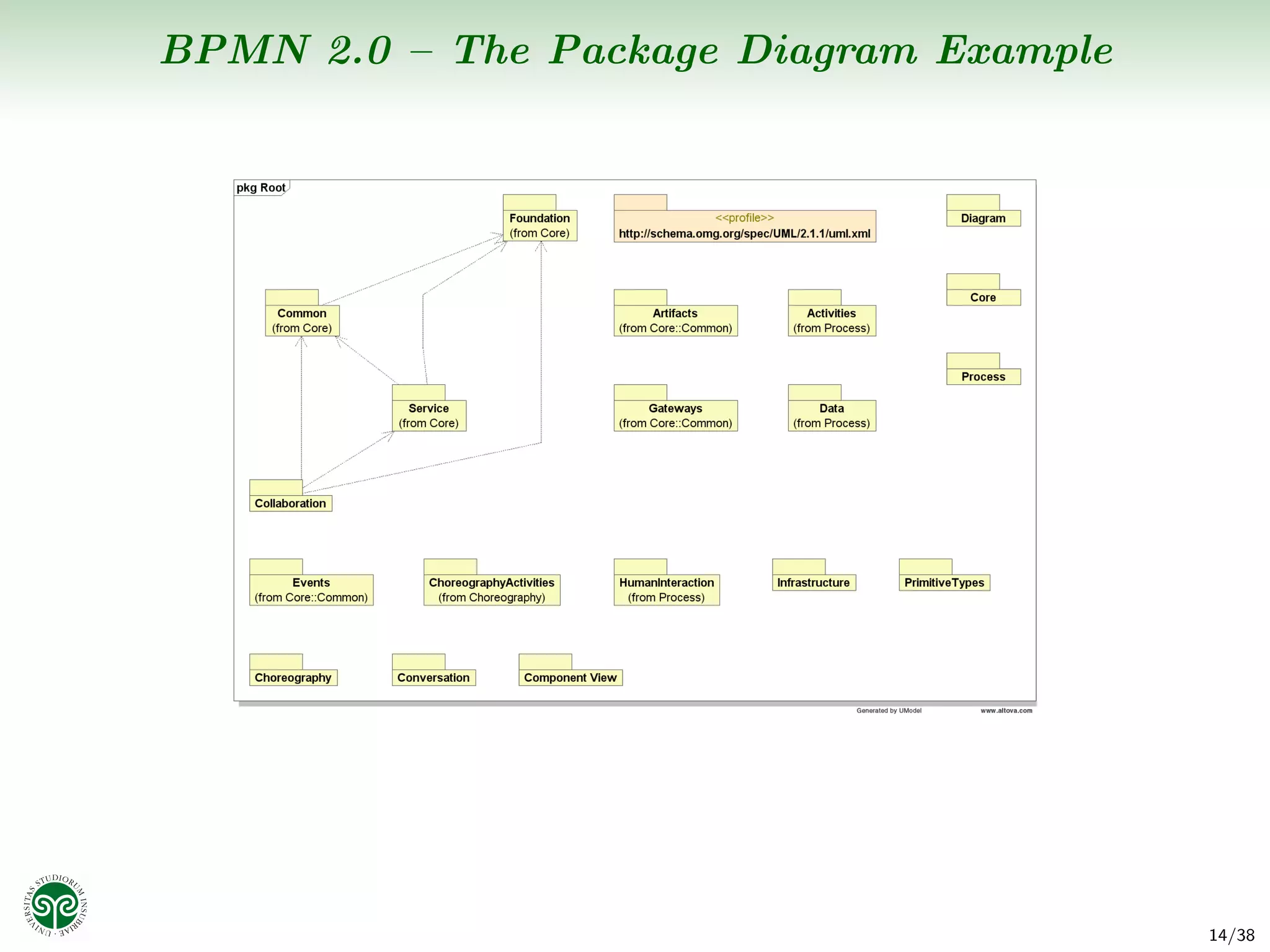
BPMN 2.0 – The Package Diagram Example


                                         14/38
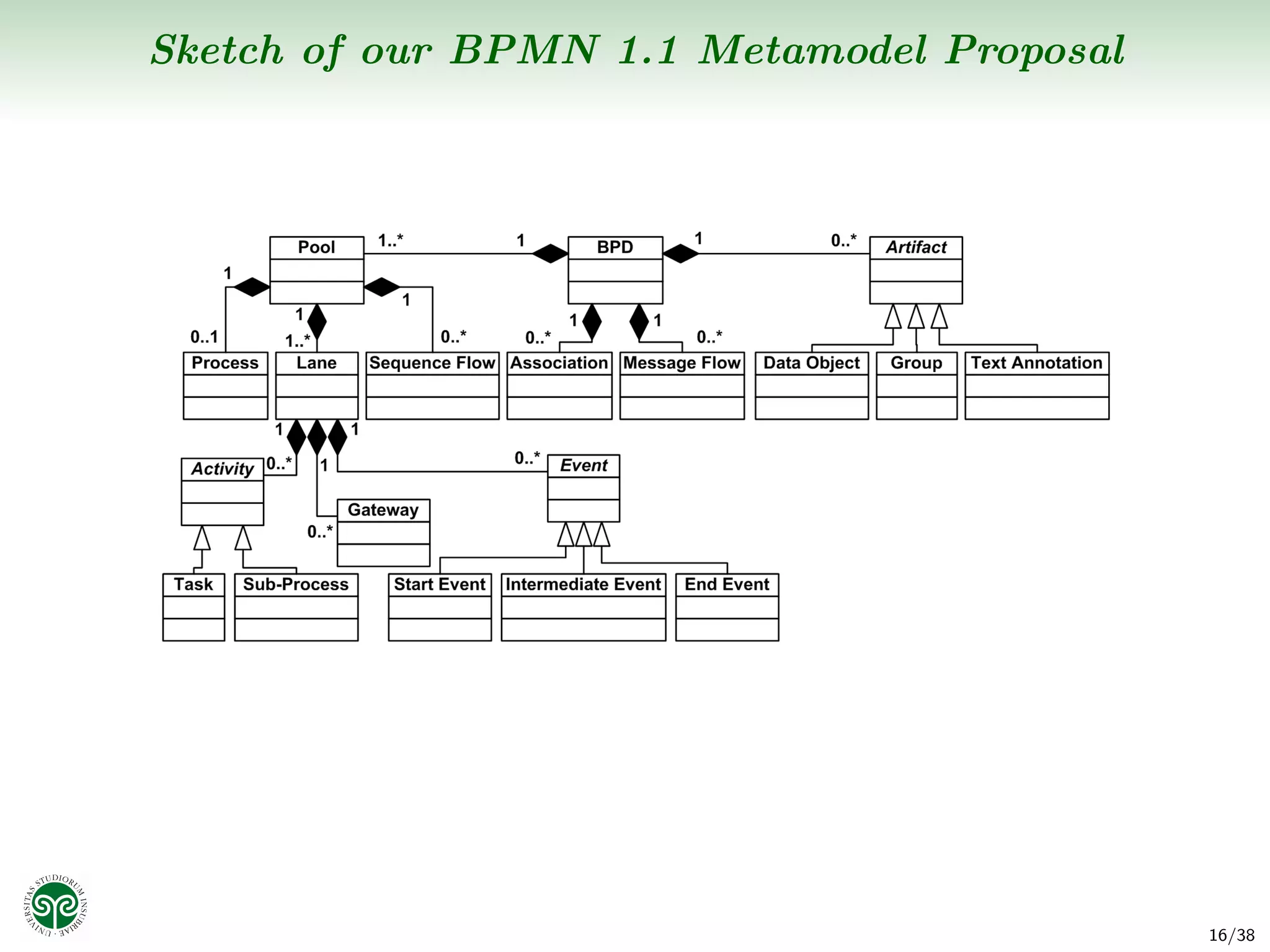
Our BPMN 1.1 Metamodel Proposal


• top-down fashion methodology
    • from BPD to all the other elements
    • strongly hierarchical model
• reduces the Connections-by-Types and deletes all the missing
  connections
    • BPMN Supporting elements treated as types
    • simpler model
    • Connections-by-Semantics (UML compositions)
• every BPD can be described as one valid instance of the model
• right positioning of Connecting flow objects


                                                                  15/38
Sketch of our BPMN 1.1 Metamodel Proposal


                                            16/38
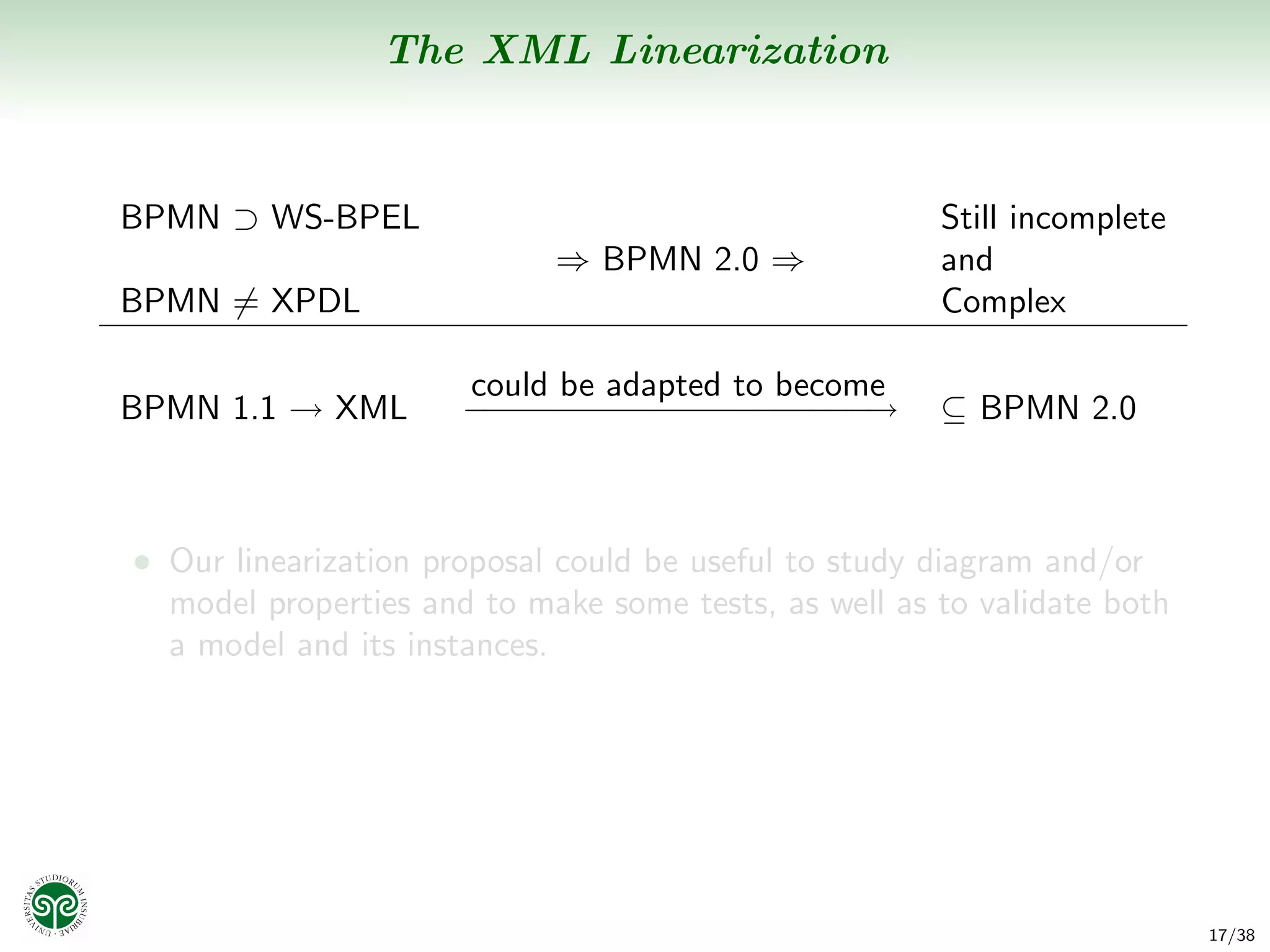
The XML Linearization


BPMN ⊃ WS-BPEL                                        Still incomplete
                            ⇒ BPMN 2.0 ⇒              and
BPMN = XPDL                                           Complex

                      could be adapted to become
BPMN 1.1 → XML        −−−−−−−−−−−
                       −−−−−−−−−−→                    ⊆ BPMN 2.0


• Our linearization proposal could be useful to study diagram and/or
  model properties and to make some tests, as well as to validate both
  a model and its instances.


                                                                         17/38
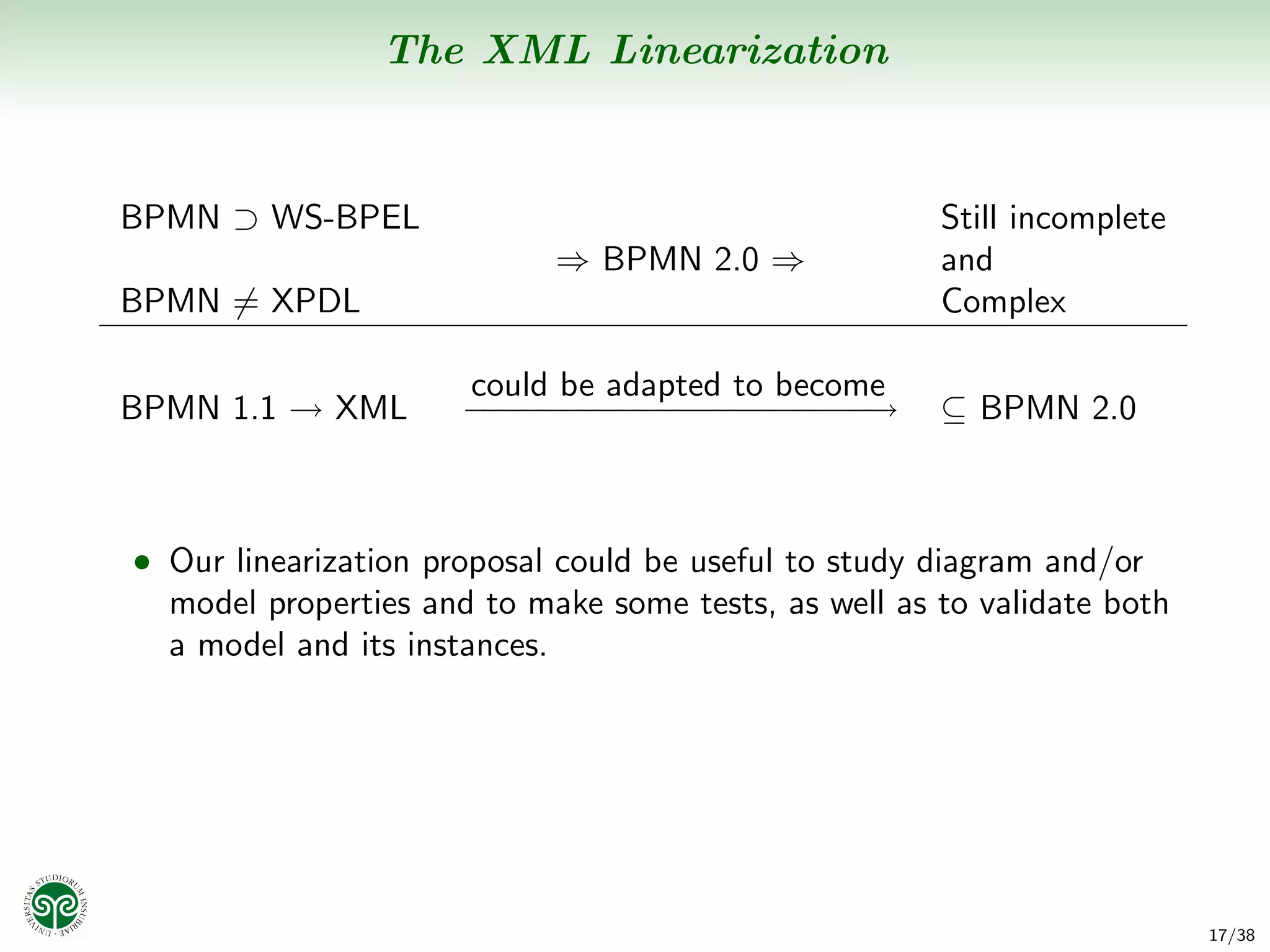
The XML Linearization


BPMN ⊃ WS-BPEL                                        Still incomplete
                            ⇒ BPMN 2.0 ⇒              and
BPMN = XPDL                                           Complex

                      could be adapted to become
BPMN 1.1 → XML        −−−−−−−−−−−
                       −−−−−−−−−−→                    ⊆ BPMN 2.0


• Our linearization proposal could be useful to study diagram and/or
  model properties and to make some tests, as well as to validate both
  a model and its instances.


                                                                         17/38
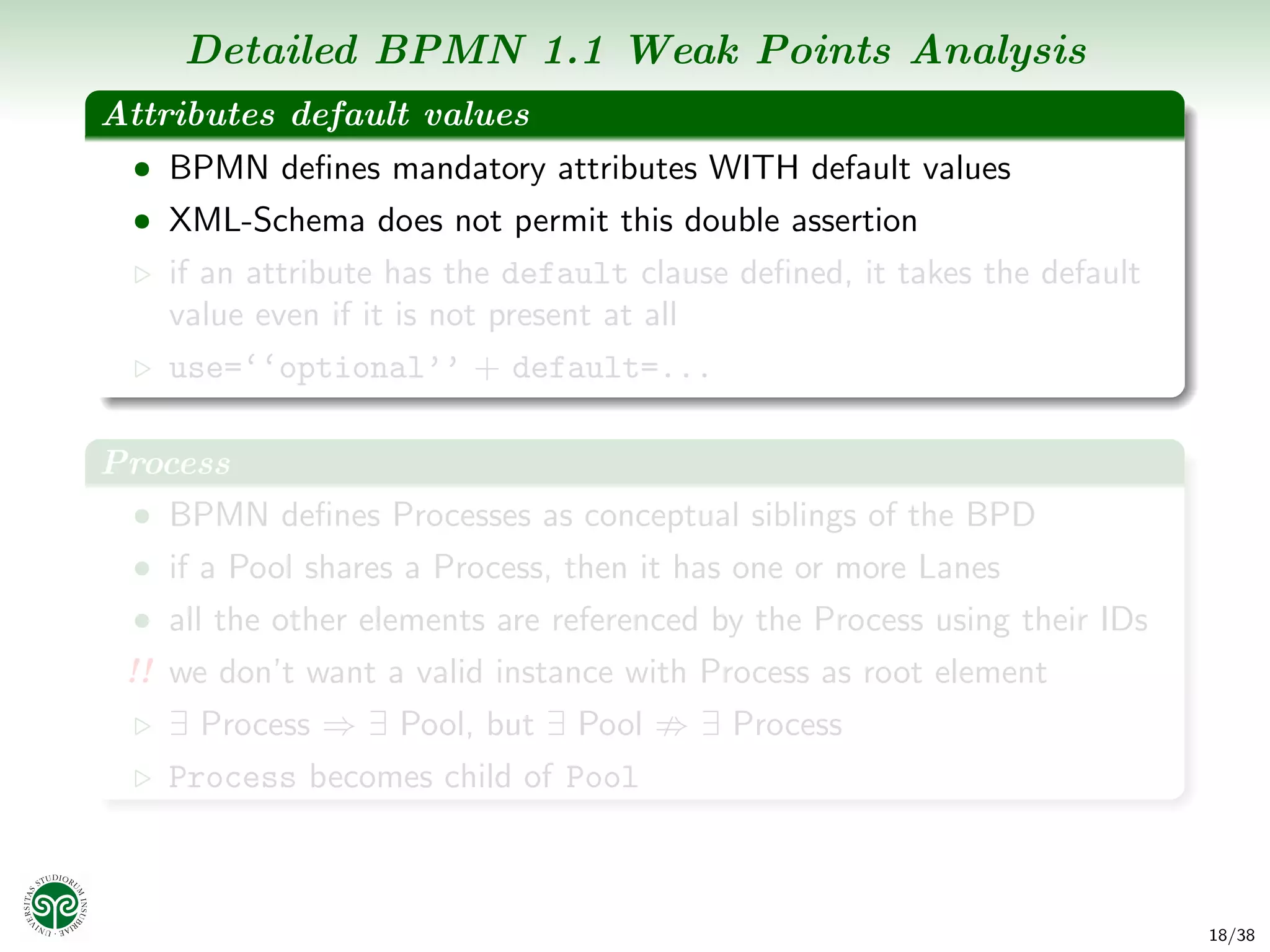
Detailed BPMN 1.1 Weak Points Analysis
Attributes default values
  • BPMN defines mandatory attributes WITH default values
  • XML-Schema does not permit this double assertion
    if an attribute has the default clause defined, it takes the default
    value even if it is not present at all
    use=‘‘optional’’ + default=...

Process
 • BPMN defines Processes as conceptual siblings of the BPD
  • if a Pool shares a Process, then it has one or more Lanes
  • all the other elements are referenced by the Process using their IDs
 !! we don’t want a valid instance with Process as root element
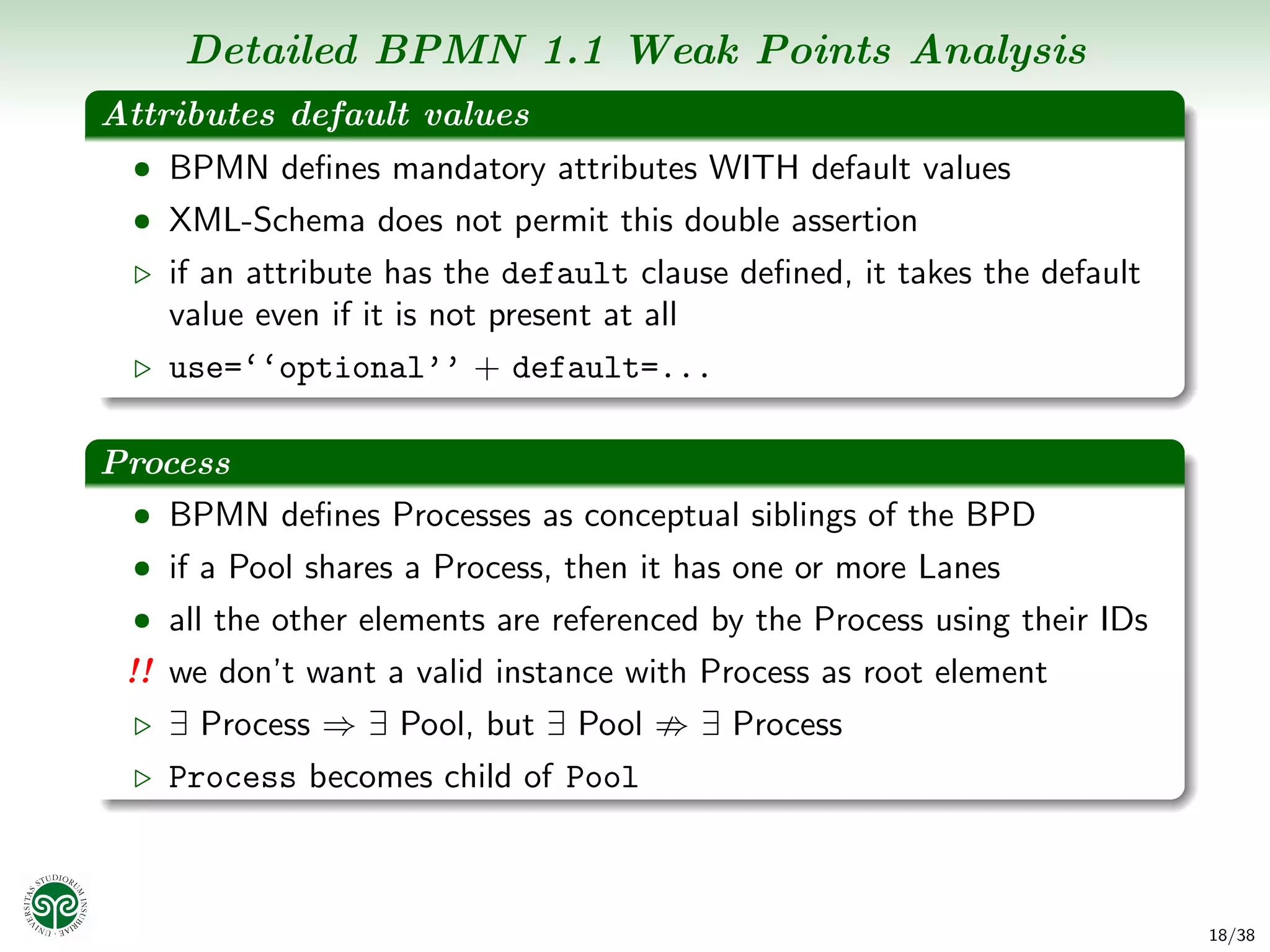
    ∃ Process ⇒ ∃ Pool, but ∃ Pool       ∃ Process
    Process becomes child of Pool


                                                                           18/38
Detailed BPMN 1.1 Weak Points Analysis
Attributes default values
  • BPMN defines mandatory attributes WITH default values
  • XML-Schema does not permit this double assertion
    if an attribute has the default clause defined, it takes the default
    value even if it is not present at all
    use=‘‘optional’’ + default=...

Process
 • BPMN defines Processes as conceptual siblings of the BPD
  • if a Pool shares a Process, then it has one or more Lanes
  • all the other elements are referenced by the Process using their IDs
 !! we don’t want a valid instance with Process as root element
    ∃ Process ⇒ ∃ Pool, but ∃ Pool       ∃ Process
    Process becomes child of Pool


                                                                           18/38
Detailed BPMN 1.1 Weak Points Analysis
Attributes default values
  • BPMN defines mandatory attributes WITH default values
  • XML-Schema does not permit this double assertion
    if an attribute has the default clause defined, it takes the default
    value even if it is not present at all
    use=‘‘optional’’ + default=...

Process
 • BPMN defines Processes as conceptual siblings of the BPD
  • if a Pool shares a Process, then it has one or more Lanes
  • all the other elements are referenced by the Process using their IDs
 !! we don’t want a valid instance with Process as root element
    ∃ Process ⇒ ∃ Pool, but ∃ Pool       ∃ Process
    Process becomes child of Pool


                                                                           18/38
Detailed BPMN 1.1 Weak Points Analysis
Attributes default values
  • BPMN defines mandatory attributes WITH default values
  • XML-Schema does not permit this double assertion
    if an attribute has the default clause defined, it takes the default
    value even if it is not present at all
    use=‘‘optional’’ + default=...

Process
 • BPMN defines Processes as conceptual siblings of the BPD
  • if a Pool shares a Process, then it has one or more Lanes
  • all the other elements are referenced by the Process using their IDs
 !! we don’t want a valid instance with Process as root element
    ∃ Process ⇒ ∃ Pool, but ∃ Pool       ∃ Process
    Process becomes child of Pool


                                                                           18/38
Detailed BPMN 1.1 Weak Points Analysis
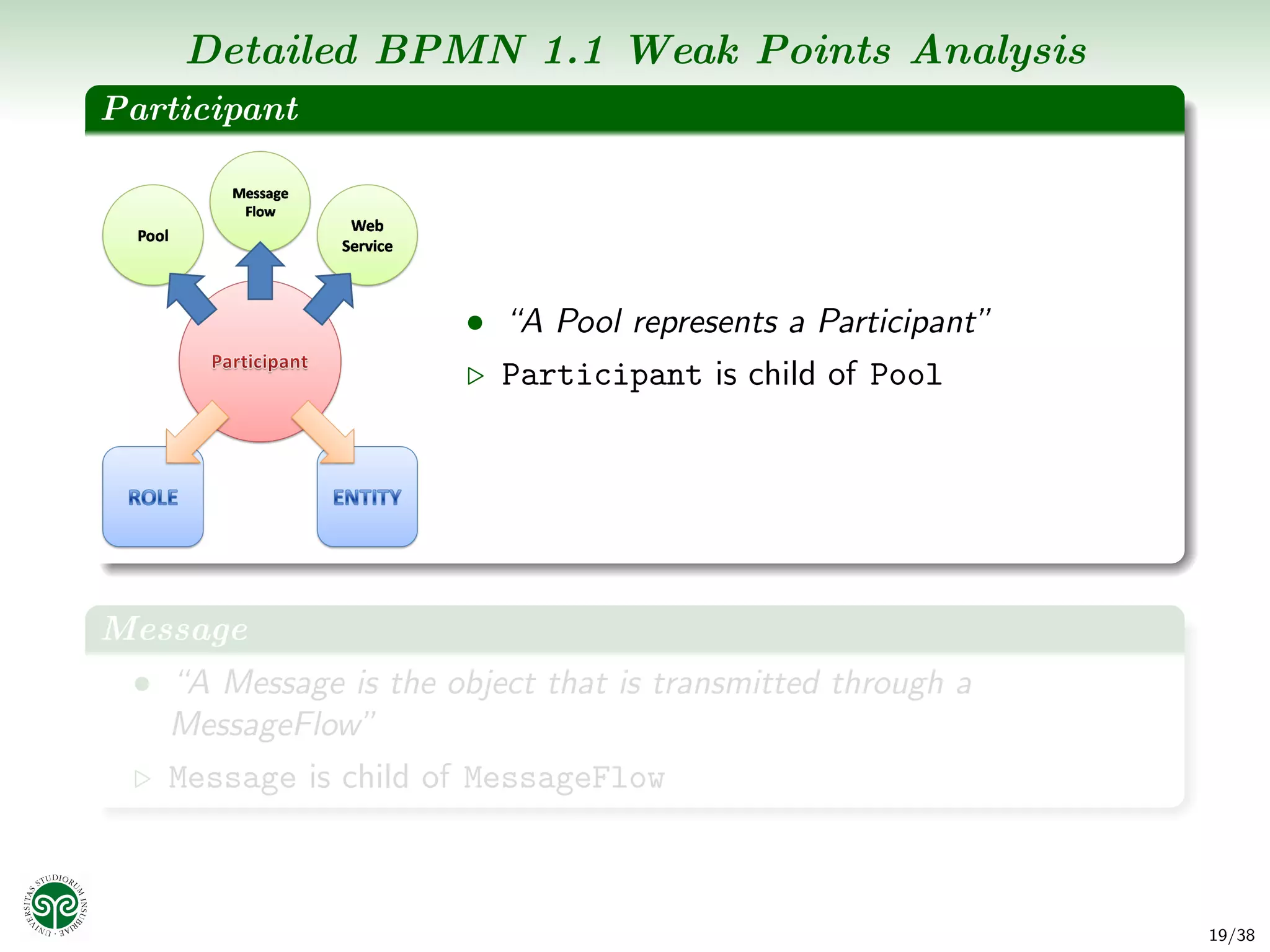
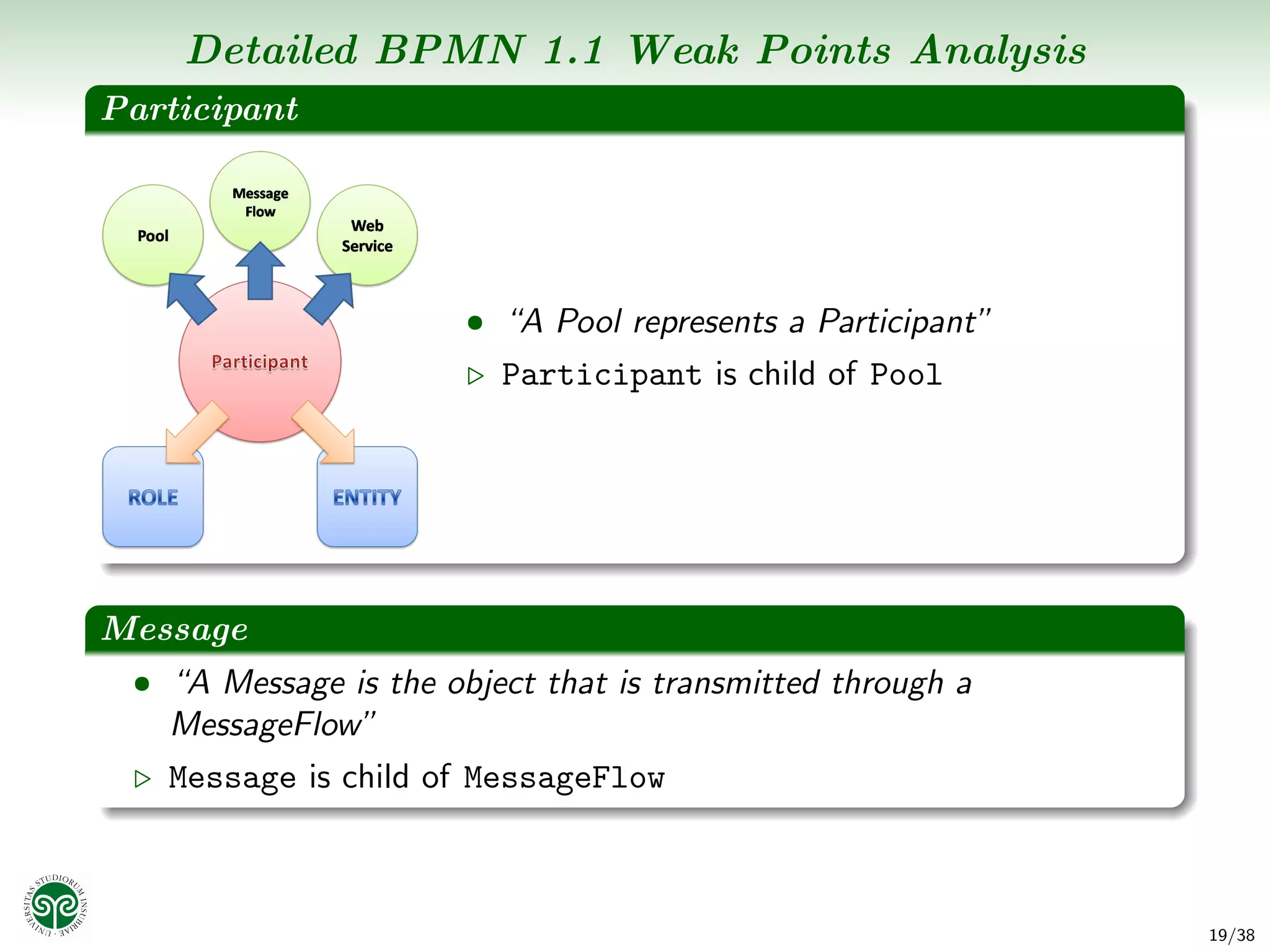
Participant


                       • “A Pool represents a Participant”
                         Participant is child of Pool


Message
 • “A Message is the object that is transmitted through a
   MessageFlow”
   Message is child of MessageFlow


                                                             19/38
Detailed BPMN 1.1 Weak Points Analysis
Participant


                       • “A Pool represents a Participant”
                         Participant is child of Pool


Message
 • “A Message is the object that is transmitted through a
   MessageFlow”
   Message is child of MessageFlow


                                                             19/38
Detailed BPMN 1.1 Weak Points Analysis


Web Service
 • WebService is required by many other elements
  • BPMN defines WebService as a Supporting Element
    Inside the BPMN to WS-BPEL mapping example the WebService is
    defined inside the parent element
    We chose to instantiate WebService every time it is needed
    (xs:assert)


                                                                   20/38
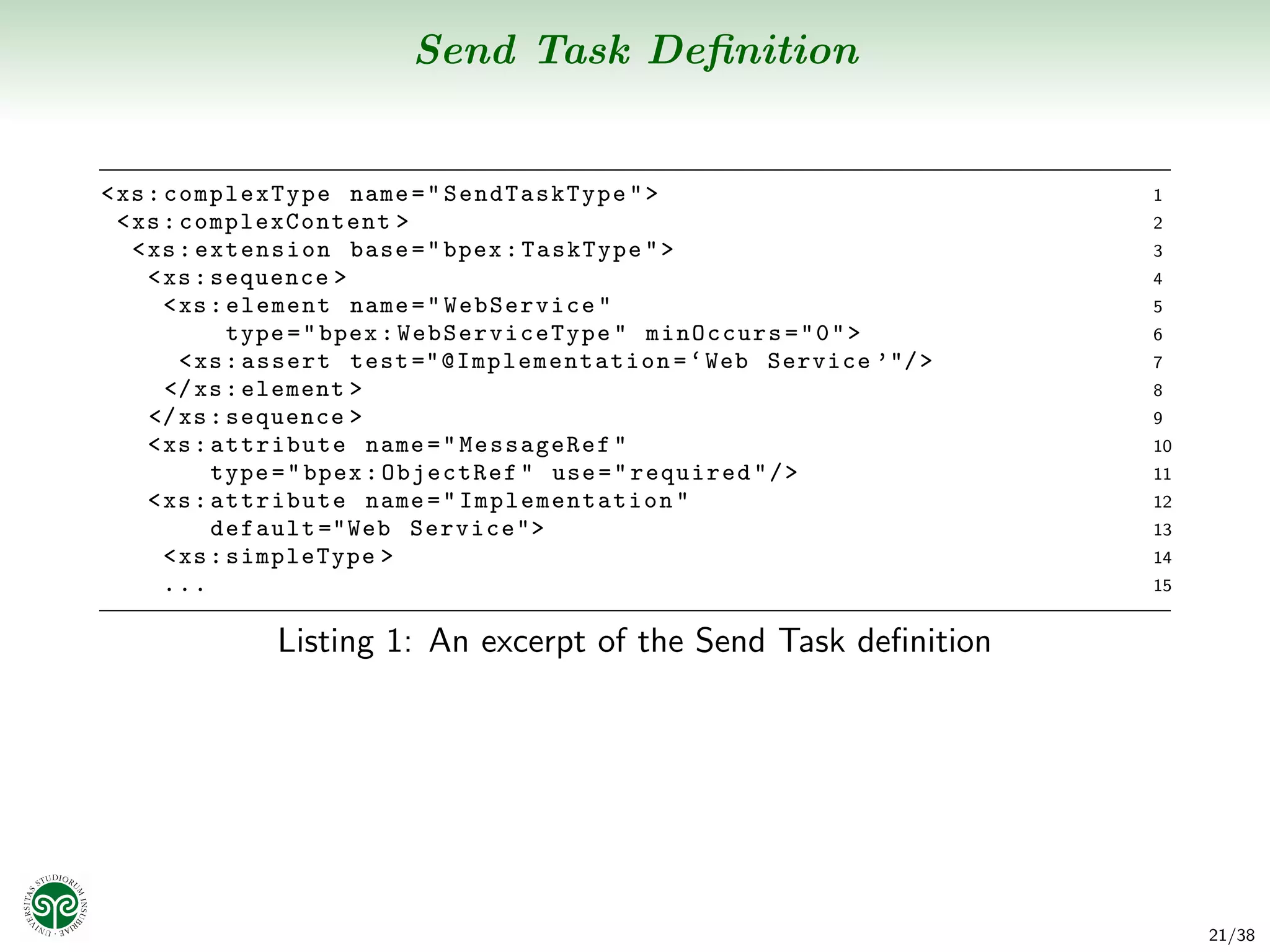
Send Task Definition


< xs : complexType name = " SendTaskType " >                                   1
  < xs : complexContent >                                                      2
    < xs : extension base = " bpex : TaskType " >                              3
      < xs : sequence >                                                        4
        < xs : element name = " WebService "                                   5
               type = " bpex : WebServi ceType " minOccurs = " 0 " >           6
          < xs : assert test ="@I mp le m en ta t io n = ‘ Web Service ’"/ >   7
        </ xs : element >                                                      8
      </ xs : sequence >                                                       9
      < xs : attribute name = " MessageRef "                                   10
             type = " bpex : ObjectRef " use = " required " / >                11
      < xs : attribute name = " Impl ementat ion "                             12
             default ="Web Service">                                           13
        < xs : simpleType >                                                    14
        ...                                                                    15


                Listing 1: An excerpt of the Send Task definition


                                                                                    21/38
Detailed BPMN 1.1 Weak Points Analysis


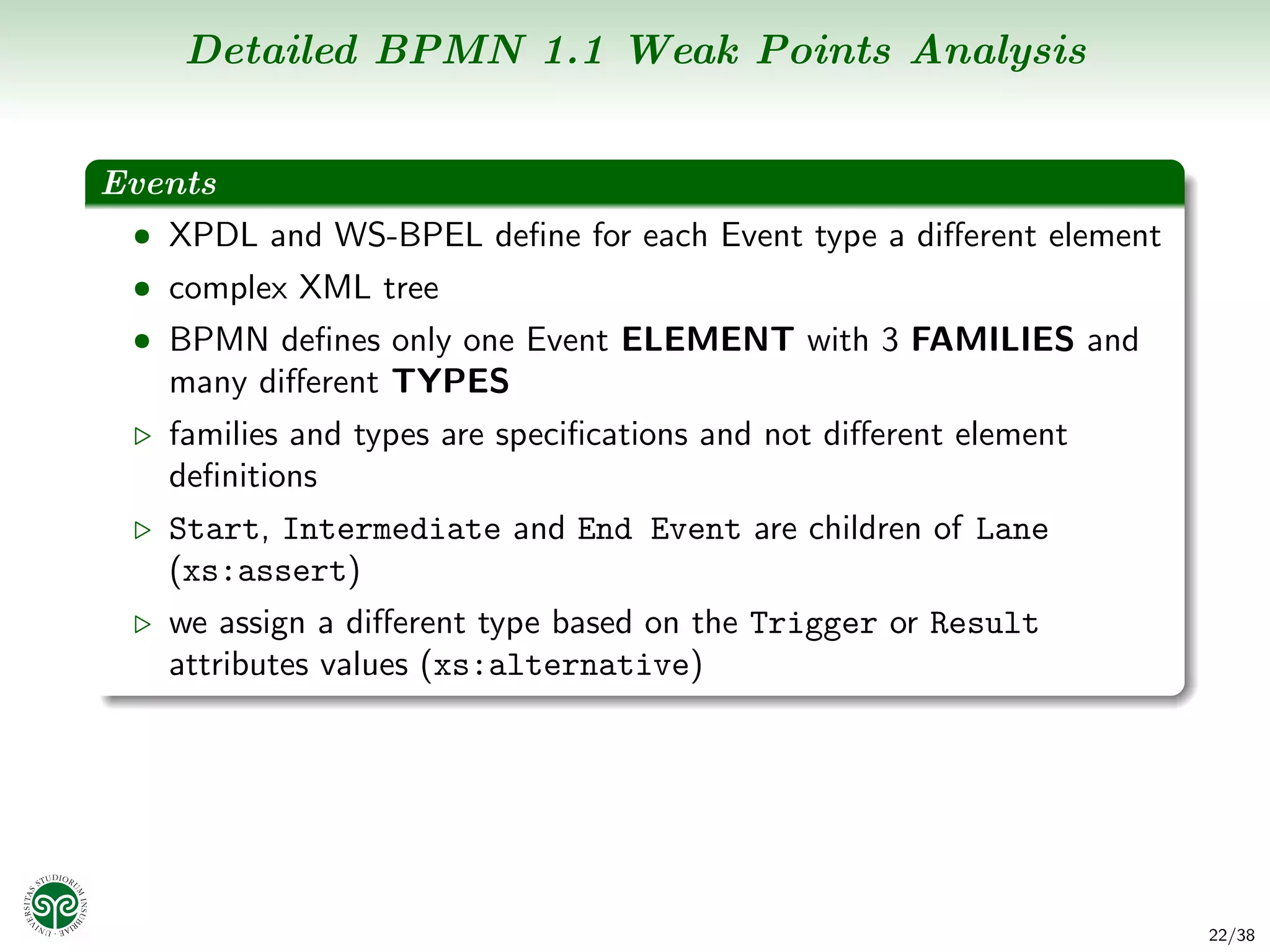
Events
 • XPDL and WS-BPEL define for each Event type a different element
  • complex XML tree
  • BPMN defines only one Event ELEMENT with 3 FAMILIES and
    many different TYPES
    families and types are specifications and not different element
    definitions
    Start, Intermediate and End Event are children of Lane
    (xs:assert)
    we assign a different type based on the Trigger or Result
    attributes values (xs:alternative)


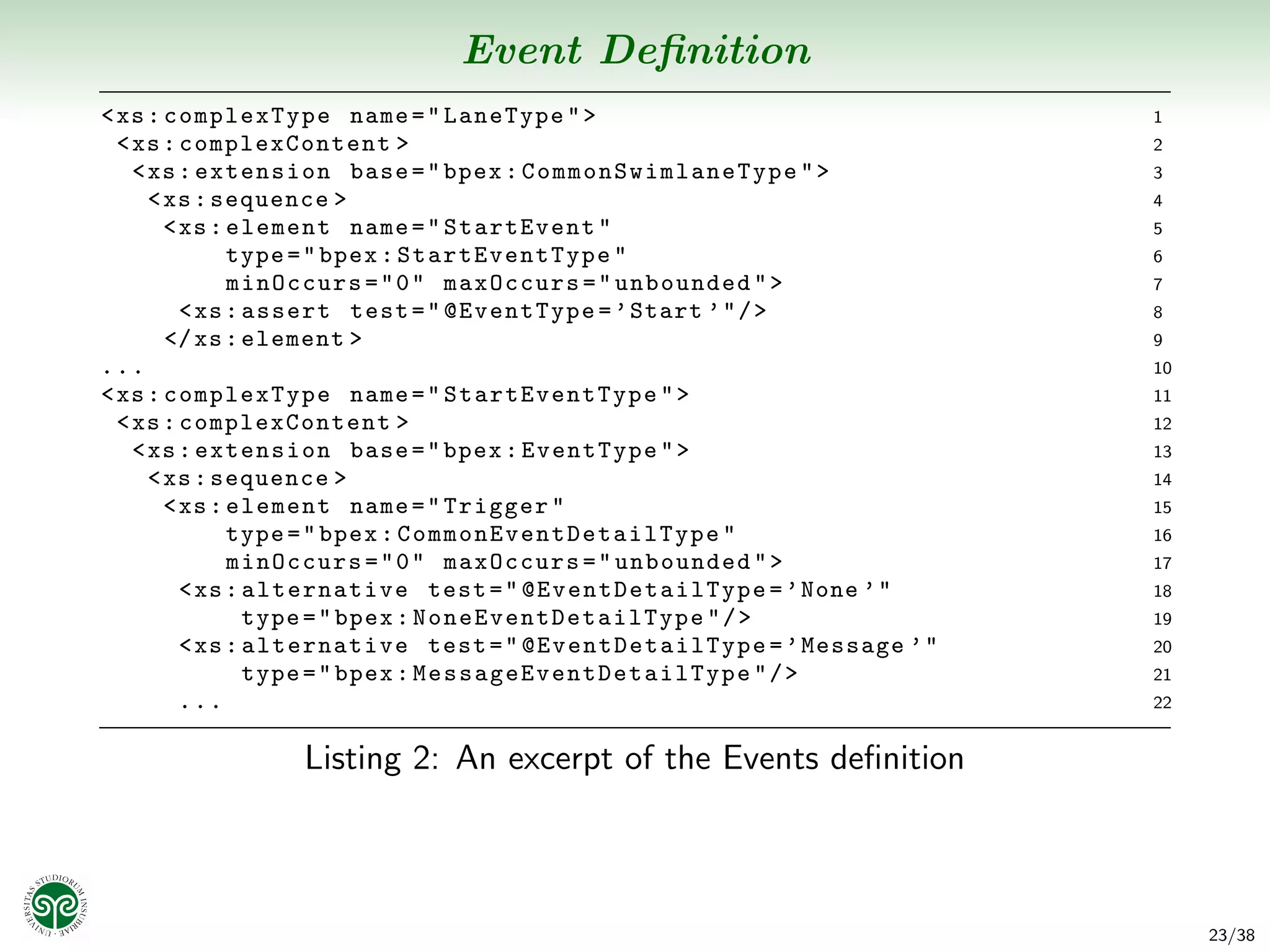
                                                                    22/38
Event Definition
< xs : complexType name = " LaneType " >                                                1
  < xs : complexContent >                                                               2
    < xs : extension base = " bpex : C o m m o n S w i m l a n e T y p e " >            3
      < xs : sequence >                                                                 4
        < xs : element name = " StartEvent "                                            5
               type = " bpex : StartEve ntType "                                        6
               minOccurs = " 0 " maxOccurs = " unbounded " >                            7
          < xs : assert test = " @EventType = ’ Start ’ " / >                           8
        </ xs : element >                                                               9
...                                                                                     10
< xs : complexType name = " StartEve ntType " >                                         11
  < xs : complexContent >                                                               12
    < xs : extension base = " bpex : EventType " >                                      13
      < xs : sequence >                                                                 14
        < xs : element name = " Trigger "                                               15
               type = " bpex : C o m m o n E v e n t D e t a i l T y p e "              16
               minOccurs = " 0 " maxOccurs = " unbounded " >                            17
          < xs : alternative test = " @ E v e n t D e t a i l T y p e = ’ None ’ "      18
                 type = " bpex : N o n e E v e n t D e t a i l T y p e " / >            19
          < xs : alternative test = " @ E v e n t D e t a i l T y p e = ’ Message ’ "   20
                 type = " bpex : M e s s a g e E v e n t D e t a i l T y p e " / >      21
          ...                                                                           22


                    Listing 2: An excerpt of the Events definition


                                                                                             23/38
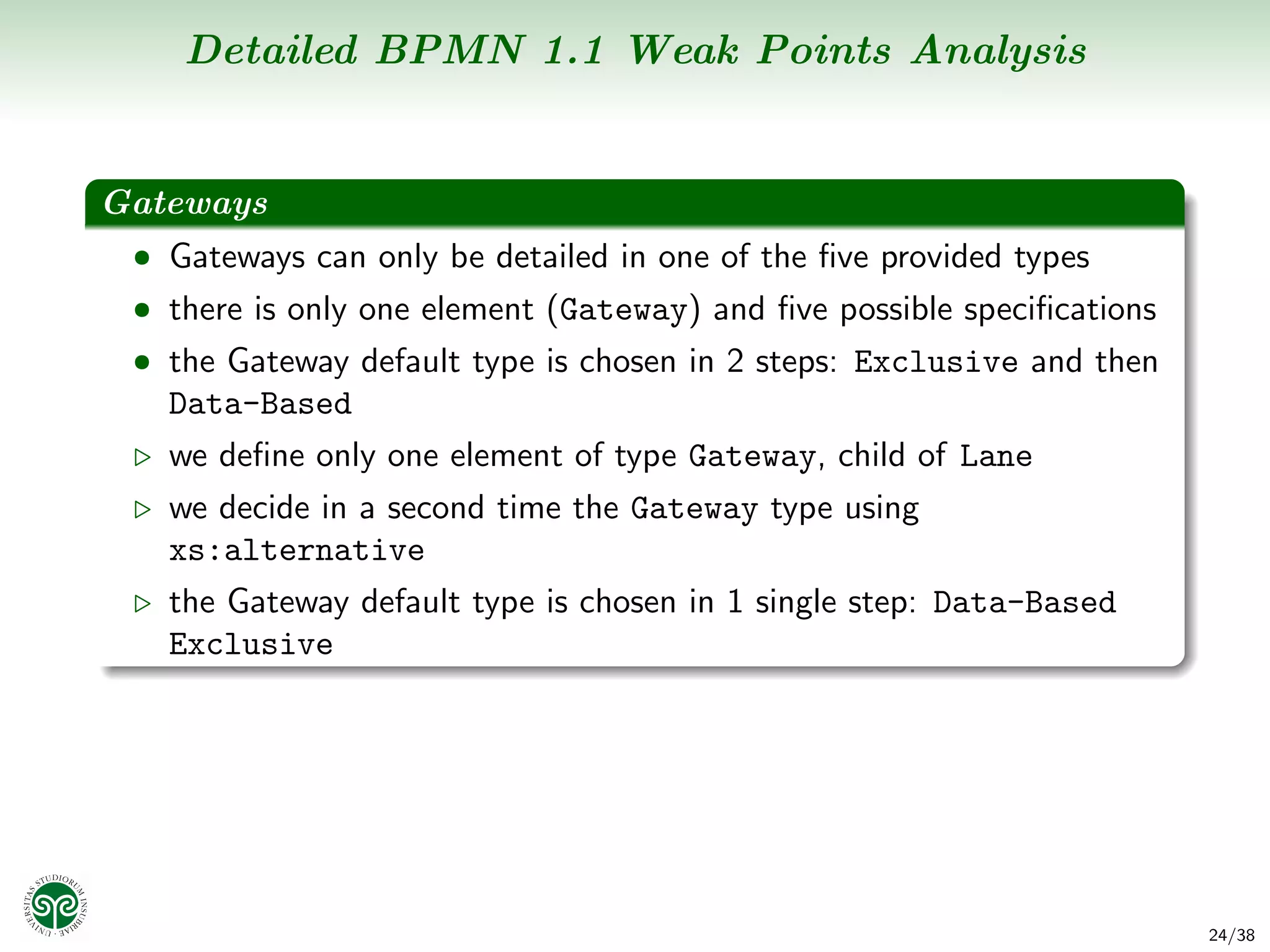
Detailed BPMN 1.1 Weak Points Analysis


Gateways
 • Gateways can only be detailed in one of the five provided types
 • there is only one element (Gateway) and five possible specifications
 • the Gateway default type is chosen in 2 steps: Exclusive and then
   Data-Based
   we define only one element of type Gateway, child of Lane
   we decide in a second time the Gateway type using
   xs:alternative
   the Gateway default type is chosen in 1 single step: Data-Based
   Exclusive


                                                                        24/38
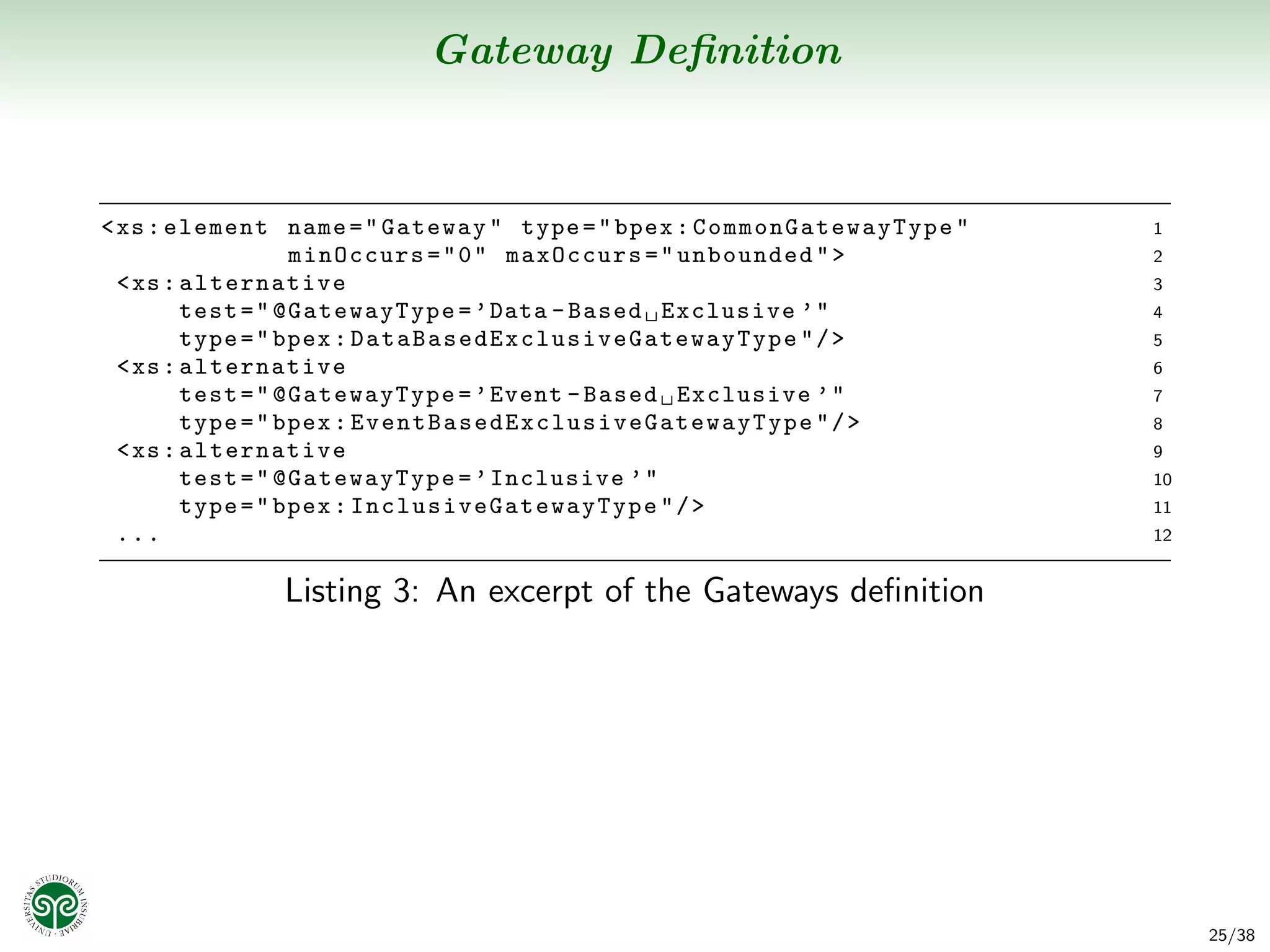
Gateway Definition


< xs : element name = " Gateway " type = " bpex : C o m m o n G a t e w a y T y p e "        1
                   minOccurs = " 0 " maxOccurs = " unbounded " >                             2
  < xs : alternative                                                                         3
         test = " @GatewayType = ’ Data - Based Exclusive ’ "                                4
         type = " bpex : D a t a B a s e d E x c l u s i v e G a t e w a y T y p e " / >     5
  < xs : alternative                                                                         6
         test = " @GatewayType = ’ Event - Based Exclusive ’ "                               7
         type = " bpex : E v e n t B a s e d E x c l u s i v e G a t e w a y T y p e " / >   8
  < xs : alternative                                                                         9
         test = " @GatewayType = ’ Inclusive ’ "                                             10
         type = " bpex : I n c l u s i v e G a t e w a y T y p e " / >                       11
  ...                                                                                        12


                   Listing 3: An excerpt of the Gateways definition


                                                                                                  25/38
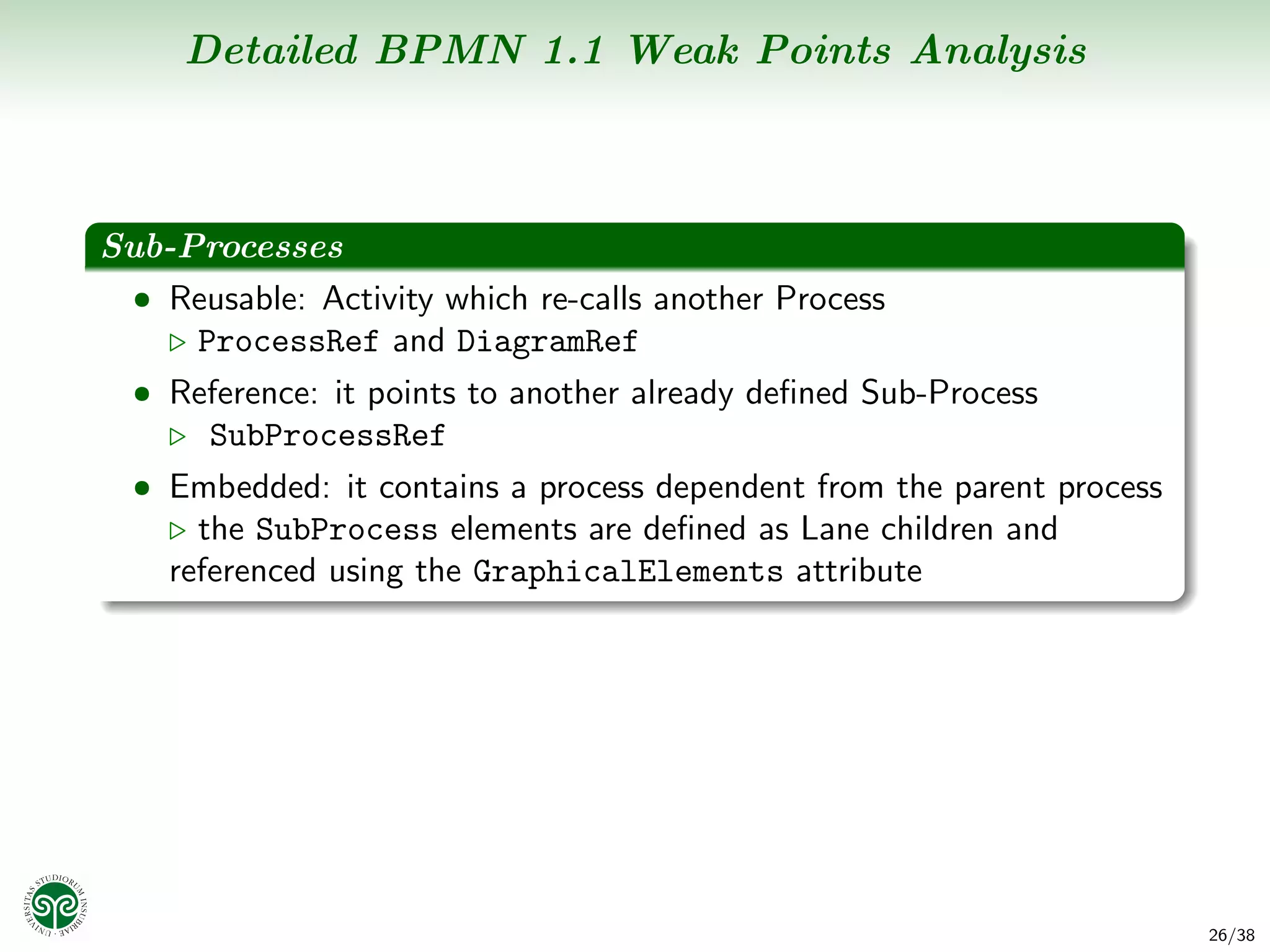
Detailed BPMN 1.1 Weak Points Analysis


Sub-Processes
  • Reusable: Activity which re-calls another Process
     ProcessRef and DiagramRef
  • Reference: it points to another already defined Sub-Process
       SubProcessRef
  • Embedded: it contains a process dependent from the parent process
      the SubProcess elements are defined as Lane children and
    referenced using the GraphicalElements attribute


                                                                        26/38
Detailed BPMN 1.1 Weak Points Analysis
Artifacts
 • one Artifact could be used across the whole BPD, using Associations
    to reference elements
 • they need only one place to be instantiated
    Artifacts as BPD children
    inside the XML they can be positioned everywhere

Transactions and Signals
 • some elements need to be referenced from multiple objects and they
    are instantiated every time they are requested: different IDs but the
    same name
 • the attribute TransactionId of type String serves as an “identifier
    for the Transactions used within a diagram”
    we extended the idea behind the TransactionId also to Signals
    and other similar objects


                                                                           27/38
Detailed BPMN 1.1 Weak Points Analysis
Artifacts
 • one Artifact could be used across the whole BPD, using Associations
    to reference elements
 • they need only one place to be instantiated
    Artifacts as BPD children
    inside the XML they can be positioned everywhere

Transactions and Signals
 • some elements need to be referenced from multiple objects and they
    are instantiated every time they are requested: different IDs but the
    same name
 • the attribute TransactionId of type String serves as an “identifier
    for the Transactions used within a diagram”
    we extended the idea behind the TransactionId also to Signals
    and other similar objects


                                                                           27/38
Referential Integrity Using XPath

  • The very old way: manual ID/IDRef references – strings, numbers,
    NCNames, random generators, . . .
  • The old way: xs:key and xs:keyref
  • The new way: xs:assert and xs:alternative

xs:assert
  • <xs:assert-test=‘‘XPathExpr’’ />
  • limit: the XPath 2.0 expressions set


xs:alternative
  • it permits to choose the type of an element according to the success
    of a XPath 2.0 test
  • useful for Events, Gateways, Activities


                                                                           28/38
Referential Integrity Using XPath

  • The very old way: manual ID/IDRef references – strings, numbers,
    NCNames, random generators, . . .
  • The old way: xs:key and xs:keyref
  • The new way: xs:assert and xs:alternative

xs:assert
  • <xs:assert-test=‘‘XPathExpr’’ />
  • limit: the XPath 2.0 expressions set


xs:alternative
  • it permits to choose the type of an element according to the success
    of a XPath 2.0 test
  • useful for Events, Gateways, Activities


                                                                           28/38
Referential Integrity Verification


• Using our XML-Schema Model we are able to validate statically the
  syntax as well as structural semantics rules of a BPD
• Using a set of XQuery/XPath interrogations on the XML instances
  we can validate also most of the behavioral semantics rules of BPMN
• The use of XQuery/XPath let us verify business rules at code-gen
  time and at run-time


                                                                        29/38
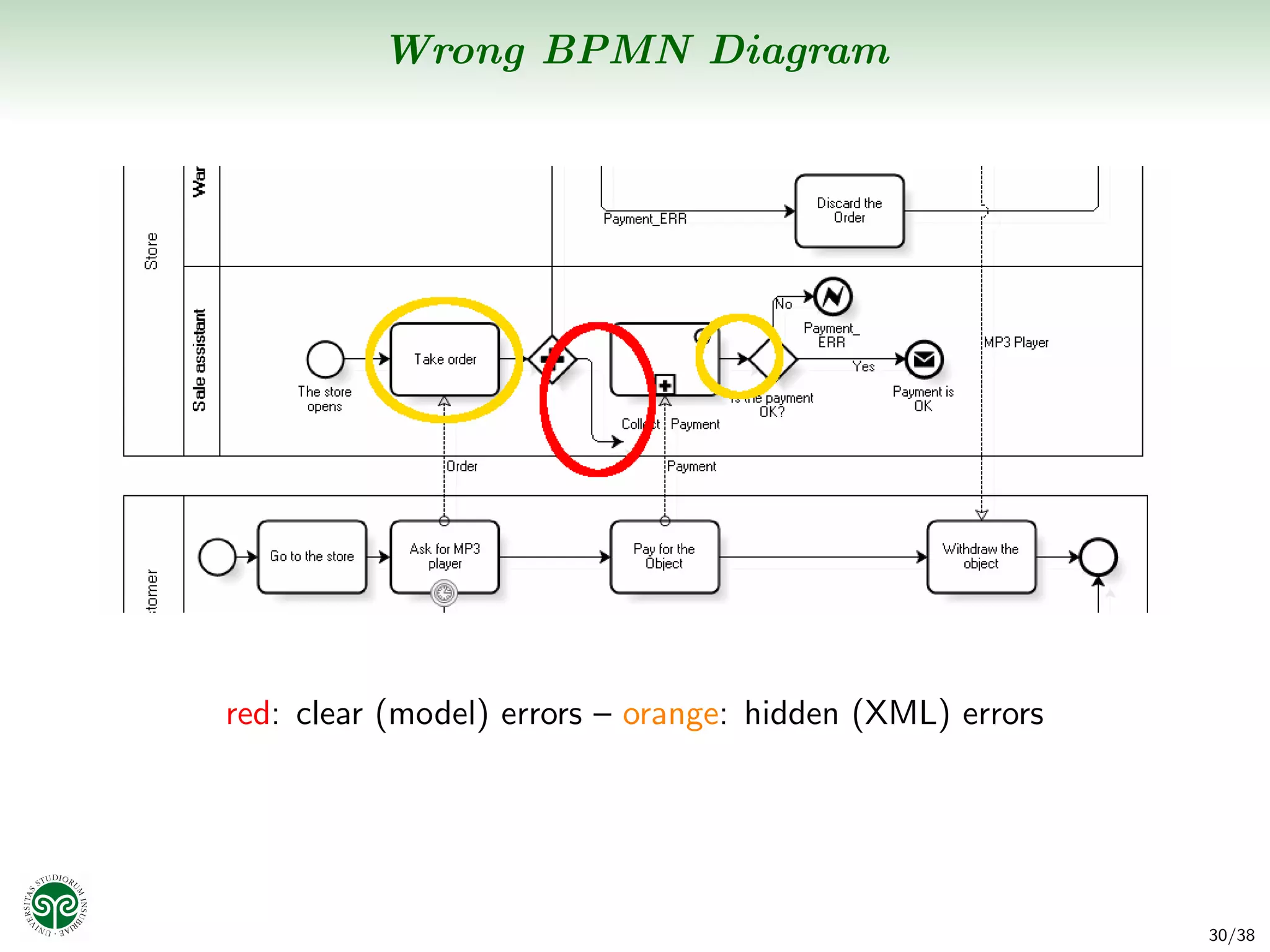
Wrong BPMN Diagram


red: clear (model) errors – orange: hidden (XML) errors


                                                          30/38
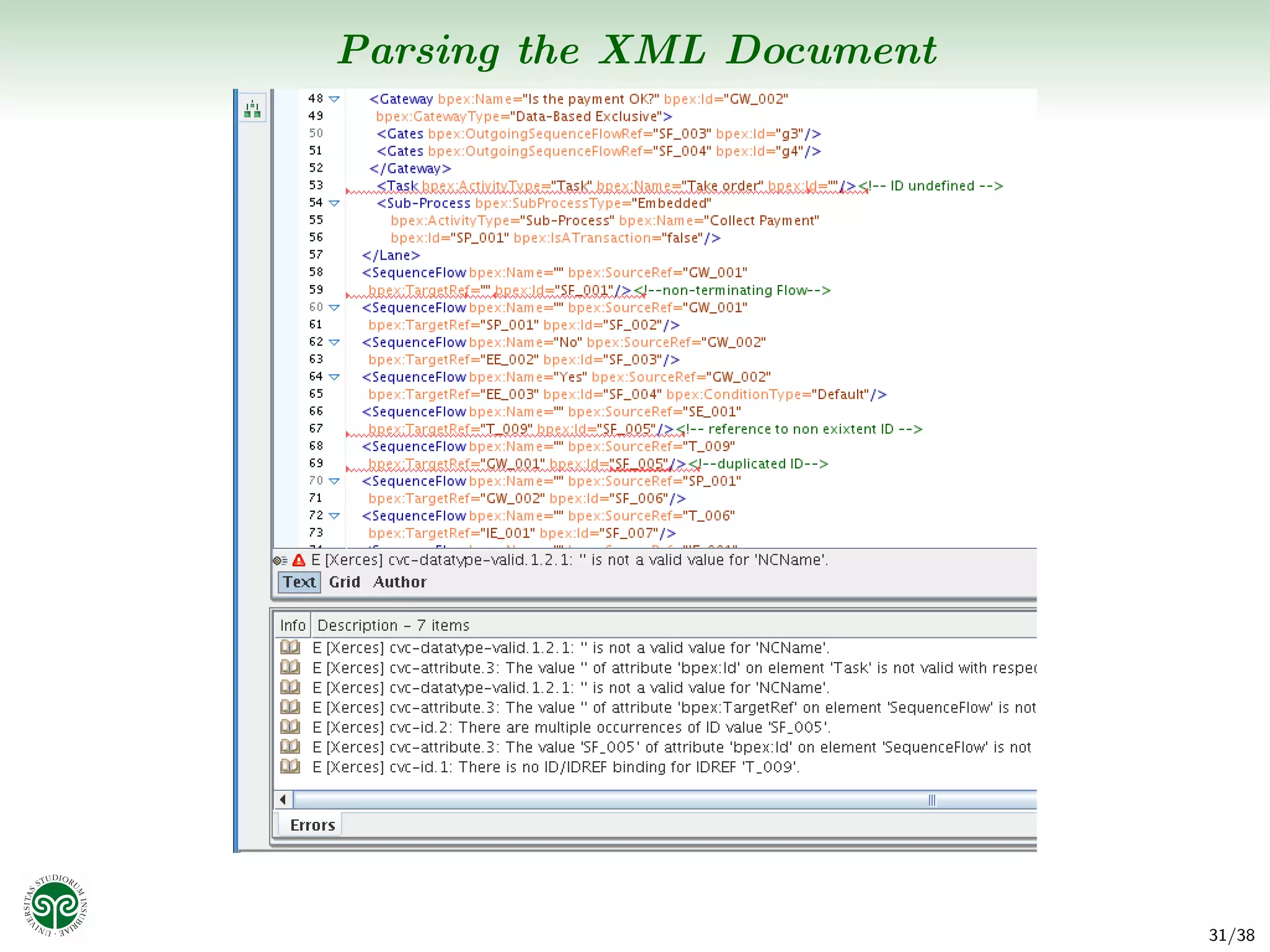
Parsing the XML Document


                           31/38
Start Event Check


for $ pool in // Pool ,                                              1
    $ startevent in $ pool // StartEvent                             2
return $ pool // SequenceFlow [ @b pe x :T ar ge t Re f = ←          3
        $ startevent / @bpex:Id ]/ @bpex:Id                          4


      Listing 4: Rules verification using XPath/XQuery: Start Event


                                                                         32/38
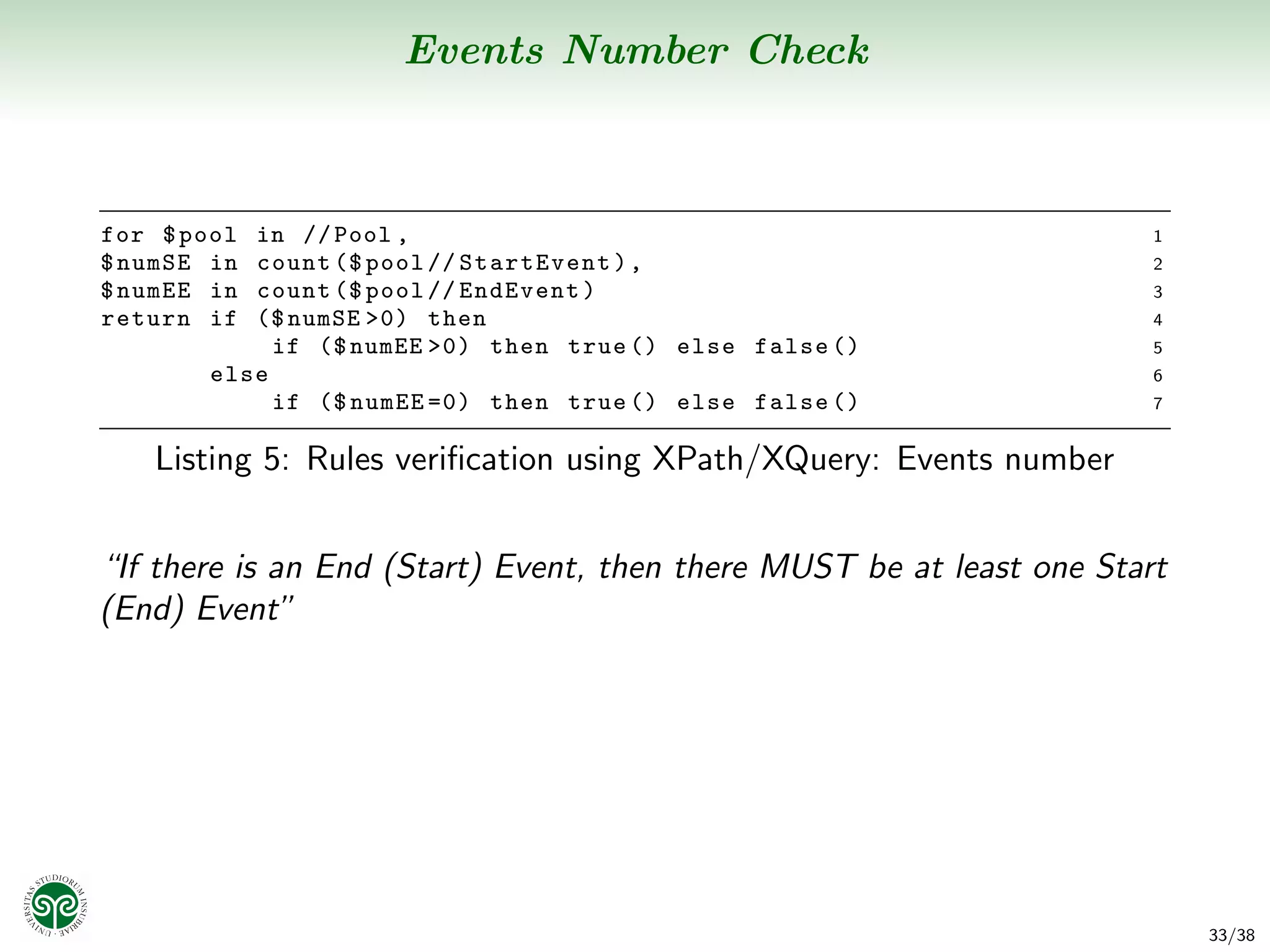
Events Number Check


for $ pool in // Pool ,                                                1
$ numSE in count ($ pool // StartEvent ) ,                             2
$ numEE in count ($ pool // EndEvent )                                 3
return if  ($ numSE >0) then                                           4
             if ($ numEE >0) then true () else false ()                5
        else                                                           6
             if ($ numEE =0) then true () else false ()                7


   Listing 5: Rules verification using XPath/XQuery: Events number


“If there is an End (Start) Event, then there MUST be at least one Start
(End) Event”


                                                                           33/38
Instantiation Semantic Verification


for $ pool in // Pool ,                                               1
$ startEvent in $ pool // StartEvent ,                                2
$ numSE in count ($ startEvent ) ,                                    3
$ elements in $ pool / Lane /*[ name ()!= " StartEvent " ]            4
return                                                                5
if ($ numSE >0) then                                                  6
  if ( every $ id in $ elements / @bpex:Id satisfies ←                7
       $ id =$ pool / SequenceFlow / @ b pe x: T ar ge tR e f )       8
  then true ()                                                        9
  else $ elements / @bpex:Id                                          10
else false ()                                                         11


Listing 6: Rules verification using XPath/XQuery: instantiation semantic


“If the Start Event is used, then there MUST NOT be other flow
elements that do not have incoming Sequence Flow”


                                                                           34/38
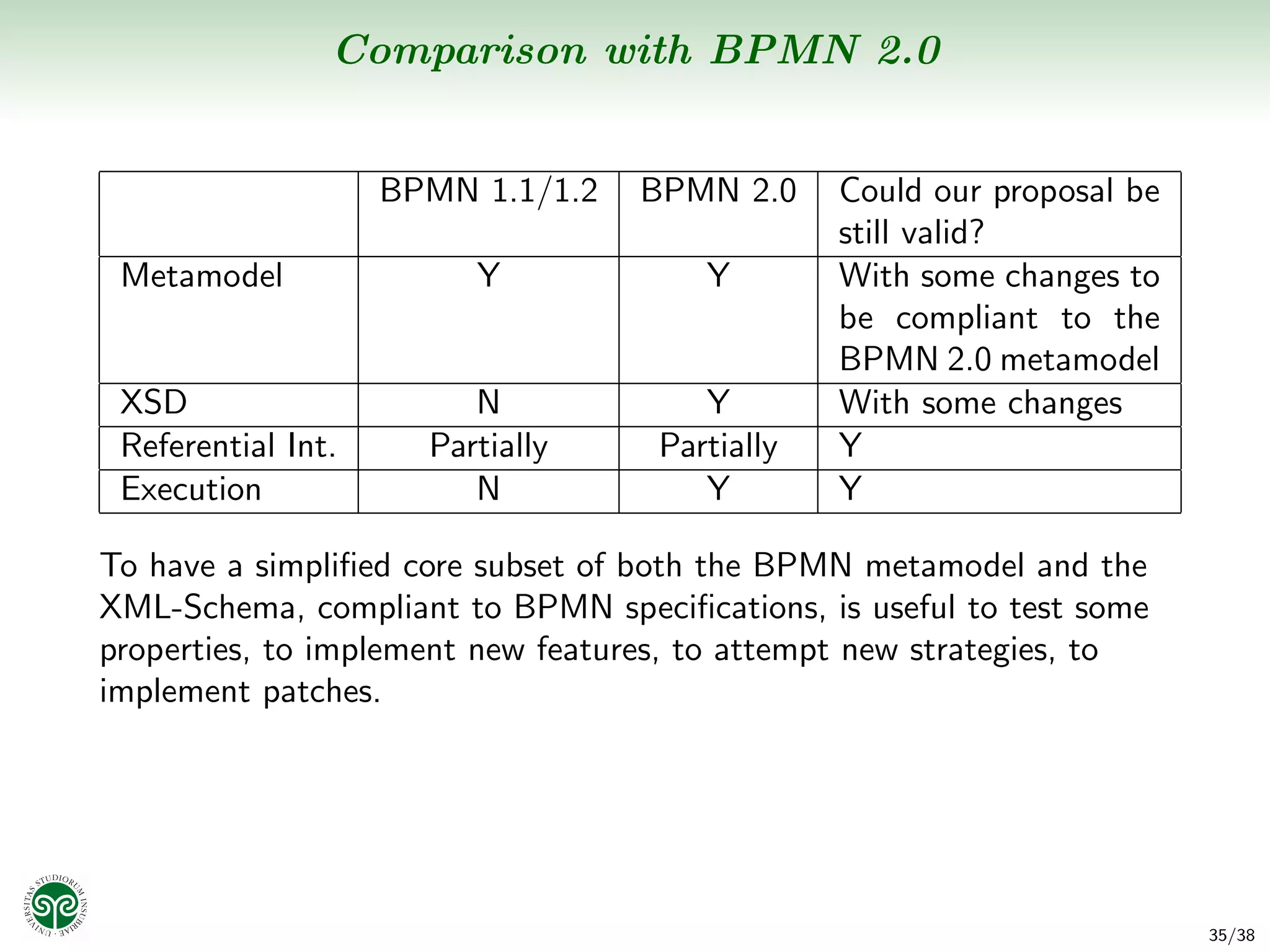
Comparison with BPMN 2.0


                    BPMN 1.1/1.2   BPMN 2.0     Could our proposal be
                                                still valid?
 Metamodel               Y             Y        With some changes to
                                                be compliant to the
                                                BPMN 2.0 metamodel
 XSD                     N             Y        With some changes
 Referential Int.     Partially     Partially   Y
 Execution               N             Y        Y

To have a simplified core subset of both the BPMN metamodel and the
XML-Schema, compliant to BPMN specifications, is useful to test some
properties, to implement new features, to attempt new strategies, to
implement patches.


                                                                        35/38
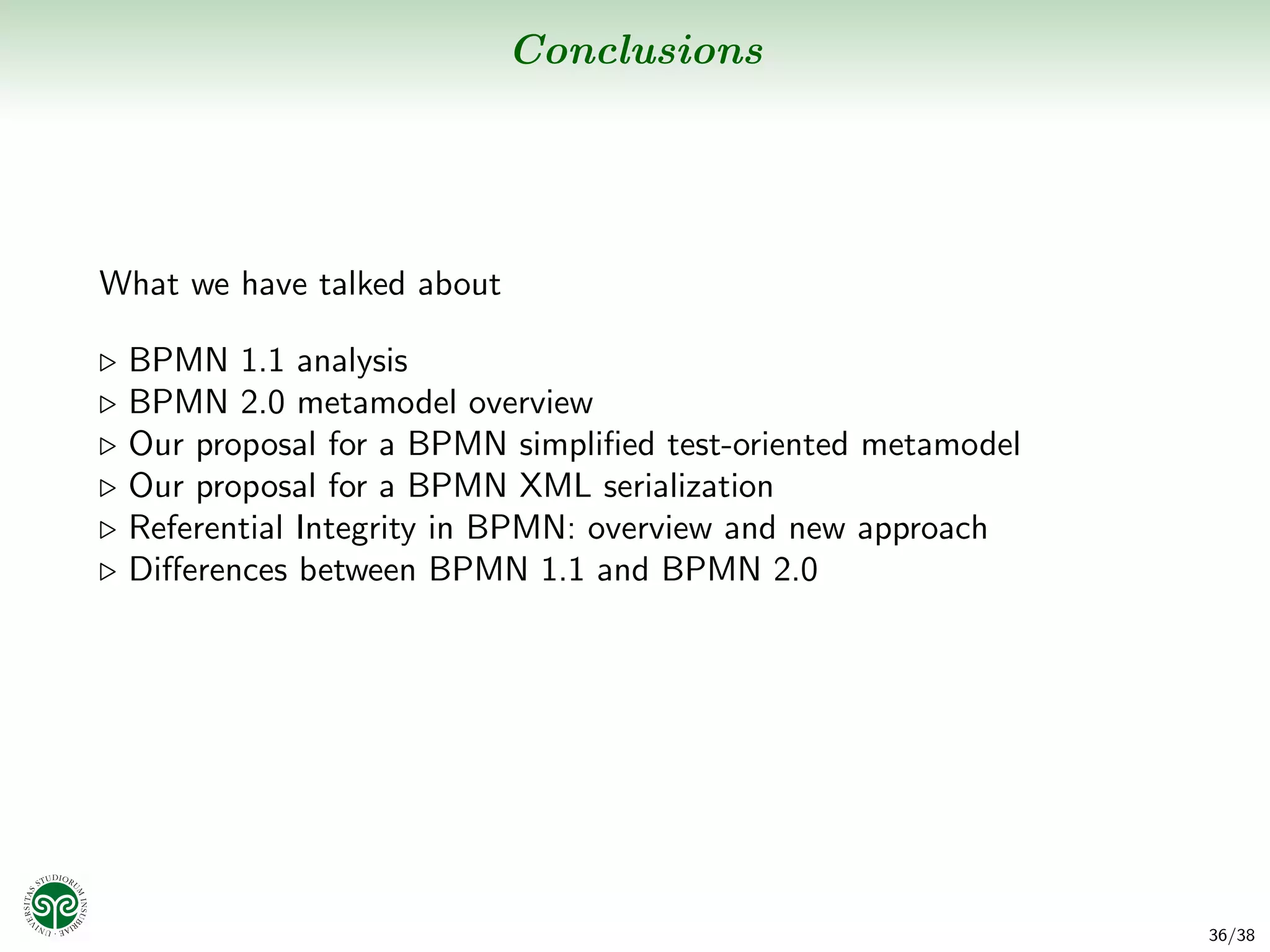
Conclusions


What we have talked about

 BPMN 1.1 analysis
 BPMN 2.0 metamodel overview
 Our proposal for a BPMN simplified test-oriented metamodel
 Our proposal for a BPMN XML serialization
 Referential Integrity in BPMN: overview and new approach
 Differences between BPMN 1.1 and BPMN 2.0


                                                             36/38
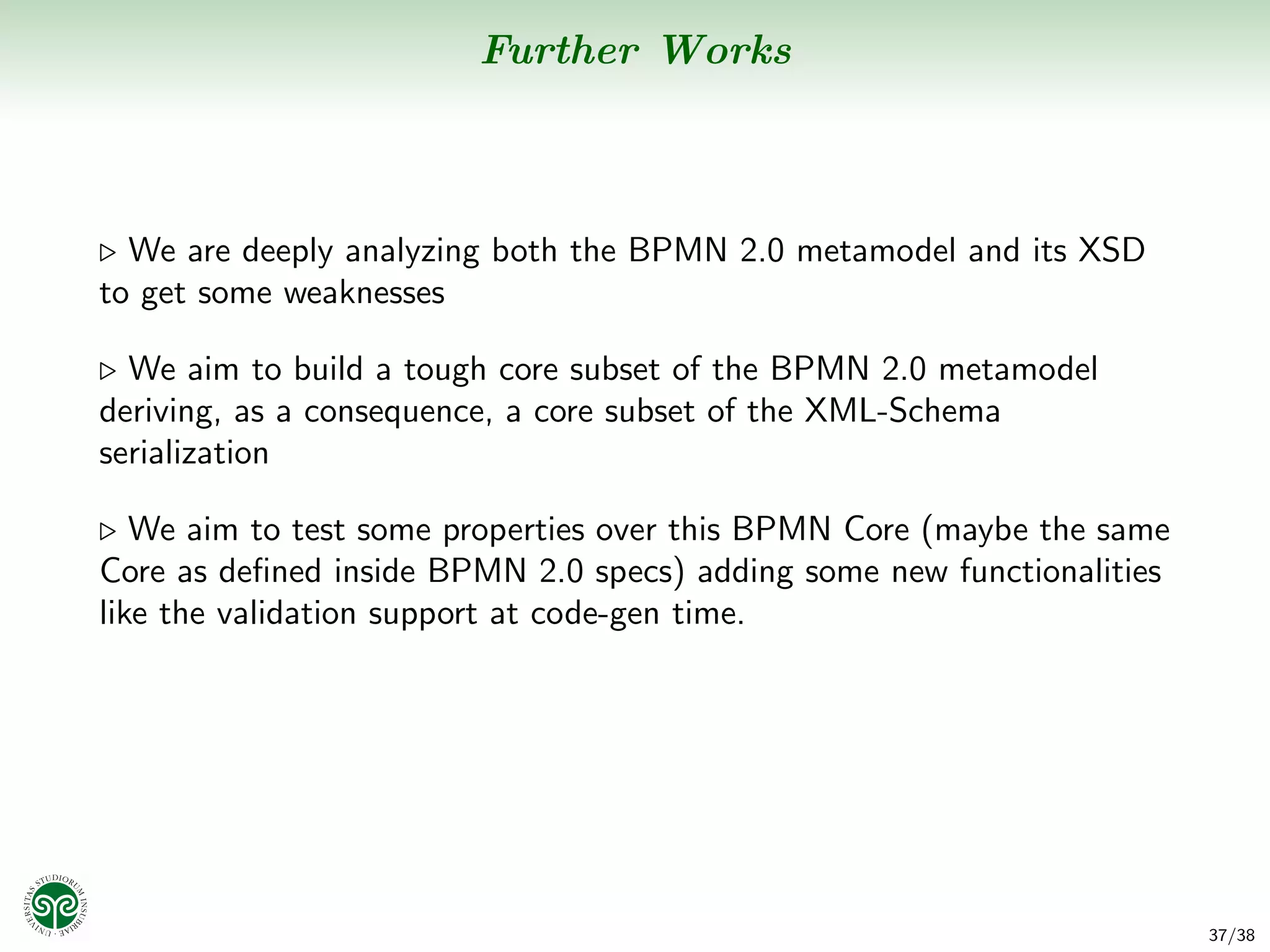
Further Works


  We are deeply analyzing both the BPMN 2.0 metamodel and its XSD
to get some weaknesses

  We aim to build a tough core subset of the BPMN 2.0 metamodel
deriving, as a consequence, a core subset of the XML-Schema
serialization

   We aim to test some properties over this BPMN Core (maybe the same
Core as defined inside BPMN 2.0 specs) adding some new functionalities
like the validation support at code-gen time.


                                                                        37/38
Thank you.


    Questions?


July 20, 1969 – 22.56 EDT


                            38/38

Modeling and Validating BPMN Diagrams

  • 1.
    Modeling and Validating BPMN Diagrams Michele Chinosi, Alberto Trombetta Universit` degli Studi dell’Insubria (Varese – Italy) a Dipartimento di Informatica e Comunicazione michele.chinosi@uninsubria.it BPMN 2009 Workshop July 20, 2009, Vienna, Austria
  • 2.
  • 3.
    Agenda BPMN 1.1 and2.0 Analysis Our BPMN Metamodel Proposal The XML Linearization Referential Integrity Concluding Remarks 3/38
  • 4.
    Motivations • need foreasy usable models to test properties, to patch BPMN and to add new features • other proposals (as well as BPMN 2.0 submissions) are quite unclear and too complex • lack of validation support • BPMN 1.1/1.2 comes without a native XSD • methods to ensure diagrams correctness are manual and error-prone 4/38
  • 5.
    Contributions •simplified test-oriented version of the BPMN metamodel • self-validating XML serialization for BPMN diagrams • automated checks (using software tools) • our approach could be abstracted from the specificities of BPMN 1.2 porting the base concepts also to BPMN 2.0 Last-Month Update This work has been partially superseded by the recent BPMN 2.0 final submission adoption by OMG. We will see a brief summary of major changes at the end of this talk. 5/38
  • 6.
    Contributions •simplified test-oriented version of the BPMN metamodel • self-validating XML serialization for BPMN diagrams • automated checks (using software tools) • our approach could be abstracted from the specificities of BPMN 1.2 porting the base concepts also to BPMN 2.0 Last-Month Update This work has been partially superseded by the recent BPMN 2.0 final submission adoption by OMG. We will see a brief summary of major changes at the end of this talk. 5/38
  • 7.
    BPMN 1.1 WeakPoints Analysis • weak hierarchical structure of the model • BPD are strongly hierarchical • elements placement inside the model does not reflect the expected placement inside the diagram • UML metamodel uses only generalization connections • no valid/meaningful instances • lack of distinctions between several elements and types definitions • they are all elements (classes) • Connections-by-Types 6/38
  • 8.
    Sketch of BPMN1.1 Metamodel 7/38
  • 9.
  • 10.
    BPMN 2.0 Overview (B)IOS • (BEA), IBM, Oracle, SAP • execution semantics formalization • extensibility mechanism for both model and graphical extensions • event composition and correlation refinement • human interactions definition • choreography model BPMN-S • Adaptive, Axway Software, HP, Lombardi Software, Fujitsu, et al. • business level modeling • checking compliance to choreography and rules • process taxonomies • execution interoperability • model re-usability 9/38
  • 11.
    Sketch of BPMN2.0 UML – (B)IOS Proposal 10/38
  • 12.
    Sketch of BPMN2.0 UML – BPMN-S Proposal 11/38
  • 13.
    Sketch of BPMN2.0 UML – Final Submission 12/38
  • 14.
    BPMN 2.0 –The CORE UML Class Diagram Example 13/38
  • 15.
    BPMN 2.0 –The Package Diagram Example 14/38
  • 16.
    Our BPMN 1.1Metamodel Proposal • top-down fashion methodology • from BPD to all the other elements • strongly hierarchical model • reduces the Connections-by-Types and deletes all the missing connections • BPMN Supporting elements treated as types • simpler model • Connections-by-Semantics (UML compositions) • every BPD can be described as one valid instance of the model • right positioning of Connecting flow objects 15/38
  • 17.
    Sketch of ourBPMN 1.1 Metamodel Proposal 16/38
  • 18.
    The XML Linearization BPMN⊃ WS-BPEL Still incomplete ⇒ BPMN 2.0 ⇒ and BPMN = XPDL Complex could be adapted to become BPMN 1.1 → XML −−−−−−−−−−− −−−−−−−−−−→ ⊆ BPMN 2.0 • Our linearization proposal could be useful to study diagram and/or model properties and to make some tests, as well as to validate both a model and its instances. 17/38
  • 19.
    The XML Linearization BPMN⊃ WS-BPEL Still incomplete ⇒ BPMN 2.0 ⇒ and BPMN = XPDL Complex could be adapted to become BPMN 1.1 → XML −−−−−−−−−−− −−−−−−−−−−→ ⊆ BPMN 2.0 • Our linearization proposal could be useful to study diagram and/or model properties and to make some tests, as well as to validate both a model and its instances. 17/38
  • 20.
    Detailed BPMN 1.1Weak Points Analysis Attributes default values • BPMN defines mandatory attributes WITH default values • XML-Schema does not permit this double assertion if an attribute has the default clause defined, it takes the default value even if it is not present at all use=‘‘optional’’ + default=... Process • BPMN defines Processes as conceptual siblings of the BPD • if a Pool shares a Process, then it has one or more Lanes • all the other elements are referenced by the Process using their IDs !! we don’t want a valid instance with Process as root element ∃ Process ⇒ ∃ Pool, but ∃ Pool ∃ Process Process becomes child of Pool 18/38
  • 21.
    Detailed BPMN 1.1Weak Points Analysis Attributes default values • BPMN defines mandatory attributes WITH default values • XML-Schema does not permit this double assertion if an attribute has the default clause defined, it takes the default value even if it is not present at all use=‘‘optional’’ + default=... Process • BPMN defines Processes as conceptual siblings of the BPD • if a Pool shares a Process, then it has one or more Lanes • all the other elements are referenced by the Process using their IDs !! we don’t want a valid instance with Process as root element ∃ Process ⇒ ∃ Pool, but ∃ Pool ∃ Process Process becomes child of Pool 18/38
  • 22.
    Detailed BPMN 1.1Weak Points Analysis Attributes default values • BPMN defines mandatory attributes WITH default values • XML-Schema does not permit this double assertion if an attribute has the default clause defined, it takes the default value even if it is not present at all use=‘‘optional’’ + default=... Process • BPMN defines Processes as conceptual siblings of the BPD • if a Pool shares a Process, then it has one or more Lanes • all the other elements are referenced by the Process using their IDs !! we don’t want a valid instance with Process as root element ∃ Process ⇒ ∃ Pool, but ∃ Pool ∃ Process Process becomes child of Pool 18/38
  • 23.
    Detailed BPMN 1.1Weak Points Analysis Attributes default values • BPMN defines mandatory attributes WITH default values • XML-Schema does not permit this double assertion if an attribute has the default clause defined, it takes the default value even if it is not present at all use=‘‘optional’’ + default=... Process • BPMN defines Processes as conceptual siblings of the BPD • if a Pool shares a Process, then it has one or more Lanes • all the other elements are referenced by the Process using their IDs !! we don’t want a valid instance with Process as root element ∃ Process ⇒ ∃ Pool, but ∃ Pool ∃ Process Process becomes child of Pool 18/38
  • 24.
    Detailed BPMN 1.1Weak Points Analysis Participant • “A Pool represents a Participant” Participant is child of Pool Message • “A Message is the object that is transmitted through a MessageFlow” Message is child of MessageFlow 19/38
  • 25.
    Detailed BPMN 1.1Weak Points Analysis Participant • “A Pool represents a Participant” Participant is child of Pool Message • “A Message is the object that is transmitted through a MessageFlow” Message is child of MessageFlow 19/38
  • 26.
    Detailed BPMN 1.1Weak Points Analysis Web Service • WebService is required by many other elements • BPMN defines WebService as a Supporting Element Inside the BPMN to WS-BPEL mapping example the WebService is defined inside the parent element We chose to instantiate WebService every time it is needed (xs:assert) 20/38
  • 27.
    Send Task Definition <xs : complexType name = " SendTaskType " > 1 < xs : complexContent > 2 < xs : extension base = " bpex : TaskType " > 3 < xs : sequence > 4 < xs : element name = " WebService " 5 type = " bpex : WebServi ceType " minOccurs = " 0 " > 6 < xs : assert test ="@I mp le m en ta t io n = ‘ Web Service ’"/ > 7 </ xs : element > 8 </ xs : sequence > 9 < xs : attribute name = " MessageRef " 10 type = " bpex : ObjectRef " use = " required " / > 11 < xs : attribute name = " Impl ementat ion " 12 default ="Web Service"> 13 < xs : simpleType > 14 ... 15 Listing 1: An excerpt of the Send Task definition 21/38
  • 28.
    Detailed BPMN 1.1Weak Points Analysis Events • XPDL and WS-BPEL define for each Event type a different element • complex XML tree • BPMN defines only one Event ELEMENT with 3 FAMILIES and many different TYPES families and types are specifications and not different element definitions Start, Intermediate and End Event are children of Lane (xs:assert) we assign a different type based on the Trigger or Result attributes values (xs:alternative) 22/38
  • 29.
    Event Definition < xs: complexType name = " LaneType " > 1 < xs : complexContent > 2 < xs : extension base = " bpex : C o m m o n S w i m l a n e T y p e " > 3 < xs : sequence > 4 < xs : element name = " StartEvent " 5 type = " bpex : StartEve ntType " 6 minOccurs = " 0 " maxOccurs = " unbounded " > 7 < xs : assert test = " @EventType = ’ Start ’ " / > 8 </ xs : element > 9 ... 10 < xs : complexType name = " StartEve ntType " > 11 < xs : complexContent > 12 < xs : extension base = " bpex : EventType " > 13 < xs : sequence > 14 < xs : element name = " Trigger " 15 type = " bpex : C o m m o n E v e n t D e t a i l T y p e " 16 minOccurs = " 0 " maxOccurs = " unbounded " > 17 < xs : alternative test = " @ E v e n t D e t a i l T y p e = ’ None ’ " 18 type = " bpex : N o n e E v e n t D e t a i l T y p e " / > 19 < xs : alternative test = " @ E v e n t D e t a i l T y p e = ’ Message ’ " 20 type = " bpex : M e s s a g e E v e n t D e t a i l T y p e " / > 21 ... 22 Listing 2: An excerpt of the Events definition 23/38
  • 30.
    Detailed BPMN 1.1Weak Points Analysis Gateways • Gateways can only be detailed in one of the five provided types • there is only one element (Gateway) and five possible specifications • the Gateway default type is chosen in 2 steps: Exclusive and then Data-Based we define only one element of type Gateway, child of Lane we decide in a second time the Gateway type using xs:alternative the Gateway default type is chosen in 1 single step: Data-Based Exclusive 24/38
  • 31.
    Gateway Definition < xs: element name = " Gateway " type = " bpex : C o m m o n G a t e w a y T y p e " 1 minOccurs = " 0 " maxOccurs = " unbounded " > 2 < xs : alternative 3 test = " @GatewayType = ’ Data - Based Exclusive ’ " 4 type = " bpex : D a t a B a s e d E x c l u s i v e G a t e w a y T y p e " / > 5 < xs : alternative 6 test = " @GatewayType = ’ Event - Based Exclusive ’ " 7 type = " bpex : E v e n t B a s e d E x c l u s i v e G a t e w a y T y p e " / > 8 < xs : alternative 9 test = " @GatewayType = ’ Inclusive ’ " 10 type = " bpex : I n c l u s i v e G a t e w a y T y p e " / > 11 ... 12 Listing 3: An excerpt of the Gateways definition 25/38
  • 32.
    Detailed BPMN 1.1Weak Points Analysis Sub-Processes • Reusable: Activity which re-calls another Process ProcessRef and DiagramRef • Reference: it points to another already defined Sub-Process SubProcessRef • Embedded: it contains a process dependent from the parent process the SubProcess elements are defined as Lane children and referenced using the GraphicalElements attribute 26/38
  • 33.
    Detailed BPMN 1.1Weak Points Analysis Artifacts • one Artifact could be used across the whole BPD, using Associations to reference elements • they need only one place to be instantiated Artifacts as BPD children inside the XML they can be positioned everywhere Transactions and Signals • some elements need to be referenced from multiple objects and they are instantiated every time they are requested: different IDs but the same name • the attribute TransactionId of type String serves as an “identifier for the Transactions used within a diagram” we extended the idea behind the TransactionId also to Signals and other similar objects 27/38
  • 34.
    Detailed BPMN 1.1Weak Points Analysis Artifacts • one Artifact could be used across the whole BPD, using Associations to reference elements • they need only one place to be instantiated Artifacts as BPD children inside the XML they can be positioned everywhere Transactions and Signals • some elements need to be referenced from multiple objects and they are instantiated every time they are requested: different IDs but the same name • the attribute TransactionId of type String serves as an “identifier for the Transactions used within a diagram” we extended the idea behind the TransactionId also to Signals and other similar objects 27/38
  • 35.
    Referential Integrity UsingXPath • The very old way: manual ID/IDRef references – strings, numbers, NCNames, random generators, . . . • The old way: xs:key and xs:keyref • The new way: xs:assert and xs:alternative xs:assert • <xs:assert-test=‘‘XPathExpr’’ /> • limit: the XPath 2.0 expressions set xs:alternative • it permits to choose the type of an element according to the success of a XPath 2.0 test • useful for Events, Gateways, Activities 28/38
  • 36.
    Referential Integrity UsingXPath • The very old way: manual ID/IDRef references – strings, numbers, NCNames, random generators, . . . • The old way: xs:key and xs:keyref • The new way: xs:assert and xs:alternative xs:assert • <xs:assert-test=‘‘XPathExpr’’ /> • limit: the XPath 2.0 expressions set xs:alternative • it permits to choose the type of an element according to the success of a XPath 2.0 test • useful for Events, Gateways, Activities 28/38
  • 37.
    Referential Integrity Verification •Using our XML-Schema Model we are able to validate statically the syntax as well as structural semantics rules of a BPD • Using a set of XQuery/XPath interrogations on the XML instances we can validate also most of the behavioral semantics rules of BPMN • The use of XQuery/XPath let us verify business rules at code-gen time and at run-time 29/38
  • 38.
    Wrong BPMN Diagram red:clear (model) errors – orange: hidden (XML) errors 30/38
  • 39.
    Parsing the XMLDocument 31/38
  • 40.
    Start Event Check for$ pool in // Pool , 1 $ startevent in $ pool // StartEvent 2 return $ pool // SequenceFlow [ @b pe x :T ar ge t Re f = ← 3 $ startevent / @bpex:Id ]/ @bpex:Id 4 Listing 4: Rules verification using XPath/XQuery: Start Event 32/38
  • 41.
    Events Number Check for$ pool in // Pool , 1 $ numSE in count ($ pool // StartEvent ) , 2 $ numEE in count ($ pool // EndEvent ) 3 return if ($ numSE >0) then 4 if ($ numEE >0) then true () else false () 5 else 6 if ($ numEE =0) then true () else false () 7 Listing 5: Rules verification using XPath/XQuery: Events number “If there is an End (Start) Event, then there MUST be at least one Start (End) Event” 33/38
  • 42.
    Instantiation Semantic Verification for$ pool in // Pool , 1 $ startEvent in $ pool // StartEvent , 2 $ numSE in count ($ startEvent ) , 3 $ elements in $ pool / Lane /*[ name ()!= " StartEvent " ] 4 return 5 if ($ numSE >0) then 6 if ( every $ id in $ elements / @bpex:Id satisfies ← 7 $ id =$ pool / SequenceFlow / @ b pe x: T ar ge tR e f ) 8 then true () 9 else $ elements / @bpex:Id 10 else false () 11 Listing 6: Rules verification using XPath/XQuery: instantiation semantic “If the Start Event is used, then there MUST NOT be other flow elements that do not have incoming Sequence Flow” 34/38
  • 43.
    Comparison with BPMN2.0 BPMN 1.1/1.2 BPMN 2.0 Could our proposal be still valid? Metamodel Y Y With some changes to be compliant to the BPMN 2.0 metamodel XSD N Y With some changes Referential Int. Partially Partially Y Execution N Y Y To have a simplified core subset of both the BPMN metamodel and the XML-Schema, compliant to BPMN specifications, is useful to test some properties, to implement new features, to attempt new strategies, to implement patches. 35/38
  • 44.
    Conclusions What we havetalked about BPMN 1.1 analysis BPMN 2.0 metamodel overview Our proposal for a BPMN simplified test-oriented metamodel Our proposal for a BPMN XML serialization Referential Integrity in BPMN: overview and new approach Differences between BPMN 1.1 and BPMN 2.0 36/38
  • 45.
    Further Works We are deeply analyzing both the BPMN 2.0 metamodel and its XSD to get some weaknesses We aim to build a tough core subset of the BPMN 2.0 metamodel deriving, as a consequence, a core subset of the XML-Schema serialization We aim to test some properties over this BPMN Core (maybe the same Core as defined inside BPMN 2.0 specs) adding some new functionalities like the validation support at code-gen time. 37/38
  • 46.
    Thank you. Questions? July 20, 1969 – 22.56 EDT 38/38