R&D TODAY: ADDRESSING AND ENHANCING RESEARCH & DEVELOPMENT’S EFFECTIVENESS Concepts, Case Studies, and Debatable Ideas Kenny Ong CNI Holdings Berhad
In other words… How do we make R&D  more  Effective?
Before that… How is R&D  not  effective? Top Down – Process problem Because I can  - Competency problem Poor business value – Ignorance problem No Budget - Alignment problem Not-Invented-Here – Ego problem
Contents: How do we make R&D more Effective? Know Your Business Research Reverse Marketing Align R&D Today  ->  RD&D Issues and Challenges
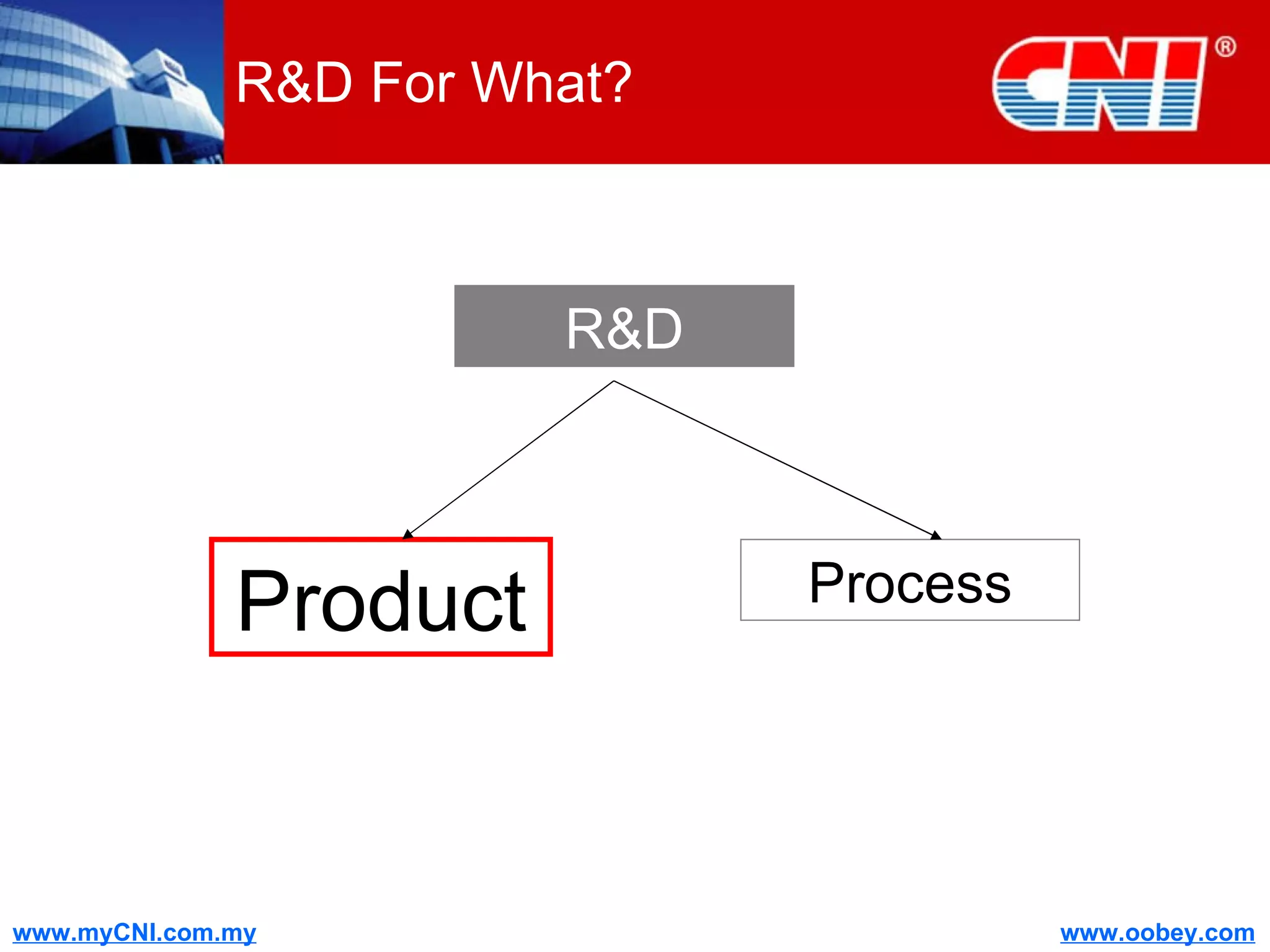
R&D For What? R&D Product Process
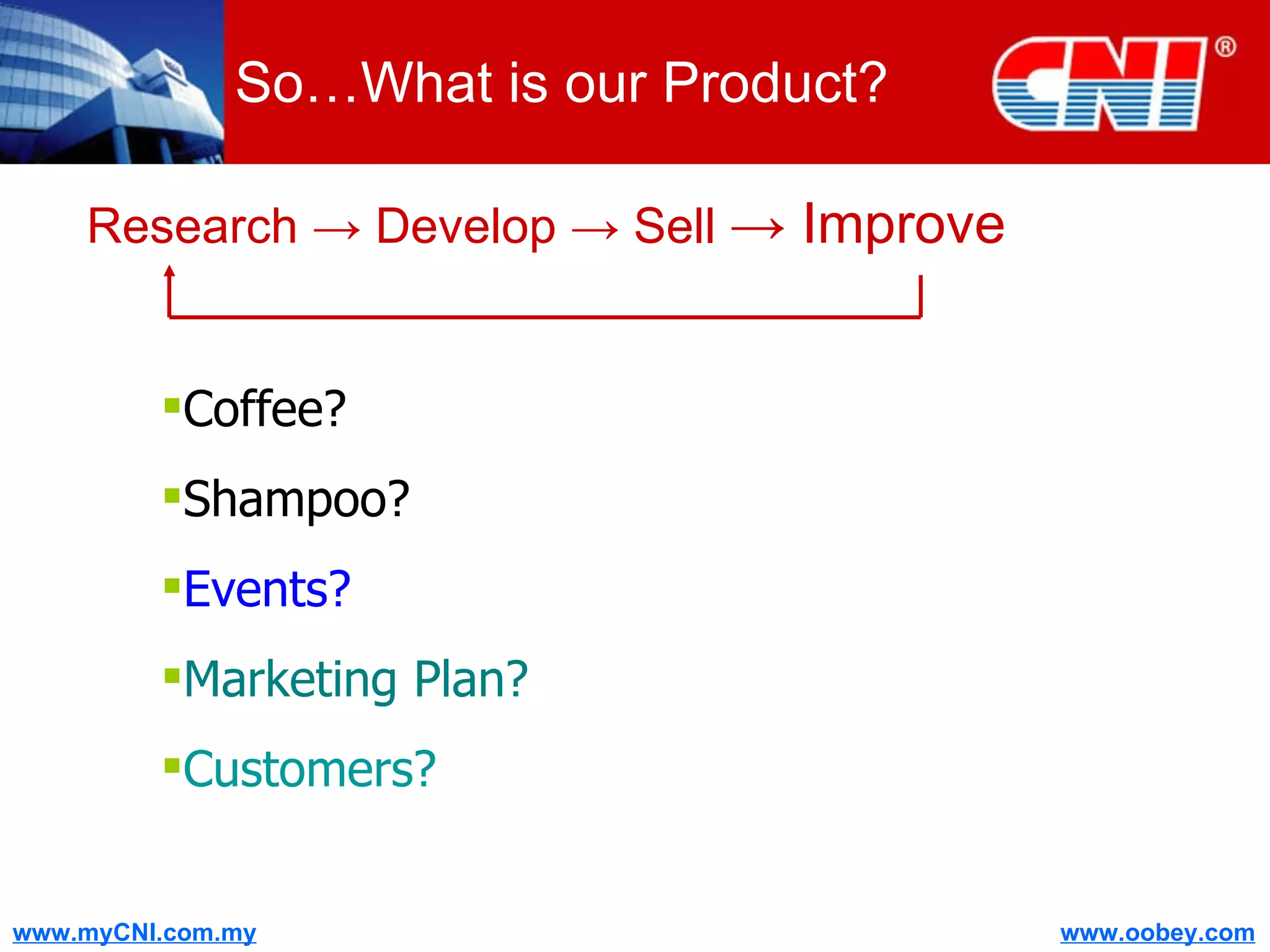
So…What is our Product? Research  -> Develop -> Sell  -> Improve Coffee? Shampoo? Events? Marketing Plan? Customers?
A1. Know Your Business The anchor for all decisions
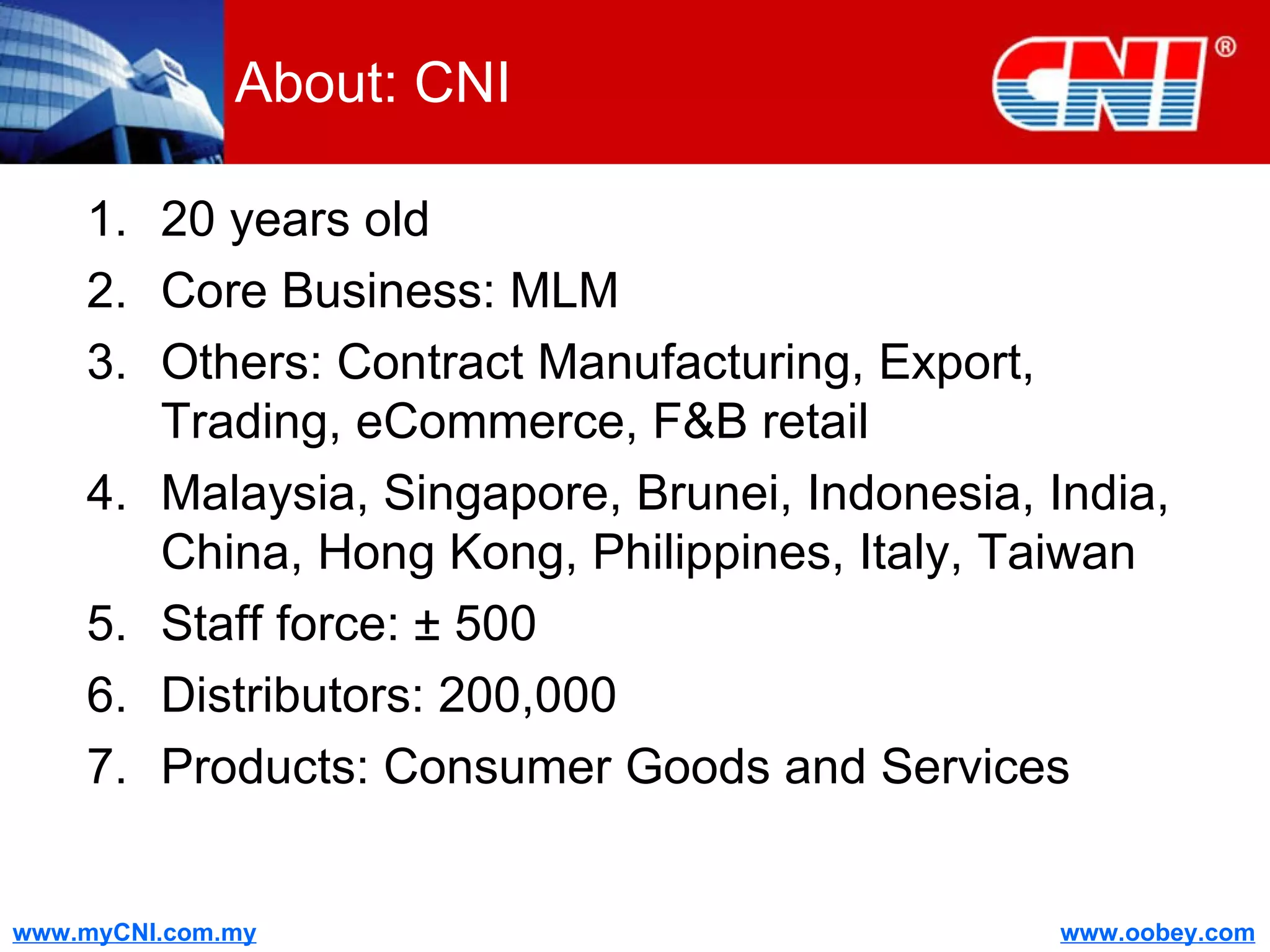
About: CNI 20 years old Core Business: MLM Others: Contract Manufacturing, Export, Trading, eCommerce, F&B retail Malaysia, Singapore, Brunei, Indonesia, India, China, Hong Kong, Philippines, Italy, Taiwan Staff force:  ± 500 Distributors: 200,000 Products: Consumer Goods and Services
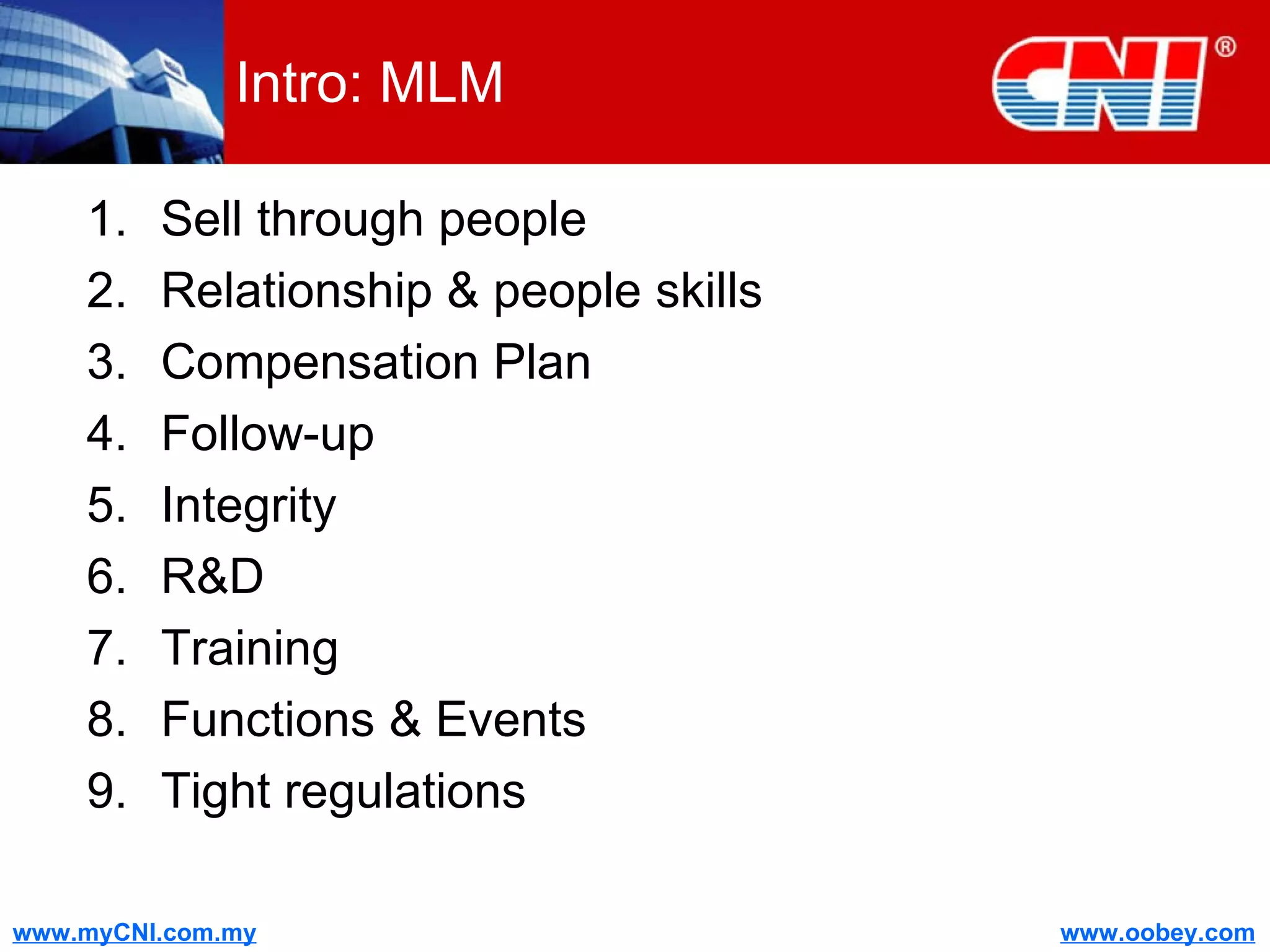
Intro: MLM Sell through people Relationship & people skills Compensation Plan Follow-up Integrity R&D Training Functions & Events Tight regulations
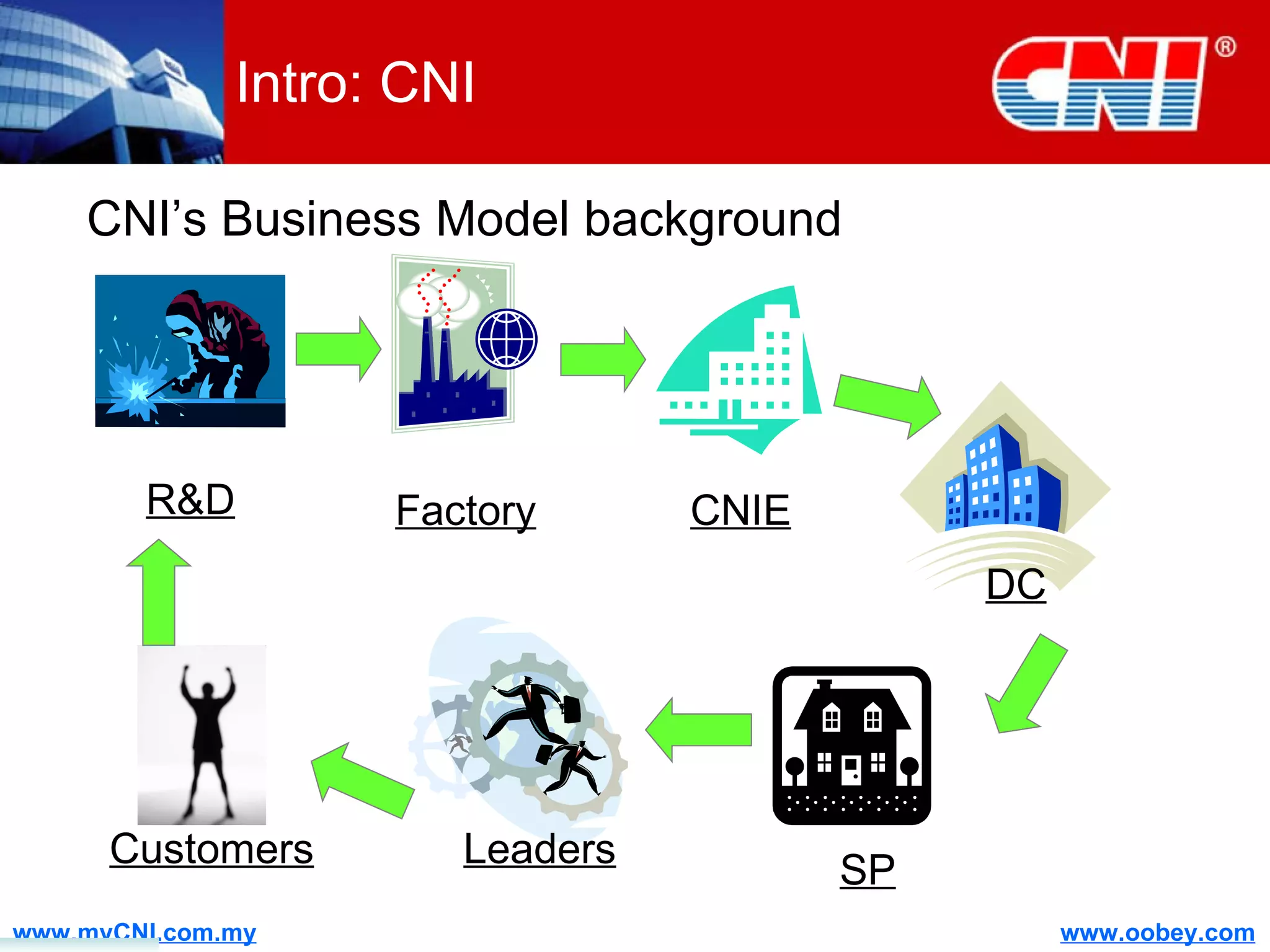
Intro: CNI CNI’s Business Model background Factory CNIE DC SP Leaders Customers R&D
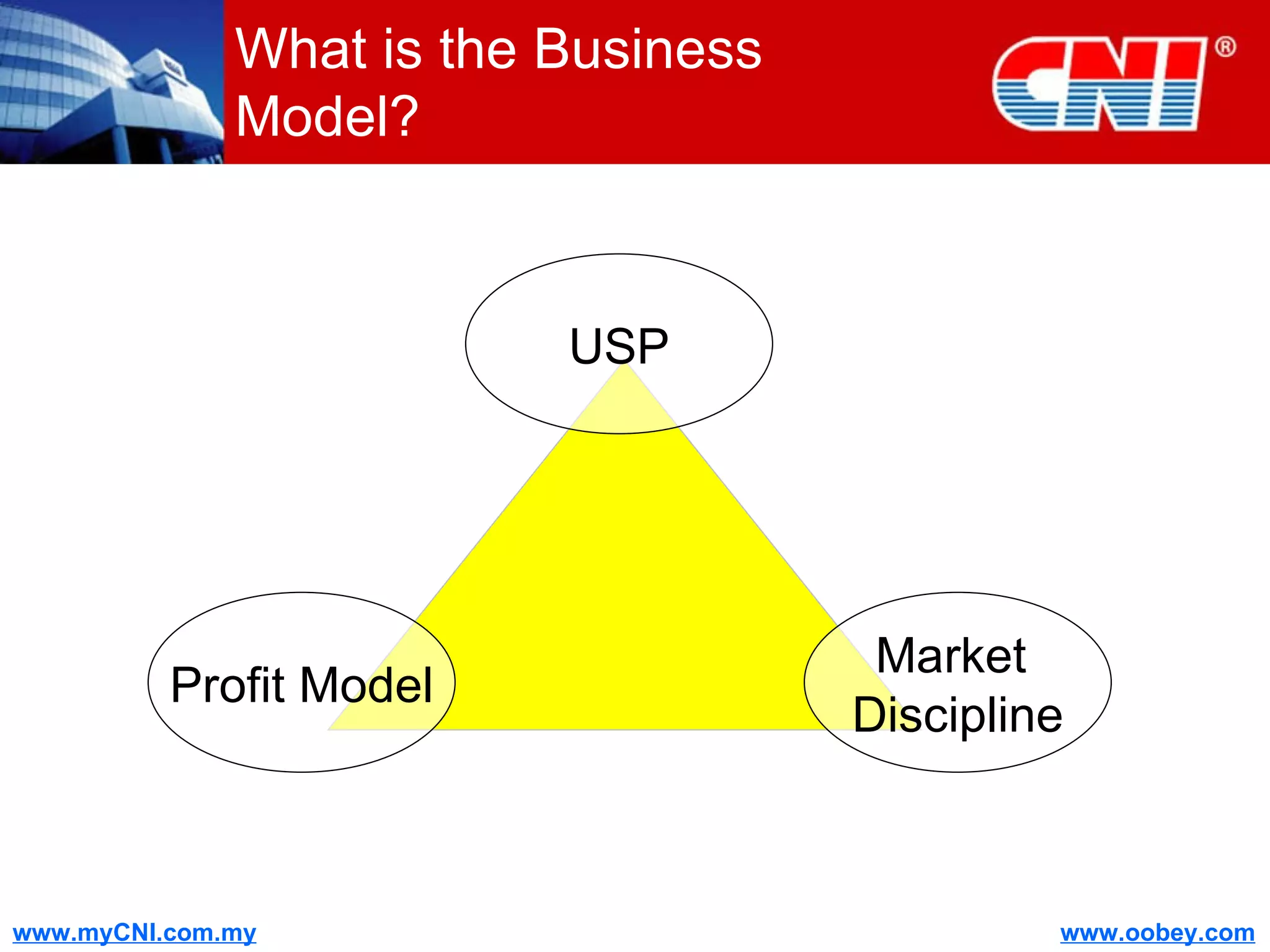
What is the Business Model? USP Market  Discipline Profit Model
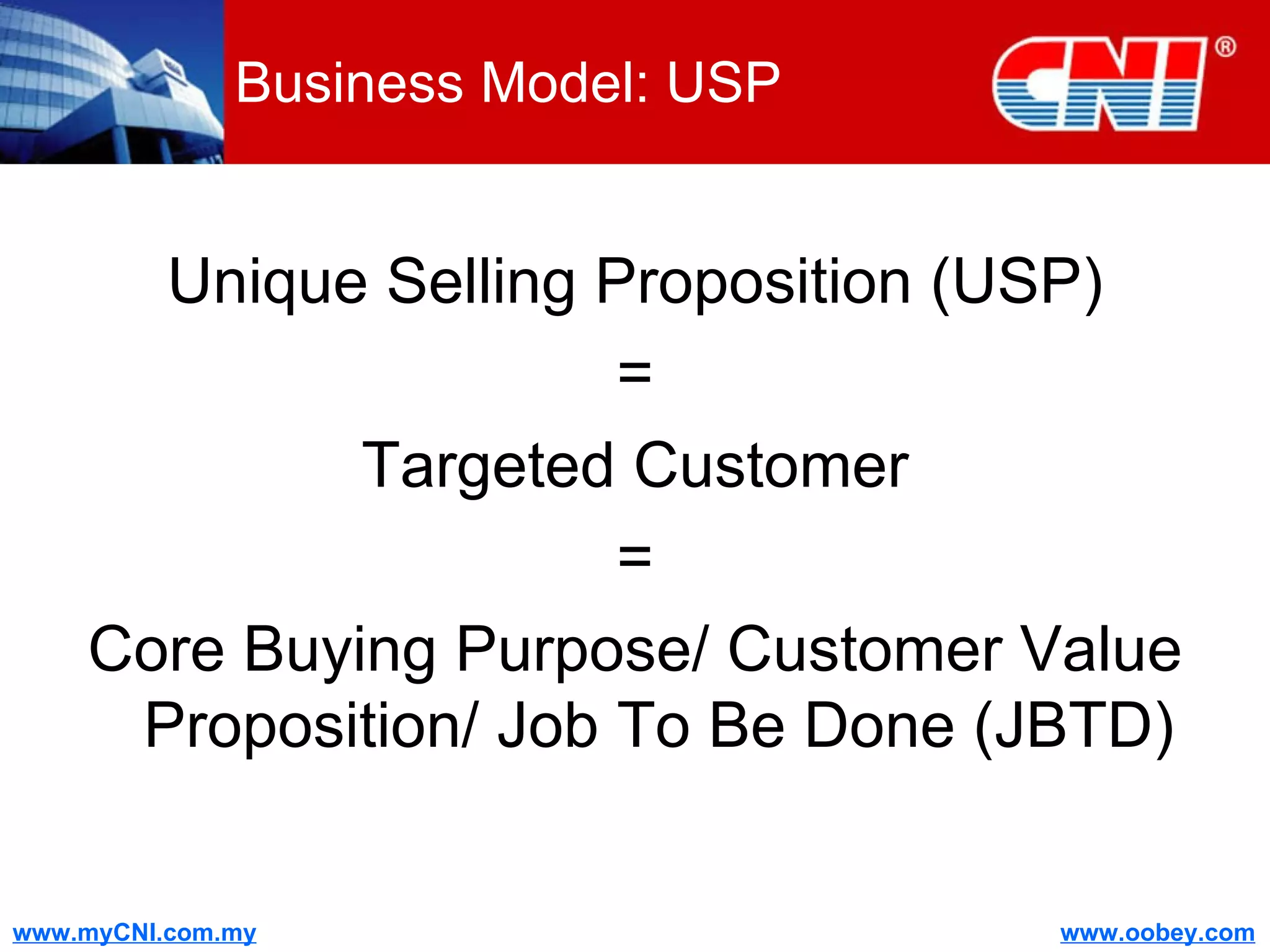
Business Model: USP Unique Selling Proposition (USP) = Targeted Customer = Core Buying Purpose/ Customer Value Proposition/ Job To Be Done (JBTD)
Business Model: USP “ The Product is Not the Product” What is the customer really buying? What is the “Core Buying Purpose”?
Business Model: USP Insufficient WEALTH Insufficient ACCESS Insufficient SKILL Insufficient TIME
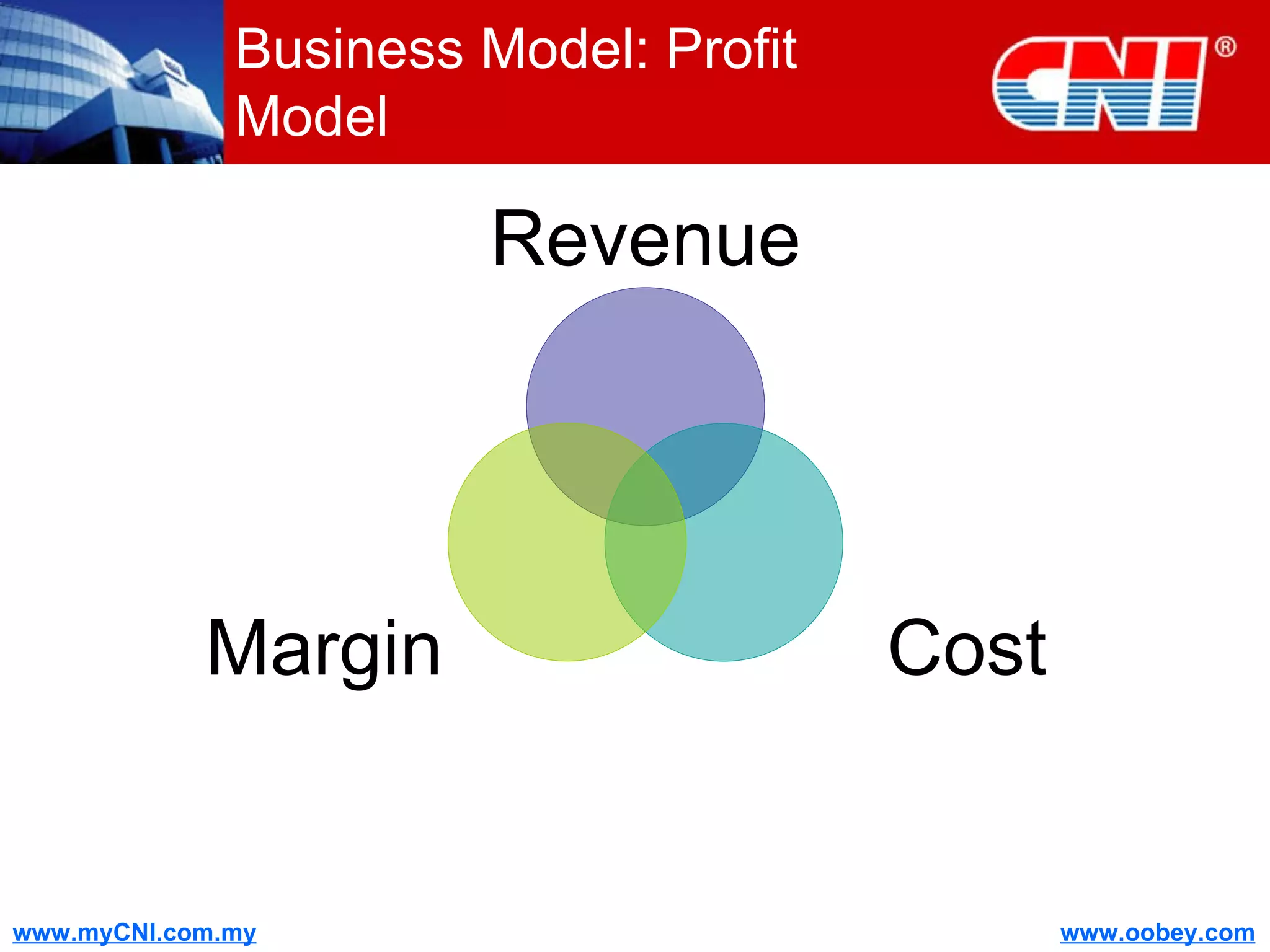
Business Model: Profit Model Revenue Cost Margin
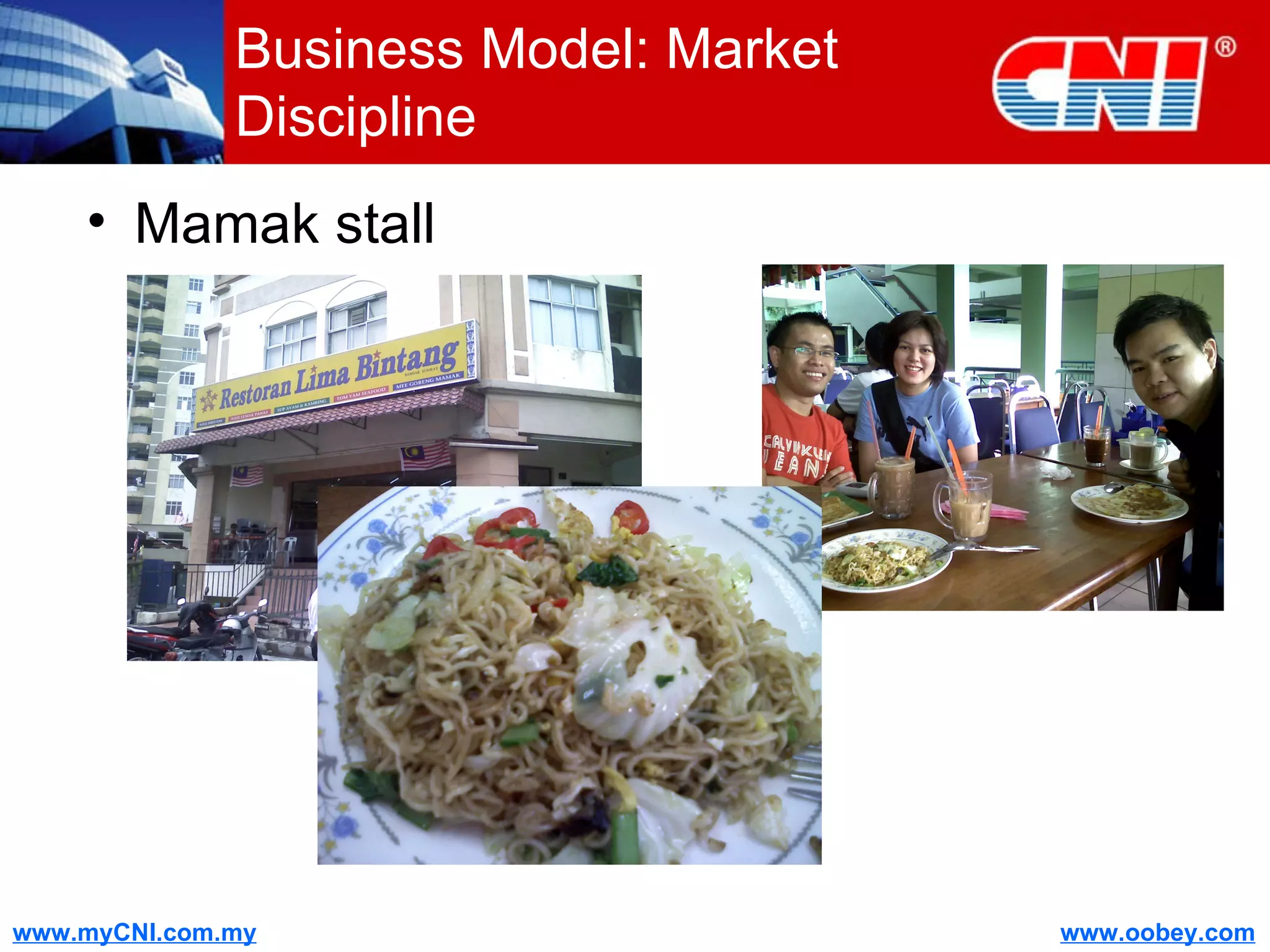
Business Model: Market Discipline Mamak stall
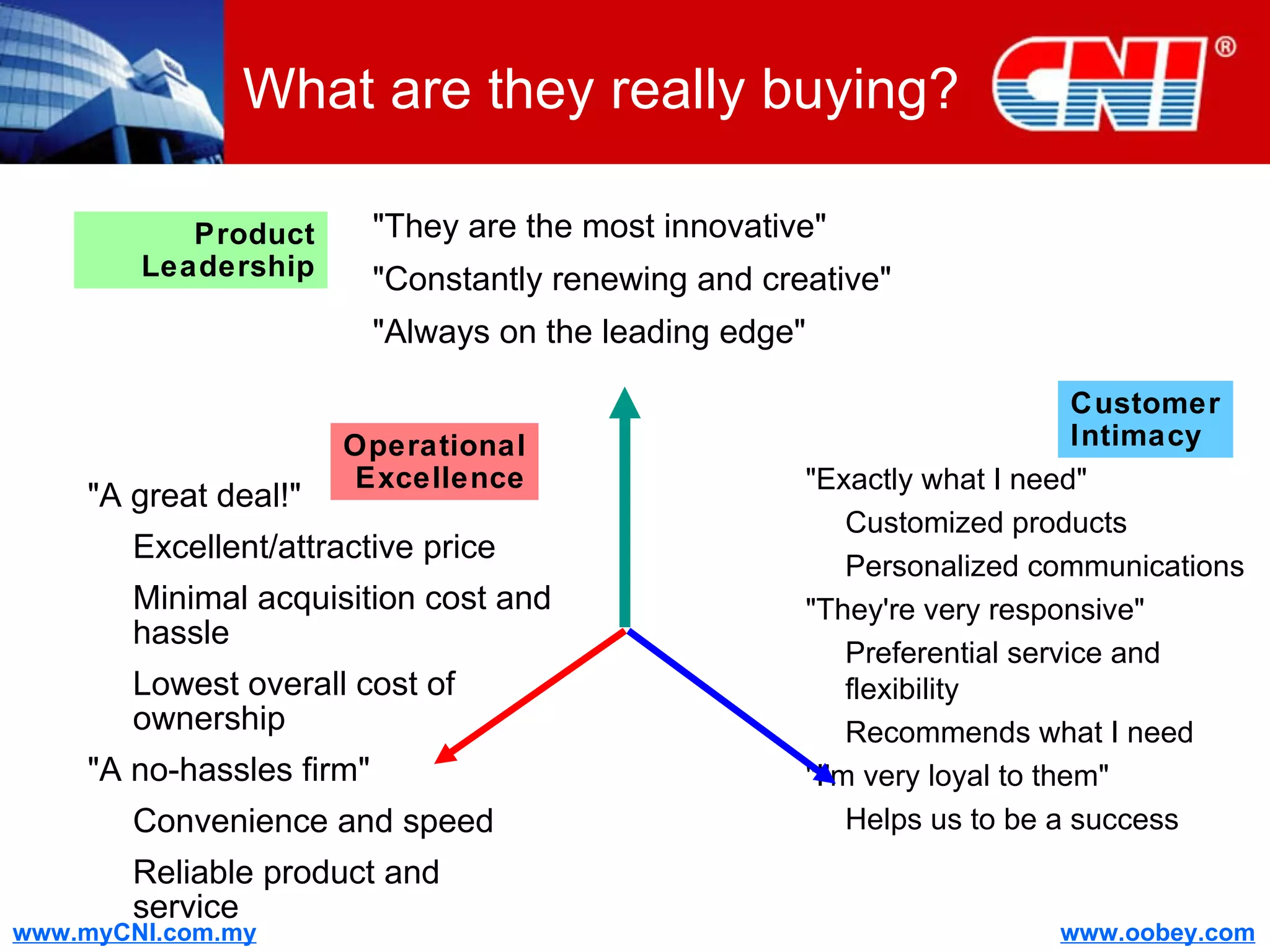
What are they really buying? "Exactly what I need" Customized products Personalized communications "They're very responsive" Preferential service and flexibility Recommends what I need "I'm very loyal to them" Helps us to be a success "They are the most innovative" "Constantly renewing and creative" "Always on the leading edge" "A great deal!" Excellent/attractive price Minimal acquisition cost and hassle Lowest overall cost of ownership "A no-hassles firm" Convenience and speed Reliable product and service Product Leadership Operational Excellence Customer Intimacy
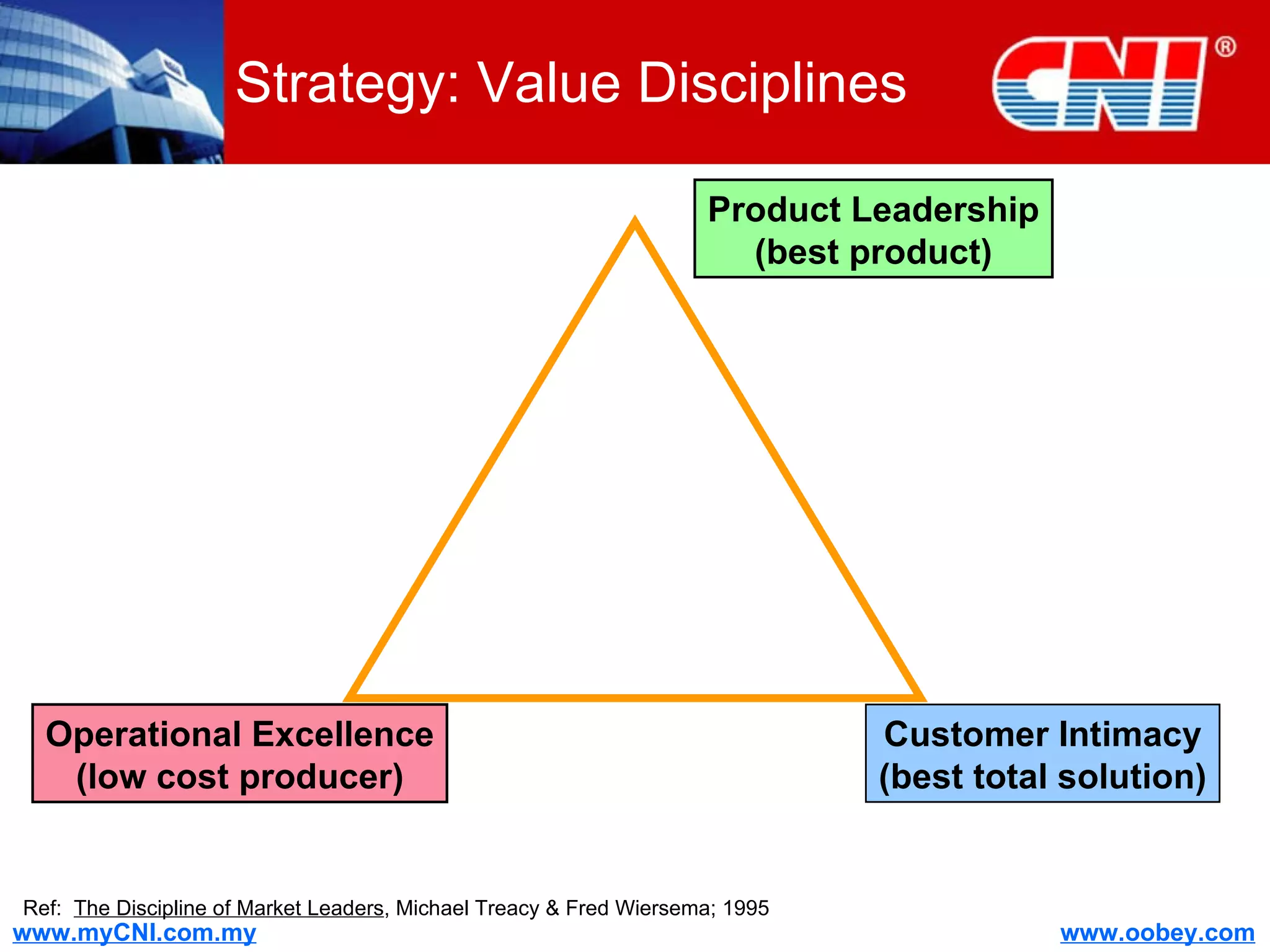
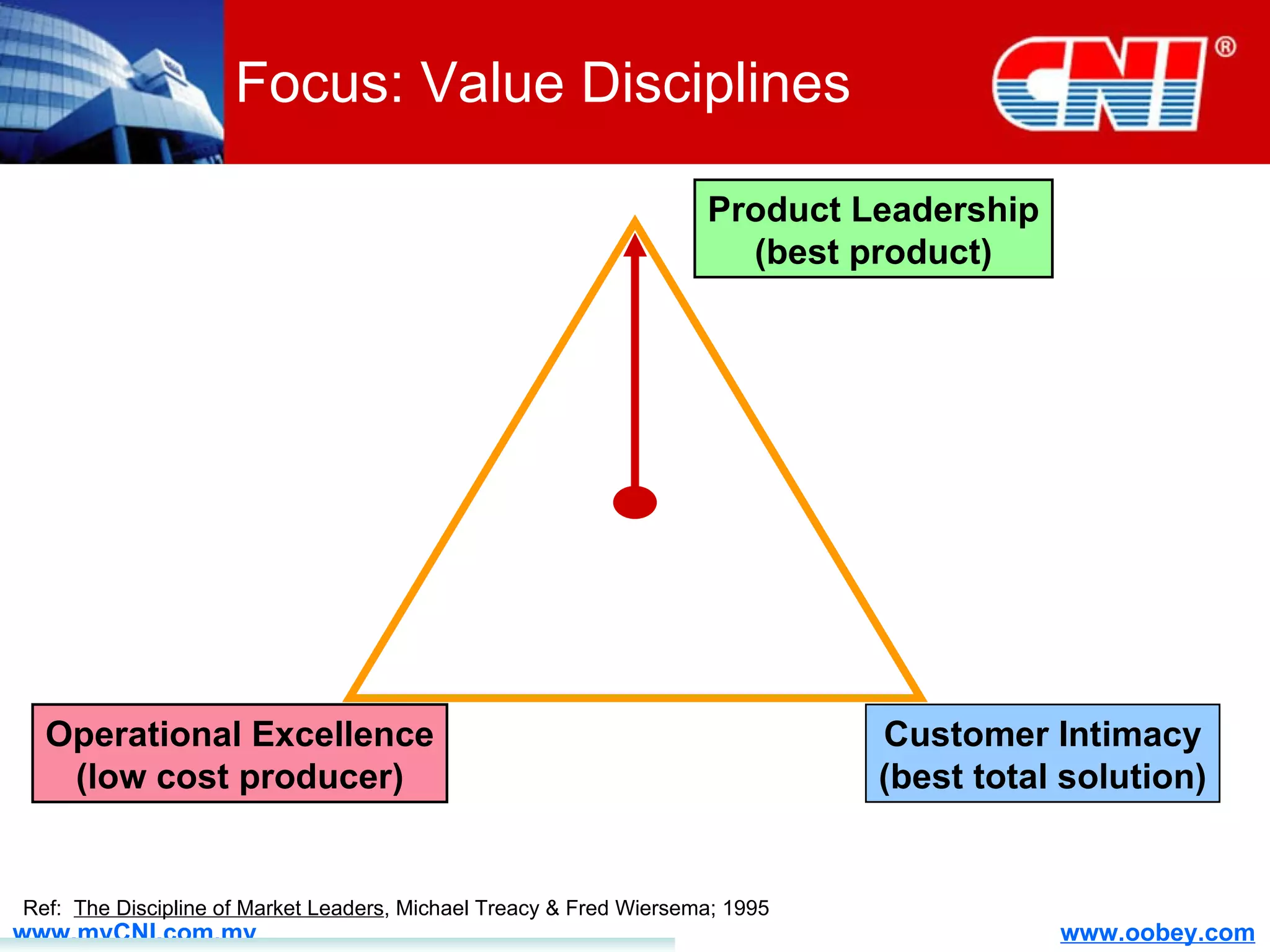
Strategy: Value Disciplines Operational Excellence (low cost producer) Ref:  The Discipline of Market Leaders , Michael Treacy & Fred Wiersema; 1995 Product Leadership (best product) Customer Intimacy (best total solution)
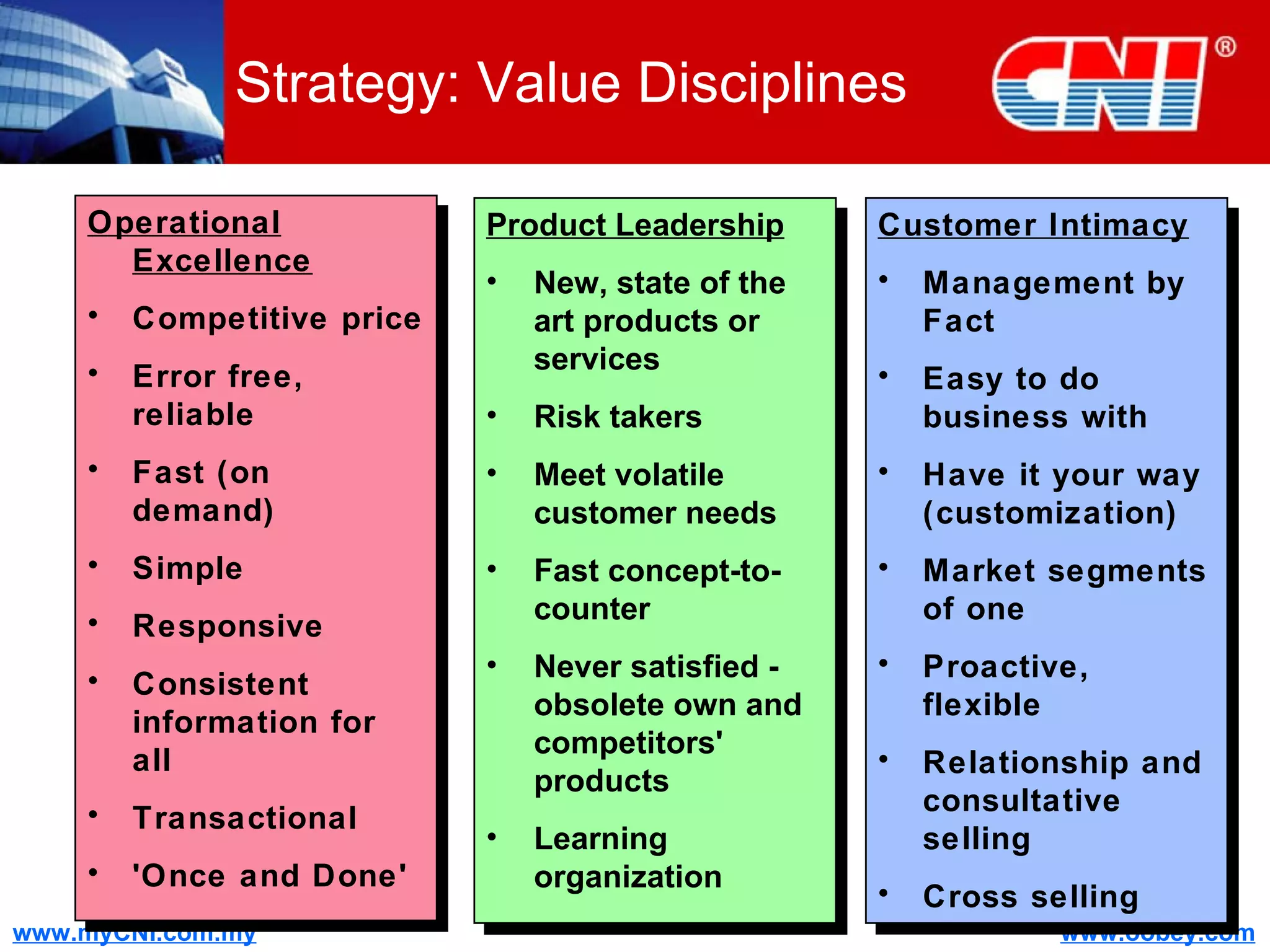
Product Leadership New, state of the art products or services Risk takers Meet volatile customer needs Fast concept-to- counter Never satisfied - obsolete own and competitors' products Learning organization Strategy: Value Disciplines Operational Excellence Competitive price Error free, reliable Fast (on demand) Simple Responsive Consistent information for all Transactional 'Once and Done' Customer Intimacy Management by Fact Easy to do business with Have it your way (customization) Market segments of one Proactive, flexible Relationship and consultative selling Cross selling
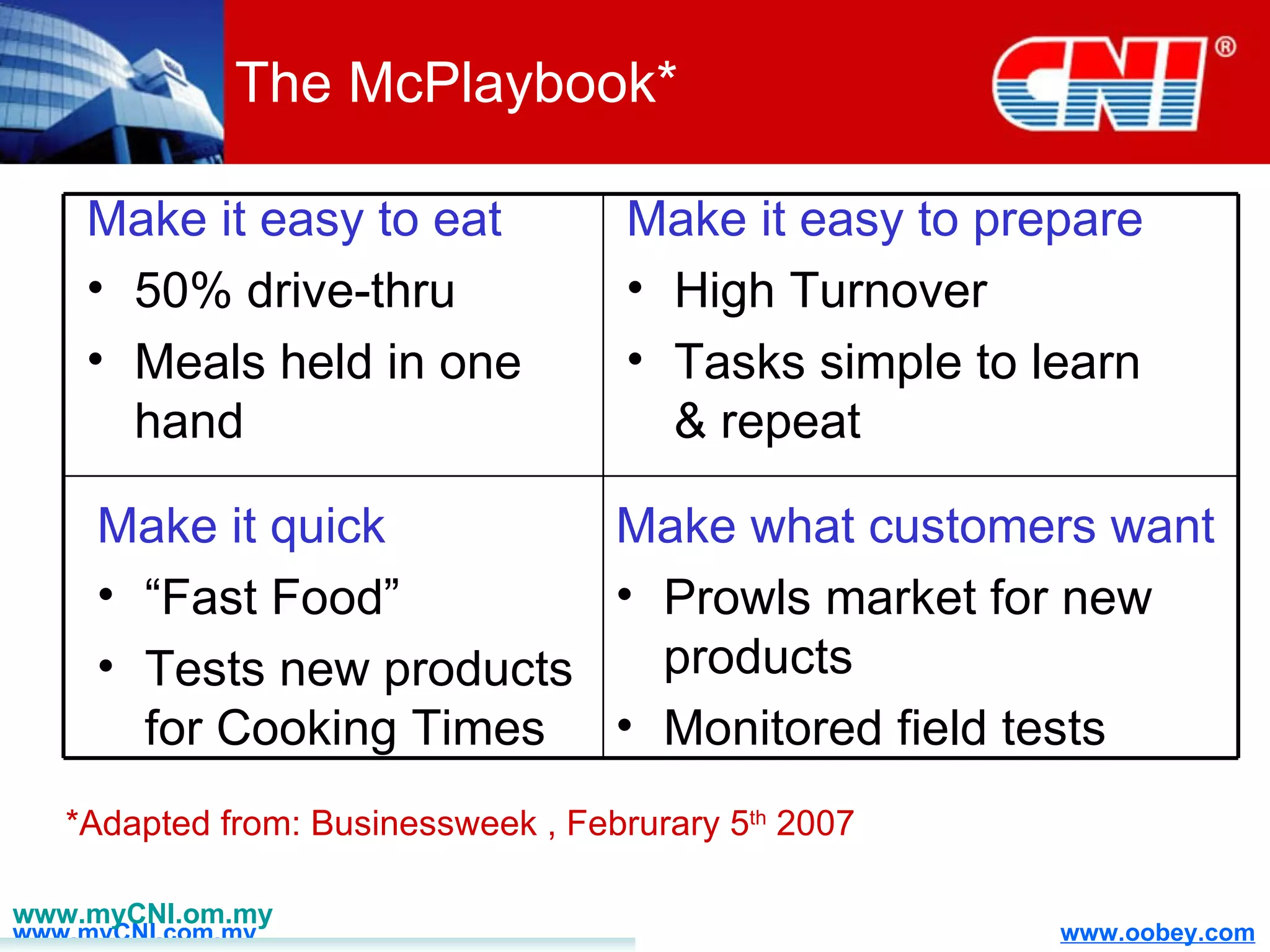
The McPlaybook* Make it easy to eat 50% drive-thru Meals held in one hand Make it easy to prepare High Turnover Tasks simple to learn & repeat Make it quick “ Fast Food” Tests new products for Cooking Times Make what customers want Prowls market for new products Monitored field tests *Adapted from: Businessweek , Februrary 5 th  2007 www.myCNI.om.my
Focus: Value Disciplines Operational Excellence (low cost producer) Ref:  The Discipline of Market Leaders , Michael Treacy & Fred Wiersema; 1995 Product Leadership (best product) Customer Intimacy (best total solution)
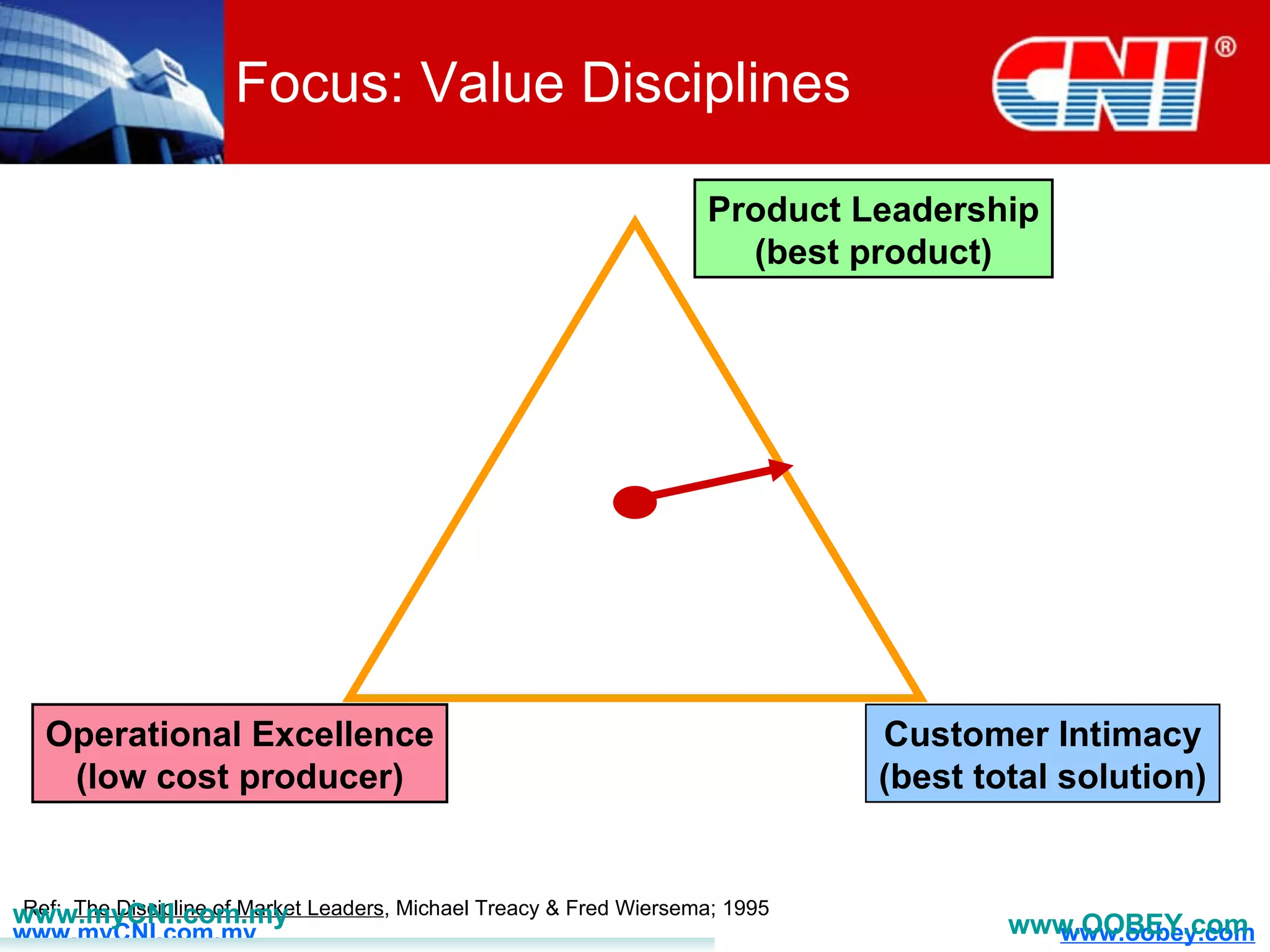
Focus: Value Disciplines Operational Excellence (low cost producer) Ref:  The Discipline of Market Leaders , Michael Treacy & Fred Wiersema; 1995 Product Leadership (best product) Customer Intimacy (best total solution) www.myCNI.com.my www.OOBEY.com
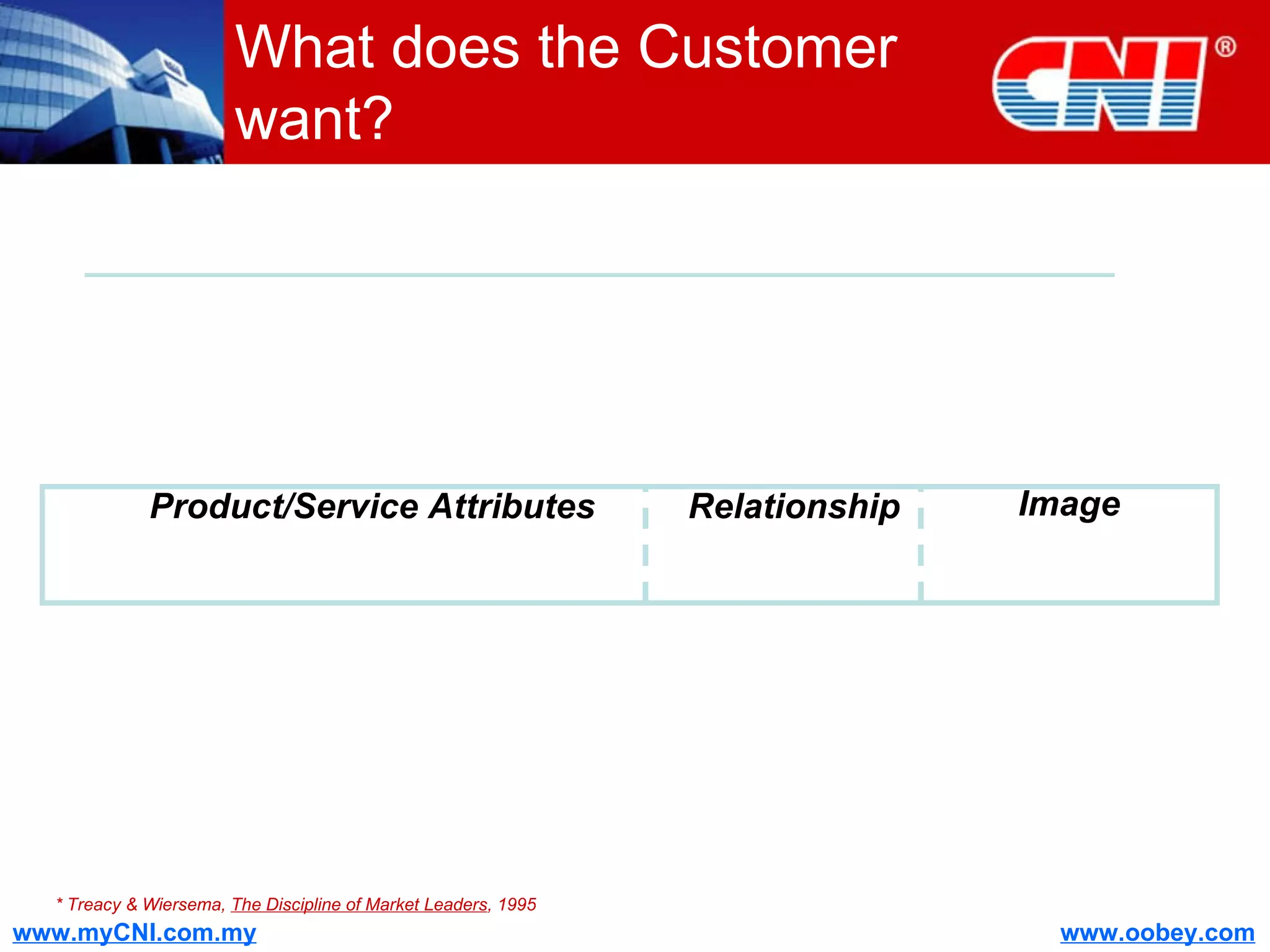
What does the Customer want? * Treacy & Wiersema,  The Discipline of Market Leaders , 1995 Product/Service Attributes Relationship Image
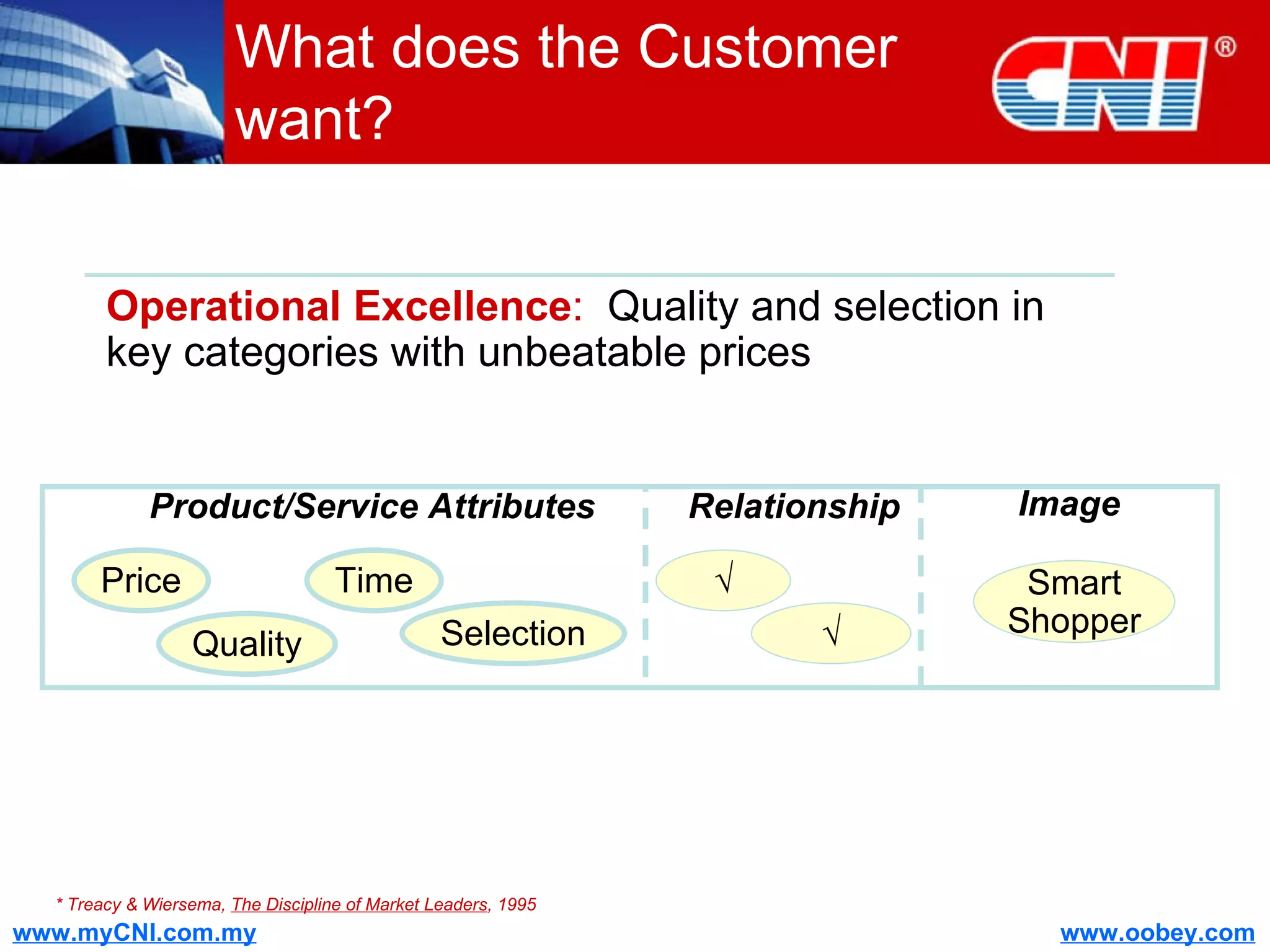
What does the Customer want? * Treacy & Wiersema,  The Discipline of Market Leaders , 1995 Product/Service Attributes Price Quality Time Selection √ √ Smart Shopper Relationship Image Operational Excellence :   Quality and selection in key categories with unbeatable prices
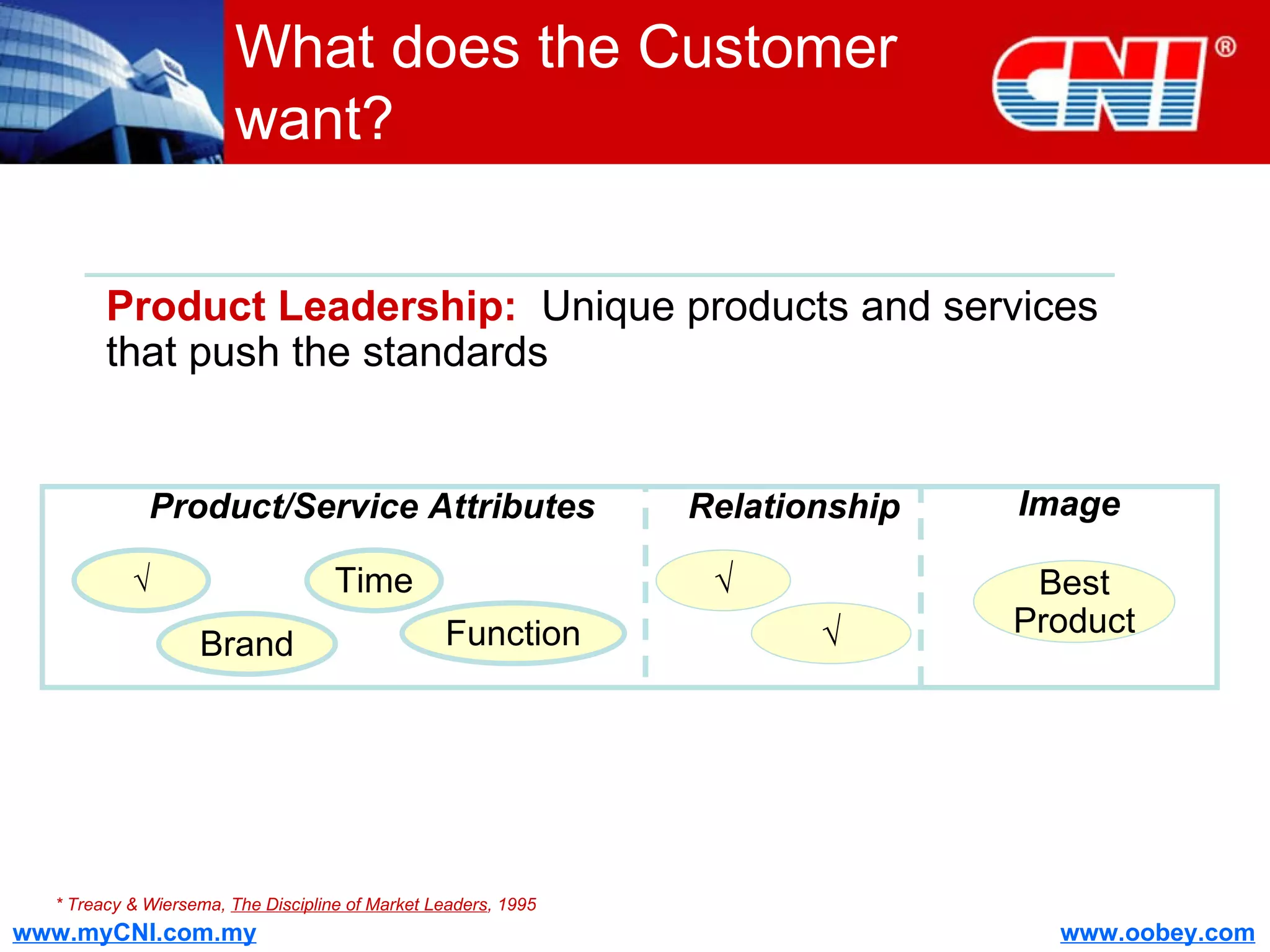
What does the Customer want? * Treacy & Wiersema,  The Discipline of Market Leaders , 1995 Product/Service Attributes √ Brand Time Function √ √ Best Product Relationship Image Product Leadership:   Unique products and services that push the standards
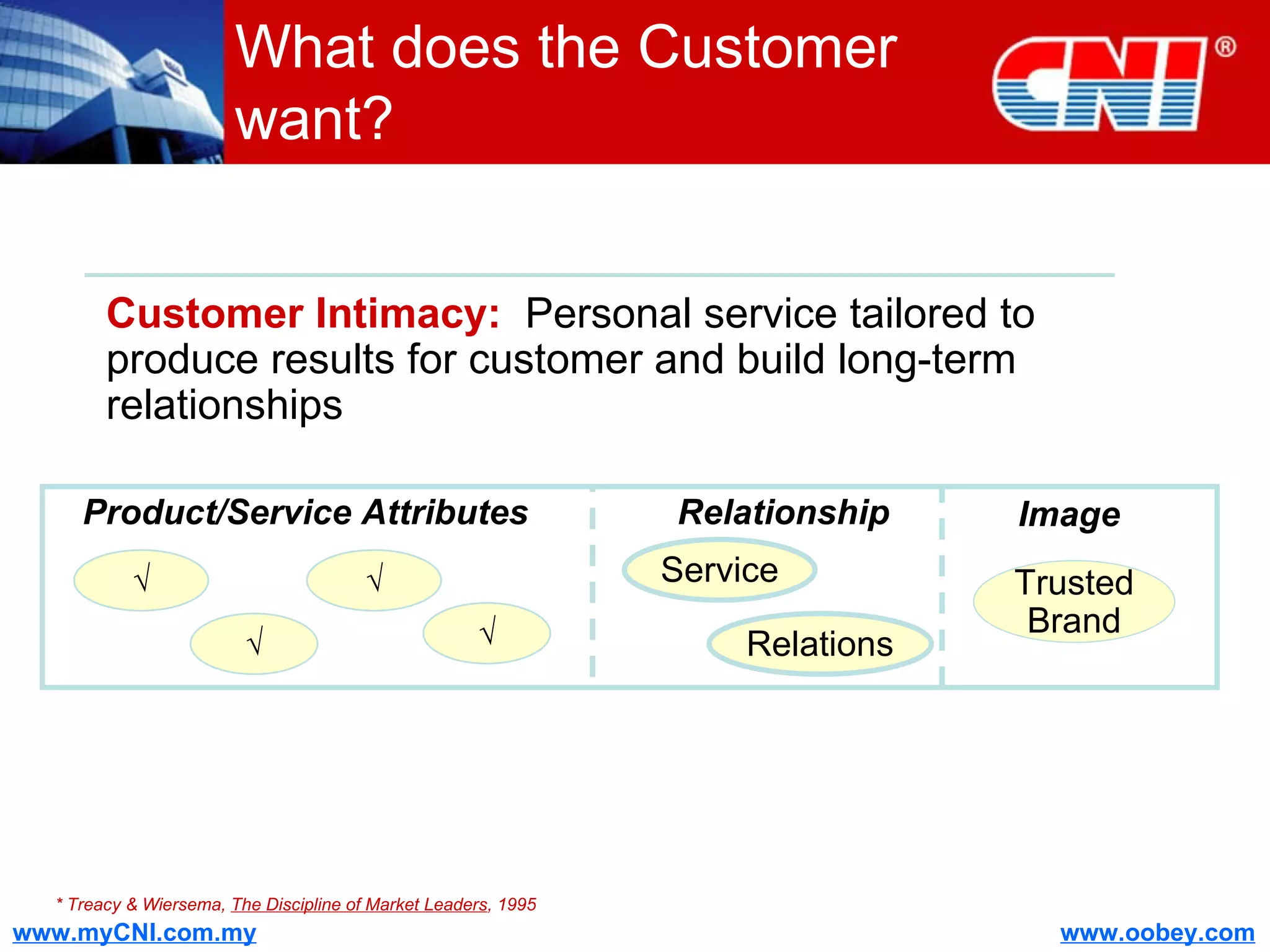
What does the Customer want? * Treacy & Wiersema,  The Discipline of Market Leaders , 1995 Product/Service Attributes √ √ √ √ Service Trusted Brand Relationship Image Customer Intimacy:   Personal service tailored to produce results for customer and build long-term relationships Relations
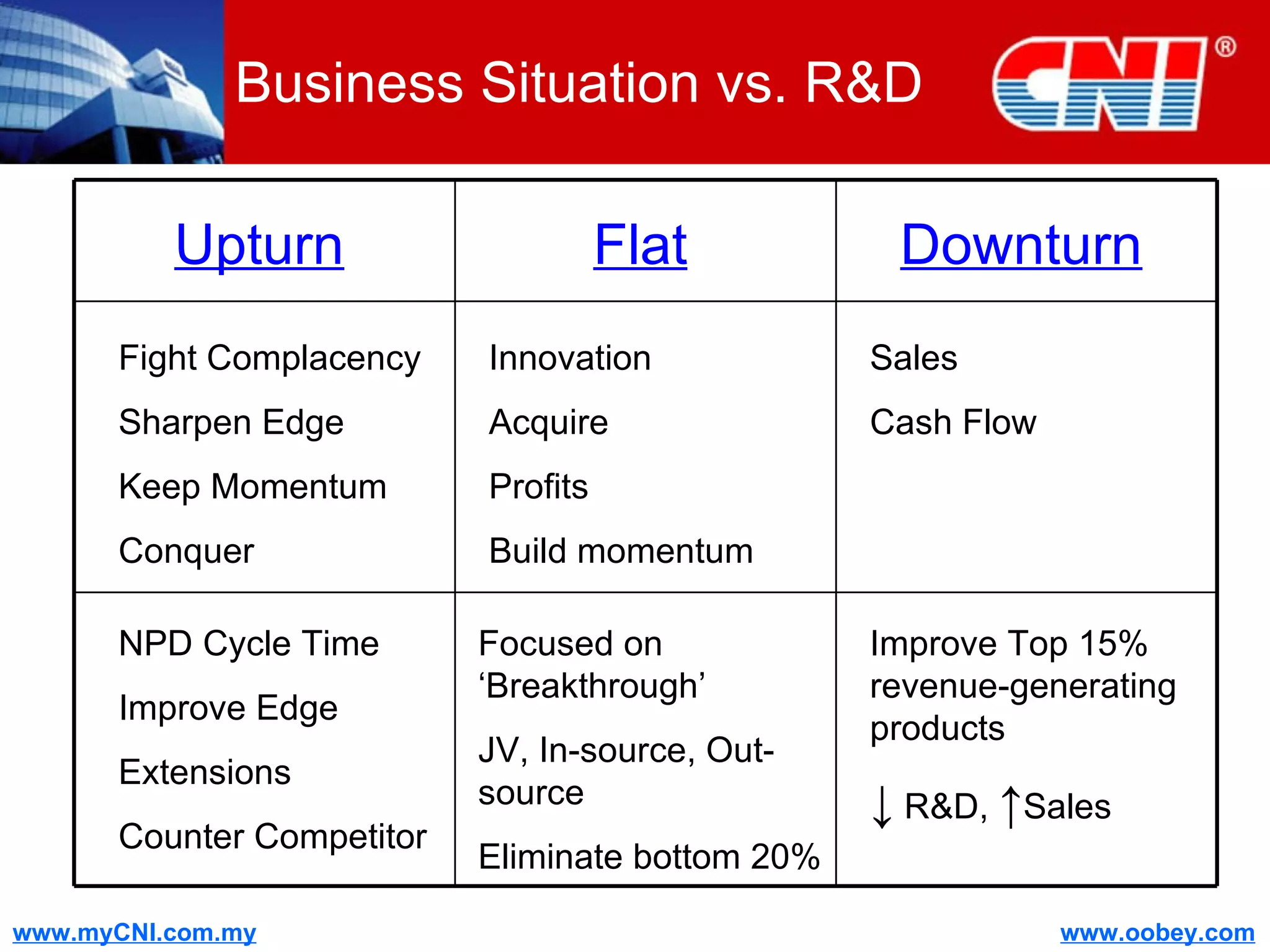
Business Situation vs. R&D Upturn Flat Downturn Fight Complacency Sharpen Edge Keep Momentum Conquer NPD Cycle Time Improve Edge Extensions Counter Competitor Innovation Acquire Profits Build momentum Sales Cash Flow Focused on ‘Breakthrough’ JV, In-source, Out-source Eliminate bottom 20% Improve Top 15% revenue-generating products ↓   R&D,  ↑ Sales
A2. Research Lies. Deception. Statistics.
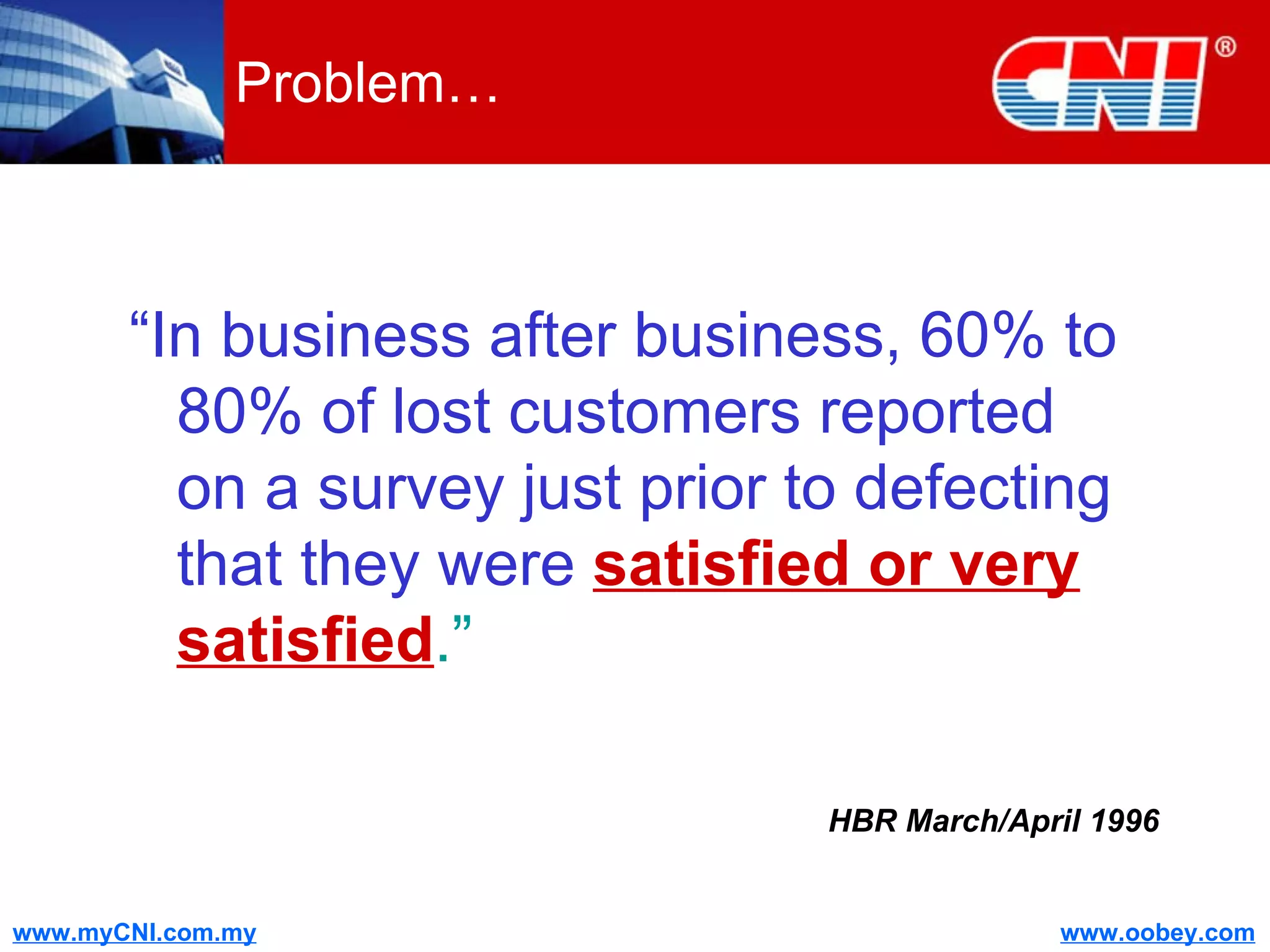
Problem… “ In business after business, 60% to 80% of lost customers reported on a survey just prior to defecting that they were   satisfied or very satisfied .” HBR March/April 1996
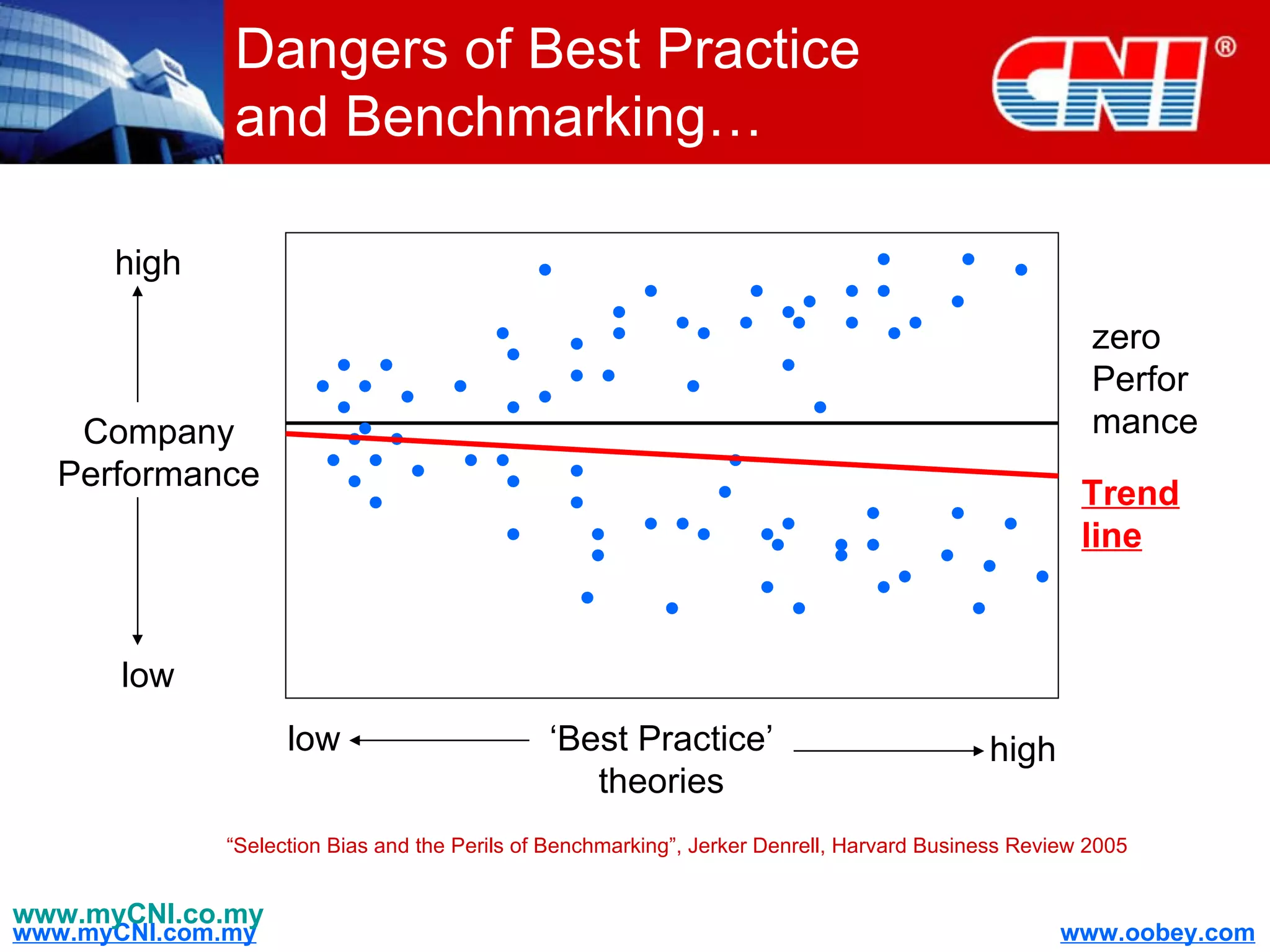
Dangers of Best Practice and Benchmarking… www.myCNI.co.my Company Performance high low ‘ Best Practice’ theories low high zero Performance “ Selection Bias and the Perils of Benchmarking”, Jerker Denrell, Harvard Business Review 2005 Trend line
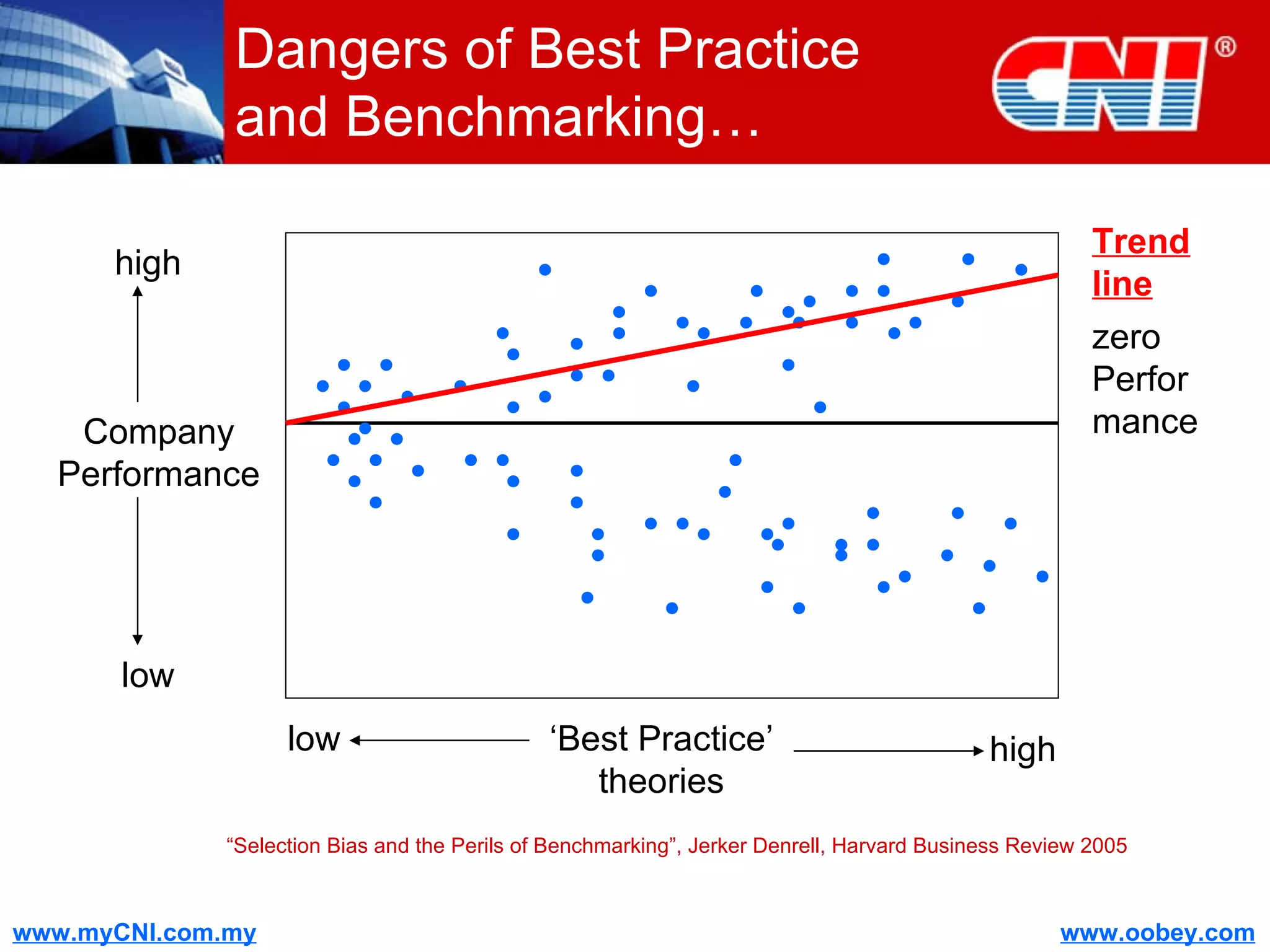
Dangers of Best Practice and Benchmarking… Company Performance high low ‘ Best Practice’ theories low high zero Performance “ Selection Bias and the Perils of Benchmarking”, Jerker Denrell, Harvard Business Review 2005 Trend line
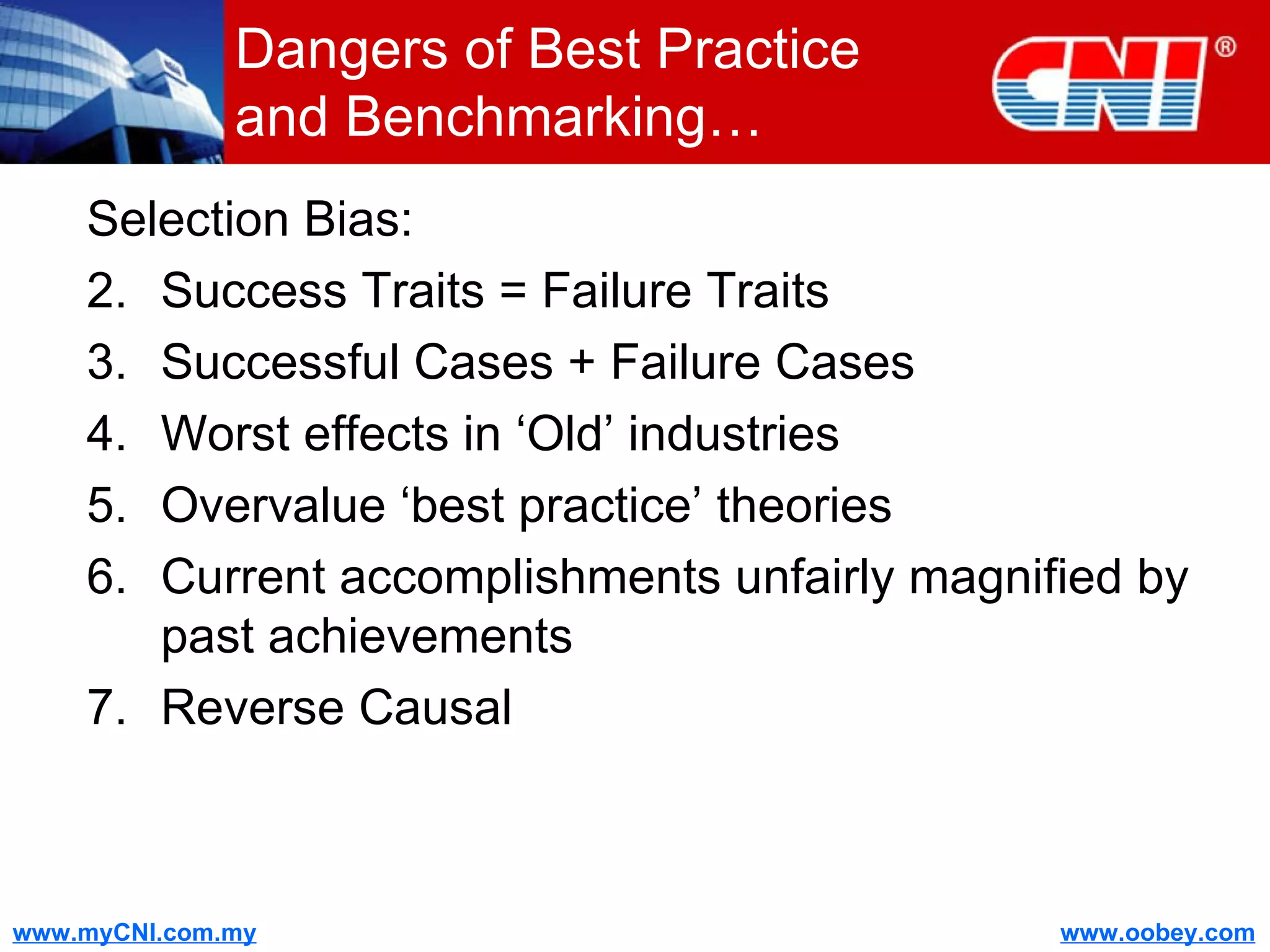
Dangers of Best Practice and Benchmarking… Selection Bias: Success Traits = Failure Traits Successful Cases + Failure Cases Worst effects in ‘Old’ industries Overvalue ‘best practice’ theories Current accomplishments unfairly magnified by past achievements Reverse Causal
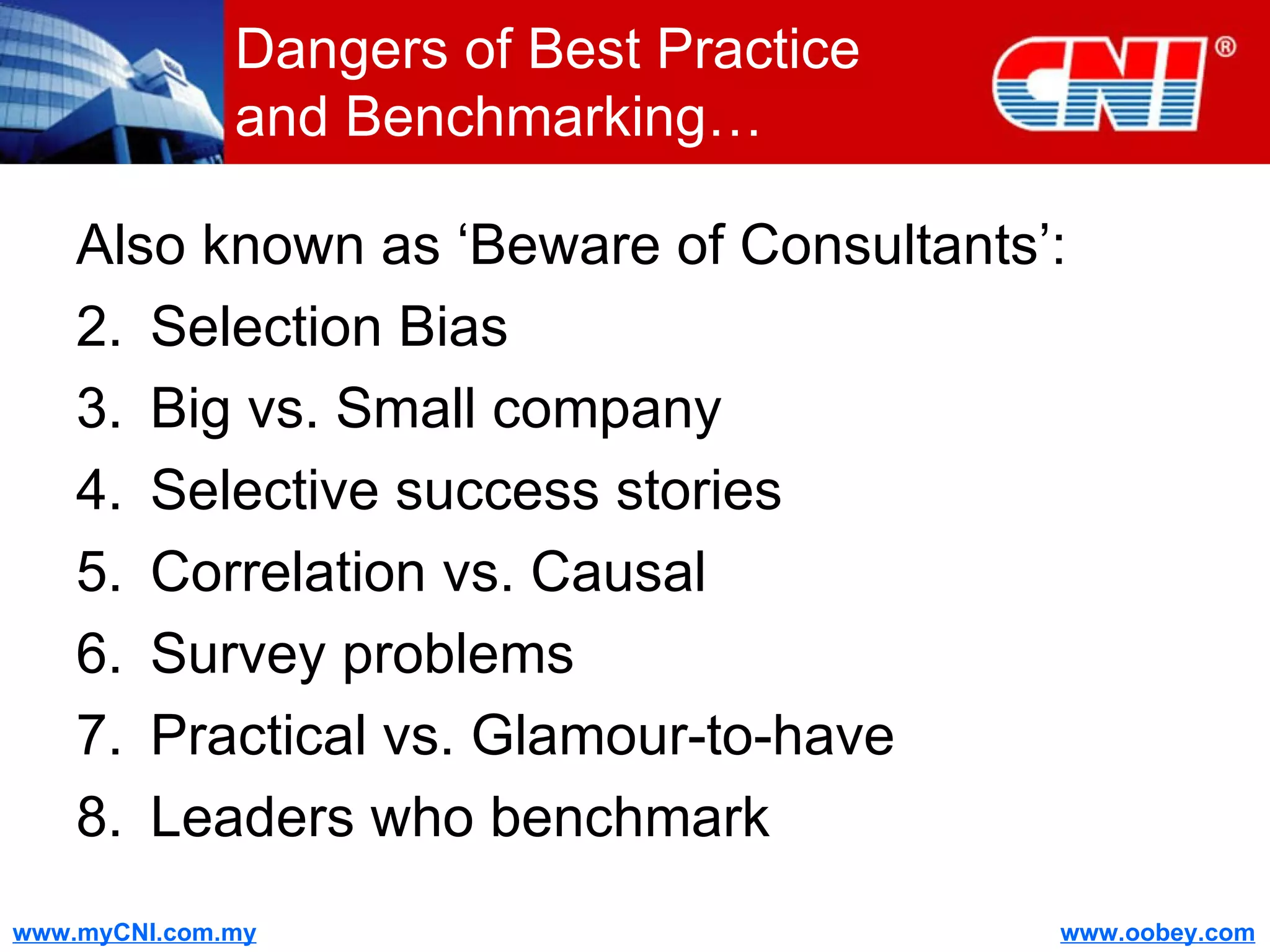
Dangers of Best Practice and Benchmarking… Also known as ‘Beware of Consultants’: Selection Bias Big vs. Small company Selective success stories Correlation vs. Causal Survey problems Practical vs. Glamour-to-have Leaders who benchmark
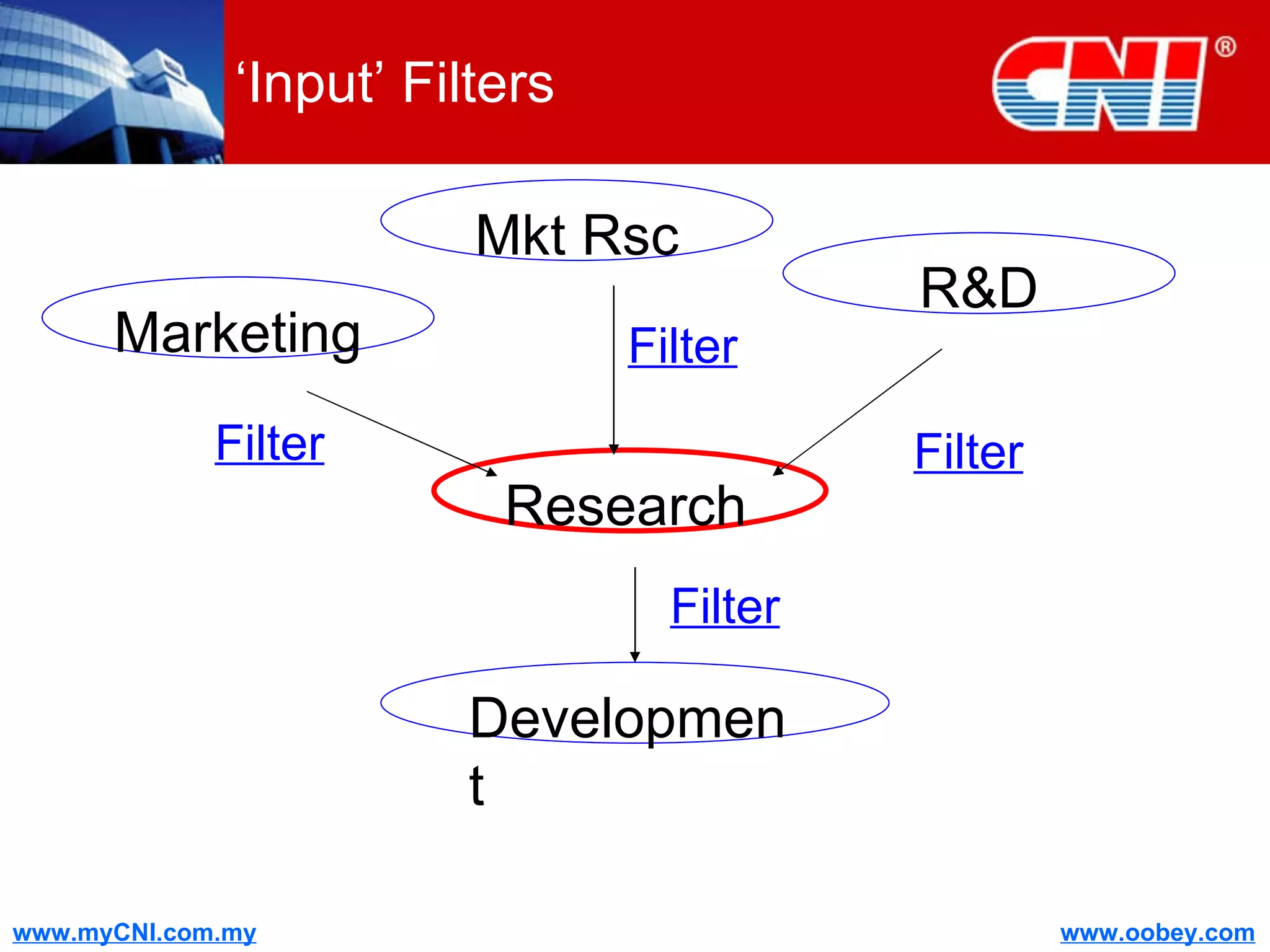
‘Input’ Filters Mkt Rsc R&D Research Development Filter Filter Filter Marketing Filter
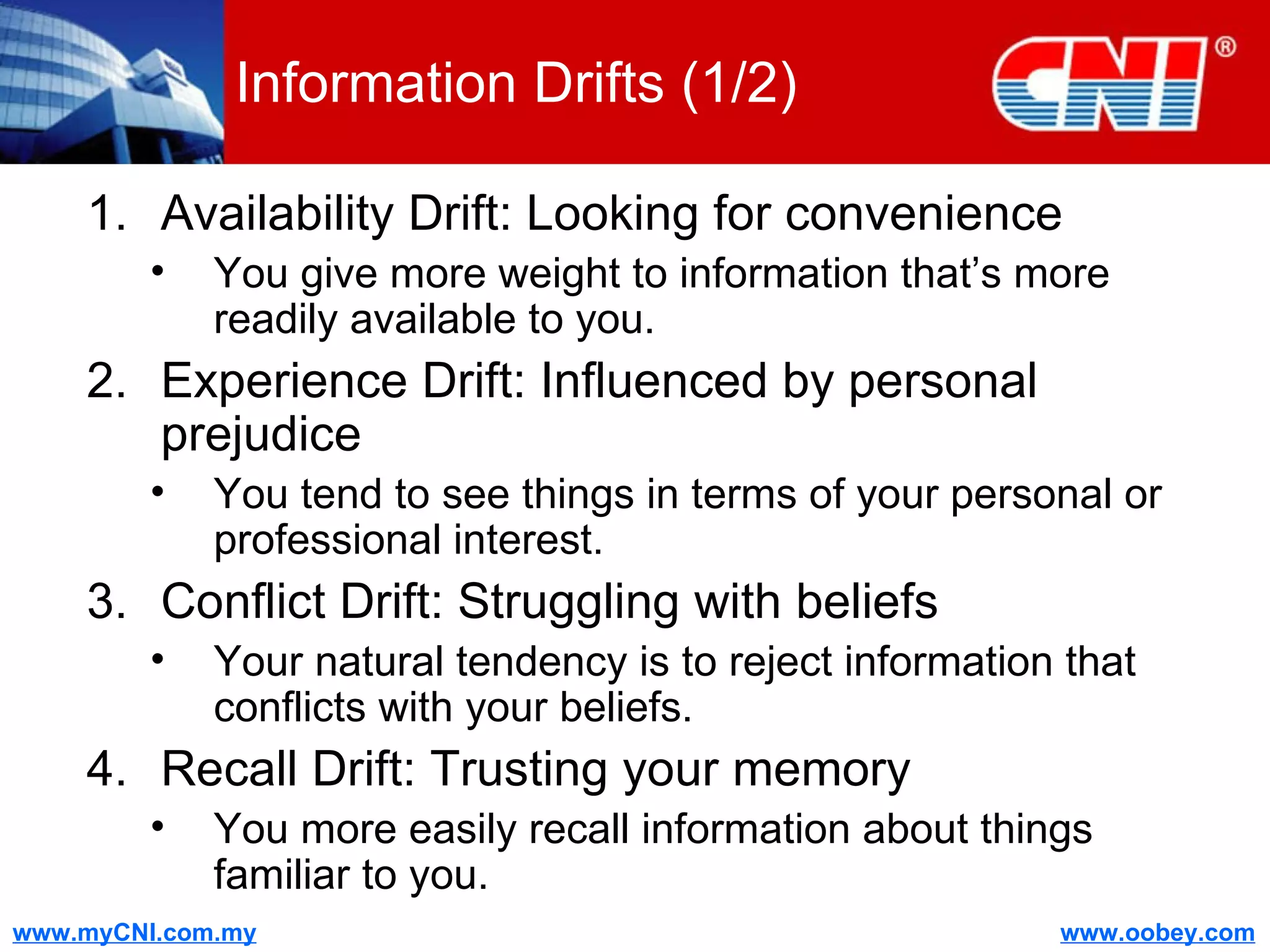
Information Drifts (1/2) Availability Drift: Looking for convenience You give more weight to information that’s more readily available to you. Experience Drift: Influenced by personal prejudice You tend to see things in terms of your personal or professional interest.  Conflict Drift: Struggling with beliefs Your natural tendency is to reject information that conflicts with your beliefs. Recall Drift: Trusting your memory You more easily recall information about things familiar to you.
Information Drifts (2/2) Selectivity Drift: Picking your priorities You screen out information and observations about things that do not interest you. Anchoring Drift: Weighing answers too heavily If you lack experience in a specific area, you hang on to or anchor to the first information you hear. Recency Drift You place greater emphasis on what has just happened to you. Favorability Drift You are more likely to look harder for information that supports your beliefs rather than input that is obvious in front of you.
A3. Reverse Marketing What we can vs. What we need
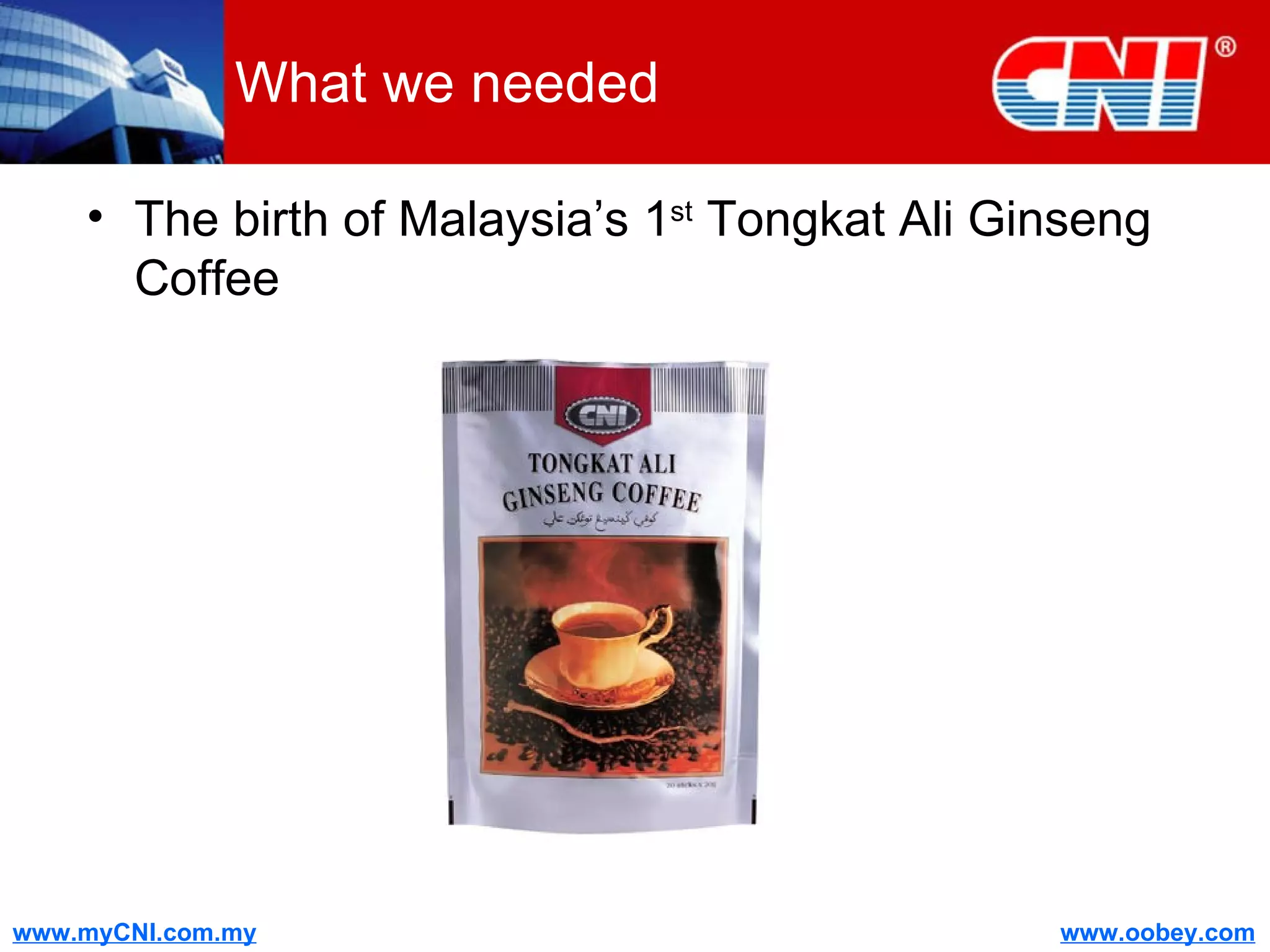
What we needed The birth of Malaysia’s 1 st  Tongkat Ali Ginseng Coffee
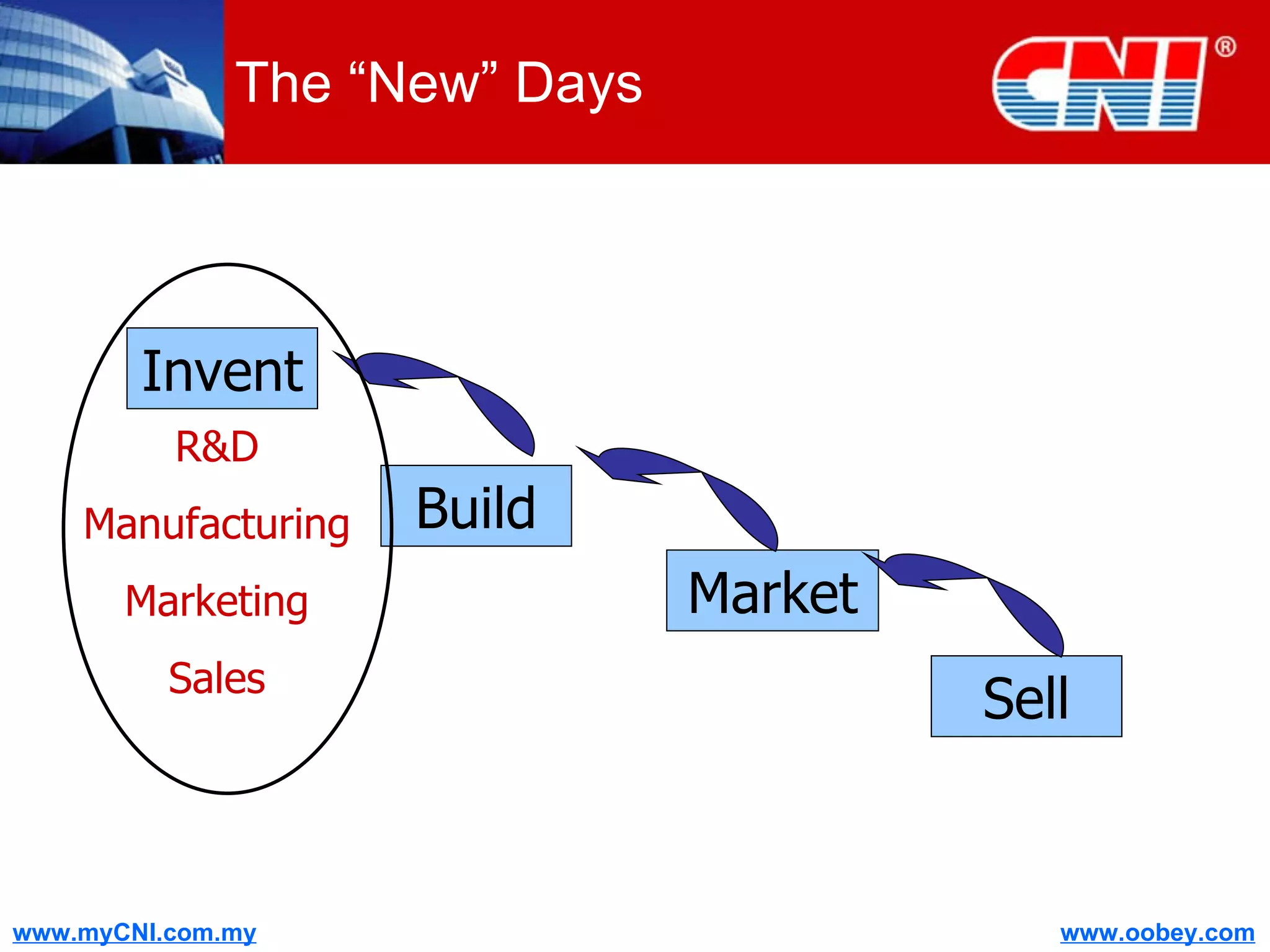
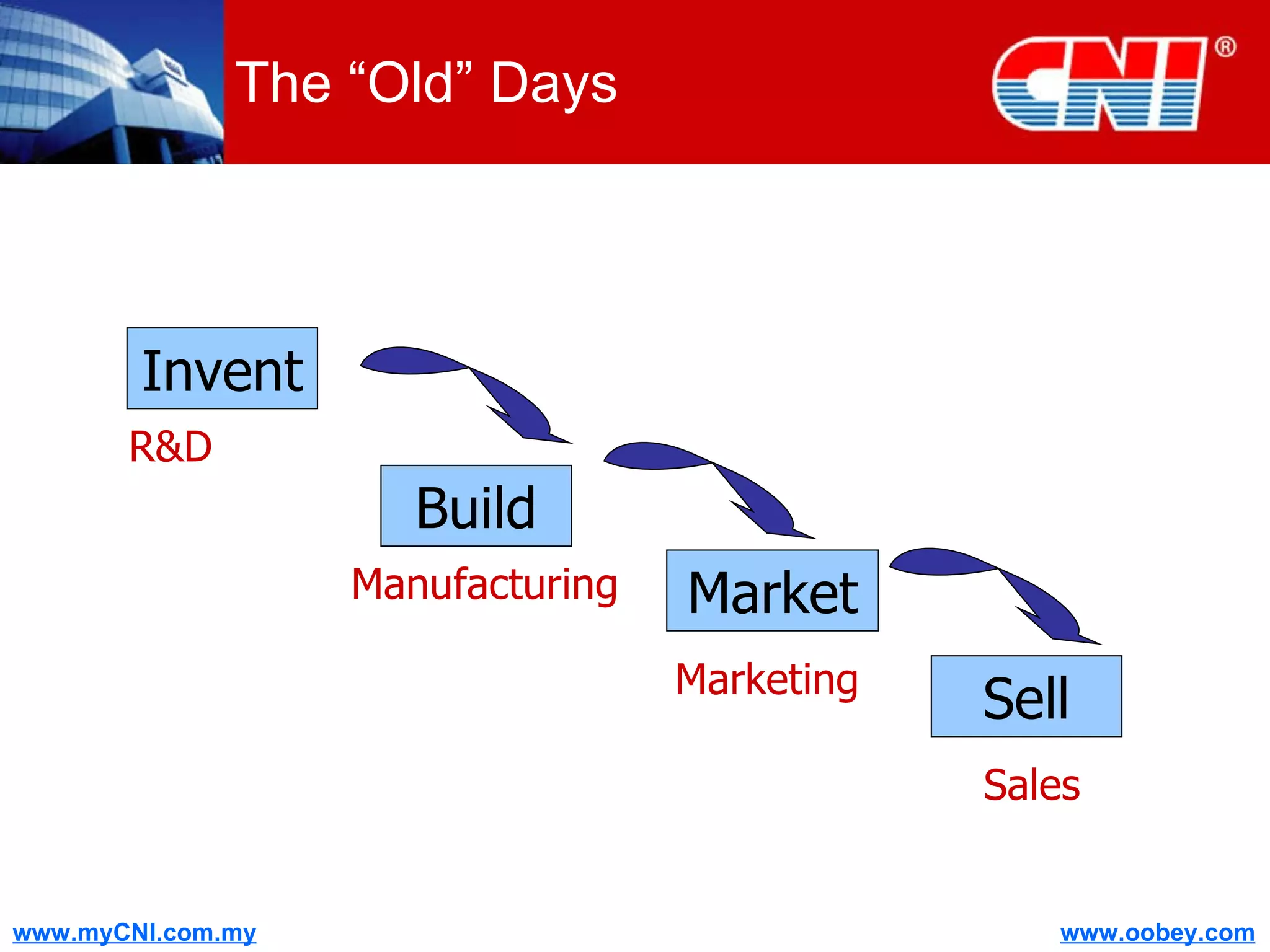
The “Old” Days Invent R&D Build Manufacturing Market Marketing Sell Sales
The “New” Days Invent Build Market Sell R&D Manufacturing Marketing Sales
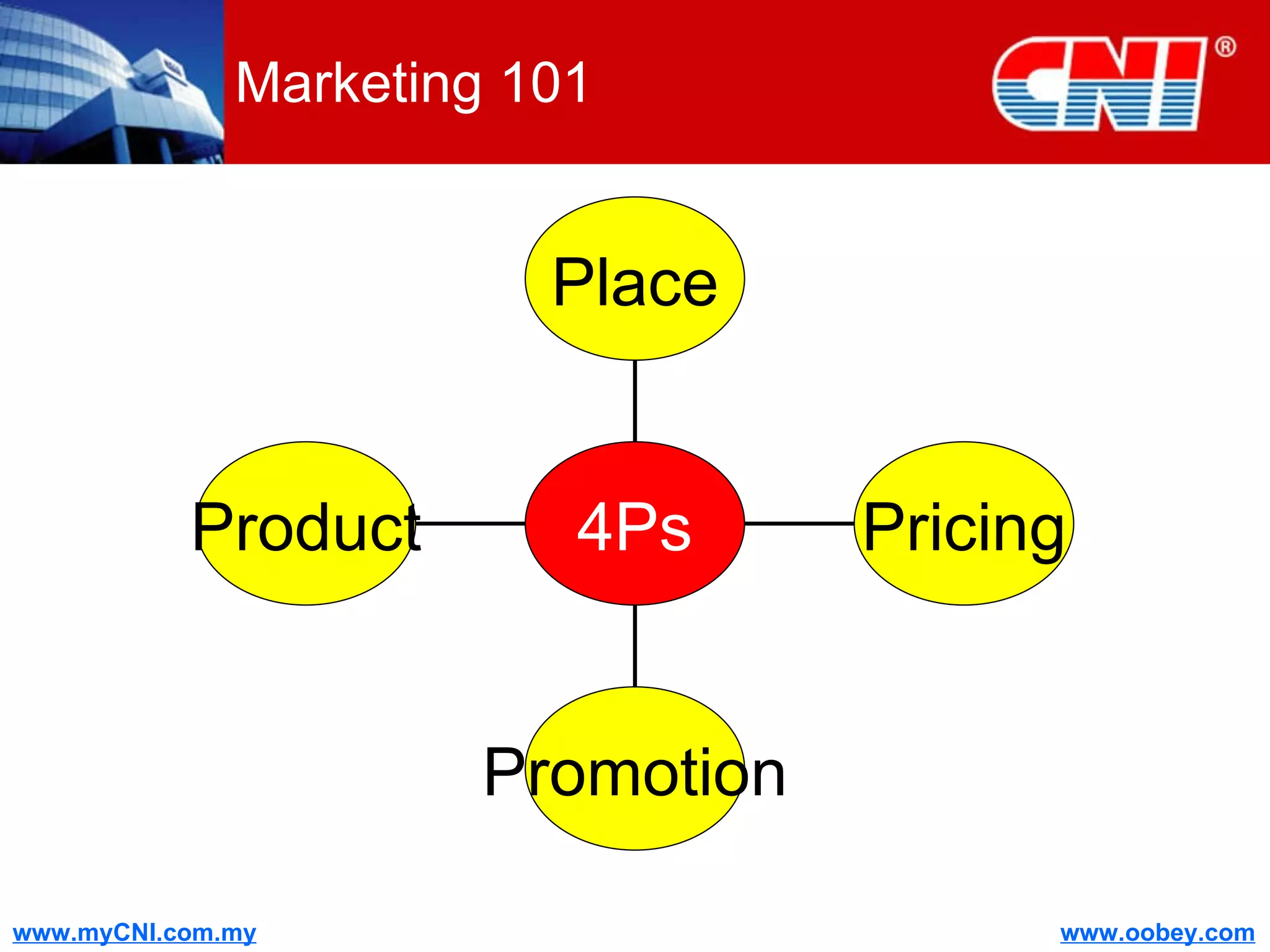
Marketing 101 Product Promotion Pricing Place 4Ps
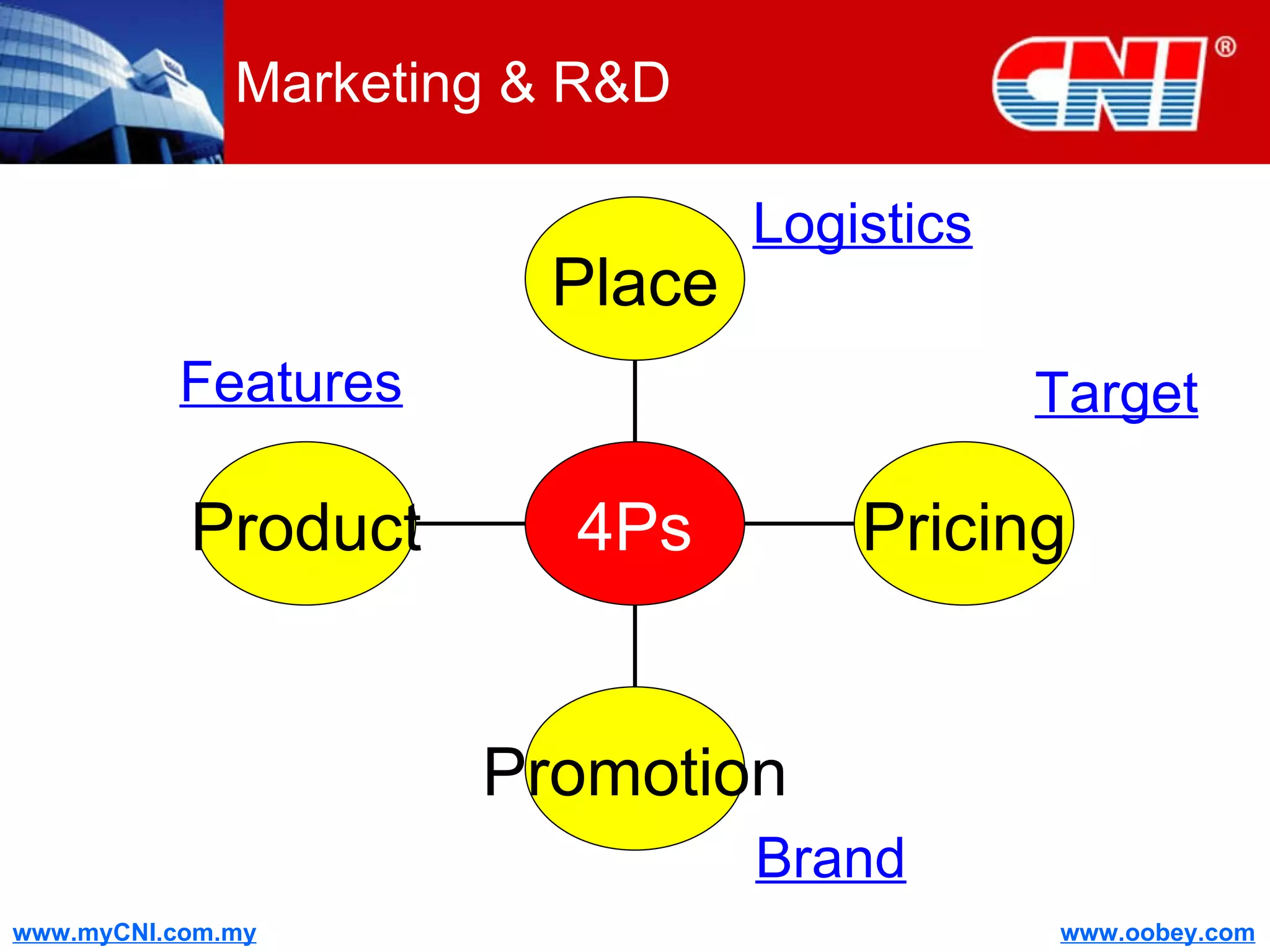
Marketing & R&D Features Brand Target Logistics Product Promotion Pricing Place 4Ps
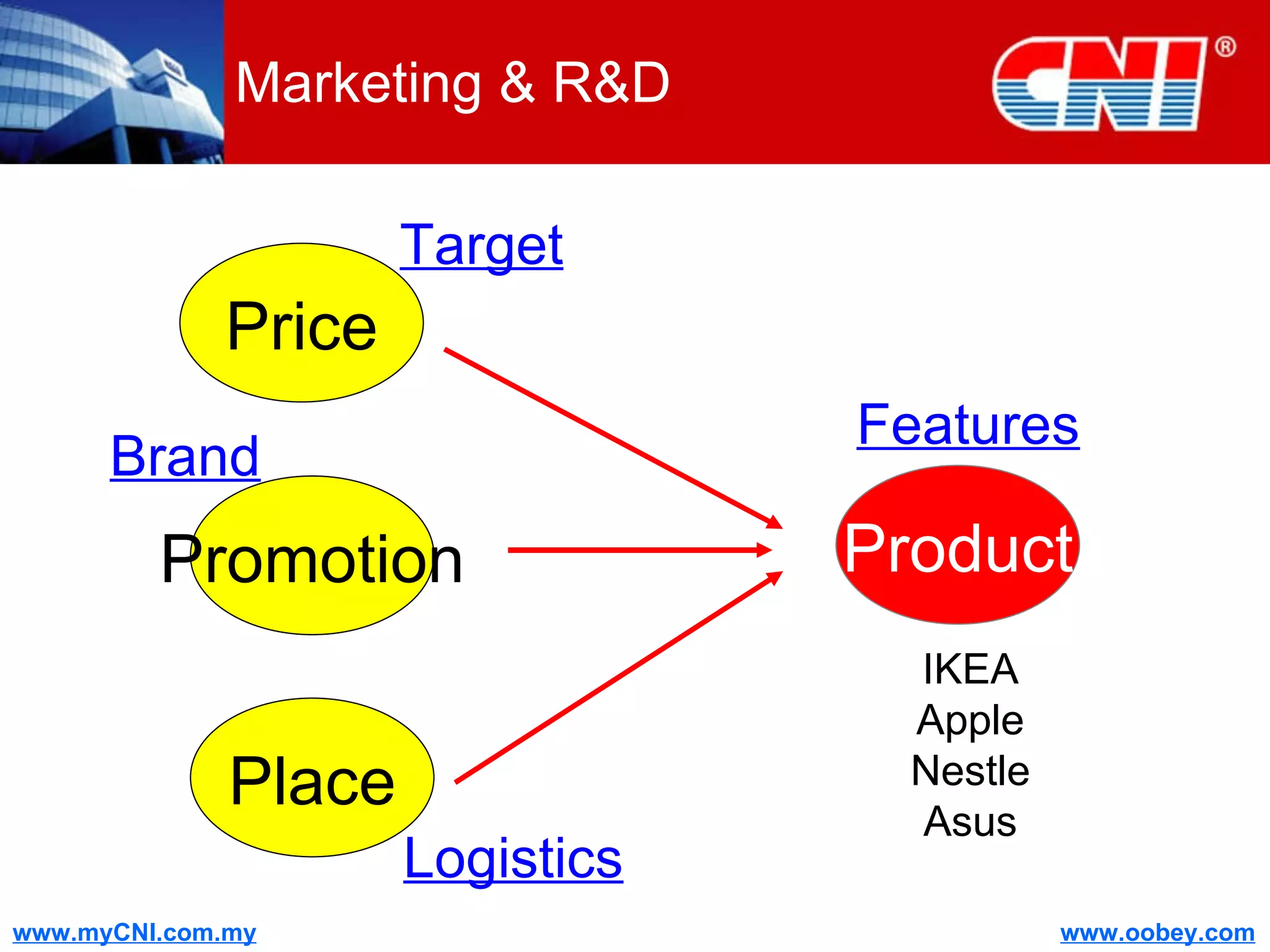
Marketing & R&D Features Brand Target Logistics Price Promotion Place Product IKEA Apple Nestle Asus
A4. Align Running in the same direction with the proper resources
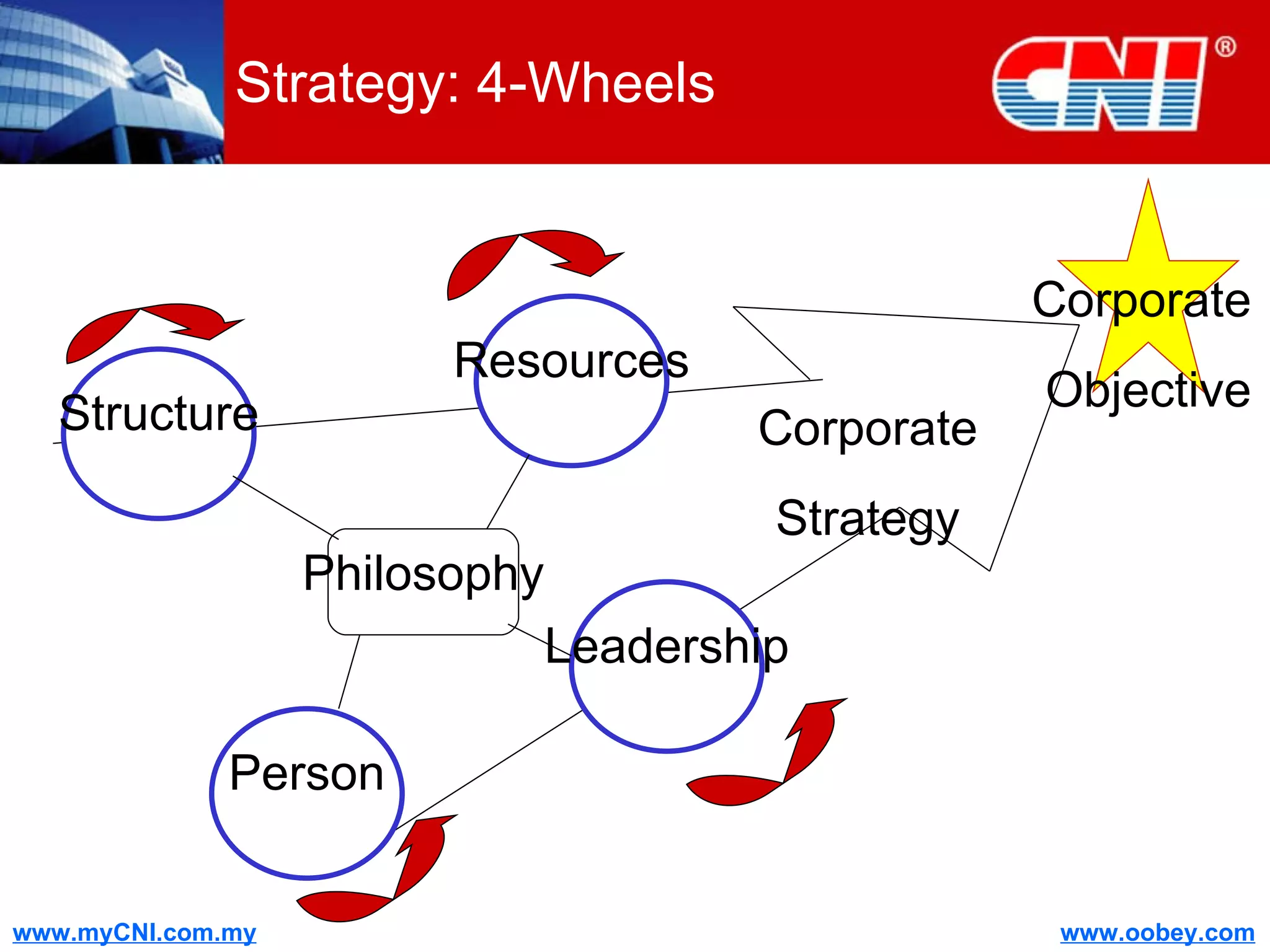
Strategy: 4-Wheels Philosophy Corporate  Objective Corporate Strategy Structure Resources Leadership Person
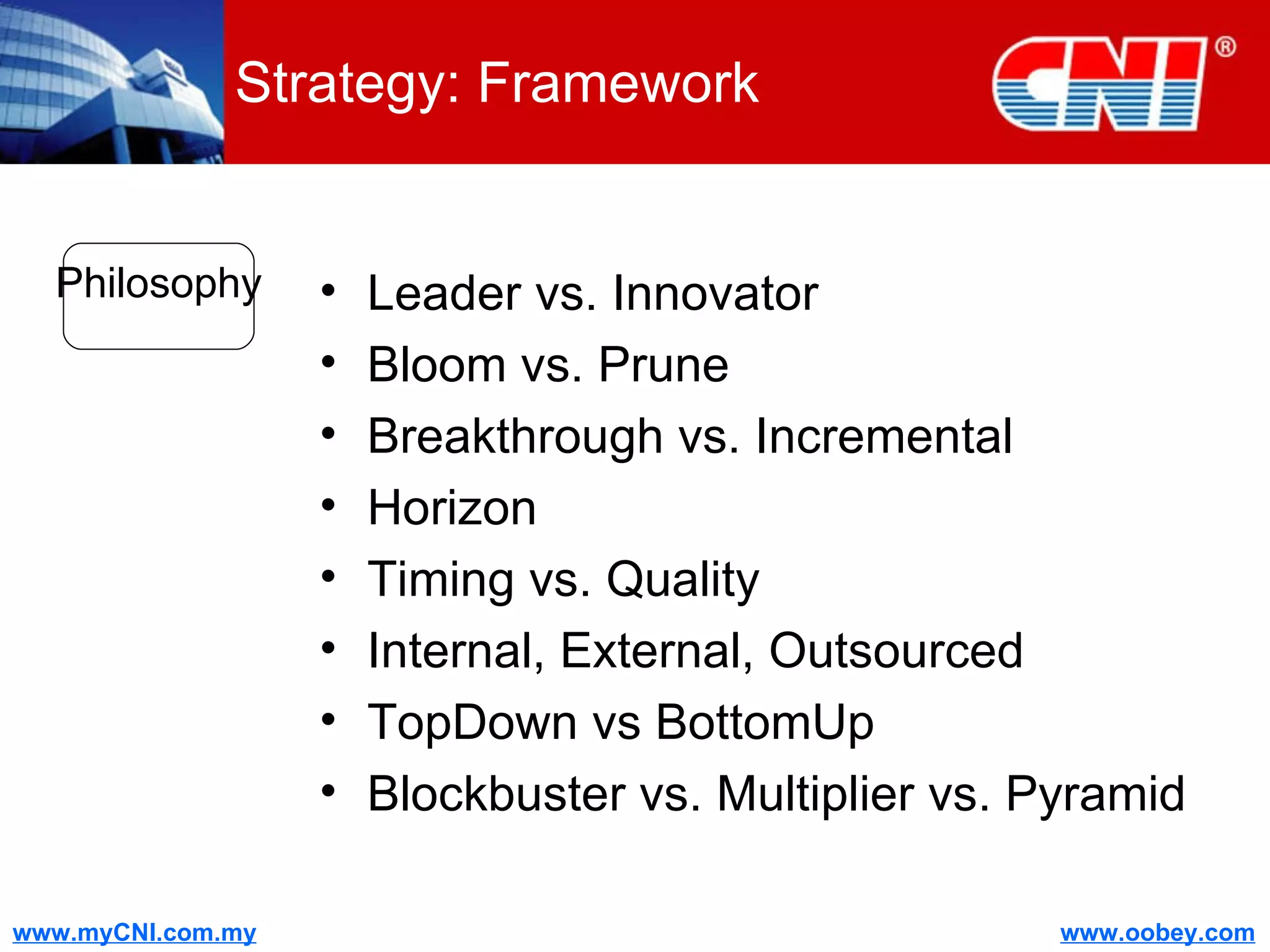
Strategy: Framework Leader vs. Innovator Bloom vs. Prune Breakthrough vs. Incremental Horizon Timing vs. Quality Internal, External, Outsourced TopDown vs BottomUp Blockbuster vs. Multiplier vs. Pyramid Philosophy
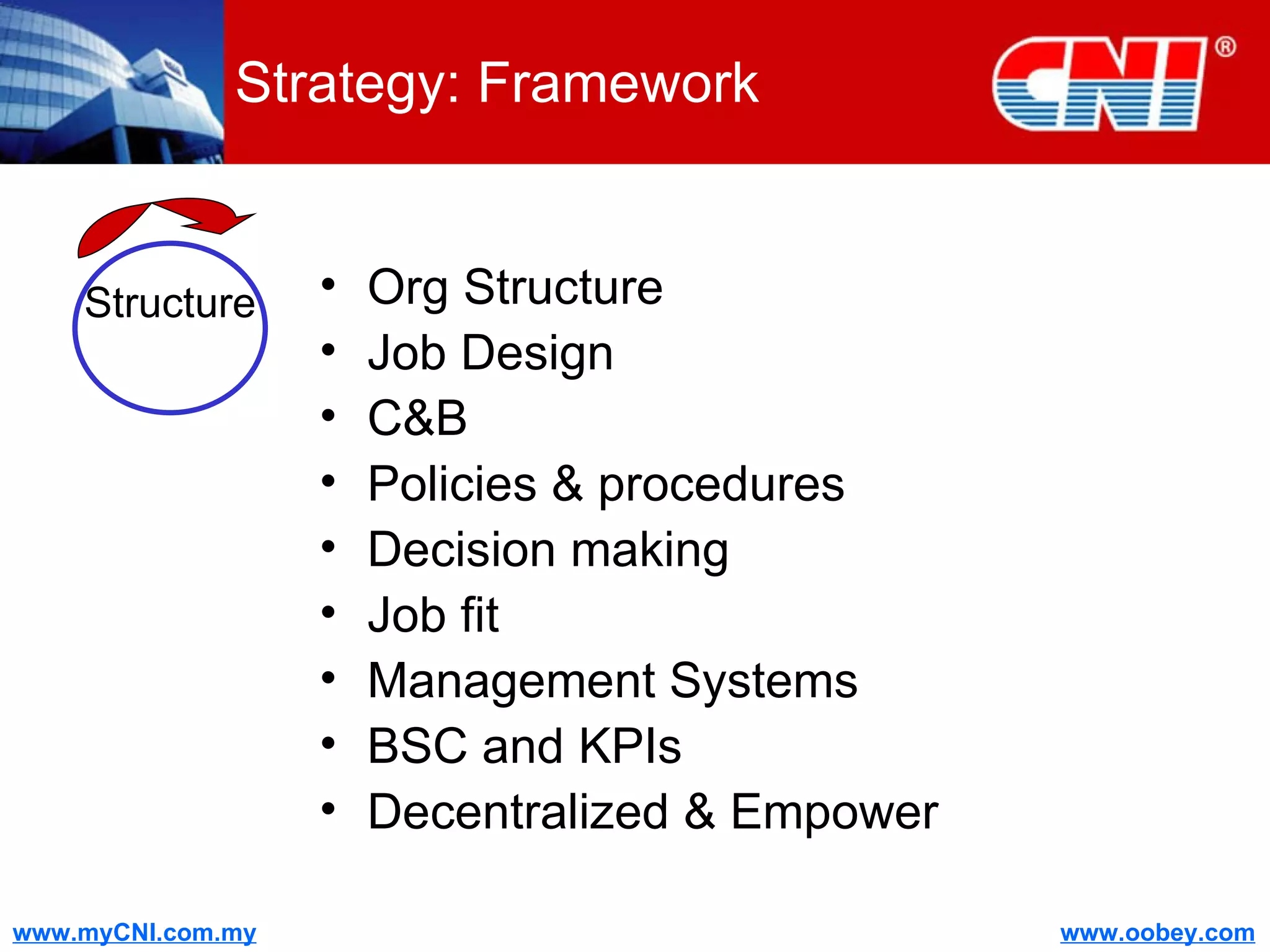
Strategy: Framework Org Structure Job Design C&B Policies & procedures Decision making Job fit Management Systems BSC and KPIs Decentralized & Empower Structure
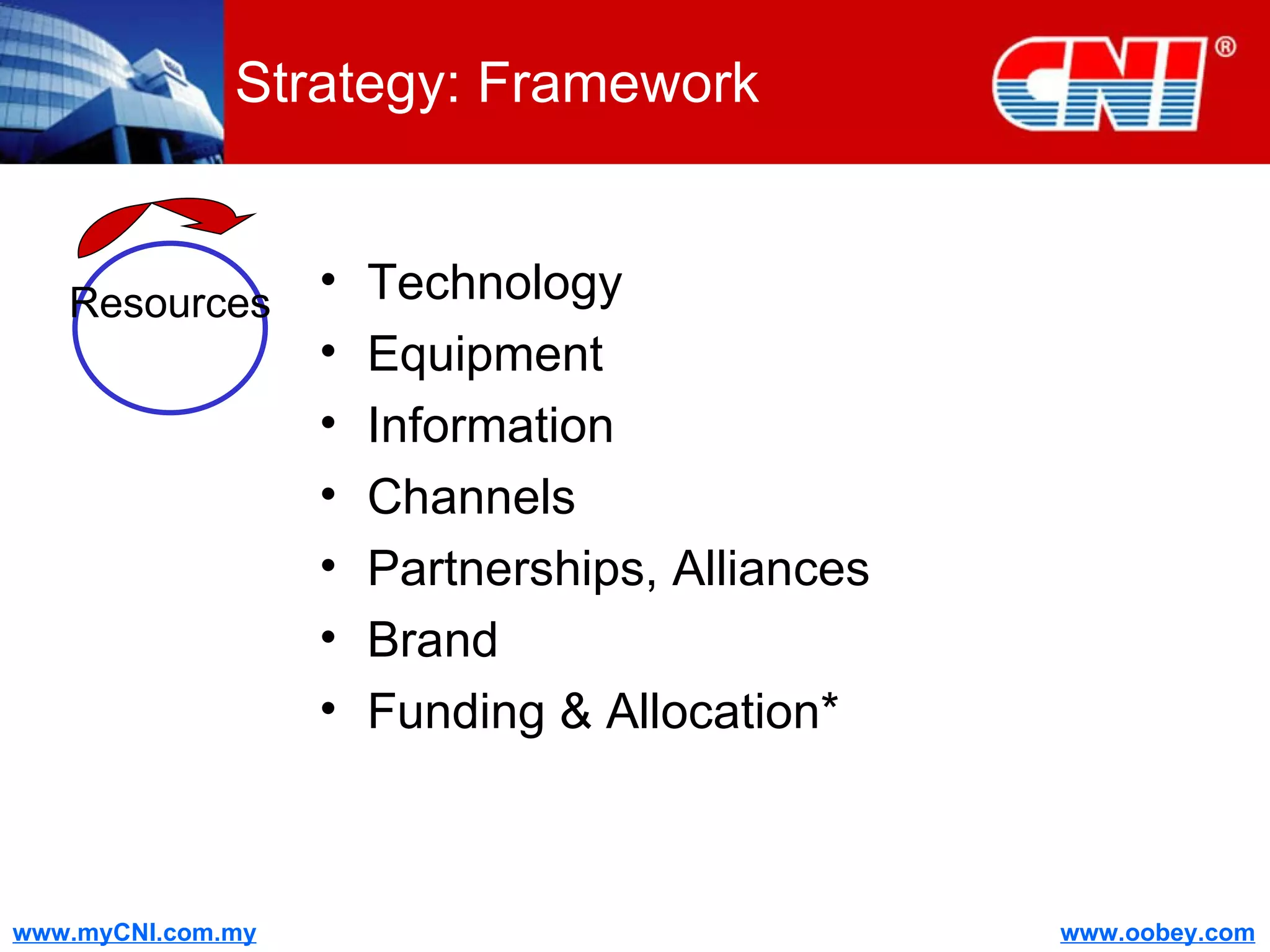
Strategy: Framework Technology Equipment Information Channels Partnerships, Alliances Brand Funding & Allocation* Resources
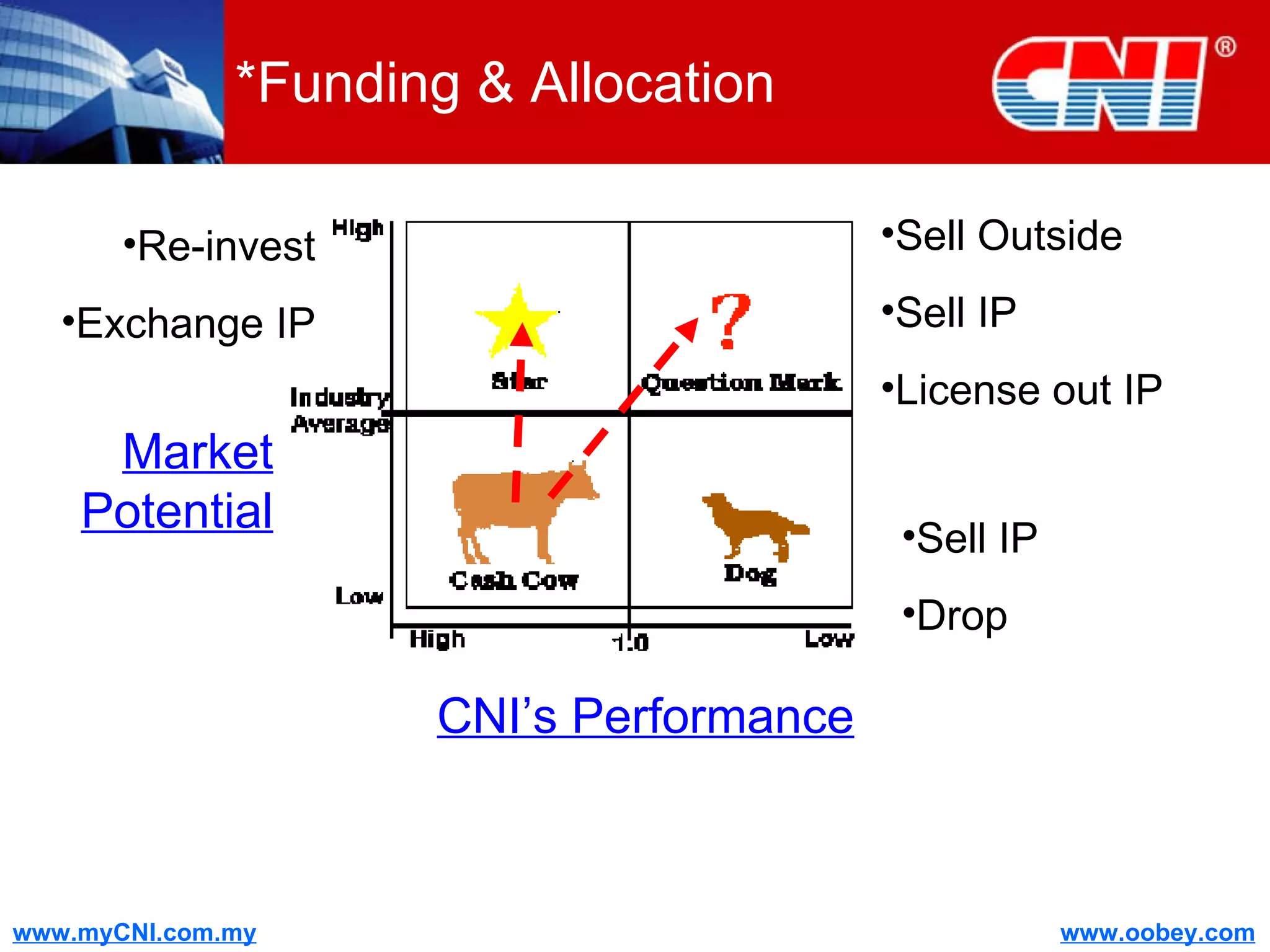
*Funding & Allocation CNI’s Performance Market Potential Sell Outside Sell IP License out IP Sell IP Drop Re-invest Exchange IP
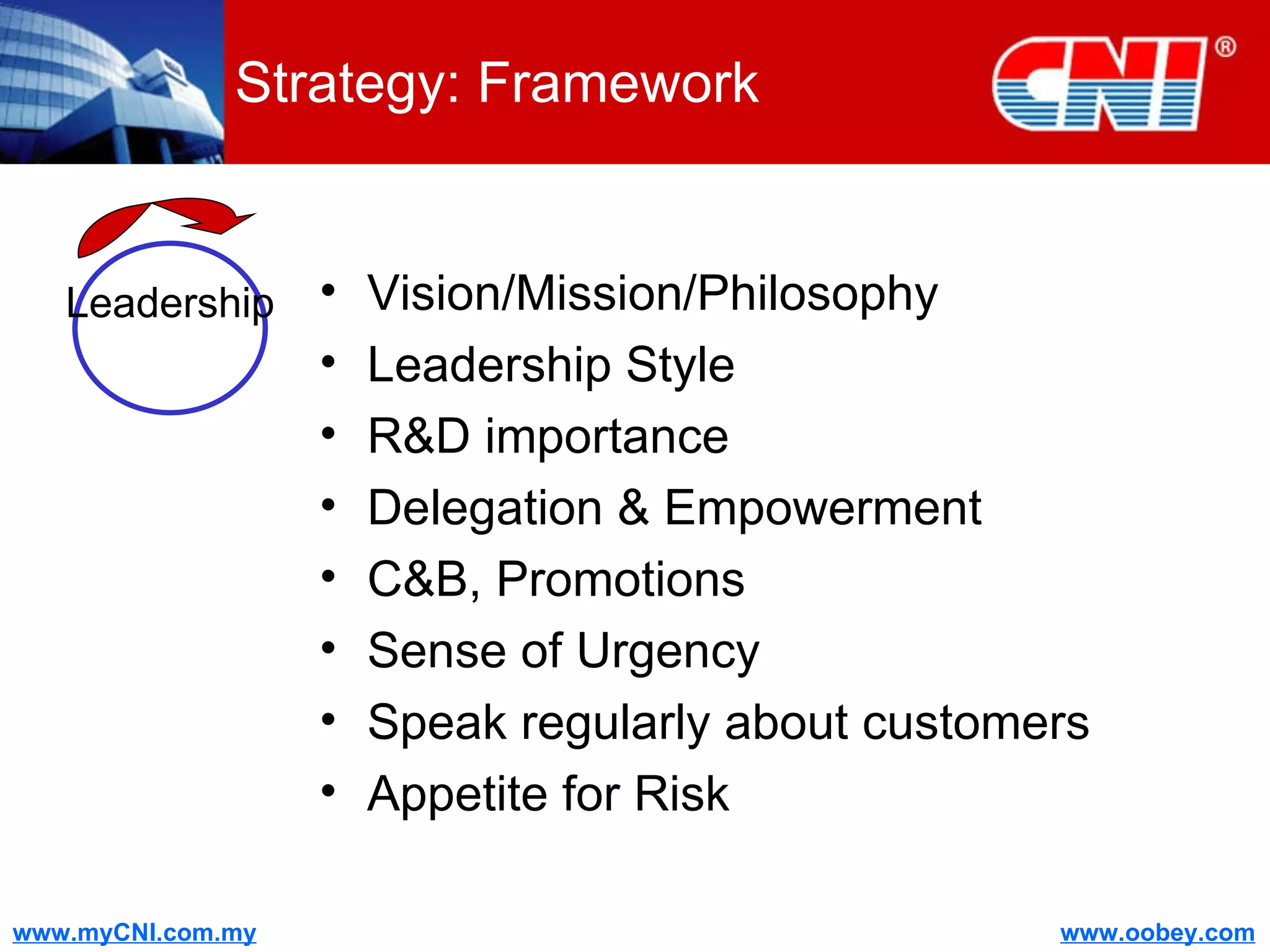
Strategy: Framework Vision/Mission/Philosophy Leadership Style R&D importance Delegation & Empowerment C&B, Promotions Sense of Urgency Speak regularly about customers Appetite for Risk Leadership
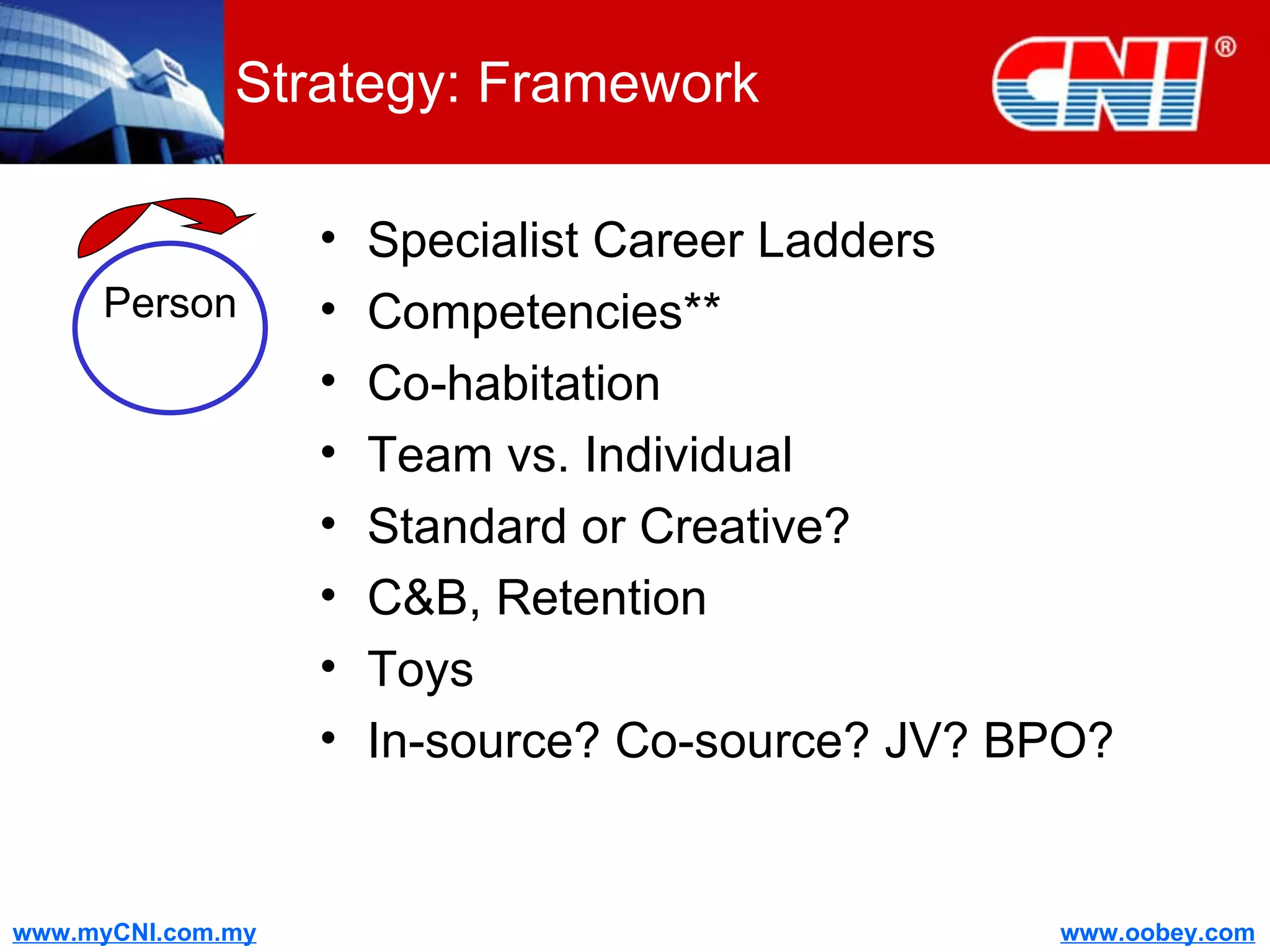
Strategy: Framework Specialist Career Ladders Competencies** Co-habitation Team vs. Individual Standard or Creative? C&B, Retention Toys In-source? Co-source? JV? BPO? Person
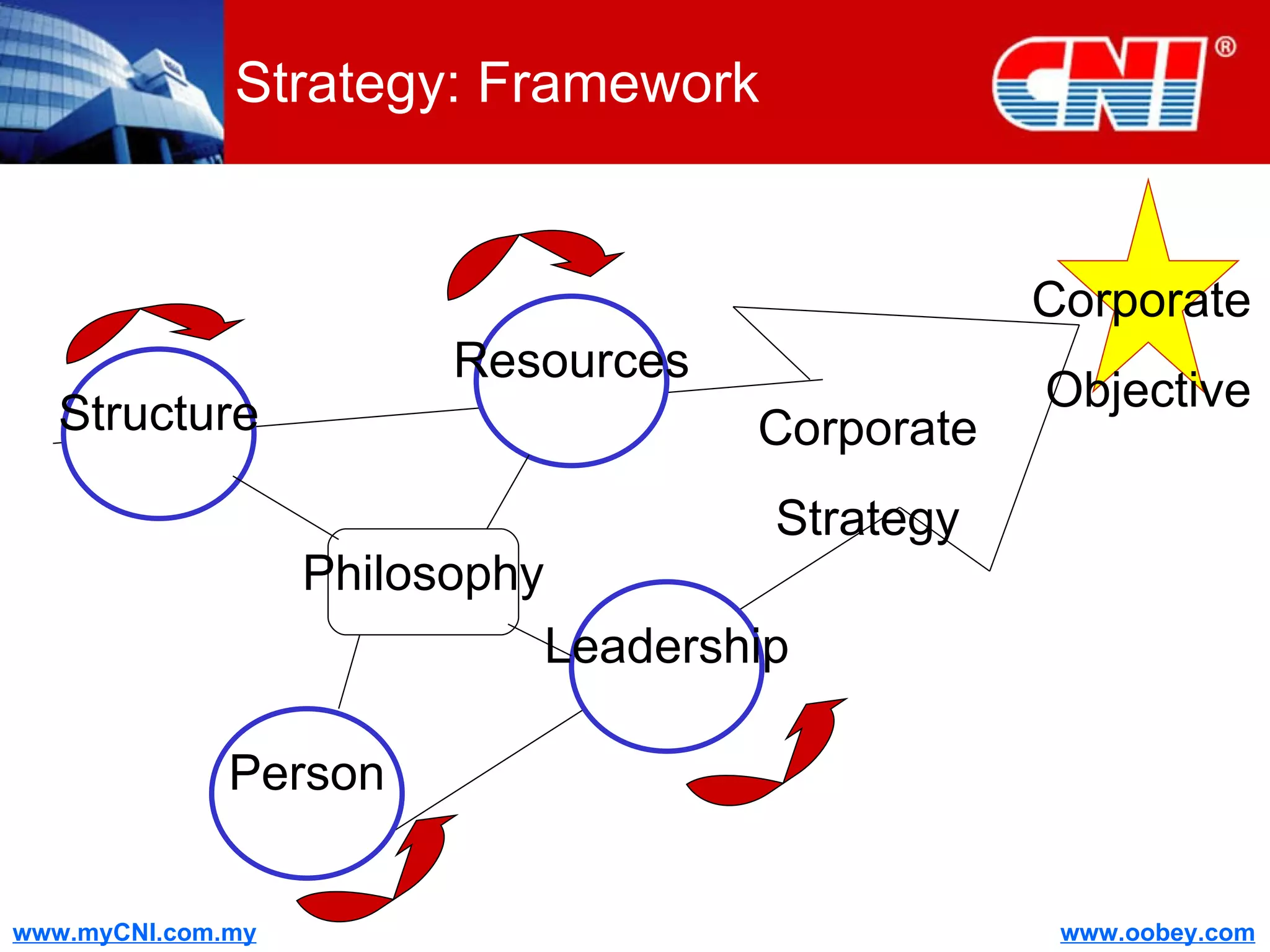
Strategy: Framework Philosophy Corporate  Objective Corporate Strategy Structure Resources Leadership Person
B. R&D Today -> RD&D R&D in Totality
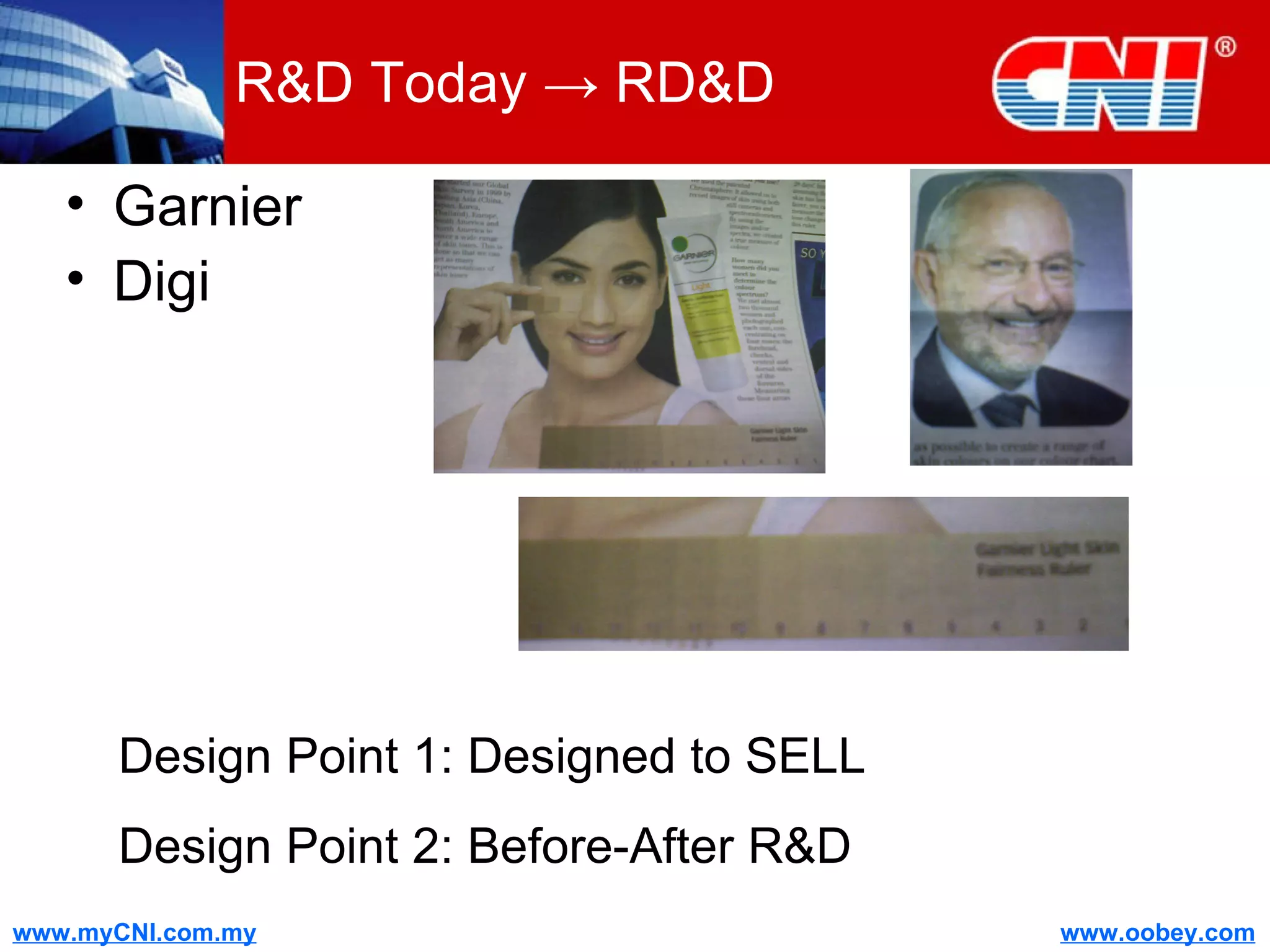
R&D Today -> RD&D Garnier Digi Design Point 1: Designed to SELL Design Point 2: Before-After R&D
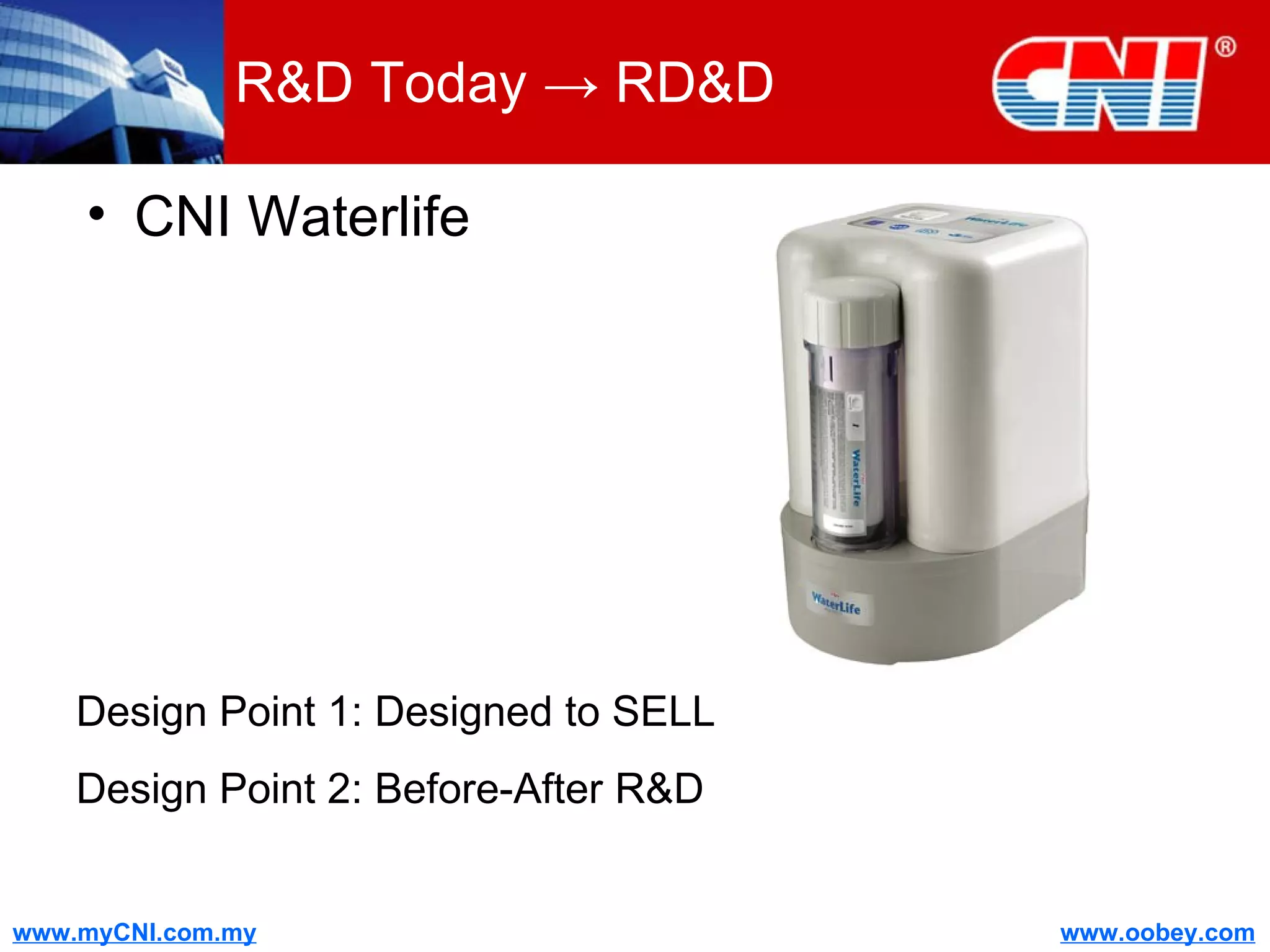
R&D Today -> RD&D CNI Waterlife Design Point 1: Designed to SELL Design Point 2: Before-After R&D
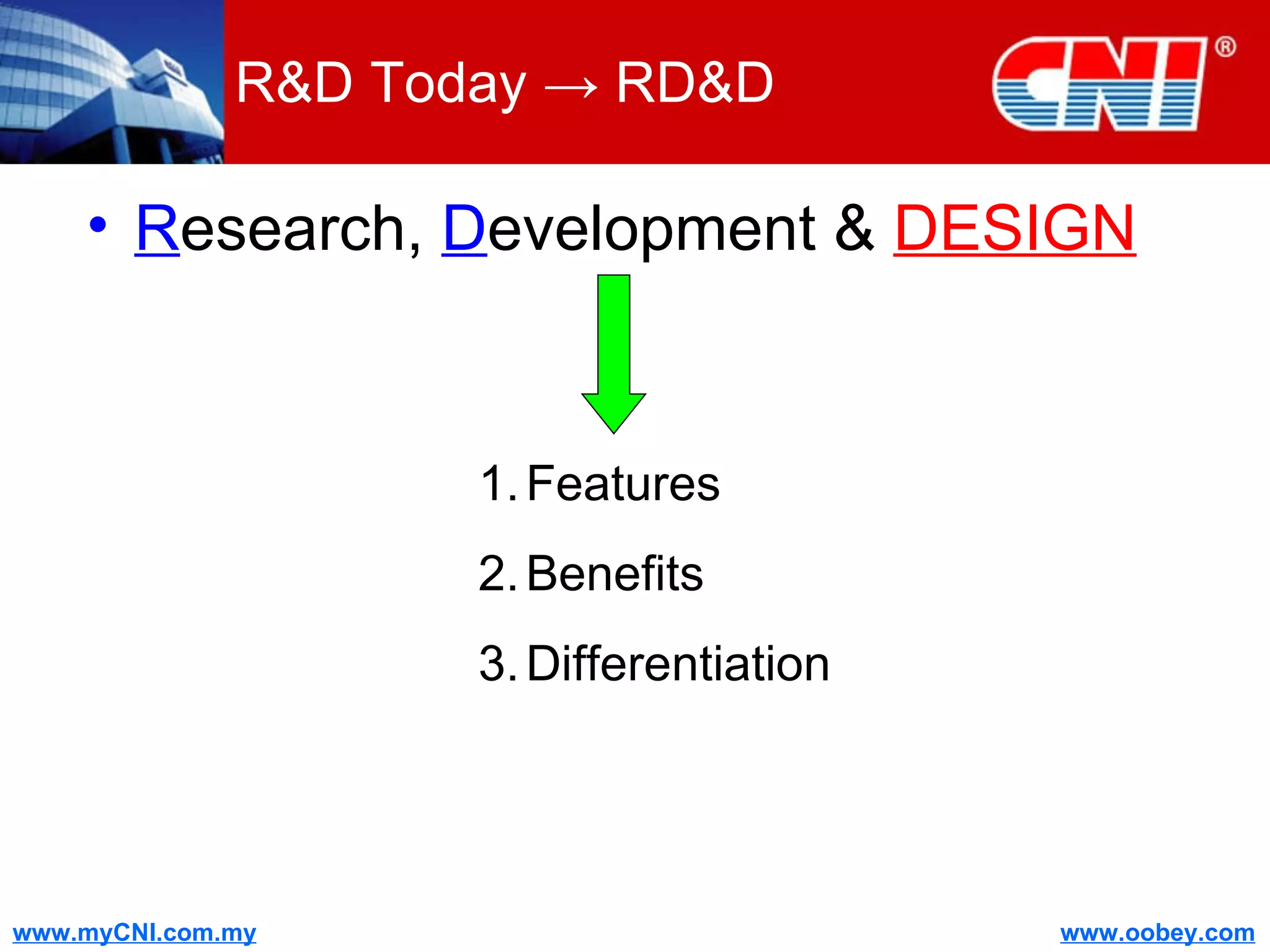
R&D Today -> RD&D R esearch,  D evelopment &  DESIGN Features Benefits Differentiation
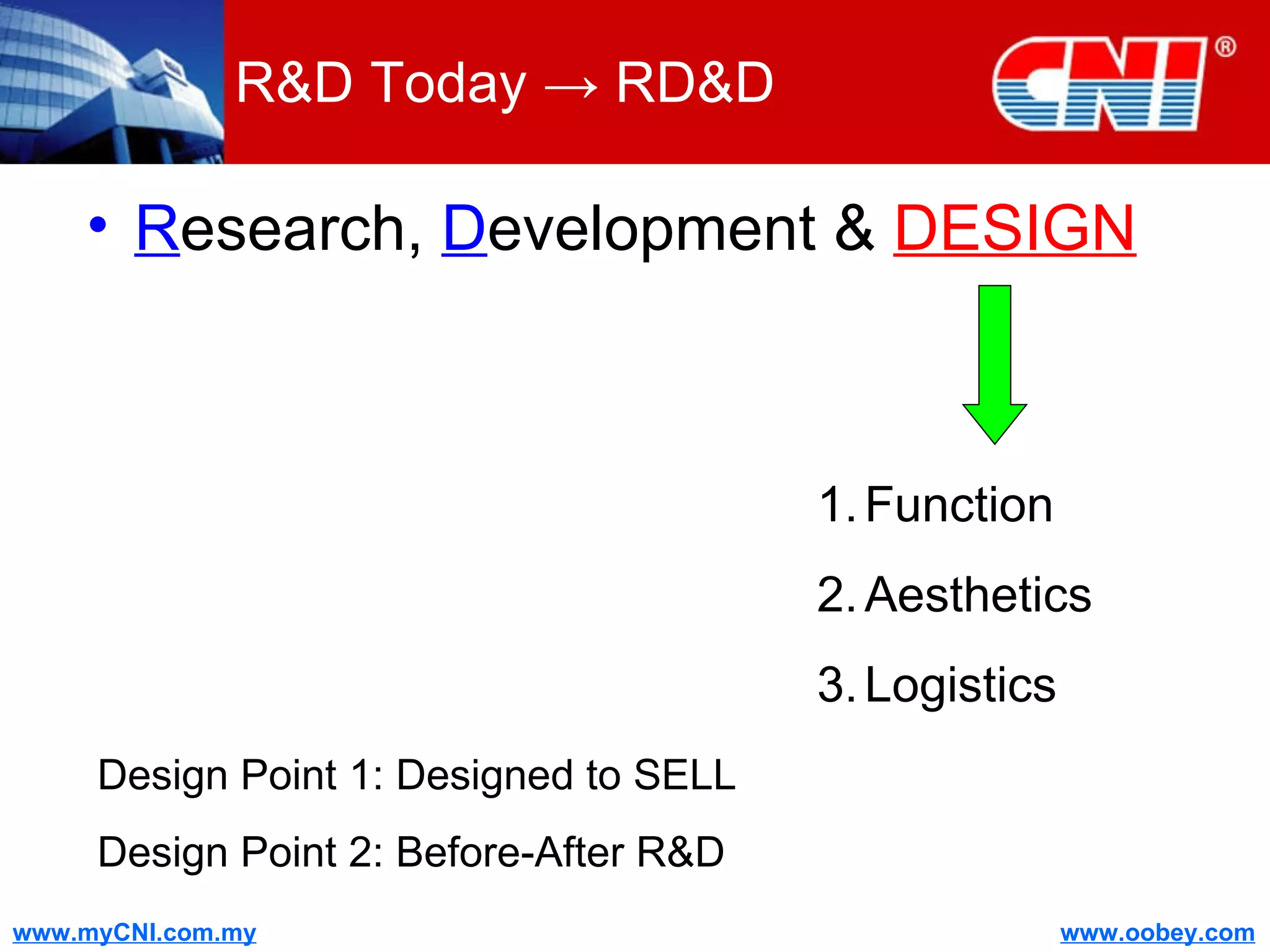
R&D Today -> RD&D R esearch,  D evelopment &  DESIGN Function Aesthetics Logistics Design Point 1: Designed to SELL Design Point 2: Before-After R&D
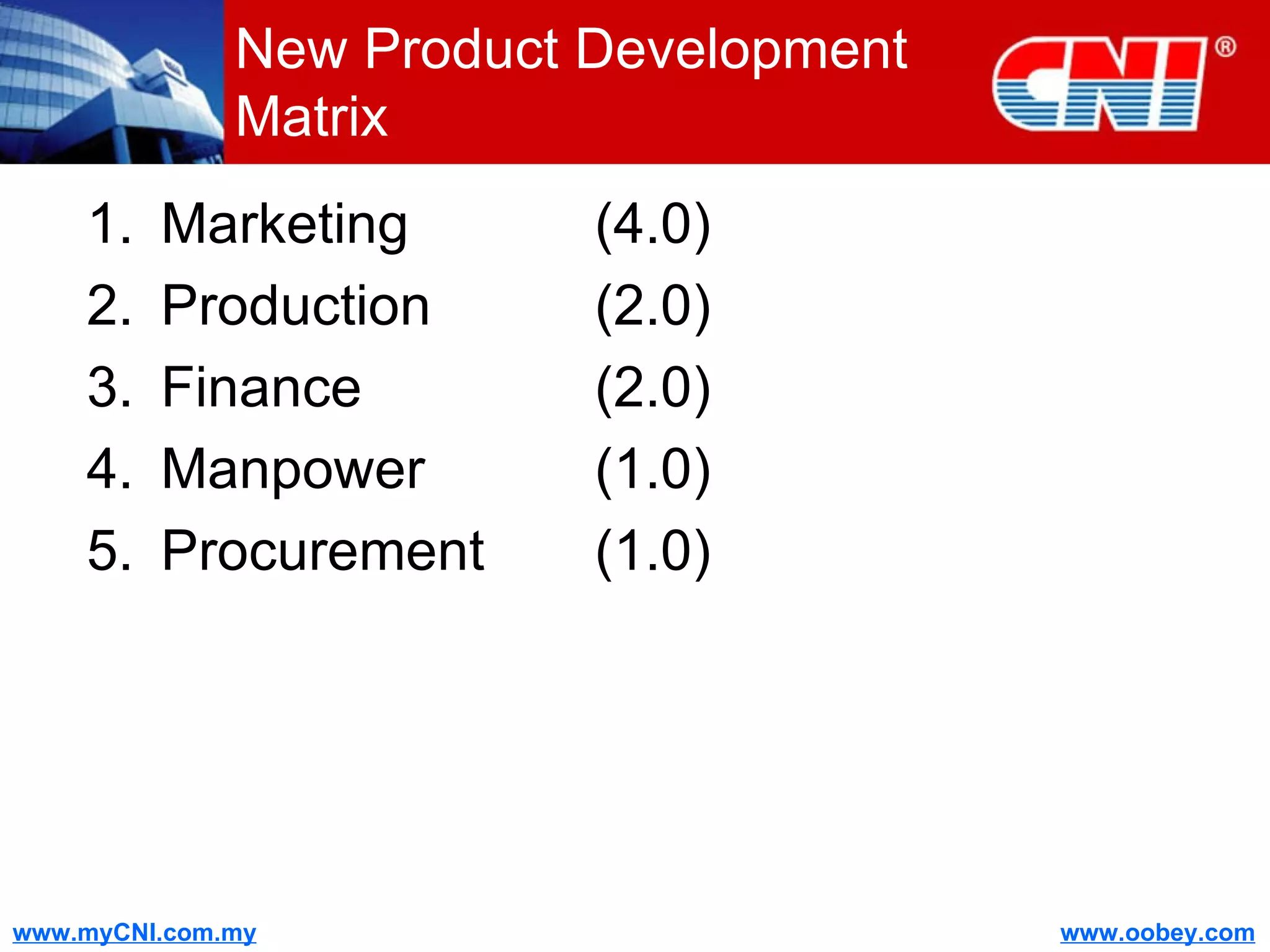
New Product Development Matrix Marketing  (4.0) Production (2.0) Finance (2.0) Manpower (1.0) Procurement (1.0)
C. Issues and Challenges Problems, Problems, Problems
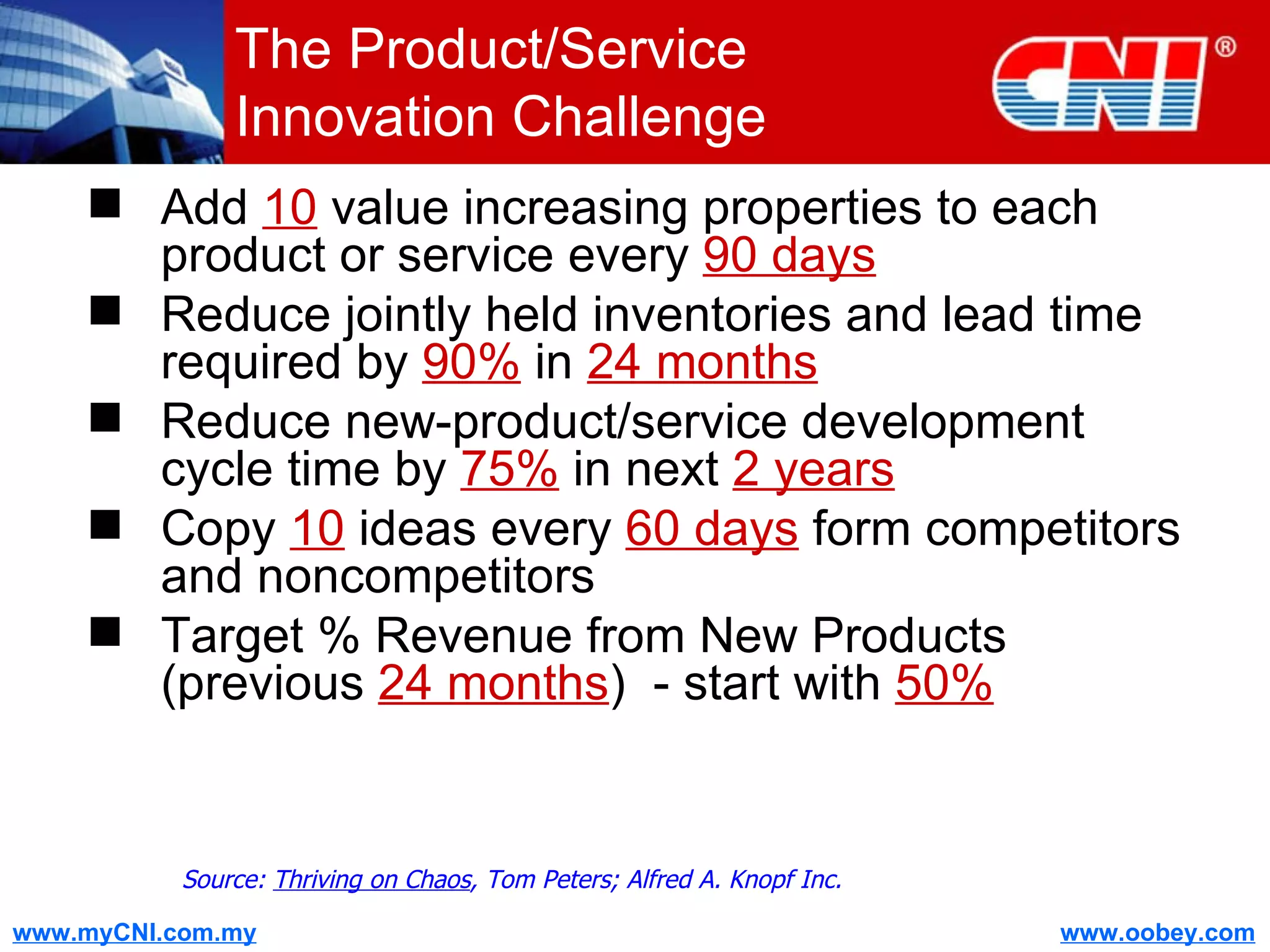
The Product/Service Innovation Challenge Add  10  value increasing properties to each product or service every  90 days Reduce jointly held inventories and lead time required by  90%  in  24 months Reduce new-product/service development cycle time by  75%  in next  2 years Copy  10  ideas every  60 days  form competitors and noncompetitors Target % Revenue from New Products (previous  24 months )  - start with  50% Source:  Thriving on Chaos , Tom Peters; Alfred A. Knopf Inc.
Thank You.  soft copy of slides:   http://totallyunrelatedrandomanddebatable.blogspot.com/

R&D today: Addressing and enhancing Research & Development’s effectiveness

  • 1.
    R&D TODAY: ADDRESSINGAND ENHANCING RESEARCH & DEVELOPMENT’S EFFECTIVENESS Concepts, Case Studies, and Debatable Ideas Kenny Ong CNI Holdings Berhad
  • 2.
    In other words…How do we make R&D more Effective?
  • 3.
    Before that… Howis R&D not effective? Top Down – Process problem Because I can - Competency problem Poor business value – Ignorance problem No Budget - Alignment problem Not-Invented-Here – Ego problem
  • 4.
    Contents: How dowe make R&D more Effective? Know Your Business Research Reverse Marketing Align R&D Today -> RD&D Issues and Challenges
  • 5.
    R&D For What?R&D Product Process
  • 6.
    So…What is ourProduct? Research -> Develop -> Sell -> Improve Coffee? Shampoo? Events? Marketing Plan? Customers?
  • 7.
    A1. Know YourBusiness The anchor for all decisions
  • 8.
    About: CNI 20years old Core Business: MLM Others: Contract Manufacturing, Export, Trading, eCommerce, F&B retail Malaysia, Singapore, Brunei, Indonesia, India, China, Hong Kong, Philippines, Italy, Taiwan Staff force: ± 500 Distributors: 200,000 Products: Consumer Goods and Services
  • 9.
    Intro: MLM Sellthrough people Relationship & people skills Compensation Plan Follow-up Integrity R&D Training Functions & Events Tight regulations
  • 10.
    Intro: CNI CNI’sBusiness Model background Factory CNIE DC SP Leaders Customers R&D
  • 11.
    What is theBusiness Model? USP Market Discipline Profit Model
  • 12.
    Business Model: USPUnique Selling Proposition (USP) = Targeted Customer = Core Buying Purpose/ Customer Value Proposition/ Job To Be Done (JBTD)
  • 13.
    Business Model: USP“ The Product is Not the Product” What is the customer really buying? What is the “Core Buying Purpose”?
  • 14.
    Business Model: USPInsufficient WEALTH Insufficient ACCESS Insufficient SKILL Insufficient TIME
  • 15.
    Business Model: ProfitModel Revenue Cost Margin
  • 16.
    Business Model: MarketDiscipline Mamak stall
  • 17.
    What are theyreally buying? "Exactly what I need" Customized products Personalized communications "They're very responsive" Preferential service and flexibility Recommends what I need "I'm very loyal to them" Helps us to be a success "They are the most innovative" "Constantly renewing and creative" "Always on the leading edge" "A great deal!" Excellent/attractive price Minimal acquisition cost and hassle Lowest overall cost of ownership "A no-hassles firm" Convenience and speed Reliable product and service Product Leadership Operational Excellence Customer Intimacy
  • 18.
    Strategy: Value DisciplinesOperational Excellence (low cost producer) Ref: The Discipline of Market Leaders , Michael Treacy & Fred Wiersema; 1995 Product Leadership (best product) Customer Intimacy (best total solution)
  • 19.
    Product Leadership New,state of the art products or services Risk takers Meet volatile customer needs Fast concept-to- counter Never satisfied - obsolete own and competitors' products Learning organization Strategy: Value Disciplines Operational Excellence Competitive price Error free, reliable Fast (on demand) Simple Responsive Consistent information for all Transactional 'Once and Done' Customer Intimacy Management by Fact Easy to do business with Have it your way (customization) Market segments of one Proactive, flexible Relationship and consultative selling Cross selling
  • 20.
    The McPlaybook* Makeit easy to eat 50% drive-thru Meals held in one hand Make it easy to prepare High Turnover Tasks simple to learn & repeat Make it quick “ Fast Food” Tests new products for Cooking Times Make what customers want Prowls market for new products Monitored field tests *Adapted from: Businessweek , Februrary 5 th 2007 www.myCNI.om.my
  • 21.
    Focus: Value DisciplinesOperational Excellence (low cost producer) Ref: The Discipline of Market Leaders , Michael Treacy & Fred Wiersema; 1995 Product Leadership (best product) Customer Intimacy (best total solution)
  • 22.
    Focus: Value DisciplinesOperational Excellence (low cost producer) Ref: The Discipline of Market Leaders , Michael Treacy & Fred Wiersema; 1995 Product Leadership (best product) Customer Intimacy (best total solution) www.myCNI.com.my www.OOBEY.com
  • 23.
    What does theCustomer want? * Treacy & Wiersema, The Discipline of Market Leaders , 1995 Product/Service Attributes Relationship Image
  • 24.
    What does theCustomer want? * Treacy & Wiersema, The Discipline of Market Leaders , 1995 Product/Service Attributes Price Quality Time Selection √ √ Smart Shopper Relationship Image Operational Excellence : Quality and selection in key categories with unbeatable prices
  • 25.
    What does theCustomer want? * Treacy & Wiersema, The Discipline of Market Leaders , 1995 Product/Service Attributes √ Brand Time Function √ √ Best Product Relationship Image Product Leadership: Unique products and services that push the standards
  • 26.
    What does theCustomer want? * Treacy & Wiersema, The Discipline of Market Leaders , 1995 Product/Service Attributes √ √ √ √ Service Trusted Brand Relationship Image Customer Intimacy: Personal service tailored to produce results for customer and build long-term relationships Relations
  • 27.
    Business Situation vs.R&D Upturn Flat Downturn Fight Complacency Sharpen Edge Keep Momentum Conquer NPD Cycle Time Improve Edge Extensions Counter Competitor Innovation Acquire Profits Build momentum Sales Cash Flow Focused on ‘Breakthrough’ JV, In-source, Out-source Eliminate bottom 20% Improve Top 15% revenue-generating products ↓ R&D, ↑ Sales
  • 28.
    A2. Research Lies.Deception. Statistics.
  • 29.
    Problem… “ Inbusiness after business, 60% to 80% of lost customers reported on a survey just prior to defecting that they were satisfied or very satisfied .” HBR March/April 1996
  • 30.
    Dangers of BestPractice and Benchmarking… www.myCNI.co.my Company Performance high low ‘ Best Practice’ theories low high zero Performance “ Selection Bias and the Perils of Benchmarking”, Jerker Denrell, Harvard Business Review 2005 Trend line
  • 31.
    Dangers of BestPractice and Benchmarking… Company Performance high low ‘ Best Practice’ theories low high zero Performance “ Selection Bias and the Perils of Benchmarking”, Jerker Denrell, Harvard Business Review 2005 Trend line
  • 32.
    Dangers of BestPractice and Benchmarking… Selection Bias: Success Traits = Failure Traits Successful Cases + Failure Cases Worst effects in ‘Old’ industries Overvalue ‘best practice’ theories Current accomplishments unfairly magnified by past achievements Reverse Causal
  • 33.
    Dangers of BestPractice and Benchmarking… Also known as ‘Beware of Consultants’: Selection Bias Big vs. Small company Selective success stories Correlation vs. Causal Survey problems Practical vs. Glamour-to-have Leaders who benchmark
  • 34.
    ‘Input’ Filters MktRsc R&D Research Development Filter Filter Filter Marketing Filter
  • 35.
    Information Drifts (1/2)Availability Drift: Looking for convenience You give more weight to information that’s more readily available to you. Experience Drift: Influenced by personal prejudice You tend to see things in terms of your personal or professional interest. Conflict Drift: Struggling with beliefs Your natural tendency is to reject information that conflicts with your beliefs. Recall Drift: Trusting your memory You more easily recall information about things familiar to you.
  • 36.
    Information Drifts (2/2)Selectivity Drift: Picking your priorities You screen out information and observations about things that do not interest you. Anchoring Drift: Weighing answers too heavily If you lack experience in a specific area, you hang on to or anchor to the first information you hear. Recency Drift You place greater emphasis on what has just happened to you. Favorability Drift You are more likely to look harder for information that supports your beliefs rather than input that is obvious in front of you.
  • 37.
    A3. Reverse MarketingWhat we can vs. What we need
  • 38.
    What we neededThe birth of Malaysia’s 1 st Tongkat Ali Ginseng Coffee
  • 39.
    The “Old” DaysInvent R&D Build Manufacturing Market Marketing Sell Sales
  • 40.
    The “New” DaysInvent Build Market Sell R&D Manufacturing Marketing Sales
  • 41.
    Marketing 101 ProductPromotion Pricing Place 4Ps
  • 42.
    Marketing & R&DFeatures Brand Target Logistics Product Promotion Pricing Place 4Ps
  • 43.
    Marketing & R&DFeatures Brand Target Logistics Price Promotion Place Product IKEA Apple Nestle Asus
  • 44.
    A4. Align Runningin the same direction with the proper resources
  • 45.
    Strategy: 4-Wheels PhilosophyCorporate Objective Corporate Strategy Structure Resources Leadership Person
  • 46.
    Strategy: Framework Leadervs. Innovator Bloom vs. Prune Breakthrough vs. Incremental Horizon Timing vs. Quality Internal, External, Outsourced TopDown vs BottomUp Blockbuster vs. Multiplier vs. Pyramid Philosophy
  • 47.
    Strategy: Framework OrgStructure Job Design C&B Policies & procedures Decision making Job fit Management Systems BSC and KPIs Decentralized & Empower Structure
  • 48.
    Strategy: Framework TechnologyEquipment Information Channels Partnerships, Alliances Brand Funding & Allocation* Resources
  • 49.
    *Funding & AllocationCNI’s Performance Market Potential Sell Outside Sell IP License out IP Sell IP Drop Re-invest Exchange IP
  • 50.
    Strategy: Framework Vision/Mission/PhilosophyLeadership Style R&D importance Delegation & Empowerment C&B, Promotions Sense of Urgency Speak regularly about customers Appetite for Risk Leadership
  • 51.
    Strategy: Framework SpecialistCareer Ladders Competencies** Co-habitation Team vs. Individual Standard or Creative? C&B, Retention Toys In-source? Co-source? JV? BPO? Person
  • 52.
    Strategy: Framework PhilosophyCorporate Objective Corporate Strategy Structure Resources Leadership Person
  • 53.
    B. R&D Today-> RD&D R&D in Totality
  • 54.
    R&D Today ->RD&D Garnier Digi Design Point 1: Designed to SELL Design Point 2: Before-After R&D
  • 55.
    R&D Today ->RD&D CNI Waterlife Design Point 1: Designed to SELL Design Point 2: Before-After R&D
  • 56.
    R&D Today ->RD&D R esearch, D evelopment & DESIGN Features Benefits Differentiation
  • 57.
    R&D Today ->RD&D R esearch, D evelopment & DESIGN Function Aesthetics Logistics Design Point 1: Designed to SELL Design Point 2: Before-After R&D
  • 58.
    New Product DevelopmentMatrix Marketing (4.0) Production (2.0) Finance (2.0) Manpower (1.0) Procurement (1.0)
  • 59.
    C. Issues andChallenges Problems, Problems, Problems
  • 60.
    The Product/Service InnovationChallenge Add 10 value increasing properties to each product or service every 90 days Reduce jointly held inventories and lead time required by 90% in 24 months Reduce new-product/service development cycle time by 75% in next 2 years Copy 10 ideas every 60 days form competitors and noncompetitors Target % Revenue from New Products (previous 24 months ) - start with 50% Source: Thriving on Chaos , Tom Peters; Alfred A. Knopf Inc.
  • 61.
    Thank You. soft copy of slides: http://totallyunrelatedrandomanddebatable.blogspot.com/