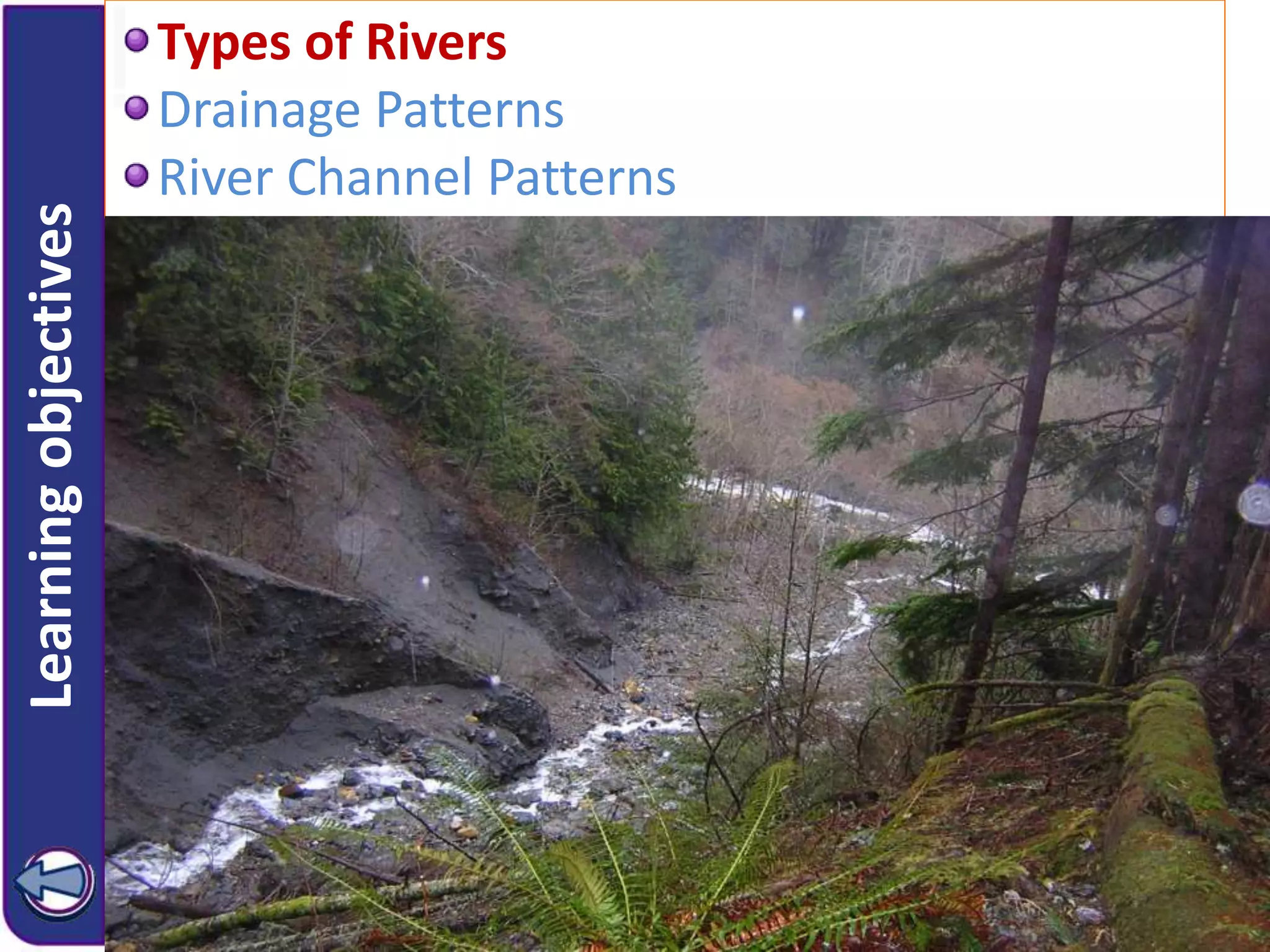
Learningobjectives Types of Rivers
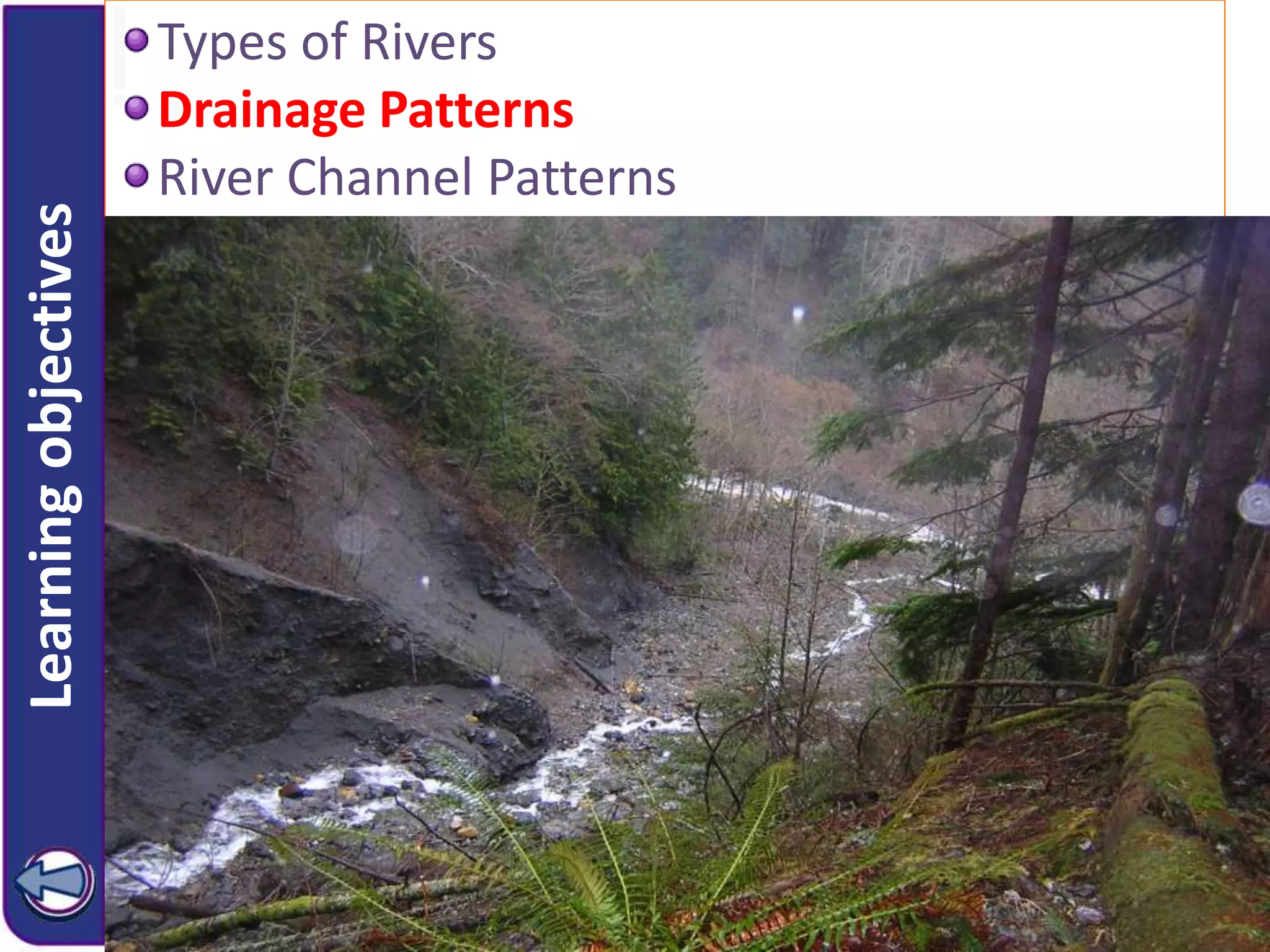
Drainage Patterns
River Channel Patterns
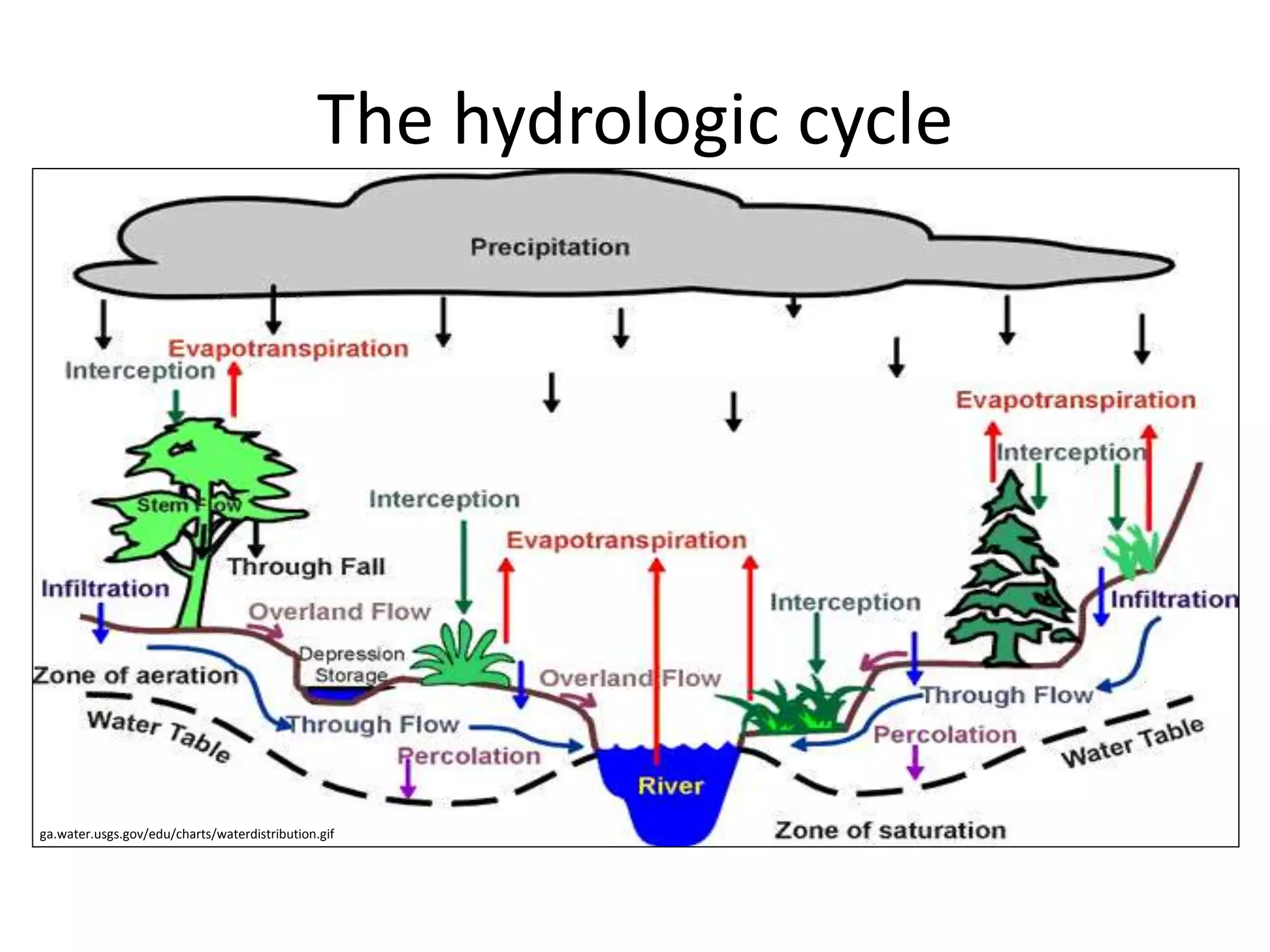
The hydrologic cycle
ga.water.usgs.gov/edu/charts/waterdistribution.gif
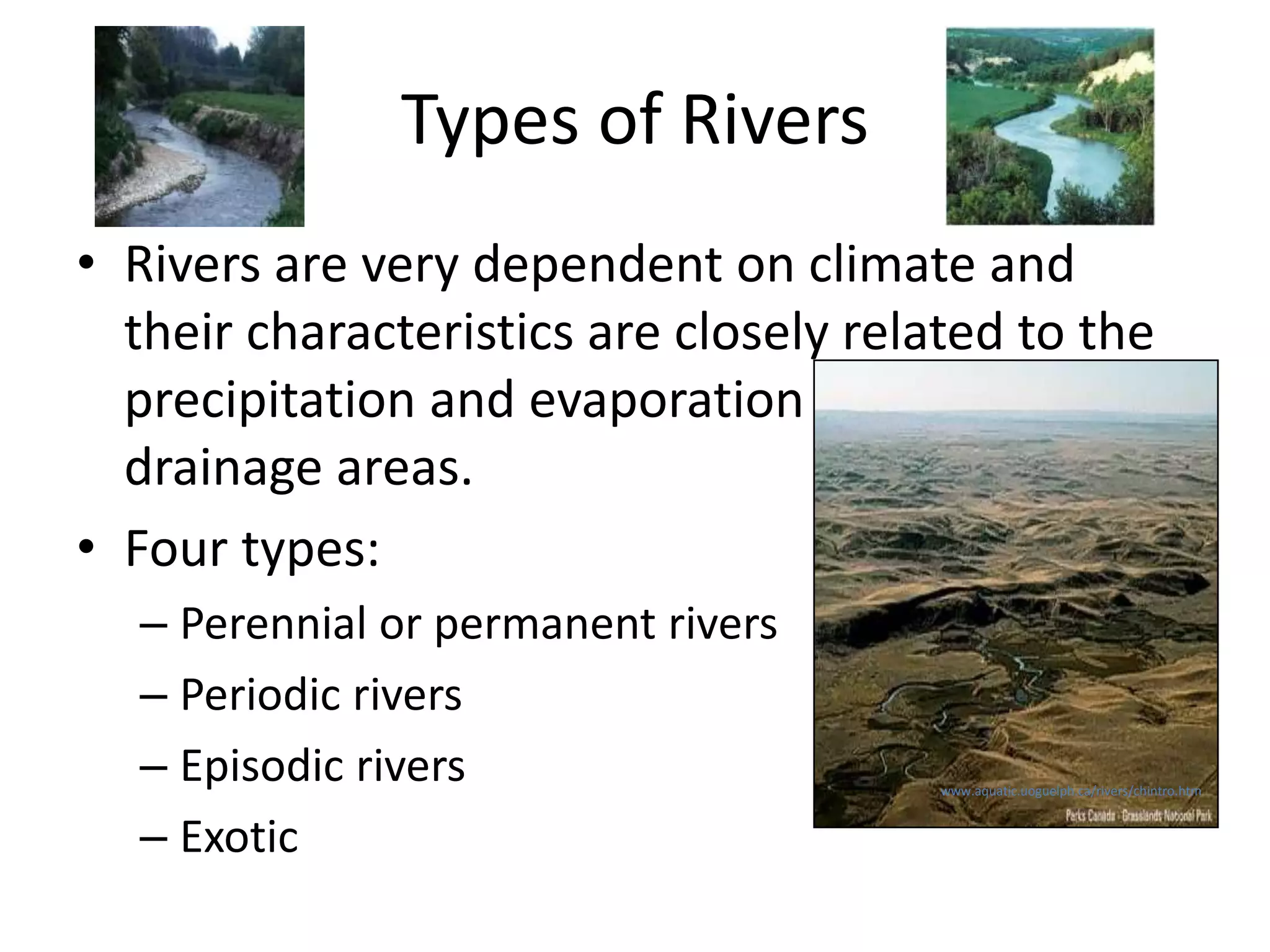
Types of Rivers
• Rivers are very dependent on climate and
their characteristics are closely related to the
precipitation and evaporation regimes in their
drainage areas.
• Four types:
– Perennial or permanent rivers
– Periodic rivers
– Episodic rivers
– Exotic
www.aquatic.uoguelph.ca/rivers/chintro.htm
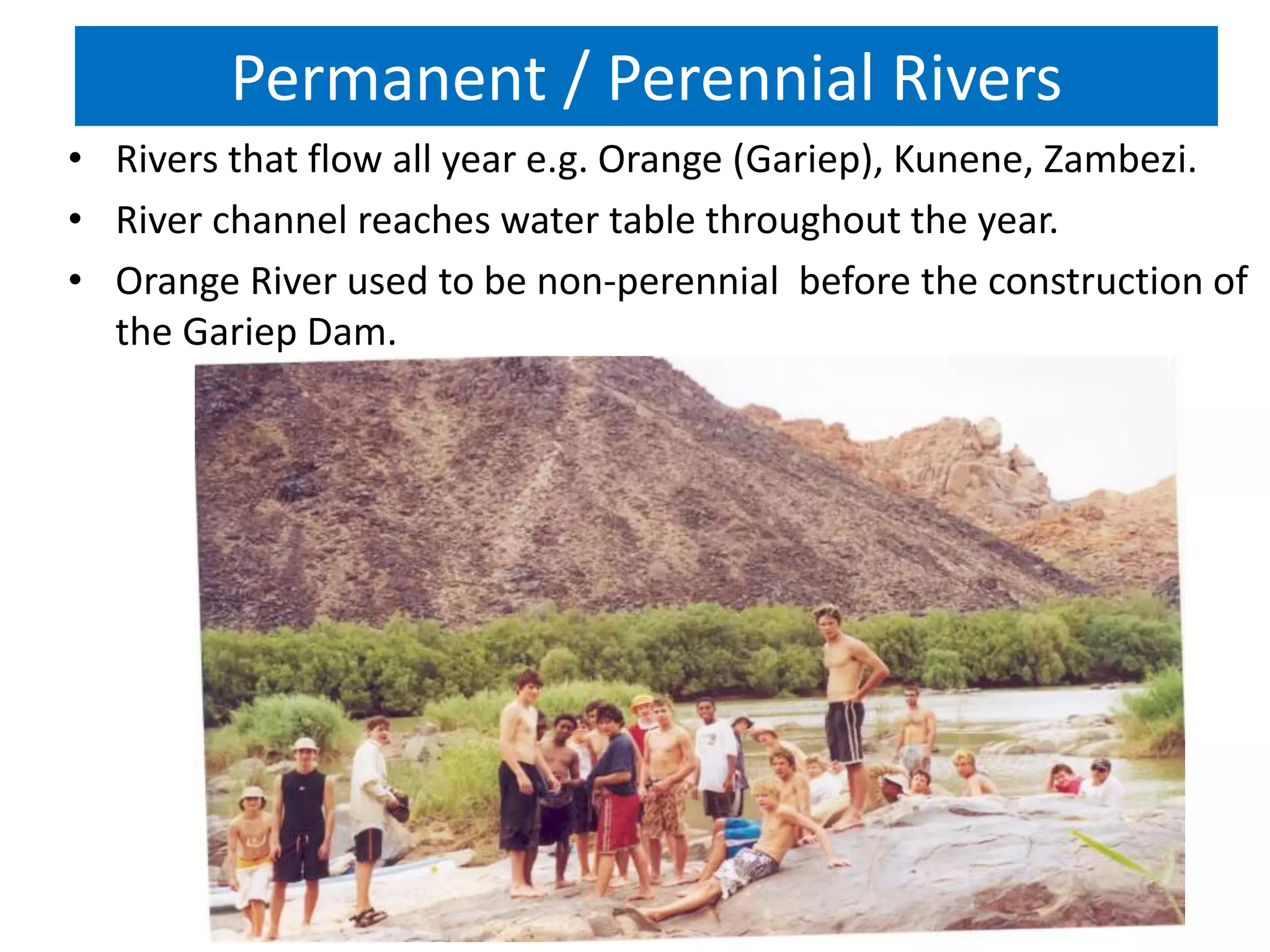
Permanent / Perennial Rivers
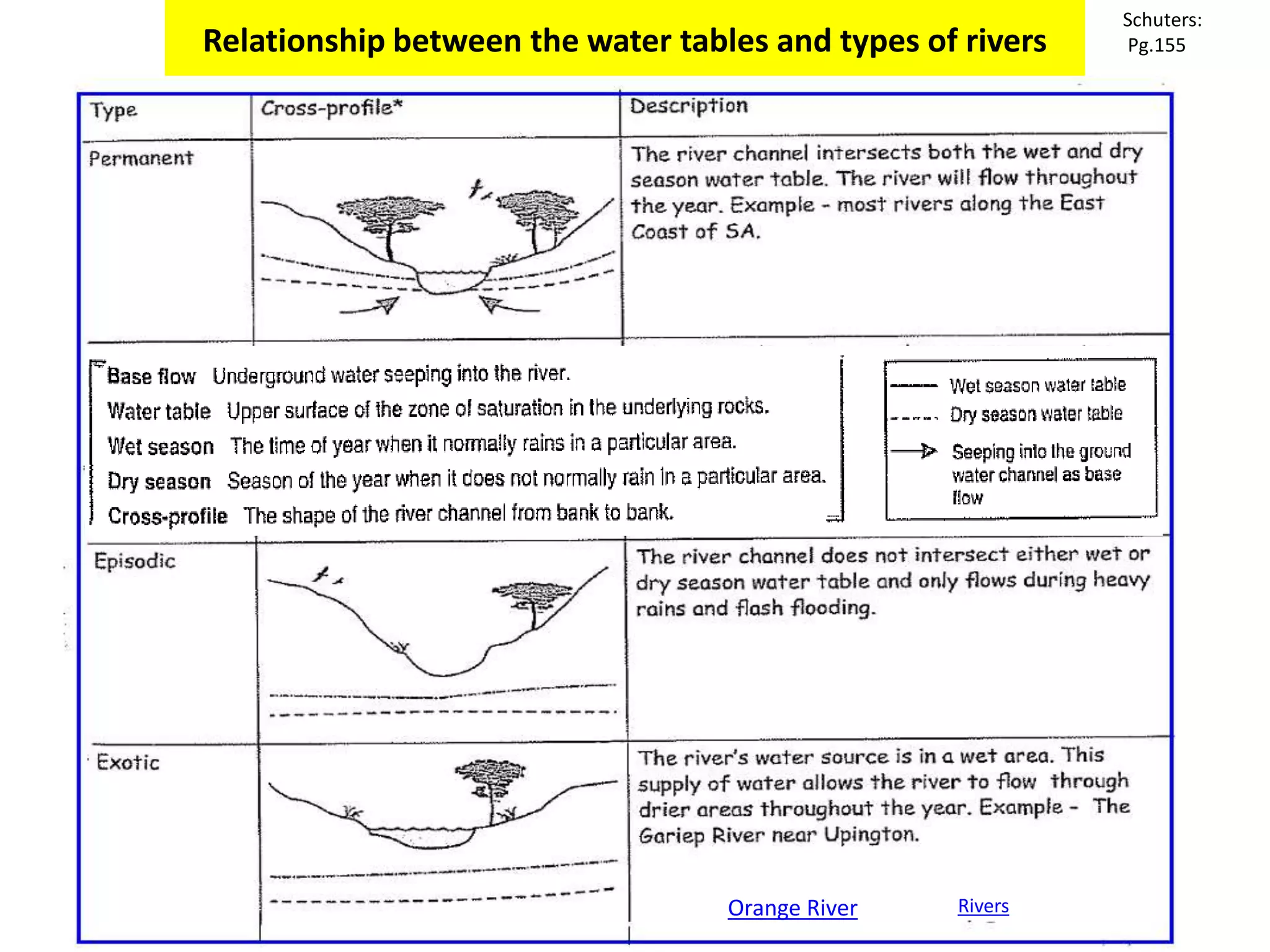
• Rivers that flow all year e.g. Orange (Gariep), Kunene, Zambezi.
• River channel reaches water table throughout the year.
• Orange River used to be non-perennial before the construction of
the Gariep Dam.
Periodic / Non-Perennial Rivers
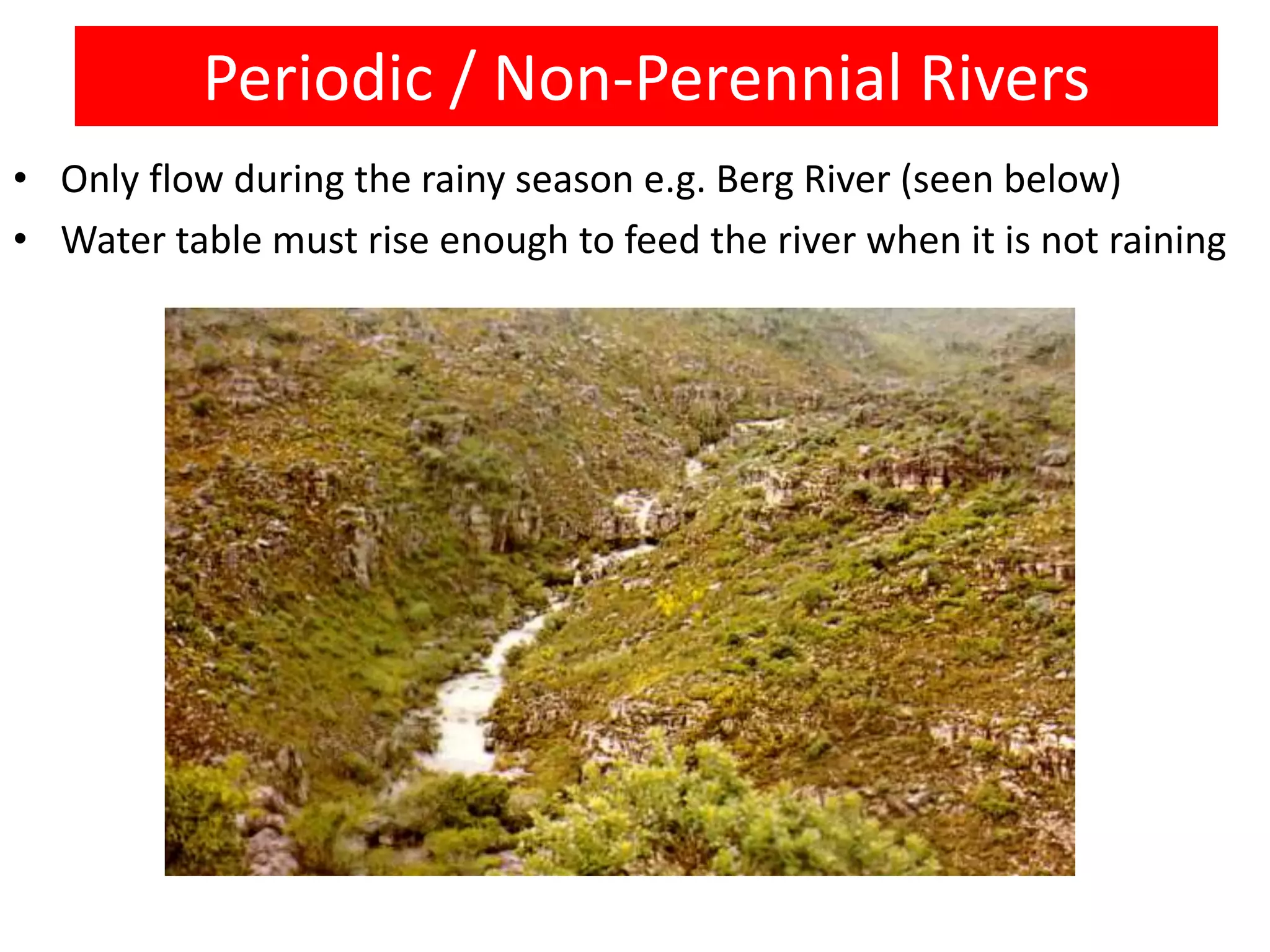
• Only flow during the rainy season e.g. Berg River (seen below)
• Water table must rise enough to feed the river when it is not raining
Episodic Rivers
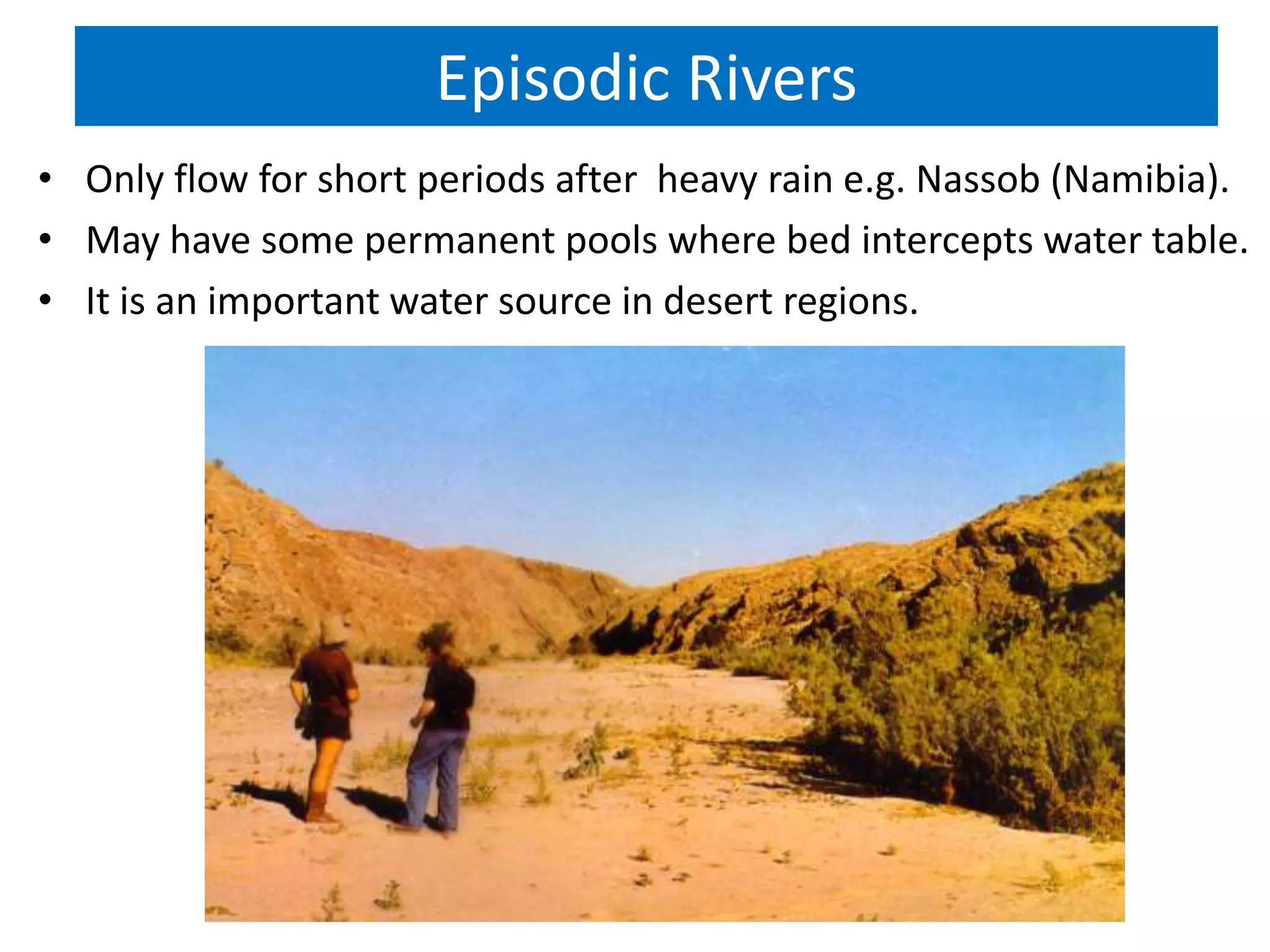
• Only flow for short periods after heavy rain e.g. Nassob (Namibia).
• May have some permanent pools where bed intercepts water table.
• It is an important water source in desert regions.
Exotic Rivers
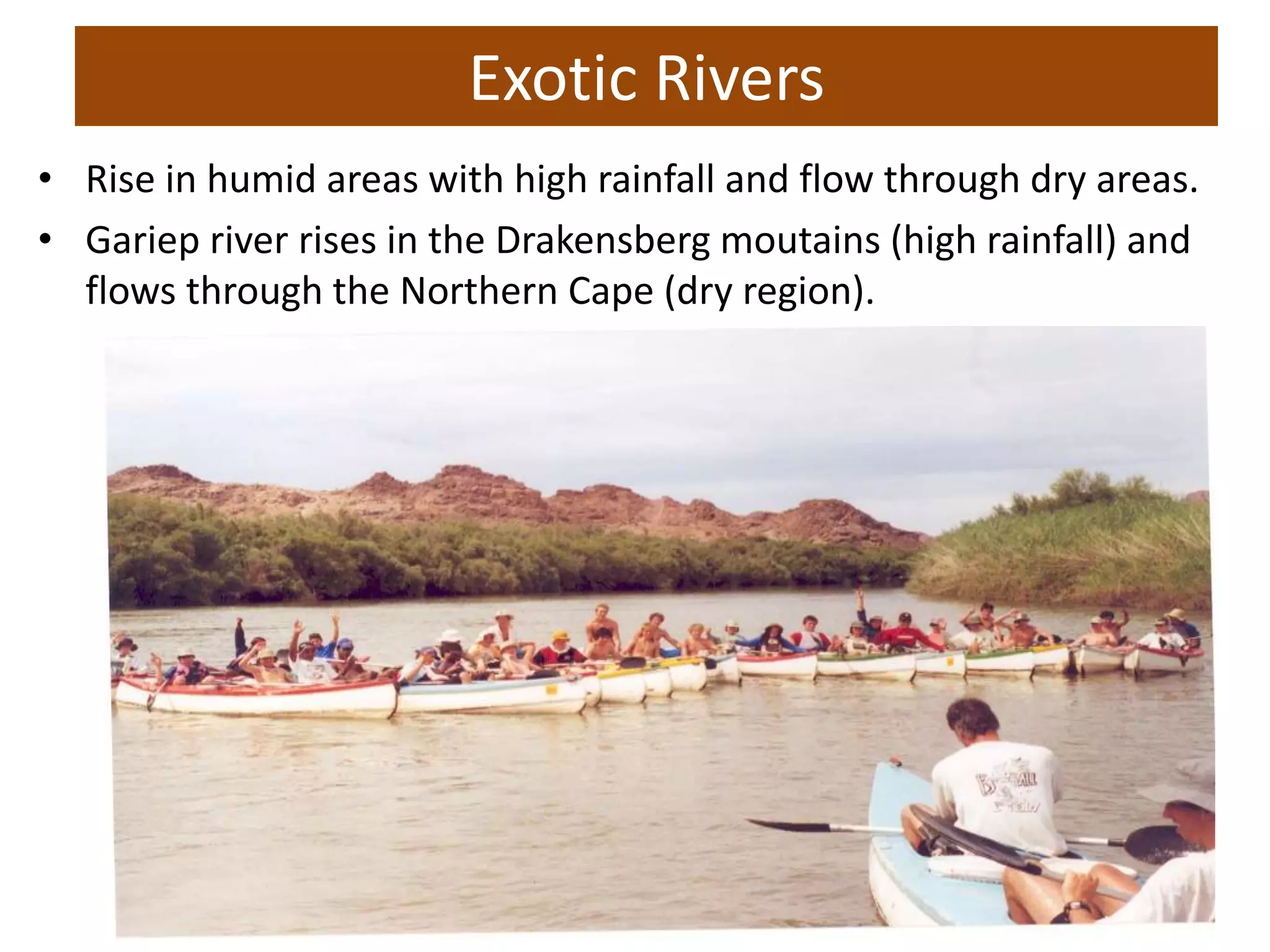
• Rise in humid areas with high rainfall and flow through dry areas.
• Gariep river rises in the Drakensberg moutains (high rainfall) and
flows through the Northern Cape (dry region).
Relationship between the water tables and types of rivers
Schuters:
Pg.155
Orange River Rivers
Learningobjectives Types of Rivers
Drainage Patterns
River Channel Patterns
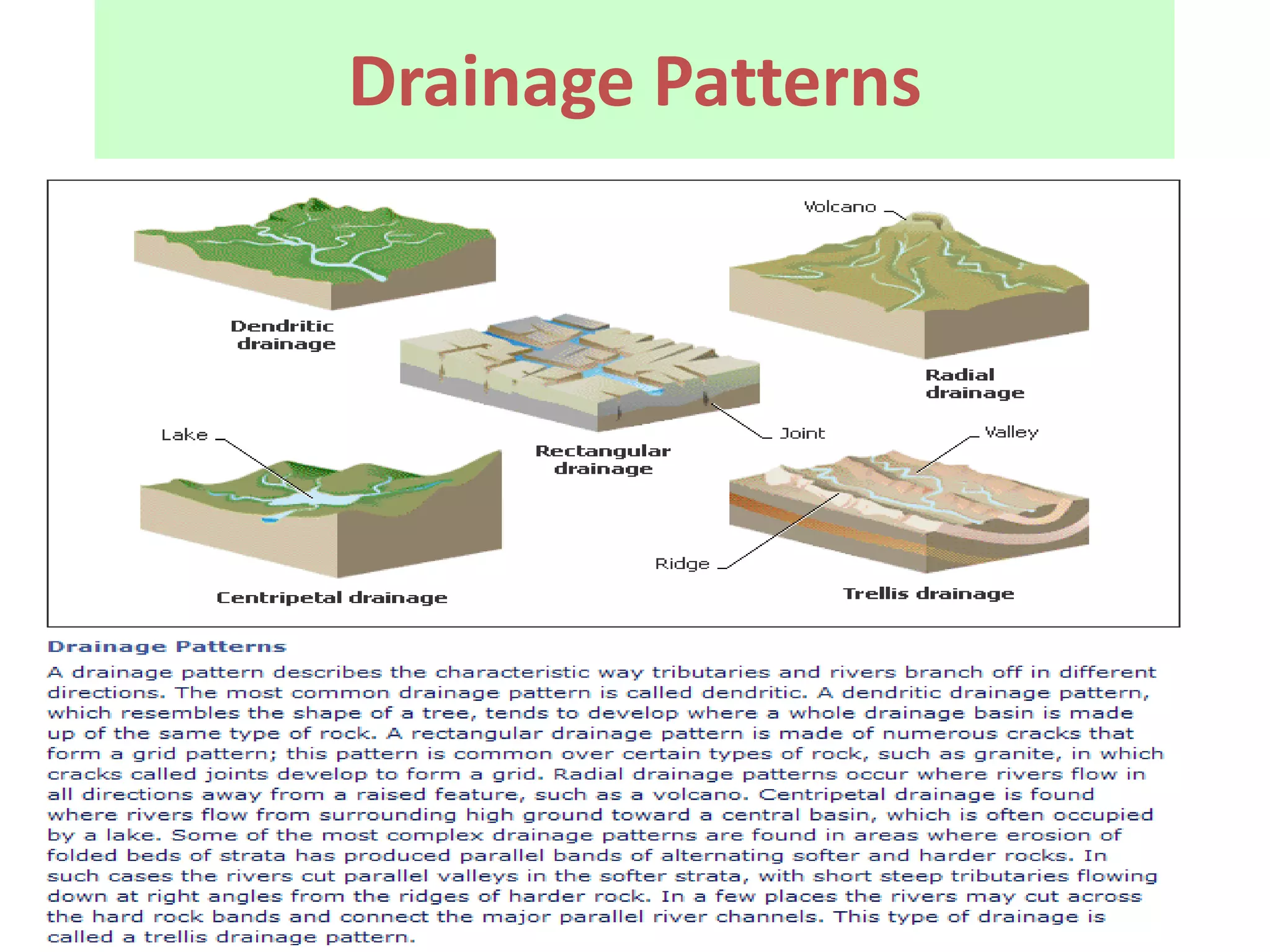
Drainage Patterns
Schuters Pg.150 and 151
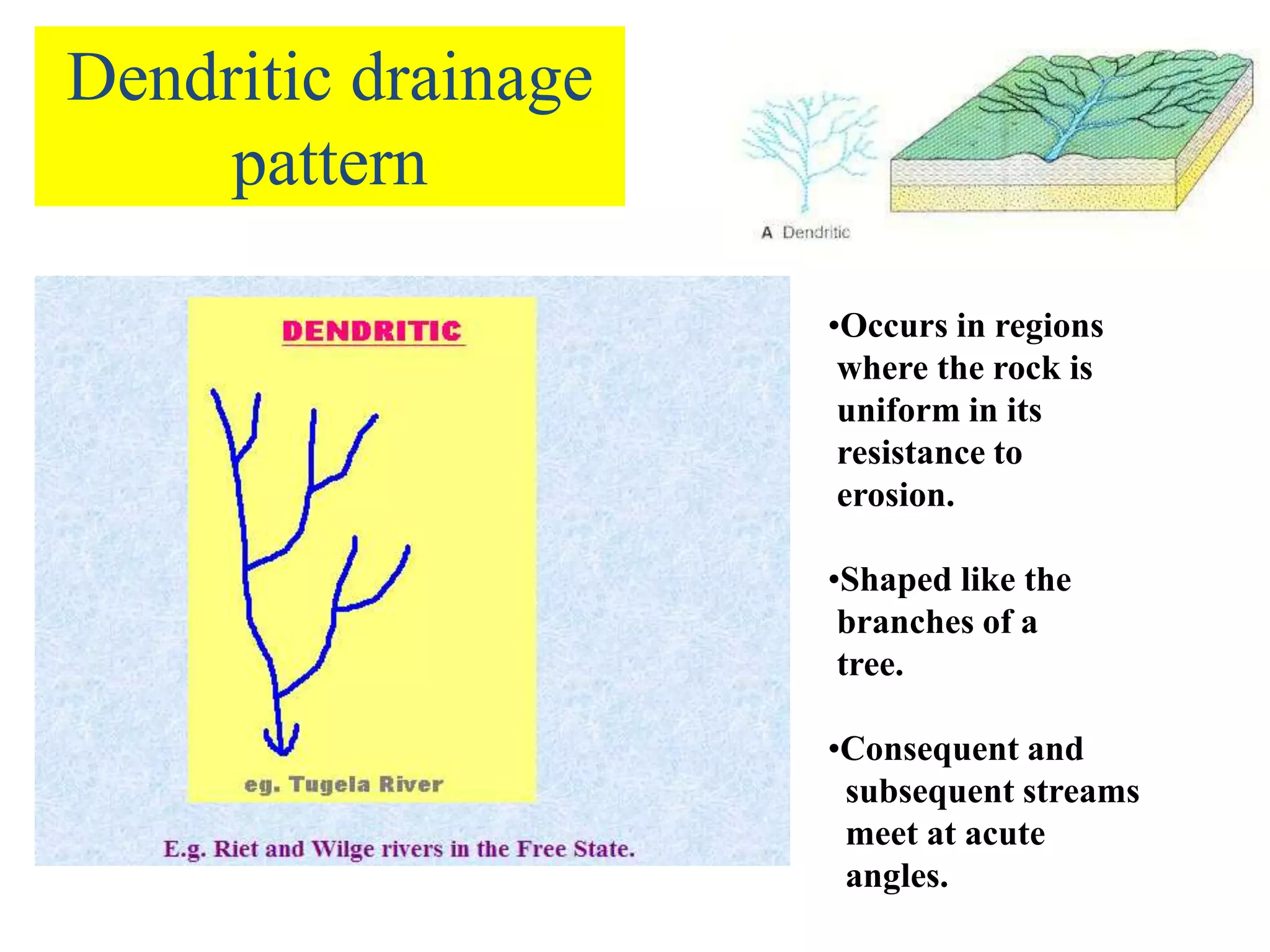
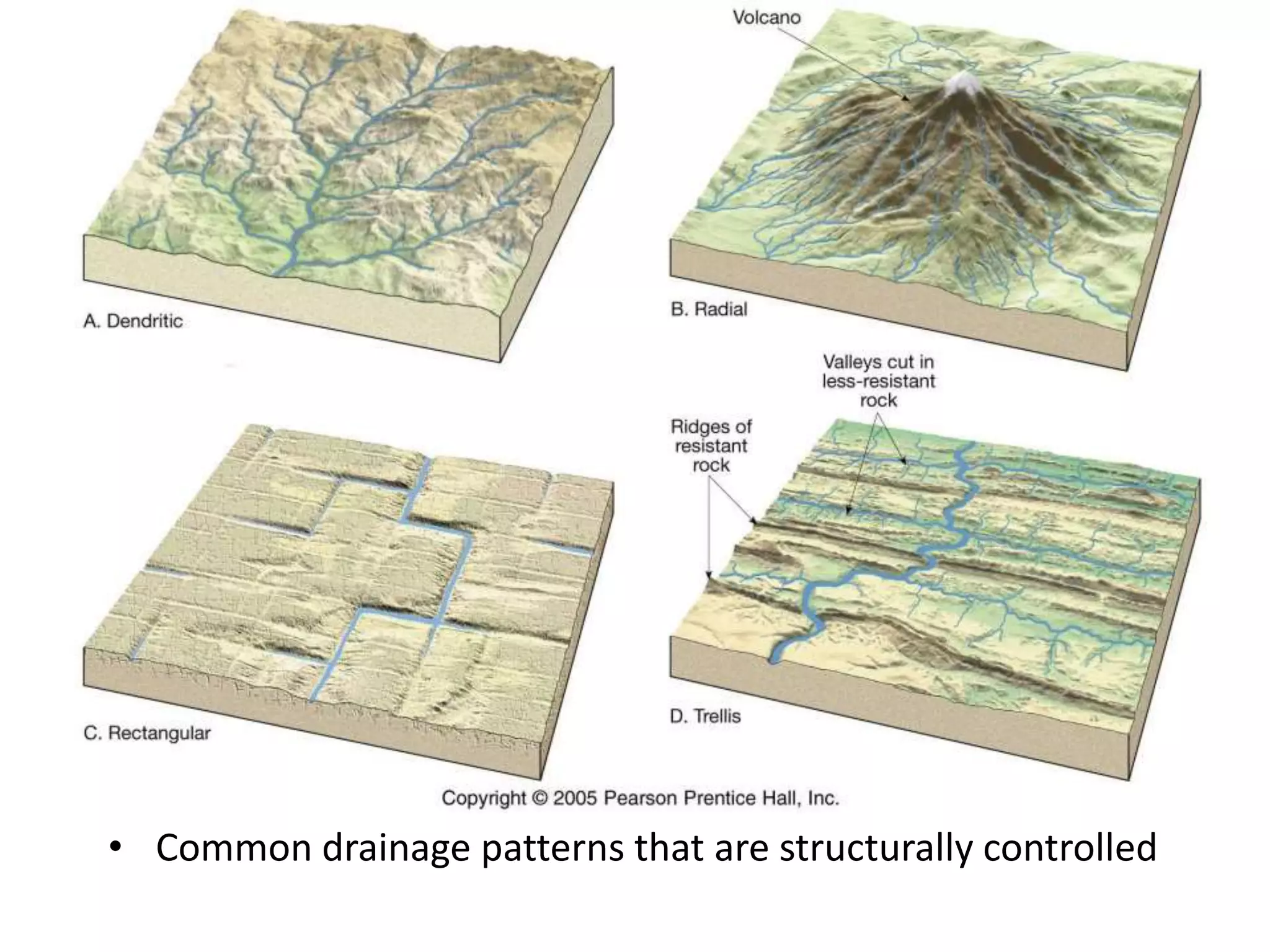
Dendritic drainage
pattern
•Occurs in regions
where the rock is
uniform in its
resistance to
erosion.
•Shaped like the
branches of a
tree.
•Consequent and
subsequent streams
meet at acute
angles.
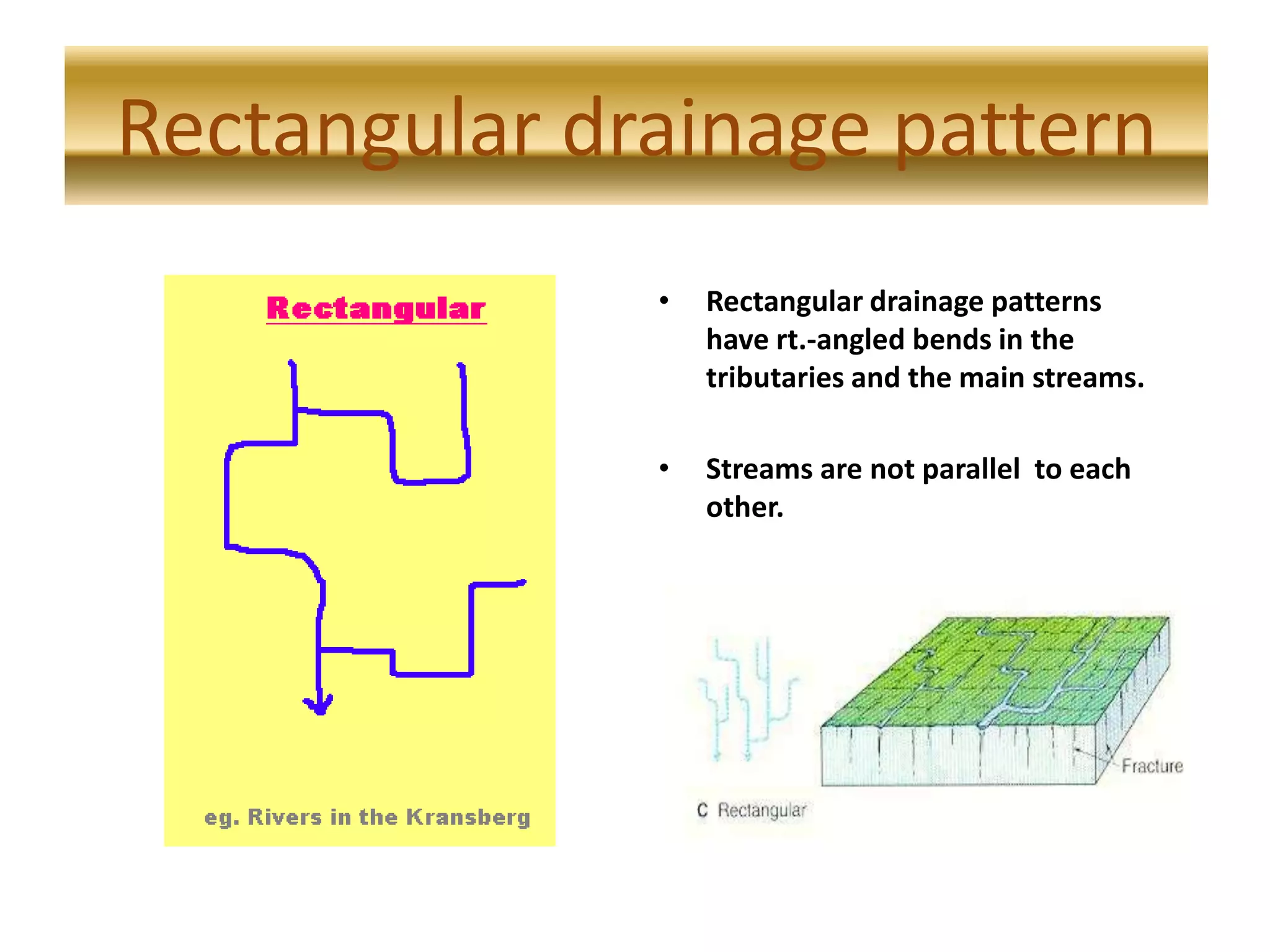
Rectangular drainage pattern
• Rectangular drainage patterns
have rt.-angled bends in the
tributaries and the main streams.
• Streams are not parallel to each
other.
Rectangular drainage pattern
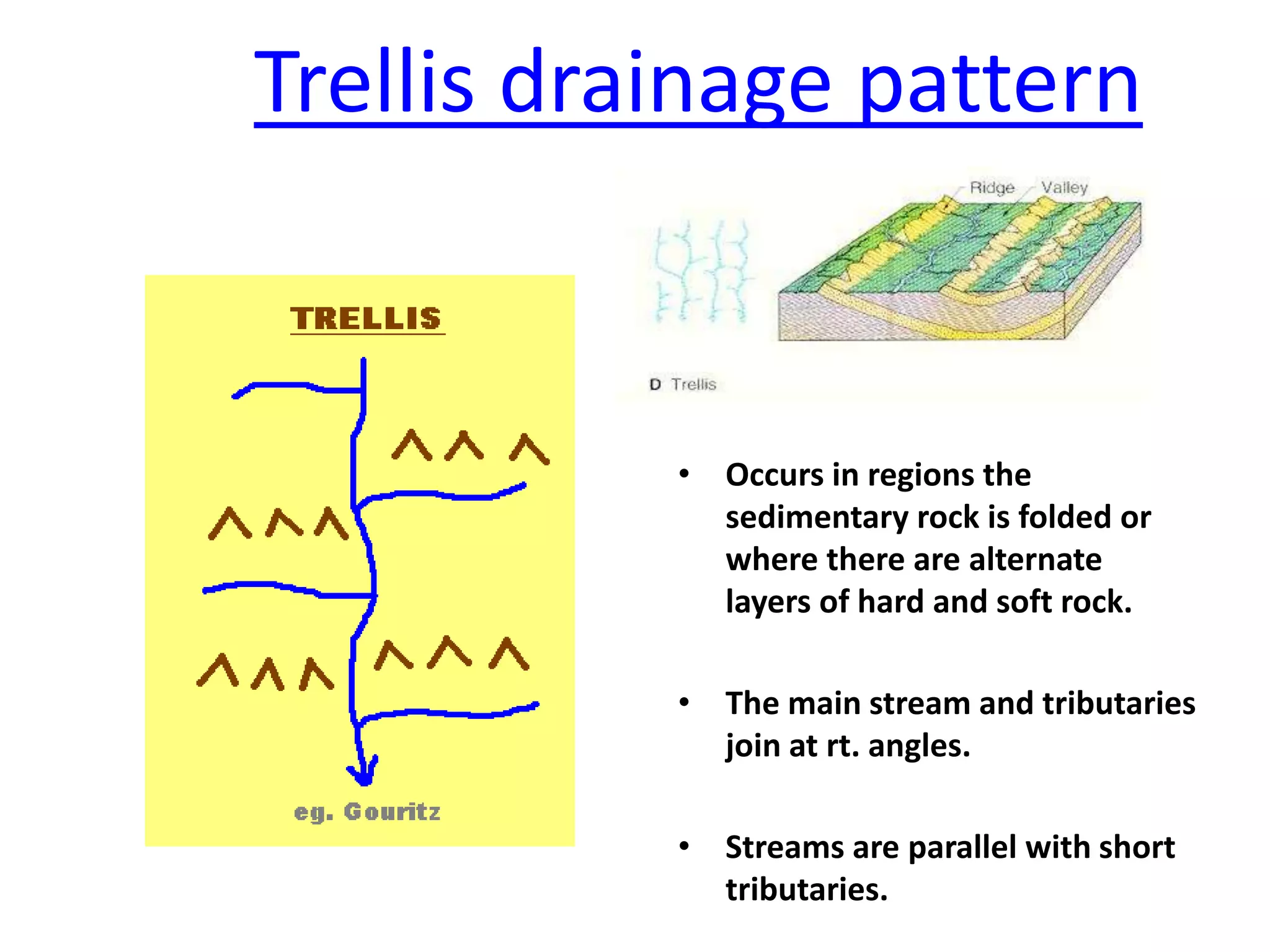
Trellis drainage pattern
• Occurs in regions the
sedimentary rock is folded or
where there are alternate
layers of hard and soft rock.
• The main stream and tributaries
join at rt. angles.
• Streams are parallel with short
tributaries.
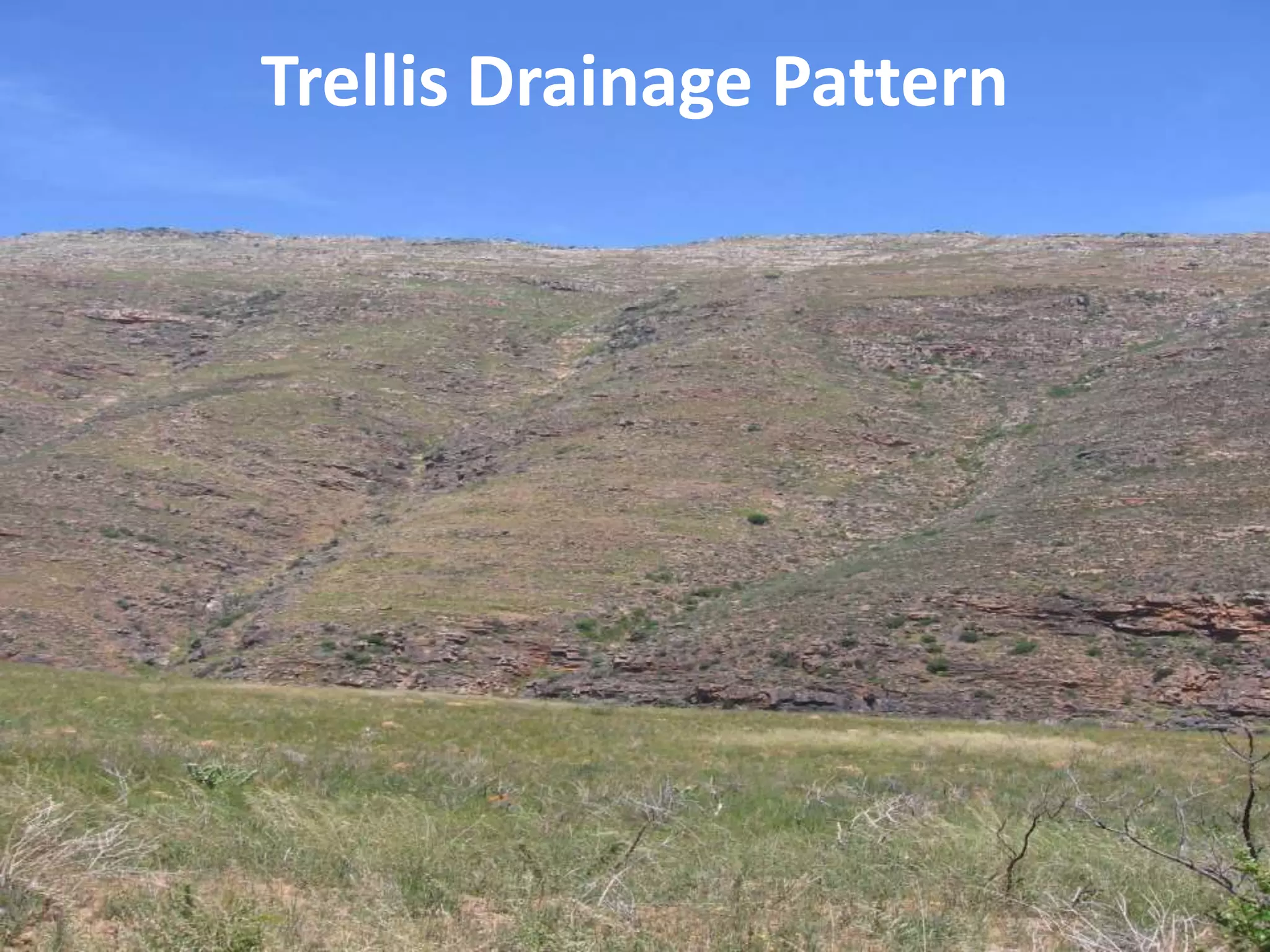
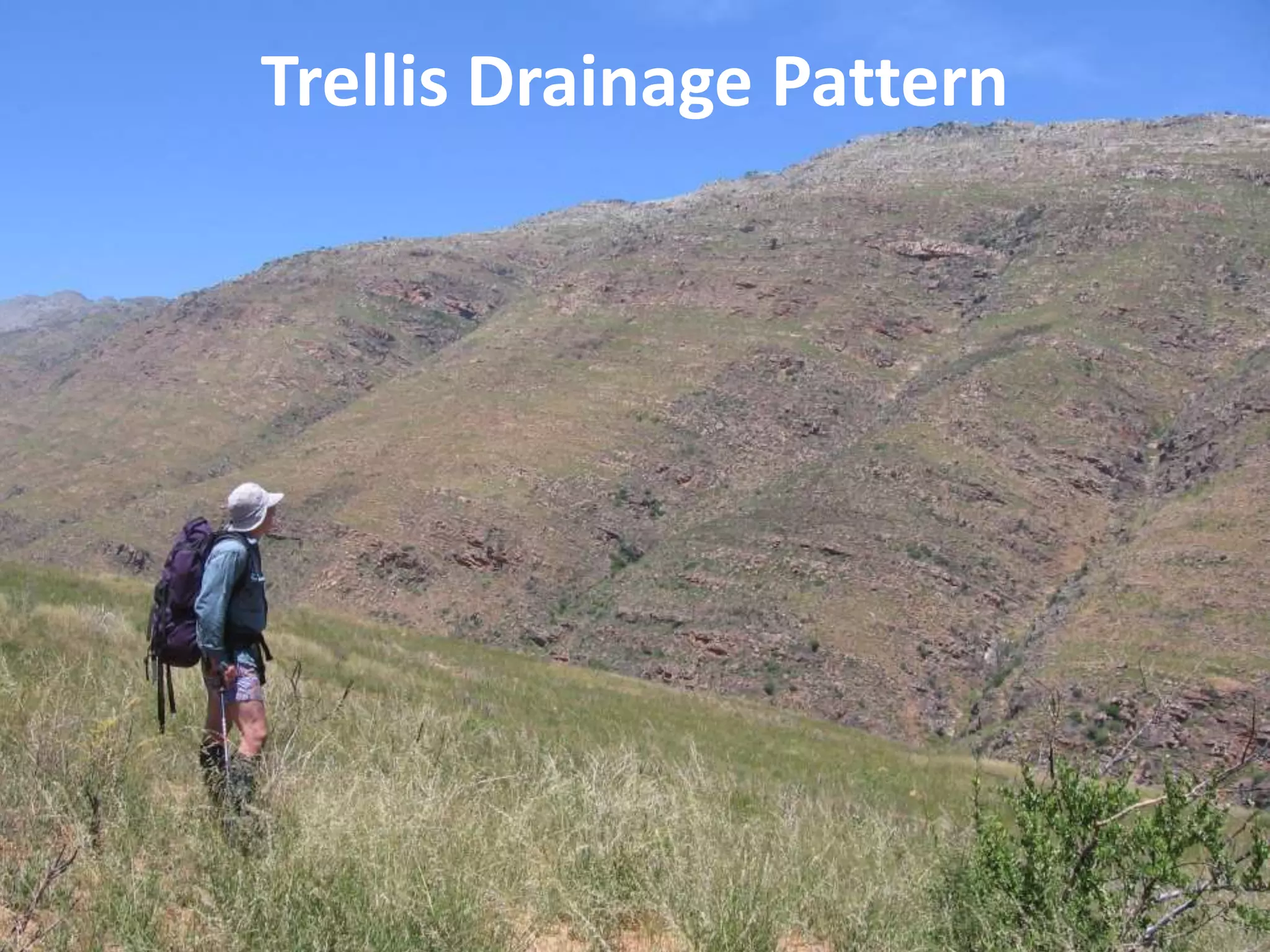
Trellis Drainage Pattern
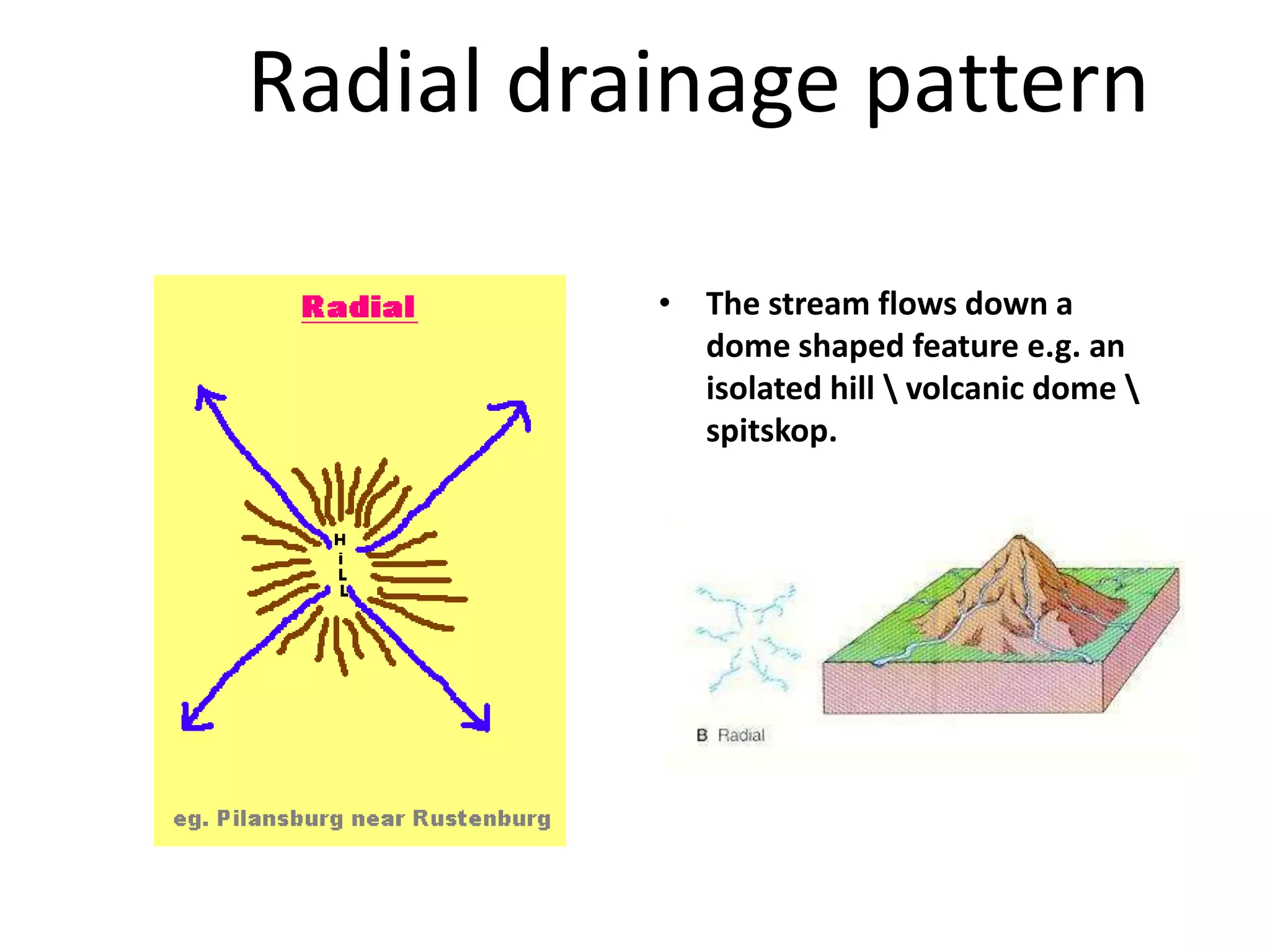
Radial drainage pattern
• The stream flows down a
dome shaped feature e.g. an
isolated hill  volcanic dome 
spitskop.
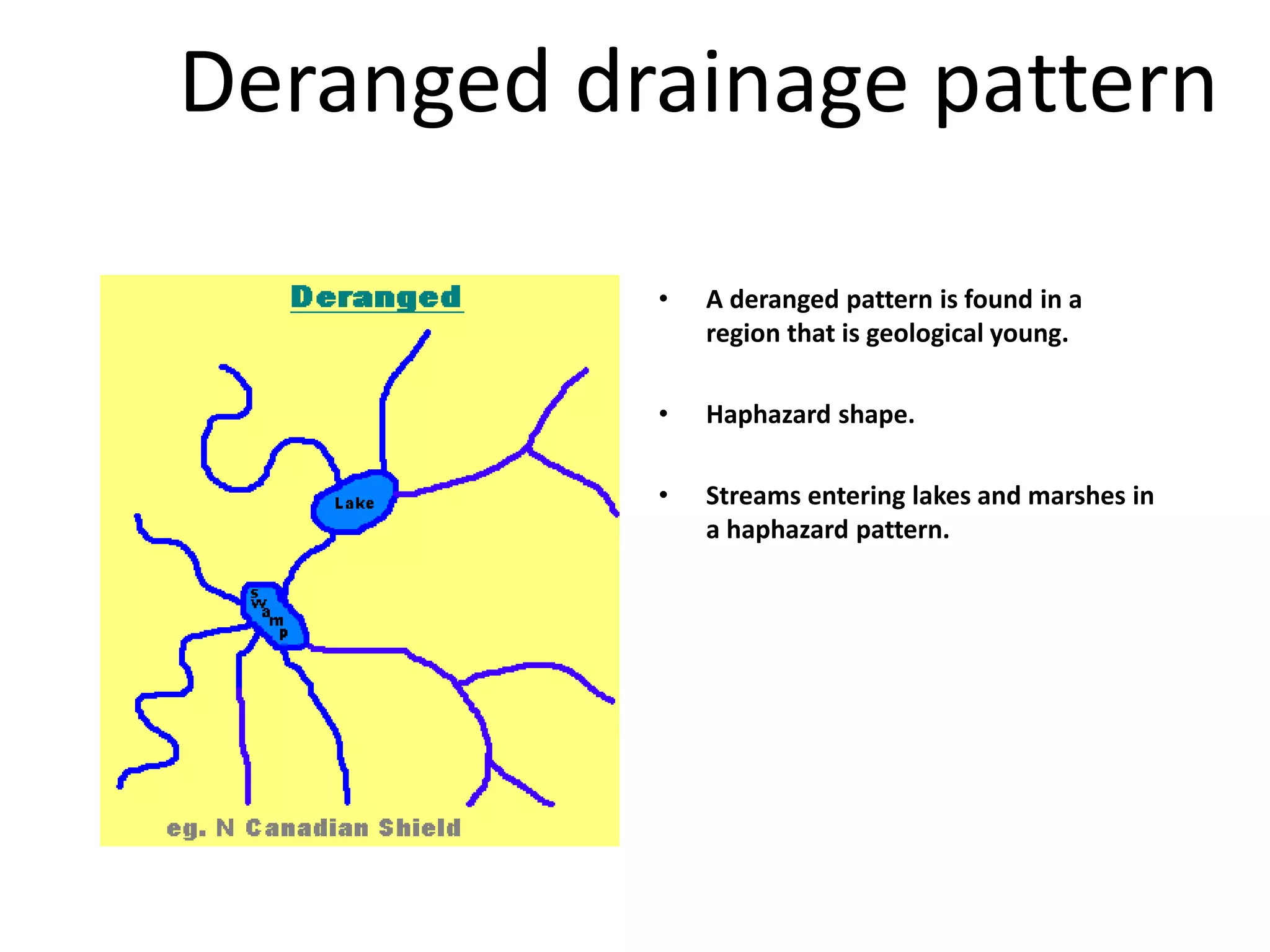
Deranged drainage pattern
• A deranged pattern is found in a
region that is geological young.
• Haphazard shape.
• Streams entering lakes and marshes in
a haphazard pattern.
• Common drainage patterns that are structurally controlled
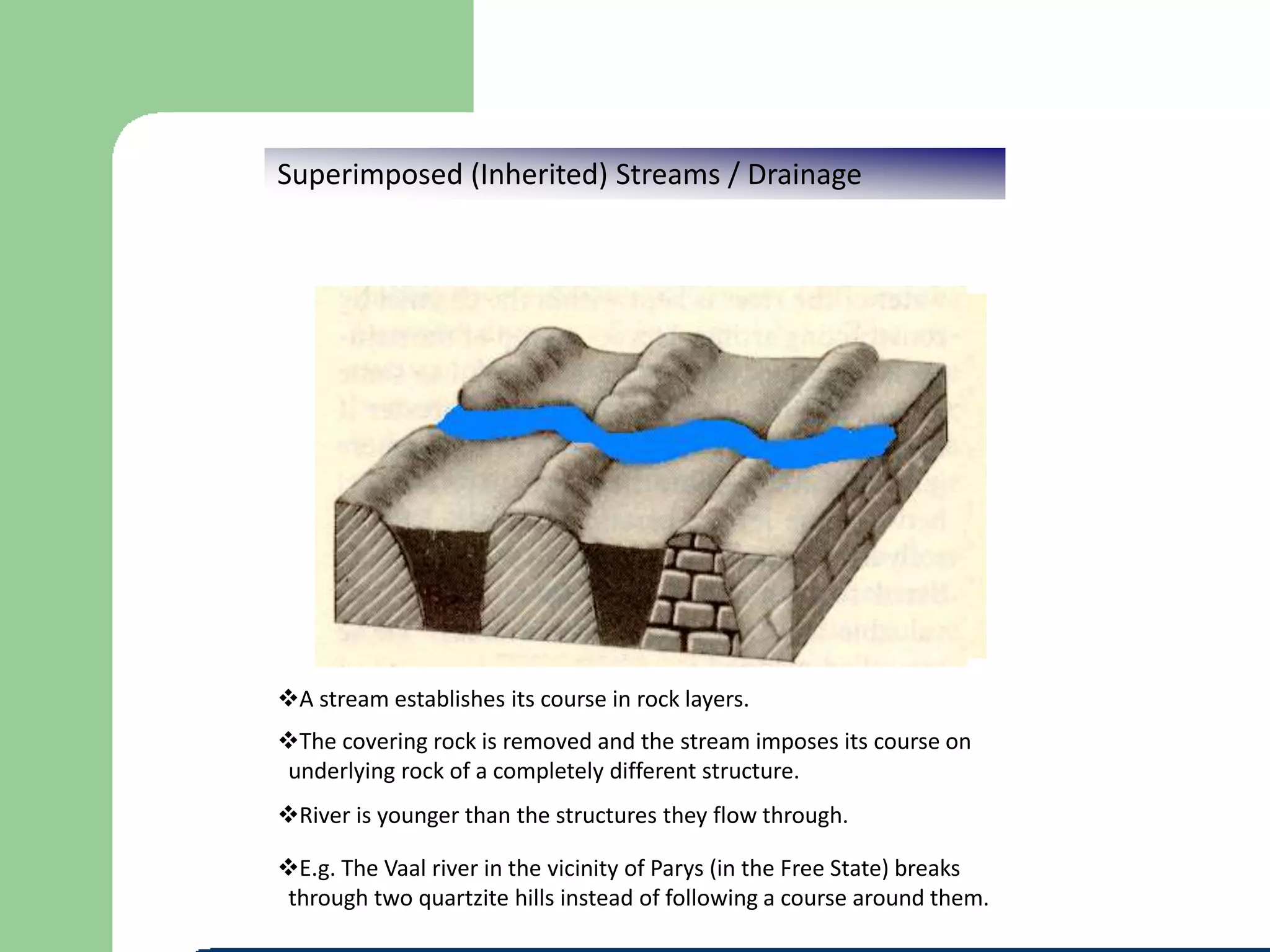
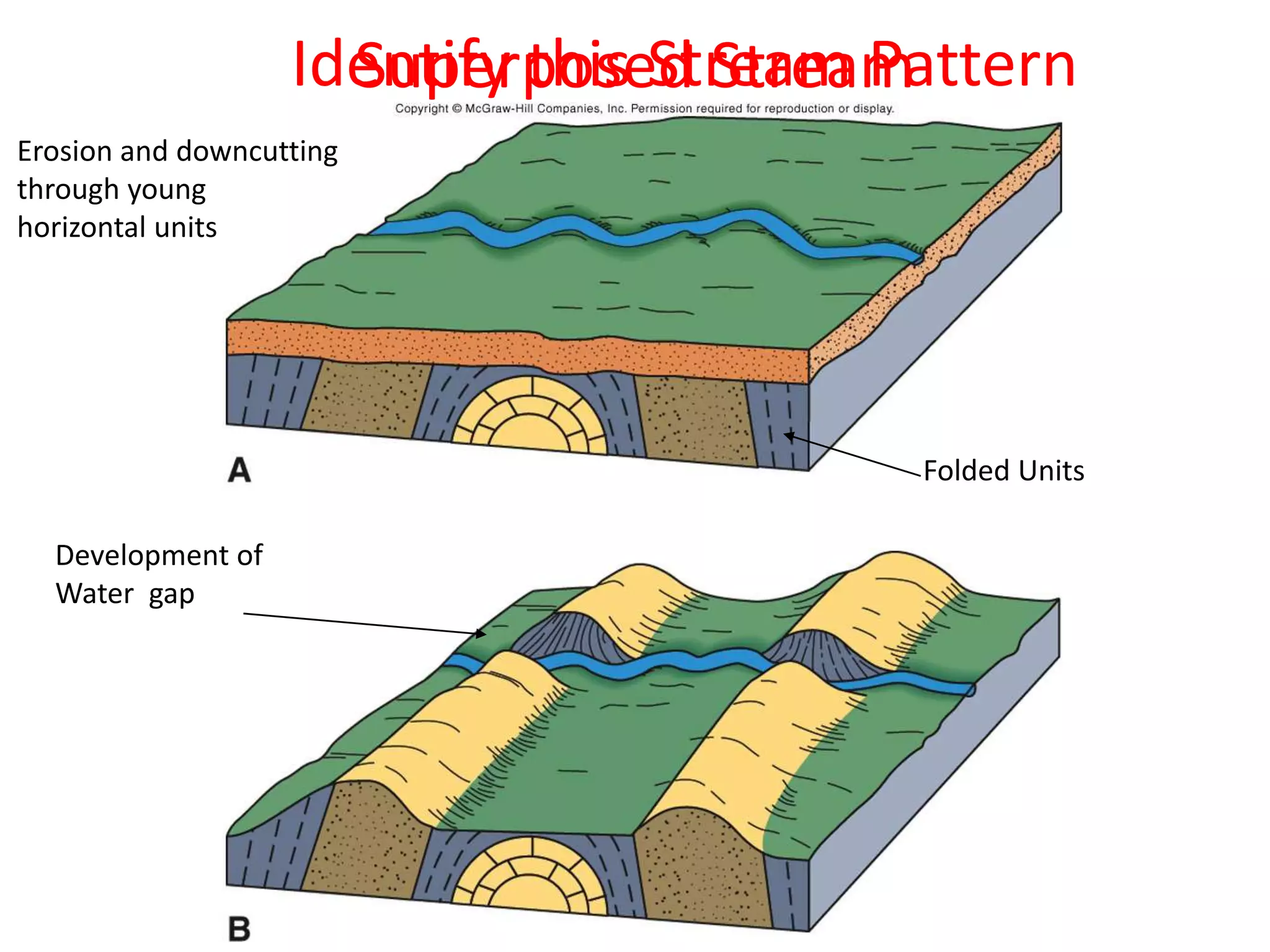
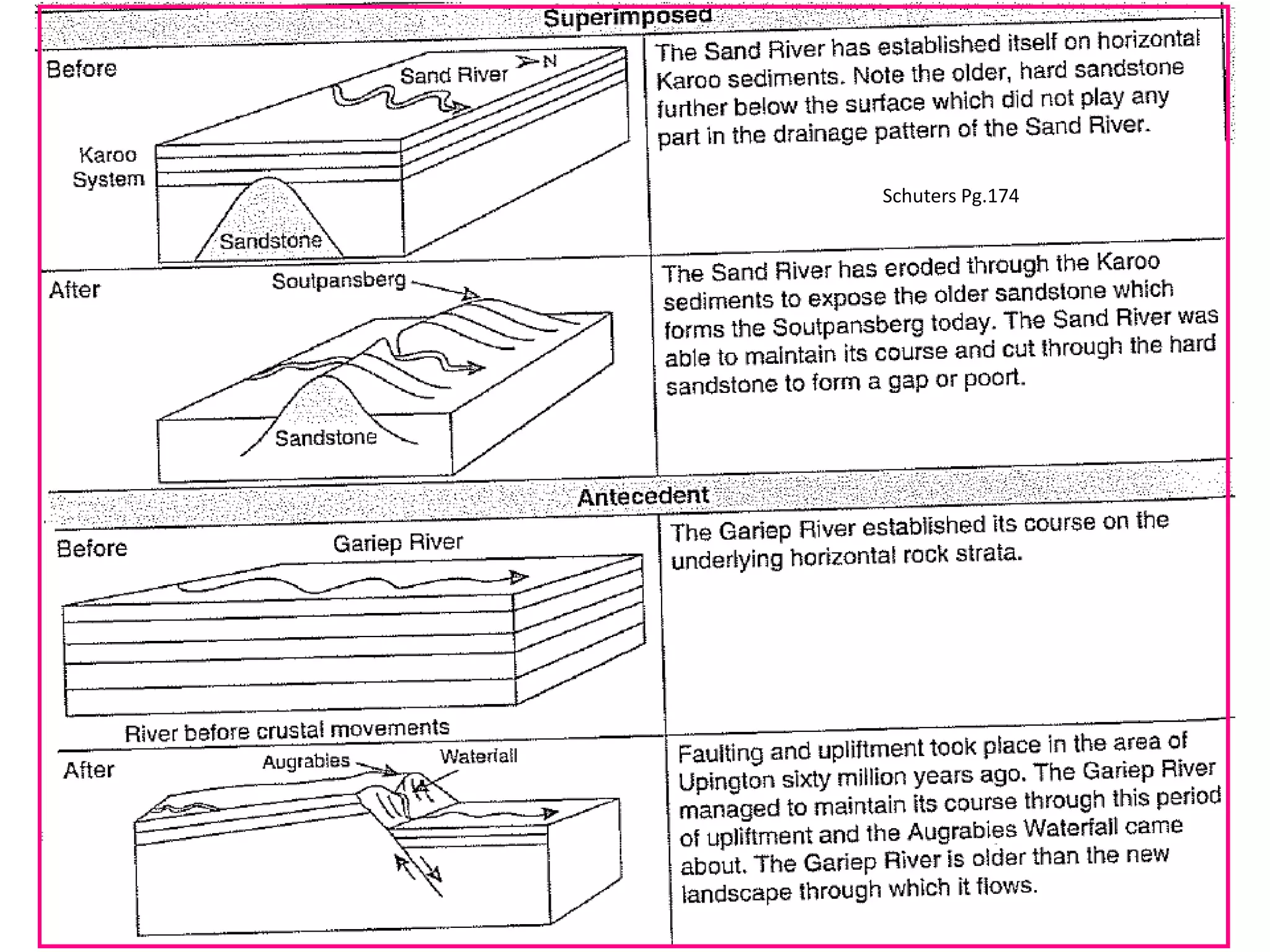
Superimposed (Inherited) Streams / Drainage
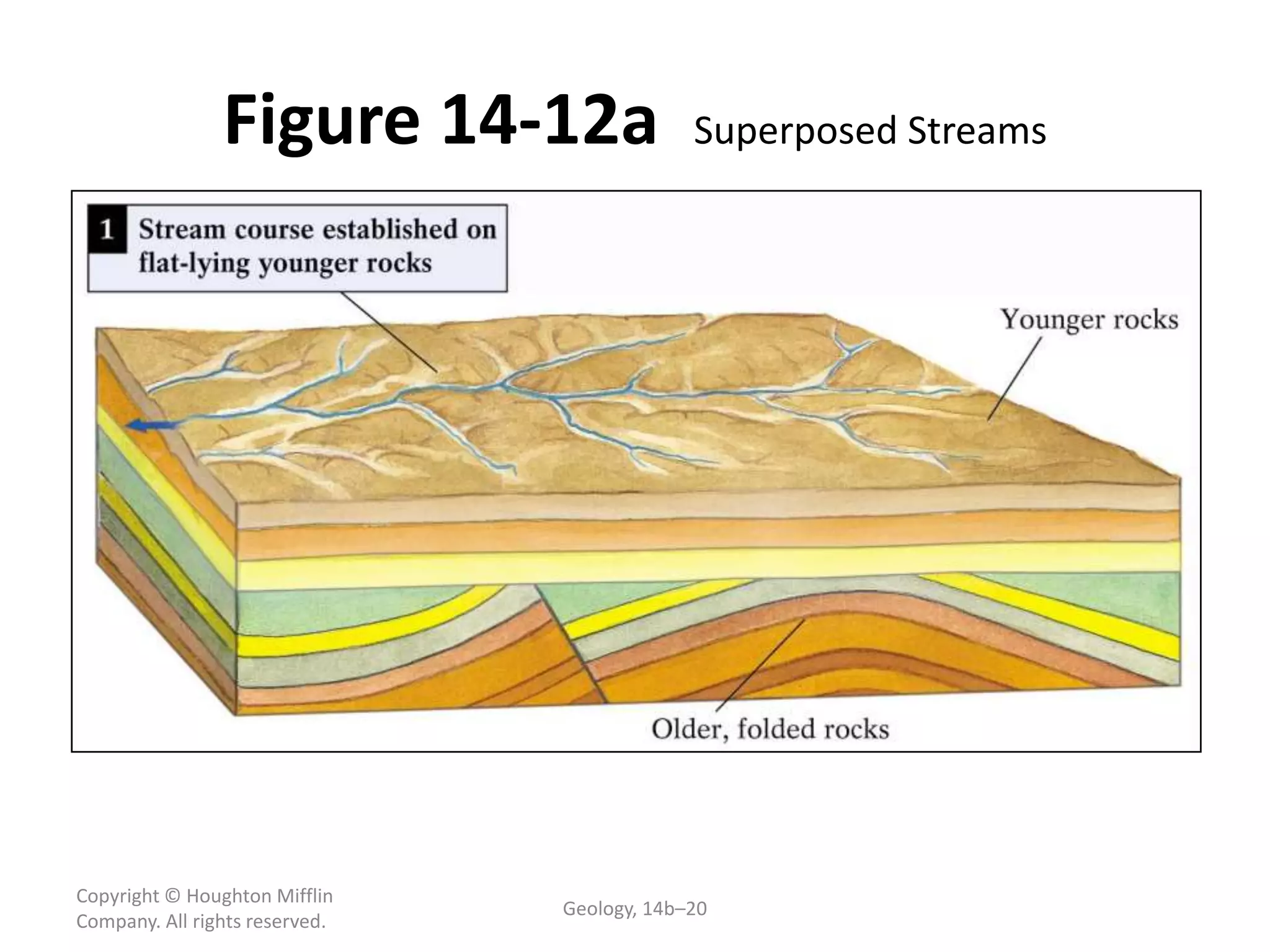
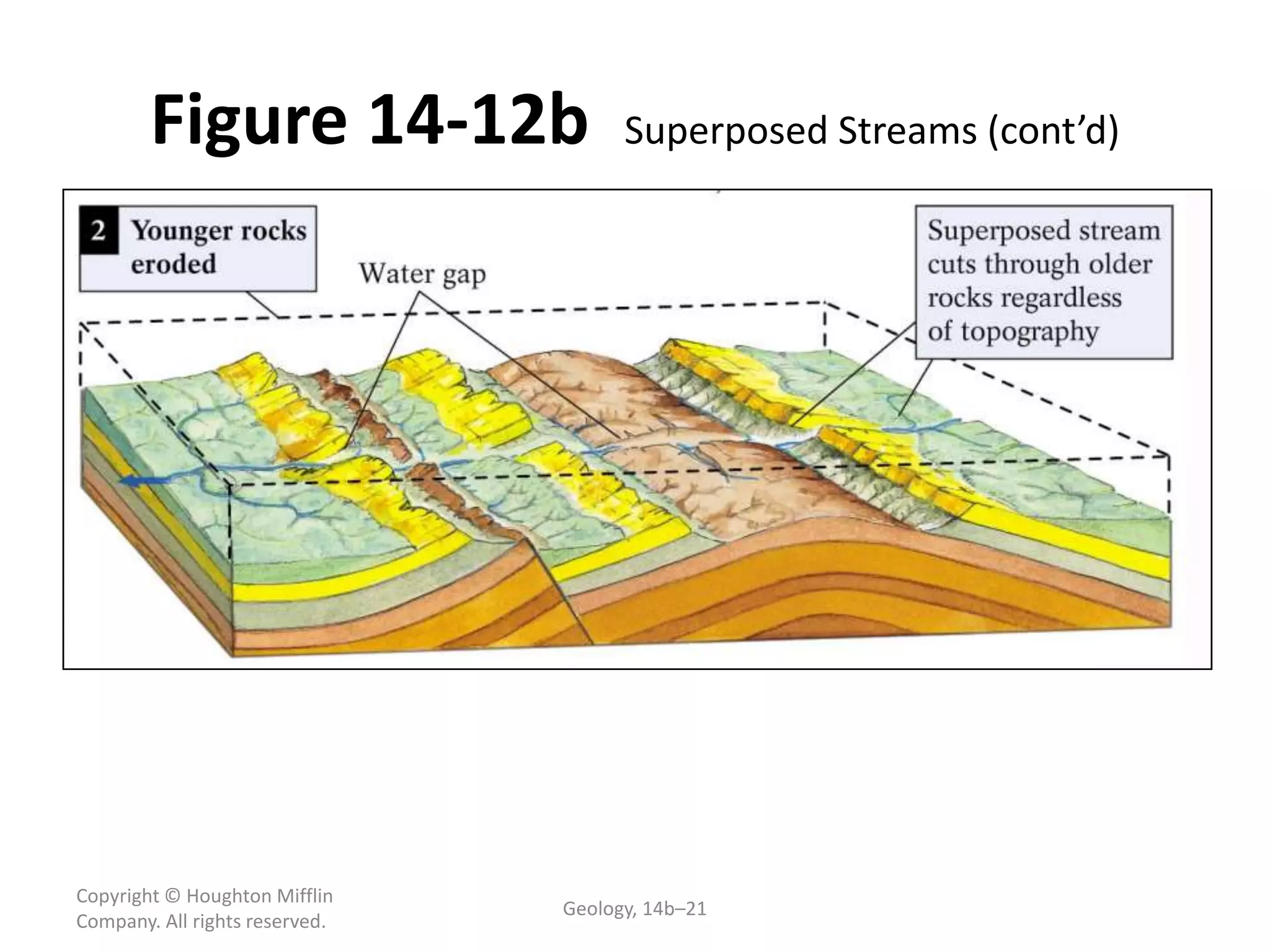
A stream establishes its course in rock layers.
The covering rock is removed and the stream imposes its course on
underlying rock of a completely different structure.
River is younger than the structures they flow through.
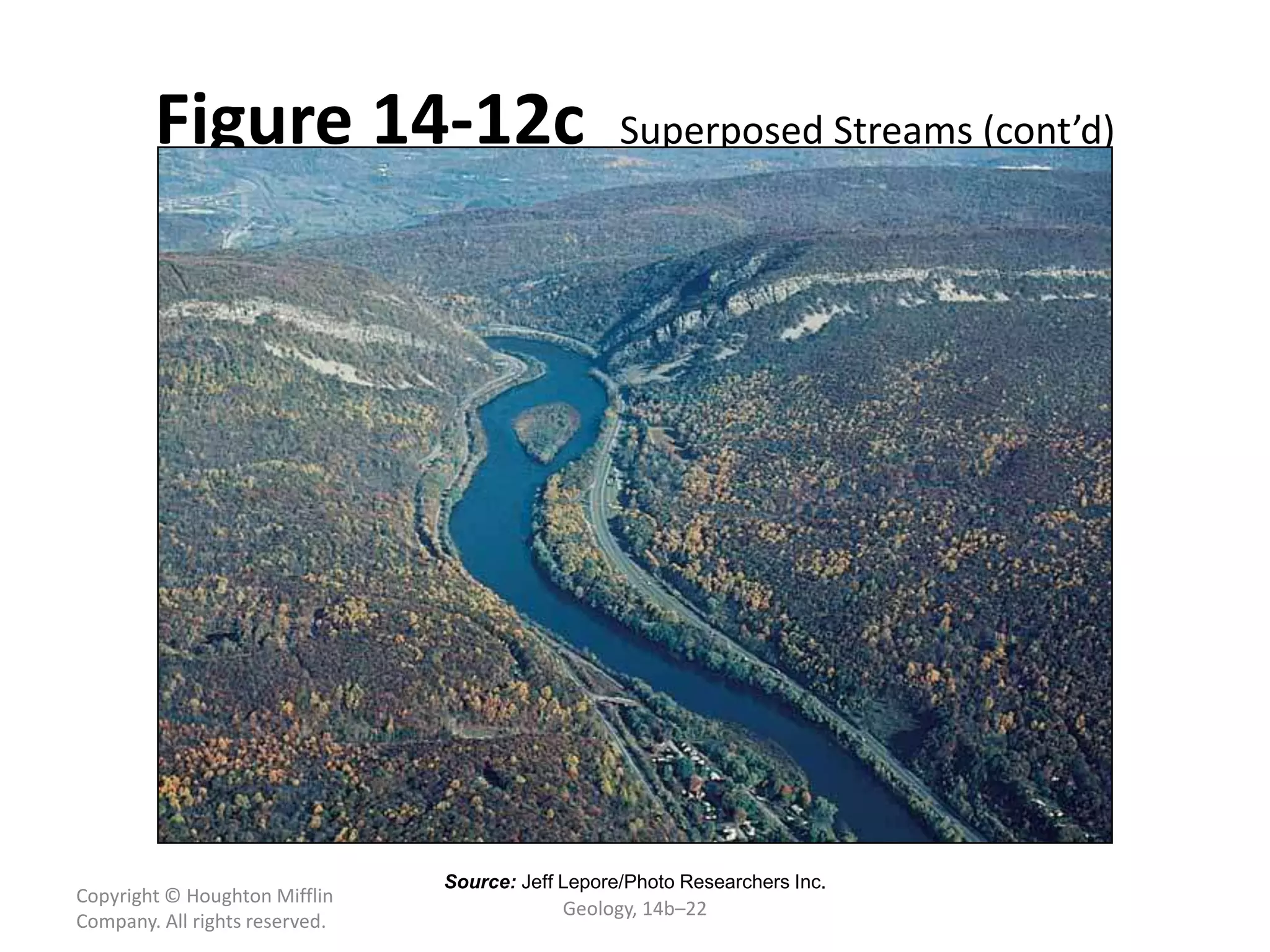
E.g. The Vaal river in the vicinity of Parys (in the Free State) breaks
through two quartzite hills instead of following a course around them.
Copyright © Houghton Mifflin
Company. All rights reserved.
Geology, 14b–20
Figure 14-12a Superposed Streams
Copyright © Houghton Mifflin
Company. All rights reserved.
Geology, 14b–21
Figure 14-12b Superposed Streams (cont’d)
Copyright © Houghton Mifflin
Company. All rights reserved.
Geology, 14b–22
Figure 14-12c Superposed Streams (cont’d)
Source: Jeff Lepore/Photo Researchers Inc.
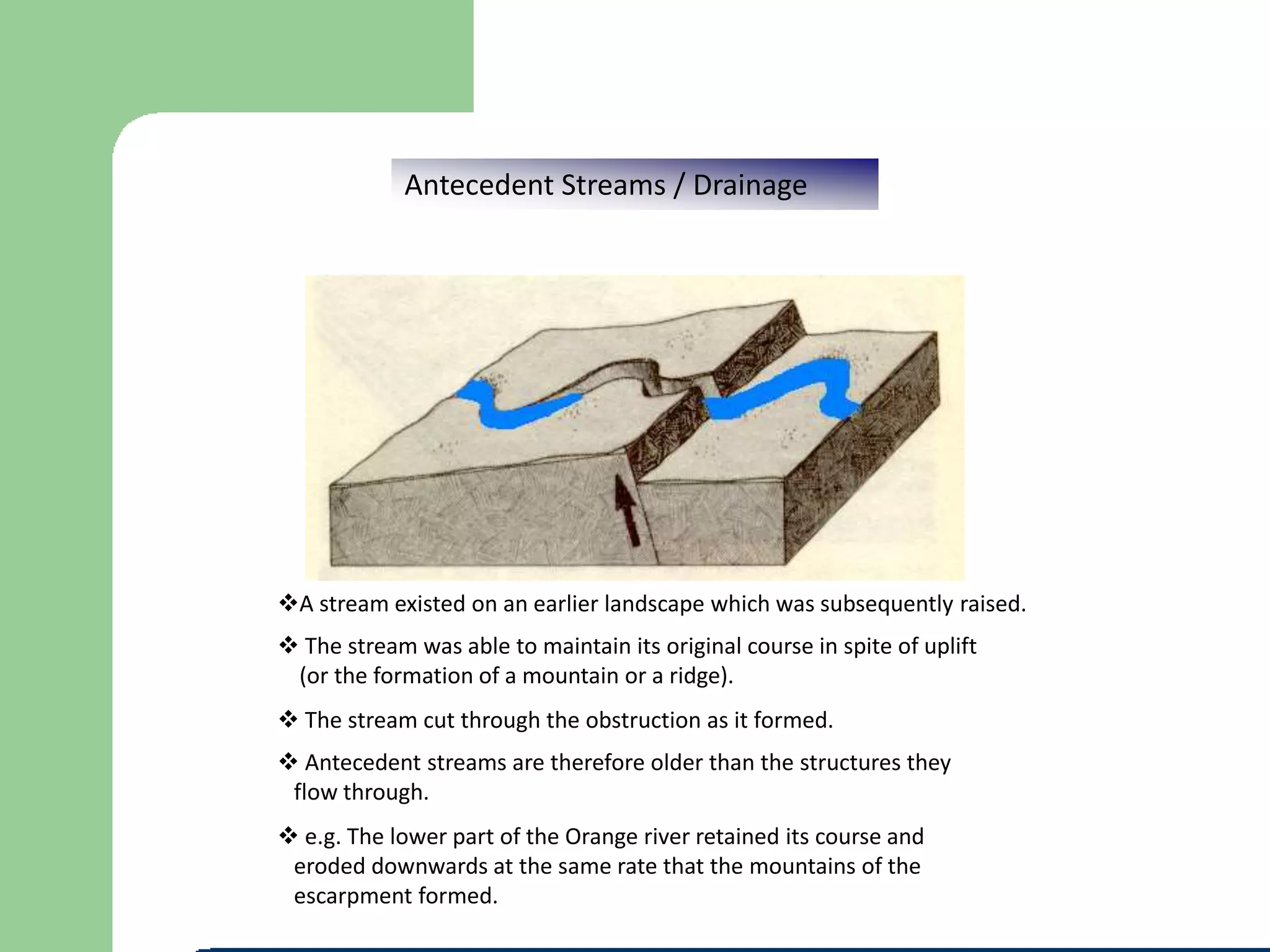
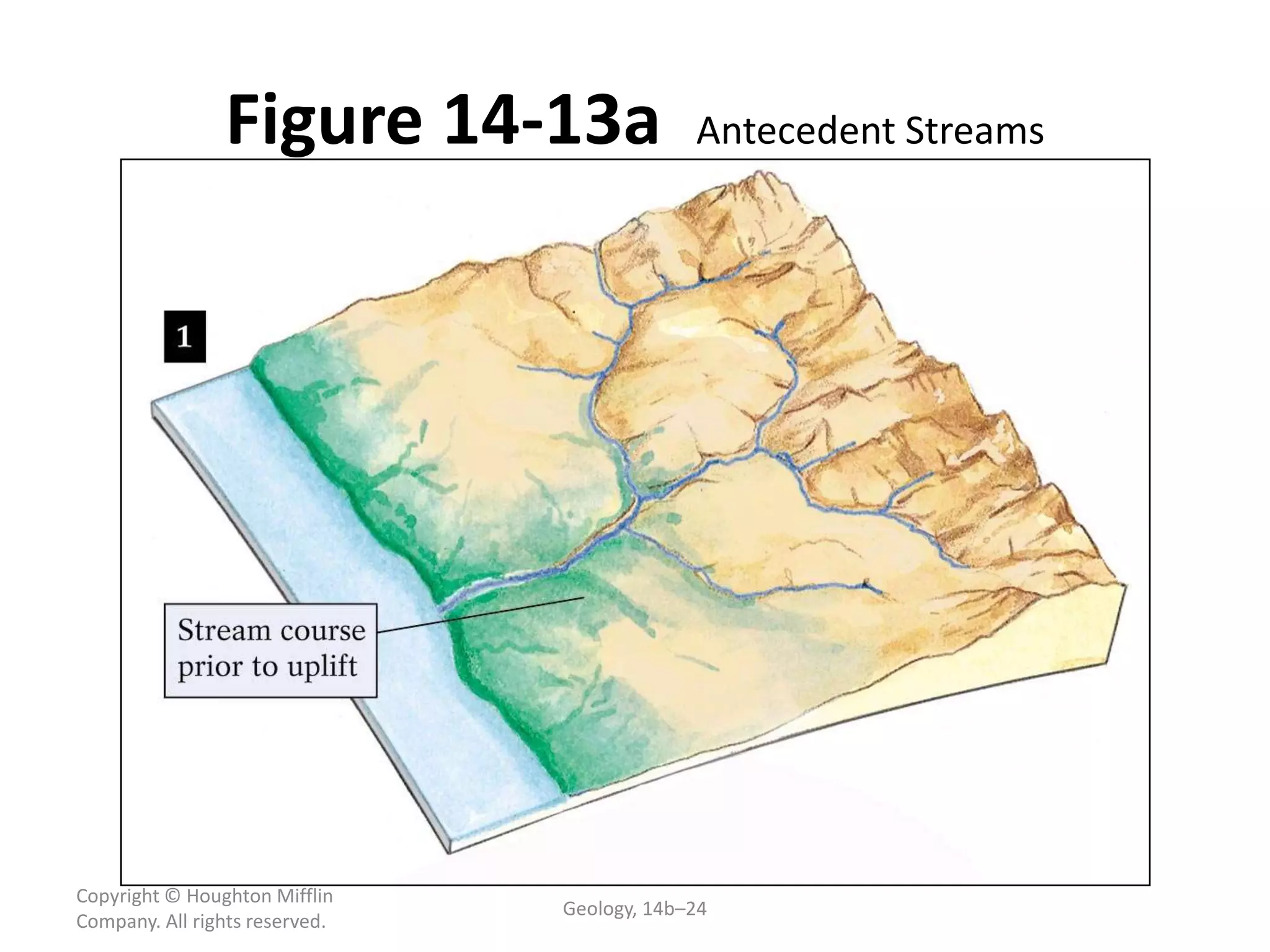
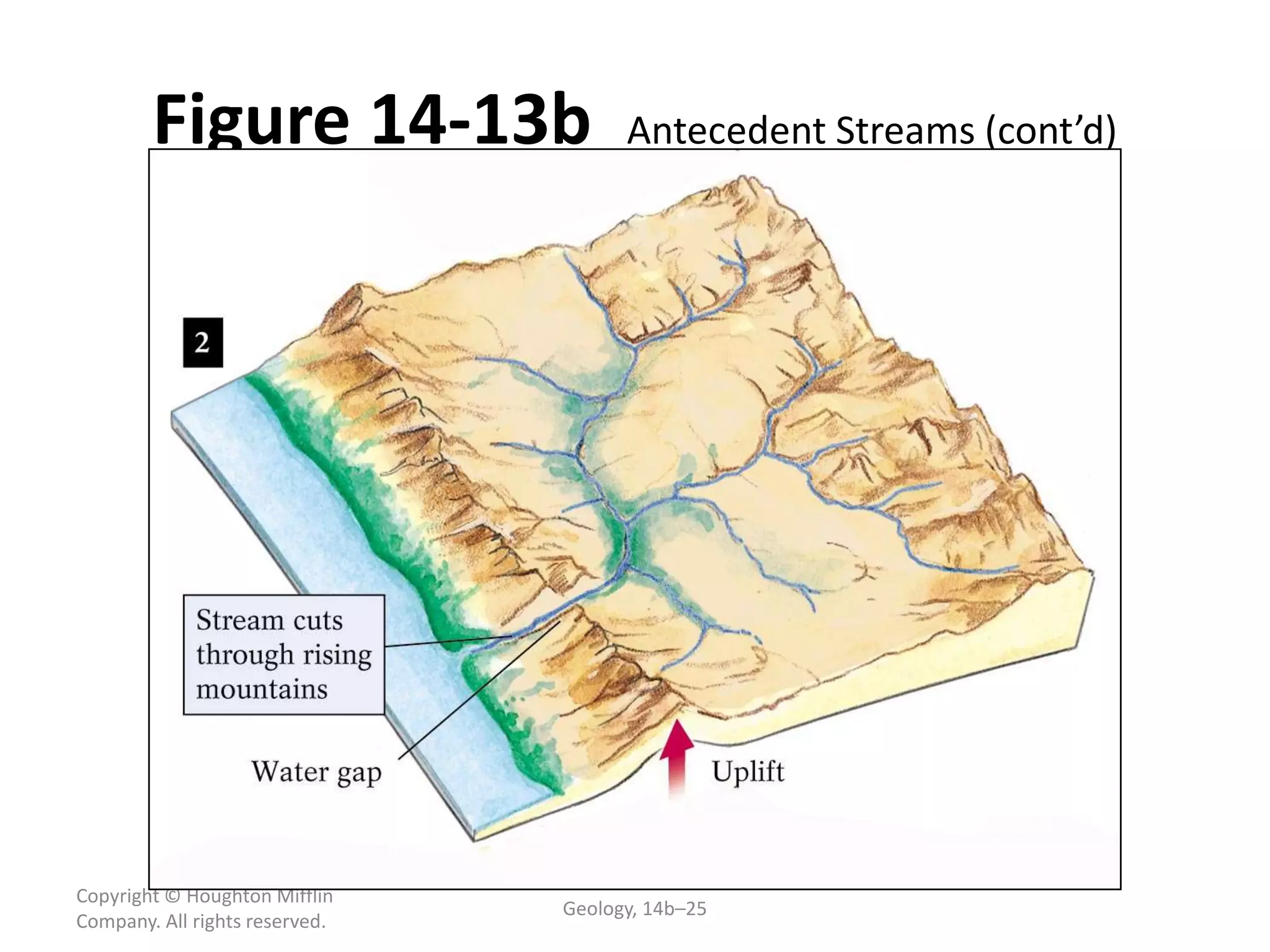
Antecedent Streams / Drainage
A stream existed on an earlier landscape which was subsequently raised.
 The stream was able to maintain its original course in spite of uplift
(or the formation of a mountain or a ridge).
 Antecedent streams are therefore older than the structures they
flow through.
 e.g. The lower part of the Orange river retained its course and
eroded downwards at the same rate that the mountains of the
escarpment formed.
 The stream cut through the obstruction as it formed.
Copyright © Houghton Mifflin
Company. All rights reserved.
Geology, 14b–24
Figure 14-13a Antecedent Streams
Copyright © Houghton Mifflin
Company. All rights reserved.
Geology, 14b–25
Figure 14-13b Antecedent Streams (cont’d)
Superposed Stream
Development of
Water gap
Folded Units
Erosion and downcutting
through young
horizontal units
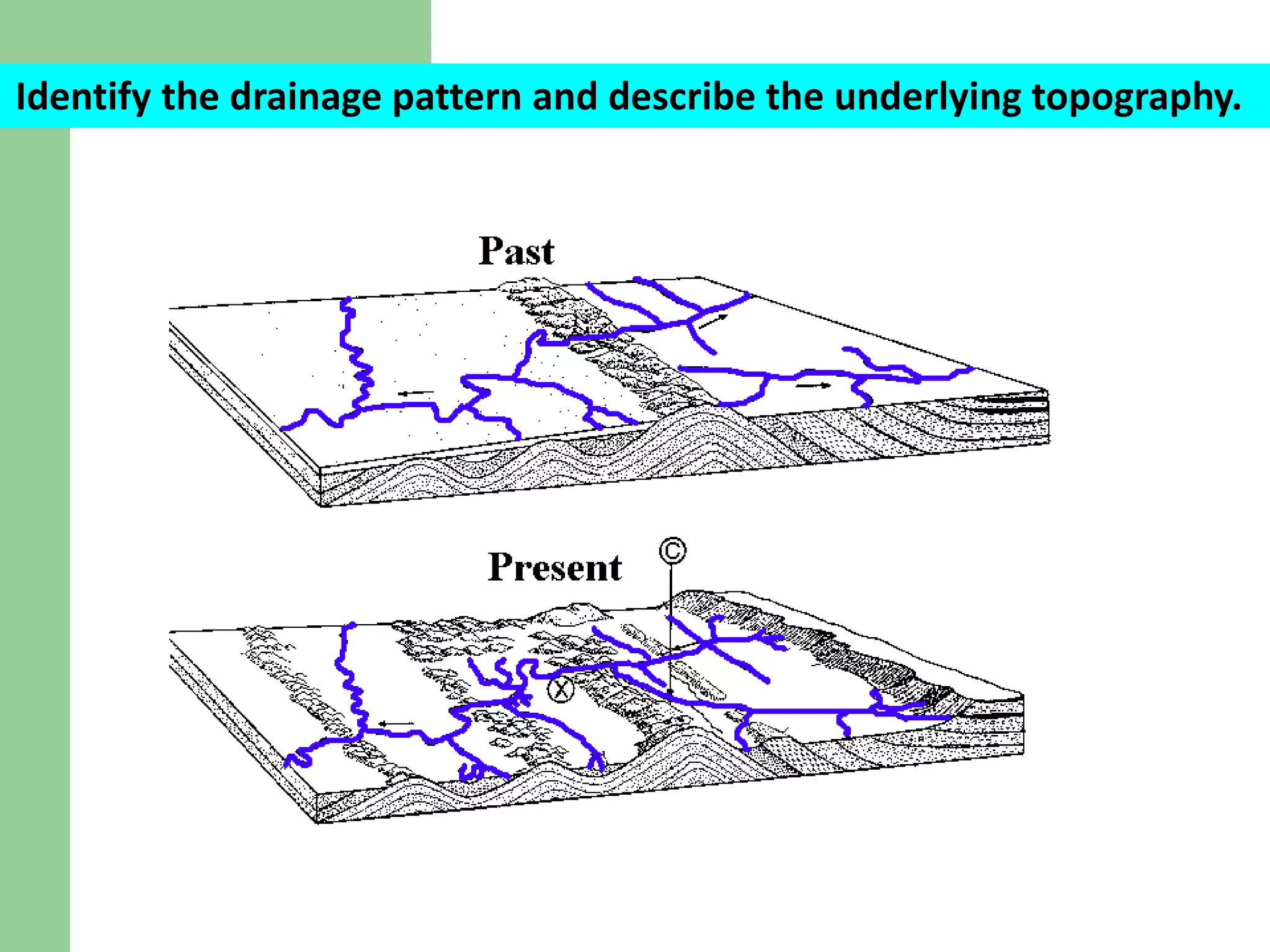
Identify this Stream Pattern
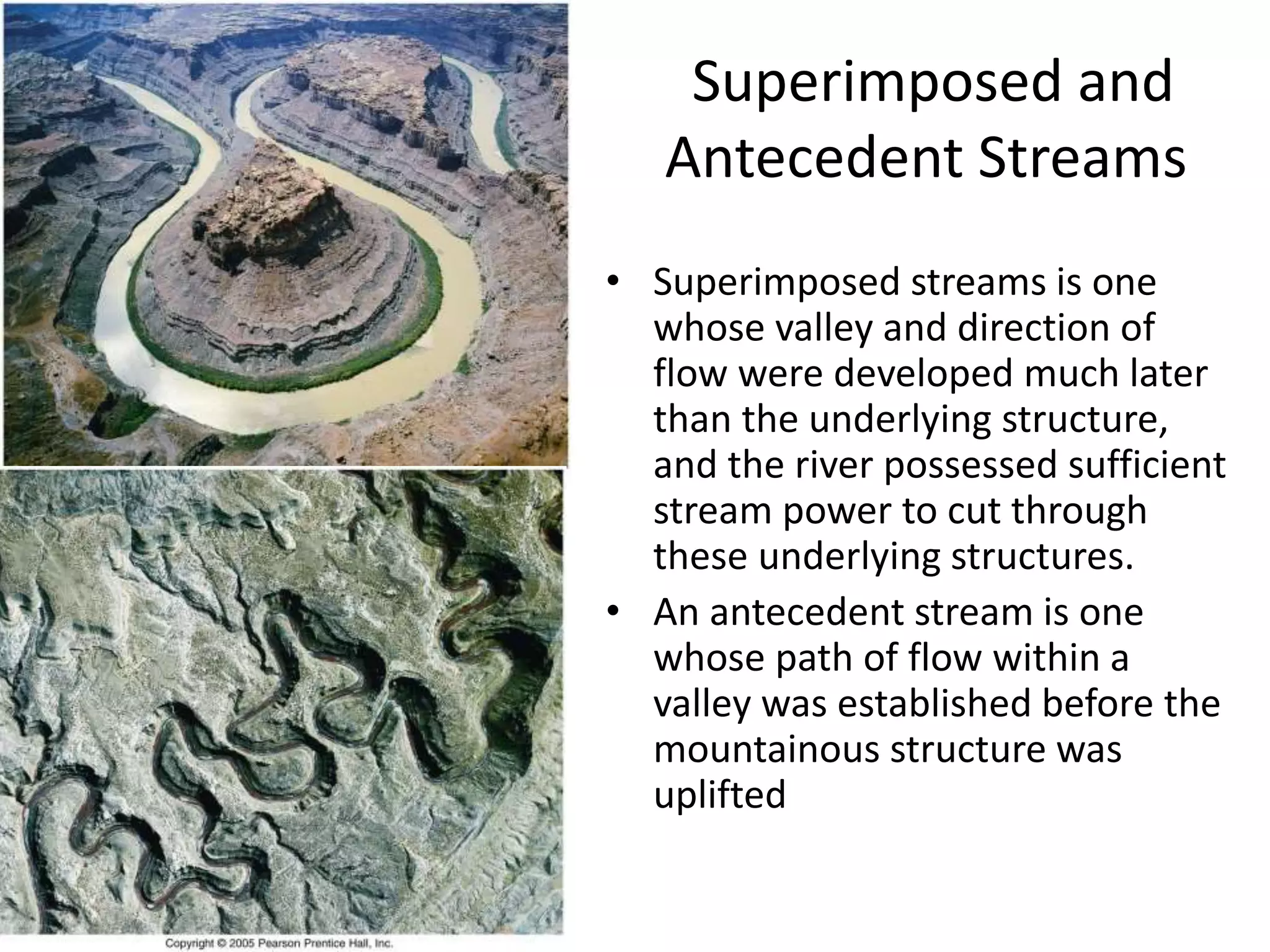
Superimposed and
Antecedent Streams
• Superimposed streams is one
whose valley and direction of
flow were developed much later
than the underlying structure,
and the river possessed sufficient
stream power to cut through
these underlying structures.
• An antecedent stream is one
whose path of flow within a
valley was established before the
mountainous structure was
uplifted
Schuters Pg.174
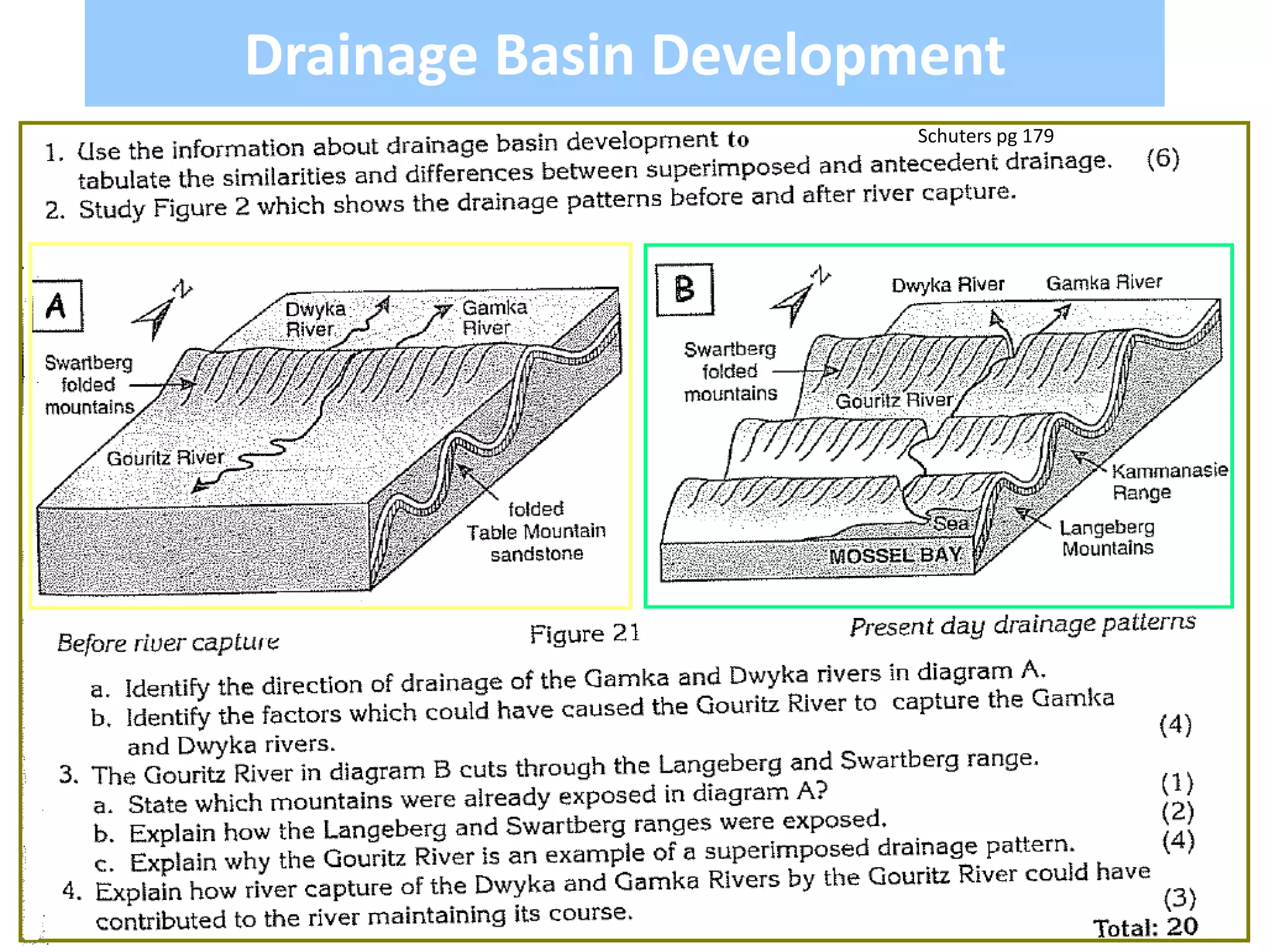
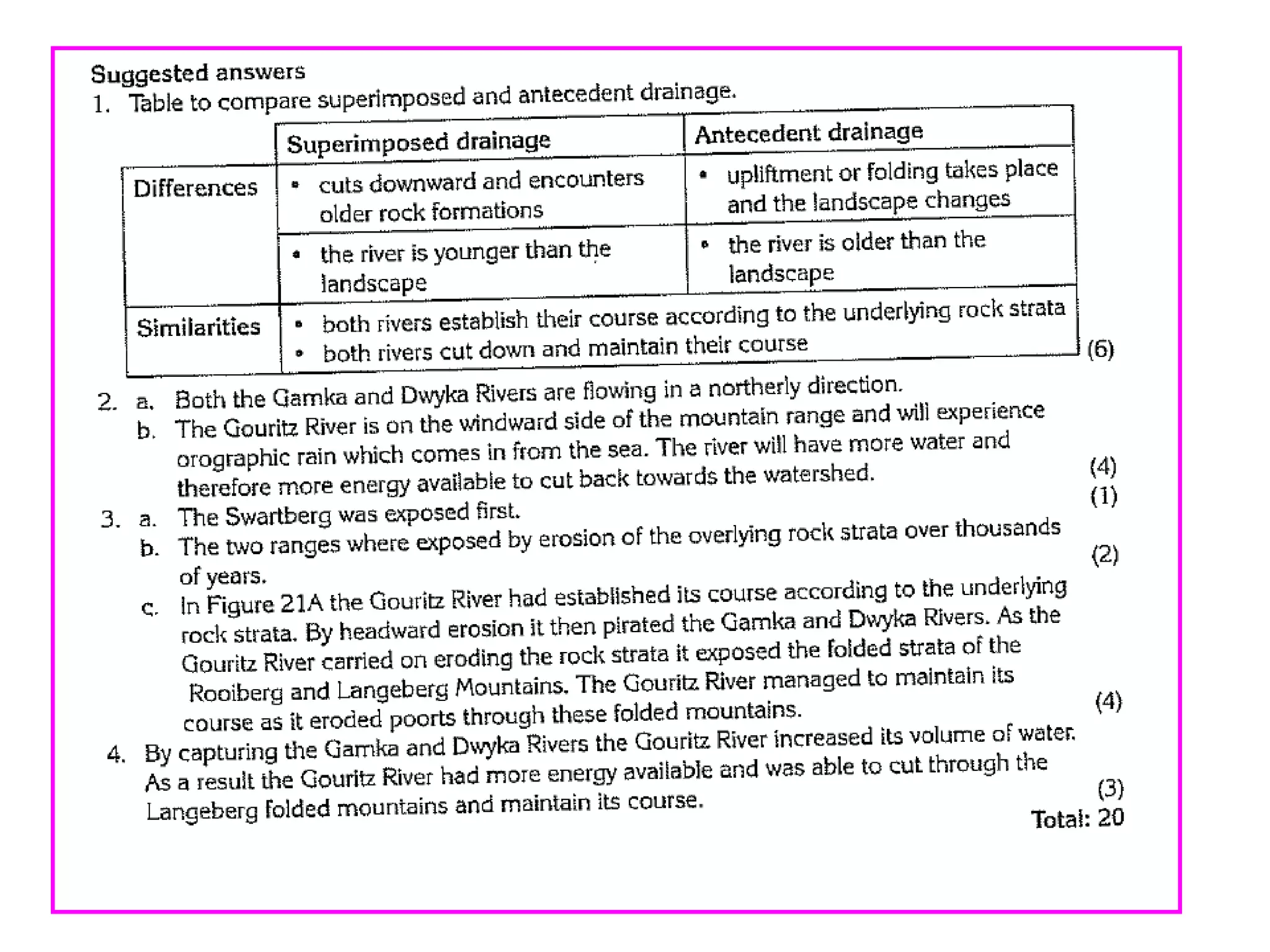
Schuters pg 179
Schuters pg 179
Drainage Basin Development
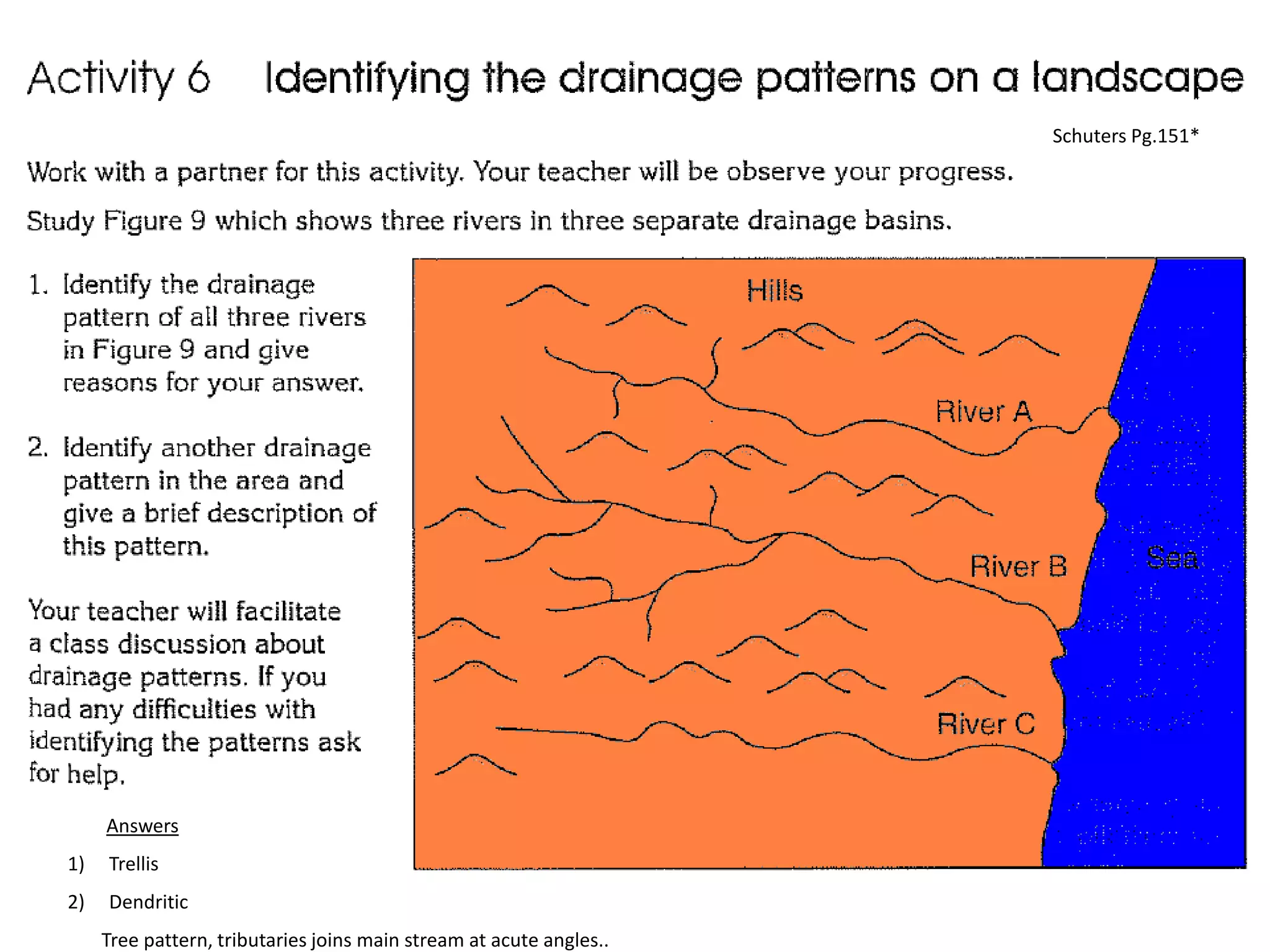
Schuters Pg.151*
Answers
1) Trellis
2) Dendritic
Tree pattern, tributaries joins main stream at acute angles..
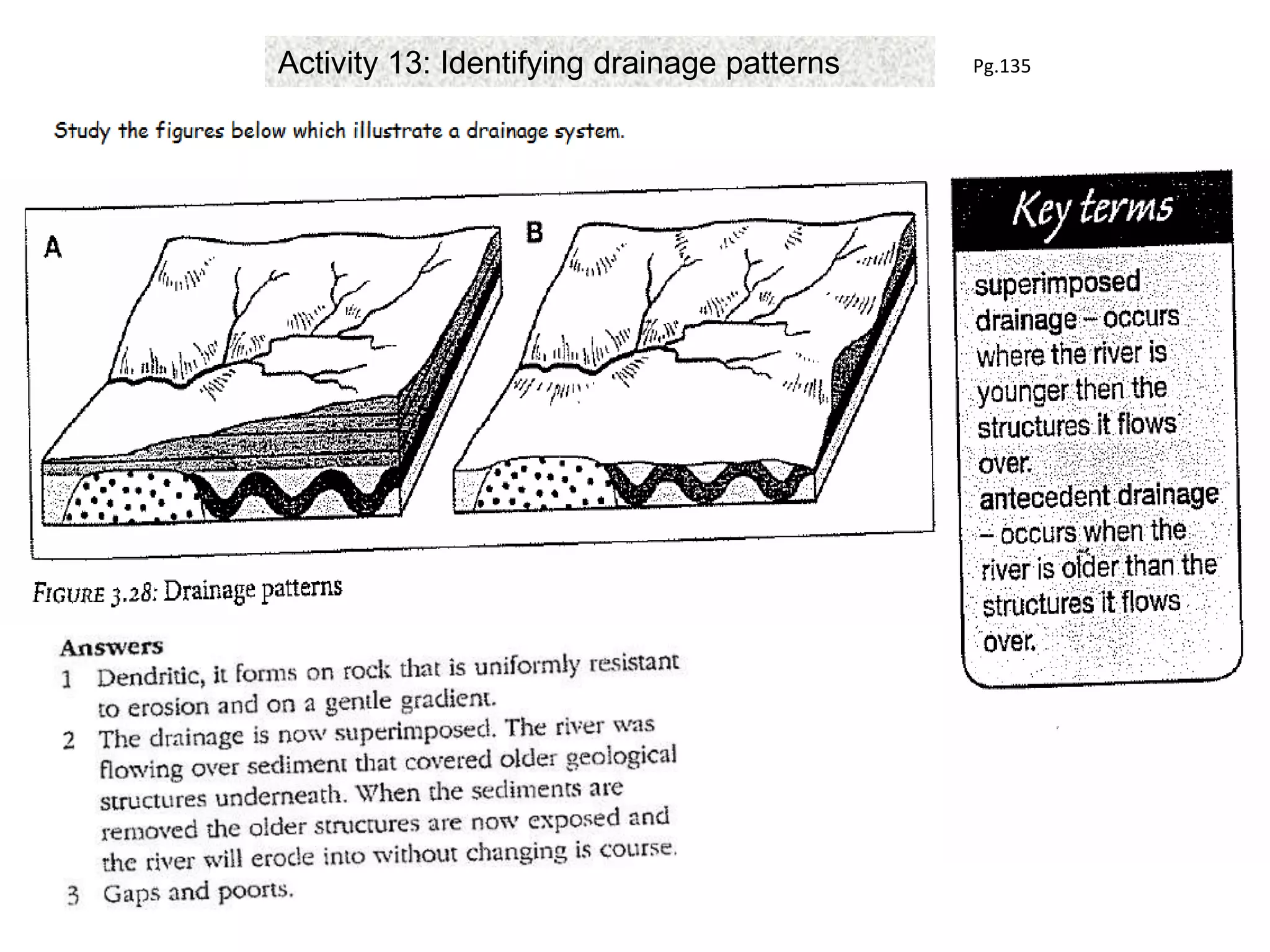
Activity 13: Identifying drainage patterns Pg.135
Learningobjectives Types of Rivers
Drainage Patterns
River Channel Patterns (Stream flow Characteristics)
River Channel Patterns / Stream flow characteristics
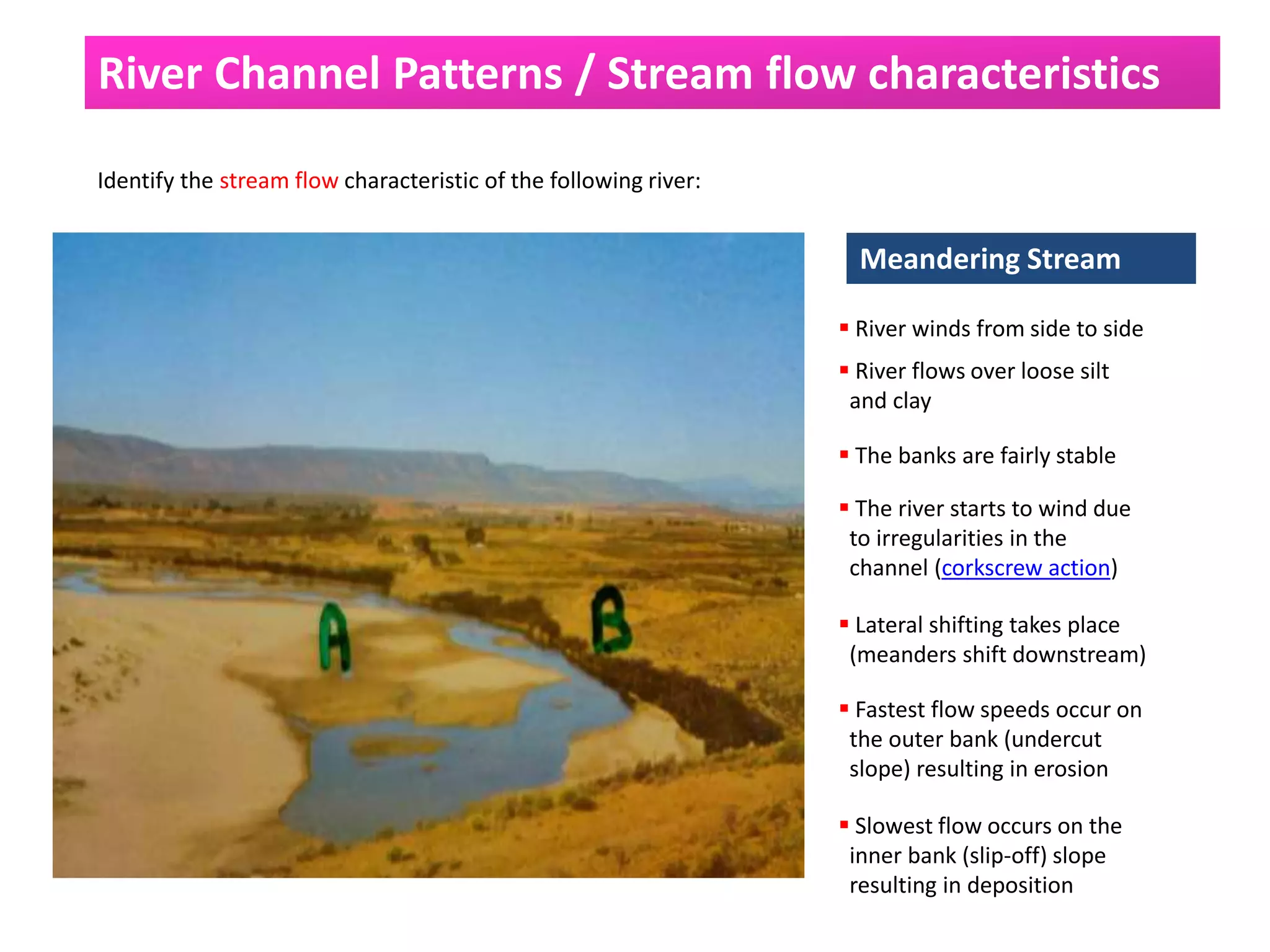
Identify the stream flow characteristic of the following river:
Meandering Stream
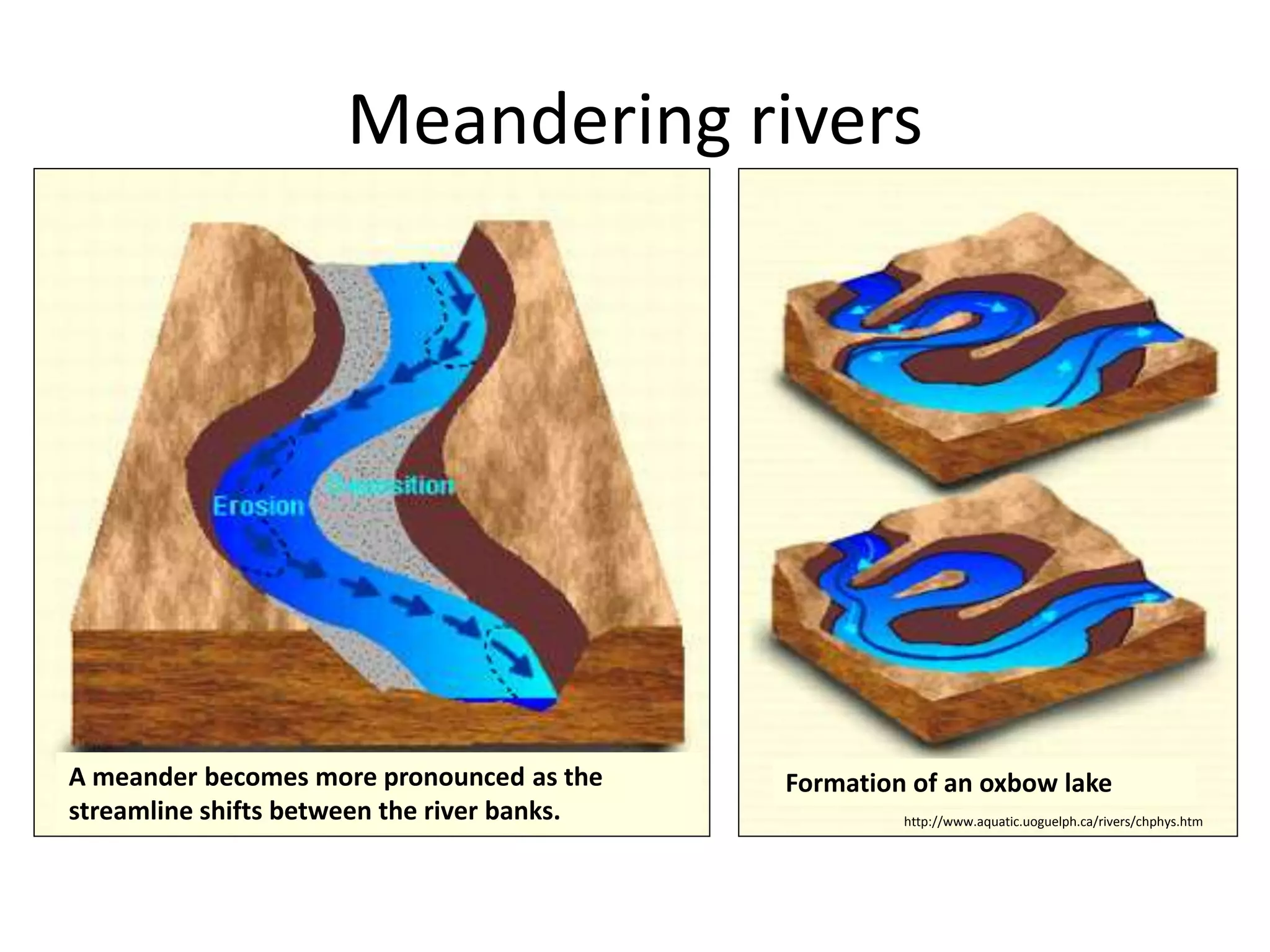
 River winds from side to side
 River flows over loose silt
and clay
 The banks are fairly stable
 The river starts to wind due
to irregularities in the
channel (corkscrew action)
 Lateral shifting takes place
(meanders shift downstream)
 Fastest flow speeds occur on
the outer bank (undercut
slope) resulting in erosion
 Slowest flow occurs on the
inner bank (slip-off) slope
resulting in deposition
Schuters:
Pg.170
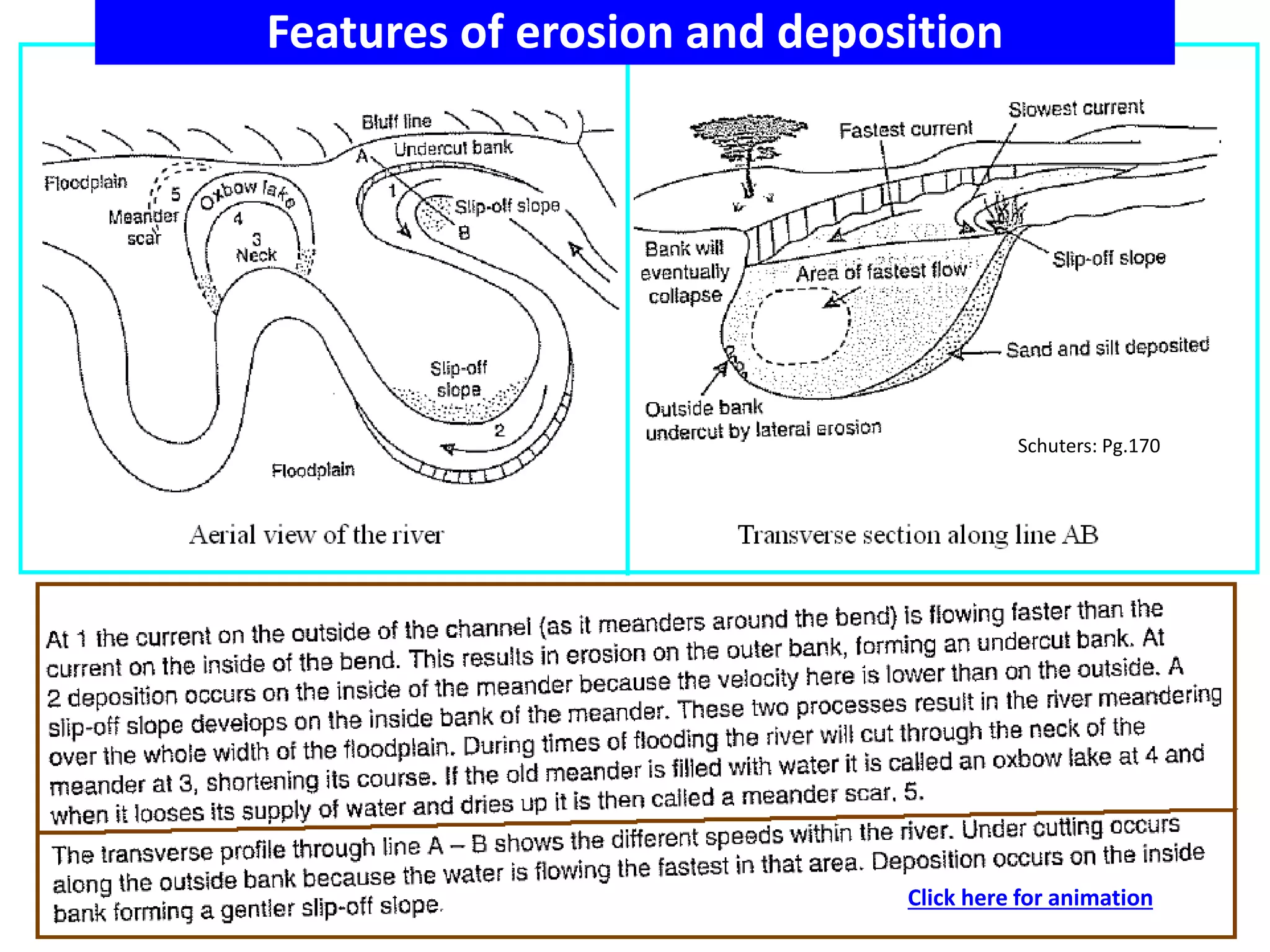
Features of erosion and deposition
Schuters: Pg.170
Click here for animation
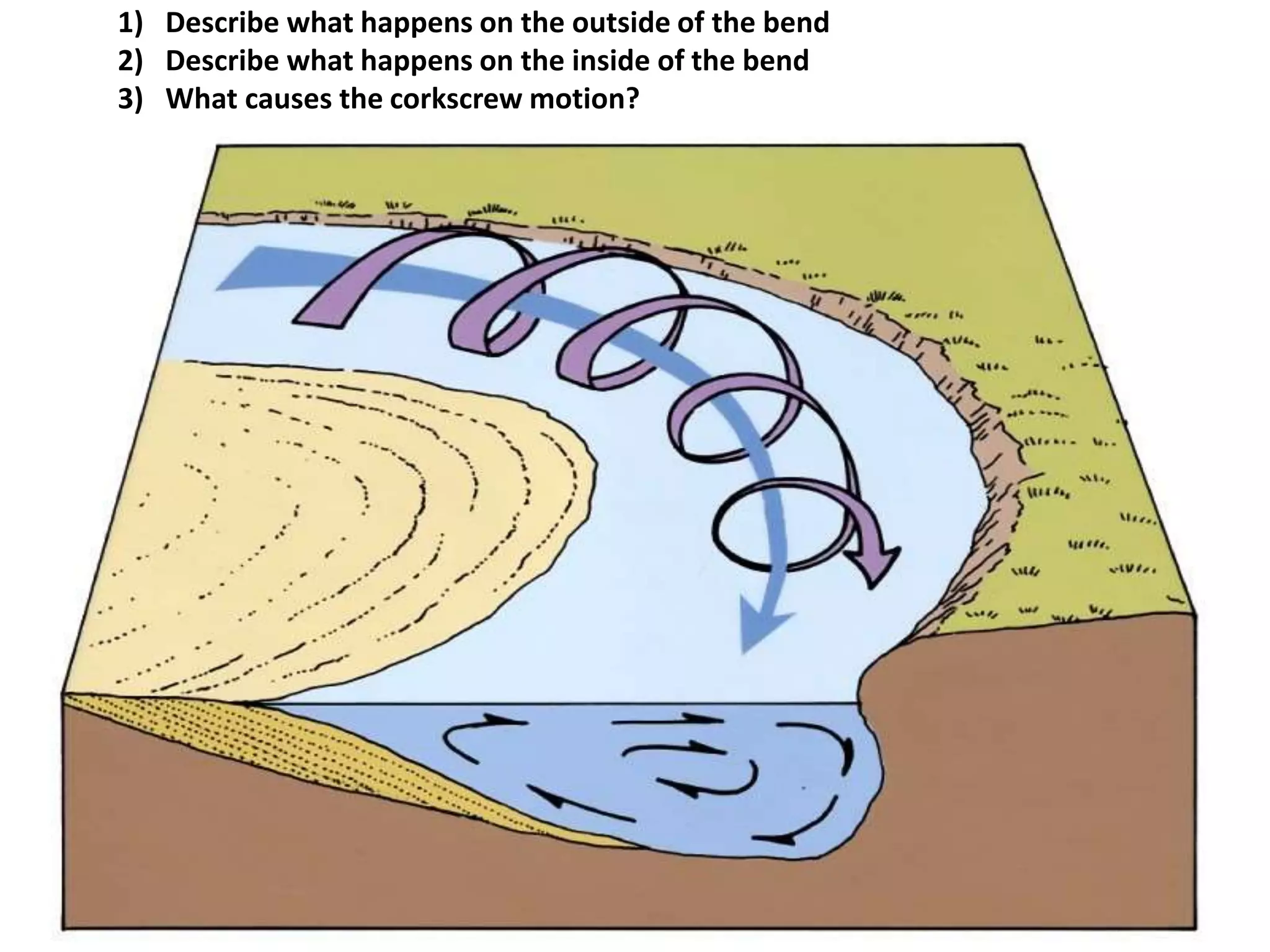
1) Describe what happens on the outside of the bend
2) Describe what happens on the inside of the bend
3) What causes the corkscrew motion?
Meandering rivers
http://www.aquatic.uoguelph.ca/rivers/chphys.htm
A meander becomes more pronounced as the
streamline shifts between the river banks.
Formation of an oxbow lake
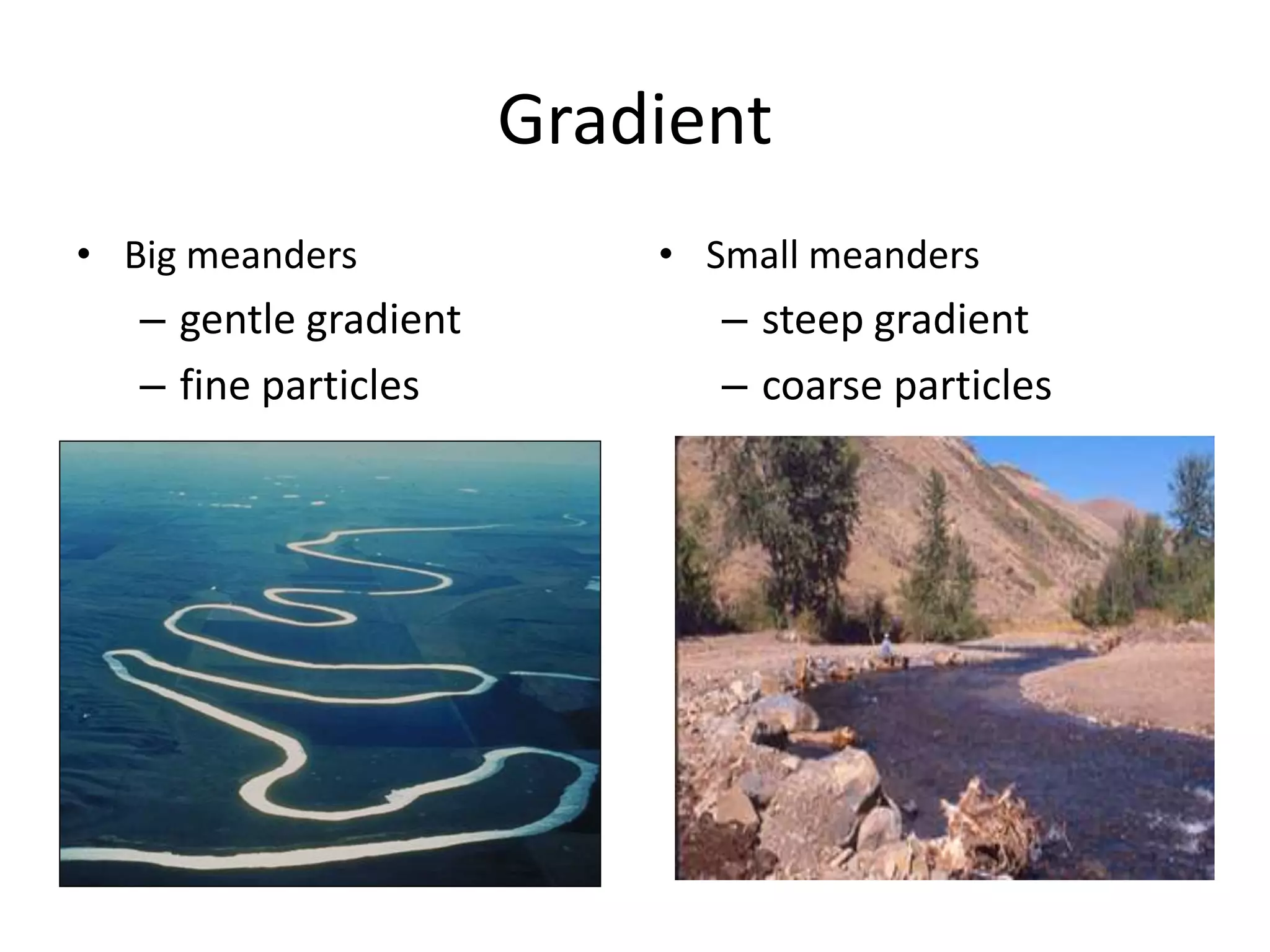
• Small meanders
– steep gradient
– coarse particles
Gradient
• Big meanders
– gentle gradient
– fine particles
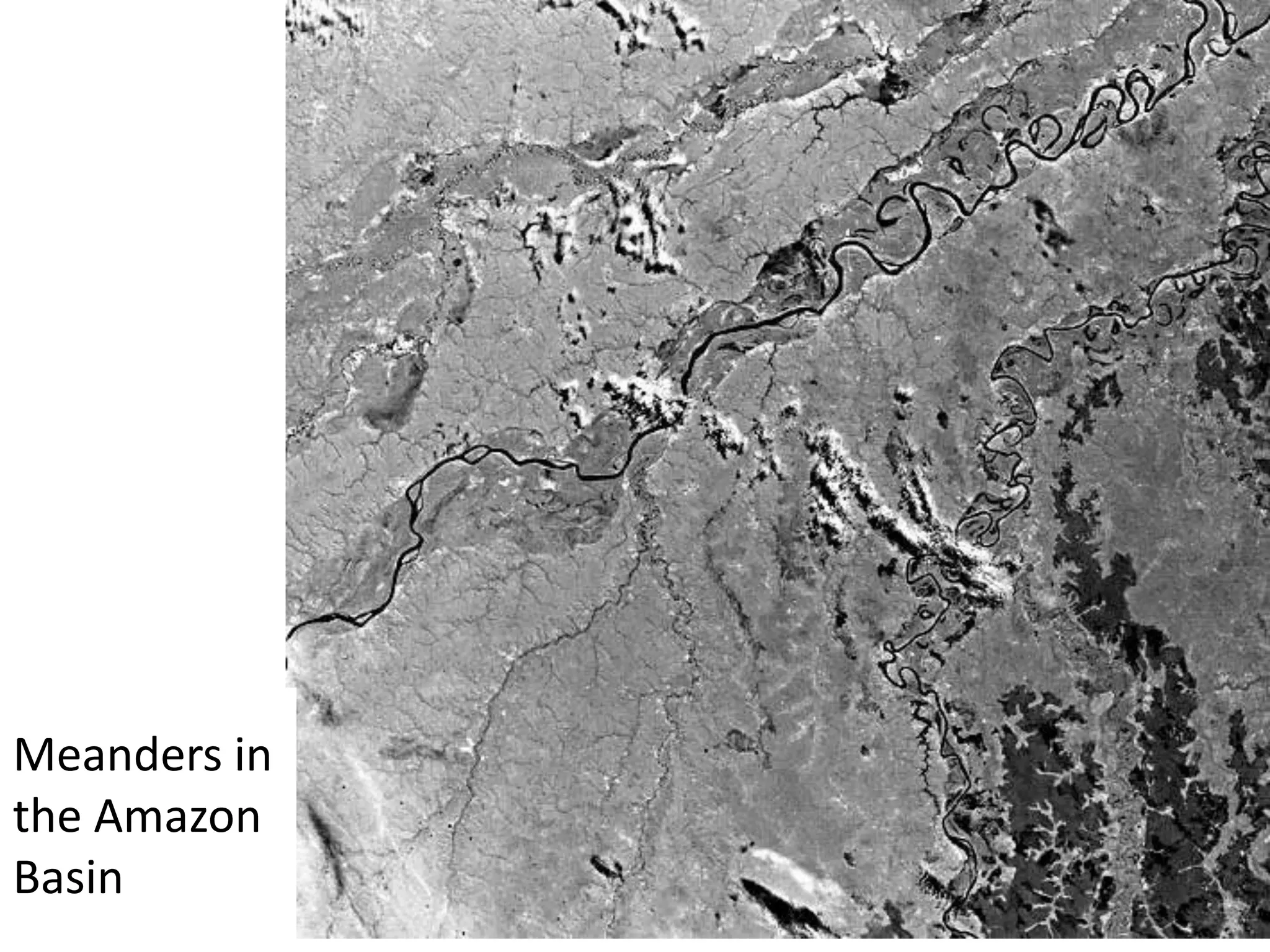
Meanders in
the Amazon
Basin
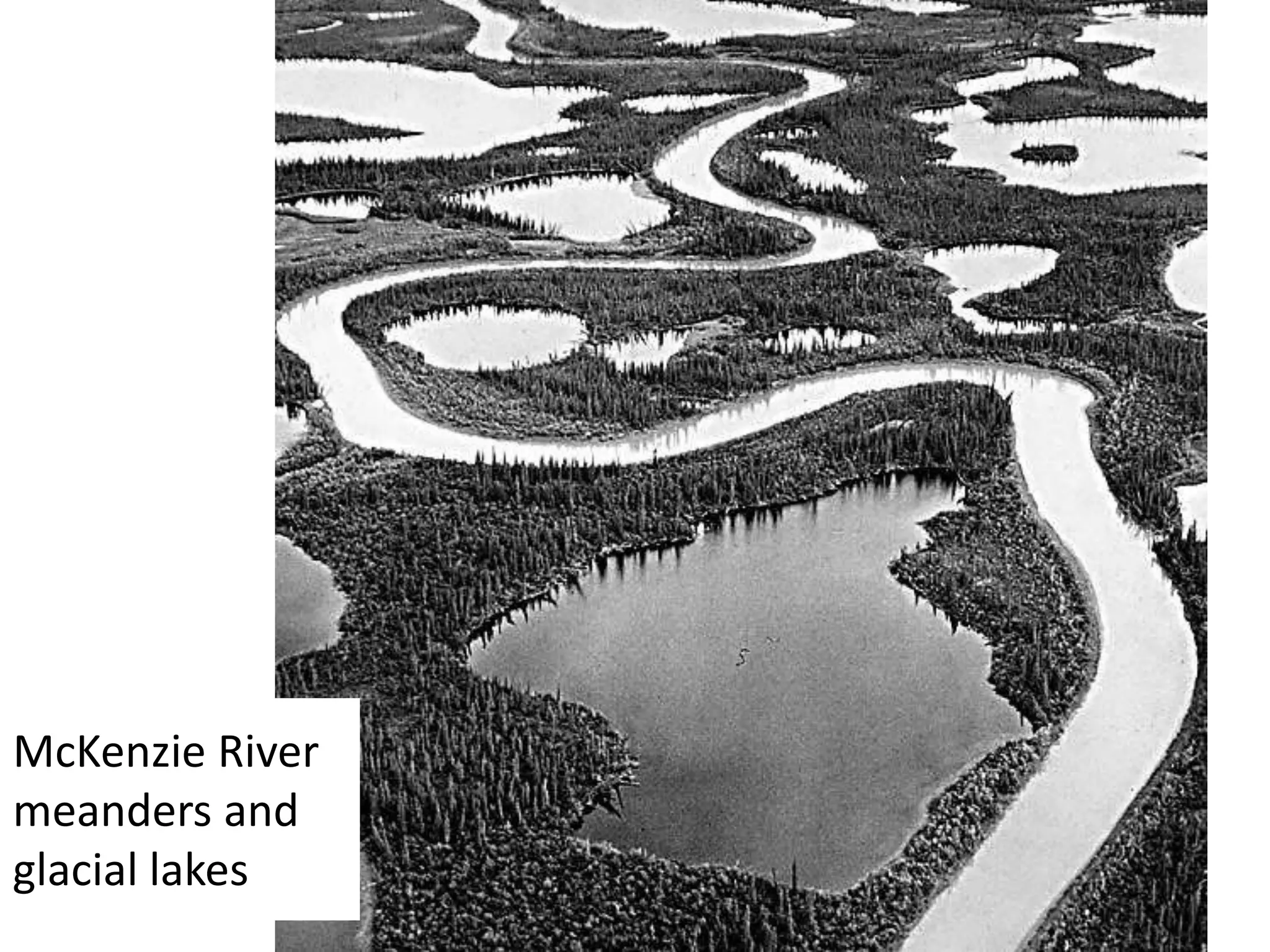
McKenzie River
meanders and
glacial lakes
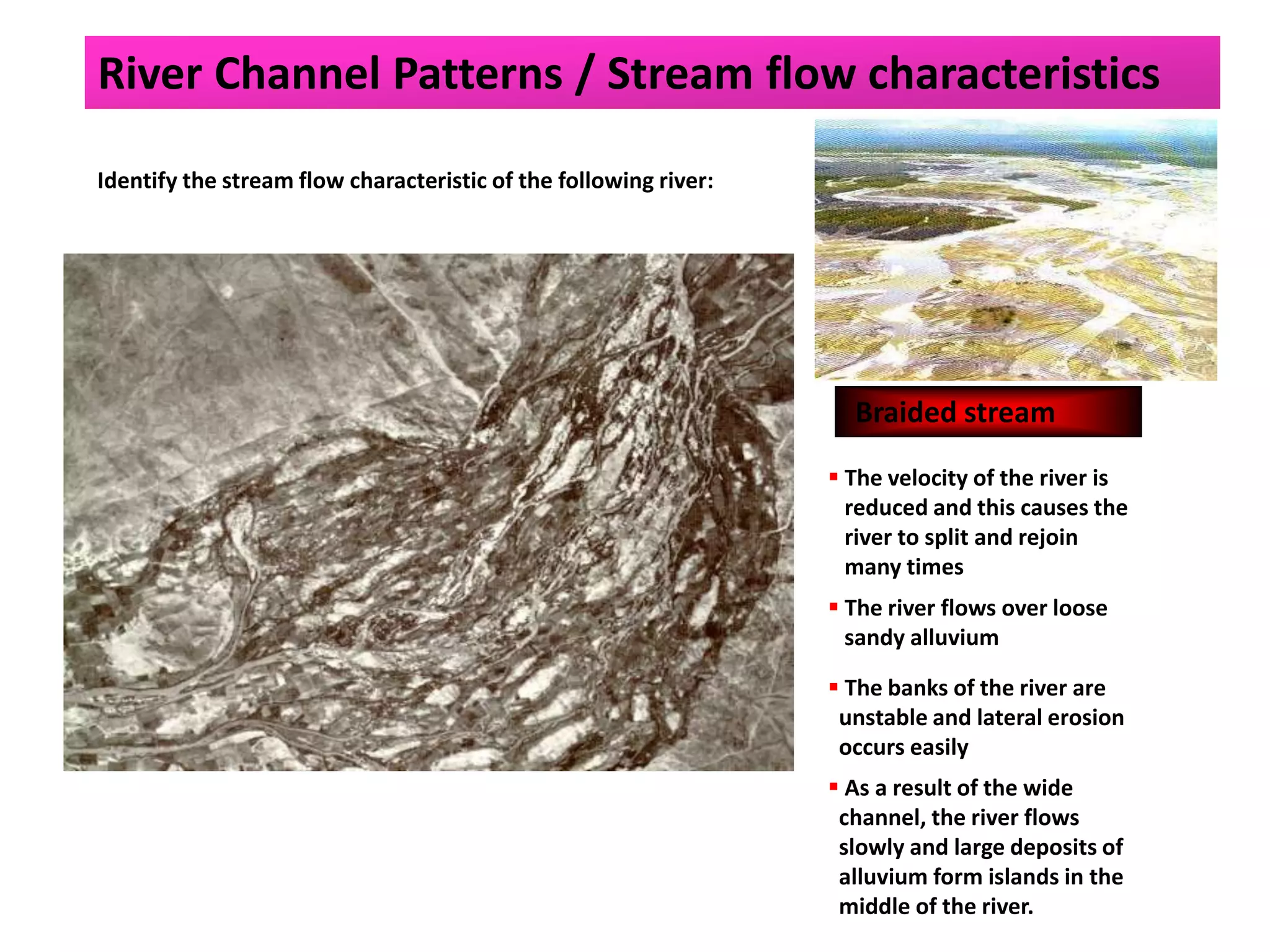
Identify the stream flow characteristic of the following river:
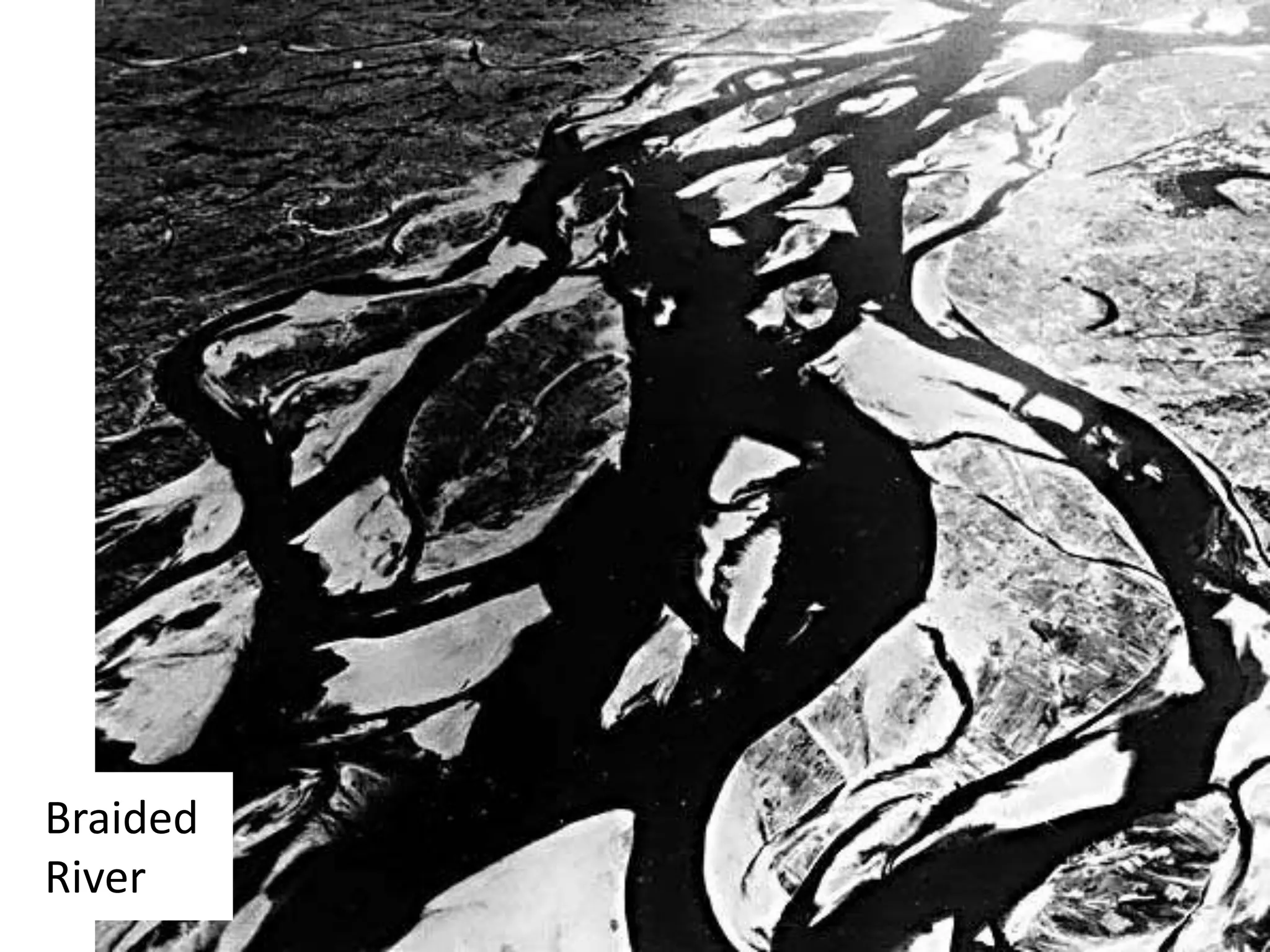
Braided stream
 The velocity of the river is
reduced and this causes the
river to split and rejoin
many times
 The river flows over loose
sandy alluvium
 The banks of the river are
unstable and lateral erosion
occurs easily
 As a result of the wide
channel, the river flows
slowly and large deposits of
alluvium form islands in the
middle of the river.
River Channel Patterns / Stream flow characteristics
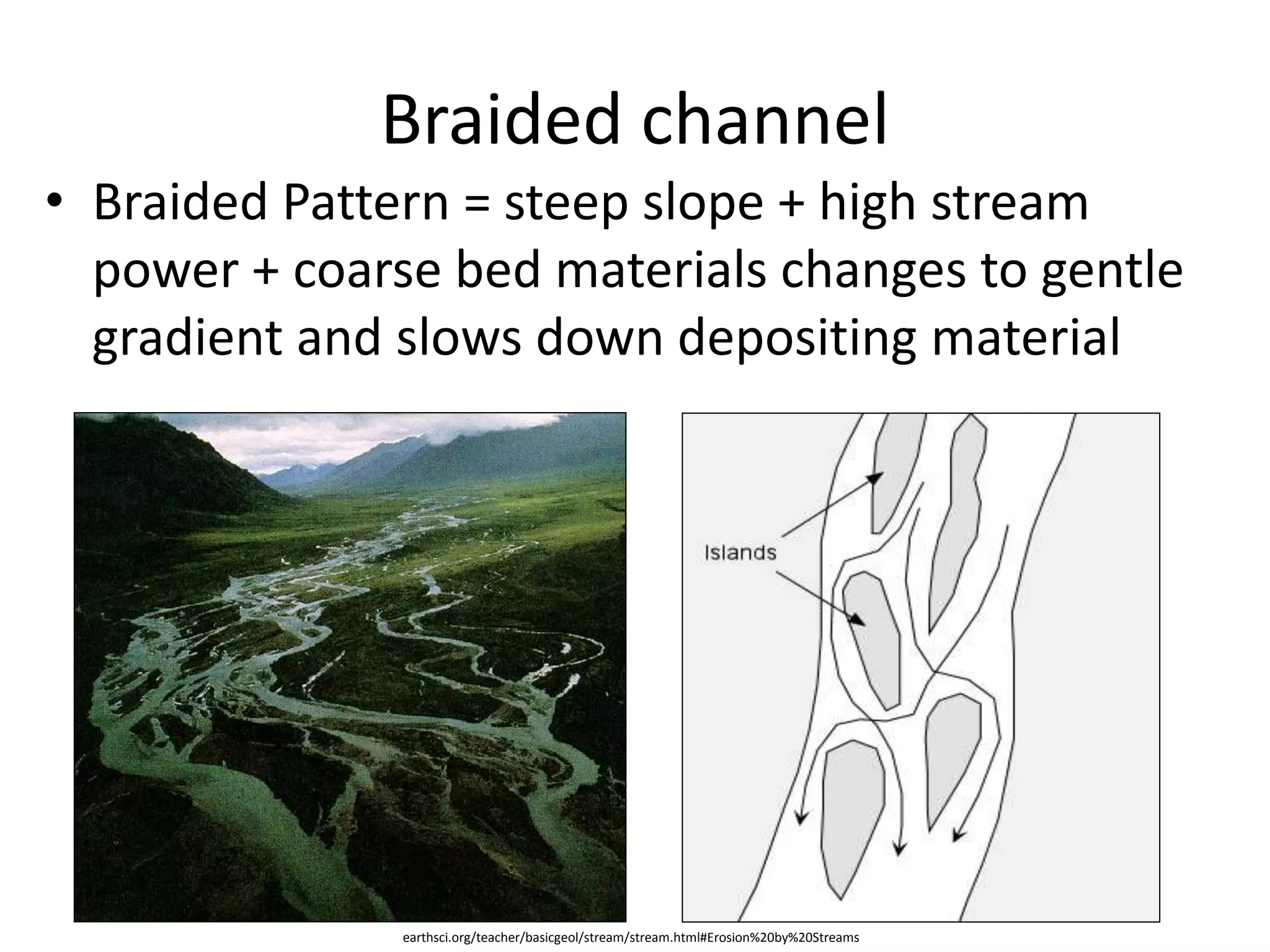
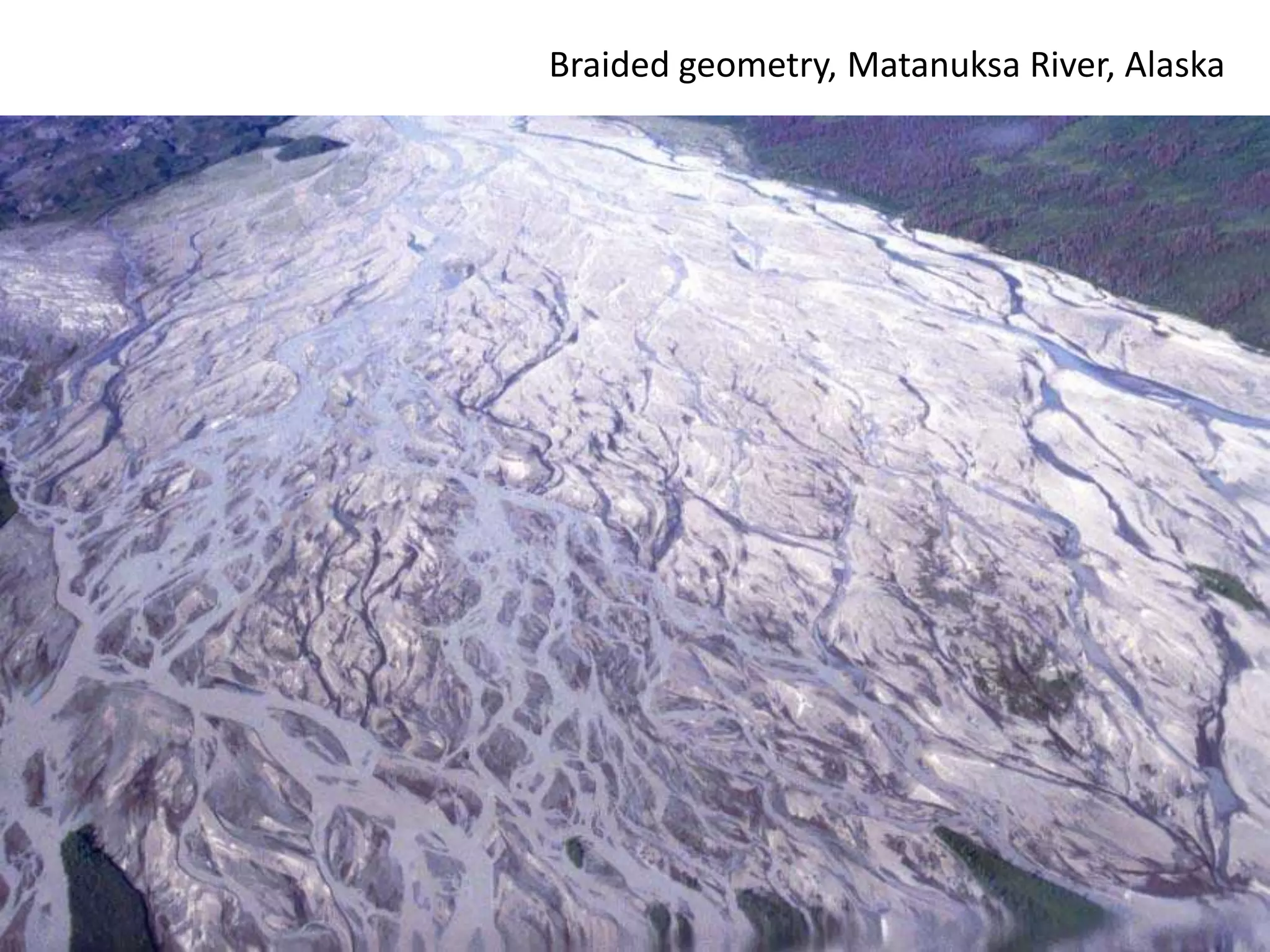
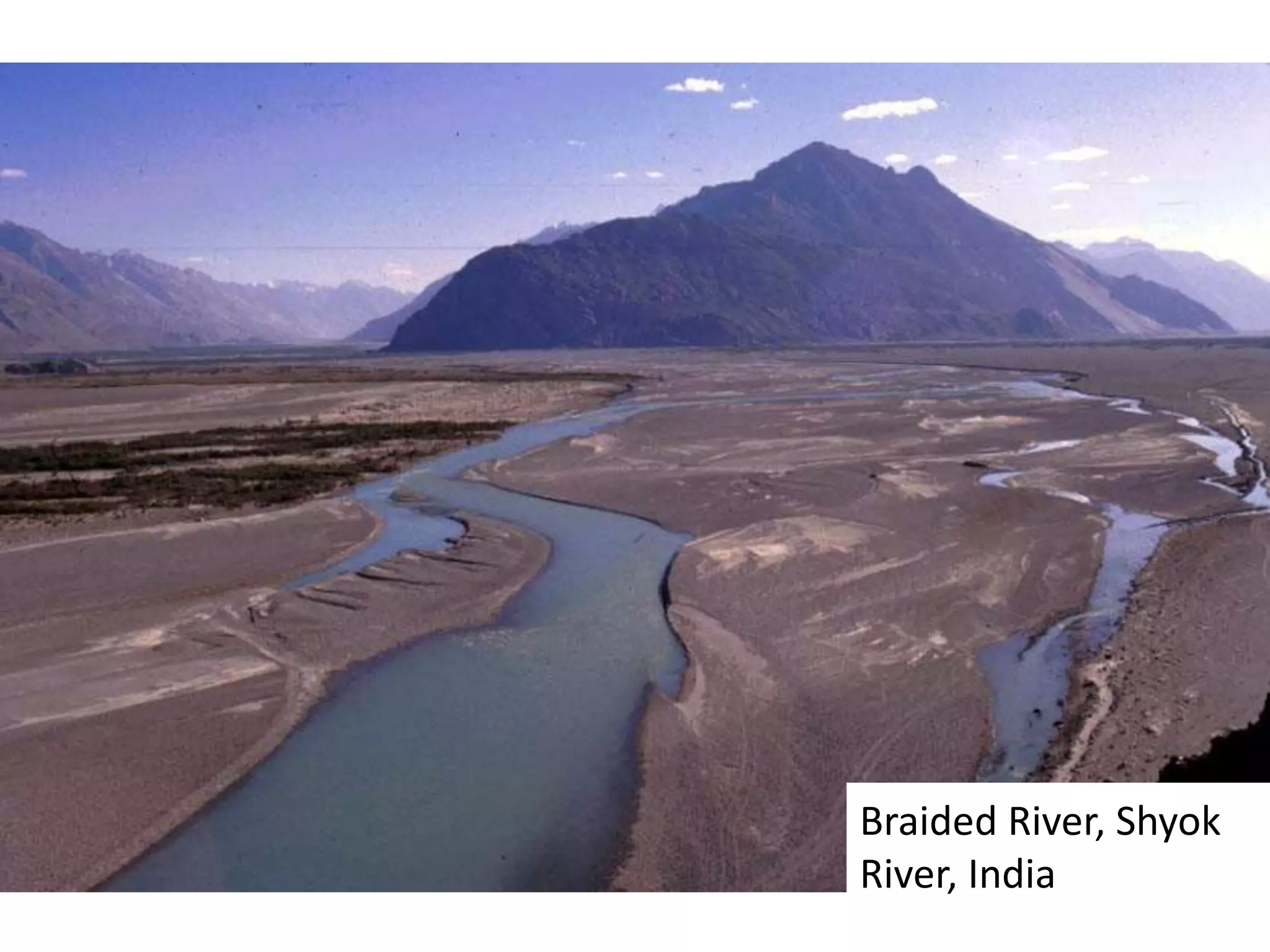
• Braided Pattern = steep slope + high stream
power + coarse bed materials changes to gentle
gradient and slows down depositing material
Braided channel
earthsci.org/teacher/basicgeol/stream/stream.html#Erosion%20by%20Streams
Braided
River
Braided geometry, Matanuksa River, Alaska
Braided River, Shyok
River, India
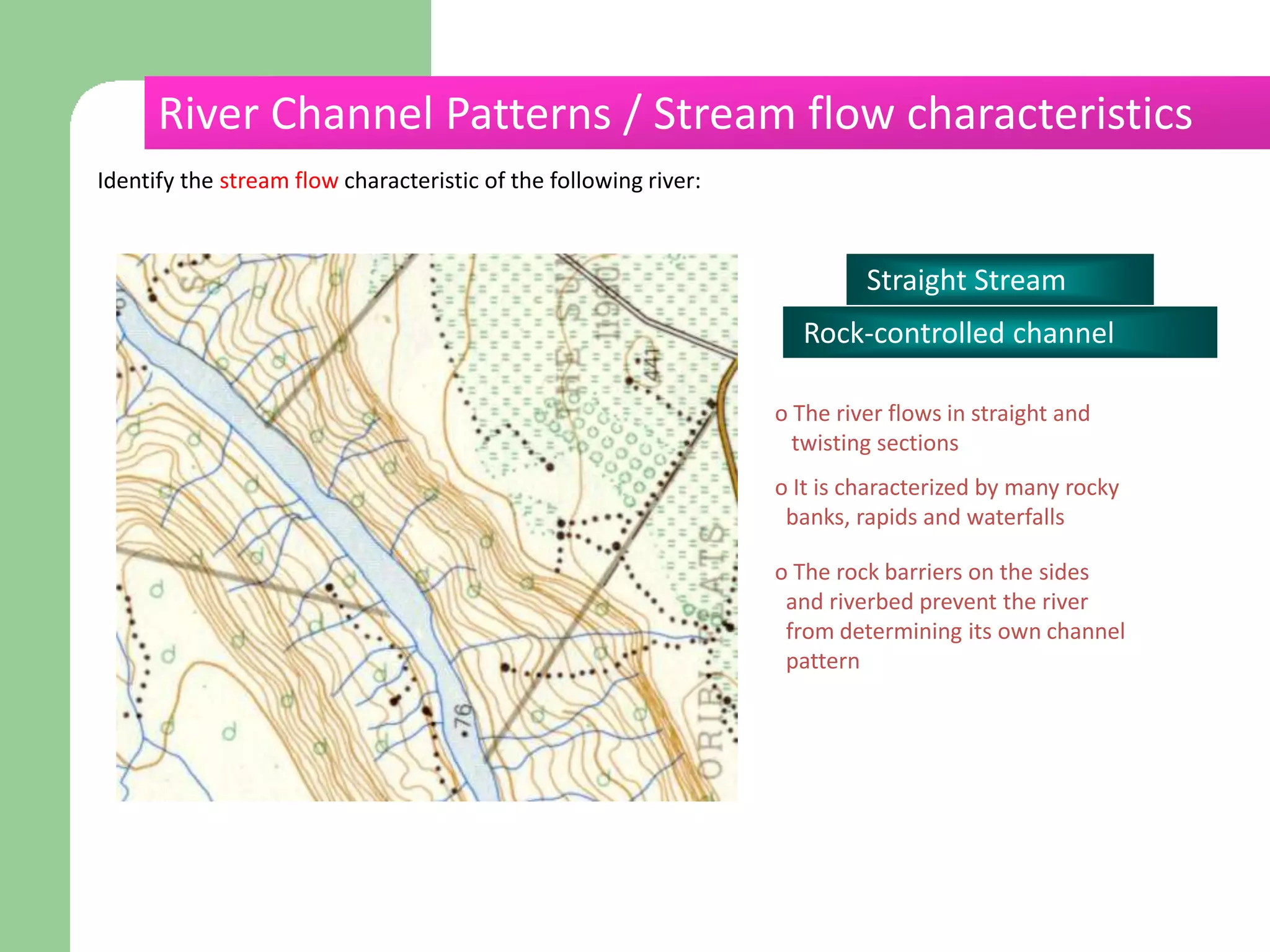
Identify the stream flow characteristic of the following river:
Straight Stream
Rock-controlled channel
o The river flows in straight and
twisting sections
o It is characterized by many rocky
banks, rapids and waterfalls
o The rock barriers on the sides
and riverbed prevent the river
from determining its own channel
pattern
River Channel Patterns / Stream flow characteristics
Identify the drainage pattern and describe the underlying topography.

Types of Rivers

  • 1.
    Learningobjectives Types ofRivers Drainage Patterns River Channel Patterns
  • 2.
  • 3.
    Types of Rivers •Rivers are very dependent on climate and their characteristics are closely related to the precipitation and evaporation regimes in their drainage areas. • Four types: – Perennial or permanent rivers – Periodic rivers – Episodic rivers – Exotic www.aquatic.uoguelph.ca/rivers/chintro.htm
  • 4.
    Permanent / PerennialRivers • Rivers that flow all year e.g. Orange (Gariep), Kunene, Zambezi. • River channel reaches water table throughout the year. • Orange River used to be non-perennial before the construction of the Gariep Dam.
  • 5.
    Periodic / Non-PerennialRivers • Only flow during the rainy season e.g. Berg River (seen below) • Water table must rise enough to feed the river when it is not raining
  • 6.
    Episodic Rivers • Onlyflow for short periods after heavy rain e.g. Nassob (Namibia). • May have some permanent pools where bed intercepts water table. • It is an important water source in desert regions.
  • 7.
    Exotic Rivers • Risein humid areas with high rainfall and flow through dry areas. • Gariep river rises in the Drakensberg moutains (high rainfall) and flows through the Northern Cape (dry region).
  • 8.
    Relationship between thewater tables and types of rivers Schuters: Pg.155 Orange River Rivers
  • 9.
    Learningobjectives Types ofRivers Drainage Patterns River Channel Patterns
  • 10.
  • 11.
    Dendritic drainage pattern •Occurs inregions where the rock is uniform in its resistance to erosion. •Shaped like the branches of a tree. •Consequent and subsequent streams meet at acute angles.
  • 12.
    Rectangular drainage pattern •Rectangular drainage patterns have rt.-angled bends in the tributaries and the main streams. • Streams are not parallel to each other. Rectangular drainage pattern
  • 13.
    Trellis drainage pattern •Occurs in regions the sedimentary rock is folded or where there are alternate layers of hard and soft rock. • The main stream and tributaries join at rt. angles. • Streams are parallel with short tributaries.
  • 14.
  • 15.
  • 16.
    Radial drainage pattern •The stream flows down a dome shaped feature e.g. an isolated hill volcanic dome spitskop.
  • 17.
    Deranged drainage pattern •A deranged pattern is found in a region that is geological young. • Haphazard shape. • Streams entering lakes and marshes in a haphazard pattern.
  • 18.
    • Common drainagepatterns that are structurally controlled
  • 19.
    Superimposed (Inherited) Streams/ Drainage A stream establishes its course in rock layers. The covering rock is removed and the stream imposes its course on underlying rock of a completely different structure. River is younger than the structures they flow through. E.g. The Vaal river in the vicinity of Parys (in the Free State) breaks through two quartzite hills instead of following a course around them.
  • 20.
    Copyright © HoughtonMifflin Company. All rights reserved. Geology, 14b–20 Figure 14-12a Superposed Streams
  • 21.
    Copyright © HoughtonMifflin Company. All rights reserved. Geology, 14b–21 Figure 14-12b Superposed Streams (cont’d)
  • 22.
    Copyright © HoughtonMifflin Company. All rights reserved. Geology, 14b–22 Figure 14-12c Superposed Streams (cont’d) Source: Jeff Lepore/Photo Researchers Inc.
  • 23.
    Antecedent Streams /Drainage A stream existed on an earlier landscape which was subsequently raised.  The stream was able to maintain its original course in spite of uplift (or the formation of a mountain or a ridge).  Antecedent streams are therefore older than the structures they flow through.  e.g. The lower part of the Orange river retained its course and eroded downwards at the same rate that the mountains of the escarpment formed.  The stream cut through the obstruction as it formed.
  • 24.
    Copyright © HoughtonMifflin Company. All rights reserved. Geology, 14b–24 Figure 14-13a Antecedent Streams
  • 25.
    Copyright © HoughtonMifflin Company. All rights reserved. Geology, 14b–25 Figure 14-13b Antecedent Streams (cont’d)
  • 26.
    Superposed Stream Development of Watergap Folded Units Erosion and downcutting through young horizontal units Identify this Stream Pattern
  • 27.
    Superimposed and Antecedent Streams •Superimposed streams is one whose valley and direction of flow were developed much later than the underlying structure, and the river possessed sufficient stream power to cut through these underlying structures. • An antecedent stream is one whose path of flow within a valley was established before the mountainous structure was uplifted
  • 28.
  • 29.
    Schuters pg 179 Schuterspg 179 Drainage Basin Development
  • 31.
    Schuters Pg.151* Answers 1) Trellis 2)Dendritic Tree pattern, tributaries joins main stream at acute angles..
  • 32.
    Activity 13: Identifyingdrainage patterns Pg.135
  • 33.
    Learningobjectives Types ofRivers Drainage Patterns River Channel Patterns (Stream flow Characteristics)
  • 34.
    River Channel Patterns/ Stream flow characteristics Identify the stream flow characteristic of the following river: Meandering Stream  River winds from side to side  River flows over loose silt and clay  The banks are fairly stable  The river starts to wind due to irregularities in the channel (corkscrew action)  Lateral shifting takes place (meanders shift downstream)  Fastest flow speeds occur on the outer bank (undercut slope) resulting in erosion  Slowest flow occurs on the inner bank (slip-off) slope resulting in deposition
  • 35.
    Schuters: Pg.170 Features of erosionand deposition Schuters: Pg.170 Click here for animation
  • 36.
    1) Describe whathappens on the outside of the bend 2) Describe what happens on the inside of the bend 3) What causes the corkscrew motion?
  • 37.
    Meandering rivers http://www.aquatic.uoguelph.ca/rivers/chphys.htm A meanderbecomes more pronounced as the streamline shifts between the river banks. Formation of an oxbow lake
  • 38.
    • Small meanders –steep gradient – coarse particles Gradient • Big meanders – gentle gradient – fine particles
  • 39.
  • 40.
  • 41.
    Identify the streamflow characteristic of the following river: Braided stream  The velocity of the river is reduced and this causes the river to split and rejoin many times  The river flows over loose sandy alluvium  The banks of the river are unstable and lateral erosion occurs easily  As a result of the wide channel, the river flows slowly and large deposits of alluvium form islands in the middle of the river. River Channel Patterns / Stream flow characteristics
  • 42.
    • Braided Pattern= steep slope + high stream power + coarse bed materials changes to gentle gradient and slows down depositing material Braided channel earthsci.org/teacher/basicgeol/stream/stream.html#Erosion%20by%20Streams
  • 43.
  • 44.
  • 45.
  • 46.
    Identify the streamflow characteristic of the following river: Straight Stream Rock-controlled channel o The river flows in straight and twisting sections o It is characterized by many rocky banks, rapids and waterfalls o The rock barriers on the sides and riverbed prevent the river from determining its own channel pattern River Channel Patterns / Stream flow characteristics
  • 47.
    Identify the drainagepattern and describe the underlying topography.