Learning objectives

Informal Sector
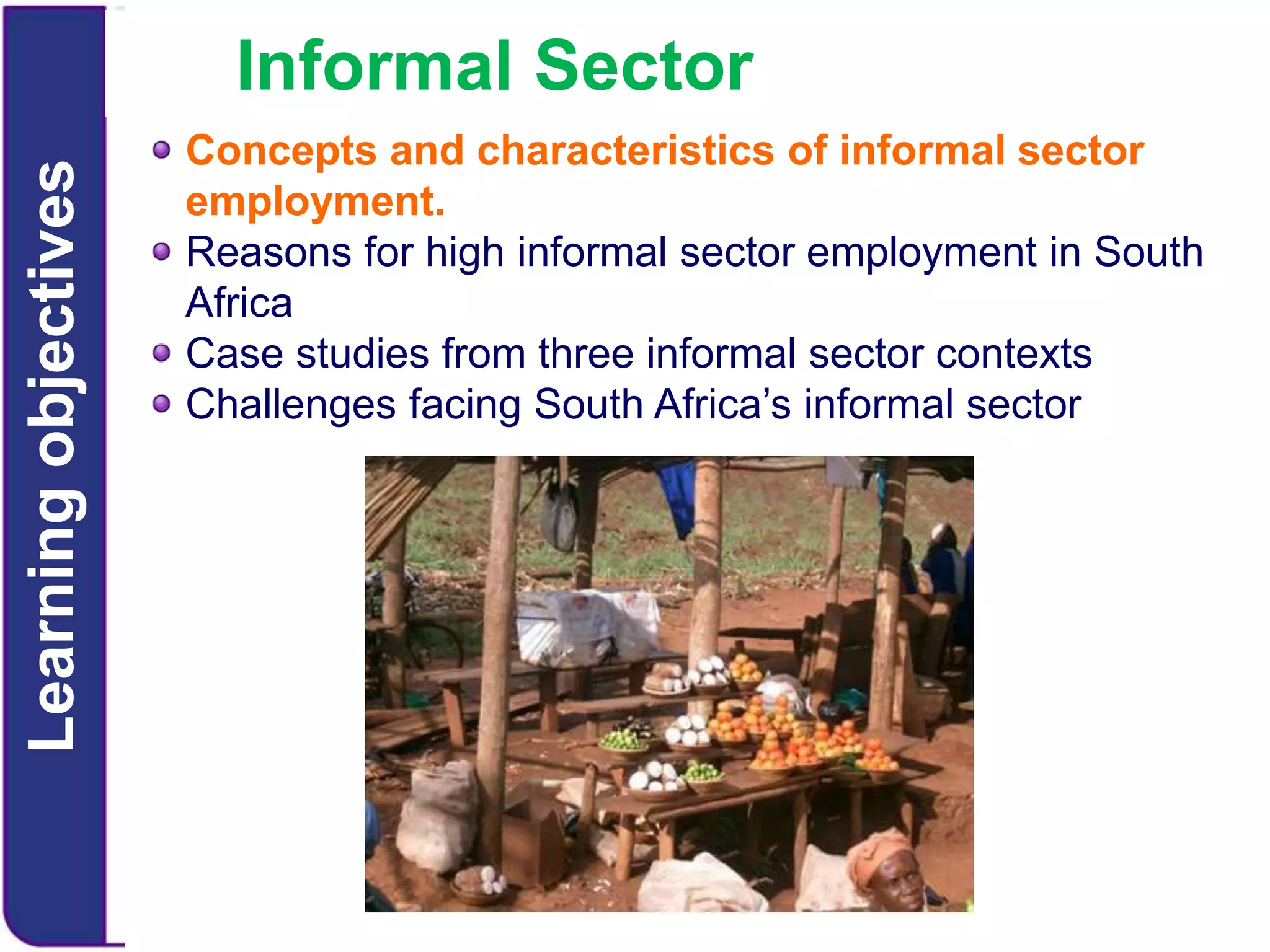
Concepts and characteristics of informal sector
employment.
Reasons for high informal sector employment in South
Africa
Case studies from three informal sector contexts
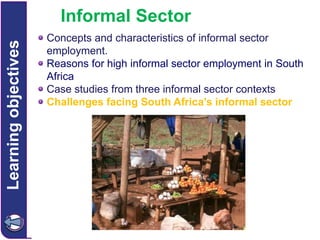
Challenges facing South Africa’s informal sector
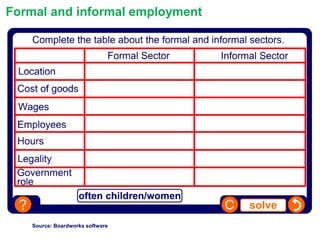
What are the formal and informal sectors?
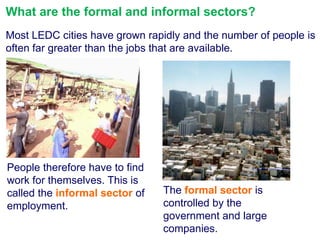
Most LEDC cities have grown rapidly and the number of people is
often far greater than the jobs that are available.

People therefore have to find
work for themselves. This is
called the informal sector of
employment.

The formal sector is
controlled by the
government and large
companies.
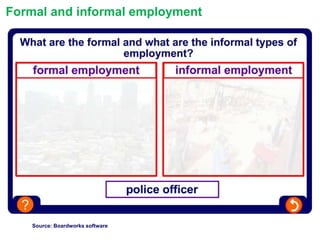
Formal and informal employment

Source: Boardworks software
Formal and informal employment

Source: Boardworks software
Industry in LEDCs quiz

Source: Boardworks software
Key ideas

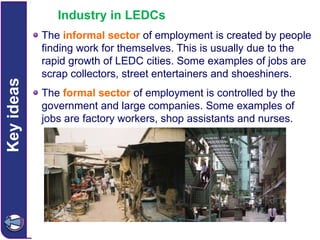
Industry in LEDCs
The informal sector of employment is created by people
finding work for themselves. This is usually due to the
rapid growth of LEDC cities. Some examples of jobs are
scrap collectors, street entertainers and shoeshiners.
The formal sector of employment is controlled by the
government and large companies. Some examples of
jobs are factory workers, shop assistants and nurses.
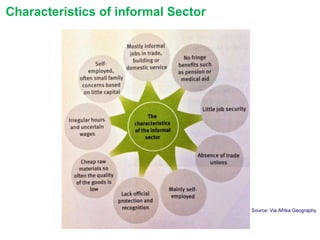
Characteristics of informal Sector

Source: Via Afrika Geography
Learning objectives

Informal Sector
Concepts and characteristics of informal sector
employment.
Reasons for high informal sector employment in
South Africa
Case studies from three informal sector contexts
Challenges facing South Africa’s informal sector
Statistics on high Informal Employment

• It is estimated that about 3 million out of a
labour force of about 13 million are in the
informal sector and is growing at 8% per year.
• It accounts for between 5 – 10 percent of GDP.
• The official present unemployment rate is
25%.
• South Africa has the 69th biggest informal
sector in the world just after Greece(68th) and
before Poland(70th)
Graphs

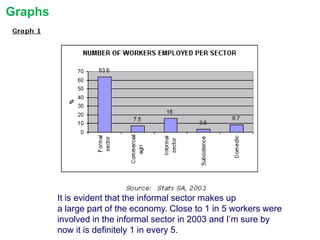
It is evident that the informal sector makes up
a large part of the economy. Close to 1 in 5 workers were
involved in the informal sector in 2003 and I’m sure by
now it is definitely 1 in every 5.
Why are these stats so high?

• Under apartheid, black people were denied entry
to much of the economy except as unskilled or
semi-skilled labourers. With many of these people
unable to get education they enter into the
informal sector.
• As unemployment increases, so does the informal
sector.
• Many informal jobs are carried out by non-South
Africans. A lot of Zimbabweans as they are often
denied formal employment.
Learning objectives

Informal Sector
Concepts and characteristics of informal sector
employment.
Reasons for high informal sector employment in South
Africa
Case studies from three informal sector contexts
Challenges facing South Africa’s informal sector
Informal Trading in Manguang
• A survey was conducted in the Manguang municipality in the Free
State.
• It found that:
• 30% of traders were women
• Age range was 18 – 64
• 31% had no secondary education
• 21% were also employed in the formal sector
• There was a wide range of occupations
• The traders earn an average of R5 300 per month but this varies
considerably.
• The highest earner was a shebeen operator who made R90 000 a
month.
Manguang Informal Traders

• Agriculture is aided by informal traders, as
hawkers buy nearly half of the potatoes traded
on markets and a quarter of all market produce
in Manguang. This share is growing by 2%.
• 40% of a certain cool drink’s sales in South
Africa are generated by informal traders.
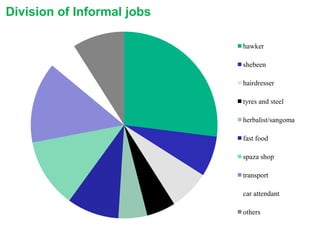
Division of Informal jobs
hawker
shebeen
hairdresser
tyres and steel
herbalist/sangoma
fast food
spaza shop
transport
car attendant
others
Michael enters Informal Sector

• Michael is a young South African male that is
currently employed in the informal sector.
• He was born into a poor family in a squattercamp just outside of Benoni and was unable to
afford any form of education or training.
• He did not have the skills to be employed in
the formal sector of the country and had to find
a way to earn an income.
Problem

• There are too many people in our country that
do not have the skills and qualifications to get
proper jobs in the formal sector which is why
the informal sector is growing.
• South Africa as a country needs to reduce the
amount of people that enter into the formal
sector.
Howard comes to South Africa

• A man named Howard Fled Zim in 1999 for
‘greener pastures’
• He was educated at Prince Edward School
where he obtained 7 O levels.
• He achieved a 4-year diploma in mechanical
engineering from the Harare Polytech.
• He now sells wire structures and catapults
outside a shopping centre.
• Good day – R600 Average R300
Why is Howard not in the Formal sector?
• As a Zimbabwean he suffers discrimination from local
residents as they feel he is steeling their jobs.
• Howard has not been as badly affected as some Zimbabweans
who have had their shops looted and burnt down.
• He has friends in the informal sector, most of whom are also
Zimbabwean.
• Howard one day hopes to return to Zimbabwe like many other
foreigners working in the informal sector in South Africa.
• Howard is lucky as he has been granted residence status and
legally lives in SA.
Time to Think

• Why do you think it is very hard to obtain
accurate statistics about the informal sector?
Learning objectives

Informal Sector
Concepts and characteristics of informal sector
employment.
Reasons for high informal sector employment in South
Africa
Case studies from three informal sector contexts
Challenges facing South Africa’s informal sector
Challenges facing the Informal Sector
•
•
•
•
•

People earn less income, which is irregular and variable.
Businesses lack the potential for growth.
Limited access to raw materials and funding.
Usually outdoors no matter the conditions.
People have little time or incentive to improve their education or
training.
• Many have diseases, and as work gets tougher they start to struggle.
• Many foods and goods are sold off the pavement which is extremely
unhygienic and unhealthy.
• Many of the informal workers are subject to xenophobia because
they are foreign.
Challenges facing the Informal Sector

• Many people in the informal sector have no other
choice, they have no money or can’t find a job
anywhere for numerous reasons and so have to
work in the informal sector.
• Many of the foreigners that come to South Africa
for brighter futures end up in the informal sector
because nobody will give them a job.
• The sector is continuously growing and needs to
be halted.
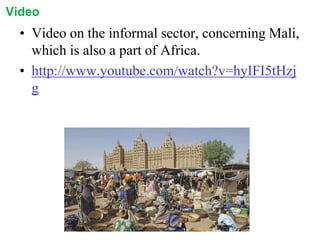
Video

• Video on the informal sector, concerning Mali,
which is also a part of Africa.
• http://www.youtube.com/watch?v=hyIFI5tHzj
g
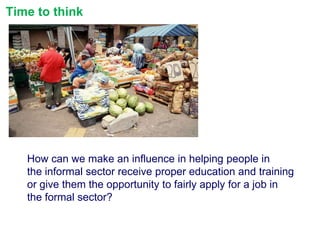
Time to think

How can we make an influence in helping people in
the informal sector receive proper education and training
or give them the opportunity to fairly apply for a job in
the formal sector?

Informal Sector

  • 1.
    Learning objectives Informal Sector Conceptsand characteristics of informal sector employment. Reasons for high informal sector employment in South Africa Case studies from three informal sector contexts Challenges facing South Africa’s informal sector
  • 2.
    What are theformal and informal sectors? Most LEDC cities have grown rapidly and the number of people is often far greater than the jobs that are available. People therefore have to find work for themselves. This is called the informal sector of employment. The formal sector is controlled by the government and large companies.
  • 3.
    Formal and informalemployment Source: Boardworks software
  • 4.
    Formal and informalemployment Source: Boardworks software
  • 5.
    Industry in LEDCsquiz Source: Boardworks software
  • 6.
    Key ideas Industry inLEDCs The informal sector of employment is created by people finding work for themselves. This is usually due to the rapid growth of LEDC cities. Some examples of jobs are scrap collectors, street entertainers and shoeshiners. The formal sector of employment is controlled by the government and large companies. Some examples of jobs are factory workers, shop assistants and nurses.
  • 7.
    Characteristics of informalSector Source: Via Afrika Geography
  • 8.
    Learning objectives Informal Sector Conceptsand characteristics of informal sector employment. Reasons for high informal sector employment in South Africa Case studies from three informal sector contexts Challenges facing South Africa’s informal sector
  • 9.
    Statistics on highInformal Employment • It is estimated that about 3 million out of a labour force of about 13 million are in the informal sector and is growing at 8% per year. • It accounts for between 5 – 10 percent of GDP. • The official present unemployment rate is 25%. • South Africa has the 69th biggest informal sector in the world just after Greece(68th) and before Poland(70th)
  • 10.
    Graphs It is evidentthat the informal sector makes up a large part of the economy. Close to 1 in 5 workers were involved in the informal sector in 2003 and I’m sure by now it is definitely 1 in every 5.
  • 11.
    Why are thesestats so high? • Under apartheid, black people were denied entry to much of the economy except as unskilled or semi-skilled labourers. With many of these people unable to get education they enter into the informal sector. • As unemployment increases, so does the informal sector. • Many informal jobs are carried out by non-South Africans. A lot of Zimbabweans as they are often denied formal employment.
  • 12.
    Learning objectives Informal Sector Conceptsand characteristics of informal sector employment. Reasons for high informal sector employment in South Africa Case studies from three informal sector contexts Challenges facing South Africa’s informal sector
  • 13.
    Informal Trading inManguang • A survey was conducted in the Manguang municipality in the Free State. • It found that: • 30% of traders were women • Age range was 18 – 64 • 31% had no secondary education • 21% were also employed in the formal sector • There was a wide range of occupations • The traders earn an average of R5 300 per month but this varies considerably. • The highest earner was a shebeen operator who made R90 000 a month.
  • 14.
    Manguang Informal Traders •Agriculture is aided by informal traders, as hawkers buy nearly half of the potatoes traded on markets and a quarter of all market produce in Manguang. This share is growing by 2%. • 40% of a certain cool drink’s sales in South Africa are generated by informal traders.
  • 15.
    Division of Informaljobs hawker shebeen hairdresser tyres and steel herbalist/sangoma fast food spaza shop transport car attendant others
  • 16.
    Michael enters InformalSector • Michael is a young South African male that is currently employed in the informal sector. • He was born into a poor family in a squattercamp just outside of Benoni and was unable to afford any form of education or training. • He did not have the skills to be employed in the formal sector of the country and had to find a way to earn an income.
  • 17.
    Problem • There aretoo many people in our country that do not have the skills and qualifications to get proper jobs in the formal sector which is why the informal sector is growing. • South Africa as a country needs to reduce the amount of people that enter into the formal sector.
  • 18.
    Howard comes toSouth Africa • A man named Howard Fled Zim in 1999 for ‘greener pastures’ • He was educated at Prince Edward School where he obtained 7 O levels. • He achieved a 4-year diploma in mechanical engineering from the Harare Polytech. • He now sells wire structures and catapults outside a shopping centre. • Good day – R600 Average R300
  • 19.
    Why is Howardnot in the Formal sector? • As a Zimbabwean he suffers discrimination from local residents as they feel he is steeling their jobs. • Howard has not been as badly affected as some Zimbabweans who have had their shops looted and burnt down. • He has friends in the informal sector, most of whom are also Zimbabwean. • Howard one day hopes to return to Zimbabwe like many other foreigners working in the informal sector in South Africa. • Howard is lucky as he has been granted residence status and legally lives in SA.
  • 20.
    Time to Think •Why do you think it is very hard to obtain accurate statistics about the informal sector?
  • 21.
    Learning objectives Informal Sector Conceptsand characteristics of informal sector employment. Reasons for high informal sector employment in South Africa Case studies from three informal sector contexts Challenges facing South Africa’s informal sector
  • 22.
    Challenges facing theInformal Sector • • • • • People earn less income, which is irregular and variable. Businesses lack the potential for growth. Limited access to raw materials and funding. Usually outdoors no matter the conditions. People have little time or incentive to improve their education or training. • Many have diseases, and as work gets tougher they start to struggle. • Many foods and goods are sold off the pavement which is extremely unhygienic and unhealthy. • Many of the informal workers are subject to xenophobia because they are foreign.
  • 23.
    Challenges facing theInformal Sector • Many people in the informal sector have no other choice, they have no money or can’t find a job anywhere for numerous reasons and so have to work in the informal sector. • Many of the foreigners that come to South Africa for brighter futures end up in the informal sector because nobody will give them a job. • The sector is continuously growing and needs to be halted.
  • 24.
    Video • Video onthe informal sector, concerning Mali, which is also a part of Africa. • http://www.youtube.com/watch?v=hyIFI5tHzj g
  • 25.
    Time to think Howcan we make an influence in helping people in the informal sector receive proper education and training or give them the opportunity to fairly apply for a job in the formal sector?