The document provides guidance for conducting a research synthesis. It discusses the purpose of a research synthesis, which is to gain in-depth knowledge of studies in one's area of interest. It also lists several questions researchers should aim to answer when reviewing a research article, such as the problem investigated, debates in the field, research questions, methods used, findings, and how the article can contribute to one's own thesis. The document uses an example research article by García & López-Velásquez (2003) to illustrate how to extract these details and demonstrate understanding of the key elements of a research study.
The WHY ofthe Research
Synthesis
Gain deep knowledge of
studies in the area of your interest
Exposure to academic language
Used in your area of interest
Presents work done by a community
of researchers interested in the same area
(debates/lit review)
3.
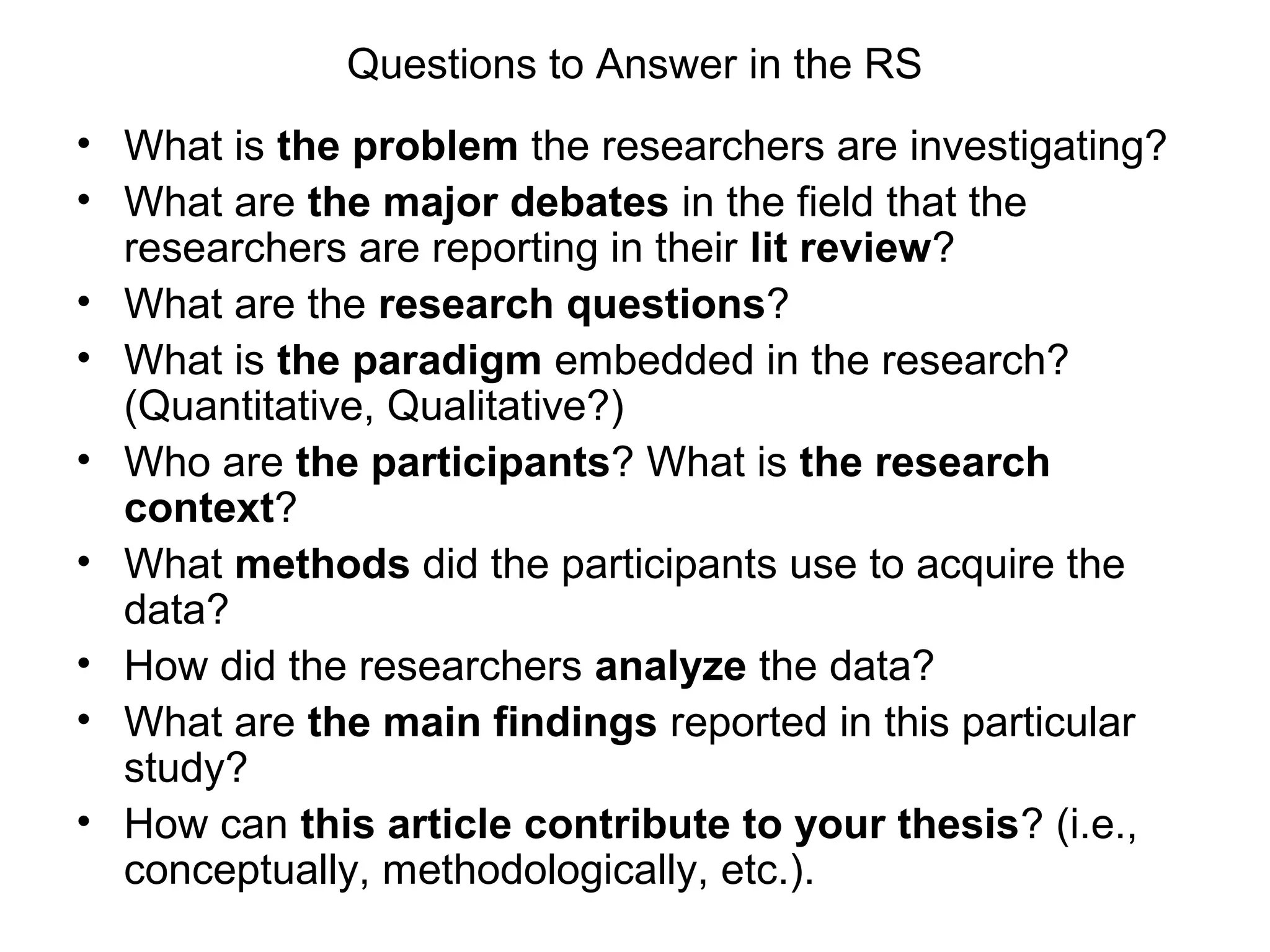
Questions to Answerin the RS
• What is the problem the researchers are investigating?
• What are the major debates in the field that the
researchers are reporting in their lit review?
• What are the research questions?
• What is the paradigm embedded in the research?
(Quantitative, Qualitative?)
• Who are the participants? What is the research
context?
• What methods did the participants use to acquire the
data?
• How did the researchers analyze the data?
• What are the main findings reported in this particular
study?
• How can this article contribute to your thesis? (i.e.,
conceptually, methodologically, etc.).
4.
The problem
• Wheredo we typically find the problem in
a research article?
•In the abstract
•In the introduction
5.
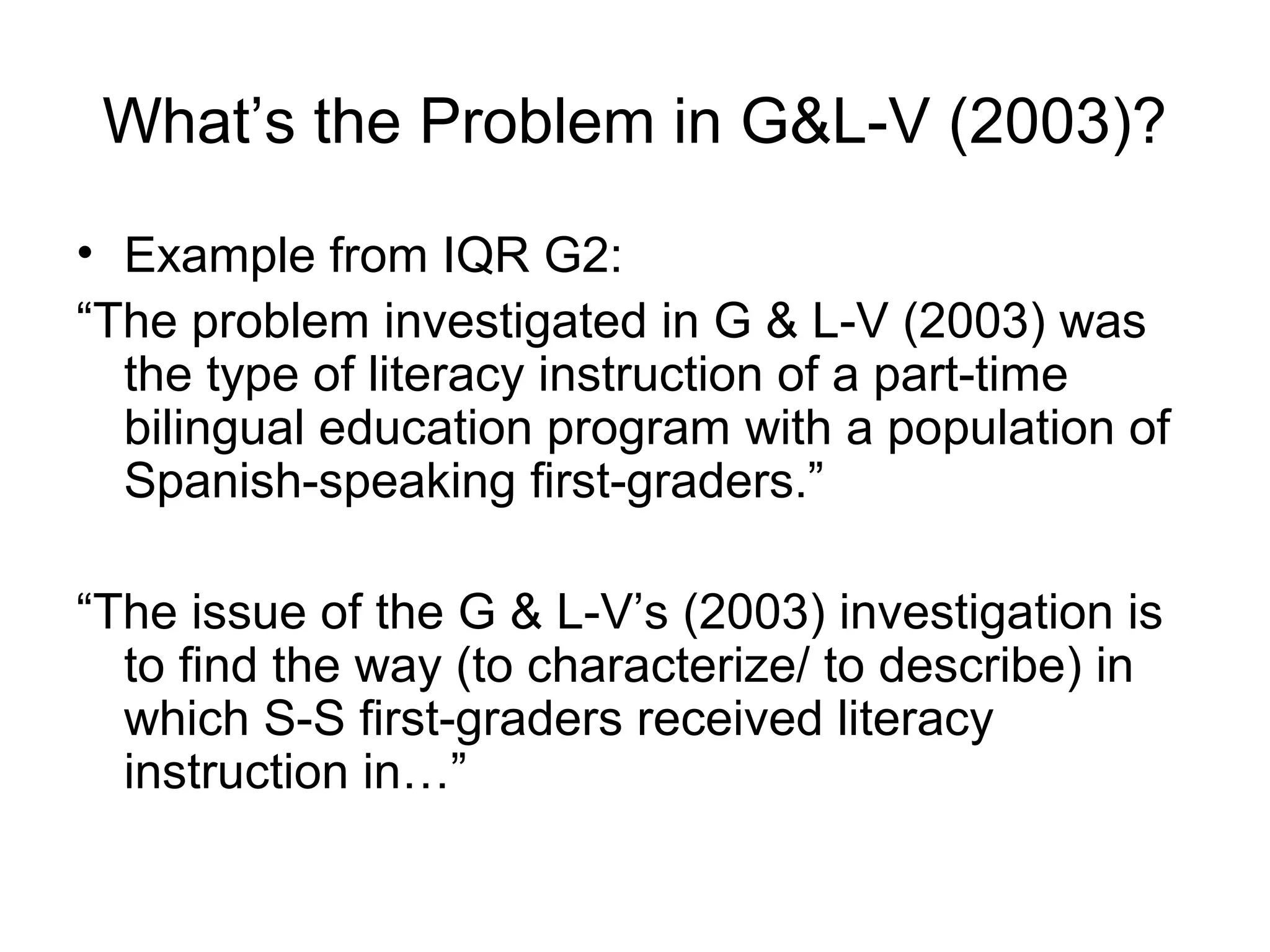
What’s the Problemin G&L-V (2003)?
• Example from IQR G2:
“The problem investigated in G & L-V (2003) was
the type of literacy instruction of a part-time
bilingual education program with a population of
Spanish-speaking first-graders.”
“The issue of the G & L-V’s (2003) investigation is
to find the way (to characterize/ to describe) in
which S-S first-graders received literacy
instruction in…”
6.
The Major Debates(high value point)
• Where do we find the major debates in a
research article?
– In the literature review
• What are other ways that the debates are
called?
– Perspectives
– Theoretical framework
– Literature review
7.
When writing thedebates of an
article…
• Choose the most relevant ones for the
topic
• Use indirect or reported speech
• Paraphrase the author’s idea (you need to
comprehend first what the author means)
8.
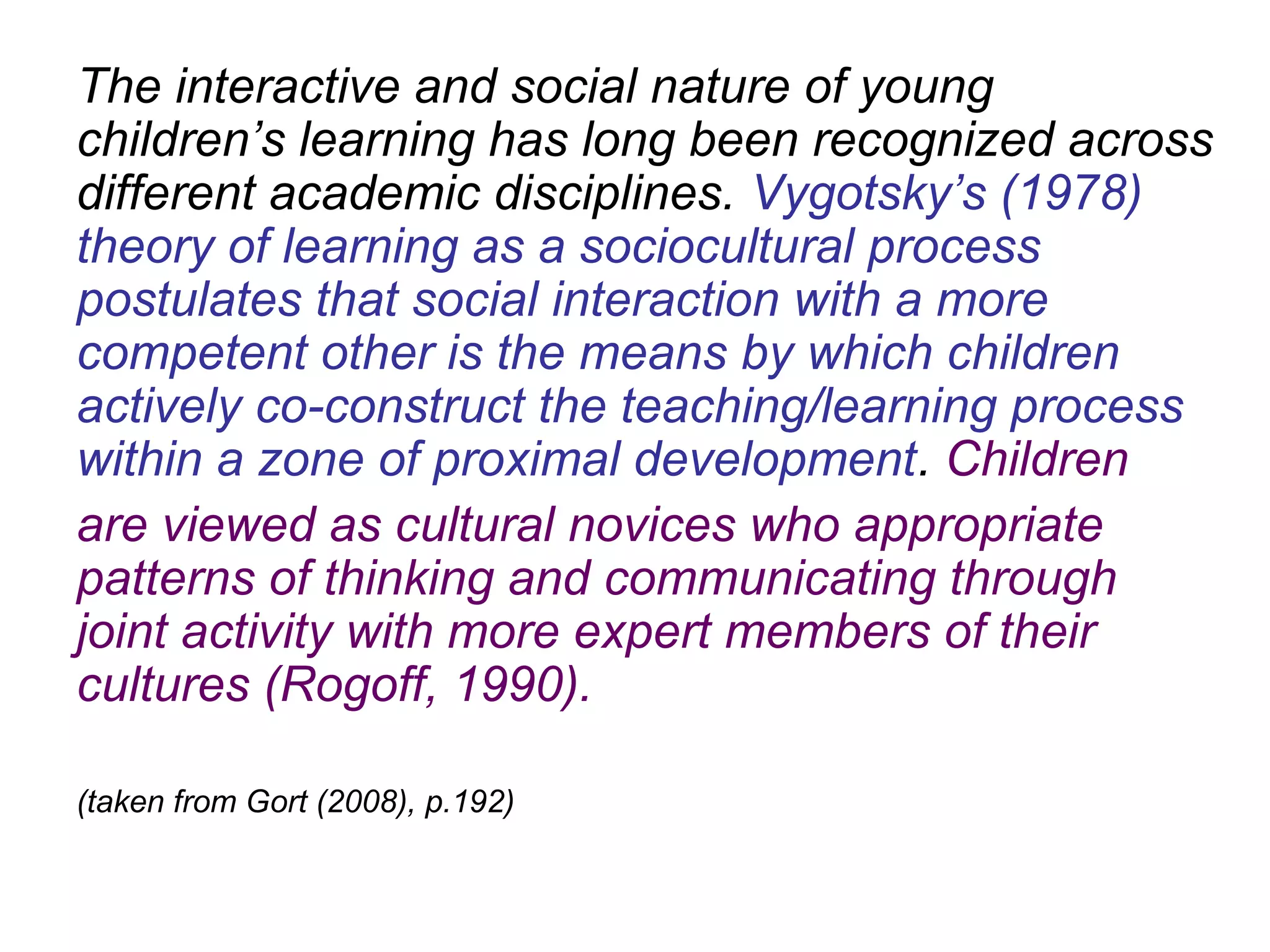
The interactive andsocial nature of young
children’s learning has long been recognized across
different academic disciplines. Vygotsky’s (1978)
theory of learning as a sociocultural process
postulates that social interaction with a more
competent other is the means by which children
actively co-construct the teaching/learning process
within a zone of proximal development. Children
are viewed as cultural novices who appropriate
patterns of thinking and communicating through
joint activity with more expert members of their
cultures (Rogoff, 1990).
(taken from Gort (2008), p.192)
9.
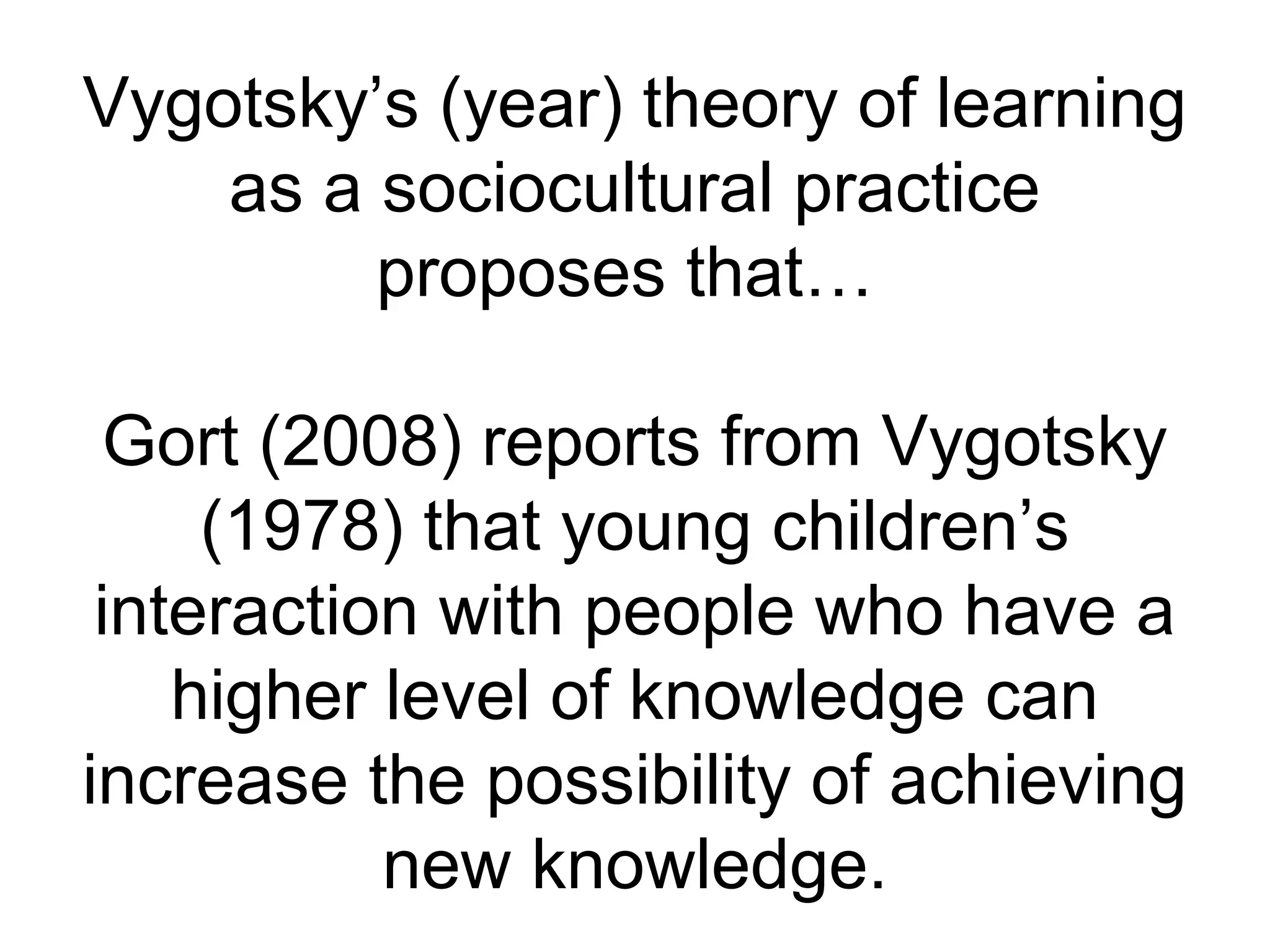
Vygotsky’s (year) theoryof learning
as a sociocultural practice
proposes that…
Gort (2008) reports from Vygotsky
(1978) that young children’s
interaction with people who have a
higher level of knowledge can
increase the possibility of achieving
new knowledge.
10.
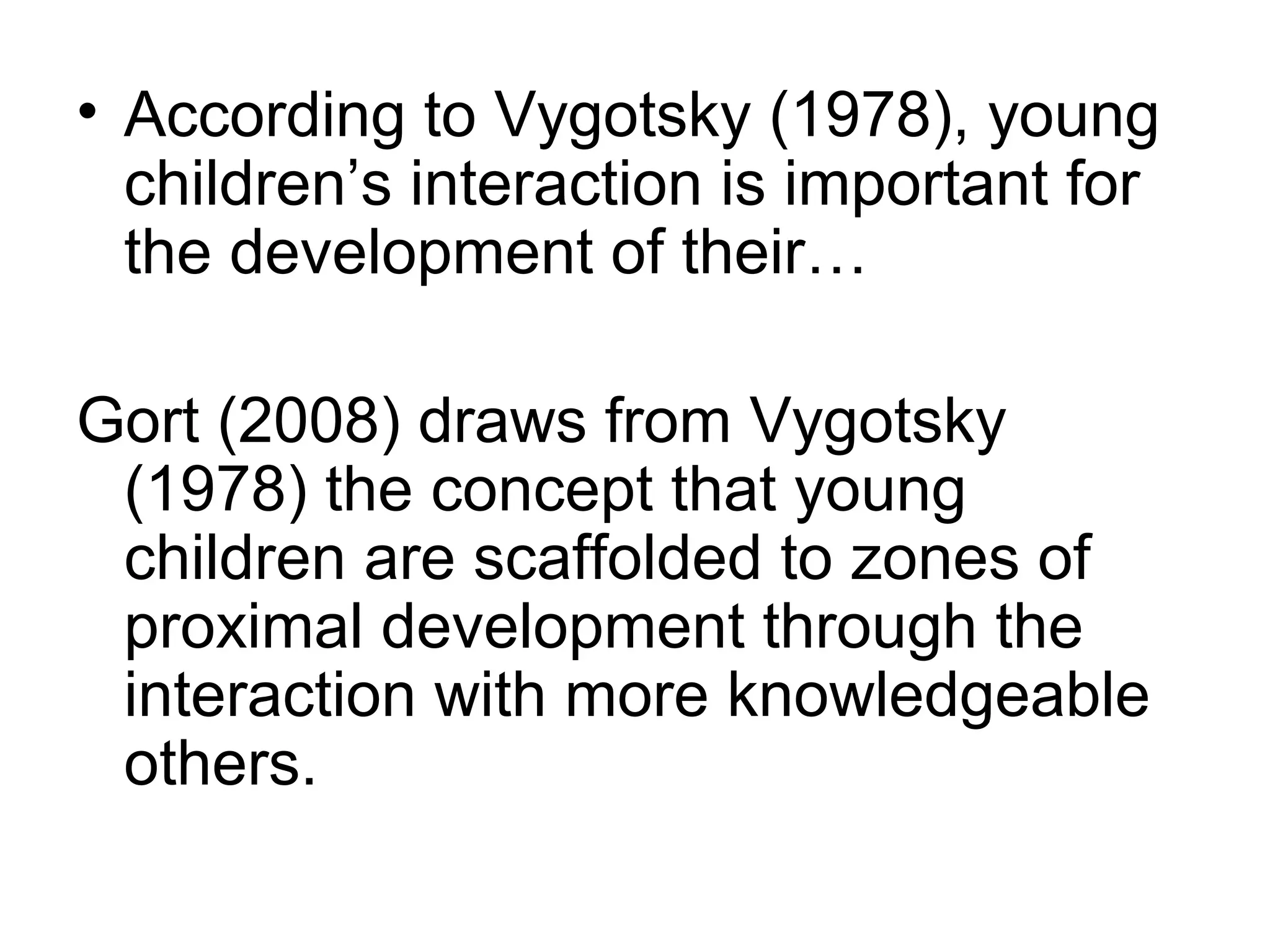
• According toVygotsky (1978), young
children’s interaction is important for
the development of their…
Gort (2008) draws from Vygotsky
(1978) the concept that young
children are scaffolded to zones of
proximal development through the
interaction with more knowledgeable
others.
11.
• Gort (2008)cites the work by
Vygotsky (1978) where he
states that young children’s
interaction with people who
have a higher level of
knowledge can increase the
possibility of achieving new
knowledge.
12.
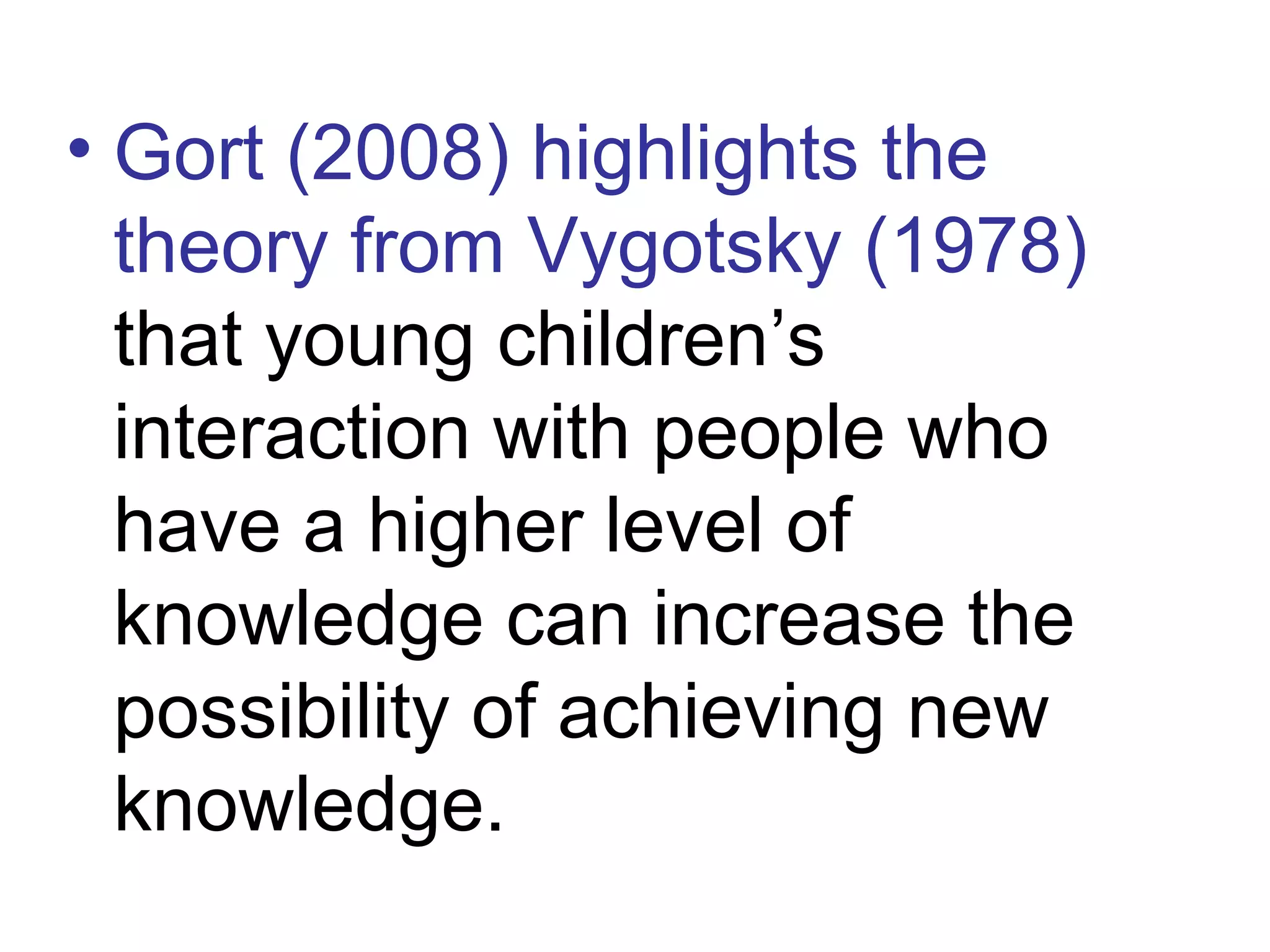
• Gort (2008)highlights the
theory from Vygotsky (1978)
that young children’s
interaction with people who
have a higher level of
knowledge can increase the
possibility of achieving new
knowledge.
13.
Gort (2008) drawsfrom Rogoff
(1990) the idea that children
are known as cultural learners
who adapt/construct their
knowledge through the
experiences that they have
with other members of their
culture.
14.
Reporting Debates
Gort (2008)uses Vygotsky’s theory of learning as
a sociocultural process to propose in her study
that children learn when they interact with others
who know more, by co-constructing knowledge.
The researcher also draws from Rogoff’s (1990)
view of children as cultural novices who
constantly learn their culture in their interaction
with others who are experts in that culture.
15.
G & L-V(2003) draw from Tharp
& Gallimore (1988) the idea that
identity, definition or execution,
timing, place, and motivation of
an activity affects/influences
children’s acquisition of
knowledge.
16.
G & L-V(2003) point out Moll (1990) and
Wertsch’s (1985) insights that
Social interaction
Context
Way
instruction, social interaction it is
important, to understand how children
learn.
The Paradigm
• Isthe study qualitative or quantitative?
• What’s the evidence?
– Nature of research questions
– Methods of data collection (tests vs.
interviews)
– Data analysis (statistics vs. constant-
comparative)
19.
Participants and Context
•Should be explicit in the
article
• Enough detail to
understand the situation
of the study (e.g., grade-
level, bilingual status,
SES, degree of literacy)
Methods
• Should be explicit in the
article
• Only mention the
methods used
Participants, Context, and Methods
20.
Analysis and Findings(high value point)
Analysis
• If statistical
(quantitative), only
mention it.
• If interpretive
(qualitative),describe
in detail what
researchers did.
Findings
• You should
demonstrate
understanding of the
findings
• Paraphrase
• Findings should be
relevant to RQs
21.
Contribution of Articleto your
Thesis or Idea (high value point)
• Be explicit when answering this question.
This point determines the relevance of the
article for your thesis. You need to justify
in this section the selection of the article.
22.
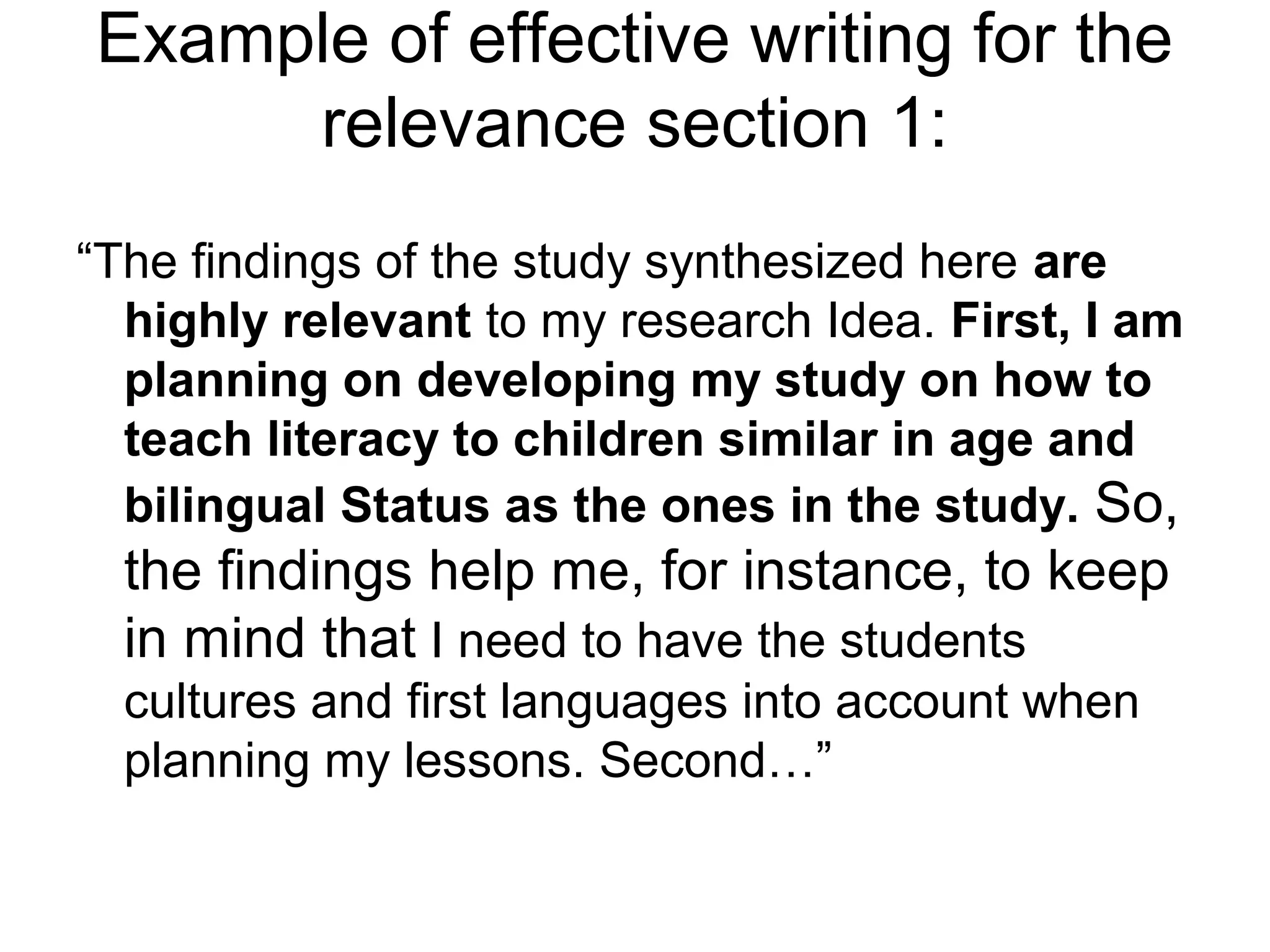
Example of effectivewriting for the
relevance section 1:
“The findings of the study synthesized here are
highly relevant to my research Idea. First, I am
planning on developing my study on how to
teach literacy to children similar in age and
bilingual Status as the ones in the study. So,
the findings help me, for instance, to keep
in mind that I need to have the students
cultures and first languages into account when
planning my lessons. Second…”
23.
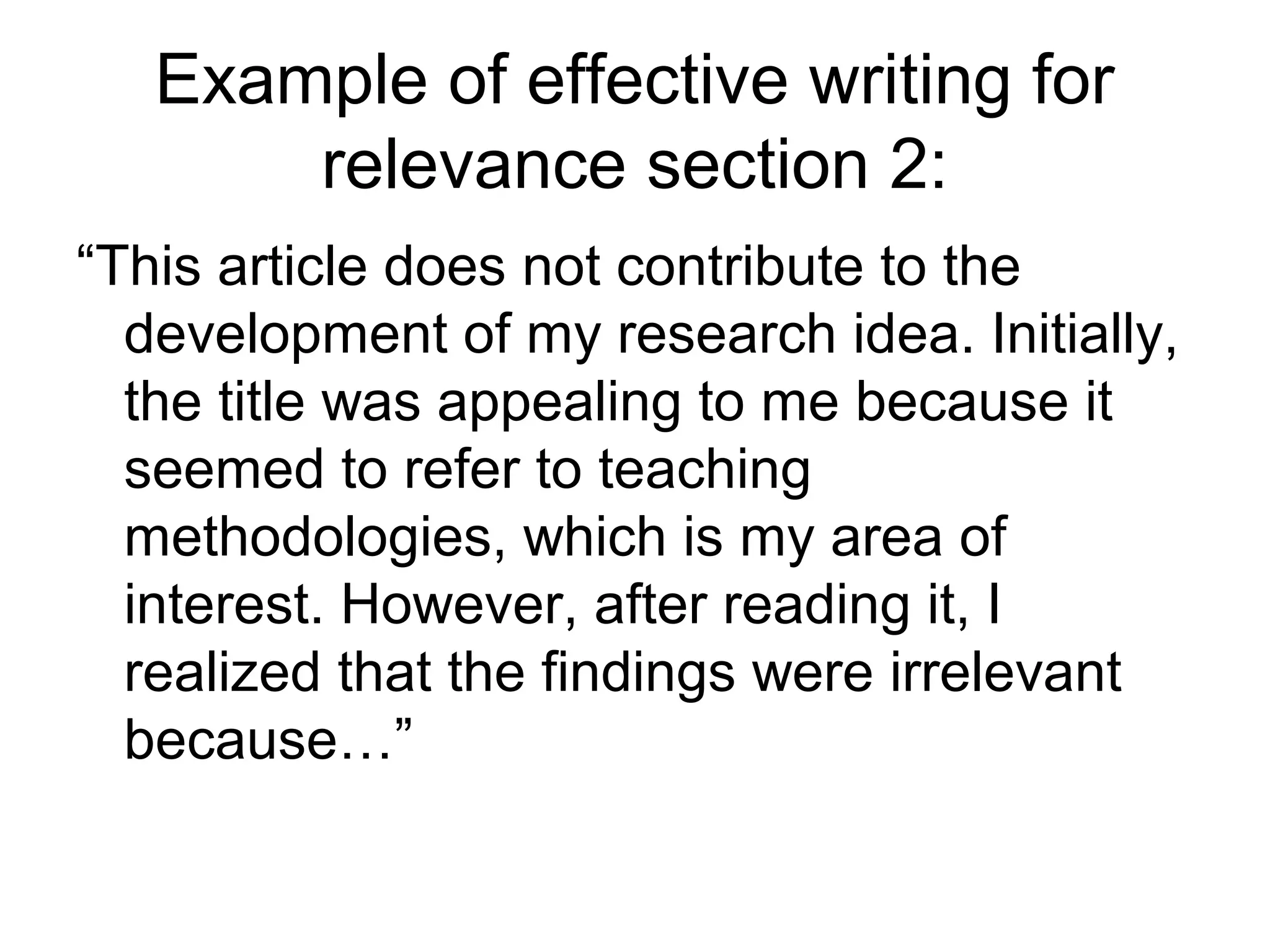
Example of effectivewriting for
relevance section 2:
“This article does not contribute to the
development of my research idea. Initially,
the title was appealing to me because it
seemed to refer to teaching
methodologies, which is my area of
interest. However, after reading it, I
realized that the findings were irrelevant
because…”
24.
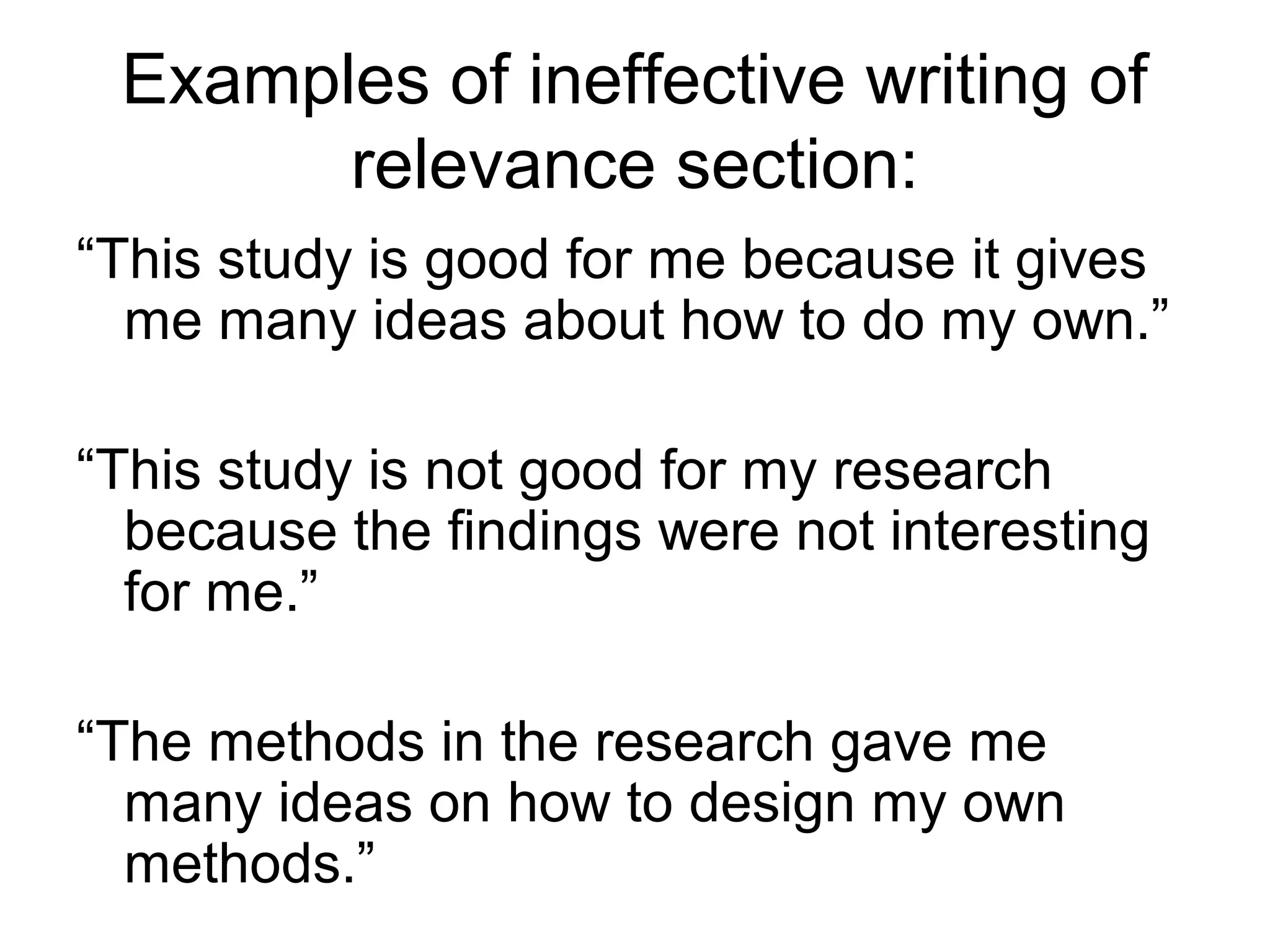
Examples of ineffectivewriting of
relevance section:
“This study is good for me because it gives
me many ideas about how to do my own.”
“This study is not good for my research
because the findings were not interesting
for me.”
“The methods in the research gave me
many ideas on how to design my own
methods.”