The academic app store


                                         Ian Thornton

                            Psychology Department, Swansea University


Thursday, 13 September 12
Take home message

             • Mobile apps have revolutionised the software
               industry

             • “Academic apps” could dramatically change the
               way we produce and consume science


               ECVP 2012           Academic Apps              Ian Thornton


Thursday, 13 September 12
Take home message
             • Produce -- mobile devices can be useful
               experimental platforms

             • Produce -- academic apps could allow us to
               “market” our science in new ways

             • Consume -- readers vs. users


               ECVP 2012            Academic Apps           Ian Thornton


Thursday, 13 September 12
iPad Experiments

             • The iPad (and similar mobile devices) have
               potential as powerful experimental tools

             • Easy to set-up and run a range of experiments
               (particularly with platforms such as Unity)

             • Flexible ways to measure performance


               ECVP 2012            Academic Apps           Ian Thornton


Thursday, 13 September 12
iPad Experiments

             • Changes the dynamics of traditional, lab-based,
               screen-and-keyboard tasks

             • Potential for mass, remote data collection

             • Easy to network, for joint action


               ECVP 2012             Academic Apps          Ian Thornton


Thursday, 13 September 12
Take home message
             • Produce -- mobile devices can be useful
               experimental platforms

             • Produce -- academic apps could allow us to
               “market” our science in new ways

             • Consume -- readers vs. users


               ECVP 2012            Academic Apps           Ian Thornton


Thursday, 13 September 12
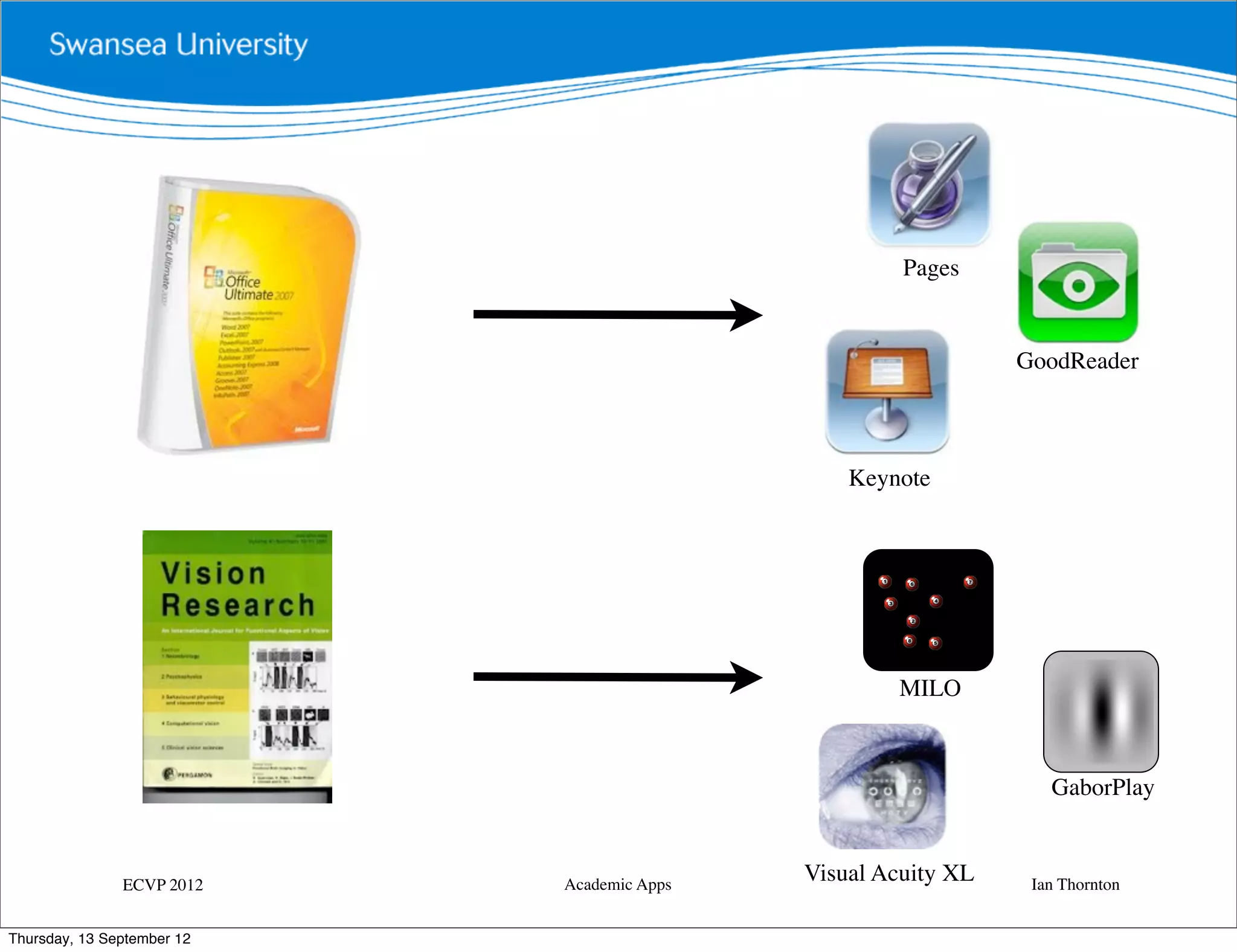
Pages


                                                               GoodReader


                                                Keynote


                                                    MILO


                                                                  GaborPlay


               ECVP 2012    Academic Apps
                                            Visual Acuity XL    Ian Thornton


Thursday, 13 September 12
Overview

             • Background on “apps”

             • Academic Apps -- a working example

             • Discussion


               ECVP 2012          Academic Apps     Ian Thornton


Thursday, 13 September 12
Background
             • Mobile apps are single-use or limited function
               pieces of application software, designed for smart
               phones and tablets.

             • They redefined “software” as “content”

             • The majority of apps are still games, but also span
               the whole range covered by traditional
               applications (500, 000 titles just on Apple Store)

               ECVP 2012             Academic Apps           Ian Thornton


Thursday, 13 September 12
Background

             • Reduction in scale/function initially driven by
               tech limits of mobile devices. Now desktop apps

             • App Store (2008) opened up a whole new way to
               market and distribute software

             • Independent developers vs. software giants


               ECVP 2012            Academic Apps           Ian Thornton


Thursday, 13 September 12
Overview

             • Background on “apps”

             • Academic Apps -- a working example

             • Discussion


               ECVP 2012          Academic Apps     Ian Thornton


Thursday, 13 September 12
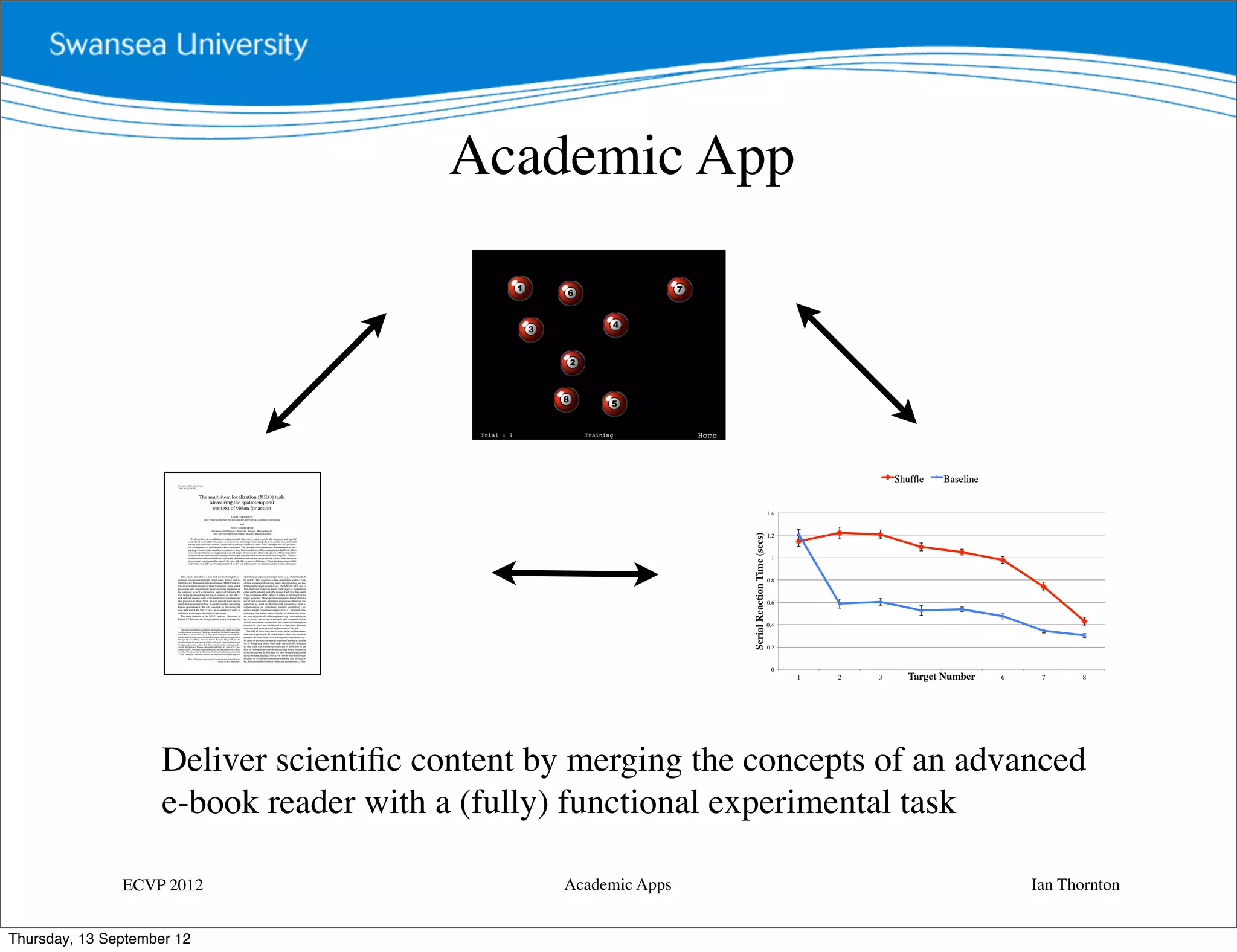
Academic App


                       Perception & Psychophysics
                                                                                                                                                                                                                                                    Shuffle!   Baseline!
                       2004, 66 (1), 38-50


                                               The multi-item localization (MILO) task:
                                                   Measuring the spatiotemporal
                                                    context of vision for action
                                                                             IAN M. THORNTON
                                                                                                                                                                                                                              1.4!
                                                     Max Planck Institute for Biological Cybernetics, Tübingen, Germany
                                                                                               and
                                                                            TODD S. HOROWITZ
                                                              Brigham and Women’s Hospital, Boston, Massachusetts


                                                                                                                                                                                               Serial Reaction Time (secs)!
                                                               and Harvard Medical School, Boston, Massachusetts

                                     We describe a new multi-item localization task that can be used to probe the temporal and spatial
                                                                                                                                                                                                                              1.2!
                                  contexts of search-like behaviors. A sequence of four target letters (e.g., E, F, G, and H) was presented
                                  among four distractor letters. Observers located the targets in order. Both retrospective and prospec-
                                  tive components of performance were examined. The retrospective component was assessed by hav-
                                  ing target items either vanish or remain once they had been located. This manipulation had little effect
                                  on search performance, suggesting that old target items can be efficiently ignored. The prospective
                                  component was assessedby shuffling future target and distractor locations after each response. This ma-
                                  nipulation revealed that observers typically plan ahead at least one target into the future. However, even
                                  when observers cannot plan ahead, they are still able to ignore old targets. These findings suggest that
                                                                                                                                                                                                                                1!
                                  both “what you did” and “what you intend to do” can influence the localization and selection of targets.


                          This article introduces a new task for exploring the se-                      alphabetical sequence of target items (e.g., the letters E, F,
                       quential selection of multiple target items during search-
                       like behavior. This multi-item localization(MILO) task dif-
                                                                                                        G, and H). This sequence is then distributed within a field
                                                                                                        of four additional distracting items, two preceding and two
                                                                                                                                                                                                                              0.8!
                       fers in a number of respects from traditional visual search                      following the target sequence (e.g., the letters C, D, I, and J).
                       paradigms and, in particular, places a strong emphasis on                        The observers’ task is to locate each target in alphabetical
                       the temporal, as well as the spatial, aspects of behavior. We                    order and to select it, using the mouse. Each trial thus yields
                       will begin by describing the novel features of the MILO                          N reaction times (RTs), where N refers to the length of the
                       task and will discuss some of the theoretical considerations                     target sequence. The experiments reported below all make
                       that gave rise to them. Next, we will present three experi-                      use of such four-item alphabetic sequences. However, it is
                       ments that demonstrate how it can be used for measuring                          important to point out that the task parameters—that is,                                                              0.6!
                       human performance. We will conclude by discussing the                            sequence type (i.e., alphabetic, numeric, or arbitrary), se-
                       ease with which the MILO task can be adapted in order to                         quence length, sequence complexity (i.e., interitem rela-
                       address a wide range of empirical questions.                                     tionships), the nature and/or number of distracting items,
                          The main features of the MILO task are illustrated in                         the ease of physically selecting items (e.g., size or proxim-
                       Figure 1. Observers are first presented with a trial-specific                    ity of items), and so on—can easily and systematically be
                                                                                                        varied. A constant stimulus set has been used throughout
                                                                                                        this article, since our initial goal is to introduce the basic
                                                                                                        structure and more general applications of the task.
                                                                                                                                                                                                                              0.4!
                          The authors contributed equally to this research, and authorship order
                       was determined arbitrarily. Thanks are extended to Richard Abrams, Ray-             The MILO task clearly has its roots in the well-known vi-
                       mond Klein, Cathleen Moore, Jay Pratt, Kimron Shapiro, Jeremy Wolfe,             sual search paradigm.1 In visual search, observers are asked
                       and an anonymous reviewer for useful comments and suggestions and to             to report on some property of a designated target item (e.g.,
                       George Alvarez, Helga Arsenio, Serena Butcher, Megan Hyle, and                   location or presence/absence) presented among a variable
                       Stephan Simon for assistance with data collection. Correspondence may
                       be addressed to either author: T. S. Horowitz, Center for Ophthalmic Re-         set of distracting items. Such tasks are typically designed
                                                                                                        so that each trial isolates a single act of selection in the
                       search, Brigham and Women’s Hospital, 64 Sidney St., Suite 170, Cam-
                       bridge, MA 02139 (e-mail: todd@search.bwh.harvard.edu)or I. M. Thorn-            face of competition from the distracting items, measuring                                                             0.2!
                       ton, Max Planck Institute for Biological Cybernetics, Spemannstrasse 38,         a single response. In this way, we have learned a great deal
                       72076 Tübingen, Germany (e-mail: ian.thornton@tuebingen.mpg.de).
                                                                                                        about the basic building blocks of vision, the overall orga-
                                  Note—This article was accepted by the previous editorial team,        nization of visual information processing, and in particu-
                                                                     headed by Neil Macmillan.          lar, the relationship between vision and attention (e.g., Dun-


                       Copyright 2004 Psychonomic Society, Inc.                                    38                                                                                                                           0!
                                                                                                                                                                                                                                     1!   2!   3!      Target Number!
                                                                                                                                                                                                                                                         4!      5!       6!    7!   8!


                     Deliver scientific content by merging the concepts of an advanced
                     e-book reader with a (fully) functional experimental task

               ECVP 2012                                                                                                                                                       Academic Apps                                                                                   Ian Thornton


Thursday, 13 September 12
Discussion/FAQs
           • Why not just use “web apps”?


           • Is it expensive/complicated to write apps?


           • Giving away the goods? (Freemium model?)


           • Ad Hoc or Academic App store?


           • Who pays?


           • Is this really “Open Science?”

               ECVP 2012                      Academic Apps   Ian Thornton


Thursday, 13 September 12

Academic Apps

  • 1.
    The academic appstore Ian Thornton Psychology Department, Swansea University Thursday, 13 September 12
  • 2.
    Take home message • Mobile apps have revolutionised the software industry • “Academic apps” could dramatically change the way we produce and consume science ECVP 2012 Academic Apps Ian Thornton Thursday, 13 September 12
  • 3.
    Take home message • Produce -- mobile devices can be useful experimental platforms • Produce -- academic apps could allow us to “market” our science in new ways • Consume -- readers vs. users ECVP 2012 Academic Apps Ian Thornton Thursday, 13 September 12
  • 4.
    iPad Experiments • The iPad (and similar mobile devices) have potential as powerful experimental tools • Easy to set-up and run a range of experiments (particularly with platforms such as Unity) • Flexible ways to measure performance ECVP 2012 Academic Apps Ian Thornton Thursday, 13 September 12
  • 5.
    iPad Experiments • Changes the dynamics of traditional, lab-based, screen-and-keyboard tasks • Potential for mass, remote data collection • Easy to network, for joint action ECVP 2012 Academic Apps Ian Thornton Thursday, 13 September 12
  • 6.
    Take home message • Produce -- mobile devices can be useful experimental platforms • Produce -- academic apps could allow us to “market” our science in new ways • Consume -- readers vs. users ECVP 2012 Academic Apps Ian Thornton Thursday, 13 September 12
  • 7.
    Pages GoodReader Keynote MILO GaborPlay ECVP 2012 Academic Apps Visual Acuity XL Ian Thornton Thursday, 13 September 12
  • 8.
    Overview • Background on “apps” • Academic Apps -- a working example • Discussion ECVP 2012 Academic Apps Ian Thornton Thursday, 13 September 12
  • 9.
    Background • Mobile apps are single-use or limited function pieces of application software, designed for smart phones and tablets. • They redefined “software” as “content” • The majority of apps are still games, but also span the whole range covered by traditional applications (500, 000 titles just on Apple Store) ECVP 2012 Academic Apps Ian Thornton Thursday, 13 September 12
  • 10.
    Background • Reduction in scale/function initially driven by tech limits of mobile devices. Now desktop apps • App Store (2008) opened up a whole new way to market and distribute software • Independent developers vs. software giants ECVP 2012 Academic Apps Ian Thornton Thursday, 13 September 12
  • 11.
    Overview • Background on “apps” • Academic Apps -- a working example • Discussion ECVP 2012 Academic Apps Ian Thornton Thursday, 13 September 12
  • 12.
    Academic App Perception & Psychophysics Shuffle! Baseline! 2004, 66 (1), 38-50 The multi-item localization (MILO) task: Measuring the spatiotemporal context of vision for action IAN M. THORNTON 1.4! Max Planck Institute for Biological Cybernetics, Tübingen, Germany and TODD S. HOROWITZ Brigham and Women’s Hospital, Boston, Massachusetts Serial Reaction Time (secs)! and Harvard Medical School, Boston, Massachusetts We describe a new multi-item localization task that can be used to probe the temporal and spatial 1.2! contexts of search-like behaviors. A sequence of four target letters (e.g., E, F, G, and H) was presented among four distractor letters. Observers located the targets in order. Both retrospective and prospec- tive components of performance were examined. The retrospective component was assessed by hav- ing target items either vanish or remain once they had been located. This manipulation had little effect on search performance, suggesting that old target items can be efficiently ignored. The prospective component was assessedby shuffling future target and distractor locations after each response. This ma- nipulation revealed that observers typically plan ahead at least one target into the future. However, even when observers cannot plan ahead, they are still able to ignore old targets. These findings suggest that 1! both “what you did” and “what you intend to do” can influence the localization and selection of targets. This article introduces a new task for exploring the se- alphabetical sequence of target items (e.g., the letters E, F, quential selection of multiple target items during search- like behavior. This multi-item localization(MILO) task dif- G, and H). This sequence is then distributed within a field of four additional distracting items, two preceding and two 0.8! fers in a number of respects from traditional visual search following the target sequence (e.g., the letters C, D, I, and J). paradigms and, in particular, places a strong emphasis on The observers’ task is to locate each target in alphabetical the temporal, as well as the spatial, aspects of behavior. We order and to select it, using the mouse. Each trial thus yields will begin by describing the novel features of the MILO N reaction times (RTs), where N refers to the length of the task and will discuss some of the theoretical considerations target sequence. The experiments reported below all make that gave rise to them. Next, we will present three experi- use of such four-item alphabetic sequences. However, it is ments that demonstrate how it can be used for measuring important to point out that the task parameters—that is, 0.6! human performance. We will conclude by discussing the sequence type (i.e., alphabetic, numeric, or arbitrary), se- ease with which the MILO task can be adapted in order to quence length, sequence complexity (i.e., interitem rela- address a wide range of empirical questions. tionships), the nature and/or number of distracting items, The main features of the MILO task are illustrated in the ease of physically selecting items (e.g., size or proxim- Figure 1. Observers are first presented with a trial-specific ity of items), and so on—can easily and systematically be varied. A constant stimulus set has been used throughout this article, since our initial goal is to introduce the basic structure and more general applications of the task. 0.4! The authors contributed equally to this research, and authorship order was determined arbitrarily. Thanks are extended to Richard Abrams, Ray- The MILO task clearly has its roots in the well-known vi- mond Klein, Cathleen Moore, Jay Pratt, Kimron Shapiro, Jeremy Wolfe, sual search paradigm.1 In visual search, observers are asked and an anonymous reviewer for useful comments and suggestions and to to report on some property of a designated target item (e.g., George Alvarez, Helga Arsenio, Serena Butcher, Megan Hyle, and location or presence/absence) presented among a variable Stephan Simon for assistance with data collection. Correspondence may be addressed to either author: T. S. Horowitz, Center for Ophthalmic Re- set of distracting items. Such tasks are typically designed so that each trial isolates a single act of selection in the search, Brigham and Women’s Hospital, 64 Sidney St., Suite 170, Cam- bridge, MA 02139 (e-mail: todd@search.bwh.harvard.edu)or I. M. Thorn- face of competition from the distracting items, measuring 0.2! ton, Max Planck Institute for Biological Cybernetics, Spemannstrasse 38, a single response. In this way, we have learned a great deal 72076 Tübingen, Germany (e-mail: ian.thornton@tuebingen.mpg.de). about the basic building blocks of vision, the overall orga- Note—This article was accepted by the previous editorial team, nization of visual information processing, and in particu- headed by Neil Macmillan. lar, the relationship between vision and attention (e.g., Dun- Copyright 2004 Psychonomic Society, Inc. 38 0! 1! 2! 3! Target Number! 4! 5! 6! 7! 8! Deliver scientific content by merging the concepts of an advanced e-book reader with a (fully) functional experimental task ECVP 2012 Academic Apps Ian Thornton Thursday, 13 September 12
  • 13.
    Discussion/FAQs • Why not just use “web apps”? • Is it expensive/complicated to write apps? • Giving away the goods? (Freemium model?) • Ad Hoc or Academic App store? • Who pays? • Is this really “Open Science?” ECVP 2012 Academic Apps Ian Thornton Thursday, 13 September 12