ECREA Digital Culture Workshop
University of Salzburg 26-27 November 2015
Antoni Roig, Elisenda Ardèvol, Gemma San Cornelio
Universitat Oberta de Catalunya
Context of the research
Focus on personal narratives generated by users in
social networks.
Selfie as object of study: current example of the
modes of representation of self?
Mixed methods: quantitative analysis and qualitative
analysis with a two-folded aim:
1) to foster the debate on the possibilities and
limitations of “Data Analytics” in social research
2) to expand qualitative research on this issue,
providing a framework of analysis from Big Data.
"Selfiestories and personal data" - Project funded by the BBVA - 12/2015- 12/2016
www.selfiestories.net
Some theoretical references
Selfie as ‘performed’ in different social contexts as part of a personal or
collective narrative (Vivien and Burgess, 2013).
Selfie in a broader spectrum of images and narrative threads that emerge within
and between images conforming larger narrative streams or feeds (Fallon,
2014).
Selfie understood as a cultural form beyond the ‘selfie tag’ (Gunthert, 2015)
Social and technological devices are key to the understanding of the practices
of the selfie and constitute an ‘alternative genealogy’, along with chats and
other ways of technology-mediated interaction (Gómez and Thornham, 2015)
Big data needs thick data (Wang, 2013)www.selfiestories.net
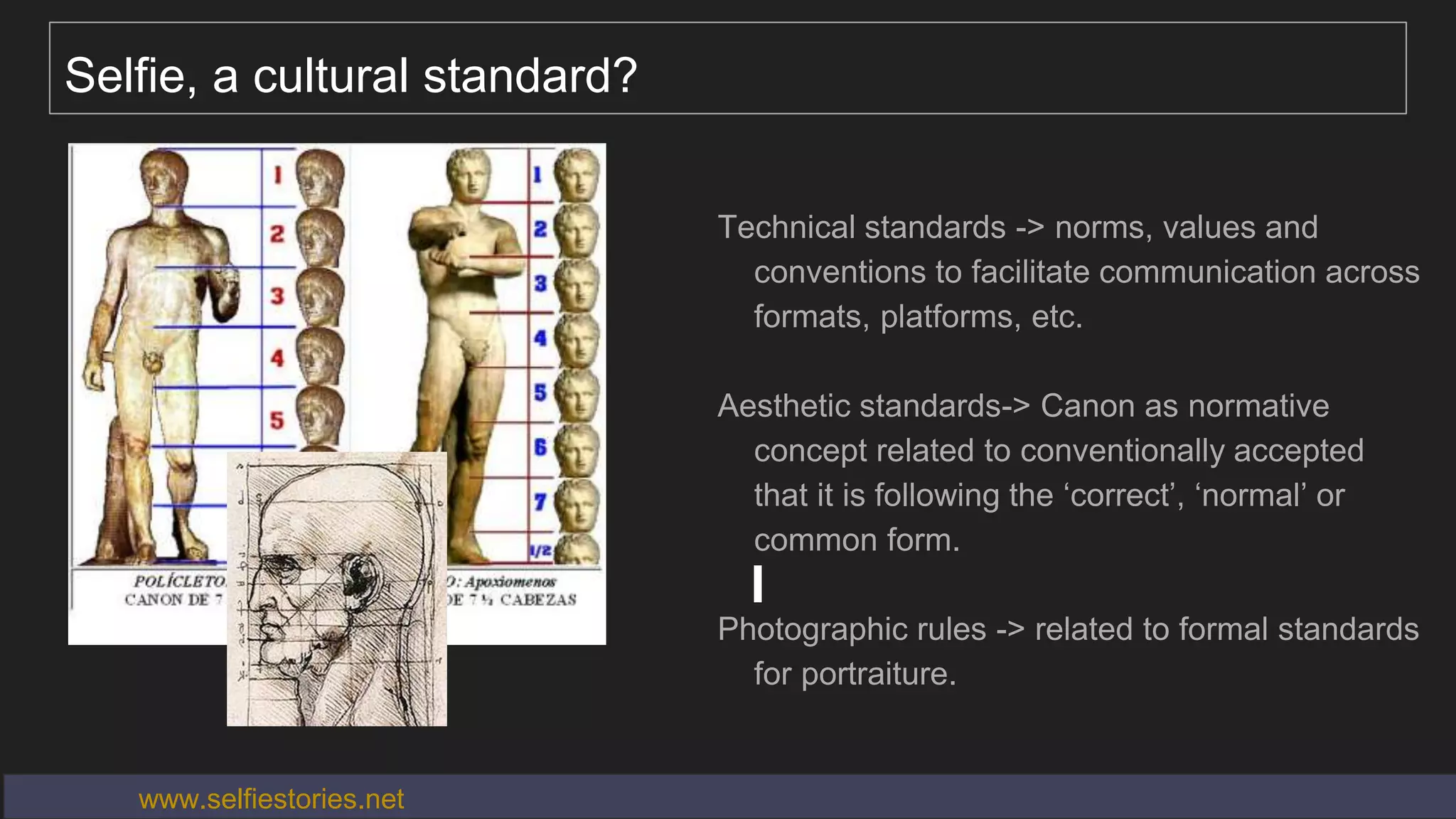
Selfie, a cultural standard?
Technical standards -> norms, values and
conventions to facilitate communication across
formats, platforms, etc.
Aesthetic standards-> Canon as normative
concept related to conventionally accepted
that it is following the ‘correct’, ‘normal’ or
common form.
Photographic rules -> related to formal standards
for portraiture.
www.selfiestories.net
Selfie as a visual standard
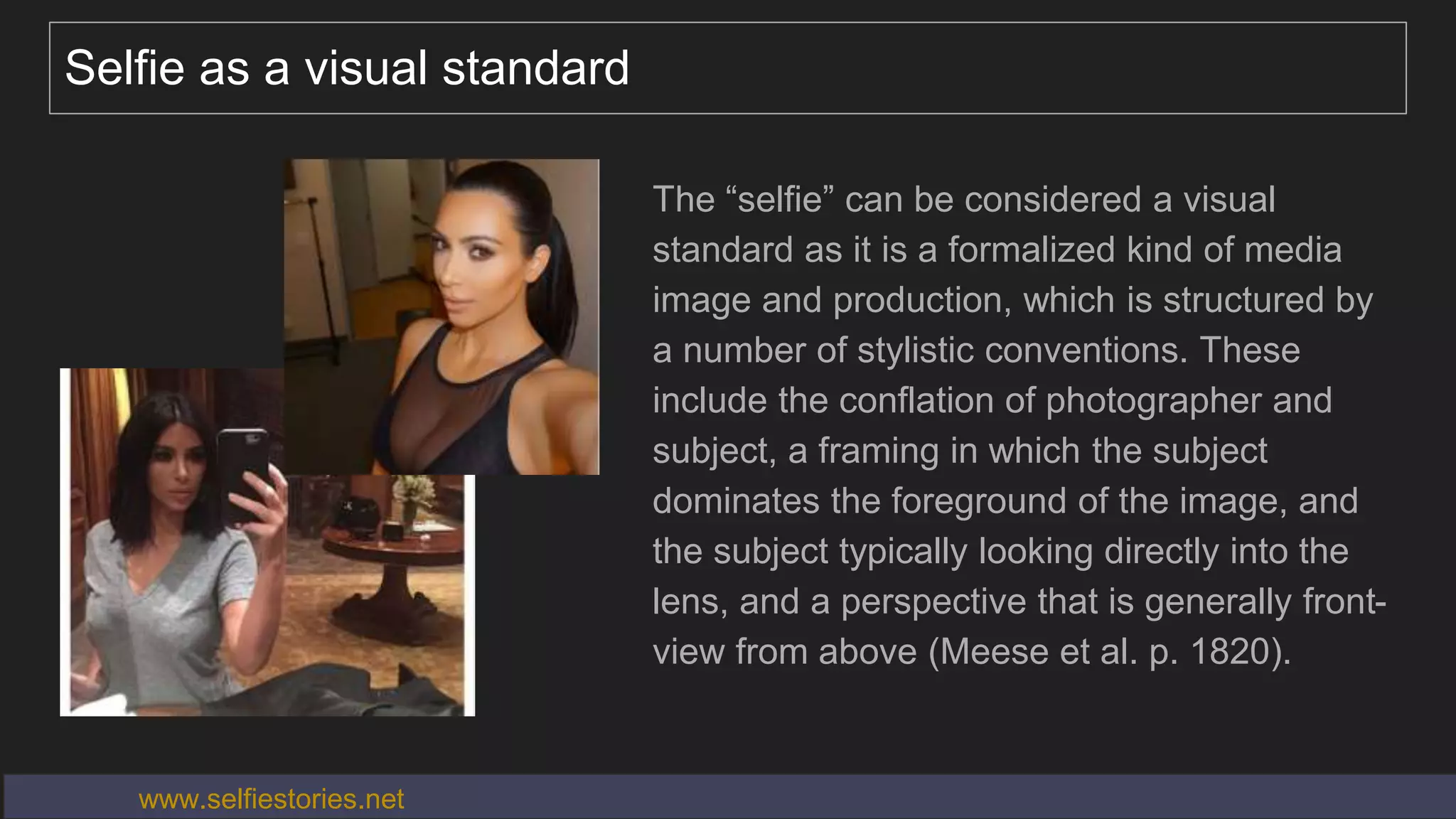
The “selfie” can be considered a visual
standard as it is a formalized kind of media
image and production, which is structured by
a number of stylistic conventions. These
include the conflation of photographer and
subject, a framing in which the subject
dominates the foreground of the image, and
the subject typically looking directly into the
lens, and a perspective that is generally front-
view from above (Meese et al. p. 1820).
www.selfiestories.net
Formal analysis of selfies
From a formal perspective, selfies have some
common traits that some authors have analysed,
trying to find rules.
Manovich - Selfiecity (2013) They find some slightly
different poses (such as the head tilt, or the
tendency to smile) in the different cities where the
selfies were extracted
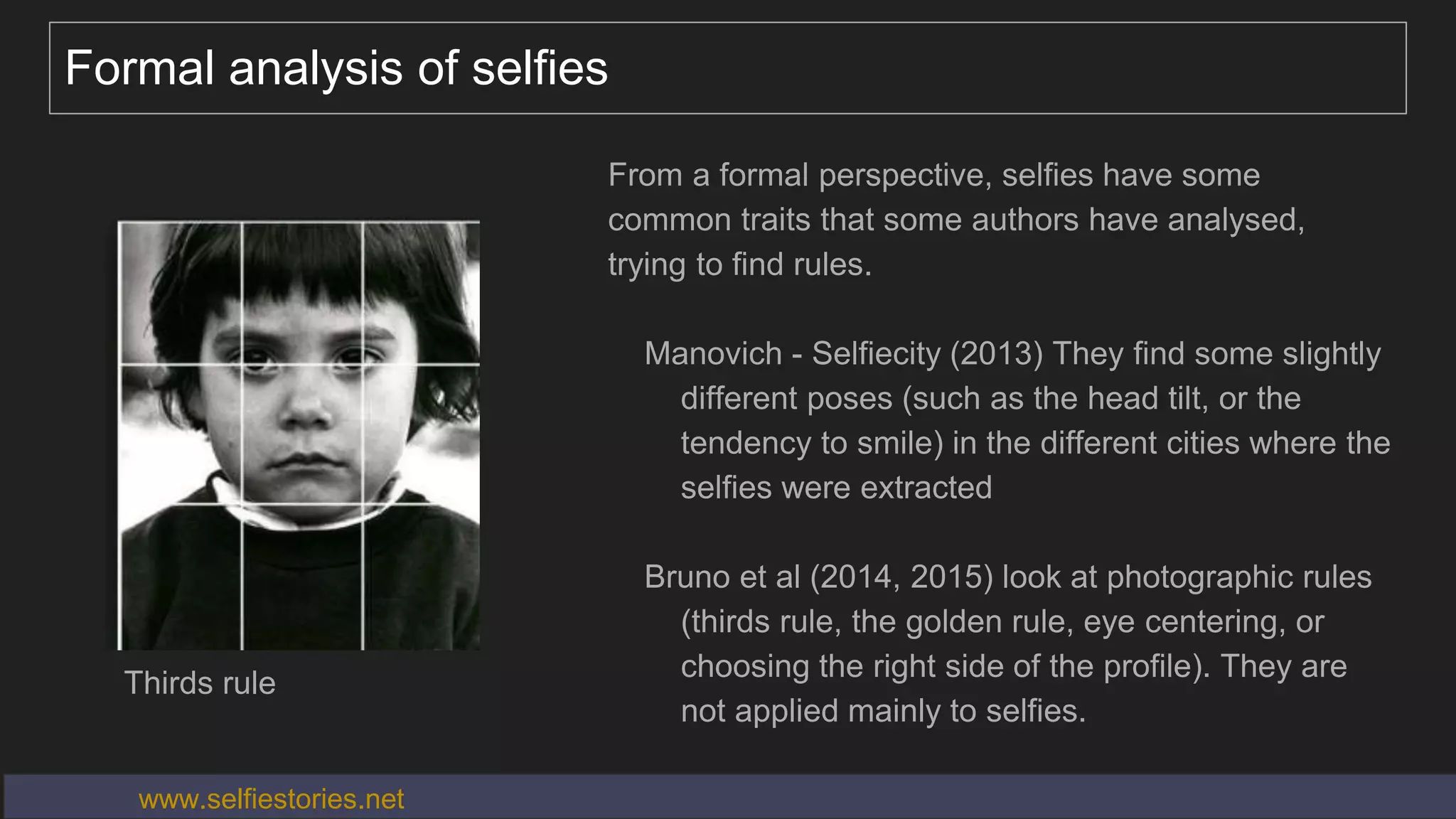
Bruno et al (2014, 2015) look at photographic rules
(thirds rule, the golden rule, eye centering, or
choosing the right side of the profile). They are
not applied mainly to selfies.
www.selfiestories.net
Thirds rule
The communicative nature of selfies
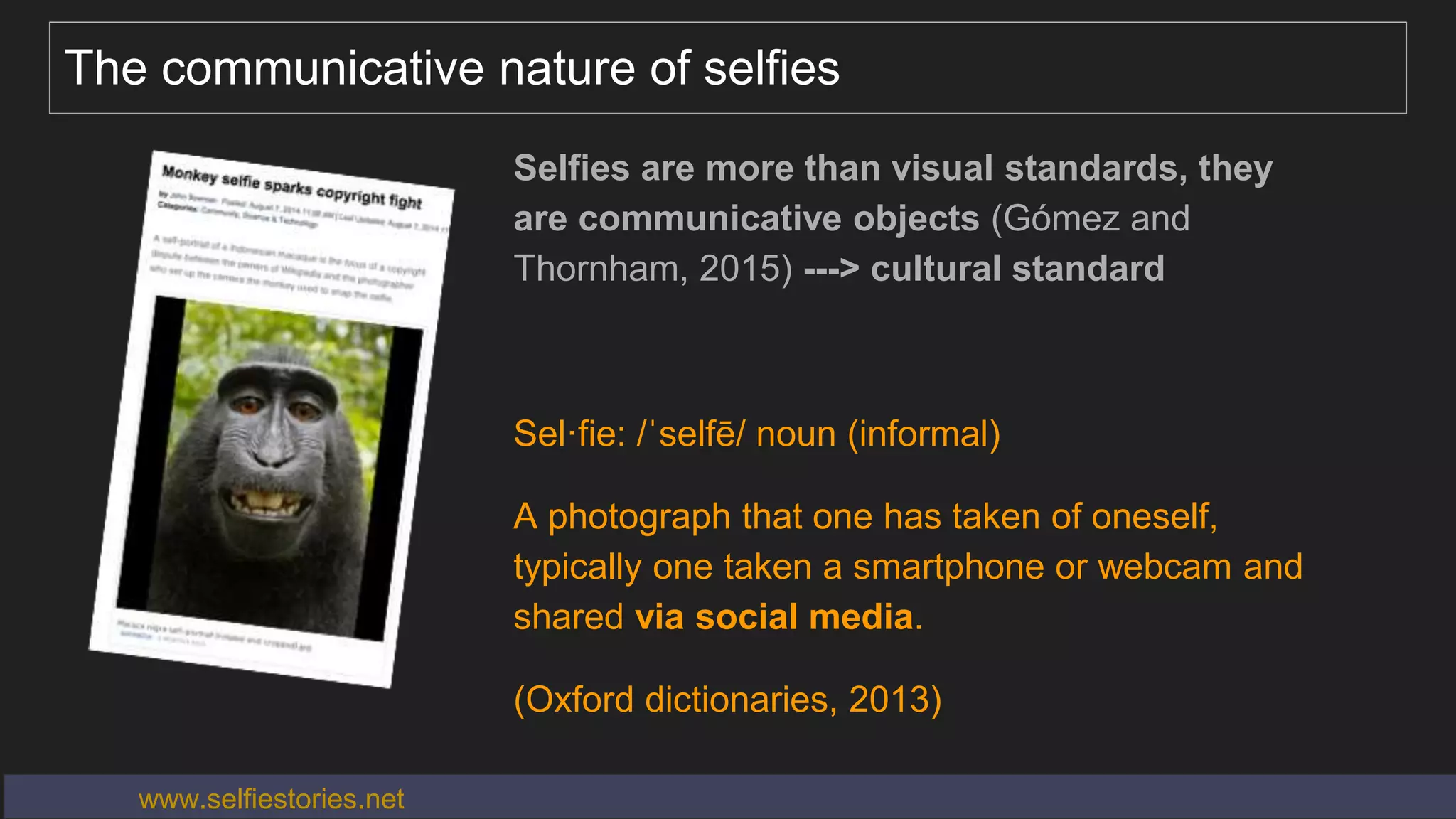
Selfies are more than visual standards, they
are communicative objects (Gómez and
Thornham, 2015) ---> cultural standard
Sel·fie: /ˈselfē/ noun (informal)
A photograph that one has taken of oneself,
typically one taken a smartphone or webcam and
shared via social media.
(Oxford dictionaries, 2013)
www.selfiestories.net
The double nature of the selfie
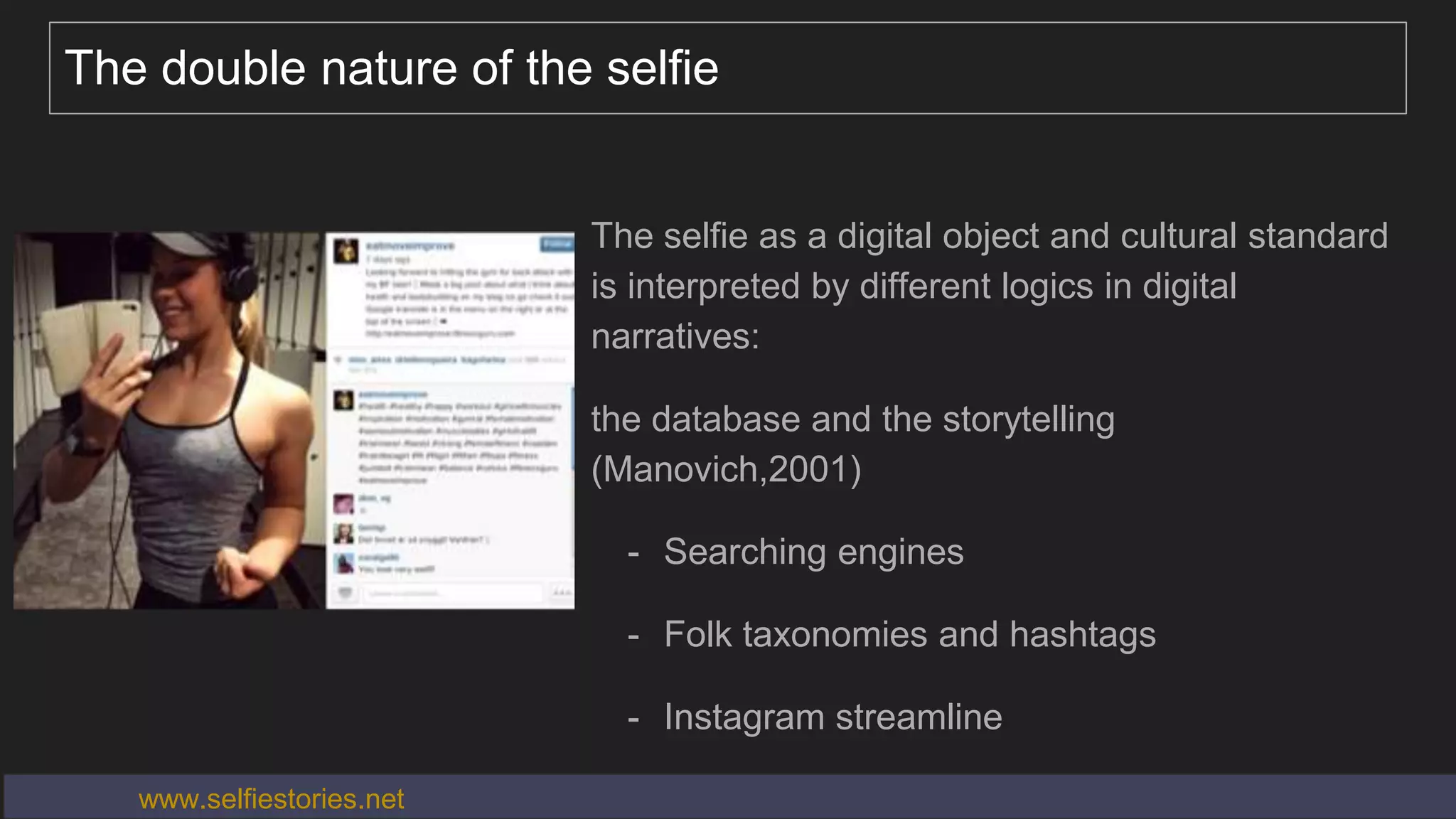
The selfie as a digital object and cultural standard
is interpreted by different logics in digital
narratives:
the database and the storytelling
(Manovich,2001)
- Searching engines
- Folk taxonomies and hashtags
- Instagram streamline
www.selfiestories.net
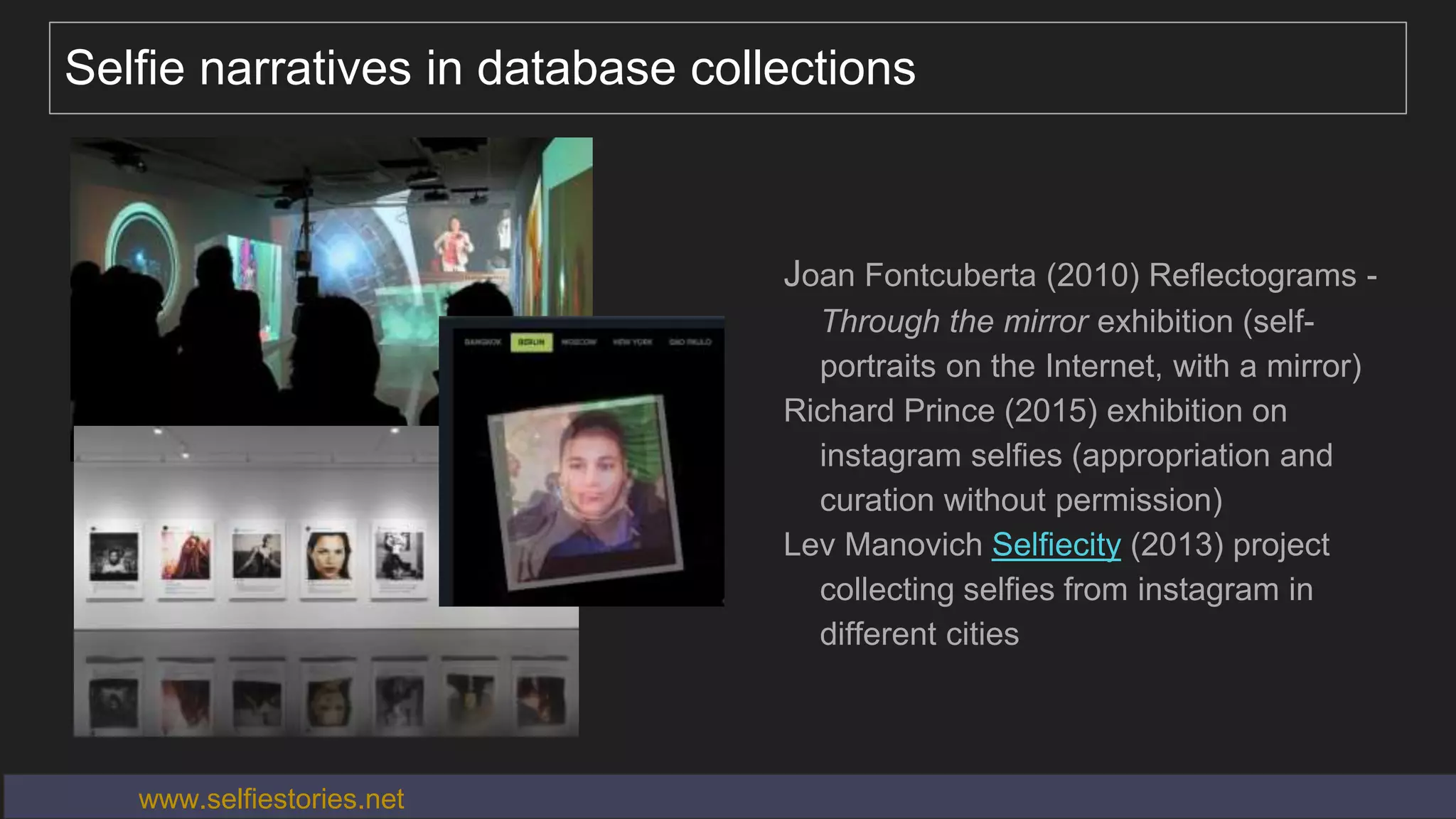
Selfie narratives in database collections
Joan Fontcuberta (2010) Reflectograms -
Through the mirror exhibition (self-
portraits on the Internet, with a mirror)
Richard Prince (2015) exhibition on
instagram selfies (appropriation and
curation without permission)
Lev Manovich Selfiecity (2013) project
collecting selfies from instagram in
different cities
www.selfiestories.net
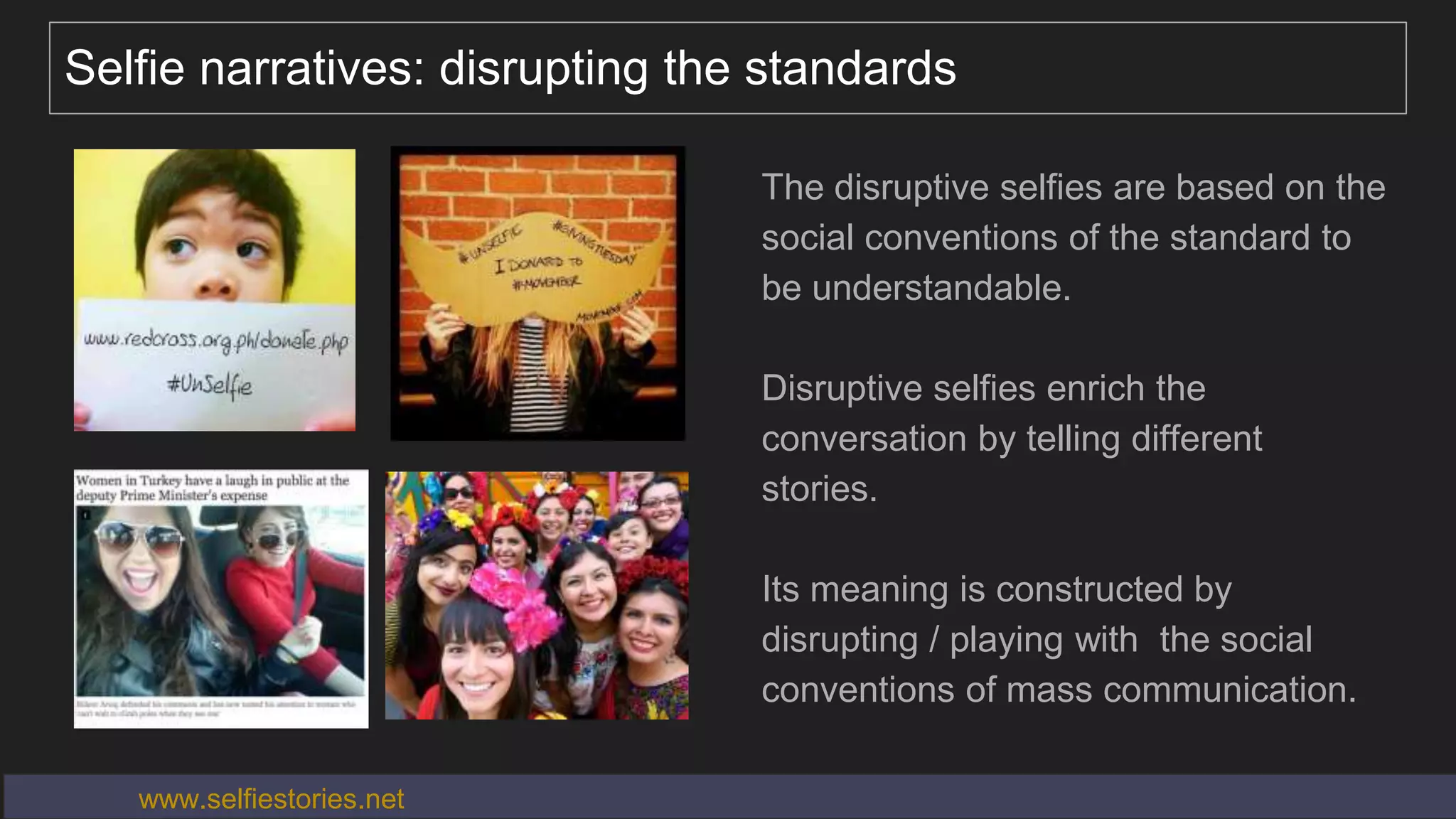
Selfie narratives: disrupting the standards
The disruptive selfies are based on the
social conventions of the standard to
be understandable.
Disruptive selfies enrich the
conversation by telling different
stories.
Its meaning is constructed by
disrupting / playing with the social
conventions of mass communication.
www.selfiestories.net
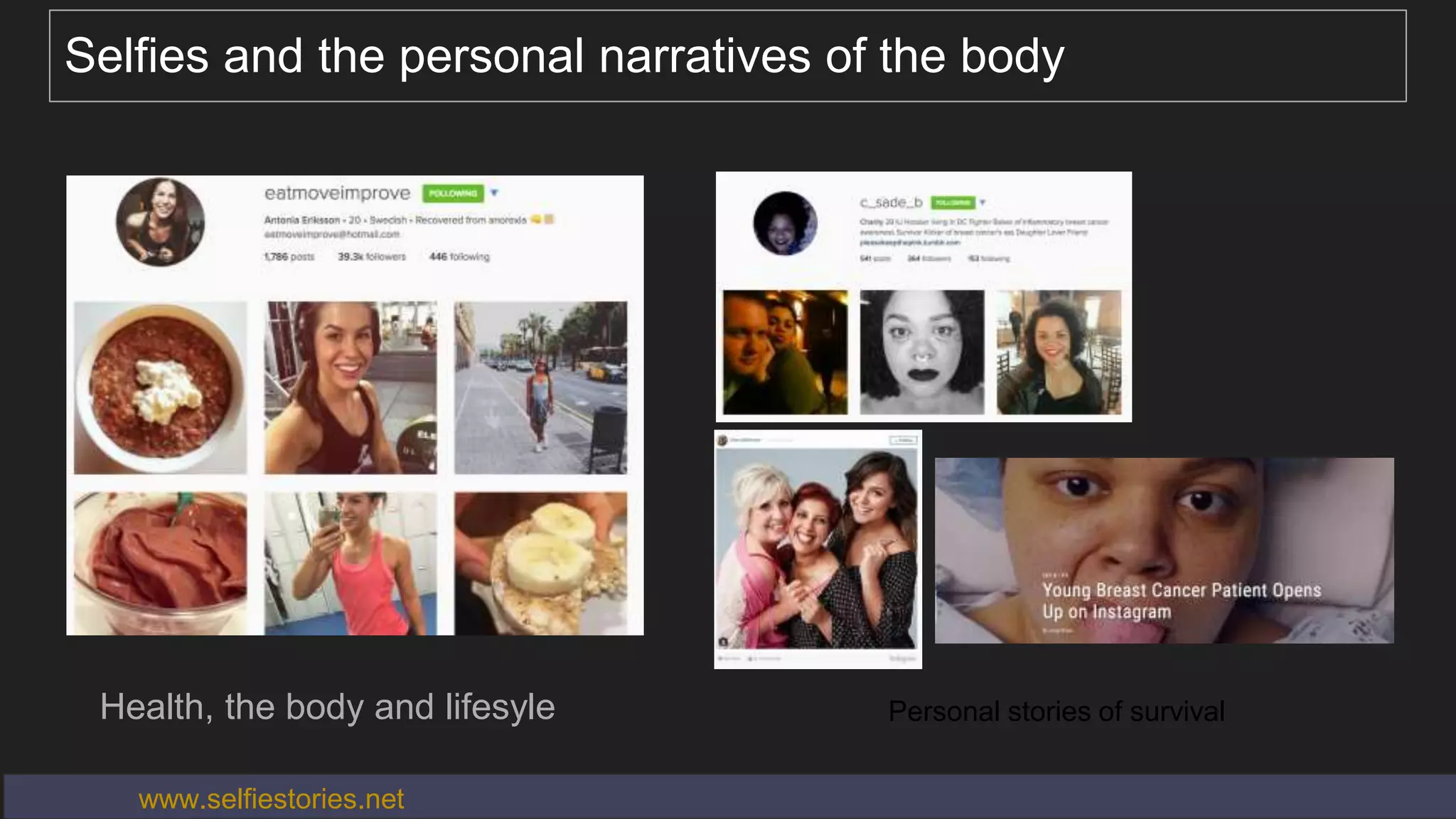
Selfies and the personal narratives of the body
Health, the body and lifesyle Personal stories of survival
www.selfiestories.net
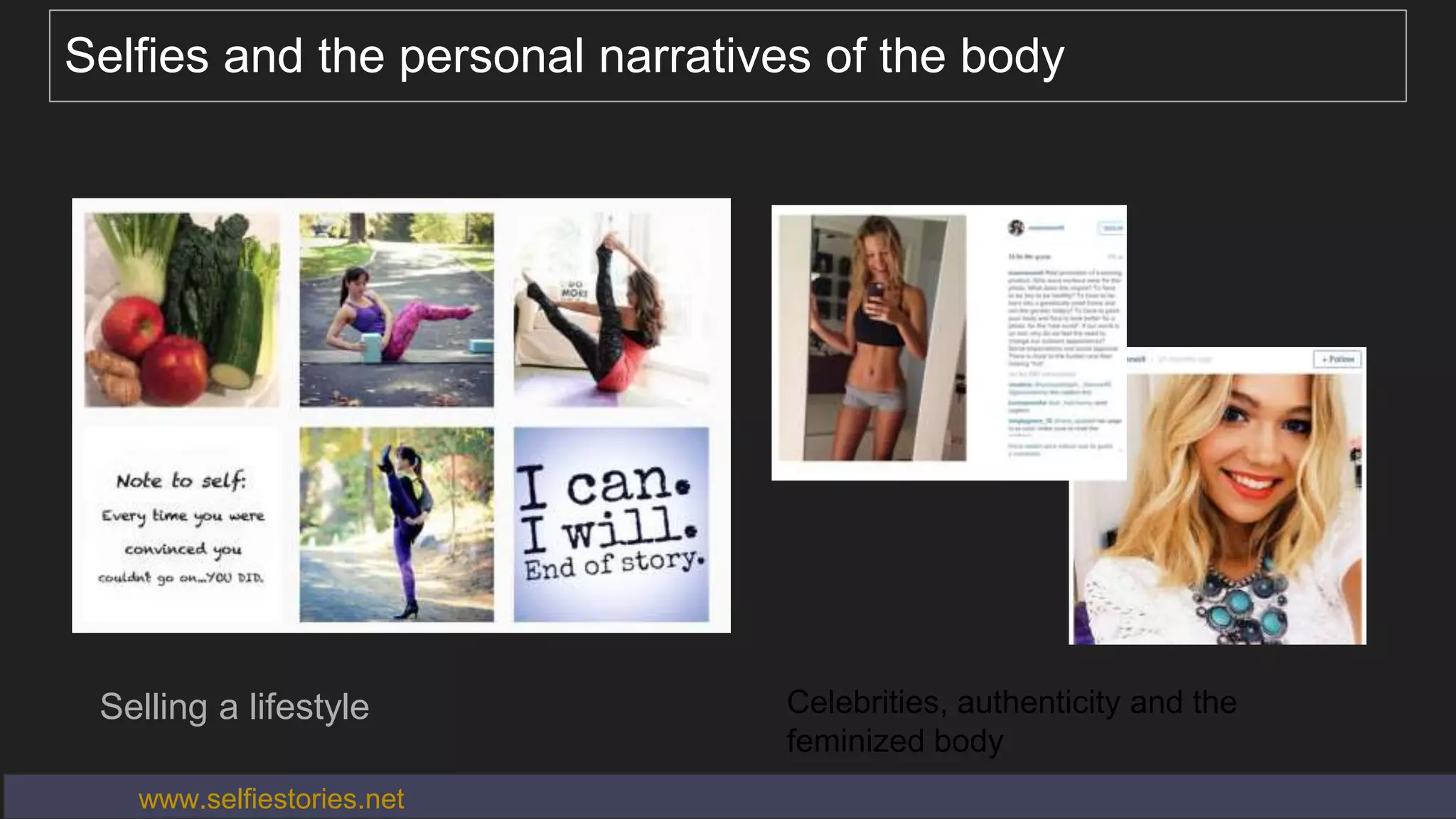
Selfies and the personal narratives of the body
Selling a lifestyle Celebrities, authenticity and the
feminized body
www.selfiestories.net
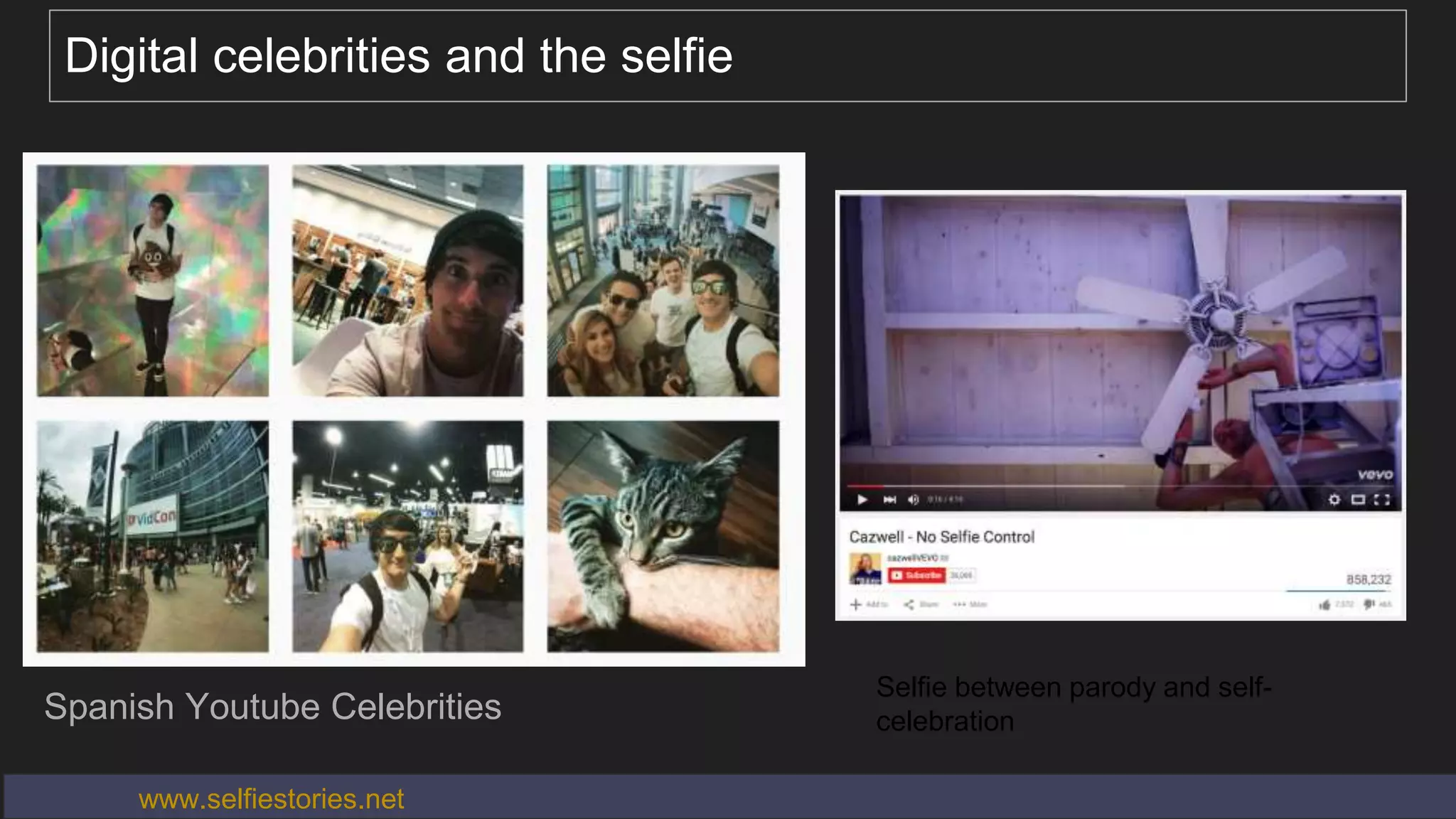
Digital celebrities and the selfie
Spanish Youtube Celebrities
Selfie between parody and self-
celebration
www.selfiestories.net
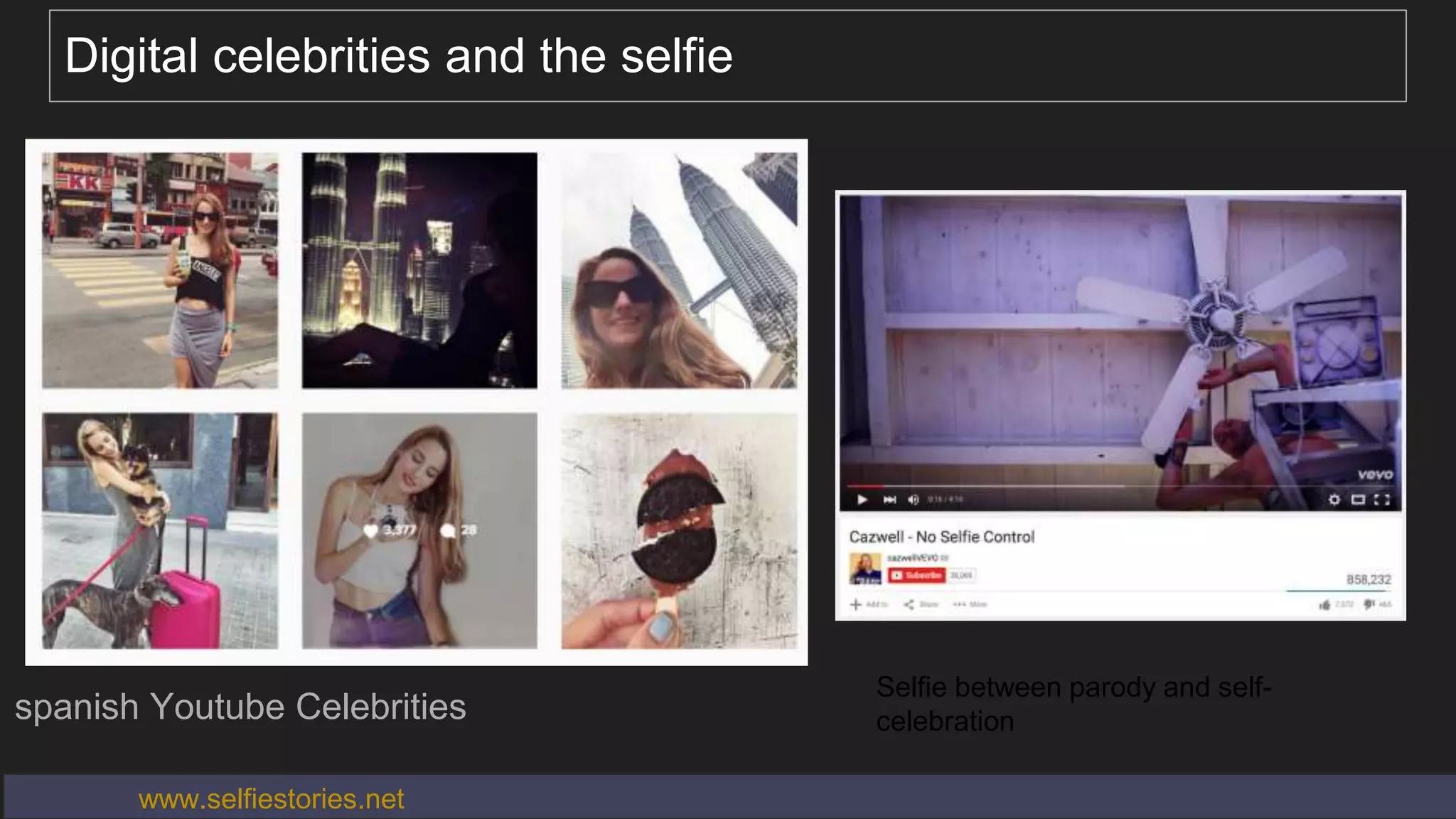
Digital celebrities and the selfie
spanish Youtube Celebrities
Selfie between parody and self-
celebration
www.selfiestories.net
Appropriations, critique and fakes
Abdou Diouf: a fake journey Amalia Ullman: a fake celebrity
www.selfiestories.net
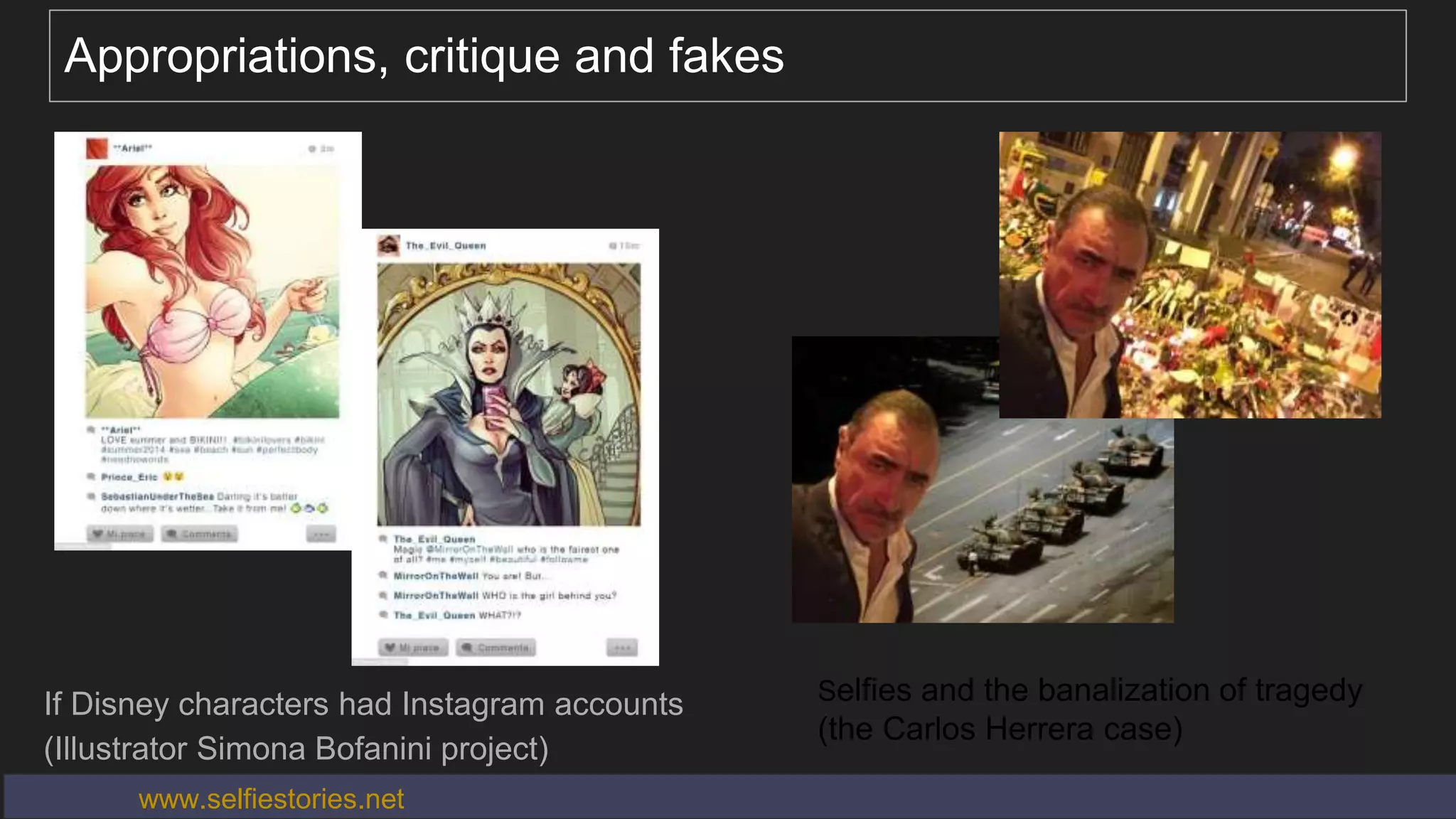
Appropriations, critique and fakes
If Disney characters had Instagram accounts
(Illustrator Simona Bofanini project)
Selfies and the banalization of tragedy
(the Carlos Herrera case)
www.selfiestories.net
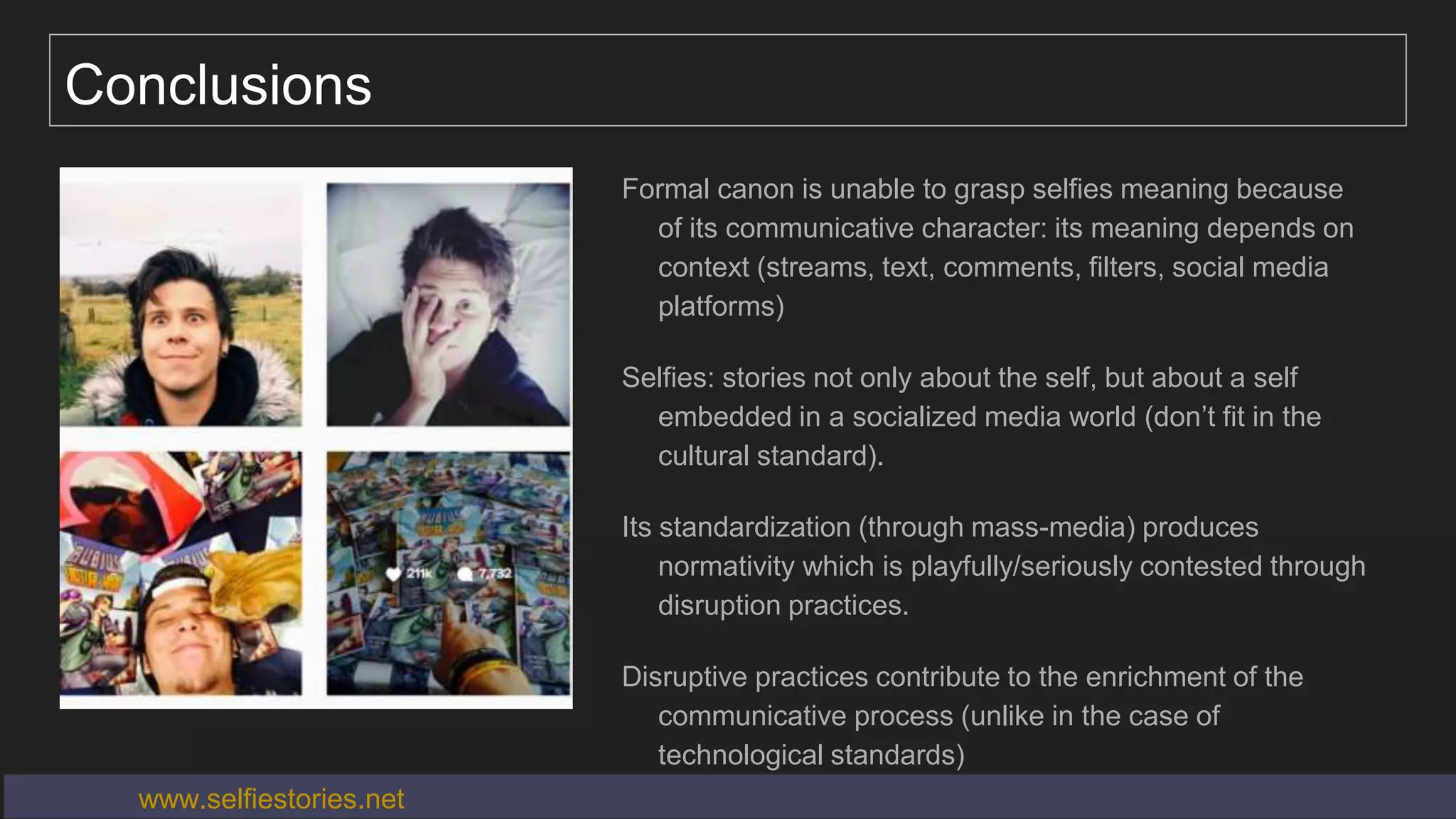
Conclusions
Formal canon is unable to grasp selfies meaning because
of its communicative character: its meaning depends on
context (streams, text, comments, filters, social media
platforms)
Selfies: stories not only about the self, but about a self
embedded in a socialized media world (don’t fit in the
cultural standard).
Its standardization (through mass-media) produces
normativity which is playfully/seriously contested through
disruption practices.
Disruptive practices contribute to the enrichment of the
communicative process (unlike in the case of
technological standards)
www.selfiestories.net
Conclusions
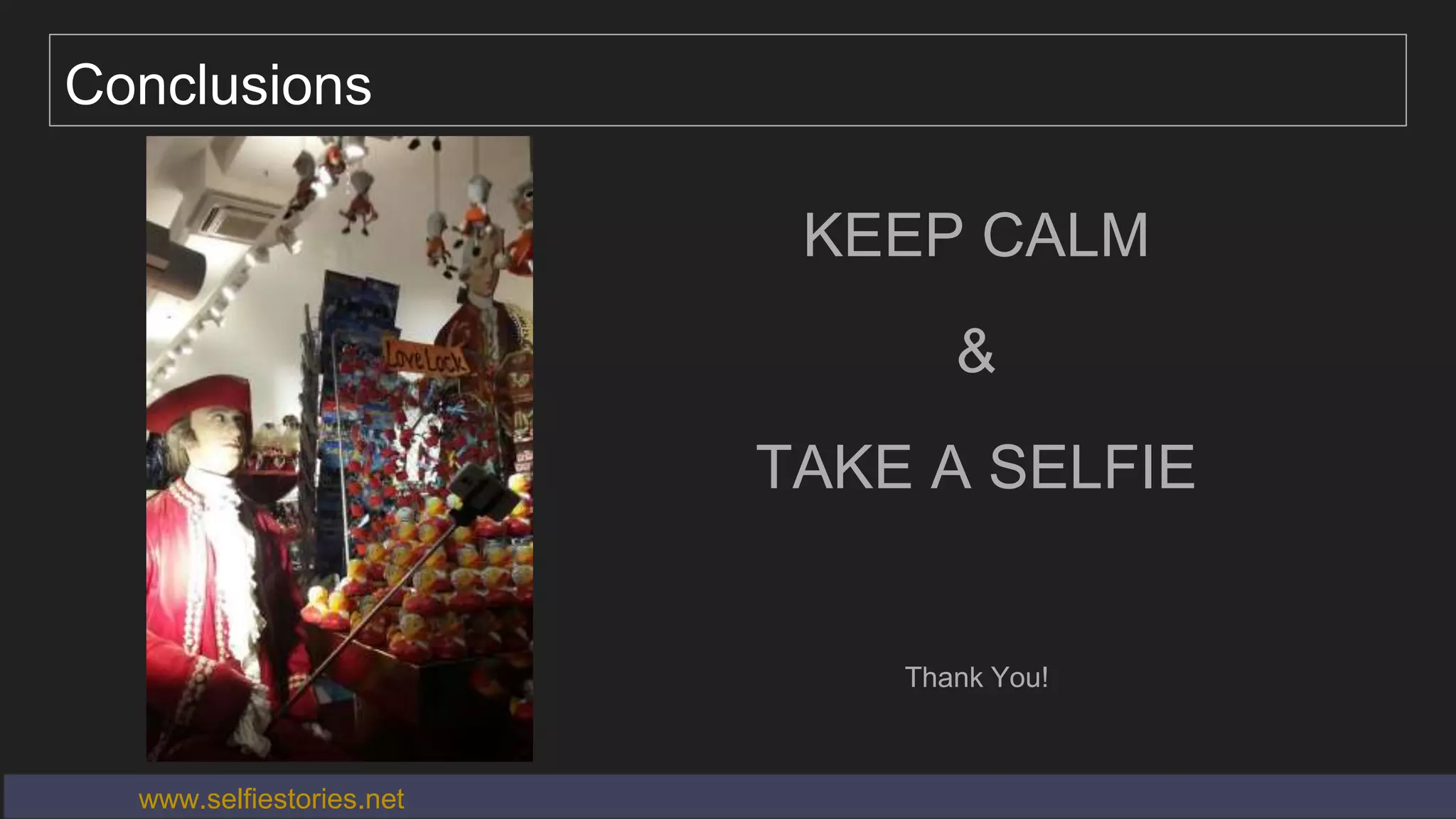
KEEP CALM
&
TAKE A SELFIE
Thank You!
www.selfiestories.net

Visual standards and disruptive practices in selfies

  • 1.
    ECREA Digital CultureWorkshop University of Salzburg 26-27 November 2015 Antoni Roig, Elisenda Ardèvol, Gemma San Cornelio Universitat Oberta de Catalunya
  • 2.
    Context of theresearch Focus on personal narratives generated by users in social networks. Selfie as object of study: current example of the modes of representation of self? Mixed methods: quantitative analysis and qualitative analysis with a two-folded aim: 1) to foster the debate on the possibilities and limitations of “Data Analytics” in social research 2) to expand qualitative research on this issue, providing a framework of analysis from Big Data. "Selfiestories and personal data" - Project funded by the BBVA - 12/2015- 12/2016 www.selfiestories.net
  • 3.
    Some theoretical references Selfieas ‘performed’ in different social contexts as part of a personal or collective narrative (Vivien and Burgess, 2013). Selfie in a broader spectrum of images and narrative threads that emerge within and between images conforming larger narrative streams or feeds (Fallon, 2014). Selfie understood as a cultural form beyond the ‘selfie tag’ (Gunthert, 2015) Social and technological devices are key to the understanding of the practices of the selfie and constitute an ‘alternative genealogy’, along with chats and other ways of technology-mediated interaction (Gómez and Thornham, 2015) Big data needs thick data (Wang, 2013)www.selfiestories.net
  • 4.
    Selfie, a culturalstandard? Technical standards -> norms, values and conventions to facilitate communication across formats, platforms, etc. Aesthetic standards-> Canon as normative concept related to conventionally accepted that it is following the ‘correct’, ‘normal’ or common form. Photographic rules -> related to formal standards for portraiture. www.selfiestories.net
  • 5.
    Selfie as avisual standard The “selfie” can be considered a visual standard as it is a formalized kind of media image and production, which is structured by a number of stylistic conventions. These include the conflation of photographer and subject, a framing in which the subject dominates the foreground of the image, and the subject typically looking directly into the lens, and a perspective that is generally front- view from above (Meese et al. p. 1820). www.selfiestories.net
  • 6.
    Formal analysis ofselfies From a formal perspective, selfies have some common traits that some authors have analysed, trying to find rules. Manovich - Selfiecity (2013) They find some slightly different poses (such as the head tilt, or the tendency to smile) in the different cities where the selfies were extracted Bruno et al (2014, 2015) look at photographic rules (thirds rule, the golden rule, eye centering, or choosing the right side of the profile). They are not applied mainly to selfies. www.selfiestories.net Thirds rule
  • 7.
    The communicative natureof selfies Selfies are more than visual standards, they are communicative objects (Gómez and Thornham, 2015) ---> cultural standard Sel·fie: /ˈselfē/ noun (informal) A photograph that one has taken of oneself, typically one taken a smartphone or webcam and shared via social media. (Oxford dictionaries, 2013) www.selfiestories.net
  • 8.
    The double natureof the selfie The selfie as a digital object and cultural standard is interpreted by different logics in digital narratives: the database and the storytelling (Manovich,2001) - Searching engines - Folk taxonomies and hashtags - Instagram streamline www.selfiestories.net
  • 9.
    Selfie narratives indatabase collections Joan Fontcuberta (2010) Reflectograms - Through the mirror exhibition (self- portraits on the Internet, with a mirror) Richard Prince (2015) exhibition on instagram selfies (appropriation and curation without permission) Lev Manovich Selfiecity (2013) project collecting selfies from instagram in different cities www.selfiestories.net
  • 10.
    Selfie narratives: disruptingthe standards The disruptive selfies are based on the social conventions of the standard to be understandable. Disruptive selfies enrich the conversation by telling different stories. Its meaning is constructed by disrupting / playing with the social conventions of mass communication. www.selfiestories.net
  • 11.
    Selfies and thepersonal narratives of the body Health, the body and lifesyle Personal stories of survival www.selfiestories.net
  • 12.
    Selfies and thepersonal narratives of the body Selling a lifestyle Celebrities, authenticity and the feminized body www.selfiestories.net
  • 13.
    Digital celebrities andthe selfie Spanish Youtube Celebrities Selfie between parody and self- celebration www.selfiestories.net
  • 14.
    Digital celebrities andthe selfie spanish Youtube Celebrities Selfie between parody and self- celebration www.selfiestories.net
  • 15.
    Appropriations, critique andfakes Abdou Diouf: a fake journey Amalia Ullman: a fake celebrity www.selfiestories.net
  • 16.
    Appropriations, critique andfakes If Disney characters had Instagram accounts (Illustrator Simona Bofanini project) Selfies and the banalization of tragedy (the Carlos Herrera case) www.selfiestories.net
  • 17.
    Conclusions Formal canon isunable to grasp selfies meaning because of its communicative character: its meaning depends on context (streams, text, comments, filters, social media platforms) Selfies: stories not only about the self, but about a self embedded in a socialized media world (don’t fit in the cultural standard). Its standardization (through mass-media) produces normativity which is playfully/seriously contested through disruption practices. Disruptive practices contribute to the enrichment of the communicative process (unlike in the case of technological standards) www.selfiestories.net
  • 18.
    Conclusions KEEP CALM & TAKE ASELFIE Thank You! www.selfiestories.net

Editor's Notes

  • #3 fase inicial exploratoria
  • #4 Aquí també n’he afegit només algunes per començar big data thick data
  • #18 Aquí n’he deixat algunes idees
  • #19 Aquí n’he deixat algunes idees