
SMEs – Funding through Transition
Paul Taberner
Enterprise Ventures
1ST JUNE 2015
Enterprise Ventures
.
• 30 years in operation
• £160m funds under management
• £100m invested in 4 years into 774 transactions
• £30m invested in 2014 into 220 transactions
• £170m raised since 2003
Enterprise Ventures
.
• Wholly owned by its management team - empathy
• Hugely experienced investors and lenders – seen it all
• Team of 32 people (20 FCA threshold competent)
• Manchester, Liverpool, Preston and Barnsley offices
• CDFA member
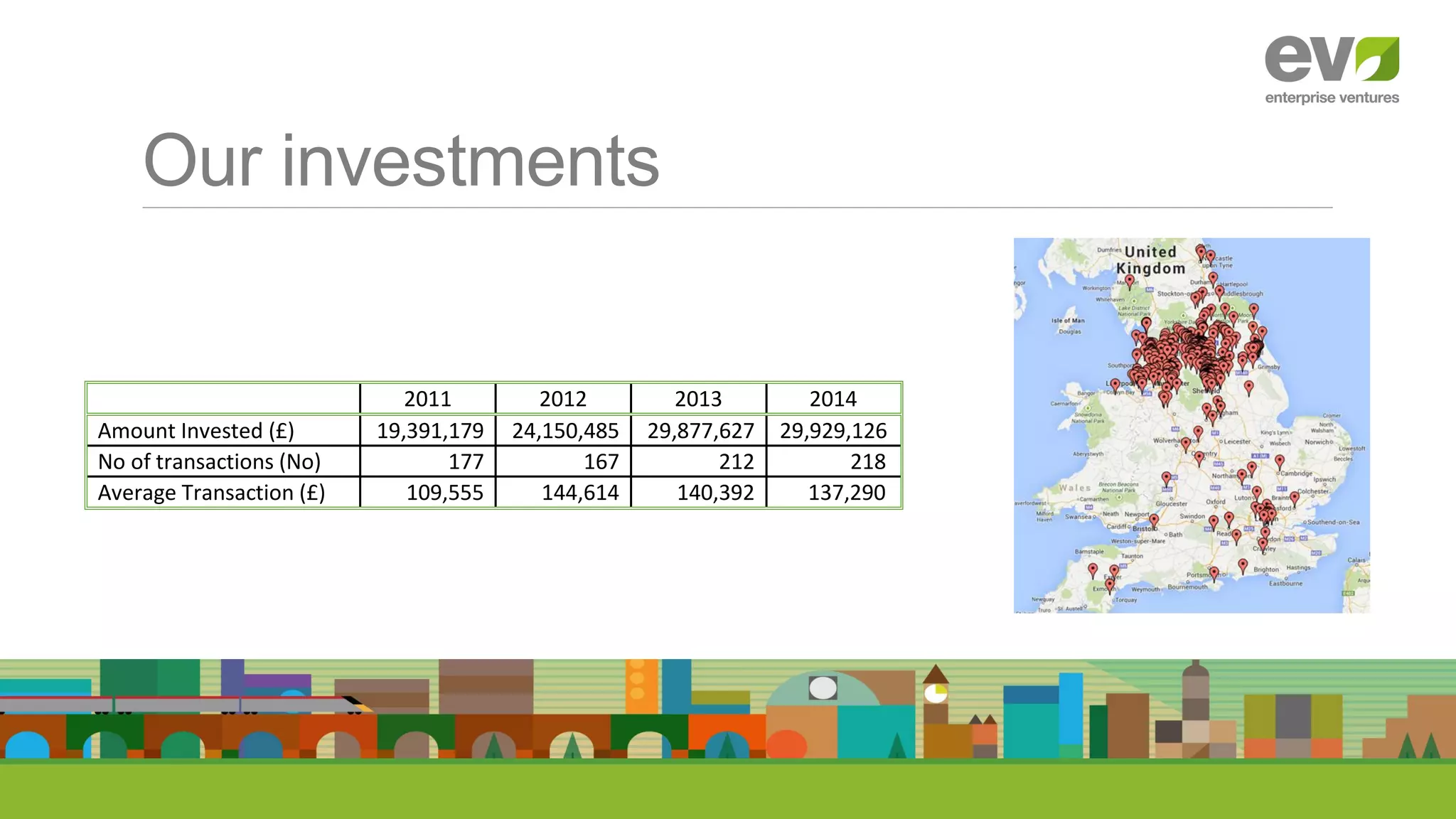
Our investments
.
2011 2012 2013 2014
Amount Invested (£) 19,391,179 24,150,485 29,877,627 29,929,126
No of transactions (No) 177 167 212 218
Average Transaction (£) 109,555 144,614 140,392 137,290
Our clients
.
Paul Taberner ACIB
• Investment Director, 33 years in SME Banking and Finance
• 15 years Barclays Bank, Management Development Programme, UK and overseas
• Corporate Manager, then 8 years with Barclays Ventures
• Joined EV in 2005 as Investment Director, Equity
• Responsible for EV’s Loans activity
What to we mean by SME
• £38m turnover, sub 250 employees
• Vast majority “S”, some aspire to “M”, but not many
• Lifestyle v Growth – which has greatest impact?
• Role of the Public Sector?
Who funds what?
• Finance based on past performance – not ideal if growing or recovering
• BANKS
• “Future Certain”
• ALTERNATIVE and ASSET BASED LENDERS – costly
• “Future uncertain”
• EQUITY – not really - 99% of applicants fail
Funding Stages – Start Up
• Bootstrap, redundancy, savings, family
• Debt based on personal assets, not corporate performance
• Little financial discipline
• Stakeholders passive, no security or scrutiny
• Up to 5 people, owner multi tasks
• Economic impact limited, but……….
• Stay and become “lifestyle” or……………
Funding Stages – Growth
• Personal wealth/security exhausted
• Limited corporate security, track record and still small, sub 25 employees
• Need external funding, stock debtors etc.
• Unless high growth equity unrealistic, but have potential
• Mainstream debt funding – “The Funding Gap”
• Management, delegation – new skills
• Financial disciplines
• Stop here……………..financial impact of getting it wrong is significant
Funding Stages – Maturing
• 25 employees
• Management structure
• Finance function, stakeholder management
• Management Information, Forecasts – Bankers get a warm glow
• Glow heightened by SECURITY
• Track Record is the real tipping point (remember, Bankers look backwards)
• Public Sector job done, but Access to Finance is the problem post 2008
Why bother?
• “Small Businesses become Big Businesses” - rarely
• Employ
• Contribute
• Need help or finance, often both
• If you endorse Public Sector intervention, then must facilitate (not deliver) both
• Ultimate goal must be to achieve maturity of scale, and eliminate the dependency
Funding through Transition . Paul Taberber. 01.06.2015

Funding through Transition . Paul Taberber. 01.06.2015

  • 1.
    SMEs – Fundingthrough Transition Paul Taberner Enterprise Ventures 1ST JUNE 2015
  • 2.
    Enterprise Ventures . • 30years in operation • £160m funds under management • £100m invested in 4 years into 774 transactions • £30m invested in 2014 into 220 transactions • £170m raised since 2003
  • 3.
    Enterprise Ventures . • Whollyowned by its management team - empathy • Hugely experienced investors and lenders – seen it all • Team of 32 people (20 FCA threshold competent) • Manchester, Liverpool, Preston and Barnsley offices • CDFA member
  • 4.
    Our investments . 2011 20122013 2014 Amount Invested (£) 19,391,179 24,150,485 29,877,627 29,929,126 No of transactions (No) 177 167 212 218 Average Transaction (£) 109,555 144,614 140,392 137,290
  • 5.
  • 6.
    Paul Taberner ACIB •Investment Director, 33 years in SME Banking and Finance • 15 years Barclays Bank, Management Development Programme, UK and overseas • Corporate Manager, then 8 years with Barclays Ventures • Joined EV in 2005 as Investment Director, Equity • Responsible for EV’s Loans activity
  • 7.
    What to wemean by SME • £38m turnover, sub 250 employees • Vast majority “S”, some aspire to “M”, but not many • Lifestyle v Growth – which has greatest impact? • Role of the Public Sector?
  • 8.
    Who funds what? •Finance based on past performance – not ideal if growing or recovering • BANKS • “Future Certain” • ALTERNATIVE and ASSET BASED LENDERS – costly • “Future uncertain” • EQUITY – not really - 99% of applicants fail
  • 9.
    Funding Stages –Start Up • Bootstrap, redundancy, savings, family • Debt based on personal assets, not corporate performance • Little financial discipline • Stakeholders passive, no security or scrutiny • Up to 5 people, owner multi tasks • Economic impact limited, but………. • Stay and become “lifestyle” or……………
  • 10.
    Funding Stages –Growth • Personal wealth/security exhausted • Limited corporate security, track record and still small, sub 25 employees • Need external funding, stock debtors etc. • Unless high growth equity unrealistic, but have potential • Mainstream debt funding – “The Funding Gap” • Management, delegation – new skills • Financial disciplines • Stop here……………..financial impact of getting it wrong is significant
  • 11.
    Funding Stages –Maturing • 25 employees • Management structure • Finance function, stakeholder management • Management Information, Forecasts – Bankers get a warm glow • Glow heightened by SECURITY • Track Record is the real tipping point (remember, Bankers look backwards) • Public Sector job done, but Access to Finance is the problem post 2008
  • 12.
    Why bother? • “SmallBusinesses become Big Businesses” - rarely • Employ • Contribute • Need help or finance, often both • If you endorse Public Sector intervention, then must facilitate (not deliver) both • Ultimate goal must be to achieve maturity of scale, and eliminate the dependency