HR PHILOSOPHIES


      28 February 2012   Dr.Padma Shankar   1
Philosophy comes from the Greek
 (philosophia) which literally means
 “love of wisdom”

"Philosophy studies the fundamental
 nature of existence, of man, and of
 man's relationship to
 existence…………….‖
           —Ayn Rand,
           Philosophy, Who Needs
 It (p. 2)
               28 February 2012   Dr.Padma Shankar   2
Why do we need a

    philosophy??? of life."
    Philosophical convictions are “sense

   It reflects the fundamental ways you relate to the world and
    other people; it is your intuitive feeling of how things are and
    how they ought to be.

   There is a need to understand the convictions
    consciously, Otherwise we don't really have a clear idea of what
    we believe or what is motivating us to make our biggest
    decisions.

   This sense of life that dominates nations or cultures can
    determine their fates.
                               (Ayn Rand, Philosophy: Who Needs
    It, p. 5)
                              28 February 2012   Dr.Padma Shankar      3
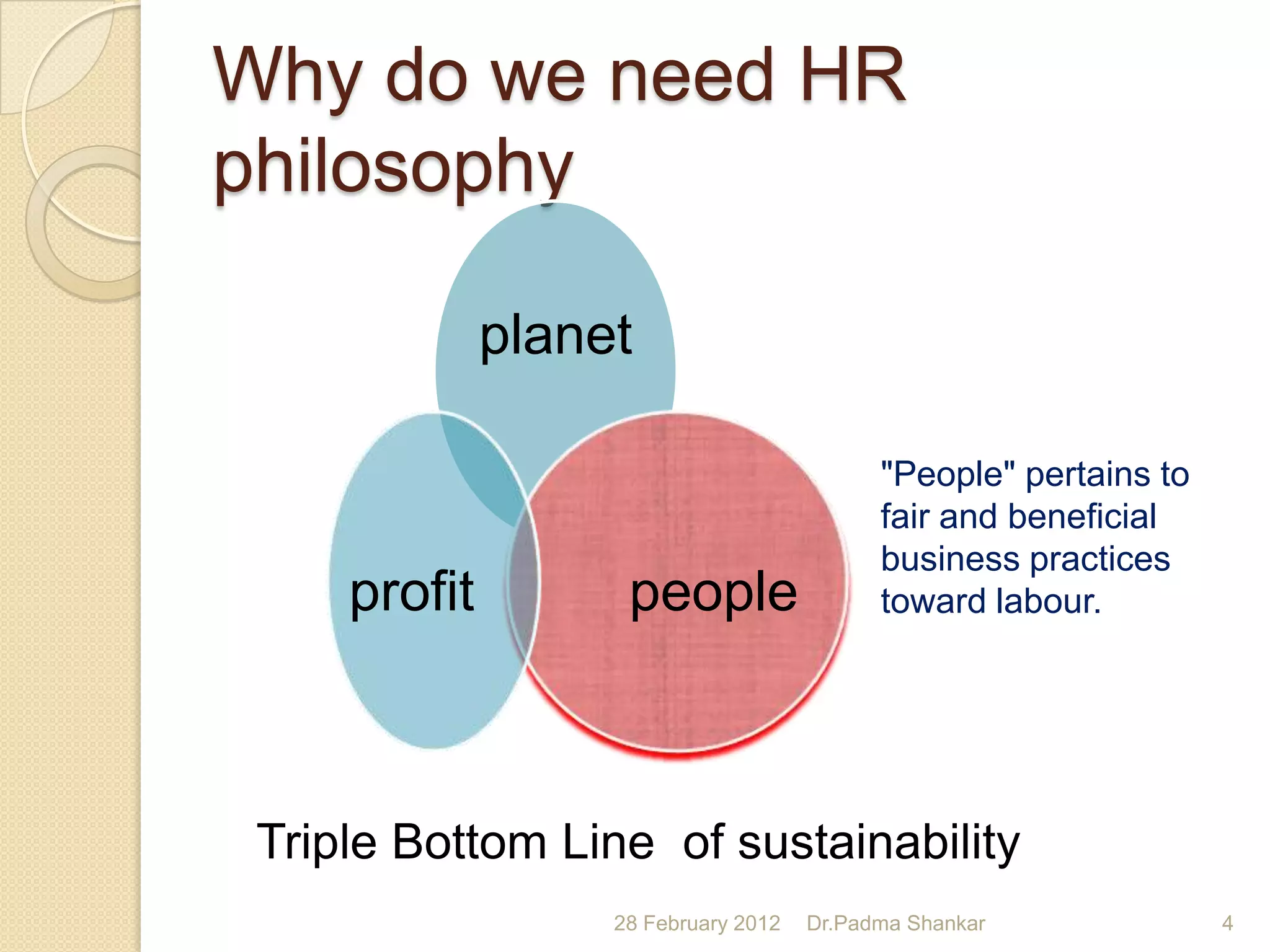
Why do we need HR
philosophy

              planet

                                            "People" pertains to
                                            fair and beneficial
                                            business practices
     profit         people                  toward labour.


 Triple Bottom Line of sustainability
                   28 February 2012   Dr.Padma Shankar             4
Assumptions of HR Philosophy
 HR is a resource (useful, limited and potential to
  deplete), capital (asset), and talent (ability)
 „understand-predict-influence' sequence
 'philosophy of HR' shapes the way the employees are
  managed in that organization.
 'Theory X„ -- that the employees are inherently lazy
  and will avoid work if they can-- will promote 'Theory X'
  kind of behavior among the employees
 'articulated HR philosophy' and the 'HR philosophy in
  practice' !
 HR philosophy be closely linked to (or even derived
  from) the core values of the organization.

                         28 February 2012   Dr.Padma Shankar   5
Why HR philosophy

(a) Organization………….

   has barriers,

   may not be perfect but are good,

   now aiming to be “great”

   benefits from a talented, motivated, loyal and
    free spirited work force.


                       28 February 2012   Dr.Padma Shankar   6
(b) HR………..
   can be developed and increased to an unlimited extent;
   philosophy create conducive and healthy climate with values of
    openness, enthusiasm, trust mutuality and collaboration.
   to plan and monitor ways that are beneficial both for the
    individual and the organization.
   to perpetuate a feeling of belongingness to make them feel
    committed to their work and the organization.
 to motivate employees by satisfying their basic and
  higher level needs.
 to discover and use the employees capabilities and
  potentials to increase their commitment.
 to ensure the development and utilization of the capability
  of all the subordinates.


                              28 February 2012   Dr.Padma Shankar    7
How HR philosophy helps:

   to makes explicit the organizations
    core beliefs about managing people.

   to translate the HR philosophy into
    management system and practices.

   And finally HR philosophy provides
    direction, practices make it operational.

                    28 February 2012   Dr.Padma Shankar   8
How to Create a HR

Philosophy?


        28 February 2012   Dr.Padma Shankar   9
Keep it in Context
“An attempt to create an identity for the company that distinguishes it in
the marketplace," says David Ulrich,
  (a business professor at the University of Michigan and co-founder of the RBL Group, a consultancy that advises businesses on
   human resources, leadership, and organization.)

A company needs to have a mission statement, philosophy, and code of
ethics:
Mission statement: A mission statement should succinctly summarize
what you do or what your aims are.
Philosophy: A philosophy is the slogan like into core ideas or values that
the company and its members hold dear and adhere to in their business
dealings.
Code of ethics: A code of ethics or code of conduct expands to deal with
specific types of situations and behaviors.


Ulrich continues,
"There are dimensions of this identity: They all try to position a
company's identity in the minds of those inside and outside the company."
                                                      28 February 2012         Dr.Padma Shankar                                   10
Don't Put It Off

“What tear them (companies) apart is people that don't get along
with one another; they have different values.“

Alex Plinio, co-founder of the Institute for Ethical Leadership at Rutgers Business School.


Practice What You Preach

The principles in a company's philosophy have to come from,
and be true to, the founder or CEO as a person.

"if you have a hard-driving, aggressive, person [in charge of a
business], having 'play nice with others' as part of your principles
is not going to work,“ says Steve Priest, president of Ethical Leadership Group
(ELG), a consulting firm.


                                               28 February 2012     Dr.Padma Shankar          11
Keep it Simple

Ulrich warns that,

"Only focusing on details makes [your philosophy] non-
memorable and no one will wade through it;

managing by slogan is superficial and does not lead to
accountability or change."

It should encapsulate your ideology in a memorable way without
being reductive.

                     “Commitment to add value”


                                28 February 2012   Dr.Padma Shankar   12
Hire People Who Match the Culture

Ulrich says.

"Crafting a philosophy statement, or identity, becomes helpful
when the 'bumper cars' no longer bump into each other“.

As Ulrich puts it,

"Technical fit without cultural fit is a misfit, and the employee will
be competent, but not contributing to business success.“


                “shot tempered marketing executive”


                                 28 February 2012   Dr.Padma Shankar     13
School New Hires on Company History

New hires get introduced to the company's history, and to it's
ecological commitment, "I think one of my roles as a leader here is to
keep the story of who we are--our creation story as well as our
evolution--alive and vivid and active,"


Finally, Fixing a Broken Company Culture

As a company grows, it's possible for the leadership or the
employees to lose sight of the founding values.

This can lead, among other things, to ethical lapses.


                              28 February 2012   Dr.Padma Shankar    14
Mahatma‟s Philosophy:
Truth and Nonviolence

Mother Teresa:
Untiring Service to Humankind

Philosophy of prayer.
"Lead me from the unreal to the Real“

Nature‟s Philosophy is :
Change

                 28 February 2012   Dr.Padma Shankar   15
Great place to work 2012
First 4 Ranks are………

 Google
 Boston Consulting company
 SAS
 Wegmans Food company


              28 February 2012   Dr.Padma Shankar   16
Google philosophy……..
At Google, innovation and creativity
 keeps
our projects changing and improving.
 Our
consistency comes from our Googlers –
smart, amazing people who foster an
environment of collaboration and fun.


              28 February 2012   Dr.Padma Shankar   17
Boston Consulting company
Upon joining,
you become a lifelong member of a
unique global community


              28 February 2012   Dr.Padma Shankar   18
SAS


We seek the best talent to build on our success story.
In return, SAS employees enjoy a supportive environment,
outstanding opportunities for professional growth,
and a chance to help SAS drive the new economy
and provide innovative solutions for business decision makers
across the globe.


                            28 February 2012   Dr.Padma Shankar   19
Wegmans philosophy…………….


Our values are a way of giving freedom to our
people. Once you share a common set of
values, you can go and be yourself. This is
something we live.” Danny Wegman,CEO


 ―We’re committed to our Who We
 Are values because they set a
 strong foundation for us as a
 company – a foundation of caring
 about people and each other.‖
 Colleen Wegman President
                             28 February 2012   Dr.Padma Shankar   20
FedEx HR Philosophy
"In the fiercely competitive air express
  cargo
transportation industry, FedEx attributes
much of its success to its corporate
  “people
service profit” philosophy. Under the
founder of FedEx, Frederick
  Smith, “when
people are placed first they will provide
  the             28 February 2012   Dr.Padma Shankar   21
Infosys HR Philosophy:

Working with Infosys is not a job.
It's a journey,
an experience. There's so much
to explore here –
even about yourself – that every day is
   a
new day.

               28 February 2012   Dr.Padma Shankar   22
Tata Philosophy

Leadership with trust;

Nurturing employees from
womb to tomb.


                28 February 2012   Dr.Padma Shankar   23
Mahindra Rise philosophy to infuse in the DNA of the
organization (Rajeev Dubey)


   Nurture and nourish the core values of the
    group
   Confidence, morale and motivation is to be high
    for getting innovation

Future 3 pillars or mind set of this organization to
   be
infused:
 We accept no limits;
 We do alternative thinking;
 We drive positive change
                      28 February 2012   Dr.Padma Shankar   24
Vineet Nayar on “employees first and
    customer second”
 Generations have changed
 “Building is in Fire” --Trust between us and employees is
  at the lowest;
 Future is in the innovation of our employees
 Value zone Is in the inter phase of customers and
  employees, value is created by employees
 Enthuse, encourage, and enabling the employees to
  create the differentiated values
Three steps:
 Ask and look at the mirror, feel uncomfortable;
 Vision for tomorrow;
 Small action to create a revolutions.

Source: http://www.youtube.com/watch?v=fHTtddLvh6s


                                    28 February 2012   Dr.Padma Shankar   25
Symbiosis believe that the

 „World is One Family‟
“ Vasudhaiva Kutumbakam”


               28 February 2012   Dr.Padma Shankar   26
Therefore what is HR
philosophy?

 Fundamental assumptions and
  beliefs;
 system of values;
 an underlying theory;
 system of thought on which the
  HR of an organization is based.


               28 February 2012   Dr.Padma Shankar   27
References:


http://www.tata.com/company/Media/inside.aspx?artid=aAOifiKhB/g=
http://kisholoygupta.blogspot.in/

http://www.mahindra.com/News/Media-Library/AV-1295013331

http://prasadokurian.blogspot.in/2007/11/towards-philosophy-of-hr.html
Lee G Bolman, Terrence E Deal, (2008), Refraining organization, John
Wiley and Sons , USA.


        Thank you…………………….


                                   28 February 2012   Dr.Padma Shankar   28

HRM -- Philosophies

  • 1.
    HR PHILOSOPHIES 28 February 2012 Dr.Padma Shankar 1
  • 2.
    Philosophy comes fromthe Greek (philosophia) which literally means “love of wisdom” "Philosophy studies the fundamental nature of existence, of man, and of man's relationship to existence…………….‖ —Ayn Rand, Philosophy, Who Needs It (p. 2) 28 February 2012 Dr.Padma Shankar 2
  • 3.
    Why do weneed a  philosophy??? of life." Philosophical convictions are “sense  It reflects the fundamental ways you relate to the world and other people; it is your intuitive feeling of how things are and how they ought to be.  There is a need to understand the convictions consciously, Otherwise we don't really have a clear idea of what we believe or what is motivating us to make our biggest decisions.  This sense of life that dominates nations or cultures can determine their fates. (Ayn Rand, Philosophy: Who Needs It, p. 5) 28 February 2012 Dr.Padma Shankar 3
  • 4.
    Why do weneed HR philosophy planet "People" pertains to fair and beneficial business practices profit people toward labour. Triple Bottom Line of sustainability 28 February 2012 Dr.Padma Shankar 4
  • 5.
    Assumptions of HRPhilosophy  HR is a resource (useful, limited and potential to deplete), capital (asset), and talent (ability)  „understand-predict-influence' sequence  'philosophy of HR' shapes the way the employees are managed in that organization.  'Theory X„ -- that the employees are inherently lazy and will avoid work if they can-- will promote 'Theory X' kind of behavior among the employees  'articulated HR philosophy' and the 'HR philosophy in practice' !  HR philosophy be closely linked to (or even derived from) the core values of the organization. 28 February 2012 Dr.Padma Shankar 5
  • 6.
    Why HR philosophy (a)Organization………….  has barriers,  may not be perfect but are good,  now aiming to be “great”  benefits from a talented, motivated, loyal and free spirited work force. 28 February 2012 Dr.Padma Shankar 6
  • 7.
    (b) HR………..  can be developed and increased to an unlimited extent;  philosophy create conducive and healthy climate with values of openness, enthusiasm, trust mutuality and collaboration.  to plan and monitor ways that are beneficial both for the individual and the organization.  to perpetuate a feeling of belongingness to make them feel committed to their work and the organization.  to motivate employees by satisfying their basic and higher level needs.  to discover and use the employees capabilities and potentials to increase their commitment.  to ensure the development and utilization of the capability of all the subordinates. 28 February 2012 Dr.Padma Shankar 7
  • 8.
    How HR philosophyhelps:  to makes explicit the organizations core beliefs about managing people.  to translate the HR philosophy into management system and practices.  And finally HR philosophy provides direction, practices make it operational. 28 February 2012 Dr.Padma Shankar 8
  • 9.
    How to Createa HR Philosophy? 28 February 2012 Dr.Padma Shankar 9
  • 10.
    Keep it inContext “An attempt to create an identity for the company that distinguishes it in the marketplace," says David Ulrich, (a business professor at the University of Michigan and co-founder of the RBL Group, a consultancy that advises businesses on human resources, leadership, and organization.) A company needs to have a mission statement, philosophy, and code of ethics: Mission statement: A mission statement should succinctly summarize what you do or what your aims are. Philosophy: A philosophy is the slogan like into core ideas or values that the company and its members hold dear and adhere to in their business dealings. Code of ethics: A code of ethics or code of conduct expands to deal with specific types of situations and behaviors. Ulrich continues, "There are dimensions of this identity: They all try to position a company's identity in the minds of those inside and outside the company." 28 February 2012 Dr.Padma Shankar 10
  • 11.
    Don't Put ItOff “What tear them (companies) apart is people that don't get along with one another; they have different values.“ Alex Plinio, co-founder of the Institute for Ethical Leadership at Rutgers Business School. Practice What You Preach The principles in a company's philosophy have to come from, and be true to, the founder or CEO as a person. "if you have a hard-driving, aggressive, person [in charge of a business], having 'play nice with others' as part of your principles is not going to work,“ says Steve Priest, president of Ethical Leadership Group (ELG), a consulting firm. 28 February 2012 Dr.Padma Shankar 11
  • 12.
    Keep it Simple Ulrichwarns that, "Only focusing on details makes [your philosophy] non- memorable and no one will wade through it; managing by slogan is superficial and does not lead to accountability or change." It should encapsulate your ideology in a memorable way without being reductive. “Commitment to add value” 28 February 2012 Dr.Padma Shankar 12
  • 13.
    Hire People WhoMatch the Culture Ulrich says. "Crafting a philosophy statement, or identity, becomes helpful when the 'bumper cars' no longer bump into each other“. As Ulrich puts it, "Technical fit without cultural fit is a misfit, and the employee will be competent, but not contributing to business success.“ “shot tempered marketing executive” 28 February 2012 Dr.Padma Shankar 13
  • 14.
    School New Hireson Company History New hires get introduced to the company's history, and to it's ecological commitment, "I think one of my roles as a leader here is to keep the story of who we are--our creation story as well as our evolution--alive and vivid and active," Finally, Fixing a Broken Company Culture As a company grows, it's possible for the leadership or the employees to lose sight of the founding values. This can lead, among other things, to ethical lapses. 28 February 2012 Dr.Padma Shankar 14
  • 15.
    Mahatma‟s Philosophy: Truth andNonviolence Mother Teresa: Untiring Service to Humankind Philosophy of prayer. "Lead me from the unreal to the Real“ Nature‟s Philosophy is : Change 28 February 2012 Dr.Padma Shankar 15
  • 16.
    Great place towork 2012 First 4 Ranks are………  Google  Boston Consulting company  SAS  Wegmans Food company 28 February 2012 Dr.Padma Shankar 16
  • 17.
    Google philosophy…….. At Google,innovation and creativity keeps our projects changing and improving. Our consistency comes from our Googlers – smart, amazing people who foster an environment of collaboration and fun. 28 February 2012 Dr.Padma Shankar 17
  • 18.
    Boston Consulting company Uponjoining, you become a lifelong member of a unique global community 28 February 2012 Dr.Padma Shankar 18
  • 19.
    SAS We seek thebest talent to build on our success story. In return, SAS employees enjoy a supportive environment, outstanding opportunities for professional growth, and a chance to help SAS drive the new economy and provide innovative solutions for business decision makers across the globe. 28 February 2012 Dr.Padma Shankar 19
  • 20.
    Wegmans philosophy……………. Our valuesare a way of giving freedom to our people. Once you share a common set of values, you can go and be yourself. This is something we live.” Danny Wegman,CEO ―We’re committed to our Who We Are values because they set a strong foundation for us as a company – a foundation of caring about people and each other.‖ Colleen Wegman President 28 February 2012 Dr.Padma Shankar 20
  • 21.
    FedEx HR Philosophy "Inthe fiercely competitive air express cargo transportation industry, FedEx attributes much of its success to its corporate “people service profit” philosophy. Under the founder of FedEx, Frederick Smith, “when people are placed first they will provide the 28 February 2012 Dr.Padma Shankar 21
  • 22.
    Infosys HR Philosophy: Workingwith Infosys is not a job. It's a journey, an experience. There's so much to explore here – even about yourself – that every day is a new day. 28 February 2012 Dr.Padma Shankar 22
  • 23.
    Tata Philosophy Leadership withtrust; Nurturing employees from womb to tomb. 28 February 2012 Dr.Padma Shankar 23
  • 24.
    Mahindra Rise philosophyto infuse in the DNA of the organization (Rajeev Dubey)  Nurture and nourish the core values of the group  Confidence, morale and motivation is to be high for getting innovation Future 3 pillars or mind set of this organization to be infused:  We accept no limits;  We do alternative thinking;  We drive positive change 28 February 2012 Dr.Padma Shankar 24
  • 25.
    Vineet Nayar on“employees first and customer second”  Generations have changed  “Building is in Fire” --Trust between us and employees is at the lowest;  Future is in the innovation of our employees  Value zone Is in the inter phase of customers and employees, value is created by employees  Enthuse, encourage, and enabling the employees to create the differentiated values Three steps:  Ask and look at the mirror, feel uncomfortable;  Vision for tomorrow;  Small action to create a revolutions. Source: http://www.youtube.com/watch?v=fHTtddLvh6s 28 February 2012 Dr.Padma Shankar 25
  • 26.
    Symbiosis believe thatthe „World is One Family‟ “ Vasudhaiva Kutumbakam” 28 February 2012 Dr.Padma Shankar 26
  • 27.
    Therefore what isHR philosophy?  Fundamental assumptions and beliefs;  system of values;  an underlying theory;  system of thought on which the HR of an organization is based. 28 February 2012 Dr.Padma Shankar 27
  • 28.