Writeable CTEs,
 A Revolution in SQL
PGCon
May 20, 2011
Copyright © 2011
David Fetter dfetter@vmware.com
All Rights Reserved
Current CTEs
WITH [RECURSIVE] t1 [(column type,…)] AS
(
    [SELECT | VALUES]
[UNION [ALL]
    [SELECT]
),
t2 AS…tn AS…
SELECT…
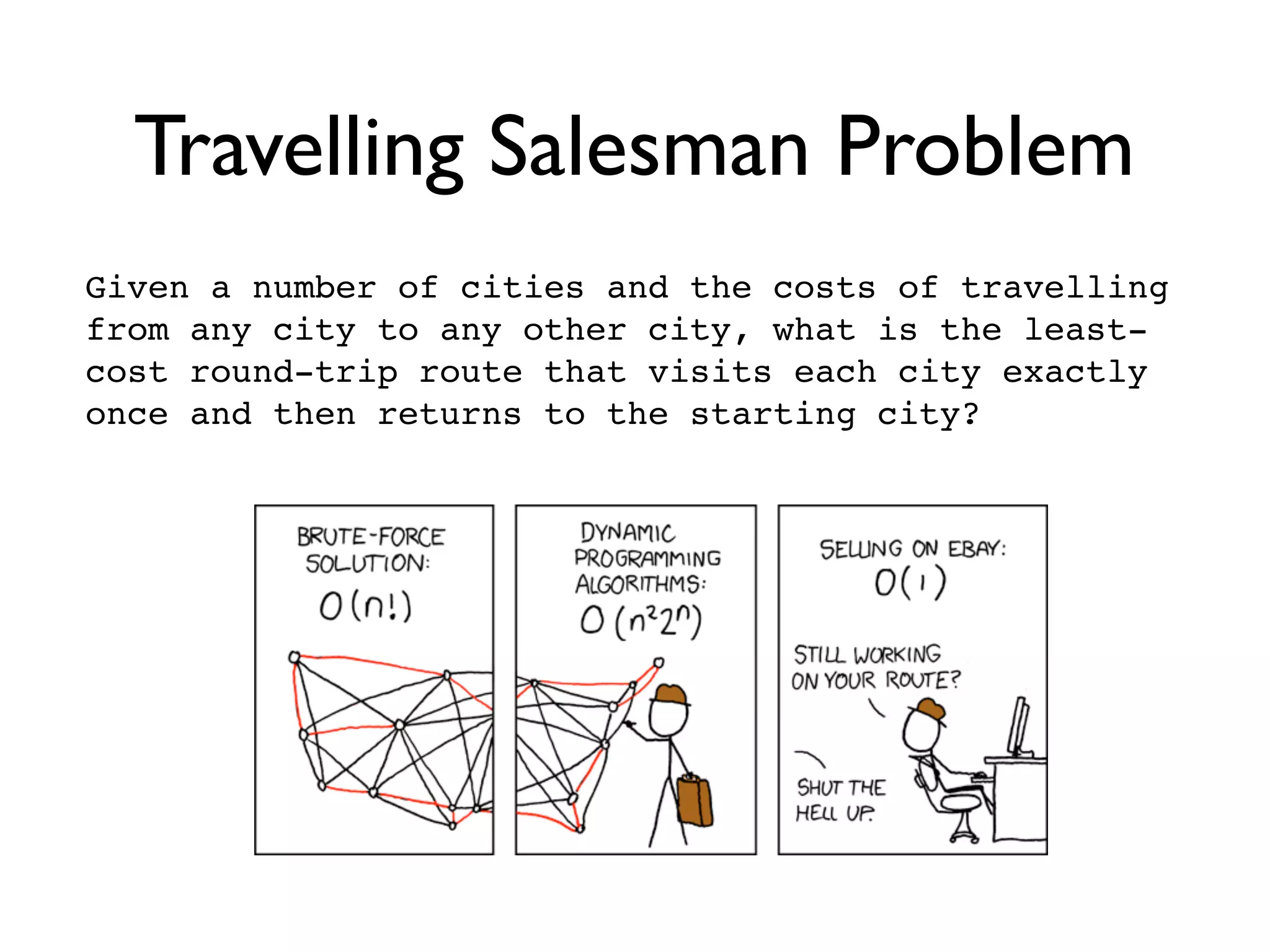
Travelling Salesman Problem
Given a number of cities and the costs of travelling
from any city to any other city, what is the least-
cost round-trip route that visits each city exactly
once and then returns to the starting city?
OBTW

With CTE and Windowing, SQL is Turing Complete.
What Didn't the
Old Syntax Do?
WRITE!
WITH [RECURSIVE] t1 [(column type,…)] AS
(
    [SELECT | VALUES |
   (INSERT | UPDATE | DELETE) [RETURNING]]
[UNION [ALL]
    [SELECT | VALUES |
   (INSERT     | UPDATE | DELETE) [RETURNING]]
)
(SELECT |   INSERT | UPDATE | DELETE)      …
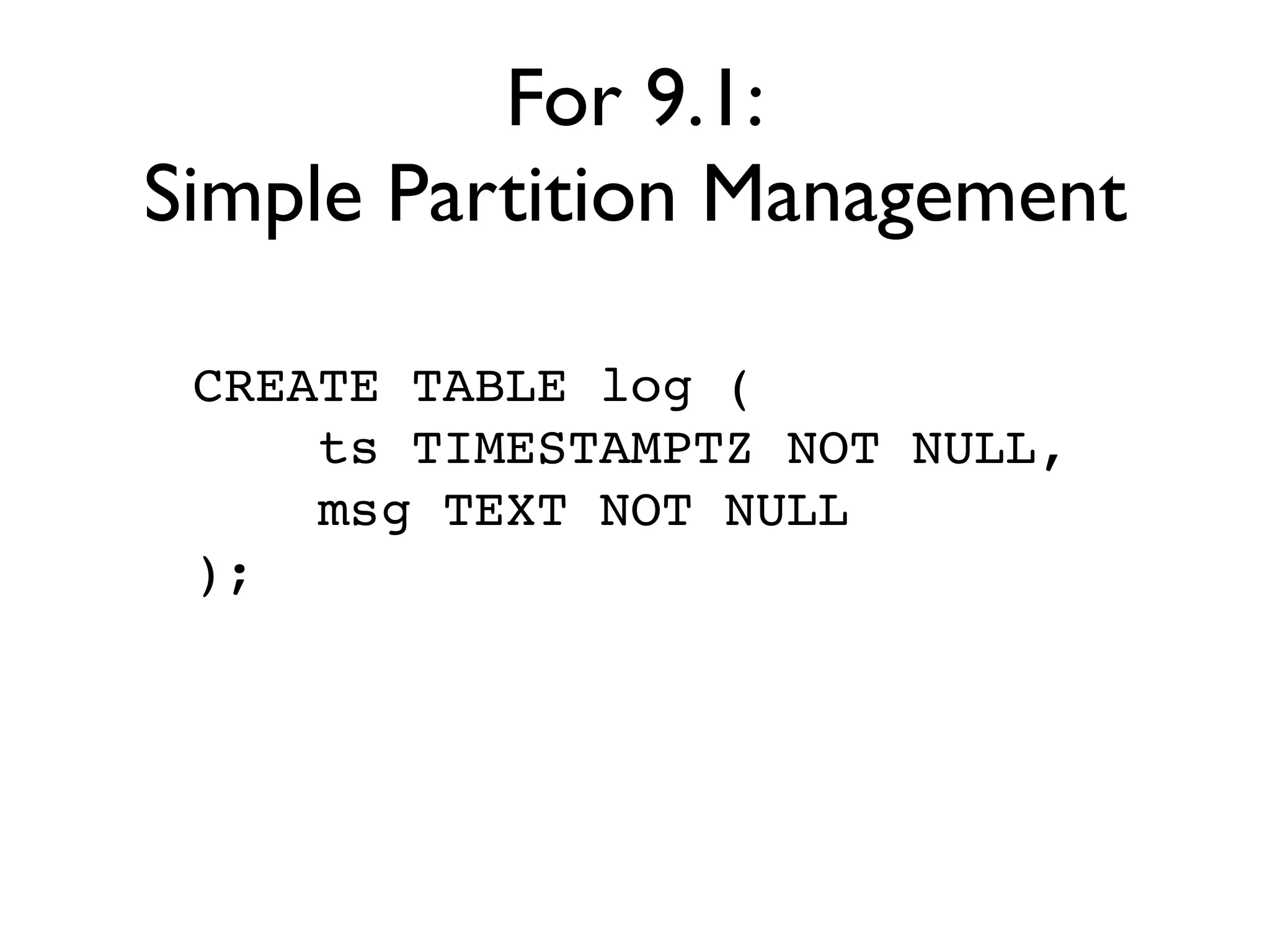
For 9.1:
Simple Partition Management

 CREATE TABLE log (
     ts TIMESTAMPTZ NOT NULL,
     msg TEXT NOT NULL
 );
For 9.1:
Simple Partition Management
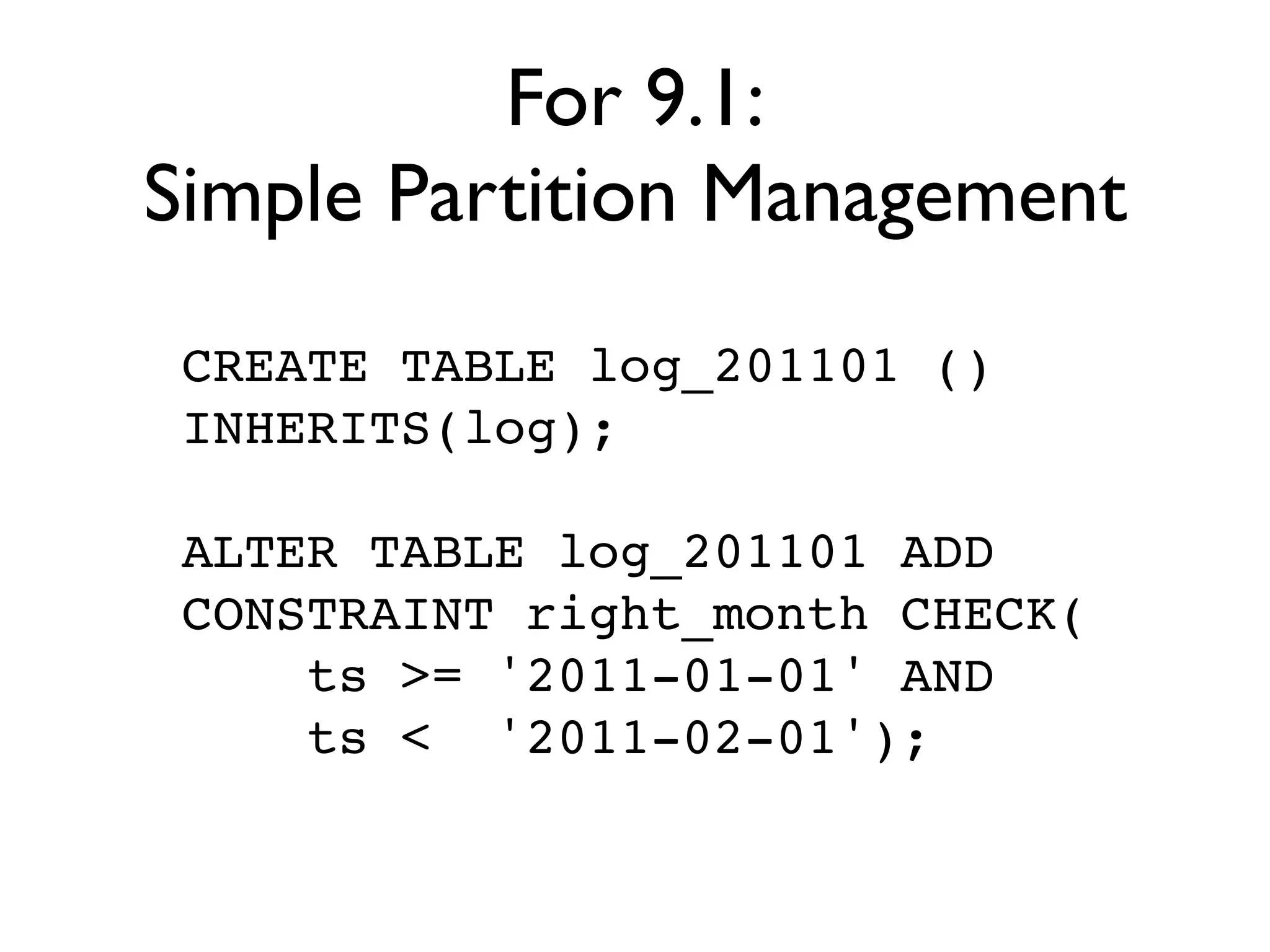
 CREATE TABLE log_201101 ()
 INHERITS(log);

 ALTER TABLE log_201101 ADD
 CONSTRAINT right_month CHECK(
     ts >= '2011-01-01' AND
     ts < '2011-02-01');
For 9.1:
    Simple Partition Management

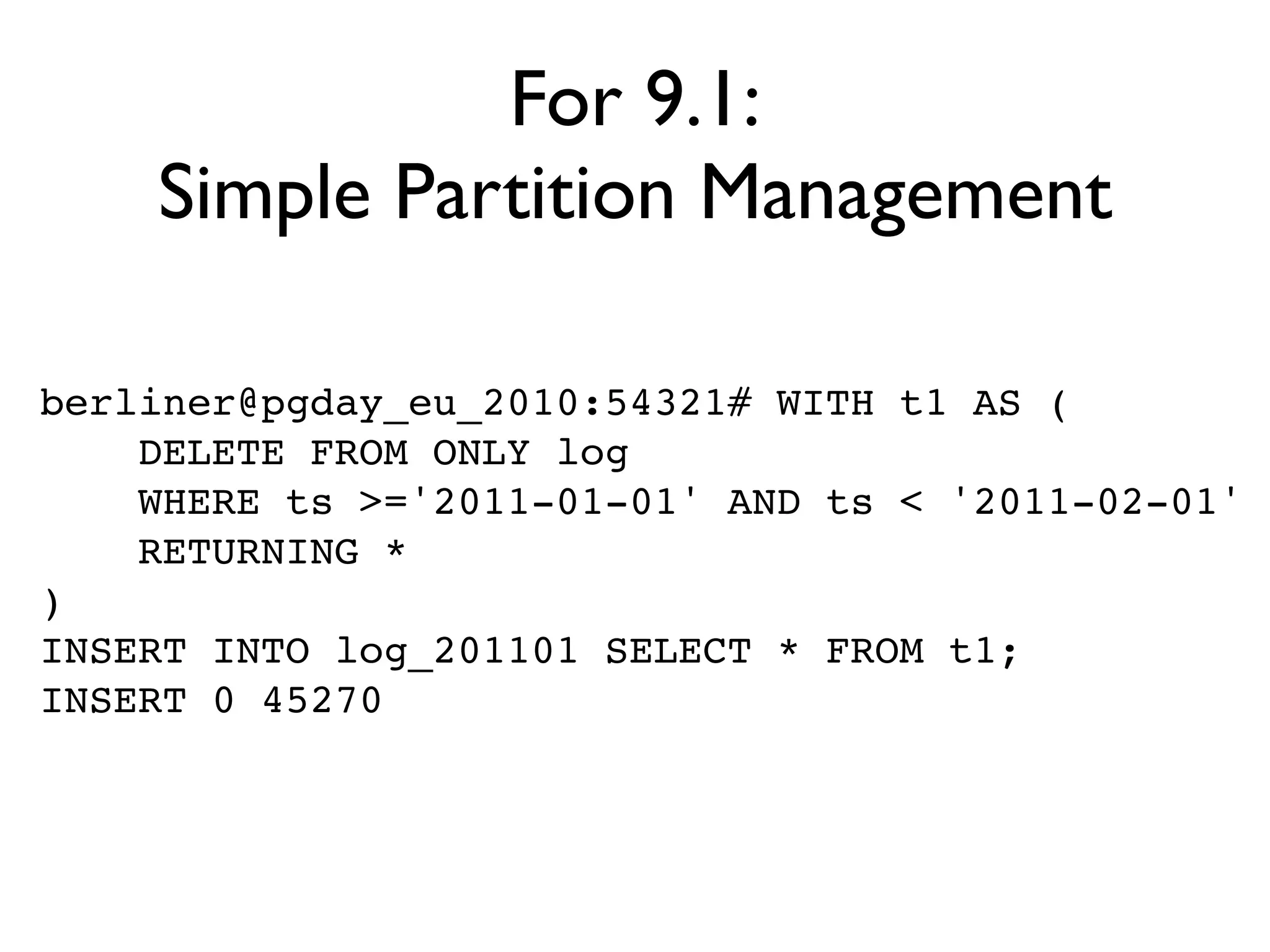
berliner@pgday_eu_2010:54321# WITH t1 AS (
    DELETE FROM ONLY log
    WHERE ts >='2011-01-01' AND ts < '2011-02-01'
    RETURNING *
)
INSERT INTO log_201101 SELECT * FROM t1;
INSERT 0 45270
Query Clustering:
             I/O Minimization

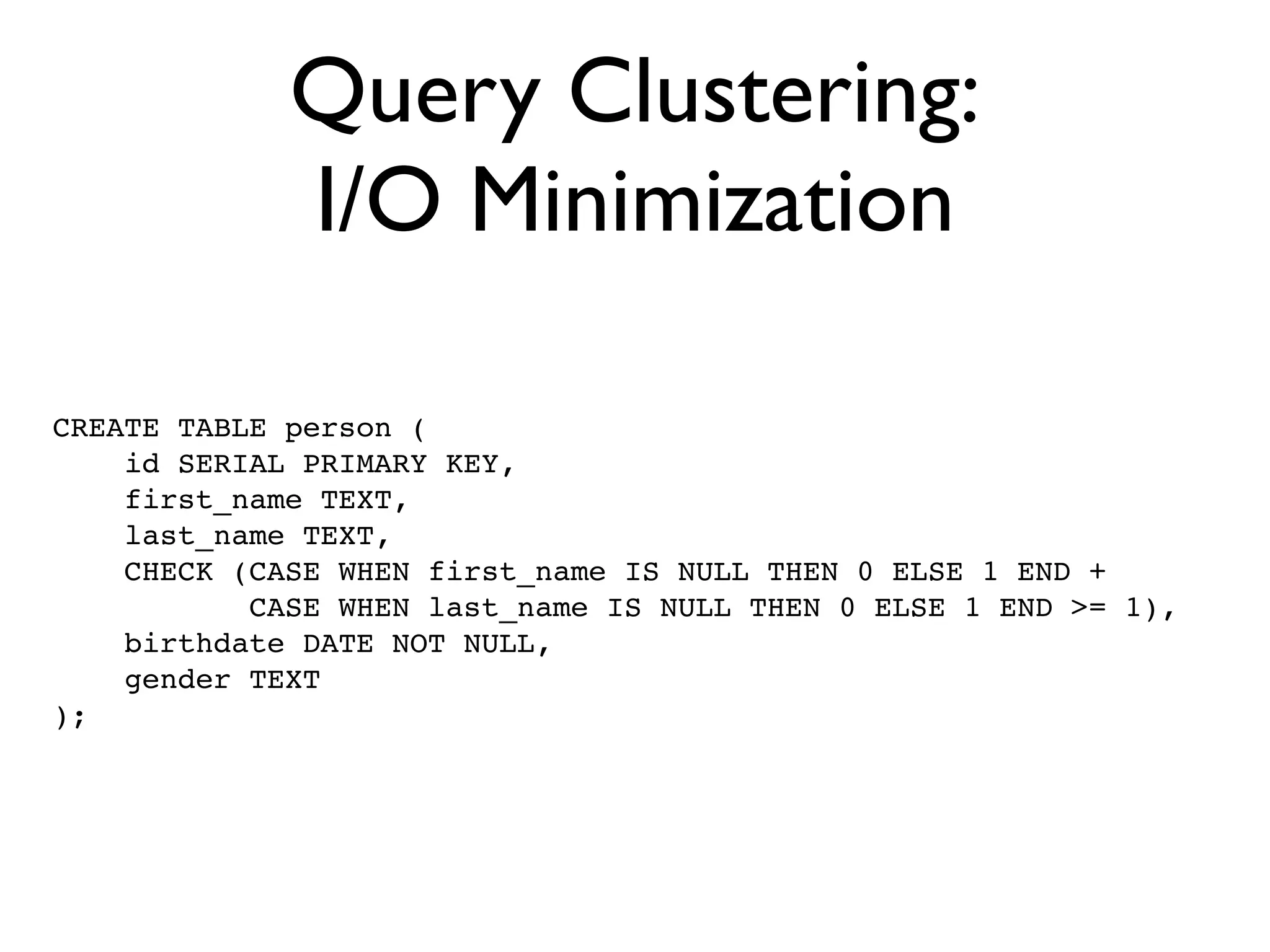
CREATE TABLE person (
    id SERIAL PRIMARY KEY,
    first_name TEXT,
    last_name TEXT,
    CHECK (CASE WHEN first_name IS NULL THEN 0 ELSE 1 END +
           CASE WHEN last_name IS NULL THEN 0 ELSE 1 END >= 1),
    birthdate DATE NOT NULL,
    gender TEXT
);
Query Clustering:
         I/O Minimization

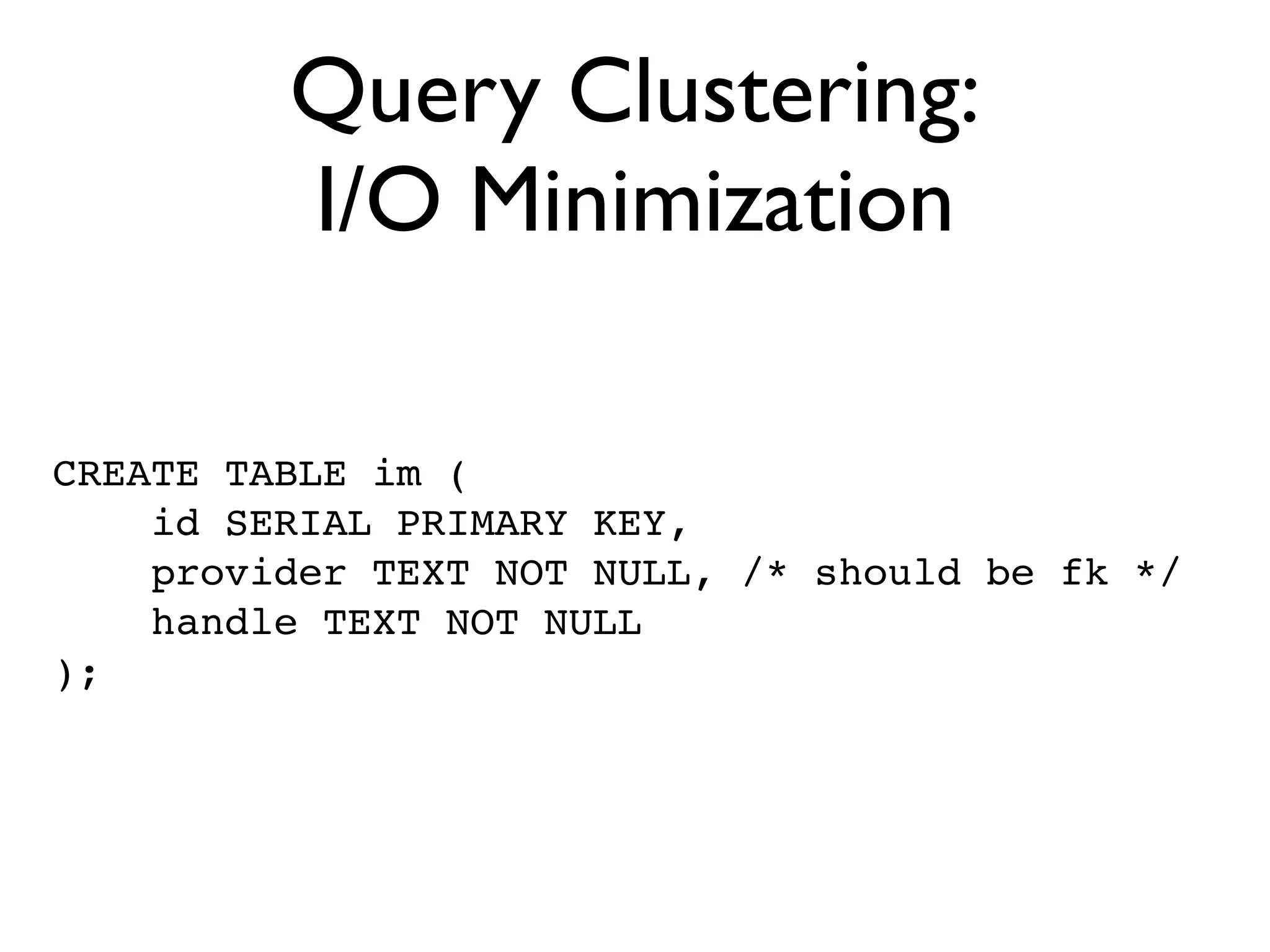
CREATE TABLE im (
    id SERIAL PRIMARY KEY,
    provider TEXT NOT NULL, /* should be fk */
    handle TEXT NOT NULL
);
Query Clustering:
      I/O Minimization
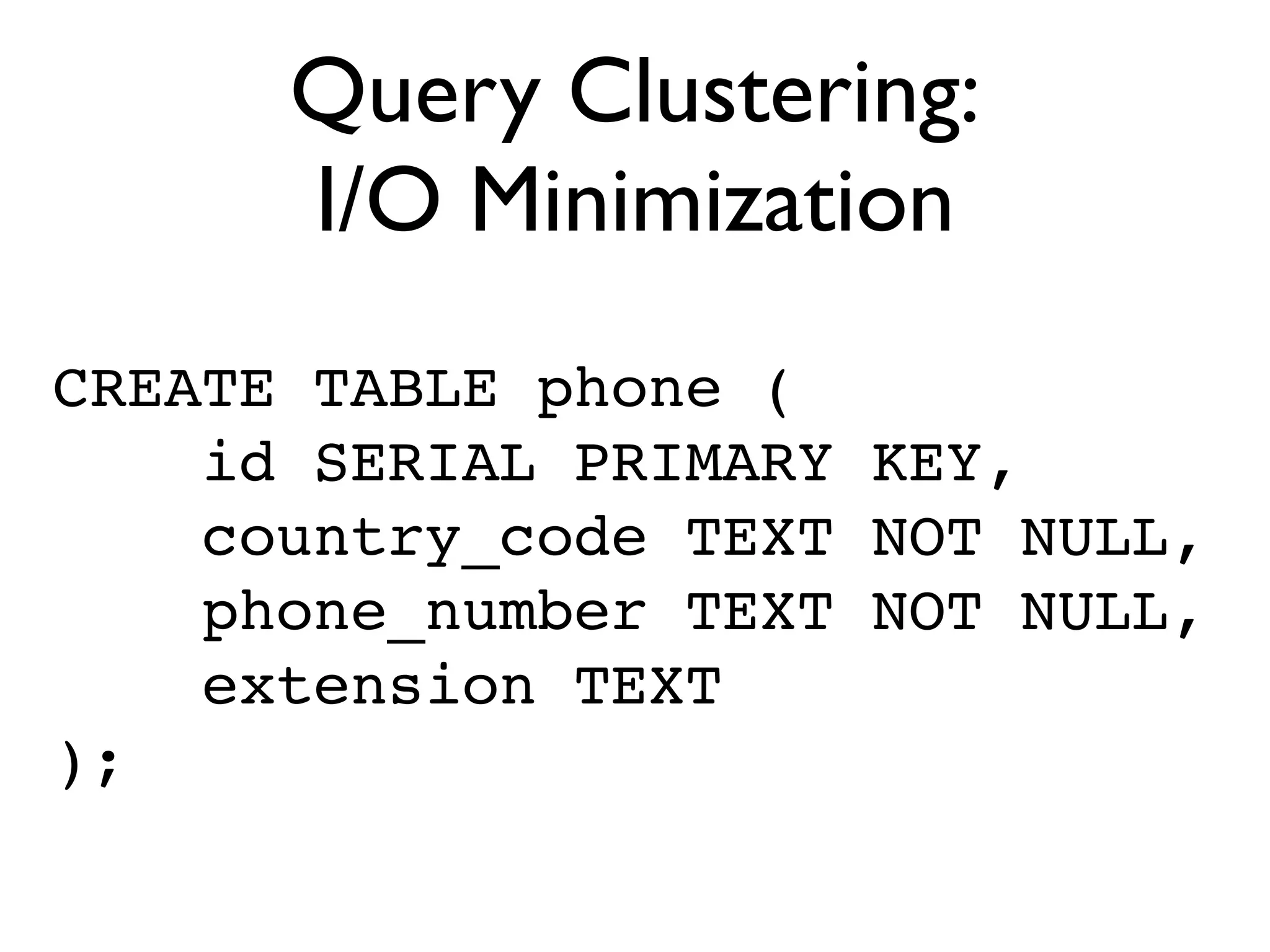
CREATE TABLE phone (
    id SERIAL PRIMARY KEY,
    country_code TEXT NOT NULL,
    phone_number TEXT NOT NULL,
    extension TEXT
);
Query Clustering:
 I/O Minimization
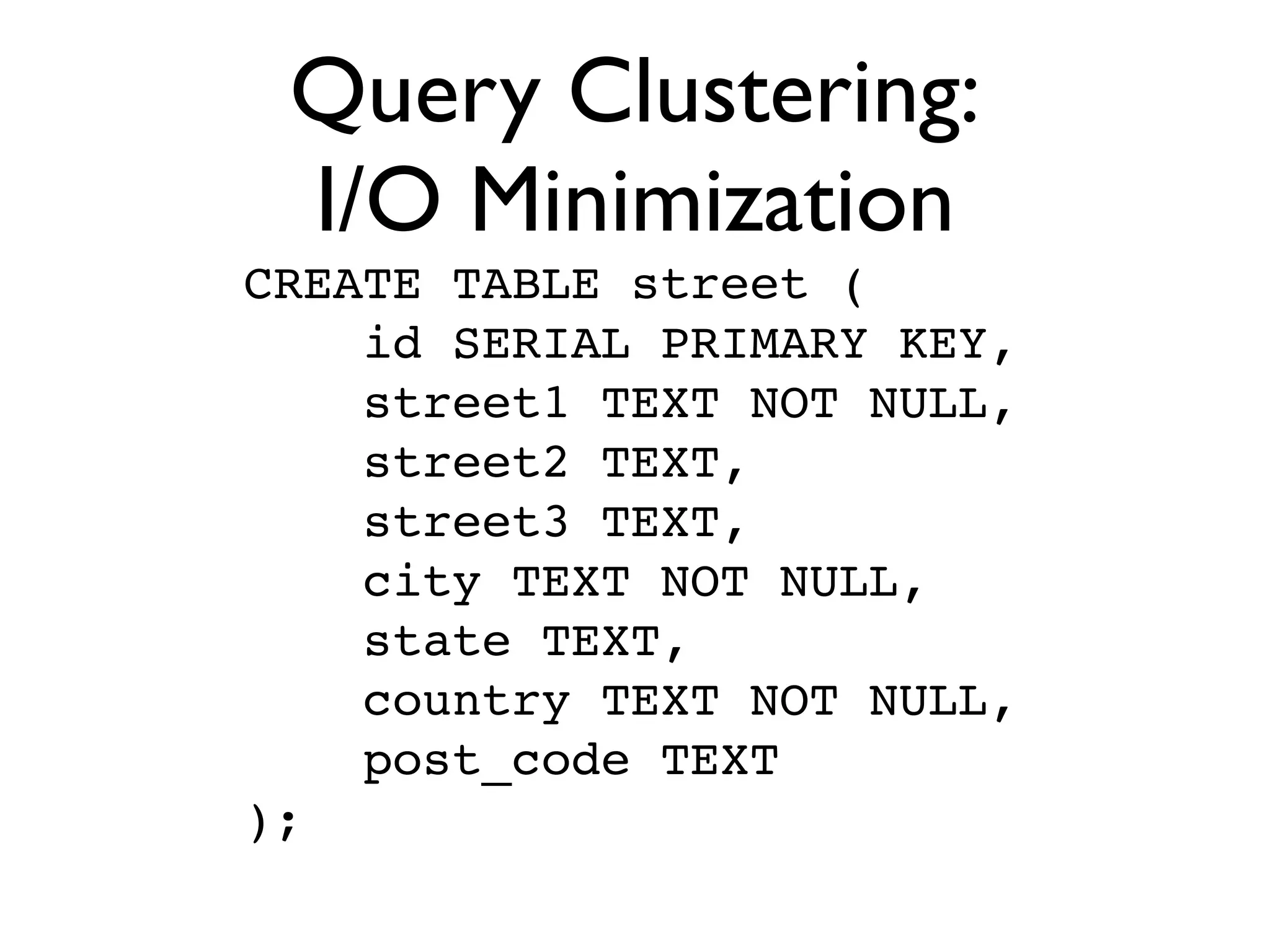
CREATE TABLE street (
    id SERIAL PRIMARY KEY,
    street1 TEXT NOT NULL,
    street2 TEXT,
    street3 TEXT,
    city TEXT NOT NULL,
    state TEXT,
    country TEXT NOT NULL,
    post_code TEXT
);
Query Clustering:
   I/O Minimization
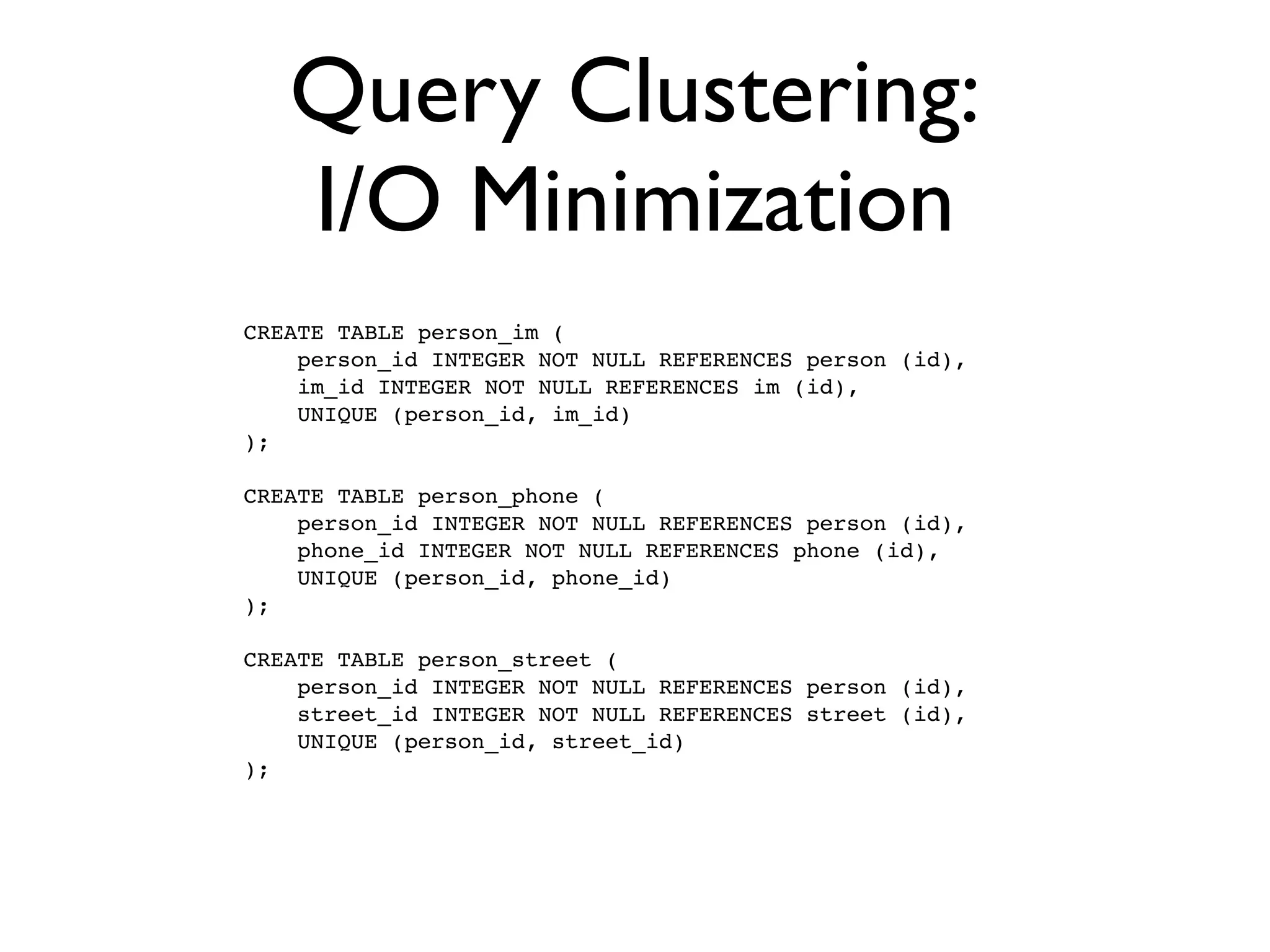
CREATE TABLE person_im (
    person_id INTEGER NOT NULL REFERENCES person (id),
    im_id INTEGER NOT NULL REFERENCES im (id),
    UNIQUE (person_id, im_id)
);

CREATE TABLE person_phone (
    person_id INTEGER NOT NULL REFERENCES person (id),
    phone_id INTEGER NOT NULL REFERENCES phone (id),
    UNIQUE (person_id, phone_id)
);

CREATE TABLE person_street (
    person_id INTEGER NOT NULL REFERENCES person (id),
    street_id INTEGER NOT NULL REFERENCES street (id),
    UNIQUE (person_id, street_id)
);
Query Clustering:
         I/O Minimization

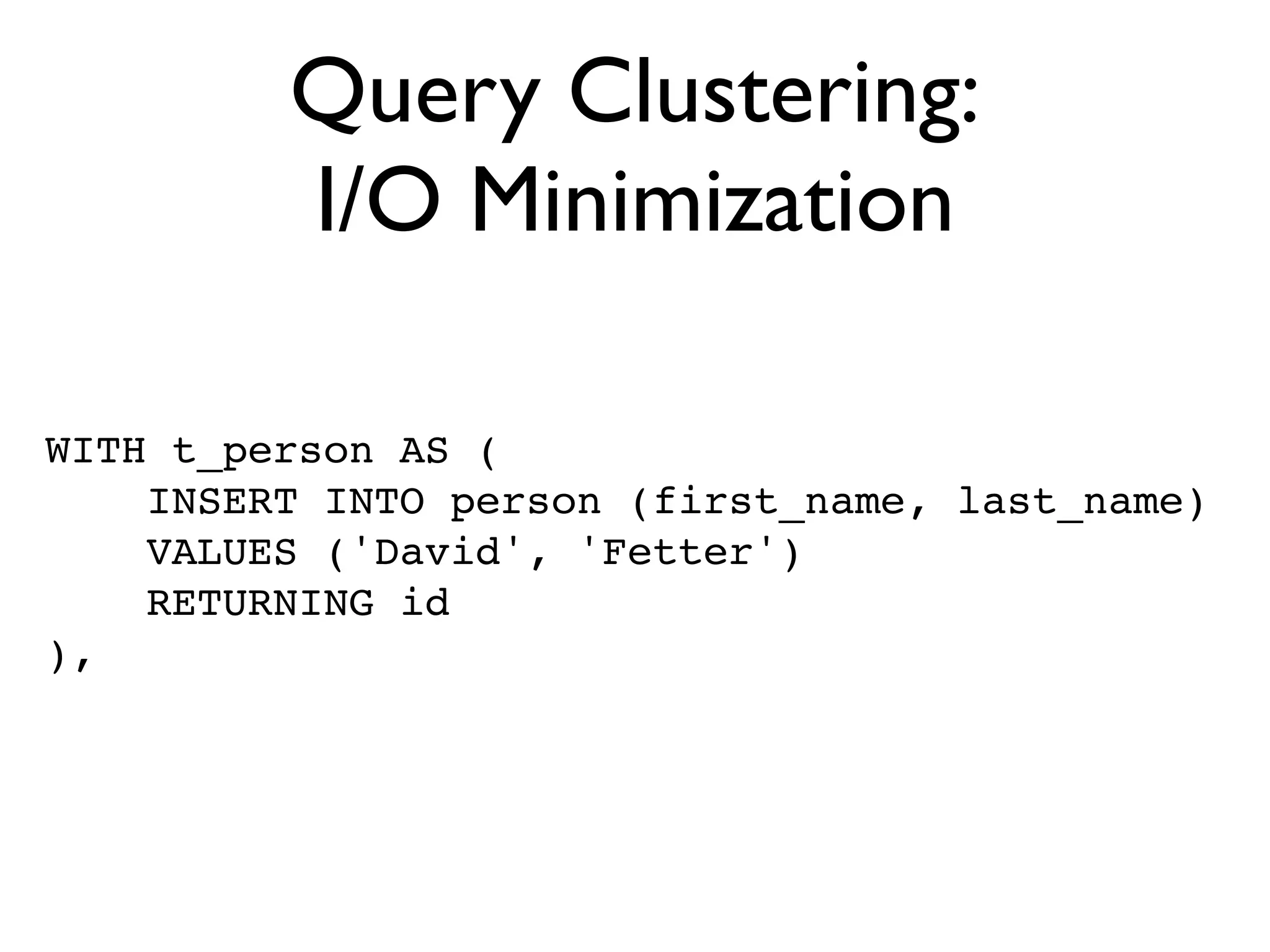
WITH t_person AS (
    INSERT INTO person (first_name, last_name)
    VALUES ('David', 'Fetter')
    RETURNING id
),
Query Clustering:
        I/O Minimization
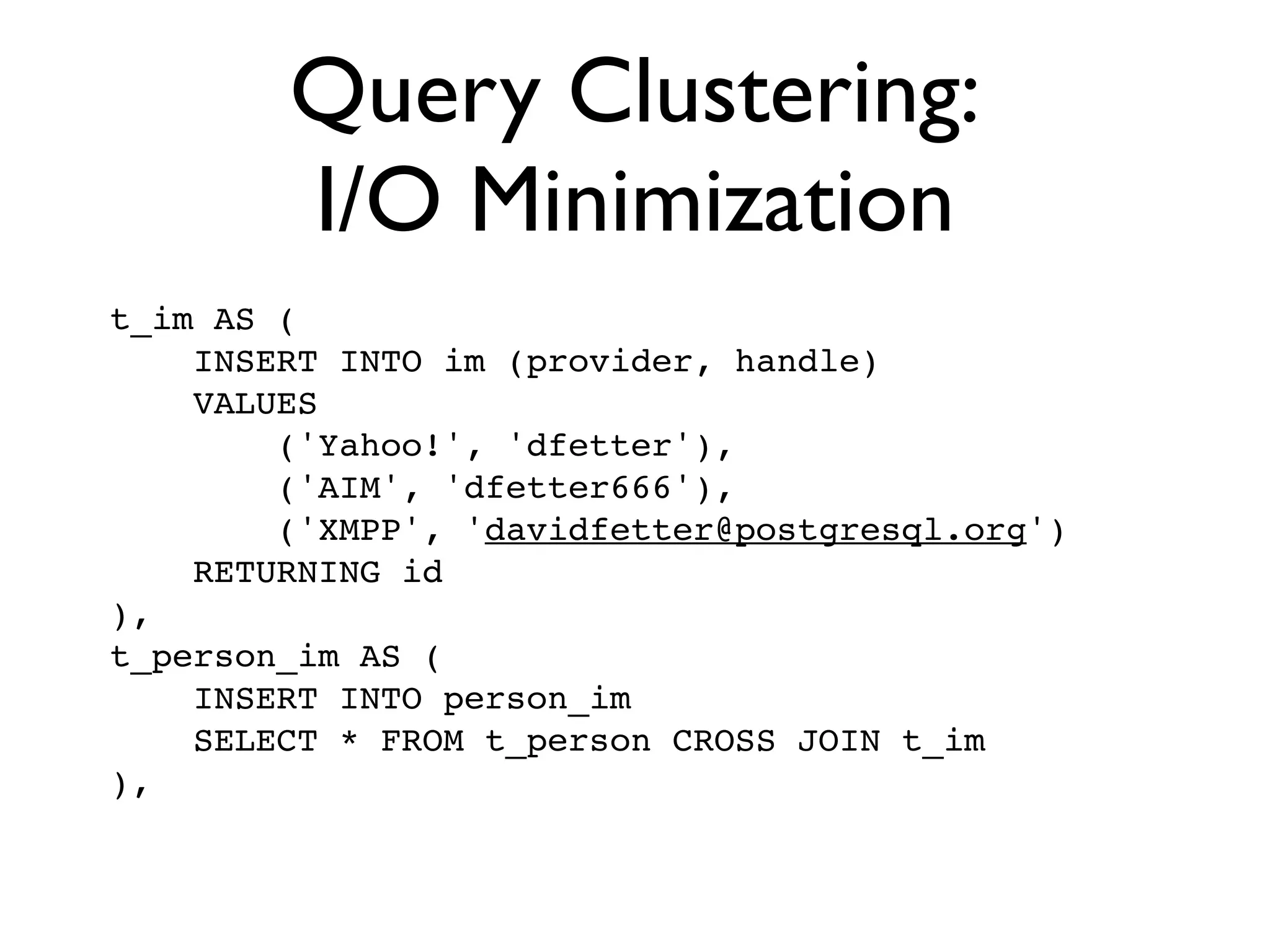
t_im AS (
    INSERT INTO im (provider, handle)
    VALUES
        ('Yahoo!', 'dfetter'),
        ('AIM', 'dfetter666'),
        ('XMPP', 'davidfetter@postgresql.org')
    RETURNING id
),
t_person_im AS (
    INSERT INTO person_im
    SELECT * FROM t_person CROSS JOIN t_im
),
Query Clustering:
        I/O Minimization
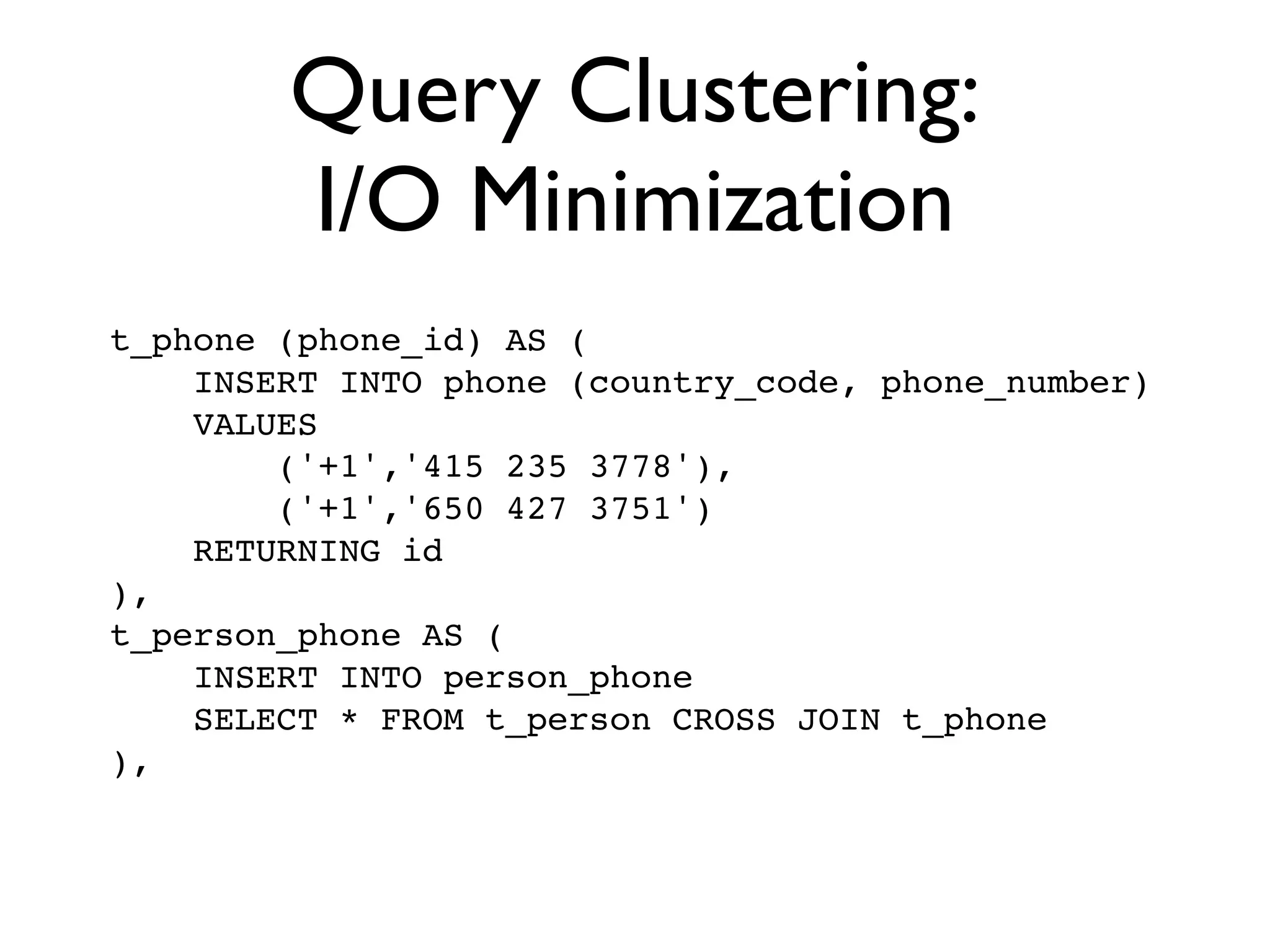
t_phone (phone_id) AS (
    INSERT INTO phone (country_code, phone_number)
    VALUES
        ('+1','415 235 3778'),
        ('+1','650 427 3751')
    RETURNING id
),
t_person_phone AS (
    INSERT INTO person_phone
    SELECT * FROM t_person CROSS JOIN t_phone
),
Query Clustering:
                     I/O Minimization

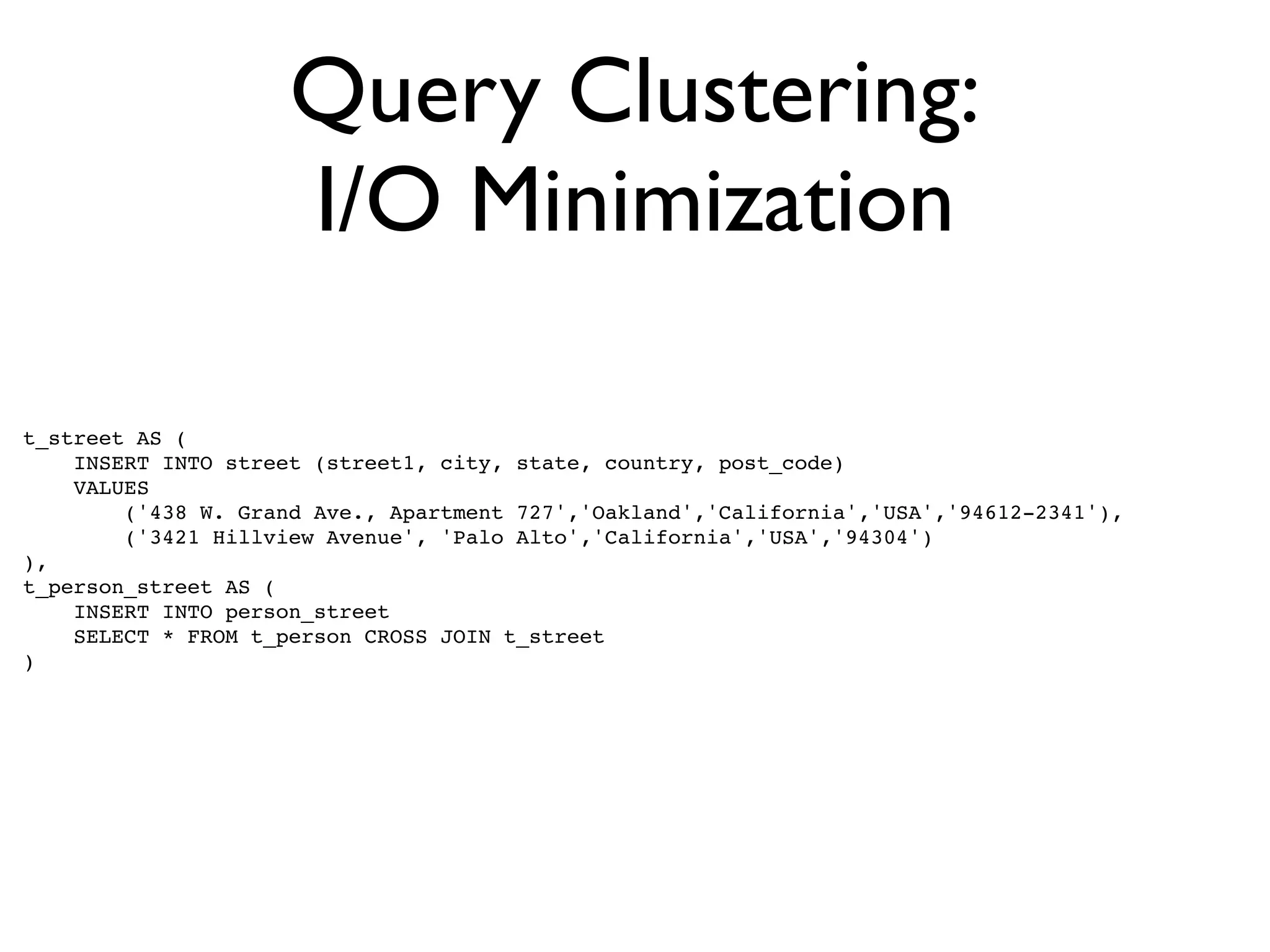
t_street AS (
    INSERT INTO street (street1, city, state, country, post_code)
    VALUES
        ('438 W. Grand Ave., Apartment 727','Oakland','California','USA','94612-2341'),
        ('3421 Hillview Avenue', 'Palo Alto','California','USA','94304')
),
t_person_street AS (
    INSERT INTO person_street
    SELECT * FROM t_person CROSS JOIN t_street
)
Query Clustering:
  I/O Minimization


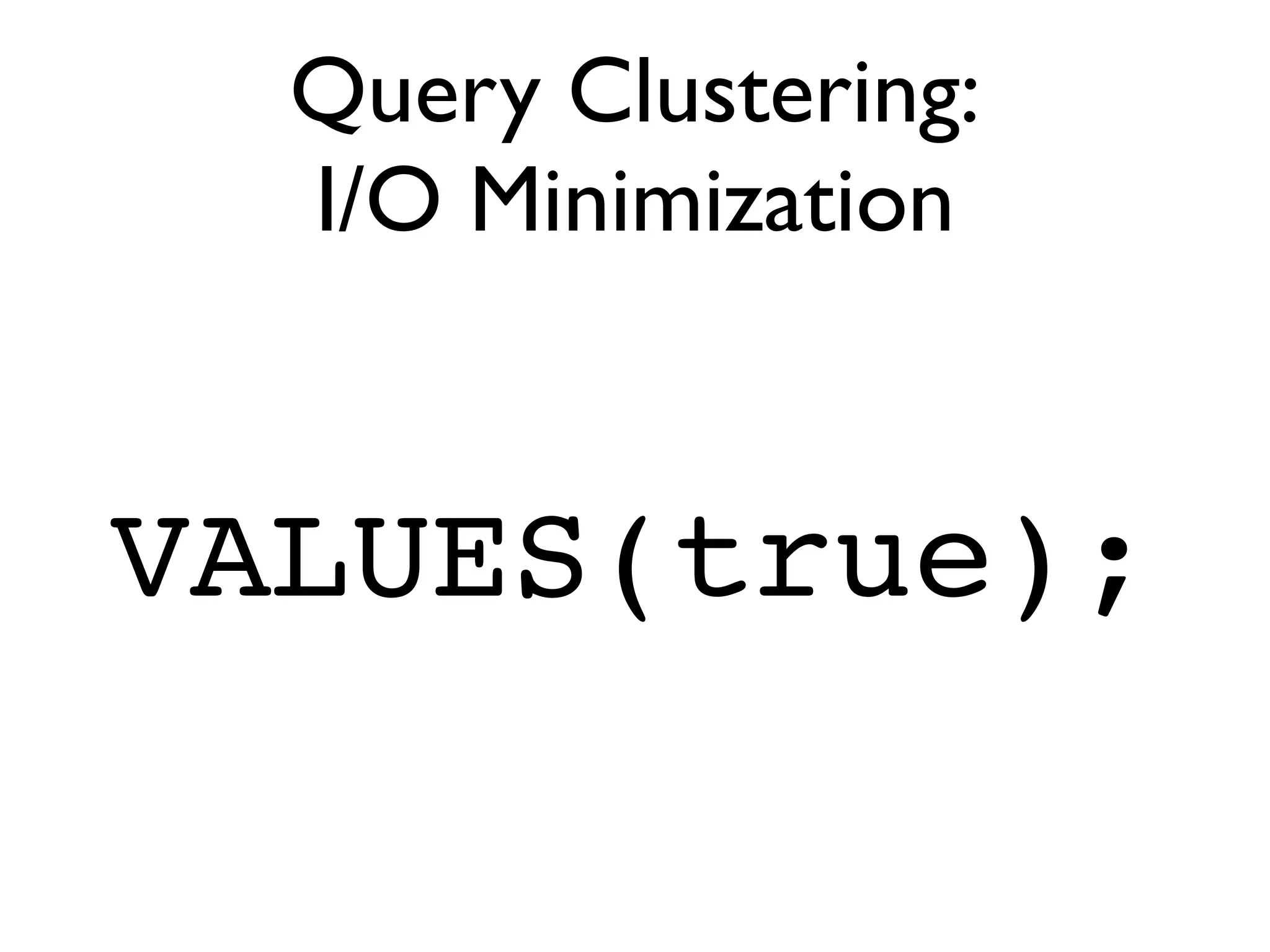
VALUES(true);
Query Clustering:
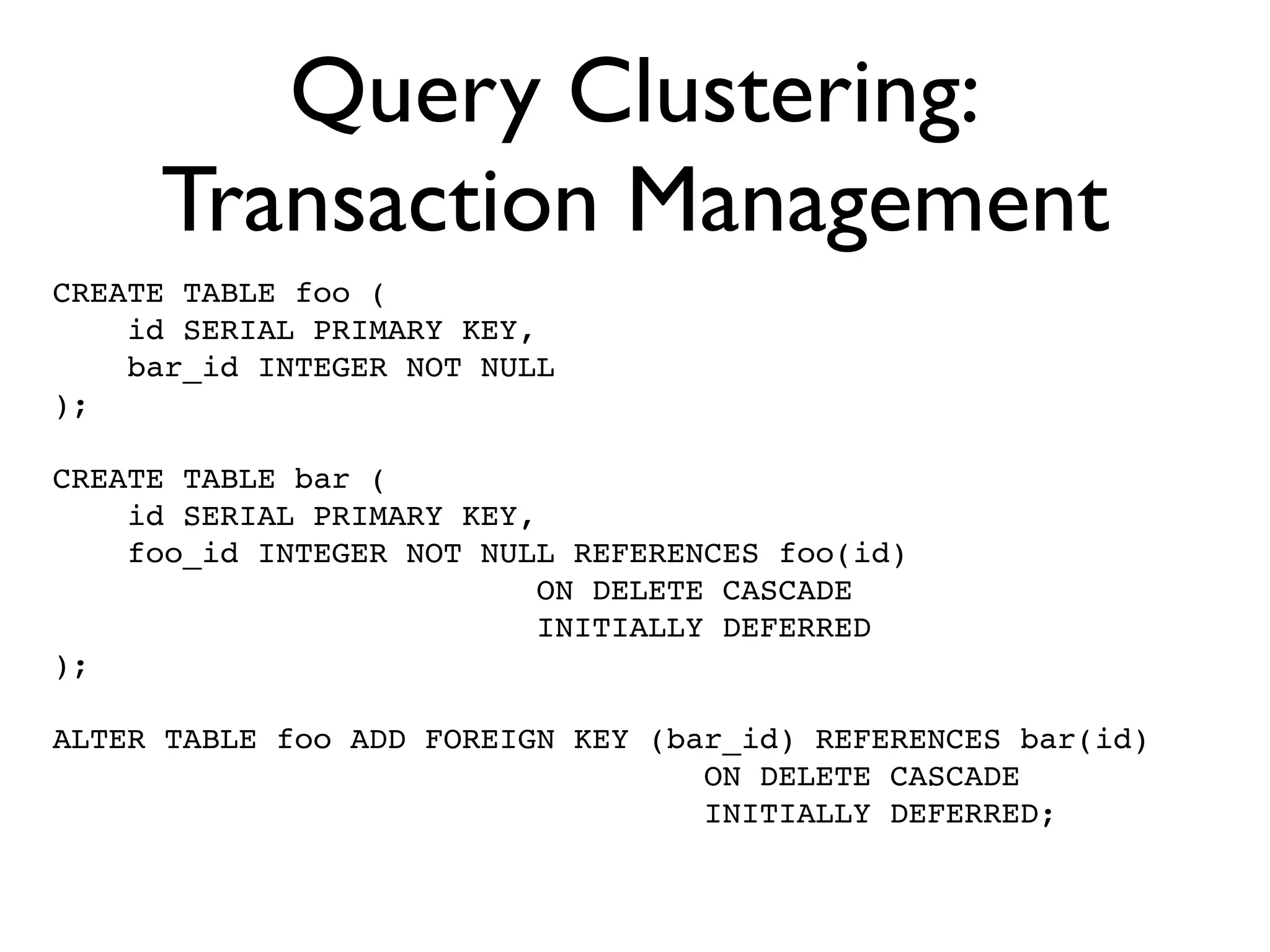
     Transaction Management
CREATE TABLE foo (
    id SERIAL PRIMARY KEY,
    bar_id INTEGER NOT NULL
);

CREATE TABLE bar (
    id SERIAL PRIMARY KEY,
    foo_id INTEGER NOT NULL REFERENCES foo(id)
                           ON DELETE CASCADE
                           INITIALLY DEFERRED
);

ALTER TABLE foo ADD FOREIGN KEY (bar_id) REFERENCES bar(id)
                                   ON DELETE CASCADE
                                   INITIALLY DEFERRED;
Query Clustering:
    Transaction Management
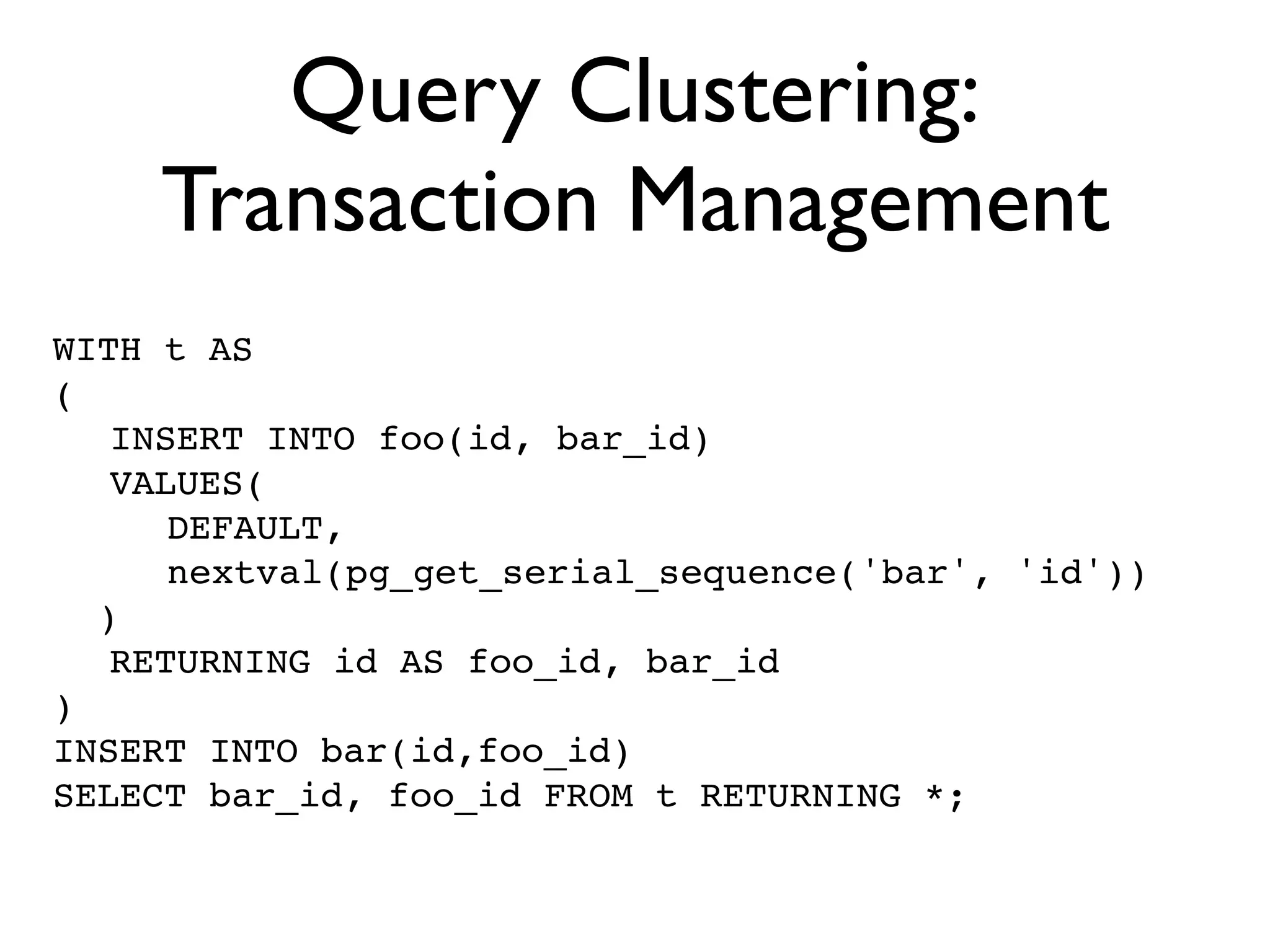
WITH t AS
(
! INSERT INTO foo(id, bar_id)
! VALUES(
! ! DEFAULT,
! ! nextval(pg_get_serial_sequence('bar', 'id'))
  )
! RETURNING id AS foo_id, bar_id
)
INSERT INTO bar(id,foo_id)
SELECT bar_id, foo_id FROM t RETURNING *;
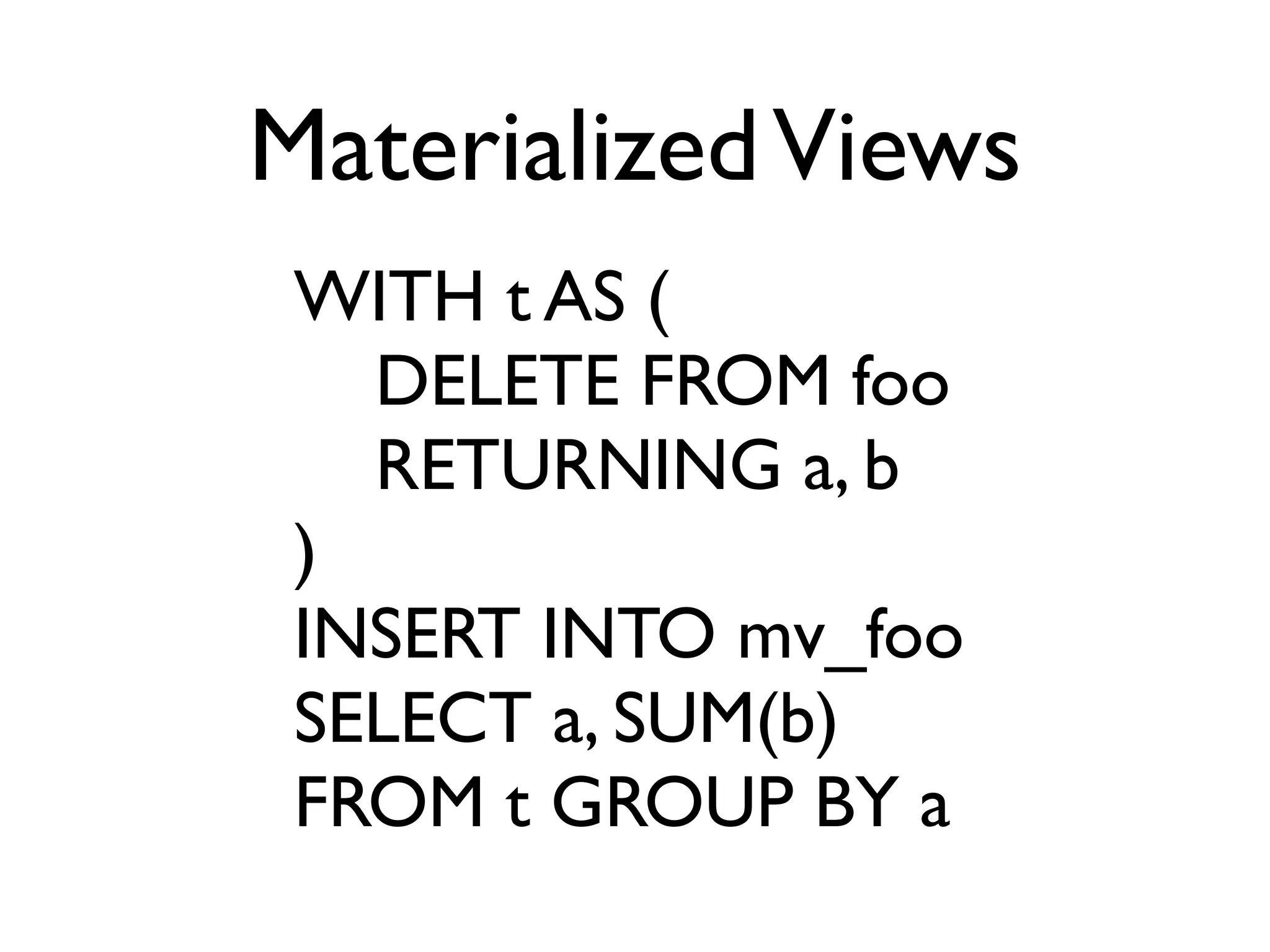
Materialized Views
 WITH t AS (
   DELETE FROM foo
   RETURNING a, b
 )
 INSERT INTO mv_foo
 SELECT a, SUM(b)
 FROM t GROUP BY a
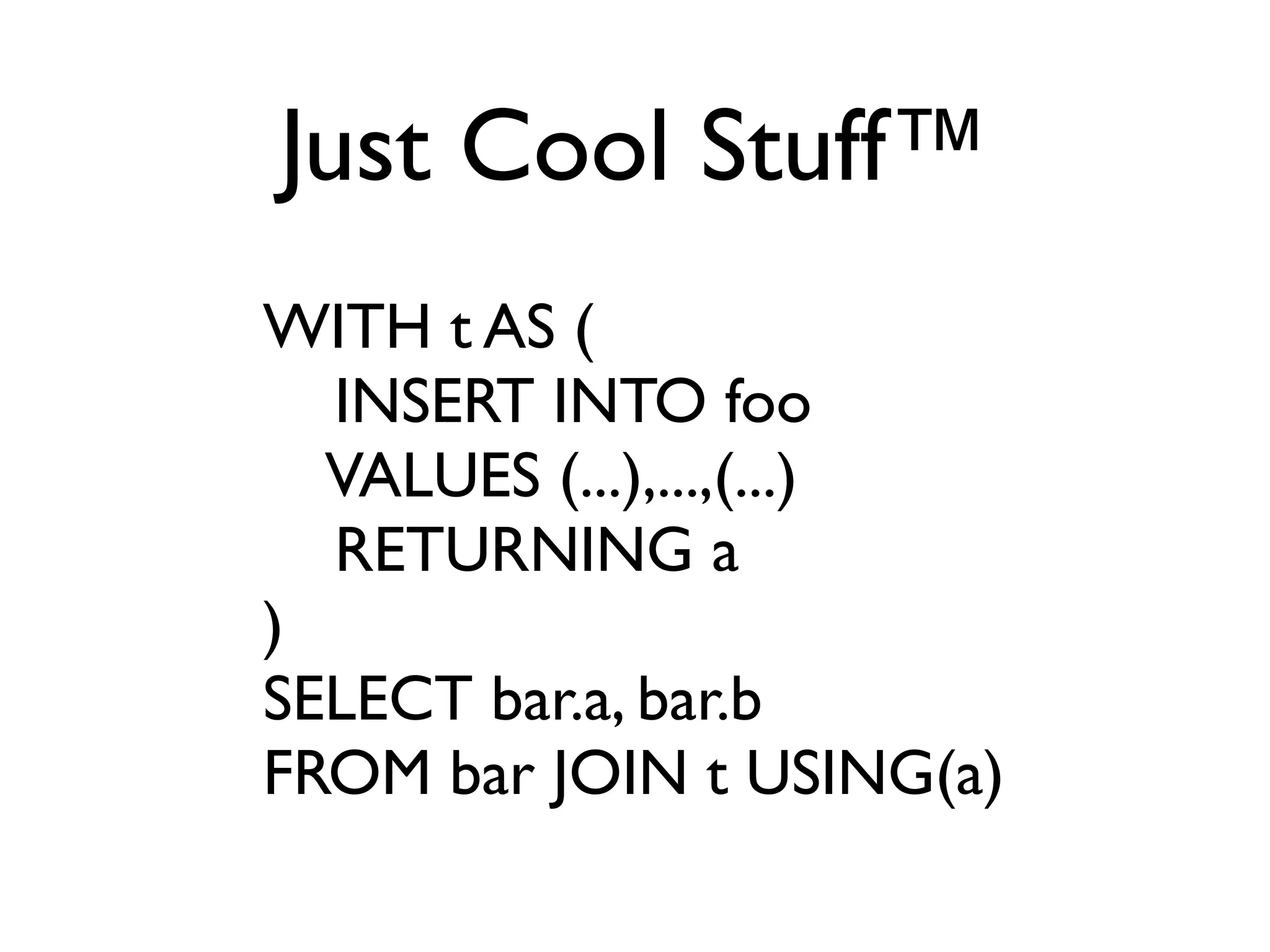
Just Cool Stuff™
WITH t AS (
  INSERT INTO foo
  VALUES (...),...,(...)
  RETURNING a
)
SELECT bar.a, bar.b
FROM bar JOIN t USING(a)
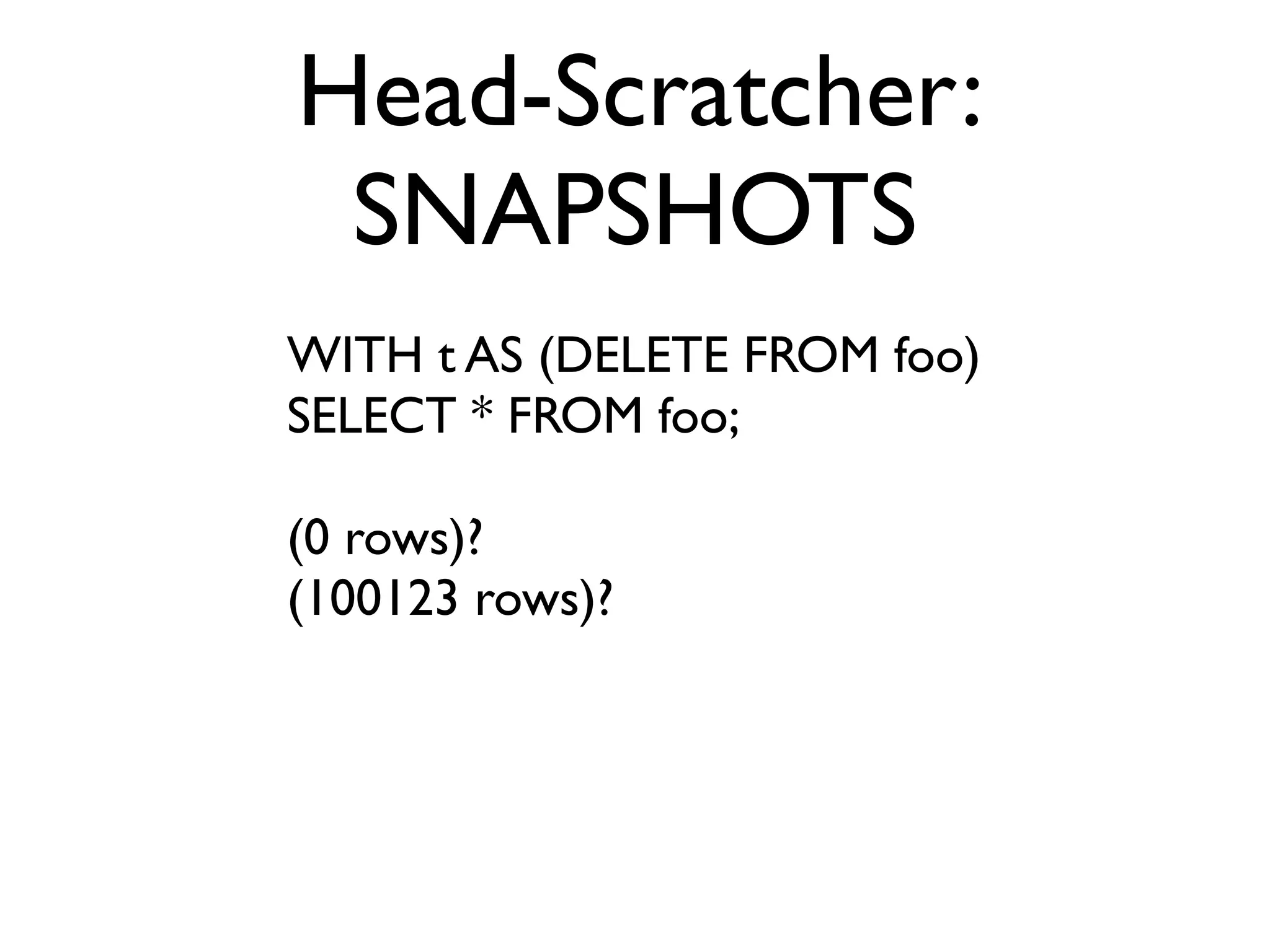
Head-Scratcher:
 SNAPSHOTS
WITH t AS (DELETE FROM foo)
SELECT * FROM foo;

(0 rows)?
(100123 rows)?
How'd He Do That?!?


First try: David digs into the grammar and gets cut
a few times.
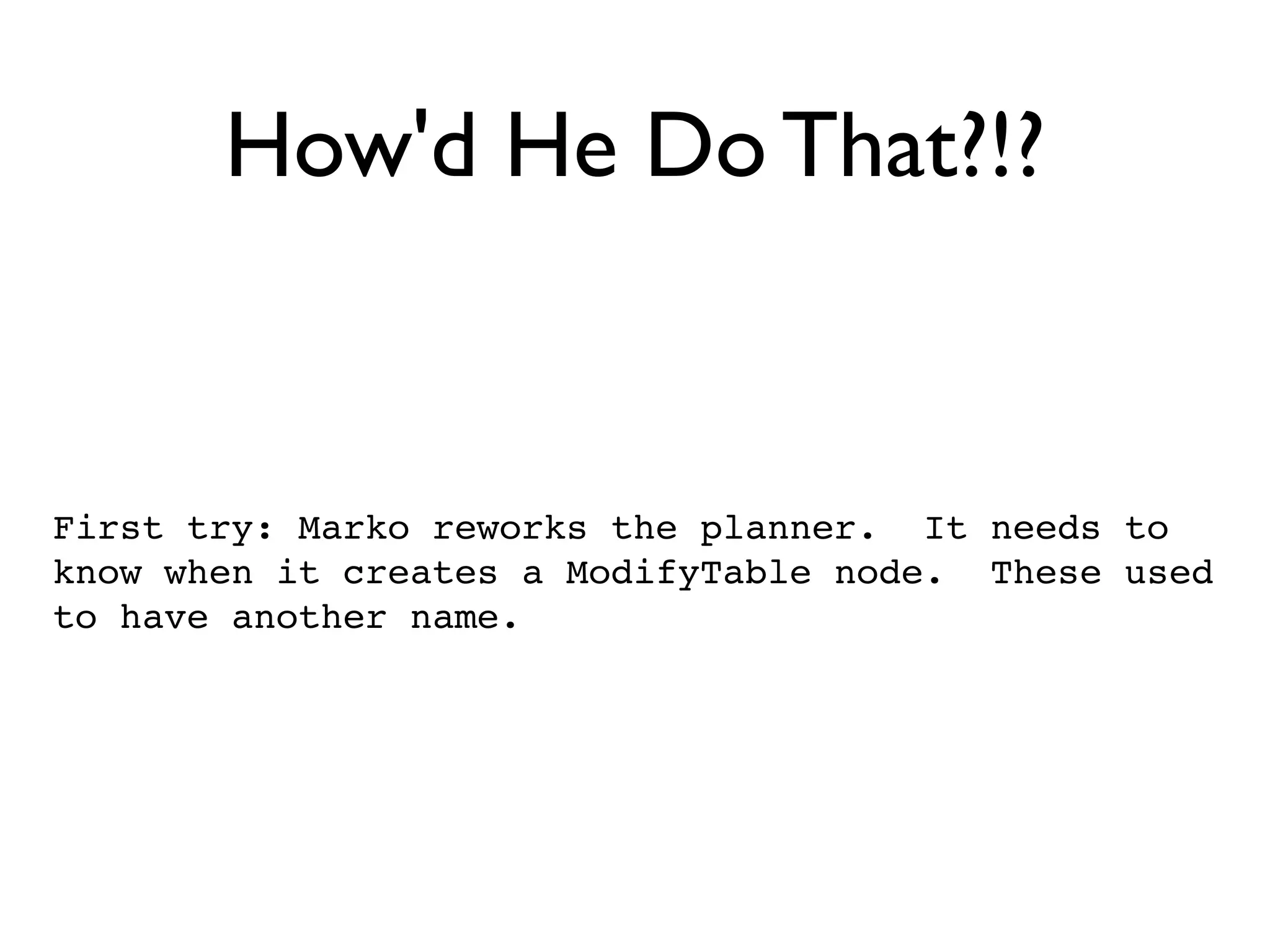
How'd He Do That?!?


First try: Marko reworks the planner. It needs to
know when it creates a ModifyTable node. These used
to have another name.
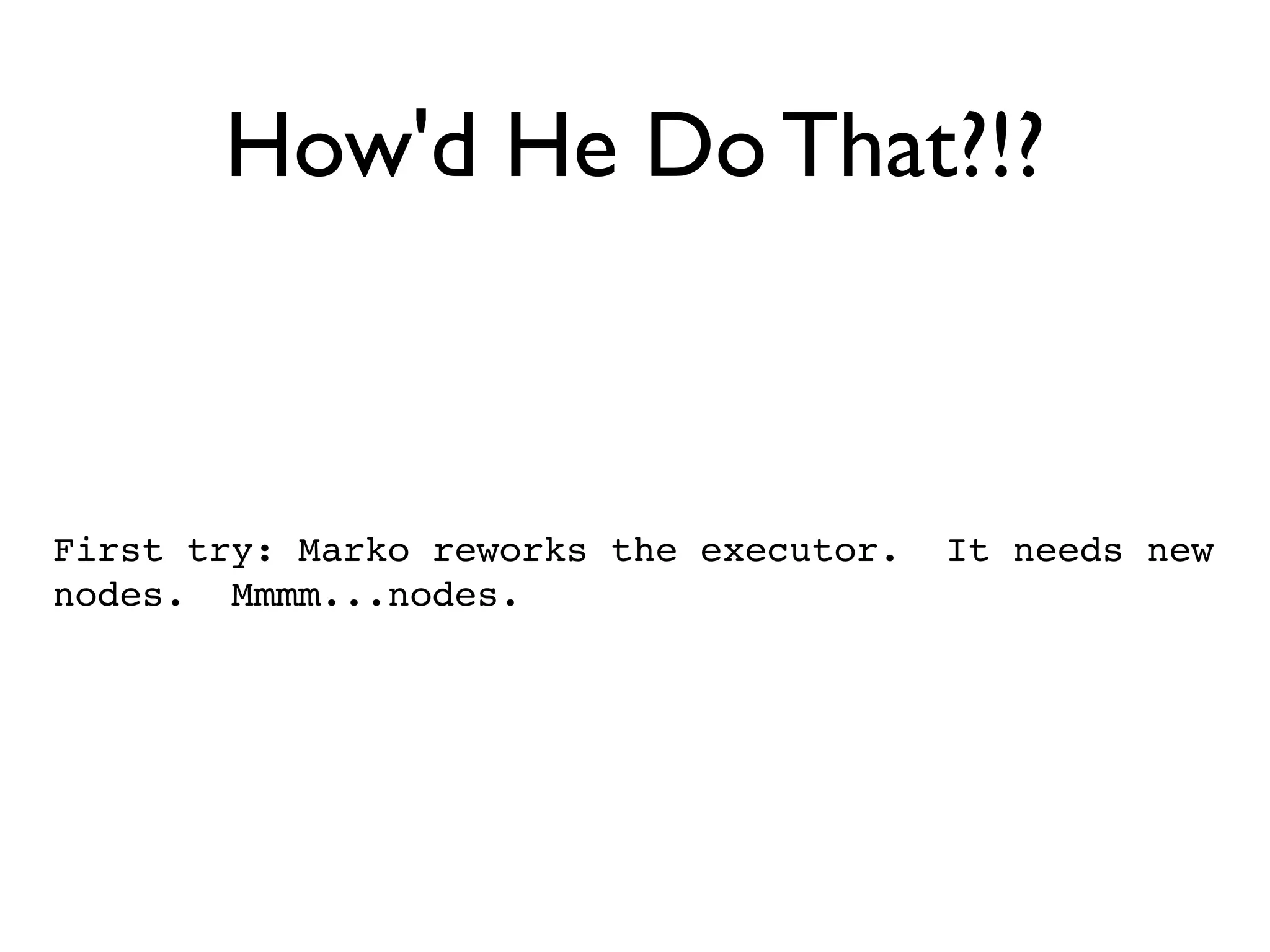
How'd He Do That?!?


First try: Marko reworks the executor.   It needs new
nodes. Mmmm...nodes.
How'd He Do That?!?


Marko reworks the executor, Part II:
Copy & Paste. Now it's getting ugly...
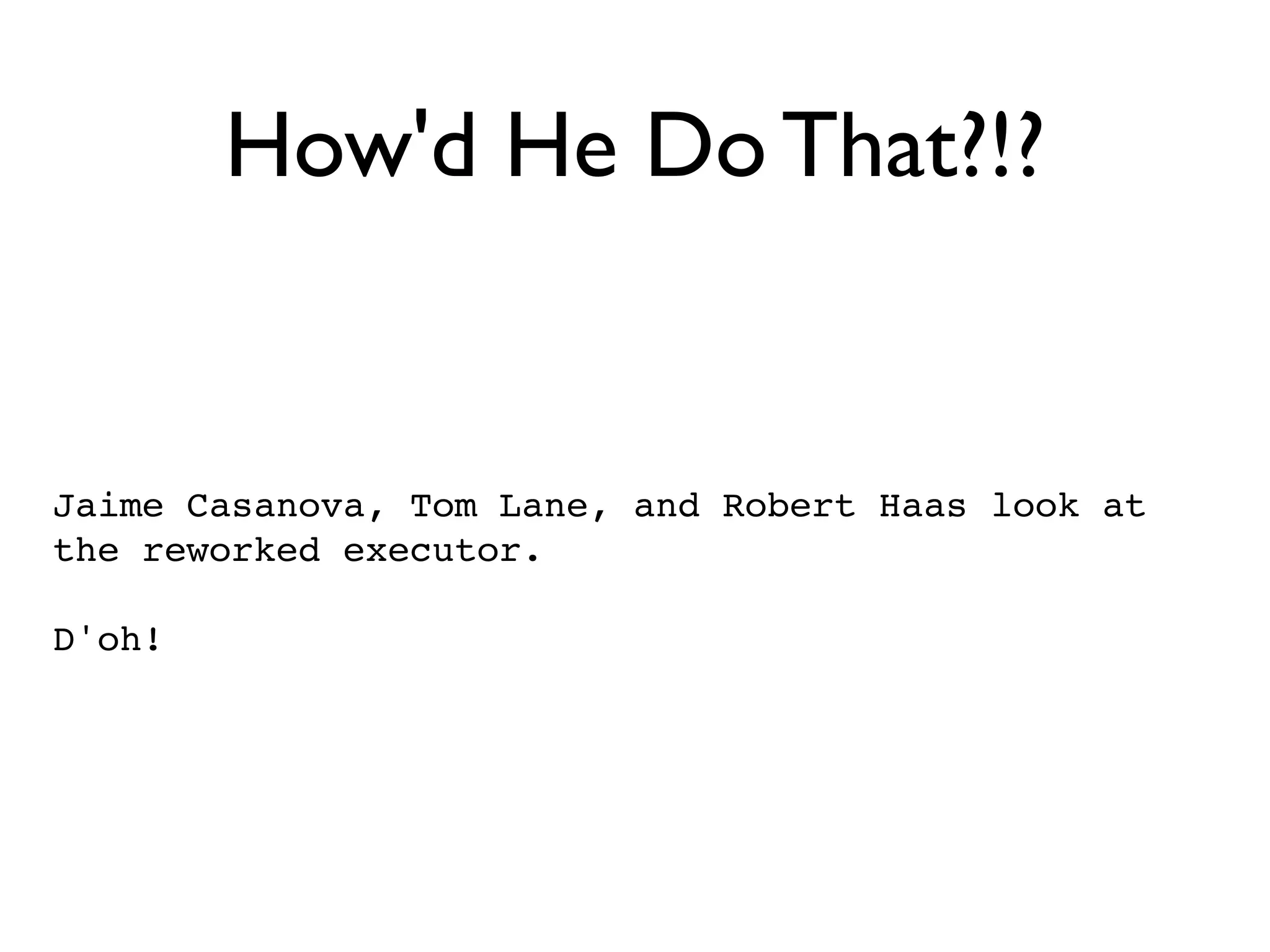
How'd He Do That?!?


Jaime Casanova, Tom Lane, and Robert Haas look at
the reworked executor.

D'oh!
How'd He Do That?!?


       FAIL!
Way too much code copying from top
level to the new nodes.
How'd He Do That?!?


Planner changes for ModifyTable node (a few)
How'd He Do That?!?


Executor changes: ONE new node called ModifyTable
How'd He Do That?!?


Marko Tiikkaja restructures the whole code base for the
ModifyTable node. "The usual stuff," (he said casually) for
                      new nodes.
How'd He Do That?!?


 WIN!
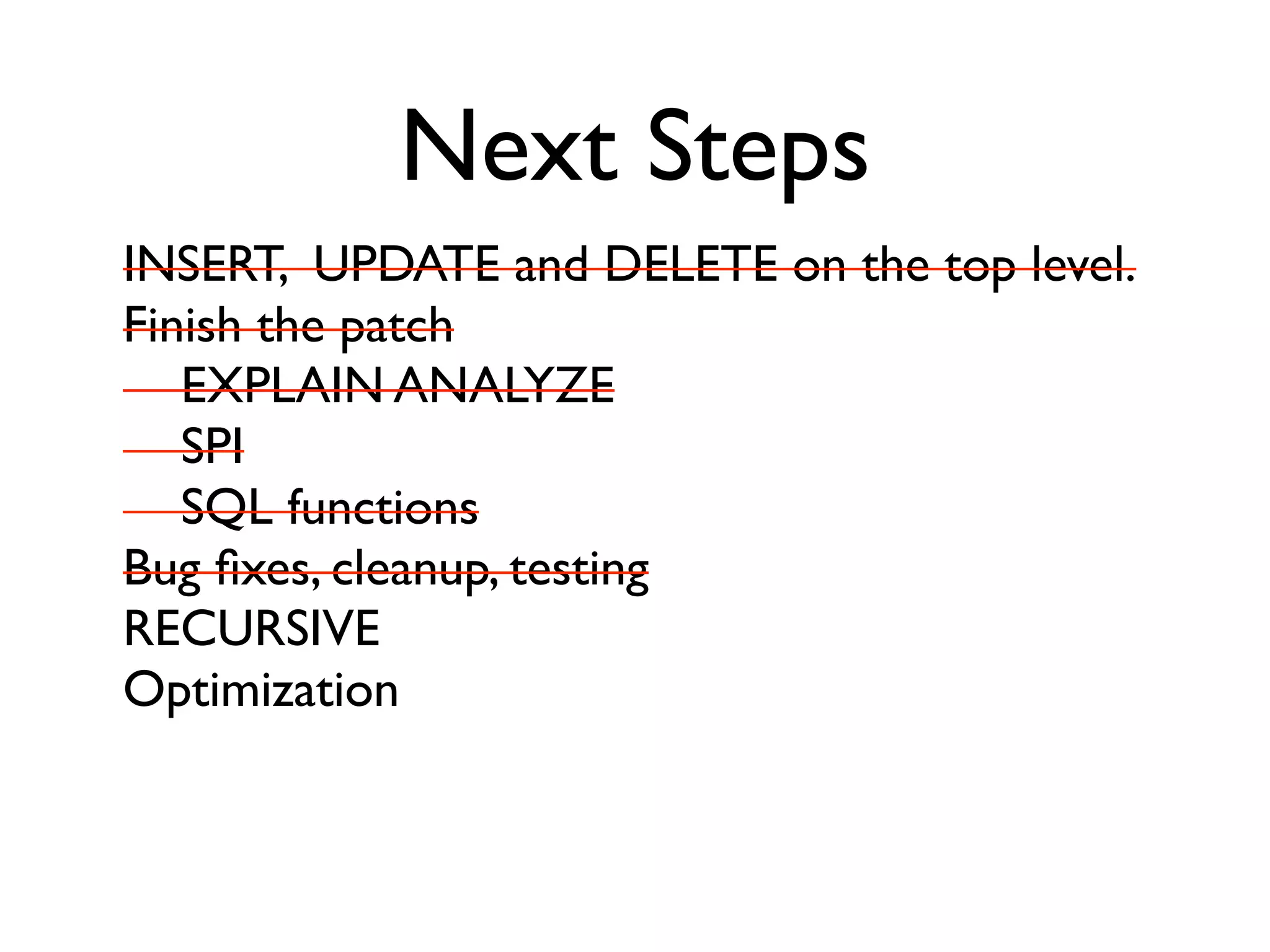
Next Steps
INSERT, UPDATE and DELETE on the top level.
Finish the patch
   EXPLAIN ANALYZE
   SPI
   SQL functions
Bug fixes, cleanup, testing
RECURSIVE
Optimization
Future?

DCL (GRANT/REVOKE)
DDL (CREATE/ALTER/DROP)
Where Is It?!?

http://www.postgresql.org/developer/beta
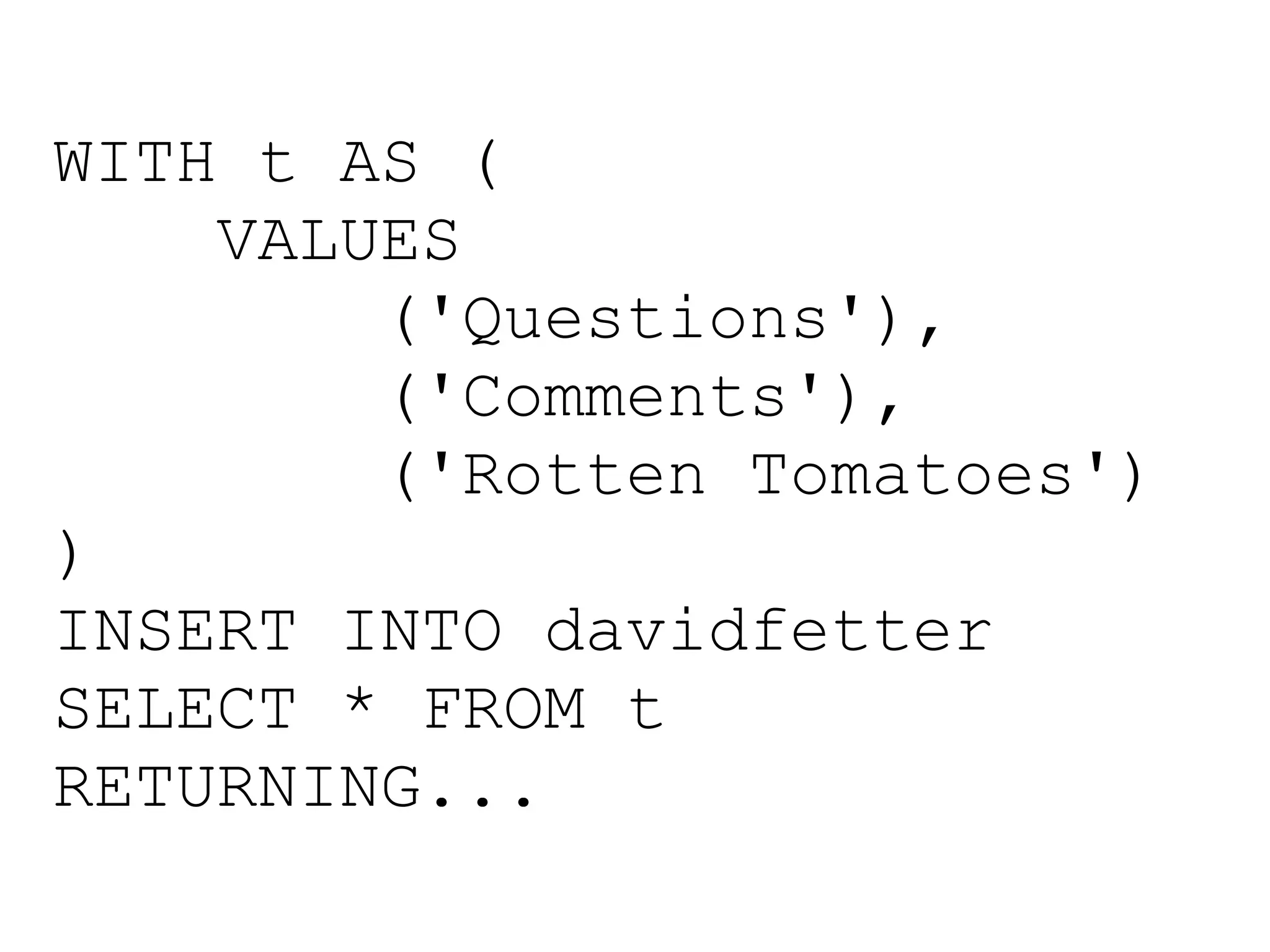
WITH t AS (
    VALUES
        ('Questions'),
        ('Comments'),
        ('Rotten Tomatoes')
)
INSERT INTO davidfetter
SELECT * FROM t
RETURNING...
Thanks, eh!
 Copyright © 2011
 David Fetter dfetter@vmware.com
 All Rights Reserved

Writeable ct es_pgcon_may_2011

  • 1.
    Writeable CTEs, ARevolution in SQL PGCon May 20, 2011 Copyright © 2011 David Fetter dfetter@vmware.com All Rights Reserved
  • 2.
    Current CTEs WITH [RECURSIVE]t1 [(column type,…)] AS ( [SELECT | VALUES] [UNION [ALL] [SELECT] ), t2 AS…tn AS… SELECT…
  • 4.
    Travelling Salesman Problem Givena number of cities and the costs of travelling from any city to any other city, what is the least- cost round-trip route that visits each city exactly once and then returns to the starting city?
  • 5.
    OBTW With CTE andWindowing, SQL is Turing Complete.
  • 6.
  • 7.
    WRITE! WITH [RECURSIVE] t1[(column type,…)] AS ( [SELECT | VALUES | (INSERT | UPDATE | DELETE) [RETURNING]] [UNION [ALL] [SELECT | VALUES | (INSERT | UPDATE | DELETE) [RETURNING]] ) (SELECT | INSERT | UPDATE | DELETE) …
  • 8.
    For 9.1: Simple PartitionManagement CREATE TABLE log ( ts TIMESTAMPTZ NOT NULL, msg TEXT NOT NULL );
  • 9.
    For 9.1: Simple PartitionManagement CREATE TABLE log_201101 () INHERITS(log); ALTER TABLE log_201101 ADD CONSTRAINT right_month CHECK( ts >= '2011-01-01' AND ts < '2011-02-01');
  • 10.
    For 9.1: Simple Partition Management berliner@pgday_eu_2010:54321# WITH t1 AS ( DELETE FROM ONLY log WHERE ts >='2011-01-01' AND ts < '2011-02-01' RETURNING * ) INSERT INTO log_201101 SELECT * FROM t1; INSERT 0 45270
  • 11.
    Query Clustering: I/O Minimization CREATE TABLE person ( id SERIAL PRIMARY KEY, first_name TEXT, last_name TEXT, CHECK (CASE WHEN first_name IS NULL THEN 0 ELSE 1 END + CASE WHEN last_name IS NULL THEN 0 ELSE 1 END >= 1), birthdate DATE NOT NULL, gender TEXT );
  • 12.
    Query Clustering: I/O Minimization CREATE TABLE im ( id SERIAL PRIMARY KEY, provider TEXT NOT NULL, /* should be fk */ handle TEXT NOT NULL );
  • 13.
    Query Clustering: I/O Minimization CREATE TABLE phone ( id SERIAL PRIMARY KEY, country_code TEXT NOT NULL, phone_number TEXT NOT NULL, extension TEXT );
  • 14.
    Query Clustering: I/OMinimization CREATE TABLE street ( id SERIAL PRIMARY KEY, street1 TEXT NOT NULL, street2 TEXT, street3 TEXT, city TEXT NOT NULL, state TEXT, country TEXT NOT NULL, post_code TEXT );
  • 15.
    Query Clustering: I/O Minimization CREATE TABLE person_im ( person_id INTEGER NOT NULL REFERENCES person (id), im_id INTEGER NOT NULL REFERENCES im (id), UNIQUE (person_id, im_id) ); CREATE TABLE person_phone ( person_id INTEGER NOT NULL REFERENCES person (id), phone_id INTEGER NOT NULL REFERENCES phone (id), UNIQUE (person_id, phone_id) ); CREATE TABLE person_street ( person_id INTEGER NOT NULL REFERENCES person (id), street_id INTEGER NOT NULL REFERENCES street (id), UNIQUE (person_id, street_id) );
  • 16.
    Query Clustering: I/O Minimization WITH t_person AS ( INSERT INTO person (first_name, last_name) VALUES ('David', 'Fetter') RETURNING id ),
  • 17.
    Query Clustering: I/O Minimization t_im AS ( INSERT INTO im (provider, handle) VALUES ('Yahoo!', 'dfetter'), ('AIM', 'dfetter666'), ('XMPP', 'davidfetter@postgresql.org') RETURNING id ), t_person_im AS ( INSERT INTO person_im SELECT * FROM t_person CROSS JOIN t_im ),
  • 18.
    Query Clustering: I/O Minimization t_phone (phone_id) AS ( INSERT INTO phone (country_code, phone_number) VALUES ('+1','415 235 3778'), ('+1','650 427 3751') RETURNING id ), t_person_phone AS ( INSERT INTO person_phone SELECT * FROM t_person CROSS JOIN t_phone ),
  • 19.
    Query Clustering: I/O Minimization t_street AS ( INSERT INTO street (street1, city, state, country, post_code) VALUES ('438 W. Grand Ave., Apartment 727','Oakland','California','USA','94612-2341'), ('3421 Hillview Avenue', 'Palo Alto','California','USA','94304') ), t_person_street AS ( INSERT INTO person_street SELECT * FROM t_person CROSS JOIN t_street )
  • 20.
    Query Clustering: I/O Minimization VALUES(true);
  • 21.
    Query Clustering: Transaction Management CREATE TABLE foo ( id SERIAL PRIMARY KEY, bar_id INTEGER NOT NULL ); CREATE TABLE bar ( id SERIAL PRIMARY KEY, foo_id INTEGER NOT NULL REFERENCES foo(id) ON DELETE CASCADE INITIALLY DEFERRED ); ALTER TABLE foo ADD FOREIGN KEY (bar_id) REFERENCES bar(id) ON DELETE CASCADE INITIALLY DEFERRED;
  • 22.
    Query Clustering: Transaction Management WITH t AS ( ! INSERT INTO foo(id, bar_id) ! VALUES( ! ! DEFAULT, ! ! nextval(pg_get_serial_sequence('bar', 'id')) ) ! RETURNING id AS foo_id, bar_id ) INSERT INTO bar(id,foo_id) SELECT bar_id, foo_id FROM t RETURNING *;
  • 23.
    Materialized Views WITHt AS ( DELETE FROM foo RETURNING a, b ) INSERT INTO mv_foo SELECT a, SUM(b) FROM t GROUP BY a
  • 24.
    Just Cool Stuff™ WITHt AS ( INSERT INTO foo VALUES (...),...,(...) RETURNING a ) SELECT bar.a, bar.b FROM bar JOIN t USING(a)
  • 25.
    Head-Scratcher: SNAPSHOTS WITH tAS (DELETE FROM foo) SELECT * FROM foo; (0 rows)? (100123 rows)?
  • 26.
    How'd He DoThat?!? First try: David digs into the grammar and gets cut a few times.
  • 27.
    How'd He DoThat?!? First try: Marko reworks the planner. It needs to know when it creates a ModifyTable node. These used to have another name.
  • 28.
    How'd He DoThat?!? First try: Marko reworks the executor. It needs new nodes. Mmmm...nodes.
  • 29.
    How'd He DoThat?!? Marko reworks the executor, Part II: Copy & Paste. Now it's getting ugly...
  • 30.
    How'd He DoThat?!? Jaime Casanova, Tom Lane, and Robert Haas look at the reworked executor. D'oh!
  • 31.
    How'd He DoThat?!? FAIL! Way too much code copying from top level to the new nodes.
  • 32.
    How'd He DoThat?!? Planner changes for ModifyTable node (a few)
  • 33.
    How'd He DoThat?!? Executor changes: ONE new node called ModifyTable
  • 34.
    How'd He DoThat?!? Marko Tiikkaja restructures the whole code base for the ModifyTable node. "The usual stuff," (he said casually) for new nodes.
  • 35.
    How'd He DoThat?!? WIN!
  • 36.
    Next Steps INSERT, UPDATEand DELETE on the top level. Finish the patch EXPLAIN ANALYZE SPI SQL functions Bug fixes, cleanup, testing RECURSIVE Optimization
  • 37.
  • 38.
  • 39.
    WITH t AS( VALUES ('Questions'), ('Comments'), ('Rotten Tomatoes') ) INSERT INTO davidfetter SELECT * FROM t RETURNING...
  • 40.
    Thanks, eh! Copyright© 2011 David Fetter dfetter@vmware.com All Rights Reserved

Editor's Notes