30 minutes to CPAN

(Minimizing the magic, and demystifying the process.)
30 minutes is pure Marketing Department hype.

       But with practice, it's realistic.
There are many ways to do it.

 This is a good way to start.
Get a PAUSE/CPAN account
●   https://pause.perl.org/pause/query?ACTION=request_id
●   The form takes 2 minutes.
●   The response time can be 1-3 days, so be patient.
●   Make sure to search CPAN ensuring you're not requesting a
    PAUSE ID that is already in use.
Create a directory framework
$ mkdir Foo
$ cd Foo
$ mkdir lib
$ mkdir t
$ mkdir examples
$ touch lib/Foo.pm
$ touch t/00-load.t
$ touch examples/example.pl
$ touch Makefile.PL
$ touch MANIFEST
$ touch Changes
$ touch README
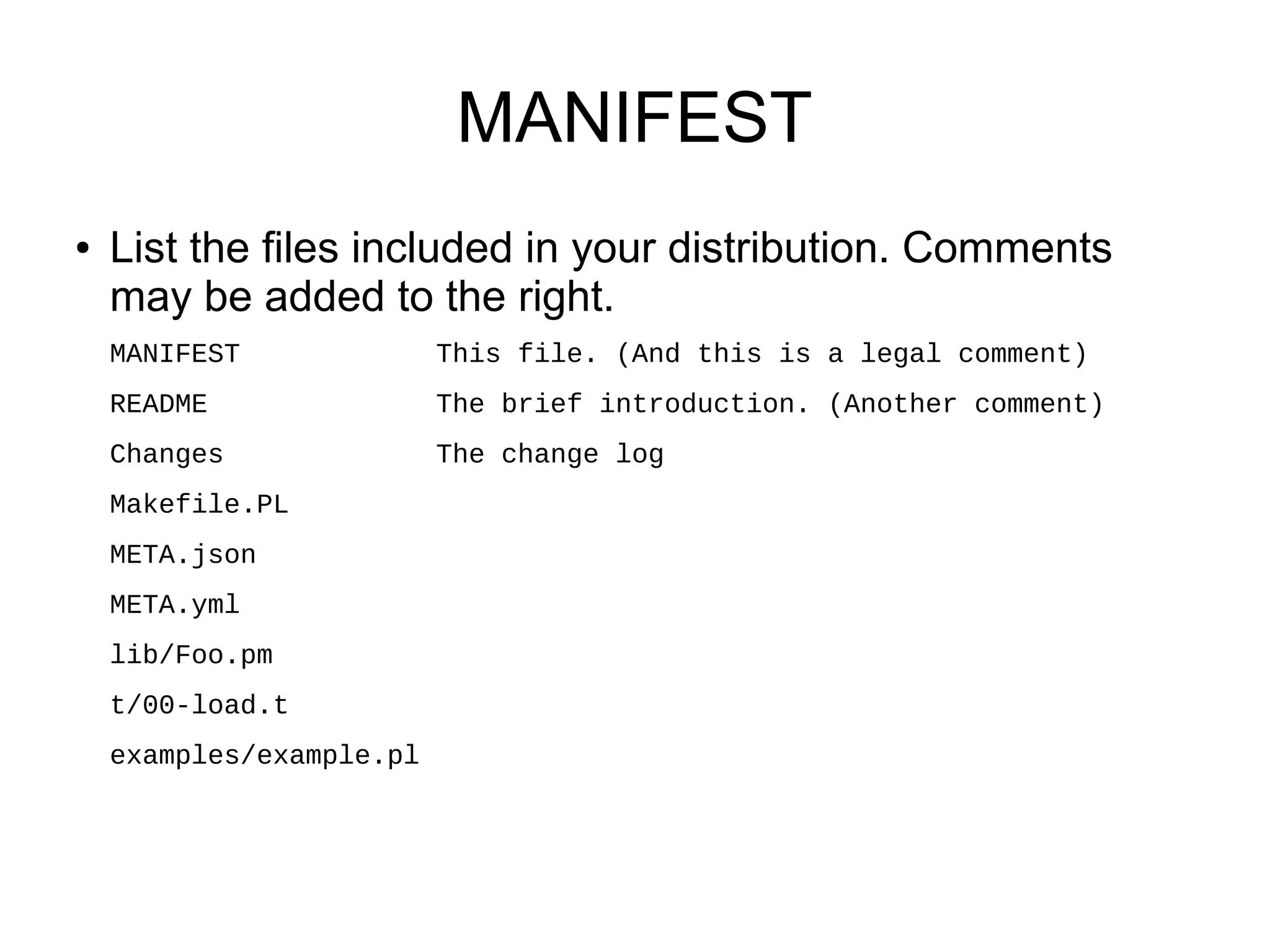
MANIFEST
●   List the files included in your distribution. Comments
    may be added to the right.
    MANIFEST              This file. (And this is a legal comment)
    README                The brief introduction. (Another comment)
    Changes               The change log
    Makefile.PL
    META.json
    META.yml
    lib/Foo.pm
    t/00-load.t
    examples/example.pl
README
●   Brief intro to your module.

●   Just copy one from CPAN as an example and
    modify it to suit your needs.
    –   Too long to post here, mostly boilerplate.

●   No version numbers. No version-specific details.
    –   It will make your life as an author easier.
Changes
●   The change log for CPAN releases. Newer releases are
    listed above older ones. One blank line separates
    releases.

    Change log for Perl module Foo.


    0.02 2013-01-09
      - Fixed all the bugs in version 0.01.


    0.01 2012-11-15
      - First version.
Makefile.PL
use strict;
use warnings;
use 5.006000;
use ExtUtils::MakeMaker;


WriteMakefile( … );
Makefile.PL – WriteMakefile()
WriteMakefile(
     NAME               => 'Foo',
     AUTHOR             => q{Your Name < cpan_acct [at] cpan [dot] org >},
     VERSION_FROM       => 'lib/Foo.pm',
     ABSTRACT_FROM      => 'lib/Foo.pm',
     LICENSE            => 'perl',
     MIN_PERL_VERSION   => '5.006000',
    BUILD_REQUIRES      => { Test::More => '0', },    # Core; needn't be
listed.
     PREREQ_PM          => { List::MoreUtils => '0.33', },
     META_MERGE         => { … },
     dist               => { COMPRESS => 'gzip -9f', SUFFIX => 'gz', },
     clean              => { FILES => 'Foo-*' },
);
Other Makefile.PL meta info
●   It's helpful to include a META_MERGE section
    in Makefile.PL
    –   List the public version control repositiory.
    –   Other useful meta fields documented in
        CPAN::Meta::Spec
    –   These fields are helpful, but not mandatory.
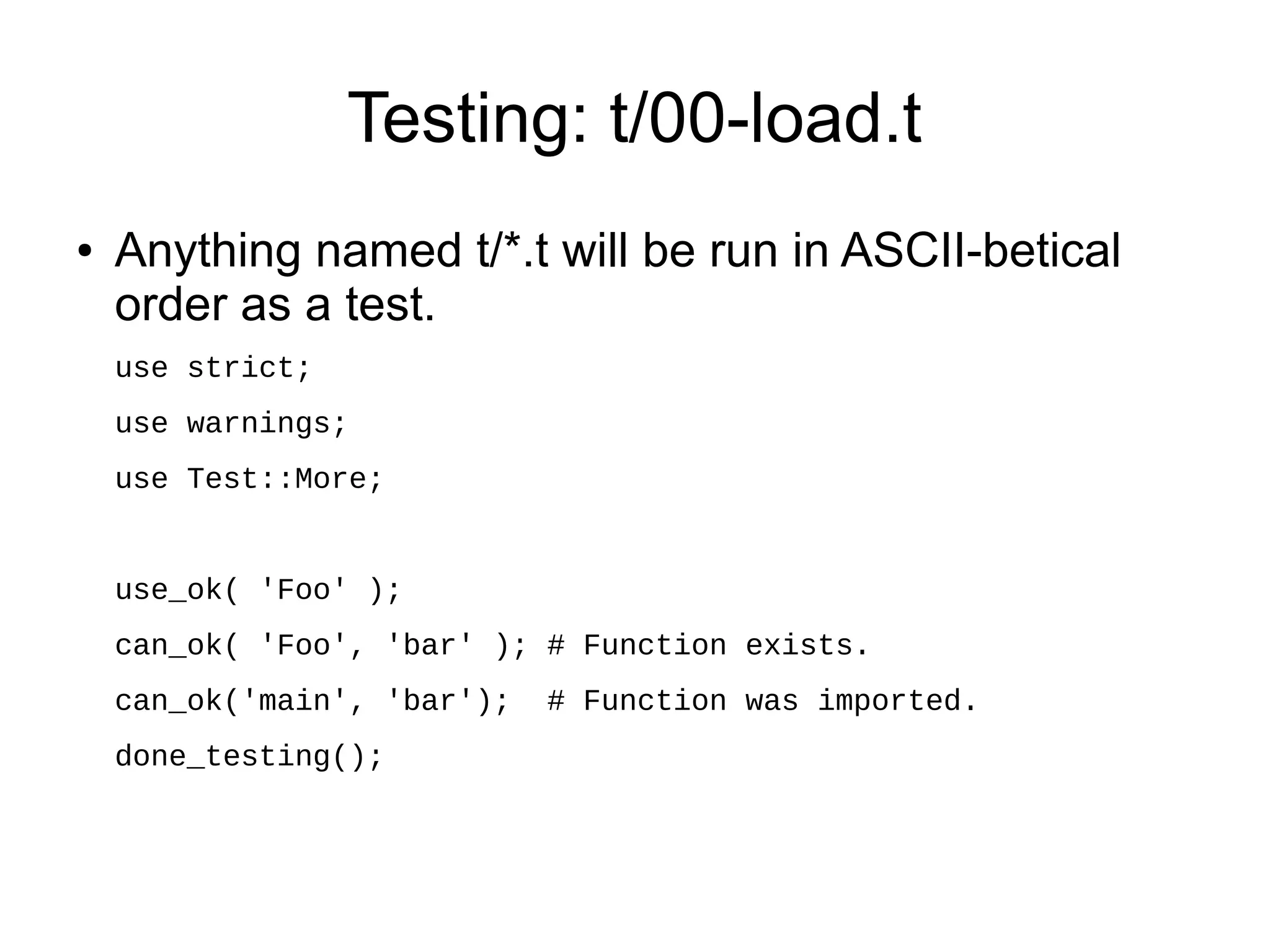
Testing: t/00-load.t
●   Anything named t/*.t will be run in ASCII-betical
    order as a test.
    use strict;
    use warnings;
    use Test::More;


    use_ok( 'Foo' );
    can_ok( 'Foo', 'bar' ); # Function exists.
    can_ok('main', 'bar');   # Function was imported.
    done_testing();
lib/Foo.pm
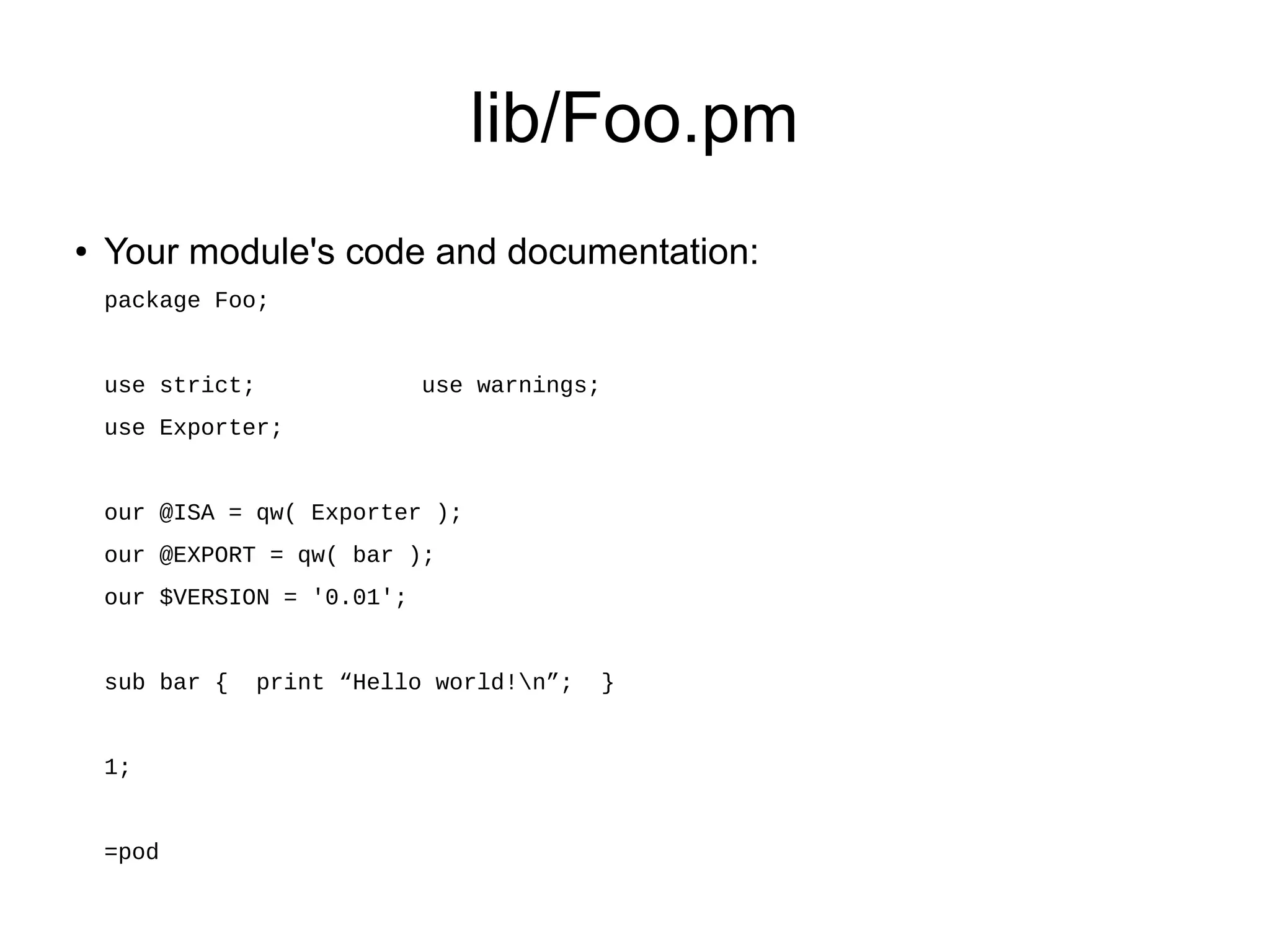
●   Your module's code and documentation:
    package Foo;


    use strict;              use warnings;
    use Exporter;


    our @ISA = qw( Exporter );
    our @EXPORT = qw( bar );
    our $VERSION = '0.01';


    sub bar {     print “Hello world!n”;    }


    1;


    =pod
lib/Foo.pm ( =pod )
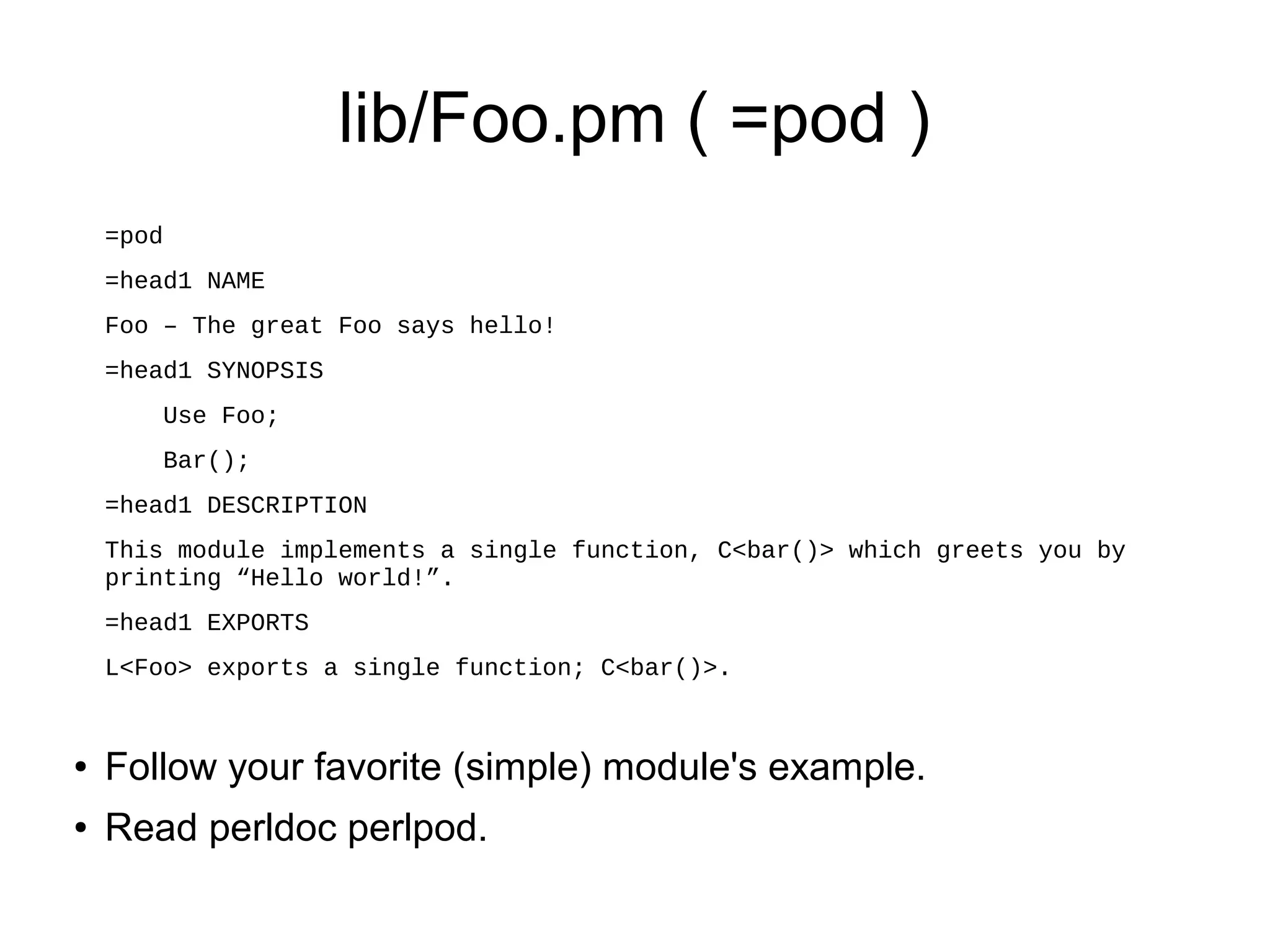
    =pod
    =head1 NAME
    Foo – The great Foo says hello!
    =head1 SYNOPSIS
        Use Foo;
        Bar();
    =head1 DESCRIPTION
    This module implements a single function, C<bar()> which greets you by
    printing “Hello world!”.
    =head1 EXPORTS
    L<Foo> exports a single function; C<bar()>.


●   Follow your favorite (simple) module's example.
●   Read perldoc perlpod.
examples/example.pl
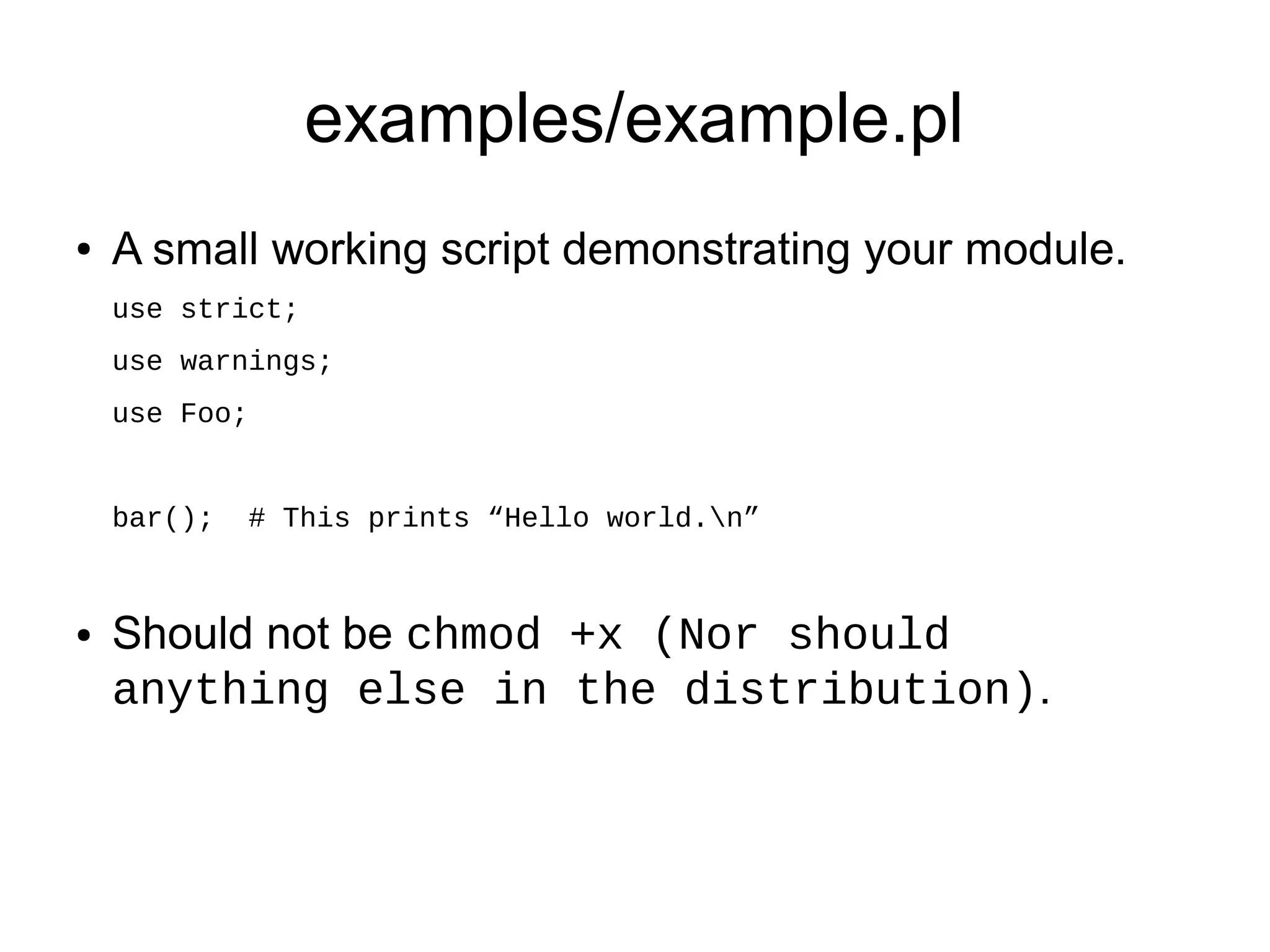
●   A small working script demonstrating your module.
    use strict;
    use warnings;
    use Foo;


    bar();   # This prints “Hello world.n”


●   Should not be chmod +x (Nor should
    anything else in the distribution).
Prepare the distribution
perl Makefile.PL
make
make test
make distcheck
make disttest
cp Foo-0.01/META.* ./
rm -rf Foo-0.01
make dist
Upload to PAUSE
●   Log in at: http://pause.perl.org


●   Upload at:
    https://pause.perl.org/pause/authenquery?ACTION=add_uri


●   Wait a few hours for the CPAN mirrors to update.


●   Visit http://cpantesters.org to check smoke test results.
Request the namespace.
●   This is a formality, and can take a week to be
    approved.

●   This is done via the PAUSE website.

●   Top-level namespaces are more difficult.

●   Upload first, then request.
Version Numbers
●   Regular Releases
        our $VERSION = '0.01';


●   Always bump the version number before uploading to
    CPAN.

●   Minimize error-prone work: Keep version numbers in as
    few places as practical.
    –   Consider adding a version number consistency test.
Module tests
●   Module tests are important to you and users.
    –   You get feedback from the smoke testers.
    –   Your users gain confidence that the module will work on their
        platform.
    –   Bugs are easier to track down.
●   List additional test dependencies in BUILD_REQUIRES.
●   Some tests such as Test::NoWarnings may be written
    generically, and copied into your next project.
    –   Your next module won't take as long to assemble.
Author / Release Tests
●   Should run optionally
●   Should not fail if a test module dependency isn't
    available.
●   Use environment variables such as RELEASE_TESTING
    to trigger these sorts of tests.
●   Skip and exit gracefully if an optional test's module is
    unavailable on the target system.
●   Generic: They may be useful in your next module.
A few author tests to consider
●   Test::Pod
●   Test::Pod::Coverage
●   Test::CPAN::Changes
●   Test::Manifest
●   Test::Perl::Critic
●   Test::Kwalitee
●   Test::Version
●   Many other favorites are on CPAN – Ask around.
License
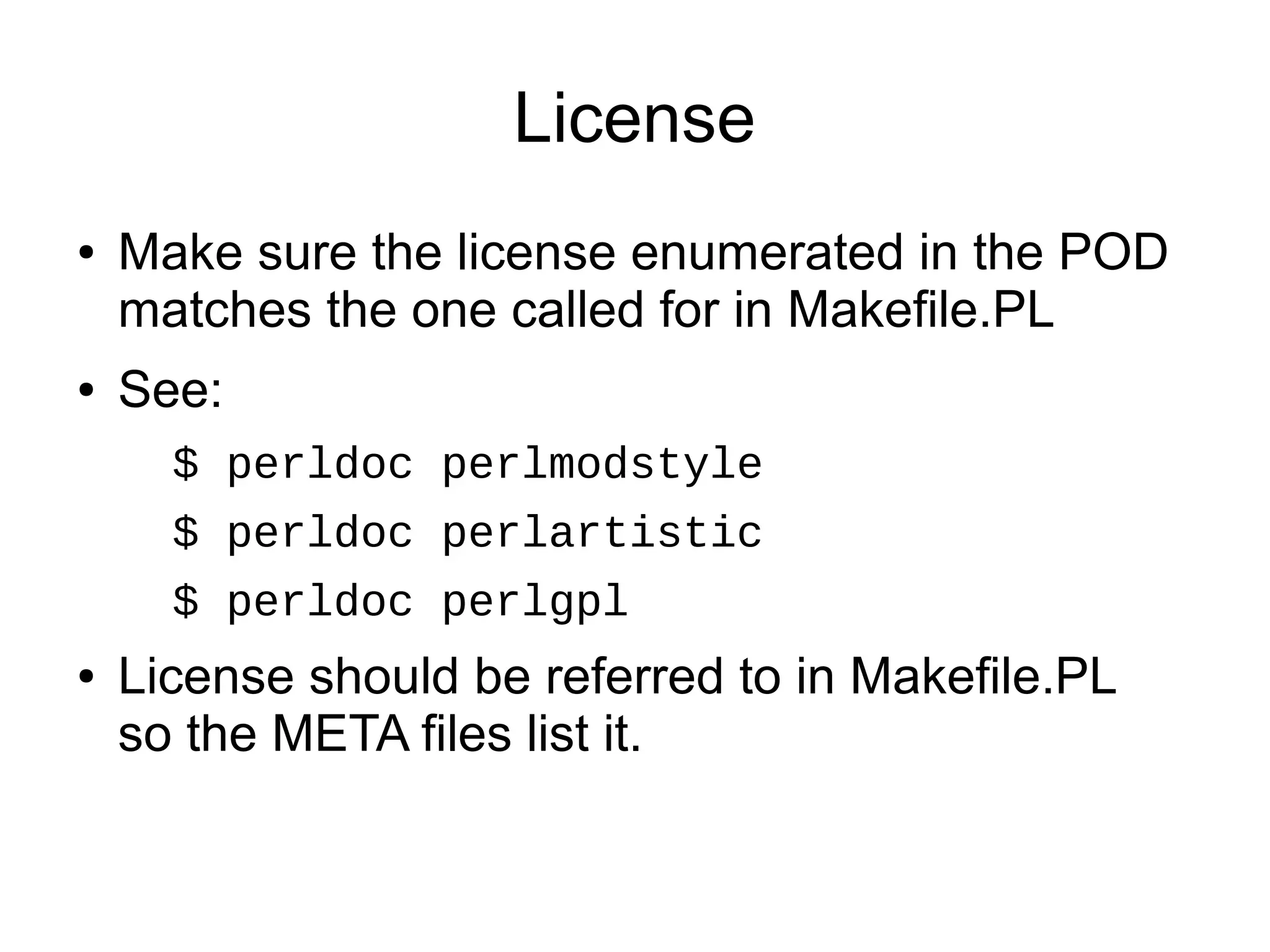
●   Make sure the license enumerated in the POD
    matches the one called for in Makefile.PL
●   See:
      $ perldoc perlmodstyle
      $ perldoc perlartistic
      $ perldoc perlgpl
●   License should be referred to in Makefile.PL
    so the META files list it.
License
●   Make sure the license enumerated in the POD
    matches the one called for in Makefile.PL
●   See:
      $ perldoc perlmodstyle
      $ perldoc perlartistic
      $ perldoc perlgpl
●   License should be referred to in Makefile.PL
    so the META files list it.
Next time...
●   Use Module::Starter
    –   Creates a simple template for you, and adds a few
        tests.
●   Copy the generic (especially author-only) tests
    from your previous distribution.
●   Whenver you come up with a test that might
    be useful in other distributions, copy it to them.
Eventually...
●   Some people love Dist::Zilla; a distribution
    automator / manager.
●   Module::Build is a more Perlish alternative to
    ExtUtils::MakeMaker
●   Module::Install is yet another solution that lets
    you bundle prereqs more easily. It simplifies
    creating ExtUtils::MakeMaker-based
    distributions.
References (Really, look them over)
●   POD
    –   perlmodstyle
    –   perlpod
●   On CPAN
    –   Module::Starter
    –   ExtUtils::MakeMaker
    –   CPAN::Meta::Spec
●   In print
    –   Intermediate Perl Programming (O'Reilly)
●   On testing
    –   Test::More
    –   http://cpantesters.org
●   CPAN itself! (Thousands of good – and bad – examples.)
David Oswald

daoswald@gmail.com / davido@cpan.org

30 Minutes To CPAN

  • 1.
    30 minutes toCPAN (Minimizing the magic, and demystifying the process.)
  • 2.
    30 minutes ispure Marketing Department hype. But with practice, it's realistic.
  • 3.
    There are manyways to do it. This is a good way to start.
  • 4.
    Get a PAUSE/CPANaccount ● https://pause.perl.org/pause/query?ACTION=request_id ● The form takes 2 minutes. ● The response time can be 1-3 days, so be patient. ● Make sure to search CPAN ensuring you're not requesting a PAUSE ID that is already in use.
  • 5.
    Create a directoryframework $ mkdir Foo $ cd Foo $ mkdir lib $ mkdir t $ mkdir examples $ touch lib/Foo.pm $ touch t/00-load.t $ touch examples/example.pl $ touch Makefile.PL $ touch MANIFEST $ touch Changes $ touch README
  • 6.
    MANIFEST ● List the files included in your distribution. Comments may be added to the right. MANIFEST This file. (And this is a legal comment) README The brief introduction. (Another comment) Changes The change log Makefile.PL META.json META.yml lib/Foo.pm t/00-load.t examples/example.pl
  • 7.
    README ● Brief intro to your module. ● Just copy one from CPAN as an example and modify it to suit your needs. – Too long to post here, mostly boilerplate. ● No version numbers. No version-specific details. – It will make your life as an author easier.
  • 8.
    Changes ● The change log for CPAN releases. Newer releases are listed above older ones. One blank line separates releases. Change log for Perl module Foo. 0.02 2013-01-09 - Fixed all the bugs in version 0.01. 0.01 2012-11-15 - First version.
  • 9.
    Makefile.PL use strict; use warnings; use5.006000; use ExtUtils::MakeMaker; WriteMakefile( … );
  • 10.
    Makefile.PL – WriteMakefile() WriteMakefile( NAME => 'Foo', AUTHOR => q{Your Name < cpan_acct [at] cpan [dot] org >}, VERSION_FROM => 'lib/Foo.pm', ABSTRACT_FROM => 'lib/Foo.pm', LICENSE => 'perl', MIN_PERL_VERSION => '5.006000', BUILD_REQUIRES => { Test::More => '0', }, # Core; needn't be listed. PREREQ_PM => { List::MoreUtils => '0.33', }, META_MERGE => { … }, dist => { COMPRESS => 'gzip -9f', SUFFIX => 'gz', }, clean => { FILES => 'Foo-*' }, );
  • 11.
    Other Makefile.PL metainfo ● It's helpful to include a META_MERGE section in Makefile.PL – List the public version control repositiory. – Other useful meta fields documented in CPAN::Meta::Spec – These fields are helpful, but not mandatory.
  • 12.
    Testing: t/00-load.t ● Anything named t/*.t will be run in ASCII-betical order as a test. use strict; use warnings; use Test::More; use_ok( 'Foo' ); can_ok( 'Foo', 'bar' ); # Function exists. can_ok('main', 'bar'); # Function was imported. done_testing();
  • 13.
    lib/Foo.pm ● Your module's code and documentation: package Foo; use strict; use warnings; use Exporter; our @ISA = qw( Exporter ); our @EXPORT = qw( bar ); our $VERSION = '0.01'; sub bar { print “Hello world!n”; } 1; =pod
  • 14.
    lib/Foo.pm ( =pod) =pod =head1 NAME Foo – The great Foo says hello! =head1 SYNOPSIS Use Foo; Bar(); =head1 DESCRIPTION This module implements a single function, C<bar()> which greets you by printing “Hello world!”. =head1 EXPORTS L<Foo> exports a single function; C<bar()>. ● Follow your favorite (simple) module's example. ● Read perldoc perlpod.
  • 15.
    examples/example.pl ● A small working script demonstrating your module. use strict; use warnings; use Foo; bar(); # This prints “Hello world.n” ● Should not be chmod +x (Nor should anything else in the distribution).
  • 16.
    Prepare the distribution perlMakefile.PL make make test make distcheck make disttest cp Foo-0.01/META.* ./ rm -rf Foo-0.01 make dist
  • 17.
    Upload to PAUSE ● Log in at: http://pause.perl.org ● Upload at: https://pause.perl.org/pause/authenquery?ACTION=add_uri ● Wait a few hours for the CPAN mirrors to update. ● Visit http://cpantesters.org to check smoke test results.
  • 18.
    Request the namespace. ● This is a formality, and can take a week to be approved. ● This is done via the PAUSE website. ● Top-level namespaces are more difficult. ● Upload first, then request.
  • 19.
    Version Numbers ● Regular Releases our $VERSION = '0.01'; ● Always bump the version number before uploading to CPAN. ● Minimize error-prone work: Keep version numbers in as few places as practical. – Consider adding a version number consistency test.
  • 20.
    Module tests ● Module tests are important to you and users. – You get feedback from the smoke testers. – Your users gain confidence that the module will work on their platform. – Bugs are easier to track down. ● List additional test dependencies in BUILD_REQUIRES. ● Some tests such as Test::NoWarnings may be written generically, and copied into your next project. – Your next module won't take as long to assemble.
  • 21.
    Author / ReleaseTests ● Should run optionally ● Should not fail if a test module dependency isn't available. ● Use environment variables such as RELEASE_TESTING to trigger these sorts of tests. ● Skip and exit gracefully if an optional test's module is unavailable on the target system. ● Generic: They may be useful in your next module.
  • 22.
    A few authortests to consider ● Test::Pod ● Test::Pod::Coverage ● Test::CPAN::Changes ● Test::Manifest ● Test::Perl::Critic ● Test::Kwalitee ● Test::Version ● Many other favorites are on CPAN – Ask around.
  • 23.
    License ● Make sure the license enumerated in the POD matches the one called for in Makefile.PL ● See: $ perldoc perlmodstyle $ perldoc perlartistic $ perldoc perlgpl ● License should be referred to in Makefile.PL so the META files list it.
  • 24.
    License ● Make sure the license enumerated in the POD matches the one called for in Makefile.PL ● See: $ perldoc perlmodstyle $ perldoc perlartistic $ perldoc perlgpl ● License should be referred to in Makefile.PL so the META files list it.
  • 25.
    Next time... ● Use Module::Starter – Creates a simple template for you, and adds a few tests. ● Copy the generic (especially author-only) tests from your previous distribution. ● Whenver you come up with a test that might be useful in other distributions, copy it to them.
  • 26.
    Eventually... ● Some people love Dist::Zilla; a distribution automator / manager. ● Module::Build is a more Perlish alternative to ExtUtils::MakeMaker ● Module::Install is yet another solution that lets you bundle prereqs more easily. It simplifies creating ExtUtils::MakeMaker-based distributions.
  • 27.
    References (Really, lookthem over) ● POD – perlmodstyle – perlpod ● On CPAN – Module::Starter – ExtUtils::MakeMaker – CPAN::Meta::Spec ● In print – Intermediate Perl Programming (O'Reilly) ● On testing – Test::More – http://cpantesters.org ● CPAN itself! (Thousands of good – and bad – examples.)
  • 28.