Salt Lake Perl Mongers
http://saltlake.pm.org
David Oswald
daoswald@gmail.com
Add Perl To Your Toolbelt
Salt Lake Perl Mongers
http://saltlake.pm.org
David Oswald
daoswald@gmail.com
Add Perl To Your Toolbelt
Salt Lake Perl Mongers
http://saltlake.pm.org
David Oswald
daoswald@gmail.com
Add Perl To Your Toolbelt
Salt Lake Perl Mongers
● The local “Perl Community”
– Monthly meetings.
– Partnership discounts.
– Job announcements.
– Everyone learns and grows.
– For the love of Perl!
● http://saltlake.pm.org
Who am I?
●
Dave Oswald.
● Studied Economics and Computer Science at U of U.
– Also CS in High School, SLCC, LAVC, and self-guided.
● Endurance International Group / Bluehost.
– Focus on back-end development with Perl.
●
Solving problems programatically is my hobby. Gratifyingly, it's also my job.
● daoswald@gmail.com - david.oswald@endurance.com
● Salt Lake Perl Mongers
– http://saltlake.pm.org
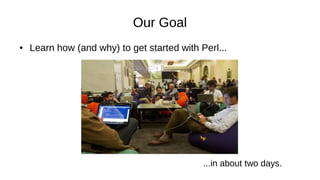
Our Goal
● Learn how (and why) to get started with Perl...
...in about two days.
But...But...
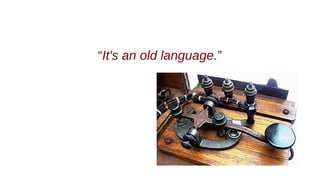
“It's an old language.”
First Appeared Most Recent Standard / Version
C 1972 2011 C11
Java 1995 2016 (est) JSE9
Objective-C 1983 2014? 2.0
C++ 1983 2014 C++14
Visual Basic 1991 2015 14.0 (.net)
C# 2000 2015 6.0
PHP 1995 2016 7.0.4
Python 1991
Python 2 2015 2.7.11
Python 3 2015 3.5.1
JavaScript 1995 2011 1.8.5
ECMAScript 1997 2015 6
Perl 1987
Perl 5 1994 2015 5.22.1 (5.24 due in June 2016)
Conclusion
We can't draw useful conclusions based on a
programming language's age.
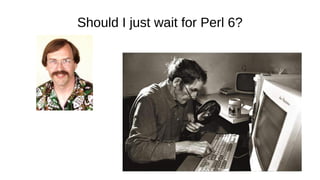
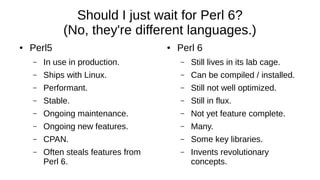
Should I just wait for Perl 6?
(No, they're different languages.)
● Perl5
– In use in production.
– Ships with Linux.
– Performant.
– Stable.
– Ongoing maintenance.
– Ongoing new features.
– CPAN.
– Often steals features from
Perl 6.
● Perl 6
– Still lives in its lab cage.
– Can be compiled / installed.
– Still not well optimized.
– Still in flux.
– Not yet feature complete.
– Many.
– Some key libraries.
– Invents revolutionary
concepts.
“The syntax is ugly.”
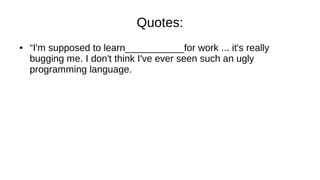
Quotes:
● “I'm supposed to learn___________for work ... it's really
bugging me. I don't think I've ever seen such an ugly
programming language.
Quotes:
● “I'm supposed to learn Objective-C for work ... it's really
bugging me. I don't think I've ever seen such an ugly
programming language.
Quotes:
● The Homoiconic nature of ____
means that one cannot tell by
looking at the code alone whether
something is a data structure or a
function. You have to read and
understand the context. Other
languages make it pretty clear
because they use different
symbols and syntax for each.
Quotes:
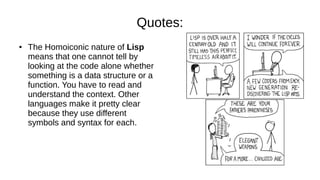
● The Homoiconic nature of Lisp
means that one cannot tell by
looking at the code alone whether
something is a data structure or a
function. You have to read and
understand the context. Other
languages make it pretty clear
because they use different
symbols and syntax for each.
Do we need to talk about C++ and C syntax?
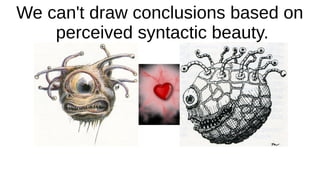
We can't draw conclusions based on
perceived syntactic beauty.
“Perl lacks subroutine signatures, or named
parameters.”
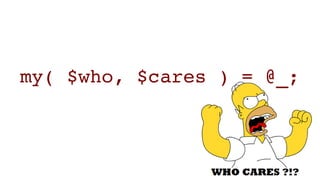
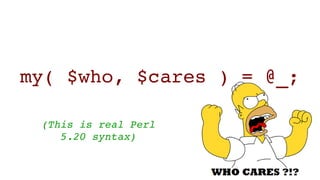
my( $who, $cares ) = @_;
(This is real Perl 
5.20 syntax)
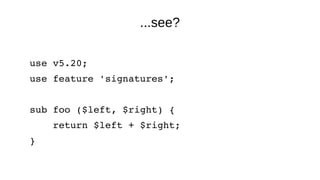
...see?
use v5.20;
use feature 'signatures';
sub foo ($left, $right) {
    return $left + $right;
}
So, why Perl?
The Three Virtues
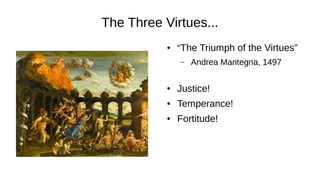
The Three Virtues...
● “The Triumph of the Virtues”
– Andrea Mantegna, 1497
● Justice!
● Temperance!
● Fortitude!
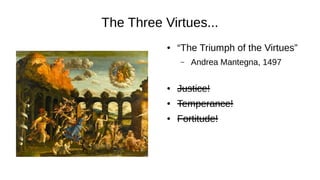
The Three Virtues...
● “The Triumph of the Virtues”
– Andrea Mantegna, 1497
● Justice!
● Temperance!
● Fortitude!
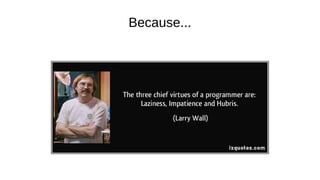
The Three Virtues...of Programmers
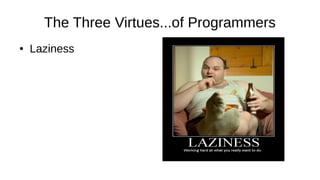
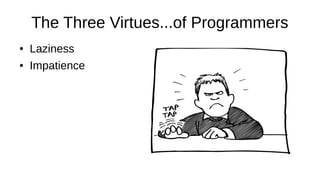
● Laziness
The Three Virtues...of Programmers
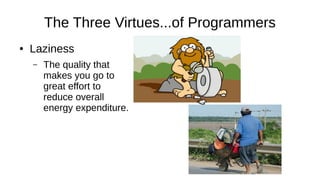
● Laziness
– The quality that
makes you go to
great effort to
reduce overall
energy expenditure.
Impatience!
The Three Virtues...of Programmers
● Laziness
● Impatience
The Three Virtues...of Programmers
● Laziness
● Impatience
– The anger you feel when
the computer is being
lazy, which happens
when another
programmer is not lazy.
The Three Virtues...of Programmers
● Laziness
● Impatience
● Hubris
The Three Virtues...of Programmers
● Laziness
● Impatience
● Hubris
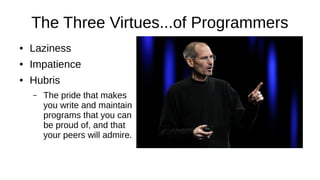
– The pride that makes
you write and maintain
programs that you can
be proud of, and that
your peers will admire.
The Three Virtues...of Programmers
● Laziness
– ...makes you go to great effort to reduce
your overall energy expenditure.
– …makes you write robust, modular, well-
documented programs so you can reuse
[the effort].
● Impatience
– ...anger you feel when the computer is being lazy, which
happens when another programmer is not lazy.
– ...makes you write programs that use minimal code so they’re
fast, efficient, and anticipate what needs to be done.
● Hubris
– ...pride that makes you write and maintain
programs that you and your peers will
admire.
– ...uncontrolled or undeserved, it can also
get you in trouble.
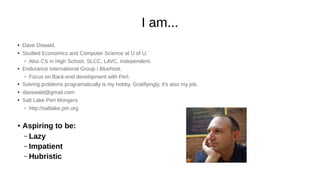
So... Who am I?
●
Dave Oswald.
● Studied Economics and Computer Science at U of U.
– Also CS in High School, SLCC, LAVC, Independent.
● Endurance International Group / Bluehost.
– Focus on back-end development with Perl.
●
Solving problems programatically is my hobby. Gratifyingly, it's also my job.
● daoswald@gmail.com – david.oswald@endurance.com
● Salt Lake Perl Mongers
– http://saltlake.pm.org
I am...
● Dave Oswald.
● Studied Economics and Computer Science at U of U.
– Also CS in High School, SLCC, LAVC, Independent.
● Endurance International Group / Bluehost.
– Focus on Back-end development with Perl.
● Solving problems programatically is my hobby. Gratifyingly, it's also my job.
● daoswald@gmail.com
● Salt Lake Perl Mongers
– http://saltlake.pm.org
● Aspiring to be:
– Lazy
– Impatient
– Hubristic
So, why Perl?
Because...
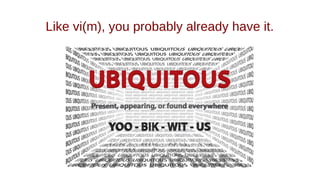
Like vi(m), you probably already have it.
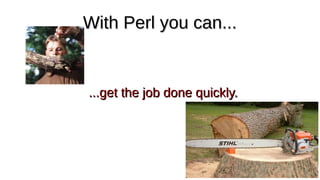
With Perl you can...With Perl you can...
...get the job done quickly....get the job done quickly.
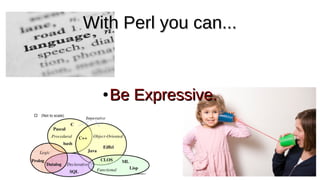
With Perl you can...With Perl you can...
●
Be Expressive.Be Expressive.
Perl is...Perl is...
●
Powerful, with finesse.Powerful, with finesse.
Perl isPerl is
FUN!FUN!
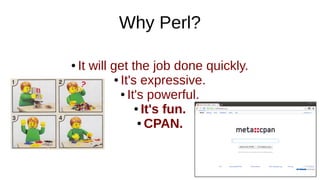
Why Perl?
● It will get the job done quickly.
● It's expressive.
● It's powerful.
● It's fun.
● CPAN.
“...easy things should be easy, and hard things
should be possible.”
– Programming Perl, 4th
ed.
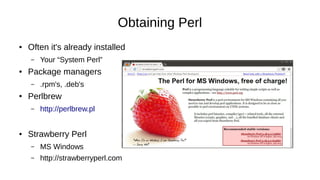
Obtaining Perl
Obtaining Perl
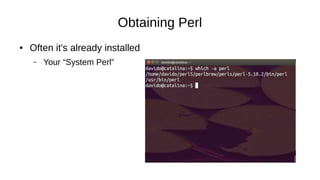
● Often it's already installed
– Your “System Perl”
Obtaining Perl
● Often it's already installed
– Your “System Perl”
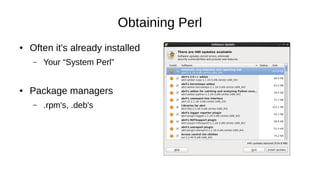
● Package managers
– .rpm's, .deb's
Obtaining Perl
● Often it's already installed
– Your “System Perl”
● Package managers
– .rpm's, .deb's
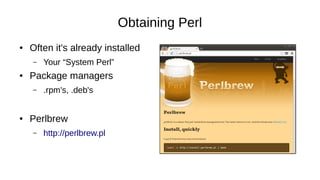
● Perlbrew
– http://perlbrew.pl
Obtaining Perl
● Often it's already installed
– Your “System Perl”
● Package managers
– .rpm's, .deb's
● Perlbrew
– http://perlbrew.pl
● Strawberry Perl
– MS Windows
– http://strawberryperl.com
Obtaining Perl
● Often it's already installed
– Your “System Perl”
● Package managers
– .rpm's, .deb's
● Perlbrew
– http://perlbrew.pl
● Strawberry Perl
– MS Windows
– http://strawberryperl.com
● Active State
– Windows
– Support
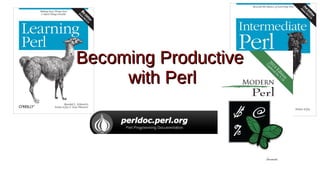
Becoming ProductiveBecoming Productive
with Perlwith Perl
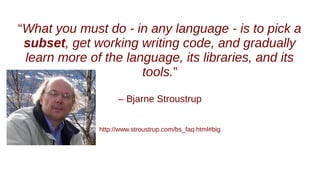
“What you must do - in any language - is to pick a
subset, get working writing code, and gradually
learn more of the language, its libraries, and its
tools.”
– Bjarne Stroustrup
http://www.stroustrup.com/bs_faq.html#big
Our Subset
● Structure
●
Data types
●
Operators
●
Lexical variables
●
Loops
● Conditionals
●
Subroutines
●
Files and Basic IO
●
Using objects
●
Using CPAN
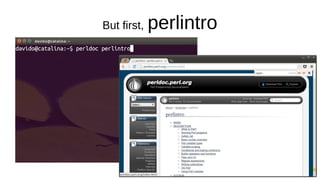
But first, perlintro
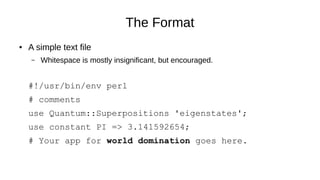
The Format
● A simple text file
– Whitespace is mostly insignificant, but encouraged.
#!/usr/bin/env perl
# comments
use Quantum::Superpositions 'eigenstates';
use constant PI => 3.141592654;
# Your app for world domination goes here.
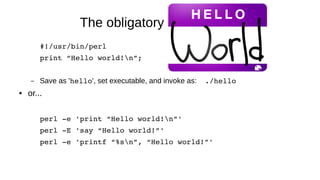
The obligatory Hello World!
#!/usr/bin/perl
print “Hello world!n”;
– Save as 'hello', set executable, and invoke as: ./hello
● or...
perl ­e 'print “Hello world!n”'
perl ­E 'say “Hello world!”'
perl ­e 'printf “%sn”, “Hello world!”'
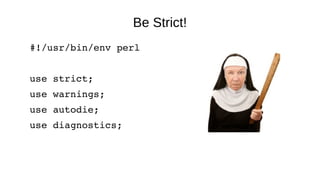
Be Strict!
#!/usr/bin/env perl
use strict;
use warnings;
use autodie;
use diagnostics;
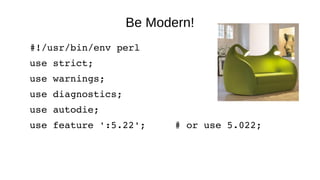
Be Modern!
#!/usr/bin/env perl
use strict;
use warnings;
use diagnostics;
use autodie;
use feature ':5.22';     # or use 5.022;
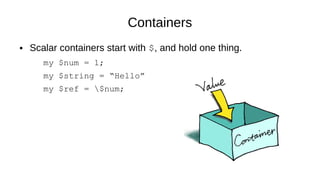
Containers
● Scalar containers start with $, and hold one thing.
my $num = 1;
my $string = “Hello”
my $ref = $num;
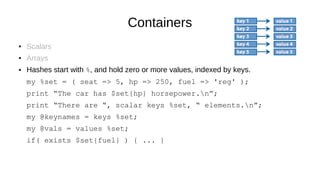
Containers
● Scalars
● Array containers start with @, and hold zero or more scalars,
indexed by integers.
my @things = qw( this that and the other );
my @refs = ( $x, $y, [@z] );
print “$things[0]n”; # this
print “$things[-1]n; # other
Containers
● Scalars
● Arrays
● Hashes start with %, and hold zero or more values, indexed by keys.
my %set = ( seat => 5, hp => 250, fuel => 'reg' );
print “The car has $set{hp} horsepower.n”;
print “There are “, scalar keys %set, “ elements.n”;
my @keynames = keys %set;
my @vals = values %set;
if( exists $set{fuel} ) { ... }
Containers
● Scalars
– Single items.
● Arrays
– Lists of items.
● Hashes
– Collections of values indexed by keys.
Aggregate vs Scalar
● Aggregate types: @, %
● Scalar types: $
The Sigil expresses the container type
● $scalar # Scalar containers start with $
● @array # Array containers start with @
● $array[5] # Array elements are scalar containers: $
● %hash # Hashes start with %
● $hash{key} # Hash elements are scalar containers: $
Containers can hold references
@structure = (
[ 'a', 'b', 'c' ],
[ 'd', 'e', 'f' ],
{ 'g' => 42 },
);
print “$structure[2]{g}n”;
Containers can hold references
@structure = (
[ 'a', 'b', 'c' ],
[ 'd', 'e', 'f' ],
{ 'g' => 42 },
);
print “$structure[2]{g}n”; # 42
Hash of arrays
%hash = (
names => [ qw/ bob frank joe / ],
ages => [ 34, 26, 46 ],
);
print $hash{names}[0], “n”;
print $hash{ages}[0], “n”;
Hash of arrays
%hash = (
names => [ qw/ bob frank joe / ],
ages => [ 34, 26, 46 ],
);
print $hash{names}[0], “n”; # bob
print $hash{ages}[0], “n”; # 34
Array of hashes
@array = (
{ name => joe, age => 34 },
{ name => pete, age => 26 }
);
print $array[0]{name}, “n”;
Array of hashes
@array = (
{ name => joe, age => 34 },
{ name => pete, age => 26 }
);
print $array[0]{name}, “n”; # joe
Hash of hashes
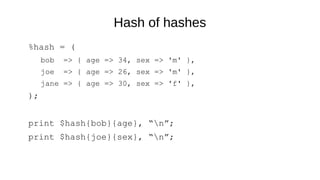
%hash = (
bob => { age => 34, sex => 'm' },
joe => { age => 26, sex => 'm' },
jane => { age => 30, sex => 'f' },
);
print $hash{bob}{age}, “n”;
print $hash{joe}{sex}, “n”;
Hash of hashes
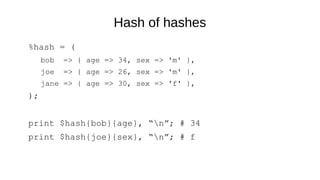
%hash = (
bob => { age => 34, sex => 'm' },
joe => { age => 26, sex => 'm' },
jane => { age => 30, sex => 'f' },
);
print $hash{bob}{age}, “n”; # 34
print $hash{joe}{sex}, “n”; # f
Scalar references to an arrays
my $aref =
[ qw/ a b c / ];
print “$aref->[1]n”;
$aref = @array;
Scalar references to an arrays
my $aref =
[ qw/ a b c / ];
print “$aref->[1]n”;
# b
$aref = @array;
Reference Constructors
● 
– Takes a reference to some
entity.
● [ … ]
– Constructs a reference to an
anonymous array.
● { … }
– Constructs a reference to an
anonymous hash.
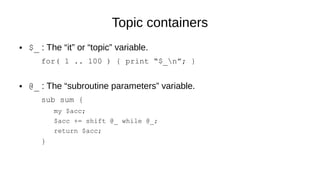
Topic containers
● $_ : The “it” or “topic” variable.
for( 1 .. 100 ) { print “$_n”; }
● @_ : The “subroutine parameters” variable.
sub sum {
my $acc;
$acc += shift @_ while @_;
return $acc;
}
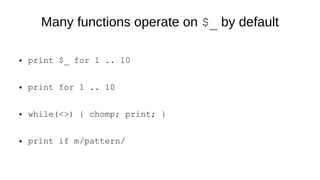
Many functions operate on $_ by default
● print $_ for 1 .. 10
● print for 1 .. 10
● while(<>) { chomp; print; }
● print if m/pattern/
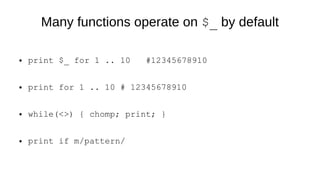
Many functions operate on $_ by default
● print $_ for 1 .. 10 #12345678910
● print for 1 .. 10 # 12345678910
● while(<>) { chomp; print; }
● print if m/pattern/
Data Types
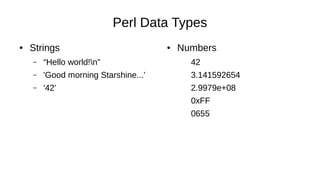
Perl Data Types
● Strings
– “Hello world!n”
– 'Good morning Starshine...'
– '42'
● Numbers
42
3.141592654
2.9979e+08
0xFF
0655
A few others
● References
– Created with , [...], or {...}
– Dereferenced with ${...}, @{...}, %{...}, or ->
● File handles
– Internally implemented as Typeglobs.
● Typeglobs
– Mostly for when we want to deal with the man behind the curtain.
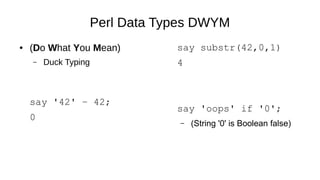
Perl Data Types DWYM
● (Do What You Mean)
– Duck Typing
say '42' – 42;
0
say substr(42,0,1)
4
say 'oops' if '0';
– (String '0' is Boolean false)
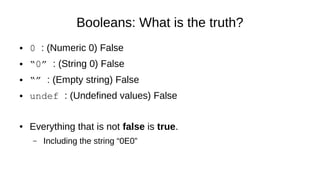
Booleans: What is the truth?
● 0 : (Numeric 0) False
● “0” : (String 0) False
● “” : (Empty string) False
● undef : (Undefined values) False
● Everything that is not false is true.
– Including the string “0E0”
Structure
Subroutines
sub add {
my @param = @_;
return $param[0] + $param[1];
}
sub fact {
my $n = shift();
return 1 if $n <= 1;
return $n * fact ( $n-1 );
}
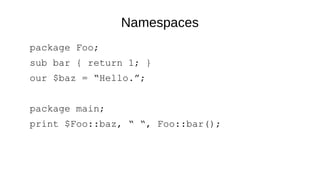
Namespaces
package Foo;
sub bar { return 1; }
our $baz = “Hello.”;
package main;
print $Foo::baz, “ “, Foo::bar();
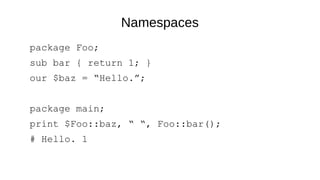
Namespaces
package Foo;
sub bar { return 1; }
our $baz = “Hello.”;
package main;
print $Foo::baz, “ “, Foo::bar();
# Hello. 1
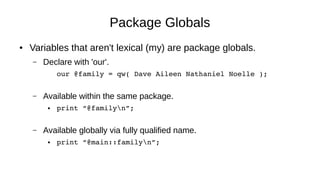
Package Globals
● Variables that aren't lexical (my) are package globals.
– Declare with 'our'.
our @family = qw( Dave Aileen Nathaniel Noelle );
– Available within the same package.
● print “@familyn”;
– Available globally via fully qualified name.
● print “@main::familyn”;
LoopingLooping
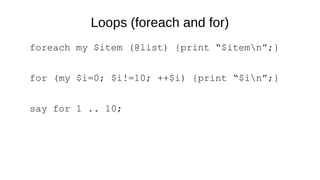
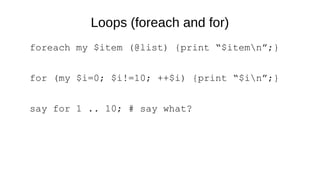
Loops (foreach and for)
foreach my $item (@list) {print “$itemn”;}
for (my $i=0; $i!=10; ++$i) {print “$in”;}
say for 1 .. 10;
Loops (foreach and for)
foreach my $item (@list) {print “$itemn”;}
for (my $i=0; $i!=10; ++$i) {print “$in”;}
say for 1 .. 10; # say what?
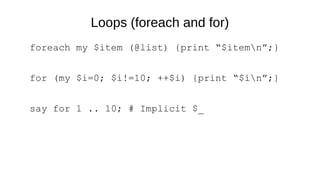
Loops (foreach and for)
foreach my $item (@list) {print “$itemn”;}
for (my $i=0; $i!=10; ++$i) {print “$in”;}
say for 1 .. 10; # Implicit $_
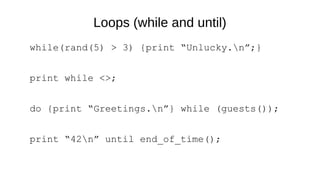
Loops (while and until)
while(rand(5) > 3) {print “Unlucky.n”;}
print while <>;
do {print “Greetings.n”} while (guests());
print “42n” until end_of_time();
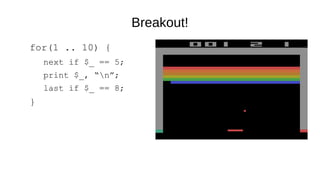
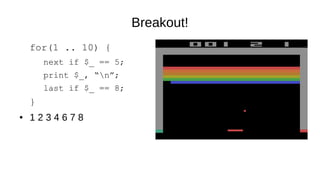
Breakout!
for(1 .. 10) {
next if $_ == 5;
print $_, “n”;
last if $_ == 8;
}
Breakout!
for(1 .. 10) {
next if $_ == 5;
print $_, “n”;
last if $_ == 8;
}
● 1 2 3 4 6 7 8
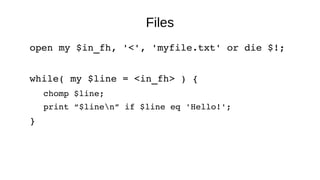
Files
open my $in_fh, '<', 'myfile.txt' or die $!;
while( my $line = <in_fh> ) {
chomp $line;
print “$linen” if $line eq 'Hello!';
}
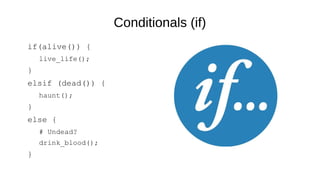
Conditionals (if)
if(alive()) {
live_life();
}
elsif (dead()) {
haunt();
}
else {
# Undead?
drink_blood();
}
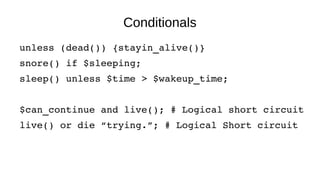
Conditionals
unless (dead()) {stayin_alive()}
snore() if $sleeping;
sleep() unless $time > $wakeup_time;
$can_continue and live(); # Logical short circuit
live() or die “trying.”; # Logical Short circuit
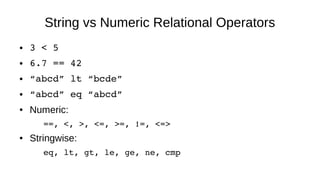
String vs Numeric Relational Operators
● 3 < 5
● 6.7 == 42
● “abcd” lt “bcde”
● “abcd” eq “abcd”
● Numeric:
==, <, >, <=, >=, !=, <=>
● Stringwise:
eq, lt, gt, le, ge, ne, cmp
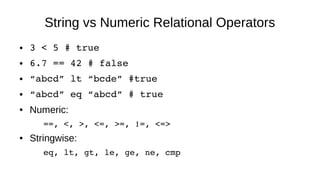
String vs Numeric Relational Operators
● 3 < 5 # true
● 6.7 == 42 # false
● “abcd” lt “bcde” #true
● “abcd” eq “abcd” # true
● Numeric:
==, <, >, <=, >=, !=, <=>
● Stringwise:
eq, lt, gt, le, ge, ne, cmp
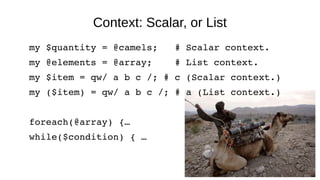
Context: Scalar, or List
my $quantity = @camels;   # Scalar context.
my @elements = @array;    # List context.
my $item = qw/ a b c /; # c (Scalar context.)
my ($item) = qw/ a b c /; # a (List context.)
foreach(@array) {…
while($condition) { …
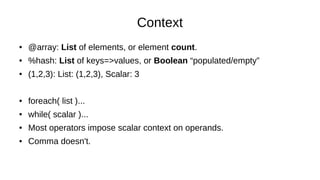
Context
● @array: List of elements, or element count.
● %hash: List of keys=>values, or Boolean “populated/empty”
● (1,2,3): List: (1,2,3), Scalar: 3
● foreach( list )...
● while( scalar )...
● Most operators impose scalar context on operands.
● Comma doesn't.
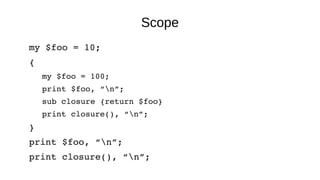
Scope
my $foo = 10;
{
my $foo = 100;
print $foo, “n”;
sub closure {return $foo}
print closure(), “n”;
}
print $foo, “n”;
print closure(), “n”;
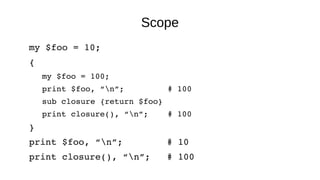
Scope
my $foo = 10;
{
my $foo = 100;
print $foo, “n”;         # 100
sub closure {return $foo}
print closure(), “n”;    # 100
}
print $foo, “n”;        # 10
print closure(), “n”;   # 100
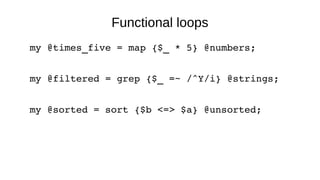
Functional loops
my @times_five = map {$_ * 5} @numbers;
my @filtered = grep {$_ =~ /^Y/i} @strings;
my @sorted = sort {$b <=> $a} @unsorted;
Is it Perl or Lisp?
my @sorted = 
map  { $_­>[0]             } 
sort { $a­>[1] cmp $b­>[1] } 
map  { [ $_ => lc $_ ]     } 
@unsorted;
Schwartzian Transform:
decorate/sort/undecorate idiom
my @sorted = 
map  { $_­>[0]             } 
sort { $a­>[1] cmp $b­>[1] } 
map  { [ $_ => lc $_ ]     } 
@unsorted;
Regular Expressions
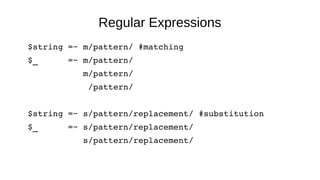
Regular Expressions
$string =~ m/pattern/ #matching
$_      =~ m/pattern/
           m/pattern/
            /pattern/
$string =~ s/pattern/replacement/ #substitution
$_      =~ s/pattern/replacement/
           s/pattern/replacement/
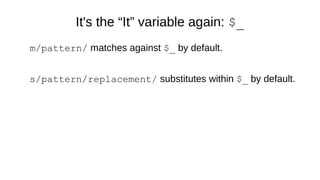
It's the “It” variable again: $_
m/pattern/ matches against $_ by default.
s/pattern/replacement/ substitutes within $_ by default.
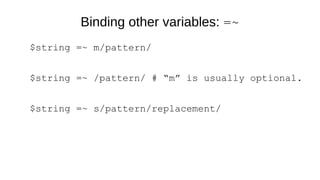
Binding other variables: =~
$string =~ m/pattern/
$string =~ /pattern/ # “m” is usually optional.
$string =~ s/pattern/replacement/
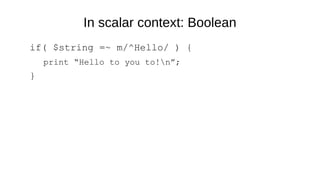
In scalar context: Boolean
if( $string =~ m/^Hello/ ) {
print “Hello to you to!n”;
}
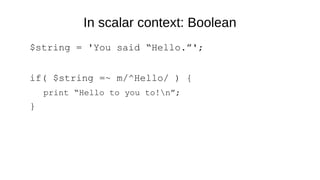
In scalar context: Boolean
$string = 'You said “Hello.”';
if( $string =~ m/^Hello/ ) {
print “Hello to you to!n”;
}
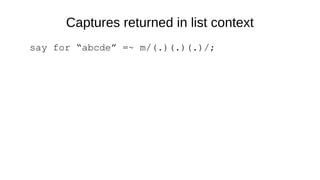
Captures returned in list context
say for “abcde” =~ m/(.)(.)(.)/;
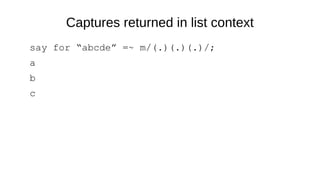
Captures returned in list context
say for “abcde” =~ m/(.)(.)(.)/;
a
b
c
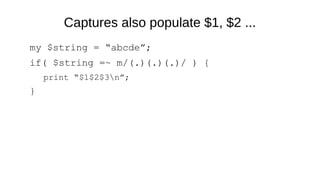
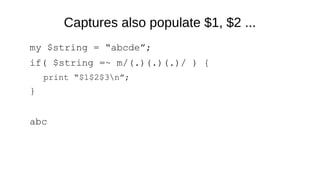
Captures also populate $1, $2 ...
my $string = “abcde”;
if( $string =~ m/(.)(.)(.)/ ) {
print “$1$2$3n”;
}
Captures also populate $1, $2 ...
my $string = “abcde”;
if( $string =~ m/(.)(.)(.)/ ) {
print “$1$2$3n”;
}
abc
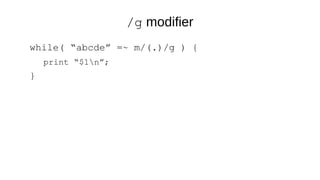
/g modifier
while( “abcde” =~ m/(.)/g ) {
print “$1n”;
}
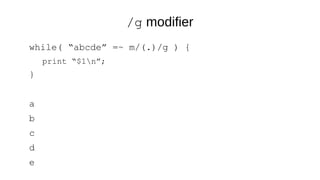
/g modifier
while( “abcde” =~ m/(.)/g ) {
print “$1n”;
}
a
b
c
d
e
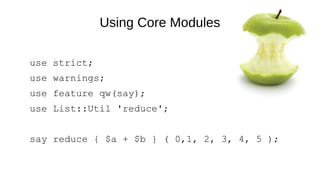
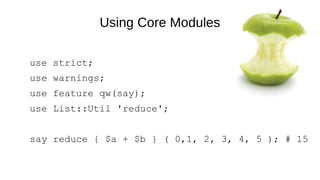
Using Core Modules
use strict;
use warnings;
use feature qw(say);
use List::Util 'reduce';
say reduce { $a + $b } ( 0,1, 2, 3, 4, 5 );
Using Core Modules
use strict;
use warnings;
use feature qw(say);
use List::Util 'reduce';
say reduce { $a + $b } ( 0,1, 2, 3, 4, 5 ); # 15
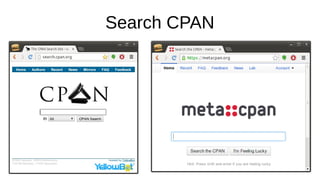
CPANCPAN
Search CPAN
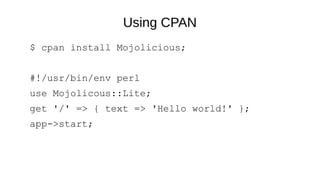
Using CPAN
$ cpan install Mojolicious;
#!/usr/bin/env perl
use Mojolicous::Lite;
get '/' => { text => 'Hello world!' };
app->start;
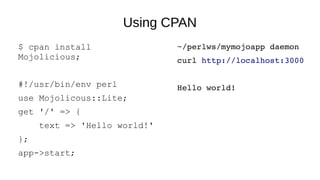
Using CPAN
$ cpan install
Mojolicious;
#!/usr/bin/env perl
use Mojolicous::Lite;
get '/' => {
text => 'Hello world!'
};
app->start;
~/perlws/mymojoapp daemon
curl http://localhost:3000
Hello world!
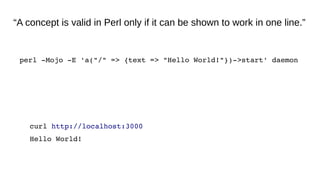
“A concept is valid in Perl only if it can be shown to work in one line.”
perl ­Mojo ­E 'a("/" => {text => "Hello World!"})­>start' daemon
curl http://localhost:3000
Hello World!
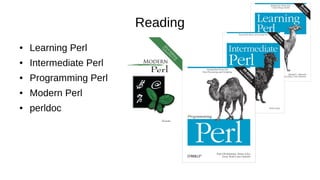
Reading
● Learning Perl
● Intermediate Perl
● Programming Perl
● Modern Perl
● perldoc
“You can sometimes write faster code in C, but
you can always write code faster in Perl.”
– perldoc perlembed
Slides available on Slide Share: http://www.slideshare.net/daoswald/toolbelt
David Oswald: daoswald@gmail.com
Add Perl to Your Toolbelt

Add Perl to Your Toolbelt

Editor's Notes

  • #63 Let&amp;apos;s stop here and try.
  • #68 When should we use a hash? An array?
  • #69 Arrays are ordered. Hashes are not.