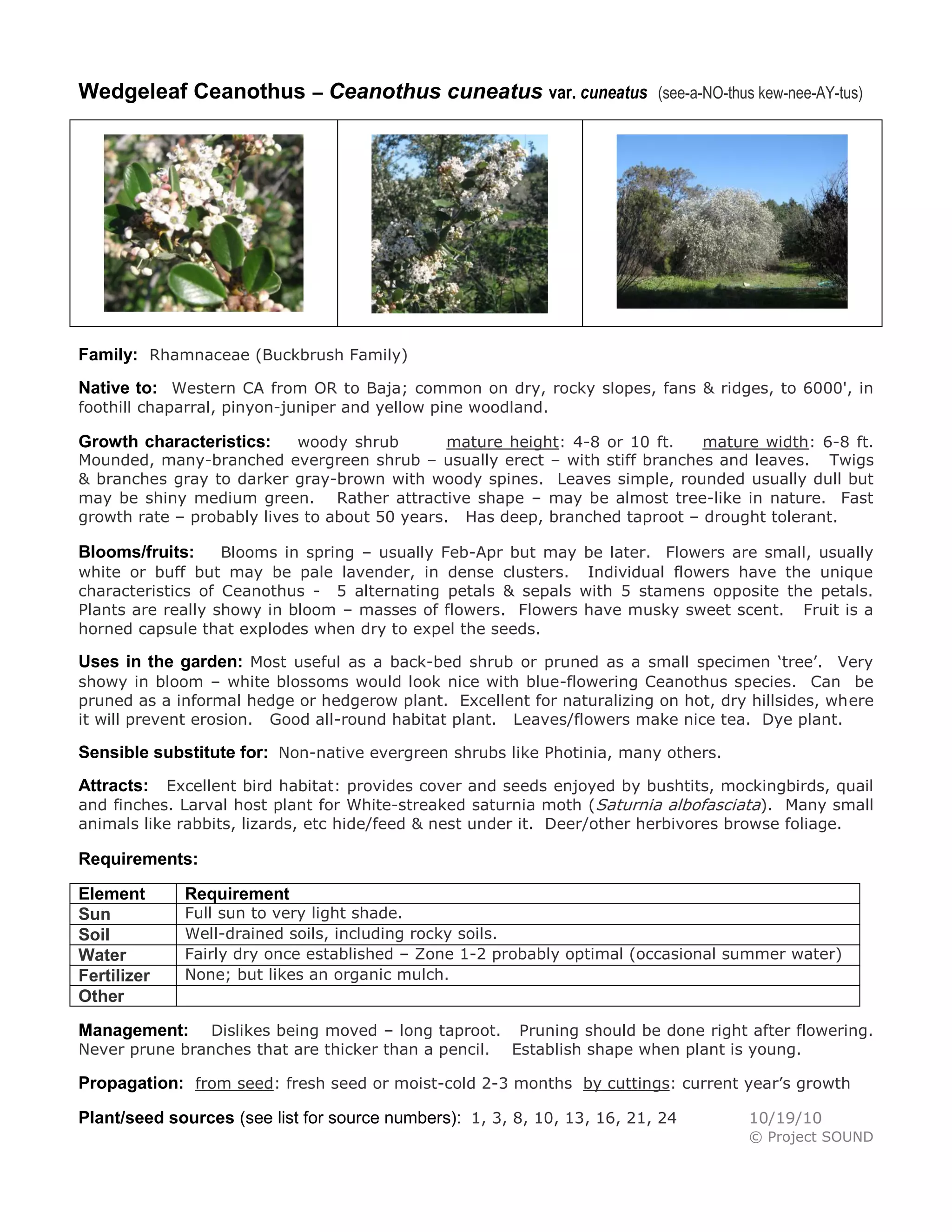
Wedgeleaf Ceanothus – Ceanothus cuneatus var. cuneatus

(see-a-NO-thus kew-nee-AY-tus)

Family: Rhamnaceae (Buckbrush Family)
Native to: Western CA from OR to Baja; common on dry, rocky slopes, fans & ridges, to 6000', in
foothill chaparral, pinyon-juniper and yellow pine woodland.

woody shrub
mature height: 4-8 or 10 ft.
mature width: 6-8 ft.
Mounded, many-branched evergreen shrub – usually erect – with stiff branches and leaves. Twigs
& branches gray to darker gray-brown with woody spines. Leaves simple, rounded usually dull but
may be shiny medium green. Rather attractive shape – may be almost tree-like in nature. Fast
growth rate – probably lives to about 50 years. Has deep, branched taproot – drought tolerant.

Growth characteristics:

Blooms in spring – usually Feb-Apr but may be later. Flowers are small, usually
white or buff but may be pale lavender, in dense clusters. Individual flowers have the unique
characteristics of Ceanothus - 5 alternating petals & sepals with 5 stamens opposite the petals.
Plants are really showy in bloom – masses of flowers. Flowers have musky sweet scent. Fruit is a
horned capsule that explodes when dry to expel the seeds.

Blooms/fruits:

Uses in the garden: Most useful as a back-bed shrub or pruned as a small specimen ‘tree’. Very
showy in bloom – white blossoms would look nice with blue-flowering Ceanothus species. Can be
pruned as a informal hedge or hedgerow plant. Excellent for naturalizing on hot, dry hillsides, where
it will prevent erosion. Good all-round habitat plant. Leaves/flowers make nice tea. Dye plant.

Sensible substitute for: Non-native evergreen shrubs like Photinia, many others.
Excellent bird habitat: provides cover and seeds enjoyed by bushtits, mockingbirds, quail
and finches. Larval host plant for White-streaked saturnia moth (Saturnia albofasciata). Many small
animals like rabbits, lizards, etc hide/feed & nest under it. Deer/other herbivores browse foliage.

Attracts:

Requirements:
Element
Sun
Soil
Water
Fertilizer
Other

Requirement

Full sun to very light shade.
Well-drained soils, including rocky soils.
Fairly dry once established – Zone 1-2 probably optimal (occasional summer water)
None; but likes an organic mulch.

Dislikes being moved – long taproot. Pruning should be done right after flowering.
Never prune branches that are thicker than a pencil. Establish shape when plant is young.

Management:

Propagation: from seed: fresh seed or moist-cold 2-3 months by cuttings: current year’s growth
Plant/seed sources (see list for source numbers): 1, 3, 8, 10, 13, 16, 21, 24

10/19/10
© Project SOUND

Ceanothus cuneatus

  • 1.
    Wedgeleaf Ceanothus –Ceanothus cuneatus var. cuneatus (see-a-NO-thus kew-nee-AY-tus) Family: Rhamnaceae (Buckbrush Family) Native to: Western CA from OR to Baja; common on dry, rocky slopes, fans & ridges, to 6000', in foothill chaparral, pinyon-juniper and yellow pine woodland. woody shrub mature height: 4-8 or 10 ft. mature width: 6-8 ft. Mounded, many-branched evergreen shrub – usually erect – with stiff branches and leaves. Twigs & branches gray to darker gray-brown with woody spines. Leaves simple, rounded usually dull but may be shiny medium green. Rather attractive shape – may be almost tree-like in nature. Fast growth rate – probably lives to about 50 years. Has deep, branched taproot – drought tolerant. Growth characteristics: Blooms in spring – usually Feb-Apr but may be later. Flowers are small, usually white or buff but may be pale lavender, in dense clusters. Individual flowers have the unique characteristics of Ceanothus - 5 alternating petals & sepals with 5 stamens opposite the petals. Plants are really showy in bloom – masses of flowers. Flowers have musky sweet scent. Fruit is a horned capsule that explodes when dry to expel the seeds. Blooms/fruits: Uses in the garden: Most useful as a back-bed shrub or pruned as a small specimen ‘tree’. Very showy in bloom – white blossoms would look nice with blue-flowering Ceanothus species. Can be pruned as a informal hedge or hedgerow plant. Excellent for naturalizing on hot, dry hillsides, where it will prevent erosion. Good all-round habitat plant. Leaves/flowers make nice tea. Dye plant. Sensible substitute for: Non-native evergreen shrubs like Photinia, many others. Excellent bird habitat: provides cover and seeds enjoyed by bushtits, mockingbirds, quail and finches. Larval host plant for White-streaked saturnia moth (Saturnia albofasciata). Many small animals like rabbits, lizards, etc hide/feed & nest under it. Deer/other herbivores browse foliage. Attracts: Requirements: Element Sun Soil Water Fertilizer Other Requirement Full sun to very light shade. Well-drained soils, including rocky soils. Fairly dry once established – Zone 1-2 probably optimal (occasional summer water) None; but likes an organic mulch. Dislikes being moved – long taproot. Pruning should be done right after flowering. Never prune branches that are thicker than a pencil. Establish shape when plant is young. Management: Propagation: from seed: fresh seed or moist-cold 2-3 months by cuttings: current year’s growth Plant/seed sources (see list for source numbers): 1, 3, 8, 10, 13, 16, 21, 24 10/19/10 © Project SOUND