*Sierra currant – Ribes nevadense (RYE (or REE)-bees nev-uh-DEN-see)
Family: Grossulariaceae (Gooseberry Family)
Native to: Mountain ranges from S. OR to NV and CA. Locally in the Tehachipi, San Gabriel, San
Bernardino and San Jacinto Mountains; in forest, shady woodland and riparian habitats, 3,000–
10,000 ft. elevation, in Yellow Pine, Red Fir, and Lodgepole Forest, Wetland-riparian woodland.
Growth characteristics: woody shrub mature height: 4-6 ft. mature width: 4-6 ft.
Drought-deciduous woody shrub with semi-upright form. Looks similar to Pink currant (Ribes
sanguineum var. glutinosum), but smaller sized. Moderate-fast growth and long-lived. Thin, three-
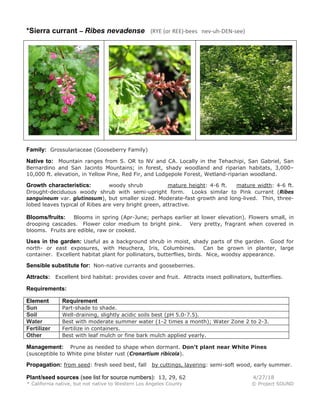
lobed leaves typical of Ribes are very bright green, attractive.
Blooms/fruits: Blooms in spring (Apr-June; perhaps earlier at lower elevation). Flowers small, in
drooping cascades. Flower color medium to bright pink. Very pretty, fragrant when covered in
blooms. Fruits are edible, raw or cooked.
Uses in the garden: Useful as a background shrub in moist, shady parts of the garden. Good for
north- or east exposures, with Heuchera, Iris, Columbines. Can be grown in planter, large
container. Excellent habitat plant for pollinators, butterflies, birds. Nice, woodsy appearance.
Sensible substitute for: Non-native currants and gooseberries.
Attracts: Excellent bird habitat: provides cover and fruit. Attracts insect pollinators, butterflies.
Requirements:
Element Requirement
Sun Part-shade to shade.
Soil Well-draining, slightly acidic soils best (pH 5.0-7.5).
Water Best with moderate summer water (1-2 times a month); Water Zone 2 to 2-3.
Fertilizer Fertilize in containers.
Other Best with leaf mulch or fine bark mulch applied yearly.
Management: Prune as needed to shape when dormant. Don’t plant near White Pines
(susceptible to White pine blister rust (Cronartium ribicola).
Propagation: from seed: fresh seed best, fall by cuttings, layering: semi-soft wood, early summer.
Plant/seed sources (see list for source numbers): 13, 29, 62 4/27/18
* California native, but not native to Western Los Angeles County © Project SOUND

Gardening sheet ribes nevadense

  • 1.
    *Sierra currant –Ribes nevadense (RYE (or REE)-bees nev-uh-DEN-see) Family: Grossulariaceae (Gooseberry Family) Native to: Mountain ranges from S. OR to NV and CA. Locally in the Tehachipi, San Gabriel, San Bernardino and San Jacinto Mountains; in forest, shady woodland and riparian habitats, 3,000– 10,000 ft. elevation, in Yellow Pine, Red Fir, and Lodgepole Forest, Wetland-riparian woodland. Growth characteristics: woody shrub mature height: 4-6 ft. mature width: 4-6 ft. Drought-deciduous woody shrub with semi-upright form. Looks similar to Pink currant (Ribes sanguineum var. glutinosum), but smaller sized. Moderate-fast growth and long-lived. Thin, three- lobed leaves typical of Ribes are very bright green, attractive. Blooms/fruits: Blooms in spring (Apr-June; perhaps earlier at lower elevation). Flowers small, in drooping cascades. Flower color medium to bright pink. Very pretty, fragrant when covered in blooms. Fruits are edible, raw or cooked. Uses in the garden: Useful as a background shrub in moist, shady parts of the garden. Good for north- or east exposures, with Heuchera, Iris, Columbines. Can be grown in planter, large container. Excellent habitat plant for pollinators, butterflies, birds. Nice, woodsy appearance. Sensible substitute for: Non-native currants and gooseberries. Attracts: Excellent bird habitat: provides cover and fruit. Attracts insect pollinators, butterflies. Requirements: Element Requirement Sun Part-shade to shade. Soil Well-draining, slightly acidic soils best (pH 5.0-7.5). Water Best with moderate summer water (1-2 times a month); Water Zone 2 to 2-3. Fertilizer Fertilize in containers. Other Best with leaf mulch or fine bark mulch applied yearly. Management: Prune as needed to shape when dormant. Don’t plant near White Pines (susceptible to White pine blister rust (Cronartium ribicola). Propagation: from seed: fresh seed best, fall by cuttings, layering: semi-soft wood, early summer. Plant/seed sources (see list for source numbers): 13, 29, 62 4/27/18 * California native, but not native to Western Los Angeles County © Project SOUND