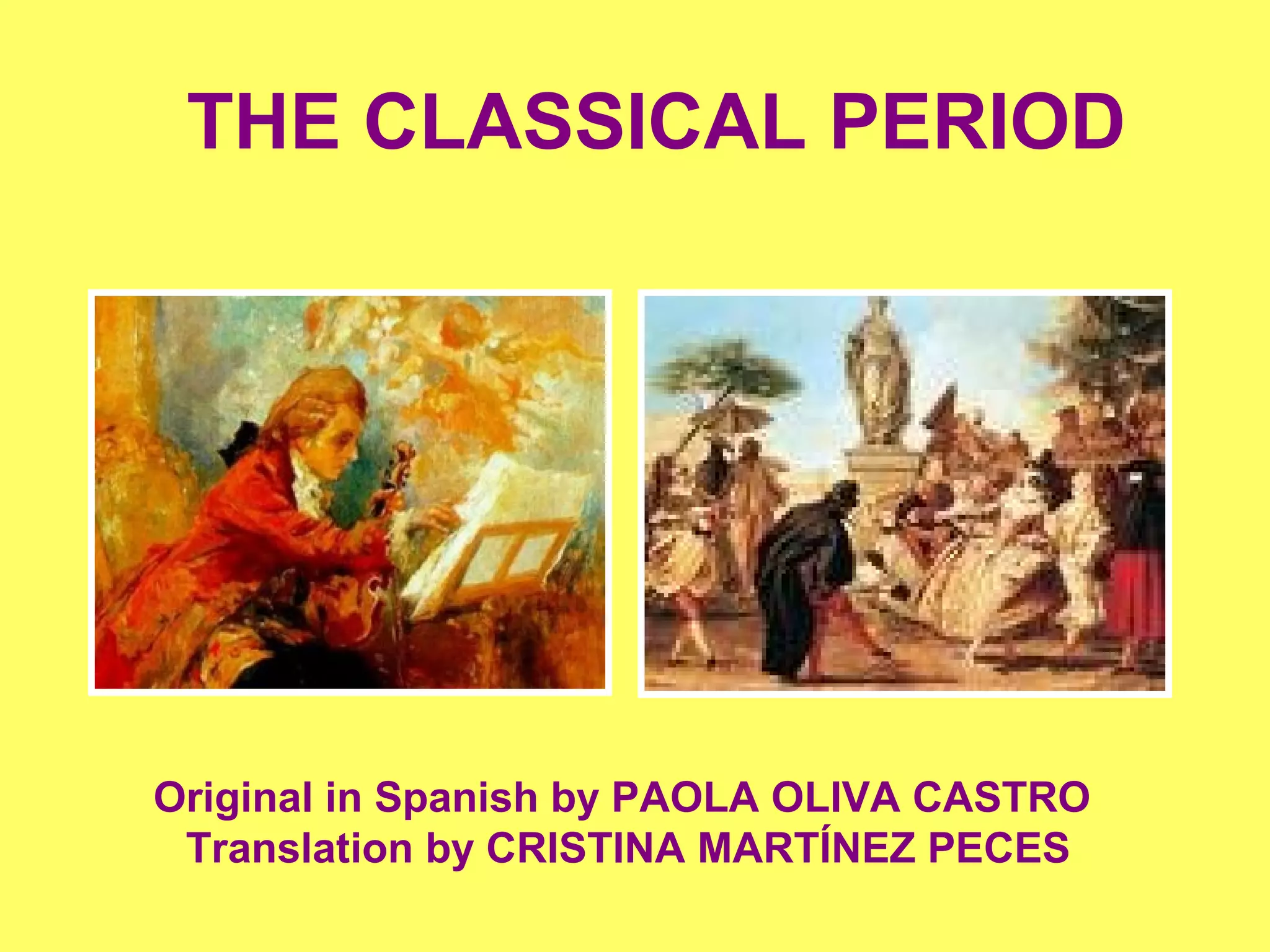
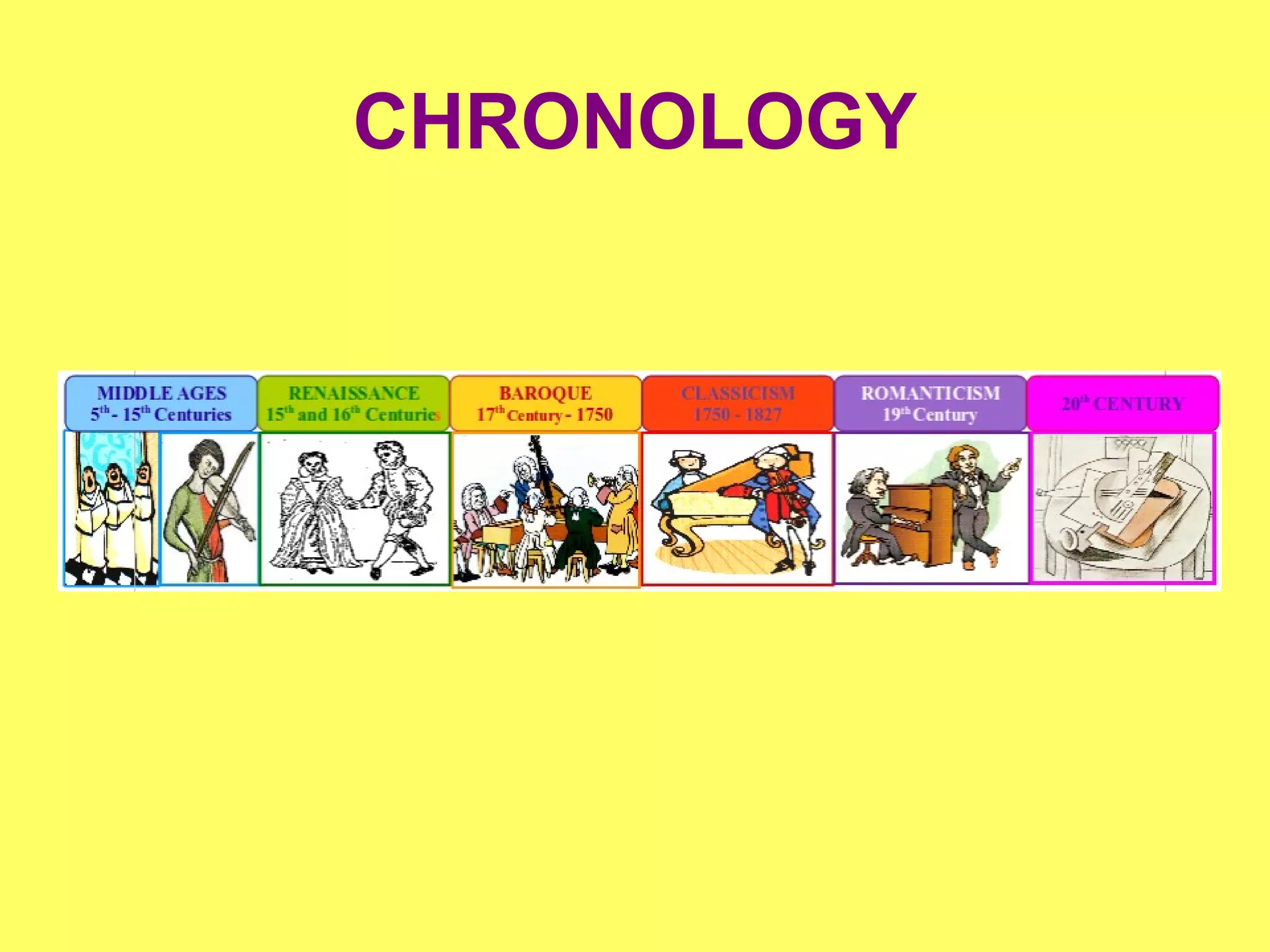
THE CLASSICAL PERIOD
Original in Spanish by PAOLA OLIVA CASTRO
Translation by CRISTINA MARTÍNEZ PECES
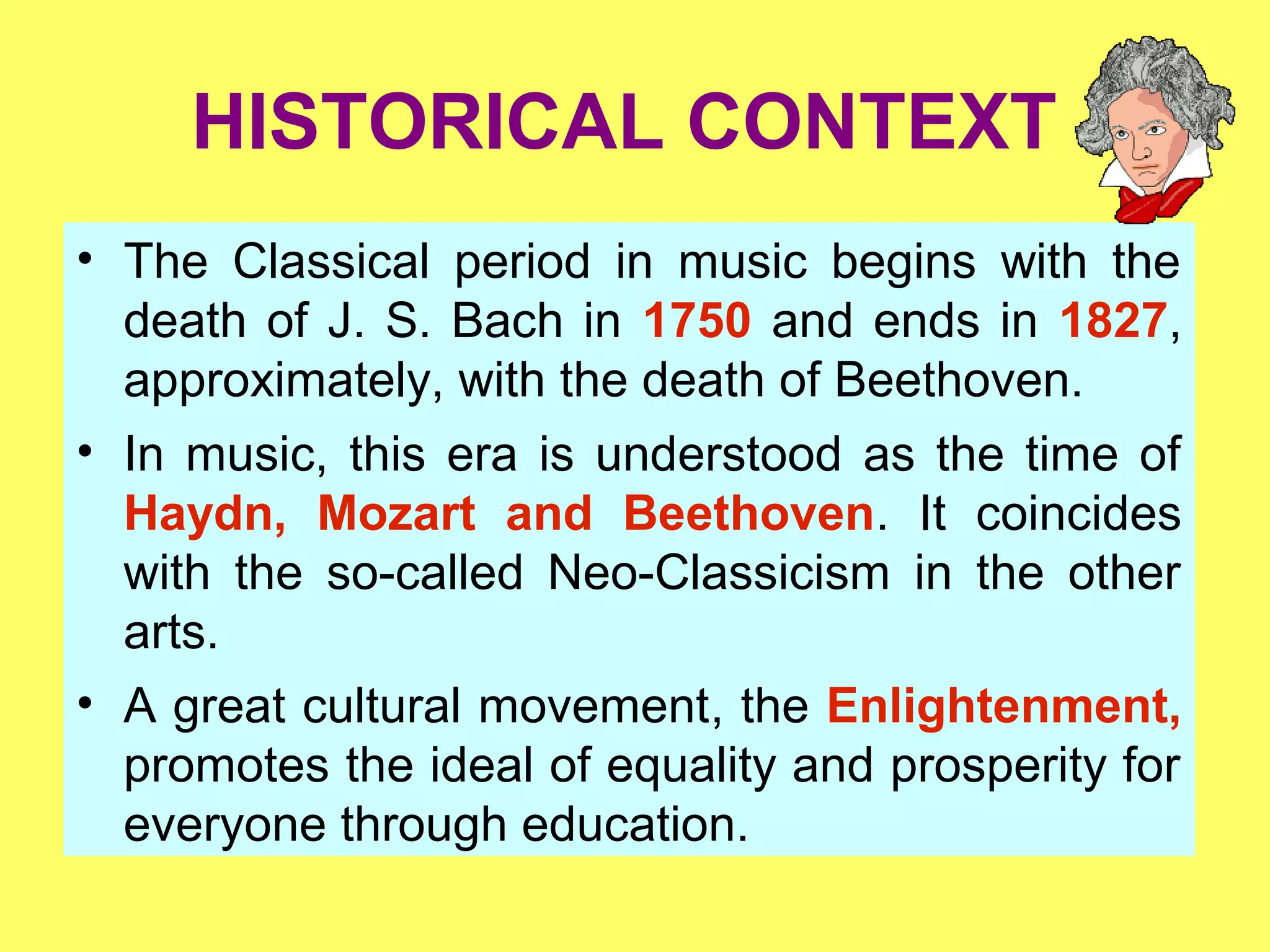
CHRONOLOGY
HISTORICAL CONTEXT
• The Classical period in music begins with the
death of J. S. Bach in 1750 and ends in 1827,
approximately, with the death of Beethoven.
• In music, this era is understood as the time of
Haydn, Mozart and Beethoven. It coincides
with the so-called Neo-Classicism in the other
arts.
• A great cultural movement, the Enlightenment,
promotes the ideal of equality and prosperity for
everyone through education.
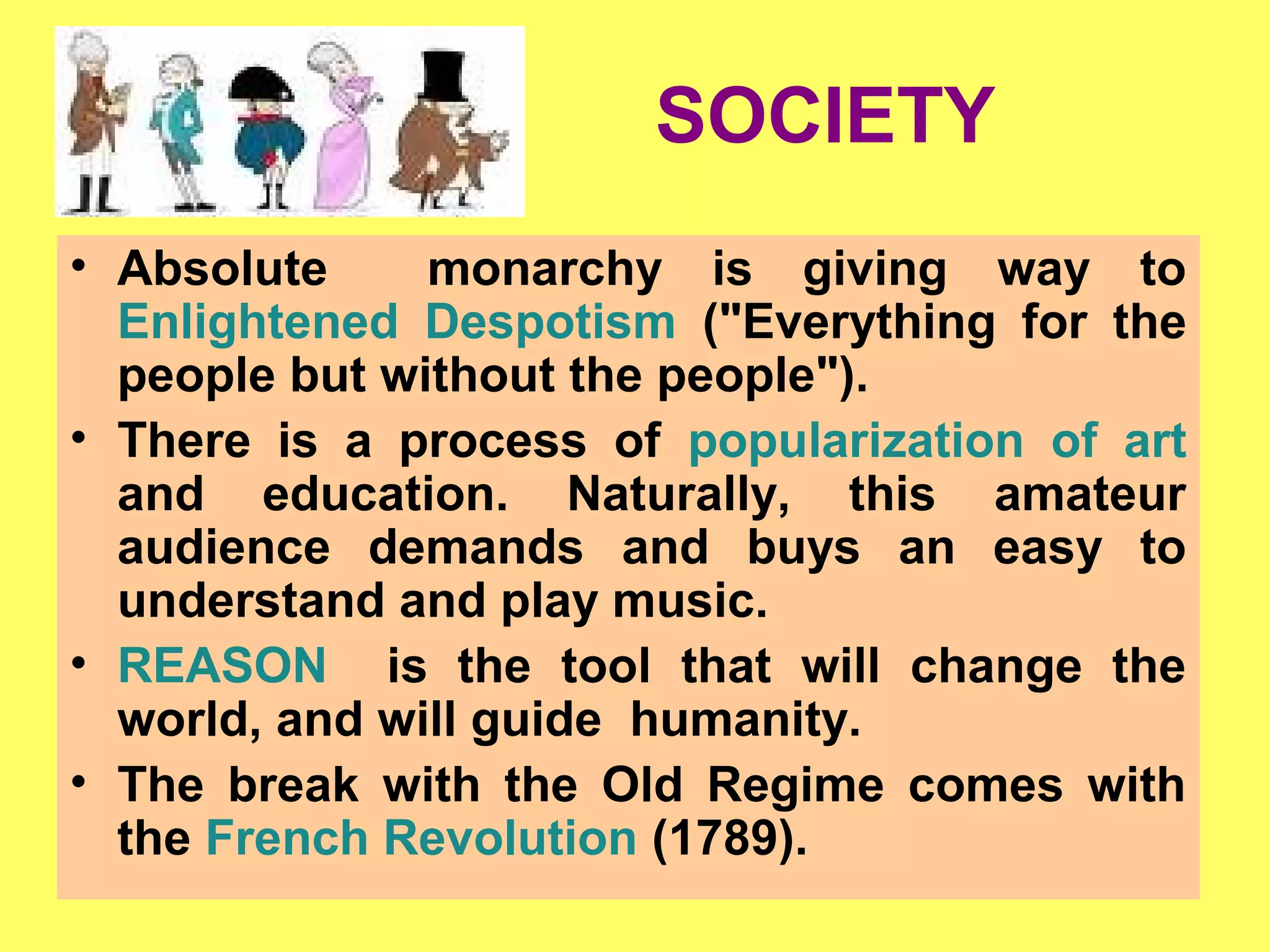
SOCIETY
• Absolute monarchy is giving way to
Enlightened Despotism ("Everything for the
people but without the people").
• There is a process of popularization of art
and education. Naturally, this amateur
audience demands and buys an easy to
understand and play music.
• REASON is the tool that will change the
world, and will guide humanity.
• The break with the Old Regime comes with
the French Revolution (1789).
ART
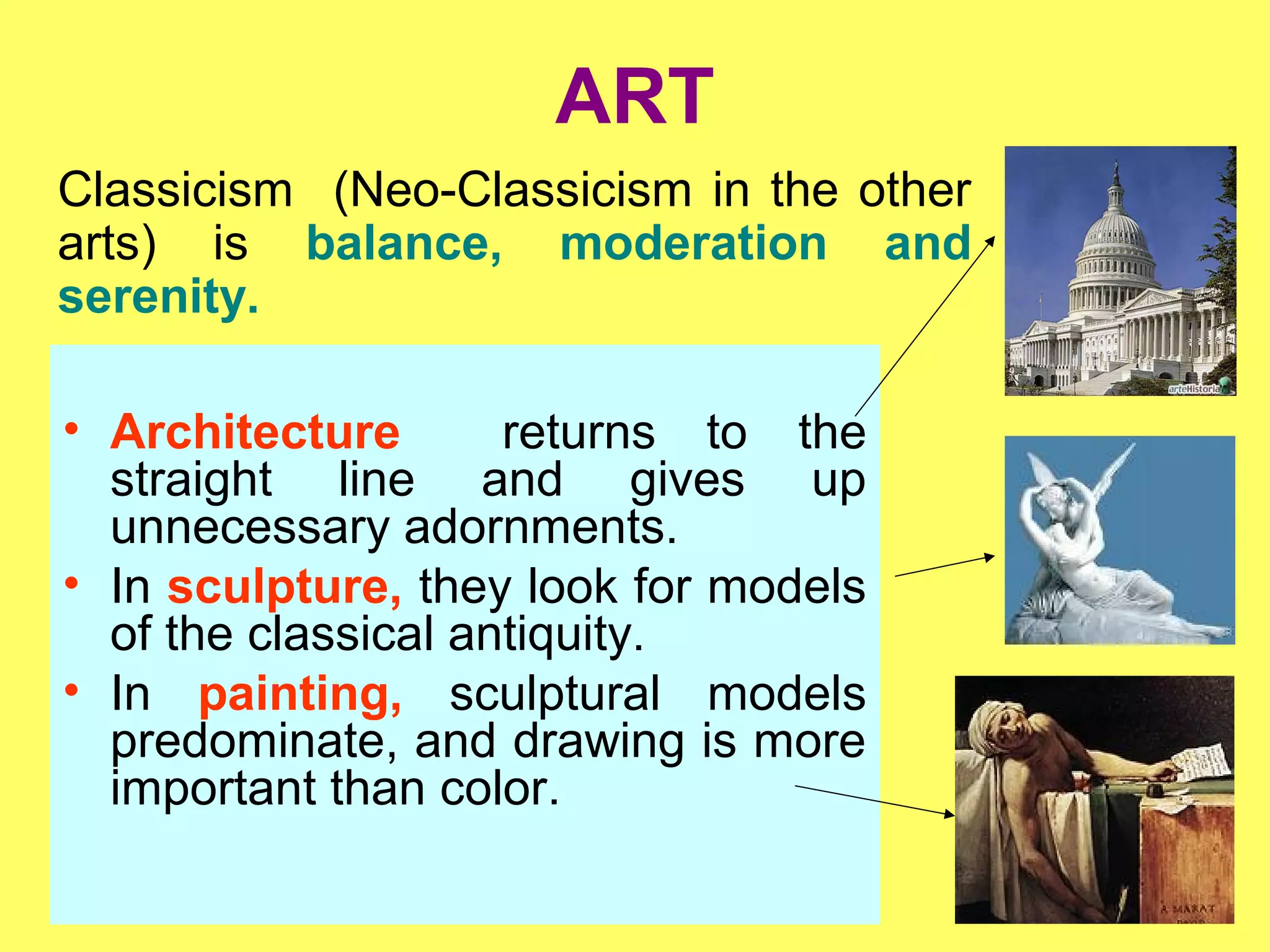
• Architecture returns to the
straight line and gives up
unnecessary adornments.
• In sculpture, they look for models
of the classical antiquity.
• In painting, sculptural models
predominate, and drawing is more
important than color.
Classicism (Neo-Classicism in the other
arts) is balance, moderation and
serenity.
DISCOVER HOW IT SOUNDS
a) The melodies are not as ornamented as in the Baroque.
They are based on simplicity, elegance and clarity and
structured in symmetrical phrases, organized into two
parts (question and answer). They are usually easy to
remember.
b) The gradual dynamic appears, with many crescendos
and diminuendos which are combined with sudden
changes.
c) The rhythm is regular, but not mechanic, looking for
making easier the musical phrasing.
d) The predominant textures are homorhythmic and
melody with accompaniment.
INSTRUMENTS
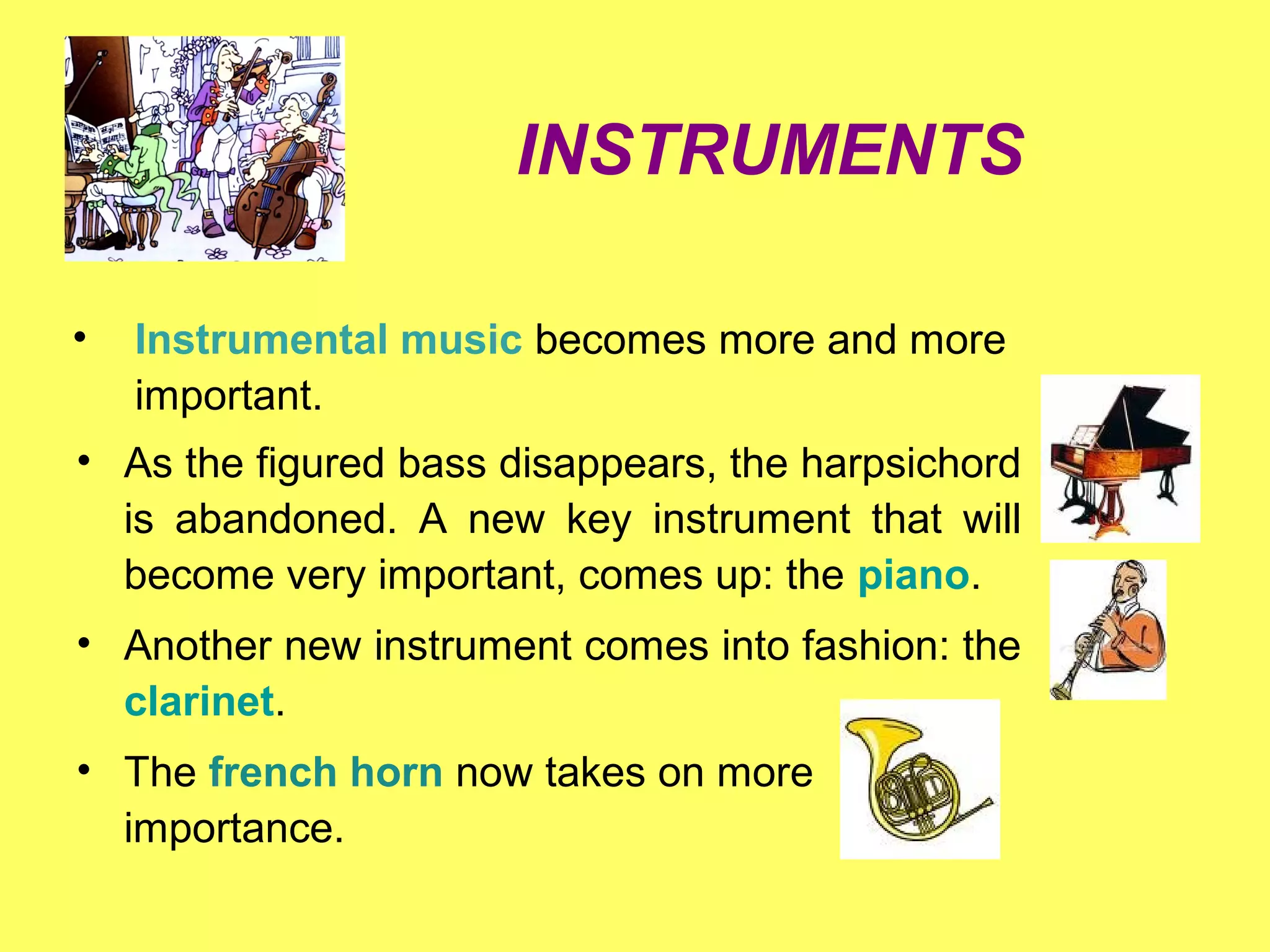
• As the figured bass disappears, the harpsichord
is abandoned. A new key instrument that will
become very important, comes up: the piano.
• Another new instrument comes into fashion: the
clarinet.
• The french horn now takes on more
importance.
• Instrumental music becomes more and more
important.
THE CLASSICAL ORCHESTRA
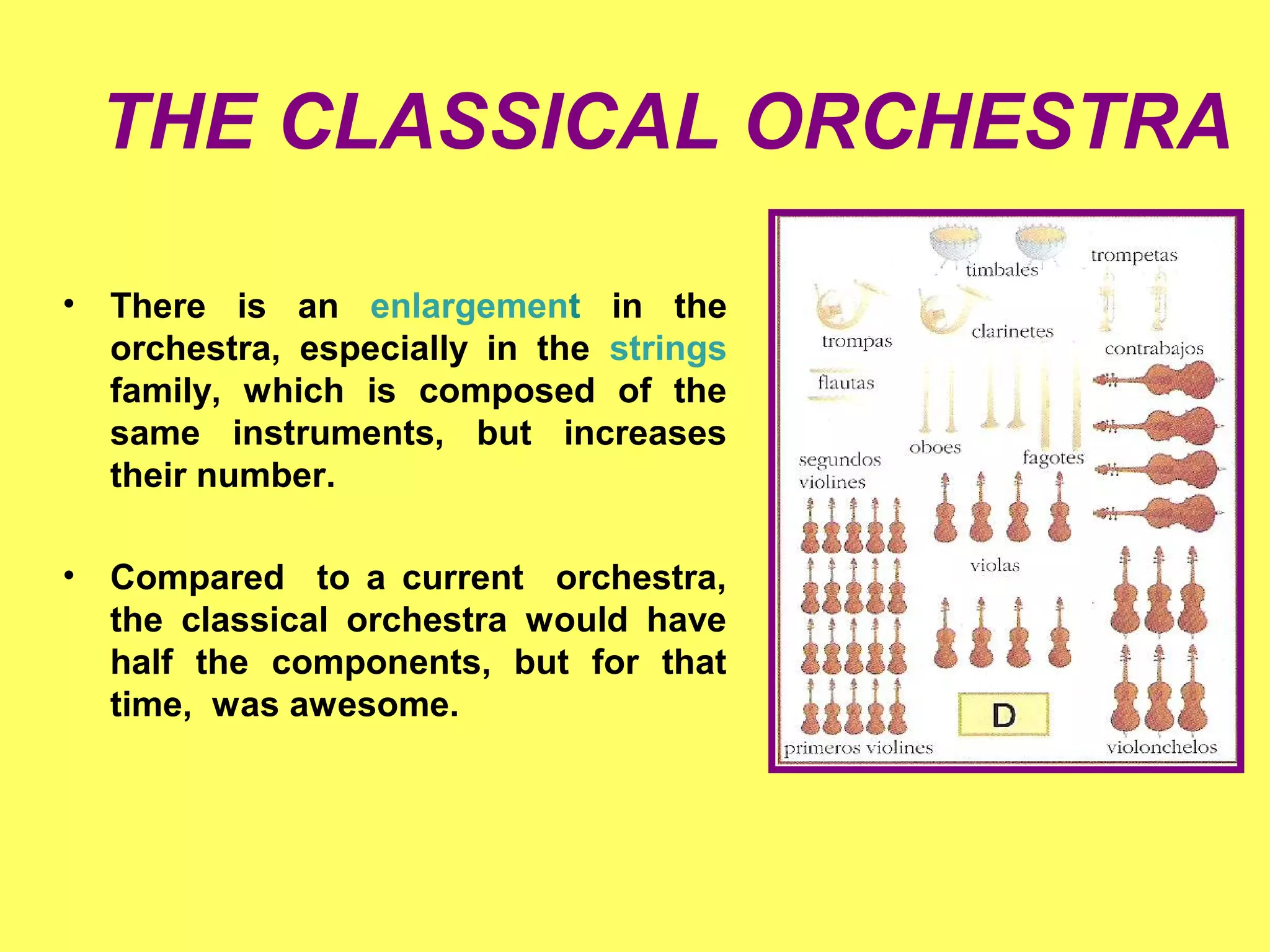
• There is an enlargement in the
orchestra, especially in the strings
family, which is composed of the
same instruments, but increases
their number.
• Compared to a current orchestra,
the classical orchestra would have
half the components, but for that
time, was awesome.
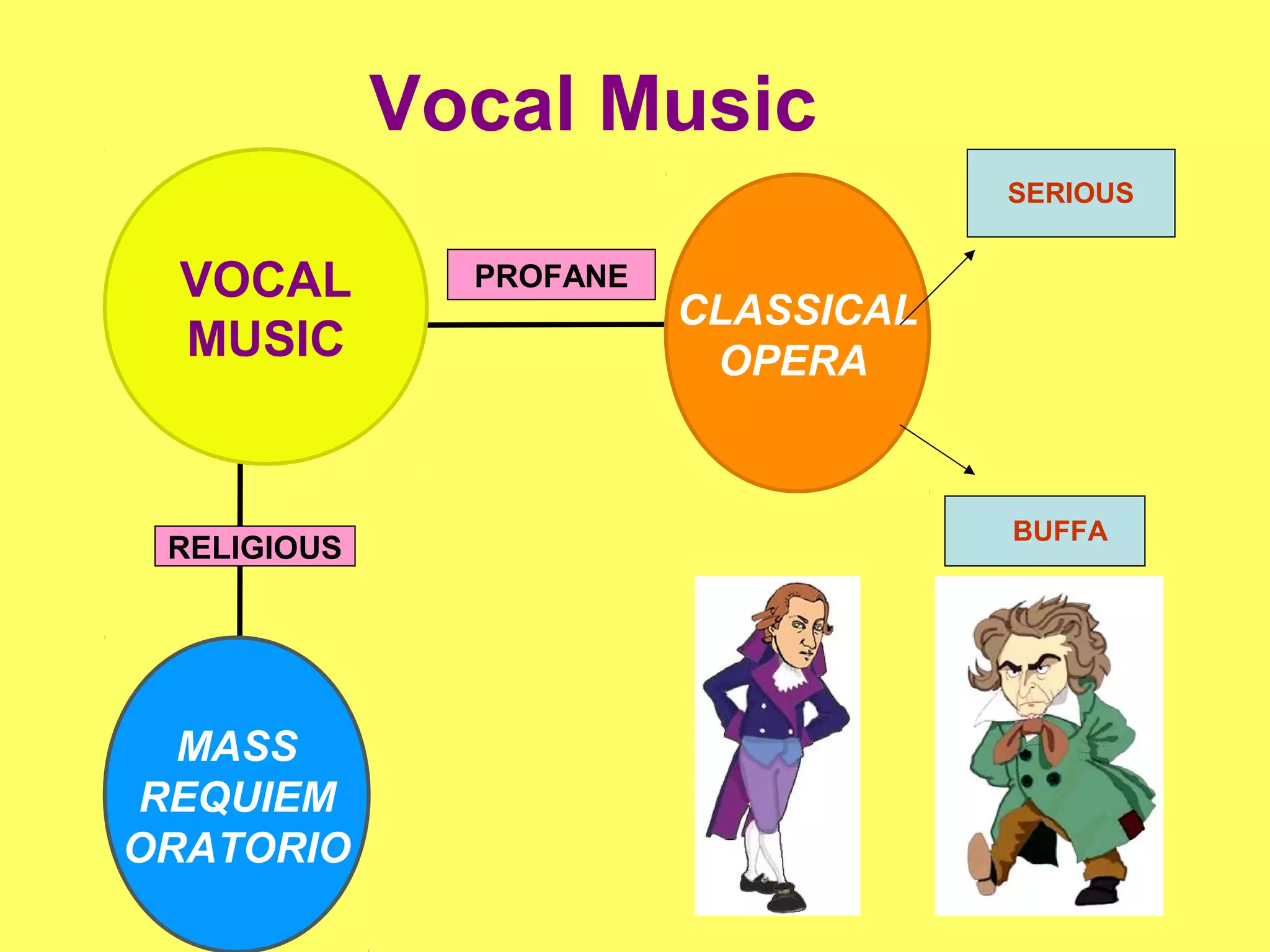
MASS
REQUIEM
ORATORIO
CLASSICAL
OPERA
VOCAL
MUSIC
PROFANE
Vocal Music
RELIGIOUS
SERIOUS
BUFFA
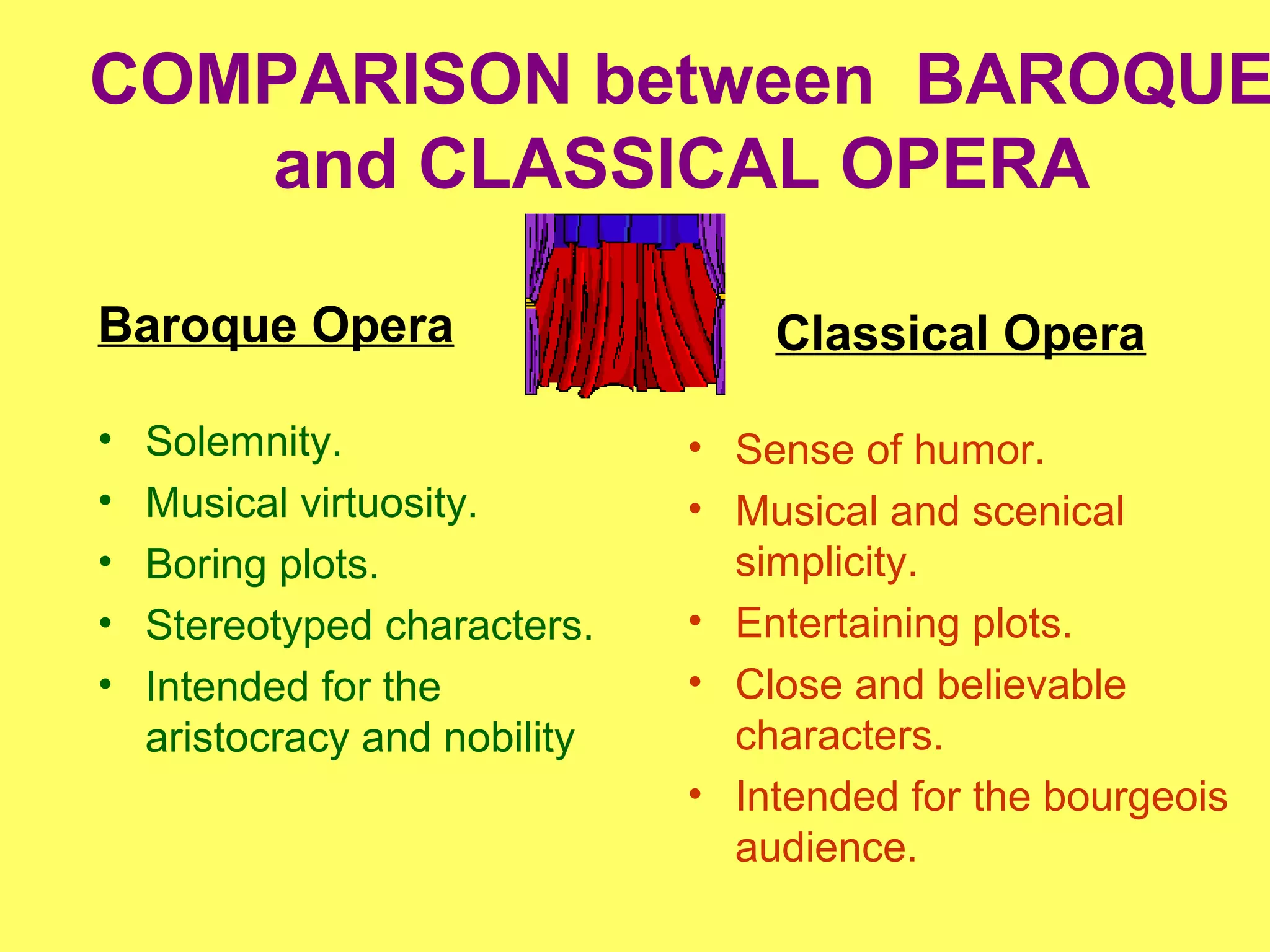
COMPARISON between BAROQUE
and CLASSICAL OPERA
Baroque Opera
• Solemnity.
• Musical virtuosity.
• Boring plots.
• Stereotyped characters.
• Intended for the
aristocracy and nobility
Classical Opera
• Sense of humor.
• Musical and scenical
simplicity.
• Entertaining plots.
• Close and believable
characters.
• Intended for the bourgeois
audience.
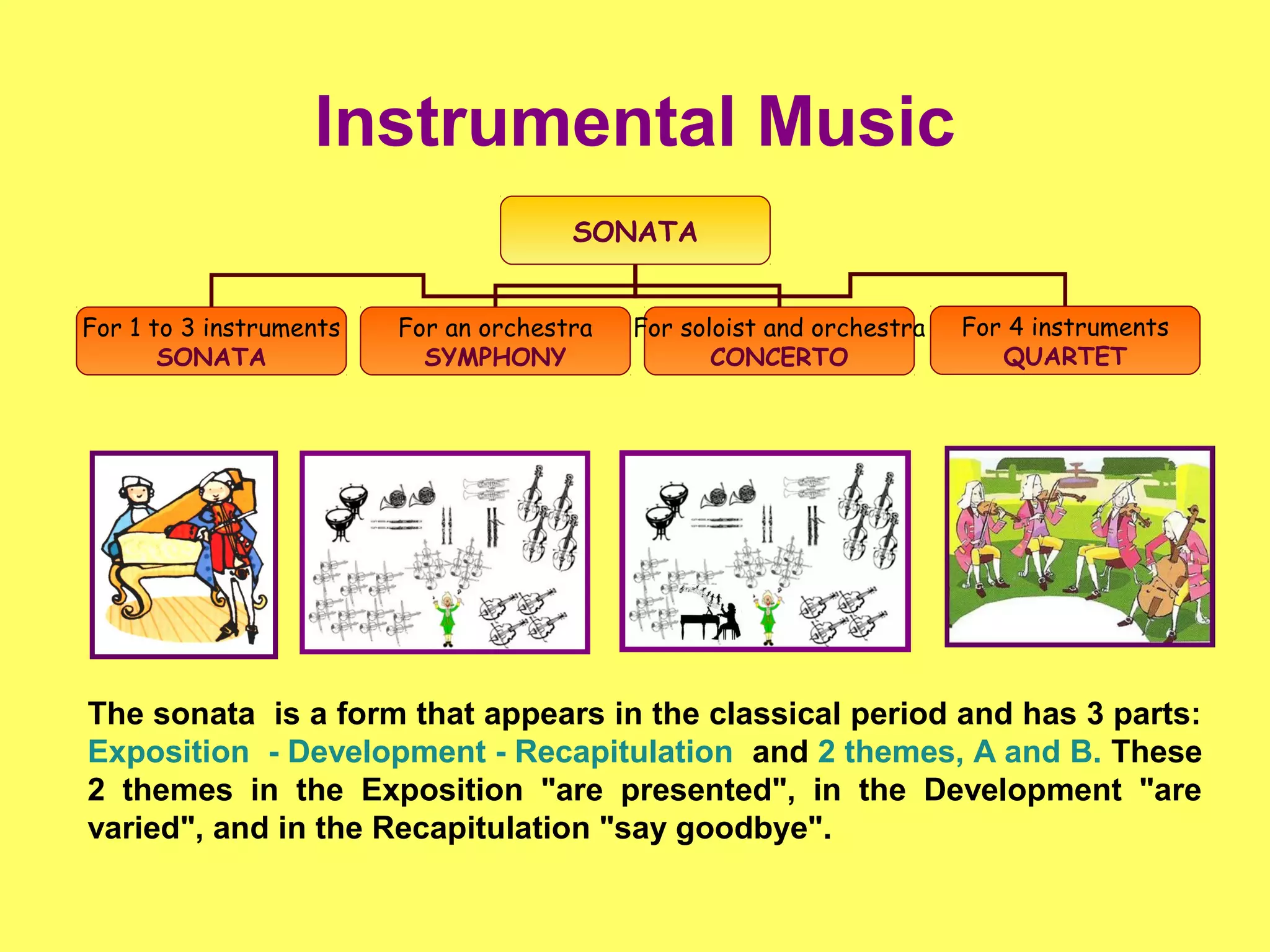
Instrumental Music
SONATA
For 1 to 3 instruments
SONATA
For an orchestra
SYMPHONY
For soloist and orchestra
CONCERTO
For 4 instruments
QUARTET
The sonata is a form that appears in the classical period and has 3 parts:
Exposition - Development - Recapitulation and 2 themes, A and B. These
2 themes in the Exposition "are presented", in the Development "are
varied", and in the Recapitulation "say goodbye".
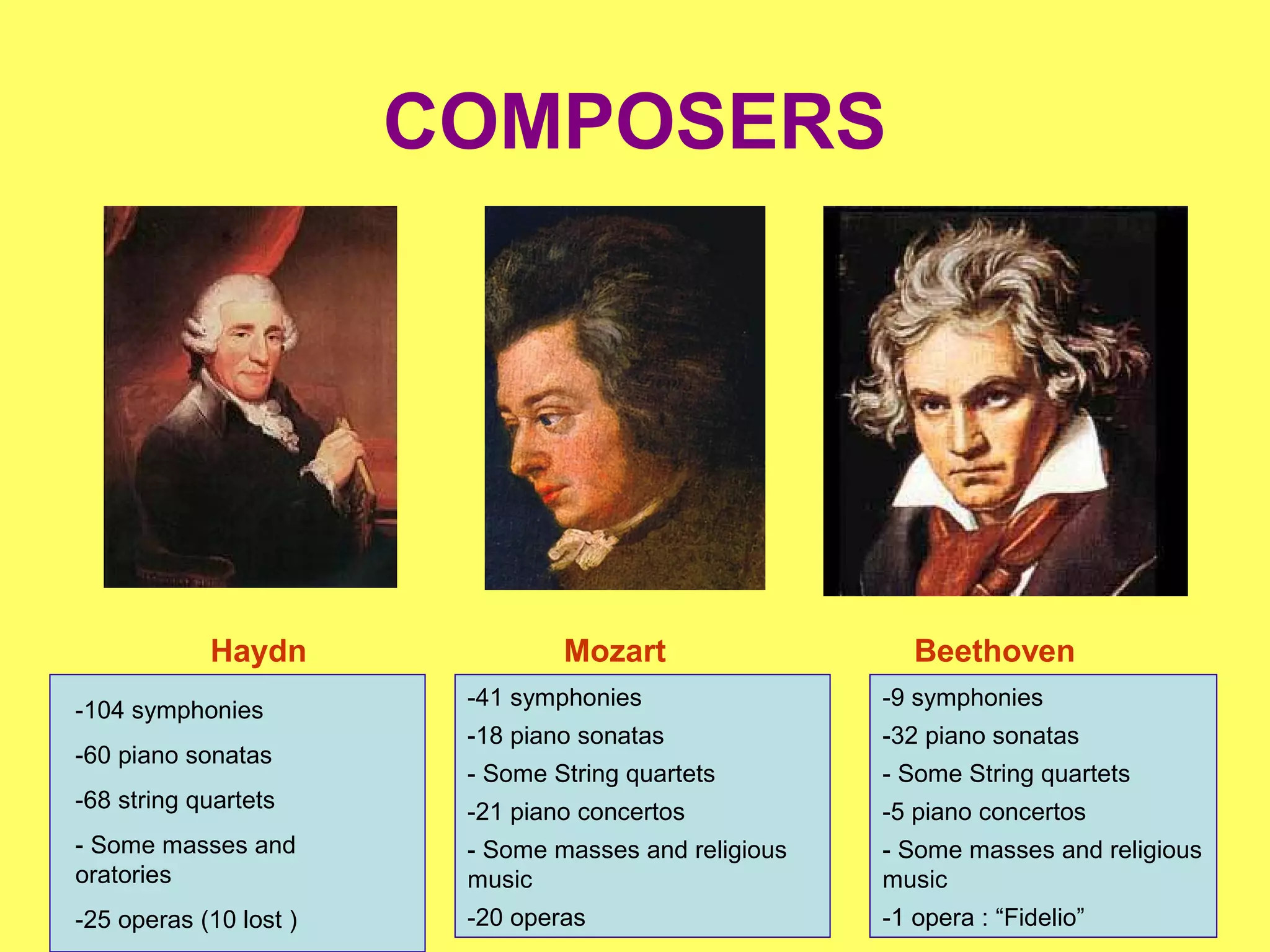
COMPOSERS
Haydn Mozart Beethoven
-104 symphonies
-60 piano sonatas
-68 string quartets
- Some masses and
oratories
-25 operas (10 lost )
-41 symphonies
-18 piano sonatas
- Some String quartets
-21 piano concertos
- Some masses and religious
music
-20 operas
-9 symphonies
-32 piano sonatas
- Some String quartets
-5 piano concertos
- Some masses and religious
music
-1 opera : “Fidelio”
➢
The contents in this presentation have only a
didactic nature.
➢
The images have been obtained using the
Google searcher or specialized webpages.
➢
If you have any problem with the copyright of the
elements included here, please contact me and
they will be deleted.
➢
Of course, this presentation can be used by any
intererested person, provided that it will be with
pedagogical purposes.
Cristina Martínez Peces
Music teacher in IES Rafael Alberti,
Cádiz, Spain

The Classical Period in music

  • 1.
    THE CLASSICAL PERIOD Originalin Spanish by PAOLA OLIVA CASTRO Translation by CRISTINA MARTÍNEZ PECES
  • 2.
  • 3.
    HISTORICAL CONTEXT • TheClassical period in music begins with the death of J. S. Bach in 1750 and ends in 1827, approximately, with the death of Beethoven. • In music, this era is understood as the time of Haydn, Mozart and Beethoven. It coincides with the so-called Neo-Classicism in the other arts. • A great cultural movement, the Enlightenment, promotes the ideal of equality and prosperity for everyone through education.
  • 4.
    SOCIETY • Absolute monarchyis giving way to Enlightened Despotism ("Everything for the people but without the people"). • There is a process of popularization of art and education. Naturally, this amateur audience demands and buys an easy to understand and play music. • REASON is the tool that will change the world, and will guide humanity. • The break with the Old Regime comes with the French Revolution (1789).
  • 5.
    ART • Architecture returnsto the straight line and gives up unnecessary adornments. • In sculpture, they look for models of the classical antiquity. • In painting, sculptural models predominate, and drawing is more important than color. Classicism (Neo-Classicism in the other arts) is balance, moderation and serenity.
  • 6.
    DISCOVER HOW ITSOUNDS a) The melodies are not as ornamented as in the Baroque. They are based on simplicity, elegance and clarity and structured in symmetrical phrases, organized into two parts (question and answer). They are usually easy to remember. b) The gradual dynamic appears, with many crescendos and diminuendos which are combined with sudden changes. c) The rhythm is regular, but not mechanic, looking for making easier the musical phrasing. d) The predominant textures are homorhythmic and melody with accompaniment.
  • 7.
    INSTRUMENTS • As thefigured bass disappears, the harpsichord is abandoned. A new key instrument that will become very important, comes up: the piano. • Another new instrument comes into fashion: the clarinet. • The french horn now takes on more importance. • Instrumental music becomes more and more important.
  • 8.
    THE CLASSICAL ORCHESTRA •There is an enlargement in the orchestra, especially in the strings family, which is composed of the same instruments, but increases their number. • Compared to a current orchestra, the classical orchestra would have half the components, but for that time, was awesome.
  • 9.
  • 10.
    COMPARISON between BAROQUE andCLASSICAL OPERA Baroque Opera • Solemnity. • Musical virtuosity. • Boring plots. • Stereotyped characters. • Intended for the aristocracy and nobility Classical Opera • Sense of humor. • Musical and scenical simplicity. • Entertaining plots. • Close and believable characters. • Intended for the bourgeois audience.
  • 11.
    Instrumental Music SONATA For 1to 3 instruments SONATA For an orchestra SYMPHONY For soloist and orchestra CONCERTO For 4 instruments QUARTET The sonata is a form that appears in the classical period and has 3 parts: Exposition - Development - Recapitulation and 2 themes, A and B. These 2 themes in the Exposition "are presented", in the Development "are varied", and in the Recapitulation "say goodbye".
  • 12.
    COMPOSERS Haydn Mozart Beethoven -104symphonies -60 piano sonatas -68 string quartets - Some masses and oratories -25 operas (10 lost ) -41 symphonies -18 piano sonatas - Some String quartets -21 piano concertos - Some masses and religious music -20 operas -9 symphonies -32 piano sonatas - Some String quartets -5 piano concertos - Some masses and religious music -1 opera : “Fidelio”
  • 13.
    ➢ The contents inthis presentation have only a didactic nature. ➢ The images have been obtained using the Google searcher or specialized webpages. ➢ If you have any problem with the copyright of the elements included here, please contact me and they will be deleted. ➢ Of course, this presentation can be used by any intererested person, provided that it will be with pedagogical purposes. Cristina Martínez Peces Music teacher in IES Rafael Alberti, Cádiz, Spain