Martial Bernoux
Climate
&
Environment
Division (NRC)
FAO’s
Submission D
to SBSTA 44
(May 2016)
“SBSTA and
Agriculture in
2016: Perspectives
for Asia"
webinar
Identification and assessment of agricultural practices and technologies to
enhance productivity in a sustainable manner, food security and
resilience, considering the differences in agroecological zones and farming
systems, such as different grassland and cropland practices and systems
FAO’s
Submission D
to SBSTA 44
(May 2016)
“SBSTA and Agriculture in 2016: Perspectives for Asia" webinar
1. Climate change and the food security challenge
Climate change affects
the four dimensions of food security
• food availability,
• food accessibility,
• the stability of food supply, and
• the ability of consumers to
adequately utilize food including
food safety and nutrition.
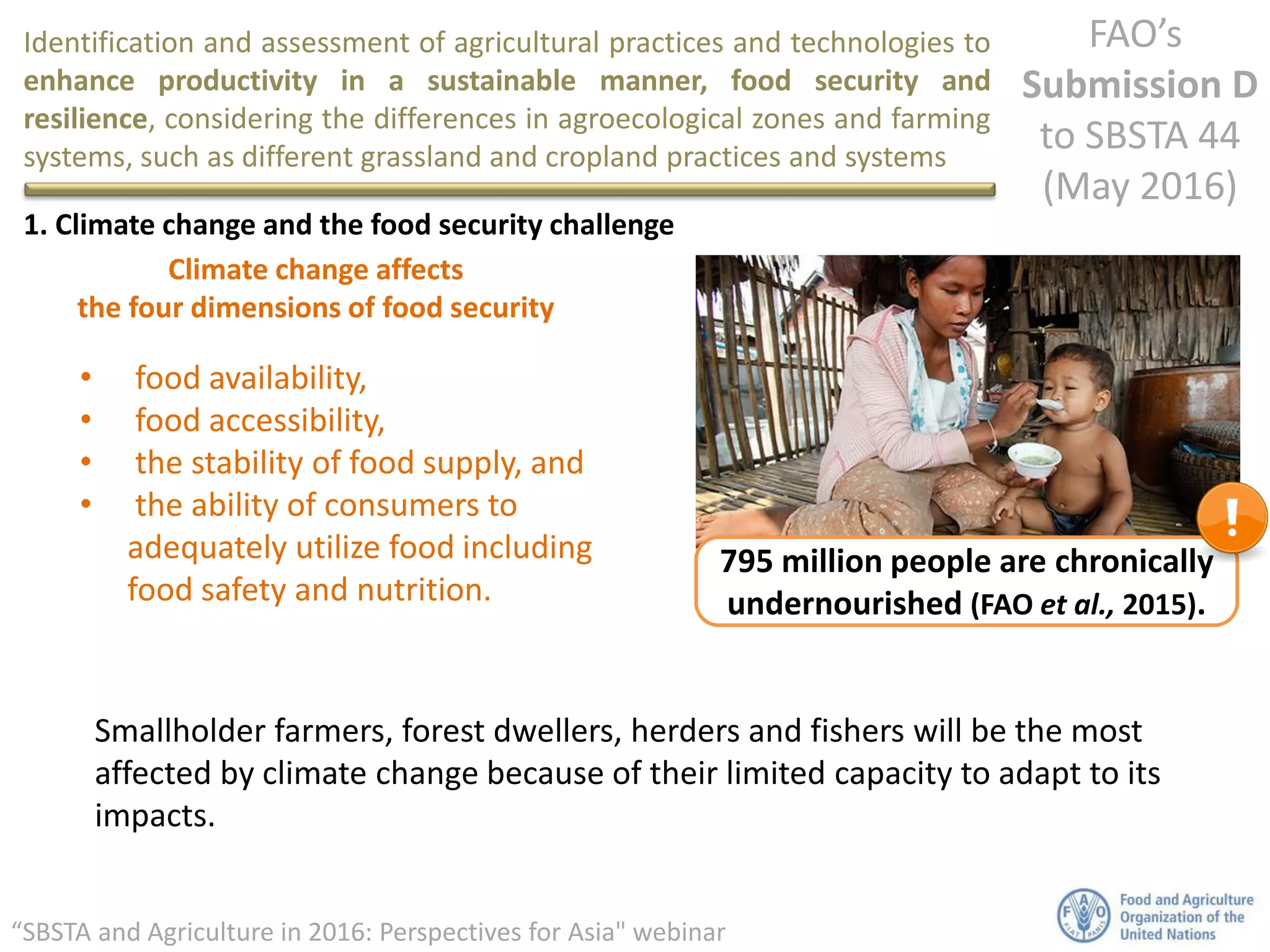
Smallholder farmers, forest dwellers, herders and fishers will be the most
affected by climate change because of their limited capacity to adapt to its
impacts.
795 million people are chronically
undernourished (FAO et al., 2015).
Identification and assessment of agricultural practices and technologies to
enhance productivity in a sustainable manner, food security and
resilience, considering the differences in agroecological zones and farming
systems, such as different grassland and cropland practices and systems
FAO’s
Submission D
to SBSTA 44
(May 2016)
“SBSTA and Agriculture in 2016: Perspectives for Asia" webinar
2. Enhancement of productivity, cobenefits and trade-offs
To improve productivity and food security while capitalizing on the synergies between
adaptation and other climatic concerns, FAO has developed a framework highlighting such
potentialities: A sustainable agriculture that will address multiple needs and objectives for
the benefits of the four dimensions of food security and nutrition
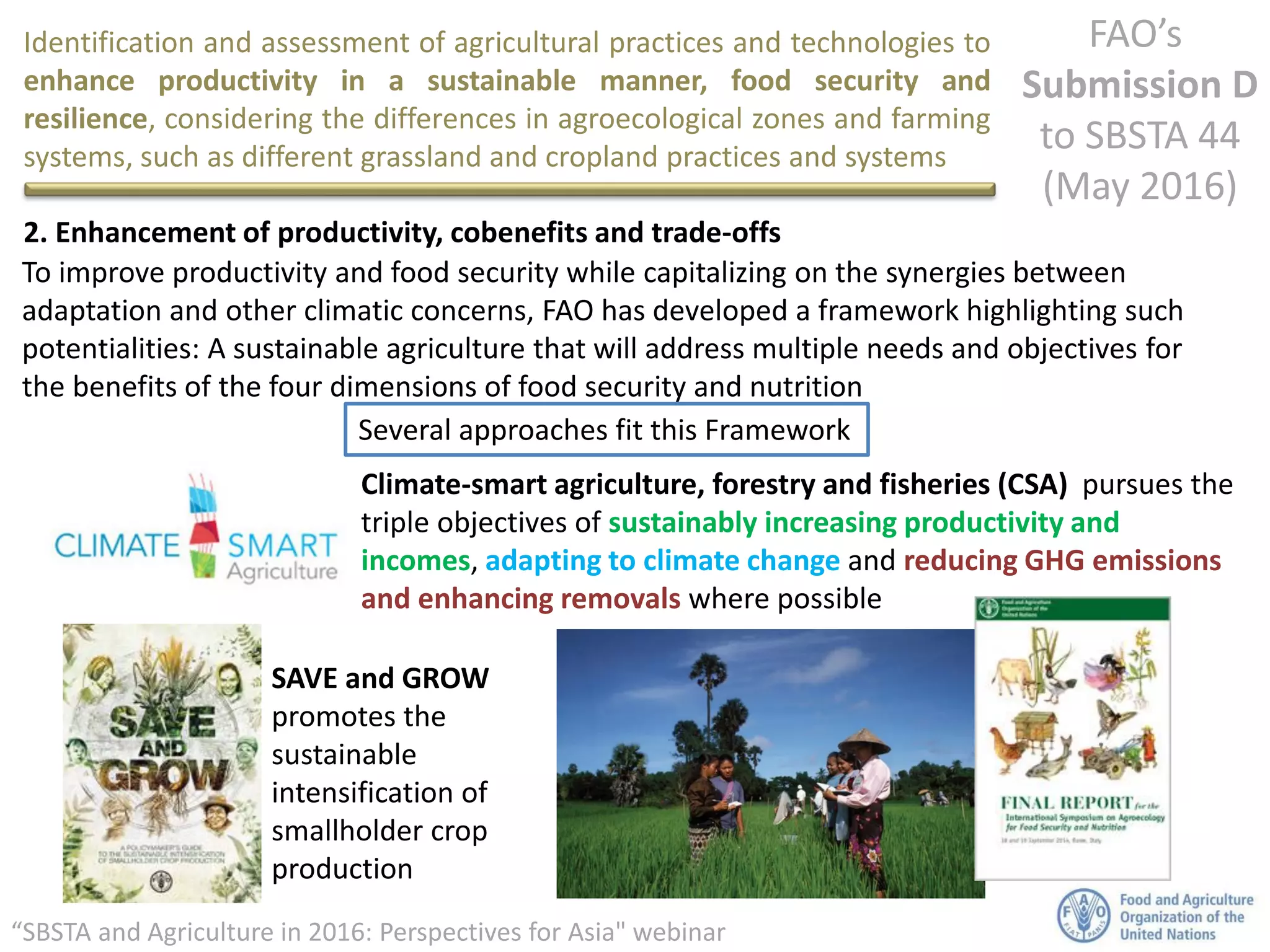
Climate-smart agriculture, forestry and fisheries (CSA) pursues the
triple objectives of sustainably increasing productivity and
incomes, adapting to climate change and reducing GHG emissions
and enhancing removals where possible
SAVE and GROW
promotes the
sustainable
intensification of
smallholder crop
production
Several approaches fit this Framework
Identification and assessment of agricultural practices and technologies to
enhance productivity in a sustainable manner, food security and
resilience, considering the differences in agroecological zones and farming
systems, such as different grassland and cropland practices and systems
FAO’s
Submission D
to SBSTA 44
(May 2016)
“SBSTA and Agriculture in 2016: Perspectives for Asia" webinar
2. Enhancement of productivity, cobenefits and trade-offs
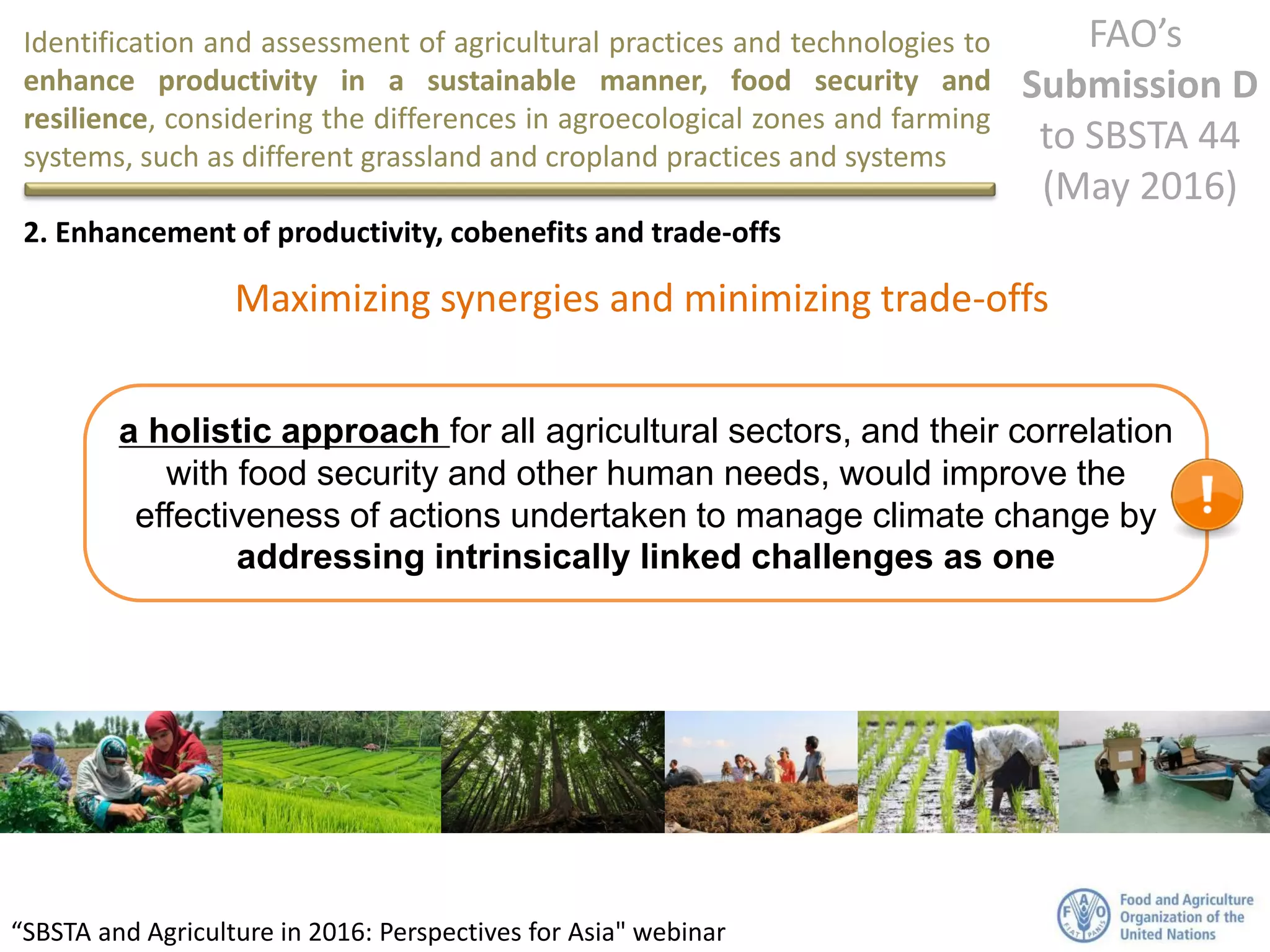
a holistic approach for all agricultural sectors, and their correlation
with food security and other human needs, would improve the
effectiveness of actions undertaken to manage climate change by
addressing intrinsically linked challenges as one
Maximizing synergies and minimizing trade-offs
Identification and assessment of agricultural practices and technologies to
enhance productivity in a sustainable manner, food security and
resilience, considering the differences in agroecological zones and farming
systems, such as different grassland and cropland practices and systems
FAO’s
Submission D
to SBSTA 44
(May 2016)
“SBSTA and Agriculture in 2016: Perspectives for Asia" webinar
3. Agricultural practices and technologies to enhance sustainable productivity, increase
resilience and food security for different agroecological zones and farming systems
There is no one-size-fits-all solutions
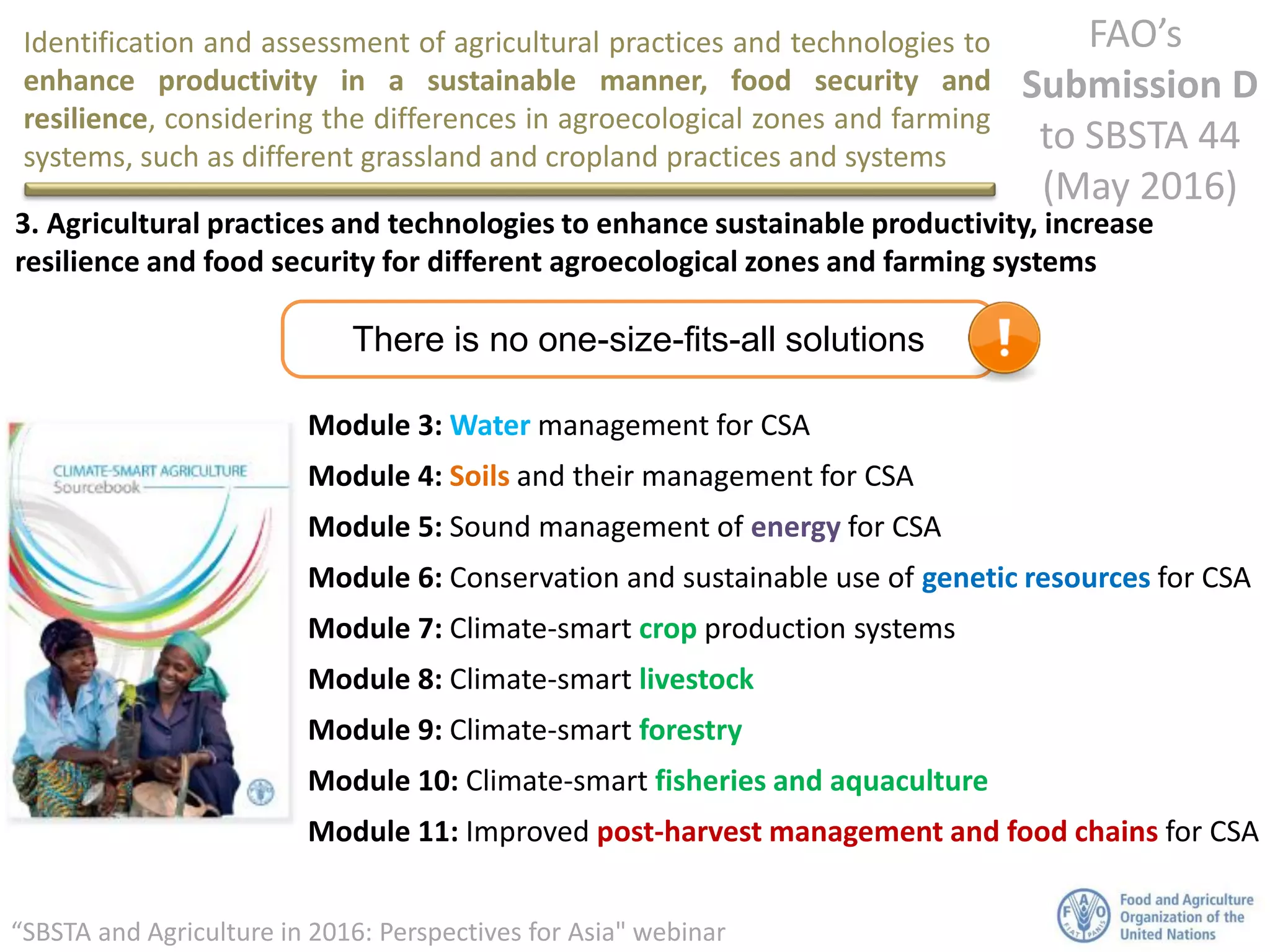
Module 3: Water management for CSA
Module 4: Soils and their management for CSA
Module 5: Sound management of energy for CSA
Module 6: Conservation and sustainable use of genetic resources for CSA
Module 7: Climate-smart crop production systems
Module 8: Climate-smart livestock
Module 9: Climate-smart forestry
Module 10: Climate-smart fisheries and aquaculture
Module 11: Improved post-harvest management and food chains for CSA
Martial Bernoux
Climate
&
Environment
Division (NRC)
MICCA Programme
FAO’s
Submission D
to SBSTA 44
(May 2016)
“SBSTA and
Agriculture in
2016: Perspectives
for Asia"
webinar
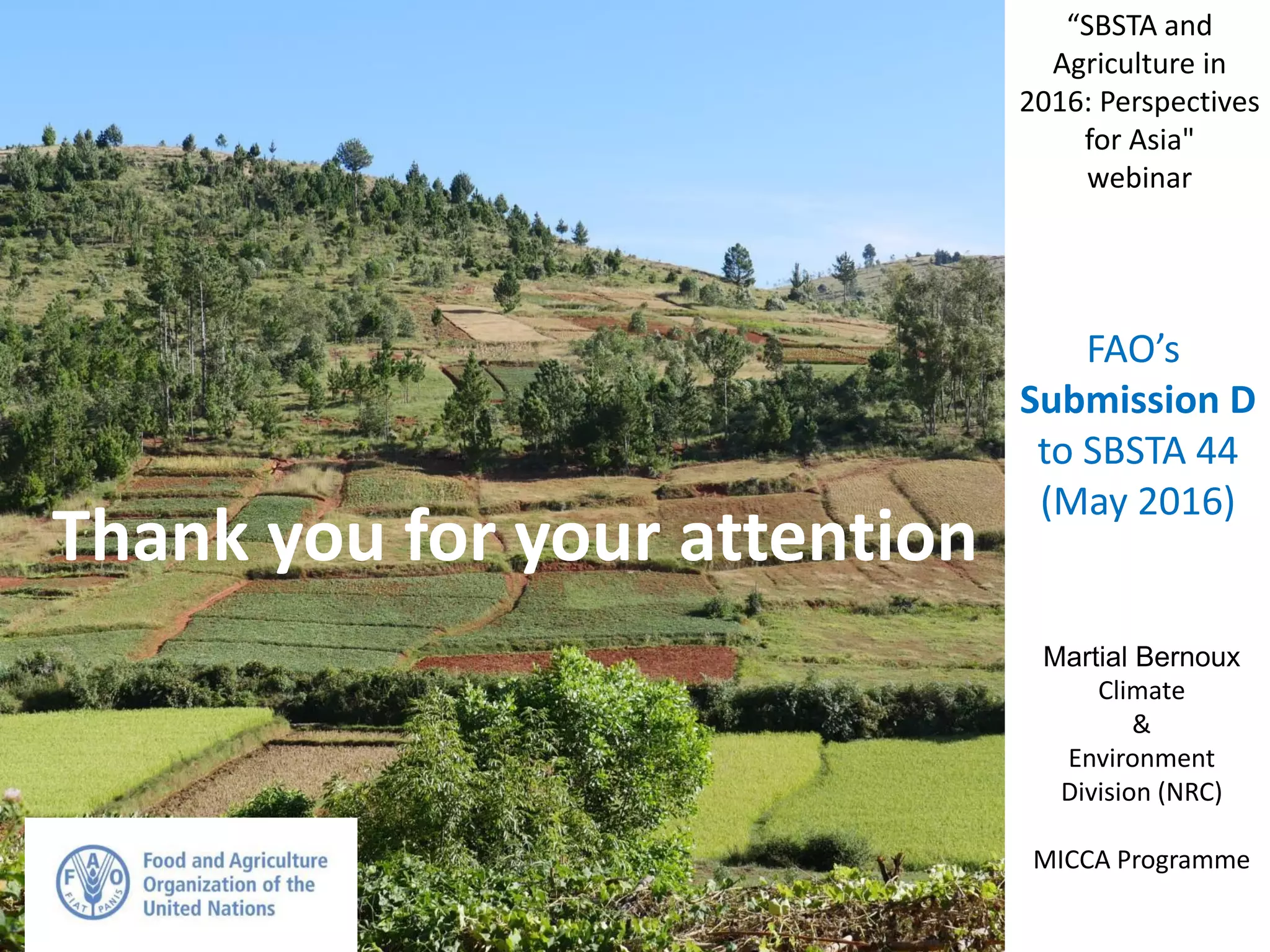
Thank you for your attention

FAO’s Submission D - agricultural practices and technologies - to SBSTA 44 (May 2016)

  • 1.
    Martial Bernoux Climate & Environment Division (NRC) FAO’s SubmissionD to SBSTA 44 (May 2016) “SBSTA and Agriculture in 2016: Perspectives for Asia" webinar
  • 2.
    Identification and assessmentof agricultural practices and technologies to enhance productivity in a sustainable manner, food security and resilience, considering the differences in agroecological zones and farming systems, such as different grassland and cropland practices and systems FAO’s Submission D to SBSTA 44 (May 2016) “SBSTA and Agriculture in 2016: Perspectives for Asia" webinar 1. Climate change and the food security challenge Climate change affects the four dimensions of food security • food availability, • food accessibility, • the stability of food supply, and • the ability of consumers to adequately utilize food including food safety and nutrition. Smallholder farmers, forest dwellers, herders and fishers will be the most affected by climate change because of their limited capacity to adapt to its impacts. 795 million people are chronically undernourished (FAO et al., 2015).
  • 3.
    Identification and assessmentof agricultural practices and technologies to enhance productivity in a sustainable manner, food security and resilience, considering the differences in agroecological zones and farming systems, such as different grassland and cropland practices and systems FAO’s Submission D to SBSTA 44 (May 2016) “SBSTA and Agriculture in 2016: Perspectives for Asia" webinar 2. Enhancement of productivity, cobenefits and trade-offs To improve productivity and food security while capitalizing on the synergies between adaptation and other climatic concerns, FAO has developed a framework highlighting such potentialities: A sustainable agriculture that will address multiple needs and objectives for the benefits of the four dimensions of food security and nutrition Climate-smart agriculture, forestry and fisheries (CSA) pursues the triple objectives of sustainably increasing productivity and incomes, adapting to climate change and reducing GHG emissions and enhancing removals where possible SAVE and GROW promotes the sustainable intensification of smallholder crop production Several approaches fit this Framework
  • 4.
    Identification and assessmentof agricultural practices and technologies to enhance productivity in a sustainable manner, food security and resilience, considering the differences in agroecological zones and farming systems, such as different grassland and cropland practices and systems FAO’s Submission D to SBSTA 44 (May 2016) “SBSTA and Agriculture in 2016: Perspectives for Asia" webinar 2. Enhancement of productivity, cobenefits and trade-offs a holistic approach for all agricultural sectors, and their correlation with food security and other human needs, would improve the effectiveness of actions undertaken to manage climate change by addressing intrinsically linked challenges as one Maximizing synergies and minimizing trade-offs
  • 5.
    Identification and assessmentof agricultural practices and technologies to enhance productivity in a sustainable manner, food security and resilience, considering the differences in agroecological zones and farming systems, such as different grassland and cropland practices and systems FAO’s Submission D to SBSTA 44 (May 2016) “SBSTA and Agriculture in 2016: Perspectives for Asia" webinar 3. Agricultural practices and technologies to enhance sustainable productivity, increase resilience and food security for different agroecological zones and farming systems There is no one-size-fits-all solutions Module 3: Water management for CSA Module 4: Soils and their management for CSA Module 5: Sound management of energy for CSA Module 6: Conservation and sustainable use of genetic resources for CSA Module 7: Climate-smart crop production systems Module 8: Climate-smart livestock Module 9: Climate-smart forestry Module 10: Climate-smart fisheries and aquaculture Module 11: Improved post-harvest management and food chains for CSA
  • 6.
    Martial Bernoux Climate & Environment Division (NRC) MICCAProgramme FAO’s Submission D to SBSTA 44 (May 2016) “SBSTA and Agriculture in 2016: Perspectives for Asia" webinar Thank you for your attention