The document discusses venture capital (VC) from an entrepreneur's perspective, aiming to demystify the funding process and highlight its impact on business growth. It emphasizes the importance of having a strong team and transformative ideas, while providing insights on how VCs operate and the challenges of securing funding. The author shares examples of successful entrepreneurs and encourages persistence and strategic planning in raising capital.
3
Why I WroteThe Book
• As an entrepreneur, I found
venture capital to be a black box
• As a VC, having seen the other
side, I wanted to help
entrepreneurs understand how
to finance and build great
companies
• The book’s mission: to
demystify the VC world for
entrepreneurs and help them
bring their dreams to fruition
4.
4
• $2.9 trillion– VC-backed
businesses combined sales
(20% of total business
revenues in US)
• 12 million – jobs at venture-
backed companies (12% of
US work force)
• 1,000 – number of active VCs
who make investment
decisions in the US
Give me a lever long enough, and
I will move the Earth.
-
Archimedes
Impact of Venture Capital: Huge Leverage
5.
6
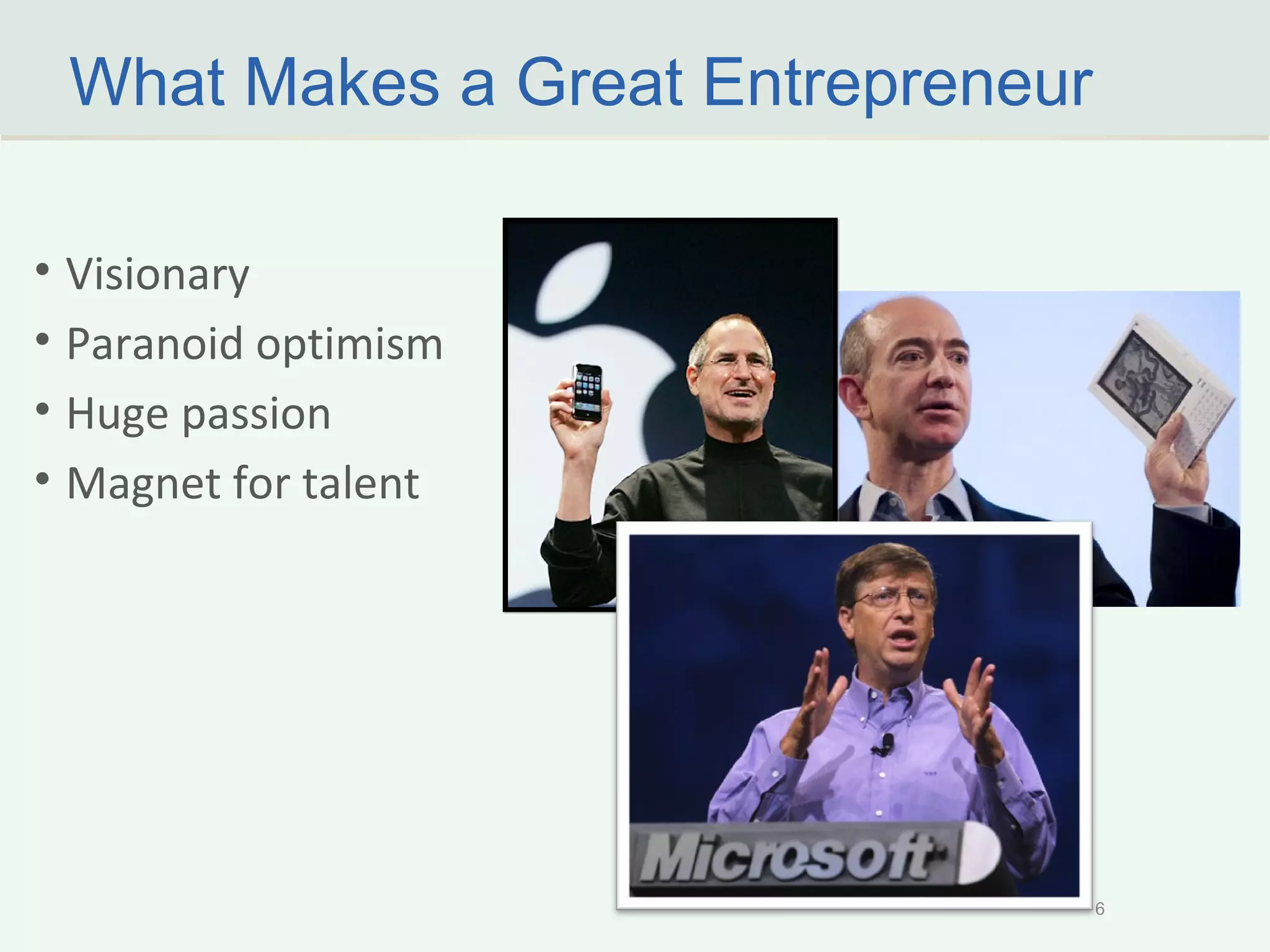
• Visionary
• Paranoidoptimism
• Huge passion
• Magnet for talent
What Makes a Great Entrepreneur
6.
8
Why Raise Moneyfrom VC
Deep Pockets:
High risk tolerance
and additional
funding for follow-
on rounds
Swing Big:
VCs don’t invest in
niches, they invest in
transformative ideas
that can build large
companies
Experience Matters:
VCs have “seen the
movie” over and over
again and can help
avoid pitfalls to find
the path to success
Value-Add:
VCs provide domain
experience, industry
contacts, and
strategic planning
7.
1104/09/10 11
• VCwith healthy deal flow:
opportunity to review 300-500
deals per year
• Most of the deals that enter
the process get nixed along the
way
• Most “active” VCs—typically
have capacity to do no more
than two deals a year(.2%-.7%
chance of funding per partner)
Chances
9
• Scope outthe firm – size
matters, as does the
individual
• Arrange for a warm
introduction
• Prepare, Be Brief (VCs
Blink), Don’t Downplay
the Risk
04/09/10 9
Raising $ from VCs: Find the Sweet Spot
10.
• Ideas area dime a dozen
• Having a world-class team is golden
• Laser focus of the young entrepreneur is very powerful
– E.g., Bill Gates, Michael Dell, and Mark Zuckerberg
• Golden rule:
1004/09/10 10
The Right People: an Unfair Advantage
11.
1404/09/10 14
Being inOver Your Head
It’s OK
Follow
the
80/20 rule
Get help
Communicate
with the
Board
12.
18
• Lifelong fascination
withmapping real-
time movements
(bicycle couriers)
• Founded dNET
• Worked for Odeo
• Created Twitter
04/09/10 18
Apply Your Passion: Twitter
Jack Dorsey
13.
17
• Joined asCEO of
Constant Contacts in 1999
• Pitched to over 100 VCs
to secure financing
• Led her company
through Internet bubble
collapse
• IPO in 2007
• Nearly 500K customers
and $130M in revenue
04/09/10 17
Never Give Up: Constant Contact
Gail Goodman
14.
13
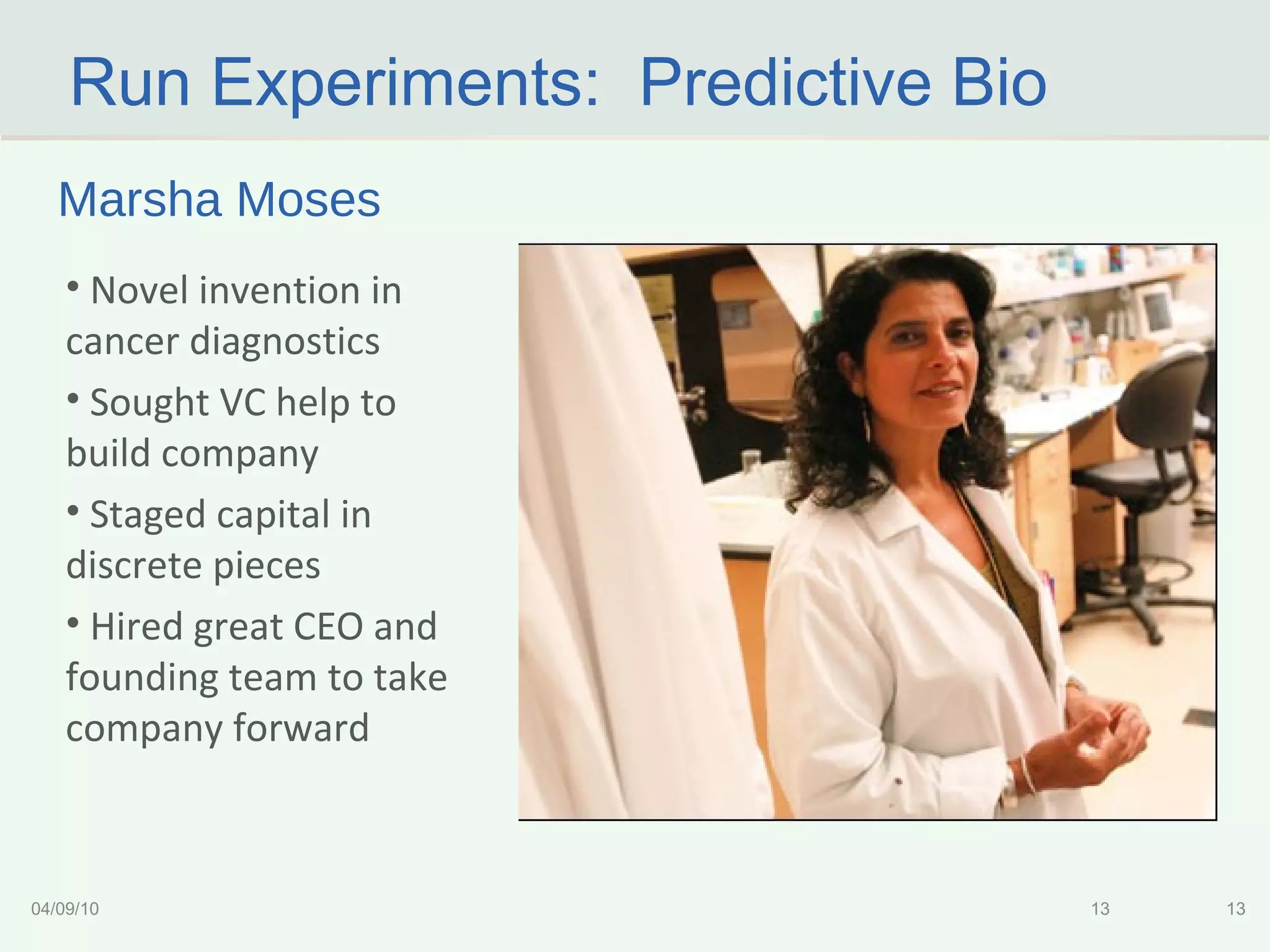
• Novel inventionin
cancer diagnostics
• Sought VC help to
build company
• Staged capital in
discrete pieces
• Hired great CEO and
founding team to take
company forward
04/09/10 13
Run Experiments: Predictive Bio
Marsha Moses
#3 Every entrepreneur exhibits high level of passion (characteristic of success)
--Greater Need to Change the world than there is to make money
--That’s how the great entrepreneurs think. The money is nice and appreciated, but, as mentioned before, it’s almost never about the money. It’s about passion, following a dream, and changing the world (with plenty of craziness along the way).
--The purpose of this book is to share the magic formula of how great entrepreneurs team with VCs to create valuable companies from raw start-up.
#7 Entrepreneurship requires too much rule-breaking and cultural transformation to be consistently viable for most large corporations
That’s largely why big companies buy small start-ups: to get the innovation they find difficult to generate from within—the very reason that GSK bought Christoph Westphal’s company, Sirtris, or Dell bought Zing Systems, one of the Flybridge portfolio companies.
945
Angels tend to provide less structure than a VC firm.
#8 Of the nearly fifty companies that we at Flybridge Capital have invested in over our eight-year history, not one of them came in cold. In fact, I polled a number of my VC colleagues on the topic, and we estimate that the odds of getting a pitch meeting from a cold email are 500 to 1, at best.
The odds of actually receiving funding from a cold email: 500 to 1.
The odds of actually receiving funding from a cold email: 50,000 to 1.
First impressions do matter and boldness can be isunderstood
“I would estimate that out of the 5,000 business plans I’ve reviewed in the last eight years as a VC, only 1-2% performed better than the numbers in the plan (78)
A set of discrete experiments with clear milestones: VCs much prefer to invest in experiments that are (1) specific and discrete; (2) have very clear assumptions; (3) are not too costly; and (4) have outcomes that can be easily measured over a reasonably short period of time (91). (Tell of Marsha Moses on next slide)
Allusion to Dr. Seussian “Land of No”(81)
The National Venture Capital Association (NVCA) estimates that there were 882 venture capital firms in existence in 2008 in the United States. A substantially smaller number, perhaps 400-500, are active in funding start-ups at the time of this writing. Of the seven thousand investment professionals working in these firms, only a thousand of them can be classified as major players.
#9 Line: Moving average
New Deals, 1991 On
Number of new companies invested in
#10 --
Whether their returns will be superior in the long run to a firm that makes more concentrated bets is irrelevant to the entrepreneur. Finding the right fit for their particular fundraising needs is what really matters to the entrepreneur (58).
--Know the underlying drivers of the financials very well (tell the Kleiner Perkins story about the first time you pitched) (67).--
--Smart entrepreneurs take a strategic approach, assessing the general kind of VC firm they should select to pitch
--If you are an entrepreneur looking to raise $3-6 million, then a firm with roughly $50 million in capital per general partner is the right fit for you
Different visual, why do we want to raise money from a VC/within the chapter
#11 Every VC asks himself at some point in the due diligence process, “What happens if a ‘fast follower’ comes up with the same idea, raises more money and recruits a better team?” The entrepreneur who has a clear, unassailable competitive advantage, something I like to call an “unfair advantage,” is the most compelling entrepreneur when it comes to the pitch.
--Show the example of Michael Bronner, CEO at Upromise who has spent the last twenty years working as a marketing strategist for the same CMOs and CEOs in creating his marketing services firm, and executive from Merrill Lynch.
Fred Wilson: “You have this 25-year-old founder, Mark Zuckerberg, who doesn’t have a wife, he doesn’t have kids, he doesn’t have anything in his life that’s distracting him from what he’s trying to do. And there’s nobody saying to him, ‘God damn it, take the money off the table. It’s $15billion dollars. You should sell it now.’ Instead, he’s going for $100 billion! Now that may be a stupid move or it might be a brilliant move. Only time will tell.” (86)
#13 Great start:
But more than confidence is required. Another element that is critical for successful entrepreneurs is an unwavering passion in what they’re doing. In the face of obstacles, distractions and naysayers, great entrepreneurs follow their passion no matter what the odds. The founding of Twitter, an emerging worldwide phenomenon, brings those lessons out in spades.
The concept for Twitter came out of Jack’s lifelong fascination with mapping the real-time movements of people and things within complex environments. “Since I was very small, I’ve been fascinated by how cities work,” Jack told me in his typical, straightforward way. “I always got really excited when I thought about visualizing them, specifically around maps. What would you place on a map to show how a city worked?”
He grew up in St. Louis—he thought couriers where were magical. “I loved couriers. You had this transfer of physical information happening throughout the city and the world. Someone picking up the package, putting I in a bag, going somewhere, taking it out of he baq, giving it to someone else. I thought that was so cool. I wanted to map it, to see that flow on a big screen. When I did some research into how courier systems worked, I found that there was a parallel information transfer that was digital, and it was called ‘dispatch,’ which was just a coordination effort. (24)
Started a bicycle courier service of his own at the age of sixteen. Coded software at young age after teaching himself. While in the second year of an engineering program at the Missouri University of Science and Technology, he came across a New York City-based company called Dispatch Management Services Corporation (DMSC), which managed dispatch centers for couriers—on foot, bicycles, and motorcyles.
Gregg Kidd, told him to come to New York. So he did. He moved to New York and transferred to NYU and started writing dispatch software for DMSC.
Improved the dispatch software. Raised money from Band of Angels ( a group of current and former Silicon Valley executives ) to found dNET. They wanted to build a Web-centric dispatch system hat would essentially provide an ATM for couriers, most of whom don’t have bank accounts, so they could easily draw their commissions through the Web.”
Discovered instant messaging but had to use your keyboard. He had a RIM 850, the predecessor to the BlackBerry
One night, I couldn’t sleep, I just had to write a prototype script. It would sit on a server, take incoming emails, broadcast them out to a list, and also record them in a database that I could view on the Web.” That was the first glimmer of Twitter
#14 IPO is a rarity and she got there.
She and her company traveled a pretty bumpy road from her arrival as CEO in 1999 to IPO in 2007.
Gail led her management team through three rounds of financing. The first two involved pitching to over a hundred VC firms, and they suffered some pretty rough treatment at the hands of both VCs and banks.
Ended with Constant Contact raising $107 million in its October 2007 IPO, with the stock price rising as high as $28.01 on its debut day, well above its forecast range of $12-14. Today, the company is the leader in its market space and has a market capitalization of over $500 million (159-160).
I was pitching a very practical and reasonable growth trajectory, but everybody kept telling me, ‘Oh no, that’s not aggressive enough. It’s got to be $100 million in three years or we’re not interested.’
Eventually, Gail convinced two VCs to believe enough in her and the business vision to raise $10 million.
Over the next three years, Constant Contact completed its product, won customers, and began to make money. But as they ramped quickly, they burned through the $10 million faster than they had intended. Meanwhile, the macroeconomic environment as deteriorating. The Internet bubble had burst and VCs got very skittish about investing in online businesses. During the time, Constant Contact had all the classic start-up company issues.
In 2002, Gail set out to raise another $5 million in financing and approached her reluctant VCs for participation. But, shaken by tough market conditions, they had decided to shut down some of their underperforming portfolio companies rather than reinvest. So relations turned tense. “We were working with a junior partner in their East Coast office,” Gail said, “but the center of power was on the West Coast.
As soon as I start presenting, two-thirds of the people in the West Coast office get up and walk out of the room.”
Despite this rude behavior, and in large part thanks to Gail’s powers of persuasion, both firms continued forward while two new VCs came on board, and Constant Contact snagged another $5 million. (162)
Founder gets squashed in recapitalization (could be a secret, I do not think worth harping on, we could have a slide on having dilution settings to protect you, but anti dilution clauses are usually asked for by the investors, I guess it follows though that if all your investors have strong anti dilution and you do not—you get squashed (162).
Everybody was at a different point. Two want to add money and step on the gas, and two wanted more proof points.
Talk about switch to VC and learning that “time is your friend.” VCs can make better decisions with time while entrepreneurs have a huge sense of urgency—urgency to get ahead of their competition, urgency to fulfill customers promises, urgency to make payroll as cash runs out.
Gail is an entrepreneur who always operates with a sense of huge urgency, and so despite this mismatch with her VCs, she kept her head down and kept executing her plan to build the business. In 2005, Constant Contact began to run on all cylinders. The company doubled its revenue from the previous year to $15 million, and was projecting to double again in 2006. But still no decision from the VCs about additional funding. Gail was getting frustrated.
Meets with Bill Kaiser of Greylock. She made her presentation “We’re going to raise this capital from Greylock and, after we’ve raised it, we’re going to spend it and that’s going to make us profitable. But it’s about marketing and securing lifetime customer revenue and here’s how the math works.
Continues: 164-166
#15 A VC with a healthy deal flow may get an opportunity to review as many as 300-500 deals per year. Most “active” VCs—those who will join the board of the company they invest in—typically have capacity to do no more than one or two deals a year. (80)
Passion (83)The more dramatic and unrealized the vision, the more the experience and expertise of the entrepreneur come under scrutiny by the VC.(3)
The care about the PEOPLE…TEAM…EXPERIENCE.
--Sweet spot + compelling vision + wrong people = no funding
--Every VC asks himself at some point in the due diligence process, “What happens if a ‘fast follower’ comes up with the same idea, raises more money and recruits a better team?” The entrepreneur who has a clear, unassailable competitive advantage, something I like to call an “unfair advantage,” is the most compelling entrepreneur when it comes to the pitch. (84