Physical/Biological
Anthropology
Chapter 1
Anthropology
• from the Greek word άνθρωπος = human
• The broad-scope scientific study of people
from all periods of time and in all areas of
the world.
• Anthropology focuses on both biological
and cultural characteristics and variation
as well as biological and cultural evolution
Holism
• A distinguishing feature of the discipline of
anthropology is its holistic approach to the
study of the whole human condition.
– Anthropology involves both biological and
sociocultural aspects of humanity.
– The time frame goes from the earliest
beginnings of humans to the present.
– Anthropology studies all varieties of people
wherever they may be found.
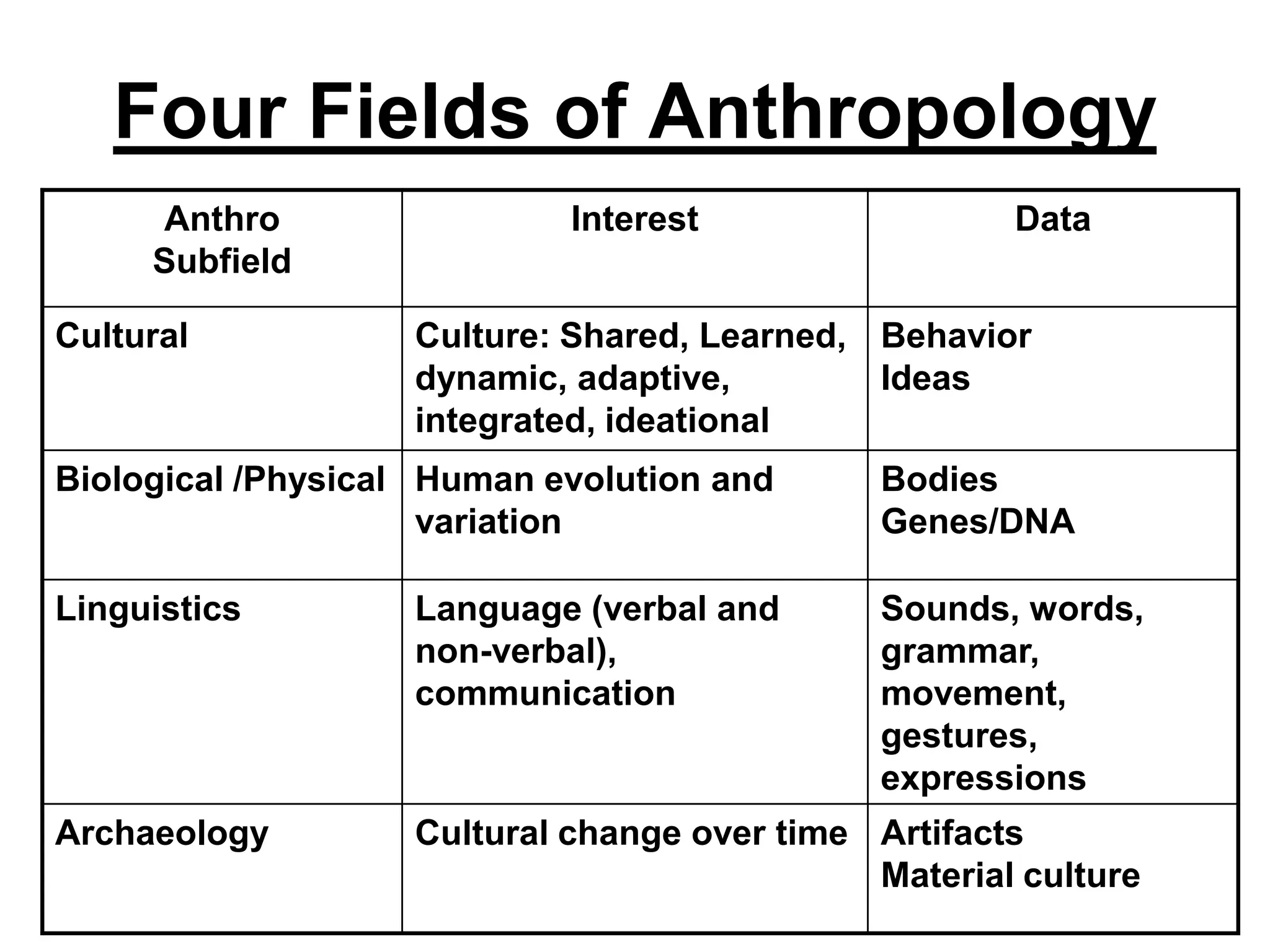
Four Fields of Anthropology
Anthro
Subfield
Cultural

Interest

Data

Culture: Shared, Learned, Behavior
dynamic, adaptive,
Ideas
integrated, ideational

Biological /Physical Human evolution and
variation

Bodies
Genes/DNA

Linguistics

Language (verbal and
non-verbal),
communication

Sounds, words,
grammar,
movement,
gestures,
expressions

Archaeology

Cultural change over time Artifacts
Material culture
Two Dimensions of Anthropology
• Theoretical/Academic Anthropology
• Applied Anthropology
– The application of anthropological data,
perspectives, theory and methods to identify,
assess, and solve contemporary social
problems.
Physical/biological
anthropology
• What is human?
• human biology, evolution, human
adaptation, diversity, heredity, genetics,
ecology, natural selection
• the process by which populations of
organisms come to differ from their
ancestral populations
Human Evolution
• Our biology is the result of millions of years of
evolutionary history:
–
–
–
–

225 million years of mammalian evolution
65 million years of primate evolution
6 million years of hominid evolution
2 million years of evolution of the genus Homo
Physical Anthropology
• Areas of Specialization:
–
–
–
–
–
–
–
–
–
–
–

Human genetics - inheritance and inherited variation
Primatology - living nonhuman primates
Human biological variation - evolutionary studies
Paleontology
Paleoanthropology
Human growth and development
Forensic Anthropology
Human ecology
Forensic ecology
Osteology
Applied Physical Anthropology
Basics
• Empirical knowledge
• Based on experiment and observation, or
based entirely on practical experience
• Perceived through the senses
• Phenomenon – observable event
Scientific Method
• Hypothesis – educated guess/tentative
statement
• Data collection and analysis
• Hypothesis testing - expected way for an
outcome based on observed data
• Theory – shows the relationship
(framework) that explains and interprets
facts
– A statement based on highly confirmed
hypothesis
Theory
• Bodies of knowledge that make predictions
(not fortune telling)
• summarizes a hypothesis or group of
hypotheses that have been supported with
repeated testing
• (inferring, suggesting)

• Monocausal/Multicausal explanation
• http://www.youtube.com/watch?v=85diE
XbJBIk&feature=related
Chapter 1 – part 2
Introduction to Evolution and
Natural Selection
•
VIEWS ON THE ESSENCE OF
HUMANS: NATURE AND TIME
• Anthropocentric
• spontaneous generation - living organism
could arise from non-living material – immutable
• http://www.youtube.com/watch?v=WNByRghR6
sw&noredirect=1
• Age of Exploration early 15th century to 17th
century
Classification – 1700s
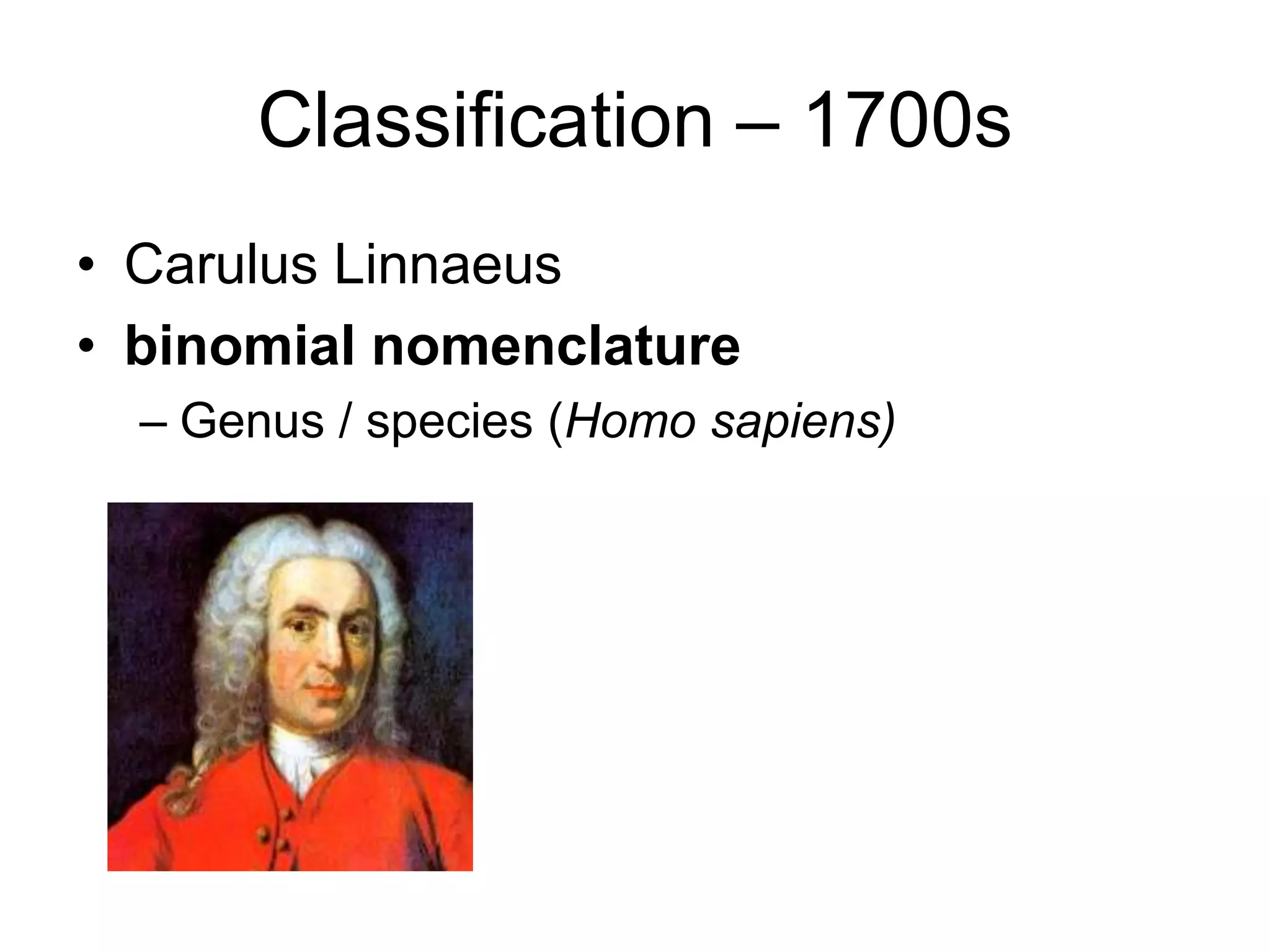
• Carulus Linnaeus
• binomial nomenclature
– Genus / species (Homo sapiens)
Jean Babtist Lamarck – 1744-1829
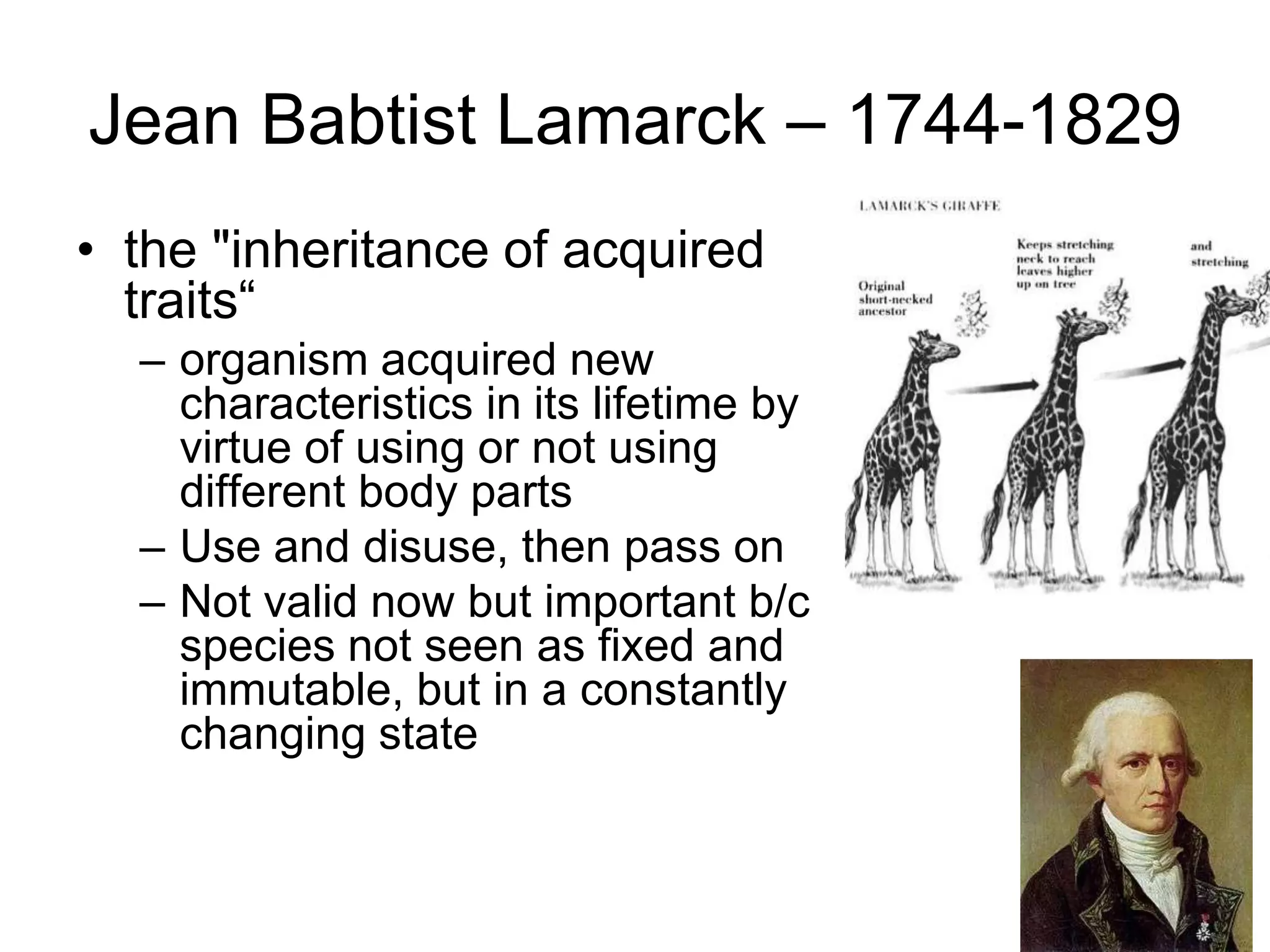
• the "inheritance of acquired
traits“
– organism acquired new
characteristics in its lifetime by
virtue of using or not using
different body parts
– Use and disuse, then pass on
– Not valid now but important b/c
species not seen as fixed and
immutable, but in a constantly
changing state
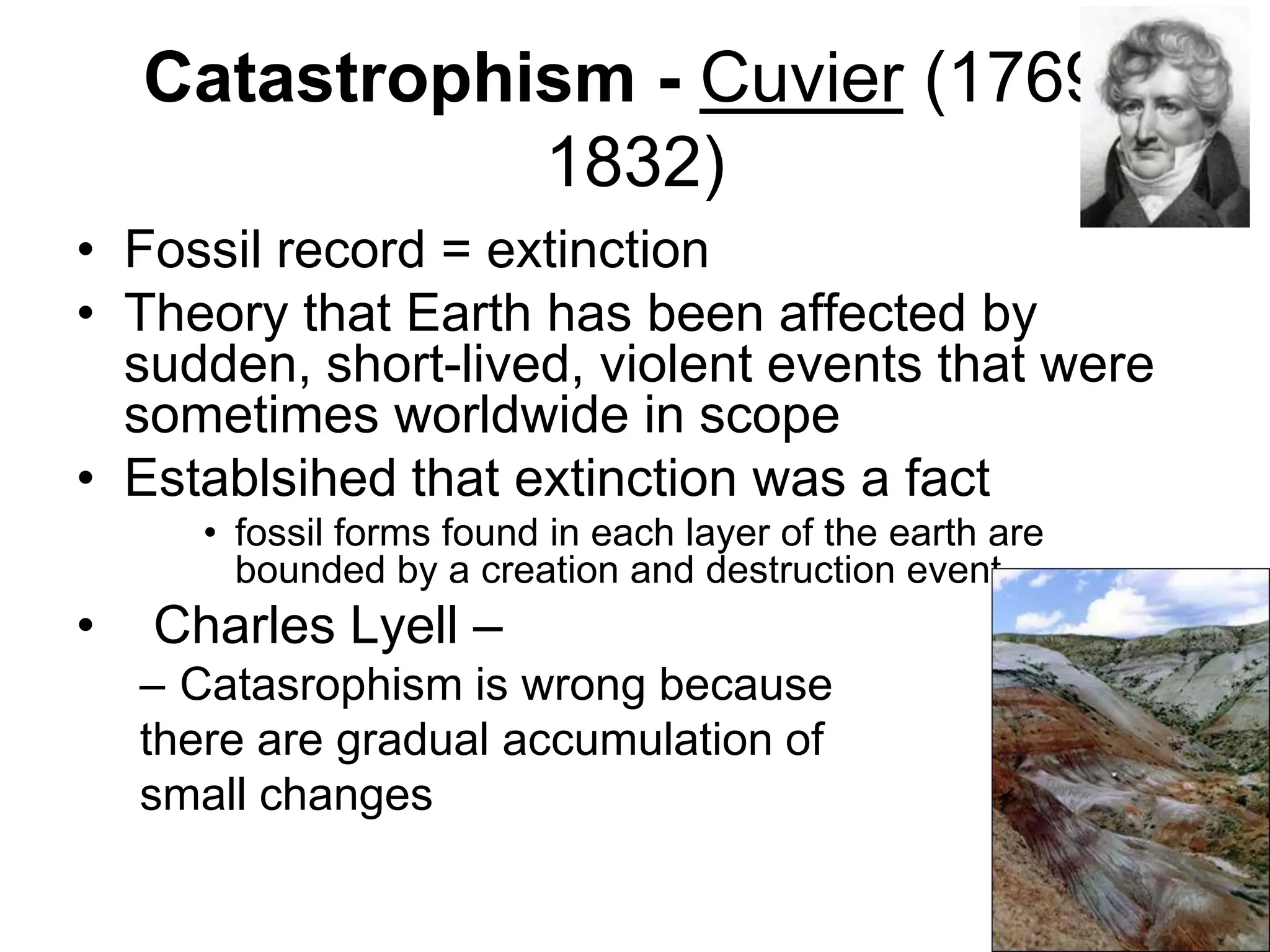
Catastrophism - Cuvier (17691832)
• Fossil record = extinction
• Theory that Earth has been affected by
sudden, short-lived, violent events that were
sometimes worldwide in scope
• Establsihed that extinction was a fact
• fossil forms found in each layer of the earth are
bounded by a creation and destruction event

•

Charles Lyell –
– Catasrophism is wrong because
there are gradual accumulation of
small changes
Uniformatism - Charles Lyell, James
Hutton
• Catastrophism is wrong
– landscape developed over long periods of
time through a variety of slow geologic and
geomorphic processes.

• natural processes operating in the past are
the same as those that can be observed
operating in the present
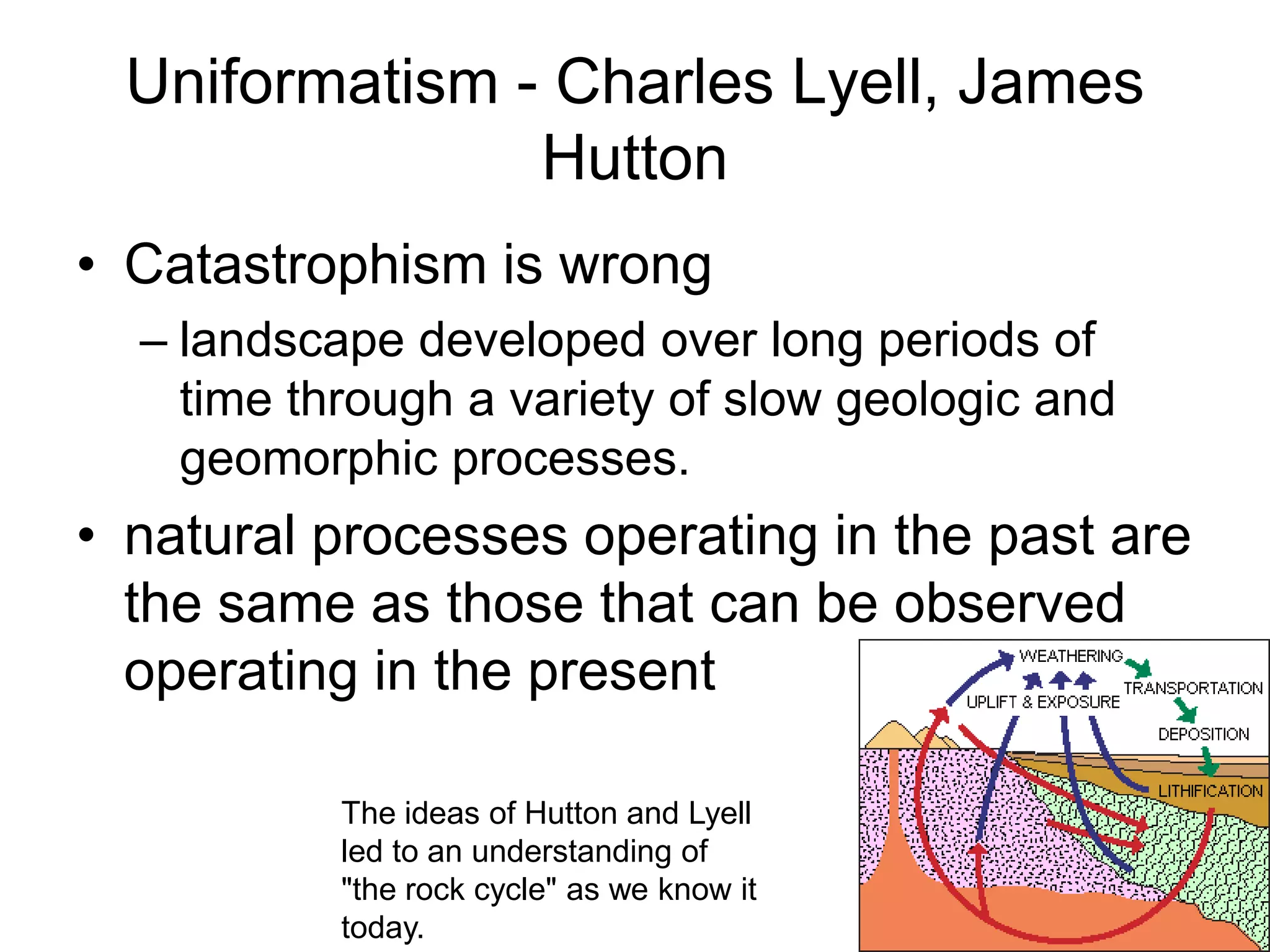
The ideas of Hutton and Lyell
led to an understanding of
"the rock cycle" as we know it
today.
ALFRED RUSSEL WALLACE
1823-1913
• co-discoverer of “The Theory of Natural
Selection” with Charles Darwin in 1858
• proposed that evolution occurs as a result
of natural selection.
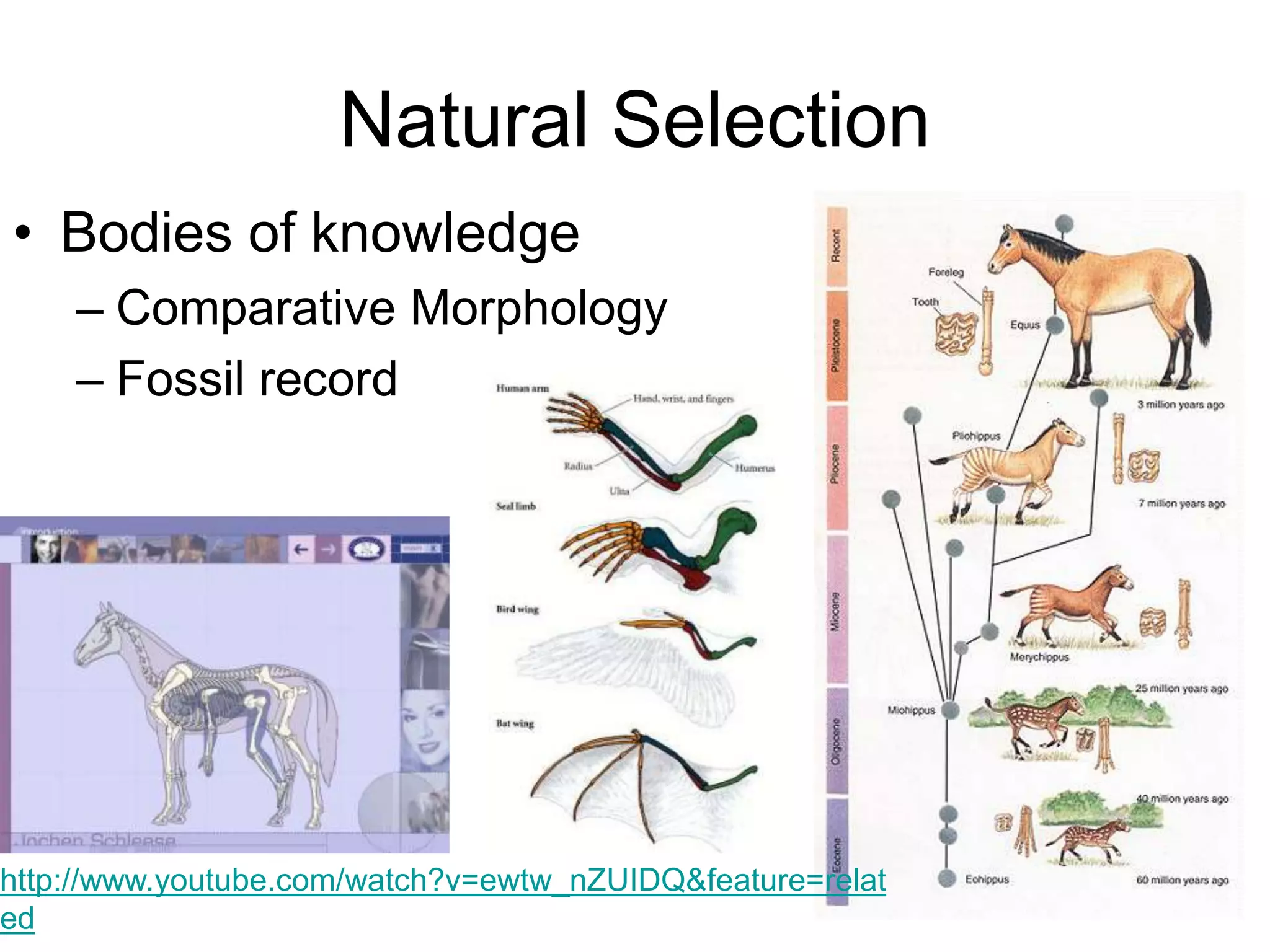
Natural Selection
• Bodies of knowledge
– Comparative Morphology
– Fossil record

http://www.youtube.com/watch?v=ewtw_nZUIDQ&feature=relat
ed
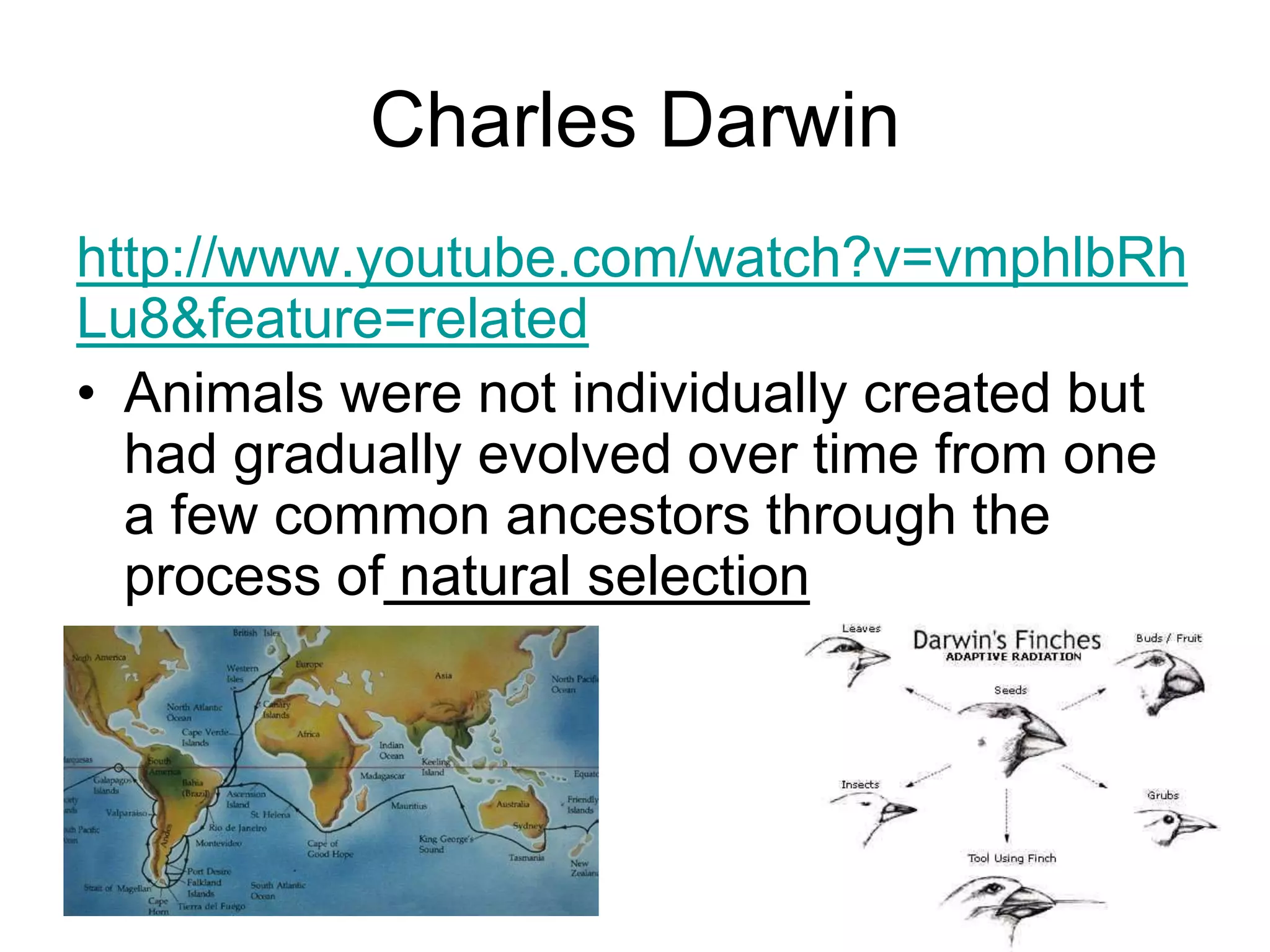
Charles Darwin
http://www.youtube.com/watch?v=vmphlbRh
Lu8&feature=related
• Animals were not individually created but
had gradually evolved over time from one
a few common ancestors through the
process of natural selection
Adaptive Radiation
• branching evolution in which different
populations of a species become
reproductively isolated from each other by
adapting to different ecological niches and
eventually become separate species.
• To learn more about Darwinhttp://darwinonline.org.uk/
Natural Selection
Survival of the fittest
the process of favoring or weeding out
individuals with different characteristics
from a population. Those individuals that
are well-suited for their environments will
be favored in the sense that they will pass
on their heritable attributes to the next
generation at a higher rate than individuals
not as well-suited to the environment
Natural Selection
First Postulate: Population grows rapidly
/ resources grow slowly therefore…
2nd postulate
2. Survival of the fittest: best traits –
individuals vary – variation effects the
ability to survive and reproduce
• VARIATION MADE BY GENE MUTATION AND
NATURAL VARIATION
3rd postulate
3. Variation may be heritable (offspring
resembles parents. If true the favorable
variation (trait) will spread, the
individuals that possess features that
increase the chance of surviving are
likely to pass on these features to the
next generations.
Evolution
http://www.youtube.com/watch?v=xkwRTIK
Xaxg&feature=related
1)Genetic variation
2)Overproduction of offspring
3)Struggle for existence
4) Differential survival and reproduction
• Evolution is – variation made by gene
mutation and natural variation
Evolution, Theory and belief
• A theory is based on repeated
observations of a phenomenon that results
in accumulated wisdom and the ability to
generalize
However: biological phenomena
• biological systems are always changing,
albeit in minute ways.
• Theories are bodies of knowledge that
make predictions, not fortune telling
Review
• Anthropology emphasizes
• Holism: How does everything fit into a
pattern?
• Comparison: In what way are biological
organisms the same? How are they
different?
Review
• Biological/Physical Anthropology is
• Based on scientific inquiry: controlled tests and
observations
• Relies on established scientific theory, of which
evolutionary models are one.
Evolution: Fact and theory
• The change in a group overtime (is a
fact)
• The process of evolution is a theory

• Evolution is a body of knowledge that is
used to make predictions that are either
supported or rejected using the scientific
method.
Intelligent Design Theory
Creationists - life forms do not change
through time from generation to generation
http://en.wikipedia.org/wiki/Intelligent_design
http://www.salon.com/2009/03/28/texas_evo
lution_case/
Physical/Biological Anthropology Chapter One– Study Questions

• What is anthropology? What are the four subfields of
anthropology and what do they study?
• What is physical anthropology? How does physical
anthropology relate to other subfields of anthropology?
Name the other subfields of anthropology?
• What is empirical knowledge?
• What is a hypothesis? What is a theory?
• What is meant by scientific thinking? How does it differ
from religious thinking?
• What are the rules of anthropology as a science?
• What is biological evolution?
• What is classification? Who created the classification
system for all living things? How many names are used
in classification? What language are these names in?
• Who proposed the idea of “inheritance of acquired
traits?” What does this propose? Is this theory valid
today?
• What is catastrophism? Who developed this idea?
• What is the principle of uniformatism? Who developed
this idea?
• What did Darwin find on the Galapagos islands that
formed is ideas on evolution?
• What is adaptive radiation?
• Name the differences in Pre-Darwin and Post-Darwin
Views?
• What is Natural Selection? What are the three steps in
Evolution by Natural Selection (Darwin’s postulates)?
• What is meant by “survival by the fittest?”
• What is Intelligent Design Theory? *
• Give an example of evolution resulting from natural
selection.
• Why is evolution a fact and a theory? Define fact and
theory when answering this.
• What does holistic mean?

Intro to physical anthropology

  • 1.
  • 2.
    Anthropology • from theGreek word άνθρωπος = human • The broad-scope scientific study of people from all periods of time and in all areas of the world. • Anthropology focuses on both biological and cultural characteristics and variation as well as biological and cultural evolution
  • 3.
    Holism • A distinguishingfeature of the discipline of anthropology is its holistic approach to the study of the whole human condition. – Anthropology involves both biological and sociocultural aspects of humanity. – The time frame goes from the earliest beginnings of humans to the present. – Anthropology studies all varieties of people wherever they may be found.
  • 4.
    Four Fields ofAnthropology Anthro Subfield Cultural Interest Data Culture: Shared, Learned, Behavior dynamic, adaptive, Ideas integrated, ideational Biological /Physical Human evolution and variation Bodies Genes/DNA Linguistics Language (verbal and non-verbal), communication Sounds, words, grammar, movement, gestures, expressions Archaeology Cultural change over time Artifacts Material culture
  • 5.
    Two Dimensions ofAnthropology • Theoretical/Academic Anthropology • Applied Anthropology – The application of anthropological data, perspectives, theory and methods to identify, assess, and solve contemporary social problems.
  • 6.
    Physical/biological anthropology • What ishuman? • human biology, evolution, human adaptation, diversity, heredity, genetics, ecology, natural selection • the process by which populations of organisms come to differ from their ancestral populations
  • 7.
    Human Evolution • Ourbiology is the result of millions of years of evolutionary history: – – – – 225 million years of mammalian evolution 65 million years of primate evolution 6 million years of hominid evolution 2 million years of evolution of the genus Homo
  • 8.
    Physical Anthropology • Areasof Specialization: – – – – – – – – – – – Human genetics - inheritance and inherited variation Primatology - living nonhuman primates Human biological variation - evolutionary studies Paleontology Paleoanthropology Human growth and development Forensic Anthropology Human ecology Forensic ecology Osteology Applied Physical Anthropology
  • 9.
    Basics • Empirical knowledge •Based on experiment and observation, or based entirely on practical experience • Perceived through the senses • Phenomenon – observable event
  • 10.
    Scientific Method • Hypothesis– educated guess/tentative statement • Data collection and analysis • Hypothesis testing - expected way for an outcome based on observed data • Theory – shows the relationship (framework) that explains and interprets facts – A statement based on highly confirmed hypothesis
  • 11.
    Theory • Bodies ofknowledge that make predictions (not fortune telling) • summarizes a hypothesis or group of hypotheses that have been supported with repeated testing • (inferring, suggesting) • Monocausal/Multicausal explanation • http://www.youtube.com/watch?v=85diE XbJBIk&feature=related
  • 12.
    Chapter 1 –part 2 Introduction to Evolution and Natural Selection
  • 13.
  • 14.
    VIEWS ON THEESSENCE OF HUMANS: NATURE AND TIME • Anthropocentric • spontaneous generation - living organism could arise from non-living material – immutable • http://www.youtube.com/watch?v=WNByRghR6 sw&noredirect=1 • Age of Exploration early 15th century to 17th century
  • 15.
    Classification – 1700s •Carulus Linnaeus • binomial nomenclature – Genus / species (Homo sapiens)
  • 16.
    Jean Babtist Lamarck– 1744-1829 • the "inheritance of acquired traits“ – organism acquired new characteristics in its lifetime by virtue of using or not using different body parts – Use and disuse, then pass on – Not valid now but important b/c species not seen as fixed and immutable, but in a constantly changing state
  • 17.
    Catastrophism - Cuvier(17691832) • Fossil record = extinction • Theory that Earth has been affected by sudden, short-lived, violent events that were sometimes worldwide in scope • Establsihed that extinction was a fact • fossil forms found in each layer of the earth are bounded by a creation and destruction event • Charles Lyell – – Catasrophism is wrong because there are gradual accumulation of small changes
  • 18.
    Uniformatism - CharlesLyell, James Hutton • Catastrophism is wrong – landscape developed over long periods of time through a variety of slow geologic and geomorphic processes. • natural processes operating in the past are the same as those that can be observed operating in the present The ideas of Hutton and Lyell led to an understanding of "the rock cycle" as we know it today.
  • 19.
    ALFRED RUSSEL WALLACE 1823-1913 •co-discoverer of “The Theory of Natural Selection” with Charles Darwin in 1858 • proposed that evolution occurs as a result of natural selection.
  • 20.
    Natural Selection • Bodiesof knowledge – Comparative Morphology – Fossil record http://www.youtube.com/watch?v=ewtw_nZUIDQ&feature=relat ed
  • 21.
    Charles Darwin http://www.youtube.com/watch?v=vmphlbRh Lu8&feature=related • Animalswere not individually created but had gradually evolved over time from one a few common ancestors through the process of natural selection
  • 22.
    Adaptive Radiation • branchingevolution in which different populations of a species become reproductively isolated from each other by adapting to different ecological niches and eventually become separate species. • To learn more about Darwinhttp://darwinonline.org.uk/
  • 23.
    Natural Selection Survival ofthe fittest the process of favoring or weeding out individuals with different characteristics from a population. Those individuals that are well-suited for their environments will be favored in the sense that they will pass on their heritable attributes to the next generation at a higher rate than individuals not as well-suited to the environment
  • 24.
    Natural Selection First Postulate:Population grows rapidly / resources grow slowly therefore…
  • 25.
    2nd postulate 2. Survivalof the fittest: best traits – individuals vary – variation effects the ability to survive and reproduce • VARIATION MADE BY GENE MUTATION AND NATURAL VARIATION
  • 26.
    3rd postulate 3. Variationmay be heritable (offspring resembles parents. If true the favorable variation (trait) will spread, the individuals that possess features that increase the chance of surviving are likely to pass on these features to the next generations.
  • 27.
    Evolution http://www.youtube.com/watch?v=xkwRTIK Xaxg&feature=related 1)Genetic variation 2)Overproduction ofoffspring 3)Struggle for existence 4) Differential survival and reproduction • Evolution is – variation made by gene mutation and natural variation
  • 28.
    Evolution, Theory andbelief • A theory is based on repeated observations of a phenomenon that results in accumulated wisdom and the ability to generalize
  • 29.
    However: biological phenomena •biological systems are always changing, albeit in minute ways. • Theories are bodies of knowledge that make predictions, not fortune telling
  • 30.
    Review • Anthropology emphasizes •Holism: How does everything fit into a pattern? • Comparison: In what way are biological organisms the same? How are they different?
  • 31.
    Review • Biological/Physical Anthropologyis • Based on scientific inquiry: controlled tests and observations • Relies on established scientific theory, of which evolutionary models are one.
  • 32.
    Evolution: Fact andtheory • The change in a group overtime (is a fact) • The process of evolution is a theory • Evolution is a body of knowledge that is used to make predictions that are either supported or rejected using the scientific method.
  • 33.
    Intelligent Design Theory Creationists- life forms do not change through time from generation to generation http://en.wikipedia.org/wiki/Intelligent_design http://www.salon.com/2009/03/28/texas_evo lution_case/
  • 34.
    Physical/Biological Anthropology ChapterOne– Study Questions • What is anthropology? What are the four subfields of anthropology and what do they study? • What is physical anthropology? How does physical anthropology relate to other subfields of anthropology? Name the other subfields of anthropology? • What is empirical knowledge? • What is a hypothesis? What is a theory? • What is meant by scientific thinking? How does it differ from religious thinking? • What are the rules of anthropology as a science?
  • 35.
    • What isbiological evolution? • What is classification? Who created the classification system for all living things? How many names are used in classification? What language are these names in? • Who proposed the idea of “inheritance of acquired traits?” What does this propose? Is this theory valid today? • What is catastrophism? Who developed this idea? • What is the principle of uniformatism? Who developed this idea? • What did Darwin find on the Galapagos islands that formed is ideas on evolution? • What is adaptive radiation?
  • 36.
    • Name thedifferences in Pre-Darwin and Post-Darwin Views? • What is Natural Selection? What are the three steps in Evolution by Natural Selection (Darwin’s postulates)? • What is meant by “survival by the fittest?” • What is Intelligent Design Theory? * • Give an example of evolution resulting from natural selection. • Why is evolution a fact and a theory? Define fact and theory when answering this. • What does holistic mean?

Editor's Notes

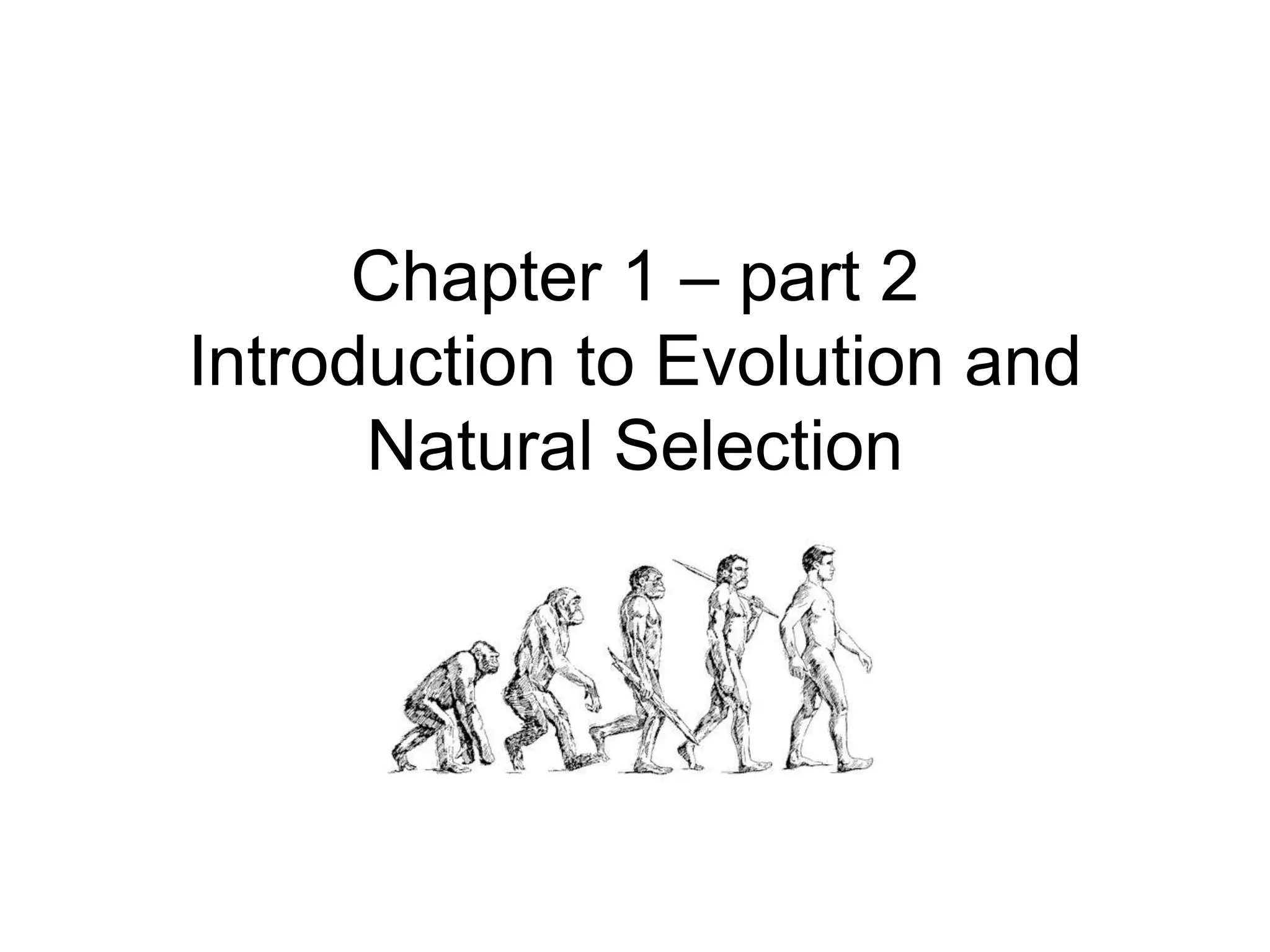
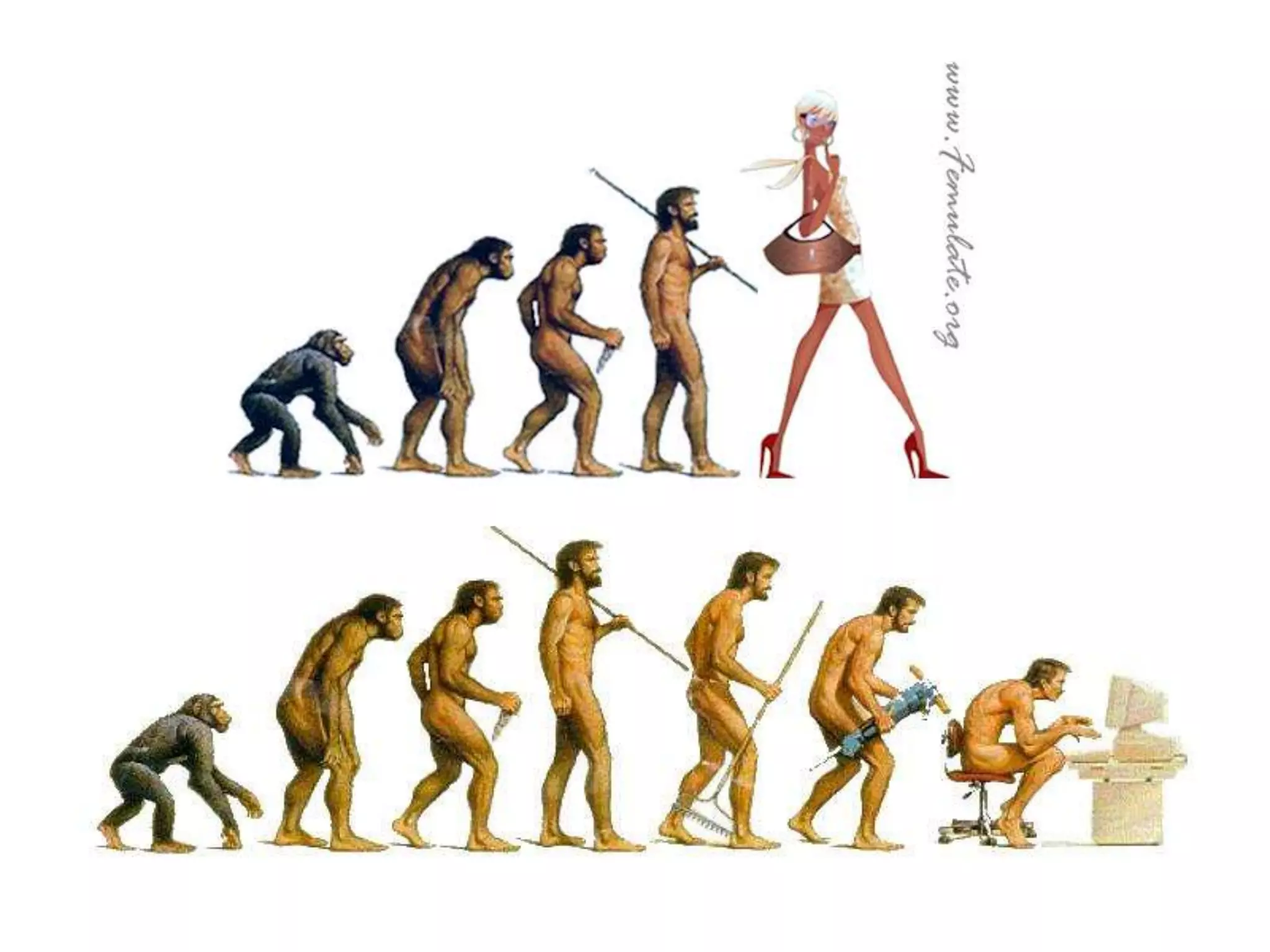
  • #13 We’ve all seen this image if ever at a museumAn idea that apes changed into a human beingAnd this is what we think about when we think of evolution. I want to be clear that even though There was no active process where apes said I want to evolove to a human and spontaneously change. That’s not what evolution is. Evolution is natural selction and I’m going to get to that
  • #20 Alfred Russel Wallace, traveled to Amazonia in 1848. Wallace noticed many plants and animals had special features enabling them survive the conditions which they lived. These observations led Wallace to develop a theory about how species of plants and animals gradually change through a process known as 'evolution' or "natural selection". Alfred Russel Wallace, a British naturalist, birnEngland in 1823.  In 1848 he made an expedition to the Amazon River. During his exploration on plants and animals of the Amazon, he distinguished that some animals had camouflage to help them hide from predators, and some birds had specially shaped bills to let them crack open nuts and extract nectar from plants. Some plants had clever defenses to help fight attacks by insects. These observations led Wallace to develop a theory about how species of plants and animals gradually change through a process known as evolution or “natural selection”. This theory was developed at the same time as that of another famous English naturalist, Charles Darwin.