SYRUPS, ELIXIRS, SPIRITS 
Prepared by: 
ARJUN SINGH KAUSHIK 
SOS PHARMACEUTICAL SCIENCE 
JIWAJI UNIVERSITY GWALIOR
SYRUPS 
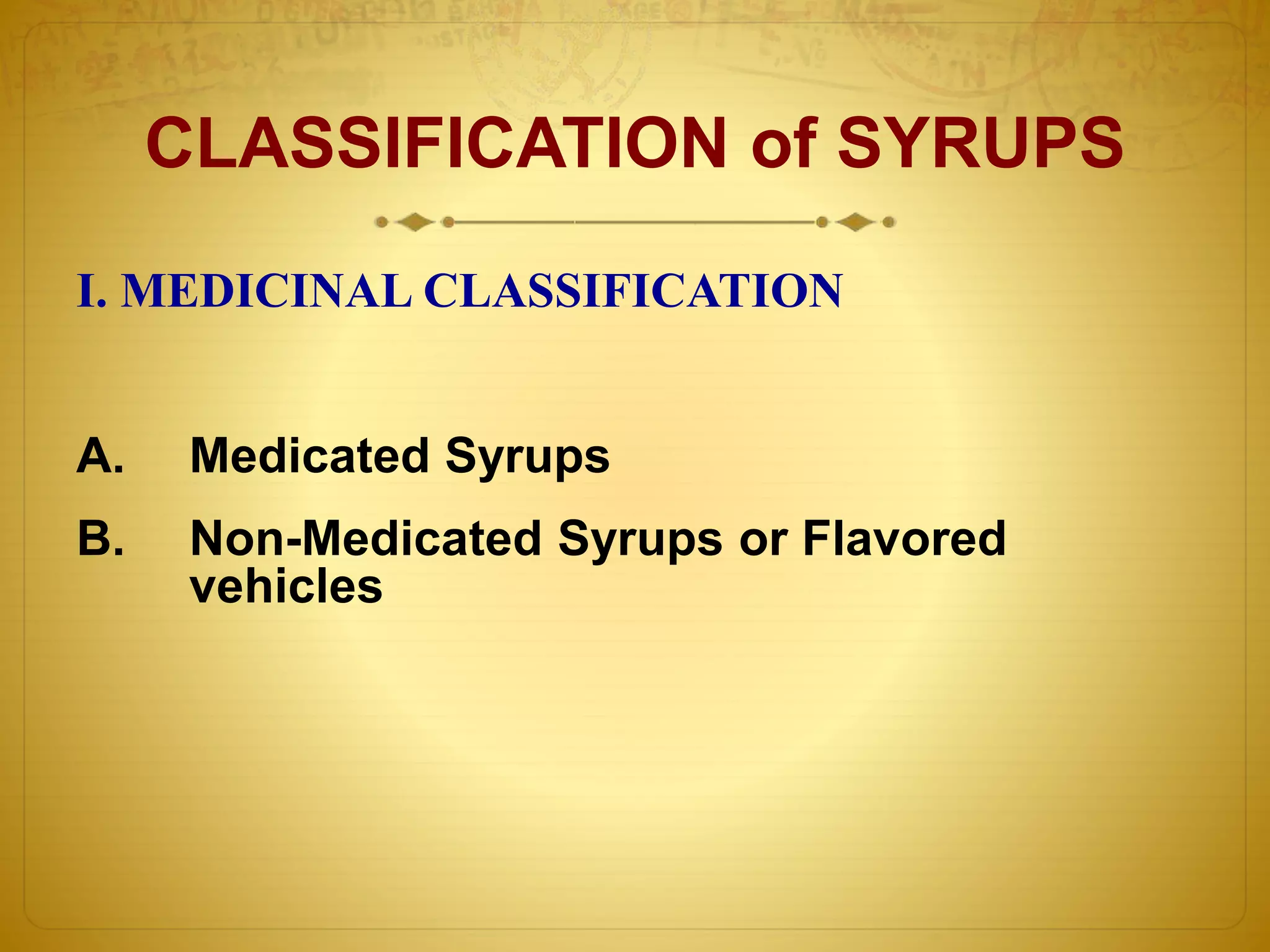
Concentrated, aqueous 
preparations, intended for oral use, 
containing; 
1. Sugar or Sugar substitutes 
2. Flavoring agent 
3. Medicinal agent
CLASSIFICATION of SYRUPS 
I. MEDICINAL CLASSIFICATION 
A. Medicated Syrups 
B. Non-Medicated Syrups or Flavored 
vehicles
NON-MEDICATED / FLAVORED SYRUPS 
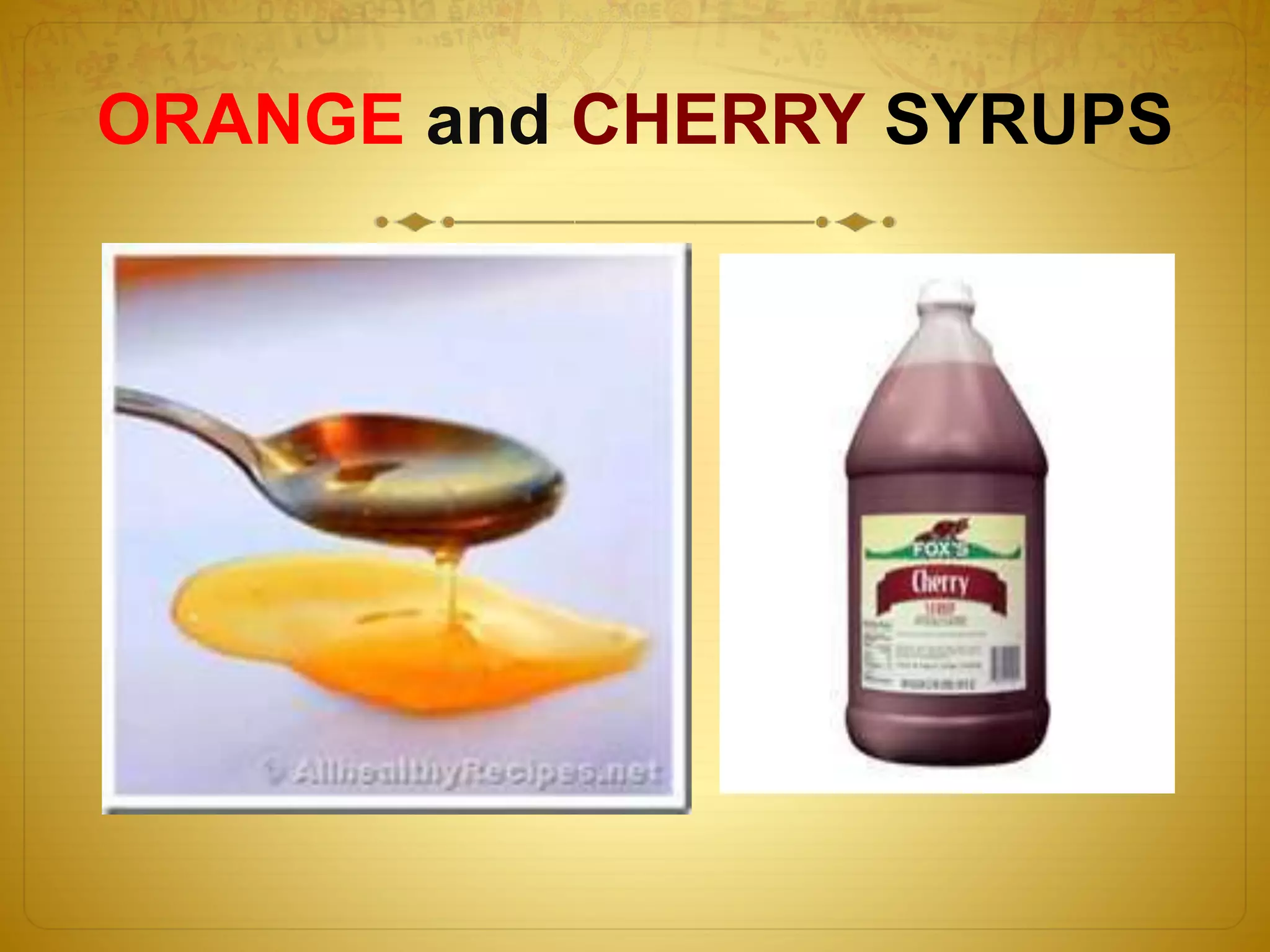
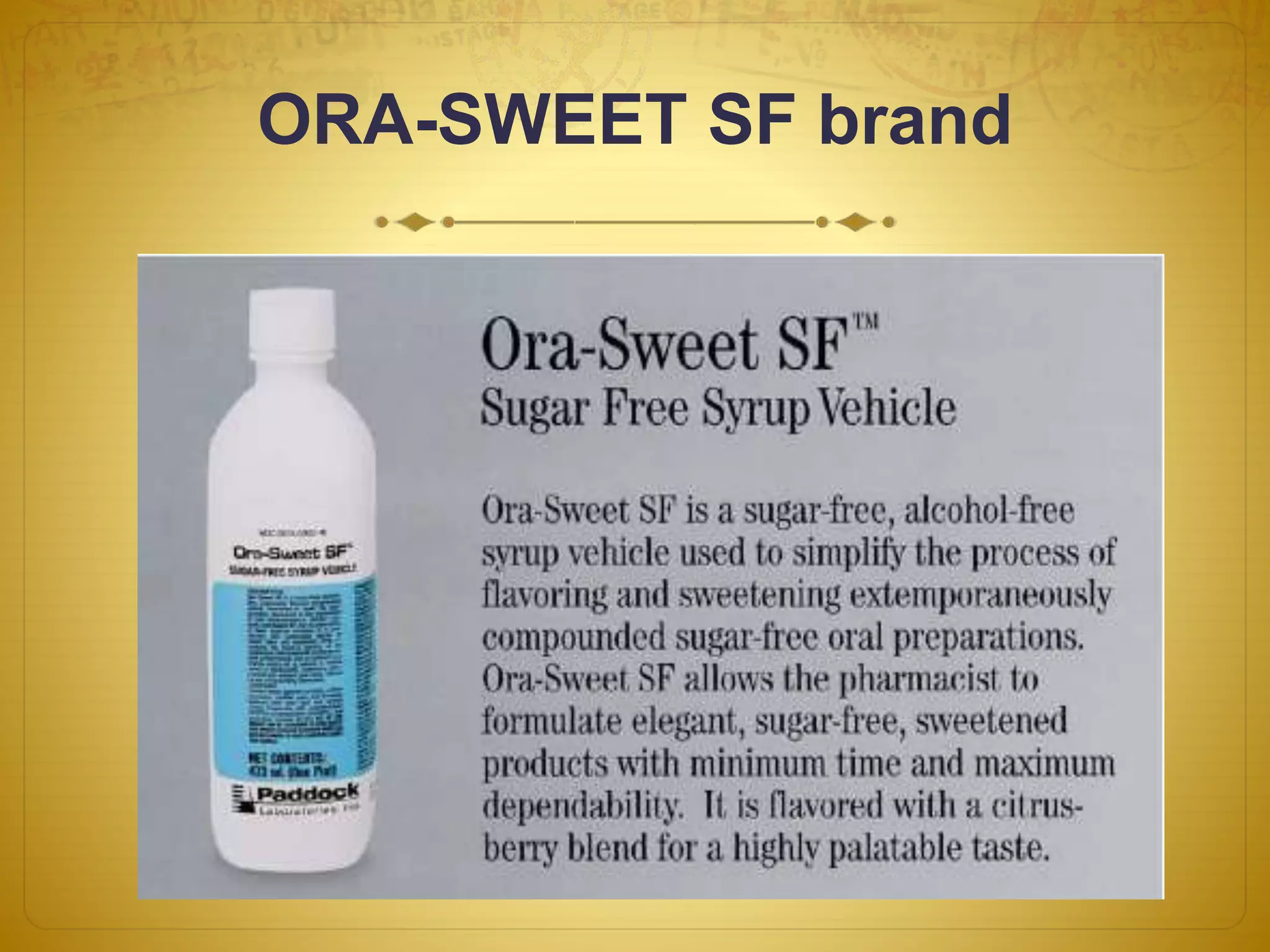
1. Cherry and Orange Syrups – good 
vehicle for drugs requiring acid medium 
2. Cocoa Syrup – effectively masks bitter 
tasting drugs 
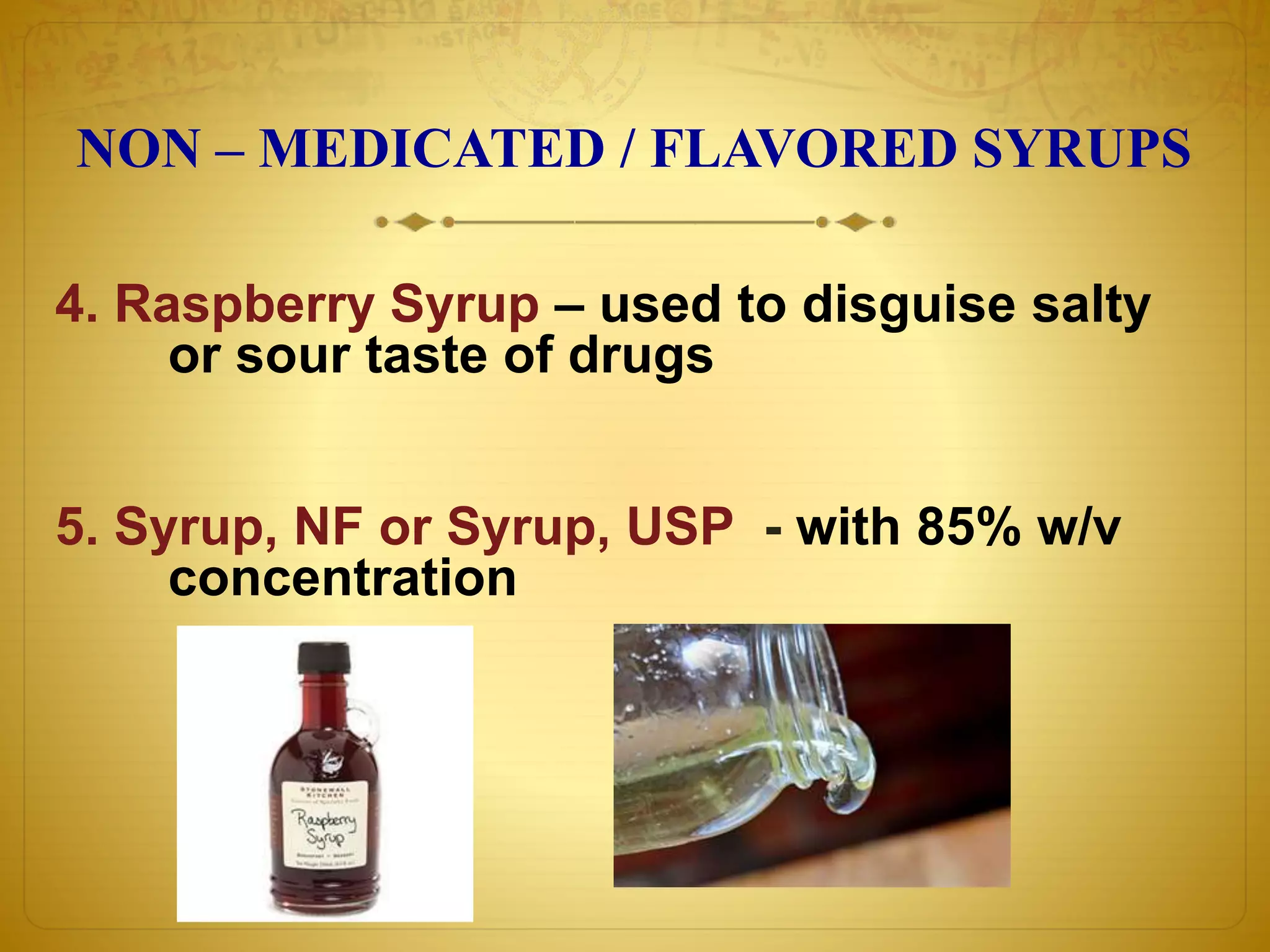
3. Ora-Sweet and Ora-Sweet SF – alcohol 
free vehicle for extemporaneous 
compounding of syrup
ORANGE and CHERRY SYRUPS
ORA-SWEET SF brand
NON – MEDICATED / FLAVORED SYRUPS 
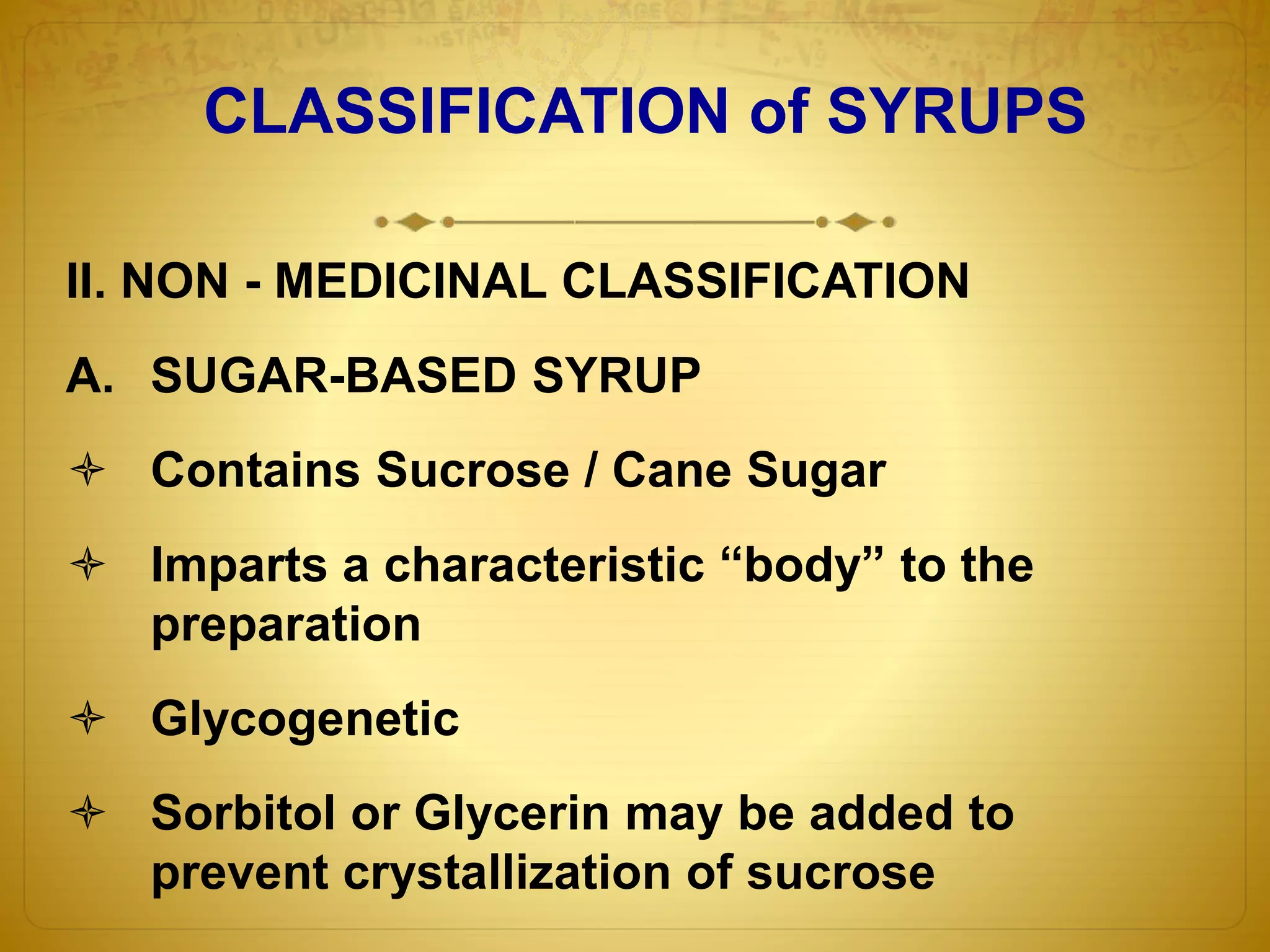
4. Raspberry Syrup – used to disguise salty 
or sour taste of drugs 
5. Syrup, NF or Syrup, USP - with 85% w/v 
concentration
CLASSIFICATION of SYRUPS 
II. NON - MEDICINAL CLASSIFICATION 
A. SUGAR-BASED SYRUP 
 Contains Sucrose / Cane Sugar 
 Imparts a characteristic “body” to the 
preparation 
 Glycogenetic 
 Sorbitol or Glycerin may be added to 
prevent crystallization of sucrose
SYRUP, NF (SIMPLE SYRUP) 
 A concentrated or nearly saturated aqueous 
solution of sugar (85% w/v, 65% w/w) 
 Specific gravity = 1.313 
 Have low solvent capacity for water-soluble 
drugs
SYRUP, NF (SIMPLE SYRUP) 
 Self-preserving, however diluted 
syrups are prone to microbial 
contamination thus require additional 
preservative (i.e. parabens) 
 Saturated solutions tend to undergo 
crystallization (Syrup, USP – minimal 
tendency to undergo crystallization)
B. NON SUGAR-BASED SYRUPS (NON 
NUTRITIVE SYRUPS) 
 Formulated with; 
1. artificial sweeteners 
2. viscosity builders 
 Non glycogenetic
COMPONENTS OF SYRUPS 
1. Sugars, or sugar substitutes 
2. Antimicrobial preservatives 
3. Flavorants 
4. Colorants 
5. Special solvents, stabilizers, 
solubilizing agents and thickeners
METHODS OF PREPARATION of 
SYRUPS 
I. SOLUTION WITH THE AID OF HEAT 
 Excessive heating tends to cause 
inversion / caramelization of sucrose 
II. SOLUTION BY AGITATION WITHOUT THE AID 
OF HEAT 
III. ADDITION OF SUCROSE TO A MEDICATED 
LIQUID OR TO A FLAVORED LIQUID 
Used in the preparation of Senna Syrup, 
NF
METHODS OF PREPARING 
SYRUPS 
I. PERCOLATION 
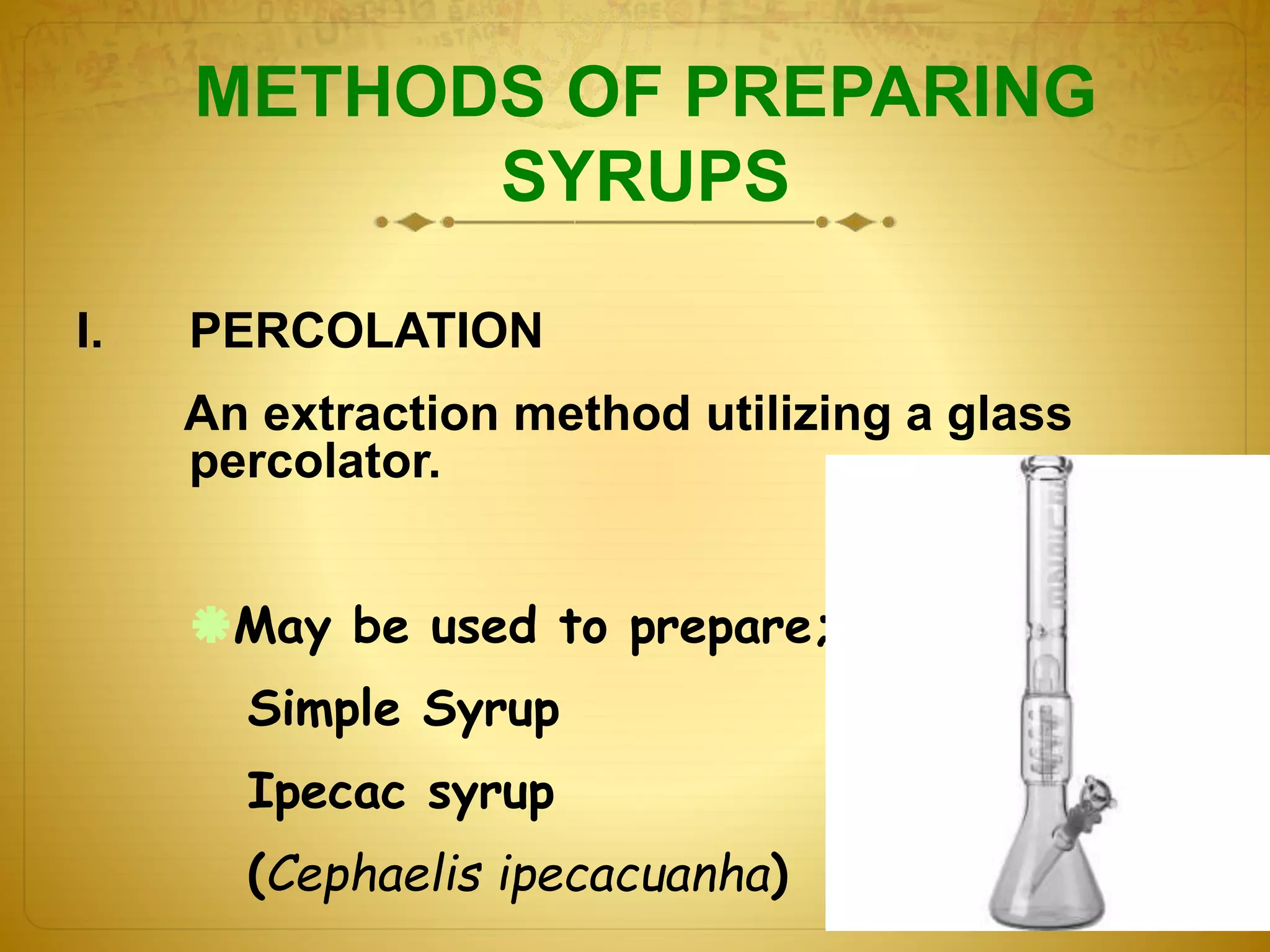
An extraction method utilizing a glass 
percolator. 
May be used to prepare; 
Simple Syrup 
Ipecac syrup 
(Cephaelis ipecacuanha)
ELIXIRS 
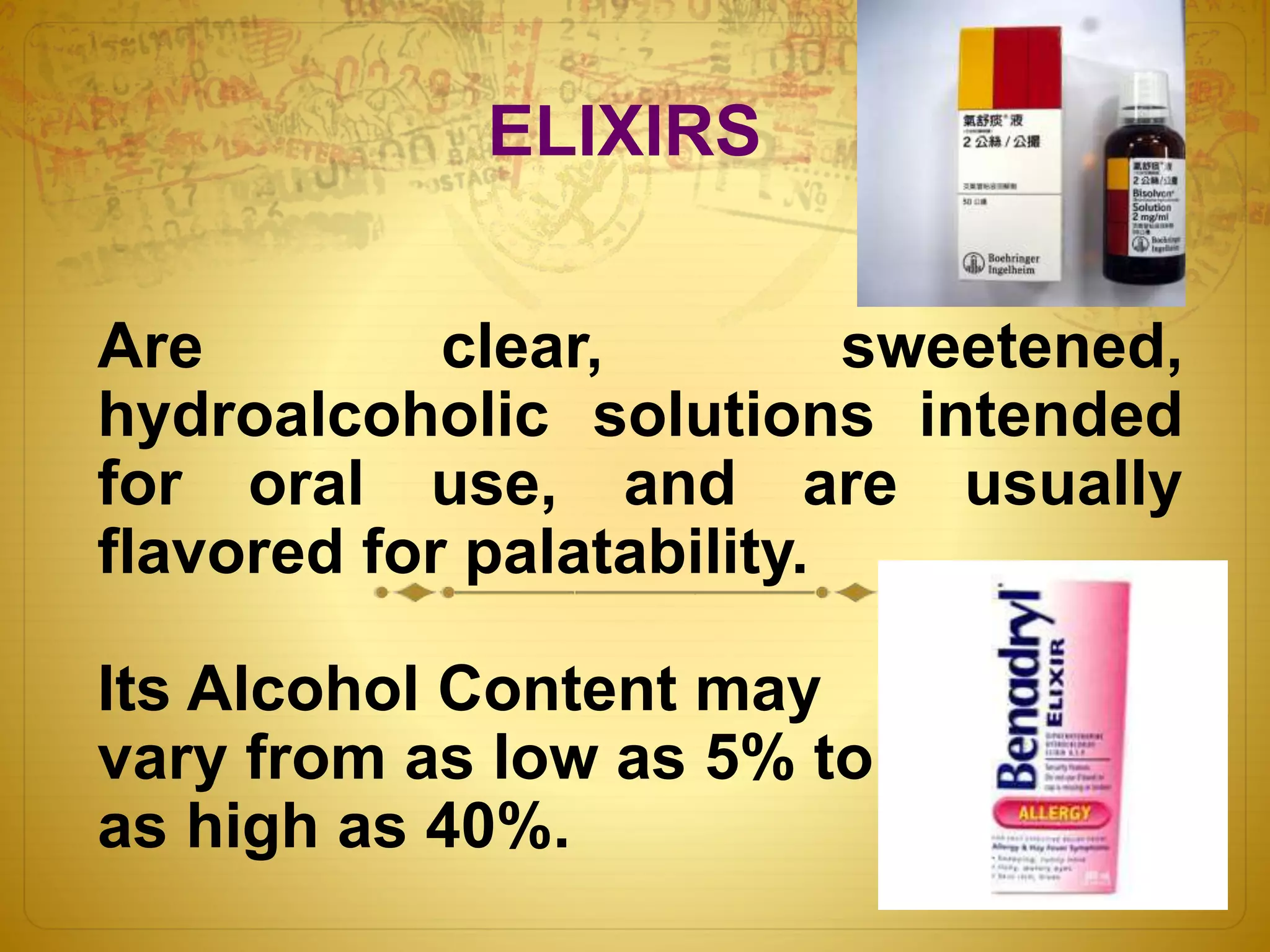
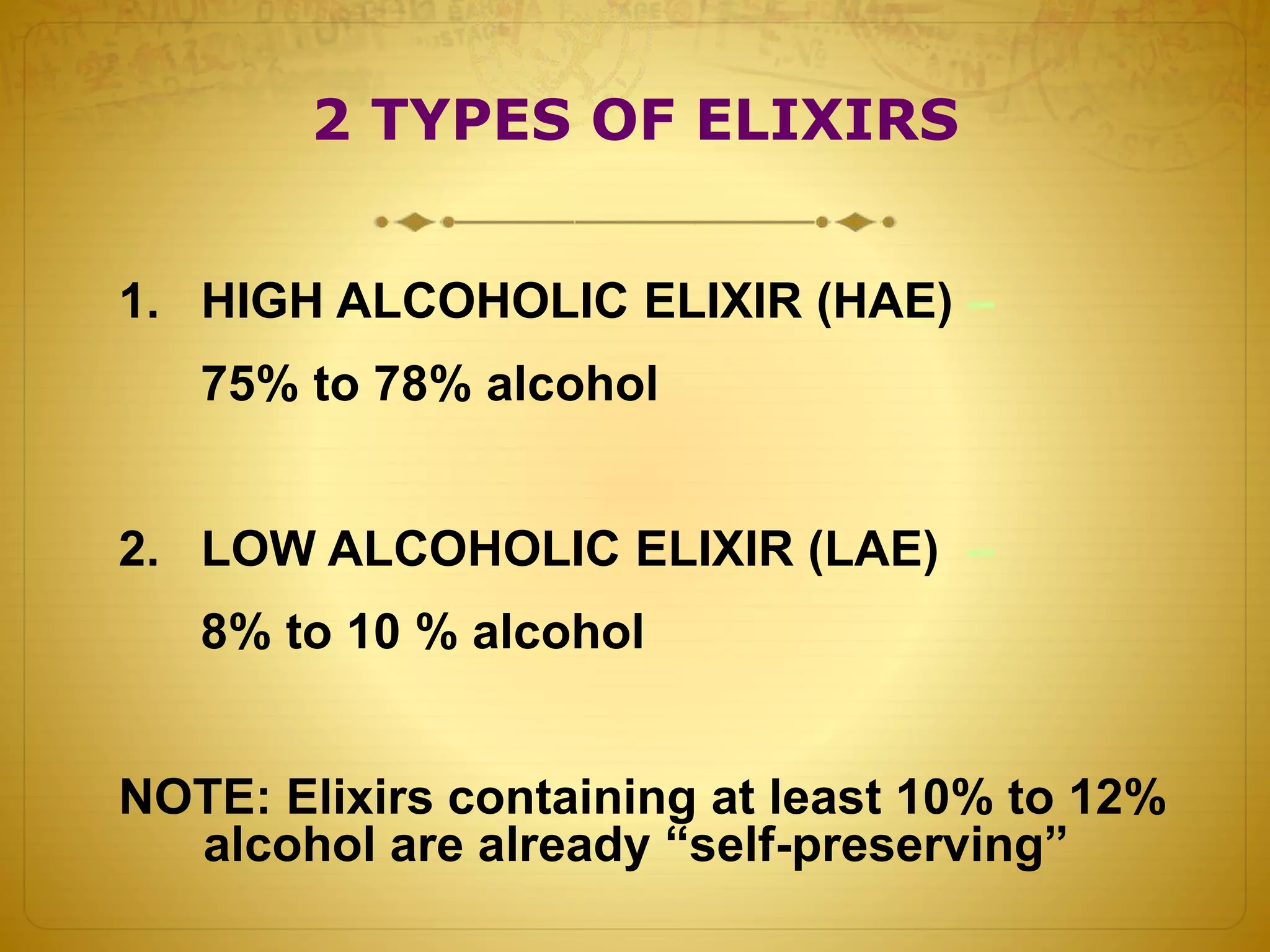
Are clear, sweetened, 
hydroalcoholic solutions intended 
for oral use, and are usually 
flavored for palatability. 
Its Alcohol Content may 
vary from as low as 5% to 
as high as 40%.
2 TYPES OF ELIXIRS 
1. HIGH ALCOHOLIC ELIXIR (HAE) – 
75% to 78% alcohol 
2. LOW ALCOHOLIC ELIXIR (LAE) – 
8% to 10 % alcohol 
NOTE: Elixirs containing at least 10% to 12% 
alcohol are already “self-preserving”
COMPONENTS OF ELIXIR 
FORMULATION 
 Alcohol and Water – primary 
solvents 
 Glycerin and Propylene Glycol-adjuncts 
(viscosity builders and stabilizers) 
 Sweeteners 
 Flavorants and Colorants 
 Medicinal substances
Advantages and Disadvantages 
of Syrups as Dosage Form 
 Maintain both 
water-soluble and 
alcohol-soluble 
components in 
solution 
 Stable 
 Easy to prepare 
(by simple 
solution method) 
 Less effective in 
masking the taste 
of drugs because 
elixirs are less 
sweet and less 
viscous 
 Not 
recommended for 
children due to 
their alcohol 
content
CLASSES OF ELIXIRS 
I. NON-MEDICATED ELIXIRS 
 Employed as vehicles 
 Examples: 
Aromatic Elixir, NF 
Isoalcoholic Elixir 
Compound Benzaldehyde Elixir
CLASSES OF ELIXIRS 
II. MEDICATED ELIXIRS 
Examples: 
Diphenhydramine Elixir 
Phenobarbital Elixir 
Digoxin Elixir
Preparation of Elixirs 
By simple solution method 
By admixture of two or more 
liquids
STORAGE and PRESERVATION 
of ELIXIRS 
Stored in a tightly closed, light-resistant 
containers 
Protected from excessive heat (do not 
store above 400C)
SPIRITS / ESSENCES 
Alcoholic or hydroalcoholic 
solutions of volatile substances. 
Usual alcohol content is 60%. 
When mixed with water, the 
volatile material separates and 
forms a milky solution.
Uses of Spirits 
A. MEDICINAL SPIRITS 
AROMATIC SPIRIT OF AMMONIA 
– reflex / respiratory stimulant ( by 
inhalation) 
B. FLAVORING SPIRITS 
- Compound Orange Spirit 
- Compound Cardamom Spirit
ROUTES of ADMINISTRATION 
of SPIRITS 
 Taken orally 
Brandy and Whisky 
Mixed with a portion of water to reduce 
pungency of the spirit 
 Applied externally 
 Used by inhalation 
 Aromatic spirit of ammonia
METHODS of PREPARATION 
of SPIRITS 
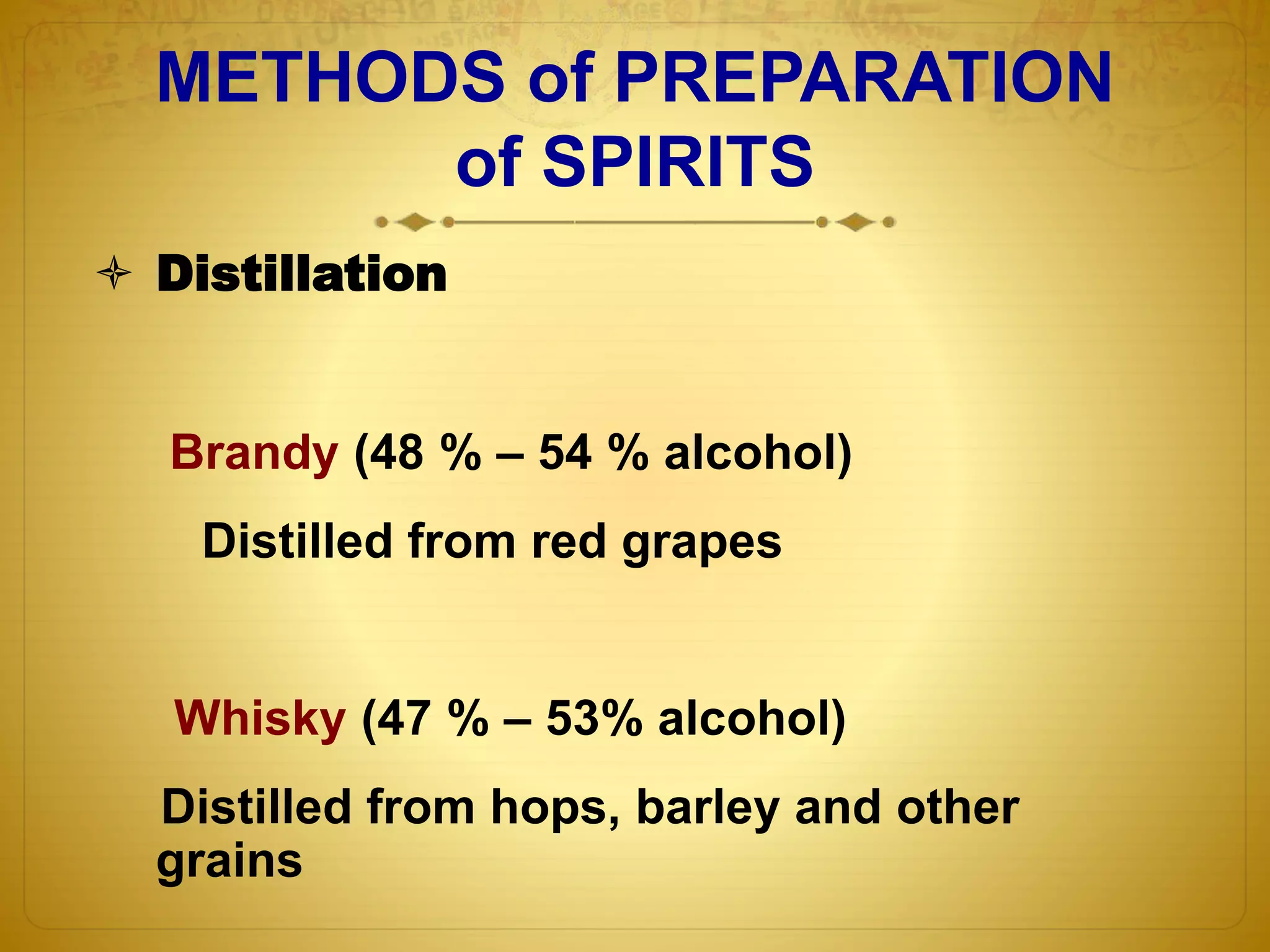
 Distillation 
Brandy (48 % – 54 % alcohol) 
Distilled from red grapes 
Whisky (47 % – 53% alcohol) 
Distilled from hops, barley and other 
grains
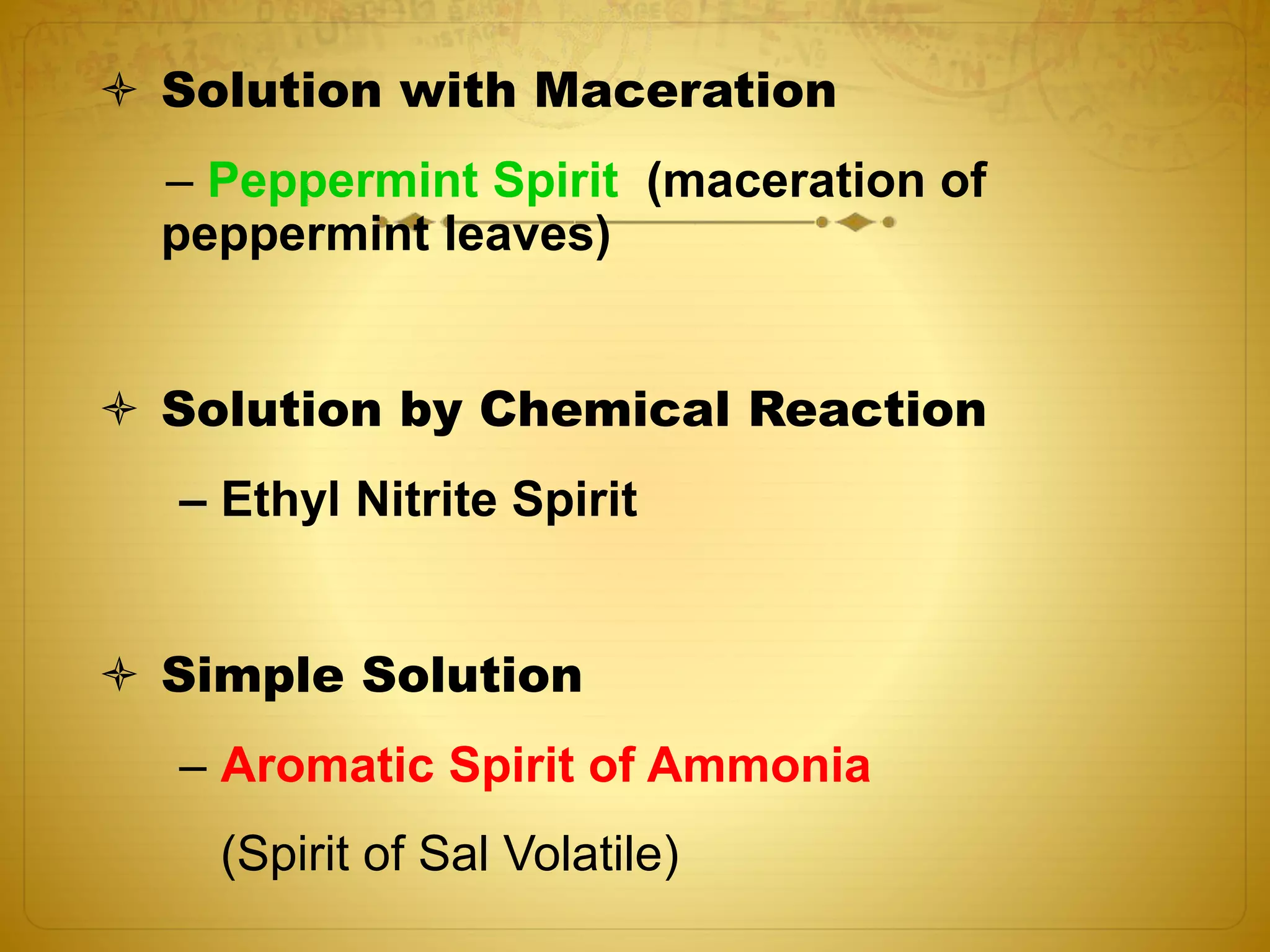
 Solution with Maceration 
– Peppermint Spirit (maceration of 
peppermint leaves) 
 Solution by Chemical Reaction 
– Ethyl Nitrite Spirit 
 Simple Solution 
– Aromatic Spirit of Ammonia 
(Spirit of Sal Volatile)
Syrup,elixir,spirits

Syrup,elixir,spirits

  • 1.
    SYRUPS, ELIXIRS, SPIRITS Prepared by: ARJUN SINGH KAUSHIK SOS PHARMACEUTICAL SCIENCE JIWAJI UNIVERSITY GWALIOR
  • 2.
    SYRUPS Concentrated, aqueous preparations, intended for oral use, containing; 1. Sugar or Sugar substitutes 2. Flavoring agent 3. Medicinal agent
  • 3.
    CLASSIFICATION of SYRUPS I. MEDICINAL CLASSIFICATION A. Medicated Syrups B. Non-Medicated Syrups or Flavored vehicles
  • 4.
    NON-MEDICATED / FLAVOREDSYRUPS 1. Cherry and Orange Syrups – good vehicle for drugs requiring acid medium 2. Cocoa Syrup – effectively masks bitter tasting drugs 3. Ora-Sweet and Ora-Sweet SF – alcohol free vehicle for extemporaneous compounding of syrup
  • 5.
  • 6.
  • 7.
    NON – MEDICATED/ FLAVORED SYRUPS 4. Raspberry Syrup – used to disguise salty or sour taste of drugs 5. Syrup, NF or Syrup, USP - with 85% w/v concentration
  • 8.
    CLASSIFICATION of SYRUPS II. NON - MEDICINAL CLASSIFICATION A. SUGAR-BASED SYRUP  Contains Sucrose / Cane Sugar  Imparts a characteristic “body” to the preparation  Glycogenetic  Sorbitol or Glycerin may be added to prevent crystallization of sucrose
  • 9.
    SYRUP, NF (SIMPLESYRUP)  A concentrated or nearly saturated aqueous solution of sugar (85% w/v, 65% w/w)  Specific gravity = 1.313  Have low solvent capacity for water-soluble drugs
  • 10.
    SYRUP, NF (SIMPLESYRUP)  Self-preserving, however diluted syrups are prone to microbial contamination thus require additional preservative (i.e. parabens)  Saturated solutions tend to undergo crystallization (Syrup, USP – minimal tendency to undergo crystallization)
  • 11.
    B. NON SUGAR-BASEDSYRUPS (NON NUTRITIVE SYRUPS)  Formulated with; 1. artificial sweeteners 2. viscosity builders  Non glycogenetic
  • 12.
    COMPONENTS OF SYRUPS 1. Sugars, or sugar substitutes 2. Antimicrobial preservatives 3. Flavorants 4. Colorants 5. Special solvents, stabilizers, solubilizing agents and thickeners
  • 13.
    METHODS OF PREPARATIONof SYRUPS I. SOLUTION WITH THE AID OF HEAT  Excessive heating tends to cause inversion / caramelization of sucrose II. SOLUTION BY AGITATION WITHOUT THE AID OF HEAT III. ADDITION OF SUCROSE TO A MEDICATED LIQUID OR TO A FLAVORED LIQUID Used in the preparation of Senna Syrup, NF
  • 14.
    METHODS OF PREPARING SYRUPS I. PERCOLATION An extraction method utilizing a glass percolator. May be used to prepare; Simple Syrup Ipecac syrup (Cephaelis ipecacuanha)
  • 15.
    ELIXIRS Are clear,sweetened, hydroalcoholic solutions intended for oral use, and are usually flavored for palatability. Its Alcohol Content may vary from as low as 5% to as high as 40%.
  • 16.
    2 TYPES OFELIXIRS 1. HIGH ALCOHOLIC ELIXIR (HAE) – 75% to 78% alcohol 2. LOW ALCOHOLIC ELIXIR (LAE) – 8% to 10 % alcohol NOTE: Elixirs containing at least 10% to 12% alcohol are already “self-preserving”
  • 17.
    COMPONENTS OF ELIXIR FORMULATION  Alcohol and Water – primary solvents  Glycerin and Propylene Glycol-adjuncts (viscosity builders and stabilizers)  Sweeteners  Flavorants and Colorants  Medicinal substances
  • 18.
    Advantages and Disadvantages of Syrups as Dosage Form  Maintain both water-soluble and alcohol-soluble components in solution  Stable  Easy to prepare (by simple solution method)  Less effective in masking the taste of drugs because elixirs are less sweet and less viscous  Not recommended for children due to their alcohol content
  • 19.
    CLASSES OF ELIXIRS I. NON-MEDICATED ELIXIRS  Employed as vehicles  Examples: Aromatic Elixir, NF Isoalcoholic Elixir Compound Benzaldehyde Elixir
  • 20.
    CLASSES OF ELIXIRS II. MEDICATED ELIXIRS Examples: Diphenhydramine Elixir Phenobarbital Elixir Digoxin Elixir
  • 21.
    Preparation of Elixirs By simple solution method By admixture of two or more liquids
  • 22.
    STORAGE and PRESERVATION of ELIXIRS Stored in a tightly closed, light-resistant containers Protected from excessive heat (do not store above 400C)
  • 23.
    SPIRITS / ESSENCES Alcoholic or hydroalcoholic solutions of volatile substances. Usual alcohol content is 60%. When mixed with water, the volatile material separates and forms a milky solution.
  • 24.
    Uses of Spirits A. MEDICINAL SPIRITS AROMATIC SPIRIT OF AMMONIA – reflex / respiratory stimulant ( by inhalation) B. FLAVORING SPIRITS - Compound Orange Spirit - Compound Cardamom Spirit
  • 25.
    ROUTES of ADMINISTRATION of SPIRITS  Taken orally Brandy and Whisky Mixed with a portion of water to reduce pungency of the spirit  Applied externally  Used by inhalation  Aromatic spirit of ammonia
  • 26.
    METHODS of PREPARATION of SPIRITS  Distillation Brandy (48 % – 54 % alcohol) Distilled from red grapes Whisky (47 % – 53% alcohol) Distilled from hops, barley and other grains
  • 27.
     Solution withMaceration – Peppermint Spirit (maceration of peppermint leaves)  Solution by Chemical Reaction – Ethyl Nitrite Spirit  Simple Solution – Aromatic Spirit of Ammonia (Spirit of Sal Volatile)