Making Log Data Useful:SIEM and Log Management TogetherDr. Anton ChuvakinSecurity Warrior Consultingwww.securitywarriorconsulting.comApril 2010
OutlineSecurity Information and Event Management vs/with Log Management Graduating from LM to SIEMSIEM and LM “best practices”First steps with SIEMUsing SIEM and LM togetherConclusions
SIEM vs LMSIEM = SECURITY information and event managementvsLM = LOG management
What SIEM MUST Have?Log and Context Data CollectionNormalizationCorrelation (“SEM”)Notification/alerting (“SEM”)Prioritization (“SEM”)Reporting (“SIM”)Security role workflow
What LM MUST Have?Broad Scope Log Data CollectionEfficient Log Data RetentionSearching Across All DataBroad Use Log Reporting Scalable Operation: Collection, Retention, Searching, Reporting
Graduating from LM to SIEMAre you ready? Well, do you have…Response capabilityPrepared to response to alertsMonitoring capabilityHas an operational process to monitorTuning and customization abilityCan customize the tools and content
How to “Graduate?”	Just like college…  Graduation tips:Satisfy the graduation criteriaUse a LM vendors that has a good SIEMDeploy LM and use it operationallyPeriodic log reviews = first step to monitoringLook for integrated capability
What is a “Best Practice”?A process or practice thatThe leaders in the field are doing todayGenerally leads to useful results with cost effectiveness
BP1 LM before SIEM!If you remember one thing from this, let it be:Deploy Log Management BEFORE SIEM!Q: Why do you think MOST 1990s SIEM deployments FAILED?A: There was no log management!
Example ScenarioA mid-size regional bank deploys log management Compliance, fraud tracking, user activity auditUse the tool on incident only firstStart checking reports once in a whileEstablish log review processIn two years, gets a SIEM to automate it!
BP2 Evolving to SIEM Steps of a journeyEstablish response processDeploy a SIEMThink “use cases”Start filtering logs from LM to SIEMPhases!Prepare for the initial increase in workload
Example LM->SIEM Filtering3D: Devices / Network topology / EventsDevices: NIDS/NIPS, WAF, serversNetwork: DMZ, payment network (PCI scope), other “key domains”Events: authentication, outbound firewall accessLater: proxies, more firewall data, web servers
BP3 SIEM First StepsFirst step = BABY steps!Compliance monitoring“Traditional” SIEM usesAuthentication  trackingIPS/IDS + firewall correlationWeb application hackingSimple use cases based on your riskWhat problems do YOU want solved?
Example SIEM Use CaseCross-system authentication  trackingScope: all systems with authentication  (!)Purpose: detect unauthorized access to systemsMethod: track login failures and successesRule details: multiple login failures followed by login successResponse plan: user account investigation, suspension, communication with suspect user
SIEM + LM Integrated UseCorrelated SIEM alert is generatedDatabase server login guessingKey information is shownAccount guessed, time, source Context information is pulled from LMWhat happened with this user before?What else the source did?What other logs were produced on server?
Eventually: SIEM Usage ScenariosSecurity Operations Center (SOC)RT views, analysts 24/7, chase alertsMini-SOC / “morning after”Delayed views, analysts 1/24, review and drill-down“Automated SOC” / alert + investigateConfigure and forget, investigate alertsCompliance status reportingReview  reports/views weekly/monthly
ConclusionsEverybody has logs -> needs to deal with them -> needs LOG MANAGEMENT!Deploy LM before SIEMThen decide whether and when you need SIEMOperationalize Log Management first, use it “early and often”Start with SIEM slowly and only for tangible, solvable problems!
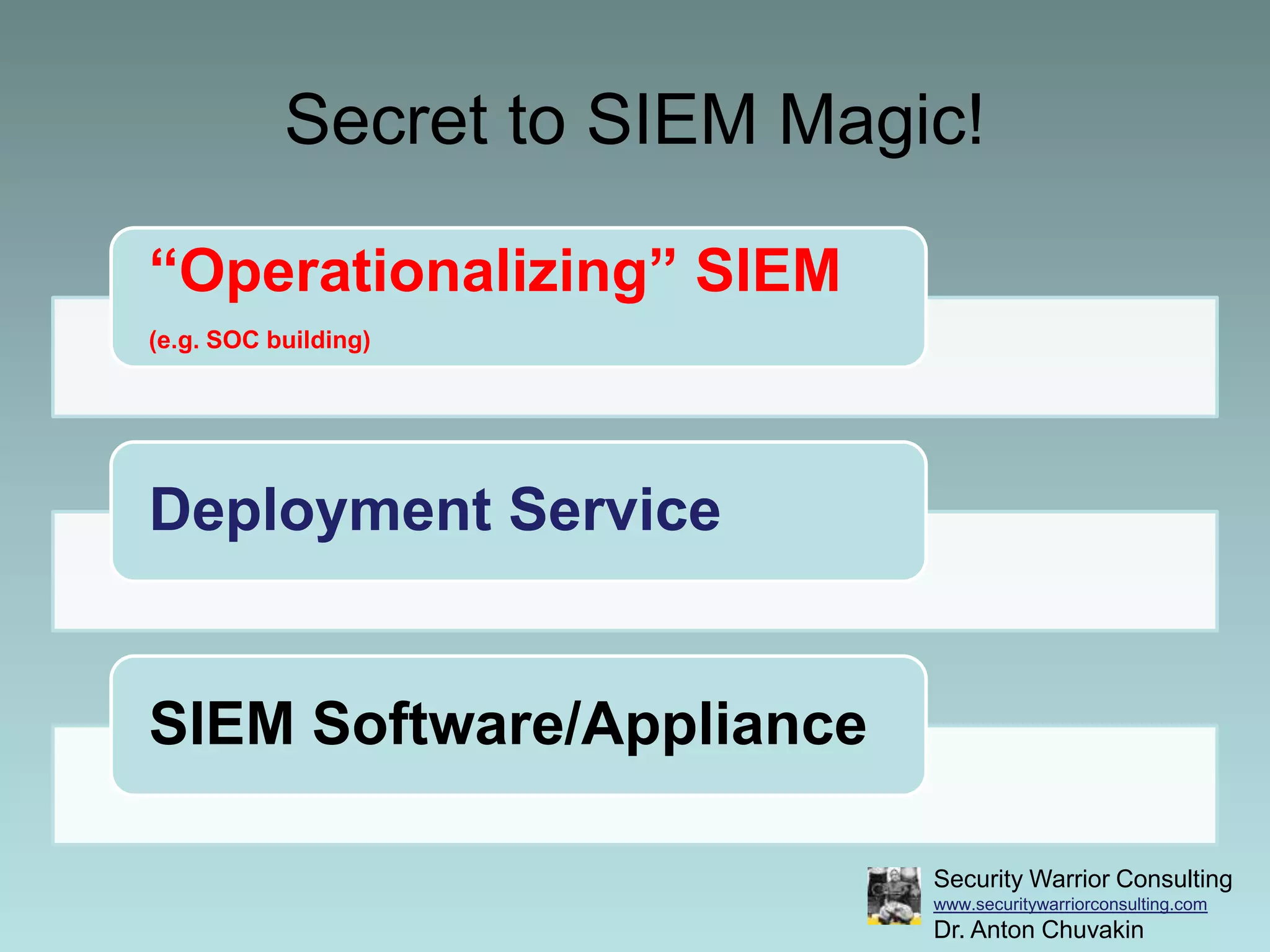
Secret to SIEM Magic!
QuestionsDr. Anton ChuvakinEmail:anton@chuvakin.orgGoogle Voice: 510-771-7106 Site:http://www.chuvakin.orgBlog:http://www.securitywarrior.orgLinkedIn:http://www.linkedin.com/in/chuvakinConsulting: www.securitywarriorconsulting.comTwitter:@anton_chuvakin
More on AntonBook author: “Security Warrior”, “PCI Compliance”, “Information Security Management Handbook”, “Know Your Enemy II”, “Hacker’s Challenge 3”, etcConference speaker: SANS, FIRST, GFIRST, ISSA, CSI, Interop, many, many others worldwideStandard developer: CEE, CVSS, OVAL, etcCommunity role: SANS, Honeynet Project, WASC, CSI, ISSA, OSSTMM, InfraGard, ISSA, othersPast roles: Researcher, Security Analyst, Strategist, Evangelist, Product Manager, Consultant
Security Warrior Consulting ServicesLogging and log management strategy, procedures and practicesDevelop logging policies and processes, log review procedures, workflows and periodic tasks as well as help architect those to solve organization problems Plan and implement log management architecture to support your business cases; develop specific components such as log data collection,  filtering, aggregation, retention, log source configuration as well as reporting, review and validationCustomize industry “best practices” related to logging and log review  to fit your environment,  help link these practices to business services and regulationsHelp  integrate logging tools and processes into IT and business operationsSIEM and log management content developmentDevelop correlation rules, reports and other content to make your SIEM and log management product more useful to you and more applicable to your risk profile and compliance needsCreate and refine policies, procedures and operational practices for logging and log management to satisfy requirements of PCI DSS, HIPAA, NERC, FISMA and other regulationsMore at www.SecurityWarriorConsulting.com

Making Log Data Useful: SIEM and Log Management Together by Dr. Anton Chuvakin

  • 1.
    Making Log DataUseful:SIEM and Log Management TogetherDr. Anton ChuvakinSecurity Warrior Consultingwww.securitywarriorconsulting.comApril 2010
  • 2.
    OutlineSecurity Information andEvent Management vs/with Log Management Graduating from LM to SIEMSIEM and LM “best practices”First steps with SIEMUsing SIEM and LM togetherConclusions
  • 3.
    SIEM vs LMSIEM= SECURITY information and event managementvsLM = LOG management
  • 4.
    What SIEM MUSTHave?Log and Context Data CollectionNormalizationCorrelation (“SEM”)Notification/alerting (“SEM”)Prioritization (“SEM”)Reporting (“SIM”)Security role workflow
  • 5.
    What LM MUSTHave?Broad Scope Log Data CollectionEfficient Log Data RetentionSearching Across All DataBroad Use Log Reporting Scalable Operation: Collection, Retention, Searching, Reporting
  • 6.
    Graduating from LMto SIEMAre you ready? Well, do you have…Response capabilityPrepared to response to alertsMonitoring capabilityHas an operational process to monitorTuning and customization abilityCan customize the tools and content
  • 7.
    How to “Graduate?” Justlike college…  Graduation tips:Satisfy the graduation criteriaUse a LM vendors that has a good SIEMDeploy LM and use it operationallyPeriodic log reviews = first step to monitoringLook for integrated capability
  • 8.
    What is a“Best Practice”?A process or practice thatThe leaders in the field are doing todayGenerally leads to useful results with cost effectiveness
  • 9.
    BP1 LM beforeSIEM!If you remember one thing from this, let it be:Deploy Log Management BEFORE SIEM!Q: Why do you think MOST 1990s SIEM deployments FAILED?A: There was no log management!
  • 10.
    Example ScenarioA mid-sizeregional bank deploys log management Compliance, fraud tracking, user activity auditUse the tool on incident only firstStart checking reports once in a whileEstablish log review processIn two years, gets a SIEM to automate it!
  • 11.
    BP2 Evolving toSIEM Steps of a journeyEstablish response processDeploy a SIEMThink “use cases”Start filtering logs from LM to SIEMPhases!Prepare for the initial increase in workload
  • 12.
    Example LM->SIEM Filtering3D:Devices / Network topology / EventsDevices: NIDS/NIPS, WAF, serversNetwork: DMZ, payment network (PCI scope), other “key domains”Events: authentication, outbound firewall accessLater: proxies, more firewall data, web servers
  • 13.
    BP3 SIEM FirstStepsFirst step = BABY steps!Compliance monitoring“Traditional” SIEM usesAuthentication trackingIPS/IDS + firewall correlationWeb application hackingSimple use cases based on your riskWhat problems do YOU want solved?
  • 14.
    Example SIEM UseCaseCross-system authentication trackingScope: all systems with authentication (!)Purpose: detect unauthorized access to systemsMethod: track login failures and successesRule details: multiple login failures followed by login successResponse plan: user account investigation, suspension, communication with suspect user
  • 15.
    SIEM + LMIntegrated UseCorrelated SIEM alert is generatedDatabase server login guessingKey information is shownAccount guessed, time, source Context information is pulled from LMWhat happened with this user before?What else the source did?What other logs were produced on server?
  • 16.
    Eventually: SIEM UsageScenariosSecurity Operations Center (SOC)RT views, analysts 24/7, chase alertsMini-SOC / “morning after”Delayed views, analysts 1/24, review and drill-down“Automated SOC” / alert + investigateConfigure and forget, investigate alertsCompliance status reportingReview reports/views weekly/monthly
  • 17.
    ConclusionsEverybody has logs-> needs to deal with them -> needs LOG MANAGEMENT!Deploy LM before SIEMThen decide whether and when you need SIEMOperationalize Log Management first, use it “early and often”Start with SIEM slowly and only for tangible, solvable problems!
  • 18.
  • 19.
    QuestionsDr. Anton ChuvakinEmail:anton@chuvakin.orgGoogleVoice: 510-771-7106 Site:http://www.chuvakin.orgBlog:http://www.securitywarrior.orgLinkedIn:http://www.linkedin.com/in/chuvakinConsulting: www.securitywarriorconsulting.comTwitter:@anton_chuvakin
  • 20.
    More on AntonBookauthor: “Security Warrior”, “PCI Compliance”, “Information Security Management Handbook”, “Know Your Enemy II”, “Hacker’s Challenge 3”, etcConference speaker: SANS, FIRST, GFIRST, ISSA, CSI, Interop, many, many others worldwideStandard developer: CEE, CVSS, OVAL, etcCommunity role: SANS, Honeynet Project, WASC, CSI, ISSA, OSSTMM, InfraGard, ISSA, othersPast roles: Researcher, Security Analyst, Strategist, Evangelist, Product Manager, Consultant
  • 21.
    Security Warrior ConsultingServicesLogging and log management strategy, procedures and practicesDevelop logging policies and processes, log review procedures, workflows and periodic tasks as well as help architect those to solve organization problems Plan and implement log management architecture to support your business cases; develop specific components such as log data collection, filtering, aggregation, retention, log source configuration as well as reporting, review and validationCustomize industry “best practices” related to logging and log review to fit your environment, help link these practices to business services and regulationsHelp integrate logging tools and processes into IT and business operationsSIEM and log management content developmentDevelop correlation rules, reports and other content to make your SIEM and log management product more useful to you and more applicable to your risk profile and compliance needsCreate and refine policies, procedures and operational practices for logging and log management to satisfy requirements of PCI DSS, HIPAA, NERC, FISMA and other regulationsMore at www.SecurityWarriorConsulting.com

Editor's Notes

  • #7 Organizations that graduate too soon will waste time and effort, and won't any increased efficiency in their security operation. However, waiting too long also means that the organization will never develop the necessary capabilities to secure themselves. In brief, the criteria are:Response capability: the organization must be ready to respond to alerts soon after they are produced.Monitoring capability: the organization must have or start to build security monitoring capability such as a Security Operation Center (SOC) or at least a team dedicated to ongoing periodic monitoring.Tuning and customization ability: the organization must accept the responsibility for tuning and customizing the deployed SIEM tool. Out-of-the-box SIEM deployments rarely succeed, or manage to reach their full potential.
  • #8 “Graduating” from LM to SIEMWho should do it? Orgs that are ready for monitoring and responseHow to go about it? Use a vendor that does bothWhen? Deploy LM first and use it. Be ready to monitor [reactive -> faster/better reactive]What to look for? Integrated LM and SIEM
  • #10 Deploy – use - operationalize – get comfortable with!
  • #11 LM before SIEM!Plan, deploy and operationalize LM (forget SIEM for now)Use LM regularly before evolvingSolve problems – and discover new problems (that call for SIEM maybe)
  • #12 Happy with LM? Then go -> SIEMPhased deployment!Filter some logs into SIEMHow to decide? Correlation, use cases, stakeholders, etcPrepare to build use cases slowlyThings to watch for while evolvingInitially increased workload: now you do more useful stuff!
  • #14 SIEM first stepsSimple use cases that are your own: based on key risks to your business, key issues you’d like to monitor forSecurity monitoring for complianceTraditional use (if customer does not have preferred use cases and does not know how to find them)IDS/IPS and firewall analysisLogin trackingWeb application hacking
  • #16 Using SIEM with LM: integrated use caseIncident response use case: alert -> log investigationMini-SOC monitoring and analysis
  • #17 SIEM use casesSOC – full real-time monitoringMini-SOC / ”morning after”Remote monitoring + investigationsCompliance status reporting