Everything You Wanted to Know About
Log Management But were Afraid to Ask
SIEM FOR BEGINNERS
www.alienvault.com
Although the industry has settled on the term ‘SIEM’ as the catch-all term for
this type of security software, it evolved from several different (but complementary)
technologies that came before it.
•	 LMS  “Log Management System” – a system that collects and stores log files (from Operating Systems, Applications, etc)
from multiple hosts and systems into a single location, allowing centralized access to logs instead of accessing them from
each system individually.
•	 SLM /SEM  “Security Log/Event Management” – an LMS, but marketed towards security analysts instead of system
administrators. SEM is about highlighting log entries as more significant to security than others.
•	 SIM  “Security Information Management” – an Asset Management system, but with features to incorporate security information
too. Hosts may have vulnerability reports listed in their summaries, Intrusion Detection and AntiVirus alerts may be shown
mapped to the systems involved.
•	 SEC  “Security Event Correlation” – To a particular piece of software, three failed login attempts to the same user account
from three different clients, are just three lines in their logfile. To an analyst, that is a peculiar sequence of events worthy of
investigation, and Log Correlation (looking for patterns in log files) is a way to raise alerts when these things happen.
•	 SIEM  “Security Information and Event Management” – SIEM is the “All of the Above” option, and as the above technologies
become merged into single products, became the generalized term for managing information generated from security controls
and infrastructure. We’ll use the term SIEM for the rest of this presentation.
A Rose By Any Other Name
SLM/LMS, SIM, SEM, SEC, SIEM
The information you need to answer
“Who’s attacking us today?” and
“How did they get access to all our corporate secrets?”
We may think of Security Controls as containing all the information we need to be secure,
but often they only contain the things they have detected – there is no ‘before and after the event’
context within them.
This context is usually vital to separate the false positive from true detection,
the actual attack from a merely misconfigured system.
Successful attacks on computer systems rarely look like real attacks except in hindsight –
if this were not the case, we could automate ALL security defenses without ever needing to
employ human analysts.
Attackers will try to remove and falsify log entries to cover their tracks – having a source of log
information that can be trusted is vital to any legal proceeding from computer misuse.
What’s in the Logs?
What’s In the Logs?!!Q:
A:
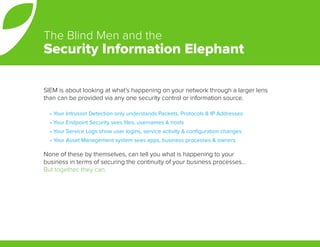
SIEM is about looking at what’s happening on your network through a larger lens
than can be provided via any one security control or information source.
None of these by themselves, can tell you what is happening to your
business in terms of securing the continuity of your business processes…
But together, they can.
•	Your Intrusion Detection only understands Packets, Protocols & IP Addresses
•	Your Endpoint Security sees files, usernames & hosts
•	Your Service Logs show user logins, service activity & configuration changes.
•	Your Asset Management system sees apps, business processes & owners
The Blind Men and the
Security Information Elephant
SIEM is essentially nothing more than a management layer above your
existing systems and security controls.
It connects and unifies the information contained in your existing systems,
allowing them to be analyzed and cross-referenced from a single interface.
SIEM is a perfect example of the ‘Garbage In, Garbage Out’ principle of computing:
SIEM is only as useful as the information you put into it.
The more valid information depicting your network, systems, and behavior
the SIEM has, the more effective it will be in helping you make effective detections,
analyses, and responses in your security operations.
SIEM
A Single View of Your IT Security
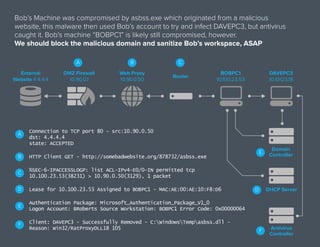
Bob’s Machine was compromised by asbss.exe which originated from a malicious
website, this malware then used Bob’s account to try and infect DAVEPC3, but antivirus
caught it. Bob’s machine “BOBPC1” is likely still compromised, however.
We should block the malicious domain and sanitize Bob’s workspace, ASAP
External	
Website 4.4.4.4
DMZ Firewall	
10.90.0.1
Web Proxy
10.90.0.50
BOBPC1	
10.100.23.53
DAVEPC3	
10.10123.18
Domain
Controller
DHCP Server
Antivirus
Controller
Router
A
A
B
C
D D
E
E
F
F
B C
Connection to TCP port 80 - src:10.90.0.50
dst: 4.4.4.4
state: ACCEPTED
HTTP Client GET - http://somebadwebsite.org/878732/asbss.exe
%SEC-6-IPACCESSLOGP: list ACL-IPv4-E0/0-IN permitted tcp
10.100.23.53(38231) > 10.90.0.50(3129), 1 packet
Lease for 10.100.23.53 Assigned to BOBPC1 - MAC:AE:00:AE:10:F8:D6
Authentication Package: Microsoft_Authentication_Package_V1_0
Logon Account: BRoberts Source Workstation: BOBPC1 Error Code: 0x00000064
Client: DAVEPC3 - Successfully Removed - C:WindowsTempasbss.dll -
Reason: Win32/RatProxyDLL18 105
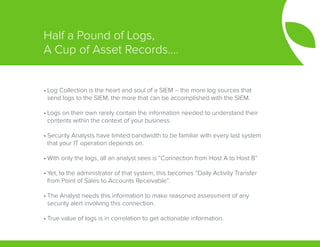
•	Log Collection is the heart and soul of a SIEM – the more log sources that
send logs to the SIEM, the more that can be accomplished with the SIEM.
•	Logs on their own rarely contain the information needed to understand their
contents within the context of your business.
•	Security Analysts have limited bandwidth to be familiar with every last system
that your IT operation depends on.
•	With only the logs, all an analyst sees is “Connection from Host A to Host B”
•	Yet, to the administrator of that system, this becomes “Daily Activity Transfer
from Point of Sales to Accounts Receivable”.
•	The Analyst needs this information to make reasoned assessment of any
security alert involving this connection.
•	True value of logs is in correlation to get actionable information.
Half a Pound of Logs,
A Cup of Asset Records….
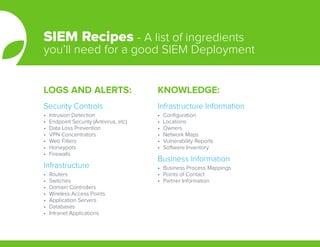
Security Controls
•	 Intrusion Detection
•	 Endpoint Security (Antivirus, etc)
•	 Data Loss Prevention
•	 VPN Concentrators
•	 Web Filters
•	 Honeypots
•	 Firewalls
Infrastructure
•	 Routers
•	 Switches
•	 Domain Controllers
•	 Wireless Access Points
•	 Application Servers
•	 Databases
•	 Intranet Applications
Infrastructure Information
•	 Configuration
•	 Locations
•	 Owners
•	 Network Maps
•	 Vulnerability Reports
•	 Software Inventory
Business Information
•	 Business Process Mappings
•	 Points of Contact
•	 Partner Information
LOGS AND ALERTS: KNOWLEDGE:
SIEM Recipes - A list of ingredients
you’ll need for a good SIEM Deployment
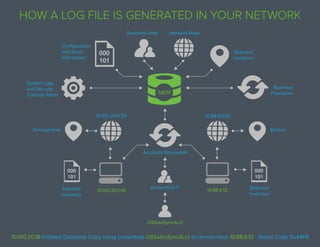
Business
Locations
Network MapsBusiness Units
Configuration
and Asset
Information
System Logs
and Security
Controls Alerts
Software
Inventory
Software
Inventory
10.100.20.0.18 10.88.6.12
10.100.20.0/24 10.88.5.0/16
Pennsylvania Boston
Business
Processes
Accounts Receivable
Accounting IT
USSaleSyncAcct
10.100.20.18 Initiated Database Copy using credentials USSalesSyncAcct to remote Host 10.88.6.12 - Status Code 0x44F8
How a Log File is Generated in Your Network
SIEM
Behold:
The Power
of Correlation
Correlation is the process of matching events from systems (hosts,
network devices, security controls, anything that sends logs to the SIEM.)
Events from different sources can be combined and compared against
each other to identify patterns of behavior invisible to individual devices…
They can also be matched against the information specific to your business.
Correlation allows you to automate detection for the things that
should not occur on your network.
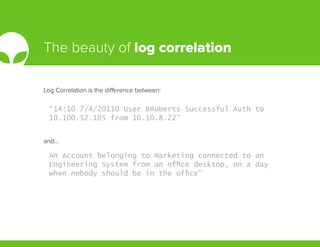
The beauty of log correlation
“14:10 7/4/20110 User BRoberts Successful Auth to
10.100.52.105 from 10.10.8.22”
An Account belonging to Marketing connected to an
Engineering System from an office desktop, on a day
when nobody should be in the office”
Log Correlation is the difference between:
and...
Your network generates vast amounts of log data – a Fortune 500 enterprise’s
infrastructure can generate 10 terabytes of plain-text log data per month, without
breaking a sweat.
You can’t hire enough people to read every line of those logs looking for bad stuff.
I’m serious, don’t even try this. Even if you succeeded, they’d be so bored they’d never
actually spot anything even if it was right in front of their face.. Which it would be.
Log Correlation lets you locate the interesting places in your logs –
that’s where the analysts start investigating…
And they’re going to find pieces of information that lead to other
pieces of information as the trail of evidence warms up.
Being able to search through the rest of those logs for that one thing they
suspect resides there is one of the other key functions of a SIEM.
It’s a good thing that a SIEM is fundamentally a…
Slow Cook for 8 Hours
Serve to Hungry Analysts…
…Giant Database of Logs.
It would be amazingly useful if every operating system and every application in the world, recorded their log
events in the same format – they don’t. Most logs are written to be readable by humans, not computers.
That makes using regular search tools over logs from different sources… a little difficult.
These two logs say the same thing to a human being,
but are very different from the machine’s point of view.
“User Broberts Successfully Authenticated to
10.100.52.105 from client 10.10.8.22”
“100.100.52.105 New Client Connection 10.10.8.22
on account: Broberts: Success”
Long story short – we’re going to need to break down every known
log message out there, into a normalized format.
“User [USERNAME] [STATUS] Authenticated to
[DESTIP] from client [SOURCEIP]”
“100.100.52.105 New Client Connection 10.10.8.22
on account: Broberts: Success”
So when you see a SIEM Product that talks about “how many devices it supports” –
it’s talking about how many devices it can parse the logs from.
Breaking those log entries down into their components – normalizing them, is what allows
us to search across logs from multiple devices and correlate events between them.
Once we’ve normalized logs into a database table, we can do database style searches, such as:
This is what allows us to do automated correlation as well, matching fields
between log events, across time periods, across device types.
Just as with any database, event normalization allows the creation of
report summarizations of our log information
Show [All Logs] From [All Devices] from the [last two
weeks], where the [username] is [Broberts]
If A single Host fails to log in to three separate
servers using the same credentials, within a 6-second
time window, raise an alert
What User Accounts have accessed the highest number
of distinct hosts in the last month?
What Subnet generate the highest number of failed login
attempts per day, averaged out over 6 months?”
Searches, Pivoting, and Cross-Correlation
But Wait, There’s More!
•	So you’ve now seen that SIEM is a recording device for the systems
that form your information infrastructure.
•	SIEM allows you to give analysts access to information from these systems,
without giving them access to the systems themselves.
•	Event Correlation allows you to encode security knowledge into automated searches
across events and asset information to alert on things happening within your infrastructure,
and create a starting point for human analysis into a sea of log data.
•	But to keep up with today’s threat landscape, you need more that just SIEM –
you need relevant data, a unified approach and integrated threat intelligence
to truly get a holistic view of your security posture.
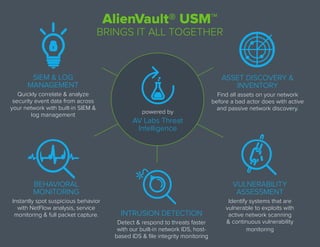
AlienVault® USM™
Brings it all together
ASSET DISCOVERY &
INVENTORY
Find all assets on your network
before a bad actor does with active
and passive network discovery.
SIEM & LOG
MANAGEMENT
Quickly correlate & analyze
security event data from across
your network with built-in SIEM &
log management
INTRUSION DETECTION
Detect & respond to threats faster
with our built-in network IDS, host-
based IDS & file integrity monitoring
VULNERABILITY
ASSESSMENT
Identify systems that are
vulnerable to exploits with
active network scanning
& continuous vulnerability
monitoring
BEHAVIORAL
MONITORING
Instantly spot suspicious behavior
with NetFlow analysis, service
monitoring & full packet capture.
powered by
AV Labs Threat
Intelligence
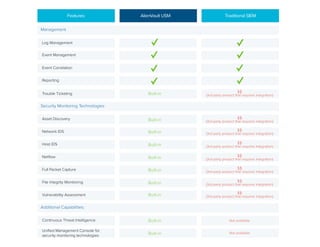
Trouble Ticketing
Asset Discovery
Log Management
Event Management
Event Correlation
Reporting
Features: AlienVault USM Traditional SIEM
Built-in $$
(3rd-party product that requires integration)
Security Monitoring Technologies
Network IDS
Host IDS
Netflow
Full Packet Capture
File Integrity Monitoring
Vulnerability Assessment
Additional Capabilities:
Built-in $$
(3rd-party product that requires integration)
Built-in $$
(3rd-party product that requires integration)
Built-in $$
(3rd-party product that requires integration)
Built-in $$
(3rd-party product that requires integration)
Built-in $$
(3rd-party product that requires integration)
Built-in $$
(3rd-party product that requires integration)
Built-in $$
(3rd-party product that requires integration)
Continuous Threat Intelligence Built-in Not available
Unified Management Console for
security monitoring technologies Built-in Not available
Management
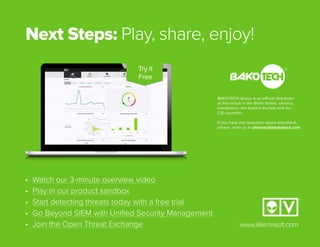
Next Steps: Play, share, enjoy!
www.alienvault.com
• Watch our 3-minute overview video
• Play in our product sandbox
• Start detecting threats today with a free trial
• Go Beyond SIEM with Unified Security Management
• Join the Open Threat Exchange
Try it
Free
BAKOTECH Group is an official distributor
of AlienVault in the Baltic States, Ukraine,
Kazakhstan, the Eastern Europe and the
CIS countries.
If you have any questions about AlienVault,
please, write us at alienvault@bakotech.com

SIEM for Beginners

  • 1.
    Everything You Wantedto Know About Log Management But were Afraid to Ask SIEM FOR BEGINNERS www.alienvault.com
  • 2.
    Although the industryhas settled on the term ‘SIEM’ as the catch-all term for this type of security software, it evolved from several different (but complementary) technologies that came before it. • LMS “Log Management System” – a system that collects and stores log files (from Operating Systems, Applications, etc) from multiple hosts and systems into a single location, allowing centralized access to logs instead of accessing them from each system individually. • SLM /SEM “Security Log/Event Management” – an LMS, but marketed towards security analysts instead of system administrators. SEM is about highlighting log entries as more significant to security than others. • SIM “Security Information Management” – an Asset Management system, but with features to incorporate security information too. Hosts may have vulnerability reports listed in their summaries, Intrusion Detection and AntiVirus alerts may be shown mapped to the systems involved. • SEC “Security Event Correlation” – To a particular piece of software, three failed login attempts to the same user account from three different clients, are just three lines in their logfile. To an analyst, that is a peculiar sequence of events worthy of investigation, and Log Correlation (looking for patterns in log files) is a way to raise alerts when these things happen. • SIEM “Security Information and Event Management” – SIEM is the “All of the Above” option, and as the above technologies become merged into single products, became the generalized term for managing information generated from security controls and infrastructure. We’ll use the term SIEM for the rest of this presentation. A Rose By Any Other Name SLM/LMS, SIM, SEM, SEC, SIEM
  • 3.
    The information youneed to answer “Who’s attacking us today?” and “How did they get access to all our corporate secrets?” We may think of Security Controls as containing all the information we need to be secure, but often they only contain the things they have detected – there is no ‘before and after the event’ context within them. This context is usually vital to separate the false positive from true detection, the actual attack from a merely misconfigured system. Successful attacks on computer systems rarely look like real attacks except in hindsight – if this were not the case, we could automate ALL security defenses without ever needing to employ human analysts. Attackers will try to remove and falsify log entries to cover their tracks – having a source of log information that can be trusted is vital to any legal proceeding from computer misuse. What’s in the Logs? What’s In the Logs?!!Q: A:
  • 4.
    SIEM is aboutlooking at what’s happening on your network through a larger lens than can be provided via any one security control or information source. None of these by themselves, can tell you what is happening to your business in terms of securing the continuity of your business processes… But together, they can. • Your Intrusion Detection only understands Packets, Protocols & IP Addresses • Your Endpoint Security sees files, usernames & hosts • Your Service Logs show user logins, service activity & configuration changes. • Your Asset Management system sees apps, business processes & owners The Blind Men and the Security Information Elephant
  • 5.
    SIEM is essentiallynothing more than a management layer above your existing systems and security controls. It connects and unifies the information contained in your existing systems, allowing them to be analyzed and cross-referenced from a single interface. SIEM is a perfect example of the ‘Garbage In, Garbage Out’ principle of computing: SIEM is only as useful as the information you put into it. The more valid information depicting your network, systems, and behavior the SIEM has, the more effective it will be in helping you make effective detections, analyses, and responses in your security operations. SIEM A Single View of Your IT Security
  • 6.
    Bob’s Machine wascompromised by asbss.exe which originated from a malicious website, this malware then used Bob’s account to try and infect DAVEPC3, but antivirus caught it. Bob’s machine “BOBPC1” is likely still compromised, however. We should block the malicious domain and sanitize Bob’s workspace, ASAP External Website 4.4.4.4 DMZ Firewall 10.90.0.1 Web Proxy 10.90.0.50 BOBPC1 10.100.23.53 DAVEPC3 10.10123.18 Domain Controller DHCP Server Antivirus Controller Router A A B C D D E E F F B C Connection to TCP port 80 - src:10.90.0.50 dst: 4.4.4.4 state: ACCEPTED HTTP Client GET - http://somebadwebsite.org/878732/asbss.exe %SEC-6-IPACCESSLOGP: list ACL-IPv4-E0/0-IN permitted tcp 10.100.23.53(38231) > 10.90.0.50(3129), 1 packet Lease for 10.100.23.53 Assigned to BOBPC1 - MAC:AE:00:AE:10:F8:D6 Authentication Package: Microsoft_Authentication_Package_V1_0 Logon Account: BRoberts Source Workstation: BOBPC1 Error Code: 0x00000064 Client: DAVEPC3 - Successfully Removed - C:WindowsTempasbss.dll - Reason: Win32/RatProxyDLL18 105
  • 7.
    • Log Collection isthe heart and soul of a SIEM – the more log sources that send logs to the SIEM, the more that can be accomplished with the SIEM. • Logs on their own rarely contain the information needed to understand their contents within the context of your business. • Security Analysts have limited bandwidth to be familiar with every last system that your IT operation depends on. • With only the logs, all an analyst sees is “Connection from Host A to Host B” • Yet, to the administrator of that system, this becomes “Daily Activity Transfer from Point of Sales to Accounts Receivable”. • The Analyst needs this information to make reasoned assessment of any security alert involving this connection. • True value of logs is in correlation to get actionable information. Half a Pound of Logs, A Cup of Asset Records….
  • 8.
    Security Controls • IntrusionDetection • Endpoint Security (Antivirus, etc) • Data Loss Prevention • VPN Concentrators • Web Filters • Honeypots • Firewalls Infrastructure • Routers • Switches • Domain Controllers • Wireless Access Points • Application Servers • Databases • Intranet Applications Infrastructure Information • Configuration • Locations • Owners • Network Maps • Vulnerability Reports • Software Inventory Business Information • Business Process Mappings • Points of Contact • Partner Information LOGS AND ALERTS: KNOWLEDGE: SIEM Recipes - A list of ingredients you’ll need for a good SIEM Deployment
  • 9.
    Business Locations Network MapsBusiness Units Configuration andAsset Information System Logs and Security Controls Alerts Software Inventory Software Inventory 10.100.20.0.18 10.88.6.12 10.100.20.0/24 10.88.5.0/16 Pennsylvania Boston Business Processes Accounts Receivable Accounting IT USSaleSyncAcct 10.100.20.18 Initiated Database Copy using credentials USSalesSyncAcct to remote Host 10.88.6.12 - Status Code 0x44F8 How a Log File is Generated in Your Network SIEM
  • 10.
    Behold: The Power of Correlation Correlationis the process of matching events from systems (hosts, network devices, security controls, anything that sends logs to the SIEM.) Events from different sources can be combined and compared against each other to identify patterns of behavior invisible to individual devices… They can also be matched against the information specific to your business. Correlation allows you to automate detection for the things that should not occur on your network.
  • 11.
    The beauty oflog correlation “14:10 7/4/20110 User BRoberts Successful Auth to 10.100.52.105 from 10.10.8.22” An Account belonging to Marketing connected to an Engineering System from an office desktop, on a day when nobody should be in the office” Log Correlation is the difference between: and...
  • 12.
    Your network generatesvast amounts of log data – a Fortune 500 enterprise’s infrastructure can generate 10 terabytes of plain-text log data per month, without breaking a sweat. You can’t hire enough people to read every line of those logs looking for bad stuff. I’m serious, don’t even try this. Even if you succeeded, they’d be so bored they’d never actually spot anything even if it was right in front of their face.. Which it would be. Log Correlation lets you locate the interesting places in your logs – that’s where the analysts start investigating… And they’re going to find pieces of information that lead to other pieces of information as the trail of evidence warms up. Being able to search through the rest of those logs for that one thing they suspect resides there is one of the other key functions of a SIEM. It’s a good thing that a SIEM is fundamentally a… Slow Cook for 8 Hours Serve to Hungry Analysts…
  • 13.
    …Giant Database ofLogs. It would be amazingly useful if every operating system and every application in the world, recorded their log events in the same format – they don’t. Most logs are written to be readable by humans, not computers. That makes using regular search tools over logs from different sources… a little difficult. These two logs say the same thing to a human being, but are very different from the machine’s point of view. “User Broberts Successfully Authenticated to 10.100.52.105 from client 10.10.8.22” “100.100.52.105 New Client Connection 10.10.8.22 on account: Broberts: Success” Long story short – we’re going to need to break down every known log message out there, into a normalized format. “User [USERNAME] [STATUS] Authenticated to [DESTIP] from client [SOURCEIP]” “100.100.52.105 New Client Connection 10.10.8.22 on account: Broberts: Success” So when you see a SIEM Product that talks about “how many devices it supports” – it’s talking about how many devices it can parse the logs from.
  • 14.
    Breaking those logentries down into their components – normalizing them, is what allows us to search across logs from multiple devices and correlate events between them. Once we’ve normalized logs into a database table, we can do database style searches, such as: This is what allows us to do automated correlation as well, matching fields between log events, across time periods, across device types. Just as with any database, event normalization allows the creation of report summarizations of our log information Show [All Logs] From [All Devices] from the [last two weeks], where the [username] is [Broberts] If A single Host fails to log in to three separate servers using the same credentials, within a 6-second time window, raise an alert What User Accounts have accessed the highest number of distinct hosts in the last month? What Subnet generate the highest number of failed login attempts per day, averaged out over 6 months?” Searches, Pivoting, and Cross-Correlation
  • 15.
    But Wait, There’sMore! • So you’ve now seen that SIEM is a recording device for the systems that form your information infrastructure. • SIEM allows you to give analysts access to information from these systems, without giving them access to the systems themselves. • Event Correlation allows you to encode security knowledge into automated searches across events and asset information to alert on things happening within your infrastructure, and create a starting point for human analysis into a sea of log data. • But to keep up with today’s threat landscape, you need more that just SIEM – you need relevant data, a unified approach and integrated threat intelligence to truly get a holistic view of your security posture.
  • 16.
    AlienVault® USM™ Brings itall together ASSET DISCOVERY & INVENTORY Find all assets on your network before a bad actor does with active and passive network discovery. SIEM & LOG MANAGEMENT Quickly correlate & analyze security event data from across your network with built-in SIEM & log management INTRUSION DETECTION Detect & respond to threats faster with our built-in network IDS, host- based IDS & file integrity monitoring VULNERABILITY ASSESSMENT Identify systems that are vulnerable to exploits with active network scanning & continuous vulnerability monitoring BEHAVIORAL MONITORING Instantly spot suspicious behavior with NetFlow analysis, service monitoring & full packet capture. powered by AV Labs Threat Intelligence
  • 17.
    Trouble Ticketing Asset Discovery LogManagement Event Management Event Correlation Reporting Features: AlienVault USM Traditional SIEM Built-in $$ (3rd-party product that requires integration) Security Monitoring Technologies Network IDS Host IDS Netflow Full Packet Capture File Integrity Monitoring Vulnerability Assessment Additional Capabilities: Built-in $$ (3rd-party product that requires integration) Built-in $$ (3rd-party product that requires integration) Built-in $$ (3rd-party product that requires integration) Built-in $$ (3rd-party product that requires integration) Built-in $$ (3rd-party product that requires integration) Built-in $$ (3rd-party product that requires integration) Built-in $$ (3rd-party product that requires integration) Continuous Threat Intelligence Built-in Not available Unified Management Console for security monitoring technologies Built-in Not available Management
  • 18.
    Next Steps: Play,share, enjoy! www.alienvault.com • Watch our 3-minute overview video • Play in our product sandbox • Start detecting threats today with a free trial • Go Beyond SIEM with Unified Security Management • Join the Open Threat Exchange Try it Free BAKOTECH Group is an official distributor of AlienVault in the Baltic States, Ukraine, Kazakhstan, the Eastern Europe and the CIS countries. If you have any questions about AlienVault, please, write us at alienvault@bakotech.com