Metadata 2.0, Glocalization, and Being Where Their Eyes Are: What’s So Special About Special Collections? Karen Calhoun Vice President, WorldCat & Metadata Services Los Angeles, CA 26 June 2008 49 th  Annual RBMS Preconference
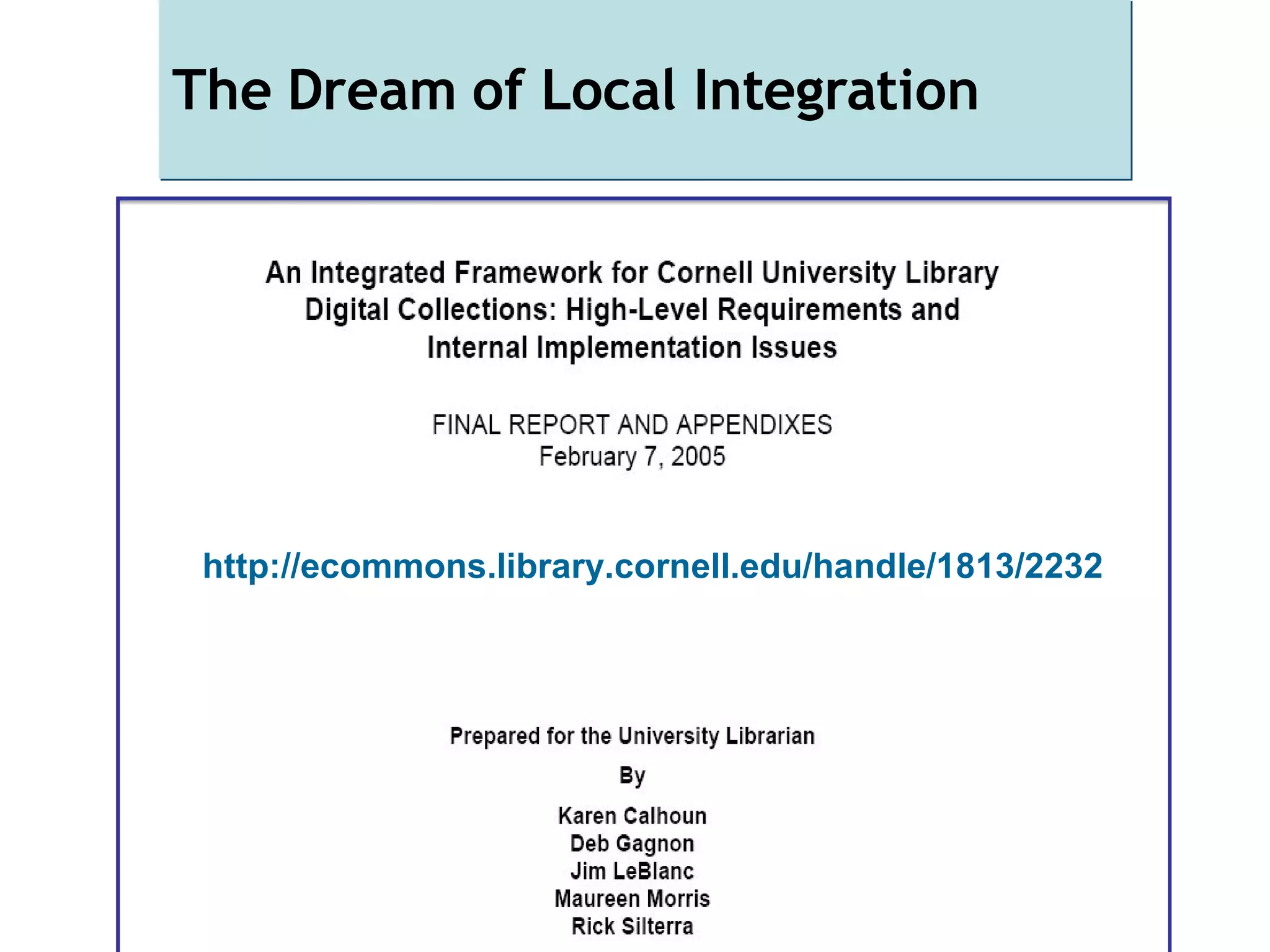
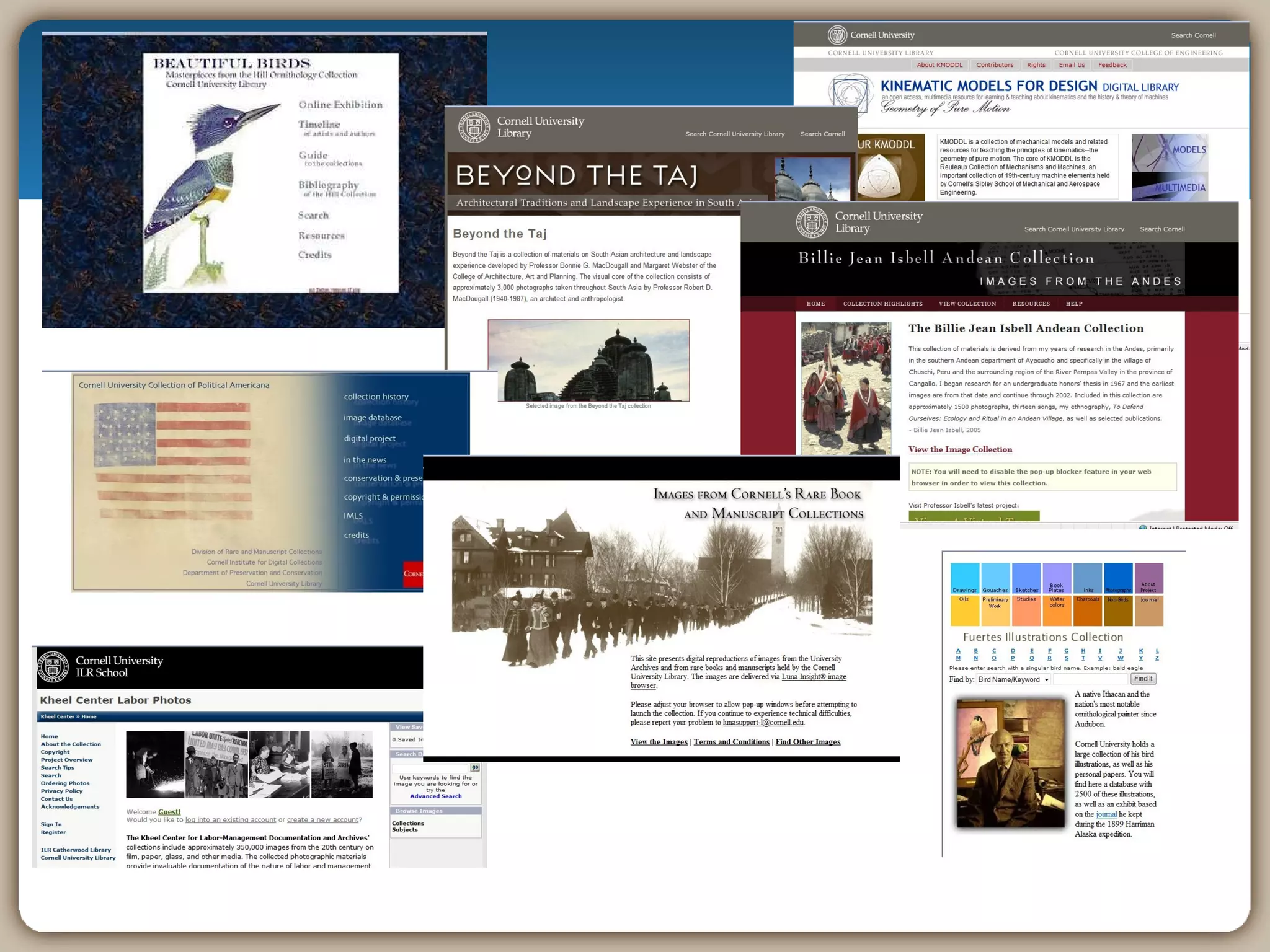
The Dream of Local Integration http://ecommons.library.cornell.edu/handle/1813/2232
 
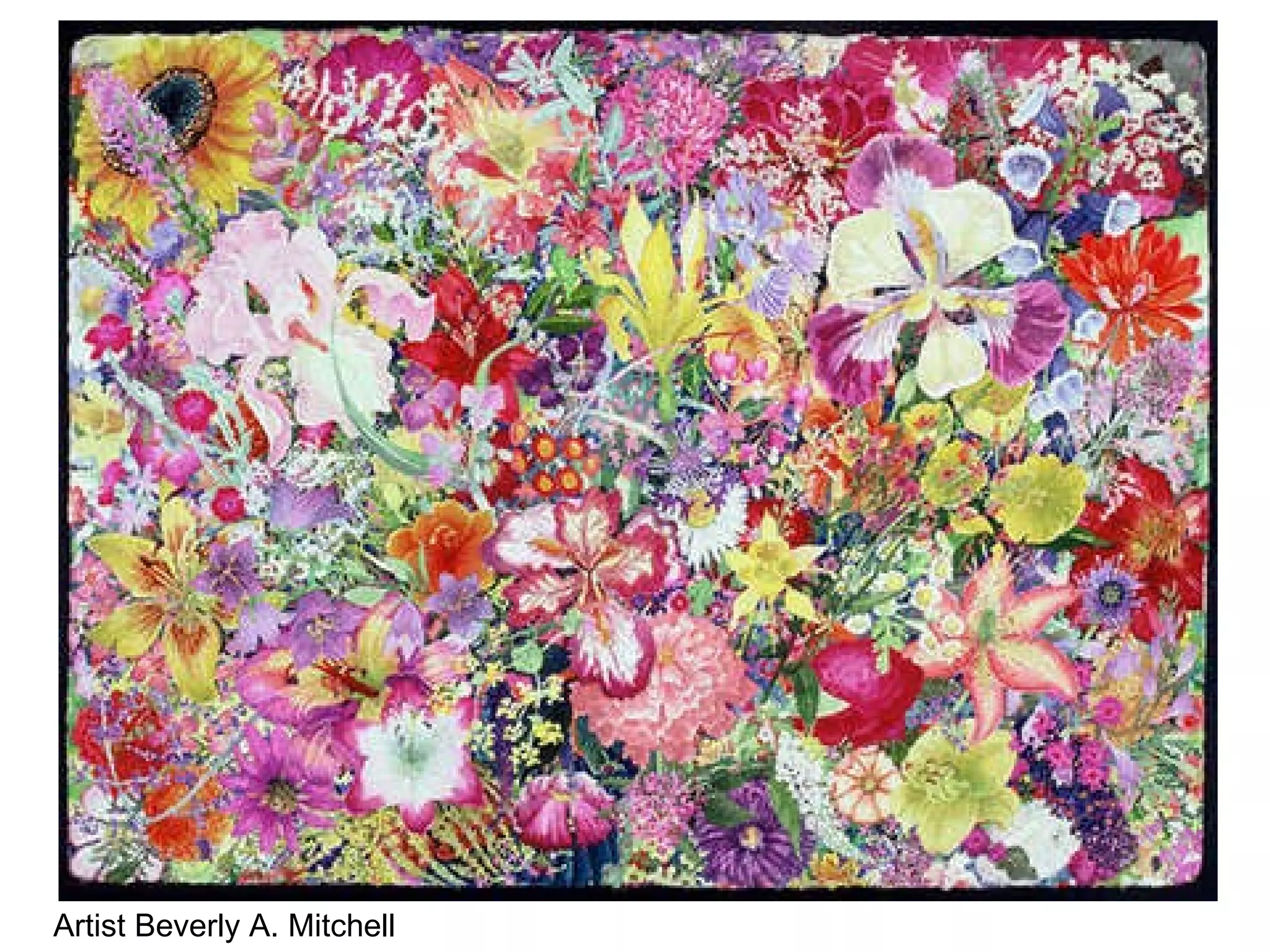
Artist Beverly A. Mitchell
One Hundred Flowers Blooming “ At this stage, no new effort should be undertaken without a sense of how it will be merged with other existing collections and where the resources for  long-term maintenance will come from.” --A Cornell University Library digital projects librarian Moving from Project to Program
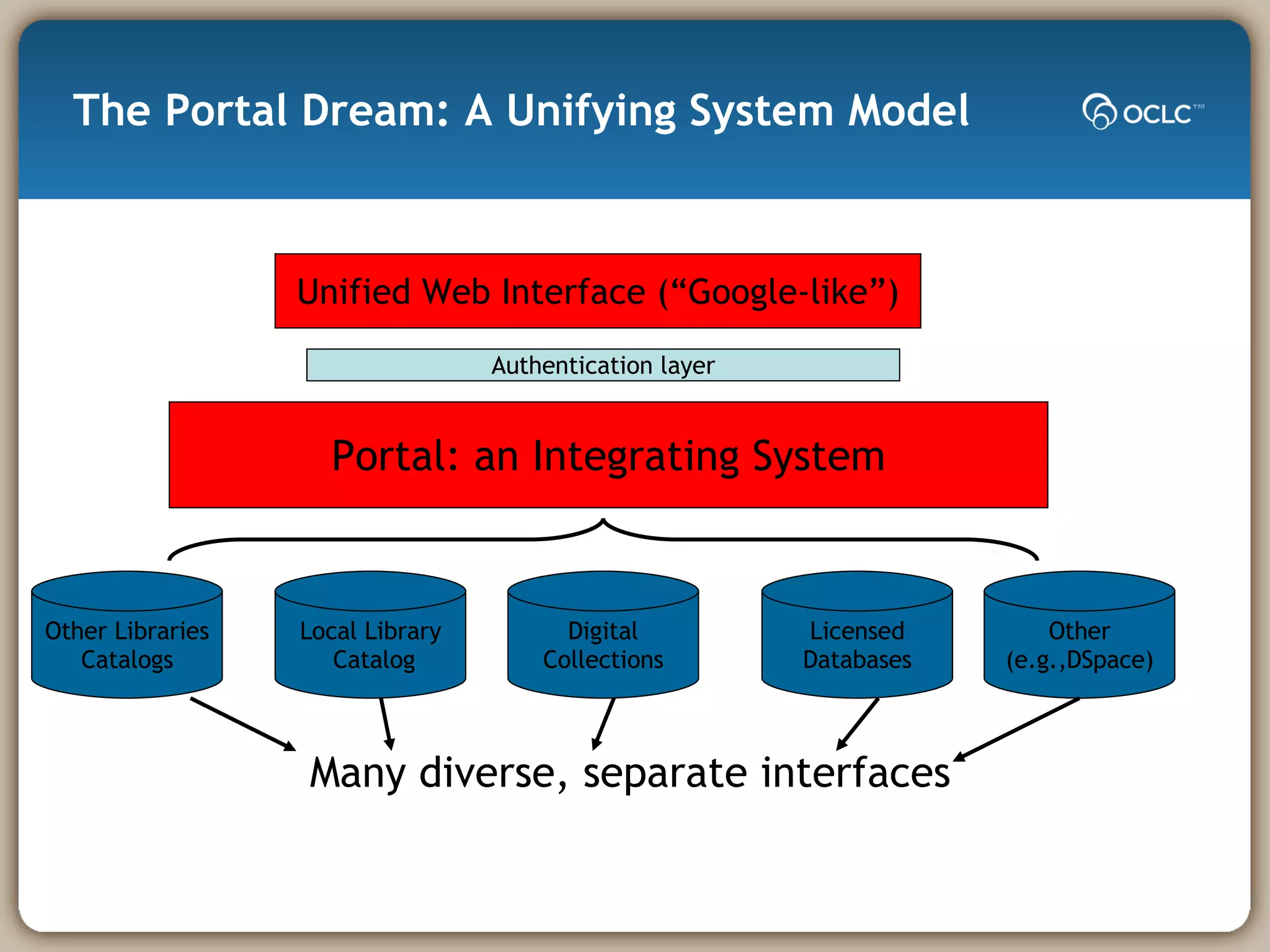
The Portal Dream: A Unifying System Model Other Libraries Catalogs Local Library Catalog Digital Collections Licensed Databases Other (e.g.,DSpace) Many diverse, separate interfaces Portal: an Integrating System Authentication layer Unified Web Interface (“Google-like”)
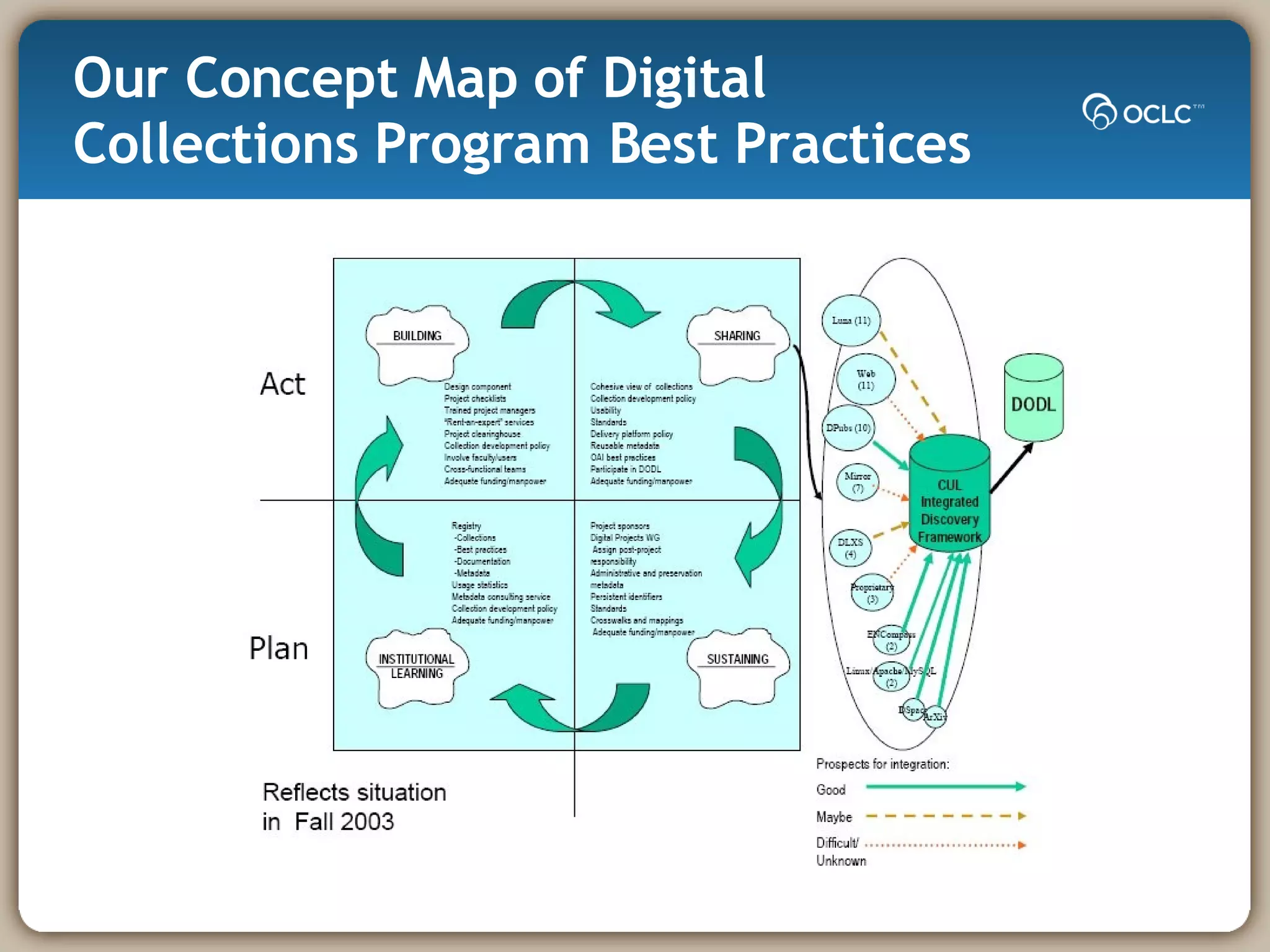
Our Concept Map of Digital Collections Program Best Practices
How It Ended “ One reviewer of an early draft of this report wondered if an integrated discovery framework would add sufficient value, considering that despite the impressive volume of material that CUL has digitized, most of  the existing collections are fragments  of larger corpuses or otherwise narrow in scope.”
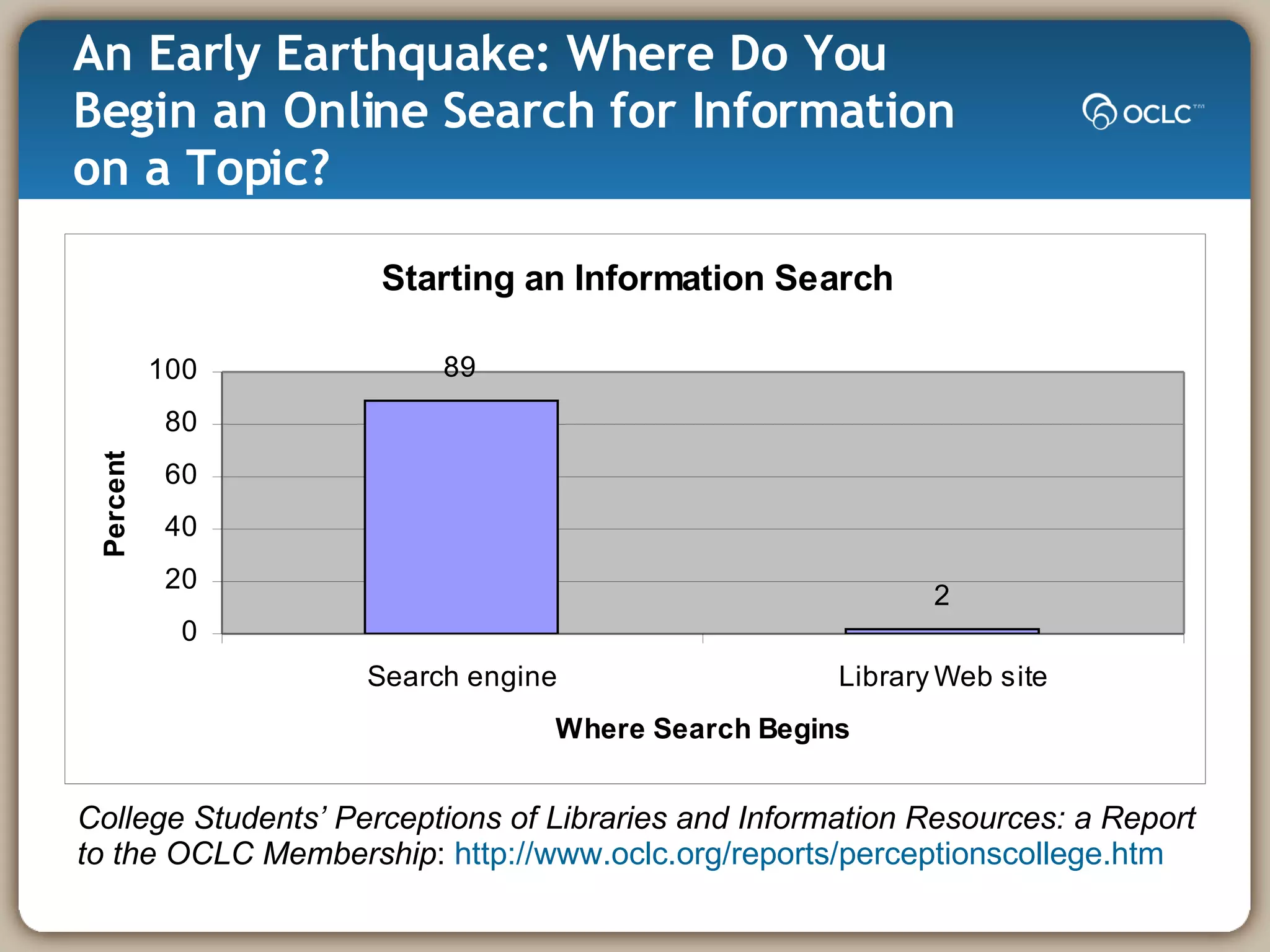
An Early Earthquake: Where Do You Begin an Online Search for Information on a Topic? College Students’ Perceptions of Libraries and Information Resources: a Report to the OCLC Membership :  http://www.oclc.org/reports/perceptionscollege.htm
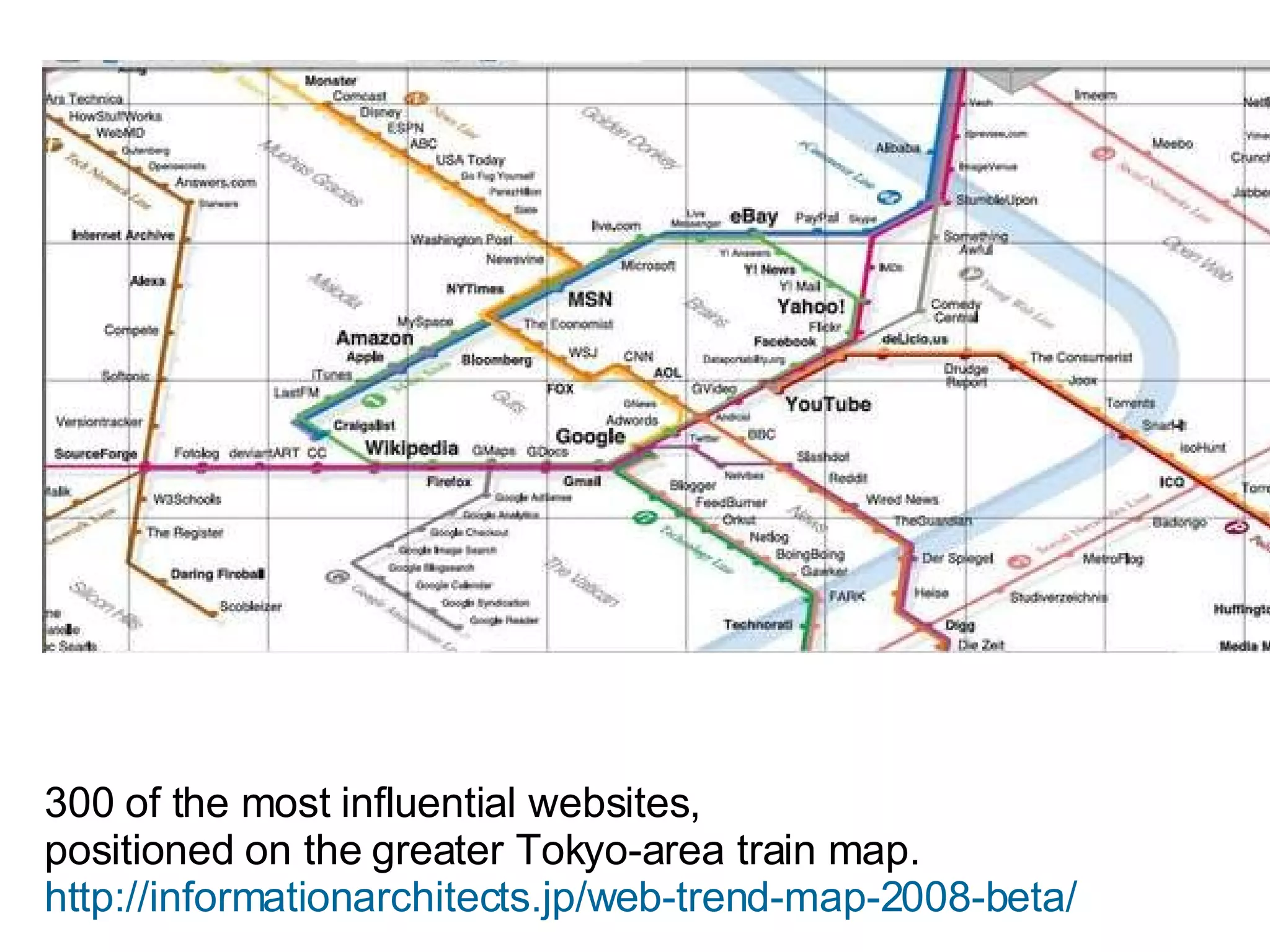
300 of the most influential websites,  positioned on the greater Tokyo-area train map.  http://informationarchitects.jp/web-trend-map-2008-beta/
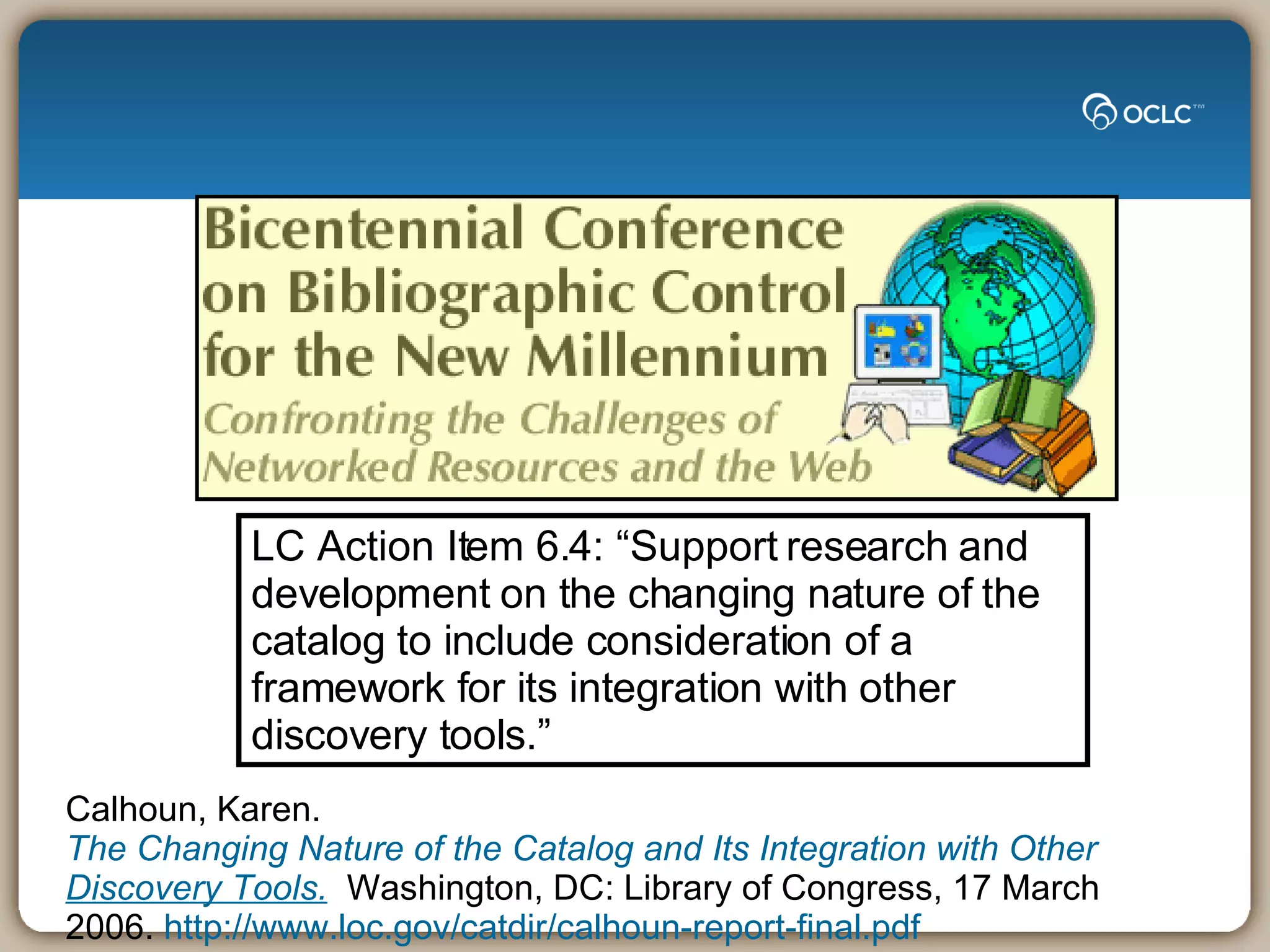
LC Action Item 6.4: “Support research and development on the changing nature of the catalog to include consideration of a framework for its integration with other discovery tools.” Calhoun, Karen.  The Changing Nature of the Catalog and Its Integration with Other  Discovery  Tools.    Washington, DC: Library of Congress, 17 March 2006.  http://www.loc.gov/catdir/calhoun-report-final.pdf
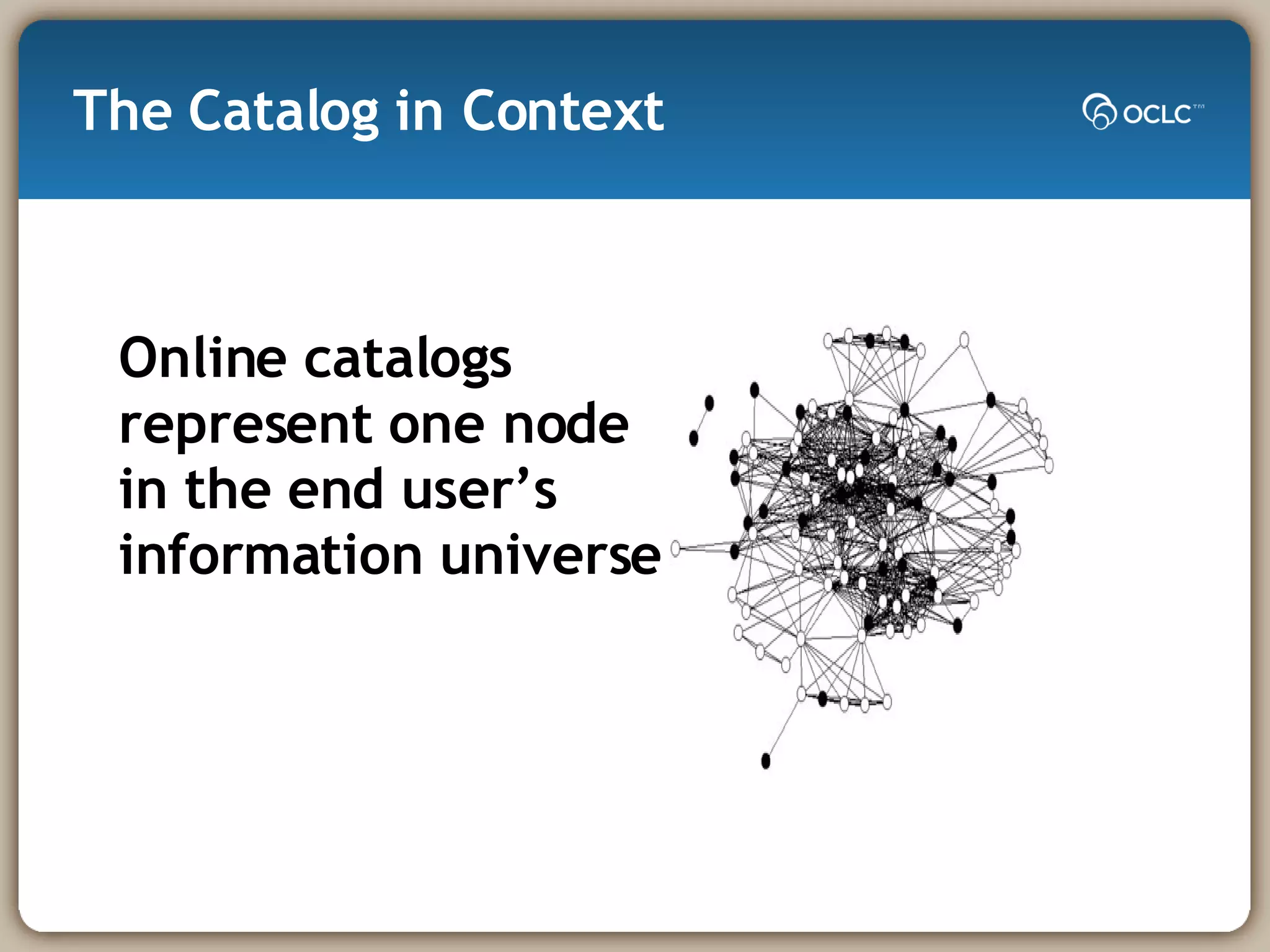
The Catalog in Context Online catalogs represent one node in the end user’s information universe
Outward Integration “ Integration should be outward rather than inward, with libraries seeking to use their components in new ways” --Interviewee for LC report on future of the catalog
Longer Term Vision Switch users from where they find things to library-managed collections of all kinds Local catalog one link in a chain of services, one repository managed by the library  More coherent and comprehensive scholarly information systems, perhaps by discipline Infrastructure to permit global discovery and delivery of information among open, loosely-coupled systems Critical mass of digitized publications and special collections online  Many starting points on the Web leading to many types of scholarly information objects
Intermediate Vision  Shared OPACs: begin to aggregate discovery function for books, serials, and their e-counterparts Draw on the local catalog’s strongest suit: support for inventory control and delivery Larger scale collaboration on collection development/resource sharing, storage, preservation
Intermediate Vision, 2 Start to build bigger scholarly information environments—with libraries playing a role—to aggregate more of the expanding universe of scholarly digital assets Metadata and outreach skills = strategic assets
Intermediate Vision, 3 Beginning of the era of special collections Aggregate discovery of digital collections More emphasis on visual resources
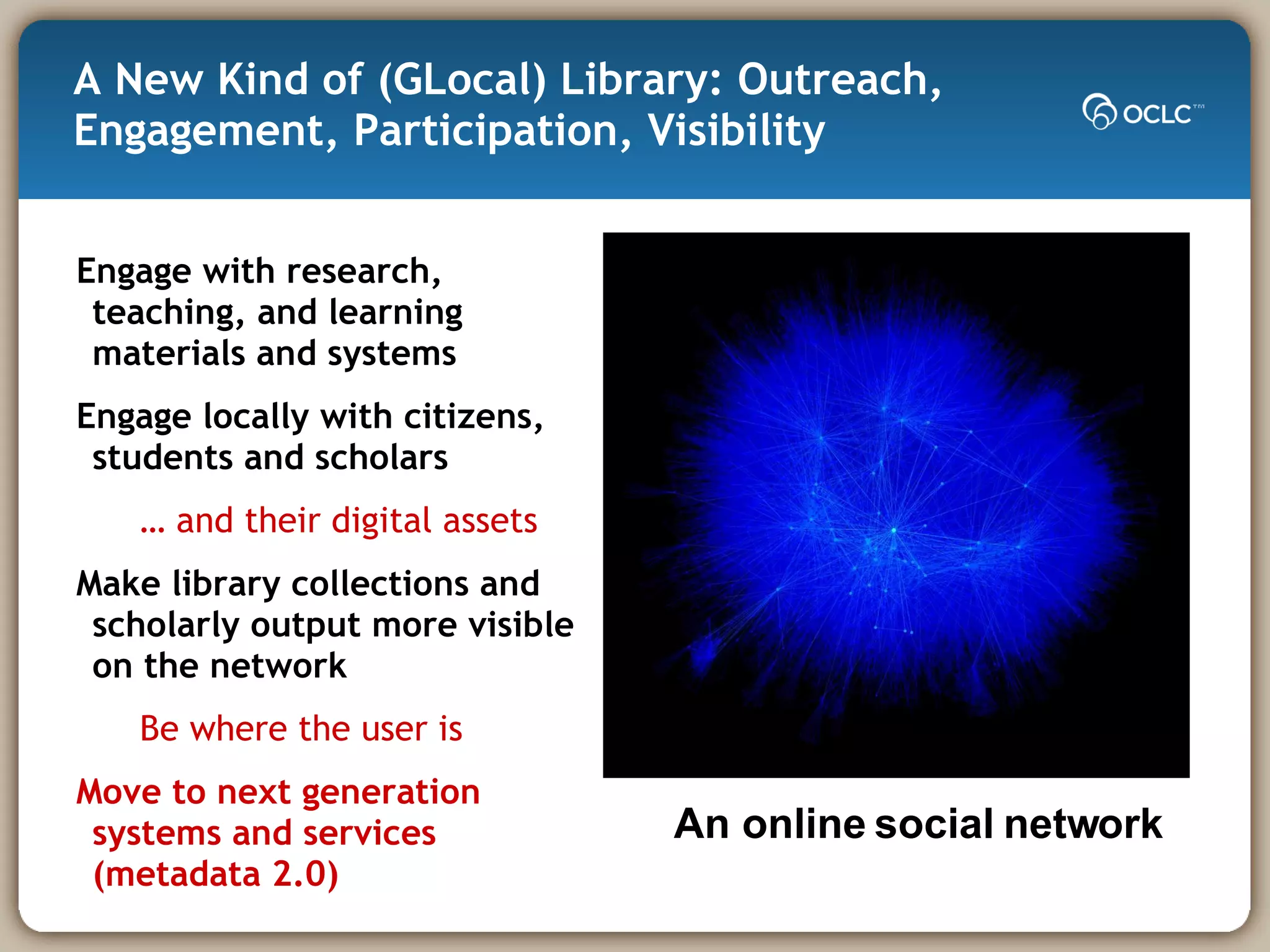
A New Kind of (GLocal) Library: Outreach,  Engagement, Participation, Visibility Engage with research, teaching, and learning materials and systems Engage locally with citizens, students and scholars  …  and their digital assets Make library collections and scholarly output more visible on the network Be where the user is  Move to next generation systems and services (metadata 2.0) An online social network
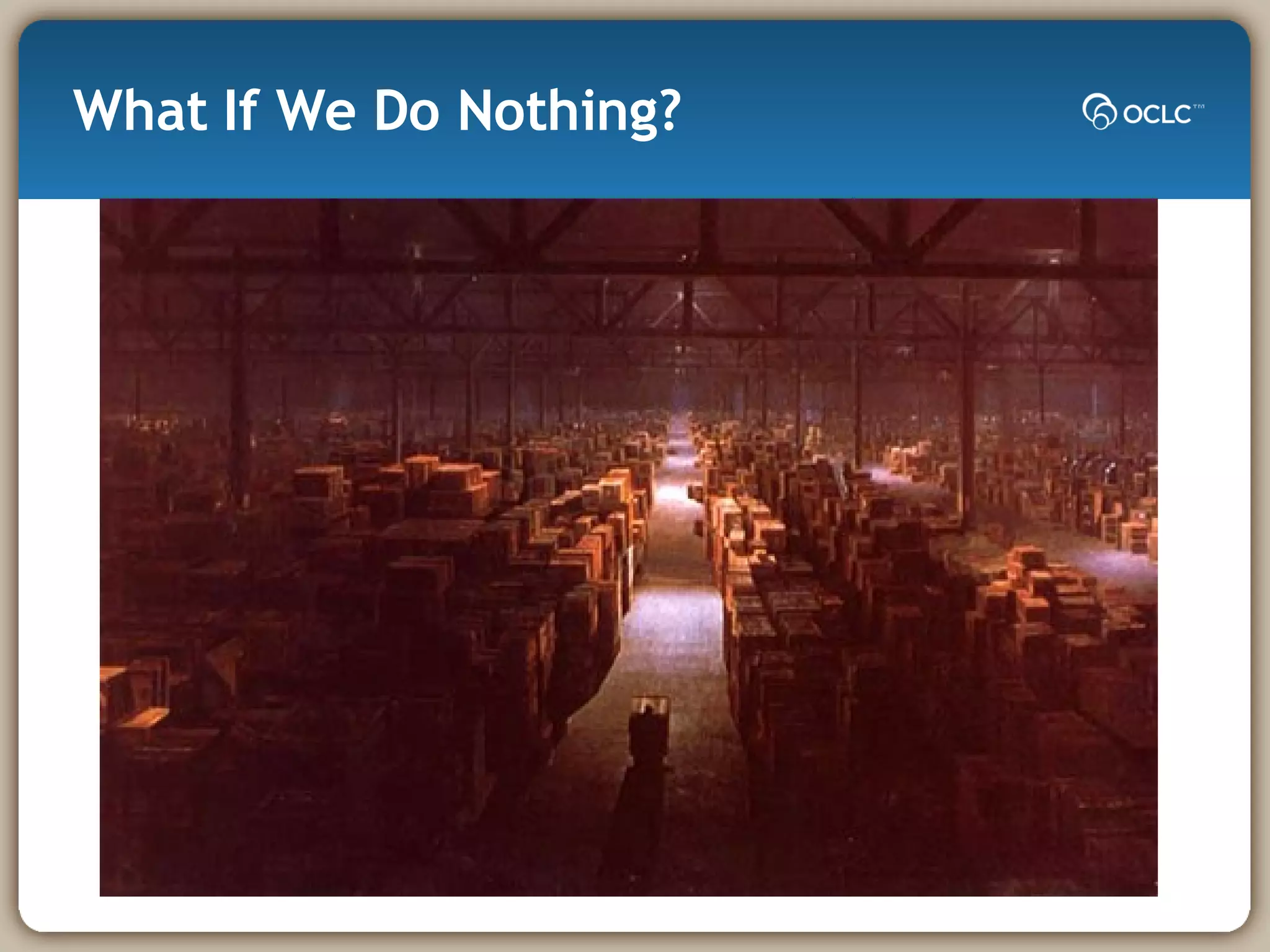
What If We Do Nothing?
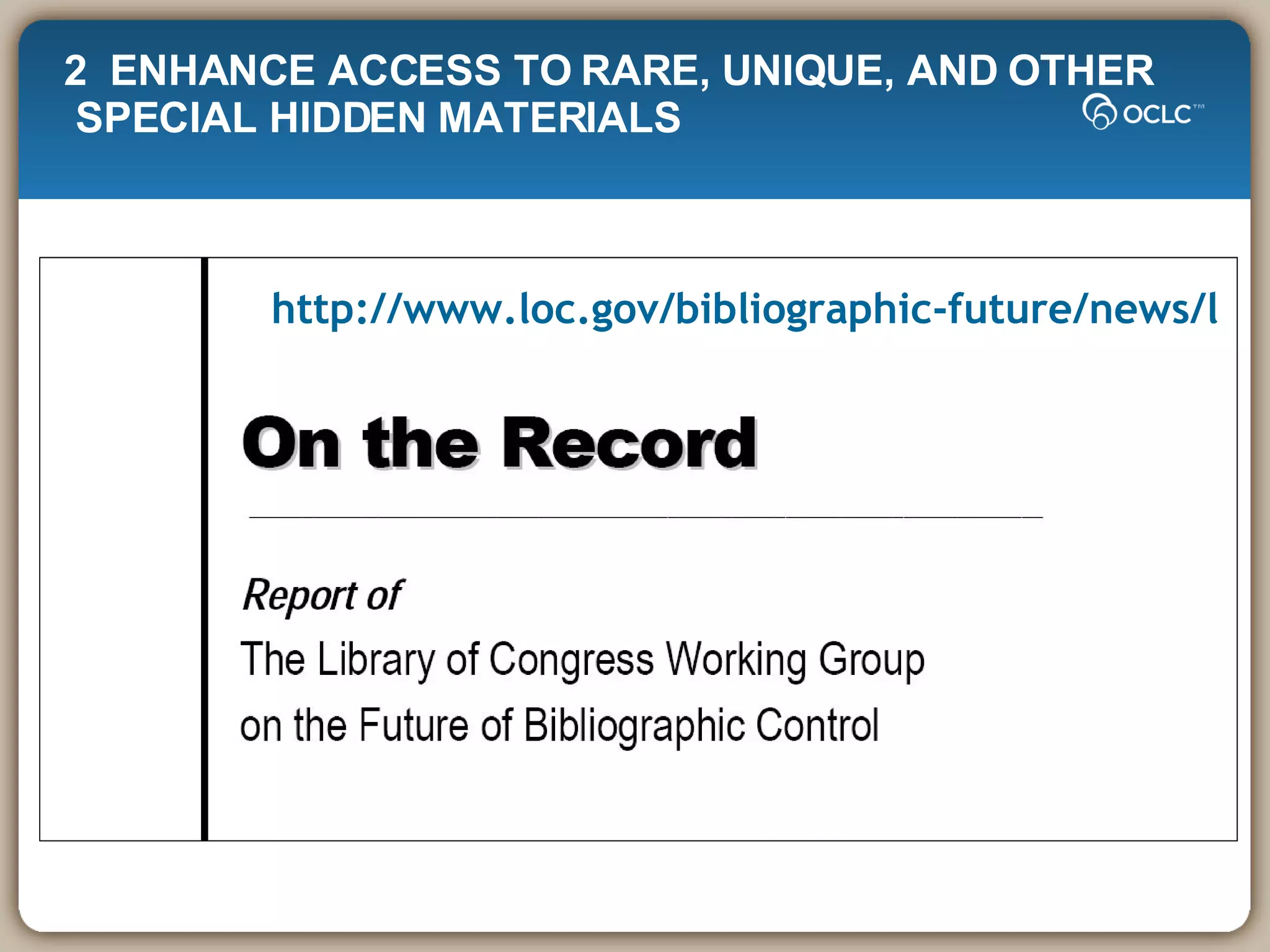
http://www.loc.gov/bibliographic-future/news/lcwg-ontherecord-jan08-final.pdf 2  ENHANCE ACCESS TO RARE, UNIQUE, AND OTHER SPECIAL HIDDEN MATERIALS
2  ENHANCE ACCESS TO RARE, UNIQUE, AND OTHER SPECIAL HIDDEN MATERIALS  2.1.1 Make the discovery of rare, unique and other special hidden materials a high priority 2.1.2 Streamline cataloging for rare, unique and other special hidden materials, emphasizing greater coverage and broader access 2.1.3 Integrate access to rare, unique and other special hidden materials with other library materials 2.1.4 Encourage digitization to allow broader access 2.1.5 Share access to rare, unique and other special hidden materials
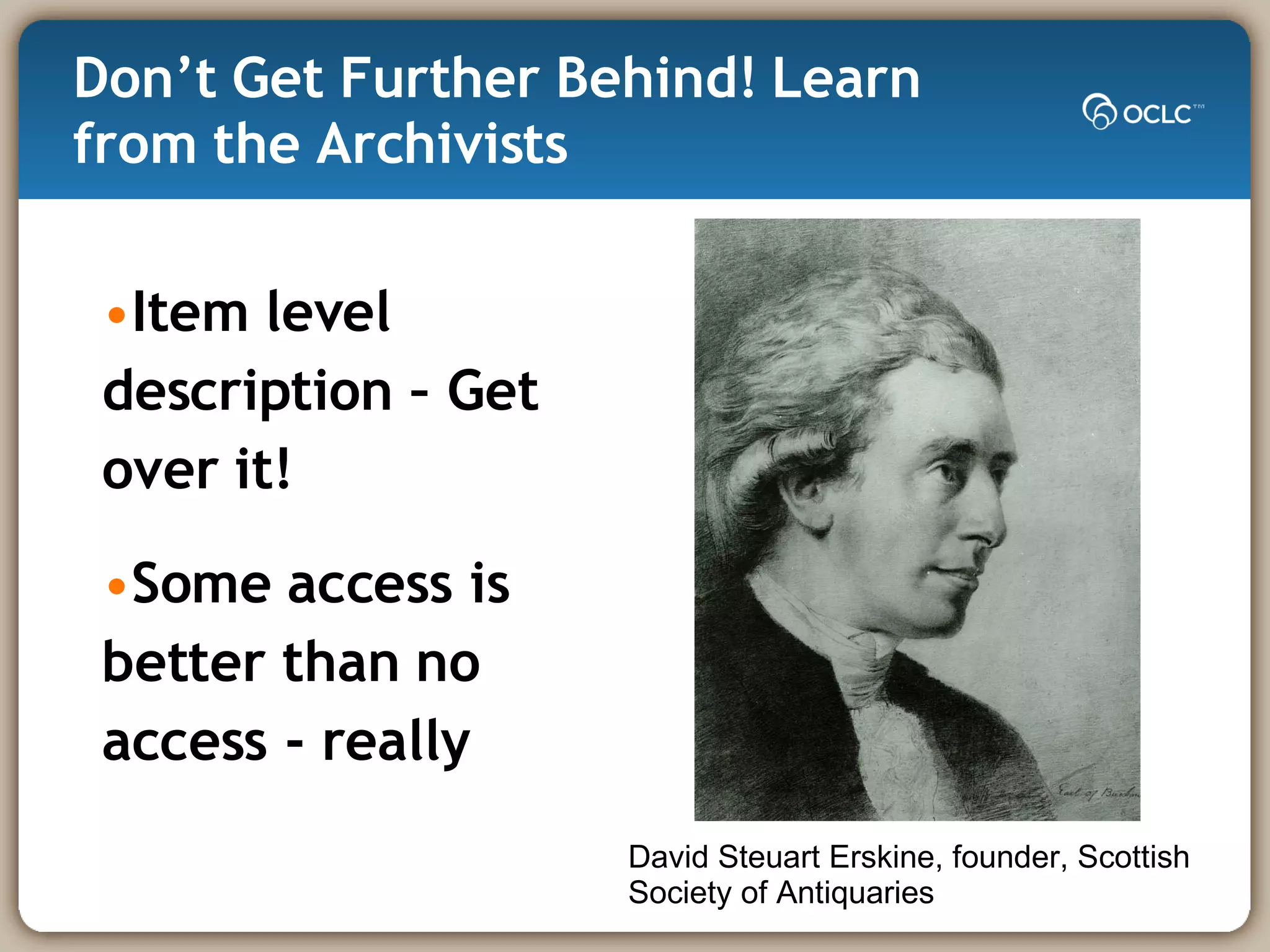
Don’t Get Further Behind! Learn from the Archivists Item level description – Get over it! Some access is better than no access - really David Steuart Erskine, founder, Scottish Society of Antiquaries
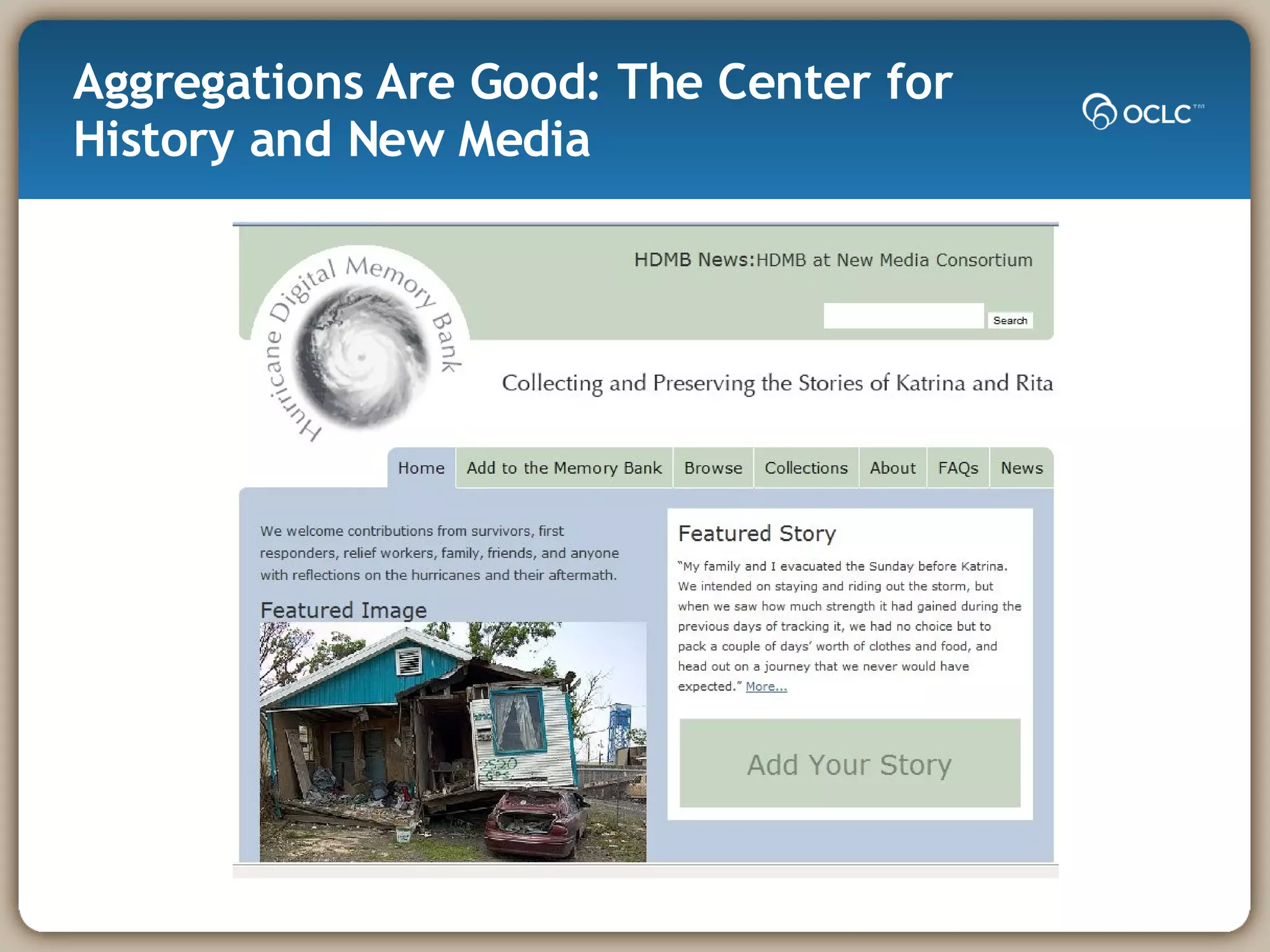
Aggregations Are Good: The Center for History and New Media
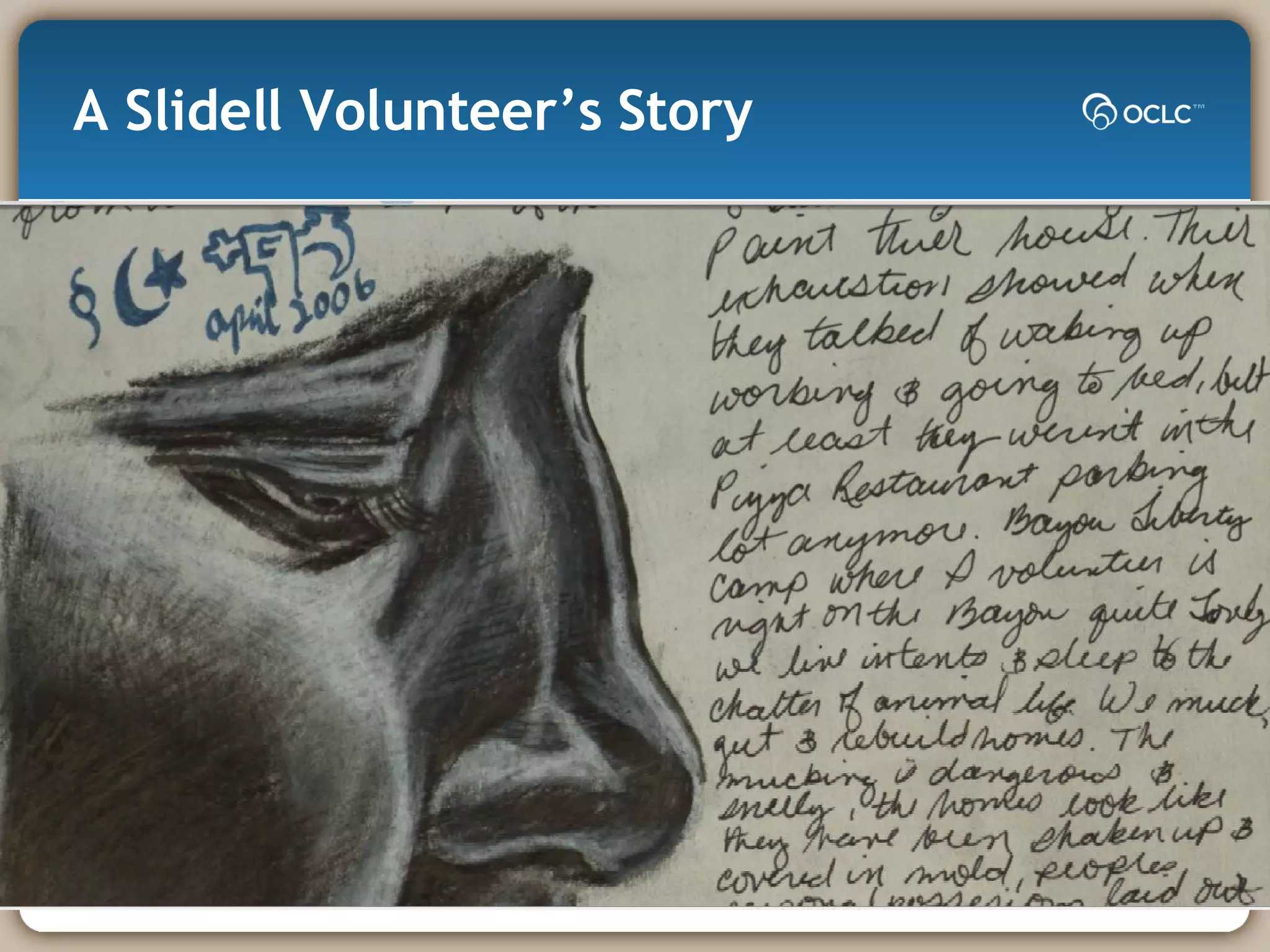
A Slidell Volunteer’s Story
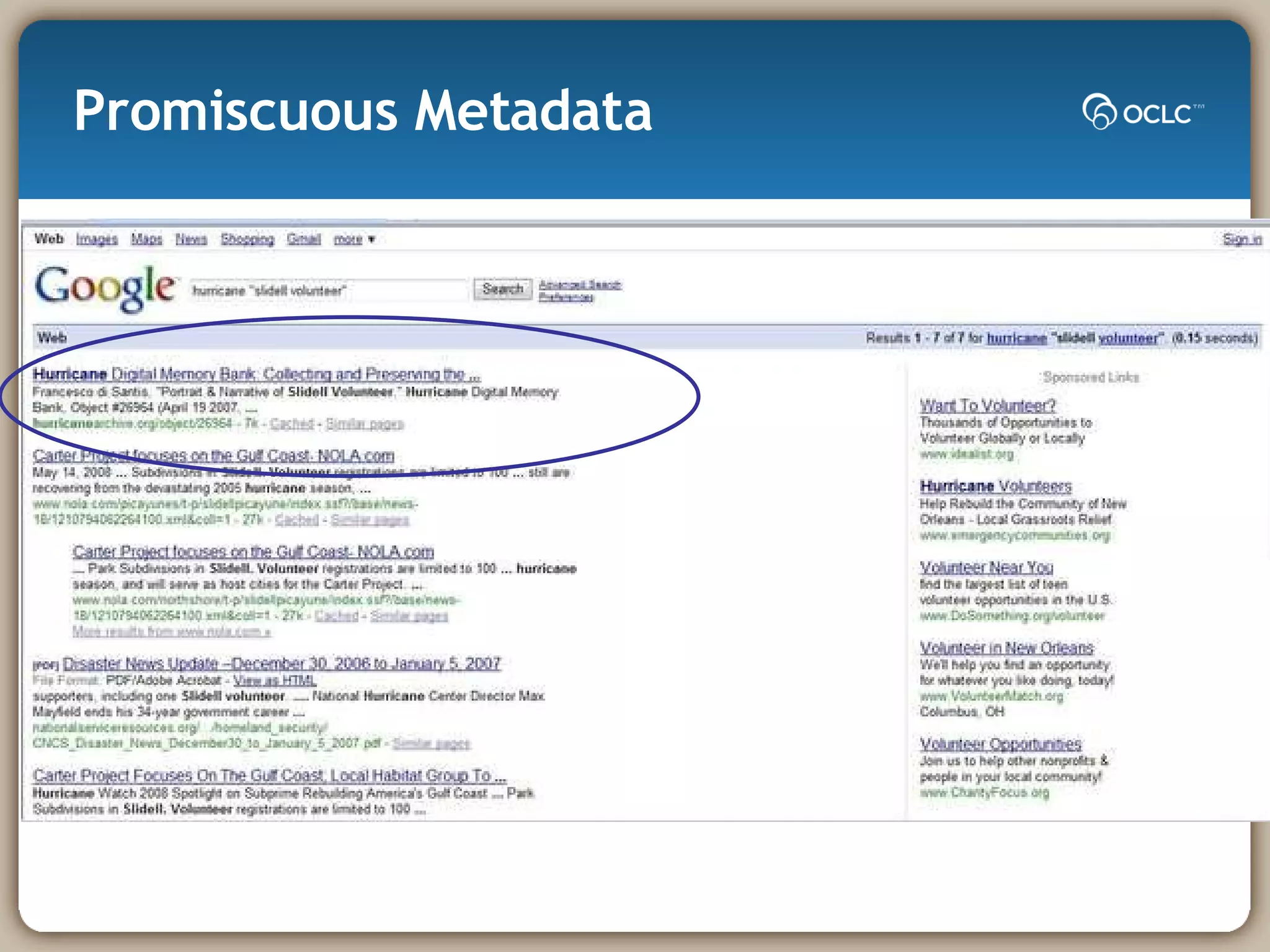
Promiscuous Metadata
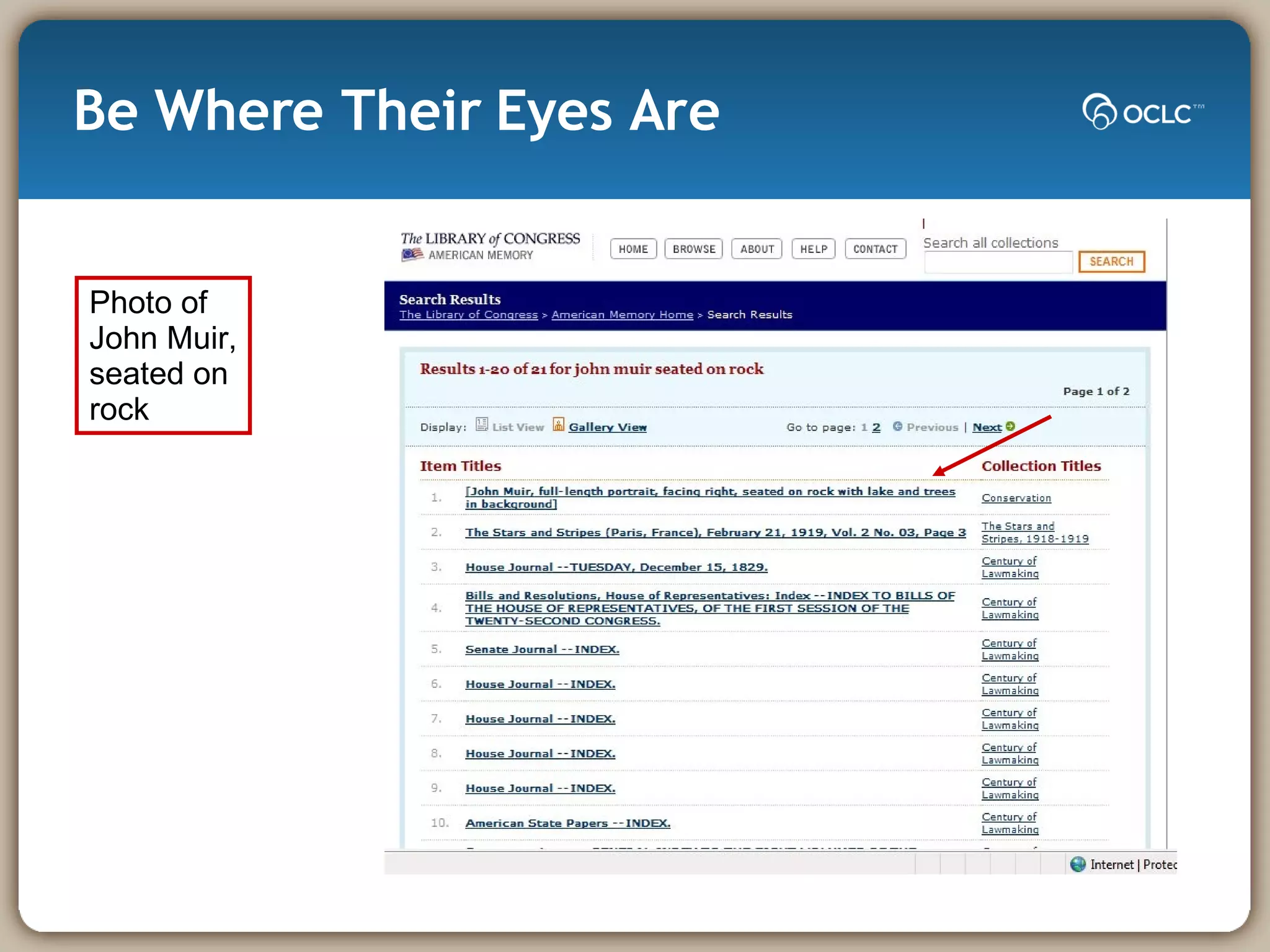
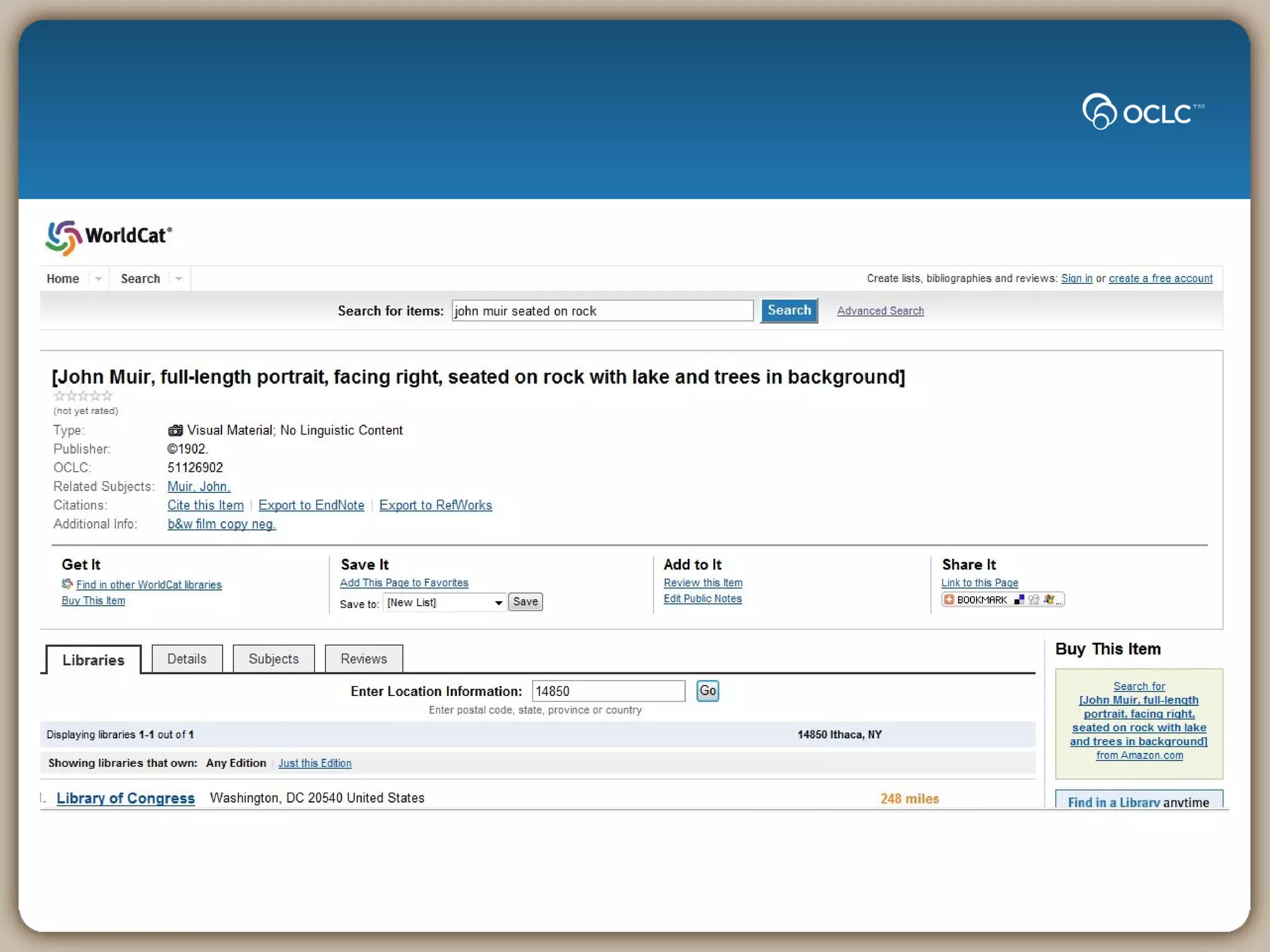
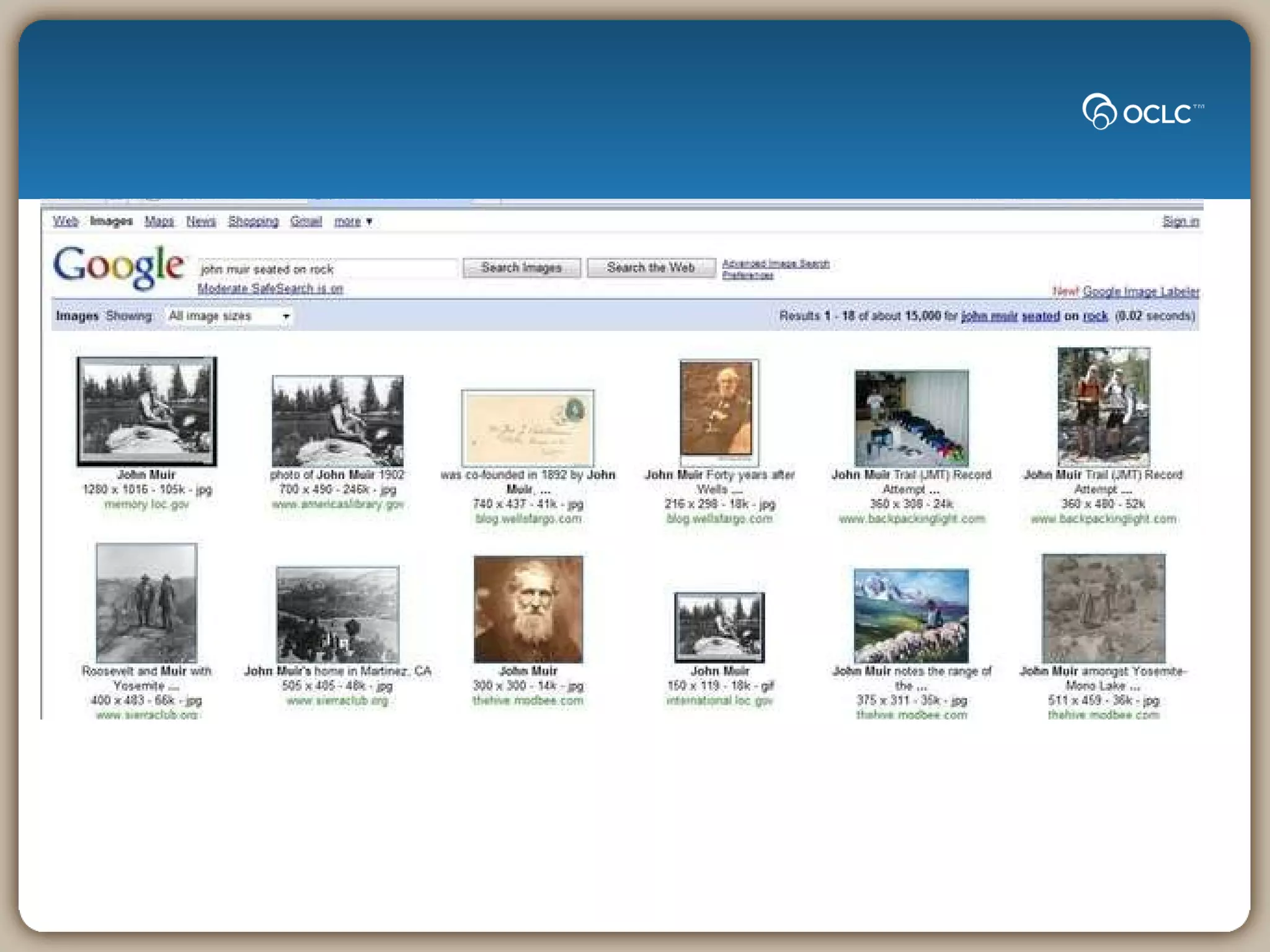
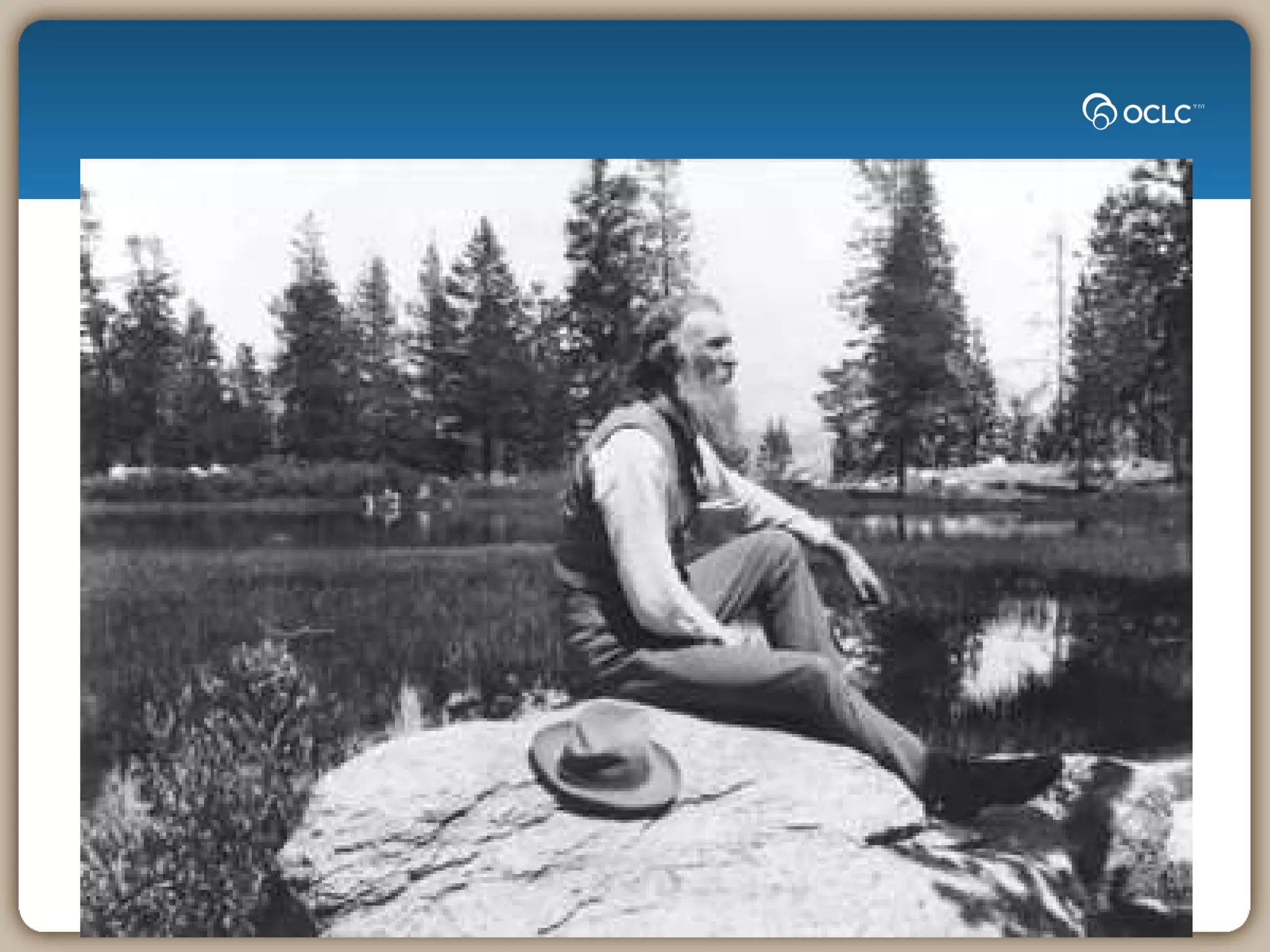
Be Where Their Eyes Are Photo of John Muir, seated on rock


You Cannot Win If You Do Not Play … Get Discovered! Get harvested Share your metadata Aggregators are good … and they are here to stay Embrace “the third order of order” Make the biggest pile you can “Include and postpone” – items can be organized over time; some organizations will be grassroots, others will be formal (taxonomies, etc.) – or both Quantity trumps quality
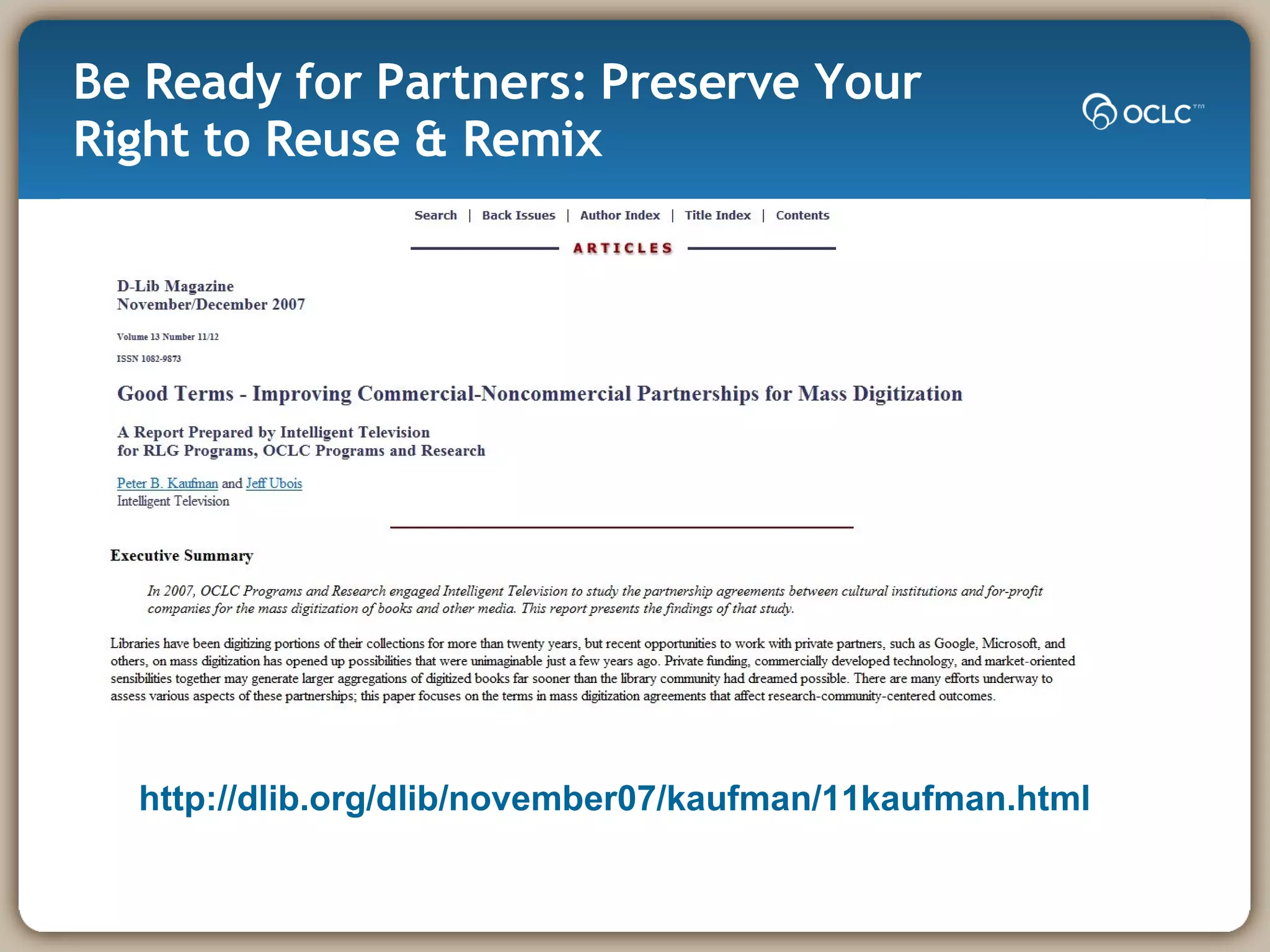
Be Ready for Partners: Preserve Your Right to Reuse & Remix http://dlib.org/dlib/november07/kaufman/11kaufman.html
How Can Metadata Help?
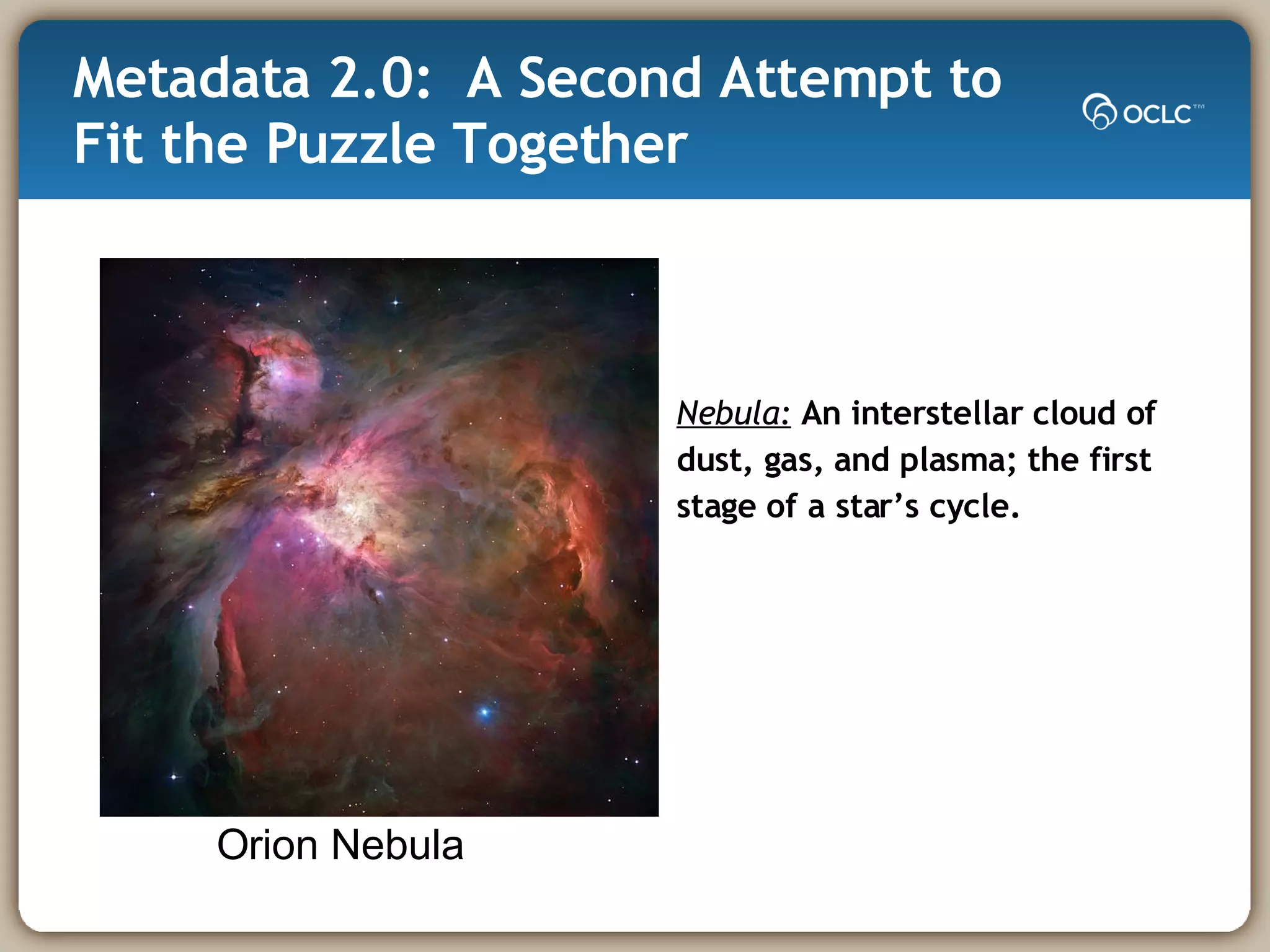
Metadata 2.0:  A Second Attempt to Fit the Puzzle Together Nebula:  An interstellar cloud of dust, gas, and plasma; the first stage of a star’s cycle. Orion Nebula
 
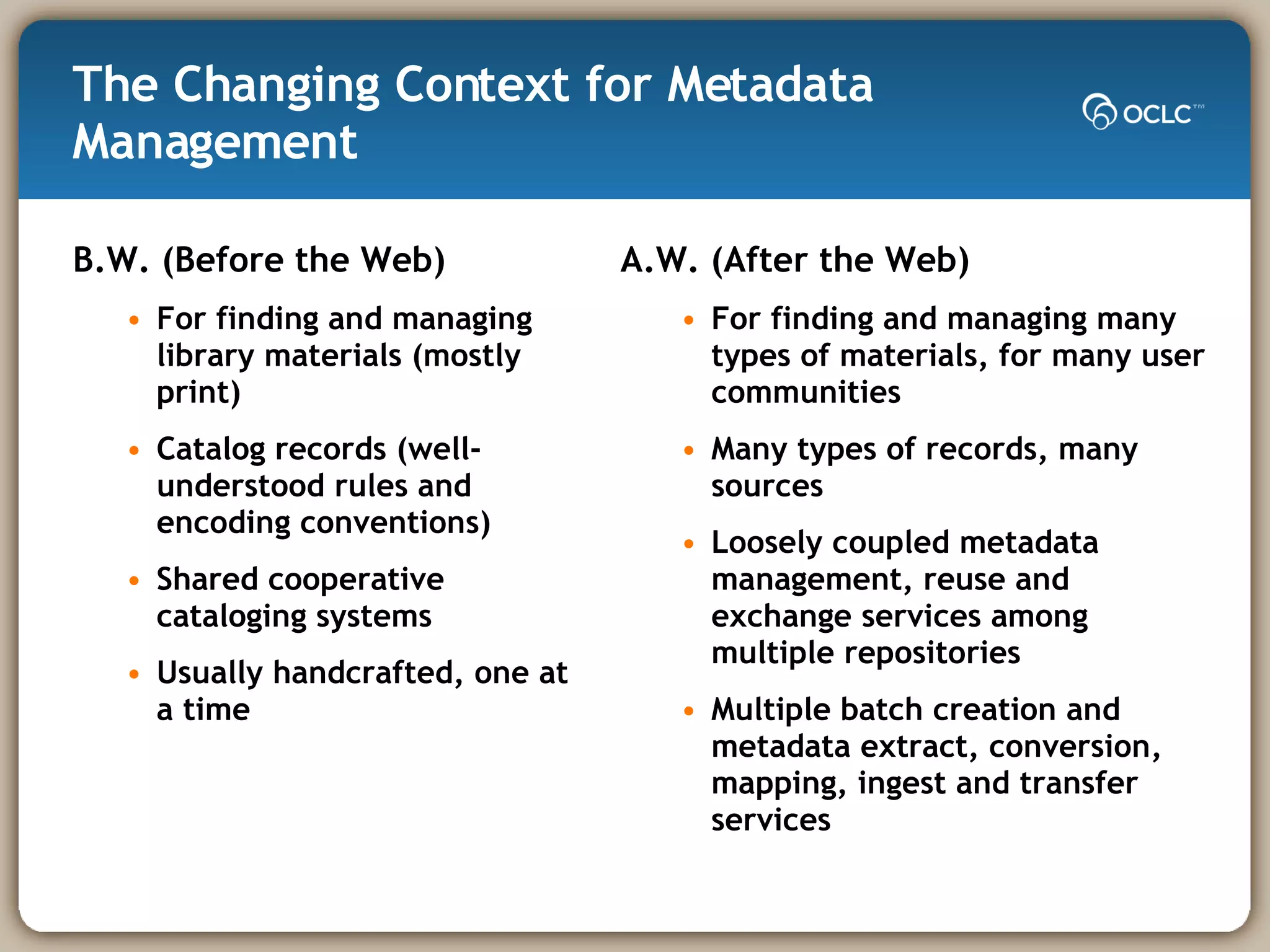
The Changing Context for Metadata Management B.W. (Before the Web) For finding and managing  library materials (mostly print) Catalog records (well-understood rules and encoding conventions) Shared cooperative cataloging systems Usually handcrafted, one at a time A.W. (After the Web) For finding and managing many types of materials, for many user communities Many types of records, many sources Loosely coupled metadata management, reuse and exchange services among multiple repositories Multiple batch creation and metadata extract, conversion, mapping, ingest and transfer services
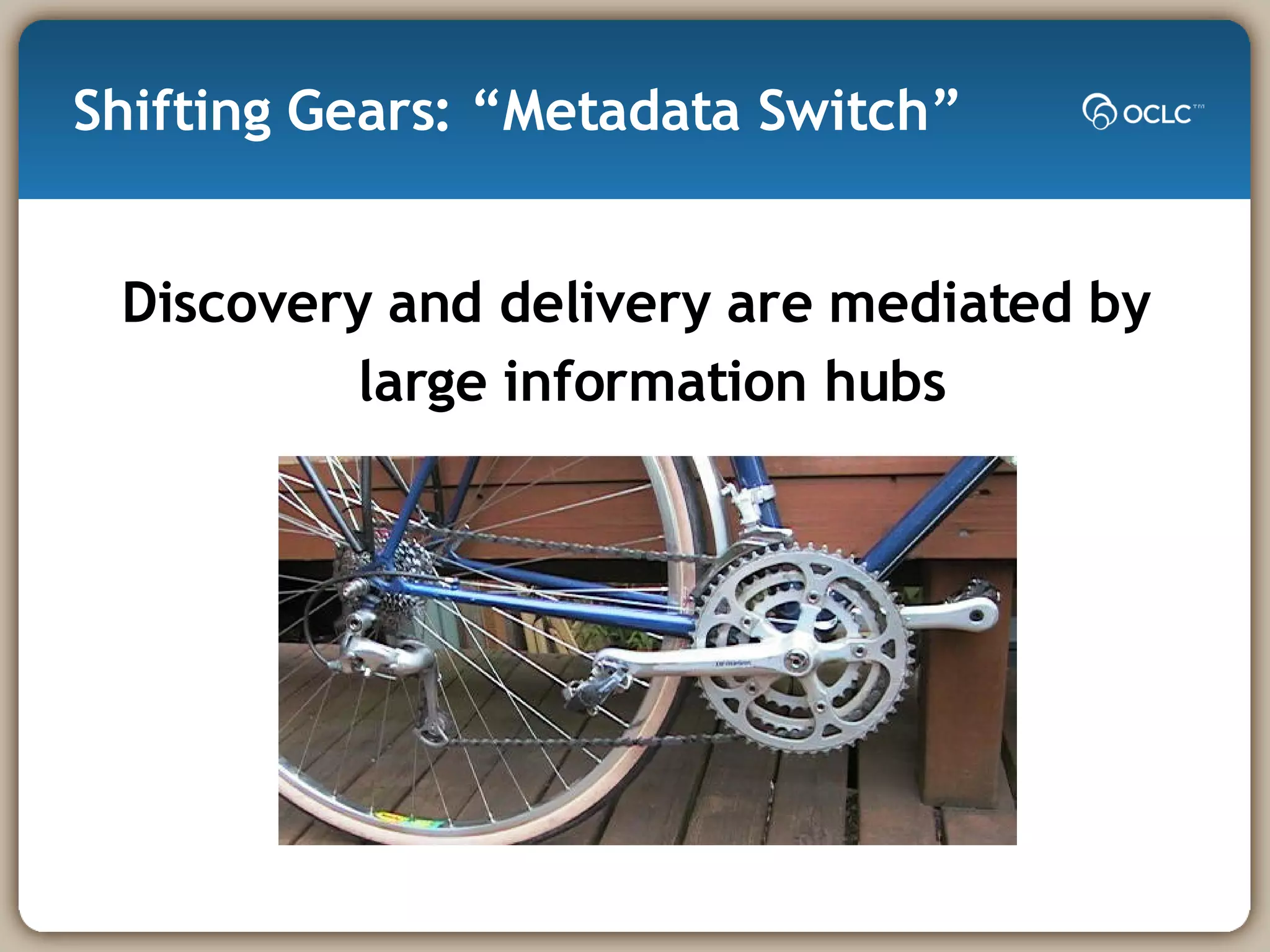
Shifting Gears: “Metadata Switch”  Discovery and delivery are mediated by large information hubs
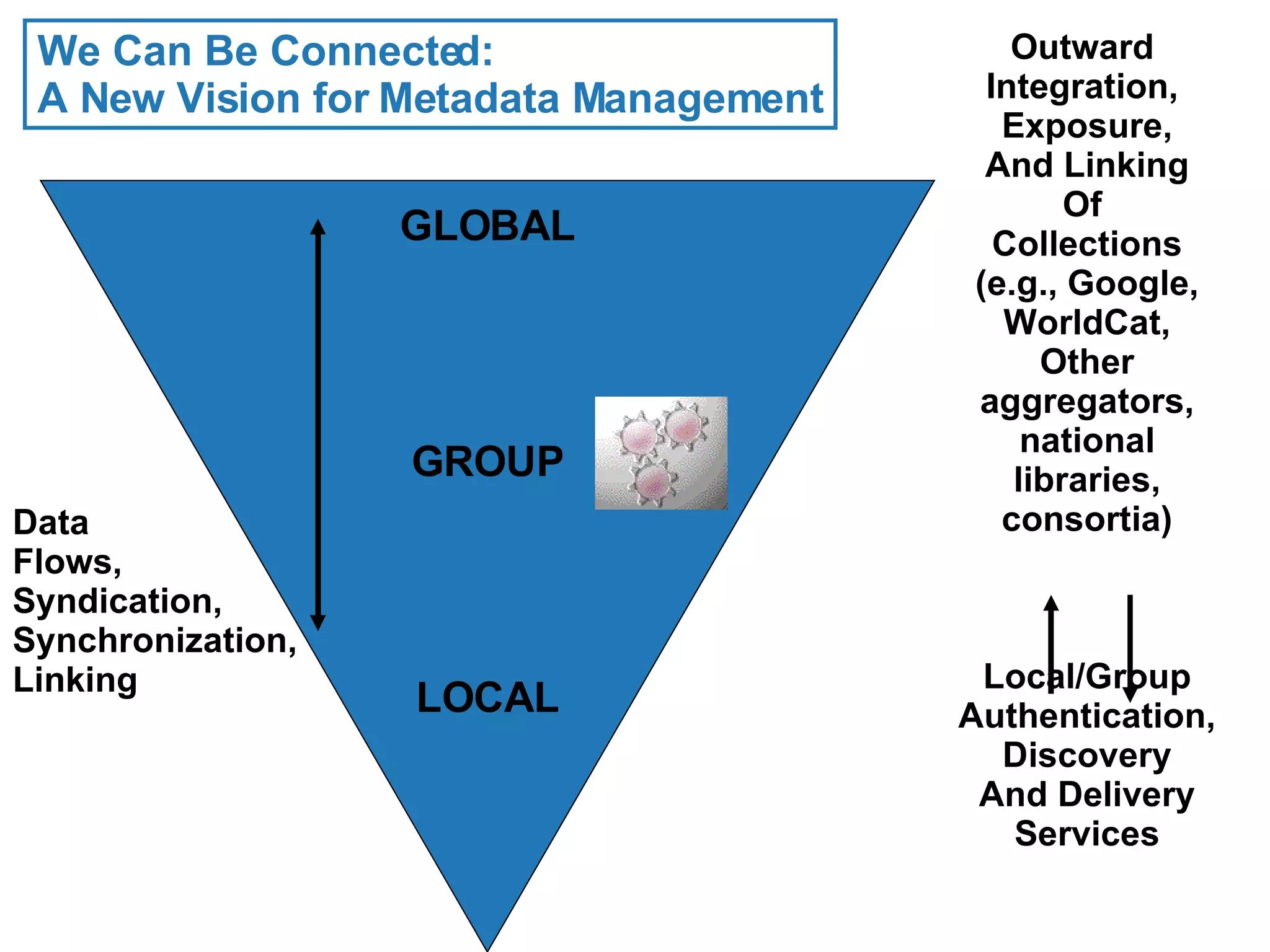
GLOBAL GROUP LOCAL Outward  Integration,  Exposure, And Linking Of  Collections (e.g., Google, WorldCat, Other aggregators, national libraries, consortia) Local/Group Authentication, Discovery And Delivery Services Data Flows, Syndication, Synchronization, Linking We Can Be Connected:  A New Vision for Metadata Management
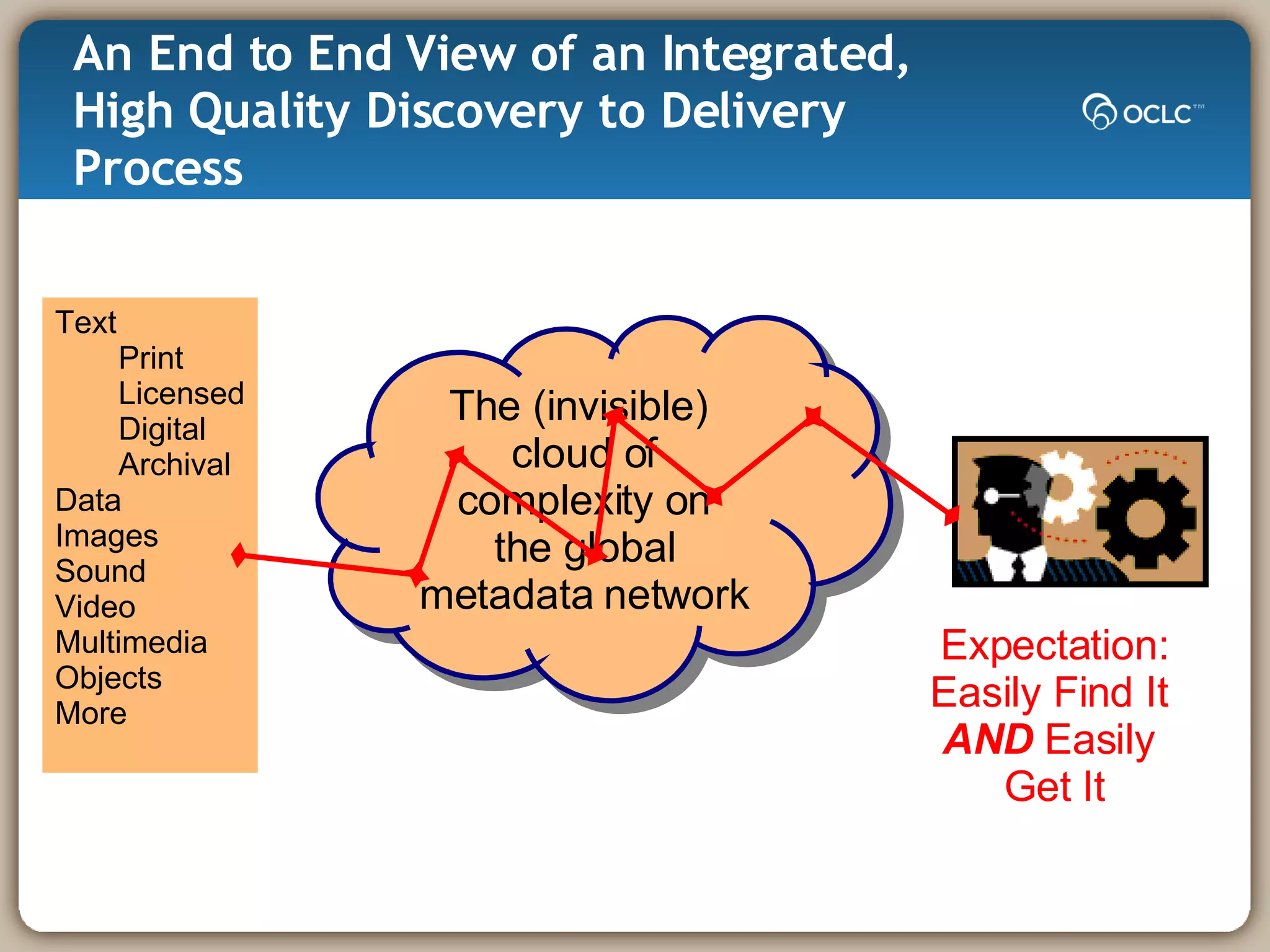
An End to End View of an Integrated, High Quality Discovery to Delivery Process The (invisible)  cloud of complexity on the global metadata network Text Print Licensed Digital Archival Data Images Sound Video Multimedia Objects More Expectation: Easily Find It  AND  Easily  Get It
“ Quality” in the User Workflow from Discovery to Delivery  Library user studies suggest that users expect  finding and getting information they want, when  and where they want it, to be easy and convenient.  These users’ tolerance for barriers to easy and convenient discovery and delivery is limited.
“ A colleague … sang the praises of the digital world to us.  He can now, he told us, get direct access to information …  His enthusiasm had screened out an enormous array of people,  organizations, and institutions involved in this “direct” touch.  The university, the library, publishers, editors, referees, authors, the computer and infrastructure designers, the cataloguers and  library collection managers, right down to the students working their way through college by [working in the library] had no place in his story.” Brown, John Seely, and Paul Duguid. 2000.  The social life  of information . Boston: Harvard Business School Press.
Opening Up Metadata Silos “ We have drawn a wall around  what is and what is not of interest to ‘cataloging’  that is not necessarily backed up by any good rationale. Many things that we decide are not of interest … are in fact of high significance to the success and ease our users will have in carrying out the tasks we mean to support … I don’t mean that “catalogers” need to apply the exact same standards to journal articles, institutional repository metadata, [etc.] … But we do need to consider it our responsibility to figure out how all these things can fit together.”  Rochkind, Jonathan. Bibliographic Wilderness [blog]. “‘Broken’ huh?” May 27 2007 http://bibwild.wordpress.com/2007/05/25/broken-huh/#more-42
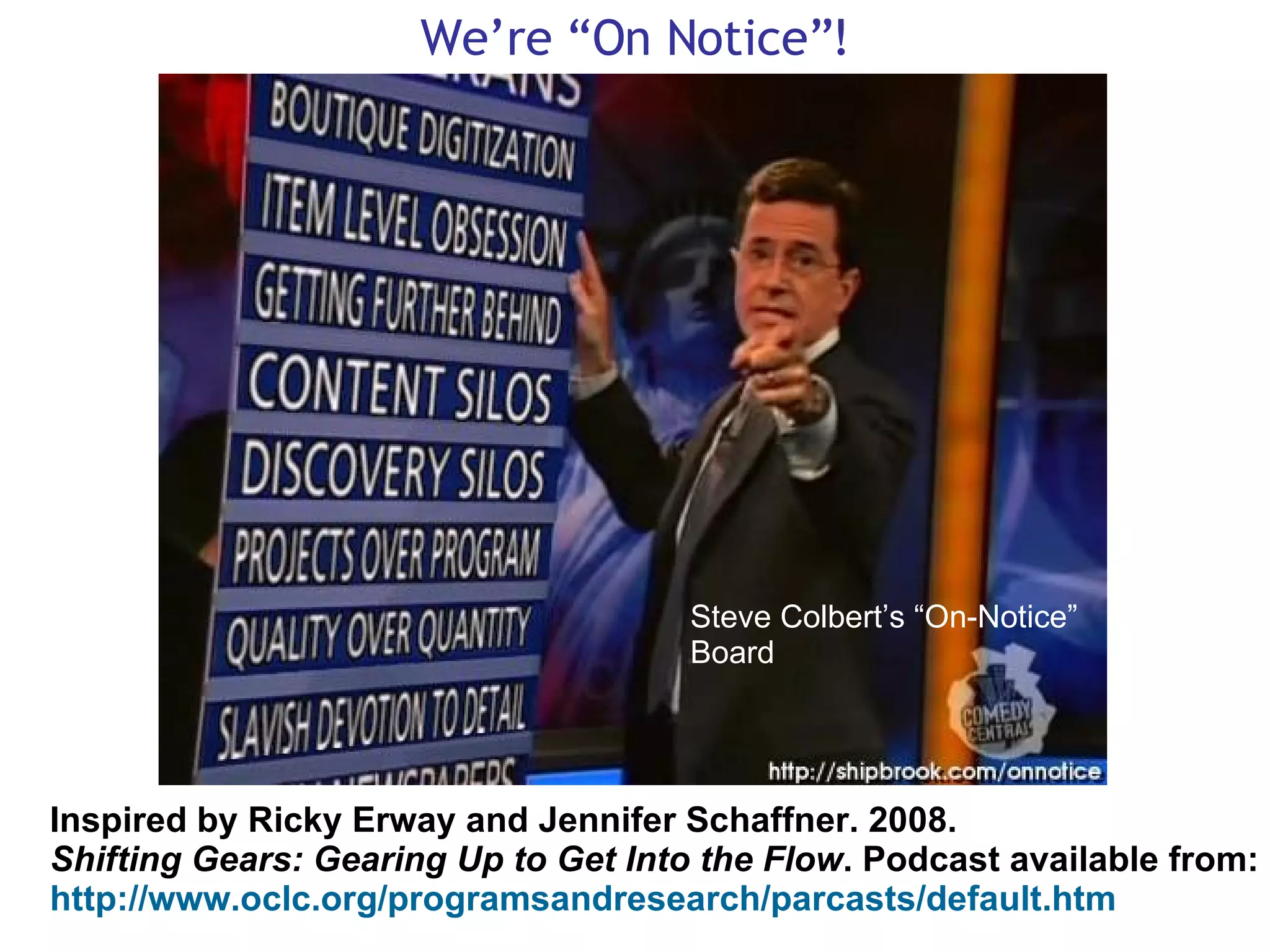
We’re “On Notice”! Steve Colbert’s “On-Notice” Board Inspired by Ricky Erway and Jennifer Schaffner. 2008. Shifting Gears: Gearing Up to Get Into the Flow . Podcast available from: http://www.oclc.org/programsandresearch/parcasts/default.htm
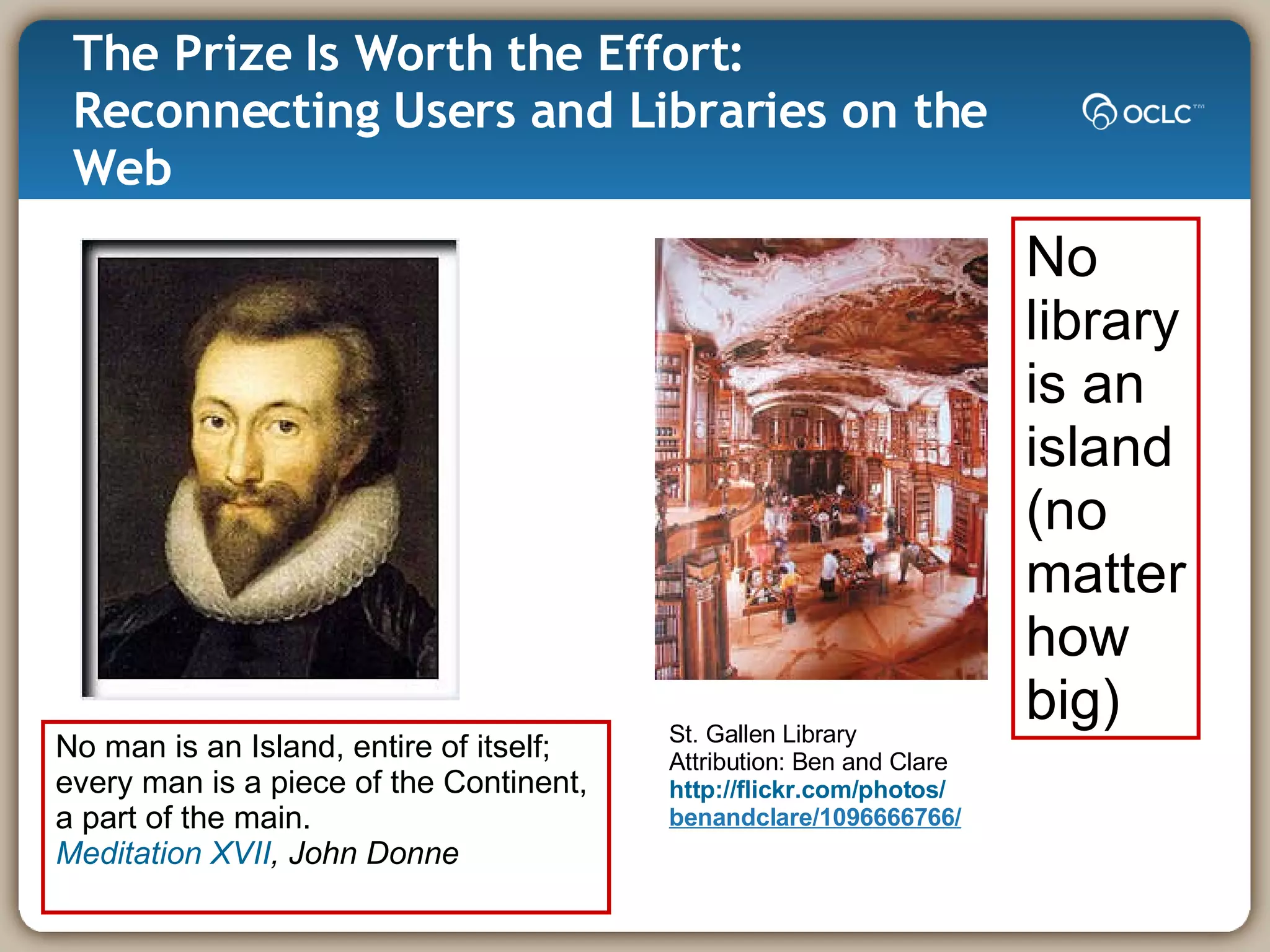
The Prize Is Worth the Effort: Reconnecting Users and Libraries on the Web No man is an Island, entire of itself; every man is a piece of the Continent,  a part of the main. Meditation XVII , John Donne No  library is an  island (no  matter how big) St. Gallen Library Attribution: Ben and Clare http://flickr.com/photos/ benandclare/1096666766/
By ideonexus http://flickr.com/photos/ideonexus/2514340529/ Comments? Observations? Questions? Thanks for the chance to speak with you today. Karen Calhoun [email_address]

Calhoun Rbms Rev June 2008

  • 1.
    Metadata 2.0, Glocalization,and Being Where Their Eyes Are: What’s So Special About Special Collections? Karen Calhoun Vice President, WorldCat & Metadata Services Los Angeles, CA 26 June 2008 49 th Annual RBMS Preconference
  • 2.
    The Dream ofLocal Integration http://ecommons.library.cornell.edu/handle/1813/2232
  • 3.
  • 4.
  • 5.
    One Hundred FlowersBlooming “ At this stage, no new effort should be undertaken without a sense of how it will be merged with other existing collections and where the resources for long-term maintenance will come from.” --A Cornell University Library digital projects librarian Moving from Project to Program
  • 6.
    The Portal Dream:A Unifying System Model Other Libraries Catalogs Local Library Catalog Digital Collections Licensed Databases Other (e.g.,DSpace) Many diverse, separate interfaces Portal: an Integrating System Authentication layer Unified Web Interface (“Google-like”)
  • 7.
    Our Concept Mapof Digital Collections Program Best Practices
  • 8.
    How It Ended“ One reviewer of an early draft of this report wondered if an integrated discovery framework would add sufficient value, considering that despite the impressive volume of material that CUL has digitized, most of the existing collections are fragments of larger corpuses or otherwise narrow in scope.”
  • 9.
    An Early Earthquake:Where Do You Begin an Online Search for Information on a Topic? College Students’ Perceptions of Libraries and Information Resources: a Report to the OCLC Membership : http://www.oclc.org/reports/perceptionscollege.htm
  • 10.
    300 of themost influential websites, positioned on the greater Tokyo-area train map. http://informationarchitects.jp/web-trend-map-2008-beta/
  • 11.
    LC Action Item6.4: “Support research and development on the changing nature of the catalog to include consideration of a framework for its integration with other discovery tools.” Calhoun, Karen.  The Changing Nature of the Catalog and Its Integration with Other Discovery Tools.   Washington, DC: Library of Congress, 17 March 2006. http://www.loc.gov/catdir/calhoun-report-final.pdf
  • 12.
    The Catalog inContext Online catalogs represent one node in the end user’s information universe
  • 13.
    Outward Integration “Integration should be outward rather than inward, with libraries seeking to use their components in new ways” --Interviewee for LC report on future of the catalog
  • 14.
    Longer Term VisionSwitch users from where they find things to library-managed collections of all kinds Local catalog one link in a chain of services, one repository managed by the library More coherent and comprehensive scholarly information systems, perhaps by discipline Infrastructure to permit global discovery and delivery of information among open, loosely-coupled systems Critical mass of digitized publications and special collections online Many starting points on the Web leading to many types of scholarly information objects
  • 15.
    Intermediate Vision Shared OPACs: begin to aggregate discovery function for books, serials, and their e-counterparts Draw on the local catalog’s strongest suit: support for inventory control and delivery Larger scale collaboration on collection development/resource sharing, storage, preservation
  • 16.
    Intermediate Vision, 2Start to build bigger scholarly information environments—with libraries playing a role—to aggregate more of the expanding universe of scholarly digital assets Metadata and outreach skills = strategic assets
  • 17.
    Intermediate Vision, 3Beginning of the era of special collections Aggregate discovery of digital collections More emphasis on visual resources
  • 18.
    A New Kindof (GLocal) Library: Outreach, Engagement, Participation, Visibility Engage with research, teaching, and learning materials and systems Engage locally with citizens, students and scholars … and their digital assets Make library collections and scholarly output more visible on the network Be where the user is Move to next generation systems and services (metadata 2.0) An online social network
  • 19.
    What If WeDo Nothing?
  • 20.
    http://www.loc.gov/bibliographic-future/news/lcwg-ontherecord-jan08-final.pdf 2 ENHANCE ACCESS TO RARE, UNIQUE, AND OTHER SPECIAL HIDDEN MATERIALS
  • 21.
    2 ENHANCEACCESS TO RARE, UNIQUE, AND OTHER SPECIAL HIDDEN MATERIALS 2.1.1 Make the discovery of rare, unique and other special hidden materials a high priority 2.1.2 Streamline cataloging for rare, unique and other special hidden materials, emphasizing greater coverage and broader access 2.1.3 Integrate access to rare, unique and other special hidden materials with other library materials 2.1.4 Encourage digitization to allow broader access 2.1.5 Share access to rare, unique and other special hidden materials
  • 22.
    Don’t Get FurtherBehind! Learn from the Archivists Item level description – Get over it! Some access is better than no access - really David Steuart Erskine, founder, Scottish Society of Antiquaries
  • 23.
    Aggregations Are Good:The Center for History and New Media
  • 24.
  • 25.
  • 26.
    Be Where TheirEyes Are Photo of John Muir, seated on rock
  • 27.
  • 28.
  • 29.
  • 30.
    You Cannot WinIf You Do Not Play … Get Discovered! Get harvested Share your metadata Aggregators are good … and they are here to stay Embrace “the third order of order” Make the biggest pile you can “Include and postpone” – items can be organized over time; some organizations will be grassroots, others will be formal (taxonomies, etc.) – or both Quantity trumps quality
  • 31.
    Be Ready forPartners: Preserve Your Right to Reuse & Remix http://dlib.org/dlib/november07/kaufman/11kaufman.html
  • 32.
  • 33.
    Metadata 2.0: A Second Attempt to Fit the Puzzle Together Nebula: An interstellar cloud of dust, gas, and plasma; the first stage of a star’s cycle. Orion Nebula
  • 34.
  • 35.
    The Changing Contextfor Metadata Management B.W. (Before the Web) For finding and managing library materials (mostly print) Catalog records (well-understood rules and encoding conventions) Shared cooperative cataloging systems Usually handcrafted, one at a time A.W. (After the Web) For finding and managing many types of materials, for many user communities Many types of records, many sources Loosely coupled metadata management, reuse and exchange services among multiple repositories Multiple batch creation and metadata extract, conversion, mapping, ingest and transfer services
  • 36.
    Shifting Gears: “MetadataSwitch” Discovery and delivery are mediated by large information hubs
  • 37.
    GLOBAL GROUP LOCALOutward Integration, Exposure, And Linking Of Collections (e.g., Google, WorldCat, Other aggregators, national libraries, consortia) Local/Group Authentication, Discovery And Delivery Services Data Flows, Syndication, Synchronization, Linking We Can Be Connected: A New Vision for Metadata Management
  • 38.
    An End toEnd View of an Integrated, High Quality Discovery to Delivery Process The (invisible) cloud of complexity on the global metadata network Text Print Licensed Digital Archival Data Images Sound Video Multimedia Objects More Expectation: Easily Find It AND Easily Get It
  • 39.
    “ Quality” inthe User Workflow from Discovery to Delivery Library user studies suggest that users expect finding and getting information they want, when and where they want it, to be easy and convenient. These users’ tolerance for barriers to easy and convenient discovery and delivery is limited.
  • 40.
    “ A colleague… sang the praises of the digital world to us. He can now, he told us, get direct access to information … His enthusiasm had screened out an enormous array of people, organizations, and institutions involved in this “direct” touch. The university, the library, publishers, editors, referees, authors, the computer and infrastructure designers, the cataloguers and library collection managers, right down to the students working their way through college by [working in the library] had no place in his story.” Brown, John Seely, and Paul Duguid. 2000. The social life of information . Boston: Harvard Business School Press.
  • 41.
    Opening Up MetadataSilos “ We have drawn a wall around what is and what is not of interest to ‘cataloging’ that is not necessarily backed up by any good rationale. Many things that we decide are not of interest … are in fact of high significance to the success and ease our users will have in carrying out the tasks we mean to support … I don’t mean that “catalogers” need to apply the exact same standards to journal articles, institutional repository metadata, [etc.] … But we do need to consider it our responsibility to figure out how all these things can fit together.” Rochkind, Jonathan. Bibliographic Wilderness [blog]. “‘Broken’ huh?” May 27 2007 http://bibwild.wordpress.com/2007/05/25/broken-huh/#more-42
  • 42.
    We’re “On Notice”!Steve Colbert’s “On-Notice” Board Inspired by Ricky Erway and Jennifer Schaffner. 2008. Shifting Gears: Gearing Up to Get Into the Flow . Podcast available from: http://www.oclc.org/programsandresearch/parcasts/default.htm
  • 43.
    The Prize IsWorth the Effort: Reconnecting Users and Libraries on the Web No man is an Island, entire of itself; every man is a piece of the Continent, a part of the main. Meditation XVII , John Donne No library is an island (no matter how big) St. Gallen Library Attribution: Ben and Clare http://flickr.com/photos/ benandclare/1096666766/
  • 44.
    By ideonexus http://flickr.com/photos/ideonexus/2514340529/Comments? Observations? Questions? Thanks for the chance to speak with you today. Karen Calhoun [email_address]

Editor's Notes

  • #2 I’d like to start today with a story about failure. As we know, Thomas Edison was a talented inventor. He went out and looked for problems to solve through inventions. When he was asked about an invention that failed after 10,000 experiments, he’s said to have replied “ I have not failed. I’ve just found 10,000 ways that won’t work.”