A Domain Specific Language for
Enterprise Grade Cloud-Mobile Hybrid
            Applications
               The MobiCloud II Experience

 Ajith Ranabahu*, Michael Maximilien**, Amit Sheth*, Krishnaprasad Thirunarayan
           *Kno.e.sis Center, Wright State University, Dayton OH, USA
                       **IBM Research, San Jose CA, USA
Outline
• What is MobiCloud
   • A quick introduction
• The MobiCloud DSL
   • MVC pattern based domain modeling
• Extending the MobiCloud DSL with Enterprise
    Features
•   Demonstration
•   Lessons learnt
•   Future Directions and Work In Progress
24th October 2011                               2
What is MobiCloud?
A Cloud-Mobile Hybrid application generator

      • Front-end runs on a mobile device
         • Smart phone / tablet etc
      • Back-end deployed on a cloud
         • Amazon EC2 / Google App Engine
      • Both components needed for the full experience


23rd October 2011                                        3
Why MobiCloud?
• Cloud-Mobile hybrids are hard to develop
      • Many complications
• Current practice is to treat the components as
    separate projects
      • Increases effort, decreases portability & drives up the cost
• Portability (both front-end and back-end) is
    important
      • Hard to cater for the large number of platforms


23rd October 2011                                                  4
A better approach is needed to
 develop cloud-mobile hybrid
applications, while maintaining
           portability
Modeling a Cloud-Mobile Hybrid (CMH)

• A CMH is effectively ‘functionally
     Monolithic’
      • Except there is a service layer in between!
• A CMH can be modeled as a single
     conceptual unit


23rd October 2011                                     6
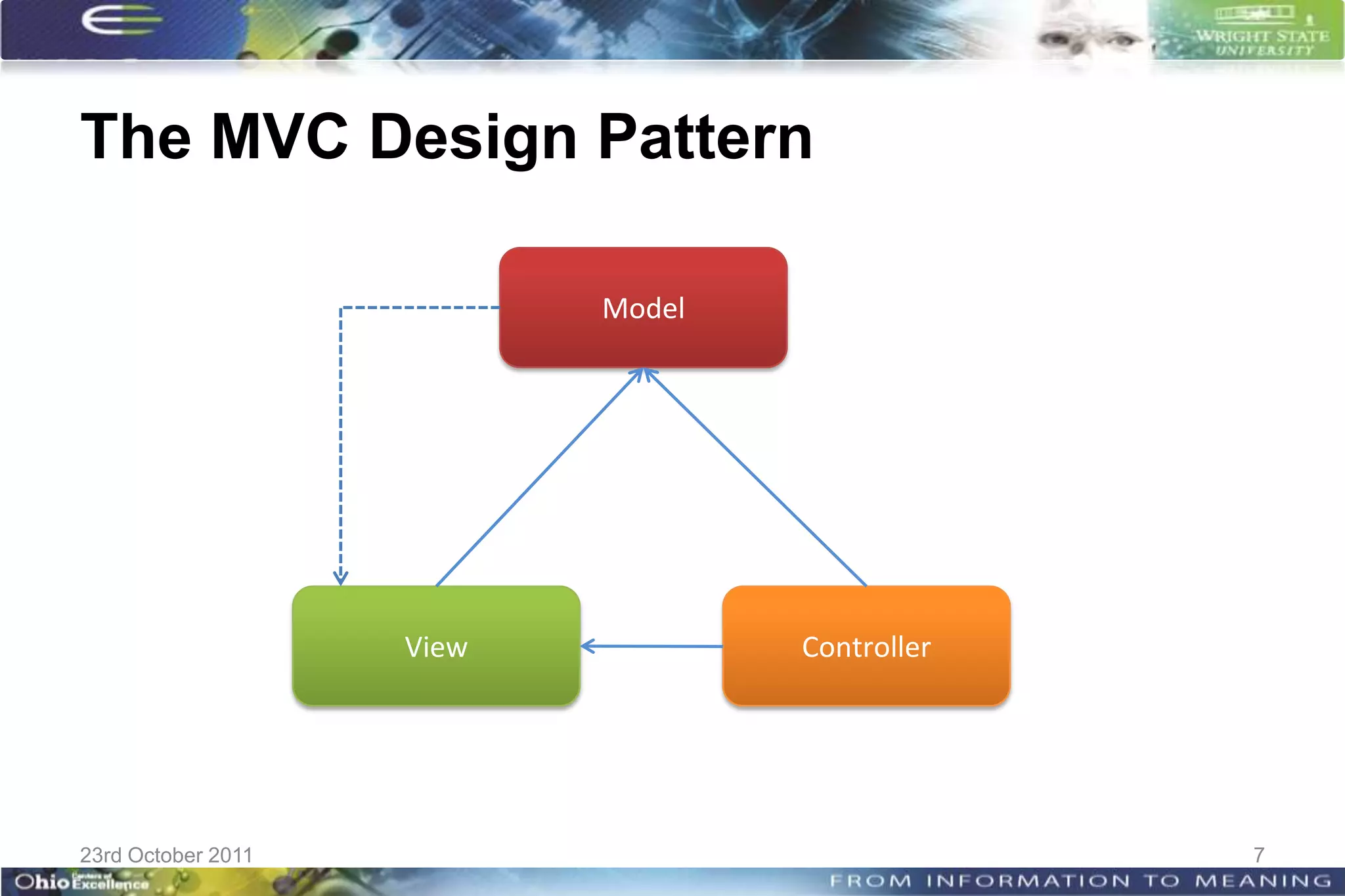
The MVC Design Pattern

                           Model


                    View           Controller


23rd October 2011                               7
CMH Applications can be nicely
decomposed into the MVC Design
A Simple Example                                                        Metadata – details that need to
                                                                          be attached to the whole
                                                                                 application


recipe(:todolist) do
  metadata({:id => „todoapp‟})                                                 Models
  # model
  model(:task,{:time => :date,:location => :string,:description => :string,:name =>
:string})
  # controller
  controller(:todohandler) do                                                 Controllers
     action(:create,:task)
     action(:retrieve,:task)                                                    Views
  end
  # view
  view(:add_task,{:models =>[:task],:controller => :todohandler,:action => :create})
  view(:show_tasks,{:models =>[:task],:controller => :todohandler,:action =>
:retrieve})
end
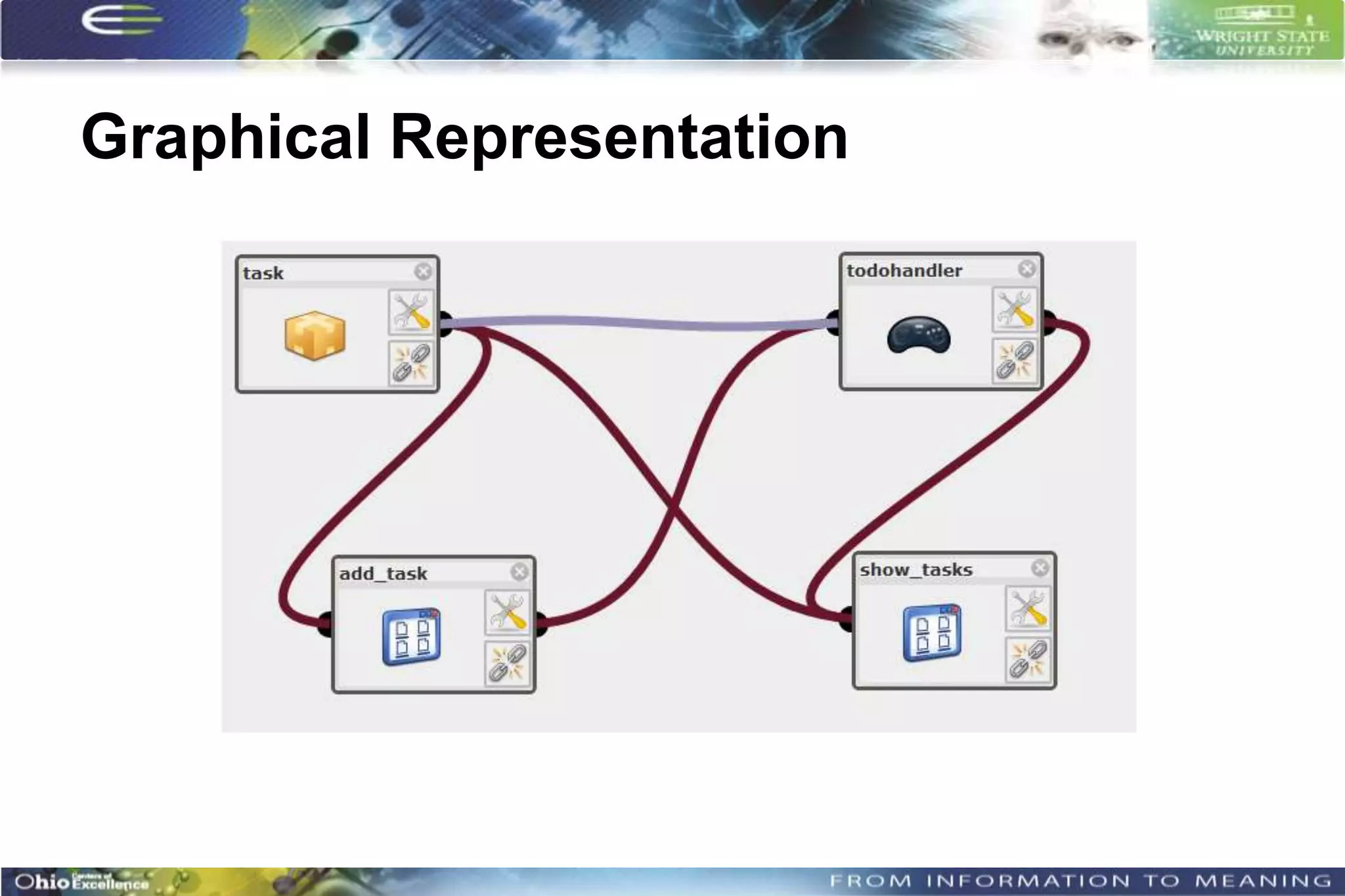
Graphical Representation
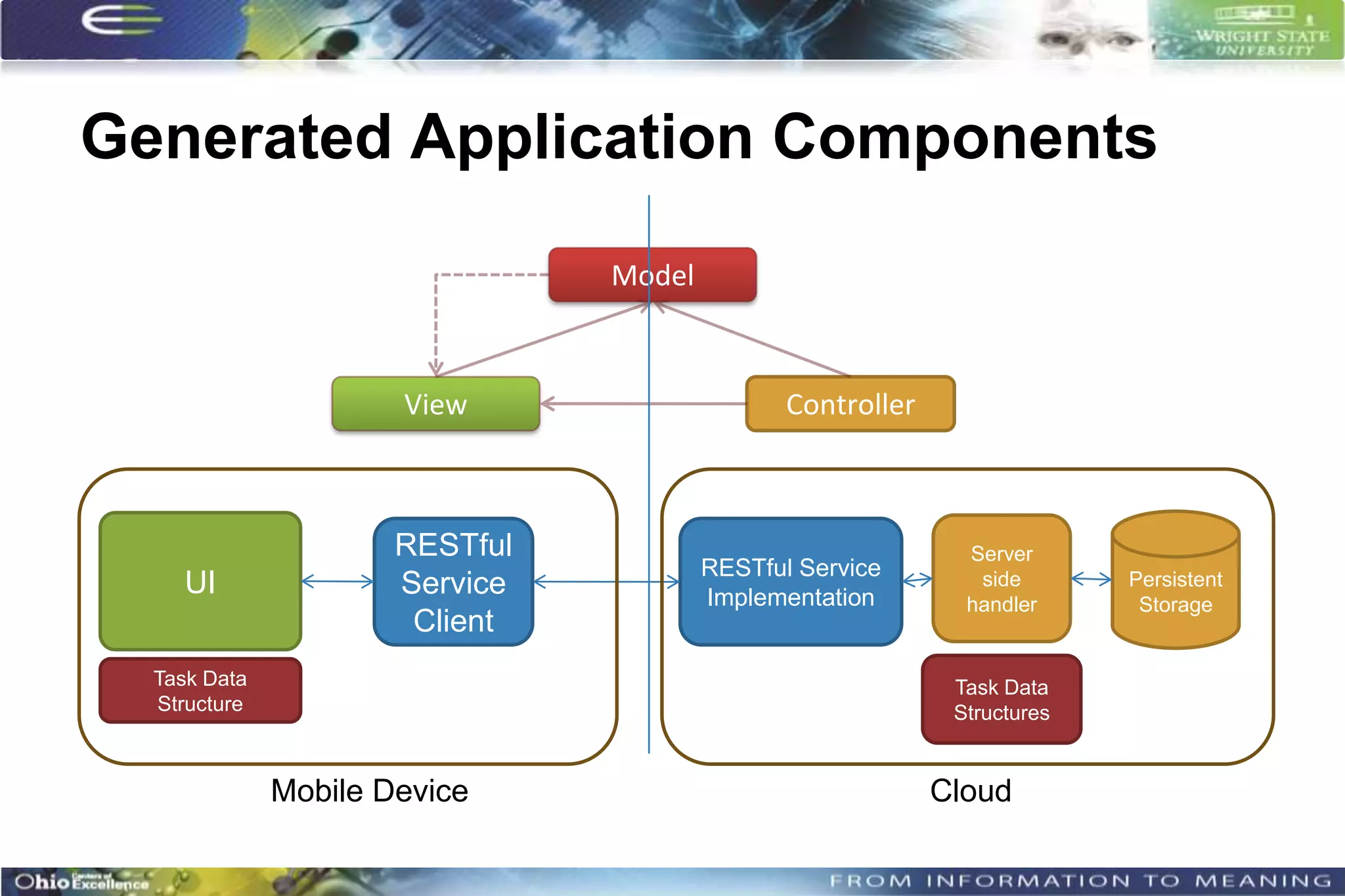
Generated Application Components

                                Model


                      View                     Controller


                      RESTful                                 Server
                                        RESTful Service
     UI               Service           Implementation
                                                               side       Persistent
                                                              handler      Storage
                       Client
  Task Data                                                  Task Data
  Structure                                                  Structures


              Mobile Device                                 Cloud
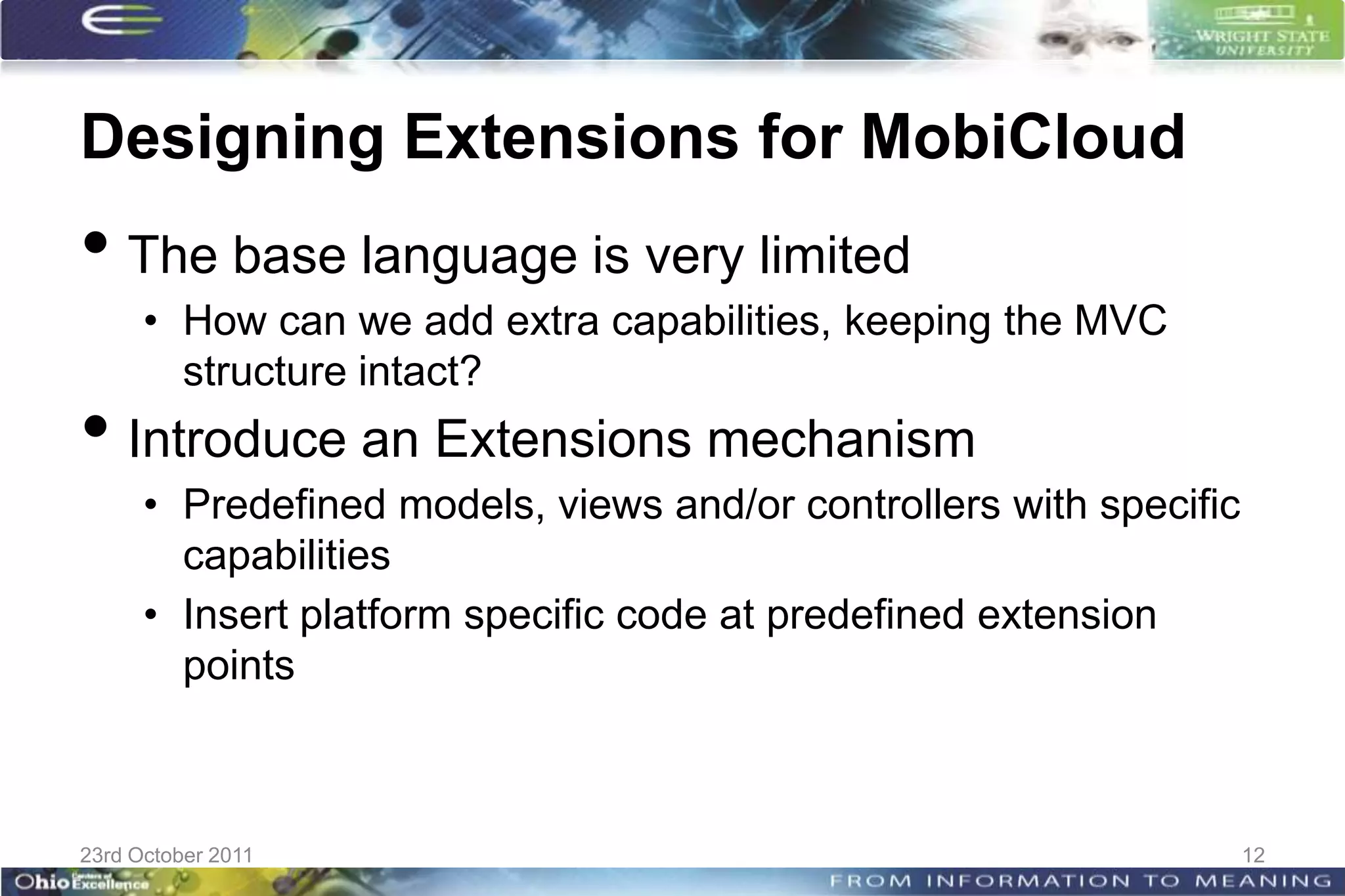
Designing Extensions for MobiCloud
• The base language is very limited
      • How can we add extra capabilities, keeping the MVC
        structure intact?
• Introduce an Extensions mechanism
      • Predefined models, views and/or controllers with specific
        capabilities
      • Insert platform specific code at predefined extension
        points


23rd October 2011                                                   12
A Simple Extension – Fetching from a
URL
recipe :http_fetch do
   # Generic http extension
 extensions ['http']
   # metadata
 metadata({:id => "ajithssimpleapp"})
   # models
 model :time_value,{:ts => :int}
  #controllers
 controller :time_manager do
   # fetch & display time from yahoo
   action :fetch_time,:time_value,{:type=>'http',
                        :url => 'http://developer.yahooapis.com/…./../getTime',
                        :params => {:appid => 'o6fGNQ3V34GxD……OaFr'},
                        :return_mapping => {:ts=> '/Result/Timestamp'},
                        :action_forward => :retrieve}
   …


23rd October 2011                                                                 13
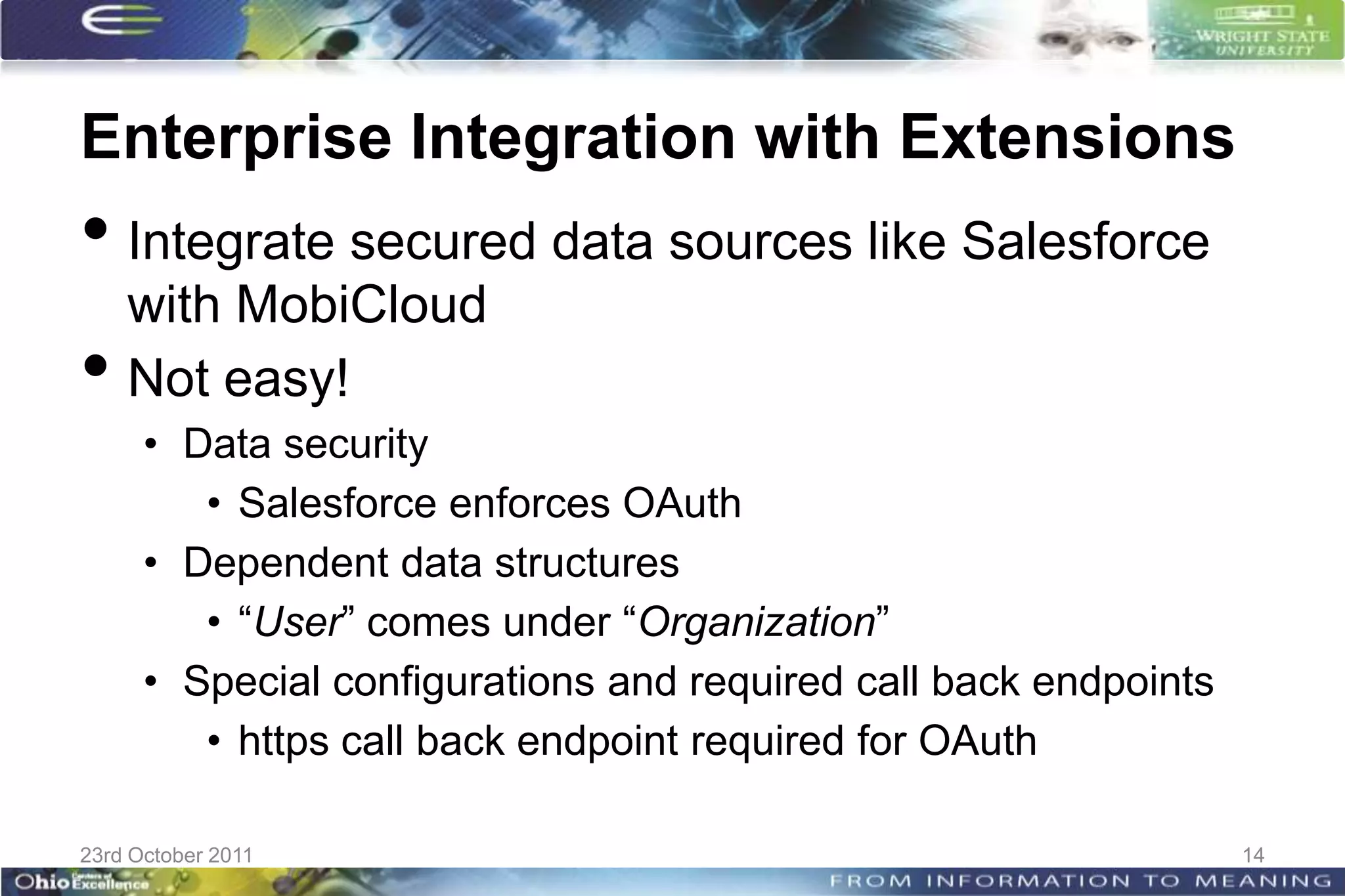
Enterprise Integration with Extensions
• Integrate secured data sources like Salesforce
    with MobiCloud
•   Not easy!
      • Data security
         • Salesforce enforces OAuth
      • Dependent data structures
         • “User” comes under “Organization”
      • Special configurations and required call back endpoints
         • https call back endpoint required for OAuth

23rd October 2011                                                 14
Demonstration
Lessons Learnt
• Developers are hesitant to use a top-down
    approach unless there is an extreme
    improvement in productivity and/or convenience
•   Graphical abstractions are important to support
    adoption


23rd October 2011                                 16
Big Picture and Future Directions
• Using DSLs as the primary means to overcome
    issues of Cloud application portability
•   Fits in with a middleware layer for complete
    independence in
      • Development
      • Deployment
      • Management     of cloud applications

23rd October 2011                                  17
Big Picture and Future Directions (Cont)
• More extensions
      • Google and other third party API integrations
• Extensions as graphical abstractions
      • The graphical mode only supports the base language
• Mixing in other languages for special functions
      • UI enhancements
         • XAML / CSS ?


23rd October 2011                                            18
Visit us on the Web at http://mobicloud.knoesis.org


      More documentation, videos and details at
http://wiki.knoesis.org/index.php/MobiCloud_Web_UI
Questions
Thank you
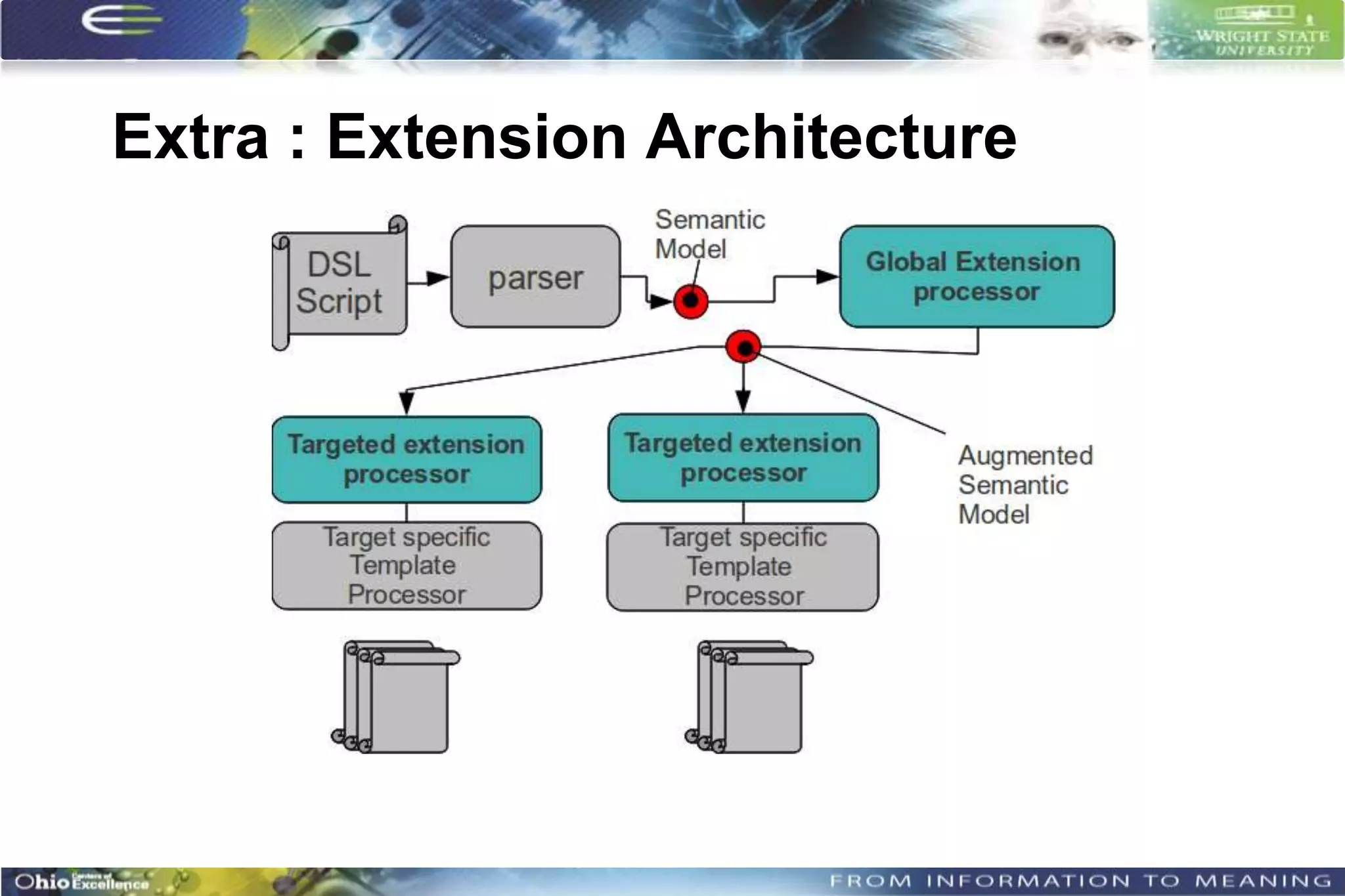
Extra : Extension Architecture

A Domain Specific Language for Enterprise Grade Cloud-Mobile Hybrid Applications

  • 1.
    A Domain SpecificLanguage for Enterprise Grade Cloud-Mobile Hybrid Applications The MobiCloud II Experience Ajith Ranabahu*, Michael Maximilien**, Amit Sheth*, Krishnaprasad Thirunarayan *Kno.e.sis Center, Wright State University, Dayton OH, USA **IBM Research, San Jose CA, USA
  • 2.
    Outline • What isMobiCloud • A quick introduction • The MobiCloud DSL • MVC pattern based domain modeling • Extending the MobiCloud DSL with Enterprise Features • Demonstration • Lessons learnt • Future Directions and Work In Progress 24th October 2011 2
  • 3.
    What is MobiCloud? ACloud-Mobile Hybrid application generator • Front-end runs on a mobile device • Smart phone / tablet etc • Back-end deployed on a cloud • Amazon EC2 / Google App Engine • Both components needed for the full experience 23rd October 2011 3
  • 4.
    Why MobiCloud? • Cloud-Mobilehybrids are hard to develop • Many complications • Current practice is to treat the components as separate projects • Increases effort, decreases portability & drives up the cost • Portability (both front-end and back-end) is important • Hard to cater for the large number of platforms 23rd October 2011 4
  • 5.
    A better approachis needed to develop cloud-mobile hybrid applications, while maintaining portability
  • 6.
    Modeling a Cloud-MobileHybrid (CMH) • A CMH is effectively ‘functionally Monolithic’ • Except there is a service layer in between! • A CMH can be modeled as a single conceptual unit 23rd October 2011 6
  • 7.
    The MVC DesignPattern Model View Controller 23rd October 2011 7
  • 8.
    CMH Applications canbe nicely decomposed into the MVC Design
  • 9.
    A Simple Example Metadata – details that need to be attached to the whole application recipe(:todolist) do metadata({:id => „todoapp‟}) Models # model model(:task,{:time => :date,:location => :string,:description => :string,:name => :string}) # controller controller(:todohandler) do Controllers action(:create,:task) action(:retrieve,:task) Views end # view view(:add_task,{:models =>[:task],:controller => :todohandler,:action => :create}) view(:show_tasks,{:models =>[:task],:controller => :todohandler,:action => :retrieve}) end
  • 10.
  • 11.
    Generated Application Components Model View Controller RESTful Server RESTful Service UI Service Implementation side Persistent handler Storage Client Task Data Task Data Structure Structures Mobile Device Cloud
  • 12.
    Designing Extensions forMobiCloud • The base language is very limited • How can we add extra capabilities, keeping the MVC structure intact? • Introduce an Extensions mechanism • Predefined models, views and/or controllers with specific capabilities • Insert platform specific code at predefined extension points 23rd October 2011 12
  • 13.
    A Simple Extension– Fetching from a URL recipe :http_fetch do # Generic http extension extensions ['http'] # metadata metadata({:id => "ajithssimpleapp"}) # models model :time_value,{:ts => :int} #controllers controller :time_manager do # fetch & display time from yahoo action :fetch_time,:time_value,{:type=>'http', :url => 'http://developer.yahooapis.com/…./../getTime', :params => {:appid => 'o6fGNQ3V34GxD……OaFr'}, :return_mapping => {:ts=> '/Result/Timestamp'}, :action_forward => :retrieve} … 23rd October 2011 13
  • 14.
    Enterprise Integration withExtensions • Integrate secured data sources like Salesforce with MobiCloud • Not easy! • Data security • Salesforce enforces OAuth • Dependent data structures • “User” comes under “Organization” • Special configurations and required call back endpoints • https call back endpoint required for OAuth 23rd October 2011 14
  • 15.
  • 16.
    Lessons Learnt • Developersare hesitant to use a top-down approach unless there is an extreme improvement in productivity and/or convenience • Graphical abstractions are important to support adoption 23rd October 2011 16
  • 17.
    Big Picture andFuture Directions • Using DSLs as the primary means to overcome issues of Cloud application portability • Fits in with a middleware layer for complete independence in • Development • Deployment • Management of cloud applications 23rd October 2011 17
  • 18.
    Big Picture andFuture Directions (Cont) • More extensions • Google and other third party API integrations • Extensions as graphical abstractions • The graphical mode only supports the base language • Mixing in other languages for special functions • UI enhancements • XAML / CSS ? 23rd October 2011 18
  • 19.
    Visit us onthe Web at http://mobicloud.knoesis.org More documentation, videos and details at http://wiki.knoesis.org/index.php/MobiCloud_Web_UI
  • 20.
  • 21.
  • 22.
    Extra : ExtensionArchitecture