ADAPTIVE
MUSIC
IN GAMES
ADAM J SPORKA
IIM/DCGI@CVUT
WARHORSE STUDIOS
UX MONDAY 03/02/15
INTRO
@adam_sporka Adaptive Music in Games UX Monday 3
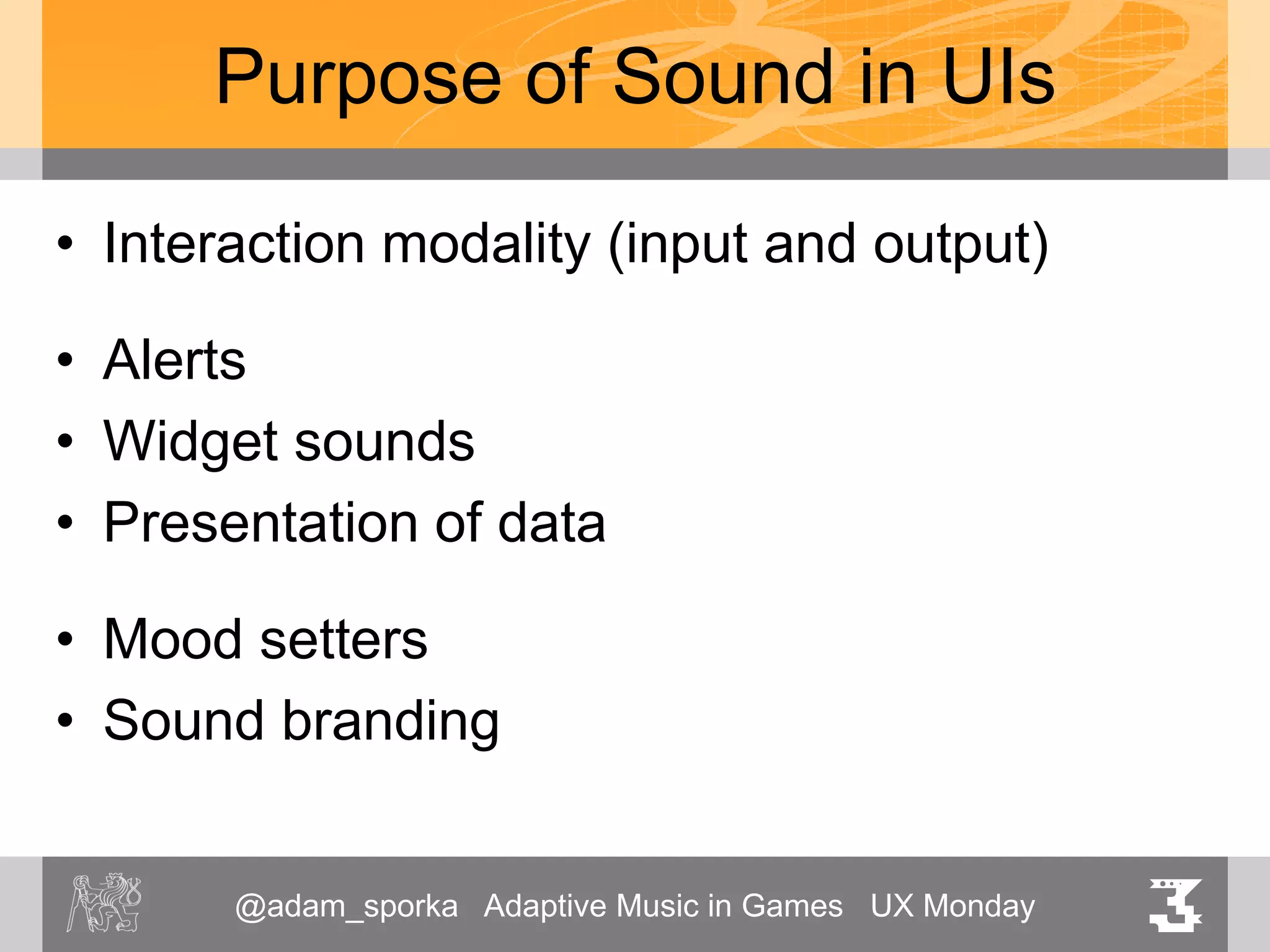
Purpose of Sound in UIs
• Interaction modality (input and output)
• Alerts
• Widget sounds
• Presentation of data
• Mood setters
• Sound branding
@adam_sporka Adaptive Music in Games UX Monday 4
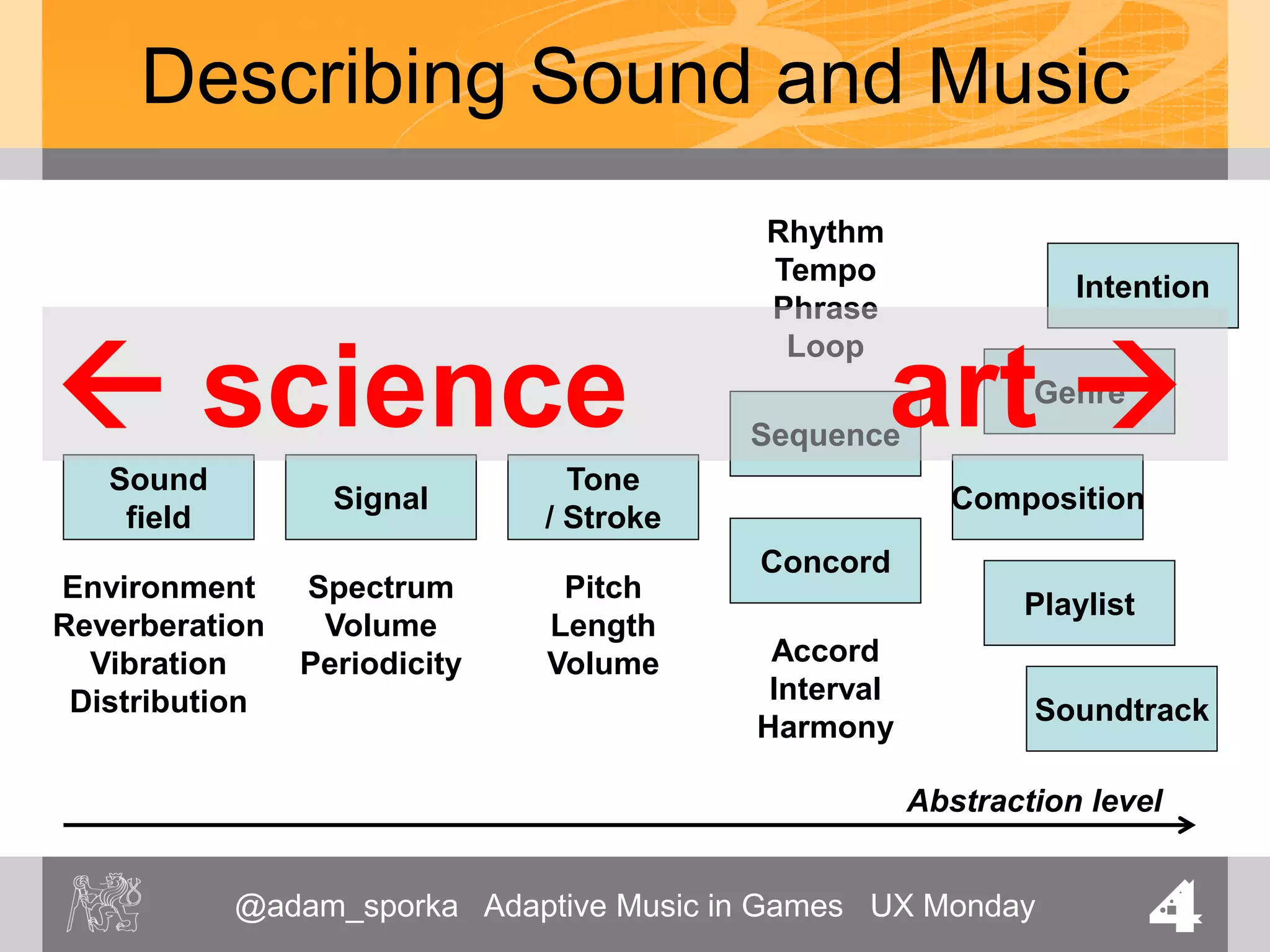
Describing Sound and Music
Signal
Sound
field
Tone
/ Stroke
Sequence
Concord
Composition
Environment
Reverberation
Vibration
Distribution
Spectrum
Volume
Periodicity
Pitch
Length
Volume Accord
Interval
Harmony
Rhythm
Tempo
Phrase
Loop
Soundtrack
Intention
Abstraction level
Playlist
Genre
 science art 
@adam_sporka Adaptive Music in Games UX Monday 5
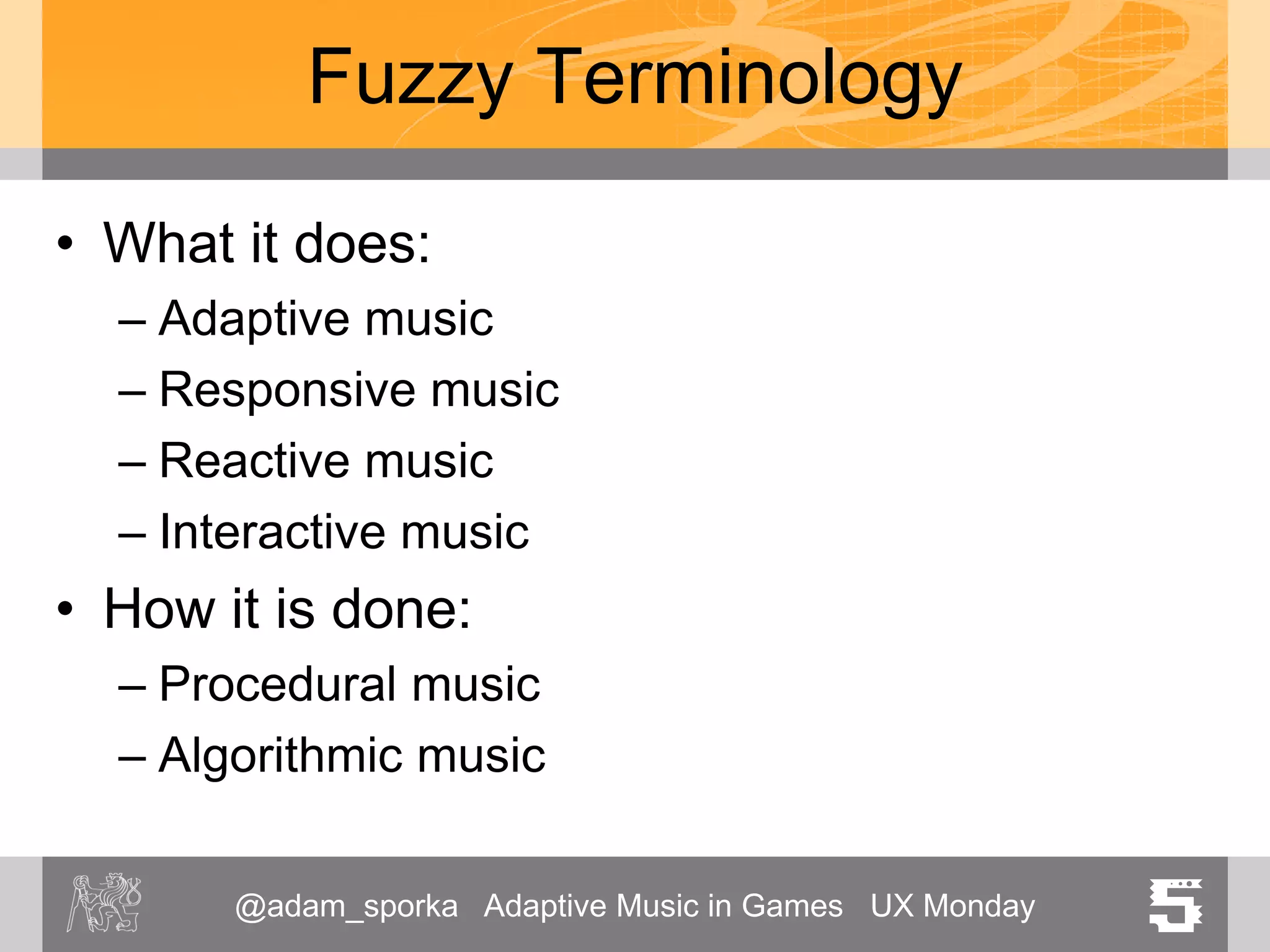
Fuzzy Terminology
• What it does:
– Adaptive music
– Responsive music
– Reactive music
– Interactive music
• How it is done:
– Procedural music
– Algorithmic music
@adam_sporka Adaptive Music in Games UX Monday 6
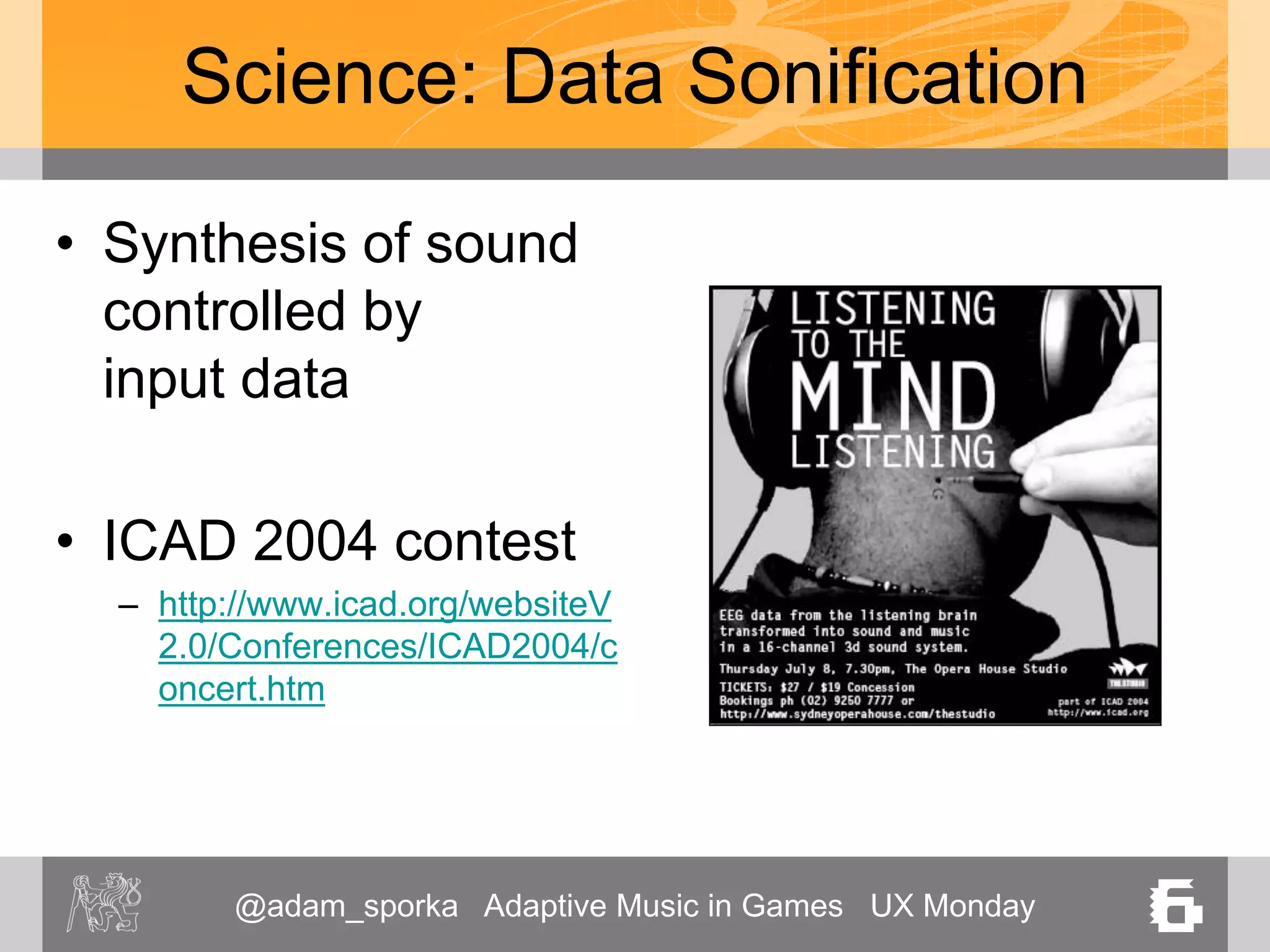
Science: Data Sonification
• Synthesis of sound
controlled by
input data
• ICAD 2004 contest
– http://www.icad.org/websiteV
2.0/Conferences/ICAD2004/c
oncert.htm
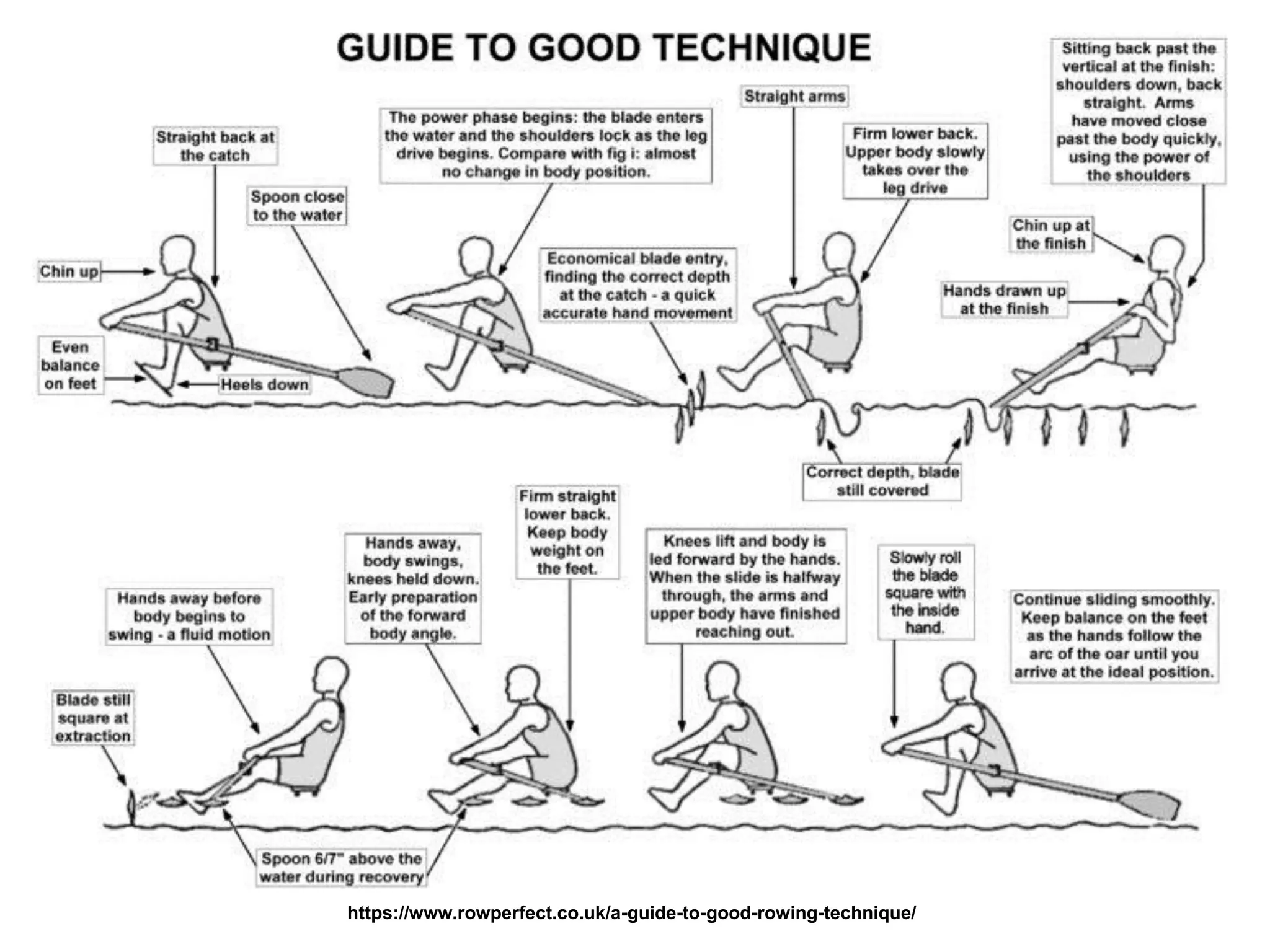
https://www.rowperfect.co.uk/a-guide-to-good-rowing-technique/
@adam_sporka Adaptive Music in Games UX Monday 8
Sonification of Rowing sounds
• https://www.youtube.com/watch?v=YxWNw9fIizk
• Audible comparison of trainee’s sound and
reference
• Audible feedback while people is rowing
@adam_sporka Adaptive Music in Games UX Monday 9
Outline
• Purpose of music in games
• Static music soundtracks
– Music design
• Dynamic music soundtracks
– Design, production, …
• Music production technology
– How the actual music is made
MUSIC
@adam_sporka Adaptive Music in Games UX Monday 11
Purpose of Music
• Tradition
– Present in most of the released titles
– Why not in yours?
• Affirmation of the genre
– “Yes, this is an 8bit retro.”
– “Indeed, cowboys in spaceships.”
– “Yay, manga.”
@adam_sporka Adaptive Music in Games UX Monday 12
Purpose of Music
• Presentation of emotion
– Easygoing, happy-go-lucky, …
– Depressing, sad, …
• Setting the expectations
– Level difficulty
• Status monitoring
– Changes of music over time indicate changes in
game
@adam_sporka Adaptive Music in Games UX Monday 13
Purpose of Music
• Essence of the gameplay
– Dance Dance Revolution (1998)
– Guitar Hero (2005)
– Pugs Luv Beats (2011)
• http://www.youtube.com/watch?v=V0i18_--8Yc
– Not covered by this talk
@adam_sporka Adaptive Music in Games UX Monday 14
Game Music Components
• Theme Music
– Often synchronized with visual events on the
screen
– Cinematic experience
• Underscore
– In-game music
– User interface background
@adam_sporka Adaptive Music in Games UX Monday 15
Game Music Components
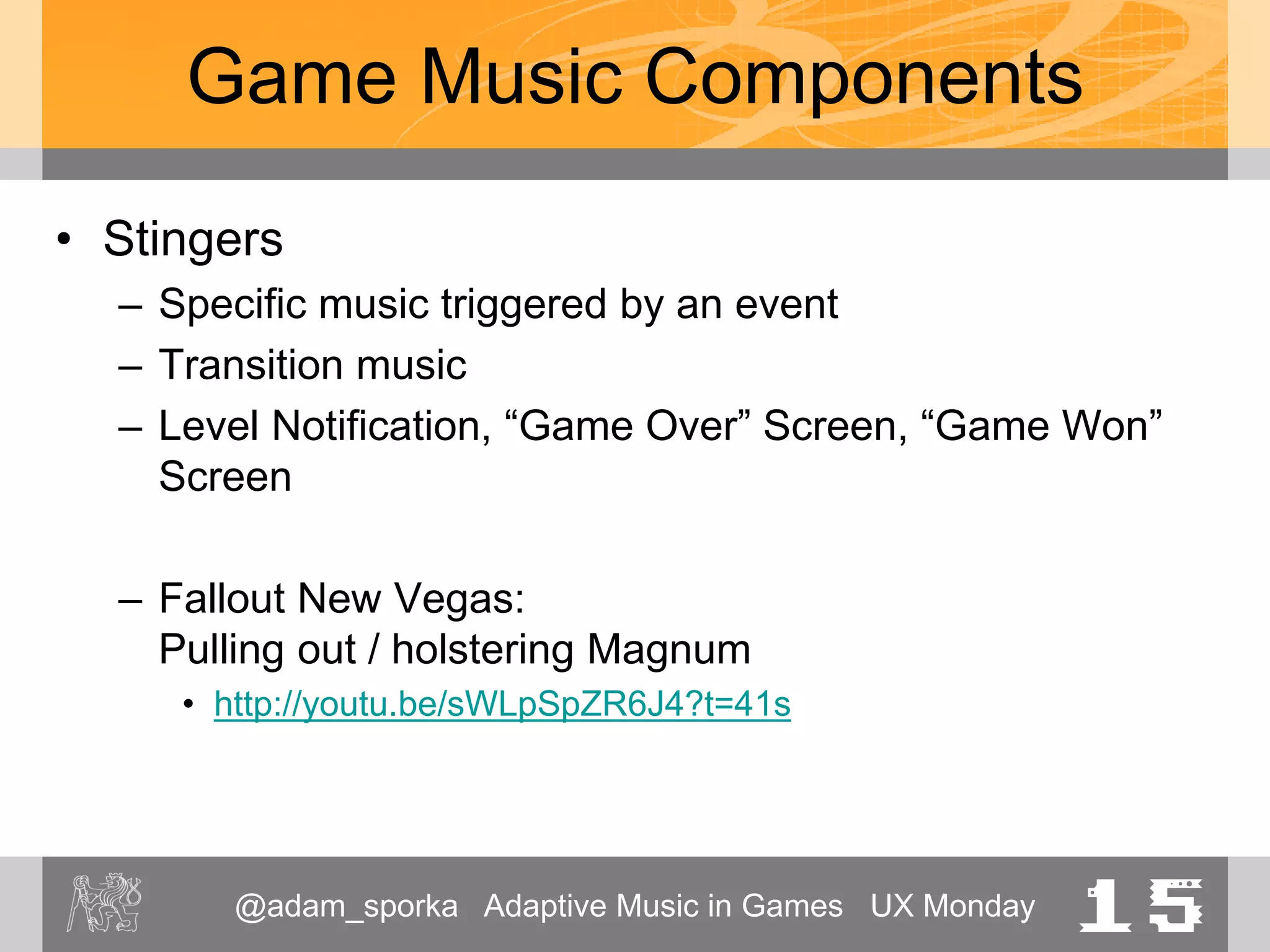
• Stingers
– Specific music triggered by an event
– Transition music
– Level Notification, “Game Over” Screen, “Game Won”
Screen
– Fallout New Vegas:
Pulling out / holstering Magnum
• http://youtu.be/sWLpSpZR6J4?t=41s
@adam_sporka Adaptive Music in Games UX Monday 16
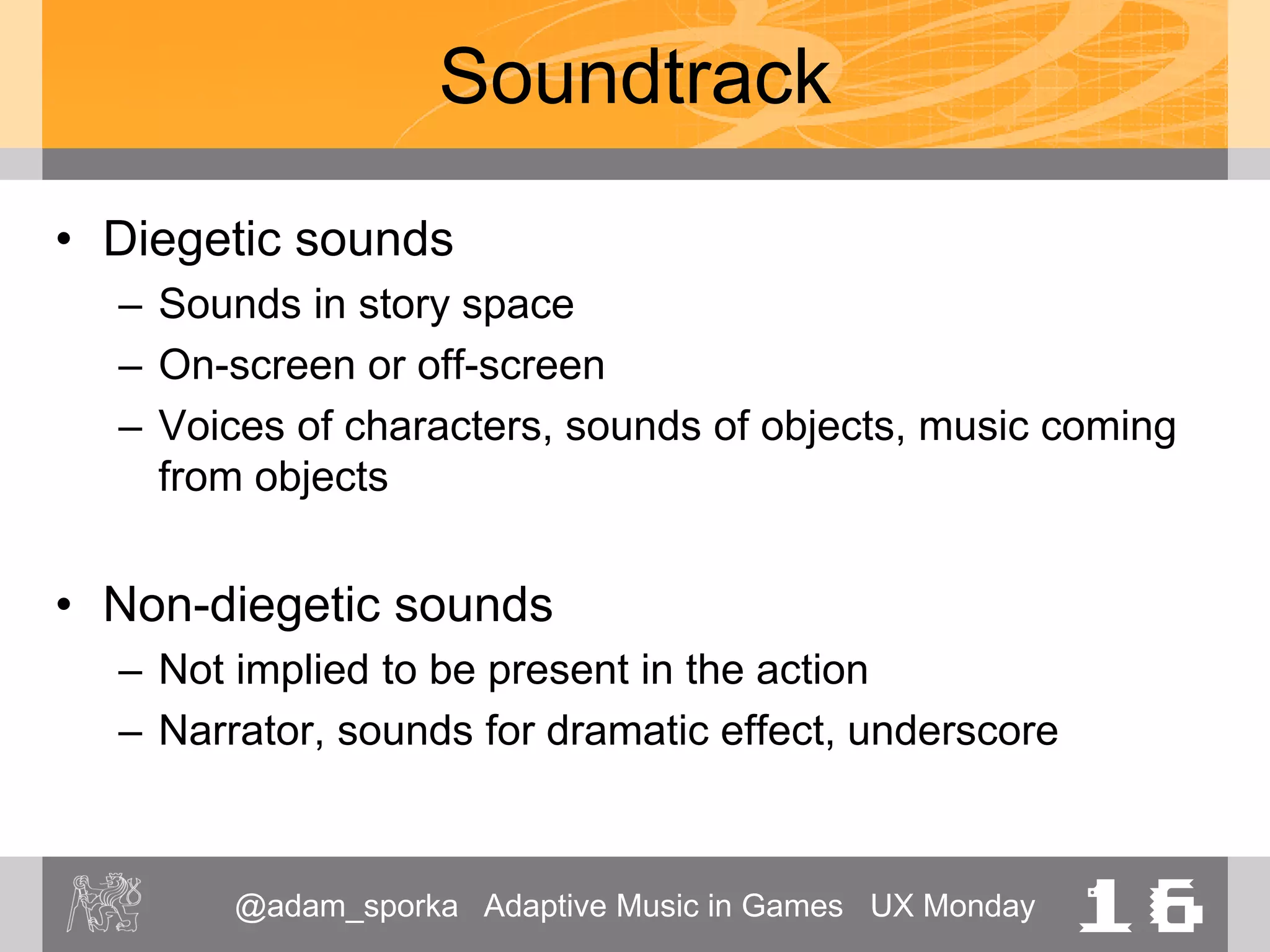
Soundtrack
• Diegetic sounds
– Sounds in story space
– On-screen or off-screen
– Voices of characters, sounds of objects, music coming
from objects
• Non-diegetic sounds
– Not implied to be present in the action
– Narrator, sounds for dramatic effect, underscore
@adam_sporka Adaptive Music in Games UX Monday 17
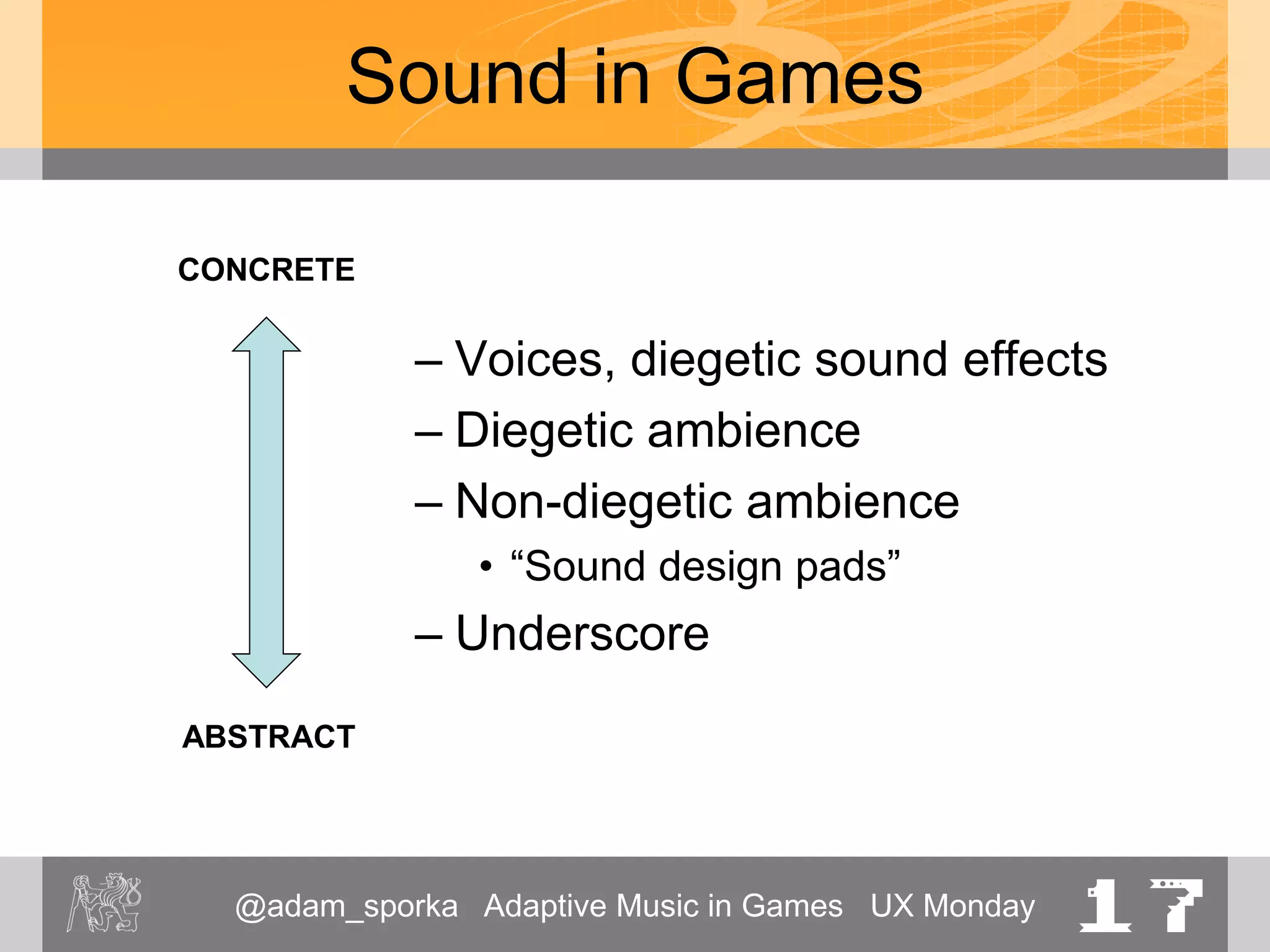
Sound in Games
– Voices, diegetic sound effects
– Diegetic ambience
– Non-diegetic ambience
• “Sound design pads”
– Underscore
ABSTRACT
CONCRETE
@adam_sporka Adaptive Music in Games UX Monday 18
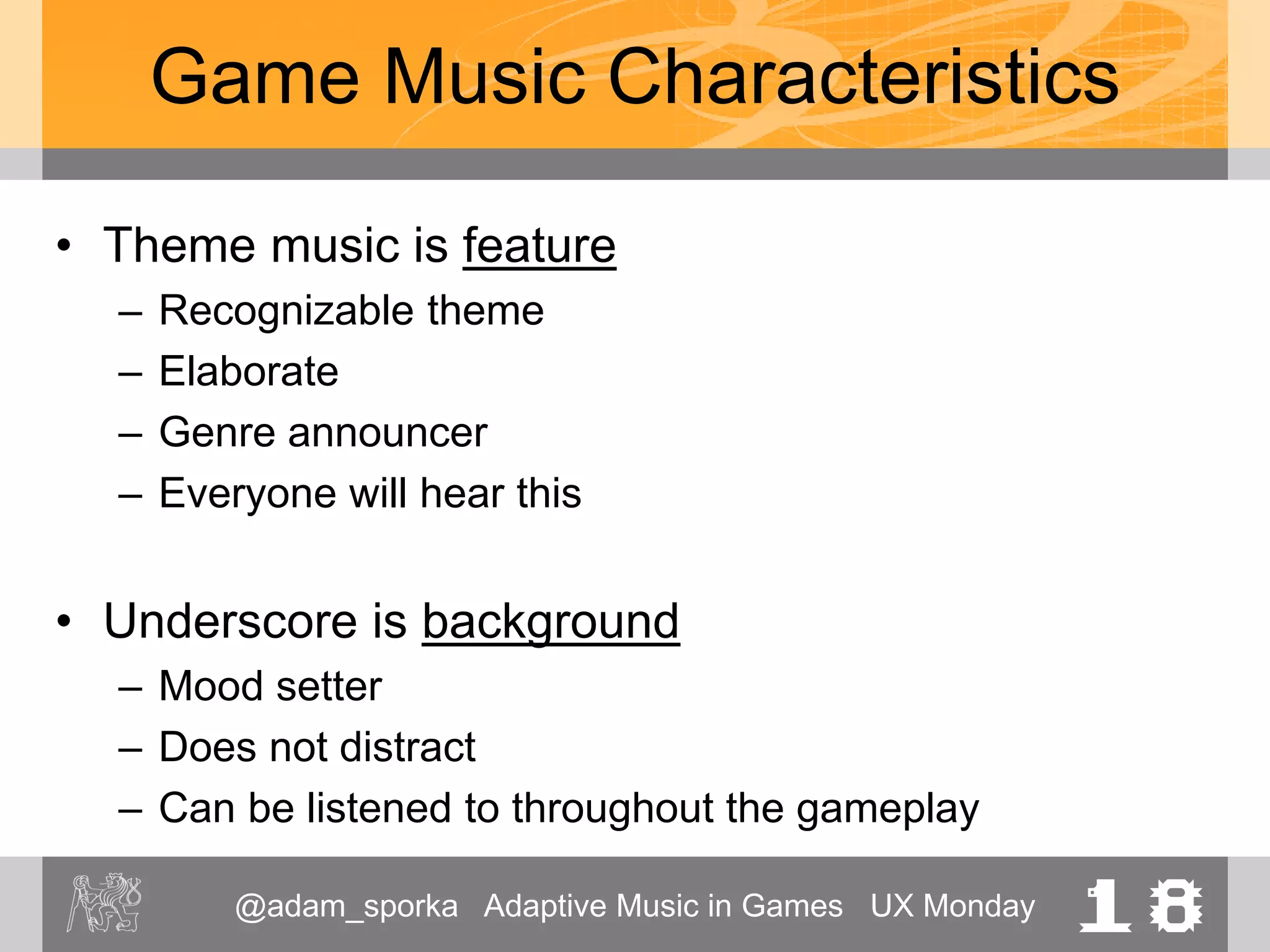
Game Music Characteristics
• Theme music is feature
– Recognizable theme
– Elaborate
– Genre announcer
– Everyone will hear this
• Underscore is background
– Mood setter
– Does not distract
– Can be listened to throughout the gameplay
@adam_sporka Adaptive Music in Games UX Monday 19
Game Music Characteristics
• Silence
– “Dosage” of music
• Used to emphasize music
– Keep the ambient sounds present
– Complete silence  “something wrong”
• “Are my speakers on? Will I hear anything at all when
I’ll really have to?”
@adam_sporka Adaptive Music in Games UX Monday 20
Game Music Interactivity
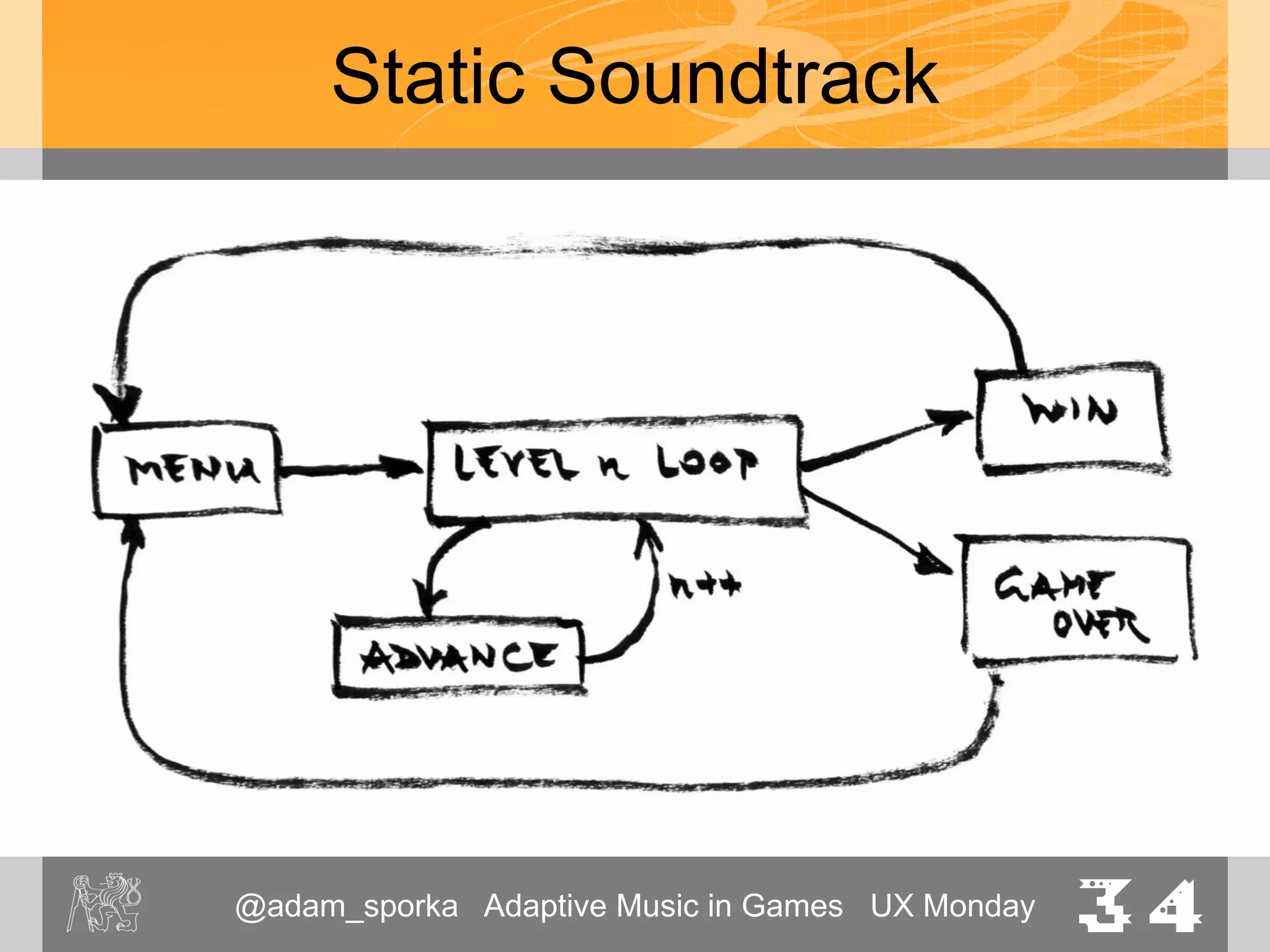
• Static soundtrack
– Predefined and unchanging
– Loops
– Assigned to specific screens / levels
• Dynamic (adaptive) soundtrack
– More complex control of the music playback
– Engine “aware” of the state of the game
DESIGN
@adam_sporka Adaptive Music in Games UX Monday 22
Music Design
• Genre?
• Situations in game?
• Mechanics of music?
@adam_sporka Adaptive Music in Games UX Monday 28
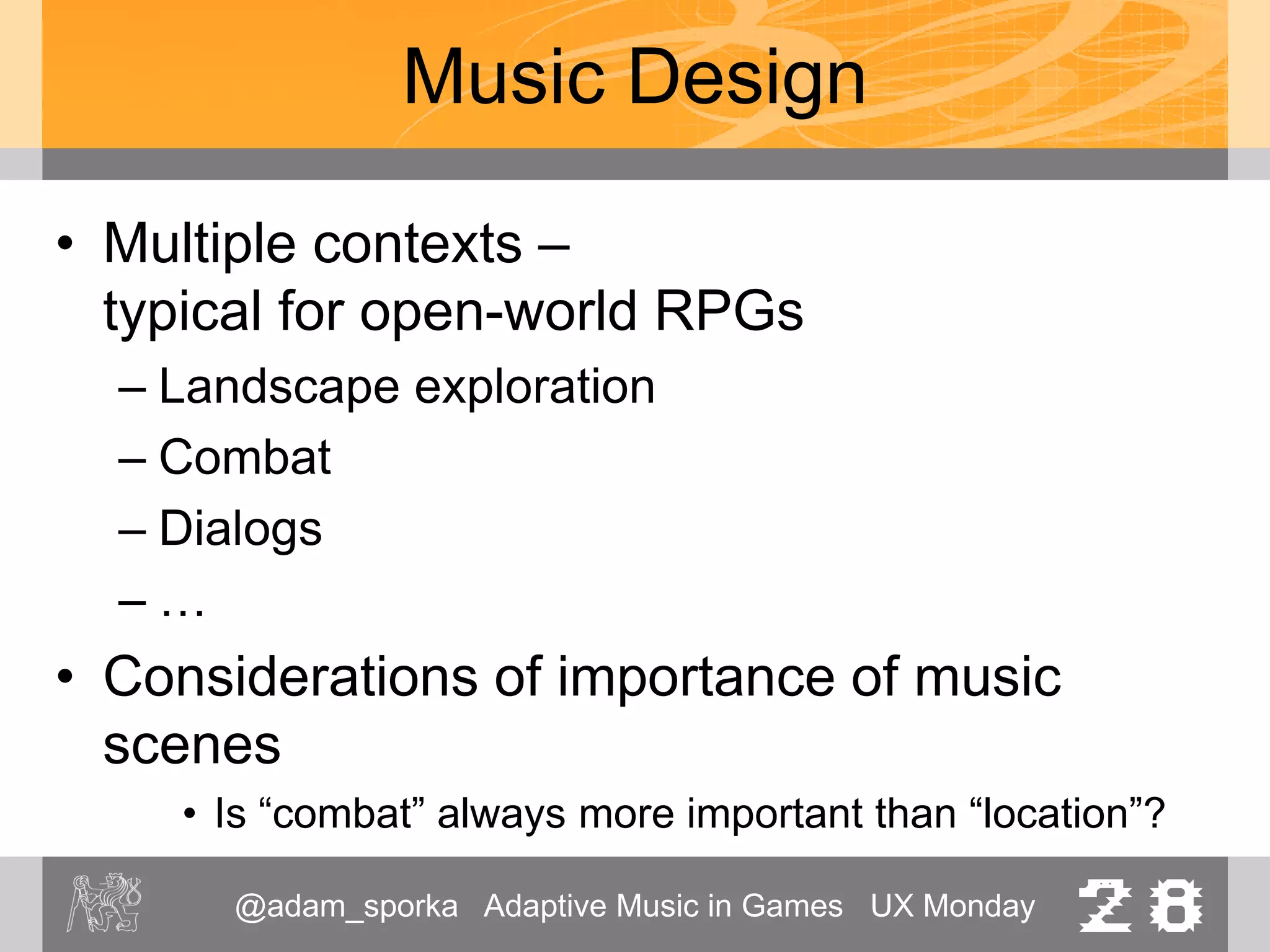
Music Design
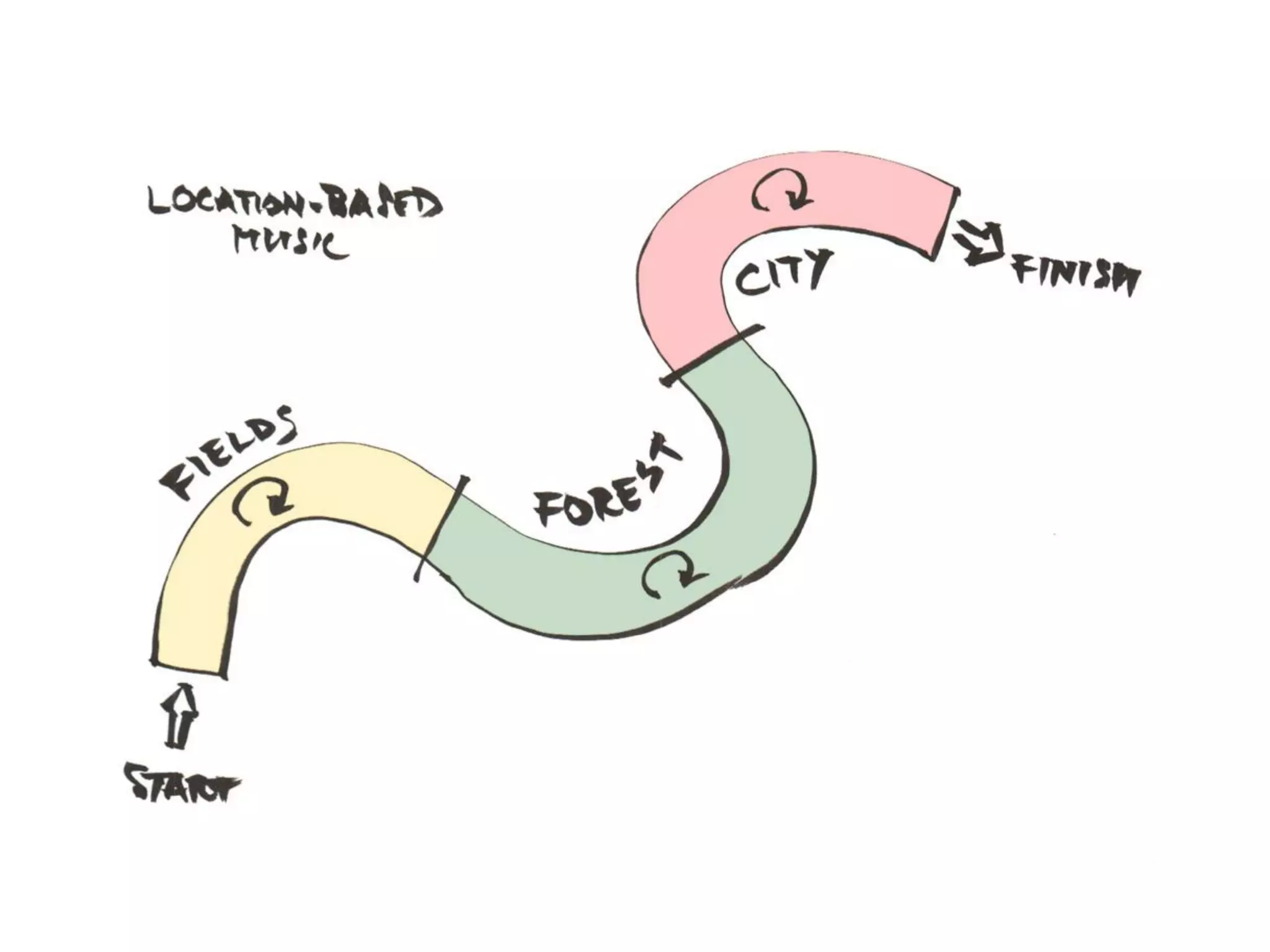
• Multiple contexts –
typical for open-world RPGs
– Landscape exploration
– Combat
– Dialogs
– …
• Considerations of importance of music
scenes
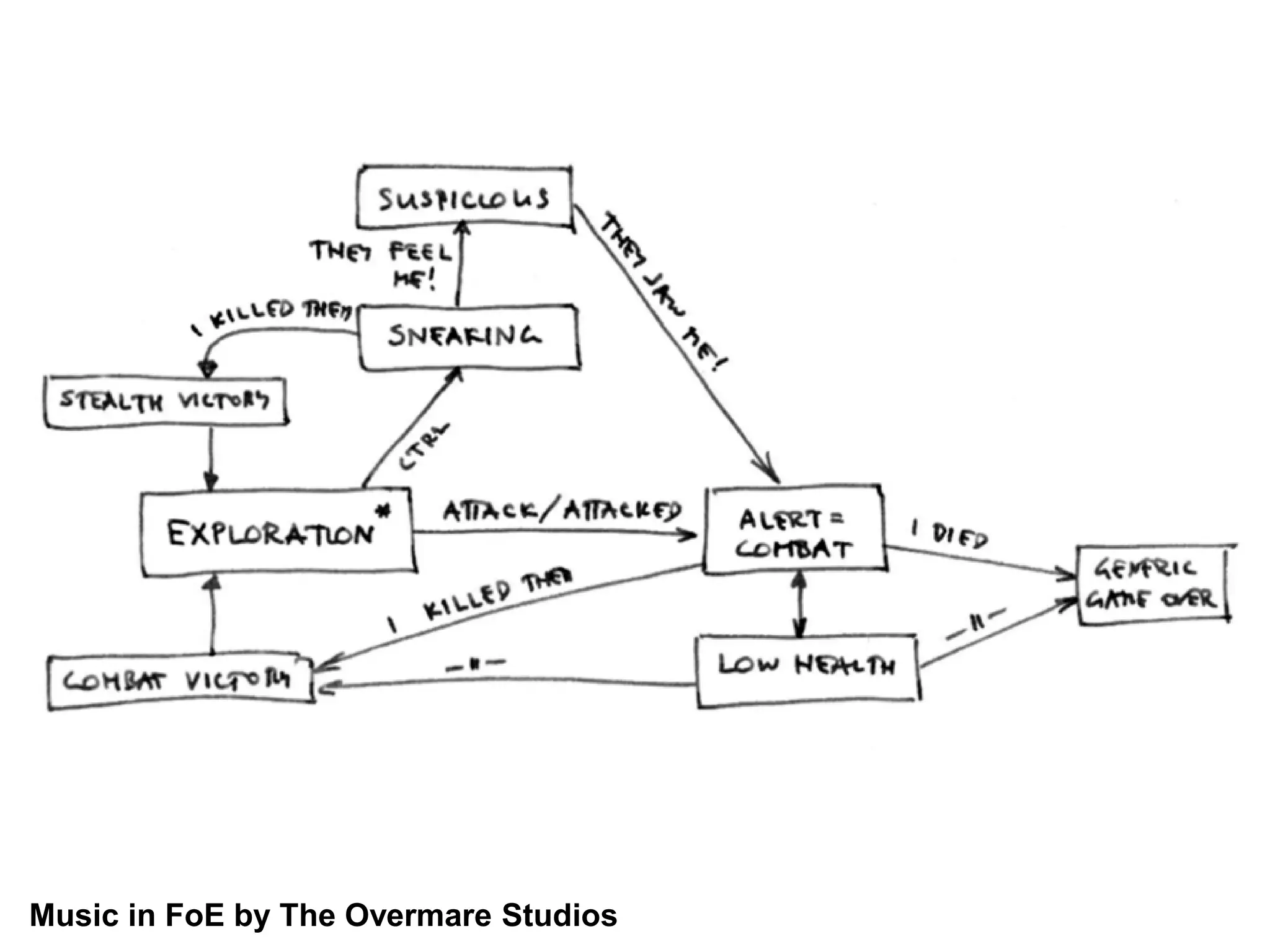
• Is “combat” always more important than “location”?
Music in FoE by The Overmare Studios
STATIC
@adam_sporka Adaptive Music in Games UX Monday 31
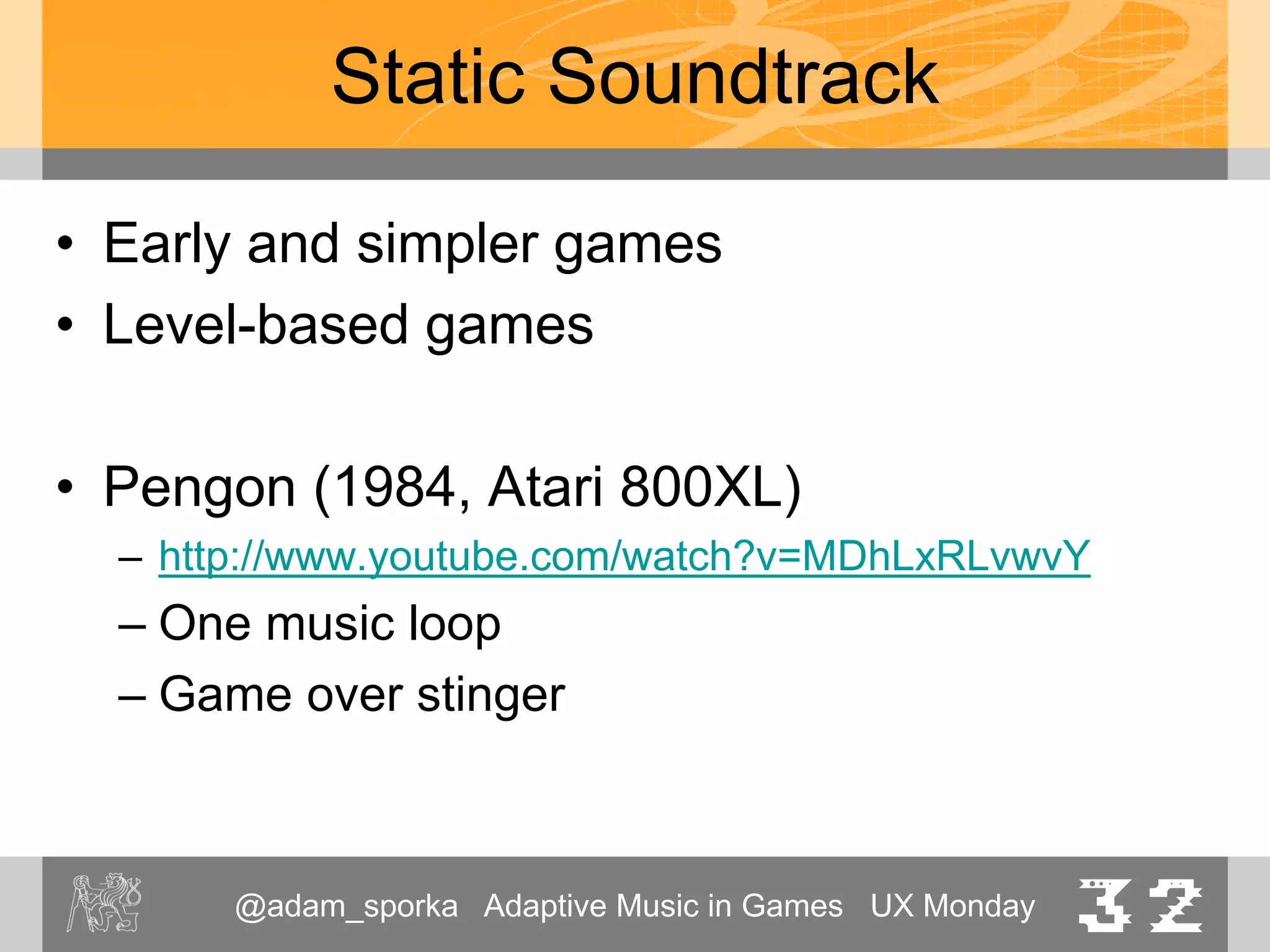
Static Soundtrack
• Early and simpler games
• Level-based games
• Pengon (1984, Atari 800XL)
– http://www.youtube.com/watch?v=MDhLxRLvwvY
– One music loop
– Game over stinger
@adam_sporka Adaptive Music in Games UX Monday 32
Static Soundtrack
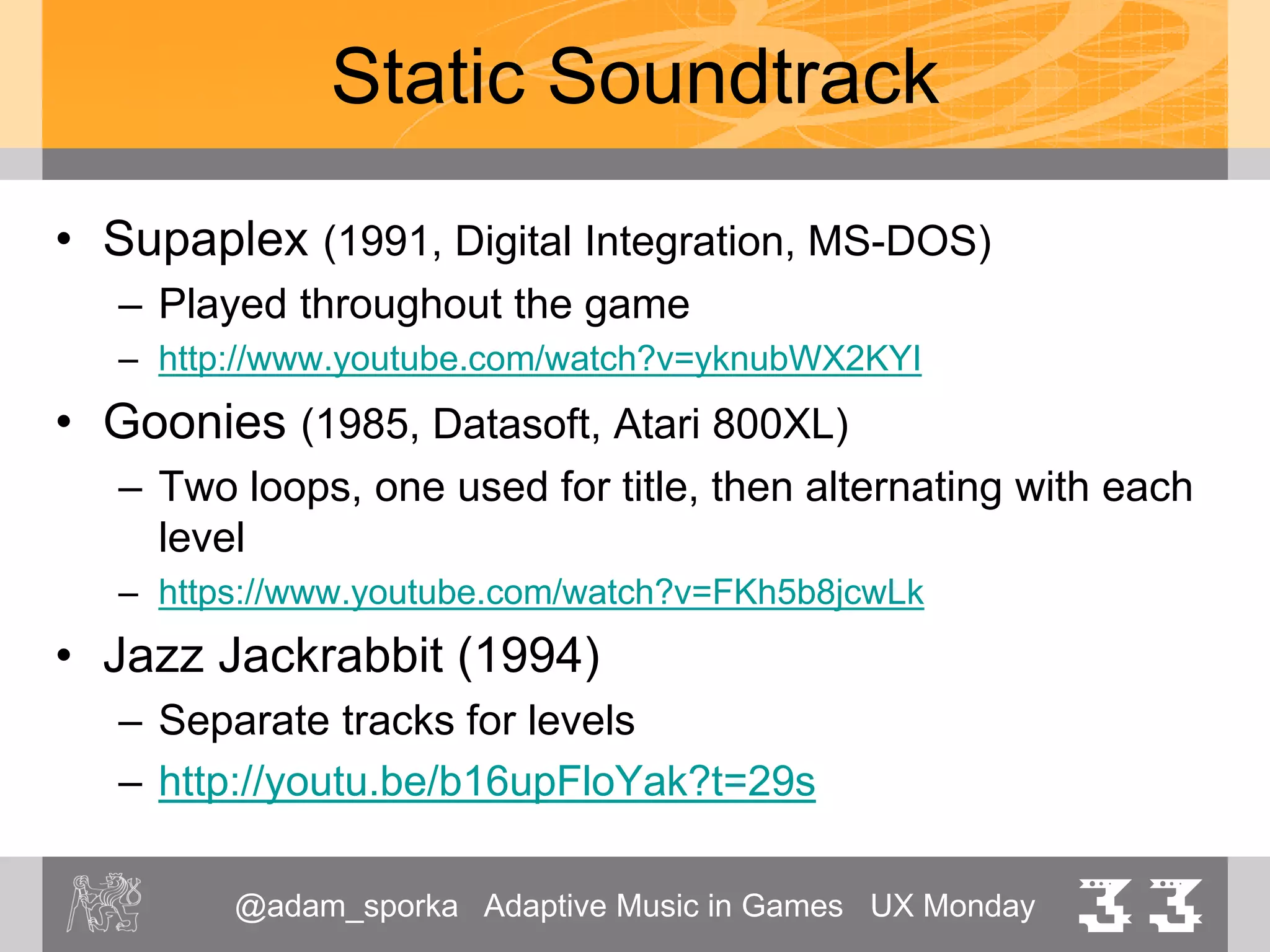
• Supaplex (1991, Digital Integration, MS-DOS)
– Played throughout the game
– http://www.youtube.com/watch?v=yknubWX2KYI
• Goonies (1985, Datasoft, Atari 800XL)
– Two loops, one used for title, then alternating with each
level
– https://www.youtube.com/watch?v=FKh5b8jcwLk
• Jazz Jackrabbit (1994)
– Separate tracks for levels
– http://youtu.be/b16upFloYak?t=29s
@adam_sporka Adaptive Music in Games UX Monday 33
Static Soundtrack
@adam_sporka Adaptive Music in Games UX Monday 34
Case Study: Nimble Quest
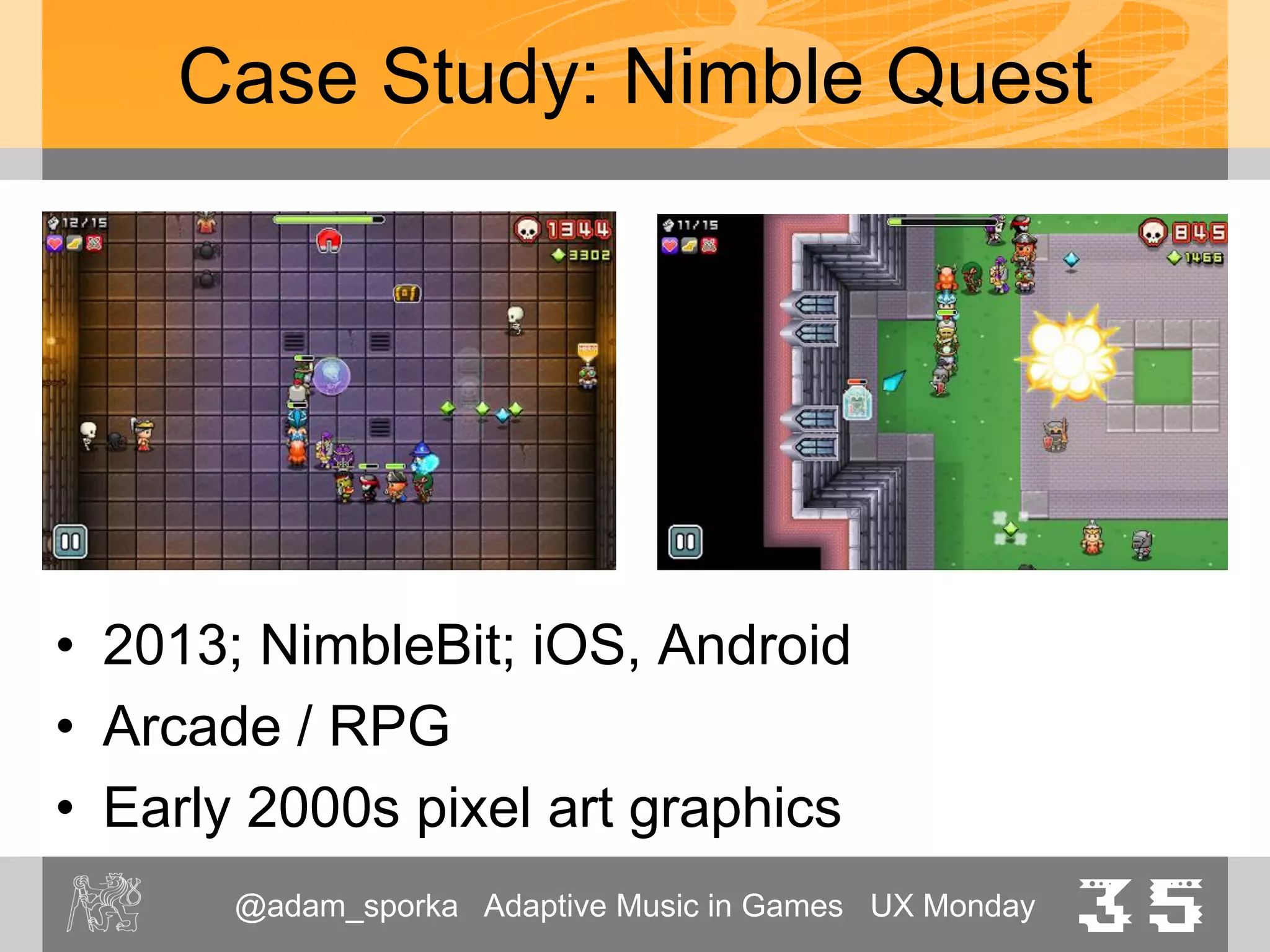
• 2013; NimbleBit; iOS, Android
• Arcade / RPG
• Early 2000s pixel art graphics
@adam_sporka Adaptive Music in Games UX Monday 35
Case Study: Nimble Quest
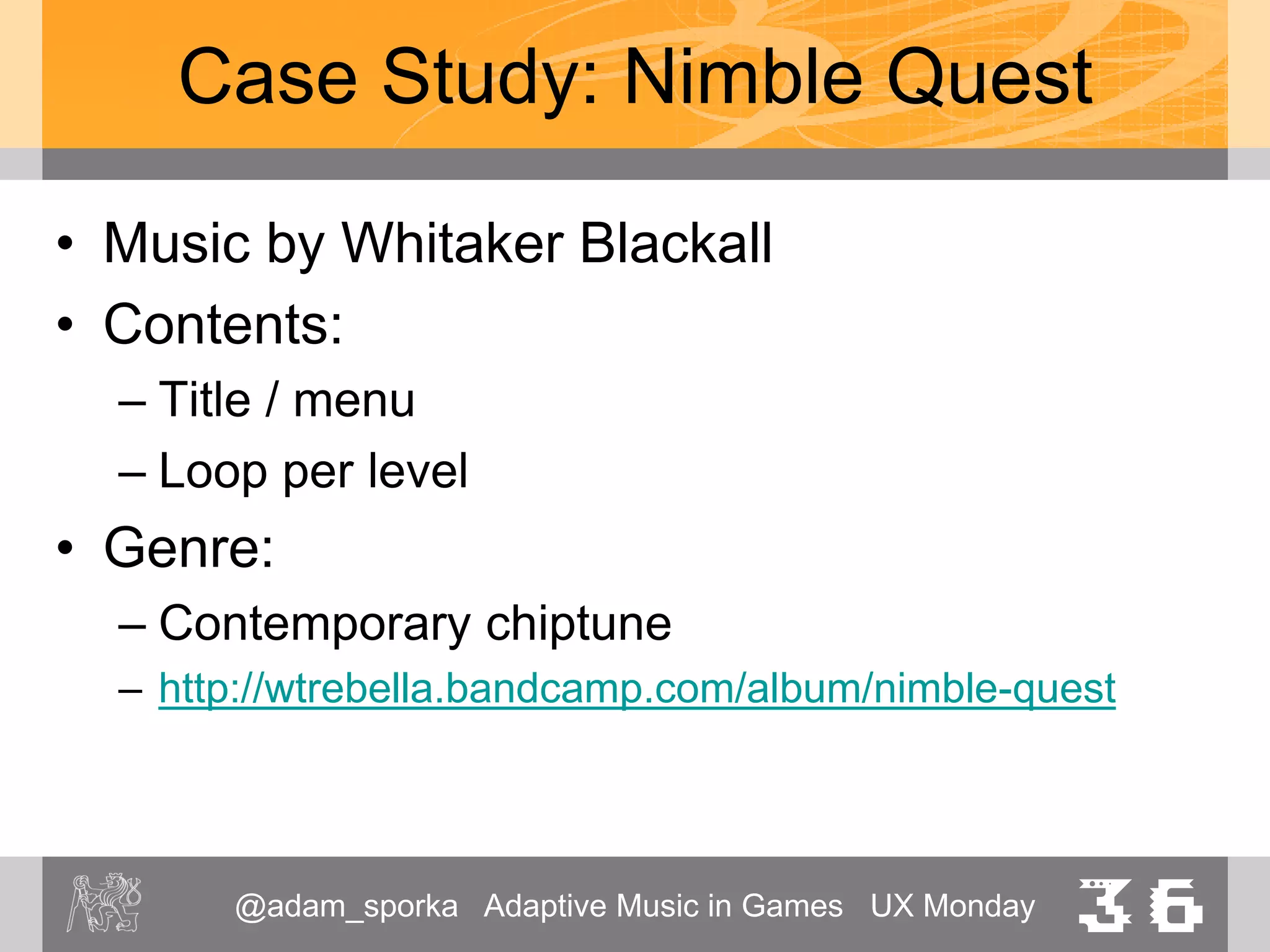
• Music by Whitaker Blackall
• Contents:
– Title / menu
– Loop per level
• Genre:
– Contemporary chiptune
– http://wtrebella.bandcamp.com/album/nimble-quest
@adam_sporka Adaptive Music in Games UX Monday 36
Case Study: Nimble Quest
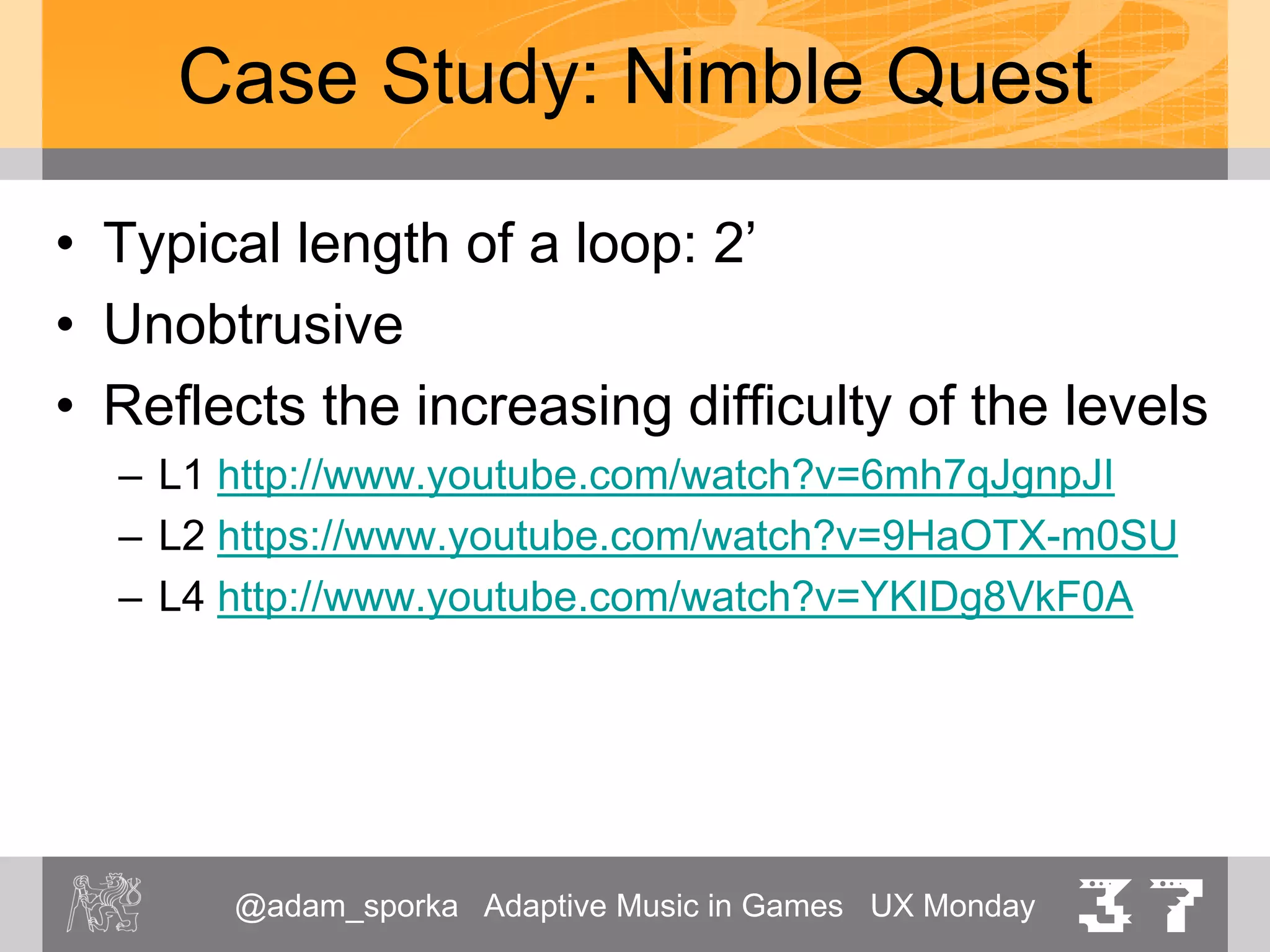
• Typical length of a loop: 2’
• Unobtrusive
• Reflects the increasing difficulty of the levels
– L1 http://www.youtube.com/watch?v=6mh7qJgnpJI
– L2 https://www.youtube.com/watch?v=9HaOTX-m0SU
– L4 http://www.youtube.com/watch?v=YKIDg8VkF0A
@adam_sporka Adaptive Music in Games UX Monday 37
Case Study: Nimble Quest
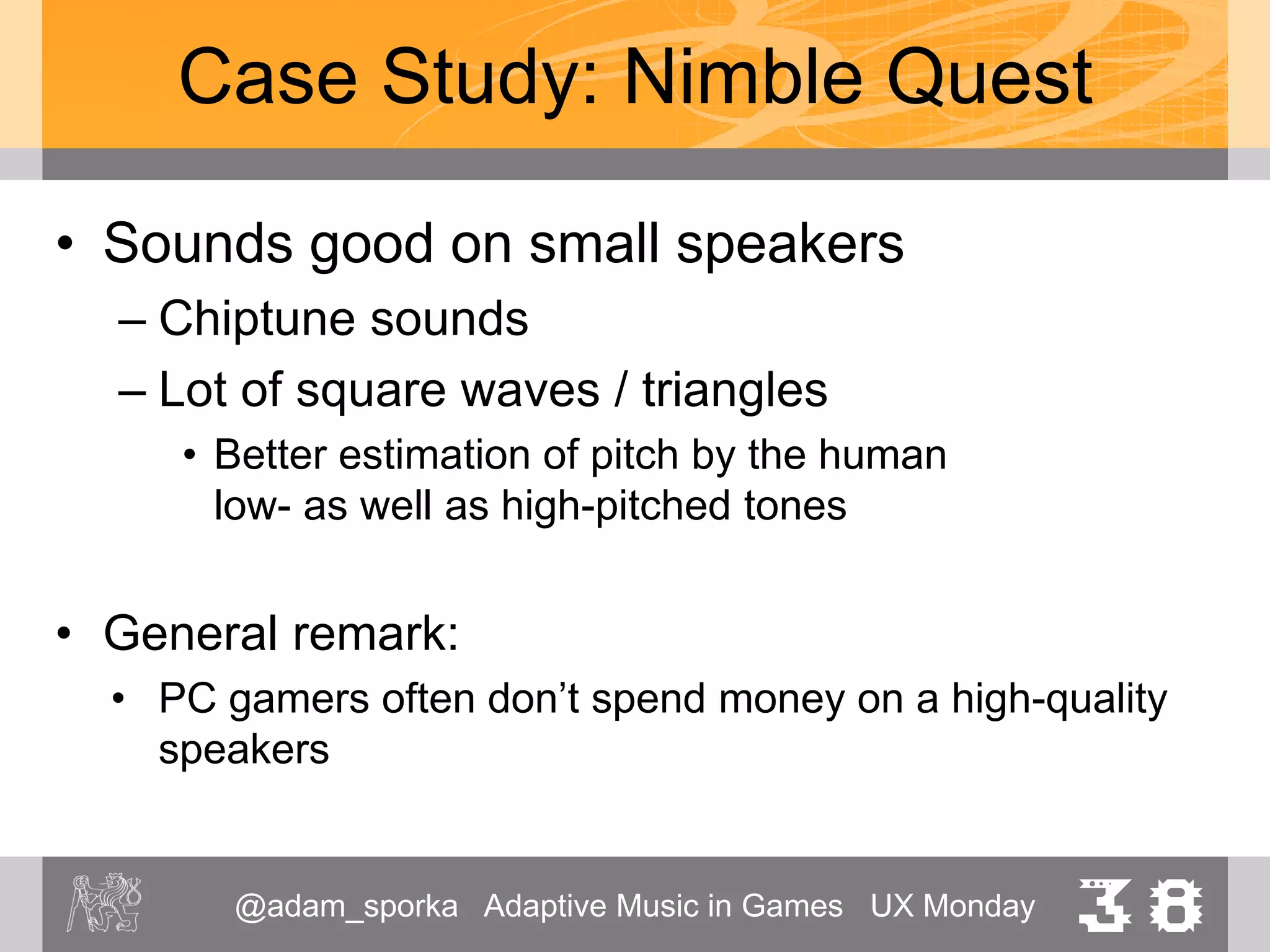
• Sounds good on small speakers
– Chiptune sounds
– Lot of square waves / triangles
• Better estimation of pitch by the human
low- as well as high-pitched tones
• General remark:
• PC gamers often don’t spend money on a high-quality
speakers
@adam_sporka Adaptive Music in Games UX Monday 38
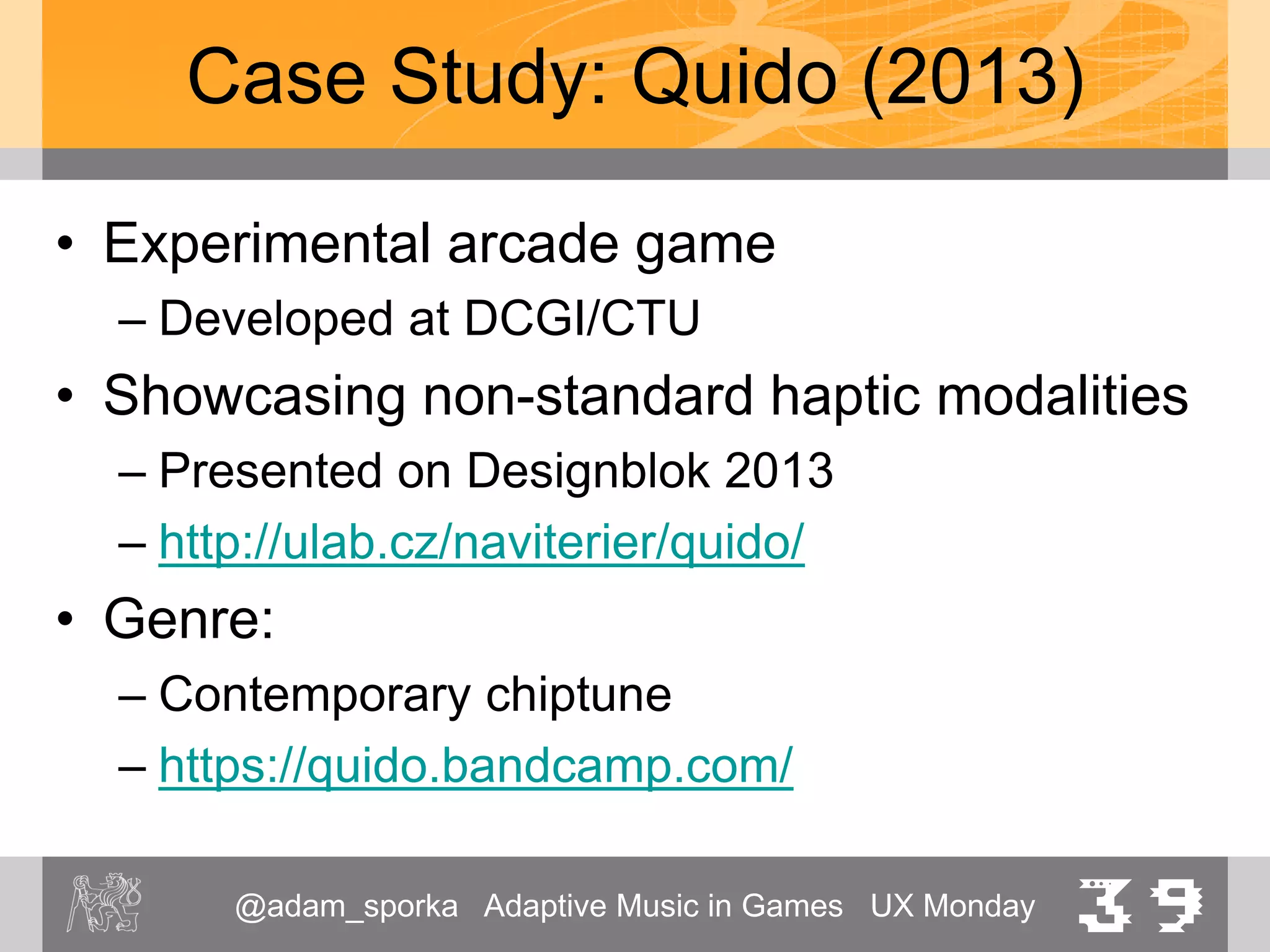
Case Study: Quido (2013)
• Experimental arcade game
– Developed at DCGI/CTU
• Showcasing non-standard haptic modalities
– Presented on Designblok 2013
– http://ulab.cz/naviterier/quido/
• Genre:
– Contemporary chiptune
– https://quido.bandcamp.com/
@adam_sporka Adaptive Music in Games UX Monday 39
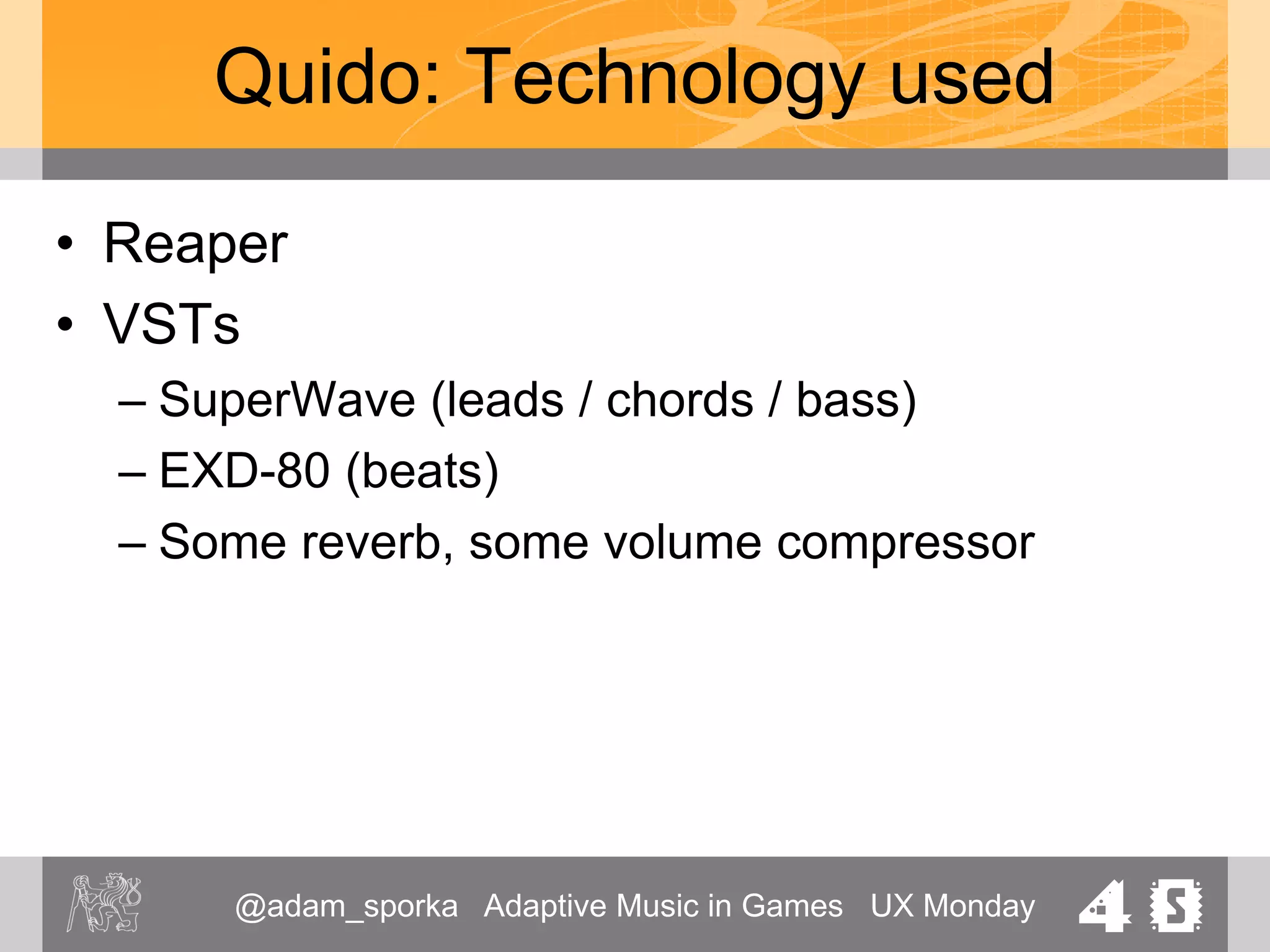
Quido: Technology used
• Reaper
• VSTs
– SuperWave (leads / chords / bass)
– EXD-80 (beats)
– Some reverb, some volume compressor
@adam_sporka Adaptive Music in Games UX Monday 40
Quido: Music
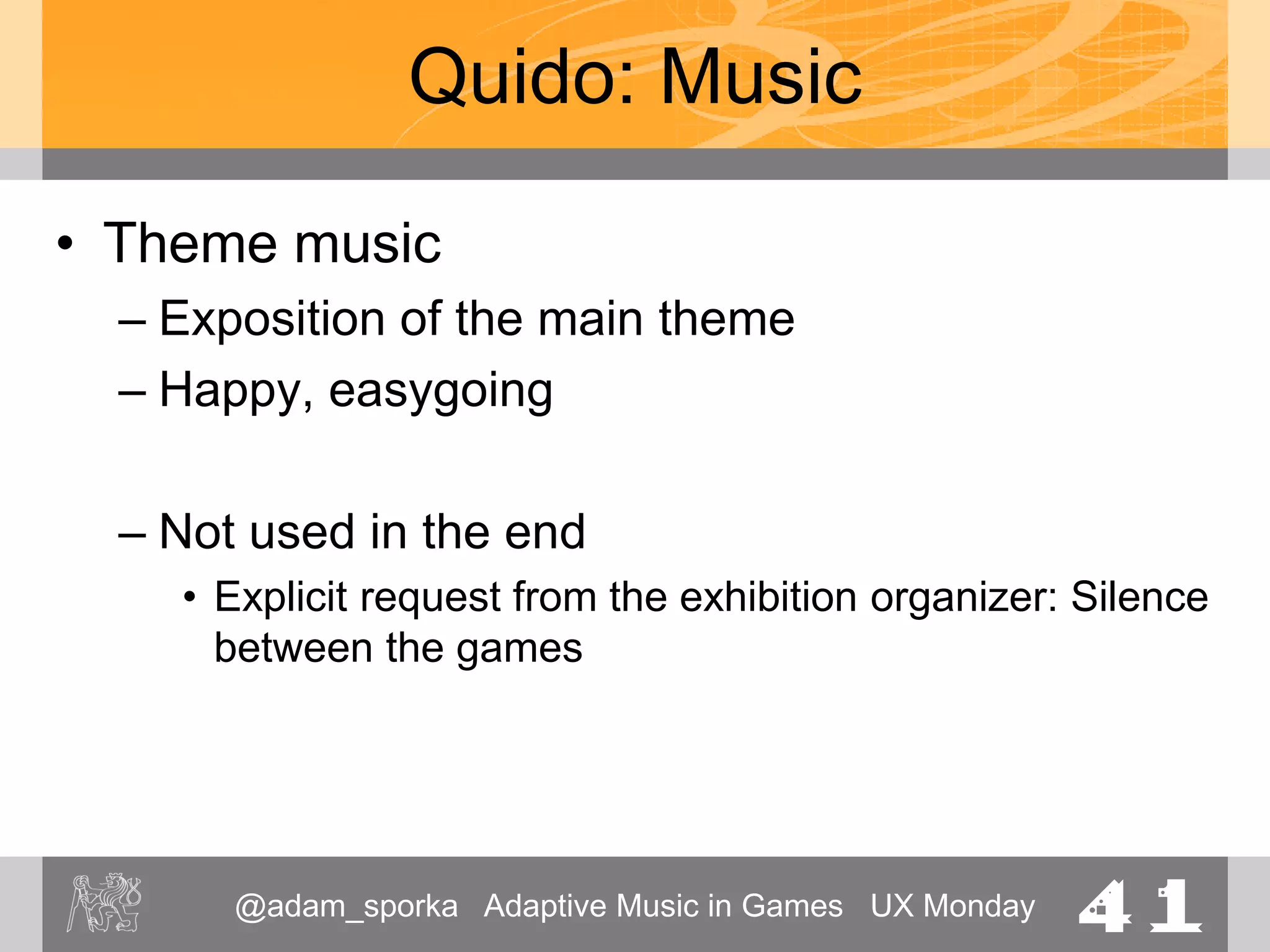
• Theme music
– Exposition of the main theme
– Happy, easygoing
– Not used in the end
• Explicit request from the exhibition organizer: Silence
between the games
@adam_sporka Adaptive Music in Games UX Monday 41
Quido: Music
• Level 1: Theme Park
– A player will be likely to be receiving instructions
from a fellow player
– Expected playtime: 3—4 minutes
– Not “dense”
– Diverse in terms of the structure
– Performance of the main theme
@adam_sporka Adaptive Music in Games UX Monday 42
Quido: Music
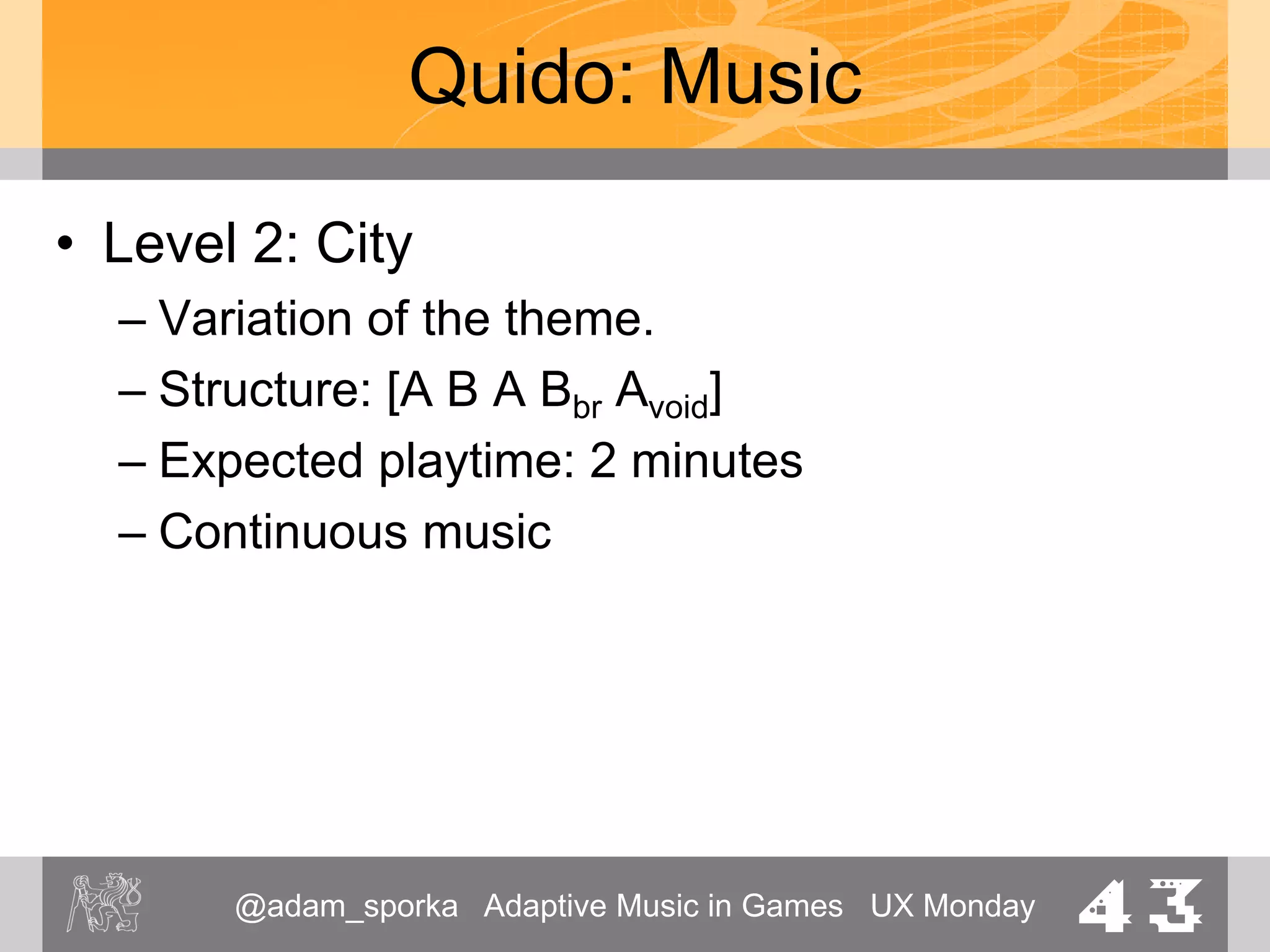
• Level 2: City
– Variation of the theme.
– Structure: [A B A Bbr Avoid]
– Expected playtime: 2 minutes
– Continuous music
@adam_sporka Adaptive Music in Games UX Monday 43
Quido: Music
• Level 3: Sky (Heaven)
– Variation of the theme. Barroque.
– Continuous music
– Expected playtime: 2 minutes
@adam_sporka Adaptive Music in Games UX Monday 44
Quido: Music
• Level completed
– Joyous jingle
• Advancing to the next level
– Expectation
@adam_sporka Adaptive Music in Games UX Monday 45
Quido: Music
• Game Over
– Definitive
– Not too tragic
@adam_sporka Adaptive Music in Games UX Monday 46
Quido: Music
• Game won
– Player enters their initials
– Reiteration of the main theme
ADAPTIVE
@adam_sporka Adaptive Music in Games UX Monday 48
Adaptive Music Styles
• Resequencing
– Selecting what to play next
• Reorchestration
– Selecting which instruments to play
• Modulation
– Modifying the timbres of notes
– Related to Data Sonification
@adam_sporka Adaptive Music in Games UX Monday 49
The Space Game
• Game loops:
– Menu / Idle
– The enemy is approaching
– The enemy opens fire
• <demo>
– http://www.candystand.com/play/the-space-game
@adam_sporka Adaptive Music in Games UX Monday 50
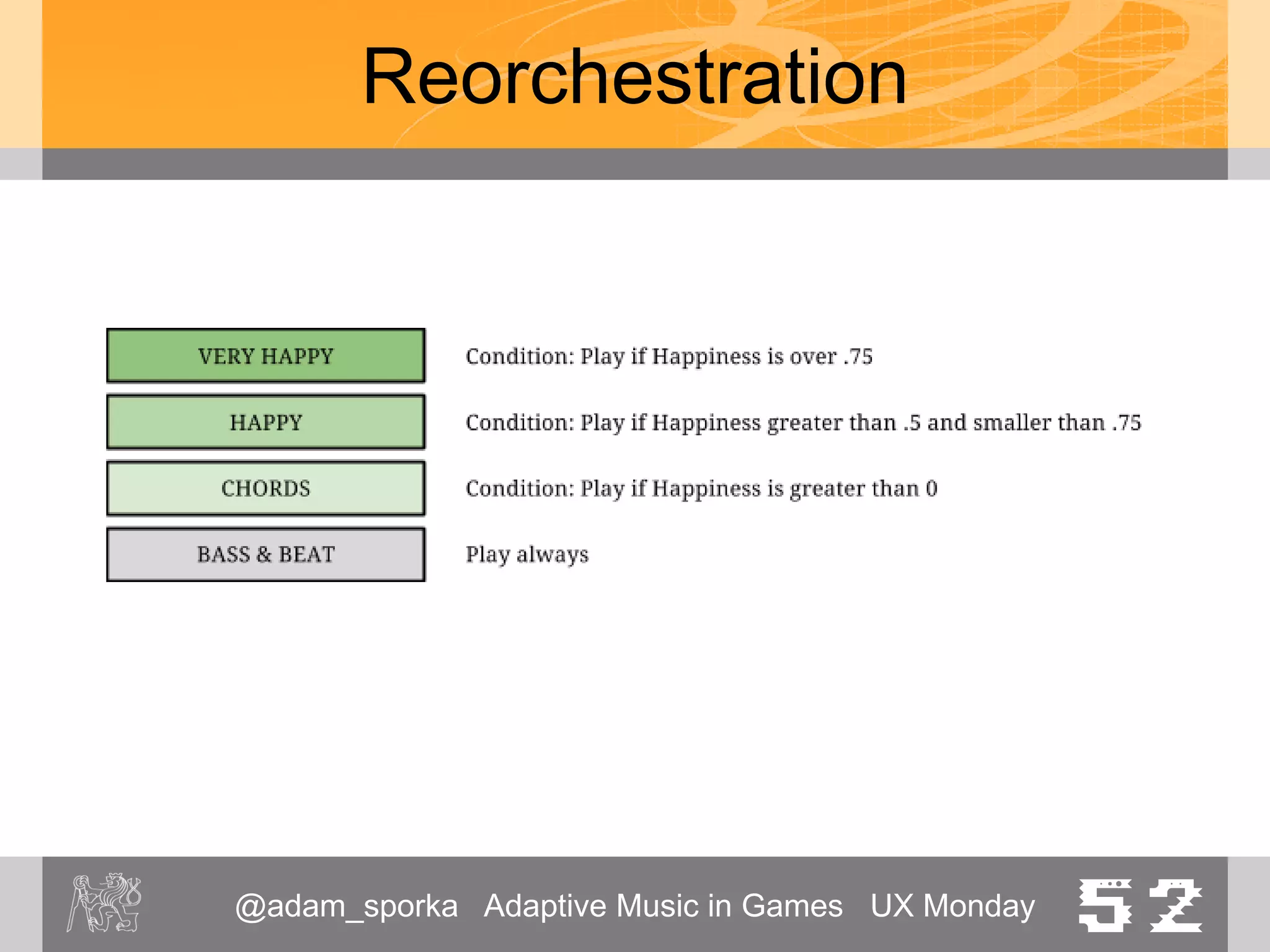
Reorchestration
• Multiple tracks
– Turned on/off
– Faded in and out
• Synchronous
<Demo: honza_test_02.sqc>
@adam_sporka Adaptive Music in Games UX Monday 51
Reorchestration
@adam_sporka Adaptive Music in Games UX Monday 52
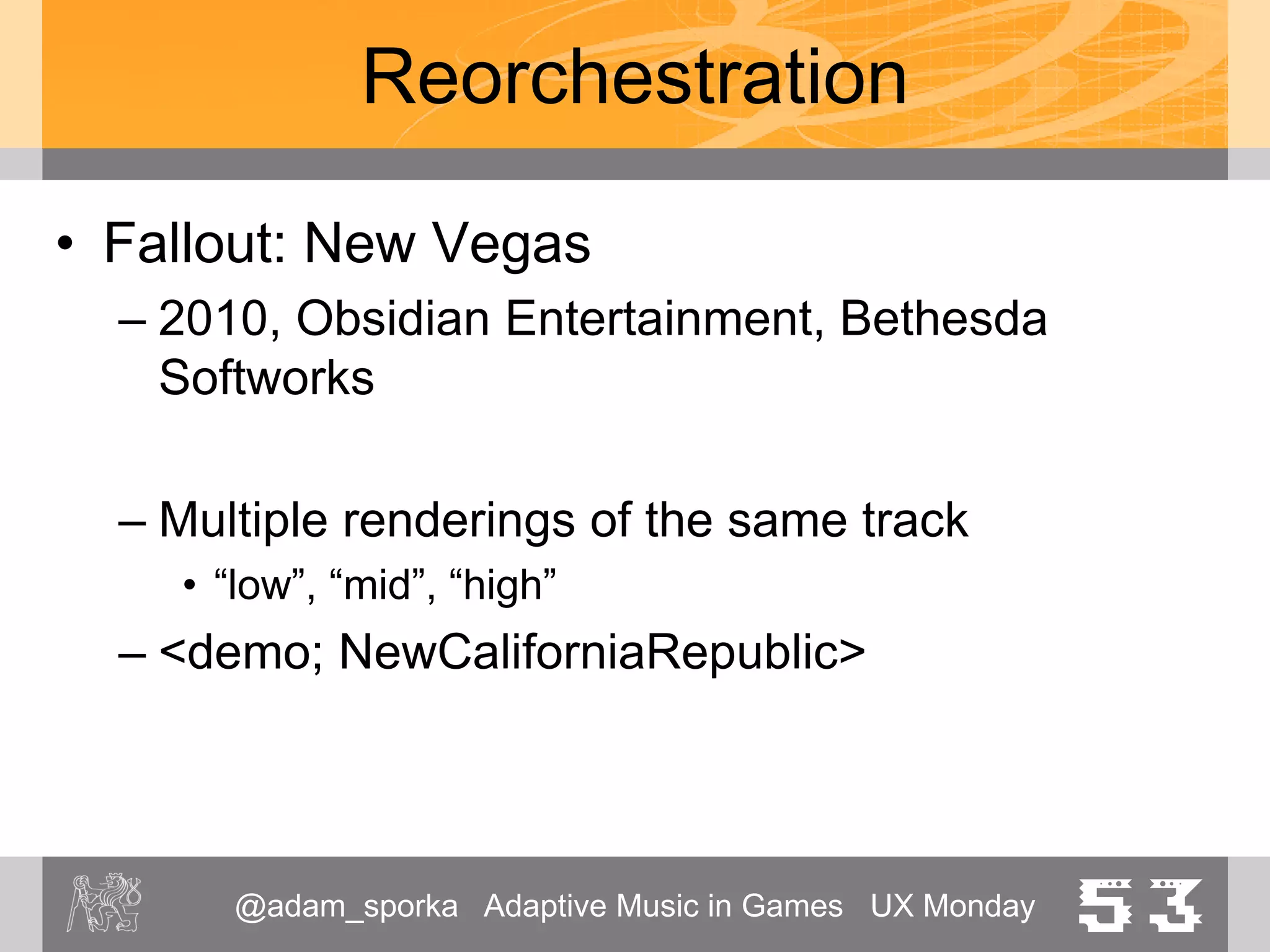
Reorchestration
• Fallout: New Vegas
– 2010, Obsidian Entertainment, Bethesda
Softworks
– Multiple renderings of the same track
• “low”, “mid”, “high”
– <demo; NewCaliforniaRepublic>
@adam_sporka Adaptive Music in Games UX Monday 53
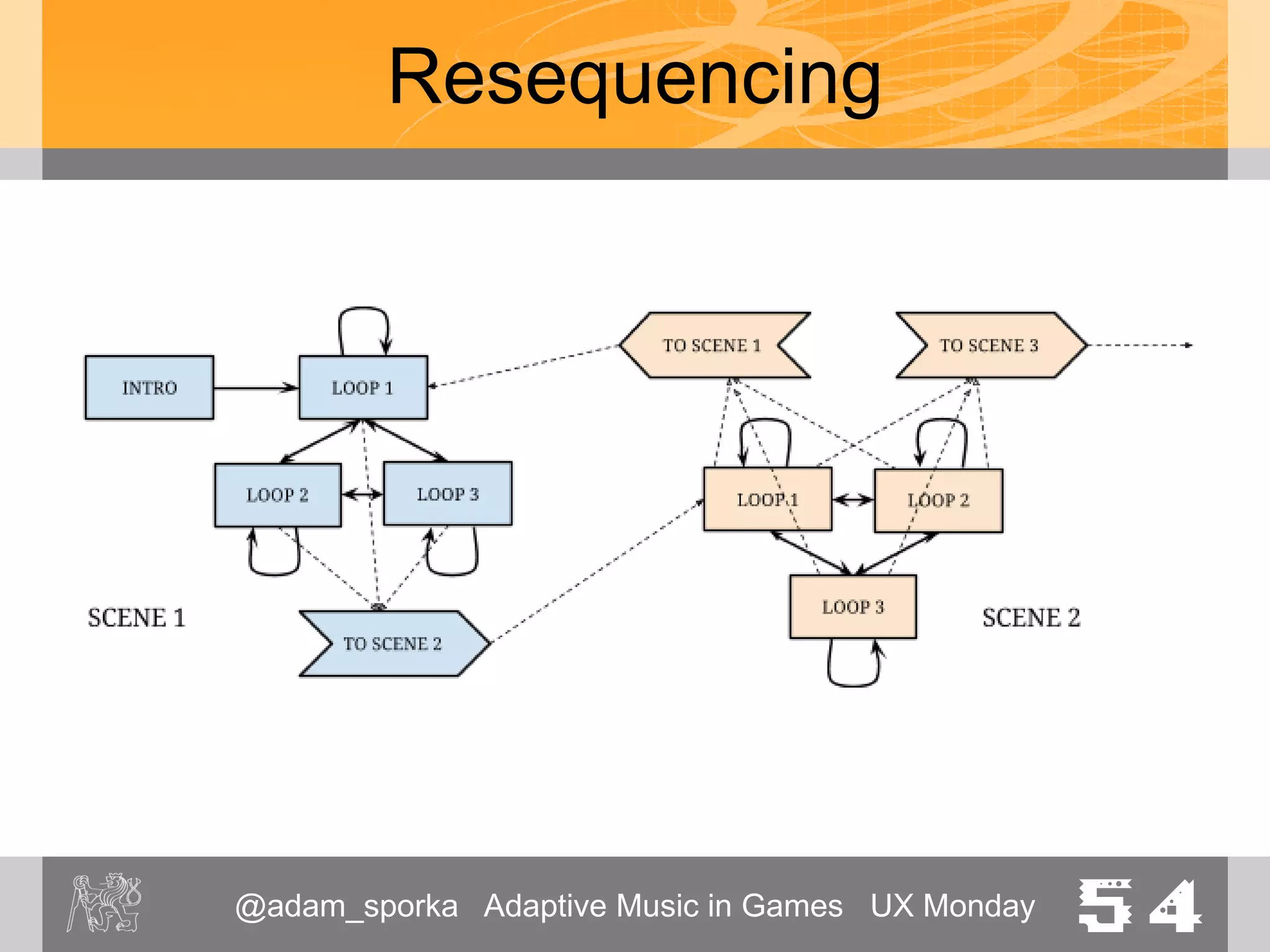
Resequencing
@adam_sporka Adaptive Music in Games UX Monday 54
Resequencing
• Slices chosen according to game state
• Precise timing of transitions
• <Demo: chiptune.sqc>
@adam_sporka Adaptive Music in Games UX Monday 55
Resequencing and Reorchestration
• Example: Monkey Island 2
– 1991, LucasArts
– http://www.youtube.com/watch?v=Nsc5nTrCzm
w#t=322
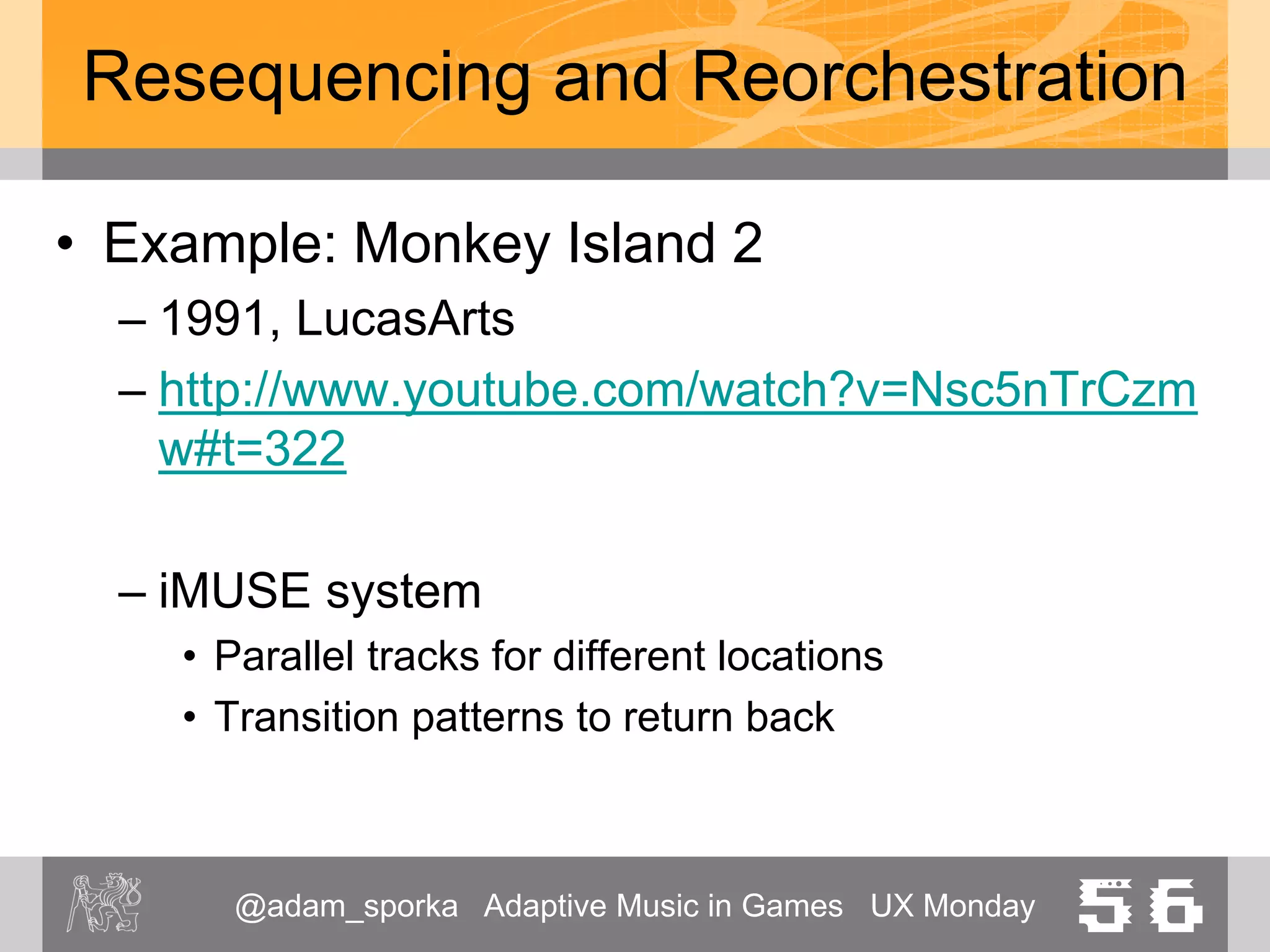
– iMUSE system
• Parallel tracks for different locations
• Transition patterns to return back
@adam_sporka Adaptive Music in Games UX Monday 56
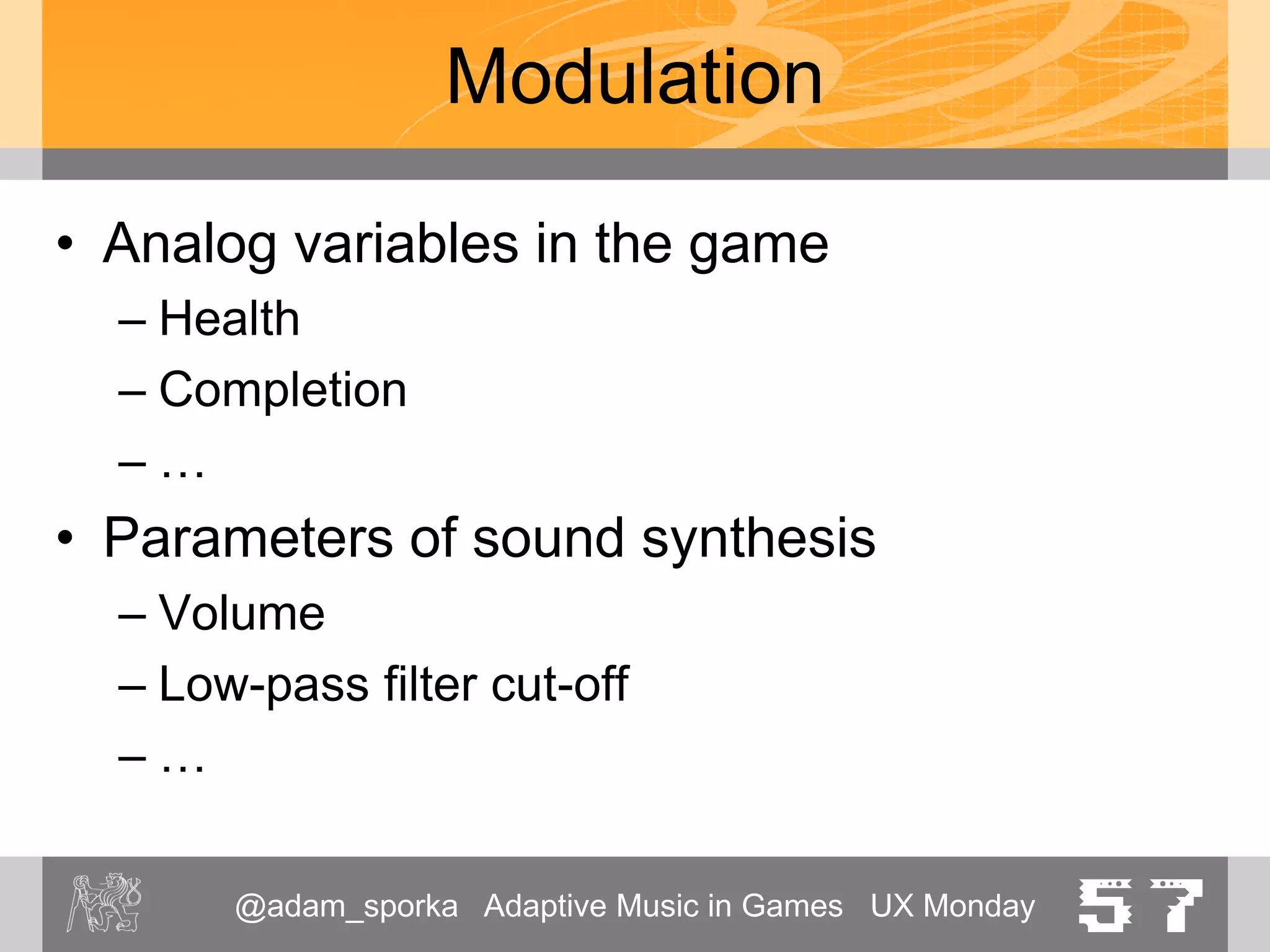
Modulation
• Analog variables in the game
– Health
– Completion
– …
• Parameters of sound synthesis
– Volume
– Low-pass filter cut-off
– …
@adam_sporka Adaptive Music in Games UX Monday 57
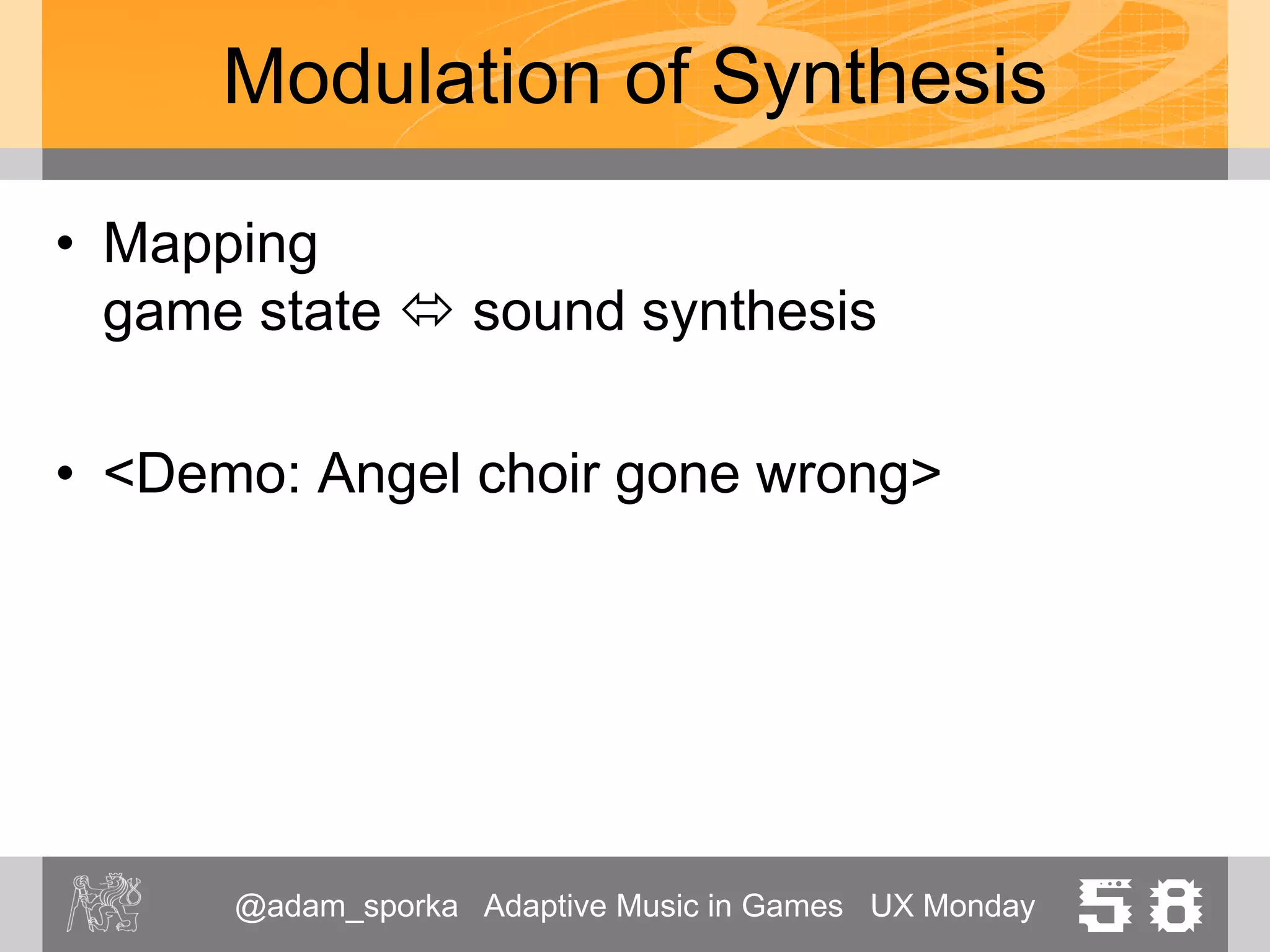
Modulation of Synthesis
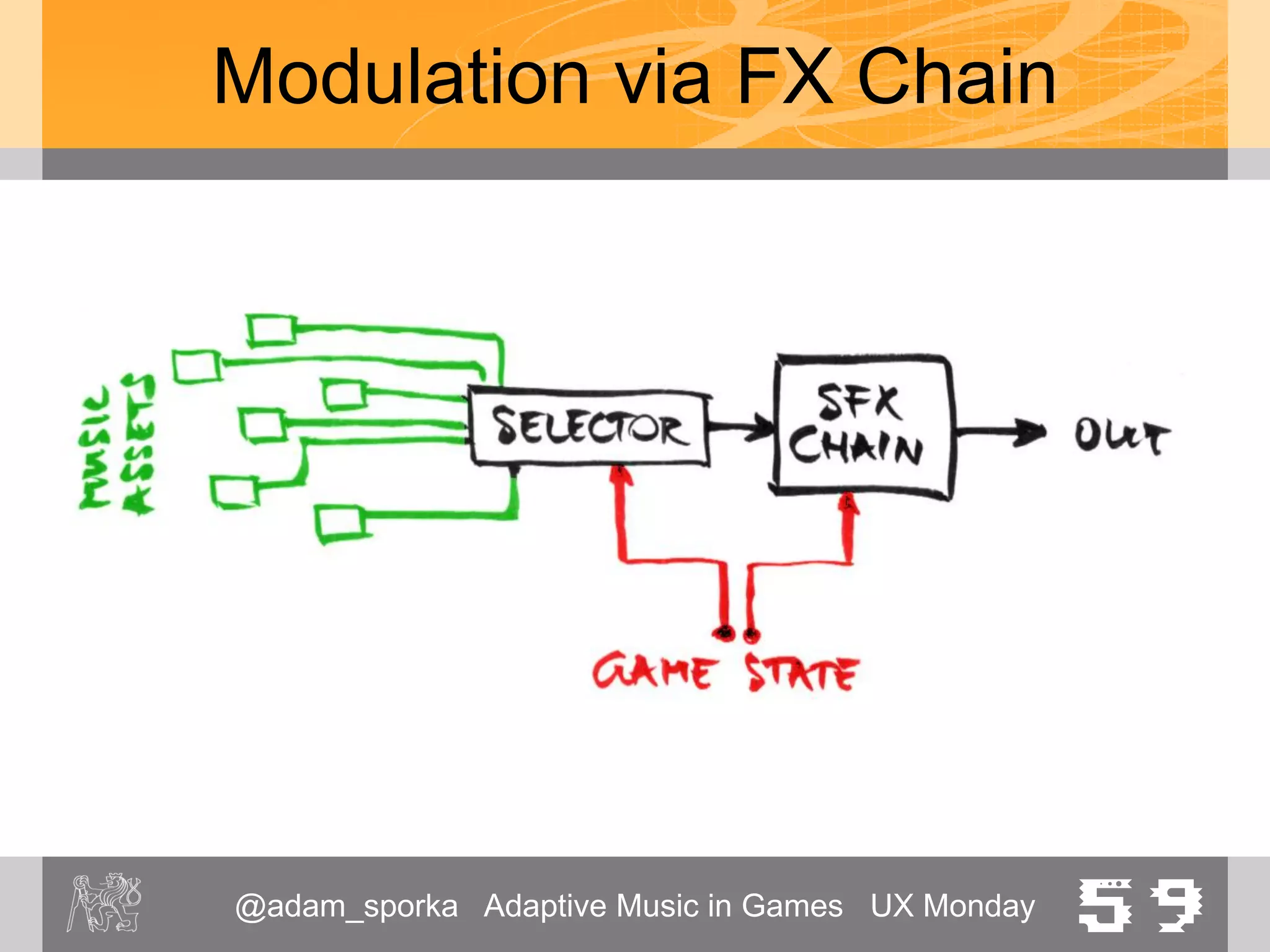
• Mapping
game state  sound synthesis
• <Demo: Angel choir gone wrong>
@adam_sporka Adaptive Music in Games UX Monday 58
Modulation via FX Chain
@adam_sporka Adaptive Music in Games UX Monday 59
Modulation
• Borderline music/sound effects
• Example: Stun grenade A/V
– Counter Strike Global Offensive
(Valve Corporation, 2012)
• https://www.youtube.com/watch?v=YmwRw8fP_8c
– Payday 2
(505 Games, 2013)
• http://youtu.be/kThVfdZvgz0?t=26m35s
PRODUCTION
@adam_sporka Adaptive Music in Games UX Monday 61
Music Composition
• Movies
– Music traditionally created aside from the entire
project
– Story is defined
– Timing is known
• “Horizontal” production
@adam_sporka Adaptive Music in Games UX Monday 62
Music Composition
• Computer Games
– Games are not (very) predictable
– “Horizontal” production
• Advantages
– Music per se works well (classic composition techniques)
– No limitations on instrumentations etc.
• Problems
– Repetition
– Abrupt changes
– Failure to respond
@adam_sporka Adaptive Music in Games UX Monday 63
Music Composition
• Computer Games
– “Vertical” production
• Advantages
– Good support of the moment
• Problems
– Difficult to express tensions, developments
– Music forms get disrupted
– Discontiuity
– Can be too descriptive
@adam_sporka Adaptive Music in Games UX Monday 64
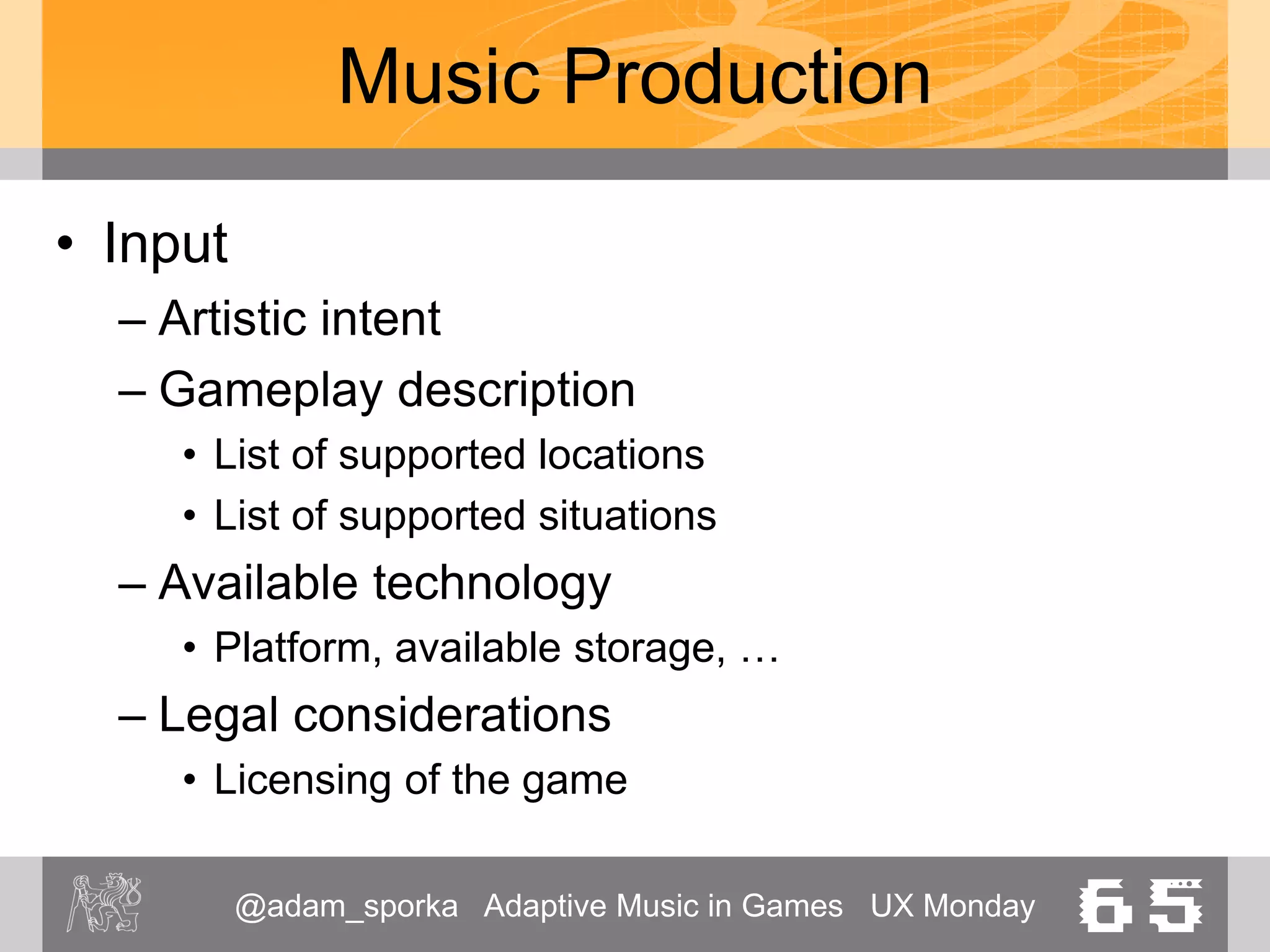
Music Production
• Input
– Artistic intent
– Gameplay description
• List of supported locations
• List of supported situations
– Available technology
• Platform, available storage, …
– Legal considerations
• Licensing of the game
@adam_sporka Adaptive Music in Games UX Monday 65
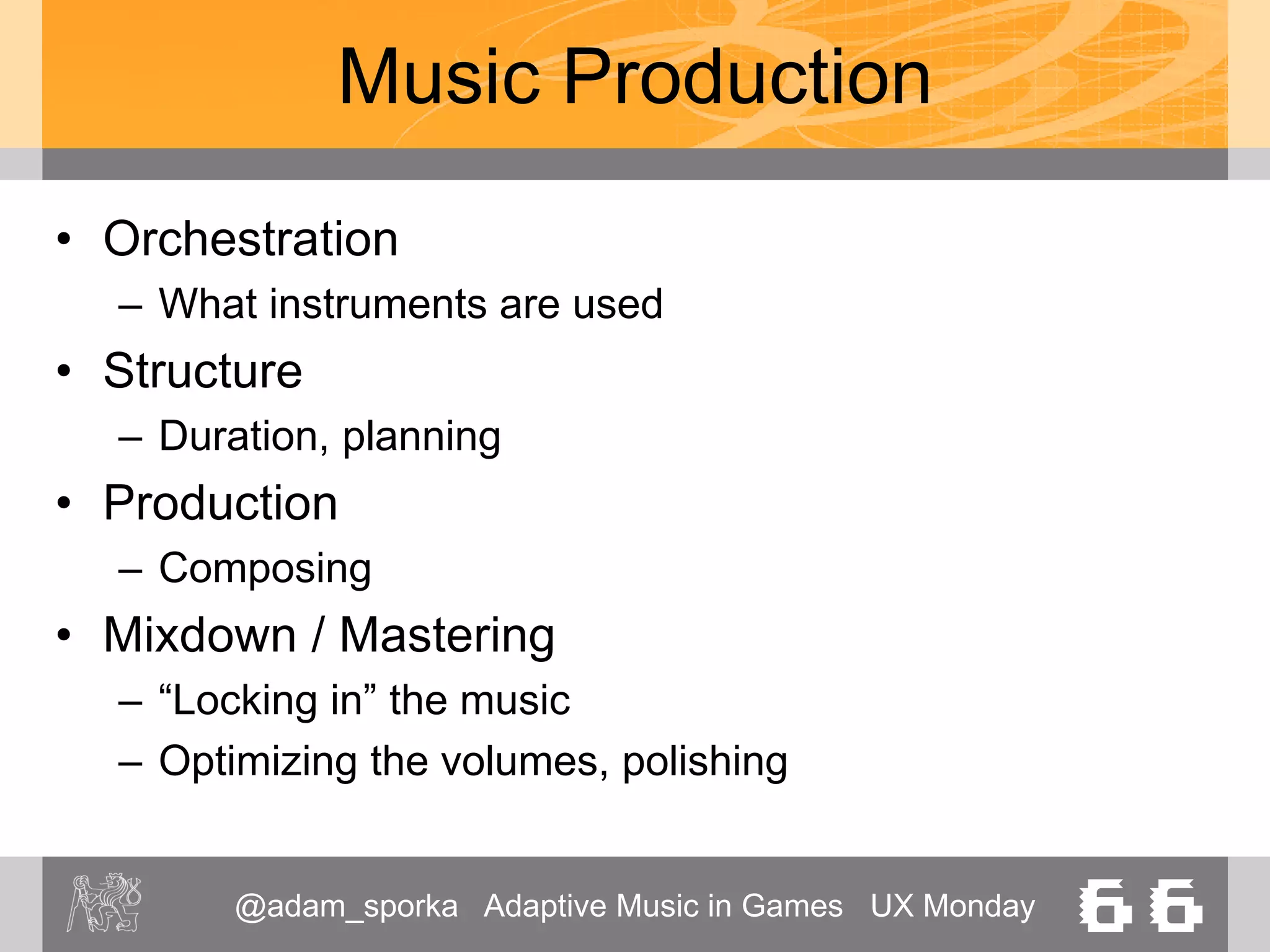
Music Production
• Orchestration
– What instruments are used
• Structure
– Duration, planning
• Production
– Composing
• Mixdown / Mastering
– “Locking in” the music
– Optimizing the volumes, polishing
@adam_sporka Adaptive Music in Games UX Monday 66
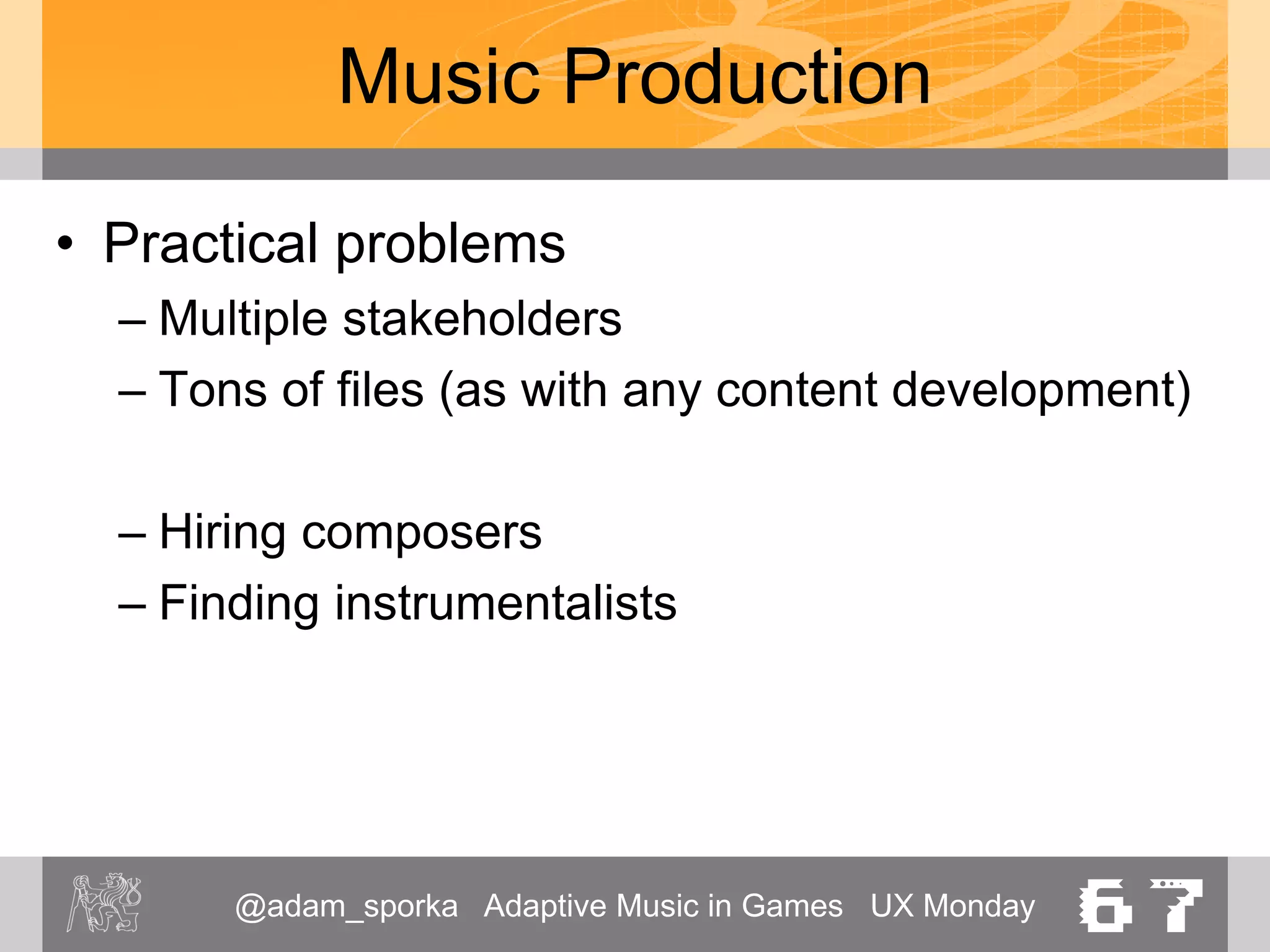
Music Production
• Practical problems
– Multiple stakeholders
– Tons of files (as with any content development)
– Hiring composers
– Finding instrumentalists
ADAPTIVE
MUSIC
IN GAMES
ADAM J SPORKA
@adam_sporka

Adaptive Music in Games

  • 1.
    ADAPTIVE MUSIC IN GAMES ADAM JSPORKA IIM/DCGI@CVUT WARHORSE STUDIOS UX MONDAY 03/02/15
  • 2.
  • 3.
    @adam_sporka Adaptive Musicin Games UX Monday 3 Purpose of Sound in UIs • Interaction modality (input and output) • Alerts • Widget sounds • Presentation of data • Mood setters • Sound branding
  • 4.
    @adam_sporka Adaptive Musicin Games UX Monday 4 Describing Sound and Music Signal Sound field Tone / Stroke Sequence Concord Composition Environment Reverberation Vibration Distribution Spectrum Volume Periodicity Pitch Length Volume Accord Interval Harmony Rhythm Tempo Phrase Loop Soundtrack Intention Abstraction level Playlist Genre  science art 
  • 5.
    @adam_sporka Adaptive Musicin Games UX Monday 5 Fuzzy Terminology • What it does: – Adaptive music – Responsive music – Reactive music – Interactive music • How it is done: – Procedural music – Algorithmic music
  • 6.
    @adam_sporka Adaptive Musicin Games UX Monday 6 Science: Data Sonification • Synthesis of sound controlled by input data • ICAD 2004 contest – http://www.icad.org/websiteV 2.0/Conferences/ICAD2004/c oncert.htm
  • 7.
  • 8.
    @adam_sporka Adaptive Musicin Games UX Monday 8 Sonification of Rowing sounds • https://www.youtube.com/watch?v=YxWNw9fIizk • Audible comparison of trainee’s sound and reference • Audible feedback while people is rowing
  • 9.
    @adam_sporka Adaptive Musicin Games UX Monday 9 Outline • Purpose of music in games • Static music soundtracks – Music design • Dynamic music soundtracks – Design, production, … • Music production technology – How the actual music is made
  • 10.
  • 11.
    @adam_sporka Adaptive Musicin Games UX Monday 11 Purpose of Music • Tradition – Present in most of the released titles – Why not in yours? • Affirmation of the genre – “Yes, this is an 8bit retro.” – “Indeed, cowboys in spaceships.” – “Yay, manga.”
  • 12.
    @adam_sporka Adaptive Musicin Games UX Monday 12 Purpose of Music • Presentation of emotion – Easygoing, happy-go-lucky, … – Depressing, sad, … • Setting the expectations – Level difficulty • Status monitoring – Changes of music over time indicate changes in game
  • 13.
    @adam_sporka Adaptive Musicin Games UX Monday 13 Purpose of Music • Essence of the gameplay – Dance Dance Revolution (1998) – Guitar Hero (2005) – Pugs Luv Beats (2011) • http://www.youtube.com/watch?v=V0i18_--8Yc – Not covered by this talk
  • 14.
    @adam_sporka Adaptive Musicin Games UX Monday 14 Game Music Components • Theme Music – Often synchronized with visual events on the screen – Cinematic experience • Underscore – In-game music – User interface background
  • 15.
    @adam_sporka Adaptive Musicin Games UX Monday 15 Game Music Components • Stingers – Specific music triggered by an event – Transition music – Level Notification, “Game Over” Screen, “Game Won” Screen – Fallout New Vegas: Pulling out / holstering Magnum • http://youtu.be/sWLpSpZR6J4?t=41s
  • 16.
    @adam_sporka Adaptive Musicin Games UX Monday 16 Soundtrack • Diegetic sounds – Sounds in story space – On-screen or off-screen – Voices of characters, sounds of objects, music coming from objects • Non-diegetic sounds – Not implied to be present in the action – Narrator, sounds for dramatic effect, underscore
  • 17.
    @adam_sporka Adaptive Musicin Games UX Monday 17 Sound in Games – Voices, diegetic sound effects – Diegetic ambience – Non-diegetic ambience • “Sound design pads” – Underscore ABSTRACT CONCRETE
  • 18.
    @adam_sporka Adaptive Musicin Games UX Monday 18 Game Music Characteristics • Theme music is feature – Recognizable theme – Elaborate – Genre announcer – Everyone will hear this • Underscore is background – Mood setter – Does not distract – Can be listened to throughout the gameplay
  • 19.
    @adam_sporka Adaptive Musicin Games UX Monday 19 Game Music Characteristics • Silence – “Dosage” of music • Used to emphasize music – Keep the ambient sounds present – Complete silence  “something wrong” • “Are my speakers on? Will I hear anything at all when I’ll really have to?”
  • 20.
    @adam_sporka Adaptive Musicin Games UX Monday 20 Game Music Interactivity • Static soundtrack – Predefined and unchanging – Loops – Assigned to specific screens / levels • Dynamic (adaptive) soundtrack – More complex control of the music playback – Engine “aware” of the state of the game
  • 21.
  • 22.
    @adam_sporka Adaptive Musicin Games UX Monday 22 Music Design • Genre? • Situations in game? • Mechanics of music?
  • 28.
    @adam_sporka Adaptive Musicin Games UX Monday 28 Music Design • Multiple contexts – typical for open-world RPGs – Landscape exploration – Combat – Dialogs – … • Considerations of importance of music scenes • Is “combat” always more important than “location”?
  • 29.
    Music in FoEby The Overmare Studios
  • 30.
  • 31.
    @adam_sporka Adaptive Musicin Games UX Monday 31 Static Soundtrack • Early and simpler games • Level-based games • Pengon (1984, Atari 800XL) – http://www.youtube.com/watch?v=MDhLxRLvwvY – One music loop – Game over stinger
  • 32.
    @adam_sporka Adaptive Musicin Games UX Monday 32 Static Soundtrack • Supaplex (1991, Digital Integration, MS-DOS) – Played throughout the game – http://www.youtube.com/watch?v=yknubWX2KYI • Goonies (1985, Datasoft, Atari 800XL) – Two loops, one used for title, then alternating with each level – https://www.youtube.com/watch?v=FKh5b8jcwLk • Jazz Jackrabbit (1994) – Separate tracks for levels – http://youtu.be/b16upFloYak?t=29s
  • 33.
    @adam_sporka Adaptive Musicin Games UX Monday 33 Static Soundtrack
  • 34.
    @adam_sporka Adaptive Musicin Games UX Monday 34 Case Study: Nimble Quest • 2013; NimbleBit; iOS, Android • Arcade / RPG • Early 2000s pixel art graphics
  • 35.
    @adam_sporka Adaptive Musicin Games UX Monday 35 Case Study: Nimble Quest • Music by Whitaker Blackall • Contents: – Title / menu – Loop per level • Genre: – Contemporary chiptune – http://wtrebella.bandcamp.com/album/nimble-quest
  • 36.
    @adam_sporka Adaptive Musicin Games UX Monday 36 Case Study: Nimble Quest • Typical length of a loop: 2’ • Unobtrusive • Reflects the increasing difficulty of the levels – L1 http://www.youtube.com/watch?v=6mh7qJgnpJI – L2 https://www.youtube.com/watch?v=9HaOTX-m0SU – L4 http://www.youtube.com/watch?v=YKIDg8VkF0A
  • 37.
    @adam_sporka Adaptive Musicin Games UX Monday 37 Case Study: Nimble Quest • Sounds good on small speakers – Chiptune sounds – Lot of square waves / triangles • Better estimation of pitch by the human low- as well as high-pitched tones • General remark: • PC gamers often don’t spend money on a high-quality speakers
  • 38.
    @adam_sporka Adaptive Musicin Games UX Monday 38 Case Study: Quido (2013) • Experimental arcade game – Developed at DCGI/CTU • Showcasing non-standard haptic modalities – Presented on Designblok 2013 – http://ulab.cz/naviterier/quido/ • Genre: – Contemporary chiptune – https://quido.bandcamp.com/
  • 39.
    @adam_sporka Adaptive Musicin Games UX Monday 39 Quido: Technology used • Reaper • VSTs – SuperWave (leads / chords / bass) – EXD-80 (beats) – Some reverb, some volume compressor
  • 40.
    @adam_sporka Adaptive Musicin Games UX Monday 40 Quido: Music • Theme music – Exposition of the main theme – Happy, easygoing – Not used in the end • Explicit request from the exhibition organizer: Silence between the games
  • 41.
    @adam_sporka Adaptive Musicin Games UX Monday 41 Quido: Music • Level 1: Theme Park – A player will be likely to be receiving instructions from a fellow player – Expected playtime: 3—4 minutes – Not “dense” – Diverse in terms of the structure – Performance of the main theme
  • 42.
    @adam_sporka Adaptive Musicin Games UX Monday 42 Quido: Music • Level 2: City – Variation of the theme. – Structure: [A B A Bbr Avoid] – Expected playtime: 2 minutes – Continuous music
  • 43.
    @adam_sporka Adaptive Musicin Games UX Monday 43 Quido: Music • Level 3: Sky (Heaven) – Variation of the theme. Barroque. – Continuous music – Expected playtime: 2 minutes
  • 44.
    @adam_sporka Adaptive Musicin Games UX Monday 44 Quido: Music • Level completed – Joyous jingle • Advancing to the next level – Expectation
  • 45.
    @adam_sporka Adaptive Musicin Games UX Monday 45 Quido: Music • Game Over – Definitive – Not too tragic
  • 46.
    @adam_sporka Adaptive Musicin Games UX Monday 46 Quido: Music • Game won – Player enters their initials – Reiteration of the main theme
  • 47.
  • 48.
    @adam_sporka Adaptive Musicin Games UX Monday 48 Adaptive Music Styles • Resequencing – Selecting what to play next • Reorchestration – Selecting which instruments to play • Modulation – Modifying the timbres of notes – Related to Data Sonification
  • 49.
    @adam_sporka Adaptive Musicin Games UX Monday 49 The Space Game • Game loops: – Menu / Idle – The enemy is approaching – The enemy opens fire • <demo> – http://www.candystand.com/play/the-space-game
  • 50.
    @adam_sporka Adaptive Musicin Games UX Monday 50 Reorchestration • Multiple tracks – Turned on/off – Faded in and out • Synchronous <Demo: honza_test_02.sqc>
  • 51.
    @adam_sporka Adaptive Musicin Games UX Monday 51 Reorchestration
  • 52.
    @adam_sporka Adaptive Musicin Games UX Monday 52 Reorchestration • Fallout: New Vegas – 2010, Obsidian Entertainment, Bethesda Softworks – Multiple renderings of the same track • “low”, “mid”, “high” – <demo; NewCaliforniaRepublic>
  • 53.
    @adam_sporka Adaptive Musicin Games UX Monday 53 Resequencing
  • 54.
    @adam_sporka Adaptive Musicin Games UX Monday 54 Resequencing • Slices chosen according to game state • Precise timing of transitions • <Demo: chiptune.sqc>
  • 55.
    @adam_sporka Adaptive Musicin Games UX Monday 55 Resequencing and Reorchestration • Example: Monkey Island 2 – 1991, LucasArts – http://www.youtube.com/watch?v=Nsc5nTrCzm w#t=322 – iMUSE system • Parallel tracks for different locations • Transition patterns to return back
  • 56.
    @adam_sporka Adaptive Musicin Games UX Monday 56 Modulation • Analog variables in the game – Health – Completion – … • Parameters of sound synthesis – Volume – Low-pass filter cut-off – …
  • 57.
    @adam_sporka Adaptive Musicin Games UX Monday 57 Modulation of Synthesis • Mapping game state  sound synthesis • <Demo: Angel choir gone wrong>
  • 58.
    @adam_sporka Adaptive Musicin Games UX Monday 58 Modulation via FX Chain
  • 59.
    @adam_sporka Adaptive Musicin Games UX Monday 59 Modulation • Borderline music/sound effects • Example: Stun grenade A/V – Counter Strike Global Offensive (Valve Corporation, 2012) • https://www.youtube.com/watch?v=YmwRw8fP_8c – Payday 2 (505 Games, 2013) • http://youtu.be/kThVfdZvgz0?t=26m35s
  • 60.
  • 61.
    @adam_sporka Adaptive Musicin Games UX Monday 61 Music Composition • Movies – Music traditionally created aside from the entire project – Story is defined – Timing is known • “Horizontal” production
  • 62.
    @adam_sporka Adaptive Musicin Games UX Monday 62 Music Composition • Computer Games – Games are not (very) predictable – “Horizontal” production • Advantages – Music per se works well (classic composition techniques) – No limitations on instrumentations etc. • Problems – Repetition – Abrupt changes – Failure to respond
  • 63.
    @adam_sporka Adaptive Musicin Games UX Monday 63 Music Composition • Computer Games – “Vertical” production • Advantages – Good support of the moment • Problems – Difficult to express tensions, developments – Music forms get disrupted – Discontiuity – Can be too descriptive
  • 64.
    @adam_sporka Adaptive Musicin Games UX Monday 64 Music Production • Input – Artistic intent – Gameplay description • List of supported locations • List of supported situations – Available technology • Platform, available storage, … – Legal considerations • Licensing of the game
  • 65.
    @adam_sporka Adaptive Musicin Games UX Monday 65 Music Production • Orchestration – What instruments are used • Structure – Duration, planning • Production – Composing • Mixdown / Mastering – “Locking in” the music – Optimizing the volumes, polishing
  • 66.
    @adam_sporka Adaptive Musicin Games UX Monday 66 Music Production • Practical problems – Multiple stakeholders – Tons of files (as with any content development) – Hiring composers – Finding instrumentalists
  • 67.
    ADAPTIVE MUSIC IN GAMES ADAM JSPORKA @adam_sporka