Quantum Computing: 
Welcome to the Future 
Vern Brownell 
CEO
© 2014 D-Wave Systems Inc. All Rights Reserved 2
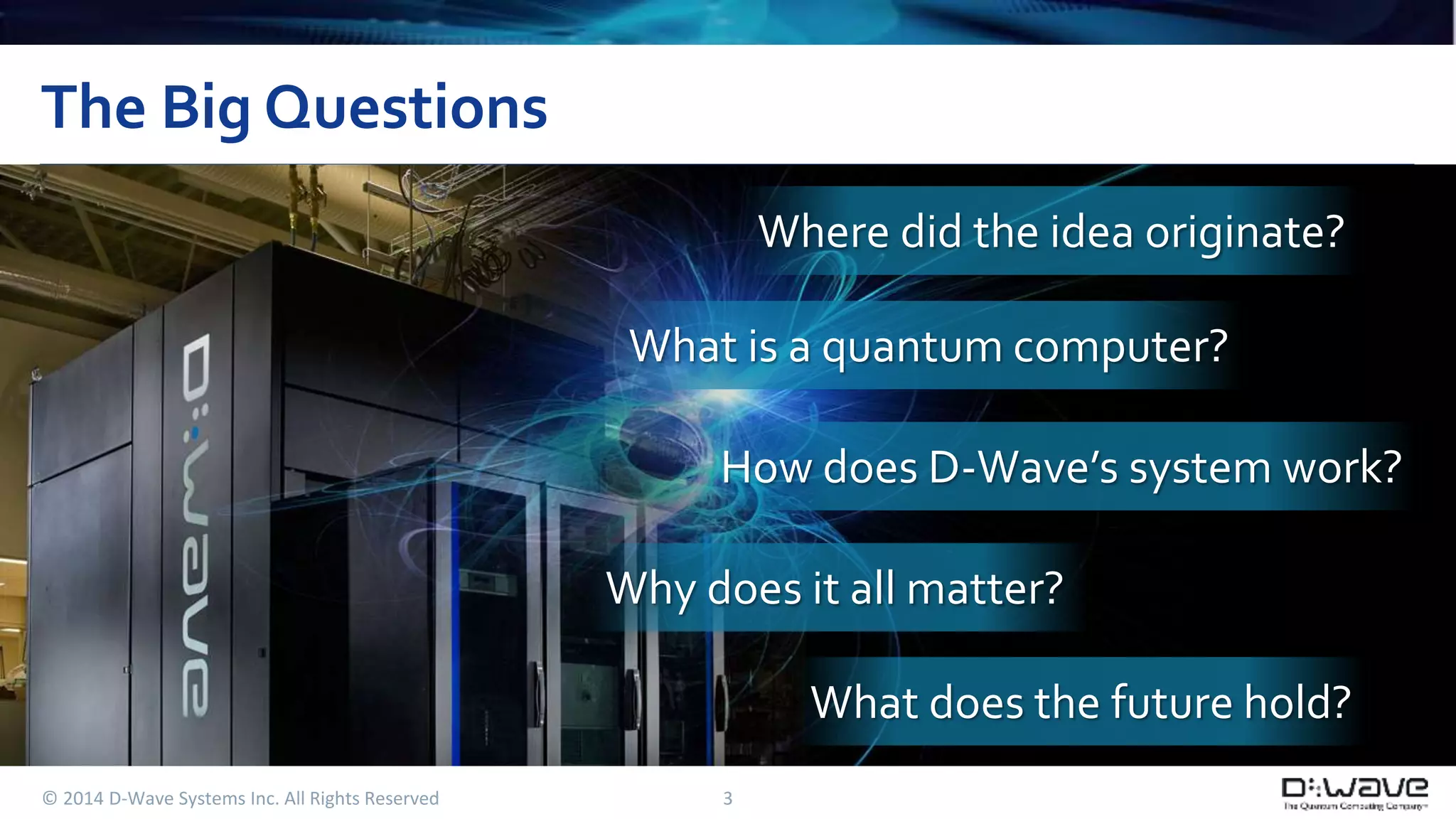
The Big Questions 
© 2014 D-Wave Systems Inc. All Rights Reserved 3 
Where did the idea originate? 
What is a quantum computer? 
How does D-Wave’s system work? 
Why does it all matter? 
What does the future hold?
Where did this idea come from? 
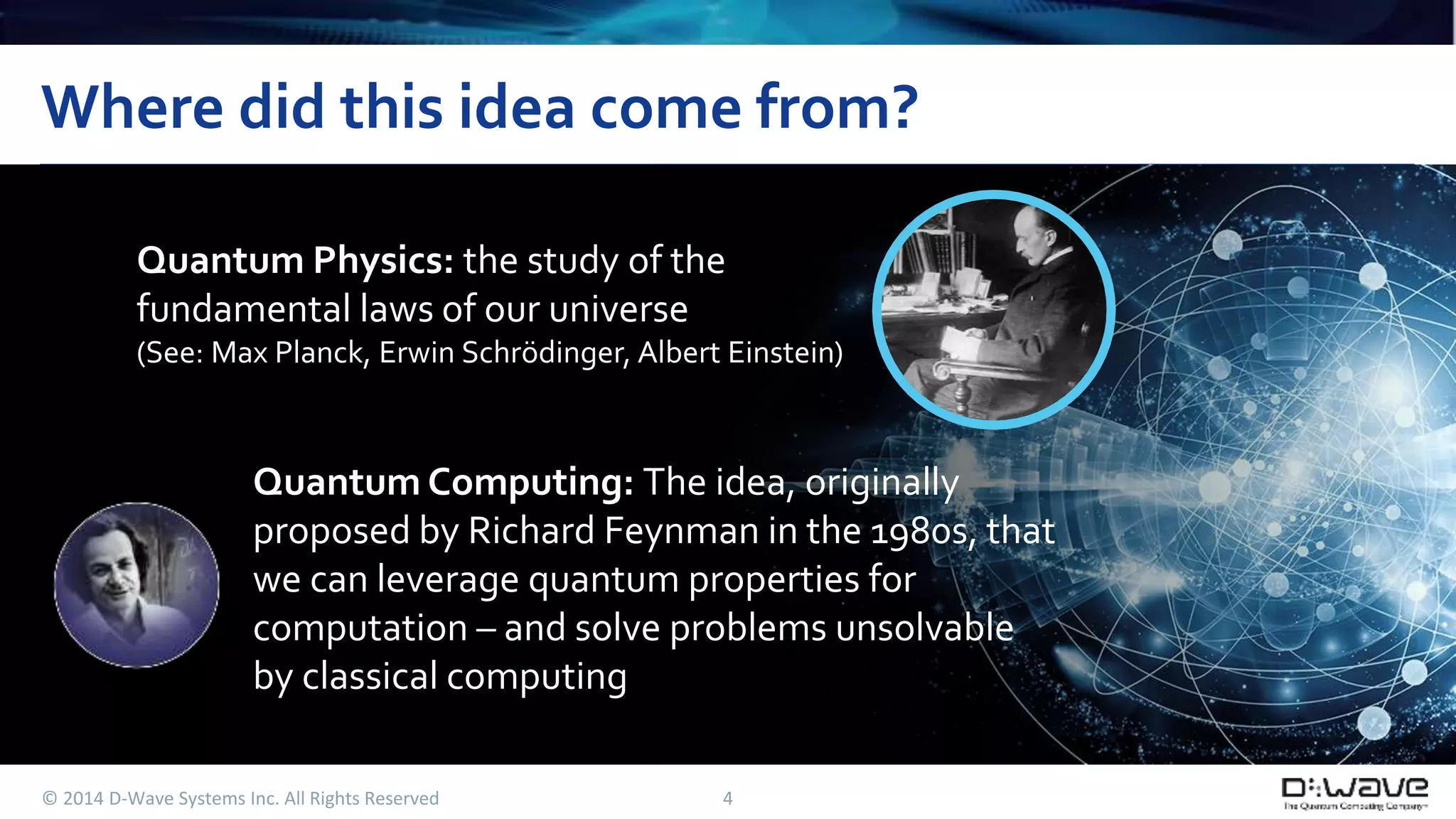
Quantum Physics: the study of the 
fundamental laws of our universe 
(See: Max Planck, Erwin Schrödinger, Albert Einstein) 
Quantum Computing: The idea, originally 
proposed by Richard Feynman in the 1980s, that 
we can leverage quantum properties for 
computation – and solve problems unsolvable 
by classical computing 
© 2014 D-Wave Systems Inc. All Rights Reserved 4
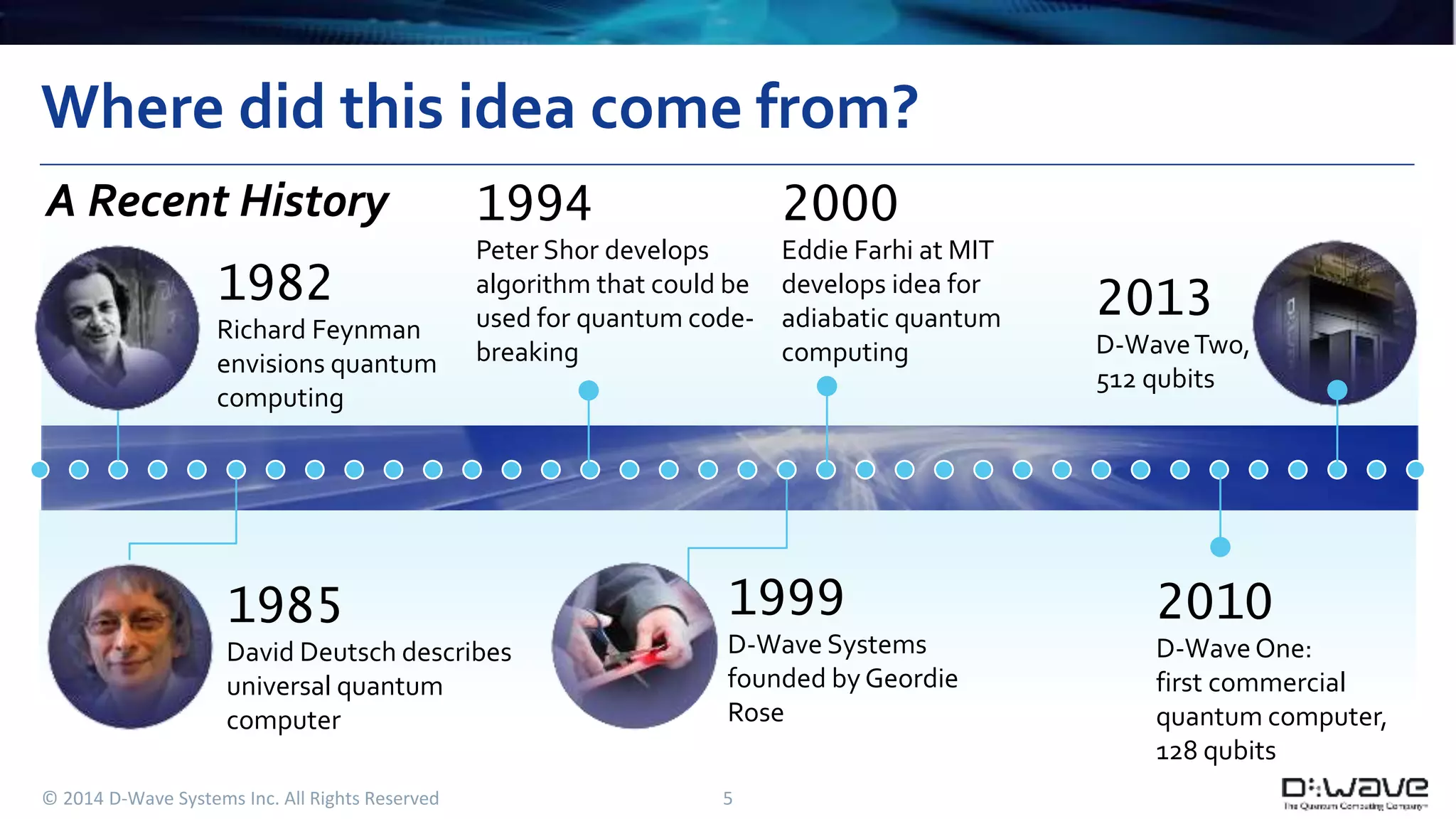
Where did this idea come from? 
1982 
Richard Feynman 
envisions quantum 
computing 
1994 
Peter Shor develops 
algorithm that could be 
used for quantum code-breaking 
1985 
David Deutsch describes 
universal quantum 
computer 
1999 
D-Wave Systems 
founded by Geordie 
Rose 
© 2014 D-Wave Systems Inc. All Rights Reserved 5 
2000 
Eddie Farhi at MIT 
develops idea for 
adiabatic quantum 
computing 
2013 
D-Wave Two, 
512 qubits 
2010 
D-Wave One: 
first commercial 
quantum computer, 
128 qubits 
A Recent History
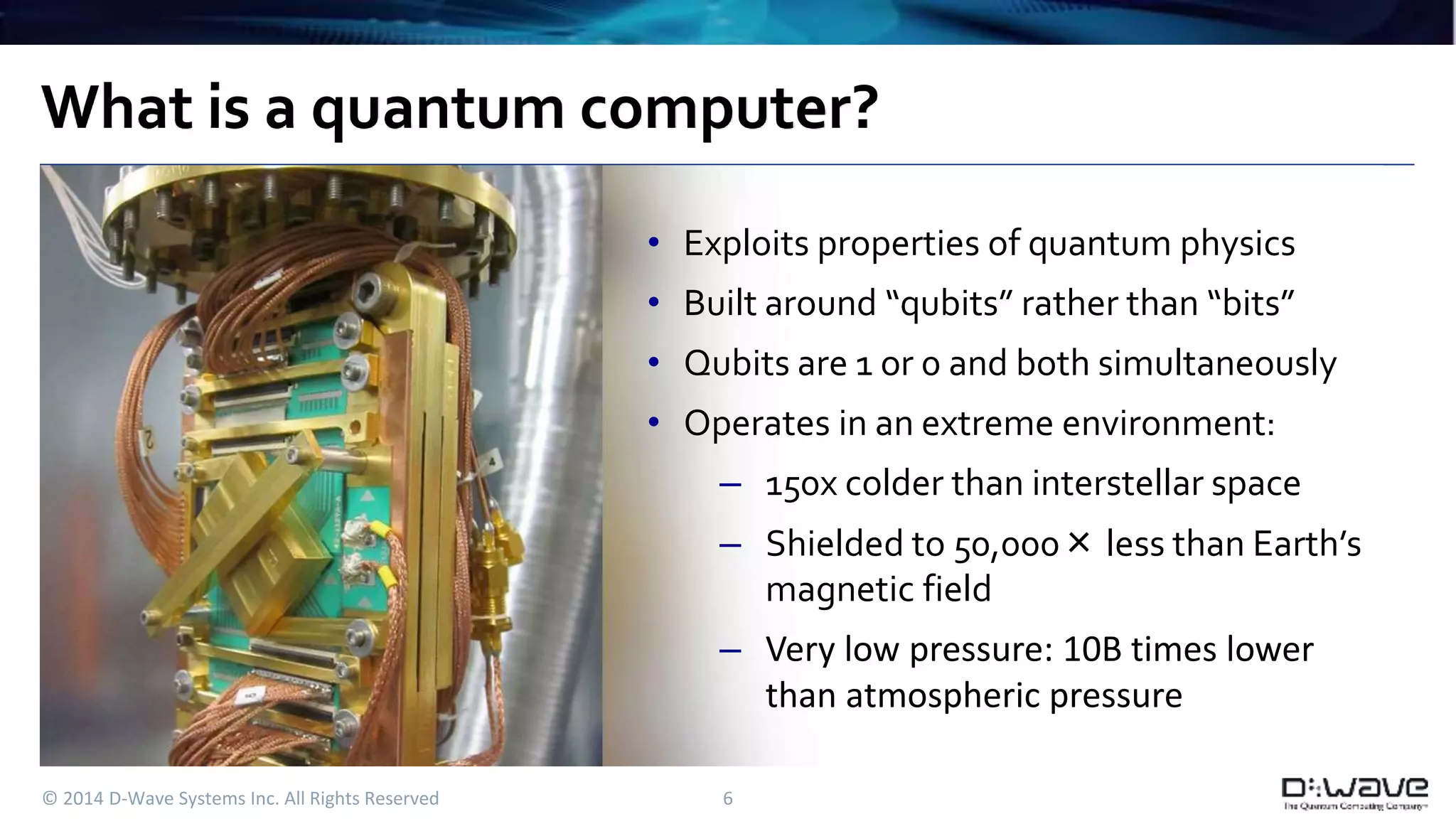
What is a quantum computer? 
• Exploits properties of quantum physics 
• Built around “qubits” rather than “bits” 
• Qubits are 1 or 0 and both simultaneously 
• Operates in an extreme environment: 
– 150x colder than interstellar space 
– Shielded to 50,000×less than Earth’s 
© 2014 D-Wave Systems Inc. All Rights Reserved 6 
magnetic field 
– Very low pressure: 10B times lower 
than atmospheric pressure
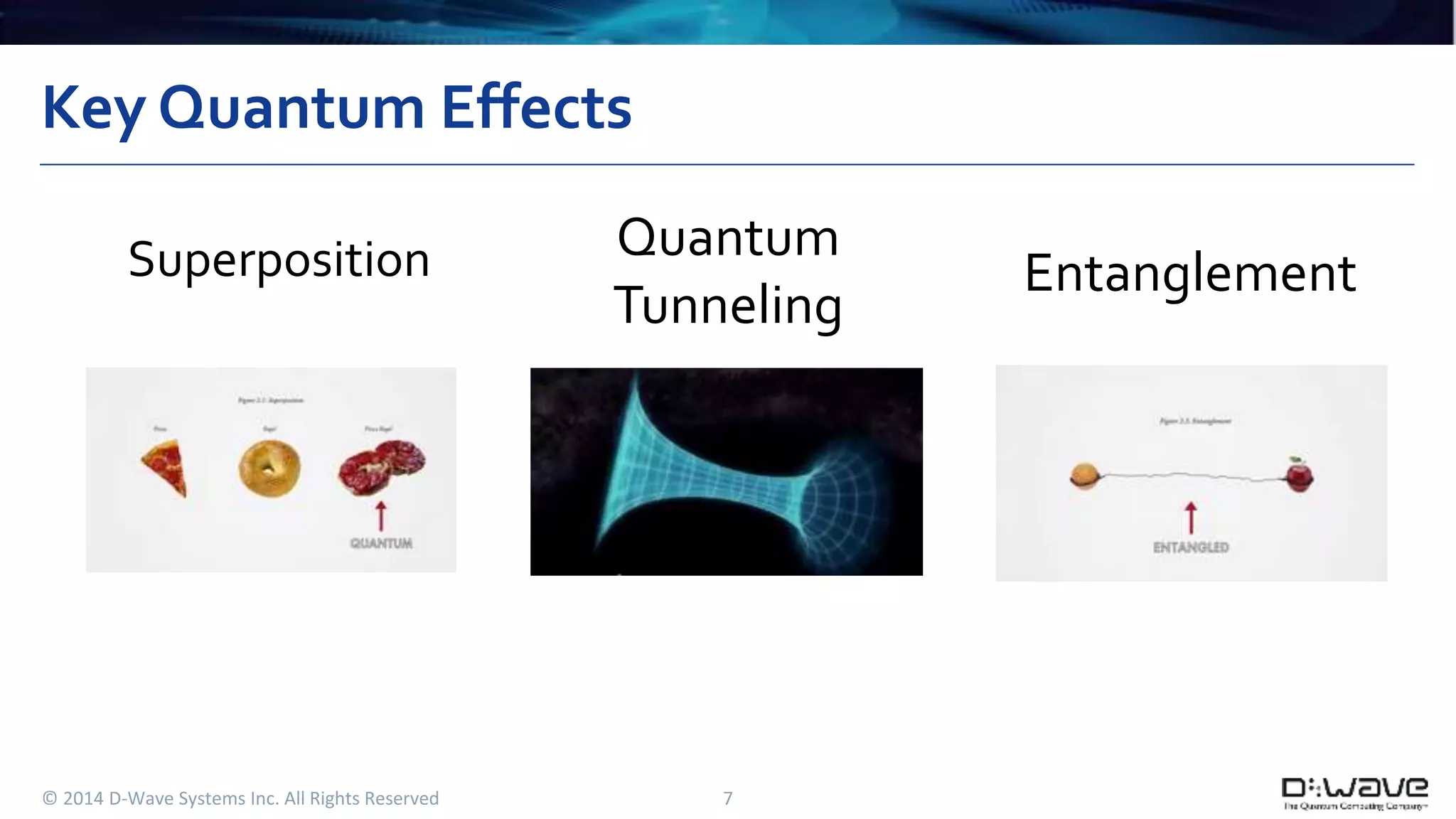
Key Quantum Effects 
Quantum 
Tunneling 
Superposition Entanglement 
© 2014 D-Wave Systems Inc. All Rights Reserved 7
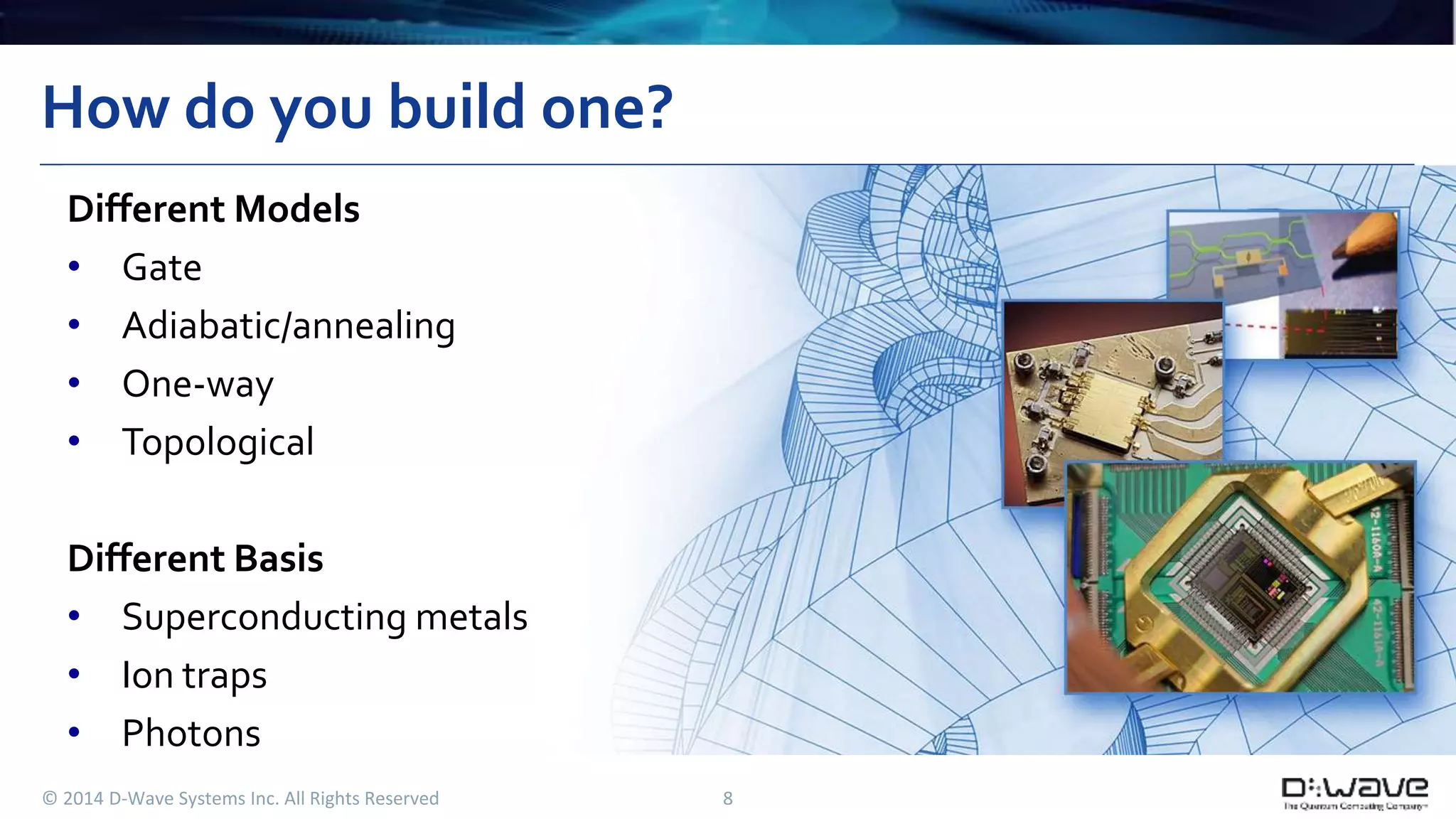
How do you build one? 
Different Models 
• Gate 
• Adiabatic/annealing 
• One-way 
• Topological 
Different Basis 
• Superconducting metals 
• Ion traps 
• Photons 
© 2014 D-Wave Systems Inc. All Rights Reserved 8
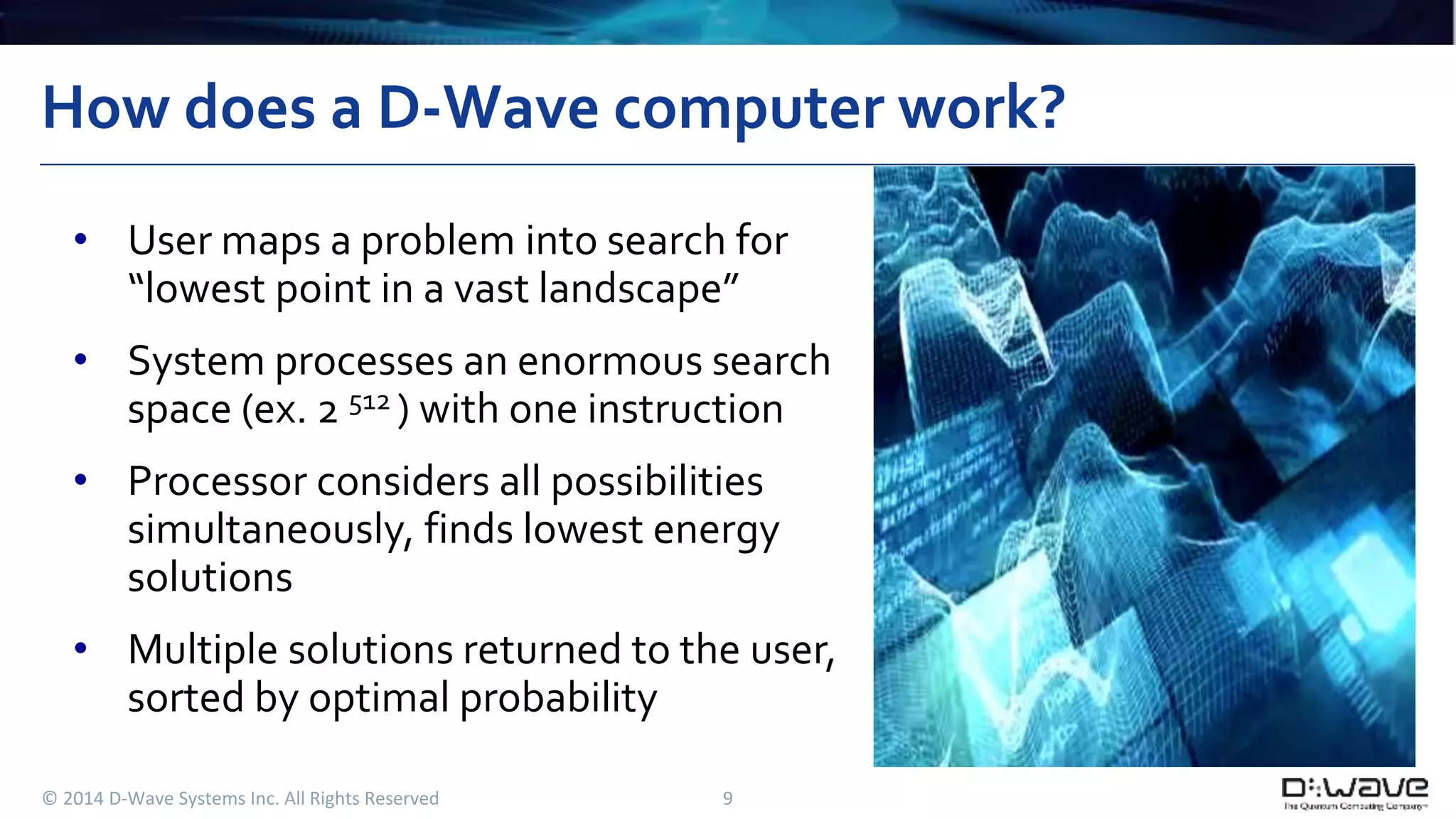
How does a D-Wave computer work? 
• User maps a problem into search for 
“lowest point in a vast landscape” 
• System processes an enormous search 
space (ex. 2 512 ) with one instruction 
• Processor considers all possibilities 
simultaneously, finds lowest energy 
solutions 
• Multiple solutions returned to the user, 
sorted by optimal probability 
© 2014 D-Wave Systems Inc. All Rights Reserved 9
Why does this matter? 
We are at the dawn of 
the last computing frontier.. 
© 2014 D-Wave Systems Inc. All Rights Reserved 10
Key Challenges 
1. Deciding what approach will work - and scale 
2. Creating the extreme operating environment 
3. Manufacturing usable quantum processors 
4. Proving quantum effects and understanding their impact 
on computation 
5. Finding “the right problems” for the computer 
6. Scaling processors and performance 
© 2014 D-Wave Systems Inc. All Rights Reserved 11
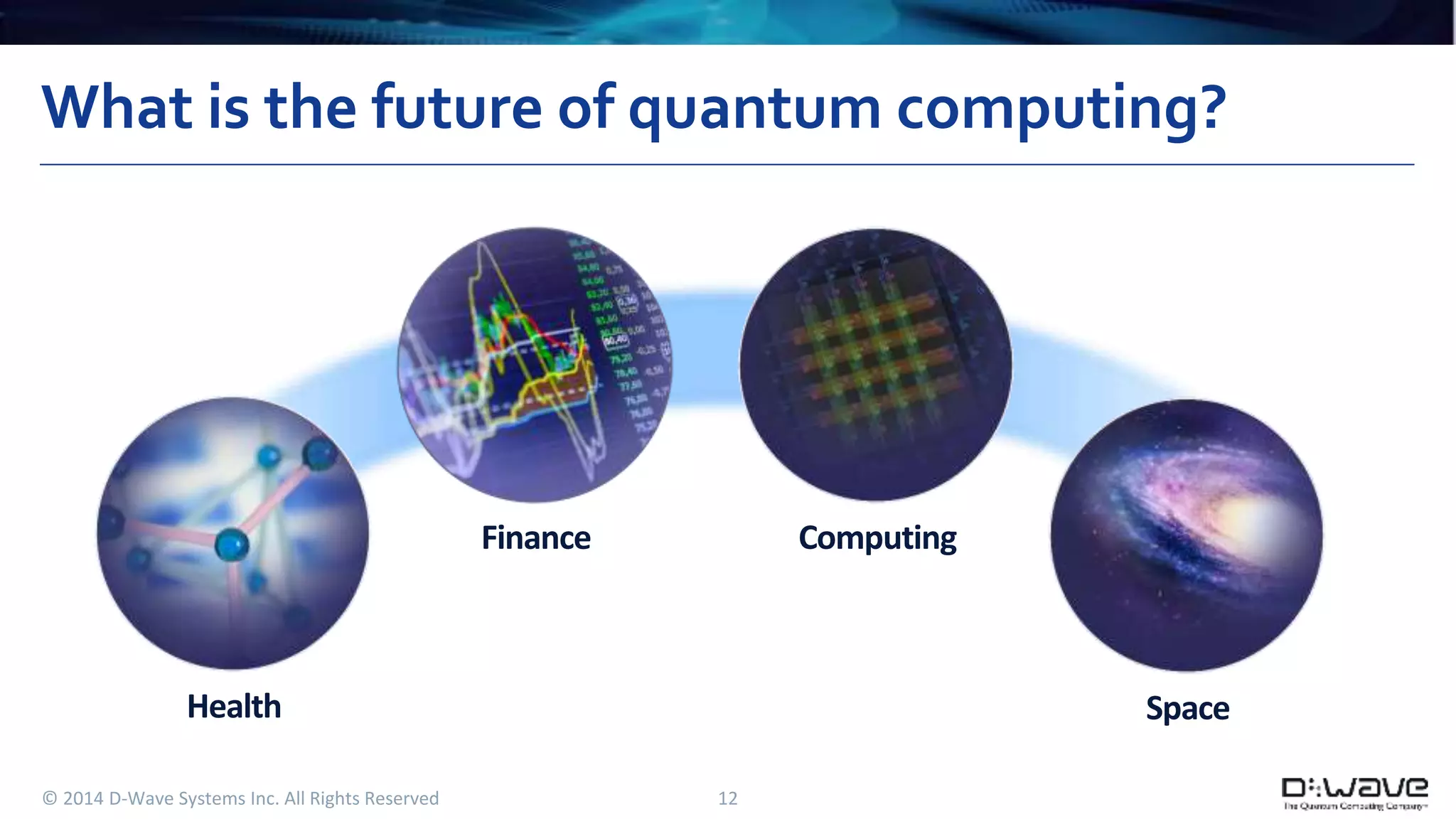
What is the future of quantum computing? 
Health 
Finance Computing 
© 2014 D-Wave Systems Inc. All Rights Reserved 12 
Space
What is the future of quantum computing? 
• Powerful new resource for computation 
• Complementary to classical computers 
• Accessible via the cloud 
• Emergence of quantum software ecosystem 
- Developer tools 
- Optimized algorithms 
- Applications 
© 2014 D-Wave Systems Inc. All Rights Reserved 13
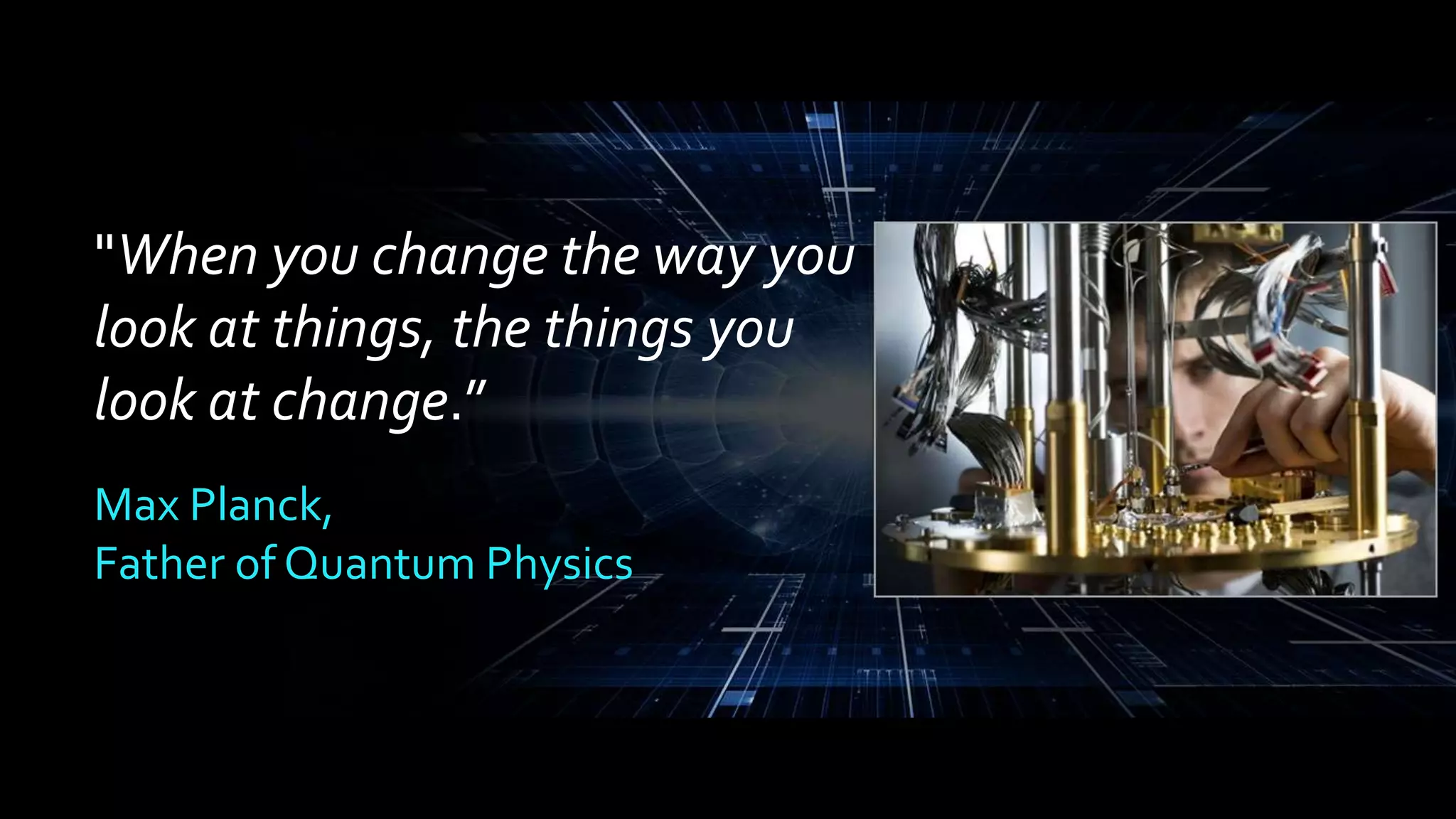
"When you change the way you 
look at things, the things you 
look at change.” 
Max Planck, 
Father of Quantum Physics
Questions? 
Thank You!

Quantum Computing: Welcome to the Future

  • 1.
    Quantum Computing: Welcometo the Future Vern Brownell CEO
  • 2.
    © 2014 D-WaveSystems Inc. All Rights Reserved 2
  • 3.
    The Big Questions © 2014 D-Wave Systems Inc. All Rights Reserved 3 Where did the idea originate? What is a quantum computer? How does D-Wave’s system work? Why does it all matter? What does the future hold?
  • 4.
    Where did thisidea come from? Quantum Physics: the study of the fundamental laws of our universe (See: Max Planck, Erwin Schrödinger, Albert Einstein) Quantum Computing: The idea, originally proposed by Richard Feynman in the 1980s, that we can leverage quantum properties for computation – and solve problems unsolvable by classical computing © 2014 D-Wave Systems Inc. All Rights Reserved 4
  • 5.
    Where did thisidea come from? 1982 Richard Feynman envisions quantum computing 1994 Peter Shor develops algorithm that could be used for quantum code-breaking 1985 David Deutsch describes universal quantum computer 1999 D-Wave Systems founded by Geordie Rose © 2014 D-Wave Systems Inc. All Rights Reserved 5 2000 Eddie Farhi at MIT develops idea for adiabatic quantum computing 2013 D-Wave Two, 512 qubits 2010 D-Wave One: first commercial quantum computer, 128 qubits A Recent History
  • 6.
    What is aquantum computer? • Exploits properties of quantum physics • Built around “qubits” rather than “bits” • Qubits are 1 or 0 and both simultaneously • Operates in an extreme environment: – 150x colder than interstellar space – Shielded to 50,000×less than Earth’s © 2014 D-Wave Systems Inc. All Rights Reserved 6 magnetic field – Very low pressure: 10B times lower than atmospheric pressure
  • 7.
    Key Quantum Effects Quantum Tunneling Superposition Entanglement © 2014 D-Wave Systems Inc. All Rights Reserved 7
  • 8.
    How do youbuild one? Different Models • Gate • Adiabatic/annealing • One-way • Topological Different Basis • Superconducting metals • Ion traps • Photons © 2014 D-Wave Systems Inc. All Rights Reserved 8
  • 9.
    How does aD-Wave computer work? • User maps a problem into search for “lowest point in a vast landscape” • System processes an enormous search space (ex. 2 512 ) with one instruction • Processor considers all possibilities simultaneously, finds lowest energy solutions • Multiple solutions returned to the user, sorted by optimal probability © 2014 D-Wave Systems Inc. All Rights Reserved 9
  • 10.
    Why does thismatter? We are at the dawn of the last computing frontier.. © 2014 D-Wave Systems Inc. All Rights Reserved 10
  • 11.
    Key Challenges 1.Deciding what approach will work - and scale 2. Creating the extreme operating environment 3. Manufacturing usable quantum processors 4. Proving quantum effects and understanding their impact on computation 5. Finding “the right problems” for the computer 6. Scaling processors and performance © 2014 D-Wave Systems Inc. All Rights Reserved 11
  • 12.
    What is thefuture of quantum computing? Health Finance Computing © 2014 D-Wave Systems Inc. All Rights Reserved 12 Space
  • 13.
    What is thefuture of quantum computing? • Powerful new resource for computation • Complementary to classical computers • Accessible via the cloud • Emergence of quantum software ecosystem - Developer tools - Optimized algorithms - Applications © 2014 D-Wave Systems Inc. All Rights Reserved 13
  • 14.
    "When you changethe way you look at things, the things you look at change.” Max Planck, Father of Quantum Physics
  • 15.